


Abstract
The transport sector is responsible for about 60% of emissions in the atmosphere due to the exhaust-polluting gases of internal combustion engine (ICE) vehicles. An effective solution to this issue is the electrification of the transport means, which can significantly reduce pollution, especially in urban areas. Apart from the necessary technological advancements that must improve the battery performances, the diffusion of electric vehicles (EVs) must be further supported and facilitated by new dedicated services and tools for electric vehicle users and operators aiming at improving the travel and charging experience. To this goal, this paper proposes new models based on Timed Colored Petri Nets (TCPN) to simulate and manage the charge demand of the EV fleet. At first, the proposed tool must take into account the charging requests from different EV drivers with different charging need located in different geographical areas. This is possible by knowing input data such as EV current location, battery data, charge points (CPs) availability, and compatibility. In particular, EV drivers are simulated when finding and booking the preferred charge option according to the available infrastructure in the area of interest and the CPs tariff and power rate. The proposed TCPN is designed to model the multi-user charging demand in specific geographic areas, and it is evaluated in several scenarios of a case study to measure its performance in serving multiple EV users.
1. Introduction
Towards the ambitious objective of decarbonization, in the transport and mobility sector, electric vehicles (EVs) are progressively diffusing all around the world as sustainable and zero-emissions means. It is due to the necessity to reduce the harmful emissions of internal combustion engine (ICE) vehicles, especially in the urban road network. In this context, one of the main goals of the European Commission is to overcome the use of such ICE vehicles in cities by 2050, improving quality of life and health for European citizens [1]. EVs are a promising alternative to ICE vehicles, but there are still some issues to be addressed that are slowing the substitution process. Purchasing costs are still high in comparison with same models of ICE vehicles, and technological aspects need improvement to provide more efficient battery packs that can extend the driving autonomy and reduce the charging time [2,3].
Authors in [4] analyze critical challenges of the electric mobility ecosystem, remarking about the need for innovative manufacturing technologies for vehicles and their batteries. Vehicle manufacturers have the challenge of modifying their manufacturing processes and improving the battery technology and life cycle [4,5]. In addition, EV technology management is different from ICE vehicles. New charging solutions and services are needed in order to facilitate the use of EVs. Also, it is important to increase the level of interoperability among the actors of the ecosystem in order to facilitate data exchange and seamless charging services [2,4].
The estimation of EV parameters regarding battery technology, e.g., State of Charge (SoC), State of Health (SoH), is studied to optimize charging operations and preserve the power grid [6,7,8,9]. In particular, paper [6] gives a comprehensive review of several estimation approaches used in hybrid and electric vehicles, focusing on the battery management system. Four estimation strategies are studied to ensure stability and reliability to the vehicle managing battery faults, SoC, SoH, and battery life. These strategies estimate the measurement of key parameters instead of using physical sensors.
The SoC turns out to be one key parameter to estimate the energy needs during a trip and deploy charging-management strategies.
Based on SoC and energy demand, Model Predictive Control (MPC) approaches are adopted to schedule EV stops during the trip in order to reduce charging costs using smart grids [10,11,12,13,14]. In particular, Diaz et al. [10] propose an MPC for reducing the operating costs of charging stations considering EV batteries as flexible loads. The work [11] presents an adaptive flexible scheduling algorithm, based on MPC and convex optimization, to manage the electric charges and improve the operator profit. In addition, in a user-centric perspective, refs. [12,13] propose MPC approaches to save battery energy during the trip considering road slopes and using EV location, traveling direction, elevations, and terrain information. In addition, Shi et al. [14] propose an MPC for the charge scheduling in order to minimize the impact of electric charges into the power grid, consequently reducing the EV charging costs. Summarizing, the proposed MPC approaches take care of the optimal recharge of EVs, minimizing the costs and preserving the power grid. The limitation stands in not exhibiting good real-time strategies for large EV fleet.
In this paper, the objective is to propose a Petri Net (PN) model to simulate the recharge operations of large EV fleets. Petri Nets have been used mainly for performance and analysis purposes of electric car sharing systems [15,16,17,18]. In [16] a discrete event simulation model for electric car sharing systems is proposed based on stochastic PN, taking into account capacities and locations of the stations, battery and energy availability, and also car maintenance activities. Similarly, in [17] the authors developed an agent-based control strategy based on stochastic PN for the EV relocation problem in one-way sharing systems. The model can test the system dynamics under different battery-charging levels to identify the battery-charging level, minimizing the demand loss.
In work [1] Timed PNs (TPN) are used to model and simulate in a discrete event system framework large fleet of EVs sharing charging infrastructures in order to satisfy the energy demand in specific geographical areas and time periods. This TPN model is designed to be used in electric mobility service for operators who need to manage charging operations of EVs.
In this paper, in the context of the European Union project eCharge4Drivers (2020–2024) [19], we extend the work in [1] by improving the discrete event system model as a Timed Colored Petri Net (TCPN). Using TCPN is essential to effectively model and manage multi-area charging requests from different EVs asking for the service from different geographical locations. It results in a more realistic analysis of the performance of the charging infrastructure in real geographical areas serving EV fleet energy demand, and the model can be used in a digital twin to improve charging infrastructure efficiency.
In particular, the aim of the paper is twofold: (i) to simulate a charging service to be used by EV drivers in order to search, find, and book the preferable available charging option; (ii) to model the multiple charging requests over time by a TCPN and analyze the performance of the EV network charging service. To this aim, input data are required from EVs/drivers such as location and SoC, the CPs locations, occupancy status and charge tariff, as well as driver charging preferences.
On this basis, and based on the estimated charge cost to get final SoC, each user can select/book the preferred charge station. All the users charging requests are managed through the TCPN for performance analysis of the charging infrastructure. The proposed TCPN models based on discrete event systems can be a valid tool for a digital twin with the aim of analyzing and improving charging infrastructure efficiency.
The rest of the paper is structured as follows. Section 2 describes the problem of modeling user charging requests. Section 3 presents the TCPN model to simulate a large EV fleet charging demand request. In Section 4 a case study shows the application of the TCPN model to the city of Bari and provides the performance analysis. Furthermore, Section 6 draws the conclusions and some perspectives on future works.
2. Problem Statement
The aim of this work is to provide a tool to Charge Point Operators (CPOs) in order to analyze the charging infrastructure performance when serving multi-users EV charging requests. To this aim, EV user charging requests service coming from an Electromobility service provider (EMP) is modeled in a TCPN model.
Charge Point Finding and Selection
In the first phase, the EMP service aims at finding the CPs in the user neighborhood, available for charging the EV. In particular, the service analyses the CPs availability in the driver’s neighborhood in a specific time horizon and provides the list of CPs with their geographical position and technical information.
The service requires the GPS coordinates from the driver/EV and the preferred time slot for charging. In addition, the service requires the battery SoC and charge rate that can be automatically retrieved by the vehicle manufacturer back-end system, in case of agreement, or, alternatively manually inputted by the driver. Afterwards, the service estimates on the map the largest reachable circle area (Amax) in km2, i.e., the area of a circle surrounding the EV position with radius SoCkm, with SoCkm residual autonomy in kilometers for the EV. Once Amax is determined, the service decreases the dimension of this area by S (km2), obtaining a new round area denoted with Aj, and this process is repeated iteratively until a lower bound round area ALB is reached (see Section 4. Case Study). This area is defined as the sum of the minimum acceptable area Amin and S. The resulting round area Aj = ALB is considered, and the service searches and finds the CPs included in this area with related information (position, tariff, charge power, plug type, point of interest, etc.), taking into account the vehicle autonomy and battery type. Afterwards, the service estimates the charge session cost as additional information for the selection of the preferred CP based on the energy tariff and the actual EV SoC. Two charge costs are estimated: (1) the cost to fully charge the battery; (2) the cost to charge the battery at a random level decided by a stochastic transition of the Petri Net model.
At this point, the service can provide the list of CPs compatible with the EV battery in Aj and visualizes the list to the drivers. To retrieve the necessary data, the service needs to communicate with other electromobility actors such as the Charge Point Operators (CPO), map provider, EV manufacturer, and the driver [2].
In order to accomplish service tasks, the following inputs are required:
- EV: GPS position such as latitude, longitude (data source: car/user GPS system);
- EV: current SoC such as % or km (data source: EV backend/EV user app);
- EV: battery power and plug (data source: static data input from the user);
- Driver/PN: final SoC such as full or stochastic and/or km (data source: EV backend or PN model prediction);
- Driver: time slot preference such as hh.mm-hh.mm (data source: user input via app);
- CPO: CPs GPS positions such as latitude, longitude (data source: CPO backend/CP map);
- CPO: occupancy status, parking occupancy if available (data source: parking sensor);
- CPO: tariff (€/kWh) of CPs in the selected area Aj (data source: CPO backend/CP map);
- CPO: CPs technical details (data source: CPO backend/CP map).
The output provides to the driver the following information for a more informed CP selection:
- CP ID or address;
- charge power (kW);
- CP socket (Type1, 2, CHAdeMO, CCS, etc.);
- charge tariff (C/kWh) and estimated cost (C);
- CP status (free/occupied);
- parking status (free/occupied—if available);
- distance from CP (km);
- Point of interest (restaurant, hotel, markets, etc.);
- Renewable sources (yes/no);
- free time slots (hh.mm-hh.mm), if available;
- fastest route (from map provider).
The driver selects the preferred CP and, in case of availability, the CP can be reserved; otherwise, the driver has the following options: (1) wait in a queue for the CP availability, (2) select another CP in Aj, or (3) go back to the service home page to consider a larger area of selection Aj = Aj + S, if possible. In case no more selection area can be considered, the user will exit the service. In the next section, a TCPN model is proposed to design the CPs and EV fleet system in a city.
3. Time Colored Petri Net
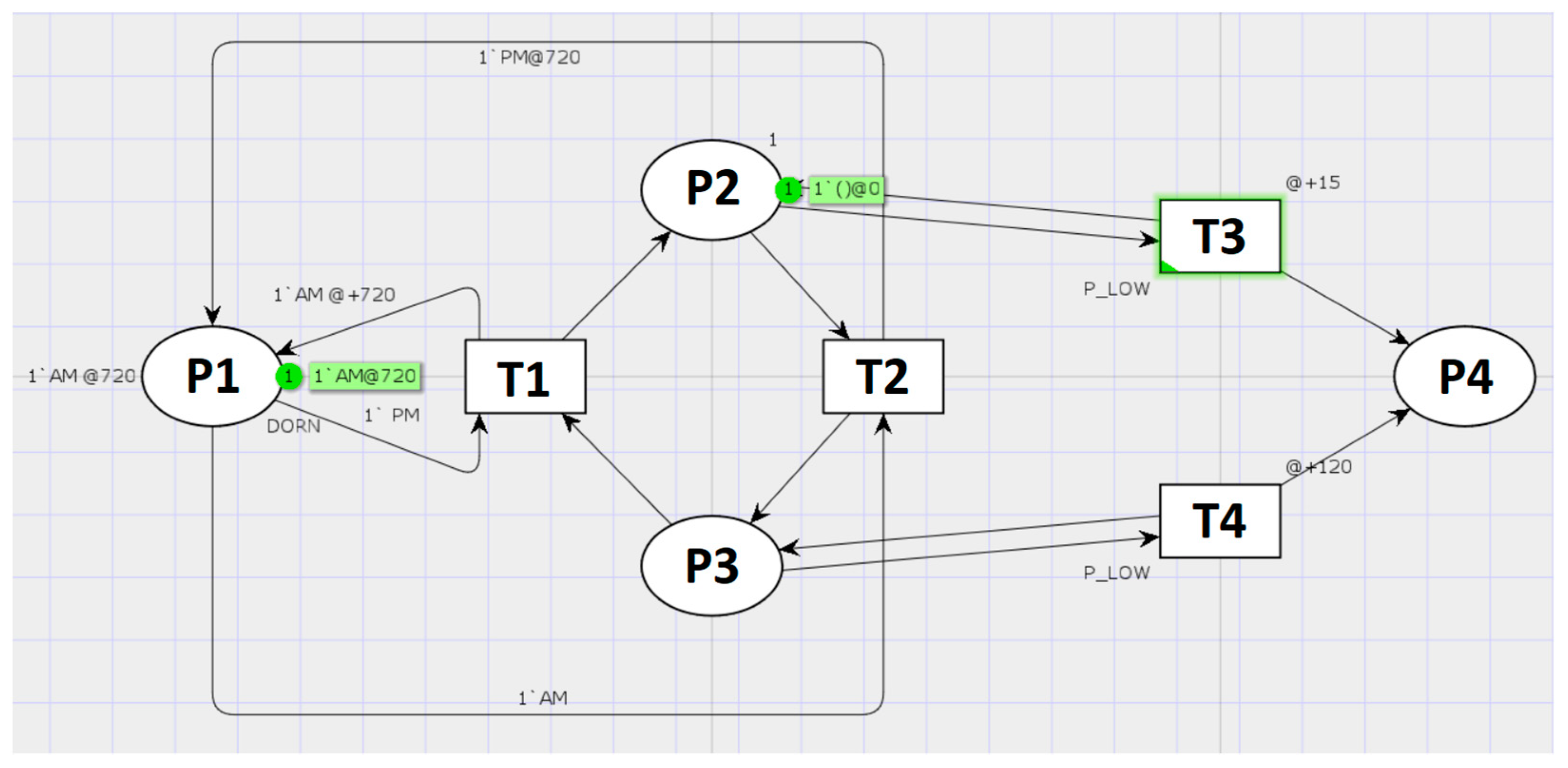
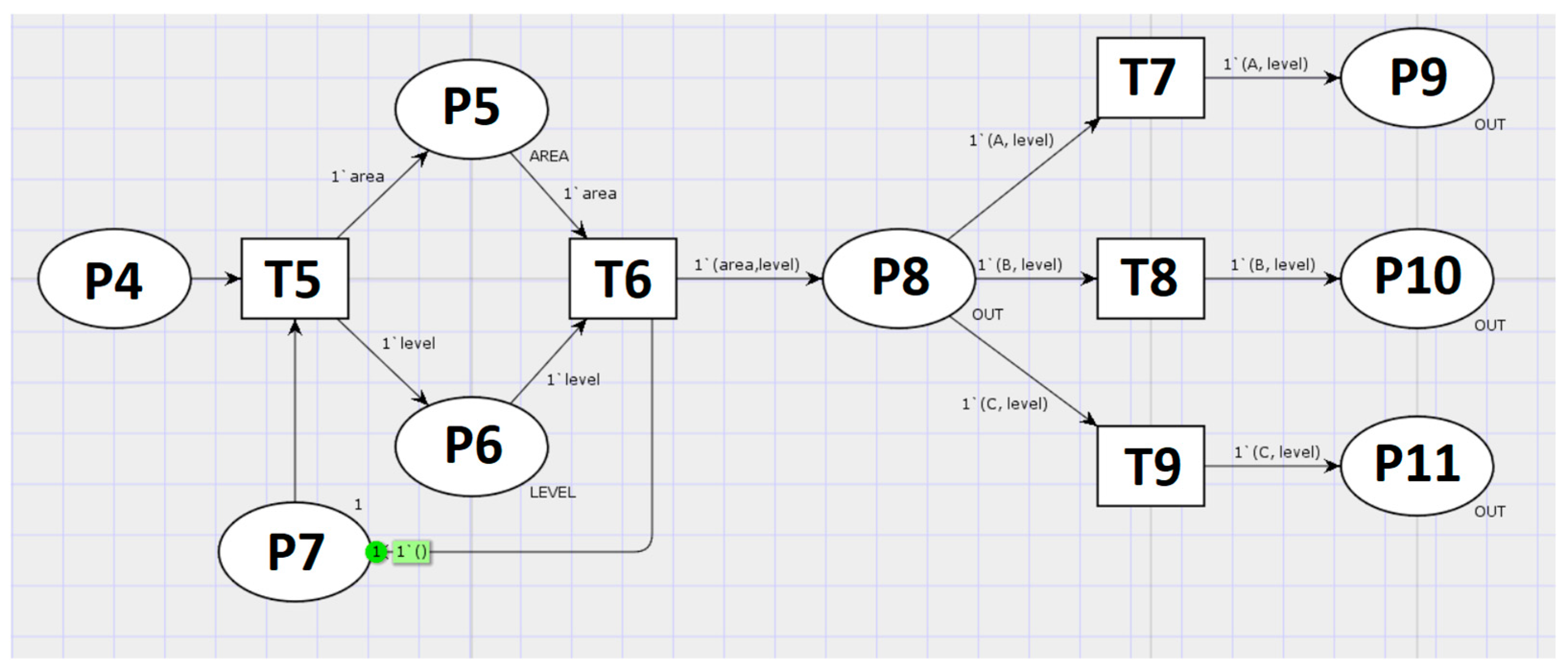
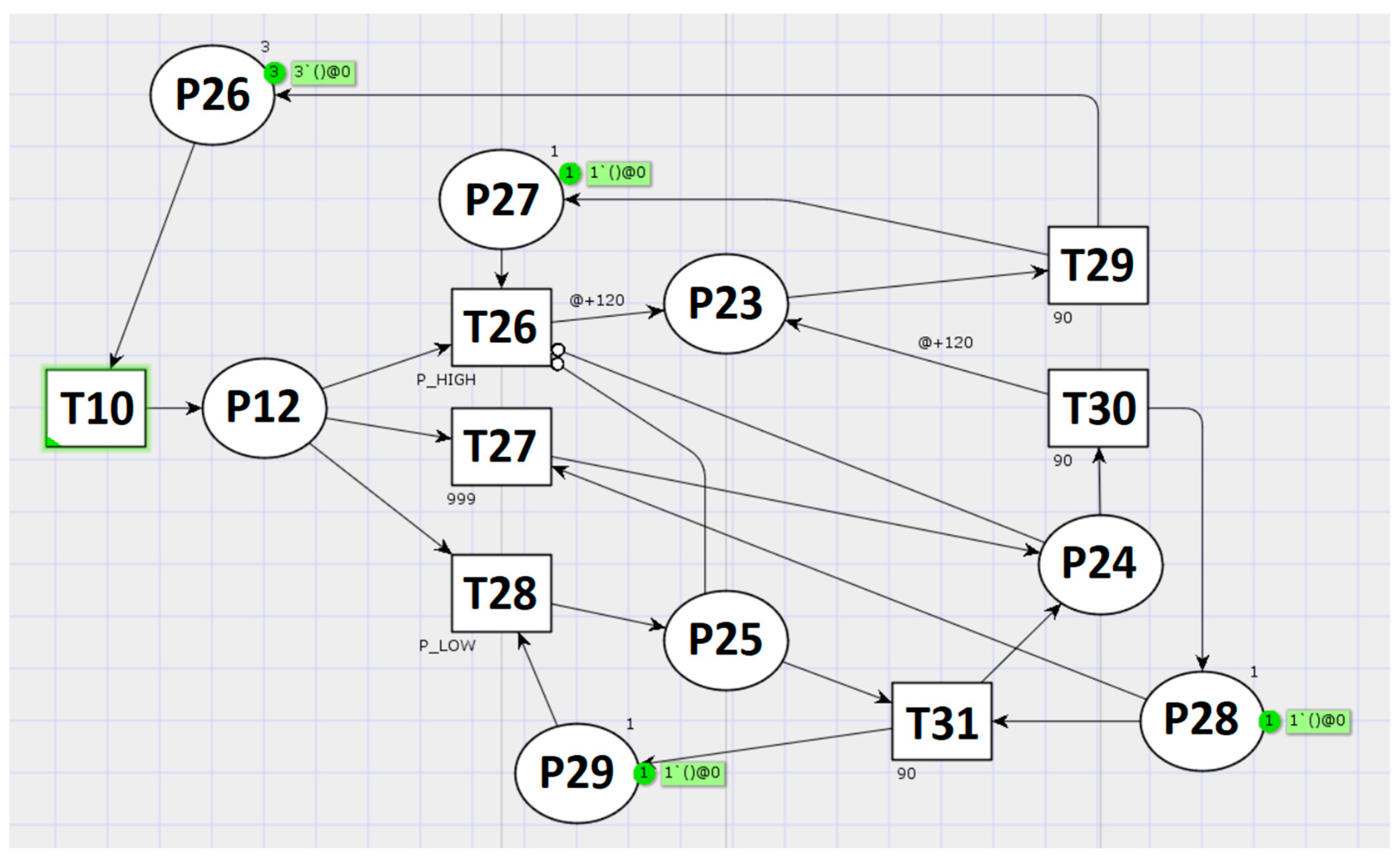
In this section, the described EV charging service is modeled with TCPN for multiple users. In particular, the TCPN model is composed by sub-nets shown in Figure 1, Figure 2, Figure 3 and Figure 4 and described below.
The designed TCPN models consider the alternation of day and night, simulating the entry of EVs throughout the 24-h cycle. Afterwards, the system considers the area where the vehicle has been identified and its remaining range in order to drive the EV towards the preferred CP. Finally, charging points have been modeled, each allowing access to a maximum of three EVs (two queued and one under charging).
3.1. Day-Night Cycle
Figure 1 shows how the alternation of day and night has been modeled and simulated. It is also possible to set the input frequency of EVs for each time slot. Every 12 h (720 min) the system switches from AM to PM and vice-versa. In addition, Table 1 and Table 2 describe the meaning of places and transitions of the TCPN for the day-night cycle. The initial marking places the system at the beginning of the time slot relative to the daytime (8:00). The only enabled transition is T3, which, when fired, represents the entry of an EV during daylight hours, placing a token in P4. After 12 h, the token present in P1 becomes available, enabling transition T2, which updates the value of the token present in P1 (from AM to PM) and moves the token from P2 to P3. With the token present in P3, transition T4 becomes enabled. The firing of transition T4 represents the entry of an EV into the system during the nighttime period. After another 12 h, transition T1 is enabled, and upon firing, it again updates the value of the token in P1 and moves the token from P3 to P2.
Table 1.
Places Meaning in the TCPN for the Day-Night Cycle.
Table 2.
Transition Meaning in the TCPN for the Day-Night Cycle.
Figure 1.
TCPN for Night and Day Cycle.
3.2. Feature Assignment and Area Identification
Once the vehicle has requested the service, the battery SoC and the area in which it is located can be randomly assigned, when real data from sensors cannot not be used (see Figure 2). The presence of a token in P4 represents the entry of an EV into the system and enables transition T5. The control place P7 with unitary capacity ensures that vehicle features are assigned one vehicle at a time to avoid overlaps. Upon firing of T5, a token is placed in P5 and another in P6, each assigned, respectively, with the area value and the SoC. The firing of transition T6 means, through the combination of assigned values, that the system knows the features of the newly entered vehicle, represented by the values of the token placed in P8. Additionally, the firing of transition T6 returns the token to place P7, making a new feature assignment available. Based on the zone/area (A, B, or C), respective transitions (T7, T8, or T9) may be enabled. Once the features are assigned, the EV is routed to the correct area, as shown in Figure 2. In Table 3 and Table 4, places and transitions of the TCPN for feature assignment and area identification are described.
Table 3.
Places Meaning in the TCPN for Feature Assignment and Area Identification.
Table 4.
Transition Meaning in the TCPN for Feature Assignment and Area Identification.
Figure 2.
Features Assignment and Sorting to the Correct Area.
3.3. CP Selection
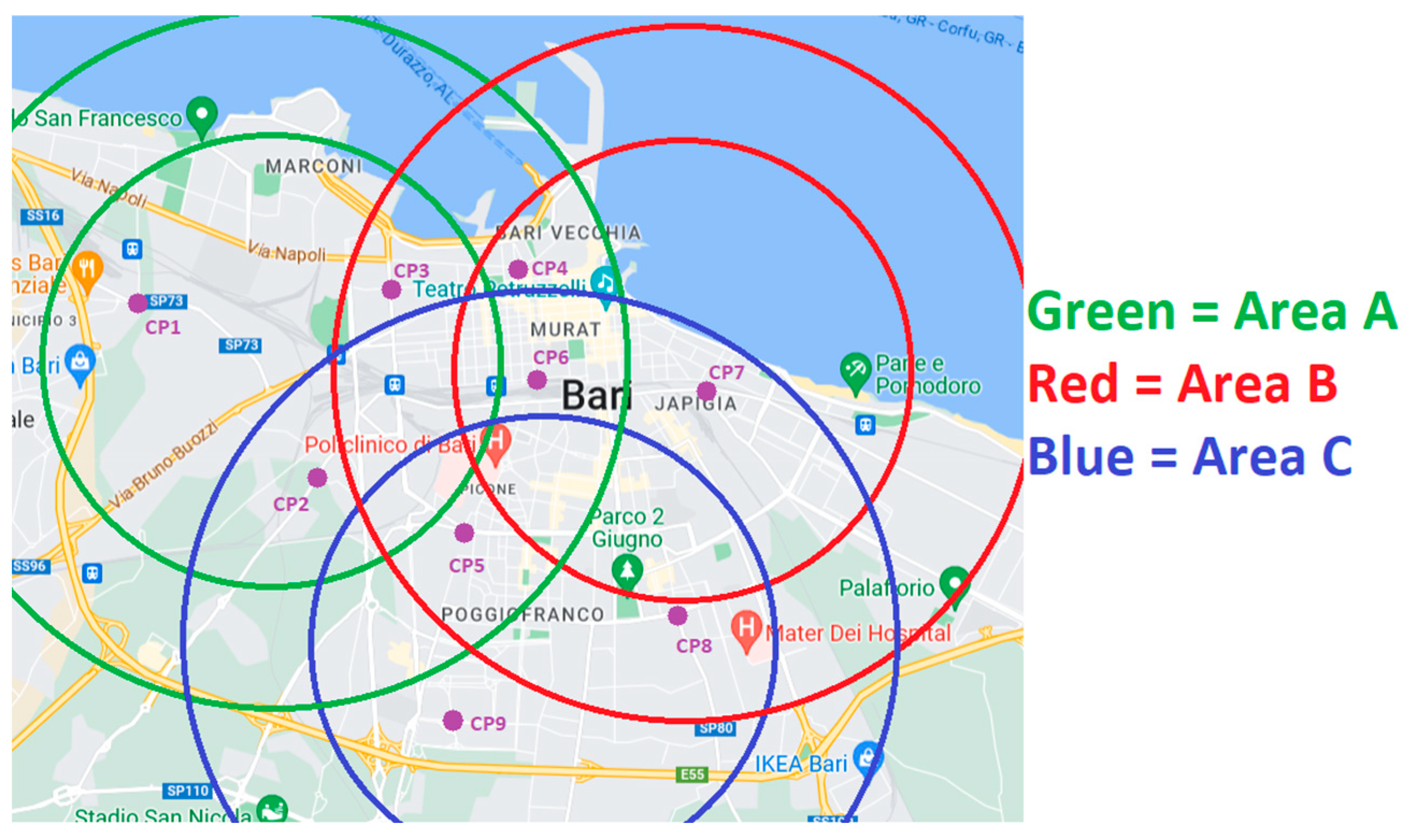
In Figure 3, the possible CP selection process is illustrated once the area in which the EV is located has been identified. Table 5 and Table 6 describe the meaning of places and transitions in Figure 3, respectively. Without loss of generality, let us assume that three circle areas of the same color can be explored (see, for instance, Figure 5). Once the system has recognized the area in which the EV is located, the corresponding place is endowed with the corresponding token, place P9 (for Area A), P10 (for Area B), and P11 (for Area C) in the case of different areas. Therefore, the EV is located within one of the smallest radius circles areas (see Figure 5 as example). At this point, the user has three possible choices:
- recharge at one of the CPs located in the current area, if any are available (firing of transitions T10, T11, or T12), or join a waiting queue;
- decide to expand the search radius, moving to the larger-radius circle of the same color (firing of transition T13);
- exit without using the charging service (firing of transition T14).
Transitions related to entering one of the CPs in the current area have higher priority, since the user would prefer to select a CP as close as possible. In the event that the user decides to change area, the same scenario is repeated for the new area: recharge (or join a queue) at one of the CPs in the second area (firing of transitions T15, T16, or T17), exit the system without recharging (firing of transition T19), or move to the largest area (firing of transition T18), as long as it has enough battery SoC. Unlike the previous scenario, the user also has the option to return to the previous area, again contingent on having sufficient range autonomy (firing of transition T20). If the user opts to further expand the area, the only options will be to charge in CPs of that area (firing of transitions T21, T22, or T23), to return to the previous area (firing of transition T25), or to exit the service (firing of transition T24).
Figure 3.
CP Selection.
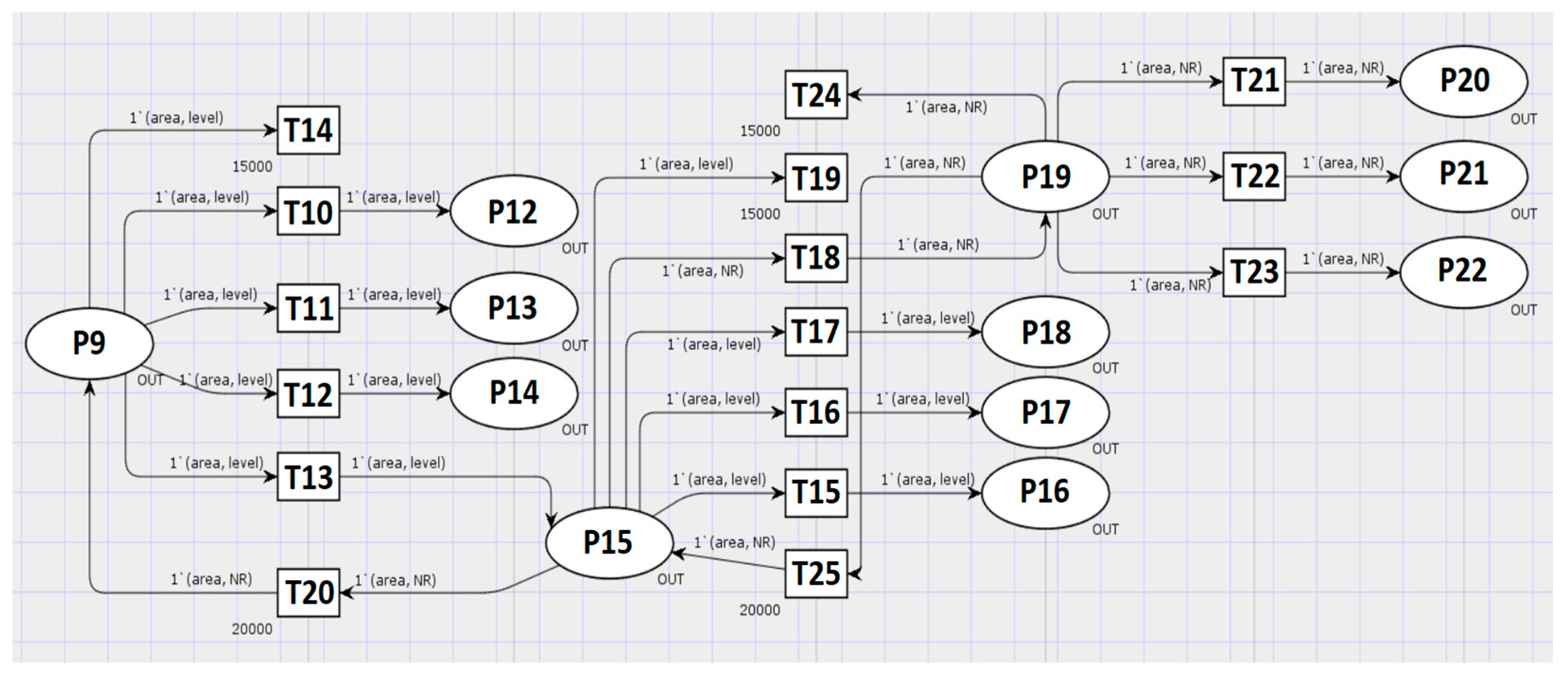
Table 5.
Places Meaning in the TCPN for Choice of the CP.
Table 6.
Transition Meaning in the TCPN for Choice of the CP.
3.4. CP Management
In Figure 4, we show how each CP has been modeled, while Table 7 and Table 8 report the meaning of places and transitions, respectively. It is possible to access each CP only if it is available. In this regard, it is assigned a capacity of three EVs at each CP (maximum of three tokens in place P26, representing the capacity of the CP), one in charging mode and two in a queue based on their arrival order.
Table 7.
Places Meaning in the TCPN for CP Management.
Table 8.
Transition Meaning in the TCPN for CP Management.
Upon the arrival of an EV (firing of transition T10 that places the token in P12), if the CP is available (control place P27 has an available token), the vehicle can go directly to the charging place (firing of transition T26 that places the token in P23). Otherwise, it will join a queue that not only maintains the arrival order but also inhibits direct access to charging to other EVs if there are vehicles in the queue. If the queue is empty (token in place P28), but a vehicle is already charging, the only enabled transition, due to its priority, is T27, which, when fired, removes a token from control place P28, inhibiting any other entries into the first position of the queue, and places a token in place P24, representing the first user in the queue. If, instead, both a user is charging and there is one user in the queue, the only enabled transition is T28 (also in this case, there is a control place P29 with a unitary capacity). A token in place P25 represents a user in the queue at the second position. The charging time is managed by adding a specific timestamp to the token upon entry into the dedicated CP. This makes the token available for exit from the service only after the charging process is complete.
Figure 4.
CP Management.
In the next section, a case study simulation is developed to apply the TCPN model proposed.
4. Case Study
In this section, a case study is presented in which the target is the central area of the city of Bari, which has been divided into nine selection areas Aj (green color), Bj (red color), and Cj (blue color), with j = 1, 2, 3, each containing three of nine total CPs, i.e., CPi with i = 1, …, 9, as can be seen in Figure 5.
Figure 5.
Round Areas for CP Selection Example.
It is remarked that the input data used in the simulated scenarios are real-world data collected during the demonstration activities of the charging solutions developed in the EU Research and Innovation project named eCharge4Drivers [19]. In particular, the Metropolitan City of Bari has been one of the demo sites of the project in which innovative charging services have been demonstrated. In this demo, the data collection has been carried out in the period September 2023–May 2024 adopting some of the CPs available in the city, equipped with the necessary data sources, and involving a selected pool of private users. The connection with the local CPOs was necessary to retrieve all data from the CPs. Despite most of the CPs data being available (e.g., power, plug type, status, tariff) through the CPO connection, it was necessary to equip some of the used CPs with parking sensors in order to monitor the availability of the parking spots for a more reliable reservation functionality. Ideally, a direct connection with the EV backend system can allow for an automatic data exchange with the car. For the lack of this connection, in the project, the EV data such as plug type, battery capacity, and initial SoC have been required to the users through the service application.
Initially, the service identifies the area in which the electric vehicle is located, A1, B1, or C1, and allows the user to choose whether to proceed with charging at one of the three charging points in the current area or move to the next larger area enlarging the charging options.
The system was designed and simulated using a TCPN with CPN Tools software (version 4.0, https://cpntools.org/) in different scenarios in order to validate it and evaluate its performances. The different scenarios consider an equal number of charging points but in multiple configurations (slow only, different mix of slow and fast, fast only) and different arrival frequency of users (demand) considering average times (the simulation is stochastic and not deterministic). The number of charging points considered for each of the two types is a multiple of three, while for arrival frequency multiple values of five min (up to 15 min) during the day and a fixed value for the night (considering very low demand) were considered. Table 9 lists the colors that have been defined for the TCPN.
Table 9.
Colors Defined for the TCPN.
In Table 10, the 12 scenarios considered are outlined based on a combination of different CP recharge times (slow CP = 120 min and fast CP = 40 min) and various arrival frequencies of EVs during daytime hours (every 5, 10, or 15 min). The arrival frequency during nighttime hours (every 120 min) remains constant.
Table 10.
Parameter Settings for the Scenarios.
Experimental Results
This section describes and reports the experimental results obtained by simulating the TCPN integrating the TCPNs in Figure 1, Figure 2, Figure 3 and Figure 4, in all the 12 scenarios reported in Table 10. The net’s performance is evaluated in two different observation windows, 12 h (from 8 to 20) daytime and 12 h (from 20 to 8) nighttime for one month (30 days).
Ten different simulations for each scenario are performed to evaluate their average value, since both the location area and CP routing are randomly assigned. The results can be seen in Table 11 and Table 12.
Table 11.
Results for a 12 h Observation Window.
Table 12.
Results for a 30-Day Observation Window.
During the 12-h simulation, the performance was evaluated based on the following parameters:
- the number of EVs leaving the service after completing a full recharge;
- the number of EVs forced to leave the service without recharging due to the unavailability of any CPs;
- the ratio between the number of EVs effectively recharged and the number of EVs entering the service.
It can be observed that in very adverse scenarios, i.e., with many slow CPs and a high frequency of vehicle entries, there is a notable increase in the number of EVs that could not be served. This behavior is particularly evident in scenario 1. However, decreasing the entry frequency and/or increasing the number of fast CPs, the efficiency of the system reaches very satisfactory levels. This can be seen in particular in scenarios 10, 11, and 12, where all charging points are fast. Nevertheless, across the entire range of scenarios analyzed, instances where the system had to reject an EV remain relatively low.
During the month simulation, the evaluation of the net’s performance is based on the following parameters:
- the number of EVs leaving the service after undergoing a full recharge;
- the number of EVs forced to leave the service without recharging due to the unavailability of any CPs;
- the number of EVs in the last available position in the CPs queue.
The results show a similar behavior to the simulation focused on daytime hours, with a significant number of EVs going unserved due to a lack of available CPs, especially in scenarios with high entry frequency or a predominance of slow CPs. However, observing the simulations results, it is apparent that during nighttime hours, the reduced entry frequency of EVs helps to drain the net from queued.
The number of vehicles entering the second position in the CPs queues, thus saturating their capacity, is higher in scenarios with high entry frequency. Additionally, it is notable that the ratio between the number of EVs entering the second position in the queues and the number of EVs unable to be served by the system increases with the growth of fast CPs.
5. Discussion
Modeling and Simulating Electric Vehicles Charge Services in real-world conditions is a complex process. The use of the proposed methodology allows the study of the technical effectiveness and the efficiency of the charging service in a specific area. The presence of charging points considering different configurations in number and type (charge capacity slow or fast), affects users’ waiting times. Similarly, the cost of infrastructure is related to the type of charging points. The analyses conducted also make it possible to assess the benefits that different scenarios generate for users and how these may affect investment.
Evaluating wait times under different scenarios allows optimizing the use of resources for new installations: in the analyses performed, user wait times are displayed in the actual state and after implementing improved policies. The proposed process enables effective improvement of the new setup by allowing all users to be served with reduced wait times. In fact, Table 11 and Table 12 show how by improving the configuration of charging points through the installation of new stations and with different types of power according to user demands, it is possible to increase users who fully charge their vehicles and greatly reduce unserved users. In the 12 scenarios developed, while in scenarios 1, 2, 4, and 7 there is the presence of several issues of unserved users, the other scenarios show significant improvement with a number of waiting users of zero or close to zero.
The result is significant in that the best arrangement of CPs in number and type within an area can be planned more accurately and with reduced waste.
A deep analysis of simulation results showed that there are critical scenarios where not all users are served. In particular, the most challenging scenarios are those with a high level of arrival frequencies of EVs and a higher number of slow charging stations. The analysis led to the following conclusions:
- -
- in the case of arrival frequencies of EVs every 5 min:
- ◦
- slow CP serves about 260 EVs per month
- ◦
- a fast CP serves about 580 EVs per month
- -
- in the case of arrival frequencies of EVs every 10 min only scenario 2, with all slow CPs, is critical, and this can be evaluated and improved. The other scenarios are already saturated
- -
- in the case of arrival frequencies of EVs every 15 min, there are no critical issues
Improving these critical conditions can be achieved by increasing the number of CPs until the optimal service condition for all users is reached, considering that all scenarios in which the value of EV not served in Table 12 is zero prevent users from being discouraged to use EVs.
In this view, a cost-benefit analysis shows that the supply and installation of a slow CP costs about €3.000–5.000, while the same activities for a fast CP cost about €15.000–20.000. Moreover, infrastructure costs will also have to be considered, in case (especially for fast CP) there is no network in the installation area enable of carrying the necessary electricity powers. The data show a ratio of the cost of a fast CP to at least four and five times the cost of a slow CP. Considering that the charging time of a fast CP is one-third the charging time of a slow CP, increasing slow CPs in a geographic area is more efficient for the system. However, the use of fast CPs is justified by user demand because they allow, with the reduction of charging time, to decrease anxiety and barriers to the use of EVs. The results obtained in the simulation are useful to address potential challenges in implementing the TCPN model, such as cost of supplying and installing new CPs, infrastructures costs, and user adoption barriers.
The proposed model requires the adaptation of a specific geographic area. Scalability to large cities can be achieved by following a few steps:
- -
- first, draw up a preliminary study of the user demands (demand) of a given geographic area
- -
- generate various scenarios (both fast and slow columns) on a smaller geographic scale (e.g., neighborhood)
- -
- run a simulation of the system thus set up
- -
- analyze the results by extrapolating the behavior of the fast and slow columns depending on the call frequencies of refills
- -
- evaluate with a cost analysis how to improve critical scenarios (adding fast or slow columns)
- -
- based on this data, implement larger scenarios for the entire city, also considering any infrastructure constraints (costs) so as to reduce barriers to use by users.
Differently from the work [20], which proposes a discrete event simulation of EV charging events without details on the discrete event system (DES) modeling, this paper proposes a rigorous and reproducible DES model, based on TCPN, tested in different simulation scenarios. The TCPN model is designed to represent several EV multi-user scenarios and give necessary statistics about EV charging, useful for EV demand and user behavior analysis. In addition, we can compare our work with paper [21], which presents an approach based on discrete event simulation developed to model the hourly electricity demand from EV charging. This approach is limited by the fact that the EVs do not share the same charging infrastructures; thus, queueing is not managed and considered. In our approach based on TCPN, the CPs are shared by the EVs, and queues and consequent waiting times are analyzed.
An interesting development is the use of EVs as connected cooperative and autonomous vehicles (CCAVs) in order to improve the optimization of charging services with lower waiting times and reduce not-served vehicles. In this context, it will be significant to consider the data security issues (trip-to-reach the charging point, charging service time, etc.) using suitable approaches to protect users by intruder attacks [22].
6. Conclusions
In this paper, we propose a Time Colored Petri Net (TCPN) model for modeling and simulating multiple users’ requests of charging electric vehicles (EVs). The proposed model takes into account the charging request from each EV in a specific geographical area based on several data, such as battery SoC, energy demand, charging points availability, simulating possible multiple requests of the same infrastructure that can generate queues. The proposed model can be a valid tool to be used by charge point operators as part of a digital twin aiming at improving the charging infrastructure performance when serving multiple users. The effectiveness of the TCPN model is demonstrated in a case study simulating several scenarios in different observation time periods to measure the number of EVs that can be served given CPs availability and user preferences. The scalability of the TCPN model to large cities is possible by considering certain aspects: both the places and transitions that model the areas where a call occurs are related to the CPs in each area. The increase in CPs leads to more places and transitions, resulting in a significant increase in simulation times. However, the use of data resulting from the analysis of scenarios related to circumscribed areas of a city allows for more efficient sizing of scenarios referring to larger areas or the entire city, greatly reducing simulation time issues. Future development includes the implementation in the model of the use of renewable energy: Through the addition of a color it is possible to represent the driver who wants to go to a CP where energy is generated renewably.
Author Contributions
Conceptualization, M.R.; Methodology, A.M.M. and M.R.; Software, L.R.; Validation, B.S.; Formal analysis, M.R. and B.S.; Investigation, B.S.; Resources, L.R.; Data curation, M.P.F.; Writing—original draft preparation, A.M.M. and M.R.; Writing—review and editing, M.P.F.; Visualization, B.S.; Supervision, A.M.M. and M.P.F.; Project administration, M.P.F.; Funding acquisition, B.S. All authors have read and agreed to the published version of the manuscript.
Funding
This research received no external funding.
Data Availability Statement
Data is contained within the article.
Acknowledgments
The authors sincerely thank students Bruno Quagliara and Michela Ostuni for their support in conducting the simulations used in this paper.
Conflicts of Interest
The authors declare no conflicts of interest.
Abbreviations
The following abbreviations are used in this manuscript:
| ICE | Internal Combustion Engine |
| EV | Electric Vehicle |
| CP | Charge Point |
| PN | Petri Net |
| TPN | Timed Petri Net |
| TCPN | Timed Colored Petri Net |
| SoC | State of Charge |
| SoCkm | State of Charge in km (residual autonomy in kilometers for the EV) |
| SoH | State of Health |
| MPC | Model Predictive Control |
| CPO | Charge Point Operator |
| EMP | Electromobility service provider |
| GPS | Global Positioning System |
| ID | Identification |
| CHAdeMO | Charge de Move |
| CCS | Combined Charging System |
| AM | Ante Meridiem |
| PM | Post Meridiem |
References
- Mangini, A.M.; Roccotelli, M. Innovative Services for Electric Mobility Based on Virtual Sensors and Petri Nets. IEEE/CAA J. Autom. Sin. 2023, 10, 1845–1859. [Google Scholar] [CrossRef] [Scilit]
- Fanti, M.P.; Mangini, A.M.; Roccotelli, M. A petri net model for a building energy management system based on a demand response approach. In Proceedings of the 22nd Mediterranean Conference on Control and Automation, Palermo, Italy, 16–19 June 2014; pp. 816–821. [Google Scholar]
- Fanti, M.P.; Mangini, A.M.; Roccotelli, M.; Silvestri, B.; Digiesi, S. Electric vehicle fleet relocation management for sharing systems based on incentive mechanism. In Proceedings of the 15th IEEE International Conference on Automation Science and Engineering, CASE 2019, Vancouver, CA, USA, 22–26 August 2019; Volume 2019, pp. 1048–1053. [Google Scholar]
- Leviakangas, P.; Kinnunen, T.; Kess, P. The Electric Vehicles Ecosystem Model: Construct, Analysis and Identification of Key Challenges. Manag. Glob. Transit. 2014, 12, 253–277. [Google Scholar]
- Ma, Y.; Li, B.; Li, G.; Zhang, J.; Chen, H. A nonlinear observer approach of SOC estimation based on hysteresis model for lithium-ion battery. IEEE/CAA J. Autom. Sin. 2017, 4, 195–204. [Google Scholar] [CrossRef] [Scilit]
- Ugras Cuma, M.; Koroglu, T. A comprehensive review on estimation strategies used in hybrid and battery electric vehicles. Renew. Sustain. Energy Rev. 2015, 42, 517–531. [Google Scholar] [CrossRef] [Scilit]
- Trippe, A.E.; Hidalgo, P.; Lienkamp, M.; Hamacher, T. Mobility Model for the Estimation of the Spatiotemporal Energy Demand of Battery Electric Vehicles in Singapore. In Proceedings of the IEEE 18th International Conference on Intelligent Transportation Systems (ITSC), Gran Canaria, Spain, 15–18 September 2015; pp. 578–583. [Google Scholar]
- Ranjith Pawar, G.; Praveen, L.S.; Nagananda, S.N. Implementation of Lithium-Ion Battery Management System with an Efficient SOC Estimation Algorithm. In Proceedings of the International Conference on Recent Trends on Electronics, Information, Communication & Technology (RTEICT), Bangalore, India, 12–13 November 2020; pp. 27–34. [Google Scholar]
- Casteleiro-Roca, J.-L.; Jove, E.; Sanchez-Lasheras, F.; Mendez-Prez, J.-A.; Calvo-Rolle, J.-L.; de Cos Juez, F.J. Power Cell SOC Modelling for Intelligent Virtual Sensor Implementation. J. Sens. 2017, 2017, 9640546. [Google Scholar] [CrossRef] [Scilit]
- Diaz, C.; Ruiz, F.; Patino, D. Smart Charge of an Electric Vehicles Station: A Model Predictive Control Approach. In Proceedings of the IEEE Conference on Control Technology and Applications (CCTA), Copenhagen, Denmark, 21–24 August 2018; pp. 54–59. [Google Scholar]
- Leeetal, Z.J. Adaptive Charging Networks: A Framework for Smart Electric Vehicle Charging. IEEE Trans. Smart Grid 2021, 12, 4339–4350. [Google Scholar]
- Zeng, X.; Wang, J. A Parallel Hybrid Electric Vehicle Energy Management Strategy Using Stochastic Model Predictive Control With Road Grade Preview. IEEE Trans. Control. Syst. Technol. 2015, 23, 2416–2423. [Google Scholar] [CrossRef] [Scilit]
- Zhao, Y.; Cai, Y.; Song, Q. Energy Control of Plug-In Hybrid Electric Vehicles Using Model Predictive Control with Route Preview. IEEE/CAA J. Autom. Sin. 2021, 8, 1948–1955. [Google Scholar] [CrossRef] [Scilit]
- Shi, Y.; Tuan, H.D.; Savkin, A.V.; Duong, T.Q.; Poor, H.V. Model Predictive Control for Smart Grids with Multiple Electric- Vehicle Charging Stations. IEEE Trans. Smart Grid 2019, 10, 2127–2136. [Google Scholar] [CrossRef] [Scilit]
- Fanti, M.P.; Mangini, A.M.; Roccotelli, M.; Silvestri, B. Innovative Approaches for Electric Vehicles Relocation in Sharing Systems. IEEE Trans. Autom. Sci. Eng. 2022, 19, 21–36. [Google Scholar] [CrossRef] [Scilit]
- Hamroun, A.; Labadi, K.; Lazri, M. Modelling and performance analysis of electric car-sharing systems using Petri nets. E3S Web Conf. 2020, 170, 03001. [Google Scholar] [CrossRef] [Scilit]
- Hamroun, A.; Labadi, K.; Lazri, M.; Barbot, J.P. A Petri Nets-Based Simulation Methodology for Modular Modeling and Performance Evaluation of Car-Sharing Networks. IEEE Trans. Autom. Sci. Eng. 2022, 20, 1945–1961. [Google Scholar] [CrossRef] [Scilit]
- Benarbia, T.; Axhausen, K.W.; Farooq, B. Modeling, relocation, and real-time inventory control of one-way electric cars sharing systems in a stochastic Petri Nets framework. IEEE Trans. Intell. Transp. Syst. 2020, 22, 2846–2861. [Google Scholar] [CrossRef] [Scilit]
- eCharge4Drivers. European Union’s Horizon 2020 Research and Innovation Programme Under Grant Agreement No 875131, 2020–2024. Available online: https://echarge4drivers.eu/ (accessed on 1 September 2024).
- Wahyudi, S.A.; Rahman, F.S.; Hariyanto, N. Modeling Electric Vehicle Charging Station in Bandung Area via Discrete Event Simulation. In Proceedings of the 2024 International Conference on Green Energy, Computing and Sustainable Technology (GECOST), Miri Sarawak, Malaysia, 17–19 January 2024; pp. 127–131. [Google Scholar]
- Lopez, N.S.; Allana, A.; Biona, J.B.M. Modeling Electric Vehicle Charging Demand with the Effect of Increasing EVSEs: A Discrete Event Simulation-Based Model. Energies 2021, 14, 3734. [Google Scholar] [CrossRef] [Scilit]
- Cong, X.; Fanti, M.P.; Mangini, A.M.; Li, Z.W. On-line verification of initial-state opacity by Petri nets and integer linear programming. ISA Trans. 2019, 93, 108–114. [Google Scholar] [CrossRef] [Scilit] [PubMed]

Disclaimer/Publisher’s Note: The statements, opinions and data contained in all publications are solely those of the individual author(s) and contributor(s) and not of MDPI and/or the editor(s). MDPI and/or the editor(s) disclaim responsibility for any injury to people or property resulting from any ideas, methods, instructions or products referred to in the content. |
© 2025 by the authors. Licensee MDPI, Basel, Switzerland. This article is an open access article distributed under the terms and conditions of the Creative Commons Attribution (CC BY) license (https://creativecommons.org/licenses/by/4.0/).