


Abstract
This study addresses energy security from the perspective of comprehensive national defence, especially the interaction between military and civilian aspects of defence. Civilian infrastructure is seldom configured or developed with defence in focus. Therefore, with the aim of facilitating a system-level discussion, this study takes two steps. The first step is to develop indicators for assessing energy security in a comprehensive national defence setting. The second step is to qualitatively assess the effect on energy security from three different energy development scenarios related to either the development of local solar, wind, and bio-power production and storage; an increased resilience of the high voltage electric power transmission system; or an increase in large hydropower and nuclear power production. The study identifies that there are positive systemic effects of increasing the diversity of the energy system, especially for solutions that do not need external supply and do not risk creating large-scale effects if attacked. However, these changes to the energy system also lead to local changes that affect warfighting and defence. Such changes can be met by updated tactics and technology that would also give the defending force an advantage.
1. Introduction
Civilian infrastructure, such as national energy systems, is of great importance for defence forces with a focus on non-expeditionary national defence. However, such civilian infrastructure is seldom configured or developed with defence in focus. In a prolonged conflict, military units and their support require energy that directly and indirectly is dependent on the national civilian energy system. NATO defines “resilient energy supplies” as one of a nation’s seven baseline requirements [1]. In research, this dependence is addressed at the component level, e.g., in relation to military microgrids [2,3] and infrastructure protection coordination [4]. However, constructive suggestions for how to develop energy security, taking national defence into consideration, are limited.
The concept of energy security can help countries achieve economic stability [5], and the field provides guidance to stakeholders in solving transitional energy problems [6]. Energy security is a context-dependent concept [5], and there is a discussion on the need to expand the concept [7,8]. Von Hippel et al. [8] argue for adding new components such as environment, technology, and socio-cultural factors. Vivoda [9] argues for including aspects such as human security and geopolitical incidents when understanding energy security. Therefore, there are strong connections between comprehensive national defence, national resilience and territorial defence, and energy security [10].
Several approaches exist to assess energy security, including the 4A framework that relies on the four dimensions: Availability, Applicability, Acceptability, and Affordability [11]. The framework has proven to be a robust approach since it can add indicators depending on the contextual background [5]. This study addresses energy security from the perspective of comprehensive national defence and especially the interaction between military and civilian aspects of defence. Comprehensive national defence is here based on the description by Berzina [12] and here understood in the European setting as a defence concept governed by two basic principles: the whole-of-society and whole-of-government approaches for defence.
When addressing and preparing for national defence, there is a possibility for the national defence force to affect decisions on infrastructure and to adapt the defence concept and the system for comprehensive national defence to the specific and possibly unique circumstances the national infrastructures provide. However, for such considerations, defence capability, and especially national comprehensive defence capability, must be understood as a system comprised of several different organisations, doctrines, and technology components [13,14,15,16]. Due to this, change must be analysed on a system level to fully understand the effect.
With the aim to facilitate a system-level discussion on energy security and comprehensive national defence, this study takes two steps. The first step is to develop indicators for assessing energy security in a comprehensive national defence setting. The second step is to qualitatively assess the effect on energy security with the 4A framework in a national defence setting by comparing three different future scenarios: Scenario A, an increase in local solar, wind, and bio-power production and storage; Scenario B, an increased resilience of the high voltage electric power transmission system; and Scenario C, an increase in large hydropower and nuclear power production. The scenarios are here based on European conditions and data. The developed 4A framework is used to investigate the effect on comprehensive national defence capability. Subsequently, this paper’s main objective is to investigate the effect of emerging sustainable energy technologies on total defence with the lens of the modified 4A framework.
The novelty of the paper is threefold. First, indicators of the 4As dimensions in this study are unique and chosen explicitly for comprehensive national defence. Second, no previous studies have investigated energy security in relation to comprehensive national defence and emerging energy solutions. Third, the study aims to contribute to the existing literature by providing strategic policy suggestions specifically for comprehensive national defence.
2. Theoretical Frames of Reference
2.1. Energy Security
Studies describe that energy security is a multi-dimensional concept that captures and elaborates on the underlying economic, environmental, political, technological, geopolitical, and institutional aspects related to energy markets in a nation or region [5,9]. Amin et al. [5] highlight that understanding and evaluating energy security is a complex task and requires a comprehensive approach and that the complexity is described by Vivoda [9] and Yao and Chang [11]. Additionally, energy security is discussed widely, especially in the policy context, and it has been identified that physical disturbances in the energy supply can have many different causes, such as “terrorism, pirate attacks at sea, political instability in the countries having large energy resources as well as attempts of individual countries to employ the supply of energy resources for political blackmail” [17]. Therefore, this study addresses the national energy system on a high system level, assessing how the configuration of the system interacts with threats and attacks.
Other important aspects of energy security include development areas such as infrastructure protection and network topology. The research field of Infrastructure Protection provides knowledge for the energy system both on the system level and on the element level [18,19,20]. Network topology analysis aims to increase network resilience in relation to unexpected disturbances and disruptions, such as natural disasters [21]. At the national system level, there is an overlap between the aspects studied within energy security, critical infrastructure protection, and network topology, and knowledge must be collected from more than one field.
With respect to system resilience in general [22], in relation to disaster resilience [23,24], and in relation to national comprehensive defence [10,12], the system under study must also include the social measures and effects. Therefore, in this study, energy security is understood from a sociotechnical system perspective. This perspective is wider than the system perspectives typically used in infrastructure protection and energy security.
Yao and Chang have proposed an approach intended to capture the energy security issues holistically for any given nation or region [5]. The approach is built on the four dimensions, the 4As: (i) Availability, (ii) Applicability, (iii) Acceptability, and (iv) Affordability. Amin et al. [5] present a literature review of 4A studies and summarises indicators used in described studies.
2.2. Comprehensive National Defence
Defence is here viewed from a capability perspective and understood as a sociotechnical system comprised of organisational, conceptual, and technical aspects [13,15,25,26].
The concept of total defence or comprehensive national defence has its roots in several smaller European countries during World War II, where armed forces no longer operated separately from other segments of society. Therefore, “‘total defence’ and ‘total war’ are two sides of the same coin to the understanding that war requires a whole-of-society approach” [12]. Today, security challenges are often related to the so-called hybrid threats [10,12], where an adversary dynamically employs a mix of conventional weapons, irregular tactics, terrorism, and criminal behaviour to achieve military goals. At least since Crimea’s annexation by Russia and the following war in Southeast Ukraine, hybrid actions are understood to also include a non-military dimension. This non-military domain includes economic, informational, and diplomatic instruments of power [10,12]. Therefore, as hybrid threats cover major societal functions, including financial markets, media, and civil society, the defence against them must be as comprehensive. “Consequently, the two basic principles governing comprehensive national defence are the whole-of-society and whole-of-government approaches” [12].
The role of the civilian society in comprehensive national defence is to support defence efforts and for organisations and individuals to continue with the peace-time responsibilities and functions to make them fulfil their intended roles as reliably as possible. During a long conflict, maintaining a reliable order of the functions of society is imperative. Additionally, Wither [10] highlights that there is a strong connection between national comprehensive defence, national resilience, and territorial defence, which all represent emergent system aspects of the national defence capability system.
3. Research Approach
This study considers the possibility of a long-term severe defence crisis or war and its effect on a nation or region’s energy production and distribution. The study qualitatively assesses the system-level relationship between comprehensive national defence and energy security. The assessment is performed in two steps.
3.1. The First Step, Developing 4A Indicators for Assessing Energy Security in Relation to Comprehensive National Defence
The first step is to develop 4A indicators specifically for assessing energy security for the conditions defined by comprehensive national defence. This is performed based on a development from the existing 4A framework and from the needs and requirements that define comprehensive national defence. The input for this first step is described in Section 2 and further elaborated in Section 5.1, Section 5.2 and Section 5.3 in relation to the robustness of the modern energy system, military critique of the development of the energy sector, and proposed solutions to effects on military capability.
From this qualitative input on the concepts and conditions relevant to developing a robust energy system, Section 5.4 concludes the first step by defining modified 4A indicators for the comprehensive national defence setting.
3.2. The Second Step, Assessment of Development Scenarios of a National Energy Systems
The second step is to use the modified 4A framework to qualitatively assess the effect of three different developments of national energy systems. The assessment is performed on a system level based on a simplified national energy system, including both import and national production and distribution of energy under substantial war stress. System-level characteristics of the Ukrainian energy system after nine months of war are used to define the scenario. The development scenarios assessed are Scenario A, an increase in local solar, wind, and bio-power production and storage; Scenario B, an increased redundancy in the high voltage electric power transmission system; and Scenario C, an increase in large-scale hydropower and nuclear power production. The national energy scenario and development scenarios are described in Section 4.
For each of the 4A dimensions, the effect of the development described in the scenarios is given a summarised assessment on the scale: distinctly negative, negative, neutral, positive, and distinctly positive.
3.3. Implications of the Qualitative Approach
The qualitative assessment focuses on the interaction between the military and civilian comprehensive national defence measures by using the 4A indicators developed in the first step. The qualitative approach allows for system-level comparison between the three development scenarios. The assessment focuses on conceptual differences between the studied scenarios and conditions.
4. Defence and Energy Scenario
4.1. Energy System Stresses during a National Defence Scenario
This study considers the energy system of a region or nation set in European conditions. Nan and Sansavini [19] present an illustration of Switzerland’s high-voltage electric power transmission system that serves as a model of the electric backbone of such a national system. However, the national typical system is also dependent on aspects such as fuel import, refinery capacity, fuel storage, and fuel transport. The energy system is considered during a long-term national crisis. Long-term is understood as a crisis longer than nine months. Energy is analysed in a national or regional setting. The crisis is met by the national or regional comprehensive national defence system involving large effects both on civil and military defence measures.
The effects on Ukraine’s energy system, nine months after the Russian invasion on 24 February 2022, are used as a reference scenario for energy production during a large-scale defence crisis. Ukrainian electricity energy production was reduced from 19 GW to 11 GW (44% reduction) spread over almost all production types, where the largest production reduction has been to hydropower and nuclear power, with 63% and 54% respectively [27]. The only production type that has increased is natural gas, which has almost doubled in production [27]. The total reduction was down to a value close to 11 GW approximately one month after the invasion. Over time, natural gas and coal see the largest variation.
In Ukraine, consumption is reduced to lower levels both because of attacks on power production and infrastructure, as well as the temporary shutdown of the electric distribution in areas and times of energy shortage. A more detailed analysis of the effects on capacity for different energy sources in Ukraine describes how different energy types have been affected by the war after 8 months [28]. The reports show large differences between energy types, as summarised in Table 1.
Table 1.
Capacity of the Ukrainian energy sector, evaluation and damage assessment as of 24 November 2022 [28]. Arranged from most affected to least affected. Note that there is a difference between the actual production described above and the installed and operational power.
The data from Ukraine show that both the national high voltage electric power transmission system, power production, as well as fossil fuel production and import are heavily affected by the war. The national electric system is operated closer to the maximum capacity both in terms of production and distribution, even though the output is 56% of peace-time levels.
4.2. Energy System Development Scenarios
The base scenario for this study, Scenario 0, is a national energy system with a contemporary European mix of energy types. Scenario 0 is set in the conditions for a developed European country where transport, households, and industry represent 30%, 26%, and 26% of the energy consumption, respectively [29]. The range of electricity consumption per capita in the households sector in the EU Member States in 2018 varied from consumption below 1 MWh per capita in Romania, Poland, Latvia, and Slovakia to consumption of approximately 4 MWh per capita in Finland and Sweden (no and limited use no gas for households in these countries) [29]. The main use of energy by households is for heating their homes, which represents 64% [29]. Therefore, this study assumed that a household consumes 8–16 MWh per year, including heating, representing a household in northern Europe. However, the consumption sees large variation over every day, week, and year [30].
From Scenario 0, three near-future scenarios are developed: Scenario A, B, and C.
Scenario A is a near future where local or microgrid solutions have been progressively implemented in private homes, public buildings, farms, small communities, and military installations, e.g., Kumar et al. [31], Pérez et al. [32], and [2]. The capability for local and private wind, solar, and bioenergy production has in Scenario A increased so that these sources locally in many areas contribute to 30% of the peace-time energy consumption. This is a realistic power production [33]. The main production is electric energy, but production is also combined with biofuel and heat. However, especially in relation to heating, solar power is produced at the wrong time of day and year. In Scenario A, the power production is combined with local energy storage, such as batteries, with a typical capacity of 25% of the winter day peace-time consumption. Scenario A also includes electric vehicles that reduce local energy consumption (An electric car has approximately four times less energy need for same work. Estimation based on Renault Mégane electric WLTP energy consumption: 16 kWh/100 km compared to Renault Mégane diesel WLTP energy consumption 5.8 L/100 km equal to 62 kWh/100 km.) and allows for storing a relatively large amount of energy produced at times of local surplus.
Scenario B is a near future where efforts nationwide are made to increase the redundancy and resilience of the national high voltage electric power transmission system. Efforts are directed towards network topology analysis [21] and building new connections in areas of low redundancy and measures to components to reduce the risk of system failure from local physical and cyber incidents; see, for example, Rehak et al. [20]. By reducing the effects of production and distribution failures, the efforts over time increase the available energy.
Scenario C is a near future with a production increase of the power production for a set of existing large hydropower and nuclear power sites. This increases the installed plannable power. The development in Scenario C utilises existing installations and infrastructure to reduce the total needed investments. The production capability for large hydropower and nuclear power has in Scenario C increased so that these sources nationally provide an increase of 10% of the peace-time energy consumption.
Scenarios A–C are intended to be energy capacity neutral, creating an increase of approximately 10% peace-time available energy at consumers. However, the scenarios are not cost-neutral. The cost is distributed differently between stakeholders for the different scenarios. Implementation cost for Scenario A is distributed to private and local actors; Scenario B requires investments by grid owners, and Scenario C requires the state and industry production complex to make long-term commitments.
5. Results Related to a 4A Framework for Comprehensive National Defence
This section first describes comprehensive national defence, specifically in relation to energy security, and then describes the robustness of the modern energy system, military critique of the development of the energy sector, and proposed solutions to effects on military capability. Based on these descriptions, the first step of the study concludes with defining the 4A indicators in a comprehensive national defence context.
5.1. Comprehensive National Defence and Energy
Typically, the civilian components of the comprehensive national defence should provide reliable provisioning and contribute to the capability of the military to resist armed attack [34]. The way these goals are to be achieved is mainly through an obligation for actors to have pre-prepared stocks of basic inputs, including energy [34]. This puts focus on the geographical distribution of energy production and the capability to distribute this energy to the right place even at the time of large disturbances of both energy production and energy distribution and transport. Therefore, the infrastructure for electric power is important for the economy, stability, and security. The infrastructure of a nation’s electric grid is decided by decisions made long before today’s societies and threats emerged. Therefore, the defence and security challenges and strengths of a nation’s power grid can only be understood with a suitable sociotechnical system description.
Examples of the limitations of today’s energy system include the fact that in the United States, vulnerability to physical disruptions of the system providing electricity has long been recognized [35]. This vulnerability has increased in recent years because infrastructure has not expanded as quickly as demand has, thereby reducing the system’s redundancy [36]. Additionally, assessments indicate that the threat of human attacks has increased, and the US Committee on Science and Technology for Countering Terrorism states that “electric power systems must clearly be made more resilient to terrorist attack” [37]. Additionally, research indicates that the development of a dependable grid today requires understanding the grid’s dependency on its cyber infrastructure and its ability to tolerate potential failures [38]. Scholars also point out that an examination is needed of the cyber–physical relationships, and a specific review of possible attacks is necessary to determine how the grids should be protected [39]. However, the security of the grid and the contribution to military and security capability have not been in focus in the development.
5.2. The Robustness of the Modern Energy System
The whole of society concept for defence also entails that defence can only be upheld if civilian functions are kept at a relevant level, i.e., defence forces need to consider the protection of functions such as energy production and distribution. However, components of the civilian energy system cannot assume that military forces are available for protection, and the energy system must support the defence effort.
There is a growth of renewable sources such as wind and solar, as well as the global drive towards decarbonising the energy economy. However, the existing electrical grid systems in place globally are not equipped to handle mass-scale integration of these intermittent energy sources without serious disruptions to the grid, and more than 20% penetration from intermittent renewables can greatly destabilise the grid system [40].
One approach to reduce electricity users’ maximum demand is demand-based charges. It is identified that demand flexibility varies between commercial sectors; the highest demand flexibility was found in the IT sector, commerce, and public administration [41].
Also, it is identified that “electrical energy storage systems may reduce the inherent limitations in the grid system, and help improve grid reliability, facilitate full integration of intermittent renewable sources, and manage power generation” [40]. Distributed storage is an example of demand response that decouples electricity generation from the electricity user and allows for local grids and system resilience [42]. These effects improve grid security and, hence, energy security [40]. Currently, the installed storage capacity around the world is limited and is primarily provided by pumped-hydro, which is site-constrained [40]. Therefore, to effect grid security, more types of storage need to be introduced to new sites [40].
5.3. Military Responses to the Development of the Energy System
On the policy level, it is identified that there is a civil-military divide in relation to infrastructure resilience, despite the fact that military operations are dependent on infrastructure [43]. Constructive system-level suggestions for how to bridge these identified challenges are not easily identified. There are several examples, especially in Europe and the USA, of military critique on the development of sustainable energy sources. The reasons put forward are often that the proposed new technology hinders military operations and limits military capability. Examples include:
- France [44]: One obstacle to wind development is reported to be the French military, which stops the development of wind farms because of military and aviation regulations and because they might interfere with the signal from radar installations.
- Sweden [45]: The Swedish Armed Forces, together with other national agencies, have carried out measurements of the effect of solar cell installations on military equipment. The measurements show that solar cell installations can interfere with broadcast radio, radio communication, aviation radio, and signals intelligence.
- USA [46]: Disputes between military officials and wind farm developers are described in North Carolina, Tennessee, and New York. In California, the Navy wants to declare a part of the Pacific Ocean off-limits to proposed offshore wind farms because they would conflict with “the requirements of Navy and Marine Corps missions conducted in the air, on the surface, and below the surface of these waters”. Pentagon officials don’t see wind power as an obstacle to military readiness. However, a growing number of state lawmakers are citing national security to block wind farms.
The examples above from France, Sweden, and the USA are all critiques of the component level of the energy system. The critique does not address national system effects. The Swedish Armed Forces [45] conclude that the introduction of new technical solutions takes place continuously, and it is important that the legislation that may come to regulate this ensures that the defence interests can be safeguarded. This regulatory and legislative approach to limiting development is also a part of the example in France [44] and in the USA [46]. Technical solutions on the component level are also discussed in some situations; examples include:
- Sweden [45]: The Swedish Fortifications Agency, in consultation with the Swedish Armed Forces, has erected one solar cell plant where the issue of electromagnetic compatibility is highlighted with the aim of minimising any disturbances. One conclusion is that with in-depth knowledge, it is possible to build solar cell installations that disturb less.
- USA [47]: Development to create radar capacity despite wind farms both for existing radar installations and for future installations. The development also leads to a radar capacity advantage in wind farm disturbed areas over systems and nations that have not taken actions for similar development.
- Military electric microgrid development [2,3]: Several nations perform the development of military microgrids for local power production and distribution. The aim is to replace or complement military local backup systems dependent on fossil fuel with microgrids that are expected to provide abilities such as island ability, reliability, security, and utilisation of renewable energy sources. The microgrids intend to provide a continuous energy supply during attacks on national critical infrastructures.
Military or defence-specific constructive national system-level critique in relation to energy security is limited. However, such a critique is much needed to support development. The need relates to development that connects military challenges to civilian solutions and vice versa, i.e., that addresses the whole-of-society reality of energy production and distribution. A general approach to addressing energy security limitations, especially in the face of large uncertainties, is diversity, which increases resilience and reduces vulnerabilities [7]. This approach is also mirrored in NATO’s seven baseline requirements. However, resilience, as a principle or policy, is too general to guide defence development, and more specific guidelines connecting technical development with defence capability are needed [25].
The examples of solutions on a component level [2,3,45,47] show that there is also a need to proactively adopt tactics, operations, and strategies for developing national energy systems. Tactics, operations planning, doctrines, and strategy must always be adapted to the geographical situation at hand. Therefore, fighting in terrain and conditions where the force has been able to prepare, i.e., mastering the operational conditions, is viewed as an important advantage [48,49], e.g., a coastal navy should be tailor-made to fit the local environment [50]. Specific coastal conditions with limited and varying depth, islands, local weather, varying salinity, etc., affect everything from sensor wavelengths to doctrine. This is traditionally viewed as a defence advantage for coastal states [51]. Similarly, for land warfare and defence, the conditions provided local effects on both tactics and strategy [49]. Therefore, new conditions provided by solar parks and wind parks on land or at sea could also be viewed as a new feature of the local environment that could give the local force an advantage over a force not as adapted to the conditions. However, such a perspective on manmade features of the environment is only true if the features do not add to the risks, i.e., require protection and draw recourses from other defence tasks.
In sum, there is a knowledge gap between the general principles and policy and the military critique on a component level.
5.4. The 4A Indicators in a Comprehensive National Defence Context
This section discusses the indicators of each 4As dimension for the comprehensive national defence context. The indicators in existing studies [5] and the description in Section 2.1 focus on the system state during operation in normal conditions. Here, the focus is on the readiness for an unknown future system state under heavy disturbances. Therefore, when considering energy security for comprehensive national defence, there are two distinctly different states that must be considered: the state at any given peace-time day (peace-time operation) and the state of the system during a severe defence crisis (operation during war or crisis). To capture these two states, the two dimensions, Availability and Applicability, focus on operations during war or crisis. The two dimensions, Acceptability and Affordability, focus on peace-time operations leading up to a possible future war.
5.4.1. Definition of Availability
The geopolitical instability surrounding the energy markets can make it difficult for fuel-importing countries, and that dependence on external energy reduces availability [5]. Also, demand-side management is crucial for the availability of an energy source [8]. Therefore, the availability dimension here deals with the energy solution’s availability during national defence crises according to the following indicators:
- Operation during war or crisis: the possibility for demand near energy control;
- Operation during war or crisis: actual fast cycle renewable energy and low maintenance; and
- Operation during war or crisis: limited sensitivity to physical disturbances such as weapons effect.
5.4.2. Definition of Applicability
Several studies have shown that underdeveloped infrastructure, lack of technological advancement, or high vulnerability in the energy systems can potentially threaten an economy’s energy security even if the availability of energy sources is adequate [5]. System loss, grid connectivity, electricity savings potential, and access to electricity (both in rural and urban areas) would indicate the overall technical improvement in the supply of energy. It is here assumed that, during a defence crisis, there is acceptance for a lower energy delivery compared to optimum operational conditions. A suitable energy system is, therefore, a system that, despite being severely disturbed by, for example, digital or physical attacks, can continue to deliver energy to military or civilian consumers at a reduced rate:
- Operation during war or crisis: low negative effect on military capability;
- Operation during war or crisis: dependability, i.e., energy production and distribution is not affected by aspects out of the system operators’ control;
- Operation during war or crisis: does not require military protection, and if damaged, consequences are limited to reduced power production and or distribution.
5.4.3. Definition of Acceptability
Acceptability deals with the expectations of society [5]. Therefore, in this study, an energy system that, to a large extent, allows society and defence forces to focus on other things is understood to have high acceptability in terms of the following indicators:
- Peace-time operation: energy solutions that allow for local initiative;
- Peace-time operation: understood readiness function;
- Peace-time operation: low negative effect on military capability.
5.4.4. Definition of Affordability
Affordability is a precondition for implementation. Comprehensive national defence requires both a functioning energy system and readiness for substantial disturbances. The affordability, therefore, includes the cost related to implementing suitable protective measures, physical or systemic. The focus of the protective measures is on keeping the energy system operational at an acceptable level. Therefore, the affordability dimension here deals with the energy solution’s availability during national defence crises according to the following indicators:
- Peace-time operation: configuration makes financial sense;
- Peace-time operation: development costs can be taken by civilian society;
- Peace-time operation: passive protective measures for energy systems can be implemented.
6. Result in Relation to Future Energy Systems
Here, scenarios A–C are assessed with the developed 4A framework. For each of the dimensions, the indicators are assessed for the three scenarios A–C. For each dimension, the effect of the development described in the scenarios is given a summarised assessment on the scale: distinctly negative, negative, neutral, positive, and distinctly positive.
6.1. Assessment of Availability
Indicators: Operation during war or crisis: Possibility for demand near energy control; Actual fast cycle renewable energy and low maintenance; and Limited sensitivity to physical disturbances such as weapons effect.
Assessment:
- Scenario A: Implementation of wind power, solar power, and local bio-power provides energy that, after it is installed, does not need added external resources; it is self-sustained and energy that is suitable at small and medium-sized installations and allows for demand response. There is a correlation between damage and production loss, and large-scale damage requires damage spread over many locations. Summary: Distinctly positive;
- Scenario B: A distribution system with suitable redundancy is less sensitive to damage and weapons effects. Such a system is also more likely to be able to distribute produced energy from functional production sites to consumers. There is a correlation between damage and distribution loss. Summary: Positive;
- Scenario C: Large hydropower does not need added resources. Nuclear has a fuel need that is low in terms of volume in relation to power production. However, the fuel transports require several special and complex safety measures that have low compatibility with the war and crisis scenario. For large-scale production, relatively limited damage can cause a large-scale production loss; this is seen in the Statistics from Ukraine in Table 1. Summary: Distinctly negative.
6.2. Assessment of Applicability
Indicators: Operation during war or crisis: Low negative effect on military capability; Dependability, i.e., energy production and distribution is not affected by aspects out of the system operators’ control; Does not require military protection and if damaged consequences limited to reduced power production and or distribution.
Assessment:
- Scenario A: Distributed power production without the need for supplies and low consequences when attacked or destroyed is suitable for the defence. Such systems allow increases in the freedom of action for other defence purposes. This can add local negative effects on some types of systems, such as signals intelligence. Local power production reduces the need for infrastructure, reduces the effects of damage to the infrastructure, and reduces the civilian need for liquid fossil fuels. When the total capacity of the national or regional energy system is reduced, the marginal contribution from regional energy producers such as farms, houses, and towns increases. This means that production that during peace-time only meets part of the local need during a situation with a reduction in energy consumption can make that local community independent of the national grid for their basic energy needs. Additionally, studies on energy security show that change towards electric vehicles, even if not linked to substantial changes in the power sector or national crisis, can significantly improve energy security since electric vehicles, to a larger extent, can be fueled by local electric production rather than imported fossil fuel [52]. Summary: Positive;
- Scenario B: Redundancy of the high voltage electric power transmission system reduces the need for specific parts of the infrastructure and, therefore, reduces the need for immediate repair after damage. Increased redundancy of the grid is important, especially in a situation when electric power is rationed. The measure will create a much larger redundancy compared to an increased distribution capacity of 10%. Summary: Positive;
- Scenario C: Large energy production sites increase the infrastructure needs. Especially nuclear has strong links to strategic measures both from the defending country and the aggressor. Therefore, the effects on energy production can also be large times of low local threat. Nuclear power and large-scale hydropower, if damaged or disturbed, may lead to consequences substantially larger than loss of power production [53]. Therefore, these types of power production are much more sensitive to threats and hazards. This means that they both may need to be powered down as a precautionary action and need protection from military forces; examples of both have been seen in Ukraine [54]. Large power production is also dependent on fully functional power distribution. Summary: Distinctly negative.
6.3. Assessment of Acceptability
Indicators: Peace-time operation: energy solutions that allow for local initiative; Peace-time operation: understood readiness function; and Peace-time operation: low negative effect on military capability.
During war or a large-scale crisis, one important factor creating robustness of the energy system is reducing the total energy consumption. Energy rationing is one of the most powerful ways of creating robustness. Peace-time studies show that residential and commercial energy consumption varies over the day, week, and year [30], that demand is affected by peace-time crisis [30], and that demand can be affected by economic incentives [41]. Therefore, the possibility and acceptance of rationing are assumed to be high during war or a large-scale crisis. For all scenarios, rationing energy creates the robustness that is crucial for securing energy for critical military functions and for critical civilian functions, such as healthcare.
Assessment:
- Scenario A: Local power production is directly connected to local initiatives, and the local energy consumers can make use of the production during peace-time operation. The readiness contribution can be seen in everyday life. It can require extra capability development costs for military infrastructure. Summary: Positive;
- Scenario B: The effects of an increased redundancy of the high voltage electric power transmission system are seen only when the system is heavily disturbed. Any readiness contribution is not experienced by consumers. Summary: Neutral;
- Scenario C: Large energy production sites provide a stable energy and cost-effective source at peace-time. Any readiness contribution is not experienced by consumers. A large concentration of power production requires specific defence planning and specific military resources. Summary: Neutral.
All scenarios: the suggested developments of the energy system (scenarios A–C) require information on both the function of the energy system and its relation to comprehensive defence to create a clear and understood defence and readiness function.
6.4. Assessment of Affordability
Indicators: Peace-time operation: configuration makes financial sense; Peace-time operation: development costs can be taken by civilian society; and Peace-time operation: passive protective measures for energy systems can be implemented.
Assessment:
- Scenario A: Installation costs for local power production have a clear and positive link to civilian local society. Low maintenance costs and now fuel costs. Local power production has a strong correlation between unharmed demand and unharmed energy production. Especially for critical installations, such as hospitals and military installations, this means that if energy is produced and stored locally, energy is available if the installation is undamaged. The distributed production at the demand site is an effective passive protection. Summary: Positive;
- Scenario B: The effects of an increased redundancy of the high voltage electric power transmission system have a link to civilian society but require political policy on how extra costs should be distributed. The effects of an increased redundancy of the high voltage electric power transmission system constitute protective measures per se. Summary: Neutral;
- Scenario C: The financial situation for large energy production sites is unclear and politically dependent. Large-scale electric production provides cost-effective energy if the installations are optimised in relation to existing infrastructure [55]. However, such optimisation creates large concentrations of production and distribution, which limits the possibility of passive protection. Such systems require active protection of both production sites and along important distribution routes. Summary: Neutral.
7. Effects on National Defence and Discussion
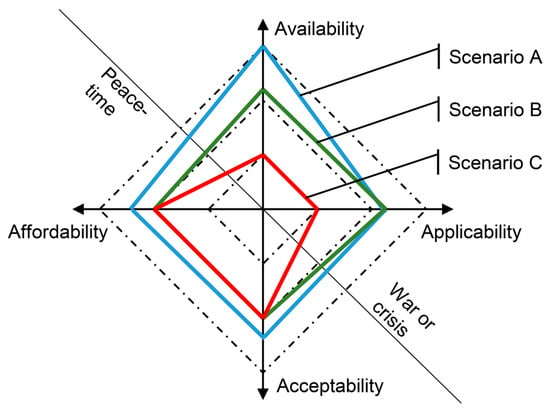
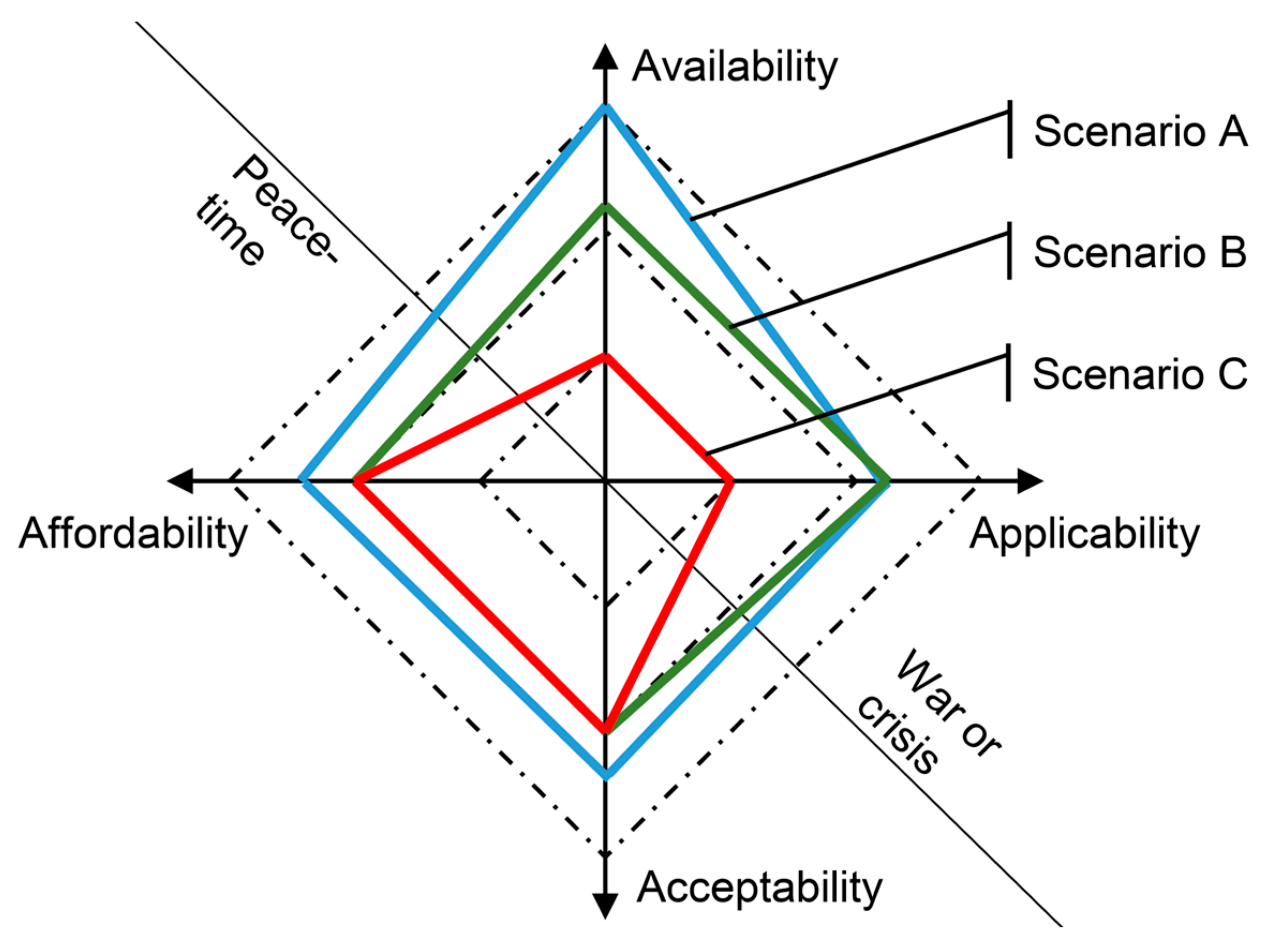
Based on the assessment in each dimension the scenarios A–C, three rhombuses are drawn in Figure 1. The differences between the three rhombuses show the strengths of Scenario A, especially in relation to availability during war and crisis, compared to Scenario C.
Figure 1.
Rhombuses illustrate the level of energy security for comprehensive national defence for the three development scenarios.
The assessment shows that sustainable, renewable, and local energy production provides for suitable energy production but also releases resources, energy, and liquid fuels to defence and other critical societal functions, and therefore also makes defence stronger. Scenario A increases the possibility for demand response system resilience. Also, Scenario B shows positive effects during war or crisis but requires a network topology suitable for the defence situation. Also, the results put a spotlight on the defence challenges related to large power production plants, the storage and distribution of liquid (fossil) fuels, and their respective dependence on national systems for energy distribution and transport. The effects of these challenges are also seen in the effects in Ukraine, summarized in Table 1.
Aiming for high energy production, low CO2 emissions, or low cost does not create a system suitable for a major national crisis. However, a system with high readiness for the national crisis does not contradict low CO2 emissions or low cost. High readiness is primarily dependent on large geographical distribution, local production, and storage prepared for island production and true renewable production independent of transport and specialised competence. Such systems have a higher probability of energy production and distribution during serious crises compared to traditional systems. This conclusion is shown in Ukraine for solar power, small hydropower, wind power, and bioenergy (Table 1). However, statistics from Ukraine do not address the extra system resilience that can be created by combining local production with local storage.
When energy is limited, local production by locally available resources, such as wind, solar, or biowaste, can reach levels, making sure that local core functions can continue. This is especially true if the need for heating can be reduced or if there is emergency heating available. War-time local energy production can if combined with local electric energy storage, power core functions for hospitals, communications, IT infrastructure, and even local transport with electric cars. The local electric storage capability also allows for continuous local power in situations with intermittent power distribution and, therefore, also contributes to local redundancy even if there is no local power production.
Large nuclear power plants and hydro plants cannot be protected sufficiently with military personnel. The risk, if an attack penetrates, is too large to allow. In contrast, solar parks and wind farms, if damaged, do not create large secondary consequences and, therefore, do not need to be protected. Such areas, therefore, should be considered as terrain and not critical assets. Therefore, solar parks and wind farms correctly considered can provide possibilities for advantages for the defending national forces, not a weakness. Such terrain gives an advantage to the forces that are best adapted to the conditions.
However, studies show that there also are some specific local effects of modern installations that can create negative effects on defence capability. However, such effects can be met with local adaptation of the energy system and/or defence system. At such places, a collaboration between defence actors and the specific installation owner is needed. Civilian installations cannot take military and defence considerations without input from defence actors with knowledge of the specific military needs and challenges [25]. Therefore, systems for acting on such problems on a case-by-case basis need to be introduced.
A focus, or even perceived focus, on stopping the development of more sustainable energy solutions and technology not only stops changes that strengthen comprehensive national defence. The negative focus also reduces the possible development of defence solutions that create specific defence advantages in geographical areas where sustainable energy solutions are implemented.
The configuration of the energy system must ensure that the energy system can support defence efforts and cannot expect military protection. The development described in Scenario A does not emerge by itself. Today, the typical solar cell installation in Europe neither has energy storage capability nor the possibility for off-grid operation. However, relatively low-cost incentive programs could drive local installations to configurations that also contribute to resilience and defence.
Stakeholders involved in comprehensive national defence planning and development do not have control over the society’s development and change. However, they have control over how to understand and meet changes. A proactive approach that aims to create opportunities rather than seeing changes as a threat will strengthen the supporting link between energy security and comprehensive national defence.
There are several aspects of the availability of energy that are of key importance for energy security that has not been covered here, especially related to complexities and challenges related to the relationship between civil infrastructure and defence. Further studies on other development scenarios, such as offshore wind farms, and more detailed analysis are needed. Also, there is a clear need for complementing this study with quantitative studies, especially if such studies combine real data with simulations of different future developments of national energy systems and their respective sensitivity to large-scale disturbances and damage. This study shows effects on both energy production and energy distribution. It is likely that these two effects magnify each other when put into an energy system that is under stress or attack. However, the magnitude of this non-linearity can only be assessed quantitatively.
8. Conclusions and Policy Implications
Energy security is an important bridge between sustainable development and comprehensive national defence. The configuration of the energy system must ensure that the energy system can support defence efforts. There are positive systemic effects of increasing the diversity of the energy system, especially for solutions that do not need external supply and do not risk creating large-scale effects if attacked. However, these changes to the energy system also lead to primarily local changes that affect warfare and defence. Such changes can be met by updated tactics and technology that would also give the defending force an advantage.
A focus, or even perceived focus, on stopping a development towards more sustainable energy solutions and technology not only stops changes that strengthen comprehensive national defence. The negative focus also reduces the possible development of defence solutions that create specific defence advantages in geographical areas where sustainable energy solutions are implemented.
Suitable development of the energy system does not emerge by itself. However, relatively low-cost incentive programs could drive local installations to configurations that also contribute to resilience and defence.
Institutions involved in comprehensive national defence planning and development do not have control over the society’s development and change. However, they have control over how to understand and meet changes. A proactive approach that aims to create opportunities rather than seeing changes as a threat will strengthen the supporting link between energy security and comprehensive national defence.
Funding
This research was funded by the Swedish Defence University (Fö 1:7) and the Swedish Armed Forces (AT. 9223082). The APC was funded by the Swedish Defence University.
Data Availability Statement
The data presented in this study are openly available in references [27,28].
Conflicts of Interest
The author declares no conflict of interest. The funders had no role in the design of the study, in the collection, analyses, interpretation of data, in the writing of the manuscript, or in the decision to publish the results.
References
- Roepke, W.-D.; Thankey, H. Resilience: The First Line of Defence. Available online: https://www.nato.int/docu/review/articles/2019/02/27/resilience-the-first-line-of-defence/index.html (accessed on 15 June 2023).
- Jiang, P.; Huang, S.; Zhang, T. Asymmetric Information in Military Microgrid Confrontations—Evaluation Metric and Influence Analysis. Energies 2020, 13, 1954. [Google Scholar] [CrossRef] [Scilit]
- Van Broekhoven, S.; Judson, N.; Galvin, J.; Marqusee, J. Leading the Charge: Microgrids for Domestic Military Installations. IEEE Power Energy Mag. 2013, 11, 40–45. [Google Scholar] [CrossRef] [Scilit]
- NATO NATO Stands up Undersea Infrastructure Coordination Cell. Available online: https://www.nato.int/cps/en/natohq/news_211919.htm?utm_source=linkedin&utm_medium=smc&utm_campaign=20230215&utm_id=webunderseacell (accessed on 26 April 2023).
- Amin, S.B.; Chang, Y.; Khan, F.; Taghizadeh-Hesary, F. Energy Security and Sustainable Energy Policy in Bangladesh: From the Lens of 4As Framework. Energy Policy 2022, 161, 112719. [Google Scholar] [CrossRef] [Scilit]
- Ang, B.W.; Choong, W.L.; Ng, T.S. Energy Security: Definitions, Dimensions and Indexes. Renew. Sustain. Energy Rev. 2015, 42, 1077–1093. [Google Scholar] [CrossRef] [Scilit]
- Månsson, A.; Johansson, B.; Nilsson, L.J. Assessing Energy Security: An Overview of Commonly Used Methodologies. Energy 2014, 73, 1–14. [Google Scholar] [CrossRef] [Scilit]
- Von Hippel, D.; Suzuki, T.; Williams, J.H.; Savage, T.; Hayes, P. Energy Security and Sustainability in Northeast Asia. Energy Policy 2011, 39, 6719–6730. [Google Scholar] [CrossRef] [Scilit]
- Vivoda, V. Evaluating Energy Security in the Asia-Pacific Region: A Novel Methodological Approach. Energy Policy 2010, 38, 5258–5263. [Google Scholar] [CrossRef] [Scilit]
- Wither, J.K. Back to the Future? Nordic Total Defence Concepts. Def. Stud. 2020, 20, 61–81. [Google Scholar] [CrossRef] [Scilit]
- Yao, L.; Chang, Y. Energy Security in China: A Quantitative Analysis and Policy Implications. Energy Policy 2014, 67, 595–604. [Google Scholar] [CrossRef] [Scilit]
- Berzina, I. From ‘Total’ to ‘Comprehensive’ National Defence: The Development of the Concept in Europe. J. Balt. Secur. 2020, 6(2), 1–9. [Google Scholar] [CrossRef] [Scilit]
- Hannay, J.E.; Gjørven, E. Leveraging Network-Centric Strategic Goals in Capabilities. J. Mil. Stud. 2021, 10, 90–104. [Google Scholar] [CrossRef] [Scilit]
- NATO. STO Futures Assessed alongside Socio-Technical Evolutions (FATE); Final Report of the SAS-123 Research Task Group; NATO Science and Technology Organization (STO): La Spezia, Italy, 2021. [Google Scholar]
- De Spiegeleire, S. Ten Trends in Capability Planning for Defence and Security. RUSI J. 2011, 156, 20–28. [Google Scholar] [CrossRef] [Scilit]
- Liwång, H.; Andersson, K.E.; Bang, M.; Malmio, I.; Tärnholm, T. How Can Systemic Perspectives on Defence Capability Development Be Strengthened? Def. Stud. 2023, 23, 399–420. [Google Scholar] [CrossRef] [Scilit]
- Baublys, J.; Miškinis, V.; Konstantinavičiūtė, I.; Lekavičius, V. Energy Efficiency as a Precondition of Energy Security. J. Secur. Sustain. Issues 2015, 4, 197–208. [Google Scholar] [CrossRef] [Scilit]
- Rehak, D.; Markuci, J.; Hromada, M.; Barcova, K. Quantitative Evaluation of the Synergistic Effects of Failures in a Critical Infrastructure System. Int. J. Crit. Infrastruct. Prot. 2016, 14, 3–17. [Google Scholar] [CrossRef] [Scilit]
- Nan, C.; Sansavini, G. A Quantitative Method for Assessing Resilience of Interdependent Infrastructures. Reliab. Eng. Syst. Saf. 2017, 157, 35–53. [Google Scholar] [CrossRef] [Scilit]
- Rehak, D.; Senovsky, P.; Hromada, M.; Lovecek, T. Complex Approach to Assessing Resilience of Critical Infrastructure Elements. Int. J. Crit. Infrastruct. Prot. 2019, 25, 125–138. [Google Scholar] [CrossRef] [Scilit]
- Rocchetta, R. Enhancing the Resilience of Critical Infrastructures: Statistical Analysis of Power Grid Spectral Clustering and Post-Contingency Vulnerability Metrics. Renew. Sustain. Energy Rev. 2022, 159, 112185. [Google Scholar] [CrossRef] [Scilit]
- Lundberg, J.; Johansson, B.J. Systemic Resilience Model. Reliab. Eng. Syst. Saf. 2015, 141, 22–32. [Google Scholar] [CrossRef] [Scilit]
- Lindberg, H.; Sundelius, B. Whole-of-Society Disaster Resilience: The Swedish Way. In The McGraw-Hill Homeland Security Handbook; Kamien, D., Ed.; McGraw-Hill: New York, NY, USA, 2012; pp. 1295–1319. [Google Scholar]
- Cedergren, A. Challenges in Designing Resilient Socio-Technical Systems: A Case Study of Railway Tunnel Projects. In Proceedings of the Fourth Resilience Engineering Symposium; Hollnagel, E., Rigaud, E., Eds.; Presses des Mines: Sophia Antipolis, France, 2011; pp. 58–64. ISBN 9782911256479. [Google Scholar]
- Liwång, H. Defense Development: The Role of Co-Creation in Filling the Gap between Policy-Makers and Technology Development. Technol. Soc. 2022, 68, 101913. [Google Scholar] [CrossRef] [Scilit]
- Tärnholm, T.; Liwång, H. Military Organisations and Emerging Technologies–How Do Unmanned Systems Find a Role in Future Navies? J. Mil. Stud. 2022, 11, 37–48. [Google Scholar] [CrossRef] [Scilit]
- IEA. Ukraine Real-Time Electricity Data Explorer. Available online: https://www.iea.org/data-and-statistics/data-tools/ukraine-real-time-electricity-data-explorer (accessed on 30 November 2022).
- Energy Charter Secretariat. Ukrainian Energy Sector Evaluation and Damage Assessment-IV (as of 24 November 2022); Energy Charter Secretariat: Brussels, Belgium, 2022. [Google Scholar]
- EUROSTAT. Energy, Transport and Environment Statistics; European Union: Luxembourg, 2020.
- Van Zoest, V.; Lindberg, K.; El Gohary, F.; Bartusch, C. Evaluating the Effects of the COVID-19 Pandemic on Electricity Consumption Patterns in the Residential, Public, Commercial and Industrial Sectors in Sweden. Energy AI 2023, 14, 100298. [Google Scholar] [CrossRef] [Scilit]
- Kumar, S.; Saket, R.K.; Dheer, D.K.; Holm-Nielsen, J.B.; Sanjeevikumar, P. Reliability Enhancement of Electrical Power System Including Impacts of Renewable Energy Sources: A Comprehensive Review. IET Gener. Transm. Distrib. 2020, 14, 1799–1815. [Google Scholar] [CrossRef] [Scilit]
- Pérez, M.; Torres, J.L.; Álvarez, J.D.; Gil, J.D.; Barnetche, M.; Osorio, N.; Cerda, M.T. Integrating Solar Heat in Energy Micro-Grids for Small Scale Productive Communities. AIP Conf. Proc. 2022, 2445, 140011. [Google Scholar]
- Bódis, K.; Kougias, I.; Jäger-Waldau, A.; Taylor, N.; Szabó, S. A High-Resolution Geospatial Assessment of the Rooftop Solar Photovoltaic Potential in the European Union. Renew. Sustain. Energy Rev. 2019, 114, 109309. [Google Scholar] [CrossRef] [Scilit]
- Swedish Ministry of Defence Motståndskraft. Inriktningen Av Totalförsvaret Och Utformningen Av Det Civila Försvaret 2021–2025 [Resilience, The Direction of Total Defence and the Design of Civil Defense 2021–2025] (Ds 2017:66); Swedish Ministry of Defence: Stockholm, Sweden, 2017. [Google Scholar]
- U.S. Congress Office of Technology Assessment. Physical Vulnerability of Electric System to Natural Disasters and Sabotage (OTA-E-453); U.S. Congress Office of Technology Assessment: Washington, DC, USA, 1990. [Google Scholar]
- National Energy Policy Development Group. National Energy Policy, Reliable, Affordable, and Environmentally Sound Energy for America’s Future; White House: Washington, DC, USA, 2001. [Google Scholar]
- National Research Council Making the Nation Safer. The Role of Science and Technology in Countering Terrorism; National Research Council Making the Nation Safer: Washington, DC, USA, 2002. [Google Scholar]
- Sun, C.-C.; Hahn, A.; Liu, C.-C. Cyber Security of a Power Grid: State-of-the-Art. Int. J. Electr. Power Energy Syst. 2018, 99, 45–56. [Google Scholar] [CrossRef] [Scilit]
- Sridhar, S.; Hahn, A.; Govindarasu, M. Cyber–Physical System Security for the Electric Power Grid. Proc. IEEE 2012, 100, 210–224. [Google Scholar] [CrossRef] [Scilit]
- Gür, T.M. Review of Electrical Energy Storage Technologies, Materials and Systems: Challenges and Prospects for Large-Scale Grid Storage. Energy Environ. Sci. 2018, 11, 2696–2767. [Google Scholar] [CrossRef] [Scilit]
- Van Zoest, V.; El Gohary, F.; Ngai, E.C.H.; Bartusch, C. Demand Charges and User Flexibility–Exploring Differences in Electricity Consumer Types and Load Patterns within the Swedish Commercial Sector. Appl. Energy 2021, 302, 117543. [Google Scholar] [CrossRef] [Scilit]
- Khezri, R.; Mahmoudi, A.; Aki, H. Optimal Planning of Solar Photovoltaic and Battery Storage Systems for Grid-Connected Residential Sector: Review, Challenges and New Perspectives. Renew. Sustain. Energy Rev. 2022, 153, 111763. [Google Scholar] [CrossRef]
- Bueger, C.; Liebetrau, T.; Franken, J. Security Threats to Undersea Communications Cables and Infrastructure–Consequences for the EU. 2022. Available online: https://www.europarl.europa.eu/RegData/etudes/IDAN/2022/702557/EXPO_IDA(2022)702557_EN.pdf (accessed on 15 June 2023).
- Hernandez-Morales, A. The French War over Onshore Wind Farms; Politico: Brussels, Belgium, 2020. [Google Scholar]
- Swedish Armed Forces. Utredning Av Elektromagnetiska Störningars Försvårande För Totalförsvarets Intressen Eller Anläggningar [Investigation of Electromagnetic Disturbances Aggravating the Interests of Total Defense or Facilities]; FM2020-22728:17; Swedish Armed Forces: Stockholm, Sweden, 2020. [Google Scholar]
- Niiler, E. The Military Is Locked in a Power Struggle With Wind Farms; Wired: London, UK, 2019. [Google Scholar]
- Biddle, J. Wind Turbine–Radar Interference Mitigation Project ID # M11. 2018. Available online: https://www.energy.gov/sites/prod/files/2019/05/f63/MIT-LL%20-%20M11%20-%20Biddle%20-%20FINAL%2020190408.pdf (accessed on 15 June 2023).
- Von Clausewitz, C. III. Drittes Buch: Von Der Strategie Überhaupt. 15. Kapitel Geometrisches Element. In Vom Kriege; Hahlweg, W., Ed.; Dümmle: Bonn, Germany, 1991. [Google Scholar]
- Von Clausewitz, C. VI. Sechstes Buch: Verteidigung. 12. Kapitel Defensivstellung. In Vom Kriege; Hahlweg, W., Ed.; Dümmler: Bonn, Germany, 1991. [Google Scholar]
- Till, G. Who Said What and Why It Maters. In Seapower: A Guide for the Twenty-First Century; Routledge: Abingdon, UK, 2009; pp. 39–82. [Google Scholar]
- Hughes, W.P. The Evolution of Tactics in the Age of Missile Warfare. In Fleet Tactics and Coastal Combat; Naval Institute Press: Annapolis, MD, USA, 2018; pp. 141–162. [Google Scholar]
- Li, Y.; Chang, Y. Road Transport Electrification and Energy Security in the Association of Southeast Asian Nations: Quantitative Analysis and Policy Implications. Energy Policy 2019, 129, 805–815. [Google Scholar] [CrossRef] [Scilit]
- Bigg, M.M. Ukraine Dam Disaster: What We Know. The New York Times, 7 June 2023.
- Burke, A. Attacks on Ukrainian Nuclear-Power Plants Challenge Treaties. Nature 2022, 611, 232–235. [Google Scholar] [CrossRef] [Scilit] [PubMed]
- Chepeliev, M.; Diachuk, O.; Podolets, R.; Semeniuk, A. What Is the Future of Nuclear Power in Ukraine? The Role of War, Techno-Economic Drivers, and Safety Considerations. Energy Policy 2023, 178, 113612. [Google Scholar] [CrossRef] [Scilit]

Disclaimer/Publisher’s Note: The statements, opinions and data contained in all publications are solely those of the individual author(s) and contributor(s) and not of MDPI and/or the editor(s). MDPI and/or the editor(s) disclaim responsibility for any injury to people or property resulting from any ideas, methods, instructions or products referred to in the content. |
© 2023 by the author. Licensee MDPI, Basel, Switzerland. This article is an open access article distributed under the terms and conditions of the Creative Commons Attribution (CC BY) license (https://creativecommons.org/licenses/by/4.0/).