


Abstract
Global warming is a critical crisis threatening human survival and development. International organizations and countries worldwide are introducing policies and practices to achieve carbon neutrality. In China, numerous carbon neutrality policies have been established; however, a systematic understanding of the underlying policy logic is lacking. Using the institutional analysis and development (IAD) framework, this paper analyzes selected carbon neutrality policies in China. We conducted a bibliometric visualization analysis of the texts of 20 policies and matched their logic to the elements of the IAD framework. We established 90 keywords with occurrences of no less than 10 times in China’s carbon neutrality policies. The network visualization analysis identified six clusters. We discuss implementation challenges of China’s carbon neutrality policies, address the policy implementation, and finally outline impacts on China’s carbon neutrality governance. This study responds to the global concern over China’s carbon neutrality commitments by clarifying the institutional logic of China’s policies and actions. This study could provide a reference for countries worldwide that are designing and introducing carbon neutrality policies.
1. Introduction
Global warming is the most challenging contemporary development crisis in the world. The Intergovernmental Panel on Climate Change (IPCC) issued a “code red for humanity” warning given current and projected climate change [1]. Since the establishment of the United Nations Framework Convention on Climate Change (UNFCCC) in 1992, countries around the world have introduced various policies that target carbon dioxide (CO2) emissions reduction. These involve varied initiatives to regulate carbon emissions (Germany), energy transitions (Japan), zero-carbon technological innovations (United States), and market-based carbon policy instruments (United Kingdom) [2].
As the world’s second-largest economy and the most populous country, China is the biggest emitter of CO2 emissions, accounting for 30 percent of global emissions. Its climate action is critical for global climate governance and has naturally attracted much attention. Over the last two decades, China has introduced a series of national policy priorities on carbon emissions and climate change, including programs of New Industrialization (2002), Circular Economy (2003), Resource-Saving and Environmentally Friendly Society (2005), Low-Carbon Development (2009), and Ecological Civilization Construction (2012) [3]. More recently, China’s President, Xi Jinping, has made important speeches at numerous international events—including the General Debate of the 75th Session of the United Nations General Assembly (2020), the United Nations Summit on Biodiversity (2020), the 3rd Paris Peace Forum (2020), the 12th BRICS Summit (2020), and the G20 Leaders’ Summit (2021)—solemnly announcing China’s growing focus on adopting more vigorous policies, and striving to reach its carbon peak by 2030 and achieve carbon neutrality by 2060. The latter announcement made at COP 26 in 2021 has set a new policy milestone for carbon neutrality governance in China.
A growing body of literature addresses China’s carbon neutrality policies. Much of this research has a relatively narrow focus, mostly approaching policy-making from legal [4], taxation [5], finance [6], and science and innovation [7] standpoints. Consideration of the institutional logic is missing across these studies. The latter is necessary to foster the right kind of institutional structures that can, in turn, support robust climate policy implementation [8,9]. To fill this gap, this research applies Elinor Ostrom’s institutional analysis and development (IAD) framework. The framework is widely recognized as a leading guide to gain policy insights, clarify institutional elements, and explore various mechanisms of policy action. In doing so, this study achieves multiple objectives: (i) it responds to the global concern over China’s carbon neutrality actions, (ii) identifies the institutional logic of China’s climate and energy policies, and (iii) presents the elemental structure of China’s carbon neutrality governance. A better understanding of these three aspects provides a basis for supporting China’s carbon neutrality policy aspirations, as well as offering lessons on climate policy design and governance for other countries.
The rest of the paper is organized as follows. Section 2 offers a literature review on carbon neutrality and related policies in China. Section 3 discusses the conceptual analytical framework used to explore carbon neutrality policies in China. Section 4 describes data sources and methods. Section 5 presents the results of the bibliometric visualization of China’s carbon neutrality policies. Section 6 discusses China’s carbon neutrality policy implementation and logic. Finally, in Section 7, we conclude the paper with key findings.
2. Understanding Carbon Neutrality
2.1. Carbon Neutrality
As of 2 November 2021, more than 140 countries had committed to carbon neutrality targets, covering 90% of global carbon emissions [10]. Thus far, however, only Suriname and Bhutan have achieved carbon neutrality [11]. Theoretically, carbon neutrality (i.e., net zero CO2 emissions) can only be achieved when anthropogenic CO2 emissions are balanced by anthropogenic CO2 removals [12].
Achieving net zero CO2 emissions requires systematic changes to how regions plan their economic and social development. This necessitates a profound transformation of the existing industrial structure, energy composition, modes and spatial patterns of production, and lifestyle. Market forces alone are unlikely to help achieve carbon neutrality, thereby signifying the reliance on national policies [13] and public institutions [14]. Anthropogenic CO2 removal through artificial sequestration or biological absorption [15,16] requires appropriate institutional response [17]. For example, the European Union (EU) member states have incorporated carbon neutrality actions into the European Climate Law [18], which is both a product of their efforts to uphold the UNFCCC and a response to public calls for stronger environmental legislation [19]. The EU has also formulated the European Green Deal, which encompasses key areas of energy, electricity, industry, transportation, construction, agriculture, and automobiles to form a series of specific carbon neutrality institutions and policy systems. Similarly, the US has proposed to enact legislation to implement comprehensive environmental justice by 2025 [20], and introduced the Clean Energy Revolution Plan to achieve a 100% clean energy economy.
2.2. Carbon Neutrality Policies in China
Public policy includes all areas where governments choose to act (or not act) [21]. Moreover, for actions to be considered policy, focus needs to be on commitment, not intent [22]. Scholars of political science, public governance, and sociology have widely studied the analysis of complex public phenomena, policy mechanisms, and what constitutes effective governance [23]. It has long been recognized that the pursuit of national interests and civic values is not meaningful in the absence of appropriate policy context [24]. The nature and scope of public policies directly affect economic and social development outcomes and the effectiveness of governance [25].
Institutional logic is an important element in understanding institutional orders and policy choices [26,27,28,29]. In the context of carbon neutrality, stringent policy contributes to better climate change mitigation outcomes [30]. A weak policy could be ineffective in climate mitigation, or exacerbate the carbon footprint [31]. Robust policymaking has paved the way for many countries (e.g., Sweden and Finland) to reduce their carbon footprints [32,33].
It is widely believed that effective policymaking is the key factor to help China achieve carbon neutrality [34]. Nationally, several carbon neutrality policies have been recently established to achieve carbon peaking by 2030 and carbon neutrality by 2060. They are often referred to as ‘1 + N’ [35]. Here, ‘1’ refers to the ‘Opinions on Complete and Accurate Implementation of the New Development Concept and Carbon Peaking & Carbon Neutrality of the Central Committee of the Communist Party of China (CCCPC) and the State Council of China (SCC)’, while ‘N’ denotes the ‘SCC’s Action Plan for Carbon Peaking by 2030’ and a series of other carbon neutrality policies in key areas and industries.
China’s carbon neutrality policy is already comparable with that of other major CO2 emitter countries and regions (for example, the EU, the US, and Japan) (Table 1). However, China’s carbon neutrality policy implementation has only just begun, and faces a range of challenges. Until now, there has been little research on China’s carbon neutrality policies despite the world’s growing scrutiny of China’s action on climate change. In particular, there is limited understanding of the institutional logic of China’s carbon neutrality policies and practices. This paper aims to shed more light on the logic and institutional fabric of China’s carbon policy landscape using the IAD framework.
Table 1.
Carbon neutrality policy comparison between China and other major CO2 emitters.
3. Conceptual Analytical Framework: Institutional Analysis and Development (IAD) Framework
3.1. What Is the IAD Framework?
Elinor Ostrom’s IAD framework has developed into one of the most influential institutional theories. As a metatheoretical language for institutional research, the IAD framework holds great value for institutional and policy analysis [36]. It provides a shared language for discussing the impact of various attributes and rules on the structure of the action arena and the outcomes faced by actors from an institutional and policy perspective. The IAD framework has been applied to analyze underlying complexities across several policy areas, including the management of common pool resources, public crises, and resource allocations. Iterations to the IAD theoretical framework have also been attempted in the past. For example, Araral and Amri [37] proposed a series of specific questions for policy research in conjunction with specific stages of the policy process, which they call IAD 2.0, while others have revised it as the “Institutional Analysis and Reconfiguration Framework” [38]. Drawing on the IAD framework, Ostrom herself developed a socio-ecological system analysis approach that highlighted biophysical properties in the institutional development [39]. Additionally, scholars [40] have tried to integrate other theories or research methods with the IAD framework (such as institutional syntax) to facilitate an in-depth study of the interactive relationship and endogenous logic between institutions and policies. Existing research demonstrates the IAD framework’s suitability to examine China’s public policies on water resources [41], urbanization governance [42,43], and ecological conservation [44].
3.2. Constituent Elements of the IAD Framework
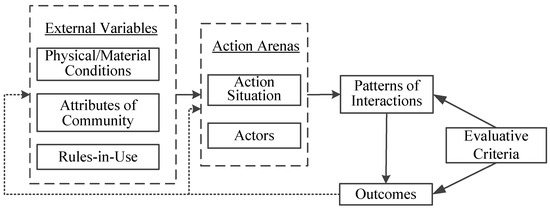
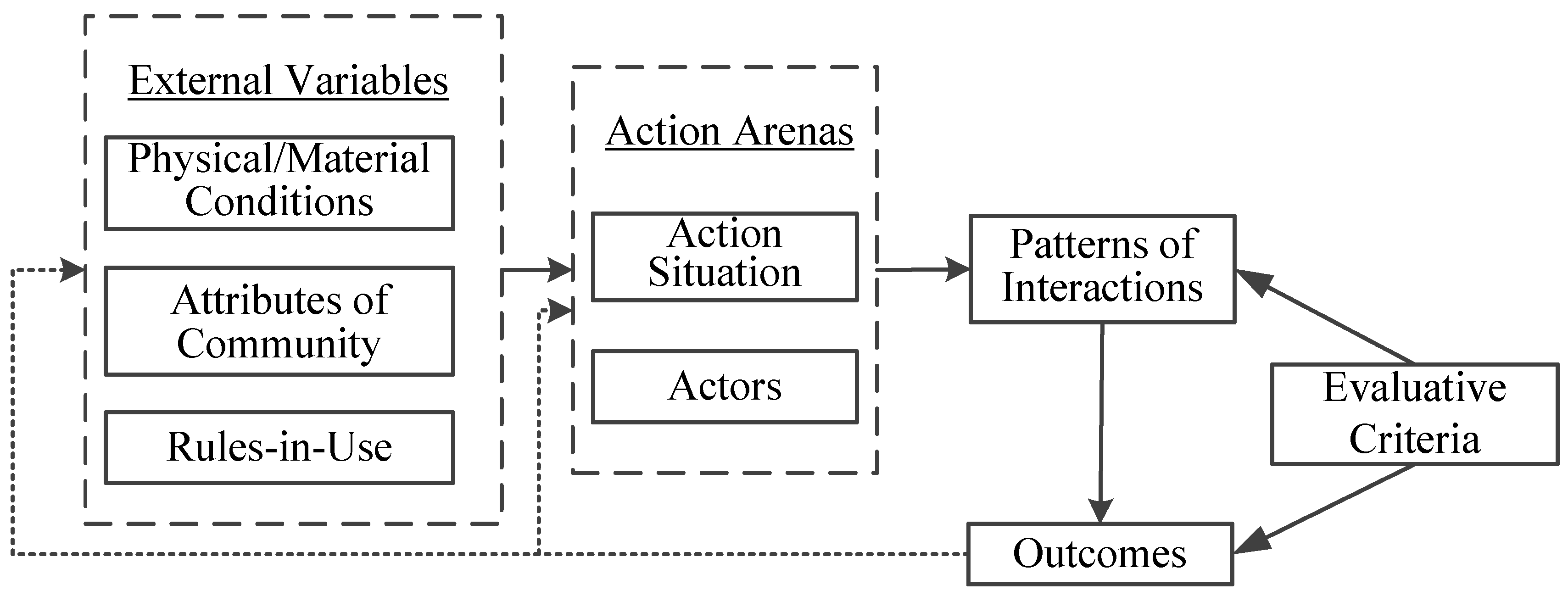
The central institutional elements of the IAD framework are external variables, action arenas, patterns of interactions, outcomes, and evaluative criteria (Figure 1).
Figure 1.
Conceptual analytical framework [45].
The primary institutional element is the action arena, which is used to describe, analyze, predict, and explain the policies. The action arena includes the action situation and actors as the core variables. The former represents the policy internal environment, and includes seven specific variables that influence policy formulation and implementation (Table 2). The latter takes the leading role in policy development and implementation, and the behavior of actors significantly affects the outcome of policy implementation. According to Elinor Ostrom’s [45] assumptions about actors, the behavioral outcomes of actors in policy design may vary depending on the nature of resources brought in by decision-makers, the action steps taken, the assessment of actions, and the access to—and use of—information.
Table 2.
Environmental variables of the action arena.
As shown in Figure 1, three elements (physical and material conditions, attributes of community, and rules-in-use) comprise external variables that affect the action arena. In the policy context, physical and material conditions influence decision-making and implementation, while also indicating policy orientation and governance key points. Community attributes serve as a lubricant for the formulation and implementation of policies, showcasing the interface with actors. The rules-in-use form the guaranteed network for effective policy implementation and regulate the action order and requirements of policy actors.
Patterns of interactions are specific pathways that guide policy implementation. These patterns are often reinforced, and the corresponding action outcomes are produced through a series of institutionalized and non-institutionalized action arrangements, as well as the combined effects of external variables and action arenas. In other words, outcomes are the synergistic effects of different elements through a series of policy arrangements. Simultaneously, as an institutional element, the outcome itself will in turn affect external variables and the action arena. Specifically, if the action outcomes are significant (both good and bad) after being measured by evaluative criteria, they may influence other institutional elements (external variables, the action arena and even the patterns of interactions), thereby resulting in an iterative loop that would influence shifts in external variables and action attributes.
4. Data and Methods
4.1. Data
This research analyzed 20 formal documents representing key carbon neutrality policies in China, including the 14th Five Year Plan, national regulations, provincial work plans, guidelines, and opinions. Websites of national and provincial governments covering the period between 2017 and 2022 provided access to these documents. To maintain consistency, search was performed in the documents’ original language, Chinese. A combination of the following keywords were used: ‘climate change’, ‘climate governance’, ‘carbon governance’, ‘low carbon development’, ‘green development’, ‘ecological civilization construction’, ‘carbon peaking’, and ‘carbon neutrality’. Only those documents that were closely related to carbon neutrality were selected (Table 3). For some documents, specific sections were used that best aligned with the study’s primary focus on carbon neutrality. For example, in The 14th Five-Year Plan for the National Economic and Social Development of the People’s Republic of China and the Outline of Long-Term Goals for 2035, we extracted Section 4 of Chapter 38 titled “Actively Responding to Climate Change”. The total length of the documents studied was 140,000 words.
Table 3.
Key carbon neutrality policies in China.
4.2. Methods
All policy texts were preprocessed by ROST CM6.0 (ROST), a large-scale data mining software developed by Professor Shen Yang’s team in China [47], to assist researchers in the humanities and social sciences. Both the classification and the test corpus of ROST experiments are in Chinese and well-adapted for Chinese text preprocessing [48]. Then, data cleaning and manual noise reduction were also performed, such as the standardization and unification of synonyms and the removal of words with no real meaning (such as dummy words, prepositions, and ordinal numbers).
Subsequently, we conducted a bibliometric visualization analysis of China’s carbon neutrality documents. Bibliometrics is the cross-disciplinary science of quantitative analysis of knowledge carriers using statistical methods [49]. It is a commonly used method to identify the relationship between different keywords [50,51]. Accordingly, the data on the occurrences, links, and total link strength of different terms in the visualization were analyzed by VOSviewer (version 1.6.1) (Table 4).
Table 4.
Explanation of analytical elements in the bibliometric method.
Based on the conceptual analytical framework, the institutional elements (external variables, action arenas, and patterns of interactions), logical structure, and interactive mechanisms of China’s carbon neutrality policies were clarified (see Figure 1). VOSviewer is a free software developed by Van Eck and Waltman [52]. It is a powerful tool that performs co-occurrence analysis and bibliometric visualization [53]. The occurrences suggest the frequency of the keyword. The more frequent the co-occurrence of different keywords, the more likely they will be classified into the same cluster. In other words, a cluster refers to a set of items that are included in a network and are not necessarily exhaustive [54]. Clustering techniques play a prominent role in bibliometric research because the software algorithms can automatically classify a large number of keywords [55].
5. Results
5.1. Keyword Frequency Analysis
We imported the noise-reduced text data into VOSviewer software; then, the keywords with occurrences of no less than 10 were derived. As Table 5 demonstrates, the occurrences of ‘carbon peaking and carbon neutrality’ are the highest, appearing 94 times, whereas the links with other words and total link strength are also highly significant, at 206 and 645, respectively. Notably, most of the keywords have clear institutional attributes. At this stage, for example, China must strengthen the protection of the ‘ecological environment’, actively respond to ‘climate change’, and fulfill the relevant commitments of the ‘Paris Agreement’, all of which comprise the physical and material conditions that necessitate China to introduce carbon neutrality policies. Consequently, the Chinese government has launched a series of policy requirements and rules (such as the establishment of the ‘standard system’, ‘regulations’, and ‘ecological protection red line’). These are aimed to support actors (‘municipal cities’, ‘enterprises’, ‘key emitter’, and ‘county government’) in promoting carbon reduction and to prioritize carbon governance in key areas and industries (such as ‘steel’, ‘energy’, and ‘transportation’). These actors are tasked with the overall reduction in greenhouse gas emissions by various patterns of interactions, such as ‘eco-environmental protection’ and ‘comprehensive green transformation’.
Table 5.
Keyword occurrence statistics (occurrences ≥ 10).
To conduct a more in-depth analysis, we carried out further classification analysis based on the semantics of the keywords and the context of the policy texts in which they originated. These keywords correspond to the ‘institutional elements’ of the conceptual analytical framework. The framework provides the opportunity to gain insights into the logic of carbon neutrality policies at the macro-level and the mechanism of interaction between different institutional elements at the micro-level. For example, we find that the actor ‘municipal cities’ has the highest number of occurrences among all actors (63), while its links and total link strength are 130 and 254, respectively. All three values are relatively high. In practice, the central government often plays the role of general coordinator and allocates tasks to provincial government in the process of China’s policy development [56]. Subsequently, each province carries out task outsourcing or target allocation to its subordinate ‘municipal cities’. Counties are the ultimate actors of policy implementation, and the effectiveness of their implementation is highly related to the quality of the translation of documents by ‘municipal cities’. The latter needs to connect with national strategies and provincial plans, but also accurately translate documents in a detailed manner based on the prevailing context of ‘municipal cities’. This, in turn, signifies the emphasis that the Chinese municipal government places on the role of ‘municipal cities’ in the design of carbon neutrality policies. China has incorporated additional multiple actors (such as enterprises, top emitters, key industries, financial agencies, local governments, and departments) into the decision-making and implementation of carbon neutrality policies. This has been carried out with the aim of establishing a top-down, tightly knit network of actors so that the institutional advantages of China’s ‘whole nation system’ can be fully used and exploited [57].
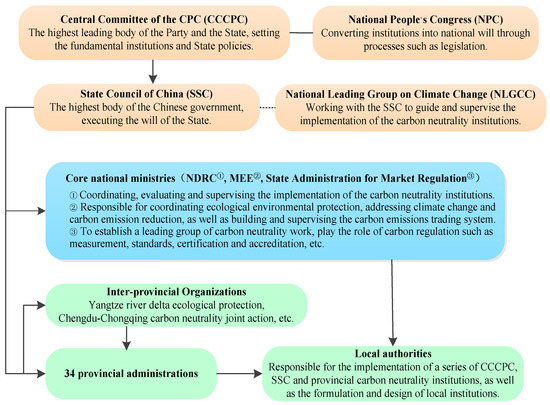
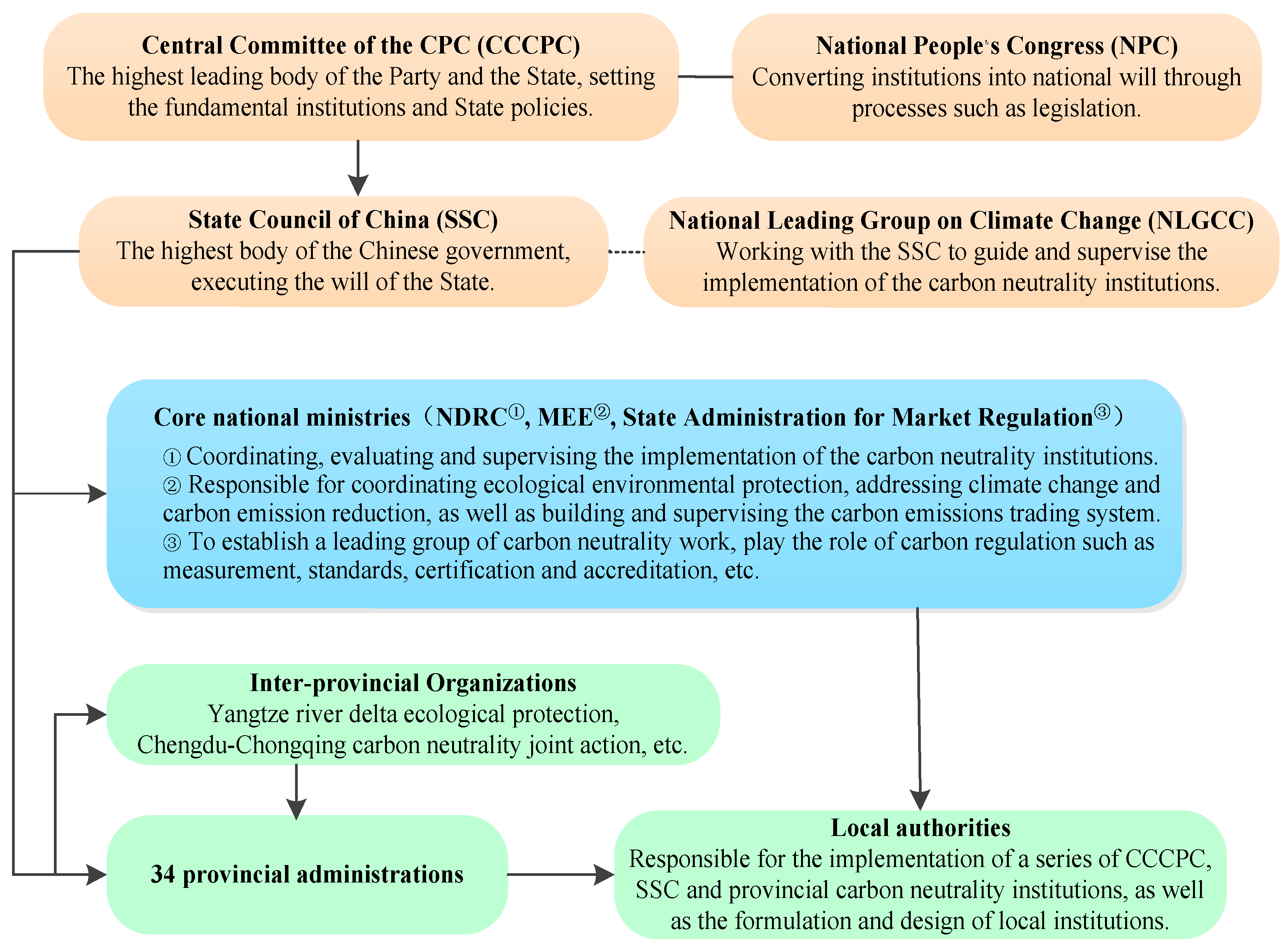
In the comparison of different actors, the government’s role is relatively dominant. This finding may be related to the fact that China is currently in the initial stage of carbon neutrality governance, where government institutions and policies tend to play a greater role than market mechanisms [58]. Moreover, this phase is often a period of intensive policy introduction; thus, the government naturally becomes the most prominent actor in the action arena. In terms of the levels of government, the CCCPC is the highest leadership body responsible for carbon neutrality policies. The National People’s Congress (NPC) is accountable for translating policy arrangements into national willingness, while the SCC is responsible for policy implementation. Additionally, there are specialized leadership working groups, such as the National Leading Group on Climate Change, which collaborates with the SCC to guide and supervise policy implementation by national ministries, interprovincial organizations, and provincial governments (Figure 2). This institutionalized arrangement of administrative actors offers a concrete manifestation of China’s ‘whole nation system’. Undoubtedly, however—in addition to government actors—there are other important actors including enterprises and the Chinese society, which are not only institutionalized objects but remain key forces that facilitate the implementation of carbon neutrality policies.
Figure 2.
Structure of carbon neutrality government actors in China. Source: Authors’ compilation.
5.2. Co-Occurrence Network and Visualization
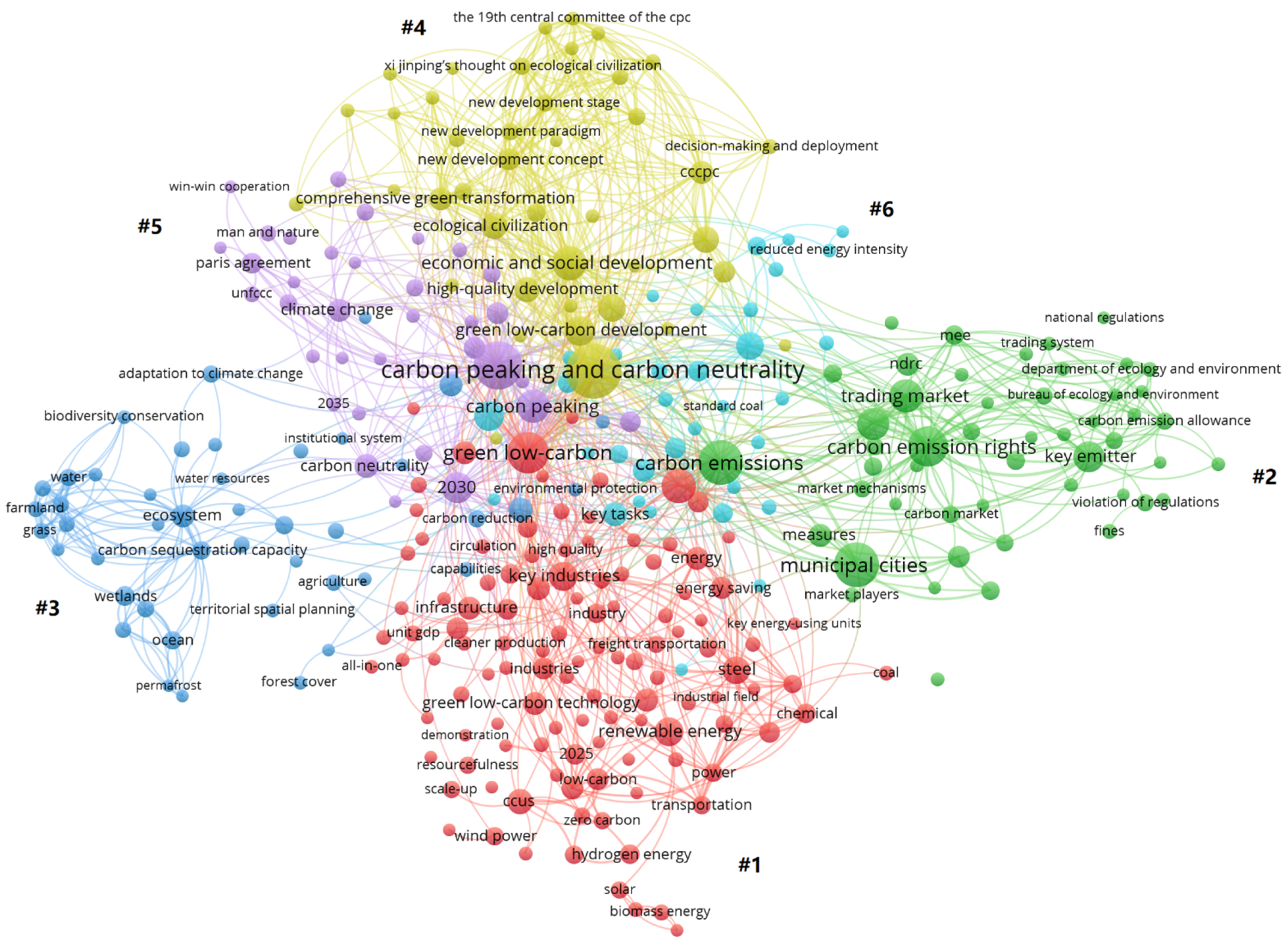
In the network visualization analysis, a total of 317 keywords (represented by nodes) appeared when the minimum number of keyword occurrences was set to five (Figure 3). The size of each node represents keyword occurrences, with larger nodes representing higher word occurrences. The lines connecting two nodes depict the co-occurrence of two keywords in one sentence or one paragraph. The network graph is color-coded based on clustering. In total, six clusters were identified.
Figure 3.
Network visualization of China’s carbon neutrality policies. Source: Generated by the authors.
Among all the keywords, the values of links and total link strength reached 8403 and 13,764, respectively. The terms of ‘carbon peaking and carbon neutrality’ are particularly striking, with three values of occurrence, link, and total link strength reaching 94, 206, and 645 respectively, thus accounting for the highest counts among all keywords. The three keywords with the most frequent links to ‘carbon peaking and carbon neutrality’ are ‘municipal cities’, ‘green low-carbon’, and ‘economic and social development’, with counts of 19, 19, and 15, respectively. These links support the carbon neutrality policy logic in China. Firstly, ‘municipal cities’ is the most important level of government directly accountable for local carbon neutrality (as discussed in the previous section). Secondly, the links with ‘green low-carbon’ and ‘economic and social development’ further substantiate China’s carbon neutrality as an essential driver of green low-carbon development which, in turn, underpins contemporary national planning for economic and social development.
At the same time, the keywords ‘carbon peaking’ and ‘carbon neutrality’ are also found separately in the network visualization because the semantics and contexts of ‘carbon peaking’ and ‘carbon neutrality’ are not identical across different policy texts. In some cases, policy makers may emphasize the importance of both, while in other cases, they may highlight only ‘carbon peaking’ or ‘carbon neutrality’ in specific contexts and situations. We note the occurrences, links, and total link strength of the keywords ‘carbon peaking’ (35, 156, and 354, respectively) and ‘carbon neutrality’ (19, 100, and 159, respectively).
Among the six clusters in the network visualization of China’s carbon neutrality policies, Cluster 1 (#1 red) is very complex among all clusters with 114 nodes. From a content standpoint, the range of keywords in Cluster 1 is relatively broad, covering various institutional elements of the conceptual analytical framework, including external variables (e.g., carbon neutrality, ecological environment, response to climate change, and Paris Agreement), action arenas (e.g., key industries namely coal, steel, infrastructure, architecture, petrochemicals, and energy transitions—including biomass, hydrogen, wind, and geothermal), and patterns of interactions (e.g., green transformation, energy saving and storage, standardization, resourcefulness, and integrated utilization).
Cluster 2 (#2 green) contains 50 keywords/nodes, most of which are actors with specific roles in the decision-making and implementation of China’s carbon neutrality policies, such as ‘municipal cities’, ‘NDRC’, ‘MEE’, ‘People’s Government’, and ‘key emitter’. Additionally, there are many keywords (such as ‘carbon market’, ‘carbon emission rights & allowance’, ‘trading market’, ‘Chinese certified emission reduction’, and ‘fines’) whose attributes demonstrate patterns of interactions, indicating the policy logic behind China’s carbon neutrality. By retracing the context and semantics of the original policy texts in which these keywords are found, we find that China is trying to develop different patterns of interactions as the logical starting point for implementing carbon neutrality policies.
Cluster 3 (#3 blue) highlights the action situation and ecological objects for the implementation of China’s carbon neutrality policies, such as ‘wetlands’, ‘ocean’, ‘grassland’, ‘forest’, and ‘water’ (with 44 keywords/nodes in total).
Cluster 4 (#4 yellow) has 41 keywords/nodes, mainly describing community attributes as a significant external variable. It is emphasized that China and other countries in the world are a community with a shared future for humankind [59] that should strive to achieve ‘carbon peaking and carbon neutrality’ as soon as possible. In brief, the community needs to focus on the synergy between ‘economic and social development’ and ‘green and low-carbon development’, to implement China’s ‘new development concept’ and the ‘new development paradigm’.
Next, Cluster 5 (#5 purple) has 34 keywords/nodes that primarily describe external variables (such as ‘UNFCCC’, ‘global climate governance’, ‘global response to climate change’, and ‘Paris Agreement’) and carbon neutrality policies (such as ‘1 + N policy system’ and ‘policy measures’). It shows that China considers international conventions as important sources of rules-in-use and policy references.
Finally, Cluster 6 (#6 azure blue) has 34 keywords/nodes. It primarily presents patterns of interactions whose central theme is the control of energy consumption intensity and quantity (main keywords include ‘carbon emission intensity’, ‘control goals of energy consumption intensity and quantity’, ‘energy consumption’, and ‘high/total energy consumption’). At the same time, evaluative criteria emerge in this cluster, suggesting that the most important evaluative object is energy consumption.
6. Discussions and Implications
6.1. Challenges in China’s Carbon Neutrality Policy Implementation
As the largest carbon emitter in the world, China has a much stronger relationship between economic growth and carbon emissions, particularly when considered against comparable OECD countries. Its large population having been on an upward economic mobility pathway for many decades has continued to generate a strong demand for materials and resources. This poses a significant challenge for China in implementing its carbon neutrality policies [60].
China’s industrial structure is dominated by traditional fossil fuels with its energy structure primarily based on coal, thereby contributing to its large CO2 footprint [61,62]. China’s carbon-intensive development path may be a significant bottleneck in the implementation of its carbon neutrality policies. First, information inequality and uncertainties between the goals of carbon neutrality policies and the nature of socio-economic development affect the achievement of carbon neutrality goals [63,64,65,66]. It is not quite possible to measure the contribution of each pattern of interaction to the carbon neutrality goals under the current policy. This makes it difficult to monitor the degree of carbon neutrality goal achievement, gaps, and impact on economic and social development nationally. Second, given the rapid expansion of residential consumption and infrastructure investments, reducing emissions from the demand side (or consumption side) remains essential to achieving both the goal of carbon neutrality and the goal of economic growth [64]. Third, current efforts to reduce emissions are mainly responses to top-down policies by the central government. Measures that can incentivize bottom-up efforts more widely are called for, such as setting local mitigation targets for emission caps, perfecting the carbon trade scheme, promoting a just transition towards carbon neutrality, and mobilizing communities and society [67].
6.2. Lessons Learned from Institutional Logic in China’s Carbon Neutrality Policy
The conceptual analytical framework makes clear that policy implementation as a process inevitably affects various institutional elements, which, in turn, impacts pre-existing endogenous and exogenous factors. Consequently, the implementation of carbon neutrality policies is conducive to the evolution and development of various institutional elements and their interaction mechanisms. Government authorities will optimize and redesign policies based on the effectiveness of implementation. The following question also arises: How can we judge when and under what circumstances the policies need to be optimized or redesigned?
From China’s carbon neutrality policy analysis, we can learn that: (1) the achievement of carbon neutrality needs strong support from national government; (2) China pays particular attention to external variables such as environmental issues and international climate conventions; and (3) governments, organizations, civil society, and markets need to engage with each other to balance decision-making structures.
Actors take the leading role in policy development and implementation, and the behavior of actors significantly affects the outcome of policy implementation. From our findings, we can tell that the NDRC, MEE, and municipal governments are the core actors in carbon neutrality policy design and implementation. The NDRC is a leading role in developing policy. The MEE is responsible for carbon trading system while municipal governments are primarily in charge of the practical implementation of carbon neutrality policies. The external variables are the natural environment (huge carbon emissions and environmental pollution) and a series of international carbon agreements (such as the Paris Agreement and the Glasgow Climate Pact). It reveals the constraints on the decision-making and implementation of China’s carbon neutrality policy. At the same time, it also indicates the institutional orientation and governance key points under the climate warming in China. Patterns of interactions are the specific paths of China’s carbon neutrality policy implementation. They directly contribute to the achievement of carbon neutrality goals. The main current interactions in China include the regulation of carbon emissions, the innovation of zero-carbon technology, and the carbon-trading market.
6.3. China’s Carbon Neutrality Governance
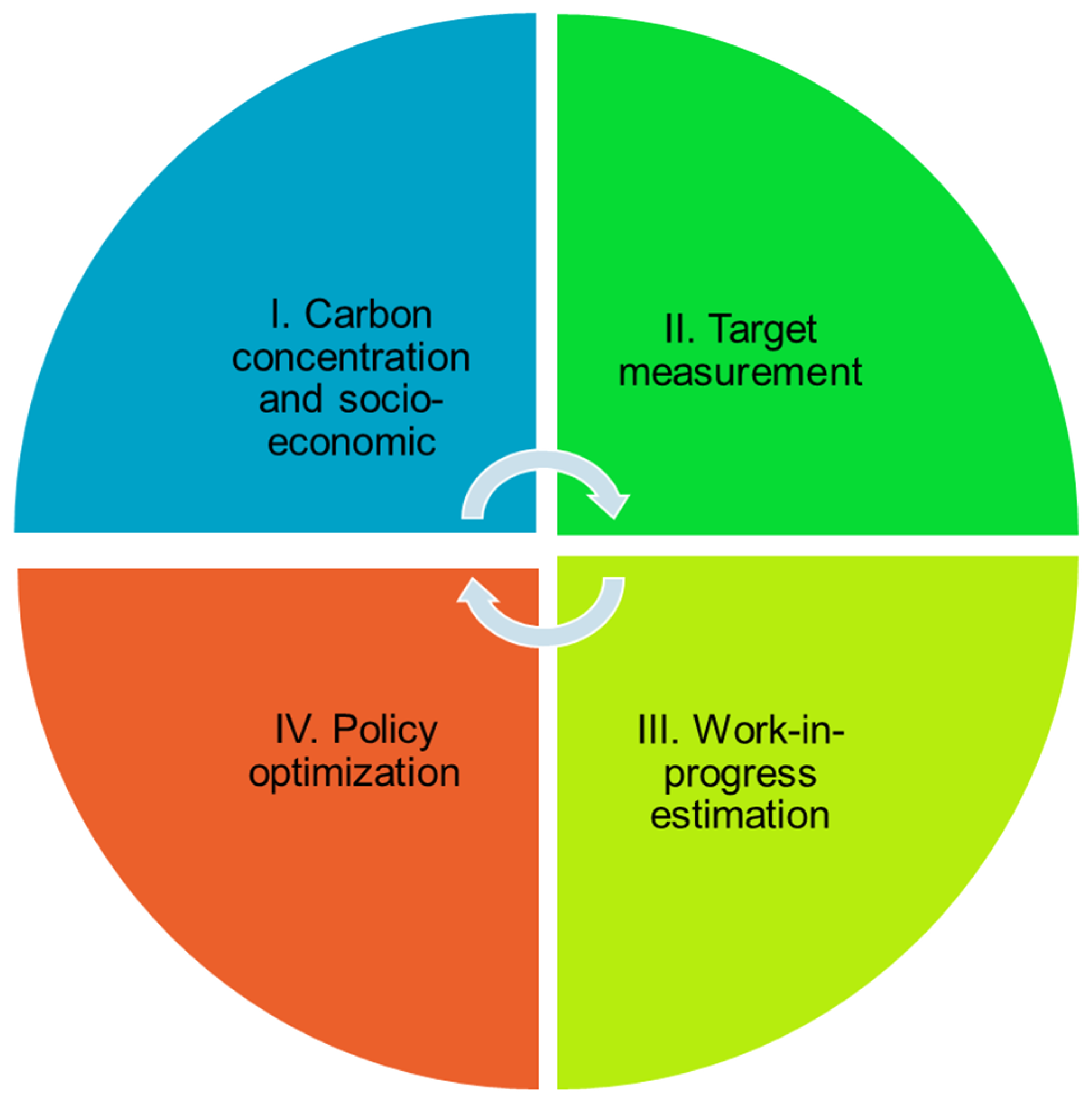
In this section, we outline China’s carbon neutrality governance structure, specifically, the different stages in policy design and implementation (Figure 4).
Figure 4.
China’s carbon neutrality governance. Source: Designed by the authors.
Firstly, it features the relationship between the current carbon concentration and socio-economic development. Understanding of this relationship can significantly lower social, economic, and environmental impacts of carbon neutrality. It is essential not only to monitor carbon concentration, but to also consider socio-economic development needs in present-day China. Carbon concentration and socio-economic consideration highlights sustainable development goals for China.
The second process involves target measurement. The target measurement is to design carbon emission indicators and socioeconomic development needs. We believe that there is an approach to provide opportunities to measure and calculate the objective levels of carbon neutrality policies in different spatial and temporal domains under different policy scenarios and governance conditions. Moreover, it is possible to optimally measure the daily and weekly frequency of dynamic carbon neutrality targets based on the socio-economic development of different regions with support of national, provincial, and municipal government. Dynamic equilibrium can be achieved between carbon neutrality goals (identifying what actors may be wanted or needed) and socio-economic development aspirations with specific target measurement setting.
The third step is work-in-progress estimation. On the basis of calculating the carbon neutrality goals of a specific city or region, monitoring can help with the dynamic measurement of the changes in the whole life cycle of carbon dioxide. Here, the aim is to perform trend analysis of carbon emissions of different energy consumption entities in the context of geographical and ecological environmental changes. In this way, it is possible to simulate and predict the evolution of carbon neutrality policies, which can considerably improve policy actors’ perception of the dynamic evolution of carbon emissions. This can, in turn, accurately forecast the process of achieving carbon neutrality goals.
The last phase is policy optimization. Actors can analyze the problems, gaps, and shortcomings in the formulation and implementation of policies. Determined by the first three steps, it is possible to optimize carbon neutrality policy, which will mitigate social, economic, and environmental impacts.
7. Conclusions
This paper empirically analyzes China’s carbon neutrality policies using the IAD framework and adopts a bibliometric visualization approach. We identify China’s climate and energy policy logic, the complexity of achieving carbon neutrality, and the challenges of policy design implementation. This research not only responds to global concerns over China’s carbon reduction commitments and gaps in concrete actions, but also clarifies and presents the logic, elements, structure, and mechanisms of China’s carbon neutrality policies. In doing so, it offers a policy reference for carbon neutrality governance in other countries.
This study has two limitations. Firstly, given that the top-down policy design of China’s carbon neutrality system was first introduced in September 2021, several policy texts remain in the process of further refinement. These were therefore excluded from our search. Secondly, given the scope of this paper, we have not conducted a complete and in-depth verification and analysis of the policy implementation results. As such, an understanding of the evaluative criteria necessary to gauge the effectiveness of China’s carbon neutrality policies is lacking. These two limitations offer important directions for further research.
Author Contributions
Conceptualization, C.Z. and R.Z.; Methodology, C.Z. and Z.Q.; Software, C.Z.; Data curation, C.Z.; Writing—original draft preparation, C.Z.; Writing—review and editing, C.Z., R.Z., J.L., V.S. and Z.Z.; Visualization, C.Z., R.Z. and Z.Z.; Supervision, R.Z., J.L. and Z.Q.; Project administration, Z.Q.; Funding acquisition, C.Z. and Z.Q. All authors have read and agreed to the published version of the manuscript.
Funding
This research was funded by Postgraduate Research & Practice Innovation Program of Jiangsu Province, grant number KYCX22_1411; and the Major Program of National Social Science Foundation of China, grant number 21&ZD043.
Institutional Review Board Statement
Not applicable.
Informed Consent Statement
Not applicable.
Data Availability Statement
Not applicable.
Acknowledgments
The authors thank the editor and reviewer for their comments regarding manuscript improvement. This study was partly support by Postgraduate Research & Practice Innovation Program of Jiangsu Province, grant number KYCX22_1411; and the Major Program of National Social Science Foundation of China, grant number 21&ZD043.
Conflicts of Interest
The authors declare no conflict of interest.
References
- Guterres, A. Secretary-General Calls Latest IPCC Climate Report ‘Code Red for Humanity’, Stressing ‘Irrefutable’ Evidence of Human Influence. 2021. Available online: https://www.un.org/press/en/2021/sgsm20847.doc.htm (accessed on 11 May 2022).
- Chen, L.; Msigwa, G.; Yang, M.; Osman, A.I.; Fawzy, S.; Rooney, D.W.; Yap, P.-S. Strategies to achieve a carbon neutral society: A review. Environ. Chem Lett. 2022, 4, 1–34. [Google Scholar] [CrossRef] [Scilit] [PubMed]
- Wang, Y.; Su, L. Green Transition in China: Understanding China’s Ecological Progress, 1st ed.; Foreign Language Press: Beijing, China, 2019. [Google Scholar]
- Gao, G.; Chen, W. The legalized path of Carbon Peaking. Guangxi Soc. Sci. 2021, 9, 13–19, (In Chinese with English Abstract). [Google Scholar]
- Xu, W. A Research on the Carbon Taxation under the Goal of Peaking Carbon Emissions and Carbon-neutrality in China. Tax. Res. 2021, 8, 22–27, (In Chinese with English Abstract). [Google Scholar] [CrossRef]
- Xin, Y.; Tang, J. China’s Green Finance under the Carbon Neutrality Target: Policies, Practices and Challenges. Contemp. Econ. Manag. 2021, 43, 91–97, (In Chinese with English Abstract). [Google Scholar] [CrossRef]
- Zhang, X.; Guo, S.; Kong, H.; Zhao, W.; Jia, L.; Liu, J.; Zhong, P. Technology Demands and Approach of Carbon Neutrality Vision. Environ. Conform. Assess. 2021, 13, 65–70, (In Chinese with English Abstract). [Google Scholar] [CrossRef]
- Stern, N. Towards a carbon neutral economy: How government should respond to market failures and market absence. J. Gov. Econ. 2022, 6, 100036. [Google Scholar] [CrossRef] [Scilit]
- Piggot, G.J. Getting to zero: A Field-Level Perspective on Organizational Transitions Towards Carbon Neutrality. Ph.D. Thesis, University of British Columbia, Vancouver, BC, Canada, 2017. [Google Scholar]
- CAT Net Zero Target Evaluations. Available online: https://climateactiontracker.org/global/cat-net-zero-target-evaluations/ (accessed on 20 May 2022).
- Net Zero Scorecard. Available online: https://eciu.net/netzerotracker (accessed on 20 May 2022).
- Masson-Delmotte, V.; Zhai, P.; Pörtner, H.-O.; Roberts, D.C.; Skea, J.; Shukla, P.R.; Pirani, A.; Moufouma-Okia, W.; Péan, C.; Pidcock, R.; et al. Global Warming of 1.5 °C: Summary for Policy Makers. IPCC—The Intergovernmental Panel on Climate Change. Available online: https://research.rug.nl/en/publications/global-warming-of-15c-summary-for-policy-makers (accessed on 19 May 2022).
- Yang, C. Green Development Practices and Challenges in the EU-An Analysis Based on a Carbon Neutrality Perspective. Dtschl. -Stud. 2021, 36, 79–97, 154–155, (In Chinese with English Abstract). [Google Scholar]
- Salvia, M.; Reckien, D.; Pietrapertosa, F.; Eckersley, P.; Spyridaki, N.A.; Krook-Riekkola, A.; Heidrich, O. Will climate mitigation ambitions lead to carbon neutrality? An analysis of the local-level plans of 327 cities in the EU. Renew. Sust. Energy Rev. 2021, 135, 110253. [Google Scholar] [CrossRef] [Scilit]
- Somanathan, E.; Sterner, T.; Sugiyama, T.; Chimanikire, D.; Dubash, N.K.; Essandoh-Yeddu, J.; Woodman, B. National and Sub-national Policies and Institutions. In Climate change 2014: Mitigation of Climate Change; Cambridge University Press: Cambridge, UK, 2014. [Google Scholar]
- Berndes, G.; Abt, B.; Asikainen, A.; Cowie, A.; Dale, V.; Egnell, G.; Yeh, S. Forest biomass, carbon neutrality and climate change mitigation. Sci. Policy 2016, 3, 28. [Google Scholar]
- Munck af Rosenschöld, J.; Rozema, J.G.; Frye-Levine, L.A. Institutional inertia and climate change: A review of the new institutionalist literature. Wiley Interdiscip. Rev.-Clim. Chang. 2014, 5, 639–648. [Google Scholar] [CrossRef] [Scilit]
- Woerdman, E.; Roggenkamp, M.; Holwerda, M. Essential EU Climate Law; Edward Elgar Publishing: Cheltenham, UK, 2021. [Google Scholar]
- Protecting the Environment and Climate Is Important for over 90% of European Citizens. Available online: https://ec.europa.eu/commission/presscorner/detail/en/ip_20_331 (accessed on 20 May 2022).
- The Biden Plan for a Clean Energy Revolution and Environmental Justice. Available online: http://www.foreconomicjustice.org/?p=20196 (accessed on 20 May 2022).
- Dye, T.R. Understanding Public Policy, 5th ed.; Prentice-Hall: Hoboken, NJ, USA, 1984. [Google Scholar]
- Colebatch, H. Policy; McGraw-Hill Education: London, UK, 2009. [Google Scholar]
- Pierson, P.; Skocpol, T. Historical institutionalism in contemporary political science. Political Sci. State Discip. 2002, 3, 1–32. [Google Scholar]
- Steinmo, S. Political institutions and tax policy in the United States, Sweden, and Britain. World Polit. 1989, 41, 500–535. [Google Scholar] [CrossRef] [Scilit]
- Heywood, A. Key Concepts in Politics; Martin’s Press: New York, NY, USA, 2000. [Google Scholar]
- Thornton, P.H.; Ocasio, W. Institutional Logics. In The Sage Handbook of Organizational Institutionalism; SAGE Publications Ltd.: London, UK, 2008; pp. 99–128. [Google Scholar]
- Thornton, P.H.; Ocasio, W.; Lounsbury, M. The Institutional Logics Perspective: A New Approach to Culture, Structure and Process; Oxford University Press: Oxford, UK, 2012. [Google Scholar]
- Michel, C.L.; Meza, O.D.; Cejudo, G.M. Interacting institutional logics in policy implementation. Governance 2022, 35, 403–420. [Google Scholar] [CrossRef] [Scilit]
- Hustedt, T.; Danken, T. Institutional logics in inter-departmental coordination: Why actors agree on a joint policy output. Public. Adm. 2017, 95, 730–743. [Google Scholar] [CrossRef] [Scilit]
- Godawska, J.; Wyrobek, J. The Impact of Environmental Policy Stringency on Renewable Energy Production in the Visegrad Group Countries. Energies 2021, 14, 6225. [Google Scholar] [CrossRef] [Scilit]
- Duan, H.; Rogelj, J.; Veysey, J.; Wang, S. Modeling deep decarbonization: Robust energy policy and climate action. Appl. Energy 2020, 262, e114517. [Google Scholar] [CrossRef] [Scilit]
- Cheng, Y.; Sinha, A.; Ghosh, V.; Sengupta, T.; Luo, H. Carbon tax and energy innovation at crossroads of carbon neutrality: Designing a sustainable decarbonization policy. J. Environ. Manage. 2021, 294, 112957. [Google Scholar] [CrossRef] [Scilit]
- Laine, J.; Heinonen, J.; Junnila, S. Pathways to carbon-neutral cities prior to a national policy. Sustainability 2020, 12, 2445. [Google Scholar] [CrossRef] [Scilit]
- Tan, X.C.; Guo, W.; Fan, J.; Guo, J.X.; Wang, M.Y.; Zeng, A.; Su, L.Y.; Sun, Y. Policy framework and technology innovation policy of carbon peak and carbon neutrality. Bull. Chin. Acad. Sci. 2022, 37, 435–443, (In Chinese with English Abstract). [Google Scholar] [CrossRef]
- Wang, J.F.; Su, L.Y.; Tang, X.C.; Chen, X.Y.; Ge, C.L. Carbon neutrality policy measures in global major economies. Bull. Chin. Acad. Sci. 2022, 37, 479–489, (In Chinese with English Abstract). [Google Scholar] [CrossRef]
- Aligica, P.D. Institutional Diversity and Political Economy: The Ostroms and Beyond; Oxford University Press: Oxford, UK, 2013. [Google Scholar]
- Araral, E.; Amri, M. Institutions and the policy process 2.0: Implications of the IAD Framework. In Contemporary Approaches to Public Policy; Palgrave Macmillan: London, UK, 2016; pp. 73–93. [Google Scholar]
- Nijnik, M.; Kluvánková, T.; Melnykovych, M.; Nijnik, A.; Kopiy, S.; Brnkaľáková, S.; Barlagne, C. An Institutional Analysis and Reconfiguration Framework for Sustainability Research on Post-Transition Forestry—A Focus on Ukraine. Sustainability 2021, 13, 4360. [Google Scholar] [CrossRef] [Scilit]
- Ostrom, E. A general framework for analyzing sustainability of social-ecological systems. Science 2009, 325, 419–422. [Google Scholar] [CrossRef] [Scilit] [PubMed]
- Basurto, X.; Kingsley, G.; McQueen, K.; Smith, M.; Weible, C.M. A systematic approach to institutional analysis: Applying Crawford and Ostrom’s grammar. Polit. Res. Q. 2010, 63, 523–537. [Google Scholar] [CrossRef] [Scilit]
- Araral, E.; Wu, X. Comparing water resources management in China and India: Policy design, institutional structure and governance. Water Policy 2016, 18, 1–13. [Google Scholar] [CrossRef] [Scilit]
- Xiong, W.; Chen, B.; Wang, H.; Zhu, D. Public–private partnerships as a governance response to sustainable urbanization: Lessons from China. Habitat Int. 2020, 95, 102095. [Google Scholar] [CrossRef] [Scilit]
- Li, R.; Van Den Brink, M.; Woltjer, J. Rules for the governance of coastal and marine ecosystem services: An evaluative framework based on the IAD framework. Land Use Policy 2016, 59, 298–309. [Google Scholar] [CrossRef] [Scilit]
- Wu, J.; Guo, Y.; Zhou, J. Nexus between ecological conservation and socio-economic development and its dynamics: Insights from a case in China. Water 2020, 12, 663. [Google Scholar] [CrossRef] [Scilit]
- Ostrom, E. Background on the institutional analysis and development framework. Policy Stud. J. 2011, 39, 7–27. [Google Scholar] [CrossRef] [Scilit]
- Ostrom, E. Institutional rational choice: An assessment of the institutional analysis and development framework. In Theories of the Policy Process; Routledge: New York, NY, USA, 2019; pp. 21–64. [Google Scholar]
- Shen, Y.; Fu, H.; Liu, P.; Wu, J. An Empirical Study of Virtual Learning Teams. Doc. Inf. Knowl. 2009, 6, 103–107, (In Chinese with English Abstract). [Google Scholar] [CrossRef]
- Zhang, W.; Xu, X. Review of Text Mining Tools. Libr. Inf. Serv. 2012, 56, 26–31, (In Chinese with English Abstract). [Google Scholar]
- De Bellis, N. Bibliometrics and Citation Analysis: From the Science Citation Index to Cybermetrics; Scarecrow Press: Lanham, MD, USA, 2009. [Google Scholar]
- Merigó, J.M.; Mas-Tur, A.; Roig-Tierno, N.; Ribeiro-Soriano, D. A bibliometric overview of the Journal of Business Research between 1973 and 2014. J. Bus. Res. 2015, 68, 2645–2653. [Google Scholar] [CrossRef] [Scilit]
- Železnik, D.; Blažun Vošner, H.; Kokol, P. A bibliometric analysis of the Journal of Advanced Nursing, 1976–2015. J. Adv. Nurs. 2017, 73, 2407–2419. [Google Scholar] [CrossRef] [Scilit] [PubMed]
- Van Eck, N.J.; Waltman, L. Software survey: VOSviewer, a computer program for bibliometric mapping. Scientometrics 2010, 84, 523–538. [Google Scholar] [CrossRef] [Scilit] [PubMed]
- Liao, H.; Tang, M.; Luo, L.; Li, C.; Chiclana, F.; Zeng, X.J. A bibliometric analysis and visualization of medical big data research. Sustainability 2018, 10, 166. [Google Scholar] [CrossRef] [Scilit]
- Manual for VOSviewer Version 1.6.10. 2019. Available online: https://www.vosviewer.com/documentation/Manual_VOSviewer_1.6.10.pdf (accessed on 3 May 2022).
- Van Eck, N.J.; Waltman, L. Citation-based clustering of publications using CitNetExplorer and VOSviewer. Scientometrics 2017, 111, 1053–1070. [Google Scholar] [CrossRef] [Scilit]
- Zhou, L. Administrative Subcontract. Society 2014, 34, 1–38, (In Chinese with English Abstract). [Google Scholar] [CrossRef]
- Song, G. On Social Action Subjects Towards the Goal of Peaking Carbon Dioxide Emissions and Achieving Carbon Neutrality and Measures in China. Urban Environ. Stud. 2021, 4, 47–60, (In Chinese with English Abstract). [Google Scholar]
- Ding, Z. Study on China’s Carbon Neutrality Framework Roadmap. China Ind. Inf. Technol. 2021, 8, 54–61, (In Chinese with English Abstract). [Google Scholar] [CrossRef]
- Liu, H.; Zhang, Y. Building a community of shared future for humankind--an ethnological perspective. Int. J. Anthr. Ethnol. 2018, 2, 1–8. [Google Scholar] [CrossRef] [Scilit]
- Yu, G.; Hao, T.; Zhu, J. Discussion on action strategies of China’s carbon peak and carbon neutrality. Bull. Chin. Acad. Sci. 2022, 37, 423–434, (In Chinese with English Abstract). [Google Scholar] [CrossRef]
- Huang, R.; Kou, J. Promoting Comprehensive Green Transition of Economic and Social Development. Available online: https://kns.cnki.net/kcms/detail/detail.aspx?dbcode=CCND&dbname=CCNDLAST2021&filename=RMRB202104120081&v=MDUyNzZuajk4VG5qcXF4ZEVlTU9VS3JpZlplUnZFQ2poVUwvTktWOFFOeURaYkxHNEhORE1xNDVIWk9zSERSTkt1aGRo (accessed on 19 May 2022).
- Magazzino, C.; Mele, M.; Schneider, N. A machine learning approach on the relationship among solar and wind energy production, coal consumption, GDP, and CO2 emissions. Renew. Energy 2021, 167, 99–115. [Google Scholar] [CrossRef] [Scilit]
- Chen, X.; Lin, B. Towards carbon neutrality by implementing carbon emissions trading scheme: Policy Evaluation in China. Energy Policy 2021, 157, 112510. [Google Scholar] [CrossRef] [Scilit]
- Lucia, U.; Grisolia, G. Irreversible thermodynamics and bioeconomy: Toward a human-oriented sustainability. Front. Phys. 2021, 9, 154. [Google Scholar] [CrossRef] [Scilit]
- Lucia, U.; Grisolia, G. The Gouy-Stodola Theorem—From Irreversibility to Sustainability—The Thermodynamic Human Development Index. Sustainability 2021, 13, 3995. [Google Scholar] [CrossRef] [Scilit]
- Grisolia, G.; Fino, D.; Lucia, U. Biomethanation of Rice Straw: A Sustainable Perspective for the Valorisation of a Field Residue in the Energy Sector. Sustainability 2022, 14, 5679. [Google Scholar] [CrossRef] [Scilit]
- Liu, Z.; Deng, Z.; He, G.; Wang, H.; Zhang, X.; Lin, J.; Qi, Y.; Liang, X. Challenges and opportunities for carbon neutrality in China. Nat. Rev. Earth Environ. 2022, 3, 141–155. [Google Scholar] [CrossRef] [Scilit]

Publisher’s Note: MDPI stays neutral with regard to jurisdictional claims in published maps and institutional affiliations. |
© 2022 by the authors. Licensee MDPI, Basel, Switzerland. This article is an open access article distributed under the terms and conditions of the Creative Commons Attribution (CC BY) license (https://creativecommons.org/licenses/by/4.0/).