


Abstract
In order to deepen the understanding of rotating effects on internal cooling, the flow and heat transfer characteristics of 2-pass rotating rectangular smooth/ribbed channels are investigated by Reynolds-Averaged Navier-Stokes (RANS) simulation. Three rotating numbers (Ro = 0.10, 0.25, and 0.40) are simulated, and the maximum buoyancy parameter (Bo) reaches 5.0. The results show that the rotating buoyancy has significant effects on the flow and heat transfer under high Bo conditions. When Bo > 1.0, rotating buoyancy inducts flow separation near the leading edge (LE) in the first passage, while the air flow in the second passage shows a double-peak profile. With increased Bo, the heat transfer in the first passage is greatly increased, and the maximum growth rate occurs at Bo = 0.6~1.0. However, the heat transfer in the second passage has no obvious changes due to a strong turn effect. In the ribbed channel, rotating effects are much weaker than those in the smooth channel. This research helps to improve the understanding of the internal cooling heat transfer mechanism in land-based gas turbines under typical operating conditions.
1. Introduction
Gas turbines are widely applied in landed power generation, aircraft propulsion and other fields. In order to achieve high thermal efficiency, they usually operate in a harsh environment, and the turbine inlet temperature is currently much higher than the allowable temperature for super-alloys. Advanced cooling techniques are of vital importance to prolong the life of hot components and ensure their safe operation. In the past few decades, many investigators have conducted extensive research on internal cooling and film cooling, which has been comprehensively reviewed by Han [1].
The principle of internal cooling is that air flows through the channels inside the blade to take away the excessive heat and cool the blade. Applying twisted tapes, dimples and ribs to increase turbulence is one of the most effective ways to enhance heat transfer [2,3]. In a multi-pass channel, surfaces are usually roughened by ribs to enhance heat transfer. Previously, many efforts have been devoted to the effect of ribs, indicating that rib angle orientation [4,5], rib configuration [6,7] and many other factors have crucial influences on heat transfer. However, most of the previous studies are for stationary channels and rotating effects were not present.
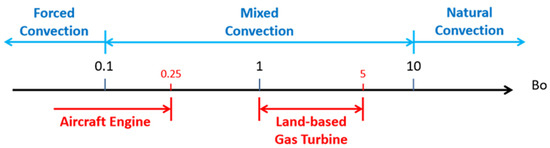
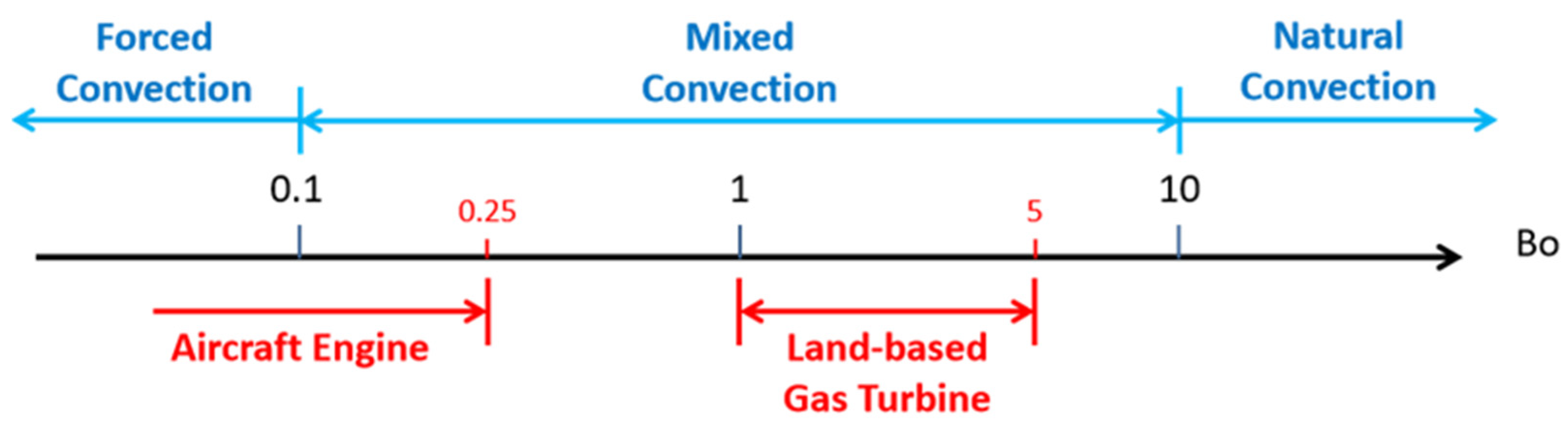
The rotating effects on internal cooling have received increased attention. The non-dimensional parameters rotation number (Ro) and buoyancy parameter (Bo), firstly proposed by Wagner et al. [8,9], are most commonly used to describe the rotating effect. The Ro describes the ratio of Coriolis to inertia. The Bo refers to the relative strength of natural convection to forced convection. Based on Bo, the convective heat transfer inside a turbine blade can fall into the regime of natural convection (Bo > 10), mixed convection (0.1 < Bo < 10), and forced convection (Bo < 0.1). From Figure 1 and Table 1 [1], the typical Ro and Bo of an aero-engine and a land-based gas turbine show that the internal cooling can be distinctly different in nature. Aero-engines operate at Bo of 0 to 0.25 and forced convection dominates. However, for land-based gas turbines, Bo is in the range of 1 to 5 which indicates that natural convection is parallel to forced convection or even more important.
Figure 1.
The Bo ranges of gas turbine and aircraft engine under typical operating conditions.
Table 1.
Typical Ro and Bo of aircraft engine and land-based gas turbine [1].
Research concerning the effects of rotation on heat transfer in turbine blades has been conducted for some years. Wagner et al. [8,9] systematically investigated the effect of Ro and density ratio on heat transfer in a four-pass serpentine channel. The heat transfer data in the first passage was presented, and the maximum Ro reached0.48. Han et al. investigated the effects of uneven wall temperature [10] and surface heating conditions [11] in a two-pass square smooth channel under rotating conditions, and the Ro ranged from 0 to 0.352. Hwang and Kuo [12] experimentally investigated rotating effects on the convective heat transfer in a radially rotating three-passage serpentine square channel (Ro < 0.032), and derived correlations of heat transfer. Then, Hwang et al. [13] tested the convective heat transfer of compressed airflow in a radially rotating four-pass serpentine channel, and the Ro increased to 0.21. Wright et al. [14] measured the heat transfer distribution and frictional loss in rotating ribbed channels (AR = 1:4) with six rib configurations, and the Ro ranged from 0 to 0.15.Effects of Ro on heat transfer can be generalized simply as the bifurcating trend of heat transfer between LE and TE in rotating conditions. It is worth noting that these studies focused more on the effect of Ro.
In the new century, the effect of Bo on heat transfer has attracted more attention, and many researchers have made great efforts to improve the range of Ro and Bo. Fu et al. [15] investigated the heat transfer distribution in two-pass rotating rectangular channels (AR = 1:2/1:4) with 45 angled ribs (Ro = 0~0.3, and Bo = 0~0.4). Then, Fu et al. [16] determined the effects of rib configurations on heat transfer with Romax = 0.206 and Bomax = 0.2. Zhou et al. [17] performed heat transfer and pressure drop measurements in a rectangular coolant channel (AR = 4:1). The range of Ro increased to 0–0.6, and the maximum Bo approached 1.0. Huh et al. [18,19] experimentally investigated the rotating effects on heat transfer in a smooth/ribbed two-pass rectangular channel (AR = 2:1), with Ro ranging from 0 to 0.45 and Bo ranging from 0 to 0.8. Li et al. [20] experimentally investigated the heat transfer performance in a rotating U-turn smooth channel with similar irregular cross-section. The maximum Ro was 0.72 with Bo approaching 1.0. This literature speculates about the effects of Bo on heat transfer, which are similar to those of Ro, except that, on LE of the pass with radially-outward flow, Nu/Nus experienced a minimum with respect to Bo. This phenomenon is explained as destabilization of the near-wall flow, due to rotating buoyancy, by Wagner et al. [8,9], or mainstream flow separation near LE, also due to rotating buoyancy, by Dutta et al. [21], which needs further clarification. Besides, from the referenced experimental research above, the Bo effect and the Ro effect are coupled and the isolated Bo effect is not obtained. Furthermore, Bo is not extended to the regime of land-based gas turbines in most of the previous literature.
This study investigates the effect of high buoyancy parameters on flow and heat transfer in two-pass smooth/ribbed channels by RANS simulation. Three rotation numbers (Ro = 0.1, 0.25 and 0.4) are studied. By varying the rotation radius, different Bo is obtained under the same Ro conditions. The Bo ranges from 0.1 to 5.0, which contains the typical operating conditions of land-based gas turbines and aircraft engines.
2. Numerical Setup
2.1. Physical Model
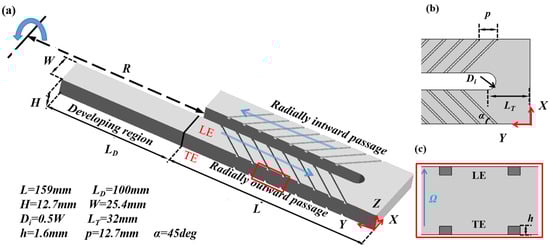
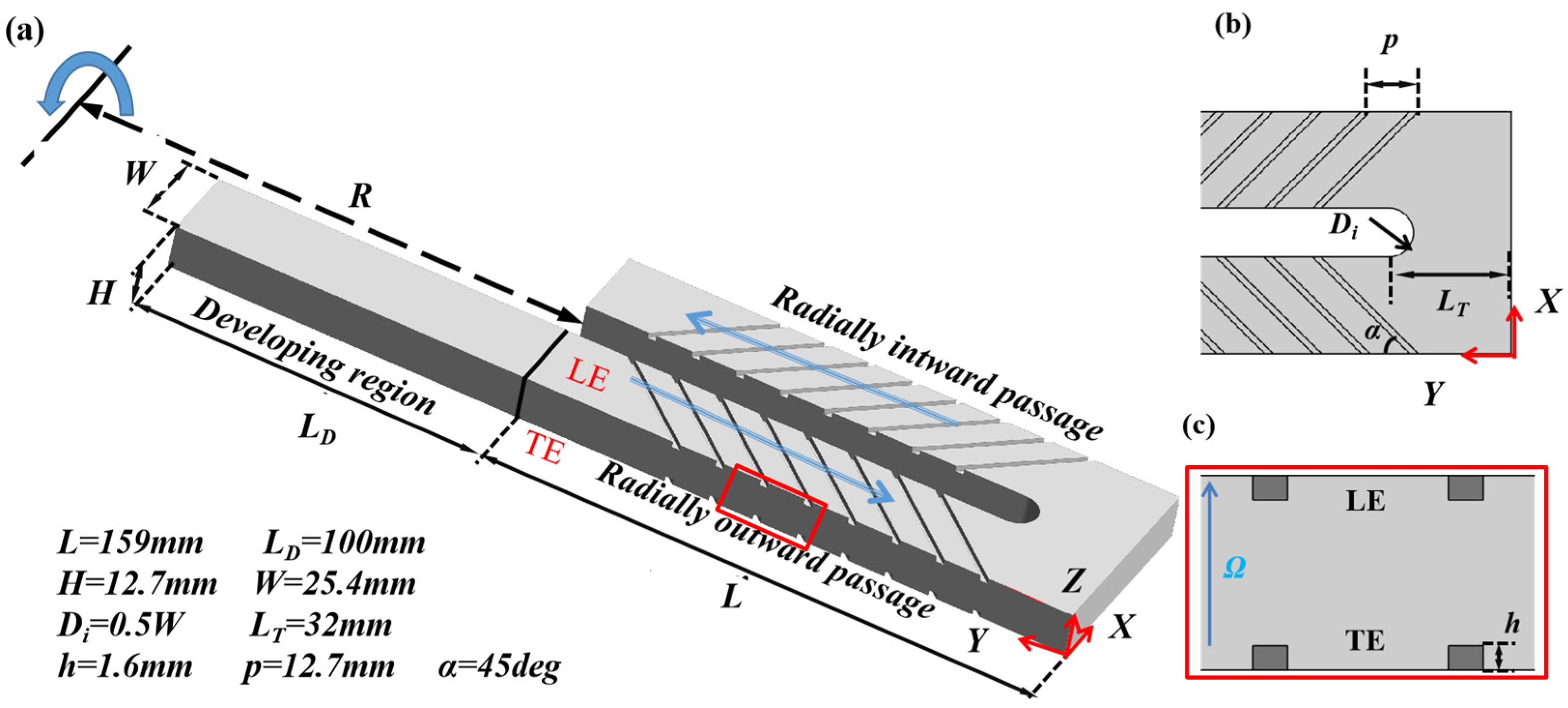
The geometry and dimensions of a rotating two-pass channel are shown in Figure 2. The two passages (AR = 2:1) are connected by a 180° sharp turn. A developing region is added before the first passage inlet to reduce entry effects. The distance between the first passage inlet and rotating axis is defined as rotation radius (R). In the first passage, mainstream is radially outward. After the turn, flow is radially inward in the second passage. In the Z direction, the upper wall and lower wall are leading edge (LE) and trailing edge (TE) with respect to rotation. In the ribbed channel, the LE and TE are roughened by 45° angled ribs, and the details of the ribs are shown in Figure 2b,c.
Figure 2.
Geometries of (a) whole channel (b) tip turn region and (c) ribs.
2.2. Definition of Parameters
The definitions of Reynolds number (Re) and Rotation number (Ro) is shown in Equations (1) and (2), where Ub refers to the bulk velocity, μ is the air viscosity, and Ω is the rotating angular velocity.
Re = (ρUbDh)/μ,
Ro = (ΩDh)/Ub,
The buoyancy parameter (Bo) reflects the relative strength of the natural convection to the forced convection, and is defined as Equation (3). Δρ/ρ is the density ratio. R/Dh refers to the non-dimensional rotation radius. By changing R/Dh, Bo ranges from 0.1 to 5.0, which includes the typical operating conditions of gas turbines and aircraft engines.
Bo = (Δρ/ρ)(Ro)2(R/Dh),
The local heat transfer coefficient (h) and corresponding Nusselt number (Nu) on the walls are given in Equations (4) and (5). Tb represents bulk temperature of air, which can be obtained by calculating the inlet and outlet average temperature in each divided section, and k is the thermal conductivity of air.
h = q″/(Tw − Tb),
NU = (hDh)/k,
The heat transfer enhancement (Nu/Nu0) is given as Equation (6), where Nu0 can be calculated by the Dittus-Boelter correlation.
Nu/Nu0 = ((hDh)/k)/(0.023Re0.8Pr0.4),
Based on the above description, the simulation cases are summarized as follows (Table 2):
Table 2.
Simulation cases.
2.3. Result Verification
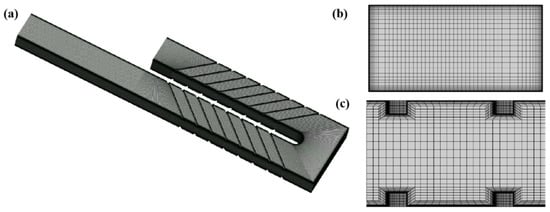
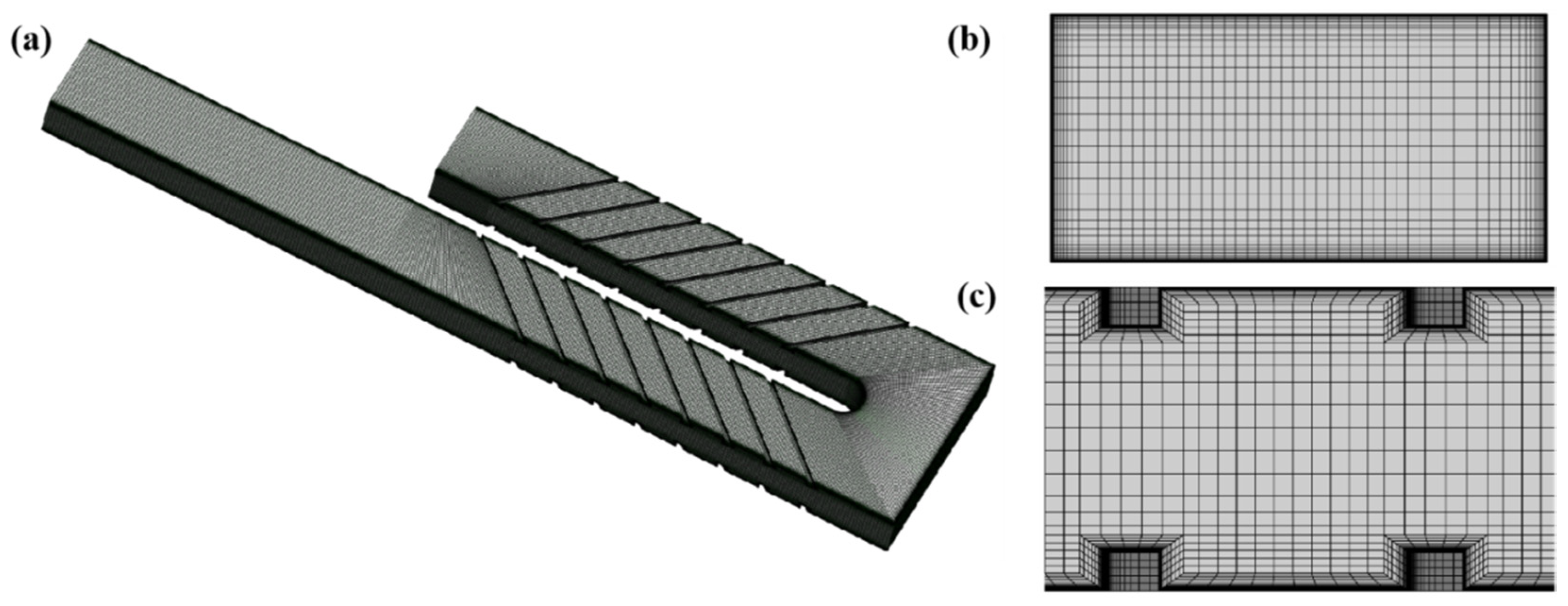
ANSYS ICEM is used to generate the fully-structured mesh, as shown in Figure 3a. The ANSYS CFX solver is used to solve the RANS equations with the SST k-ω turbulence model. By setting Ω = 1551 RPM, Ro equals 0.15. The inlet mass flow rate ( = 7.139 g/s) is given to achieve Re = 20,000, while the pressure at exit is set as 1 atm. Fixed inlet air temperature (Tin = 20 °C) and wall temperature (Tw = 60 °C) are given to maintain a constant density ratio (Δρ/ρ = 0.12). The convergence criteria are that the imbalance of momentum and energy are both less than 0.05% and the RMS of the residuals of momentum equations and energy equations is less than 1 × 10⁻⁵. To meet the requirement of the SST k-ω turbulence model, the mesh near walls and ribs is refined (Height 0.005 mm, Height ratio 1.2, Number of layer 20) as in Figure 3b,c with y+ less than 1.
Figure 3.
Mesh of (a) geometry (b) inlet section and (c) ribs region.
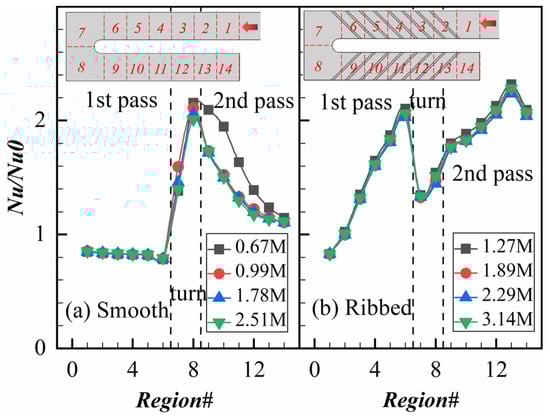
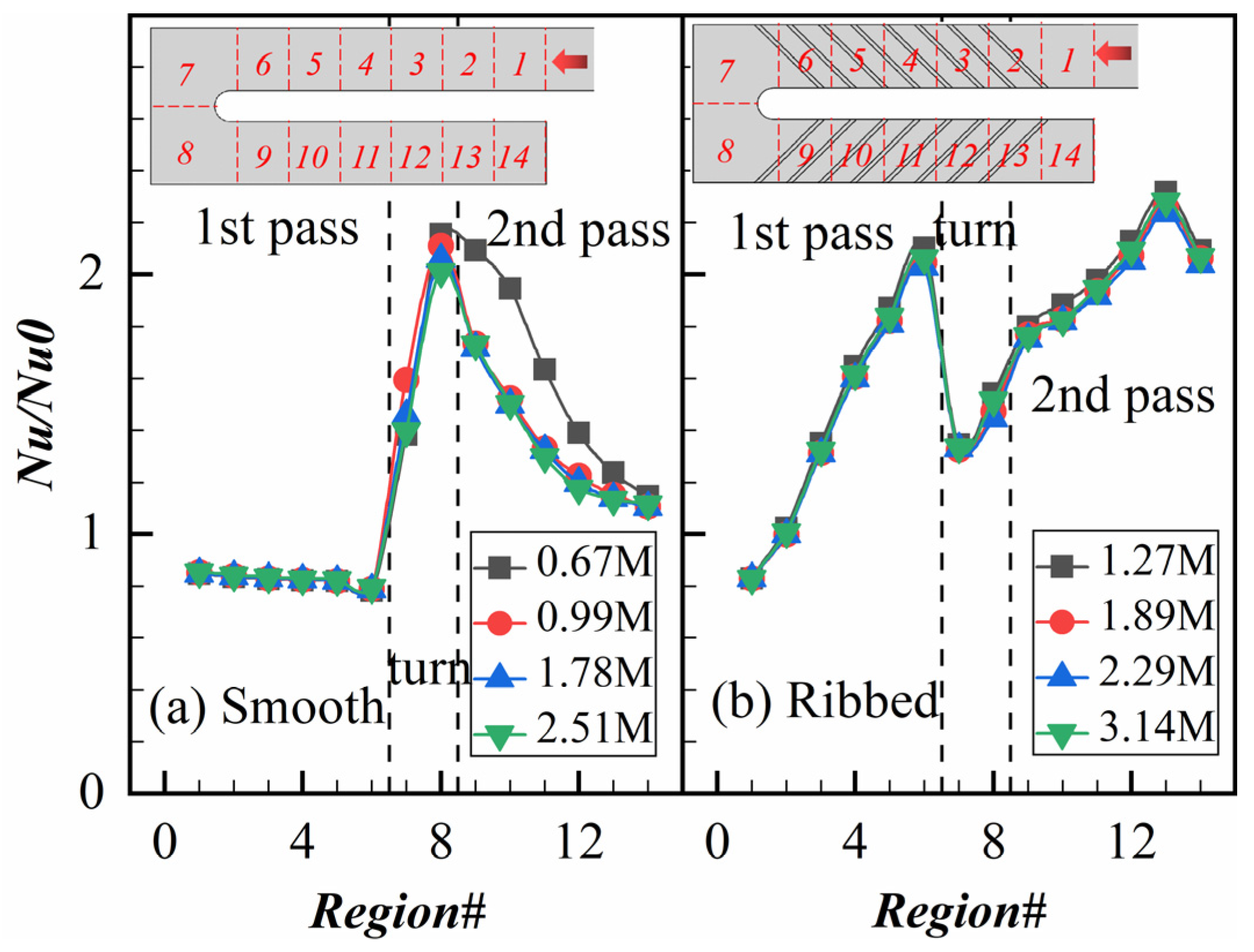
The mesh independence is verified in a stationary condition, with four mesh sizes for both smooth and ribbed channels. The channel is divided into 10 regions along streamwise direction, and the area-averaged Nu/Nu0 of each region is presented in Figure 4. For the smooth channel, Nu/Nu0 of the second-passage drops about 10% when the mesh size increases from 0.67 M to 0.99 M, while the Nu/Nu0 has no obvious difference when mesh is larger than 1.78 M. Similarly, the area-averaged Nu/Nu0 of the ribbed channel almost remains unchanged when the cell number is larger than 2.29 M. Consequently, in this study mesh of 1.78 M and 2.29 M are applied to the smooth and the ribbed channel, respectively.
Figure 4.
Mesh independence verification in smooth/ribbed channels under stationary condition.
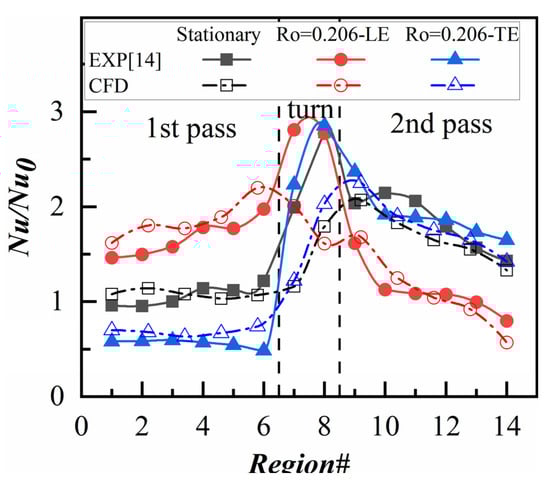
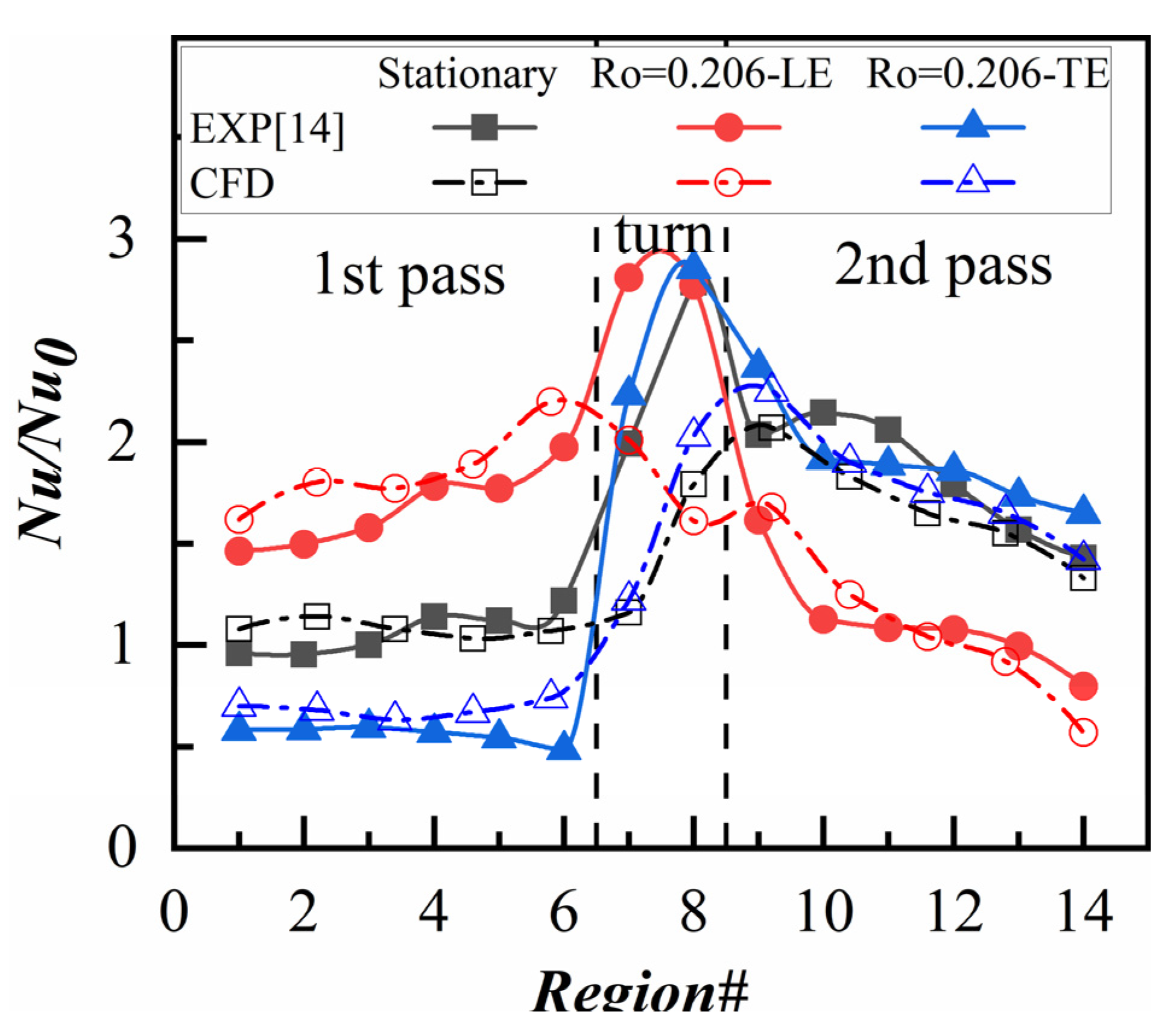
The model of the smooth channel is very similar to the test-section used by Fu [14] and the experimental results are used to verify the accuracy of the numerical simulation. The cases of Fu’s experiment (Re = 5000, Ro = 0.0 or 0.206, smooth channel) are used for comparison. The result is presented in Figure 5. In the first and second passages, the numerical results are close to experiments under both stationary and rotating conditions, with the largest difference of 16.7%. For the tip turn, the difference between prediction and experiment is a little higher. A possible reason is that the temperature distribution in the tip turn region is complicated and region-averaged temperature measured by thermocouples and copper plates has larger uncertainty.
Figure 5.
Experimental verification in smooth channels under stationary/rotating conditions.
3. Results and Discussion
3.1. Flow Field
3.1.1. Velocity Distribution in Meridian Planes
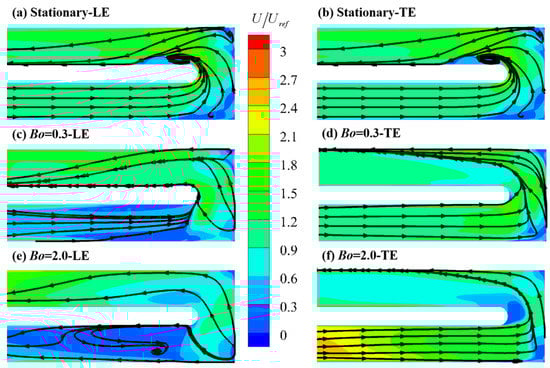
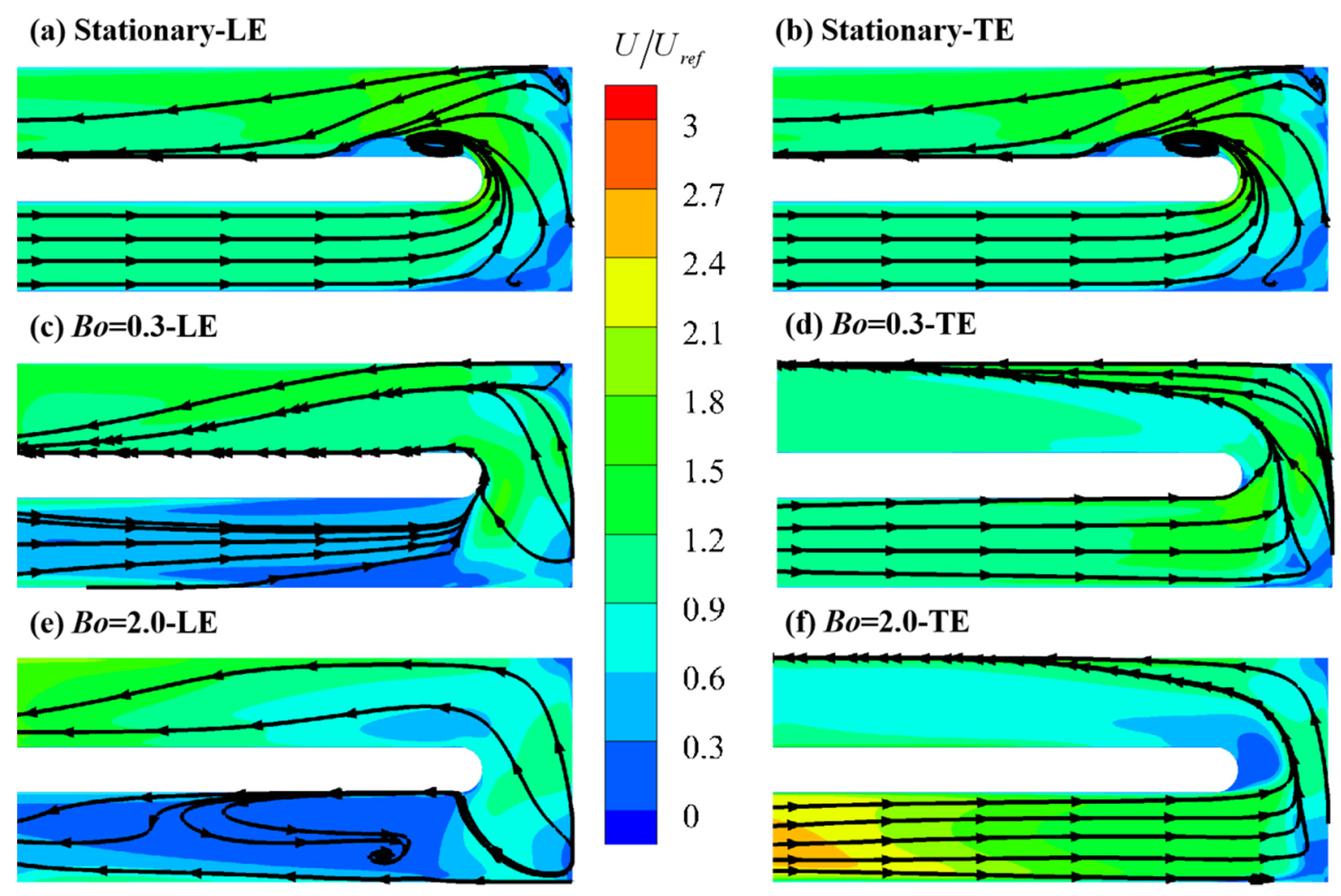
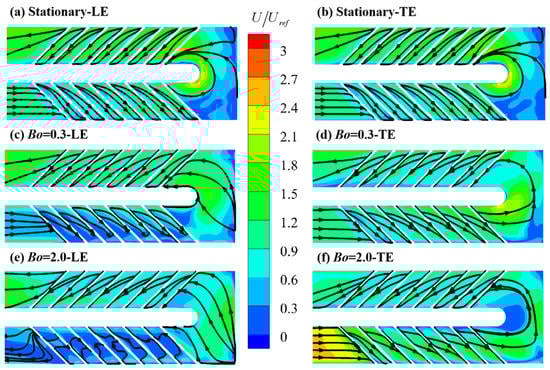
Figure 6 and Figure 7 present the 2-D non-dimensional velocity (U/Uref) contour and streamline in meridian planes at Z/H = 0.9 (near LE), and 0.1 (near TE), under stationary condition and two rotating conditions (Ro = 0.25, Bo = 0.3 and 2.0). Here, Uref refers to the average of inlet velocity. In the stationary smooth channel Figure 6a,b the flow field in the first passage is uniform. Then, the fluid is pushed to the side wall in the tip turn region. In the second passage, flow reversal exists near the upstream inner wall. In the stationary ribbed channel (Figure 7a,b), ribs-induced vortex greatly changes the flow field near LE/TE. In the first passage, the fluid near LE/TE moves along the ribs to the side wall, while in the second passage the flow direction along the ribs is opposite. In the tip turn region, the velocity near the inner wall increases while that near the side wall decreases. In addition, ribs also restrict the reversed flow near the inner wall in the second passage.
Figure 6.
2-D non-dimensional velocity (U/Uref) contour and streamline in meridian planes at Z/H = 0.9 (near LE) and 0.1 (near TE) of smooth channel.
Figure 7.
2-D non-dimensional velocity (U/Uref) contour and streamline in meridian planes at Z/H = 0.9 (near LE) and 0.1 (near TE) of ribbed channel.
In rotating conditions, rotating effects are strongly related to the mainstream direction and have very different impacts on the flow near LE and TE. For the smooth channel (Figure 6c–f), in the first passage (radially outward flow), Coriolis-induced secondary vortex makes the mainstream flow incline to TE, while buoyancy is opposite to mainstream flow. Thus, when Bo increases from 0.3 to 2.0, an obvious region of flow reversal caused by high rotating buoyancy exists near LE. In the second passage (radially inward), Coriolis makes the mainstream flow inclines to LE, and buoyancy is in the same direction as mainstream flow. Due to a strong turn effect, rotation has much less influence on flow field in the second pass. However, it should be pointed out that rotation suppresses the reversal region near the upstream inner wall. This result is consistent with the LDV measurement of Liou and Chen [22]. In the ribbed channel (Figure 7c–f), rotation effect is largely weakened by the ribs. When Bo increases from 0.3 to 2.0, a very complicated phenomenon is observed including flow reversal and rib-induced secondary flow near LE. Moreover, on TE of the tip turn, the flow skews to the side wall and a low speed zone is formed near the inner wall, which is very different to Bo = 0.3.
3.1.2. Velocity Vectors in the Central Passages
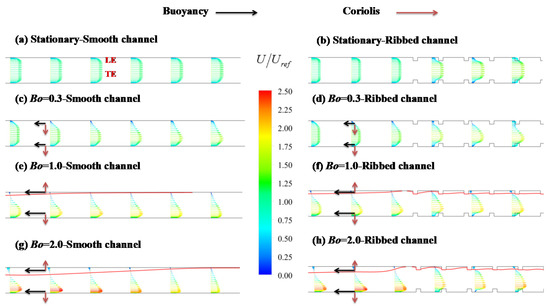
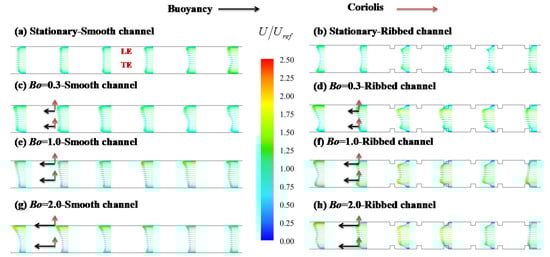
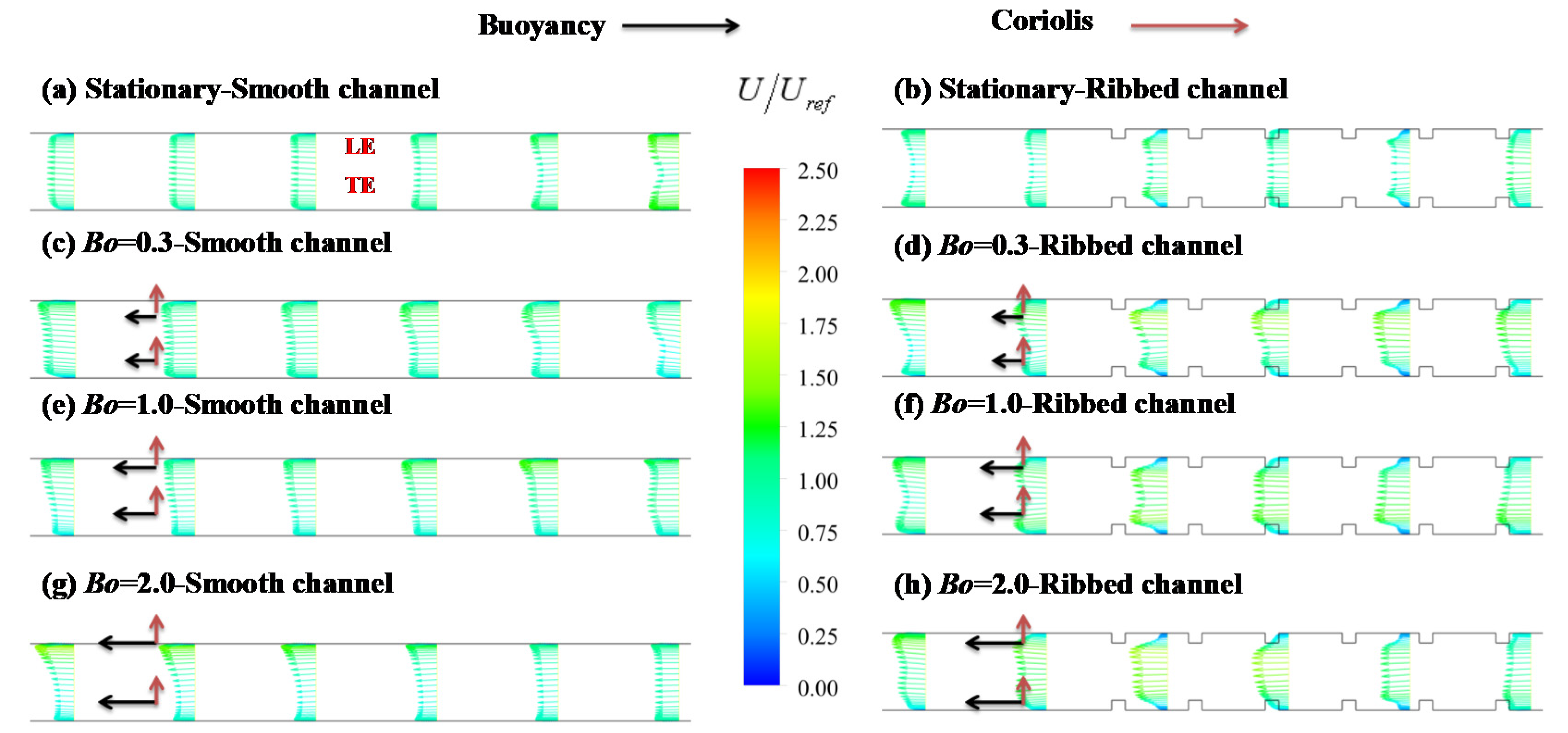
Figure 8 and Figure 9 show the 2D velocity vectors in the central plane of first (X/W = 0.5) and second (X/W = 2) passages under stationary condition and three rotation conditions (Ro = 0.15, Bo = 0.3, 1.0 and 2.0). In the first passage (radially outward flow), the Coriolis drives the air to TE and reduces the velocity near LE. Thus, when Bo = 0.3, the velocity profiles of the smooth (Figure 8c) and ribbed (Figure 8d) channels are both tilted to TE. The rotating buoyancy in the first passage is opposite to bulk flow and further reduces the air flow near LE, even inducing flow separation. When Bo = 1.0 and 2.0, an obvious flow reversal exists near LE in both smooth (Figure 8e,g) and ribbed (Figure 8f,h) channels, and separation zone expands with increased Bo. It is observed that along the mainstream direction, the separation zone does not gradually expand, but expands first and then contracts. This interesting result might be attributed to the Coriolis inversion in this region, which restrains flow separation. In the ribbed channel (Figure 8f,h), because of the higher flow instability induced by the ribs, the reversed flow is greater than that of the smooth channel, and almost all the ribs on the LE are covered by reversal flow when Bo > 1.0.
Figure 8.
2D velocity vectors in the central section of the first passage (X/W = 0.5).
Figure 9.
2D velocity vectors in the central section of the second passage (X/W = 2.0).
In the second passage (radially inward flow), the flow field is more complicated, influenced by the first passage, a 180° sharp turn, and ribs under stationary and rotating conditions. In the stationary smooth channel (Figure 9a), the upstream flow presents a double-peak profile with the continuous effects of the turning-induced secondary flow, and the downstream flow tends to be uniform due to the weakening of turning-induced secondary flow. In the stationary ribbed channel (Figure 9b), the upstream velocity profile is approximately uniform, while the downstream flow shows a double-peak profile due to the rib-induced secondary flow effects. In the rotating conditions, the Coriolis drives the air to the LE. The rotating buoyancy points to the rotation axis whose direction is the same as bulk flow near both LE and TE. Therefore, in the smooth channel, when Bo = 0.3/1.0 (Figure 9c,e), the double-peak profile flow at the upstream location and the uniform flow at the downstream location are both tilted to LE. When Bo reaches 2.0 (Figure 9g), the air flow in the second pass of the smooth channel appears as a double-peak profile. However, in the ribbed channel, when Bo = 2.0 (Figure 9h), no obvious double-peak profile flow can be formed. A possible reason is that the favorable effect of rotating buoyancy forces on the flow near LE and TE are suppressed by ribs.
3.1.3. TKE Distribution in Meridian Planes
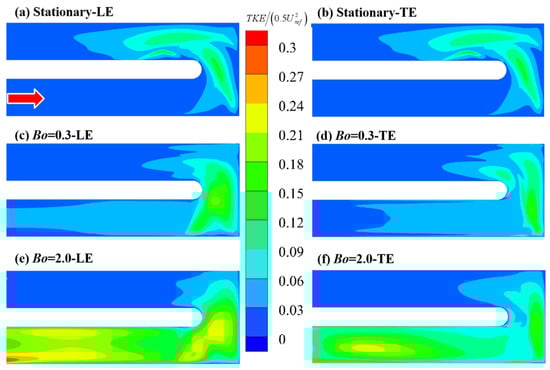
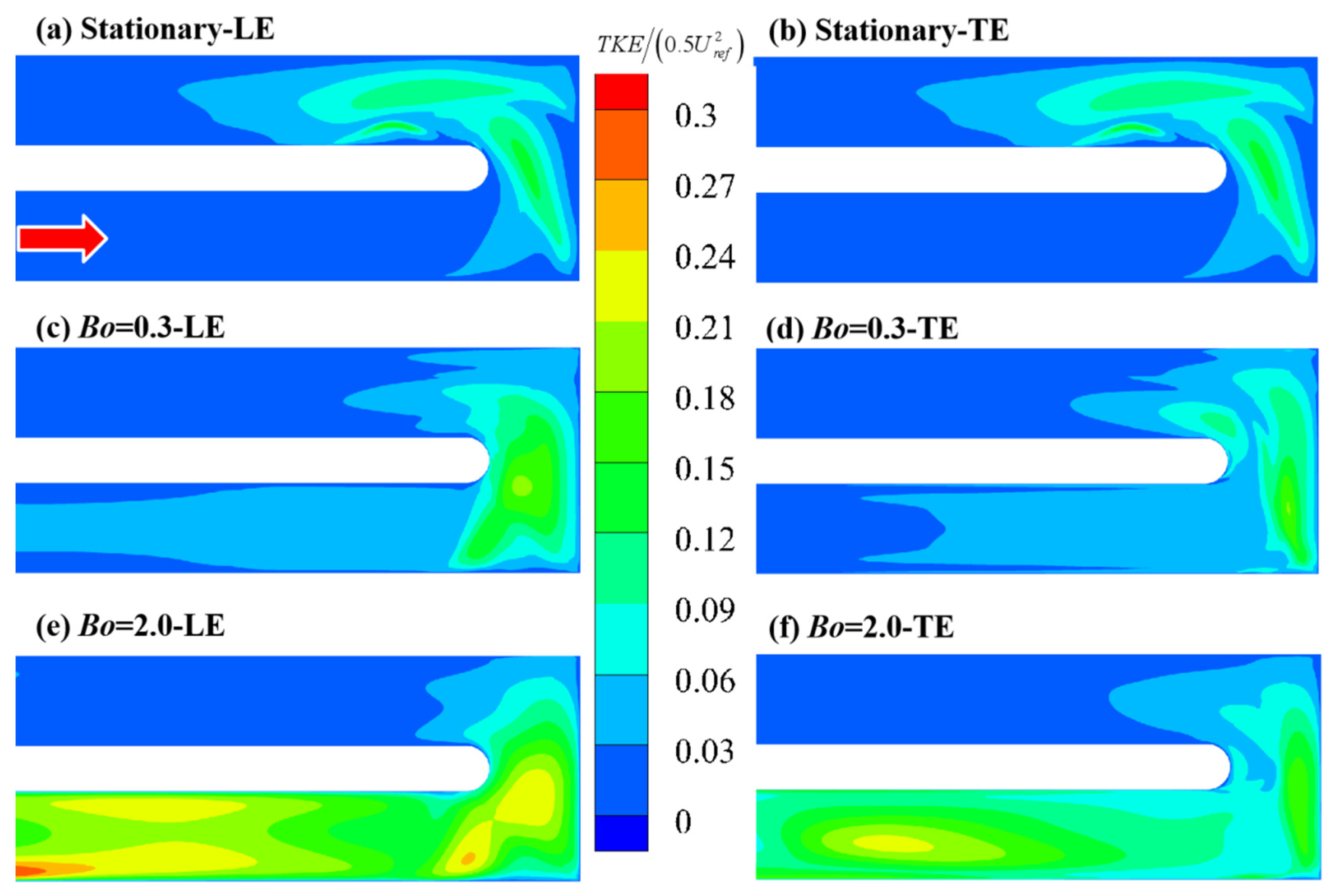
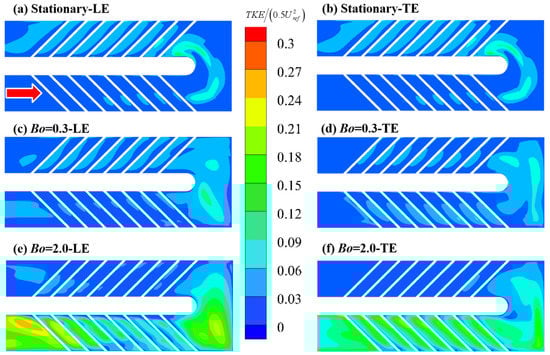
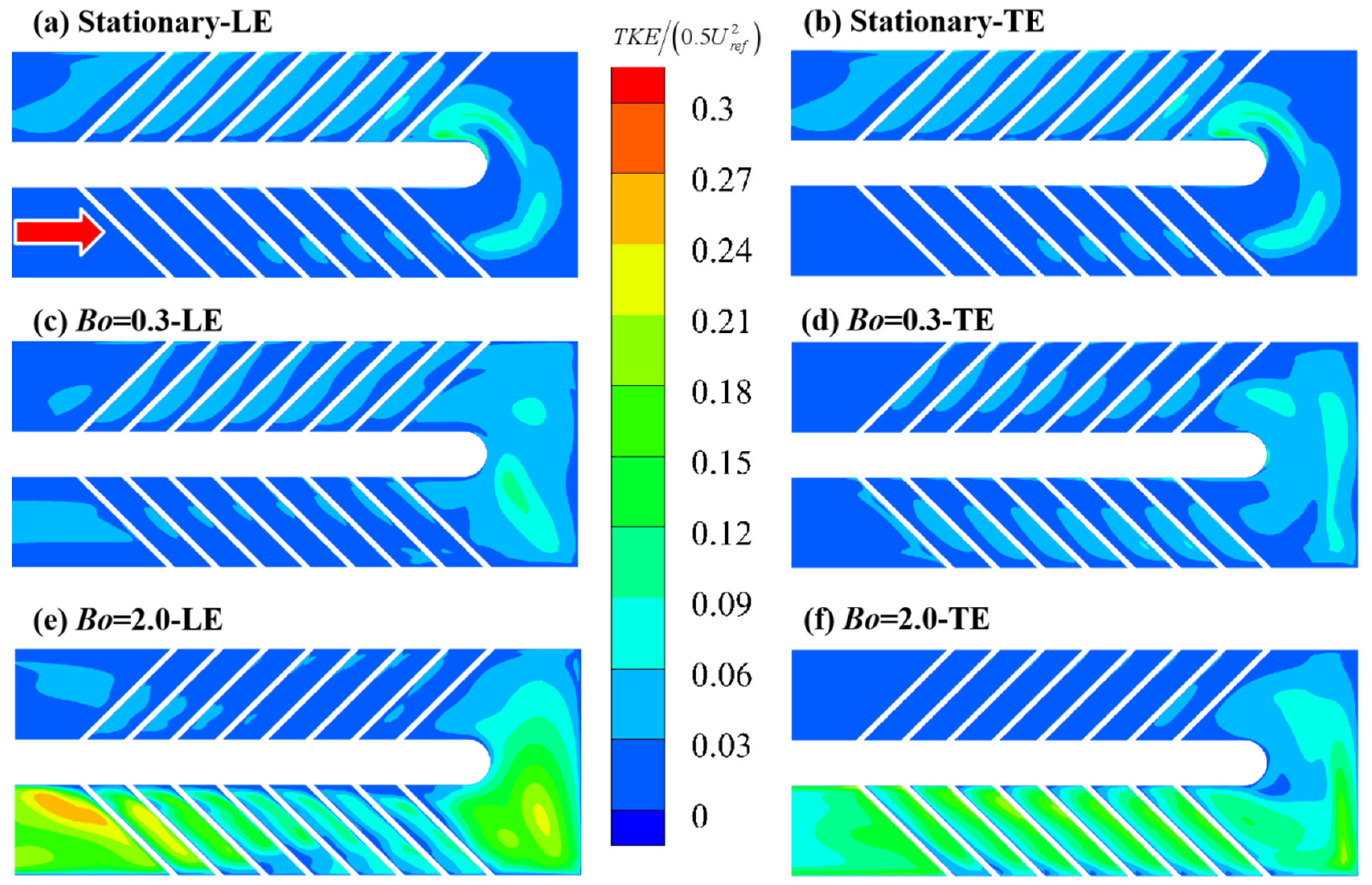
Figure 10 and Figure 11 present the 2-D non-dimensional TKE in meridian planes at Z/H = 0.9 (near LE) and 0.1 (near TE) under stationary and two rotating conditions (Ro = 0.15, Bo = 0.3 and 2.0). In the stationary smooth channel (Figure 10a,b), TKE is at low level in the first passage. Then TKE in the tip turn region rises due to the turn effect, and the downstream location achieves higher TKE enhancement. In the second passage right after the turn, TKE is maintained at a high level. Then, as the turn effects diminish, TKE decreases downstream. In the stationary ribbed channel (Figure 11a,b), ribs-induced flow separation and reattachment slightly enhance TKE in the first passage, while the TKE in the tip turn region shows a substantial reduction, compared to the smooth channel. In the downstream location of the second passage, the TKE obviously increases.
Figure 10.
Non-dimensional TKE in meridian planes at Z/H = 0.9 (near LE) and 0.1 (near TE) of smooth channel.
Figure 11.
Non-dimensional TKE in meridian planes at Z/H = 0.9 (near LE) and 0.1 (near TE) of ribbed channel.
In the rotating smooth channel, the TKE near LE/TE of the first pass elevates at Bo = 0.3 (Figure 10c,d) and when Bo = 2.0 (Figure 10e,f), and the TKE are greatly increased due to flow separation. In the tip turn region of the smooth channel, the TKE also increases due to rotation, especially in the upstream portion. In the second passage, rotation has a negative effect on TKE, possibly relevant to rotation-reduced partial impingement on the sidewall. For the ribbed channel, in the first pass TKE enhancement near LE/TE is very limited at Bo = 0.3 (Figure 11c,d), and when Bo = 2.0 (Figure 11e,f) the TKE is largely increased. In the second passage, rotating also weakens the TKE near LE/TE.
3.2. Heat Transfer Distribution
3.2.1. First Passage (Radically Outward Flow)
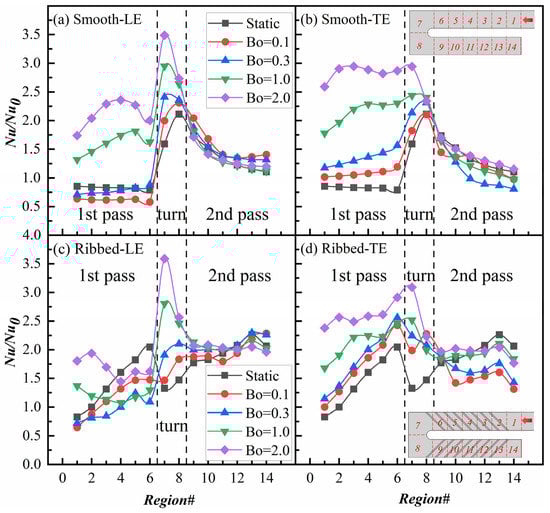
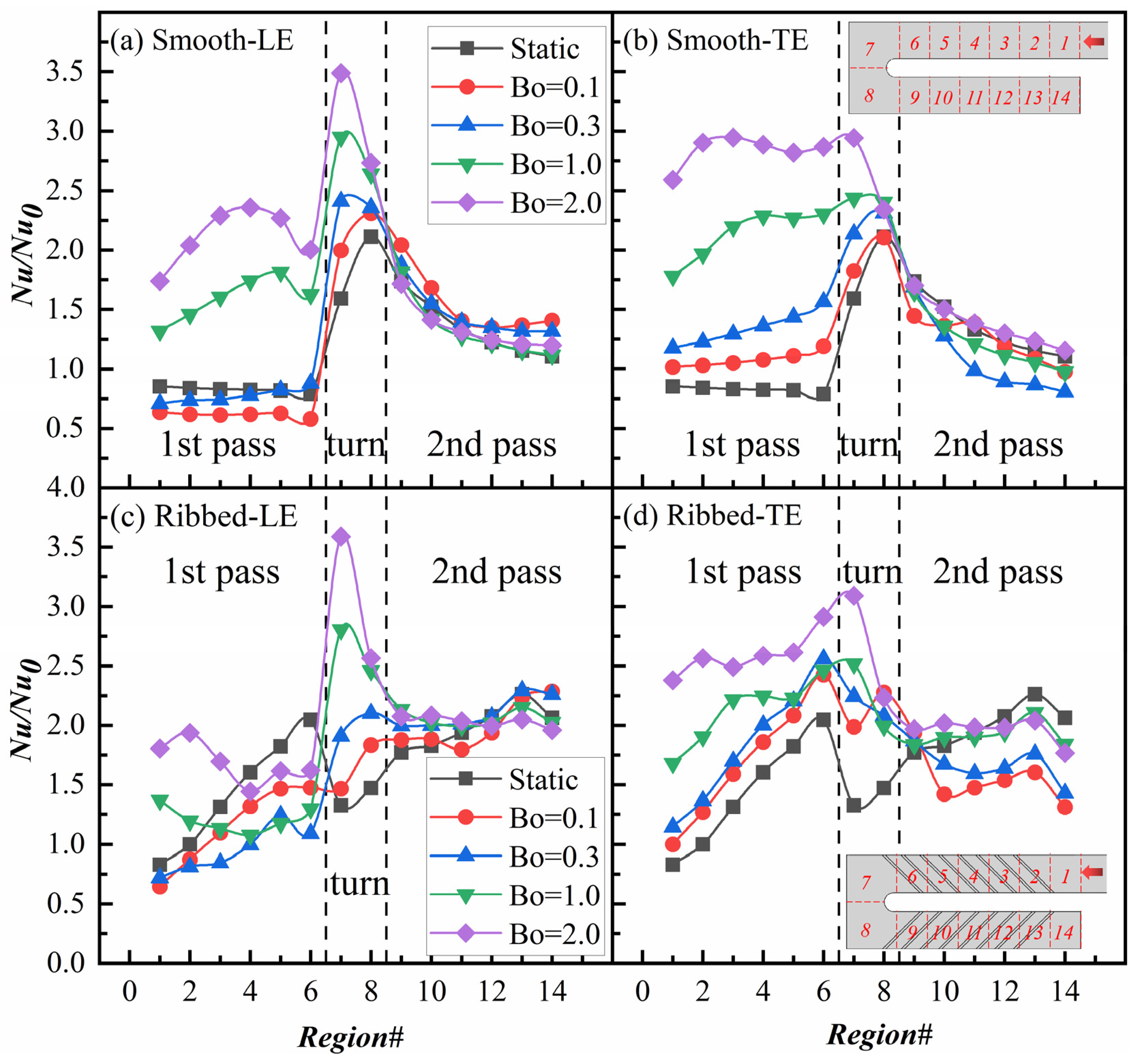
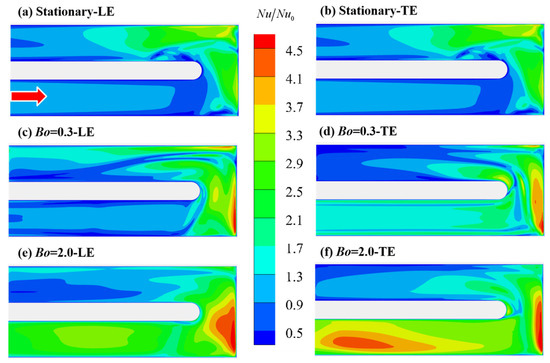
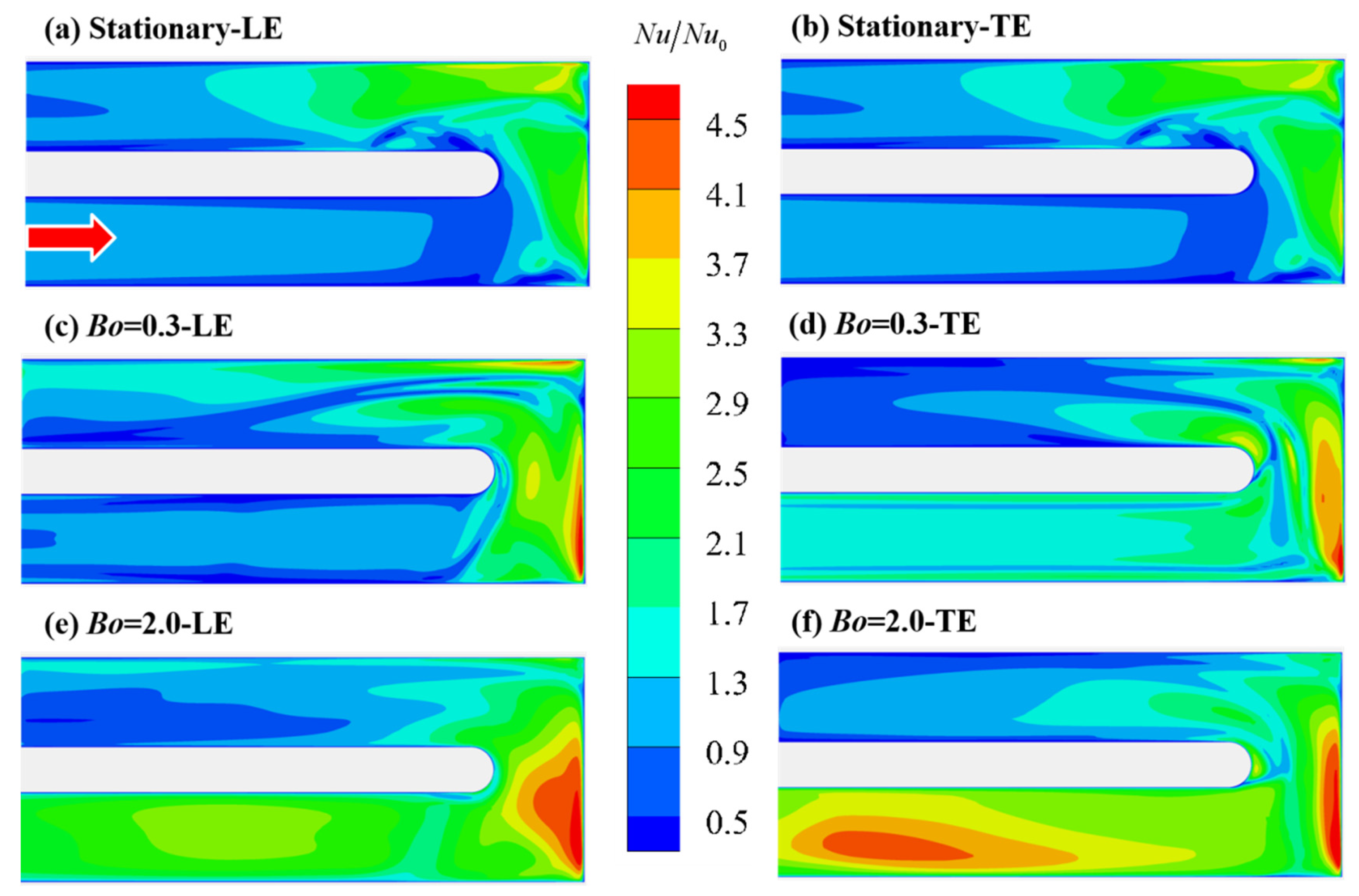
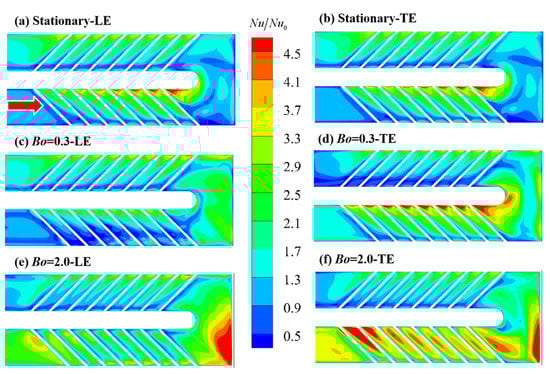
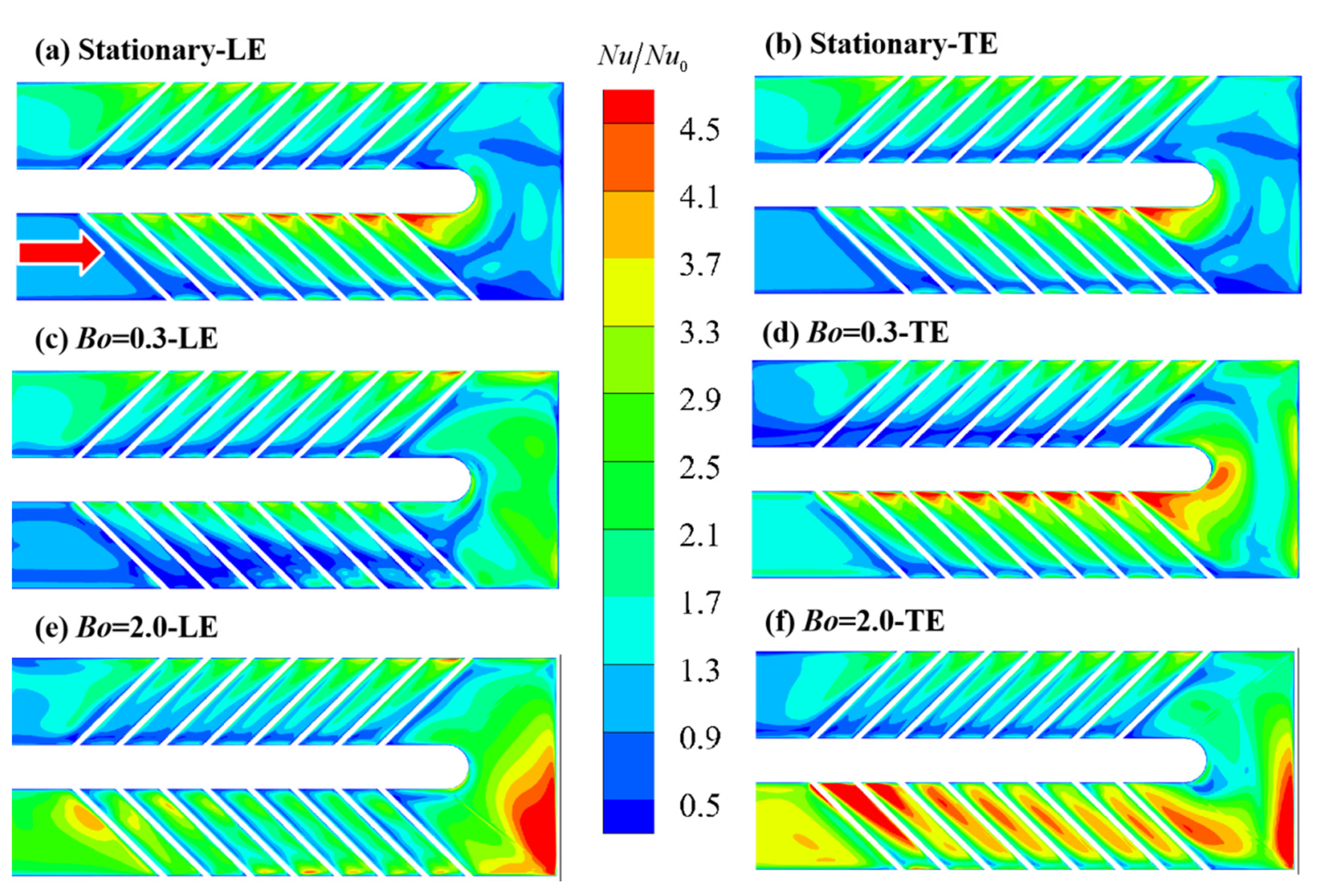
Figure 12 presents the streamwise profile of area-averaged Nu/Nu0 on LE and TE under stationary condition and rotating conditions (Ro = 0.15, Bo = 0.1/0.3/1.0/2.0), and Figure 13 and Figure 14 give the Nu/Nu0 contours. In stationary condition, the Nu/Nu0 of the first passage of the smooth channel is uniformly distributed and close to 1 (Figure 12a,b and Figure 13a,b). In the first passage of the ribbed channel (Figure 12c,d), the heat transfer is greatly enhanced by ribs, and the maximum average Nu/Nu0 is twice that of the smooth channel. Moreover, the average Nu/Nu0 keeps increasing along the passage with continuous disturbance by the ribs and the accumulation of turbulence.
Figure 12.
Streamwise profile of area-averaged Nu/Nu0.
Figure 13.
Nu/Nu0 contour of smooth channel.
Figure 14.
Nu/Nu0 contour of ribbed channel.
In the first passage of the smooth channel (Figure 12a,b), the skewed air flow leads to a 30% Nu/Nu0 decrease in LE when Bo = 0.1, while the Nu/Nu0 in TE increases obviously. When Bo = 0.3, the average Nu/Nu0 in LE shows a tiny rise compared to that of Bo = 0.1, but still below that of the stationary condition. It is proved that rotating buoyancy induced TKE enhancement is favorable compared to heat transfer on LE, though it is not enough to compensate for the weakening of heat transfer due to skewed flow. When Bo > 1.0, the high rotating buoyancy results in a substantial heat transfer enhancement, and the maximum Nu/Nu0 is 3.0 times that of the stationary condition. The strengthening of flow reversal near LE is one of the possible reasons for Nu/Nu0 elevation. However, this is not enough to explain the higher heat transfer at Bo = 0.3 than at the Bo = 0.1 condition. Because the flow separation does not occur at Bo = 0.3, the mainstream at Bo = 0.3 is more weakened by buoyancy than Bo = 0.1. The significant TKE increase is considered as the most critical reason for heat transfer enhancement. In addition, due to the negative impact of Coriolis on flow separation (as stated in Section 3.1.2), the Nu/Nu0 does not keep increasing along flow direction, but slightly decreases near the turn.
In the first passage of the ribbed channel, the rib-induced heat transfer enhancement gradually reduces as Bo increases. Firstly, when Bo increases from 0.1 to 0.3 (Figure 12c,d), the increased rotating buoyancy fails to enhance the Nu/Nu0 as in the smooth channel. A possible reason is that rotating induces a more significant weakening of rib-induced heat transfer enhancement. In addition, when Bo > 1.0 (Figure 12c,d), the averaged Nu/Nu0 does not keep increasing along the passage as in the stationary condition, but shows an obvious decrease. More importantly, the Nu/Nu0 on LE of the ribbed channel is even lower than that of the smooth channel when Bo > 1.0. The phenomenon can be interpreted as that the ribs are completely covered by the separation flow and the heat transfer enhancement mechanism of ribs induced flow separation-reattachment is greatly suppressed in this region.
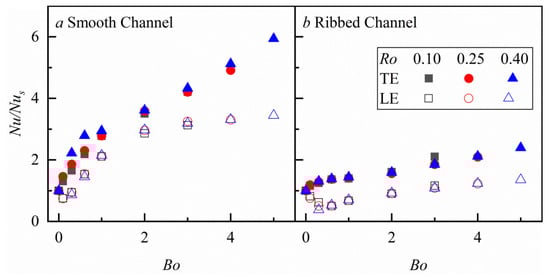
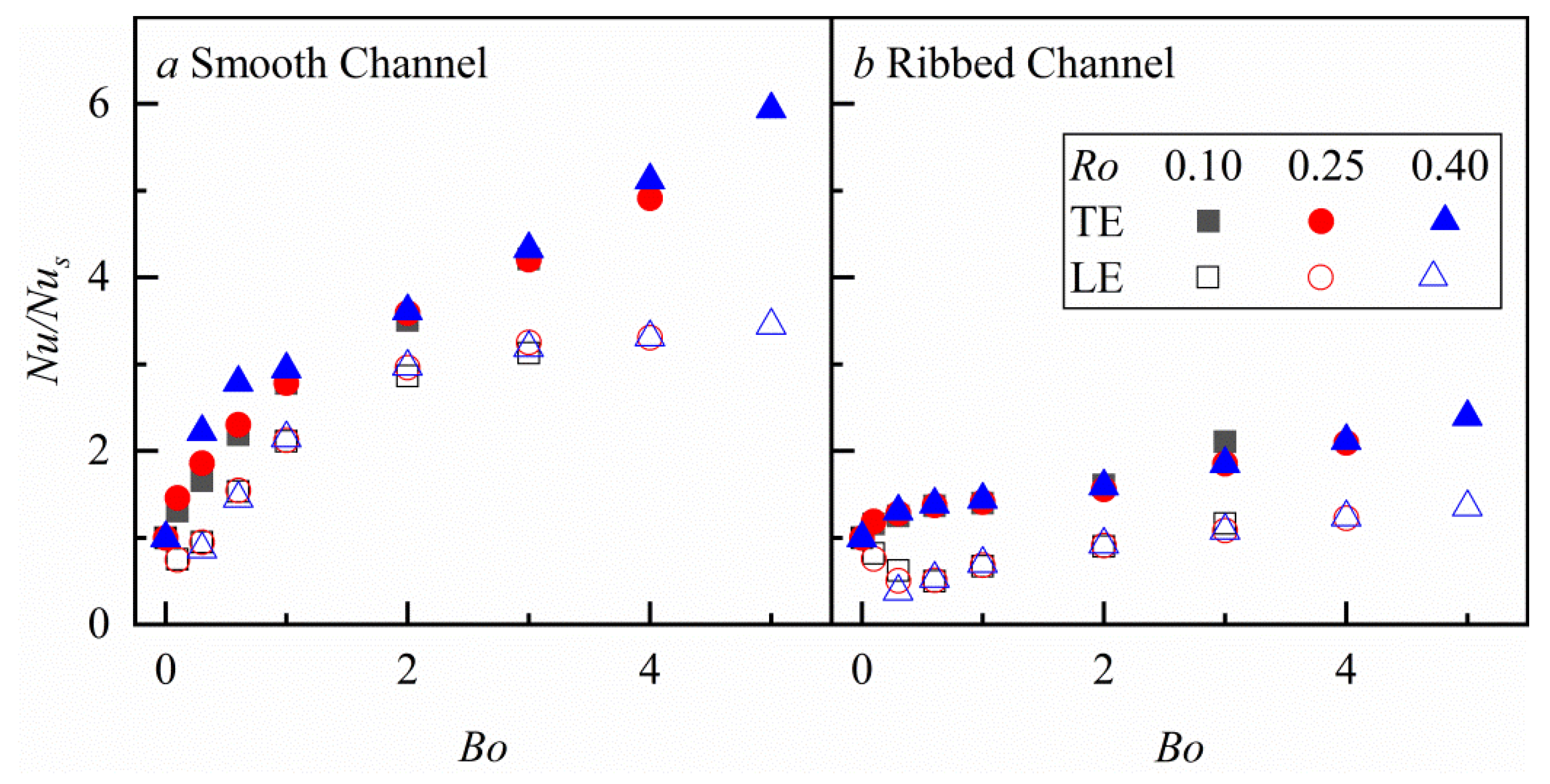
Figure 15 shows the Nu/Nus in the first passage (region 4), which denotes the ratio of Nu to Nus (stationary). For the smooth channel, the Nu/Nus on TE keeps increasing along with Bo, however, it first decreases and then increases on LE with Bo. The critical Bo is approximately 0.1, and the corresponding minimum Nu/Nus is about 0.74. When Bo = 0.6~1.0, the maximum growth rate of Nu/Nus occurs, which corresponds to the beginning of flow separation. Then, with Bo rising to 2.0, the increase rate of Nu/Nus slows down significantly. In the ribbed channel, the Nu/Nus on LE and TE are much smaller than those of the smooth channel. This indicates a significant reduction of rotation effects in the ribbed channel. In addition, the critical Bo of the ribbed channel is 0.3, and the corresponding minimum Nu/Nus is about 0.38.
Figure 15.
Nu/Nus–Bo in the first passage (region 4).
3.2.2. Second Passage (Radically Inward Flow)
Under stationary condition, in the second passage of the smooth channel (Figure 12a,b), the continuous effect of turn-inducted secondary flow and partial impingement enhances the average Nu/Nu0 in the region right after the turn. Then, the average Nu/Nu0 keeps decreasing along the passage, with turn effect diminishing. Moreover, in the region near the inner wall of the second passage entrance (Figure 13a,b), the flow reversal results in a low heat transfer zone. In the ribbed channel (Figure 12c,d), the average Nu/Nu0 remains at a high level due to the rib effect.
Under rotating conditions, the turn effect dominates the heat transfer in the second passage, and the rotating effect is relatively weak. In the second passage of the smooth channel (Figure 12a,b), on LE, the effects of favorable mainstream and decreased TKE counteract and consequently a tiny change of Nu/Nu0 occurs. On TE, when Bo = 0.1/0.3, the Nu/Nu0 decreases with TKE decreasing and non-favorable mainstream. However, when Bo > 1.0, the Nu/Nu0 in TE increases with high buoyancy induced flow, and the Nu/Nu0 on TE even exceeds that on LE. As in Figure 13c–f, the low heat transfer zone near the inner wall of the second passage entrance is suppressed with the reversal flow contracting as stated in Section 3.1.1. Meanwhile, the Nu/Nu0 near the upstream side wall drops with partial impingement diminishing. In the second passage of the ribbed channel (Figure 12c,d), when Bo = 0.1/0.3, the average Nu/Nu0 on TE drops more than that of the smooth channel due to significant TKE reduction, and the largest Nu/Nu0 decrease is about 50%. However, the average Nu/Nu0 in LE has no obvious variation.
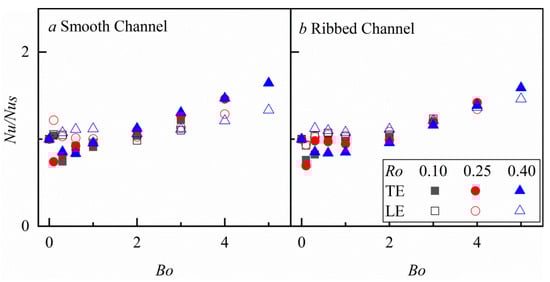
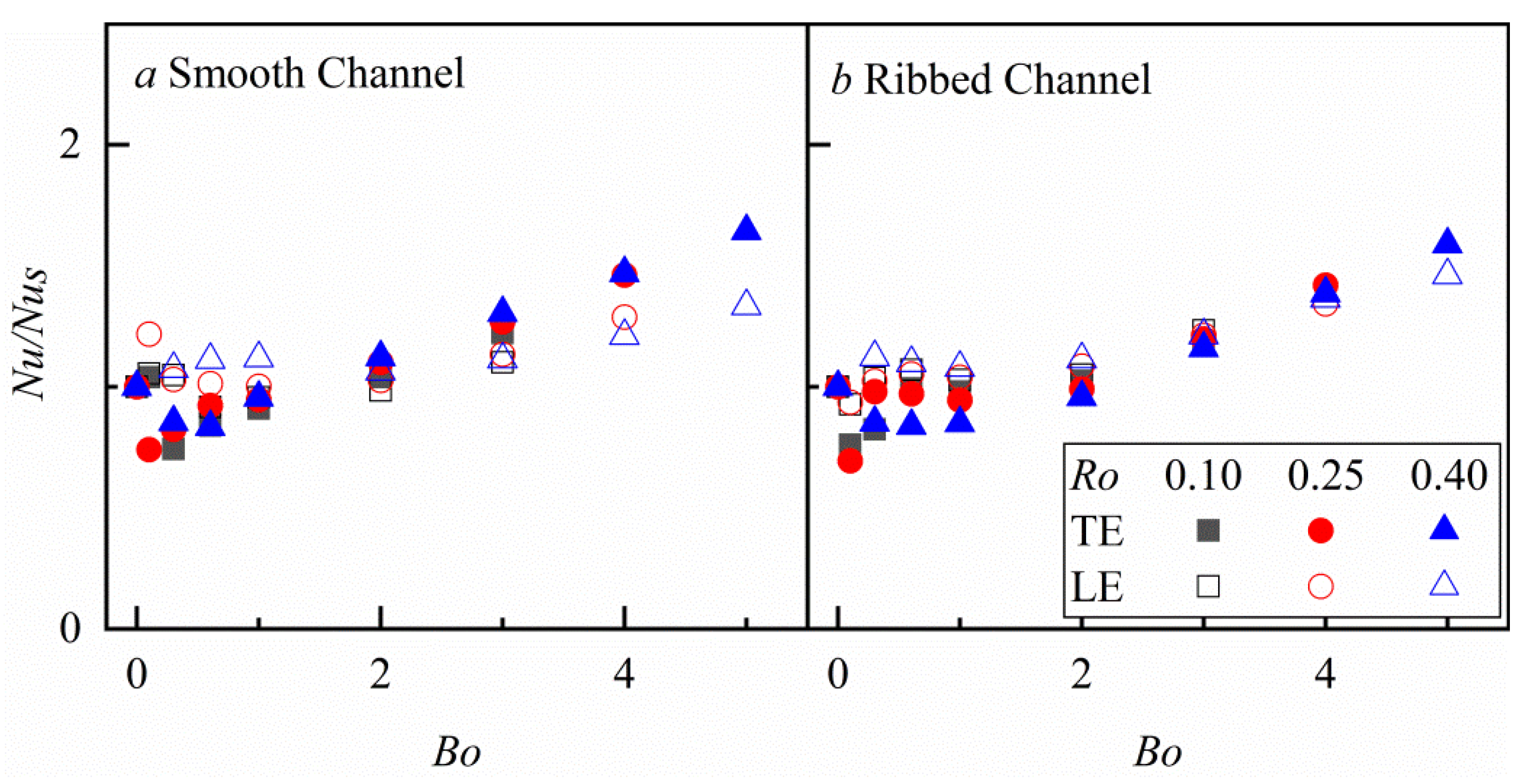
Figure 16 shows the Nu/Nus in region 11 of the second passage. Compared to the first passage, the variation of Nu/Nus in the second passage is relatively small, which reflects a weaker rotation effect on heat transfer. In the smooth channel, the biggest change of Nu/Nus on LE is only about 20%. While the heat transfer on TE appears to have significant correlation with Bo. The Nu/Nus on TE decreases first and then increases, similar to the LE of the first passage. In the ribbed channel, the Nu/Nus is slightly lower than that of the smooth channel.
Figure 16.
Nu/Nus–Bo in the second passage (region 11).
3.2.3. Tip Turn
Under stationary condition, in the tip turn region of the smooth channel (Figure 12a,b), the average Nu/Nu0 is generally higher than 1.5. Moreover, the average Nu/Nu0 in the downstream location (region 8) is greater than that of the upstream location (region 7). In addition, the heat transfer contour (Figure 13a,b) reflects that the partial impingement results in a high heat transfer in the region near the tip side wall. In the tip turn region of the ribbed channel (Figure 14a,b), the Nu/Nu0 near the inner wall increases while the Nu/Nu0 near the side wall decreases, contributed to by the change of velocity profile.
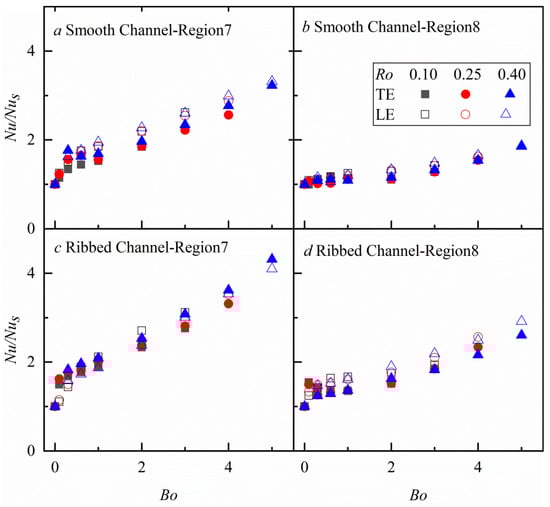
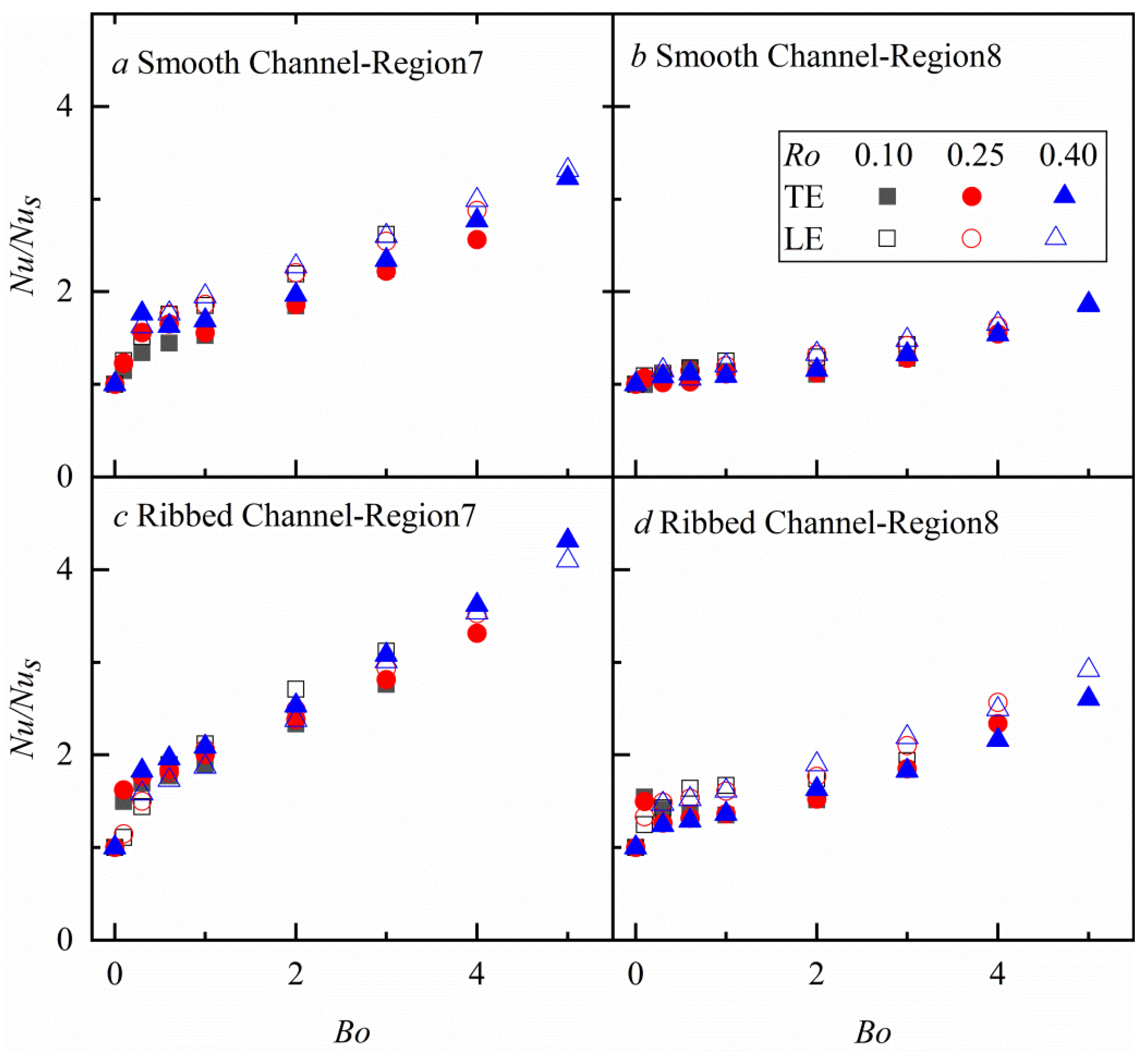
Under rotating conditions, in the tip turn region of the smooth channel (Figure 12a,b) and the ribbed channel (Figure 12c,d), the Nu/Nu0 on both TE and LE increases with Bo, and LE obtains larger elevation due to greater TKE enhancement. In addition, the Nu/Nu0 enhancement in the tip turn upstream location (region 7) is larger than that of the downstream location (region 8), consistent with Huh’s experimentation [18]. As in Figure 13e,f and Figure 14e,f, when Bo = 2.0, the Nu/Nu0 near the tip turn side wall is heavily enhanced, due to the air flow skewing to the side wall.
Figure 17 shows the Nu/Nus in the tip turn (regions 7 and 8). Obviously, for both smooth and ribbed channels, on both LE and TE surfaces, Nu/Nus rises with the Bo. Moreover, the heat transfer enhancement in region 7 is more significant. Considering both smooth and ribbed channels, rotation has a larger effect on tip turn heat transfer in the ribbed channel.
Figure 17.
Nu/Nus–Bo in the tip turn (regions 7 and 8).
4. Conclusions
The flow field and heat transfer distribution in the two-pass rotating smooth/ribbed channels are investigated. Three rotating numbers (Ro = 0.10, 0.25, and 0.40) are simulated, and the maximum Bo reaches 5.0. The main conclusions are as follows:
- First passage (Radially outward flow): Rotating buoyancy induces flow separation near LE when Bo > 1.0. The heat transfer coefficient on TE keeps increasing, while the heat transfer on LE first decreases and then increases with rising Bo, and the maximum increase rate occurs at Bo = 0.6~1.0. The significant TKE increase is considered as the most critical reason for heat transfer enhancement.
- Second passage (Radically inward flow): High rotating buoyancy enhances the air flow near both LE and TE, and induces double-peak profile flow. Rotating has a negative effect on TKE near both LE and TE. Due to the turn effects, the change of heat transfer with Bo is weaker than that in the first passage.
- Tip turn region: The heat transfer on LE and LE rises with Bo, and the upstream location (region7) of tip turn gains more heat transfer enhancement. Moreover, the Nu/Nu0 near the side wall of tip turn is heavily enhanced at Bo = 2.0.
- Ribbed effect: Rotating effects in the ribbed channel are much weaker than those in smooth channel. When Bo > 1, the Nu/Nu0 on LE of the first pass in the ribbed channel is even lower than that in the smooth channel.
Author Contributions
Conceptualization, J.L., P.S. and Y.F.; methodology, J.L., P.S. and Y.F.; software, W.H., K.Z. and J.W.; validation, W.H., K.Z., J.W. and J.L.; investigation, W.H., J.L. and P.S.; writing—original draft preparation, W.H. and J.L.; writing—review and editing, W.H., K.Z., J.W. and J.L.; supervision, J.L., P.S. and Y.F. All authors have read and agreed to the published version of the manuscript.
Funding
This research was funded by the National Science and Technology Major Project (2017-lll-0009-0035) and the National Natural Science Foundation of China (52076167&51776153).
Institutional Review Board Statement
Not applicable.
Informed Consent Statement
Not applicable.
Conflicts of Interest
The authors declare no conflict of interest.
Nomenclature
| Bo | buoyancy parameter |
| Ro | rotation number |
| Re | Reynolds number |
| Pr | Prandtl number of the air |
| Nu | Nusselt number |
| AR | aspect ratio |
| TKE | turbulent kinetic energy |
| SKE | secondary flow kinetic energy |
| R | rotation radius |
| D | diameter |
| T | temperature |
| U | reference velocity |
| mass flow rate | |
| Ω | rotating velocity |
| μ | viscosity of air |
| h | heat transfer coefficient |
| k | thermal conductivity of the air |
| q″ | heat flux |
| ρ | density of air |
| Subscripts | |
| s | stationary |
| w | wall |
| b | bulk |
| ref | reference |
| in | inlet |
| h | hydraulic |
| o | fully-developed turbulent flow in non-rotating smooth pipe |
References
- Han, J. Advanced Cooling in Gas Turbines 2016 Max Jakob Memorial Award Paper. J. Heat Transf. 2018, 140. [Google Scholar] [CrossRef] [Scilit]
- Al-Obaidi, A.R. Investigation of the flow, pressure drop characteristics, and augmentation of heat performance in a 3D flow pipe based on different inserts of twisted tape configurations. Heat Transf. 2021, 50, 5049–5079. [Google Scholar] [CrossRef] [Scilit]
- Al-Obaidi, A.R.; Alhamid, J.; Hamad, F. Flow felid and heat transfer enhancement investigations by using a combination of corrugated tubes with a twisted tape within 3D circular tube based on different dimple configurations. Heat Transf. 2021, 50, 6868–6885. [Google Scholar] [CrossRef] [Scilit]
- Park, J.S.; Han, J.; Huang, Y.; Ou, S. Heat Transfer Performance Comparisons of Five Different Rectangular Channels with Parallel Angled Ribs. Int. J. Heat Mass Transf. 1992, 35, 2891–2903. [Google Scholar] [CrossRef] [Scilit]
- Han, J.; Zhang, P. Effect of Rib-Angle Orientation on Local Mass Transfer Distribution in a Three-Pass Rib-Roughened Channel. J. Turbomach. 1991, 113, 123–130. [Google Scholar] [CrossRef] [Scilit]
- Han, J.; Zhang, Y.; Lee, C. Augmented Heat Transfer in Square Channels with Parallel, Crossed, and V-Shaped Angled Ribs. J. Heat Transf. 1991, 113, 590–596. [Google Scholar] [CrossRef] [Scilit]
- Taslim, M.E.; Li, T.; Kercher, D.M. Experimental Heat Transfer and Friction in Channels Roughened with Angled, V-Shaped, and Discrete Ribs on Two Opposite Walls. J. Turbomach. 1994, 118, 20–28. [Google Scholar] [CrossRef] [Scilit]
- Wagner, J.H.; Johnson, B.V.; Hajek, T.J. Heat Transfer in Rotating Passages with Smooth Walls and Radial Outward Flow. J. Turbomach. 1991, 113, 42–51. [Google Scholar] [CrossRef] [Scilit]
- Wagner, J.H.; Johnson, B.V.; Kopper, F.C. Heat Transfer in Rotating Serpentine Passages with Smooth Walls. J. Turbomach. 1991, 113, 321–330. [Google Scholar] [CrossRef] [Scilit]
- Han, J.; Zhang, Y.; Kalkuehler, K. Uneven Wall Temper ature Effect on Local Heat Transfer in a Rotating Two-Pass Square Chan nel With Smooth Walls. J. Heat Transf. 1993, 115, 912–920. [Google Scholar] [CrossRef] [Scilit]
- Han, J.; Zhang, Y.; Lee, C. Influence of Surface Heating Condition on Local Heat Transfer in a Rotating Square Channel with Smooth Walls and Radial Outward Flow. J. Turbomach. 1994, 116, 149–158. [Google Scholar] [CrossRef] [Scilit]
- Hwang, G.; Ku, C. Experimental Studies and Correlations of Convective Heat Transfer in a Radially Rotating Serpentine Passage. J. Heat Transf. 1997, 119, 460–466. [Google Scholar] [CrossRef] [Scilit]
- Hwang, G.; Tzeng, S.; Mao, C. Heat Transfer of Compressed Air Flow in a Spanwise Rotating Four-Pass Serpentine Channe. J. Heat Transf. 1999, 121, 583–591. [Google Scholar] [CrossRef] [Scilit]
- Wright, L.M.; Fu, W.; Han, J. Thermal Performance of Angled, V-Shaped, and W-Shaped Rib Turbulators in Rotating Rectangular Cooling Channels (AR = 4:1). J. Turbomach. 2004, 126, 604–614. [Google Scholar] [CrossRef] [Scilit]
- Fu, W.; Wright, L.M.; Han, J. Heat Transfer in Two-Pass Rotating Rectangular Channels (AR = 1:2 and AR = 1:4) With 45 Deg Angled Rib Turbulators. J. Turbomach. 2005, 127, 164–174. [Google Scholar] [CrossRef] [Scilit]
- Fu, W.; Wright, L.M.; Han, J. Heat Transfer in Two-Pass Rotating Rectangular Channels (AR = 2:1) with Discrete Ribs. J. Thermophys. Heat Transf. 2006, 20, 569–582. [Google Scholar] [CrossRef] [Scilit]
- Zhou, F.; Lagrone, J.; Acharya, S. Internal Cooling in 4:1 AR Passages at High Rotation Numbers. J. Heat Transf. 2007, 129, 1666–1675. [Google Scholar] [CrossRef] [Scilit]
- Huh, M.; Lei, J.; Liu, Y.; Han, J. High Rotation Number Effects on Heat Transfer in a Rectangular (AR = 2:1) Two-Pass Channel. J. Turbomach. 2011, 133, 021001. [Google Scholar] [CrossRef] [Scilit]
- Huh, M.; Lei, J.; Han, J. Influence of Channel Orientation on Heat Transfer in a Two-Pass Smooth and Ribbed Rectangular Channel (AR = 2:1) Under Large Rotation Numbers. J. Turbomach. 2012, 134, 011022. [Google Scholar] [CrossRef] [Scilit]
- Li, H.; You, R.; Deng, H.; Tao, Z.; Zhu, J. Heat transfer investigation in a rotating U-turn smooth channel with irregular cross-section. Int. J. Heat Mass Transf. 2016, 96, 267–277. [Google Scholar] [CrossRef] [Scilit]
- Dutta, S.; Andrews, M.J.; Han, J. Prediction of Turbulent Heat Transfer in Rotating Smooth Square Ducts. Int. J. Heat Mass Transf. 1996, 39, 2505–2514. [Google Scholar] [CrossRef] [Scilit]
- Liou, T.; Chen, C.; Chen, M. Rotating Effect on Fluid Flow in Two Smooth Ducts Connected by a 180-Degree Bend. J. Fluids Eng. 2003, 125, 138–148. [Google Scholar] [CrossRef] [Scilit]

Publisher’s Note: MDPI stays neutral with regard to jurisdictional claims in published maps and institutional affiliations. |
© 2021 by the authors. Licensee MDPI, Basel, Switzerland. This article is an open access article distributed under the terms and conditions of the Creative Commons Attribution (CC BY) license (https://creativecommons.org/licenses/by/4.0/).