On the Wind Turbine Wake and Forest Terrain Interaction


Abstract
1. Introduction
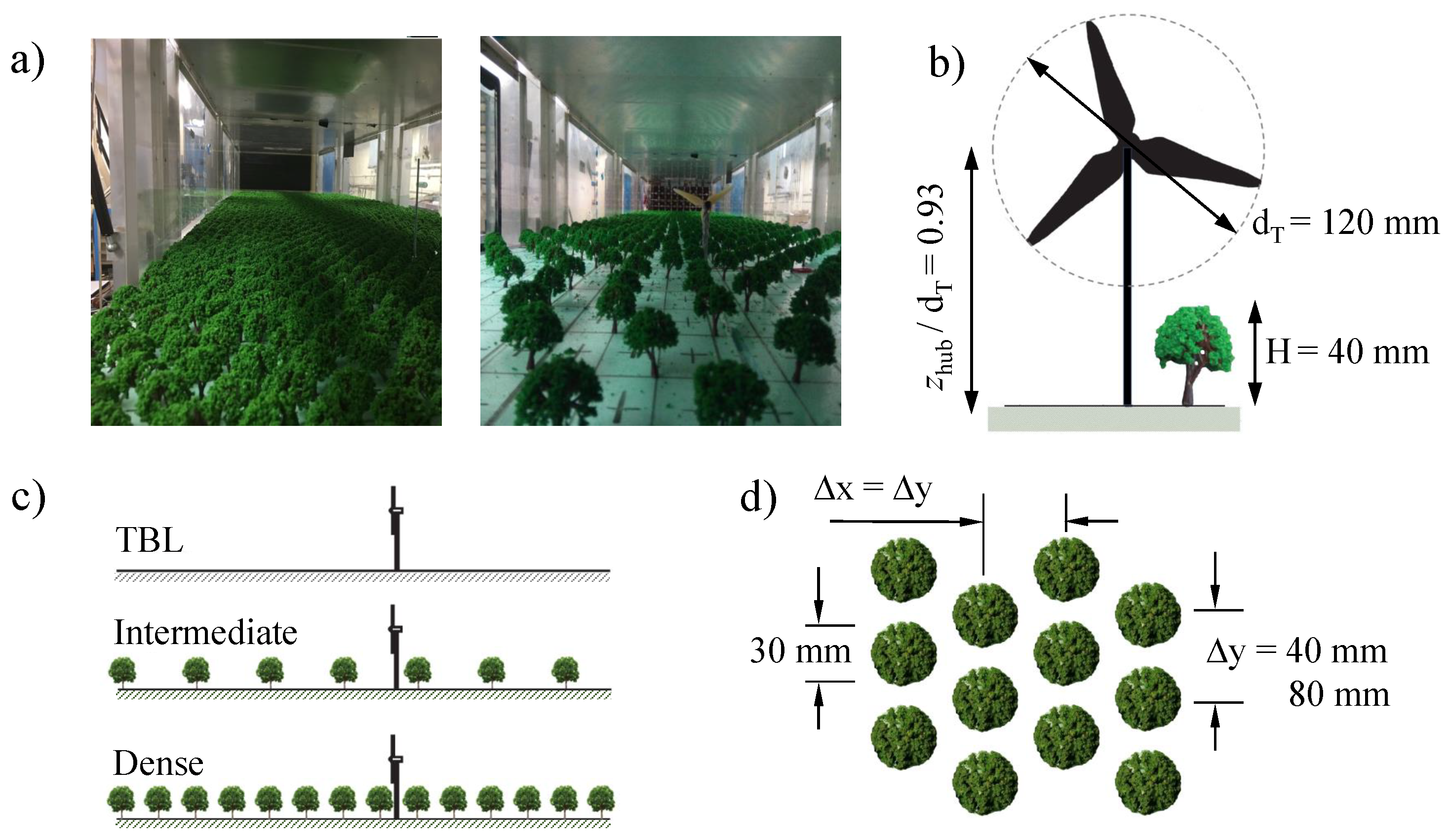
2. Experimental Set-Up
3. Results
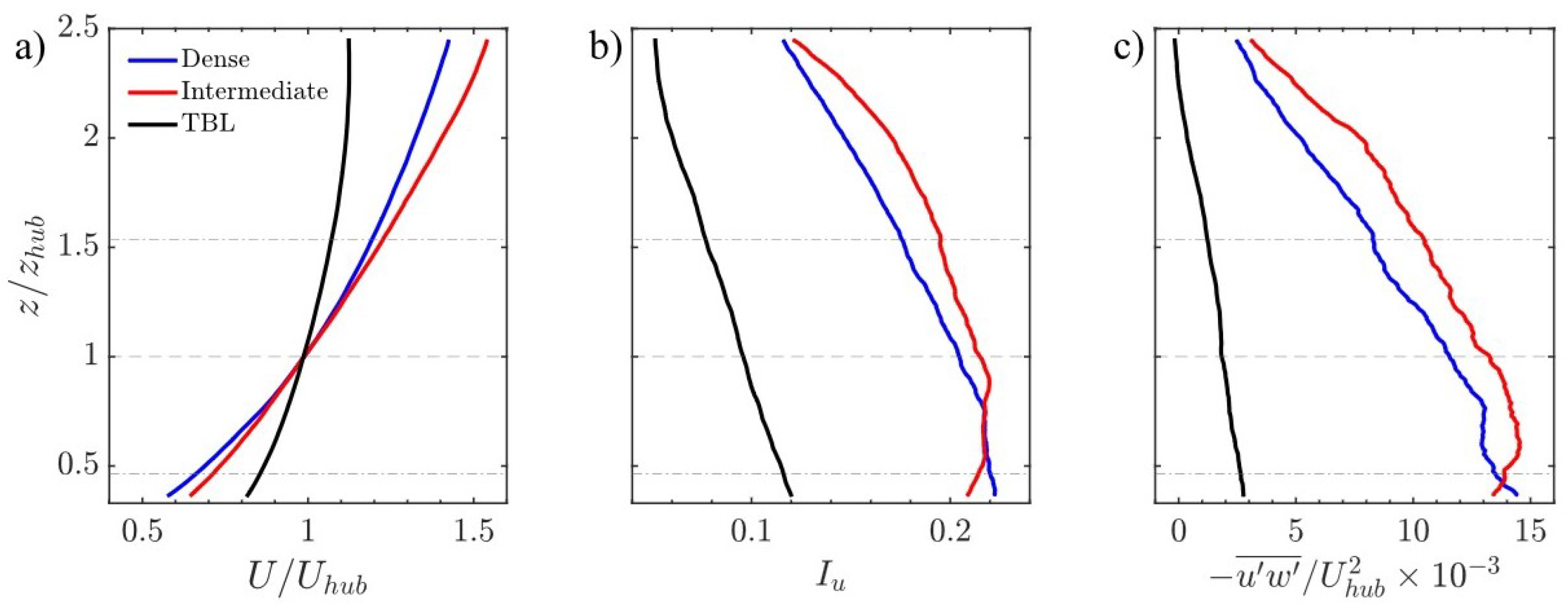
3.1. Mean Wake Characteristics
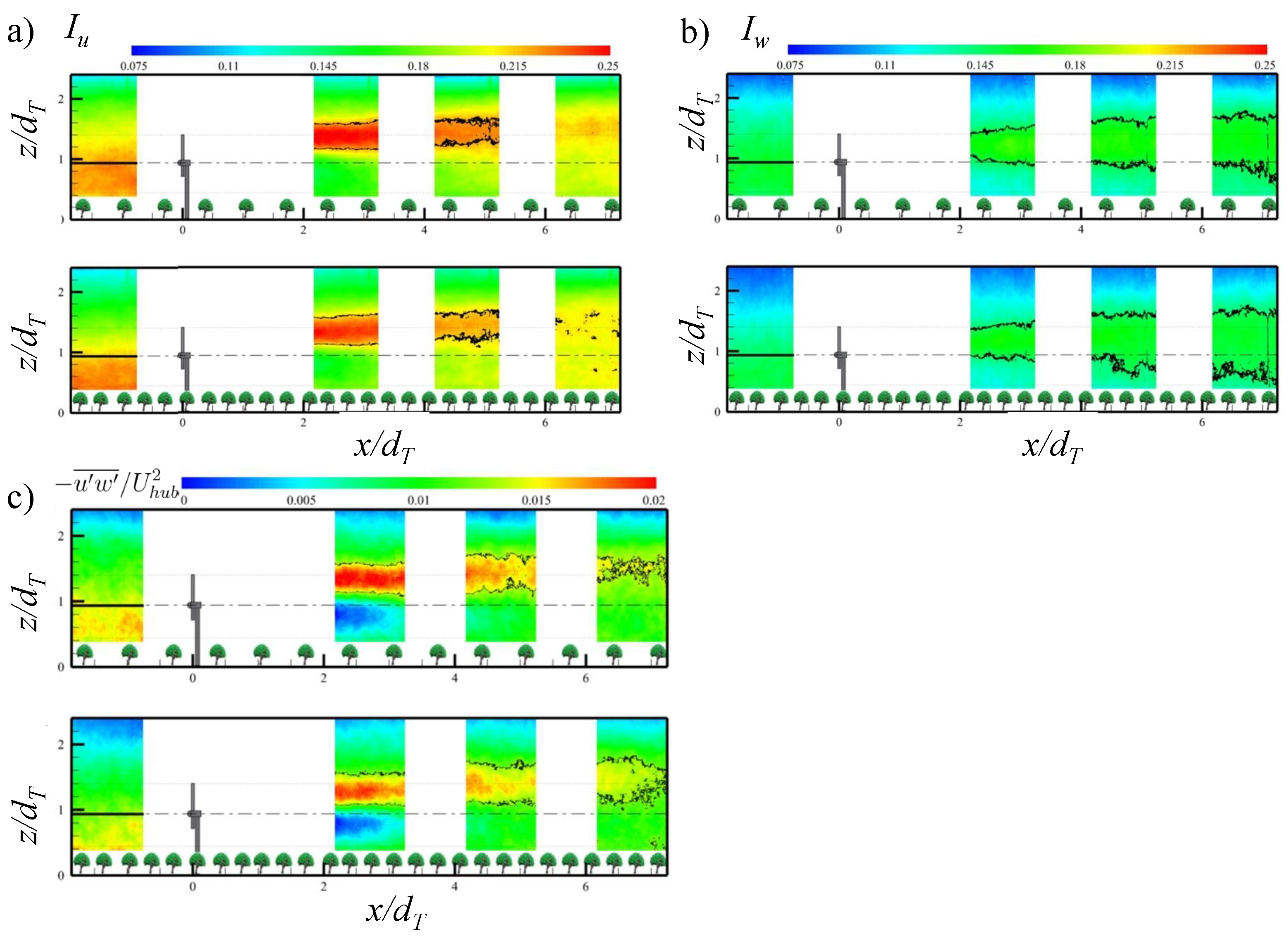
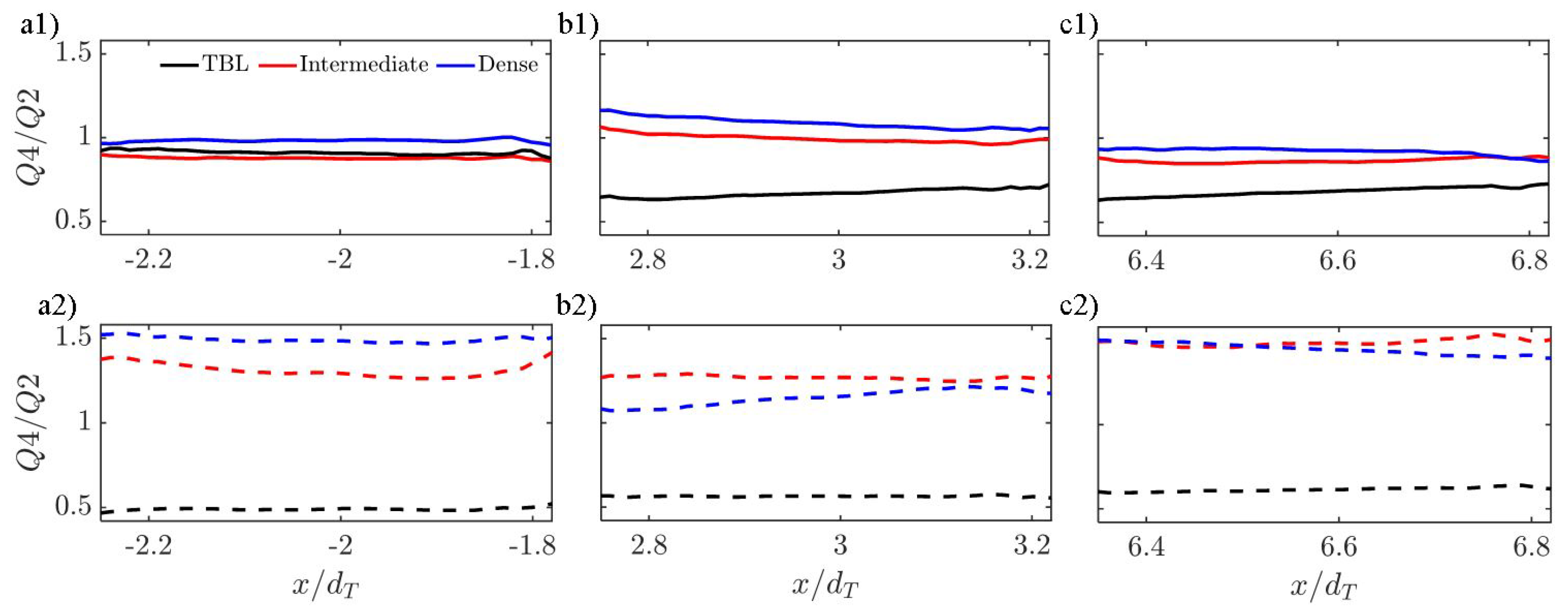
3.2. Turbulence Statistics
4. Conclusions
Author Contributions
Funding
Institutional Review Board Statement
Informed Consent Statement
Data Availability Statement
Acknowledgments
Conflicts of Interest
Abbreviations
| TBL | Turbulent Boundary Layer |
| PIV | Particle Image Velocimetry |
| FOV | Field of View |
| TKE | Turbulence Kinetic Energy |
| Probability Density Function |
References
- Alfredsson, P.H.; Segalini, A. Introduction Wind Farms in Complex Terrains: An Introduction; The Royal Society Publishing: London, UK, 2017. [Google Scholar]
- Baldocchi, D.D.; Meyers, T.P. Turbulence structure in a deciduous forest. Bound.-Layer Meteorol. 1988, 43, 345–364. [Google Scholar] [CrossRef] [Scilit]
- Finnigan, J. Turbulence in plant canopies. Annu. Rev. Fluid Mech. 2000, 32, 519–571. [Google Scholar] [CrossRef] [Scilit]
- Cava, D.; Katul, G.; Scrimieri, A.; Poggi, D.; Cescatti, A.; Giostra, U. Buoyancy and the sensible heat flux budget within dense canopies. Bound.-Layer Meteorol. 2006, 118, 217–240. [Google Scholar] [CrossRef] [Scilit]
- Lu, S.; Willmarth, W. Measurements of the structure of the Reynolds stress in a turbulent boundary layer. J. Fluid Mech. 1973, 60, 481–511. [Google Scholar] [CrossRef] [Scilit]
- Poggi, D.; Katul, G.; Albertson, J. Momentum transfer and turbulent kinetic energy budgets within a dense model canopy. Bound.-Layer Meteorol. 2004, 111, 589–614. [Google Scholar] [CrossRef] [Scilit]
- Poggi, D.; Porporato, A.; Ridolfi, L.; Albertson, J.; Katul, G. The effect of vegetation density on canopy sub-layer turbulence. Bound.-Layer Meteorol. 2004, 111, 565–587. [Google Scholar] [CrossRef] [Scilit]
- Zhu, W.; Van Hout, R.; Katz, J. PIV measurements in the atmospheric boundary layer within and above a mature corn canopy. Part II: Quadrant-hole analysis. J. Atmos. Sci. 2007, 64, 2825–2838. [Google Scholar] [CrossRef] [Scilit]
- Lopes, J.V.P.; Palma, J.; Lopes, A.S. Modelling the flow within forests: The canopy-related terms in the Reynolds-averaged formulation. J. Fluid Mech. 2021, 910. [Google Scholar] [CrossRef] [Scilit]
- Yue, W.; Meneveau, C.; Parlange, M.B.; Zhu, W.; Van Hout, R.; Katz, J. A comparative quadrant analysis of turbulence in a plant canopy. Water Resour. Res. 2007, 43. [Google Scholar] [CrossRef] [Scilit]
- Arnqvist, J.; Segalini, A.; Dellwik, E.; Bergström, H. Wind statistics from a forested landscape. Bound.-Layer Meteorol. 2015, 156, 53–71. [Google Scholar] [CrossRef] [Scilit]
- Kuwata, Y.; Suga, K. Lattice Boltzmann direct numerical simulation of interface turbulence over porous and rough walls. Int. J. Heat Fluid Flow 2016, 61, 145–157. [Google Scholar] [CrossRef] [Scilit]
- Gómez-de Segura, G.; García-Mayoral, R. Turbulent drag reduction by anisotropic permeable substrates—Analysis and direct numerical simulations. J. Fluid Mech. 2019, 875, 124–172. [Google Scholar] [CrossRef] [Scilit]
- Irvine, M.; Gardiner, B.; Hill, M. The evolution of turbulence across a forest edge. Bound.-Layer Meteorol. 1997, 84, 467–496. [Google Scholar] [CrossRef] [Scilit]
- Bailey, B.N.; Stoll, R. The creation and evolution of coherent structures in plant canopy flows and their role in turbulent transport. J. Fluid Mech. 2016, 789, 425–460. [Google Scholar] [CrossRef] [Scilit]
- Placidi, M.; Ganapathisubramani, B. Turbulent flow over large roughness elements: Effect of frontal and plan solidity on turbulence statistics and structure. Bound.-Layer Meteorol. 2018, 167, 99–121. [Google Scholar] [CrossRef] [Scilit] [PubMed]
- Pietri, L.; Petroff, A.; Amielh, M.; Anselmet, F. Turbulence characteristics within sparse and dense canopies. Environ. Fluid Mech. 2009, 9, 297. [Google Scholar] [CrossRef] [Scilit]
- Sharma, A.; García-Mayoral, R. Turbulent flows over sparse canopies. J. Phys. Conf. Ser. 2018, 1001, 012012. [Google Scholar] [CrossRef] [Scilit]
- Schröttle, J.; Piotrowski, Z.; Gerz, T.; Englberger, A.; Dörnbrack, A. Wind turbine wakes in forest and neutral plane wall boundary layer large-eddy simulations. J. Phys. Conf. Ser. 2016, 753, 032058. [Google Scholar] [CrossRef] [Scilit]
- Agafonova, O.; Avramenko, A.; Chaudhari, A.; Hellsten, A. Effects of the canopy created velocity inflection in the wake development in a large wind turbine array. J. Phys. Conf. Ser. 2016, 753, 032001. [Google Scholar] [CrossRef] [Scilit]
- Agafonova, O. A Numerical Study of Forest Influences on the Atmospheric Boundary Layer and Wind Turbines; Lappeenranta University of Technology: Lappeenranta, Finland, 2017. [Google Scholar]
- Nebenführ, B.; Davidson, L. Prediction of wind-turbine fatigue loads in forest regions based on turbulent LES inflow fields. Wind Energy 2017, 20, 1003–1015. [Google Scholar] [CrossRef] [Scilit]
- Rodrigo, J.S.; Van Beeck, J.; Dezsö-Weidinger, G. Wind tunnel simulation of the wind conditions inside bidimensional forest clear-cuts. Application to wind turbine siting. J. Wind. Eng. Ind. Aerodyn. 2007, 95, 609–634. [Google Scholar] [CrossRef] [Scilit]
- Tobin, N.; Chamorro, L.P. Windbreak effects within infinite wind farms. Energies 2017, 10, 1140. [Google Scholar] [CrossRef] [Scilit]
- Odemark, Y.; Segalini, A. The effects of a model forest canopy on the outputs of a wind turbine model. J. Phys. Conf. Ser. 2014, 555, 012079. [Google Scholar] [CrossRef] [Scilit]
- Chougule, A.; Mann, J.; Segalini, A.; Dellwik, E. Spectral tensor parameters for wind turbine load modeling from forested and agricultural landscapes. Wind Energy 2015, 18, 469–481. [Google Scholar] [CrossRef] [Scilit]
- Zendehbad, M.; Chokani, N.; Abhari, R.S. Impact of forested fetch on energy yield and maintenance of wind turbines. Renew. Energy 2016, 96, 548–558. [Google Scholar] [CrossRef] [Scilit]
- Asadi, M.; Pourhossein, K. Wind farm site selection considering turbulence intensity. Energy 2021, 236, 121480. [Google Scholar] [CrossRef] [Scilit]
- Adrian, R.J.; Meinhart, C.D.; Tomkins, C.D. Vortex organization in the outer region of the turbulent boundary layer. J. Fluid Mech. 2000, 422, 1–54. [Google Scholar] [CrossRef] [Scilit]
- Cheng, S.; Jin, Y.; Chamorro, L.P. Wind Turbines with Truncated Blades May Be a Possibility for Dense Wind Farms. Energies 2020, 13, 1810. [Google Scholar] [CrossRef] [Scilit]
- Shiu, H.; Van Dam, C.; Johnson, E.; Barone, M.; Phillips, R.; Straka, W.; Fontaine, A.; Jonson, M. A design of a hydrofoil family for current-driven marine-hydrokinetic turbines. In International Conference on Nuclear Engineering; American Society of Mechanical Engineers: New York, NY, USA, 2012; Volume 44984, pp. 839–847. [Google Scholar]
- Tobin, N.; Hamed, A.M.; Chamorro, L.P. An experimental study on the effects ofwinglets on the wake and performance of a modelwind turbine. Energies 2015, 8, 11955–11972. [Google Scholar] [CrossRef] [Scilit]
- Tobin, N.; Hamed, A.M.; Chamorro, L.P. Fractional flow speed-up from porous windbreaks for enhanced wind-turbine power. Bound.-Layer Meteorol. 2017, 163, 253–271. [Google Scholar] [CrossRef] [Scilit]
- Raffel, M.; Willert, C.E.; Scarano, F.; Kähler, C.J.; Wereley, S.T.; Kompenhans, J. PIV uncertainty and measurement accuracy. In Particle Image Velocimetry; Springer: Berlin/Heidelberg, Germany, 2018; pp. 203–241. [Google Scholar]
- Adrian, R.J.; Westerweel, J. Particle Image Velocimetry; Number 30; Cambridge University Press: Cambridge, UK, 2011. [Google Scholar]
- Fu, S.; Jin, Y.; Zheng, Y.; Chamorro, L.P. Wake and power fluctuations of a model wind turbine subjected to pitch and roll oscillations. Appl. Energy 2019, 253, 113605. [Google Scholar] [CrossRef] [Scilit]
- Chamorro, L.P.; Porté-Agel, F. A wind-tunnel investigation of wind-turbine wakes: Boundary-layer turbulence effects. Bound.-Layer Meteorol. 2009, 132, 129–149. [Google Scholar] [CrossRef] [Scilit]
- Odemark, Y. Wakes Behind Wind Turbines-Studies on Tip Vortex Evolution and Stability. Ph.D. Thesis, KTH Royal Institute of Technology, Stockholm, Sweden, 2012. [Google Scholar]
- Chamorro, L.; Guala, M.; Arndt, R.; Sotiropoulos, F. On the evolution of turbulent scales in the wake of a wind turbine model. J. Turbul. 2012, 13, N27. [Google Scholar] [CrossRef] [Scilit]
- Wallace, J.M. Quadrant analysis in turbulence research: History and evolution. Annu. Rev. Fluid Mech. 2016, 48, 131–158. [Google Scholar] [CrossRef] [Scilit]
- Jin, Y.; Liu, H.; Aggarwal, R.; Singh, A.; Chamorro, L.P. Effects of freestream turbulence in a model wind turbine wake. Energies 2016, 9, 830. [Google Scholar] [CrossRef] [Scilit]
- Laskari, A.; de Kat, R.; Hearst, R.J.; Ganapathisubramani, B. Time evolution of uniform momentum zones in a turbulent boundary layer. J. Fluid Mech. 2018, 842, 554–590. [Google Scholar] [CrossRef] [Scilit]
- Milan, P.; Wächter, M.; Peinke, J. Turbulent character of wind energy. Phys. Rev. Lett. 2013, 110, 138701. [Google Scholar] [CrossRef] [Scilit]
- Chamorro, L.P.; Lee, S.J.; Olsen, D.; Milliren, C.; Marr, J.; Arndt, R.; Sotiropoulos, F. Turbulence effects on a full-scale 2.5 MW horizontal-axis wind turbine under neutrally stratified conditions. Wind Energy 2015, 18, 339–349. [Google Scholar] [CrossRef] [Scilit]
- Kazak, J.; Van Hoof, J.; Szewranski, S. Challenges in the wind turbines location process in Central Europe—The use of spatial decision support systems. Renew. Sustain. Energy Rev. 2017, 76, 425–433. [Google Scholar] [CrossRef] [Scilit]
- Sunak, Y.; Höfer, T.; Siddique, H.; Madlener, R.; De Doncker, R.W. A GIS-Based Decision Support System for the Optimal Siting of Wind Farm Projects; Universitätsbibliothek der RWTH Aachen: Aachen, Germany, 2015. [Google Scholar]
- Lee, A.H.; Chen, H.H.; Kang, H.Y. Multi-criteria decision making on strategic selection of wind farms. Renew. Energy 2009, 34, 120–126. [Google Scholar] [CrossRef] [Scilit]



Publisher’s Note: MDPI stays neutral with regard to jurisdictional claims in published maps and institutional affiliations. |
© 2021 by the authors. Licensee MDPI, Basel, Switzerland. This article is an open access article distributed under the terms and conditions of the Creative Commons Attribution (CC BY) license (https://creativecommons.org/licenses/by/4.0/).
Share and Cite
Cheng, S.; Elgendi, M.; Lu, F.; Chamorro, L.P. On the Wind Turbine Wake and Forest Terrain Interaction. Energies 2021, 14, 7204. https://doi.org/10.3390/en14217204
Cheng S, Elgendi M, Lu F, Chamorro LP. On the Wind Turbine Wake and Forest Terrain Interaction. Energies. 2021; 14(21):7204. https://doi.org/10.3390/en14217204
Chicago/Turabian StyleCheng, Shyuan, Mahmoud Elgendi, Fanghan Lu, and Leonardo P. Chamorro. 2021. "On the Wind Turbine Wake and Forest Terrain Interaction" Energies 14, no. 21: 7204. https://doi.org/10.3390/en14217204
APA StyleCheng, S., Elgendi, M., Lu, F., & Chamorro, L. P. (2021). On the Wind Turbine Wake and Forest Terrain Interaction. Energies, 14(21), 7204. https://doi.org/10.3390/en14217204