


The name Alfred Joseph carries a special significance among the ranks of those known as pioneers in podiatric medicine. A printer who entered the field of chiropody at age 37, Dr. Joseph became the organizing force for the birth of the American Podiatric Medical Association in 1912, at that time called the National Association of Chiropodists (NAC). Even before that bedrock achievement, Dr. Joseph proved himself to be a visionary by establishing the first college of chiropody in New York in 1911; 4 years earlier, in 1907, he began publishing a journal to bring the profession together and make possible the formation of this new national organization.
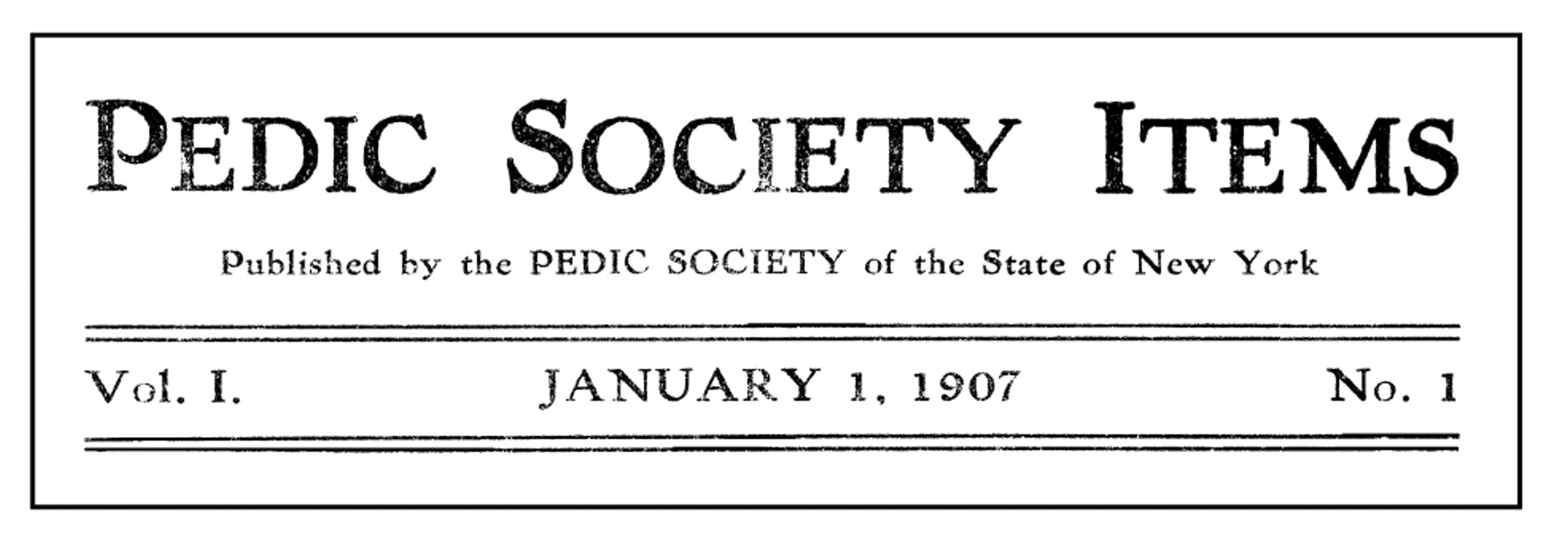
Dr. Joseph was the owner of a printing shop in New York City before becoming a chiropodist, and he knew the power of the printed word as a unifying force. Combining his two loves of printing and chiropody, Dr. Joseph established the profession’s—and the world’s—first podiatric journal 100 years ago, Pedic Society Items (Fig. 1). The journal was published by the Pedic Society of New York, one of only a few state societies in the field of chiropody. It was Pedic Society Items, a small digest-size publication, that began to knit this fledgling profession together. Today it has evolved into the Journal of the American Podiatric Medical Association, looking better than ever at the century mark, with another Dr. Joseph at the editorial helm, Warren S. Joseph, DPM, one of podiatric medicine’s most respected teachers and lecturers.
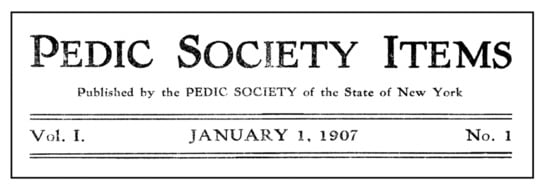
Figure 1.
Nameplate from the first issue of Pedic Society Items, published in January 1907.
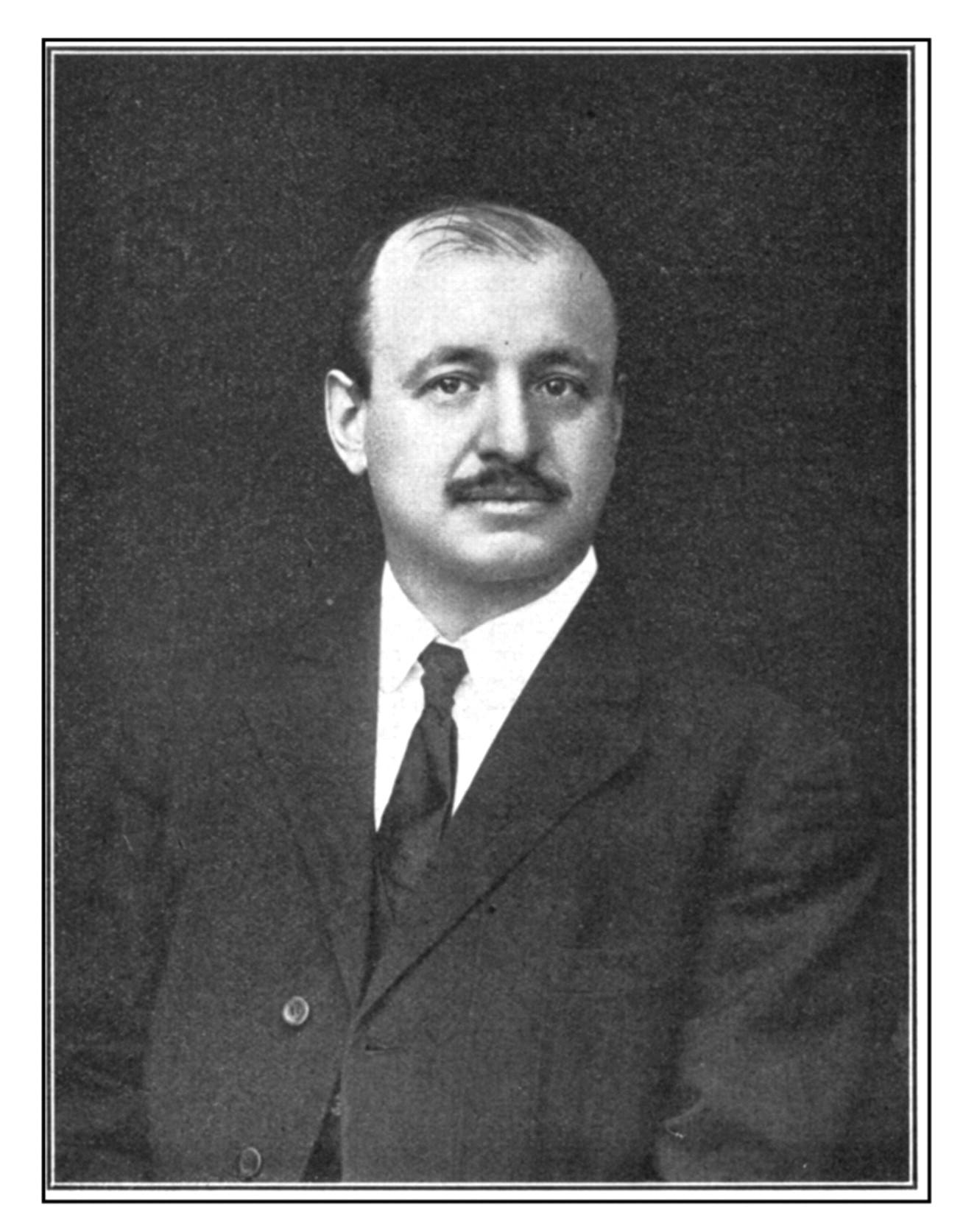
At the annual meeting of the NAC in 1912, Dr. Alfred Joseph was named the organization’s first president (Fig. 2). In his acceptance speech, he outlined the goals of the organization:
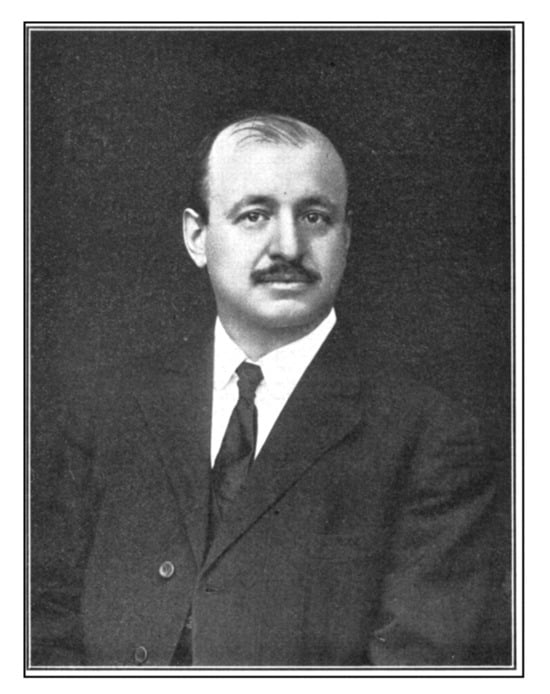
Figure 2.
Alfred Joseph, first president of the National Association of Chiropodists and founder of Pedic Society Items. (Reprinted from the cover of The Pedic Items, 2(4), July 1911.)
In inaugurating this movement, the greatest ever attempted in chiropody, our first charge is to encourage the organization of State Pedic Societies. In doing this, it is requisite to enroll as members of such bodies every reputable man and woman practicing chiropody, inasmuch as the aid and co-operation of every individual is required, both financially and morally, if success is to crown the efforts of those who are assuming to take the lead in elevating the standards of the profession.[1]
From the start, the primary goal of the NAC and its publications was to elevate the profession’s standards, a goal that is still woven into APMA’s strategic plan and is a guiding benchmark for articles approved for publication in JAPMA today.
Pedic Society Items was published sporadically, three or four times annually. With the advent of the national organization, the name of the journal was shortened to The Pedic Items, with Dr. Joseph remaining as editor following his term as NAC president. At this time, the Items blossomed into a monthly publication. The early years of The Pedic Items did much to strengthen the profession in the United States through the publication of articles on podiatric research, current treatment techniques, and, of course, societal notes that enhanced the spirit of camaraderie within the profession.
The professional life of Alfred Joseph was not all accolades and honors, however. Despite the fact that the New York Society generously bestowed full ownership of The Pedic Items on Dr. Joseph, and despite the fact that his profits rose as the NAC grew, his financial worries increased. He attempted to establish, without success, a number of shoe stores that sold only the kind of shoes chiropodists would recommend, and he later began writing promotional articles about a device that was touted as a “cure-all” for mechanical foot ailments.[2]
Such articles were considered to be heretical by the New York Society, and in 1920 Dr. Joseph stepped down as editor, selling the Items to the NAC for $15,000 and also agreeing never to establish another podiatric journal. Dr. Joseph died of intestinal cancer 8 years later. Upon his passing, he was elevated by his profession to the status of hero, with many tributes published in his honor, including several calling him “the greatest figure that chiropody will ever see.”[2]
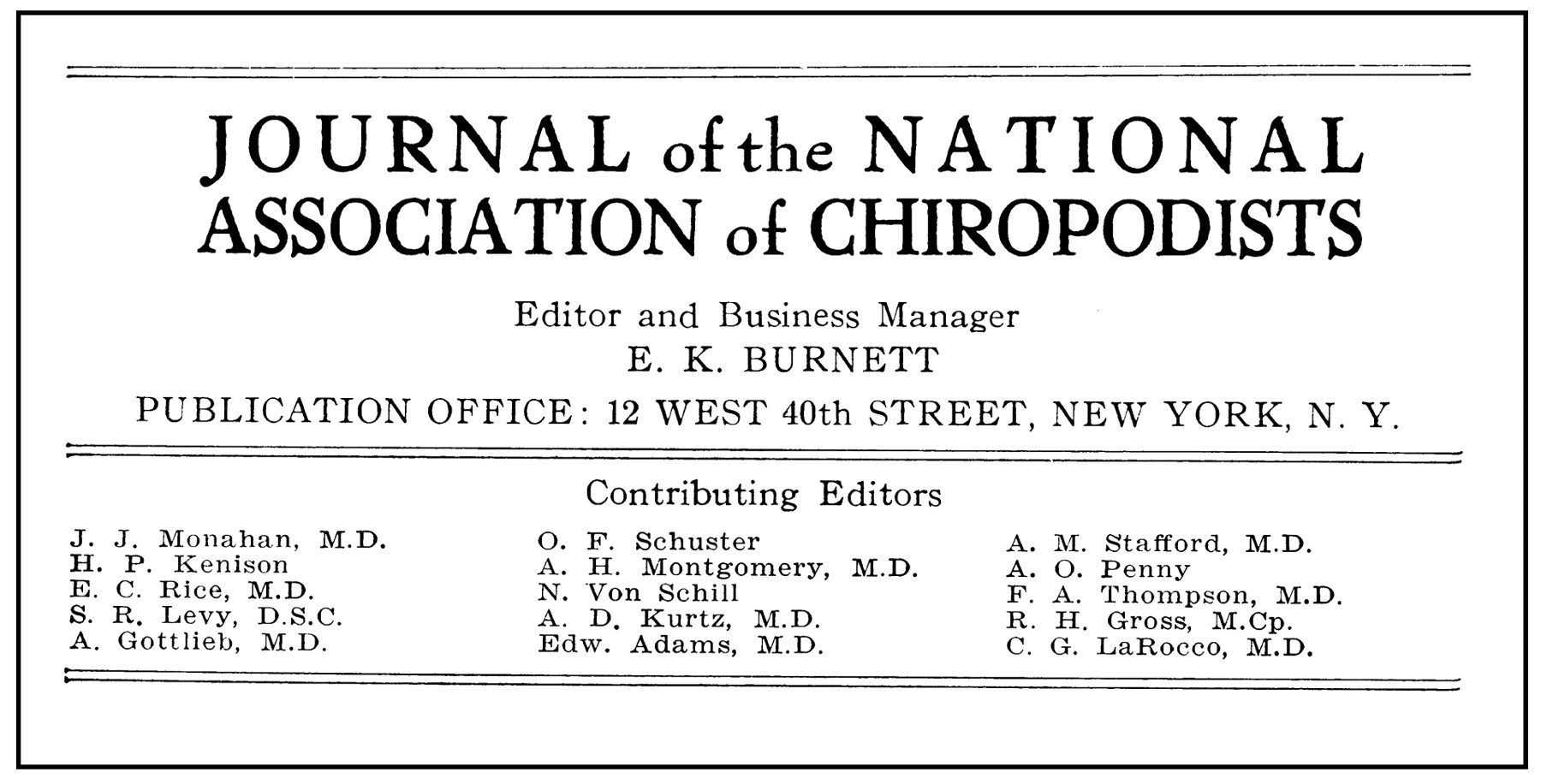
Dr. Joseph’s successor was Edwin K. Burnett, who was the editor of an independent journal, The Podiatrist. Making Dr. Burnett editor and business manager of the Items gave the Association an experienced person to whom to turn over the editorial reins, and it also removed The Podiatrist as a competing publication. In 1921, the first issue under Dr. Burnett’s editorial direction carried the name Journal of the National Association of Chiropodists on the masthead (Fig. 3). Dr. Burnett stayed on as editor until 1930, adding many new features to the publication along the way, as well as a cadre of contributing editors.
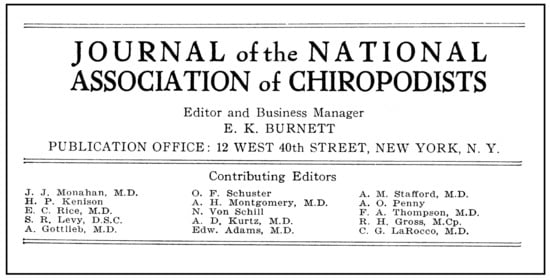
Figure 3.
Masthead of the January 1921 issue, the first issue edited by Edwin K. Burnett.
In 1930, Joseph Lelyveld assumed editorial control of the Journal, serving until 1942. He was the tenth president of the NAC (1931–1932), and throughout his career he was extremely active on most NAC committees. As an example of his vision, he legally registered the name “American Podiatry Association” in 1932, keeping that name safe until its actual adoption by the House of Delegates in 1958. Moreover, Dr. Lelyveld was a pioneer in podiatric sports medicine, working at foot-care stations for the Boston Marathon for more than 30 years. He was also team chiropodist for the Boston Braves and Red Sox, and he even designed shoes for astronauts prior to his death in 1965. Dr. Lelyveld, who had an appreciation for the value of public relations, is credited with starting the observance of Foot Health Week in 1925, a concept that is still part of APMA’s public relations programming.
Dr. Lelyveld’s editorial philosophy was that the Journal should “act as a vast reflector, but an intelligent reflector, recording for the profession the various happenings that go on in their midst.”[3] He added several new features, including more information on the goals and problems of the NAC and podiatry-chiropody. The highlight issues were the silver anniversary edition, which he produced in January 1936, and, again flexing his public relations skills, an organizational issue in February 1937 that was sent to all chiropodists in the country as encouragement for them to join the organization.
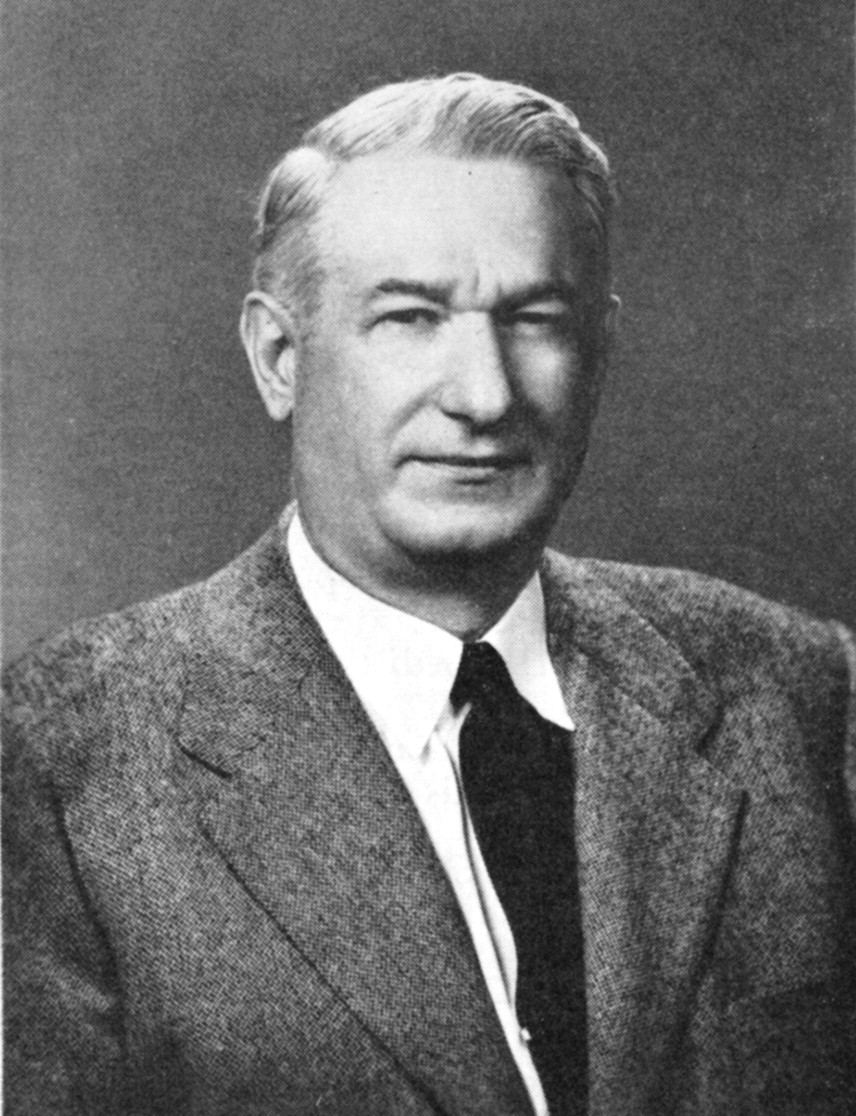
William J. Stickel came to Washington in 1941 as secretary of the NAC Defense Committee for the purpose of opening a headquarters for the profession (Fig. 4). His service as the first executive secretary of the NAC was only one of his major achievements, however. During his 14 years in Washington, Dr. Stickel worked tirelessly as a champion for his profession. One of his passions was the NAC’s scientific journal, which, now under his editorship, had become the Journal of the National Association of Chiropodists-Podiatrists. He enhanced the scientific content of the Journal and included more news of the profession, especially during the tumultuous war years. Dr. Stickel created the NAC Award for Research to encourage scientific research and papers in podiatry, a major APMA award that still exists today, named in Dr. Stickel’s honor and memory. As a businessman, Dr. Stickel also saw to it that advertising revenues improved for the Journal, and indeed they doubled under his watch.
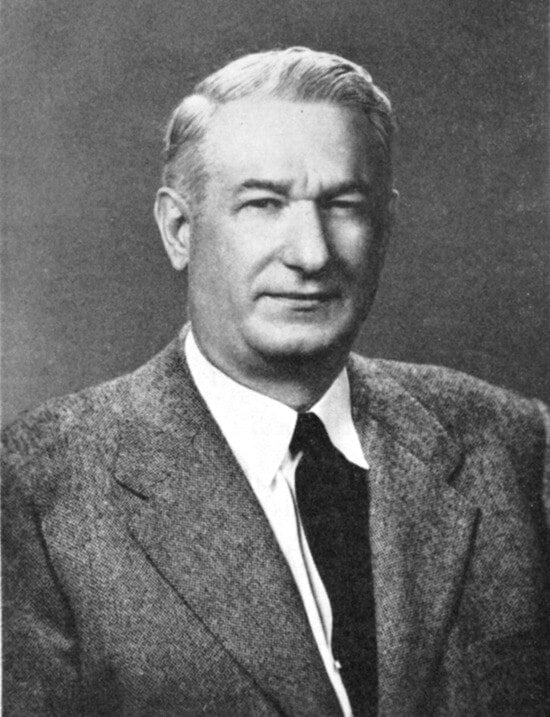
Figure 4.
William J. Stickel, first executive secretary of the National Association of Chiropodists. (Reprinted from the Journal of the National Association of Chiropodists, 45(7), July 1955.)
Before coming to the NAC, Dr. Stickel was dean at the Illinois College of Chiropody, a charter member of the Chiropody Bibliographic Research Society, the editor of the Chiropody Record, and president of the American Association of Colleges of Chiropody for 3 years. He also negotiated the purchase of APMA’s first headquarters building at 3301 16th Street in Washington, DC. His contributions elevated the profession in the eyes of the public, the Defense Department, and other government agencies, as well as his students and colleagues. Through it all, Dr. Stickel considered the Journal to be the most important facet of the NAC, and he worked tirelessly to make each issue better than the one before.
Upon the death of Dr. Stickel in 1955 at the age of 52, Abe Rubin was appointed editor, a position he held for 15 years. The Rubin years were marked by incredible progress for the profession, which officially changed its name to “podiatry,” thus necessitating another name change for the publication, to the Journal of the American Podiatry Association (JAPA). Liaisons were established with other health-care organizations, notably the American Medical Association, and chiropodists and podiatrists were included in insurance plans nationally and participated in public health programs. JAPA faithfully reported on the progress of podiatry, making the publication a source of important information on the profession for other health-care professionals and government agencies.
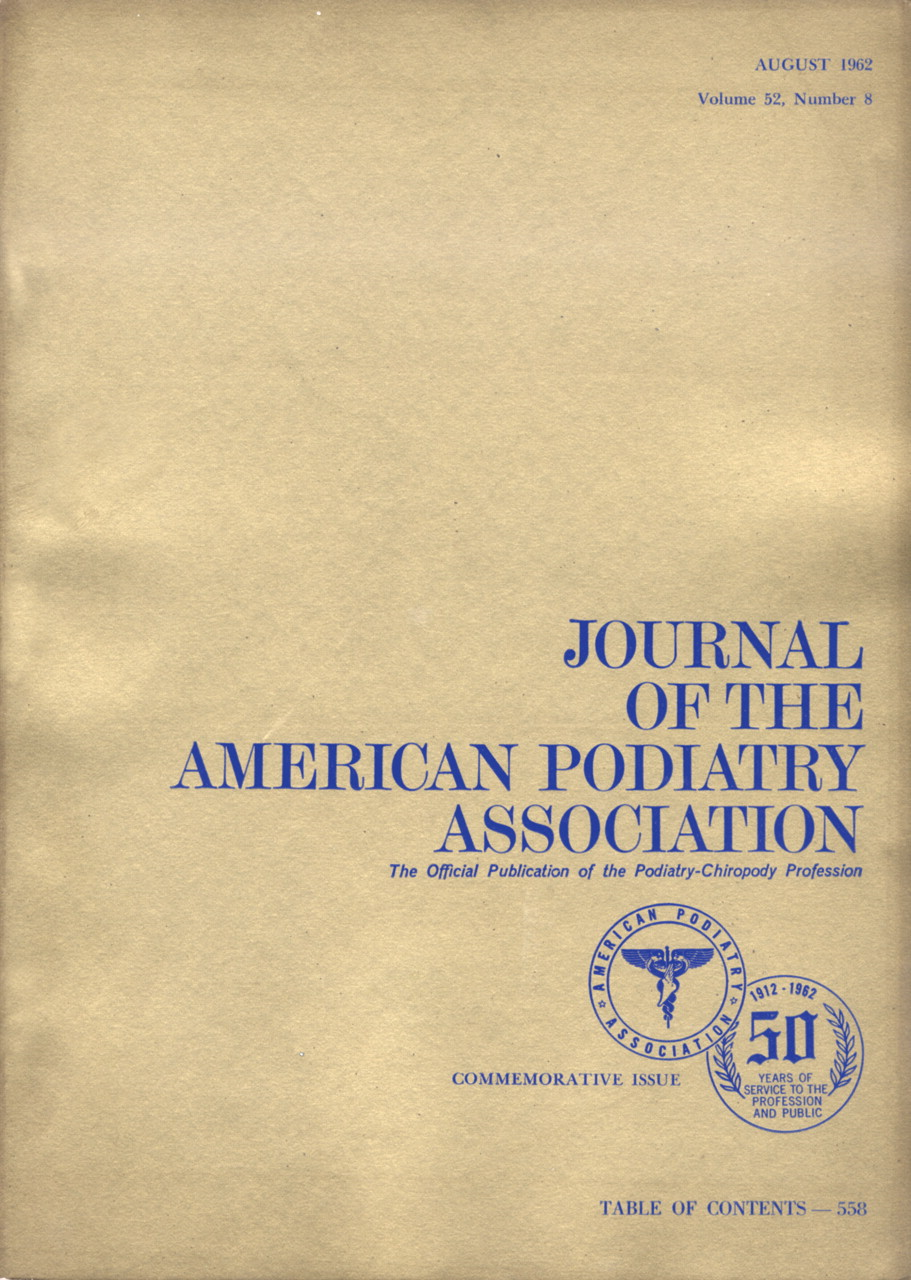
In 1962, a golden anniversary commemorative issue of JAPA was produced, which celebrated the 50th anniversary of the Association, founded in 1912 (Fig. 5). That issue, with a gold cover, contained a full complement of scientific articles, as well as special articles on the progress the profession and APA had made during those years.
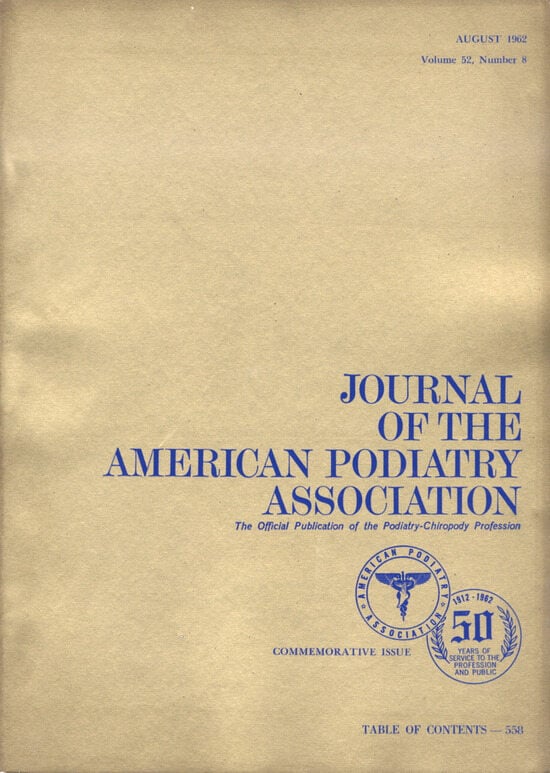
Figure 5.
Cover of the August 1962 issue commemorating the 50th anniversary of the Association.
In an article published in the February 1982 issue of APA Report—the predecessor of the APMA News —Dr. Rubin said, “I must make note of my 15 years as editor of APA’s Journal and the special pride I felt in its continuing growth and improvement.”[4]
In 1970, Dr. Rubin felt the call of his alma mater, the Ohio College of Podiatric Medicine (OCPM), and he left the APA in Washington to serve as vice president and dean of the college and, in 1971, as its president.
“I have many fond memories of my professional career, and it is difficult to enumerate them,” said Dr. Rubin in the APA Report. “I am proud of my years of teaching and the reputation I earned as an instructor, and also for my research projects—including the 1954 Gold Award in the William J. Stickel Annual Awards for Research and Papers in Podiatry.”[4] He retired in 1984 and was named President Emeritus of OCPM. A lecture hall at OCPM now bears his name in his memory.
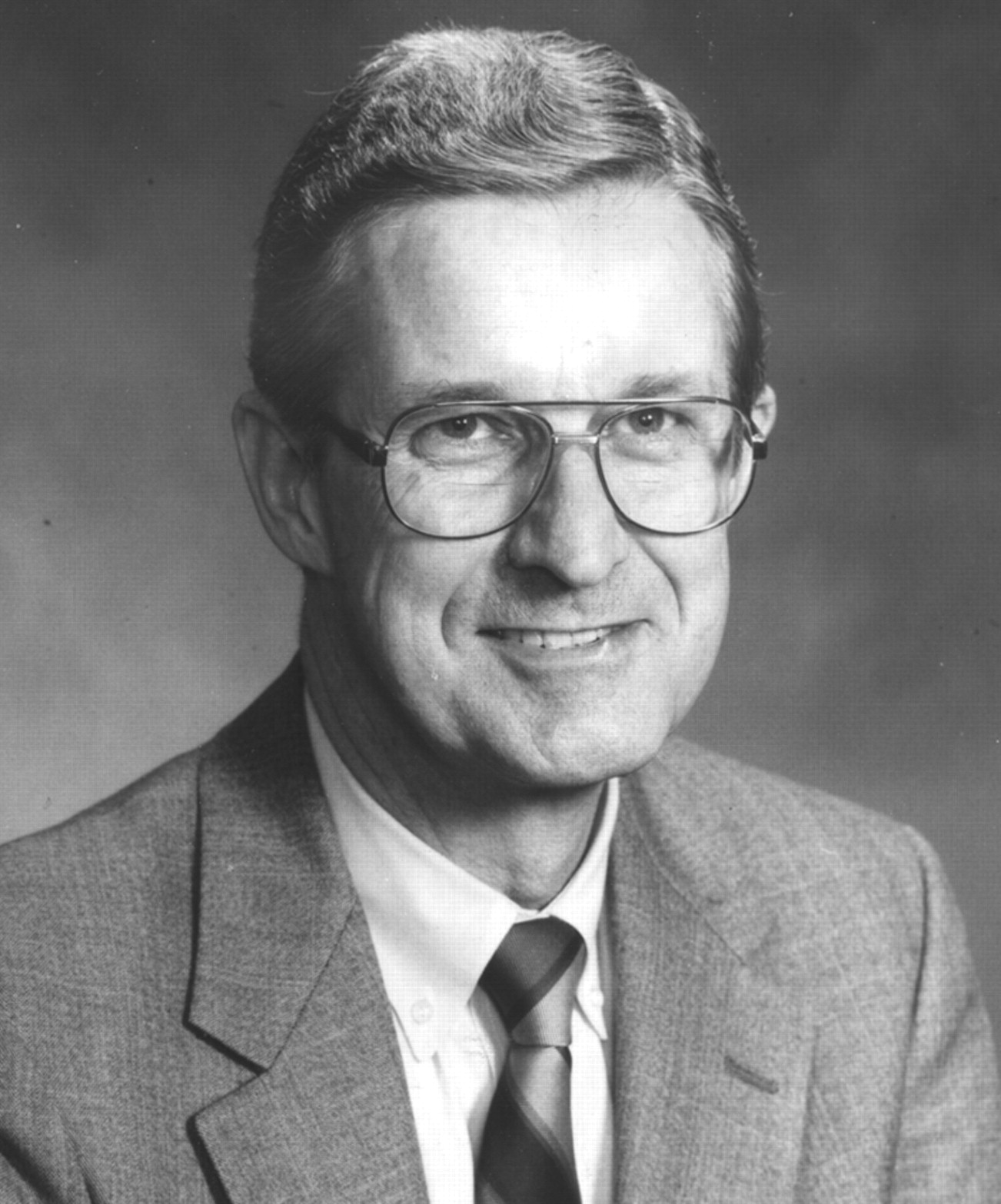
Upon Dr. Rubin’s departure in 1970, Louis G. Buttell, the APA’s director of public relations, was named managing editor of JAPA, and he worked gamely with then–editorial assistant Alice D. Overton to publish the Journal, which at this juncture was suffering from a serious lack of manuscripts. In an attempt to reorganize the publication, the APA Board of Trustees appointed E. Dalton McGlamry, of Tucker, Georgia, as senior editor (Fig. 6).
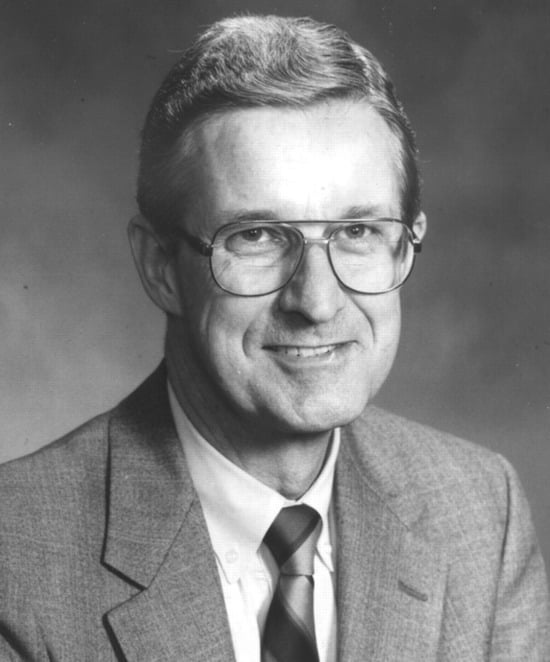
Figure 6.
E. Dalton McGlamry, appointed editor of the Journal in 1973.
“During that year I got on the telephone daily and began calling outstanding podiatric lecturers, telling them that I wanted to publish their work, but that I preferred that they write it up rather than my asking someone else to do so,” recalled Dr. McGlamry. “This was pretty successful, and manuscripts began to come in. We still had no backlog of manuscripts, but we were beginning to publish on time and to have greatly expanded content.”
In 1973, at the end of Dr. McGlamry’s term as APA president, the Board named him permanent editor, a post he held until 1981. One of Dr. McGlamry’s first changes was to begin publishing the Journal on coated stock, which greatly enhanced the detail of the photographs and charts. More importantly, he began attending major meetings in the profession to cajole speakers into submitting manuscripts. Within a year, Dr. McGlamry had amassed a 3-month backlog of manuscripts and JAPA was publishing more than twice as many pages each month. Along with the team of Buttell and Overton, he introduced another innovation, the “Clinically Speaking” and “Clinically Illustrated” sections of the Journal, which allowed contributors to present basic ideas or to simply illustrate a new instrument or modified surgical technique. It was under Dr. McGlamry’s editorship that the news section of the Journal, called “What’s Happening,” was removed and turned into a separate membership publication, the APA Report, now the APMA News.
JAPA expanded its use of special editors by 1975, inviting experts in various fields to recruit papers and to edit issues focused on a single subject area. One of the earliest special issues dealt with current thinking and techniques in hallux valgus surgery, with Dr. Tilden Sokoloff as the special editor. “You can see what these special editions did to our backlog of manuscripts,” said Dr. McGlamry. “Every time we did one, it simply pushed everything else in the backlog back a month.” During the next 8 years, many special editions were published.
The rapid growth of the Journal during the mid-1970s made the publication more attractive to advertisers; income and exhibitor dollars were higher than ever, but some potential advertisers were in the dark as to what medications and supplies podiatrists actually used. In order to give these potential advertisers a definitive answer to this question, Dr. McGlamry and Alice Overton decided to announce a medical writing and research fellowship to discover and report what instruments and equipment podiatrists use, followed by another study dealing with medications, supplies, and reagents.
The recipient of the fellowship was Barry Block, at that time a senior at the New York College of Podiatric Medicine. He was rotated to Doctors Hospital in Tucker, Georgia, where he was privileged to participate in surgery each morning, with afternoons, evenings, and weekends spent doing his research. The results of his studies were published in the Journal with the desired result—new and expanded interest in the profession from potential exhibitors and advertisers.
By 1980, the Journal was prospering and had a 1-year backlog of manuscripts ready for publication. Even then, however, the editor continued to attend many major meetings to encourage lecturers to prepare their material for publication.
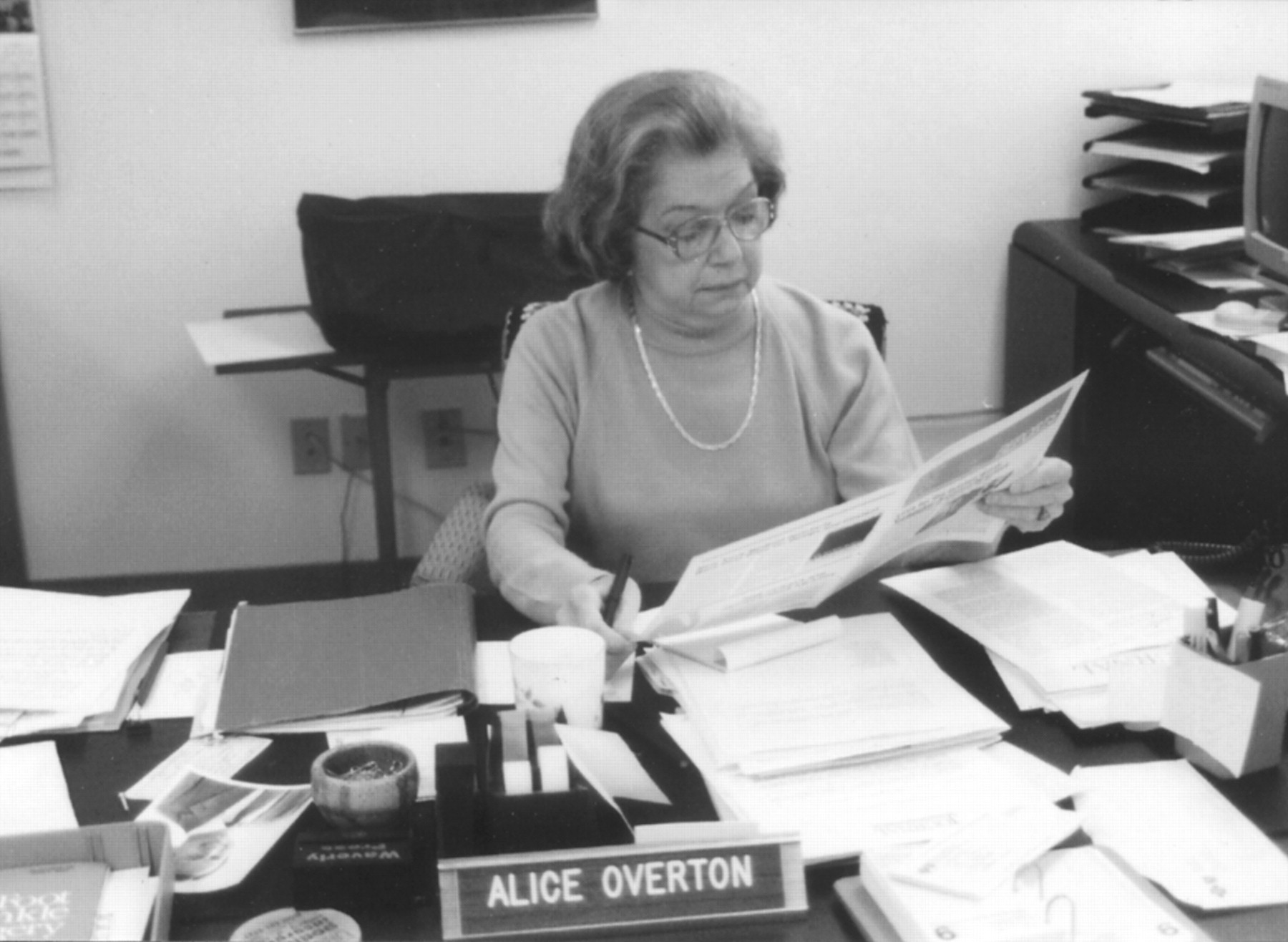
“Editing the Journal was one of the most educational jobs I ever held, and much of this was the result of Alice Overton,” said Dr. McGlamry (Fig. 7). “Alice was an experienced medical editor. My wife, Becky, also was an experienced medical writer. Between the two of them, they simply taught me to be an editor. They helped me to realize that the strength of the Journal and its credibility depend on the development of a cadre of special editors and review editors who were really responsible for accepting and rejecting papers and for becoming a part of the recruitment process for good material to be published.”
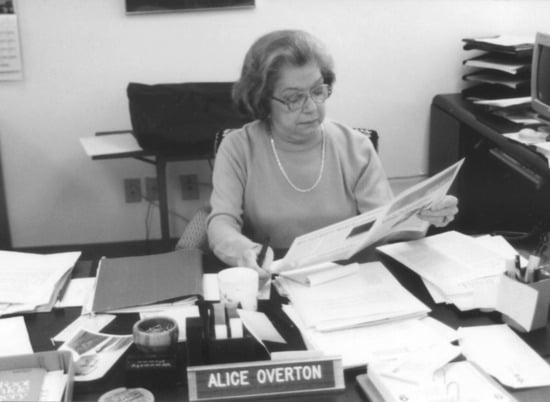
Figure 7.
Alice Overton, who managed the Journal office for two decades.
Dr. McGlamry retired as editor in 1981 to begin work on his classic text, the Comprehensive Textbook of Foot Surgery, first published in 1987, along with a companion book, Fundamentals of Foot Surgery. It was a task that encompassed 7 years, and he credits his work as JAPA editor with making the texts possible.
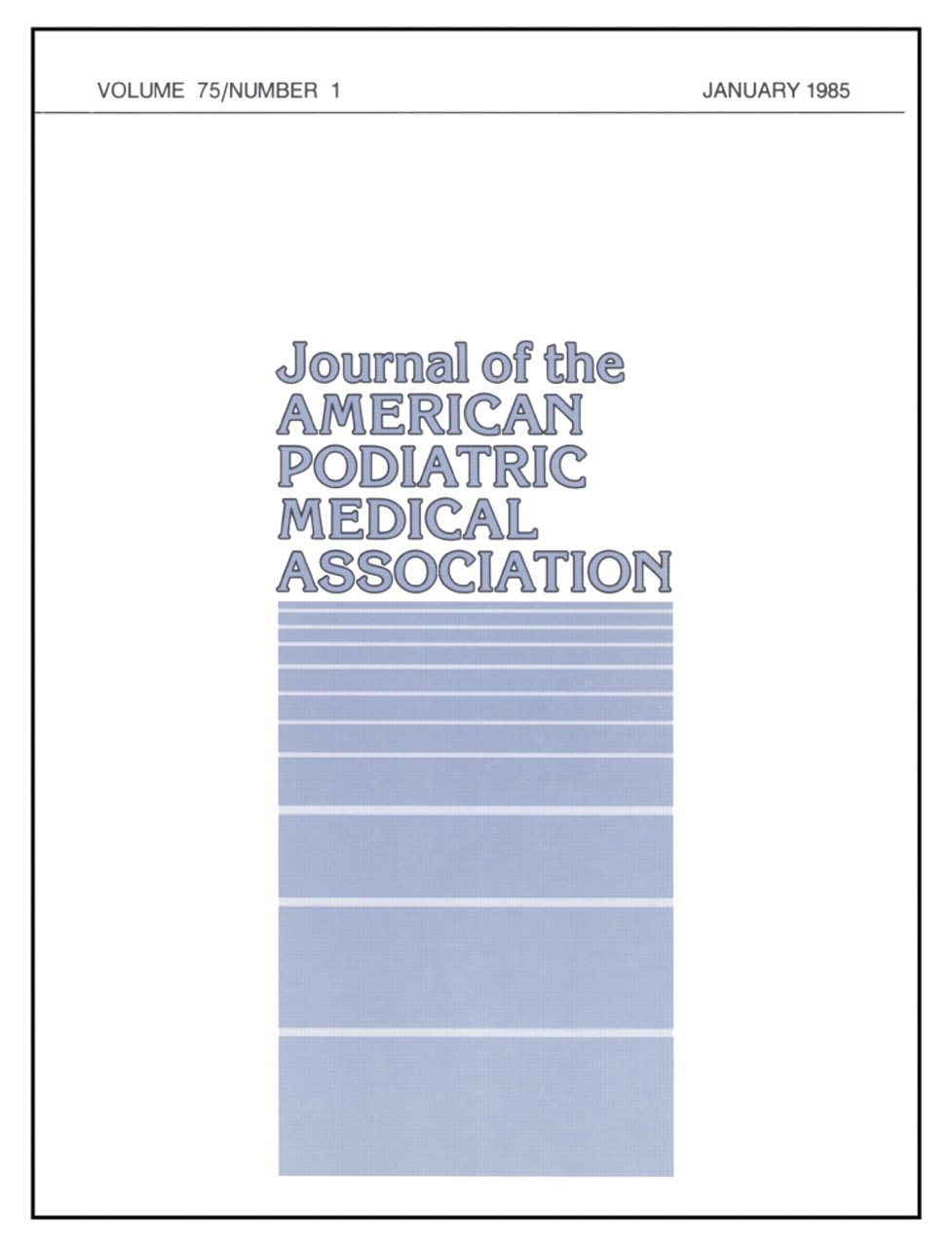
In the 1980s, JAPA became the unquestioned leading source of high-quality manuscripts on podiatric research. In 1985, the Journal underwent another name change to its current title, Journal of the American Podiatric Medical Association (JAPMA), reflecting the name change of the organization (Fig. 8). Keeping the standards high in the early 1980s were editors Michael Burns, Thomas DeLauro, and current APMA Executive Director Glenn B. Gastwirth, who was a consulting editor from 1988 to 1990, interim editor in 1990, and executive editor from 1991.
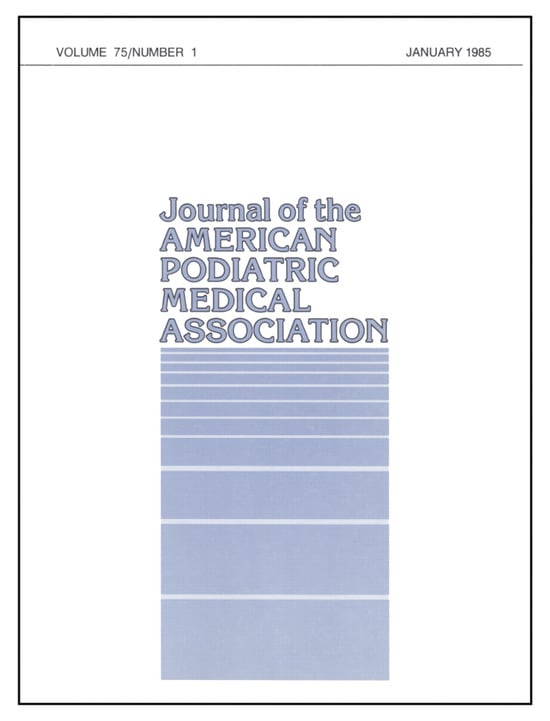
Figure 8.
Cover of the January 1985 issue, the first one bearing the current title.
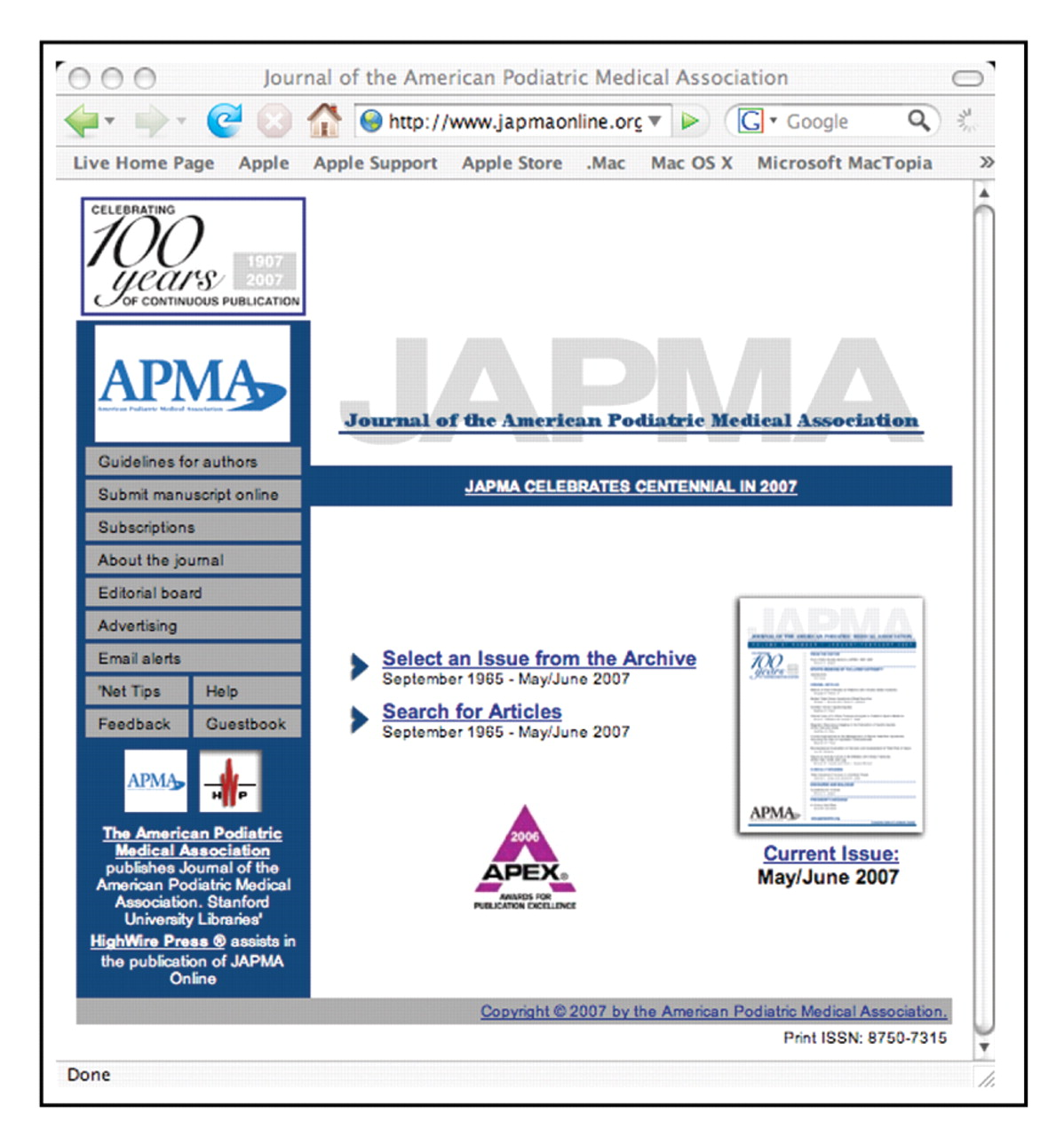
In 1991, Warren S. Joseph was named editor, ushering in another period of growth for the publication. He credits managing editor Alice Overton with helping him through the learning curve of his new position. As editor, Dr. Joseph saw the Journal enter the age of cyberspace with an online edition in 2001, produced with the assistance of HighWire Press, a division of Stanford University (Fig. 9). This step forward introduced JAPMA to a truly global readership, and, thanks to the debut of a sophisticated online manuscript submission and peer-review system in 2004, JAPMA began receiving manuscripts from all parts of the world. New features, designs, and innovations continue during Dr. Joseph’s editorship, as well as a stunning increase in advertising revenue and manuscript submissions, not only from APMA members but from around the world. In 2006, submissions were received from 15 countries, with a full 40% of the papers originating outside the United States. This globalization of JAPMA can only serve to elevate the profession on an international scale.
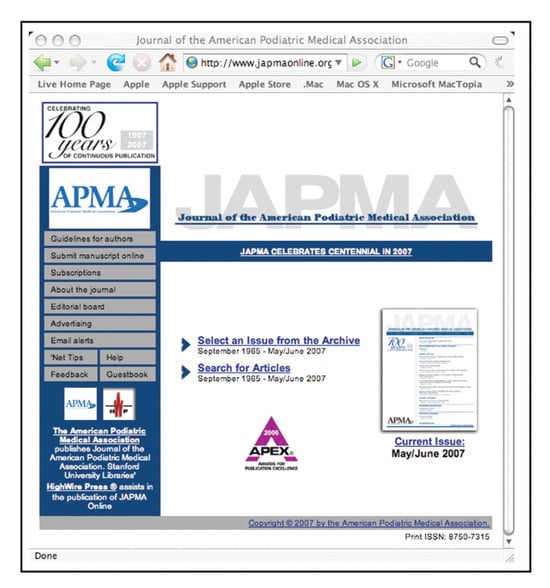
Figure 9.
Home page of JAPMA Online. The Journal became available with full online search capabilities in January 2001.
During the past several years, JAPMA staff, including executive editor Gastwirth, managing editor Annette Theuring, production editor Noëlle Boughanmi, and designer Jo Deckert, struggled with a large backlog of manuscripts awaiting publication, causing some authors to become frustrated and a few papers to require updates prior to publication. “We have made a concerted effort to ameliorate this situation over the past year [2006],” said Dr. Joseph. “We have limited the number of special issues to allow us to publish more of the unsolicited papers from the backlog. In fact, in 2006 we did not publish any special issues.”
Dr. Joseph also said that JAPMA has created a new manuscript rating system for reviewers that allows them to assign a numerical score for the overall quality and priority of each submission to allow for “fast tracking” of the most important papers. These initiatives have reduced the backlog of manuscripts to 6 to 8 months’ worth of papers, which Dr. Joseph called “an ideal size,” allowing for a good “buffer” of accepted material while significantly shortening the time from acceptance to publication.
“During his tenure as editor, JAPMA has become unquestionably the most highly regarded and influential source of podiatric medical information in the world,” said Dr. Gastwirth. “Beyond its new look, its super advanced JAPMA Online, and its sophisticated electronic manuscript submission and review process, JAPMA has the highest Institute for Scientific Information impact factor of any podiatric medical publication. The impact factor measures the frequency with which a scientific journal’s articles are cited in other scholarly scientific publications. In addition, JAPMA has received more honors, awards, and citations of excellence than all other podiatric scientific publications combined.”
As communication technology continues to explode, JAPMA will be at the forefront, but it will never abandon the charge of the founding editor, Alfred Joseph, 100 years ago. The current Dr. Joseph sees a bright future for JAPMA: It will continue to be a leader in the publication of high-quality manuscripts in all areas of podiatric medicine and surgery. It will also continue to be a source of pride for every member of the American Podiatric Medical Association, as well as an important tool to enhance the practice of podiatric medicine around the world.
Were he around today, Dr. Alfred Joseph would be amazed.
References
- Joseph A: Address delivered to the convention at Chicago, July 1, 1912. The Pedic Items 2: 9, 1912.
- Holloway LM: A Fast Pace Forward: Chronicles of American Podiatry, p 34, Pennsylvania College of Podiatric Medicine, Philadelphia, 1987.
- Mehl J: Journal of the American Podiatry Association: a history through its editors. JAPA 64: 298, 1974.
- Zych D: Dr. Abe Rubin: looking forward to the 21st century. APA Report, February. 1982.
© 2007 American Podiatric Medical Association