


Abstract
The unpleasant and subjective sensation resulting from a noxious sensory stimulus defines the phenomenon of pain. The podiatric physician is no stranger to the difficulties in achieving optimal pain therapy. Podiatric physicians must develop analgesic regimens to treat patients with acute, chronic, and postoperative pain. Because opioid therapy is the cornerstone of the pharmacologic management of acute and chronic pain, this review focuses on the prescribing of opioid analgesics to treat lower-extremity pain. The pharmacology of frequently prescribed opioids is introduced. Then, criteria for selecting appropriate opioid analgesics as found in the current medical literature are reported. Finally, a review of the literature describing legal and ethical considerations regarding the prescribing of opioid analgesics is presented.
The unpleasant and subjective sensation resulting from a noxious sensory stimulus defines the phenomenon of pain. Research has found that more than 75 million people present to a physician each year with persistent or recurrent pain [1,2]. Epidemiologic studies [3,4,5,6,7] have shown that there is an age-related increase in the prevalence of persistent pain, joint pain, and fibromyalgia among the elderly. A variety of factors may influence the severity of pain, including the underlying pathophysiology, emotional concerns, and spiritual or existential beliefs [8]. The podiatric physician is no stranger to the difficulties of achieving optimal pain therapy. Podiatric physicians must develop analgesic regimens to treat patients with acute, chronic, and postoperative pain. Analgesic opioid therapy has been the cornerstone of the pharmacologic management of acute and chronic pain. Ideally, opioid analgesics are prescribed by balancing the beneficial and adverse effects. Nist [9] presents three possible scenarios for the physician who must treat a patient in pain. First, the patient’s pain is adequately controlled until the patient makes a full recovery. In the second scenario, the physician overprescribes pain medications, resulting in an addicted patient. The third scenario is when the physician undertreats the patient’s pain. To achieve Nist’s first physician-patient scenario, the podiatric physician must become familiar with the pharmacologic properties of opioid analgesics and the legal and ethical considerations of prescribing opioid analgesics.
The central theme of this review is the prescribing of opioid analgesics to treat lower-extremity pain. First, the pharmacology of frequently prescribed opioids is introduced. Second, criteria for selecting appropriate opioid analgesics as found in the current medical literature are reported. Finally, a review of the literature describing legal and ethical considerations regarding the prescribing of opioid analgesics is presented.
Opioid Pharmacology
History
Opioids are drugs derived from opium and include morphine, codeine, and a variety of semisynthetic congeners derived from them as well as thebaine. Opium is prepared from the juice of Papaver somniferum. The milky fluid extracted from the plant’s ovary is highly narcotic after drying. This extract contains more than 20 distinct alkaloids [10]. Opium contains a variety of different substances first isolated and identified during the 19th century [10.11]. Morphine in its pure form was first extracted in 1806 by Friedrich Serturner. Codeine and papaverine followed in 1832 and 1848. Invention of the hypodermic needle in the mid-19th century led to the widespread use of morphine intravenously as an analgesic [11]. The synthetic compounds meperidine and methadone were introduced into clinical medicine just before and during World War II [10]. MacPherson [12] comments that hydromorphone, oxycodone, hydrocodone, and dihydrocodeine have all been used clinically for more than 50 years.
Opioid Receptors
Opioids interact stereospecifically with protein receptors on the membranes of certain cells in the central nervous system. Five major opioid receptor types are found in the central nervous system: Mu (μ) or OP3, Kappa (κ) or OP2, Delta (δ) or OP1, Sigma (σ), and Epsilon (ε), as well as subtypes [10,13,14]. The OP opioid receptor nomenclature is proposed by the International Union of Pharmacology system for opioid peptides. Binding potency between a particular drug and the receptor correlates with analgesia. The analgesic properties of opioids are primarily mediated by the μ (OP3) receptors. The κ (OP2) receptors found in the dorsal horn also contribute to some analgesic relief. Enkephalins interact more selectively with δ (OP1) receptors in the periphery. Activation of either κ or δ receptors seems to produce spinal analgesia [14]. The σ receptors are less specific and bind to nonopiate agents [13]. The σ receptors may be responsible for the hallucinations and dysphoria adverse events occasionally associated with opioid use [13]. The σ and ε receptors are no longer considered opioid-specific receptors because their activation does not result in analgesia [14]. All opioid receptors are coupled to inhibitory G proteins and inhibit adenylyl cyclase [13].
The five areas of the central nervous system that present with high densities of opioid receptors are the brain stem, medial thalamus, spinal cord, hypothalamus, and limbic system [13,14]. Activation of opioid receptors found in the brain stem mediates respiration, cough, nausea and vomiting, maintenance of blood pressure, pupillary diameter, and control of stomach secretions. The receptors found in the medial thalamus mediate deep pain that is poorly localized and emotionally influenced. Spinal cord receptors found in the substantia gelatinosa are involved in the receipt and integration of incoming sensory information, leading to the attenuation of painful afferent stimuli [13].
Opioids bind to peripheral sensory nerve fibers and their terminals [13]. They inhibit the Ca++-dependent release of excitatory, proinflammatory substances, such as substance P, from these nerve endings [10]. This action may contribute to the anti-inflammatory effects of opioids. Two important factors responsible for the analgesic effect of opioids are their affinity for specific receptors and their intrinsic activity at respective receptors [15]. Opioid compounds cause hyperpolarization of nerve cells, inhibition of nerve firing, and presynaptic inhibition of transmitter release.
Opioid Analgesics
Opioid analgesics are classified as agonist or antagonist drugs depending on their ability to bind or block opioid receptors [1]. Opioids each produce a wide spectrum of pharmacologic effects, including analgesia, dysphoria, euphoria, somnolence, respiratory depression, diminished gastrointestinal motility, altered circulatory dynamics, urinary retention, histamine release, and physical dependence [15].
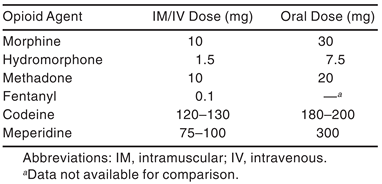
Morphine, a phenanthrene, acts as a pure agonist. It binds and thus activates opioid receptors at sites in the periaqueductal and periventricular gray matter, ventromedulla, and spinal cord to produce analgesia [15]. Morphine acts at OP3 receptors in lamina I and II of the substantia gelatinosa of the spinal cord and decreases the release of substance P, which modulates pain perception in the spinal cord. Morphine also seems to inhibit the release of many excitatory transmitters from nerve terminals carrying nociceptive stimuli [13]. Morphine has long been considered the gold standard of opioid agents. The pharmacokinetics of morphine vary considerably in its different formulations. Morphine dosing requirements vary with the degree of pain and a patient’s previous experience with opioids. Morphine-equivalent tables have been developed, and their purpose is to present information related to equianalgesic doses of various opioid agents compared with morphine. A table of opioid equianalgesic doses is presented here as Table 1. Intravenous doses for adults range from 2 to 10 mg per 70 kg of body weight. Prescribing of morphine to elderly patients and patients with hepatic or renal dysfunction should be approached with caution because of a higher risk of dose-related adverse effects [16].
Table 1.
Adult Equianalgesic Opioid Dose Comparison.
Meperidine is a synthetic opioid known as a phenylpiperidine with a structure unrelated to morphine. It binds to OP2 opiate receptors. Meperidine does not cause pinpoint pupils but rather causes the pupils to dilate because of an atropine-like activity [13]. Meperidine is frequently administered intramuscularly. However, the intramuscular route exhibits erratic absorption and is often painful to the patient. The dosage is individualized for adults and ranges from 50 to 150 mg every 3 to 4 hours as necessary [16]. Several concerns have been reported in the literature regarding the use of meperidine. First, normeperidine is an active nonopioid metabolite that is clinically important in that it is not naloxone-reversible [15]. Normeperidine may accumulate when excessive dosing occurs or in the presence of renal failure. This may cause seizures or aggravate preexisting seizure disorders. Meperidine should not be used at doses greater than 600 mg per 24 hours or for longer than 48 hours. Finally, meperidine is not recommended for patients with impaired renal function.
Hydromorphone is a hydrogenated ketone of morphine. It is a narcotic analgesic. Hydromorphone is metabolized primarily in the liver and is excreted primarily as the glucuronide conjugate. Parenteral doses range from 1 to 2 mg subcutaneously or intramuscularly every 4 to 6 hours as needed. Severe pain may require doses of 3 to 4 mg every 4 to 6 hours as needed. If the dose needs to be given intravenously, it may be given by slow intravenous push over 2 to 3 min [16]. Hydromorphone has been implicated as a cause of transient hyperglycemia, which is a consideration if this drug is selected for a diabetic patient.
Fentanyl is a highly lipophilic synthetic opioid with a phenylpiperidine chemical structure related to meperidine. Its agonist activity occurs in the brain, spinal cord, and smooth muscle. Fentanyl is an OP3 agonist and is estimated to have 80 times the analgesic potency of morphine [10,13]. Fentanyl is indicated for its analgesic action of short duration during anesthesia and in the immediate postoperative period as needed. The maintenance low dose, infrequently needed in minor procedures, is 2 μg/kg, whereas the maintenance moderate doses range from 2 to 200 μg/kg. The podiatric physician is reminded that the respiratory depressant effect of fentanyl may persist longer than the analgesic effect. The podiatric physician may want to consider the total dose of all narcotic analgesics used. The doses of narcotics usually recommended should be reduced by one-fourth to one-third [16].
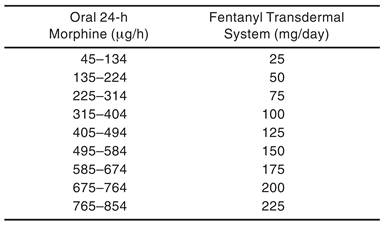
The fentanyl transdermal system is indicated for the management of chronic pain requiring continuous analgesia that cannot be managed by lesser means, such as acetaminophen-opioid combinations, nonsteroidal analgesics, or as-needed dosing with short-acting opioids. The podiatric physician must individually titrate the dose of the transdermal system to minimize the risk of adverse effects while providing analgesia. When patients are properly selected, the fentanyl transdermal system is a safe and effective alternative to other opioid regimens. To convert patients from oral or parenteral opioids to transdermal fentanyl, first calculate the previous 24-hour analgesic requirement, then convert this amount to the equianalgesic oral morphine dose using a table similar to Table 2. Most patients are adequately maintained with transdermal fentanyl administered every 72 hours. Once the system is removed, it takes 72 hours or more for the fentanyl serum concentration to decline by 50% [16].
Table 2.
Initial Fentanyl Transdermal Dose Based on Daily Oral Morphine Dose.
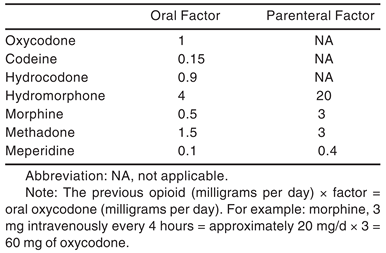
Oxycodone is a semisynthetic opioid with a higher oral bioavailability than morphine and a half-life of 3.5 to 5 hours in its short-acting formulation. Adult dosages for the management of moderate-to-severe pain when using the immediate-release product are 10 to 30 mg every 4 hours. Controlled-release tablets are intended for the management of moderate-to-severe pain when continuous, around-the-clock analgesia is needed for an extended period. Controlled-release oxycodone has a biphasic absorption profile. The first stage involves a rapid onset, followed by a prolonged release phase. The half-life of the controlled-release formulation is 4.5 hours [16]. The controlled-release formulation allows for it to be effectively administered every 12 hours. Converting a patient from a parenteral opioid to one that may be administered by mouth is an important concept to facilitate a patient’s discharge from the institution. The data in Table 3 can be used as a guide to assist podiatric physicians in accomplishing this goal.
Table 3.
Multiplication Factors for Converting the Daily Dose of Previous Opioids to the Daily Dose of Oral Oxycodone.
Propoxyphene is a derivative of methadone, to which it is structurally related. Its dextro isomer is used as an analgesic to relieve mild-to-moderate pain. Its levo isomer is not analgesic but has antitussive action [10]. The metabolite of propoxyphene known as norpropoxyphene is a proarrhythmic with a cardiac anesthetic effect similar to amitriptyline. Norpropoxyphene accumulation is associated with arrhythmias and pulmonary edema [15].
Codeine is a much less potent phenanthrene analgesic than morphine, but it has a higher oral efficacy. In contrast to morphine, codeine is approximately 60% as effective orally as parenterally, as an analgesic and as a respiratory depressant. Hepatic metabolism through the CYP-450 2D6 pathway is responsible for codeine’s metabolism to morphine [15]. Codeine shows good antitussive activity at analgesia doses. Codeine has exceptionally low affinity for opioid receptors, and the analgesic effect of codeine is due to its conversion to morphine [10]. The drug has a lower abuse potential than morphine. A few opioids have a high oralparenteral potency ratio (eg, levorphanol, oxycodone, and methadone). The greater oral efficacy of these drugs is due to less first-pass metabolism in the liver [10].
Selecting an Opioid
The podiatric physician must remember that comfort is the ultimate goal when using any medication, including opioids, to manage pain. Martin [17] recently presented a comprehensive discussion on the pharmacologic management of foot pain in older patients. This discussion focuses on the selection criteria for when and how to prescribe opioids to the podiatric medical patient with pain. Before podiatric clinicians consider an opioid analgesic, they need to ensure that a complete psychosocial and physical evaluation of the patient has been performed. The term narcotic derives from the Greek word for stupor [10], and the prescribing of these drugs is regulated by state and federal agencies [18]. Opioid therapy should be prescribed appropriately to avoid undertreating patients with painful symptoms. Opioid selection is based on patient-specific factors, such as age and renal function.
Reports in the current medical compendium may be of interest to podiatric physicians who perform surgery. These sources reported that only one-fourth of the 23 million patients who underwent surgical procedures annually recalled adequate pain relief [8,19]. Beauregard et al [20] discovered that 40% of respondents to their questionnaire reported moderate-to-severe pain during the first 24 hours after hospital discharge. The pain decreased with time, but it was severe enough to interfere with their daily activities. These authors recommend aggressive analgesic treatment during a patient’s hospital stay. Also, they recommend that patients be provided with take-home analgesia protocols and comprehensive patient-education programs.
Coley et al [21] reported data on unanticipated admissions or readmissions after same-day surgery. Pain accounted for more than one-third of the return visits, incurring significant costs. These authors recommend that efforts to manage pain should not be limited to pain in the hospital but that physicians should anticipate pain-related issues before the patient’s discharge from the institution. Apfelbaum et al [22] discovered through a nationwide random telephone survey of 250 adults that additional efforts are required to improve patients’ postoperative pain experience. These authors found during their interviews that almost 25% of patients who received pain medications experienced adverse effects despite the fact that 90% of them were satisfied with their pain medications. The podiatric physician should consider these statistics when developing pain strategies for patients.
In the setting of acute pain, some podiatric clinicians become competent in the prescribing and use of a few opioid analgesics. Although no opioid seems to be superior in relieving pain, certain products are clearly inferior because of increased risks of toxic effects [8]. In some circumstances, pain control is inadequate despite dosage increases. MacPherson [12] reviews the concept of opioid rotation. This method is the replacement of the current opioid regimen with another. Analgesic equivalence is the central motif when considering opioid substitution [12]. Mercadante [23] defines the concept of opioid rotation as the substitution of another opioid for a previous one to obtain a more favorable response. Two types of opioid rotation strategies have been used: a change in opioid products or a change in the route of administration. As mentioned previously here, Table 1 provides equianalgesic doses of various opioid agents. Two limitations are apparent when reviewing the literature regarding opioid equivalence. First, despite the availability of data regarding equianalgesic doses of various opioid agents, many of these data were obtained from singledose experiments [12,24]. Second, some opioid potency studies involved different patient populations, making it difficult to draw conclusions that agree [25,26]. It is recommended that equianalgesic opioid tables be used only as a guideline for analgesia. Changes to a patient’s analgesic therapy should be based on clinical parameters. All opioids have the potential to cause nausea and vomiting, sedation, respiratory depression, and constipation [8]. No clinical comparative data have proved that equianalgesic doses of any opioid cause fewer typical adverse effects, such as nausea and constipation, than morphine [27]. Nausea and vomiting develop in approximately 10% to 40% of patients receiving opioids [8,28].
Another element of opioid analgesic therapy that the podiatric physician must consider is the route of administration. Various methods of drug delivery have been used to treat patients in pain. Standard intravenous administration may be necessary when immediate relief is required, multiple adjustments in dose are needed, or the patient cannot take oral analgesics [8]. Patient-controlled analgesia is associated with improved analgesia and patient satisfaction. The selection of a patient-controlled analgesia pump should be reserved for patients who are expected to require parenteral opioid analgesia for longer than 24 hours. An advantage of the patient-controlled analgesia pump is that it is intended to provide an individualized dosing regimen.
The intramuscular route should be avoided because it is associated with variable absorption and potential muscle necrosis, and patient acceptance is low because of injection site pain. Subcutaneous injections of morphine or hydromorphone may be an alternative route if a patient does not have intravenous access [8]. Patients should be switched to oral analgesic therapy as soon as oral intake is tolerated.
Ethical and Legal Considerations
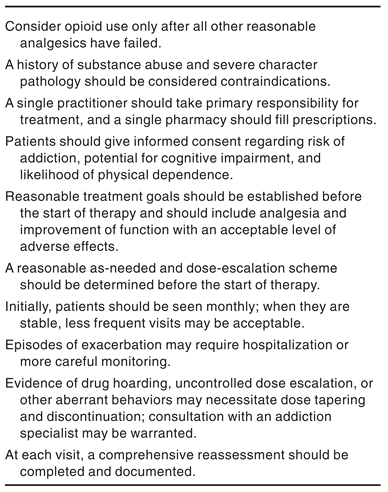
Barkin and Barkin [15] introduced the term opiophobia during their discussion of the pharmacologic management of acute and chronic pain. Opiophobia is defined as the patient’s fear of opioid use, the physician’s concern about opioid addiction, and the pharmacist’s cautions about filling opioid prescriptions. Unfortunately, the concept of opiophobia leads to unnecessary underuse of opioids in pain management. Given the concerns surrounding the use of opioid agents in patients with chronic pain, guidelines have been proposed by Portenoy (Table 4) [29]. These guidelines emphasize the prescribing physician’s achieving optimal safety and efficacy, identifying drug abuse problems, and ensuring regulatory compliance.
Table 4.
Guidelines for Podiatric Physicians When Prescribing Opioids.
Green et al [30] sought to supply health-care providers, researchers, patients, government officials, and policy makers with evidence that racial and ethnic minorities tend to be undertreated for pain compared with non-Hispanic white patients. Selective literature reviews were performed by experts in pain management. Scientific evidence was given precedence over anecdotal experience. According to these authors, their findings were consistent with the Institute of Medicine’s report on health-care disparities [30]. The findings suggest that sources of pain disparities are complex. These authors point to a need for improved training for health-care providers and educational interventions for patients to assist in preventing paintreatment disparities among racial and ethnic minorities. Weisse et al [31] attempted to experimentally challenge the literature-cited assertion that women and minorities with pain are treated less aggressively than men and nonminorities with comparable medical interventions. Using vignettes, Weisse et al evaluated the use of hydrocodone in a national sample of 712 practicing physicians in treating back pain, kidney stone pain, and sinusitis. No overall difference in patient sex or race was found in decisions to treat or in maximum doses. These authors acknowledge two limitations of their study. The first was that the response rate for their mail survey was low. The second limitation was the inability to systematically evaluate physician race and geographic region as potential factors in treatment decisions. By becoming familiar with the published works of Green et al and Weisse et al, the podiatric physician can gain an understanding of the problem of opiophobia, thus becoming a proactive opioid prescriber and relieving patients’ anxiety about opioid prescriptions.
Hoffmann and Tarzian [32] conducted a national telephone survey of state medical boards to determine whether state board members could evaluate adequate pain treatment or had concerns about drug diversion and inappropriate prescribing. Their survey included complaints received by the board in the previous 5 years regarding opioid prescribing and any disciplinary action as a result of their investigations. Of the 50 states and the District of Columbia, 38 state medical boards participated in the survey. Overprescribing complaints for 2001 were acknowledged by 25 respondents, and 11 respondents reported that they could not estimate the number of opioid overprescribing complaints. An alarming inference from these data is that only half of the state medical boards are concerned with overprescribing of opioid analgesics by practitioners. Furthermore, the 38 respondents were queried about whether the problem of drug diversion and abuse in their state had improved, worsened, or stayed the same in the past 5 years. Eighteen respondents stated that drug diversion had worsened, 11 that it had stayed the same, and 5 that it had improved, and 4 reported no definite impression. Of the 18 respondents who acknowledged that drug diversion had worsened, 15 cited the abuse and diversion of OxyContin (Purdue Pharma LP, Stamford, Connecticut) as the principle concern. Despite the concern that drug diversion has increased because of one pharmaceutical agent, 29 respondents acknowledged that their board had not changed their approach to investigating physicians for inappropriate opioid prescribing. Finally, when asked whether board investigations of physicians’ opioid-prescribing practices had increased, decreased, or stayed the same during the past 5 years (1997–2001), 17 respondents acknowledged that the number of investigations had stayed the same, 15 indicated that investigations had increased, 3 stated that investigations had decreased, and 3 respondents did not know. Among respondents who reported that the number of investigations had increased, the most common reason given for the increase was increased public awareness among patients and family members.
Mendelson [33] reviews the liability of medical practitioners under civil and criminal law in the United States for iatrogenically induced addiction and misuse of opioids by patients as well as injury and death occasioned by inappropriate prescription of narcotic analgesics. This well-written review presents legal concepts such as duty, breach of duty, and causation as well as defenses against negligence. Actual court cases are used to clarify these legal terms and illustrate the position of the prescribing practitioner. This review is very enlightening, especially the section on breach of duty. Patients must be advised of the inherent risks of opioid medications, and these risks should be listed on a consent form and the form placed in the patient’s medical record [33].
Mitka [34] addresses the topic of patient abuse of prescription drugs. The article states that the federal Drug Enforcement Agency does not know the hard numbers of prescription abuse but that anecdotal accounts from law-enforcement agencies suggest the magnitude of the problem. In the same article, Mitka also reports that hydrocodone is the most commonly abused prescription drug in the United States. This is understandable given that hydrocodone and acetaminophen accounted for 85.1 million of the 3 billion prescriptions dispensed in the United States in 2003, making it the most prescribed drug in that year [35]. For the podiatric physician worried about contributing to this problem of prescription drug abuse, Gibbs and Haddox [36] state three requirements for a controlled substance prescription to be lawful: 1) the prescription is issued for a legitimate medical purpose, 2) the practitioner is acting in the usual course of his or her professional practice, and 3) the medical records should indicate what conditions resulted in the issuance of the prescription.
Finally, Mitka [34] and Gibbs and Haddox [36] offer suggestions to help the prescribing physician minimize the risk of prescription drug diversion and related problems. First, Mitka [34] notes that a physician’s awareness should be heightened if a patient requests an opioid by name and says that they are in pain but cannot see their regular physician. Gibbs and Haddox [36] suggest that the prescriber be thoughtful and document what is done and why, obtain a history and perform a physical examination appropriate to the complaint, and document the results. Also, the podiatric physician should take the time to look for signs of drug abuse. Finally, they suggest that practitioners consider referring difficult cases to experts in the field.
Conclusion
This review focused on the prescribing of opioid analgesics by the podiatric physician. A history of opioid therapy was presented, and the opioid pharmacology of frequently prescribed opioids was introduced as a foundation. The criteria for selecting appropriate opioid analgesics as found in the current medical literature were presented. Finally, ethical and legal considerations regarding the prescribing of opioid analgesics were described.
References
- RUOFF, G. Management of pain in patients with multiple health problems: a guide for the practicing physician. Am J Med 1998, 105, 53S. [Google Scholar] [CrossRef]
- CAUDILL, M.A.; HOLMAN, G.H. TURK D: Effective ways to manage chronic pain. Patient Care 1996, 154. [Google Scholar]
- NIKOLAUS, T.; ZEYFANG, A. Pharmacological treatments for persistent non-malignant pain in older persons. Drugs Aging 2004, 21, 19. [Google Scholar] [CrossRef]
- CROOK, J.; RIDEOUT, E.; BROWNE, G. The prevalence of pain complaints in a general population. Pain 1997, 2, 157. [Google Scholar] [CrossRef]
- BRATTBERG, G.; PARKER, M.G.; THORSLUND, M. A longitudinal study of pain: reported pain from middle age to old age. Clin J Pain 1997, 13, 144. [Google Scholar] [CrossRef] [PubMed]
- BADLEY, E.M. TENNANT A: Changing profile of joint disorders with age: findings from a postal survey of the population of Calderdale, West Yorkshire, United Kingdom. Ann Rheum Dis 1992, 51, 366. [Google Scholar] [CrossRef] [PubMed]
- WOLFE, F.; ROSS, K.; ANDERSON, J. ET AL: The prevalence and characteristics of fibromyalgia in the general population. Arthritis Rheum 1995, 38, 19. [Google Scholar] [CrossRef] [PubMed]
- CAMPOMIZZI, M.E. Pharmacologic management of acute pain: the basics. Pharmacy Practice News (May) 2004, 31. [Google Scholar]
- NIST JB: Liability for overprescription of controlled substances: can it be justified in light of current practice of undertreating pain? J Leg Med 2002, 23, 85. [CrossRef]
- REISINE, T.; PASTERNAK, G. Opioid Analgesics and Antagonists. In Goodman and Gilman’s The Pharmacological Basis of Therapeutics; Hardman, J.G., Limbird, L.E., Eds.; McGraw-Hill: New York, 1996; p. 521. [Google Scholar]
- The opiates. Available online: http://www.drugtext.org/sub/ (accessed on 8 August 2004).
- MACPHERSON, R.D. Pharmacological basis of contemporary pain management. Pharmacol Ther 2000, 88, 163. [Google Scholar] [CrossRef]
- MYCEK, M.; HARVEY, R.A. CHAMPE PC: Opioid Analgesics and Antagonists. In Lippincott’s Illustrated Reviews: Pharmacology, 2nd Ed; Mycek, M., Harvey, R.A., Champe, P.C., Eds.; Lippincott-Raven: Philadelphia, 1997; p. 133. [Google Scholar]
- Opioid use in clinical practice. Pharmacy Times. Available online: https://secure.pharmacytimes.com/lessons/ (accessed on 31 July 2004).
- BARKIN, R.L.; BARKIN, D. Pharmacologic management of acute and chronic pain: focus on drug interactions and patient-specific pharmacotherapeutic selection. South Med J 2001, 94, 756. [Google Scholar] [CrossRef]
- NOVAK KK (ED): Drug Facts and Comparisons: Updated Monthly; Wolters Kluwer Health: St Louis, 2004.
- MARTIN EW: Pharmacologic management of foot pain in the older patient. JAPMA 2004, 94, 98. [CrossRef] [PubMed]
- Controlled Substances Act, 21 USC §801. 1970.
- Acute pain management: operative or medical procedures and trauma. Available online: http://www.ahcpr.gov/clinic/ (accessed on 1 September 2004).
- BEAUREGARD, L.; POMP, A.; CHOINIERE, M. Severity and impact of pain after day-surgery. Can J Anaesth 1998, 45, 304. [Google Scholar] [CrossRef]
- COLEY, K.C.; WILLIAMS, B.A.; DAPOS, S.V. ET AL: Retrospective evaluation of unanticipated admissions and readmissions after same day surgery and associated costs. J Clin Anesth 2002, 14, 349. [Google Scholar] [CrossRef]
- APFELBAUM, J.L.; CHEN, C.; MEHTA, S.S. ET AL: Postoperative pain experience: results from a national survey suggest postoperative pain continues to be undermanaged. Anesth Analg 2003, 97, 534. [Google Scholar] [CrossRef]
- MERCADANTE S: Opioid rotation for cancer pain: rationale and clinical aspects. Cancer 1999, 86, 1856. [CrossRef]
- BEAVER, W.T.; WALLENSTEIN, S.L.; HOUDE, R.W. ET AL: A comparison of the analgesic effects of pentazocine and morphine in patients with cancer. Clin Pharmacol Ther 1966, 7, 740. [Google Scholar] [CrossRef]
- LAWLOR, P.; TURNER, K.; HANSON, J. ET AL: Dose ratio between morphine and hydromorphine in patients with cancer pain: a retrospective study. Pain 1997, 72, 79. [Google Scholar] [CrossRef] [PubMed]
- MAHLER, D.L. FORREST WH: Relative analgesic potencies of morphine and hydromorphone in postoperative pain. Anesthesiology 1975, 42, 602. [Google Scholar] [CrossRef]
- 27. MCQUAY H: Opioids in pain management. Lancet 1999, 353, 2229. [CrossRef]
- CAMPORA, E.; MERLINI, L.; PACE, M. ET AL: The incidence of narcotic induced emesis. J Pain Symptom Manage 1991, 6, L428. [Google Scholar] [CrossRef] [PubMed]
- PORTENOY, R.K. Opioid therapy for chronic nonmalignant pain: a review of the critical issues. J Pain Symptom Manage 1996, 11, 203. [Google Scholar] [CrossRef]
- GREEN, C.R.; ANDERSON, K.O.; BAKER, T.A.; et al. The unequal burden of pain: confronting racial and ethnic disparities in pain. Pain Med 2003, 4, 277. [Google Scholar] [CrossRef] [PubMed]
- WEISSE, C.S.; SORUM, P.C.; DOMINGUEZ, R.E. The influence of gender and race on physicians’ pain management decisions. J Pain 2003, 9, 505. [Google Scholar] [CrossRef]
- HOFFMANN, D.E.; TARZIAN, A.J. Achieving the right balance in oversight of physician opioid prescribing for pain: the role of state boards. J Law Med Ethics 2003, 31, 21. [Google Scholar] [CrossRef]
- MENDELSON D: Legal liability for pain management involving opioid medication: an American perspective. J Law Med 2002, 10, 145.
- MITKA, M. Abuse of prescription drugs: is a patient ailing or addicted? JAMA 2000, 283, 1126. [Google Scholar] [CrossRef]
- EHS: Mosby’s Drug Consult. Available online: http://www. (accessed on 30 July 2004).
- GIBBS, L.S.; HADDOX, J.D. Lawful prescribing and the prevention of diversion. J Pain Palliat Care Pharmacother 2003, 17, 5. [Google Scholar] [CrossRef]

© 2006 American Podiatric Medical Association