In 1944, T. Duckett Jones presented “Diagnosis of Rheumatic Fever” at the 94th annual session of the American Medical Association, establishing criteria for the diagnosis of acute rheumatic fever [
1]. Rheumatic fever is still a major problem in developing countries, where the annual incidence is estimated to be 100 to 200 per 100,000 school-aged children and the condition is a major cause of cardiac death. The annual incidence in industrialized nations is estimated to be 0.5 per 100,000 school-aged children [
2]. Although acute rheumatic fever has been on the decline, an increase in outbreaks in the United States during the past few decades shows that it should still be a cause for concern in developed countries.
Acute rheumatic fever is a delayed clinical entity resulting from pharyngeal infection with group A streptococcus [
3]. Prominent clinical features, termed
major manifestations, include carditis, chorea, erythema marginatum, subcutaneous nodules, and migratory arthritis. The most serious clinical features of acute rheumatic fever are its cardiac manifestations. As a result of the cardiac and valvular dysfunction associated with acute rheumatic fever, patients may progress to congestive heart failure and even death in severe cases.
The arthritis of acute rheumatic fever is often the first symptomatic manifestation. This is classically a migratory polyarthritis. Lower-extremity joints are typically involved first, with larger joints most frequently involved. Arthralgia without clinically evident arthritis may occur, but this is considered a minor manifestation.
Minor manifestations associated with acute rheumatic fever include fever, arthralgias, elevated acutephase reactants, and prolongation of the P-R interval. The Jones criteria, which were modified by Dajani et al [
4], hold that there is a high probability of acute rheumatic fever in individuals with two major or one major and two minor manifestations. This must be supported by evidence of antecedent streptococcal infection. In 1982, Goldsmith and Long [
5] described a poststreptococcal arthritis clinically different from that seen in acute rheumatic fever. They noted its resemblance to reactive arthritis associated with enteric pathogens. Since Goldsmith and Long’s description, the term
poststreptococcal reactive arthritis has been commonly used to describe such arthritis. The prevalence of this poorly recognized entity is not known. It is clear that poststreptococcal reactive arthritis is being reported in the literature with increasing frequency. Early and accurate diagnosis of arthritis after streptococcal infection is required because of the associated morbidity, including carditis.
Case Report
A 47-year-old man presented to his internist with chills, sweats, productive cough, sore throat, and fever of 1 week’s duration. He also complained of joint pain in his left shoulder, knee, hand, and ankle. No rashes, nodules, chorea, cardiac murmurs, or subcutaneous nodules were identified. Physical examination findings were negative for joint inflammation. Oral rapid strep test results were positive. The patient was administered penicillin V, 500 mg, for 10 days. Five days after initial presentation, he was seen by another internist and complained of “body aches.” The left knee and left second, third, and fourth metacarpophalangeal joints were noted to be particularly painful. The internist also identified “plantar fascial pain.”
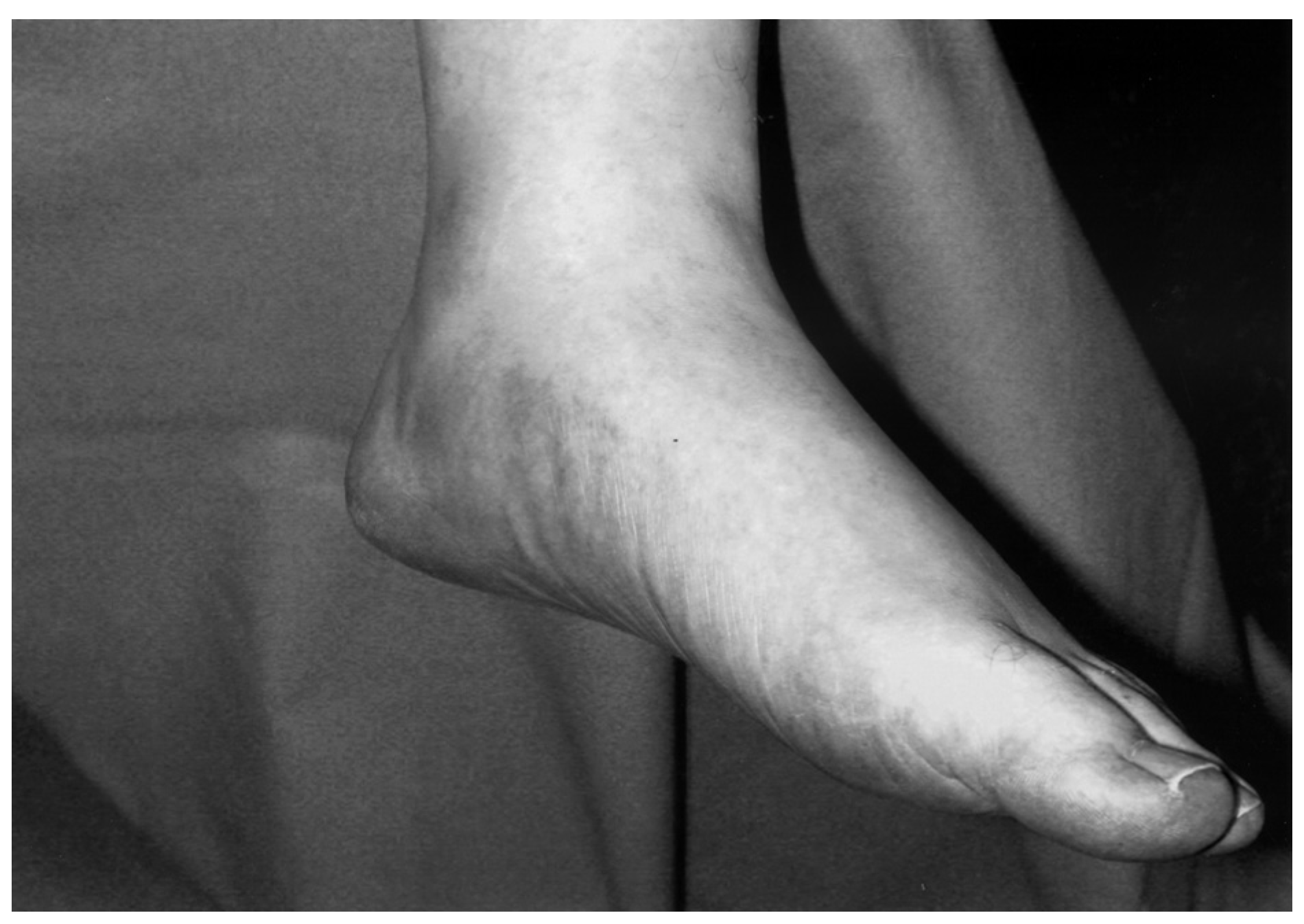
The patient was prescribed etodolac, 400 mg orally twice daily, and ice and rest. He was then referred to the podiatric medicine department at Cleveland Clinic complaining of bilateral pain in the medial arch and heel and bilateral foot swelling of less than 1 week’s duration. The pain and swelling in his feet made walking extremely difficult. On examination, the patient had tenderness on palpation along the longitudinal arch bilaterally. Edema was present grossly about the feet, dorsally and about the medial ankle (
Figure 1). The ankle joint itself was not swollen or painful. Markedly antalgic gait was noted, with extreme difficulty walking.
The patient was determined to have inflammation of the plantar fascia with ankle tenosynovitis, and a streptococcus-related arthralgic condition was considered. Laboratory studies ordered at this visit demonstrated the following values: antistreptolysin O titers, 252 IU/mL (reference range, 0–125 IU/mL); white blood cell count, 13.88 × 10³/μL (reference range, 4–11 × 103/μL); red blood cell count, 4.12 × 10⁶/μL (reference range, 4.5–6.0 × 10⁶/μL); mercury level, 12.5 g/dL (reference range, 13.5 –17.5 g/dL); hematocrit, 36.3% (reference range, 40%–52%); neutrophils, 75% (reference range, 40% –70%); lymphocytes, 21% (reference range, 22%–44%); monocytes, 4% (reference range, 0% –7%); absolute neutrophil count, 10.41 × 10³/μL (reference range, 1.8–7.7 × 10³/μL); absolute lymphocyte count, 2.91 × 10³/μL (reference range, 1.0– 4.0 × 10³/μL); and absolute monocyte count, 0.56 × 10³/μL (reference range, 0–0.8 × 10³/μL).
After this evaluation, the patient was prescribed a short course of oral corticosteroids. Three days later, the patient was doing remarkably better. His internist was contacted, and the concern regarding a possible rheumatic syndrome was relayed. The patient continued taking penicillin and underwent echocardiography to rule out cardiac involvement, with a negative result. Three weeks later, the patient was noted to have considerable improvement in symptoms, with some mild residual foot pain that resolved the following week.
Discussion
Reactive arthritis is defined as a sterile inflammatory arthritis associated with a primary infection at a distant site [
6,
7]. It is thought that antibodies formed in response to the infecting agent cross-react with joint cartilage and synovial tissue, giving rise to a sterile arthritis [
8]. There is also evidence that fragments of the initiating infection may reach the joint and induce an immune response in the absence of any cross-reactivity or clinical infection [
9].
Clinical Characteristics of Poststreptococcal Reactive Arthritis
Aviles et al [
10], in a retrospective review, classified patients as having poststreptococcal reactive arthritis if they met the following criteria: 1) acute sterile arthritis after streptococcal infection at a distant site, 2) a positive throat culture or increased antistreptococcal antibody titers, and 3) lack of Jones criteria to establish acute rheumatic fever. Deighton [
11] distinguished patients with poststreptococcal reactive arthritis from those with acute rheumatic fever by using the following criteria: 1) latency of 10 days in poststreptococcal reactive arthritis compared with 21 days to onset of arthritis seen in acute rheumatic fever, 2) prolonged or recurrent arthritis and arthralgias in poststreptococcal reactive arthritis compared with the migratory arthritis that usually resolves within 3 weeks in rheumatic fever, and 3) poor response to aspirin therapy in poststreptococcal reactive arthritis compared with the dramatic response seen with aspirin use in acute rheumatic fever (
Table 1). However, poststreptococcal reactive arthritis might have a variety of presentations and still meet the criteria for diagnosis.
Poststreptococcal reactive arthritis is characterized as usually being additive or nonmigratory [
6,
12]. The articular involvement in most cases occurs in an asymmetrical pattern with lower-extremity predominance [
13]. The joints involved may include the knees, ankles, wrists, elbows, metacarpophalangeal joints, proximal interphalangeal joints, metatarsophalangeal joints, hips, and shoulders [
12,
13,
14]. The knee and ankle joints are most commonly involved [
12]. The joint distribution is usually polyarticular or oligoarticular, but monoarticular involvement may occur [
14]. Particularly when joint involvement is monoarticular in the presence of illness, patients may mistakenly be thought to have septic arthritis. Many cases of arthralgia without any clinically evident joint swelling have been reported [
13,
15]. In addition, symptoms reported by patients may be out of proportion to the physical findings [
10]. Morning stiffness may be present [
13]. The arthritis of poststreptococcal reactive arthritis has a mean duration of 2 months [
13,
16]. Antibiotic treatment has not been found to alter the course of the arthritis [
7,
13].
Although most studies indicate a poor response of poststreptococcal reactive arthritis to nonsteroidal anti-inflammatory drugs, there are some reports [
10,
12] of patients with poststreptococcal reactive arthritis who responded well to nonsteroidal anti-inflammatory drug treatment. There are also reports [
10,
17] of improvement after treatment with corticosteroids. Most patients with poststreptococcal reactive arthritis, however, will have a less dramatic response to aspirin and nonsteroidal anti-inflammatory drug treatment compared with those with acute rheumatic fever. Even with treatment, patients are often symptomatic beyond the usual 3-week maximum seen with acute rheumatic fever.
Extra-articular manifestations may occur with poststreptococcal reactive arthritis. Uveitis [
18], livedo reticularis [
19], transient hepatitis, erythema multiforme, erythema nodosum [
12], polyarteritis nodosa [
17], vasculitis, glomerulonephritis [
7,
17], rash, and fever [
13,
17] have been reported. In multiple case series [
7,
17,
20], tenosynovitis of the hands has been described. The differential diagnosis includes connective tissue disease, juvenile rheumatoid arthritis, adult-onset Still’s disease, spondyloarthropathy, septic arthritis, malignancy, and bacterial endocarditis. These are excluded by history, physical examination findings, results of laboratory studies, the course of the illness, and response to treatment.
Laboratory Evaluation
The diagnosis of poststreptococcal reactive arthritis requires evidence of antecedent streptococcal infection. This is usually demonstrated by throat culture, rapid strep antigen detection, and the presence of elevated serum antistreptococcal antibody levels.
Antistreptolysin O and anti-DNAase B are the most common antibody titers performed. These antibody titers usually reach peak values a few weeks after pharyngitis and gradually decline during the next 3 to 6 months. A study [
12] of patients with poststreptococcal reactive arthritis found that the peak antibody response occurred at approximately 6 weeks. Serial measurements, particularly of antistreptolysin O, are recommended showing a change in the antibody titer, as some people may have long-term elevation of antistreptolysin O titers in the absence of clinical infection. Patients with poststreptococcal reactive arthritis are typically rheumatoid factor–negative, with antinuclear antibody titer frequency of elevation similar to that of the normal population [
16]. The erythrocyte sedimentation rate and C-reactive protein level are frequently elevated. Leukocytosis with polymorphonuclear cell predominance is often seen [
12,
15,
17]. Anemia with a hemoglobin level less than 12 g/dL was reported in five of six patients in one series [
17]. Synovial fluid analysis should be performed when necessary to rule out septic arthritis.
The patient in this case report presented after a febrile pharyngitis with arthralgias. The latency to onset of arthralgias was less than 10 days. There was evidence of antecedent streptococcal infection, with a positive rapid strep test result and an elevated antistreptolysin O antibody titer. No major Jones criteria for acute rheumatic fever were present. Minor criteria present included fever and arthralgias. The arthralgias occurred in an asymmetrical pattern with lower-extremity predominance. There was tenosynovitis of the medial ankle and plantar fascial pain. Although enthesitis involving the plantar fascia is known to occur with reactive arthritis, we are unaware of any previous reports associated with streptococcal infection. The patient had mild anemia and leukocytosis. Initial treatment with nonsteroidal anti-inflammatory drugs did not alleviate the discomfort, with relief obtained after the addition of oral corticosteroids. The course of the arthralgias was prolonged, lasting approximately 6 weeks. Consultation with an internist for immediate and long-term care included an echocardiogram.
The question of whether poststreptococcal reactive arthritis is a variant of acute rheumatic fever or a distinct clinical entity has been much debated. Jansen et al [
12] assert that poststreptococcal reactive arthritis is distinct from acute rheumatic fever because of the differences in presentation and the lower risk of carditis with poststreptococcal reactive arthritis. It is generally held that the frequency of carditis after a first attack of acute rheumatic fever is greater than 30% [
12]. A review of the literature demonstrates a rate of carditis of approximately 6% after an episode of poststreptococcal reactive arthritis [
13]. However, Tutar et al [
14], in a study of 24 patients, found considerable overlap of clinical and laboratory features of poststreptococcal reactive arthritis and acute rheumatic fever and concluded that they are actually different presentations of the same disease. This debate naturally extends to the need for antibiotic prophylaxis.
The need for antibiotic prophylaxis after an episode of acute rheumatic fever is clear. Opinions vary regarding the need in poststreptococcal reactive arthritis given its low frequency of carditis. Because there are pediatric reports of patients initially diagnosed as having poststreptococcal reactive arthritis later developing carditis, some consider poststreptococcal reactive arthritis to be a part of acute rheumatic fever and advocate penicillin prophylaxis [
21,
22]. Because this has not been duplicated in adults, some researchers have not supported penicillin prophylaxis in adults with poststreptococcal reactive arthritis [
10]. The American Heart Association currently recommends that individuals with poststreptococcal reactive arthritis be monitored closely for several months after the episode because of the potential for carditis. Prophylaxis is administered for up to 1 year and then is discontinued if there is no evidence of carditis. If carditis develops, the patient is classified as having acute rheumatic fever, and prophylaxis is continued [
23].
Conclusion
A case report of a patient with arthralgias with pedal involvement after a pharyngeal streptococcal infection has been presented. This patient did not fulfill the criteria for acute rheumatic fever, and the most appropriate diagnosis is poststreptococcal reactive arthritis. Knowledge of this clinical entity is essential for clinicians who treat musculoskeletal disorders. Early and accurate diagnosis of arthritis after streptococcal infection and the potential for acute rheumatic fever is required because of the associated morbidity, including carditis. Patients with poststreptococcal disease should undergo careful long-term cardiac examination and antibiotic prophylaxis. When poststreptococcal reactive arthritis or acute rheumatic fever is suspected, we recommend prompt referral to a rheumatologist.