


Abstract
A variety of medications may interact with oral antifungal agents used to treat onychomycosis. This article summarizes some possible consequences of concurrent administration of various therapeutic agents with the oral antifungals fluconazole, griseofulvin, itraconazole, ketoconazole, and terbinafine.
Oral antifungal medications used to treat onychomycosis are generally safe, with very low rates of serious adverse events. However, when an oral antifungal medication is given concurrently with another therapeutic agent, an adverse drug interaction may occur. Some possible consequences of concurrent use of various therapeutic agents with oral antifungal agents prescribed for the treatment of onychomycosis are summarized in this article. The oral antifungals discussed are fluconazole (Diflucan®) (As of this writing, fluconazole has not yet been approved by the US Food and Drug Administration for the treatment of onychomycosis.), griseofulvin (Fulvicin®, Grifulvin®, Gris-PEG®), itraconazole (Sporanox®), ketoconazole (Nizoral®), and terbinafine (Lamisil®).
The pharmacologic mechanisms underlying drug interactions are pharmacokinetic and/or pharmacodynamic.[1,2,3] Pharmacokinetic drug interactions affect the concentration, or the patient’s blood levels, of a medication. The factors that determine the blood level of a drug at any given time include its absorption, distribution, metabolism, and elimination. Pharmacodynamic drug interactions affect a patient through competition for similar receptors or physiologic systems, resulting in either additive, synergistic, or antagonistic activity. For example, because many of the oral antifungals are metabolized by the liver and excreted renally, concurrent medications that may impair hepatic or renal function should be monitored closely.
The major types of drug interactions involving the oral antifungal agents used to treat onychomycosis are the result of pharmacokinetic factors that either limit gastrointestinal absorption or affect drug metabolism through their effect on the cytochrome P-450 catabolic enzymes [1,2,3,4,5,6]. For example, griseofulvin, itraconazole, and ketoconazole are best given with a meal because their respective gastrointestinal absorptions are increased by the presence of food [7,8,9]. Furthermore, the absorptions of itraconazole and ketoconazole increase in an acidic gastric pH.
The cytochrome P-450 enzymes catalyze the intramolecular biotransformation of substrate drugs into more easily handled compounds that can be further processed for clearance and removal [1,2,10]. Griseofulvin is a cytochrome P-450 enzyme inducer. Therefore, the metabolic clearance of certain concurrent substrate drugs may be accelerated by the presence of griseofulvin, leading to possible therapeutic failure. The imidazole antifungal agents represented by fluconazole, itraconazole, and ketoconazole are, to various degrees, human cytochrome P-450 3A inhibitors; fluconazole is also a cytochrome P-450 2C9 inhibitor. Therefore, depending on the pharmacokinetic factors of the particular imidazole as well as its blood concentration, the metabolism of cytochrome P-450 3A substrate drugs may be impaired, resulting in potentially toxic concentrations of the drugs. In addition, the imidazoles are themselves cytochrome P-450 3A substrates and may suffer metabolic acceleration by inducers, resulting in decreased imidazole levels and possible loss of antifungal effectiveness.
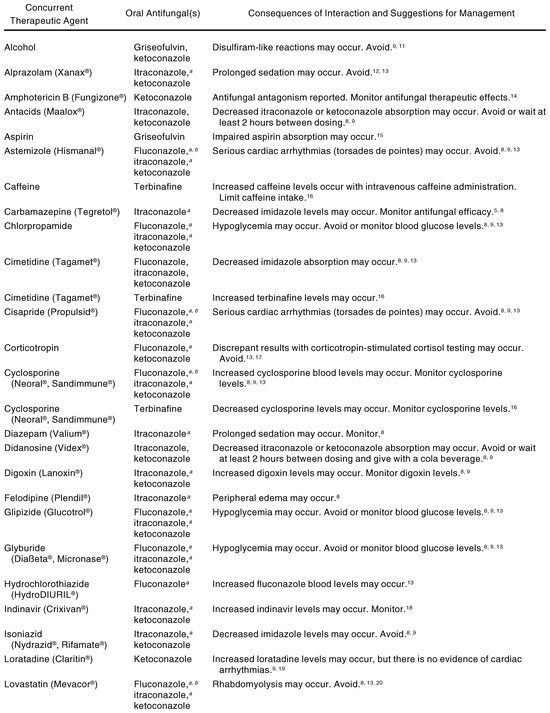
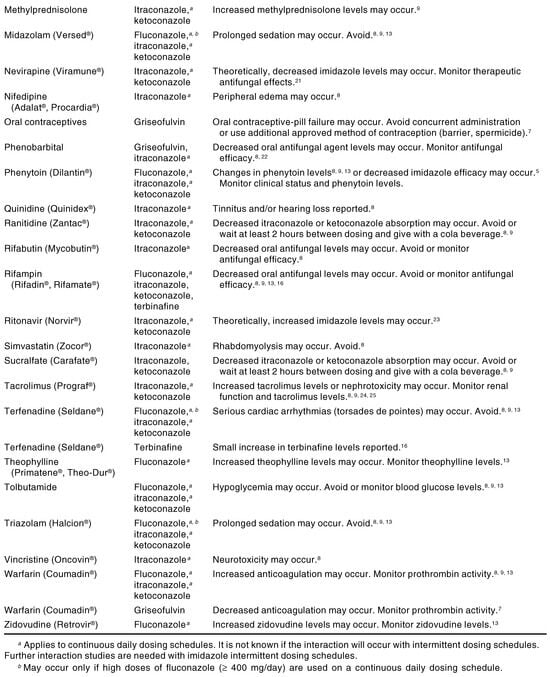
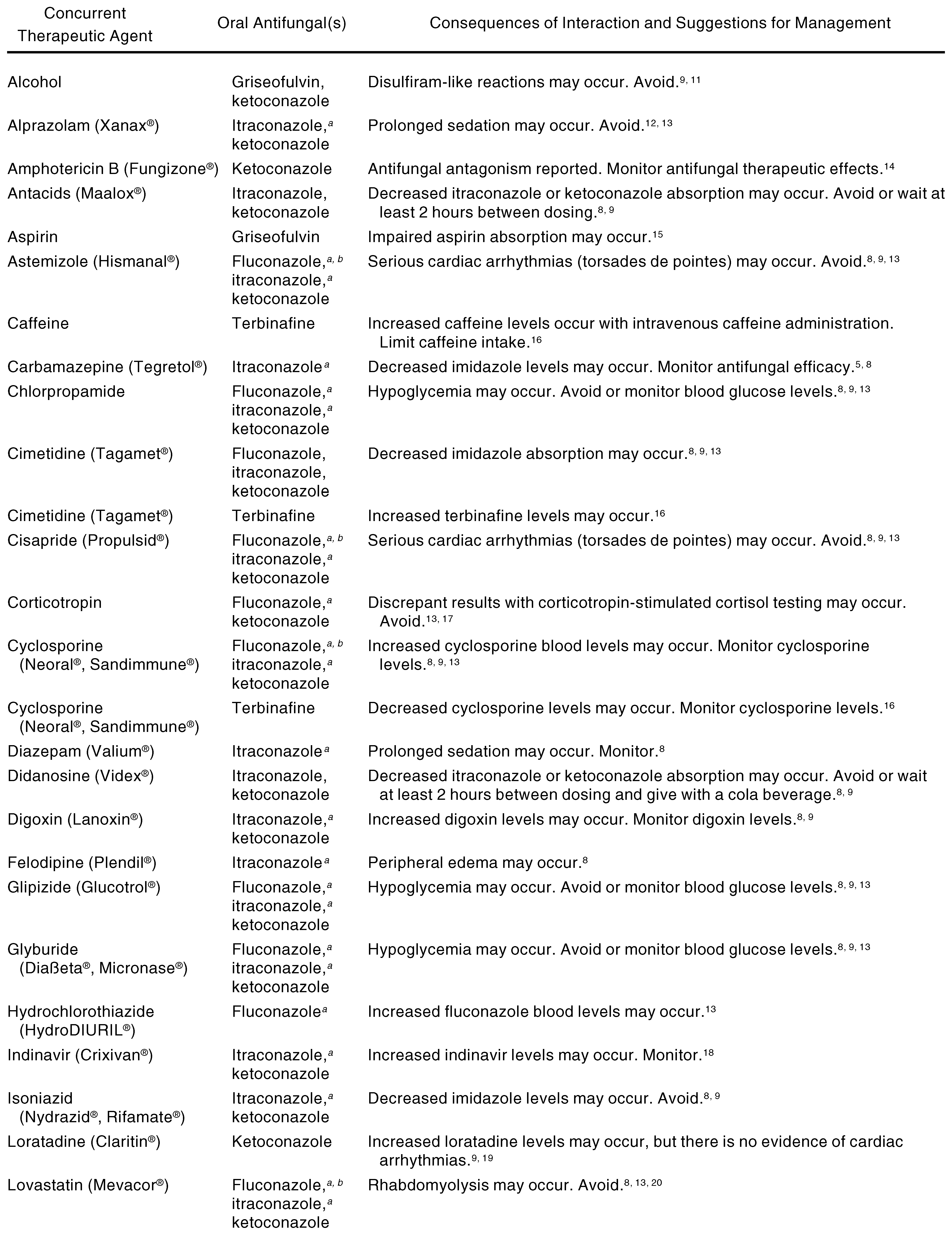
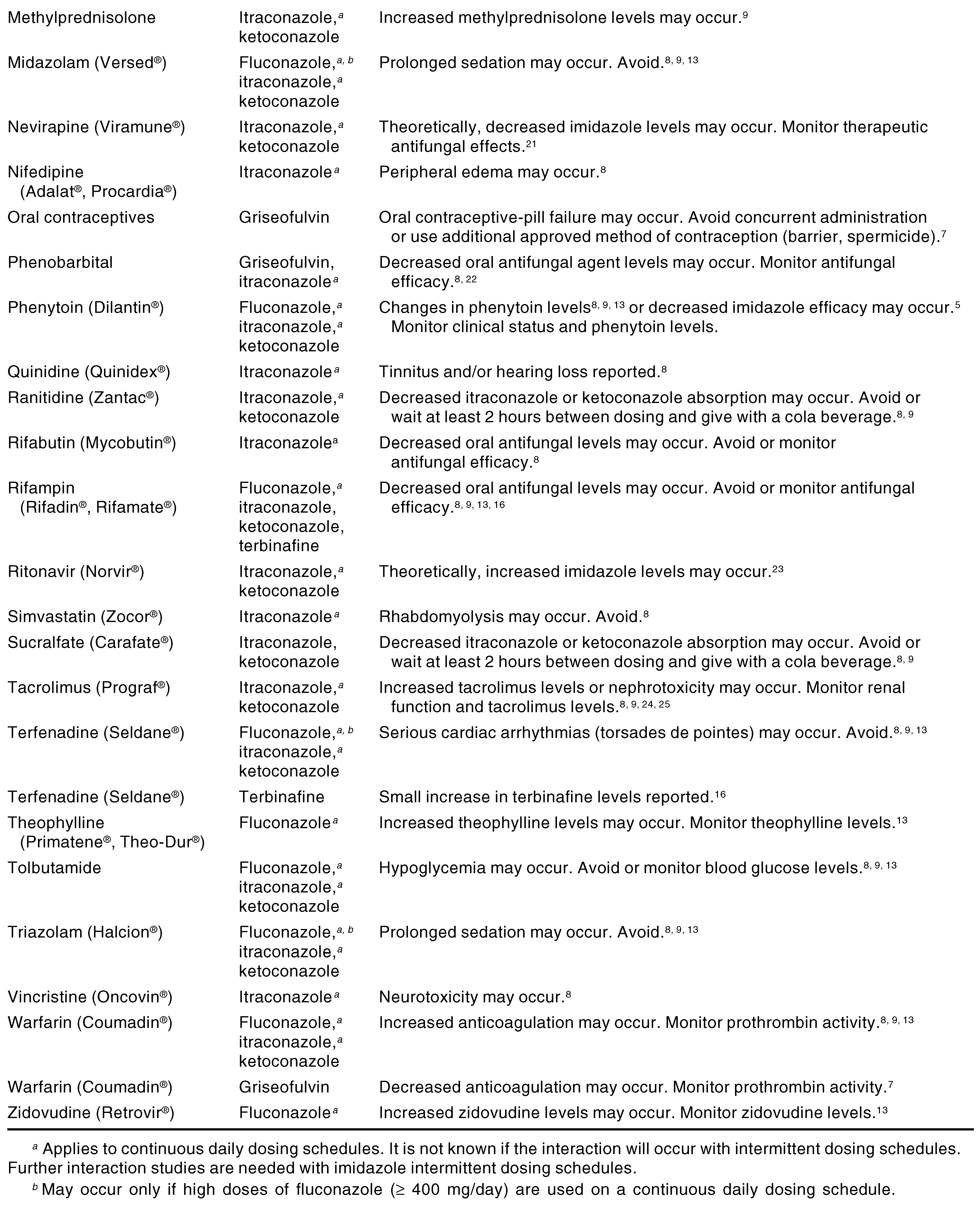
Table 1 lists various medications whose concurrent use with oral antifungal drugs may lead to adverse interactions. The reader should refer to the manufacturer’s specific product literature for additional data or the most current prescribing recommendations. The imidazole antifungals have greater potential for clinically significant drug interactions than the other oral antifungal agents. Therefore, it is prudent to use caution with this class of drugs.
Table 1.
Drugs Listed by Generic Name, with Brand Name Example(s), That May Interact with Oral Antifungal Agents.
References
- GILLUM, JG; ISRAEL, DS. POLK RE: Pharmacokinetic drug interactions with antimicrobial agents. Clin Pharmacokinet 1993, 25, 450. [Google Scholar] [CrossRef] [Scilit] [PubMed]
- SLAUGHTER, RL; EDWARDS, DJ. Recent advances: the cytochrome P450 enzymes. Ann Pharmacother 1995, 29, 619. [Google Scholar] [CrossRef] [Scilit] [PubMed]
- KATZ HI, GUPTA AK. Oral antifungal drug interactions. Dermatol Clin 1997, 15, 535. [Google Scholar] [CrossRef] [Scilit] [PubMed]
- BRECKENRIDGE, A. Clinical significance of interactions with antifungal agents. Br J Dermatol 1992, 126 (suppl 39), 19. [Google Scholar] [CrossRef] [Scilit] [PubMed]
- PERFECT JR, LINDSAY MH, DREW RH. Adverse drug reactions to systemic antifungals: prevention and management. Drug Saf 1992, 7, 323. [Google Scholar] [CrossRef] [Scilit] [PubMed]
- BRODELL, RT; ELEWSKI, BE. Clinical pearl: systemic antifungal drugs and drug interactions. J Am Acad Dermatol 1995, 33, 259. [Google Scholar] [CrossRef] [Scilit] [PubMed]
- Grisactin® (griseofulvin) package-insert data, Wyeth-Ayerst Laboratories, Philadelphia, PA, 1992.
- Sporanox® (itraconazole) package-insert data, Janssen Pharmaceutica, Titusville, NJ, 1997.
- Nizoral® (ketoconazole) package-insert data, Janssen Pharmaceutica, Titusville, NJ, 1995.
- SPATZENEGGER, M; JAEGER, W. Clinical importance of hepatic cytochrome P450 in drug metabolism. Drug Metab Rev 1995, 27, 397. [Google Scholar] [CrossRef] [Scilit] [PubMed]
- FETT DL, VUKOV LF. An unusual case of severe griseofulvin-alcohol interaction. Ann Emerg Med 1994, 24, 95. [Google Scholar] [CrossRef] [Scilit] [PubMed]
- Xanax® (alprazolam) package-insert data, Pharmacia & Upjohn Co, Kalamazoo, MI, 1996.
- Diflucan® (fluconazole) package-insert data, Roerig Division of Pfizer, Inc, New York, NY, 1997.
- Fungizone Oral Suspension® (amphotericin B) packageinsert data, Bristol-Myers Squibb, Princeton, NJ, 1996.
- PHILLIPS KR, WIDEMAN SD, COCHRAN EB; et al. Griseofulvin significantly decreases serum salicylate concentrations. Pediatr Infect Dis J 1993, 12, 350. [Google Scholar] [CrossRef] [Scilit] [PubMed]
- Lamisil® (terbinafine) tablet package-insert data, Novartis Pharmaceuticals Corp, East Hanover, NJ, 1997.
- HUGHES, GS; FRANCOM, SF; SPILLERS, CR; ET, AL. The effect of ketoconazole and transdermal estradiol on serum sex steroid hormones levels. Eur J Clin Pharmacol 1990, 38, 555. [Google Scholar] [CrossRef] [Scilit] [PubMed]
- Crixivan® (indinavir) package-insert data, Merck & Co, Inc, West Point, PA, 1997.
- Claritin® (loratadine) package-insert data, Schering Corp, Kenilworth, NJ, 1995.
- Mevacor® (lovastatin) package-insert data, Merck & Co, Inc, West Point, PA, 1996.
- Personal communication (letter from Maureen I. Oakes, PharmD, medical-data specialist, Roxane Laboratories, Inc, Ridgefield, CT), September 15, 1997.
- PATSALOS, PN; DUNCAN, JS. Antiepileptic drugs: a review of clinically significant drug interactions. Drug Saf 1993, 9, 156. [Google Scholar] [CrossRef] [Scilit] [PubMed]
- Norvir® (ritonavir) package-insert data, Abbott Laboratories, North Chicago, IL, 1997.
- ASSAN R, FREDJ G, LARGER E; et al. FK 506/fluconazole interaction enhances FK 506 nephrotoxicity. Diabetes Metab 1994, 20, 49. [Google Scholar]
- Prograf® (tacrolimus) package-insert data, Fujisawa USA, Inc, Deerfield, IL, 1995.
© 1997 American Podiatric Medical Association