


Abstract
Background: Children with idiopathic toe-walking (ITW) may experience difficulty during postural tasks and are more likely to perceive physical activity as difficult and challenging. This study aimed to compare postural control and muscle endurance in children with ITW and healthy controls. Methods: This cross-sectional study was conducted with 16 children with ITW (age, 10.88 6 2.06) and 16 age-matched controls (age, 11.69 6 1.99). Postural control was evaluated with the tests of the Biodex Balance System (postural stability, limits of stability, and modified clinical test of sensory interaction in balance) and the Balance Error Scoring System, which assesses static balance in six different conditions. Muscle endurance tests were the 1-min sit-to-stand test, the 30-sec sit-up test, and the Biering-Sorenson test. Results: There was a significant difference between the two groups in the postural stability (P< .05), limits of stability (P< .01), and modified clinical test of sensory interaction in balance (P< .01) tests of the Biodex Balance System as well as the firm surface (P5 .032), foam surface (P< .001), and total surface (P< .001) scores of the Balance Error Scoring System. Although there was a significant difference between the two groups in the 1-min sitto-stand test (P5 .016), no differences were found in the 30-sec sit-up test (P5 .896) or the Biering-Sorenson test (P5 .506). Conclusions: This comparative study showed that children with ITW had decreased postural control compared with their healthy peers. Although the lower-extremity muscle endurance of children with ITW was weaker than that of their peers, no difference was observed in terms of trunk muscle endurance.
The diagnosis of idiopathic toe-walking (ITW) defines children who toe walk in the absence of any medical or psychological condition.[1] Children with ITW often experience a progressive decrease in ankle dorsiflexion range of motion (DF-ROM) because of persistent toe-walking.[2] Consequently, this can lead to compensatory postural changes in addition to equinus, including mildly increased anterior pelvic tilt, decreased peak knee flexion in swing, and increased external tibial torsion.[3
Postural control refers to the ability to regulate the body on the base of support for a specific position to accomplish a task and includes neural control of postural equilibrium and orientation. Efficient control requires a harmonized relationship between the somatosensory, visual, and vestibular systems.[4,5] When standing on their toes, children with ITW flex their hips to maintain their body over their base of support.
Endurance is the ability to perform prolonged work and resist fatigue. Muscle endurance refers to the ability of an isolated muscle group to perform repeated muscle contractions for a certain period of time. There are studies reporting the relationship between lower-limb and trunk muscle endurance and postural control and the relationship between trunk flexor, extensor, and lateral muscle endurance and static balance level.[6789] Weaker muscle endurance might also compromise postural control in children with ITW. However, no study has examined the postural control and muscle endurance in this particular group of children thus far.
Children with ITW often stand in hip flexion, and the strength and endurance of their hip extensors have been thought to be lower than those of their peers because an increased anterior pelvic tilt can be caused by an overactive hip flexor and an inhibited gluteus maximus.[10] In addition, the weakened and inhibited abdominal muscles cross over the weak and inhibited gluteus maximus.[11
The goal of the present study was to get a better understanding of the differences between postural control and lower-extremity and trunk muscle endurance in children with ITW and those in age-matched healthy children. It was hypothesized that postural control and muscle endurance in the lower extremity and trunk would be decreased in children with ITW versus the control group.
Materials and Methods
Study Design
This cross-sectional study was approved by the Bezmialem Vakif University Non-Interventional Clinical Research Ethics Committee (number 5028, date March 21, 2019) and conducted at the Division of Physical Therapy and Rehabilitation, Faculty of Health Sciences, Bezmialem Vakif University. The study was prospectively registered on the ClinicalTrials.gov website (registration number NCT04200924, registration date December 13, 2019).
Participants
The ITW group was referred by the Department of Orthopedics and Traumatology, Faculty of Medicine, Bezmialem Vakif University. Sixteen children aged 10 to 15 years with a diagnosis of ITW and an age-matched group of typically developing children who met the inclusion criteria were enrolled in the study. All typically developing children in the control group were the family members (siblings or nephews) of students from the physical therapy graduate program.
The inclusion criteria for the ITW group were as follows: 1) having the diagnosis of ITW, 2) achievement of independent walking before 18 months of age, 3) having no contact with the heel in the initial contact phase or no contact at the midstance phase of the gait bilaterally, and 4) no participation in any training program in the last 6 months. The exclusion criteria for the ITW group were as follows: 1) presence of leg length discrepancy and 2) history of botulinum toxin type A injection or surgery within 6 months. The inclusion criteria for the control group were as follows: 1) having a normal DF-ROM degree, 2) achievement of independent walking before 18 months of age, and 3) no participation in any training program in the last 6 months. The exclusion criteria for the control group were as follows: 1) presence of leg length discrepancy and 2) history of botulinum toxin type A injection or surgery within 6 months.
All children with ITW were screened with the Toe Walking Tool,[12] which is a tool to identify children who would benefit from further medical work-up because of indications of a possible neurogenic, neuromuscular, or traumatic etiology of their toe-walking. Although the children with ITW were referred from the orthopedic department of our university, only some of them had been evaluated by a pediatric neurologist or psychologist in addition to the pediatric orthopedist. However, the Toe Walking Tool evaluation did not reveal the need for neurologic or psychiatric evaluation of any of the children. Information about the study was provided to all children and their parents through written informed consent.
G*Power 3.1 (Heinrich-Heine-Universität Düsseldorf, Düsseldorf, Germany) was used to calculate the sample size. [13] No study was found comparing postural control and muscle endurance between children with ITW and healthy peers. Based on the eyes closed sway index data measured in the study by Kenis-Coskun et al, [14] in which α = 0.05 and the power of the test was 80%, the sample size was determined to be 16 for each group (d = 0.90; α = 0.05).
Study Procedures
A physiotherapist (D.T.) with over 15 years of experience working in pediatric physiotherapy performed the testing processes for both groups.
Sociodemographic and Clinical Data. Sociodemographic and clinical data on all children were collected at the first visit. The ankle DF-ROM degree was measured with a universal goniometer in a supine position with 0° knee extension and a prone position with 90° knee flexion. The Silfverskiold, Duncan-Ely, and Thomas tests were performed to measure the flexibility of the gastrocnemius, rectus femoris, and iliopsoas muscles, respectively. The Duncan-Ely test was considered positive when the heel could not touch the gluteus maximus or the hip of the tested side rose from the table in the prone position.[15] The Thomas test was considered positive when the lower extremity on the involved side was unable to fully extend at the hip in the supine position.[16] The Silfverskiold test was considered positive if the passive ankle DF-ROM was 10° greater with the knee flexed than with the knee extended in the supine position.[17,18] The protocol for all tests was the same for both groups.
Evaluation of Muscle Endurance. Lower-extremity muscle endurance was measured with the 1-min sit-to-stand test. Each child was asked to sit and stand up from one of the sitting tables without armrests and with different heights appropriate to the child’s height. The test records the number of times a person sits and stands up from this table in 1 min (Fig. 1A).[19,20
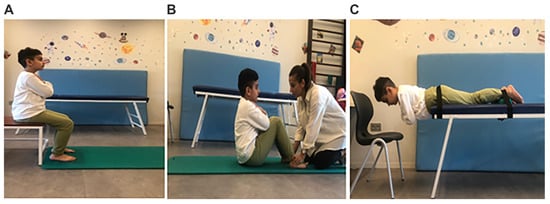
Figure 1.
A, 1-min sit-to-stand test; B, 30-sec sit-up test; C, Biering-Sorenson test.
Abdominal muscle endurance was tested with the 30-sec sit-up test. This test requires performing as many sit-ups as possible in 30 sec. The child was positioned in the supine position with the knees flexed 90° and arms crossed on opposite shoulders and the feet stabilized by the evaluator. The child was asked to flex the trunk until their elbows touched their thighs and then lie back again. The test records the number of times the child can execute this correctly in 30 sec (Fig. 1B).[21]
Back muscle endurance was tested with the Biering-Sorenson test. The test was performed by positioning the child with the trunk of the body extended off the edge of the table at the level of the anterior superior iliac crest of the pelvis, the arms crossed on opposite shoulders, and the legs stabilized by two belts at the hips and ankles. This test requires the child to keep the trunk in line with the legs as much as possible. When the child disrupted the neutral position, the timer was stopped and the maximum holding time was recorded in seconds (Fig. 1C).[22,23]
Evaluation of Postural Control. Biodex Balance System. The Biodex Balance System (Biodex Medical Systems, Inc, Shirley, New York) is a valid and reliable device for the assessment of postural control. The study was performed using the three tests included with the device: the postural stability (PS) test, the limits of stability (LoS) test, and the modified clinical test of sensory interaction in balance (mCTSIB) (Fig. 2).[24]
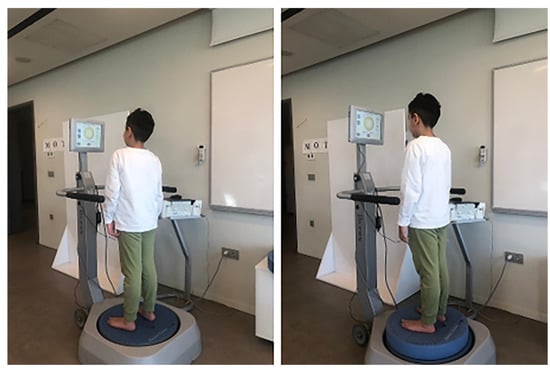
Figure 2.
Biodex Balance System.
All children completed the tests with their feet apart. The children’s feet were positioned according to their natural and comfortable posture. The PS test consisted of three measurements of 20 sec with a 10-sec rest and the LoS test consisted of three measurements with a 10-sec rest. The mCTSIB test was performed in four conditions: 1) eyes open on firm surface, 2) eyes closed on firm surface, 3) eyes open on foam surface, and 4) eyes closed on foam surface. Each condition lasted 30 sec with a 10-sec rest, and a foam pad (AIREX Balance Pad; Power Systems, Inc, Knoxville, Tennessee) was used for conditions 3 and 4. A lower stability index score on the PS test, a lower sway index on the mCTSIB test, and a higher LoS score indicated a greater level of postural control.
Balance Error Scoring System. The Balance Error Scoring System (BESS) is a brief and easily administered test of static balance. The test consists of three stances (double leg, single leg, and tandem leg) on two different surfaces (firm and foam). The test was performed with hands on hips, eyes closed, and without any support for 20 sec for each condition.[25] A foam pad (AIREX Balance Pad) was used for the foam surface. Each of the six conditions (double-leg, single-leg, and tandem stances on firm and foam surfaces) last for 20 seconds. During each 20-second trial, specific errors were recorded, with each error scoring 1 error point. The six errors included: 1) moving the hands off the iliac crest, 2) opening the eyes, 3) stumbling or falling, 4) abducting or flexing the hip beyond 30°, 5) lifting the forefoot or heel off the testing surface, and 6) remaining out of the proper testing position for more than 5 seconds. A lower error score indicated greater postural control (Fig. 3).
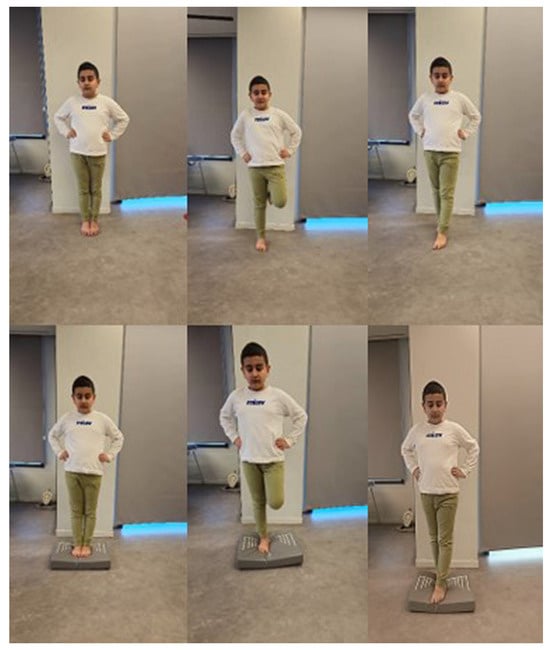
Figure 3.
Balance Error Scoring System.
Statistical Analysis
All statistical analyses were performed using SPSS Statistics 26.0 (IBM, Armonk, New York) for Windows (Microsoft, Redmond, Washington). The normal distribution of the data was examined using the Kolmogorov-Smirnov normality test. Differences between groups were analyzed using the χ2 test for categorical variables and the Student t test or Mann-Whitney U test for group comparisons depending on the distribution properties of the data. We considered differences significant if the P value was less than 0.05.
Results
The descriptive characteristics of the 32 children and the results of the clinical evaluation are presented in Table 1. No significant differences were found between the ITW and control groups according to the descriptive characteristics (P > .05). There were statistically significant differences between mean right and left DF-ROM in knee extension (P < .001) and flexion (P < .001).
Table 1.
Comparison of Descriptive and Clinical Characteristics and Muscle Endurance Test Scores of Groups
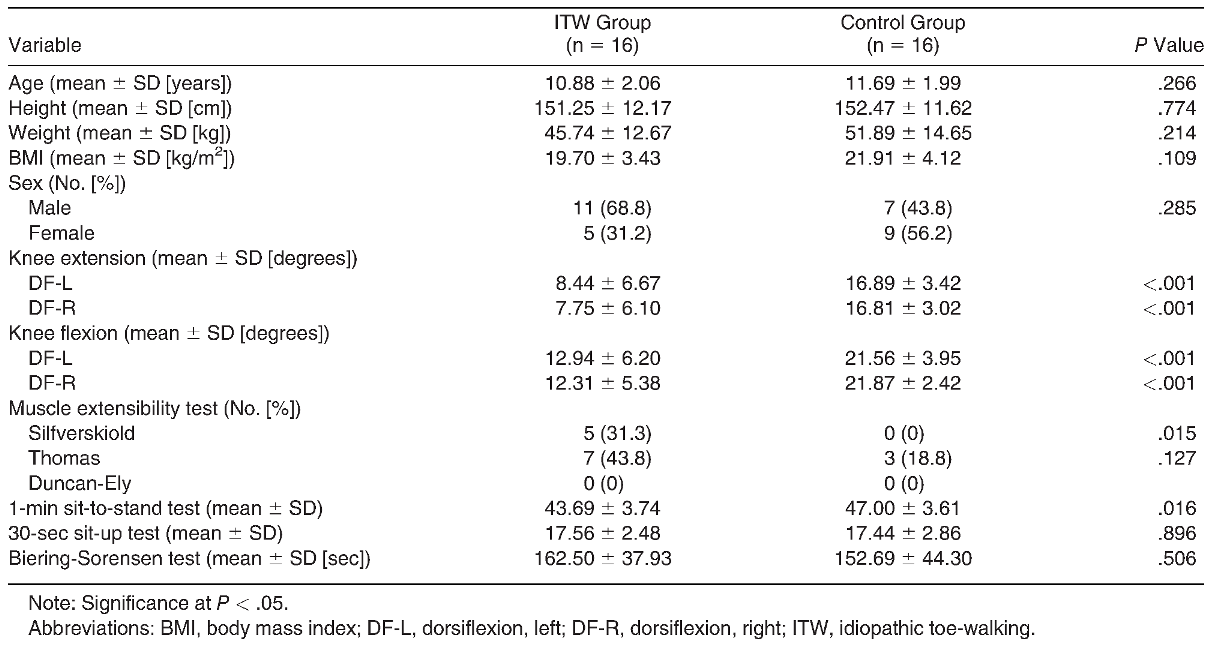
The Silfverskiold test was positive in five children in the ITW group (31.3%), and there was a statistically significant difference between the groups (P = .015). The Thomas test was positive in three children (18.8%) in the control group and seven children (43.8%) in the ITW group, but no significant difference was found between the groups (P = .127). The Duncan-Ely test was negative in both the ITW and control groups.
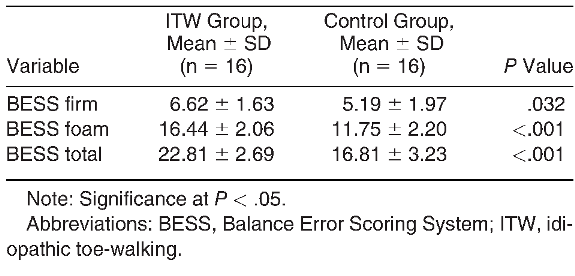
Although there was a significant difference between the two groups in the 1-min sit-to-stand test (P = .016), no significant difference was found in the 30-sec sit-up test (P = .896) or the Biering-Sorenson test (P = .506) (Table 1). There was a significant difference between the groups in the PS (P < .05), LoS (P < .01), and mCTSIB (P < .01) tests of the Biodex Balance System as well as the firm surface (P = .032), foam surface (P < .001), and total surface (P < .001) scores of BESS (Tables 2 and 3).
Table 2.
Comparison of Biodex Balance System Scores of Groups
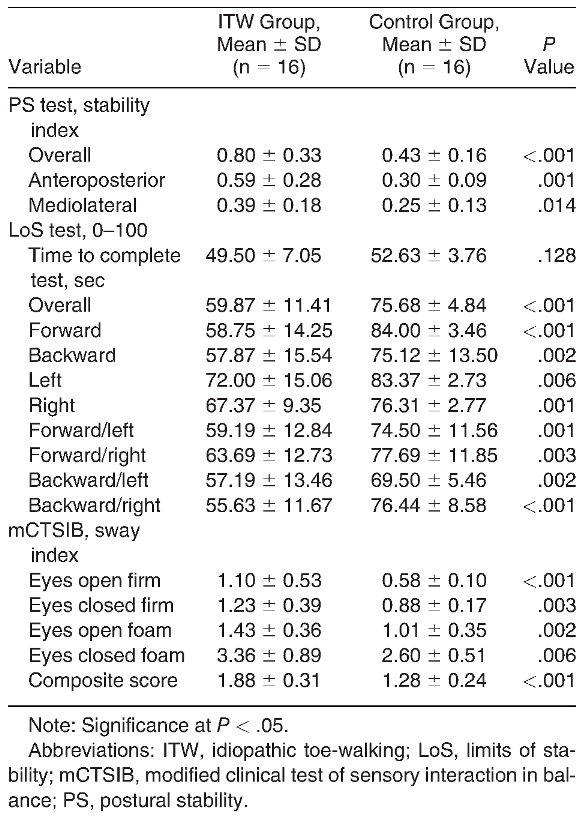
Table 3.
Comparison of Balance Error Scoring System Scores of Groups
Discussion
This cross-sectional exploratory study aimed to compare postural control and muscle endurance in children with ITW and healthy controls, who typically use a heel-toe gait. Our study demonstrated that children with ITW had impaired postural control and a decrease in lower-extremity muscle endurance compared with their healthy peers. However, abdominal and back muscle endurance was similar between the children with ITW and the control group.
Children with ITW were up to three times more likely than their healthy peers to display decreased DF-ROM associated with ankle equinus. The present study revealed significantly decreased DF-ROM in children with ITW compared with healthy controls. This finding was also consistent with other studies. [26,2728]
It has been reported that the sit-to-stand test measures more than just muscle endurance, as it also takes into account factors such as postural control, lower-extremity and core muscle strength, and ability to bear weight symmetrically on the lower limbs.[19,[20,29,30,31] In the present study, compared with the healthy controls, the children with ITW displayed weaker muscle endurance in the lower extremity and impaired balance according to Biodex Balance System and BESS scores. Decreased ankle DF-ROM may be a biomechanical disadvantage that disrupts the sit-to-stand ability. It has also been reported that increasing the speed of the sit-to-stand movement increases hip flexion, knee extension, and ankle dorsiflexion joint moments.[32] However, because children with ITW had a lower dorsiflexion angle than the healthy controls, they could not do it as fast. This may be the other reason why a significant difference was found in the sit-to-stand test between the groups in our study.
One study indicates that the sit-to-stand test may be a possible option for manual muscle testing and instrumental muscle strength measurement if the goal is to measure the performance of lower-extremity muscles.[33] Based on this, we acknowledge that the test we used for lower-extremity muscle endurance may also be an indicator of lower-extremity muscle strength in children with ITW.
The Biering-Sorenson test is a test not only of back muscle endurance but also of hip extensors. Children with ITW often stand in hip flexion, and the strength and endurance of their hip extensors have been thought to be lower than those of their peers. Although lower-extremity muscle endurance was weaker in children with ITW, no significant difference was observed in trunk muscle endurance.
It is well known that most children with ITW stand or walk with ankles in plantarflexion and hips flexed and may demonstrate an anterior pelvic tilt, knee hyperextension, or both. Therefore, the change in the gravity line may affect static balance. The PS test results support this because the stability indices were decreased in children with ITW compared with the healthy group.
We also know that dynamic balance is especially important when performing daily life activities. The LoS test is a reliable tool for evaluating dynamic stability during specific tasks, with visual feedback provided through a screen where children track and reach illuminated balls, with a green line appearing from the central ball to the directional balls based on their movements.[24] Hoang et al[34] evaluated ten children with ITW with the LoS test and identified impairments. Similarly, the present study showed that the children with ITW had decreased dynamic stability (P < .01) and the timing to complete the LoS test was similar between the groups (P = .128). We observed that dynamic balance on the LoS test was decreased in children with ITW because they may not have been able to maintain stability while trying to keep their trunk within the base of support owing to decreased range of motion, increased anterior pelvic tilt, or both.
Sensory issues in children with ITW have not been mentioned enough in the literature. However, for postural regulation, it is crucial to provide proper sensory information through the proprioceptive, vestibular, and visual systems.[35] The mCTSIB test assesses sensory interaction in standing by varying visual (eyes open/closed) and somatosensory (firm/foam surface) inputs to assist in determining which sensory system the individual relies on (somatosensory, vestibular, visual). It provides a means to quantify postural control under various sensory conditions.[36] In our study, children with ITW had significantly higher sway index scores on the mCTSIB test than their healthy peers. The results from the mCTSIB test may indicate that the children with ITW had difficulty processing sensory input, as they demonstrated decreased ability to maintain upright standing when sensory inputs were modified. This result is consistent with previous literature.[37,38]
In the current study, the PS, LoS, and mCTSIB tests of the Biodex Balance System and the firm surface, foam surface, and total surface scores of BESS were significantly worse in the ITW group than in the control group. According to the results we obtained, postural control was decreased in children with ITW, but it is not clear whether the postural control problems experienced by these children are the result of decreased DF-ROM that restricts freedom in ankle joint toe-walking or sensory processing challenges.
We performed the tests on children with ITW who had varying degrees of limitation in DF-ROM. Some studies have reported that children with ITW can have a normal DF-ROM,[1,26] and conducting these tests in such cases may provide further insight into the factors affecting postural control and muscle endurance beyond ankle range of motion.
This study has some limitations. First, we did not evaluate ankle DF-ROM with weightbearing. Second, we used the 1-min sit-to-stand test for the evaluation of lower-limb muscle endurance and strength; however, it may be more objective to consider using a hand-held dynamometer for evaluating all lower-extremity muscles separately and recording the data as Newtons or kilogram-force. Third, we were unable to conduct a blind study because the children with ITW displayed toe-walking or premature heel-off in midstance during tests in the laboratory.
Conclusions
To the best of our knowledge, the present study is the first to evaluate postural control using computerized dynamic posturography and muscle endurance in children with ITW. This study confirmed that children with ITW had decreased DF-ROM, decreased performance on functional tests of lower-extremity muscle endurance, and decreased postural control compared with their healthy age-matched peers. Therefore, it is important to assess postural control and muscle endurance in children with ITW to inform the development of a rehabilitation program focused on improving body function/structural impairments and activity limitations.
Financial Disclosure: None reported.
Conflict of Interest: None reported.
References
- SHULMAN, LH; SALA, DA; CHU, ML. ET AL: Developmental implications of idiopathic toe walking. J Pediatr 1997, 130, 541. [Google Scholar] [CrossRef] [Scilit] [PubMed]
- CASERTA, A; MORGAN, P; MCKAY, MJ; et al. Children with idiopathic toe walking display differences in lower limb joint ranges and strength compared to peers: a case control study. J Foot Ankle Res 2022, 15, 70. [Google Scholar] [CrossRef] [Scilit] [PubMed]
- MCMULKIN, ML; BAIRD, GO; CASKEY, PM. ET AL: Comprehensive outcomes of surgically treated idiopathic toe walkers. J Pediatr Orthop 2006, 26, 606. [Google Scholar] [CrossRef] [Scilit]
- ASSAIANTE, C; MALLAU, S; VIEL, S. ET AL: Development of postural control in healthy children: a functional approach. Neural Plast 2005, 12, 109. [Google Scholar] [CrossRef] [Scilit]
- SHUMWAY-COOK, A; WOOLLACOTT, MH. The growth of stability: postural control from a developmental perspective. J Mot Behav 1985, 17, 131. [Google Scholar] [CrossRef] [Scilit]
- GHAMKHAR, L; KAHLAEE, AH. The effect of trunk muscle fatigue on postural control of upright stance: a systematic review. Gait Posture 2019, 72, 167. [Google Scholar] [CrossRef] [Scilit] [PubMed]
- GRIBBLE, PA. HERTEL J: Effect of lower-extremity muscle fatigue on postural control. Arch Phys Med Rehabil 2004, 85, 589. [Google Scholar] [CrossRef] [Scilit]
- BARATI, A; SAFARCHERATI, A; AGHAYARI, A. ET AL: Evaluation of relationship between trunk muscle endurance and static balance in male students. Asian J Sports Med 2013, 4, 289. [Google Scholar] [CrossRef] [Scilit]
- PATEL, GH; CHITTE, SJ; BHAGAT, CA; et al. Correlation between transverse abdominis muscle endurance and body mass index among college students. J Sci Soc 2022, 49, 125. [Google Scholar] [CrossRef] [Scilit]
- TATEUCHI, H; TANIGUCHI, M; MORI, N; et al. Balance of hip and trunk muscle activity is associated with increased anterior pelvic tilt during prone hip extension. J Electromyogr Kinesiol 2012, 22, 391. [Google Scholar] [CrossRef] [Scilit]
- JANDA, V. Muscle Strength in Relation to Muscle Length, Pain and Muscle Imbalance. In International Perspectives in Physical Therapy 8, in Janda Compendium; Churchill Livingstone: Edinburgh, 1993; Vol 2, p. 83. [Google Scholar]
- WILLIAMS, CM; TINLEY, P; CURTIN, M. The Toe Walking Tool: a novel method for assessing idiopathic toe walking children Corrigendum to “The Toe Walking Tool: a novel method for assessing idiopathic toe walking children” [Gait Posture 32 (2010) 508–511]. Gait Posture;Gait Posture 34: 442 2010, 32, 508. [Google Scholar] [CrossRef] [Scilit]
- FAUL, F; ERDFELDER, E; LANG, AG. ET AL: G*Power 3: a flexible statistical power analysis program for the social, behavioral, and biomedical sciences. Behav Res Methods 2007, 39, 175. [Google Scholar] [CrossRef] [Scilit] [PubMed]
- KENIS-COSKUN, O; GIRAY, E; EREN, B. ET AL: Evaluation of postural stability in children with hemiplegic cerebral palsy. J Phys Ther Sci 2016, 28, 1398. [Google Scholar] [CrossRef] [Scilit] [PubMed]
- MARKS, MC; ALEXANDER, J; SUTHERLAND, DH; et al. Clinical utility of the Duncan-Ely test for rectus femoris dysfunction during the swing phase of gait. Dev Med Child Neurol 2003, 45, 763. [Google Scholar] [CrossRef] [Scilit]
- HOUGHTON, KM. Review for the generalist: evaluation of pediatric hip pain. Pediatr Rheumatol Online J 2009, 7, 10. [Google Scholar] [CrossRef] [Scilit] [PubMed]
- DIGIOVANNI, CW; KUO, R; TEJWANI, N. ET AL: Isolated gastrocnemius tightness. J Bone Joint Surg Am 2002, 84, 962. [Google Scholar] [CrossRef] [Scilit] [PubMed]
- BAROUK P, BAROUK LS: Clinical diagnosis of gastrocnemius tightness. Foot Ankle Clin 2014, 19, 659. [CrossRef] [Scilit]
- HAILE, SR; FU¨ HNER, T; GRANACHER, U; ET, AL. Reference values and validation of the 1-minute sit-to-stand test in healthy 5-16-year-old youth: a cross-sectional study. BMJ Open 2021, 11, e049143. [Google Scholar] [CrossRef] [Scilit]
- NUNEZ-GAUNAURD, A; MOORE, JG; ROACH, KE. ET AL: Motor proficiency, strength, endurance, and physical activity among middle school children who are healthy, overweight, and obese. Pediatr Phys Ther 2013, 25, 130. [Google Scholar] [CrossRef] [Scilit]
- KARKERA, A; SWAMINATHAN, N; PAIS, SM. ET AL: Physical fitness and activity levels among urban school children and their rural counterparts. Indian J Pediatr 2014, 81, 356. [Google Scholar] [CrossRef] [Scilit]
- BIERING-SØRENSEN F: Physical measurements as risk indicators for low-back trouble over a one-year period. Spine (Phila Pa 1976) 1984, 9, 106. [CrossRef] [Scilit]
- DEJANOVIC, A; HARVEY, EP; MCGILL, SM. Changes in torso muscle endurance profiles in children aged 7 to 14 years: reference values. Arch Phys Med Rehabil 2012, 93, 2295. [Google Scholar] [CrossRef] [Scilit]
- CACHUPE, WJC; SHIFFLETT, B; KAHANOV, L. ET AL: Reliability of Biodex Balance System measures. Meas Phys Educ Exerc Sci 2001, 5, 97. [Google Scholar] [CrossRef] [Scilit]
- HANSEN, C; CUSHMAN, D; CHEN, W; et al. Reliability testing of the Balance Error Scoring System in children between the ages of 5 and 14. Clin J Sport Med 2017, 27, 64. [Google Scholar] [CrossRef] [Scilit]
- ENGELBERT, R; GORTER, JW; UITERWAAL, C. ET AL: Idiopathic toewalking in children, adolescents and young adults: a matter of local or generalised stiffness? BMC Musculoskelet Disord 2011, 12, 61. [Google Scholar] [CrossRef] [Scilit]
- SOBEL, E; CASELLI, M; VELEZ, Z. Effect of persistent toe walking on ankle equinus. Analysis of 60 idiopathic toe walkers. JAPMA 1997, 87, 17. [Google Scholar] [CrossRef] [Scilit]
- RADTKE, K; KARCH, N; GOEDE, F. ET AL: Outcomes of noninvasively treated idiopathic toe walkers. Foot Ankle Spec 2019, 12, 54. [Google Scholar] [CrossRef] [Scilit] [PubMed]
- LORD, SR; MURRAY, SM; CHAPMAN, K; et al. Sit-to-stand performance depends on sensation, speed, balance, and psychological status in addition to strength in older people. J Gerontol A Biol Sci Med Sci 2002, 57, M539. [Google Scholar] [CrossRef] [Scilit] [PubMed]
- ZANINI, A; CRISAFULLI, E; D’ANDRIA, M. ET AL: Minimum clinically important difference in 30-s sit-to-stand test after pulmonary rehabilitation in subjects with COPD. Respir Care 2019, 64, 1261. [Google Scholar] [CrossRef] [Scilit] [PubMed]
- HYUN, SJ; LEE, J; LEE, BH. The effects of sit-to-stand training combined with real-time visual feedback on strength, balance, gait ability, and quality of life in patients with stroke: a randomized controlled trial. Int J Environ Res Public Health 2021, 18, 12229. [Google Scholar] [CrossRef] [Scilit]
- PAI, YC; ROGERS, MW. Speed variation and resultant joint torques during sit-to-stand. Arch Phys Med Rehabil 1991, 72, 881. [Google Scholar] [CrossRef] [Scilit]
- REYCHLER, G; PINCIN, L; AUDAG, N. ET AL: One-minute sit-to-stand test as an alternative tool to assess the quadriceps muscle strength in children. Respir Med Res 2020, 78, 100777. [Google Scholar]
- HOANG, C; SHIRAISHI, M; BEUTTLER, R. ET AL: Limits of stability in children diagnosed with idiopathic toe walking. Gait Posture 2020, 81, 149. [Google Scholar] [CrossRef] [Scilit]
- CDSC; BOFFINO, CC; RAMOS, RT. ET AL: Development of postural control and maturation of sensory systems in children of different ages: a cross-sectional study. Braz J Phys Ther 2018, 22, 70. [Google Scholar]
- HORN, LB; RICE, T; STOSKUS, JL; ET, AL. Measurement characteristics and clinical utility of the clinical test of sensory interaction on balance (CTSIB) and modified CTSIB in individuals with vestibular dysfunction. Arch Phys Med Rehabil 2015, 96, 1747. [Google Scholar] [CrossRef] [Scilit] [PubMed]
- WILLIAMS, CM; TINLEY, P; CURTIN, M; et al. Is idiopathic toe walking really idiopathic? The motor skills and sensory processing abilities associated with idiopathic toe walking gait. J Child Neurol 2014, 29, 71. [Google Scholar] [CrossRef] [Scilit] [PubMed]
- DONNE, JH; POWELL, JA; FAHEY, MC. ET AL: Some children with idiopathic toe walking display sensory processing difficulties but not all: a systematic review. Acta Paediatr 2023, 112, 1620. [Google Scholar] [CrossRef] [Scilit] [PubMed]
© 2025 American Podiatric Medical Association