Next Article in Journal
Postural Control and Muscle Endurance in Children With Idiopathic Toe-Walking
Previous Article in Journal
Results of Bioabsorbable Screws for the Fixation of Chevron Osteotomy in the Treatment of Hallux Valgus Deformities
 
 
Journal of the American Podiatric Medical Association is published by MDPI from Volume 116 Issue 1 (2026). Previous articles were published by another publisher in Open Access under a CC-BY (or CC-BY-NC-ND) licence, and they are hosted by MDPI on mdpi.com as a courtesy and upon agreement with American Podiatric Medical Association.
Article

A Nonhealing, Painful, Exophytic, Eroded Nodule on the Left Fifth Toe

by
Adina R. Greene
1,*,
Neil Vigil
2 and
Dathan Hamann
1
1
University of Arizona College of Medicine – Phoenix, Phoenix, AZ
2
HonorHealth John C. Lincoln Medical Center, Phoenix, AZ
*
Author to whom correspondence should be addressed.
J. Am. Podiatr. Med. Assoc. 2025, 115(2), 24088; https://doi.org/10.7547/24-088
Published: 1 March 2025
A 34-year-old male with no significant past medical history presented for evaluation of a 15year, growing, 8-mm, red eroded nodule with collarette of scale on his left fifth toe that appeared after a distant history of trauma. On initial examination, the lesion was clinically suspected to be a pyogenic granuloma. At this visit, a shave biopsy was performed revealing a soft white subcutaneous mass that was easily removed from the surrounding dermis. Histology revealed a softtissue mass with biphasic proliferation of elongated spindle cells with tapered nuclei occurring in compact cellular foci with palisading (Antoni A) and fewer paucicellular myxoid foci (Antoni B) consistent with a schwannoma. Schwannoma of the foot is rare, with the dorsum or interdigital space of the foot being the least reported manifestation on the foot. Podiatrists and dermatologists alike may consider schwannoma of the foot when evaluating chronic, non-healing, painful nodules, and papules. (J Am Podiatr Med Assoc 115(2), 2025; doi:10.7547/24-088)
Schwannomas, or neurilemmomas, are benign peripheral nerve sheath tumors that result from the gradual proliferation of Schwann cells.[1,2] Schwannomas often present as slow-growing tumors on the head, neck, or upper extremities, measuring less than 2 cm.[1,2,3] They present most commonly after the third decade of life and account for approximately 5% of benign soft-tissue tumors. As schwannomas evolve, they may become symptomatic, with compression of nerve fascicles. Known risk factors for schwannomas include family history, radiation, neurofibromatosis type 2, schwannomatosis, and recent trauma.[2,3,4]
Development of cutaneous schwannomas on the lower extremity is rare, comprising less than 10% of cases.[2] A schwannoma occurring on the foot is even more uncommon, with an incidence of 4%.[2,5,6,7,8] Herein we describe the case of a 34-year-old male with a progressive, nonhealing, eroded nodule on his left fifth toe after activity clinically presenting as a suspected pyogenic granuloma and subsequently diagnosed as schwannoma of the fifth toe.

Case Report

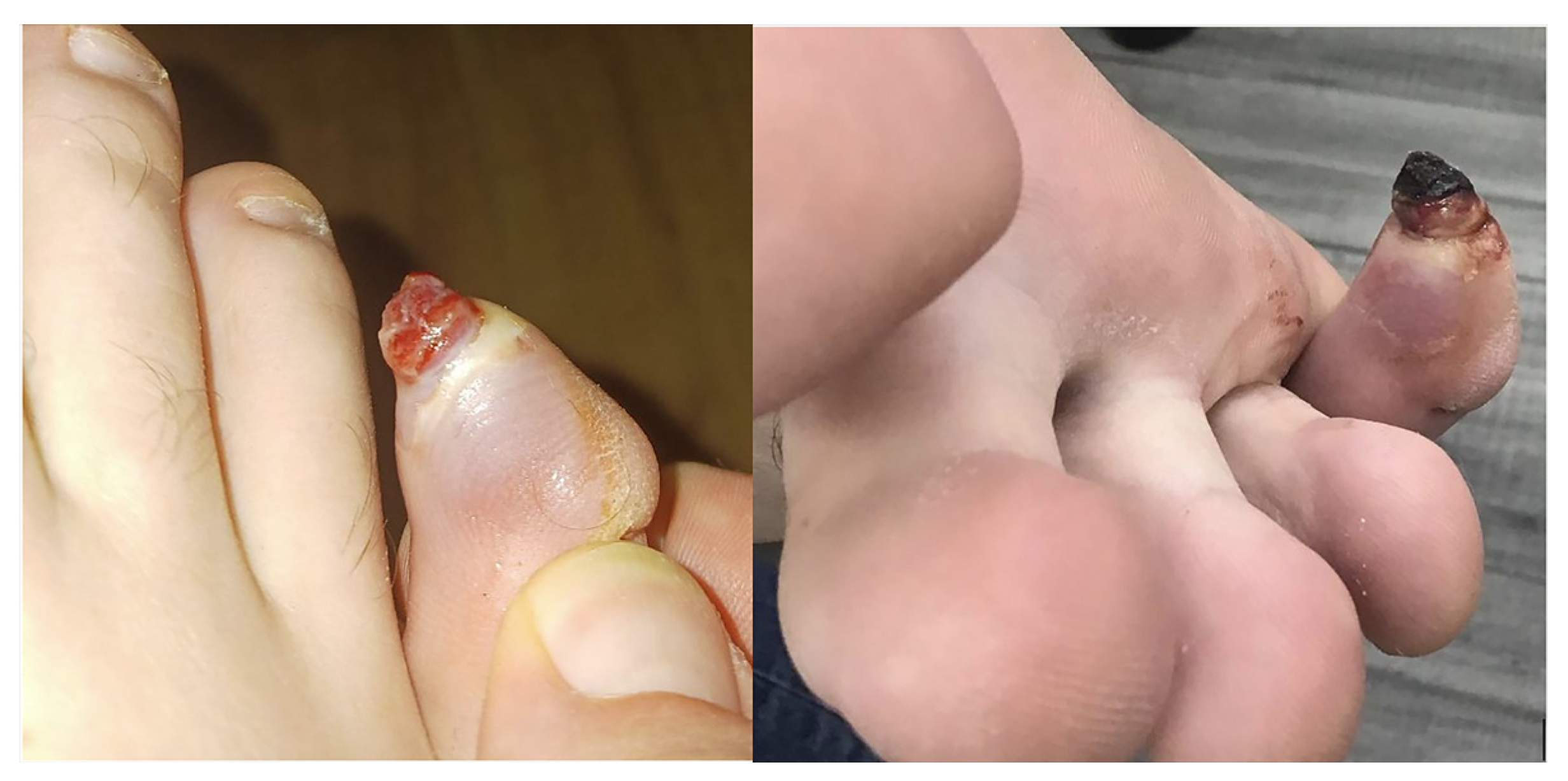
A 34-year-old male with no significant medical history presented for evaluation of a 15-year, growing, 8-mm, red, eroded nodule with a collarette of scale on his left fifth toe that appeared after a distant history of trauma (Fig. 1). On initial examination, the lesion was clinically suspected to be a pyogenic granuloma. At this visit, a shave biopsy was performed, revealing a soft, white subcutaneous mass that was easily removed from the surrounding dermis.
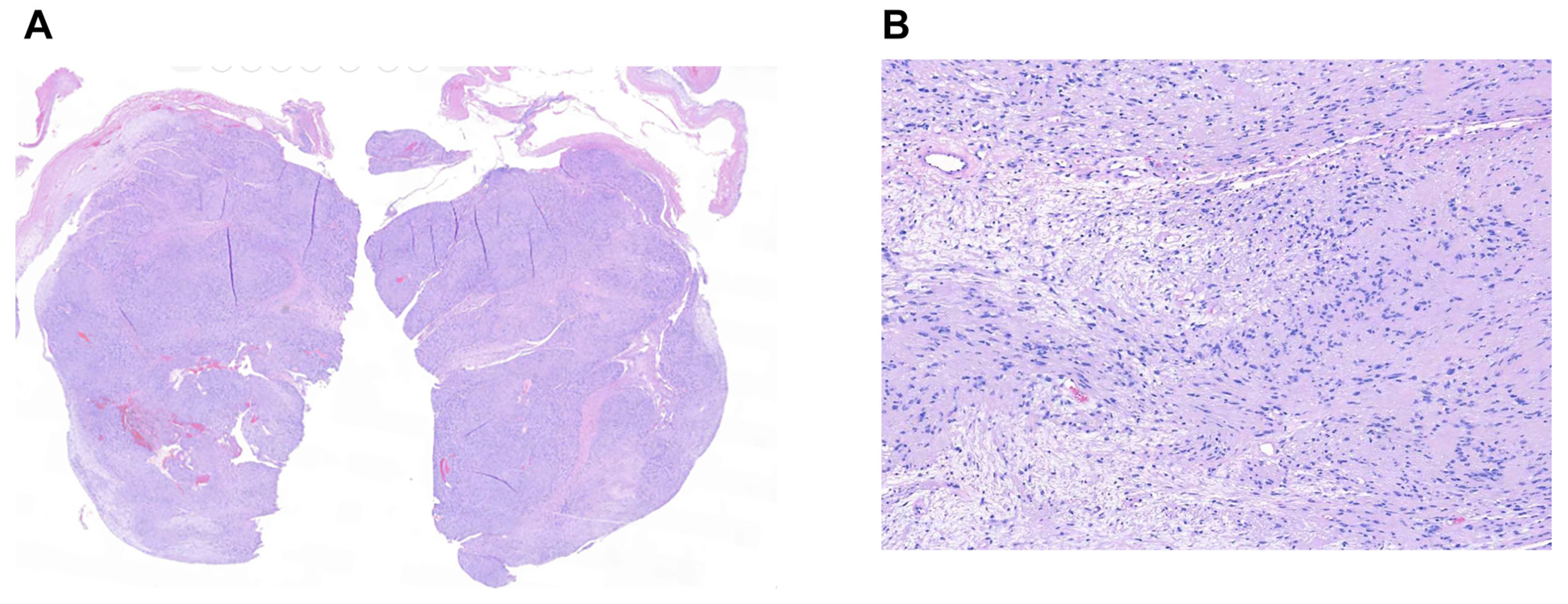
Histology revealed a soft-tissue mass with biphasic proliferation of elongated spindle cells, with tapered nuclei occurring in compact cellular foci as well as palisading (Antoni A) and fewer paucicellular myxoid foci (Antoni B), consistent with a schwannoma (Fig. 2). Notably, lobular vascular proliferation with small vascular channels was not seen, nor were vascular proliferations with dense neutrophilic infiltrate or atypical melanocytic proliferations.
The defect was closed in an intermediate fashion. At the 2-week follow-up, the toe was healing well with no postoperative complications and improvement in pain. The patient will be reevaluated at 12 months.

Discussion

To our knowledge, ours is only the second case of schwannoma to be reported on the fifth toe specifically.[8] Schwannoma of the foot is rare, with manifestation on the dorsum or interdigital space of the foot being the least reported.[5] Trauma may be a risk factor in the development of schwannomas.[4] Clinically, schwannomas usually present as slow-growing tumors on the head, neck, or upper extremities, measuring less than 2 cm.[1,2] In previous cases, schwannomas of the foot have been described as solitary subcutaneous or dermal nodules with or without ulceration.[6,7],
This patient’s clinical presentation of a nonhealing, bleeding, painful, exophytic, eroded nodule with a collarette of scale and prominent hemorrhagic crusting as well as history of trauma clinically mimics other benign and reactive vascular granuloma-like appearance. As schwannoma on the left fifth digit has rarely been reported, these diagnoses were considered much more likely than cutaneous schwannoma.[5] The diagnosis of cutaneous schwannoma was confirmed with histology, which revealed biphasic proliferation of elongated spindle cells with Antoni A and B zones, excluding all other potential diagnoses histopathologically.
Figure 1. Photograph of initial eruption of schwannoma taken by patient (left) and clinical presentation at time of biopsy (right).
Japma 115 24088 g001
Figure 2. A, Magnification of schwannoma (H &, ×2). B, Magnification demonstrating Antoni A and B tissue (H& ×10).
Japma 115 24088 g002

Conclusions

Although rare, podiatrists and dermatologists alike may consider schwannoma of the foot when evaluating chronic, nonhealing, painful nodules and papules.

References

  1. WEISS, SW; GOLDBLUM, JR. “Benign tumors of peripheral nerves,” in Soft Tissue Tumors, 4th Ed ed; MosbyYear Book: St. Louis, 2001; p. 1111. [Google Scholar]
  2. JABRA, AS; GODOY, J. Rare schwannoma nerve tumor in a lesser toe: a case report. JAPMA 2019, 109, 322. [Google Scholar] [CrossRef] [PubMed]
  3. KO, JY; KIM, JE; KIM, YH; ET, AL. Cutaneous plexiform schwannomas in a patient with neurofibromatosis type 2. Ann Dermatol 2009, 21, 402. [Google Scholar] [CrossRef] [PubMed]
  4. JACOBSON, JM; FELDER, JM, 3RD; PEDROSO, F. ET AL: Plexiform schwannoma of the foot: a review of the literature and case report. J Foot Ankle Surg 2011, 50, 68. [Google Scholar] [CrossRef] [PubMed]
  5. HAO, X; LEVINE, D; YIM, J. ET AL: Schwannoma of foot and ankle: seven case reports and literature review. Anticancer Res 2019, 39, 5185. [Google Scholar] [CrossRef] [PubMed]
  6. ARAGHI, F; TABARY, M; KAMYAB, K. ET AL: A rare case of plexiform schwannoma on the foot. Clin Case Rep 2021, 9, e04234. [Google Scholar] [CrossRef] [PubMed]
  7. NATH, AK; SANMARKAN, AD; D’SOUZA, M. ET AL: Non-healing ulcer on the great toe due to cellular schwannoma. Clin Exp Dermatol 2009, 34, e904. [Google Scholar] [CrossRef] [PubMed]
  8. WOLPA, ME. JOHNSON JD: Schwannoma of the fifth digit. J Foot Surg 1989, 28, 421. [Google Scholar] [PubMed]
  9. PATTERSON, JW. Weedon’s Skin Pathology, 4th Ed ed; Elsevier: Amsterdam, 2016. [Google Scholar]
Disclaimer/Publisher’s Note: The statements, opinions and data contained in all publications are solely those of the individual author(s) and contributor(s) and not of MDPI and/or the editor(s). MDPI and/or the editor(s) disclaim responsibility for any injury to people or property resulting from any ideas, methods, instructions or products referred to in the content.