


Abstract
Background: Although podiatric medicine is a growing field, it is still relatively unknown to many in the general public, including those seeking careers in medicine. The purpose of the present study is to portray the perspectives of current podiatric medical students on motivational factors that encouraged them to pursue the field. Methods: An online survey was developed and delivered to the student body of a single podiatric medical school. The survey investigated the motivation to pursue podiatric medicine, including first exposure to the field, shadowing experiences, and a variety of motivational factors. Results: Of 149 students, 81 (54.4%) completed the survey. The three highest-rated reasons for pursuing podiatric medicine were “stable and secure future,” “work-life balance,” and “intellectual satisfaction.” The three most-cited types of first exposure to podiatric medicine were “undergraduate pre-health advisor,” “family member/friend is a podiatrist,” and “form of media other than television, including the Internet.” Shadowing experiences were identified as an important part of developing an interest in pursuing podiatric medicine, especially in the surgical setting. Conclusions: Understanding the perspectives of current podiatric medical students is important in considering future efforts to promote the profession.
Each year, approximately 500 to 600 students enroll in a podiatric medical school [1]. Although there have been efforts to increase the number of applications to podiatric medical school [2], the number of applicants has not been increasing much during the past decade. Between 2010 and 2019 the average number of annual applications was 968, with a peak of 1,194 and a low of 868. In 2019, the number of applications was 964 [3]. Most recently, there were 1,006 applicants to at least one of the nine podiatric medical schools, with 679 first-year students entering in fall 2020 [1].
Although podiatric medicine is a growing field, it is still relatively unknown to many in the general public, including those seeking careers in medicine. Thus, the question is asked as to why students enter such a highly specialized field right from the beginning of their careers. The answer to this question involves understanding the motivations and other factors for entering podiatric medical school from current students in the field, as well as how they heard about this career option in the first place. As an added bonus, understanding these motivations and factors could aid in better advertisement of the field of podiatric medicine to premedical students. In other medical disciplines, the perspectives of current students have been formally explored in considering applicant motivation [4–7]. To support interest in the profession of podiatric medicine, it is helpful to consider the perspectives of our current students.
Podiatric medicine, as a whole, is a field that offers a greater diversity in options of practice than most health-care professions. Therefore, the determination of a group of individuals' motivations to enter into the profession could be valuable information when considering how best to advertise the field of podiatric medicine to prospective students. The purpose of this study was to explore the motivation of current podiatric medical students to pursue the field. By better understanding applicant perspectives, the field of podiatric medicine may benefit from using these perspectives to better advertise to prospective students. This will help guide future recruitment efforts and further increase the applicant pool by increasing interest in the field, which will subsequently increase awareness of and appreciation for the profession.
Methods
An anonymous online survey was created using a Web-based survey tool (Qualtrics XM; Qualtrics, Provo, Utah). No in-person interviews were conducted for this study. The survey began with an informed consent. The survey was created following a similar format from previously written articles, using a 5-point Likert scale and fill-in-the-blank–style questions on a list of 23 to 27 total questions that took approximately 10 to 15 min to complete [8]. Demographic information such as age, sex, ethnicity, marital status, and parent education were included in the survey [6]. Questions regarding first exposure, shadowing experience, and various motivational factors were also included. The survey concluded with questions regarding previous applications to other health professional or graduate schools as well as final comments on podiatry as a field and whether participants would make the same choice again. Conditional branching allowed respondents to answer auxiliary questions based on their previous response, and the survey included both open- and closed-ended questions. Five podiatric medical students created the survey questions, and five members of the faculty of a podiatric medical school were consulted in the design of the study for appropriateness and detail of the survey questions. After reviewing comments by faculty, four subsequent revisions of the original survey were made before finalizing and disseminating the survey.
The survey was administered to all of the students at a single podiatric medical school. No names were associated with participants to keep responses anonymous. Participants were allowed to skip questions, and any questions that were skipped were not included in the total number of responses for those particular questions. The survey was delivered electronically in May 2020 after approval was obtained from the Western University of Health Sciences institutional review board. Reminder e-mails were distributed once a week for 2 consecutive weeks. Two weeks later the survey was closed.
Descriptive statistics were generated based on participant responses. Inferential statistics were evaluated based on motivation to pursue podiatric medicine against respondent sex. Statistical significance was defined at the 95% confidence level (P < .05).
Results
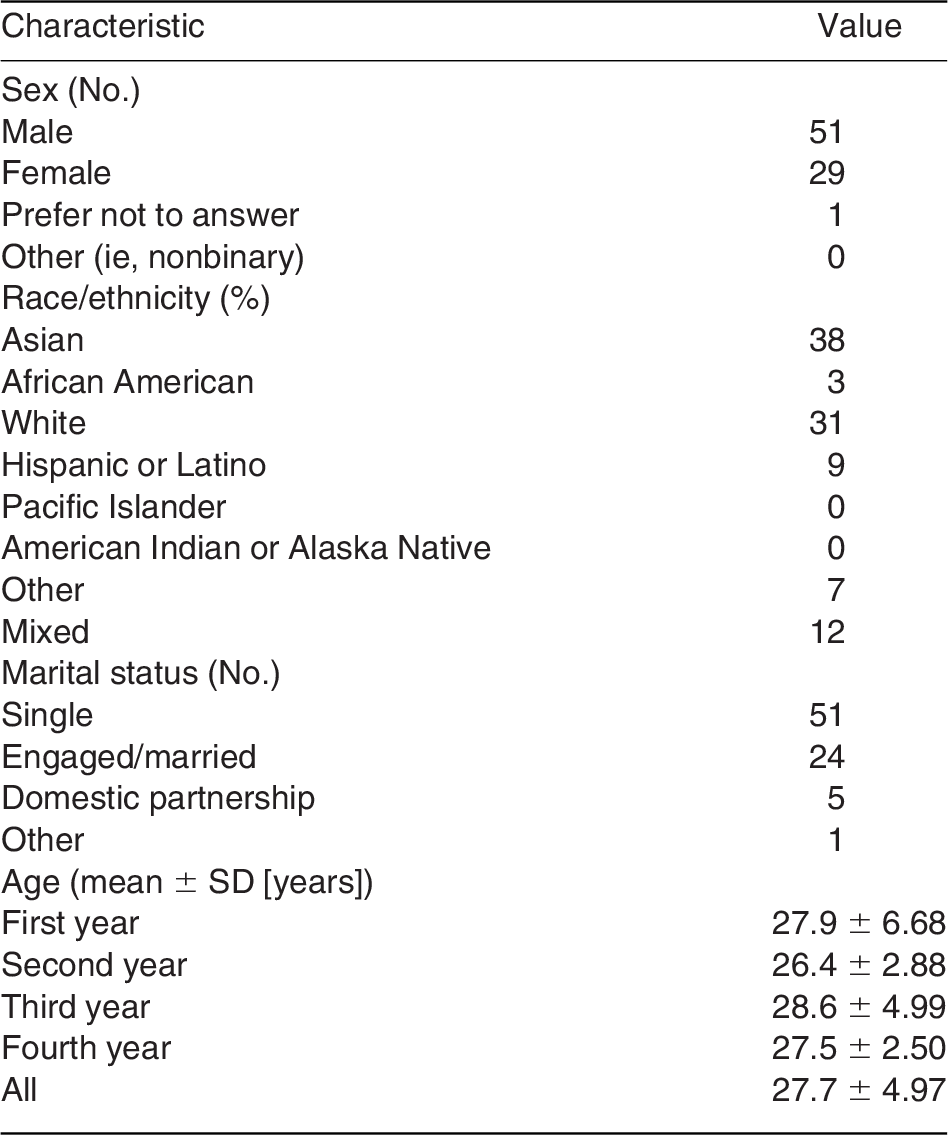
The survey was distributed to 149 students, and 81 students completed the survey. Of the 81 participants, 51 were male, 29 were female, and one preferred not to answer. The mean ± SD age of respondents was 27.7 ± 4.97 years. Regarding relationship status, 51 students identified as single, 24 as engaged or married, and five as being in a domestic partnership; one student responded with “other.” The demographic characteristics of survey participants are presented in Table 1.

Table 1.
Demographic Characteristics of the 81 Study Participants
Initial Exposure to Podiatric Medicine
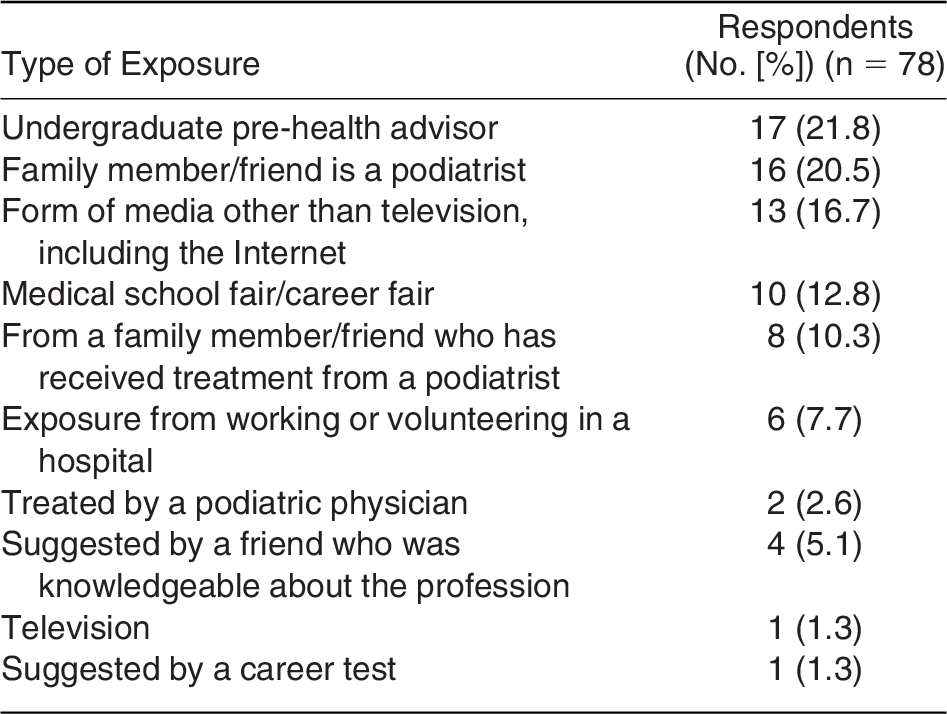
The first exposure to podiatric medicine varied among survey participants (Table 2). The three most common responses were undergraduate pre-health advisor, family member/friend who was a podiatric physician, and the Internet. Current students had shadowed a mean ± SD of 2.15 ± 1.16 podiatrists and 3.40 ± 1.87 nonpodiatrists.
Table 2.
First Exposure to Podiatric Medicine
During their shadowing experiences, 31 students (39.2%) were exposed to a surgical setting and 27 (34.2%) were exposed to an inpatient setting. Students were asked to identify how interested they were in their shadowing experiences on a 4-point Likert scale (not at all, a little, somewhat, very much). Twenty-four students (80%) responded that they were very much interested in the work performed when shadowing in the surgical setting; six (20%) identified that they were somewhat interested. Twenty students (74.1%) responded that they were very much interested in the work performed when shadowing in the inpatient setting, five (18.5%) that they were somewhat interested, and two (7.4%) that they were a little interested.
Appeal of Podiatric Medicine
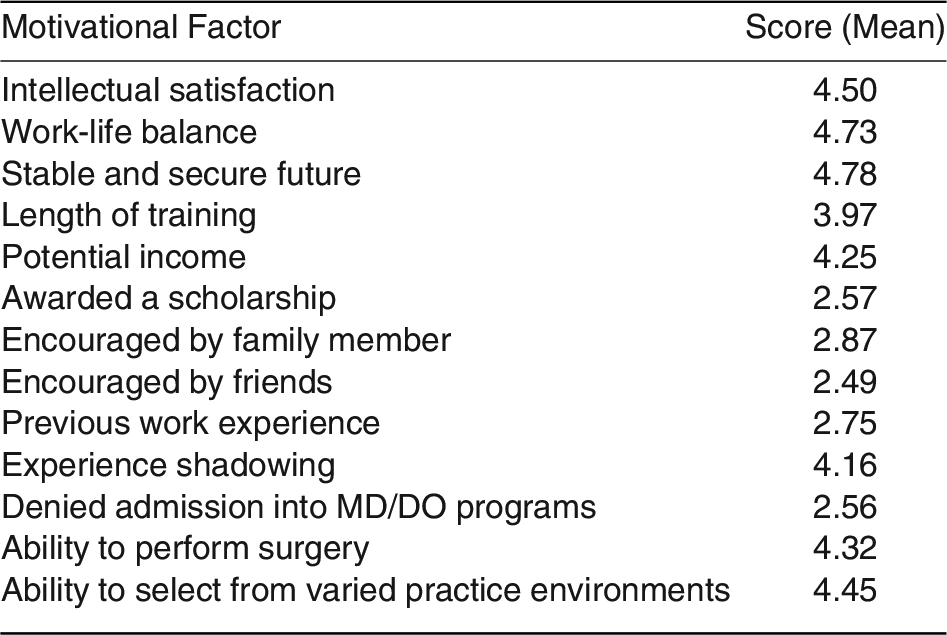
In considering the desire to pursue podiatric medicine, students were asked to rate the relative importance of an array of motivational factors. Thirteen items were included for the students to rate, and a 5-point Likert scale was used (Table 3). The three highest-rated items were “stable and secure future” (score of 4.78), “work-life balance” (score of 4.73), and “intellectual satisfaction” (score of 4.50). Of the options given, the three lowest-rated options were “encouraged by friends” (score of 2.49), “denied admission into MD/DO programs” (score of 2.56), and “awarded a scholarship” (score of 2.57).
Table 3.
Motivational Factors Rated on a 5-Point Likert Scale
Students were also asked, broadly, to rate the relative importance of surgery, outpatient clinic, and inpatient care in their decision to pursue podiatric medicine. On a 5-point Likert scale, the highest-ranked item was surgery (score of 4.37), followed by outpatient clinic (score of 4.09) and then inpatient care (score of 3.68).
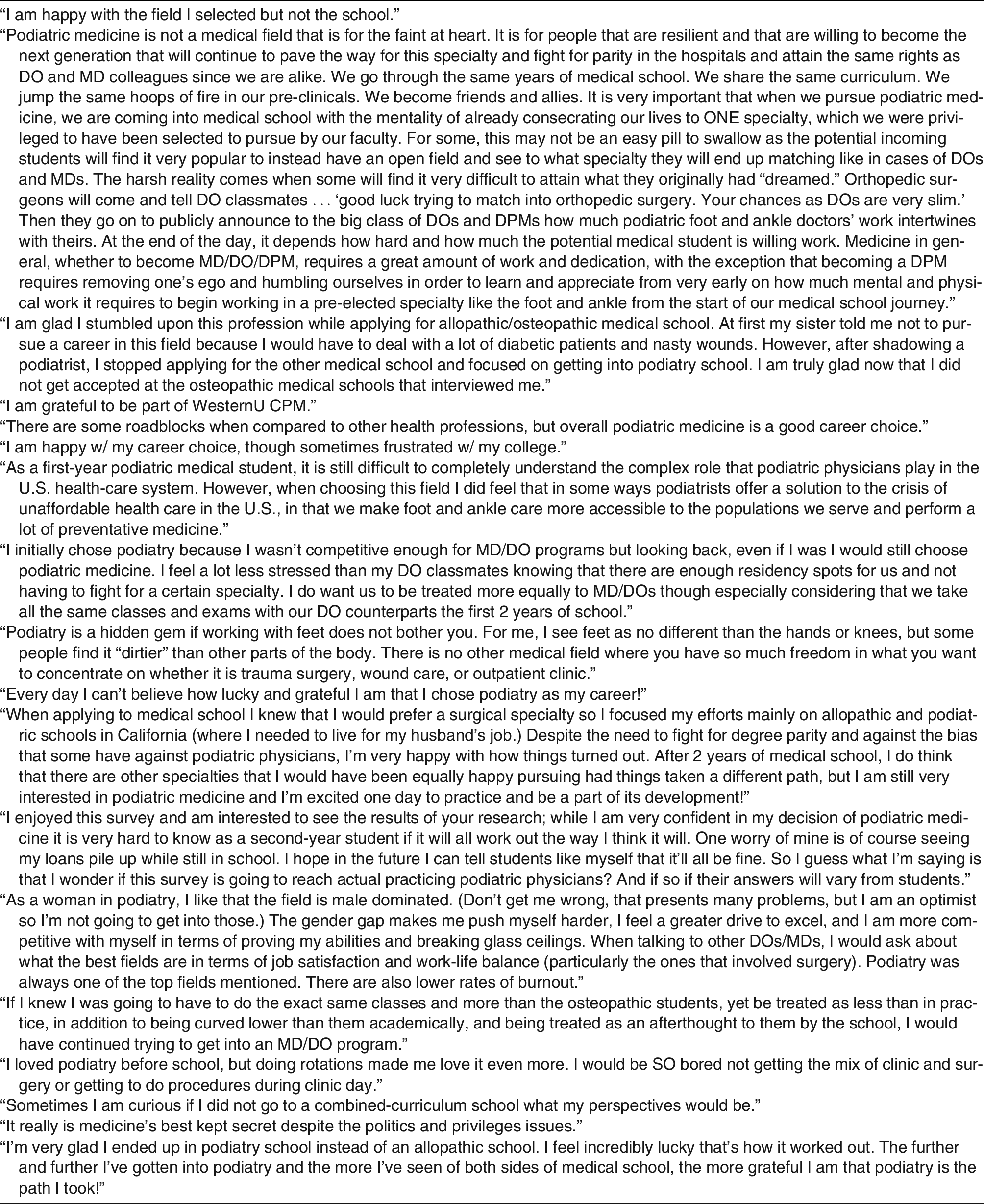
Survey participants were also asked whether there was anything specific (and not listed) that contributed to their decision to pursue podiatric medicine. Open responses to this prompt are summarized in Table 4. Students were also asked whether they had any general comments regarding their decision to pursue podiatric medicine (Table 5).
Table 4.
Other Motivations to Pursue Podiatric Medicine Not Previously Listed
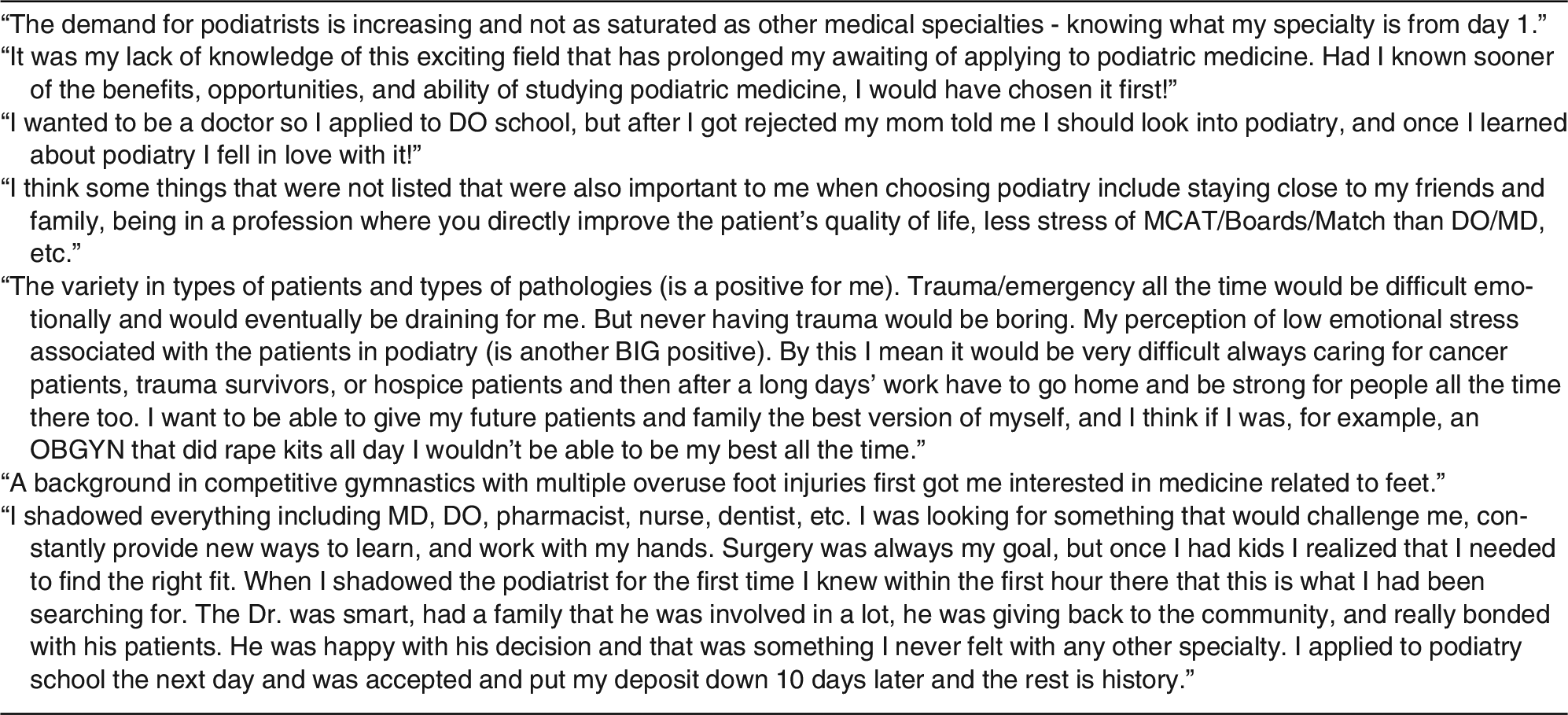
Table 5.
Final Comments Regarding Decision to Pursue Podiatry as a Career

Other Professional Options
The desire to pursue other postcollegiate options was also considered (Table 6). Forty-eight students (62.3%) had not applied to allopathic medical school, 25 (32.5%) had applied but were not accepted, and four (5.2%) had applied and been accepted. Concerning osteopathic medical school, 52 (67.5%) had not applied, 17 (22.1%) had applied but were not accepted, and eight (10.4%) had applied and been accepted. Only one student (1.3%) had applied to a dental school previously, and this student had been accepted. Students were also asked whether, broadly, they had been accepted previously to another type of graduate or professional school. Ten students (13.0%) had applied and been accepted, one student (1.3%) had applied but had not been accepted, and the remainder (85.7%) had not applied to another type of graduate or professional school.
Table 6.
Considerations to Pursue Other Postcollegiate Options

Students were asked at the end of the survey whether, given the option, they would make the same decision to pursue podiatric medicine. Most (n = 48 [62.3%]) responded “very likely,” 20 (26.0%) responded “likely,” six (7.8%) were neutral, two responded “unlikely” (2.6%), and one responded “not likely at all” (1.3%).
Sex Impact
Motivational factors were also considered based on respondent sex. No statistically significant differences were evident when comparing responses by sex.
Discussion
The three highest-rated reasons for pursuing podiatric medicine were “stable and secure future,” “work-life balance,” and “intellectual satisfaction.” For comparison, a meta-analysis from 2018 reviewed motivational factors for pursuing a career in medicine addressed in 24 studies. The most commonly identified motivational factors were categorized as “work for people/help underprivileged” (identified in three-quarters of studies reviewed) and “interest in medicine” (identified in two-thirds of studies reviewed). The following additional motivational factors were identified in 20.0% to 33.3% of reviewed studies: “social status/prestige,” “professional growth/challenging career,” “financial security,” “job security,” and “parental wish.” [8] Notably, the meta-analysis identified differences based on country income. The primary motivational factors of the studies conducted in high-income countries were generally identified as interest in science/medicine, social interest, flexible work hours, and work independence [8].
Shadowing experiences were an important part of the decision-making process of the students being surveyed. Previous studies have defined the benefits of shadowing experiences. One study found that more than 70% of high school–aged students developed a “greater inclination to apply to medical school” after a shadowing program [9]. Another study involving mostly college students found that participants of a surgical shadowing program were more likely to be academically productive, with 92% of respondents developing favorable attitudes toward medicine and 77% of respondents favoring surgery as a career choice [10]. A survey-based study of graduating medical students found that shadowing, as part of a transitioning program for their future role, was extremely valuable, with 93% of respondents describing shadowing as the most useful and effective part of the transitioning program [11]. Nonetheless, it has also been noted that shadowing experiences can be heterogeneous, lacking in objective guidelines, and inconsistent [12].
The three most-cited types of first exposure to podiatric medicine were undergraduate pre-health advisor, family member/friend is a podiatrist, and form of media other than television, including the Internet. The functions of pre-health advisors vary greatly across the United States, with varying levels of accessibility. It has been suggested that the most successful advising programs are characterized by low student-to-advisor ratios and easy access, regardless of institution size [13]. The opinion of the pre-health advisor on the field of podiatric medicine also varies greatly by institution. Enhancing this relationship may be worthwhile in building interest in the profession among undergraduate students.
Students had a markedly higher opinion of surgical experiences in their decisions to pursue podiatric medicine. A relevant 2017 study evaluated the desire to pursue orthopedic surgery among medical students. Considering motivational factors to pursue a specialty, medical students interested in orthopedic surgery as a career were more likely to value anticipated income, prestige of specialty, and experience as a patient in the field. These medical students were less likely to value quality of life/lifestyle/stress level, length of training, and sex diversity within the specialty [14]. Despite this higher opinion of surgical experiences, it should also be noted that the level of surgical interest among current podiatric medical students has been found to vary [15].
Limitations of the present study include that a survey was delivered amid the coronavirus disease 2019 pandemic because in-person interviews could not be conducted. Survey responses may have also been affected by nonresponse bias, as those electing to not participate in the survey may have had different opinions than those who did choose to participate. The survey was also limited in its delivery to a single college of podiatric medicine; thus, its results cannot be generalized to all of the podiatric medical students in the country. Future efforts may consider delivery across all of the podiatric medical colleges. A mixed-methods or focus group approach may also be helpful in further characterizing the opinions of current podiatric medical students and in investigating interventional strategies.
Conclusions
Maximizing interest in the field of podiatric medicine is critical in ensuring the long-term success of the profession. In considering student perspectives, “a stable and secure future,” “work-life balance,” and “intellectual satisfaction” were the highest-rated motivational factors of those surveyed. Undergraduate pre-health advisors and Internet resources were found to be valuable in developing interest in podiatric medicine. Shadowing was also identified as an important mode of exposure to the field. Future studies may consider involving all of the podiatric medical colleges and may consider evaluating the effectiveness of interventional strategies.
None reported.
None reported.
References
- American Association of Colleges of Podiatric Medicine: Statistics. Available at: https://aacpm.org/statistics-2/. Accessed December 1, 2020.
- American Podiatric Medical Association: APMA student recruitment. Available at: https://www.apma.org/studentrecruitment. Accessed December 1, 2020.
- American Association of Colleges of Podiatric Medicine: AACPMAS historical trends 2010-2019. Available at: https://www.aacpm.org/wp-content/uploads/Historical-TRENDS-of-apps-2010-2019-09-2019-for-health-professions-update.pdf. Accessed December 1, 2020.
- Crossley ML, Mubarik A: A comparative investigation of dental and medical student’s motivation towards career choice. Br Dent J 193: 471, 2002.
- Mashige KP, Oduntan OA: Factors influencing South African optometry students in choosing their career and institution of learning. S Afr Optom 70: 21, 2011.
- McManus IC, Livingston G, Katona C: The attractions of medicine: the generic motivations of medical school applicants in relation to demography, personality and achievement. BMC Med Educ 6: 11, 2006.
- Puljak L, Kraljevic JB, Latas VB, et al: Demographics and motives of medical school applicants in Croatia. Med Teach 29: e227, 2007.
- Al-Hallak KR, Nassani MZ, Heskul MM, et al: Reasons for choosing dentistry as a career among dental students in Saudi Arabia. Eur J Dent 12: 275, 2018.
- Hunter N, Shah A, Bollina P, et al: Improving medical work experience for students. Clin Teach 7: 284, 2010.
- Hernandez J, Al-Saadi S, Boyle R, et al: Surgeons can favorably influence career choices and goals for students interested in careers in medicine. J Am Coll Surg 209: 62, 2009.
- Matheson CB, Matheson DJ, Saunders JH, et al: The views of doctors in their first year of medical practice on the lasting impact of a preparation for house officer course they undertook as final year medical students. BMC Med Educ 10: 48, 2010.
- Kitsis EA, Goldsammler M: Physician shadowing: a review of the literature and proposal for guidelines. Acad Med 88: 102, 2013.
- Oyewole SH: “Sustaining Minorities in Prehealth Advising Programs: Challenges and Strategies for Success,” in The Right Thing to Do, The Smart Thing to Do: Enhancing Diversity in the Health Professions: Summary of the Symposium on Diversity in Health Professions in Honor of Herbert W. Nickens, M.D., National Academy Press, Washington, DC, 2001.
- Rao RD, Khatib ON, Agarwal A: Factors motivating medical students in selecting a career specialty: relevance for a robust orthopaedic pipeline. J Am Acad Orthop Surg 25: 527, 2017.
- Shofler DW, Bosia K, Harkless L: Fourth-year podiatric medical student perspectives on clerkships and residency selection. JAPMA 108: 311, 2018.
© 2023 American Podiatric Medical Association