


Abstract
Background: To evaluate complications and risk factors for nonunion in patients with diabetes after ankle fracture. Methods: We conducted a retrospective study of 139 patients with diabetes and ankle fractures followed for 1 year. We evaluated the incidence of wounds, infections, nonunions, Charcot’s arthropathy, and amputations. We determined Fracture severity (unimalleolar, bimalleolar, trimalleolar), nonunion, and Charcot’s arthropathy from radiographs. Nonunion was defined as a fracture that did not heal within 6 months of fracture. Analysis of variance was used to compare continuous variables, and χ2 tests to compare dichotomous variables, with α = 0.05. Logistic regression was performed with a binary variable representing nonunions as the dependent variable. Results: Complications were common: nonunion (24.5%), Charcot’s arthropathy (7.9%), wounds (5.2%), wound site infection (17.3%), and leg amputation (2.2%). Patients with nonunions were more likely to be male (55.9% versus 29.5%; P = .005), have sensory neuropathy (76.5% versus 32.4%; P < .001), have end-stage renal disease (17.6% versus 2.9%; P < .001), and use insulin (73.5% versus 40.1%; P < .001), β-blockers (58.8% versus 39.0%; P = .049), and corticosteroids (26.5% versus 9.5%; P = .02). Among patients with nonunion, there was an increased risk of wounds (odds ratio [OR], 3.3; 95% confidence interval [CI], 1.46–7.73), infection (OR, 2.04; 95% CI, 0.72–5.61), amputation (OR, 7.74; 95% CI, 1.01–100.23), and long-term bracing (OR, 9.51; 95% CI, 3.8–23.8). In the logistic regression analysis, four factors were associated with fracture nonunion: dialysis (OR, 7.7; 95% CI, 1.7–35.2), insulin use (OR, 3.3; 95% CI, 1.5–7.4), corticosteroid use (OR, 4.9; 95% CI, 1.4–18.0), and ankle fracture severity (bimalleolar or trimalleolar fracture) (OR, 2.5; 95% CI, 1.1–5.4). Conclusions: These results demonstrate risk factors for nonunions: dialysis, insulin use, and fracture severity after ankle fracture in patients with diabetes.
Complications after ankle fracture are common and result in a high rate of morbidity in persons with diabetes. Previous studies were usually relatively small and included fewer than 42 persons with diabetes and ankle fracture [1–10], except for a study by Wukich and colleagues that evaluated 105 ankle fractures [11]. However, Wukich et al did not separately evaluate nonunions or risk factors for nonunions. The study populations were probably too small to accurately report the incidence of complications or to evaluate risk factors for complications in the cohort of persons with diabetes. For example, several of these cohort studies did not report any cases of Charcot’s arthropathy [1–3,6]. Among studies that reported nonunion and Charcot’s arthropathy, the rate ranged from 8% to 23% for nonunion and from 4.8% to 40% for Charcot’s arthropathy. The objective of this study was to evaluate the incidence of wounds, infections, nonunions, Charcot’s arthropathy, and amputation after ankle fracture in persons with diabetes and to evaluate risk factors for nonunion.
Research Design and Methods
This was a retrospective cohort study of ankle fracture in diabetic patients aged 18 to 80 years. The study was approved by the institutional review board of Scott and White Hospital, (Temple, Texas) before implementation. We identified 139 persons with diabetes and ankle fractures with Current Procedural Terminology codes for open and closed ankle fracture treatment (codes 27760-27784) over a 5-year period. Medical history review included age, sex, diabetes, dialysis, peripheral artery disease, sensory neuropathy, and medications, including insulin, corticosteroids, calcium channel blockers, bisphosphonates, angiotensin-converting enzyme inhibitors, and antidepressants. Diabetes was defined using criteria from the American Diabetes Association: current treatment with oral hypoglycemic agents or insulin, a minimum of two fasting glucose values greater than 126 mg/dL, or 2 random glucose values greater than 200 mg/dL. There were five categories of ankle fracture: medial malleolar fractures, lateral malleolar fractures, bimalleolar fractures, trimalleolar fractures, and open fractures. Five types of complications were evaluated: wounds, infections, nonunions, Charcot’s arthropathy, and amputations. Wounds were due to 1) surgical wound dehiscence, 2) fracture blisters, 3) cast irritation, or 4) ulcers. We scored the fracture as healed or nonunion (>6 months without clinical or radiographic signs). Radiographic healing was defined as bridging bone on three of four cortices, resolution of the fracture line, and intact fixation. We evaluated the medical record for assessment of lower-extremity sensation before or after the fracture to determine sensory neuropathy. We recorded peripheral vascular disease as nonpalpable dorsalis pedis or posterior tibialis arterial pulse in the fractured extremity. We identified time parameters for fracture healing and the interval from fracture until the patient received medical care. Type of fracture, nonunion, and Charcot’s arthropathy were determined from evaluation of radiographs independently by two members of the research team (L.A.L. and T.G.) Infections were graded using the Infectious Diseases Society of America’s infection classification [12].
In the initial data analysis, we dichotomized continuous variables as normal or abnormal and then performed χ2 tests. We calculated odds ratios (ORs) and 95% confidence intervals (CIs) for exposure variables using α = 0.05. Subsequently, to simultaneously control for potential confounding variables, we used a stepwise logistic regression analysis to model the effects of various exposures and interactions. Variables in the univariate model that achieved a P < .1, as well as the covariate patient sex, were included in the final regression analysis using a statistical software program (IBM SPSS Statistics for Windows, Version 20.0; IBM Corp, Armonk, New York). We subsequently calculated risk ratios for each of these categories. Logistic regression was performed with a binary variable representing nonunions as the dependent variable and demographic variables (age, sex). Age was coded as a continuous variable; sex was a nominal binary variable. Patients with type 1 and type 2 diabetes were combined for data analysis. Also, several nominal categorical variables were used. One group of variables was related to medical conditions (fracture category, infection, chronic kidney disease), and several other variables were coded as indicator variables and represented therapeutic drugs (angiotensin-converting enzyme inhibitors, insulin, thiazolidinedione, antidepressants, β-blockers, bisphosphonates, calcium channel blockers, oral or inhaled corticosteroids, and thyroid medications) used by the study participants.
Results
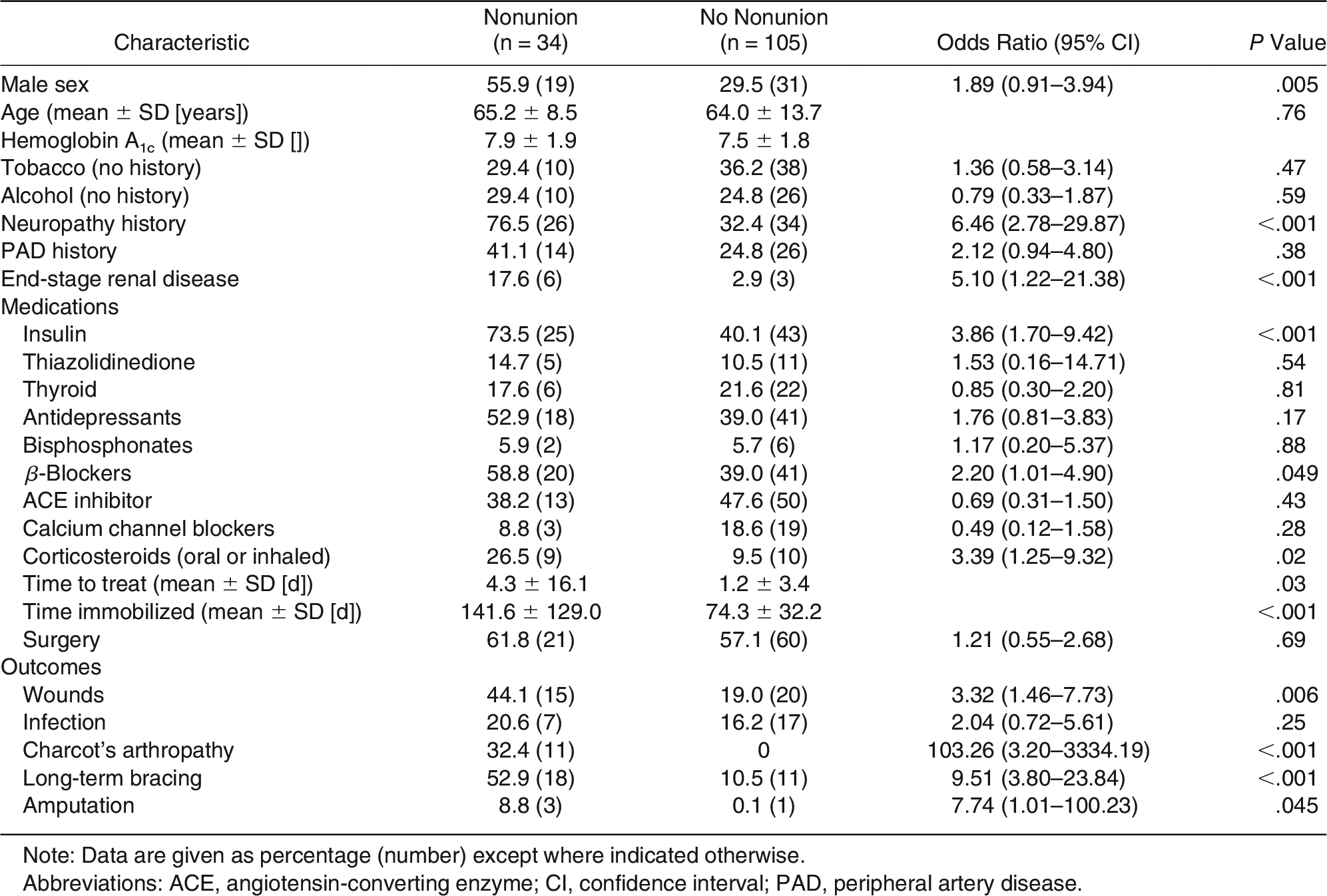
Table 1 shows the demographic and clinical characteristics of patients who developed nonunions versus patients without nonunions. The collective incidence of complications was very high: nonunion (24.5%), Charcot’s arthropathy (7.9%), wounds (25.2%), wound site infection (17.3%), and leg amputation (2.2%). In the univariate analysis, there was no difference in tobacco or alcohol use, age, or hemoglobin A1c level in patents with normal fracture healing and nonunion. Patients with nonunions were more likely to be male (55.9% versus 29.5%; P = .005), have sensory neuropathy (76.5% versus 32.4%; P < .001), have end-stage renal disease (17.6% versus 2.9%; P < .001), and use insulin (73.5% versus 40.1%; P < .001), β-blockers (58.8% versus 39.0%; P = .049), and corticosteroids (26.5% versus 9.5%; P = .02). Among patient who developed a nonunion, the risk of complications was significantly higher. Among patients with nonunion, there was an increased risk of wounds (OR, 3.3; 95% confidence interval [CI], 1.46–7.73), amputation (OR, 7.7; 95% C1, 1.01–100.23), and long-term bracing (OR, 9.51; 95% CI, 3.8–23.8). In the logistic regression analysis, four factors were associated with fracture nonunion: dialysis (OR, 7.7; 95% CI, 1.7–35.2), insulin use (OR, 3.3; 95% CI, 1.5–7.4), corticosteroid use (OR, 4.9; 95% CI, 1.4–18.0), and trimalleolar fracture (OR, 2.5; 95% CI, 1.1–5.4).

Table 1.
Demographic and Clinical Characteristics of Patients Who Developed Nonunion versus Patients Without Nonunion
Discussion
There are only a handful of retrospective studies that report complications associated with ankle fractures in people with diabetes. The incidence of complications in the present cohort of patients with ankle fractures was similar to that in other cohort studies. The incidences of nonunion (24.5%), Charcot’s arthropathy (7.9%), wounds (25.2%), wound site infection (17.3%), and leg amputation (2.2%) were very high. We have not identified any other work that evaluates risk factors for nonunion after ankle fracture in patients with diabetes.
There are a variety of important limitations inherent in retrospective studies. Often, key risk factors and clinical outcomes were inadequately defined or inconsistently reported in the medical record. Most studies do not report glucose control, medications associated with increased fracture risk, sensory neuropathy, and peripheral vascular disease (Table 1). In addition, the criteria for nonunions, infections, wound complications, sensory neuropathy, and peripheral artery disease are widely variable and inconsistently reported or are not stated in the medical records. Often, important data are simply not available.
We identified several medications that were associated with an increased risk of nonunion. In the univariate analysis, insulin, β-blockers, and corticosteroids were associated with nonunion. However, in the multiple regression analysis, only insulin and corticosteroids were associated with nonunion. This is the first study to evaluate the impact of medications in the assessment of risk factors for nonunion. There are a variety of medications that are commonly prescribed for persons with diabetes that may influence bone mineral density and fracture risk. However, none of these drugs have been studied to determine whether there is an association with nonunion or fracture complications. Treatment with β-blockers has been associated with decreased fracture risk in a nationwide case-control study [13]; however, only corticosteroids and β-blockers were significant in the regression. It has been well established that corticosteroids have a negative effect on wound healing [14]. Perioperative administration of dexamethasone has been associated with an increased risk of infection and delayed fracture healing [15,16]. However, we have been unable to identify any published articles that demonstrate any other associations between impaired fracture healing and these medications. As with any retrospective study, there are limitations that need to be acknowledged. Selection bias is a possibility based on the decision to treat a patient surgically or nonsurgically. Another weakness is that we did not evaluate the specific methods of treatment, such as weightbearing status, type of fixation, or method of immobilization. Finally, the impact of short- and long-term glycemic management was not evaluated except for hemoglobin A1c at baseline, and we acknowledge that suboptimal glycemic control can contribute to higher rates of complications. A strength of this study is that it reports the largest number of patients with diabetes with ankle fractures. We included fractures that were treated with and without surgery, and we reported the role of different medications on fracture outcomes.
In conclusion, we identified a high incidence of wounds, infections, nonunions, Charcot’s arthropathy, and amputation in persons with diabetes after ankle fracture. Most patients (52.9%) required long-term bracing after their fracture. Other variables associated with negative impact on fracture healing included end-stage renal disease on dialysis, corticosteroid and insulin use, and trimalleolar ankle fracture.
Financial Disclosure
None reported.
Conflict of Interest
None reported.
References
- 1. Jones KB, Maiers-Yelden KA, Marsh JL, et al: Ankle fractures in patients with diabetes mellitus. J Bone Joint Surg Br 87: 489, 2005.
- 2. McCormack RG, Leith JM: Ankle fractures in diabetics: complications of surgical management. J Bone Joint Surg Br 80: 689, 1998.
- 3. Low CK, Tan SK: Infection in diabetic patients with ankle fractures. Ann Acad Med Singapore 24: 353, 1995.
- 4. Blotter RH, Connolly E, Wasan A, et al: Acute complications in the operative treatment of isolated ankle fractures in patients with diabetes mellitus. Foot Ankle Int 20: 687, 1999.
- 5. Connolly JF, Csencsitz TA: Limb threatening neuropathic complications from ankle fractures in patients with diabetes. Clin Orthop Relat Res 348: 212, 1998.
- 6. Flynn JM, Rodriguez-del Rio F, Piza PA: Closed ankle fractures in the diabetic patient. Foot Ankle Int 21: 311, 2000.
- 7. White CB, Turner NS, Lee G-C, et al: Open ankle fractures in patients with diabetes mellitus. Clin Orthop Relat Res 414: 37, 2003.
- 8. Holmes GB Jr, Hill N: Fractures and dislocations of the foot and ankle in diabetics associated with Charcot joint changes. Foot Ankle Int 15: 182, 1994.
- 9. Jani MM, Ricci WM, Borrelli J Jr, et al: A protocol for treatment of unstable ankle fractures using transarticular fixation in patients with diabetes mellitus and loss of protective sensibility. Foot Ankle Int 24: 838, 2003.
- 10. Costigan W, Thordarson DB, Debnath UK: Operative management of ankle fractures in patients with diabetes mellitus. Foot Ankle Int 28: 32, 2007.
- 11. Wukich DK, Joseph A, Ryan M, et al: Outcomes of ankle fractures in patients with uncomplicated versus complicated diabetes. Foot Ankle Int 32: 120, 2011.
- 12. Lavery LA, Armstrong DG, Murdoch DP, et al: Validation of the Infectious Diseases Society of America's diabetic foot infection classification system. Clin Infect Dis 44: 562, 2007.
- 13. Rejnmark L, Vestergaard P, Mosekilde L: Treatment with beta-blockers, ACE inhibitors, and calcium-channel blockers is associated with a reduced fracture risk: a nationwide case-control study. J Hypertens 24: 581, 2006.
- 14. Ehrlich HP, Hunt TK: Effects of cortisone and vitamin A on wound healing. Ann Surg 167: 324, 1968.
- 15. Assante J, Collins S, Hewer I: Infection associated with single-dose dexamethasone for prevention of postoperative nausea and vomiting: a literature review. AANA J 83: 281, 2015.
- 16. Snall J, Apajalahti S, Suominen A-L, et al: Influence of perioperative dexamethasone on delayed union in mandibular fractures: a clinical and radiological study. Med Oral Patol Oral Cir Bucal 20: e621, 2015.
© 2022 American Podiatric Medical Association