


Abstract
Background: It is well-known that hallux valgus (HV) alters foot biomechanics. In different populations, HV and postural stability has been studied, but HV and the adolescent ballet dancer has not been studied. The aims of this study were to explore the effect of HV on adolescent ballet dancers’ balance and to assess the health-related quality of life (HRQOL) of adolescent ballet dancers with HV. Methods: Female ballet dancers aged 8 to 16 years were screened prospectively and divided into two groups: those with HV (group 1) and those without HV (group 2). The HV diagnosis was made clinically. The groups were compared according to balance parameters and HRQOL questionnaires. Results: In group 1 (n = 31) and group 2 (n = 24), the mean age was 11.6 years and 12.2 years, respectively. Mean first metatarsophalangeal angle was 13.4° (range, 10°–15°) in group 2 and 19.8° (range, 16°–25°) in group 1. A statistically significant difference was found according to the nonparametric Mann-Whitney U test results in the comparison of HV angle between groups. According to Spearman rho correlation analysis, it was determined that the increase in HV angle caused deterioration in the flamingo static balance test (r = 0.552; P = .019). No significant relationship was found between HRQOL questionnaires and the presence of HV (P > .05). Conclusions: Adolescent ballet dancers experience static balance impairment due to HV angle increase. Clinical measurement of HV and application of balance parameters made easy without need of set ups to perform evaluation with high numbers of participants in concordance with the literature.
Hallux valgus (HV) is a common forefoot deformity caused by increased first metatarsophalangeal and intermetatarsal angles. The condition affects approximately 23% of adults aged 18 to 65 years, and its incidence increases up to 36% in adults older than 65 years [1]. Previous studies reported that in 46% to 57% of patients, the onset of HV dates much earlier, including adolescence. Females are affected more, with a female to male ratio between 2.3 and 15.0 [2,3].
In children, HV is named juvenile or adolescent bunion and is a rare condition. Although there is no consensus on the definition of pediatric HV, some authors stated that the presence of an open growth plate at the time of diagnosis indicates juvenile or adolescent HV. Other researchers have advocated that being younger than 20 years is sufficient for the diagnosis of juvenile HV. Four of five patients with adolescent HV are girls, and the initial diagnosis is made at the age of 10 in 50% of patients. Also, maternal transmission is common (86%–94%) [4].
Hallux valgus is known to impair foot biomechanics, and it was associated with lower performance during balance testing in older adults. The relationship between HV angle (HVA) and balance was investigated in different populations, including asymptomatic adults and young and older adults with severe HVAs [5]. Menz et al [6]. found a relationship between increased HVA and postural sway in the older adult population. An HV-related balance disorder can cause falls, potentially leading to serious complications such as head trauma [5–7].
Balance function is the ability of the body to control the center of gravity with minimum sway and highest stability within the base of support. It involves several neuromuscular processes [5,6]. Balance is a crucial element of ballet dancing, and musculoskeletal health, flexibility, and strength are also prerequisites. Ballet dance includes typical specific movements that require balance ability and postural control [8,9].
Although the effects of foot deformities on functional ambulation or incidence of falls have been evaluated previously by subjective clinical observational tests or outcome measurement scales, to our knowledge, there are no reports regarding the impact of HV on adolescent ballet dancers’ balance parameters. Therefore, in this study we first aimed to analyze the effect of HV on static and dynamic balance parameters in ballet dancers. The first part of our hypothesis was that an HVA increase would cause impairment in balance parameters. To better understand the impact of HV on daily life and ballet activities, the effect of HV was studied using health-related quality of life (HRQOL) scales. The second part of our hypothesis is that the increase in HVA has a negative effect on HRQOL scores in adolescent ballet dancers.
Hallux valgus is a challenging issue for ballet dancers. After the surgical treatment of HV, it is almost impossible for ballet dancers to fulfill their profession. Therefore, an investigation of how HV affects performance and daily life in young dancers is important. According to the results of this study, there is a need for the development of alternative treatment methods in ballet dancers who have HV problems so that they can continue their profession.
Patients and Methods
The presence of HV in some ballet dancers attracted the attention of researchers in a screening study in which we investigated the musculoskeletal well-being, posture, and balance parameters of adolescent ballet dancers. The starting point of this study was to reveal the effect of HV in this particular population, with HV known to have an effect on balance in different populations.
Because the aim of this study was to investigate the effect of HVA on balance parameters, ballet dancers with similar demographic characteristics who received the same curriculum but without HV were included in the study as the control group to compare with the study group. Also, based on the still controversial knowledge that ballet can also cause HV, to avoid heterogeneity due to curriculum, the ballet dancers included in the study were selected from those who had been trained in the same dance school with the same curriculum for at least 1 year.
Participants with HV formed the study group (group 1). The control group (group 2) was matched with the study group in terms of sex, age, body mass index, and educational level. The basic criteria for study inclusion were diagnosis of adolescent HV, absence of previous spine or extremity surgery, and absence of a history of systemic or neurologic disease or trauma. Attention was given to the fact that the participants in the control group did not have a history of previous extremity or spine surgery, systemic neurologic disease, or recent foot and ankle trauma.
All of the participants were pain free regarding a musculoskeletal condition. Assessment procedures were performed on the dominant extremity. All of the participants and parents were informed about the aim of the work, the evaluation procedures, and the use of collected data. The study was approved by the ethics committee of Acibadem University (Istanbul, Turkey). The present work was performed in accordance with the Declaration of Helsinki.
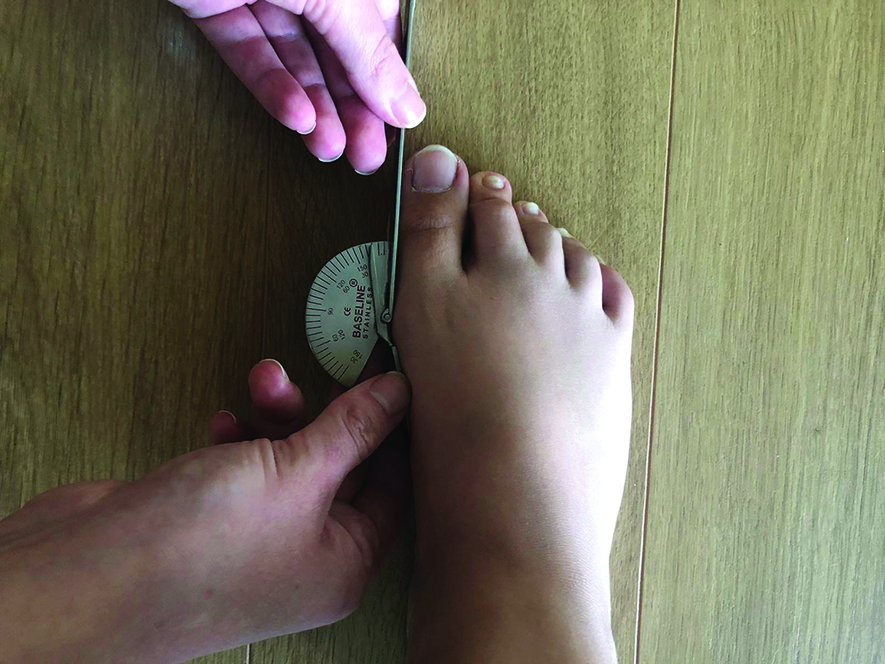
The HVA was defined as the angle between the longitudinal line of the hallux and the longitudinal axis of the first metatarsus. An angle greater than 15° was accepted as pathologic. Measurement was performed with the participant in the erect position; the fixed arm of the toe goniometer was placed on the longitudinal line of the metatarsal bone, and the other arm was placed on the hallux (Fig. 1). All of the measurements were performed by a senior physiotherapist (I.K.) [10,11]. Clinical measurement of the HVA was previously shown to be in concordance with the radiographic measurement (interclass correlation coefficient, 0.81) [1,12].
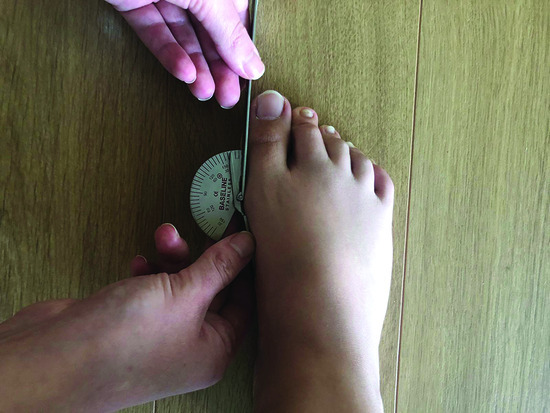
Figure 1.
Clinical measurement of the hallux valgus angle was performed with the participant in the erect position; the fixed arm of the toe goniometer was placed on the longitudinal line of the metatarsal bone, and the other arm was placed on the hallux.
The age, body weight, and height of each individual included in the study were recorded. An evaluation form was created for all of the participants, including information such as the duration, frequency, and continuity of performing ballet, as well as demographic data and test results.
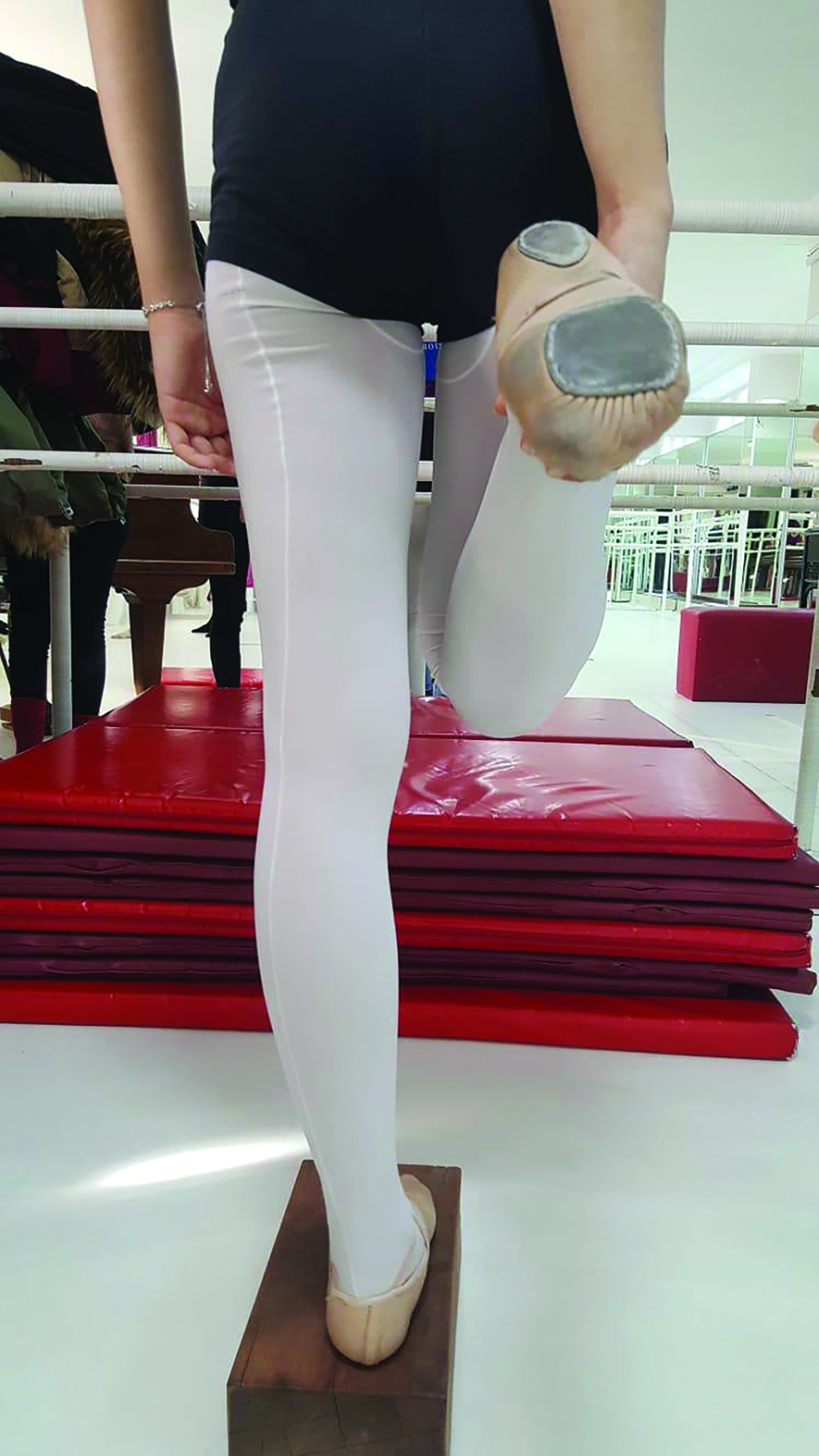
For this study, universal dynamic and static balance tests were applied to participants in both groups. In the evaluation of static balance, the flamingo static balance test, which can be easily applied to large participant groups, was used. In this test, the participant stands on his or her preferred foot, bends the free leg backwards, and grips the back of the foot with the hand on the same side, standing like a flamingo (Fig. 2). The measurement time was kept for 1 min. As the participant lost balance, the timer was stopped and restarted once balance was regained. The number of restarts was recorded [13]. The Star Excursion Balance Test (SEBT) is a screening tool commonly used to evaluate lower-extremity dynamic stability, neuromuscular control, and injury risk in athletes. It is also used to monitor rehabilitation progress after injury. The SEBT is performed by having the participant stand on one leg and extend the other leg away from the body in eight different directions [14]. The flamingo test and the SEBT do not require any set up or tools.
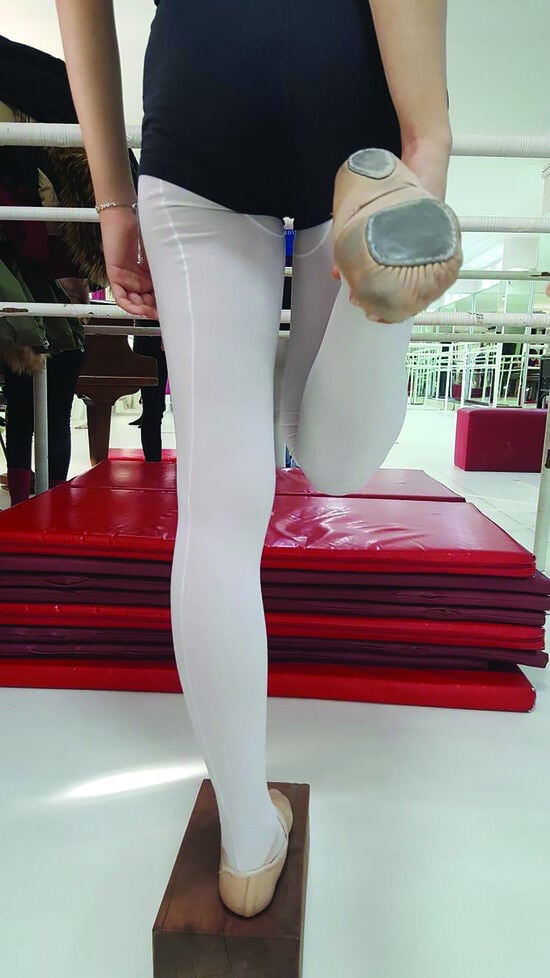
Figure 2.
In the flamingo static balance test, the participant stands on a wooden block on his or her preferred foot, bends the leg backwards, and grips the back of the foot with the hand on the same side, standing like a flamingo.
To reveal the extent to which HV affected the daily life and ballet activities of dancers, HRQOL scales were used. American Orthopaedic Foot and Ankle Society (AOFAS) forefoot scores and 36-item Short Form Health Status Survey (SF-36) tools were used to assess HRQOL [15–17].
The AOFAS scale is one of the important scales with proven validity and reliability, and it is often used to evaluate foot problems. The AOFAS scale consists of three categories (pain, function, and smoothness) and was applied to all cases. The maximum score is 100, and higher scores indicate better function [15–17].
The SF-36, which is used to evaluate HRQOL, is the most frequently used quality of life scale in the health field and consists of eight subheadings with a total of 36 items that evaluate physical and mental health. These subheadings are physical function, physical role limitation, pain, general health, vitality, social function, emotional role limitation, and mental health. Scores range from 0 to 100, with 100 points indicating the best health condition and 0 points the worst health condition. To facilitate the association of the scale with a large number of findings, the scores of the first four subheadings were combined with the physical component summary and mental component summary scores and calculated with the scores of the last four subheadings. In this way, physical and mental quality of life scores were calculated [18].
Statistical Analysis
A statistical software program (IBM SPSS Statistics for Windows, Version 26.0; IBM Corp, Armonk, New York) was used for analysis of the study findings. Nonparametric statistical methods were used because the variables were ordered or categorical and the continuous variables did not show a normal distribution. In this context, the Mann-Whitney U test was used to compare the groups with and without HV. Spearman Rho correlation was used to examine the relationships between variables (HVA, balance test results, HRQOL results). The significance level was set at P < .05 in all of the analyses.
Results
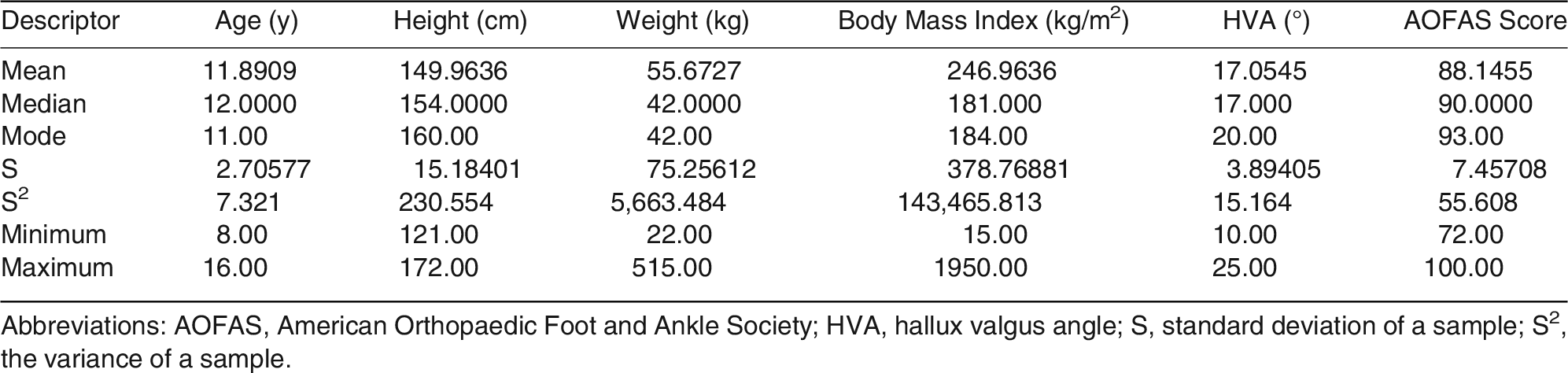
All of the participants were girls aged 8 to 16 years. Group 1 consisted of 31 participants with a mean age of 11.6 years, and group 2 consisted of 24 participants with a mean age of 12.2 years. The mean first metatarsophalangeal angle was 13.4° (range, 10°–15°) in group 2 and 19.8° (range, 16°–25°) in group 1 (P < .05). Demographic data are summarized in Table 1. There were no significant differences between the groups in terms of age, weight, height, ballet training times per week, daily ballet training times, and attendance to curriculum (P > .05).

Table 1.
Descriptive Analysis of the 55 Study Participants
The goal of this work was to explore the effect of HVA on balance parameters in adolescent ballet dancers. According to the nonparametric Mann-Whitney U test analysis, which was used to analyze the difference between groups with and without an HV diagnosis, a significant difference was found between the groups in terms of mean HVA (P < .05). The relationship between the HVA and the static balance test and HRQOL independent variables was investigated with the Spearman rho correlation test. According to Spearman rho correlation analysis there was a significant positive and intermediate relation between HVA and the flamingo static balance test (correlation coefficient r = 0.552; P = .019). The HVA and other balance tests did not show a statistically significant relationship. Further analysis showed that flamingo static balance test scores improved with older age in both groups (P = .001).
We used the SF-36 subdomains (general health, physical function, and pain) and the AOFAS forefoot score for evaluating the association of HVA and HRQOL. The mean (range) SF-36 physical function score was 92.5 (75–100) in group 1 and 91.04 (75–100) in group 2; SF-36 general health score was 78.5 (45–100) in group 1 and 77.5 2 (45–100) in group 2; pain subdomain score was 87.58 (57.5–100) in group 1 and 87.18 (57.5–100) in group 2; and AOFAS score was 86.74 (72–93) in group 1 and 89.9 (73–100) in group 2 (Fig. 3).
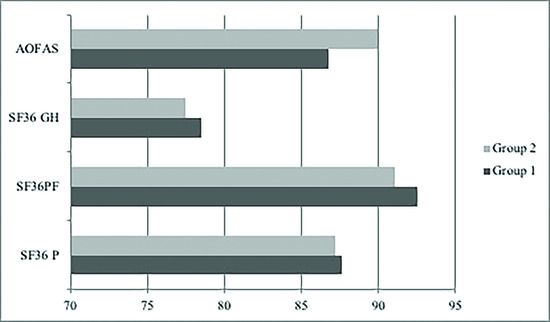
Figure 3.
Health-related quality of life and hallux valgus in adolescent ballet dancers. P > .05 for overall subdomains of the 36-item Short Form Health Status Survey (SF-36) and American Orthopaedic Foot and Ankle Society (AOFAS) forefoot scores. Group 1 had a hallux valgus angle greater than 15°, and group 2 had a hallux valgus angle of 15° or less. GH, general health; P, pain; PF, physical function.
Discussion
The aim of this study was to investigate the relationship between HVA and clinical balance tests in adolescent ballet dancers and to analyze the effects of HVA on HRQOL questionnaires. We hypothesized that as the HVA increases, it negatively affects balance parameters in static and dynamic balance tests and causes impairment in HRQOL scores in adolescent ballet dancers. The present correlation analysis found that flamingo static balance test results were negatively affected by the increase in HVA. The HRQOL questionnaire scores were not affected by increased HVA.
Studies conducted to date have revealed a negative relationship between an increase in HVA and balance, especially in elderly people and patients with rheumatoid arthritis. The negative effect of HV on balance has been found to be associated with a high risk of falls and serious complications such as head trauma [5,6]. Recently, Çınar-Medeni et al [1] reported that a mild HVA resulted in postural stability impairment in asymptomatic adults. Ballet dance is a high-level art sport that needs good musculoskeletal organization, with components of balance, high performance, and good joint compatibility. Various conditions causing altered anatomy and biomechanics affect the balance and performance of dancers, respectively [19]. According to the results of the present study, the increase in HVA leads to deterioration of static balance in adolescent ballet dancers. In ballet, where balance function must be provided very well, balance dysfunction may lead to postural sway and various injuries.
In previous reports, HVA degree has been shown to be related to impaired postural stability. Menz et al [6]. found that moderate or severe HVA affected maximum balance range and walking speed. Nix and colleagues [20]. found that moderate HVA (mean ± SD, 29.1° ± 7.8°) affected coronal plane dynamics while standing. The present study is the first to show that mild HVA (15°–25°) is related to static balance impairment in adolescent ballet dancers (Spearman rho correlation analysis with a correlation coefficient r = 0.552 and P = .019). We could not find a relationship between dynamic balance parameters and mild HVA (P > .05). Higher degrees of HVA may be related to impaired dynamic balance parameters [21].
In previous studies, HV has been shown to have a negative effect on HRQOL scales [17]. We investigated HRQOL scales in the present patient group because HV affects the future plans of ballet dancers according to treatment. Ballet dancers who have undergone surgical treatment of HV cannot return to ballet. We tried to investigate the daily lives of dancers and the effect on dance performance using HRQOL tools. In the present study, there was no significant correlation between the subheadings of the AOFAS and SF-36 scales used to determine the functional status of the participants and the HVA obtained with the clinical measurement method.
Recent studies have focused on various methods, such as three-dimensional computerized and stabilometric analysis, when investigating the relationship between balance and different ballet dance movements [22–26]. In the present study, we used the flamingo static balance test and the SEBT. The reliability of the tests was confirmed with the literature [9,13,14]. Similar to other studies, we found that balance measurements could be performed without the need for additional infrastructure and cost and that they were useful in groups with high participant numbers.
The question as to whether ballet dancers are more prone to the development of HV than the general population remains unanswered. Some dance techniques may promote the development of HV. Einarsdóttir et al [27] retrospectively compared the radiographs of 63 active and 38 retired ballet dancers of both sexes with those of nondancers and found no significant difference between the groups in terms of HVA. On the other hand, a higher prevalence of HV was found in retired ballet dancers compared with nondancers aged 50 to 70 years [23–25]. Adolescent HV is mostly a maternally transmitted condition (86%–94%) [2]. Based on the previously mentioned points (age, sex, and ballet activity), the relationship between ballet dance and HV during adolescence becomes more complicated [28,29]. The relationship between HV and sex and maternal transmission could not be evaluated in the present study because the students studying in ballet school were female and their mothers were not evaluated.
In the present study, we tried to reveal the effects of a specific disease group in a specific population, but there are numerous limitations. First, the study and control groups are small. It is difficult to find enough participants in countries where ballet education is not very popular. The second limitation in the study is that the diagnosis of HV was made clinically, not radiologically. We benefited from the method proved to be effective in the literature, without exposing the patients to radiation for a prospective screening study. Finally, the effect of the training method on the results can be eliminated and more generalized conclusions can be drawn on adolescent ballet dancers by performing studies that involve a greater number of participants from different dance schools that provide training with different curricula.
Conclusions
Hallux valgus is a condition that occurs in adolescence and is often thought to be associated with maternal transmission. It can cause adverse effects on balance during ballet dance and lead to complications during ballet movements. Conservative treatment methods should be preferred because it will not be possible to perform active ballet after surgical treatment. This work shows the first evidence that the degree of HV affects static balance in adolescent ballet dancers. According to these results, ballet dancers and their trainers should be careful regarding injuries that may be caused by the negative effect of HV on static balance in ballet dancers.
Funding
None reported.
Acknowledgments
The teachers and professional ballet candidates for their voluntary participation and completion of the tests in a very short time for this work.
Conflicts of Interest
None reported.
References
- Çınar-Medeni Ö, Atalay Guzel N, Basar S: Mild hallux valgus angle affects single-limb postural stability in asymptomatic subjects. J Back Musculoskelet Rehabil 29: 117, 2016.
- Piggott H: The natural history of hallux valgus in adolescence and early adult life. J Bone Joint Surg Br 42: 749, 1960.
- Hardy RH, Clapham JCR: Observations on hallux valgus. J Bone Joint Surg Br 33: 376, 1951.
- Chell J, Dhar S: Pediatric hallux valgus. Foot Ankle Clin 19: 235, 2014.
- Rome K, Dixon J, Gray M, et al: Evaluation of static and dynamic postural stability in established rheumatoid arthritis: exploratory study. Clin Biomech (Bristol, Avon) 24: 524, 2009.
- Menz HB, Morris ME, Lord SR: Foot and ankle characteristics associated with impaired balance and functional ability in older people. J Gerontol A Biol Sci Med Sci 60: 1546, 2005.
- Sadra S, Fleischer A, Klein E, et al: Hallux valgus surgery may produce early improvements in balance control: results of a cross-sectional pilot study. JAPMA 103: 489, 2013.
- da Silveira Costa MS, de Sá Ferreira A, Felicio LR: Static and dynamic balance in ballet dancers: a literature review. Fisioter Pesqui 20: 299, 2013.
- Clarke F, Koutedakis Y, Wilson M, et al: Associations between balance ability and dance performance using field balance tests. Med Probl Perform Art 34: 154, 2019.
- Lamur KS, Huson A, Snijders CJ, et al: Geometric data of hallux valgus feet. Foot Ankle Int 17: 548, 1996.
- Bayar B, Erel S, Simsek IE, et al: The effects of taping and foot exercises on patients with hallux valgus: a preliminary study. Turk J Med Sci 41: 403, 2011.
- Janssen DM, Sanders AP, Guldemond NA, et al: A comparison of hallux valgus angles assessed with computerised plantar pressure measurements, clinical examination and radiography in patients with diabetes. J Foot Ankle Res 7: 33, 2014.
- Tsigilis N, Douda H, Tokmakidis SP: Test-retest reliability of the Eurofit test battery administered to university students. Percept Mot Skills 95(3)(suppl): 1295, 2002.
- Plisky PJ, Rauh MJ, Kaminski TW, et al: Star Excursion Balance Test as a predictor of lower extremity injury in high school basketball players. J Orthop Sports Phys Ther 36: 911, 2006.
- Kitaoka HB, Alexander IJ, Adelaar RS, et al: Clinical rating systems for the ankle-hindfoot, midfoot, hallux, and lesser toes. Foot Ankle Int 15: 349, 1994.
- Baumhauer JF, Nawoczenski DA, DiGiovanni BF, et al: Reliability and validity of the American Orthopaedic Foot and Ankle Society Clinical Rating Scale: a pilot study for the hallux and lesser toes. Foot Ankle Int 27: 1014, 2006.
- Menz HB, Roddy E, Thomas E, et al: Impact of hallux valgus severity on general and foot-specific health-related quality of life. Arthritis Care Res (Hoboken) 63: 396, 2011.
- Brazier JE, Harper R, Jones NMB, et al: Validating the SF-36 Health survey questionnaire: new outcome measure for primary care. BMJ 305: 160, 1992.
- Wolowiec BS, Sztandera P, Kotela I, et al: Feet deformities and their close association with postural stability deficits in children aged 10-15 years. BMC Musculoskelet Disord 20: 537, 2019.
- Nix SE, Vicenzino BT, Smith MD: Foot pain and functional limitation in healthy adults with hallux valgus: a cross sectional study. BMC Musculoskelet Disord 13: 197, 2012.
- Kim JA, Lim OB, Yi CH: Difference in static and dynamic stability between flexible flatfeet and neutral feet. Gait Posture 41: 546, 2015.
- Seki H, Miura A, Sato A, et al: Correlation between degree of hallux valgus and kinematics in classical ballet: a pilot study. PLoS One 15: e0231015, 2020.
- Hopper LS, Sato N, Weidemann AL: Single-leg squats can predict leg alignment in dancers performing ballet movements in “turnout.” Open Access J Sports Med 7: 161, 2016.
- Imura A, Iino Y, Kojima T: Kinematic and kinetic analysis of the fouette turn in classical ballet. J Appl Biomech 26: 484, 2010.
- Carter SL, Bryant AR, Hopper LS: An analysis of the foot in turnout using a dance specific 3D multi-segment foot model. J Foot Ankle Res 12: 10, 2019.
- Carter SL, Duncan R, Weidemann AL, et al: Lower leg and foot contributions to turnout in female pre-professional dancers: a 3D kinematic analysis. J Sports Sci 36: 2217, 2018.
- Einarsdóttir H, Troell S, Wykman A: Hallux valgus in ballet dancers: a myth? Foot Ankle Int 16: 92, 1995.
- Davenport KL, Simmel L, Kadel N: Hallux valgus in dancers: a closer look at dance technique and its impact on dancers’ feet. J Dance Med Sci 18: 86, 2014.
- van Dijk CN, Lim LS, Poortman A, et al: Degenerative joint disease in female ballet dancers. Am J Sports Med 23: 295, 1995.
© 2022 American Podiatric Medical Association