


Abstract
Background: This study was performed to determine the factors that influence the clinical outcomes of surgically treated ankle fractures associated with the posterior malleolus (PM). Methods: We evaluated 42 fractures of 42 patients. Posterior malleolus fracture size was calculated using computed tomography. Posterior malleolar fractures with a size less than 10% were left nonfixated. The decision for larger fragments was performed using fluoroscopy following the fixation of other components. If the joint was found to be congruent, the PM was left nonfixated. Otherwise, the PM was reduced and fixated. Clinical outcomes were evaluated based on Weber, Freiburg, and American Orthopaedic Foot and Ankle Society scores. Ankle osteoarthritis was determined according to the Canadian Orthopaedic Foot and Ankle Society classification. The effect of PM fixation, age, PM fragment size, waiting period before surgery, presence of ankle dislocation, and number of injured malleoli on clinical outcomes were assessed. Statistical significance was set at a value of P < .05. Results: The mean patients age was 48.5 ± 14.9 years (range, 20–84 years) and the mean follow-up was 23.7 ± 8.6 months (range, 12–56 months). Fixation of the PM was performed solely in 12 patients. Postoperative displacement of the PM and articular step were less than 2 mm in all fractures. Statistically significant worse outcomes were demonstrated based on functional scores in the patients with a PM size greater than or equal to 25% (P = .042, P = .038, and P = .048, respectively) and in patients aged 60 years or older (P = .005, P = .007, and P = .018, respectively). However, there was no significant difference between functional scores and the other factors. Ankle osteoarthritis was observed at a higher rate in patients with PM size greater than or equal to 25% and in patients aged 60 years or older. Conclusions: Clinical outcomes of the patients are mainly influenced by the patient’s age and PM fragment size. However, if the tibiotalar joint is congruent, comparable results can be obtained in PM fixated or nonfixated patients.
Adult ankle fractures (annual incidence, 122 per 100,000 persons) have been stated to be an increasing health problem [1]. Isolated fracture of the posterior malleolus (PM) is rare [2]. However, concomitant fracture of the PM was reported in more than 40% with ankle fractures [3]. Ankle fractures including the PM were demonstrated to have less satisfactory outcomes when compared the fractures without the PM [3,4]. Moreover, larger PM fragments were associated with decreased tibiotalar contact area and posttraumatic osteoarthritis (OA) [3-6].
Although there is a consensus regarding the management of lateral and medial malleolar components of ankle fractures, the management of the PM remains controversial [7,8]. Most surgeons make the fixation decision by considering the percentage of distal tibial articular surface involvement of the fracture on the lateral ankle radiograph [3,9-11]. However, it is often not possible to identify the magnitude of the PM fracture using standard plain radiography, depending on the different fracture pattern in the axial plane. The accuracy of radiologic measurement of the PM fragment size improved by using computed tomography (CT) [12]. Generally, the postulated cutoff value is considered 25% of the distal tibial articular surface, and it was suggested that fragments larger than 25% should be fixated [3,10,11,13,14]. This paradigm has not been proved yet. When proper joint congruency exists, good function can be obtained, even with nonfixated PM fragments [9,13].
The factors related to postoperative clinical outcomes after ankle fractures with PM fracture have been widely assessed previously. The studies mostly focused on the PM fragment size and whether it was fixated or not [3,4,10,11,13]. The other factors—age, sex, obesity, presence of fracture dislocation, and joint congruency—were also investigated in the literature [9-11,13-15].
In this study, a retrospective analysis of surgically treated ankle fractures associated with the PM were performed based on clinical and radiologic results. The hypothesis of the study was that a PM fragment that involves more than 25% of the distal tibial articular surface adversely affects the functional scores. In addition, we aimed to determine the influence of other factors on clinical outcomes, such as age, presence of ankle dislocation, number of injured malleoli, internal fixation of the PM, and waiting period before surgery.
Methods
Patients and Evaluation
After approval by the hospital’s ethics committee, a retrospective review of patients with adult ankle fracture including the PM fragment who underwent surgery in the orthopedic clinic between January of 2011 and May of 2014 was conducted. Patients older than 18 years and with a preoperative CT evaluation available to measure the size of the PM fragment and with at least 12 months’ follow-up were included in this study. Patients with previous ankle deformity or bone injury and a neurologic sequela of the affected lower extremity were excluded from the study.
Forty-nine patients were reviewed and, of them, two patients who had had previous ankle fracture (both isolated lateral malleolus) were excluded from the study. There was no patient with previous ankle deformity or a neurologic sequela of the affected lower extremity. Forty-two (30 right ankles and 12 left ankles) of the remaining 47 patients who continued their follow-up examination regularly were included in the study.
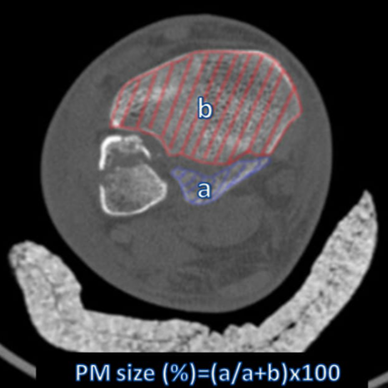
Preoperative anteroposterior and lateral plain radiographs were used to analyze the fracture patterns and classify the fractures with regard to Danis-Weber and Lauge-Hansen classifications (Table 1). Pathoanatomical classification of the PM fracture was performed as described by Haraguchi et al. [16] PM fragment size was measured on the preoperative CT scans regarding the ratio of PM fragment area to whole distal tibial articular surface area on the first axial CT scan where the talar dome totally disappears from caudal to cranial (Fig. 1). The plain radiographs and CT scans were also obtained for each patient after surgery and at their most recent follow-up visit to evaluate the residual step in articular surface and OA progression.
Table 1.
Distribution of Patients According to the Different Fracture Classification Systems
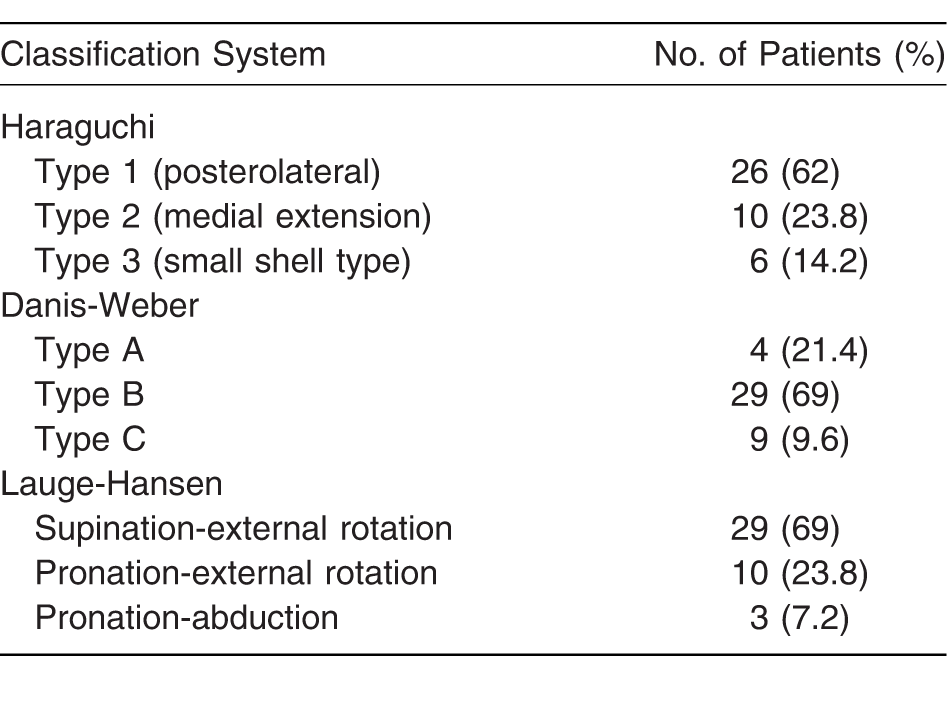
Figure 1.
Calculating the percentage of articular involvement of the posterior malleolus fragment. The first axial computed tomographic scan where the talar dome totally disappears from caudal to cranial was used for the measurements. Posterior malleolus size (%) = (a/a + b) × 100 (a = blue stripes [area of the posterior malleolus fragment]; b = red stripes [area of the remaining distal tibial articular surface]).
The stage of the ankle OA was measured according to the Canadian Orthopaedic Foot and Ankle Society classification system. Weber ankle score, Freiburg ankle scoring system, and American Orthopaedic Foot and Ankle Society (AOFAS) ankle hindfoot scale scores were used to evaluate the functional scores of the patients.
The Weber ankle score consists of the evaluation of pain, gait pattern, activity restriction, range of motion of the tibiotalar joint, subtalar joint function, and radiographic arthritis. Patients were scored between 0 and 4 for each parameter. The results are classified into three categories based on the total score as excellent (0 points), good (1 or 2 points), or poor (≥3 points).
The Freiburg ankle scoring system includes the evaluation of pain (30 points), function (10 points), instability (10 points), gait capability (10 points), degree of dorsiflexion and plantar flexion (10 points for each), strength (10 points), and difference of circumferences between injured and healthy extremities (10 points). According to the total scores, the results were classified as good (78–100 points), moderate (51–77 points), and poor (≤50 points).
The AOFAS hindfoot scale evaluates pain (40 points), function (50 points), and ankle alignment (10 points). The results were considered good if the total score was greater than or equal to 70, and the results were considered poor if the total score was less than 70. All measurements and questionnaires were performed by the same orthopedic surgeon (M.K.). The effect of patient age, PM fracture size, duration of hospitalization before surgical intervention, fracture pattern based on including malleolar components, and fixation of PM fracture on functional scores were investigated.
Surgical Technique
All patients underwent surgery after at least a 6-hour waiting period for anesthesia. Operations were performed in the supine position by three different orthopedic surgeons. The operation table was tilted contralaterally for posterolateral access of the ankle joint if direct fixation of the PM was intended by means of a posterolateral approach. One gram of a first-generation cephalosporin was used for antibiotic prophylaxis and continued 24 hours after surgery. A tourniquet was used in all cases during the surgery. The sterilization of the surgical area was obtained by using 10% povidone-iodine solution.
Open reduction and internal fixation were applied to a medial and lateral malleolus in all cases. After fixation of the malleolar fragments, the syndesmosis injury was controlled by a hook or external rotation stress test under fluoroscopy. In cases with unstable syndesmosis, the syndesmosis was reduced by an external clamp and fixated by one free tricortical screw or by a screw performed through the plate.
When the PM fragment size was less than 10% and the congruity of the tibiotalar joint was acceptable based on CT evaluation, fixation was not planned. For the larger (≥10%) PM fragments, the decision was made using fluoroscopy following the fixation of the other fracture components. If the joint congruency was found to be acceptable on fluoroscopy, fixation of the PM was not performed even in larger PM fragments. The acceptable criteria for joint congruency were determined as less than 2-mm anteroposterior displacement on sagittal plane and less than 2-mm step on the articular surface. In the event that acceptable joint congruency could not be obtained in larger fragments, the PM was fixated either directly by means of the posterolateral approach after open reduction or indirectly by means of an anterior mini incision by using cannulated or compression screws after closed reduction.
Postoperative Care
Following surgery, all fractures were stabilized with a short leg ankle splint. The patients were mobilized the day after surgery. All the patients received low-molecular-weight heparin, and full-length antiembolic stockings were applied to the contralateral limb for deep venous thromboembolism prophylaxis. Wound care was performed every other day. The splints were removed and the surgical sutures were removed on day 14. All patients underwent standardized rehabilitation programs after splint removal. Range-of-motion exercises were focused on after splint removal. Clinical and radiologic assessments were performed regularly. Partial weightbearing was carried out after 4 to 5 weeks and full weightbearing was carried out after 8 to 10 weeks following complete healing of the fracture. The syndesmotic screws were removed, if any, at 2 months postoperatively.
Statistical Analysis
Statistical analysis was performed using IBM SPSS Version 20.0 (IBM Corp, Armonk, New York). The Mann-Whitney U test was used to compare differences between nonnormal distributions. Different categorical data were compared using the χ2 test. Statistical significance was set at a value of P < .05.
Results
Twenty-five of the patients (59.5%) were female and 17 (40.5%) were male. The mean age was 48.5 ± 14.9 years (range, 20–84 years). The mean follow-up was 23.7 ± 8.6 months (range, 12–56 months). All of the patients were consulted by an orthopedic surgeon in the first 24 hours after their ankle injuries. All fractures were closed. The fracture etiology was direct trauma in eight patients and indirect trauma (ankle distortion) in 34 patients.
The mean duration of hospitalization before surgery was 5.4 days (range, 1–20 days). The most common reason for a waiting period was concomitant patient comorbidities and superficial lacerations on the fracture region. The patient with a 20-day waiting period was operated on by neurosurgery for cranial trauma before orthopedic intervention.
Based on the Weber score, the mean duration of hospitalization before surgery on the patients with excellent results was 4.6 days, with good results at 6.1 days and poor results at 6 days. Based on the Freiburg ankle scoring system, the mean duration of hospitalization before surgery of the patients with good results was 5.3 days; for those with moderate results, the mean duration was 4.2 days. There were no patients with a poor result. Based on the AOFAS hindfoot score, the mean duration of hospitalization before surgery was 4.1 days for the patients with good results and 5.2 days for those with poor results. The differences were not statistically significant based on duration of hospitalization before surgery in terms of each functional score (P = .801, P = .310, and P = .230, respectively).
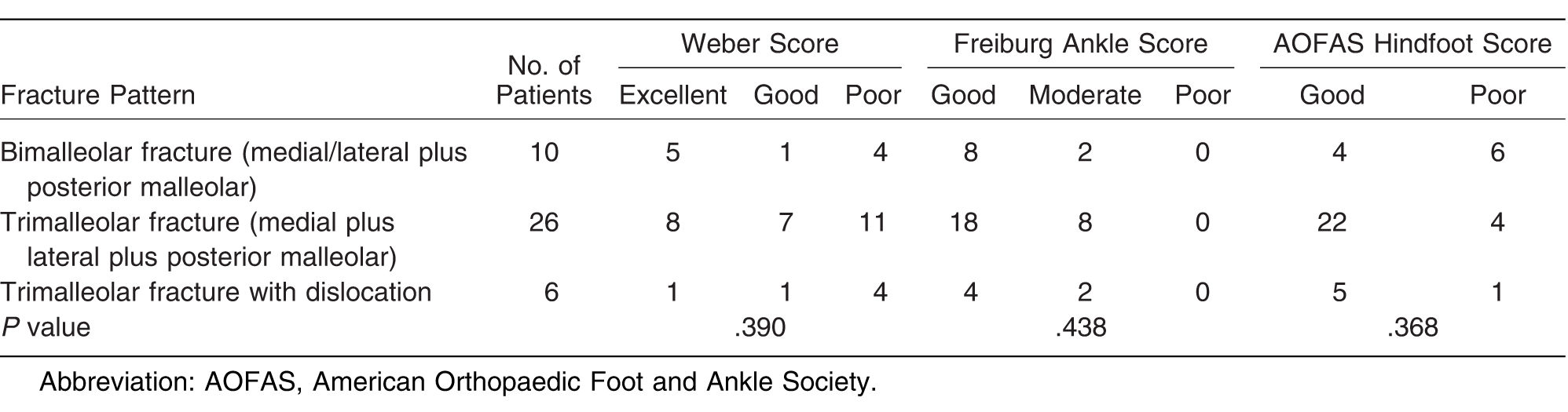
Based on ankle fracture pattern, 10 fractures (23.8%) were bimalleolar (medial or lateral malleolus fracture associated with PM fracture), 26 fractures (61.9%) were trimalleolar, and six fractures (14.3%) were trimalleolar fracture with ankle dislocation. There were no statistically significant differences between the fracture patterns in term of functional scores (Table 2).
Table 2.
Distribution of the Functional Scores of the Patients Based on the Fracture Patterns
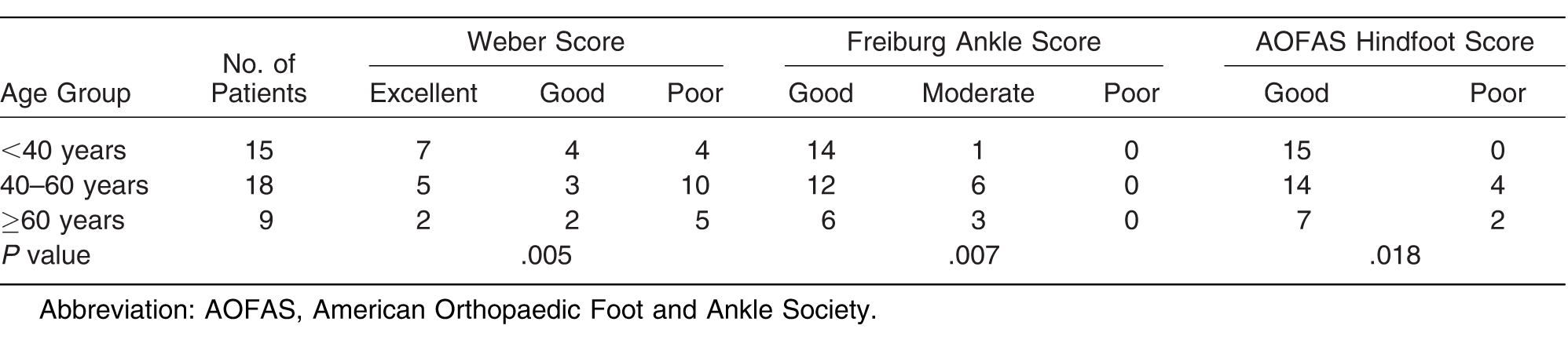
The patients were divided into three groups based on their age. Fifteen patients were younger than 40 years, 18 patients were aged between 40 and 60 years, and nine patients were aged 60 years or older. The patients aged 60 years or older demonstrated statistically significant worse outcomes in terms of Weber ankle score, Freiburg ankle scoring system, and AOFAS hindfoot scale score when compared to the younger patients (Table 3).
Table 3.
Distribution of the Functional Scores Based on the Patient’s Age
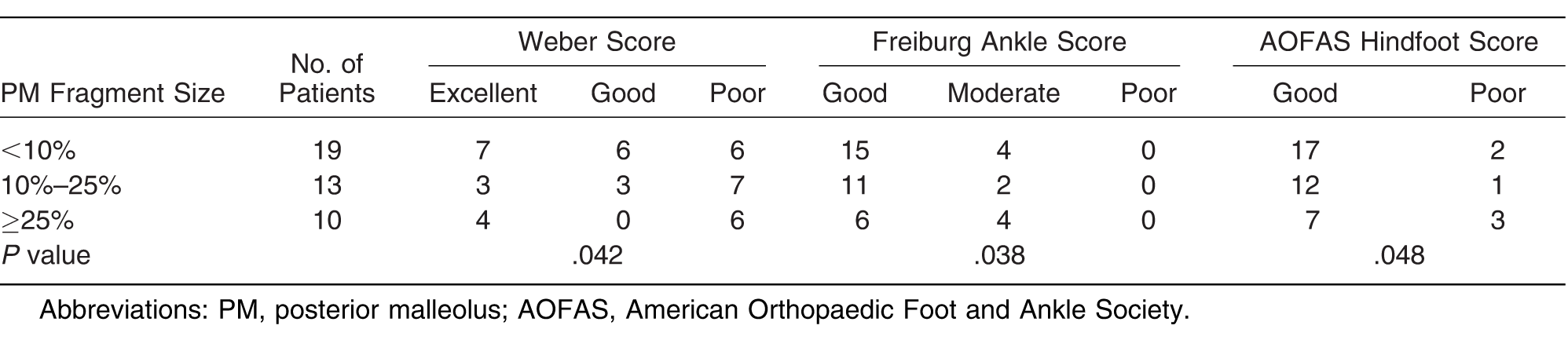
The patients were divided into three groups based on PM size as less than 10%, 10 to 25%, and greater than or equal to 25% regarding the distal tibial articular surface involvement. All the functional scores were significantly impaired in patients with a PM size greater than or equal to 25% (Table 4).
Table 4.
Distribution of the Functional Scores of the Patients Based on PM Fragment Size
The fixation of the PM fragment was performed in 12 of 42 patients. In four of them, PM size was between 10% and 25%; and in eight of them, it was greater than or equal to 25%. Anteroposterior indirect fixation was performed by means of the anterior approach totally in eight cases independent of the PM size. For the remaining fractures, open reduction and direct fixation by means of the posterolateral approach was performed. Indirect reduction and fixation was performed in all cases in which the PM size was between 10% and 25%. The articular stepoff and displacement of the PM fragment on postoperative and final follow-up CT evaluations were measured less than 2 mm in all cases whether the PM was fixated or not.
All the fractures with the PM fragment less than 10% (n = 19) and 11 of the 23 fractures with PM size greater than or equal to 10% in which acceptable joint congruency was obtained were not fixated. The differences in Weber, Freiburg ankle scoring system, and AOFAS hindfoot scores were not significant between the nonfixated fractures with a PM size less than 10% and greater than or equal to 10% (P = .70, P = .66, and P = .40, respectively). The differences between fixated (n = 12) and nonfixated PM fractures (n = 30) based on functional scores were also found to be insignificant independent of the PM size (Table 5).
Table 5.
Distribution of the Functional Scores of the Patients in PM Fixated or Nonfixated Fractures

According to the Canadian Orthopaedic Foot and Ankle Society classification system, posttraumatic OA was observed in three of 19 patients (16%) in which the PM size was less than 10% (type 1, all patients), seven of 13 patients (54%) in which the PM size was between 10% and 25% (type 1, four patients; type 2, three patients), and six of 10 patients (60%) in which the PM size greater than or equal to 25% (type 1, three patients; type 2, two patients; type 3, one patient). Based on the patient’s age, OA was observed in four patients younger than 40 years (27%), in five patients aged between 40 and 60 years (28%), and in four patients aged 60 years or older (44%).
Major complications were observed in three patients. Deep infection occurred in one patient. The hardware was totally removed and debridement was performed at week 4 after the initial surgery. Complete healing of this fracture was obtained at the last follow-up visit. The other major complication was tibiotalar synostosis observed in two patients that did not require further surgery.
Discussion
The overall results of the current study demonstrated that the PM size and the patient’s age were the most indicative factors on clinical outcomes after surgically treated ankle fractures associated with PM fragment. The functional scores did not correlate with the number of affected malleoli, ankle dislocation, duration of hospitalization before surgery, or fixation of the PM fragment.
Our findings are in concordance with several published data. Mingo-Robinet et al. [10] retrospectively reviewed 45 trimalleolar ankle fractures at a minimum 2-year follow-up and found less satisfactory results when the fragment size was greater than 25% of the articular surface. However, the functional scores were evaluated only by means of AOFAS and Olerud-Molander scores, and the results were not significantly different with regard to the latter. Broos and Bisschop [17] and Jaskulka et al [3] reported significantly worse outcomes with larger PM fragments more than one-third and 5% involvement of articular surface, respectively.
In contrast to our results, De Vries et al. [11] did not find a correlation between the PM fragment size and postoperative clinical outcomes based on Ankle Fracture Scoring System and OA scores. Their treatment regimen was based on fixating the PM fragments larger than 25% and ignoring the smaller fragments in the majority of their population. In our study, a total of 12 PM fragments in which PM size greater than or equal to 10% were fixated, whereas 30 of 42 fractures were left nonfixated, including all the fractures with PM size less than 10% (n = 19). Posterior malleolus size was greater than or equal to 25% in four of 12 fixated fractures. However, large (≥25%) fragment size showed significantly worse outcomes in our study regardless of internal fixation. Moreover, although there were no fixated fractures with a PM size less than 10% to make the comparison between fixated and nonfixated fractures in that size, comparable functional results in nonfixated fractures with PM size less than 10% and greater than or equal to 10% may suggest leaving the fractures with a PM size less than 10% nonfixated.
In addition, De Vries et al. [11] found significantly worse outcomes in dislocated fractures. However, there were comparable results with dislocated and nondislocated fractures in our study.
Langenhuijsen et al. [9] focused on the size of the PM and joint congruency after treatment of ankle fractures involving the posterior tibial margin. Fractures were divided into three groups based on their size (<10%, 10%–25%, and ≥25%) to evaluate the clinical outcomes according to Weber ankle and visual analog scale scores. A joint with the existence of greater than or equal to 1-mm displacement was considered an incongruent joint. Congruent joints demonstrated significantly better results when compared to incongruent joints with PM fragment size greater than or equal to 10%. In contrast to us, the outcomes were not affected by PM fragment size. According to our results, outcomes were not affected whether the PM was fixated or not.
Several following studies also pointed to the joint congruency and fragment size. Drijfhout van Hooff et al. [14] stated that greater than or equal to 1-mm residual articular step on the tibiotalar joint surface in the PM fragments with more than 5% size led to significant OA, particularly in medium size (5%–25%) fragments. However, they were unable to demonstrate significantly worse clinical outcomes when a greater than or equal to 1-mm residual step occurred in medium (5%–25%) and large (>25%) fragments. Moreover, differences of clinical outcomes between the groups were not significant.
In the current study, all PM fragments were displaced less than 2 mm on postoperative radiologic evaluations. Whereas 16% of the patients demonstrated OA in which PM size was less than 10%, OA was demonstrated in 60% of the patients in which PM size was greater than or equal to 25%. Although 44% of the patients who were aged 60 years or older demonstrated ankle OA, this rate decreased to 27% in patients younger than 40 years and to 28% in patients who were aged between 40 and 60 years. According to these results, it was demonstrated that higher OA rates were observed in patients aged 60 years or older and in patients with PM size greater than or equal to 25%, even if the joint was congruent.
The other factor that affects the clinical outcome was the patient’s age in the current study. According to our results, all the functional scores were significantly impaired in patients aged 60 years or older. Surprisingly, Xu et al. [13] reported comparable outcomes based on AOFAS and visual analog scale scores in young (<60 years old) and elderly patients (≥60 years old); even significantly increased OA occurred in the elderly group. In addition, they did not find a correlation between outcomes and PM fracture size, even significantly increased OA developed in large (≥25%) PM fragments. In their study, similar to our results, fixation of the PM did not significantly improve the functional scores. They also noticed that the evenness of the tibial articular surface was associated with improved outcome scores and decreased OA.
All these aforementioned studies were constructed on measuring the PM size based on lateral plain radiographs. Because the indication for surgical fixation is mostly based on the PM size, correct measurement is crucial. Ferries et al. [12] stated that plain radiographs were unreliable for assessing the PM fragment size and errors could occur, particularly in larger fragments. Haraguchi et al. [16] noticed the difficulty of assessing the PM fragment size from plain radiographs with the presence of an irregular fragment line and suggested using CT scans to calculate the articular surface involvement of the PM fragment.
Therefore, we used preoperative CT scans to measure the PM size regarding the distal tibial articular surface involvement to obtain more accurate evaluation. Evers et al. [4] also used CT scans to analyze the functional outcomes of 42 trimalleolar ankle fractures. However, 24 of the fractures had only CT scans, and the remaining measurements were performed based on lateral plain radiographs. The existence of an articular step and greater than 2-mm displacement were considered to constitute an incongruent joint in their study. Although the number of the sample size and treatment regimen based on fracture displacement were similar, contradictory to us, the AOFAS scores did not demonstrate significant differences in the PM size greater than or equal to 25% fragments. The lack of homogeneity of their study in measuring PM size could be the reason for these contrary findings.
The current study has several limitations. First, it is retrospective; second, the sample size is relatively small. However, Evers et al. [4], Langenhuijsen et al. [9], Mingo-Robinet et al. [10], and De Vries et al. [11] also had small sample sizes in their studies (n = 42, n = 57, n = 45, and n = 45, respectively). Third, because all the measurements were performed by the same orthopedic surgeon, interobserver reliability could not be evaluated. Fourth, the cartilage defects, if any at the initial injury, of the tibiotalar articular surface were not considered. The impact of cartilage defects on functional scores and tibiotalar OA was not taken into account in the evaluation.
Performing the measurements (particularly the PM fracture size) on CT scans and using three different functional scoring scales that reflect the radiologic and functional prognosis are the most powerful aspects of this study. To our knowledge, the current study is the only study that both used the three different ankle scores for evaluation and measured the PM based on CT scans with similar statistical results of functional scores for each variable.
Conclusions
In conclusion, clinical outcomes of the patients with surgically treated ankle fractures associated with PM are mainly influenced by the patient’s age and PM fragment size. Estimated outcomes may be worsened in older patients (≥60 years old) and in patients with larger fragments (PM size ≥25%), presumably because of ankle OA. However, if the tibiotalar joint is congruent, comparable results can be obtained in PM fixated or nonfixated patients.
Financial Disclosure
None reported.
Conflicts of Interest
None reported.
References
- Court-BrownCMMcBirnieJWilsonGAdult ankle fractures—an increasing problem?Acta Orthop Scand69: 43, 1988.
- ProbstENMaasRMeenenNMIsolated fracture of the posterolateral tibial lip (Volkmann’s triangle). Acta Radiol38: 359, 1997.
- JaskulkaRAIttnerGSchedlRFractures of the posterior tibial margin: their role in the prognosis of malleolar fractures. J Trauma29: 1565, 1989.
- EversJBarzLWähnertD: Size matters: the influence of the posterior fragment on patient outcomes in trimalleolar ankle fractures. Injury46(suppl 4): 109, 2015.
- HartfordJMGorczycaJTMcNamaraJL: Tibiotalar contact area. Contribution of posterior malleolus and deltoid ligament. Clin Orthop Relat Res320: 182, 1995.
- MackoVWMatthewsLSZwirkoskiP: The joint-contact area of the ankle. The contribution of the posterior malleolus. J Bone Joint Surg Am73: 347, 1991.
- VeltmanESHalmaJJde GastALongterm outcome of 886 posterior malleolar fractures: a systematic review of the literature. Foot Ankle Surg22: 73, 2016.
- OdakSAhluwaliaRUnnikrishnanP: Management of posterior malleolar fractures: a systematic review. J Foot Ankle Surg55: 140, 2016.
- LangenhuijsenJFHeetveldMJUlteeJM: Results of ankle fractures with involvement of the posterior tibial margin. J Trauma Acute Care Surg53: 55, 2002.
- Mingo-RobinetJLópez-DuránLGaleoteJE: Ankle fractures with posterior malleolar fragment: management and results. J Foot Ankle Surg50: 141, 2011.
- De VriesJSWijgmanAJSiereveltIN: Long-term results of ankle fractures with a posterior malleolar fragment. J Foot Ankle Surg44: 211, 2005.
- FerriesJSDeCosterTAFiroozbakhshKK: Plain radiographic interpretation in trimalleolar ankle fractures poorly assesses posterior fragment size. J Orthop Trauma8: 328, 1994.
- XuHLLiXZhangDY: A retrospective study of posterior malleolus fractures. Int Orthop36: 1929, 2012.
- Drijfhout van HooffCCVerhageSMHoogendoornJMInfluence of fragment size and postoperative joint congruency on long-term outcome of posterior malleolar fractures. Foot Ankle Int36: 673, 2015.
- StillGPAtwoodTCOperative outcome of 41 ankle fractures: a retrospective analysis. J Foot Ankle Surg48: 330, 2009.
- HaraguchiNHaruyamaHTogaH: Pathoanatomy of posterior malleolar fractures of the ankle. J Bone Joint Surg Am88: 1085, 2006.
- BroosPLOBisschopAPGOperative treatment of ankle fractures in adults: correlation between types of fracture and final results. Injury22: 403, 1991.
© 2021 American Podiatric Medical Association