


Abstract
Background: A recent increase in podiatric medicine fellowships has occurred as the
field continues to progress. Research regarding selection criteria from a fellowship
director’s perspective for potential fellows is lacking. This study aimed to examine
objective and subjective selection criteria that directors consider when selecting
applicants for the interview and when ranking prospective fellows after the interview. Methods: We electronically surveyed American College of Foot and Ankle Surgeons
fellowship directors with preselected criteria for granting applicants an interview and for
compiling their ranking list after the interview. A Likert scale from 1 (most important) to 5
(least important) was used to prioritize each criterion, an average rating was calculated,
and the results were placed in order of importance. Results: The most important selection criteria for granting an interview were quality of
residency program (1.985), a written personal statement of reasons for attending that
fellowship (2.063), and publications/presentations produced as a resident (2.267). The
most important criteria in completing the ranking order after the interview were
assessment of applicant’s personality (1.111), interview performance (1.173), and
expressed interest in program (1.563). Conclusions: Knowledge of the selection criteria that fellowship directors seek in
applicants can assist those who desire to further their training. The selection criteria that
program directors seek differed between being selected for the interview, which
combined both objective and subjective criteria, and when compiling their rankings
after the interview, which included only subjective criteria. Results show more emphasis
on subjective selection criteria when directors select applicants for an interview and
when ranking applicants after the interview.
As the field of podiatric medicine continues to progress within the medical community, an increase in podiatric medicine fellowships has occurred during the past 8 years. The American College of Foot and Ankle Surgeons (ACFAS) [1] funded their first approved fellowship in 2010. Potential fellowship programs must meet certain major and minor criteria to be “recognized” as an approved fellowship per ACFAS guidelines. Fellowship directors can choose to be recognized as either a foot and ankle surgery and reconstruction fellowship or as a research fellowship. Each fellowship must undergo at least a 1-year “conditional” status to determine whether the fellowship meets the ACFAS criteria. At the time that this study was conducted, there were 31 ACFAS-recognized fellowships, one research fellowship, and 11 conditional fellowships. Ninety percent of all recognized fellowships were started after 2012.
In other medical specialties, fellowships have become the norm, allowing these individuals to specialize in a specific field of interest [2]. Podiatric medicine can be summarized as a specific field of training (ie, foot and ankle), but numerous subspecialty fields exist within the field of podiatric medicine (eg, pediatrics, trauma, research, limb salvage). For individuals who desire additional training, a fellowship can offer opportunities to enhance their area of interest. One can speculate that as the desire to become fellowship trained increases, the selection process for the fellowship director is becoming more stringent.
To date, research and information regarding the selection criteria from a podiatric fellowship director's perspective for the potential fellowship applicant is lacking. The aim of this study was to examine specific selection criteria that fellowship directors consider when selecting applicants for the interview and for determining their appointed fellow.
Materials and Methods
After the study received institutional review board approval, a comprehensive list of current fellowship programs in the United States was compiled using fellowship directories located on the ACFAS Web site. A list of fellowship directors and their corresponding e-mail addresses was created from their fellowship program Web sites. A total of 43 ACFAS fellowships were identified, and the e-mail addresses for 43 fellowship directors were obtained. The ACFAS fellowships were chosen because they compose the largest subset of the current available fellowship programs.
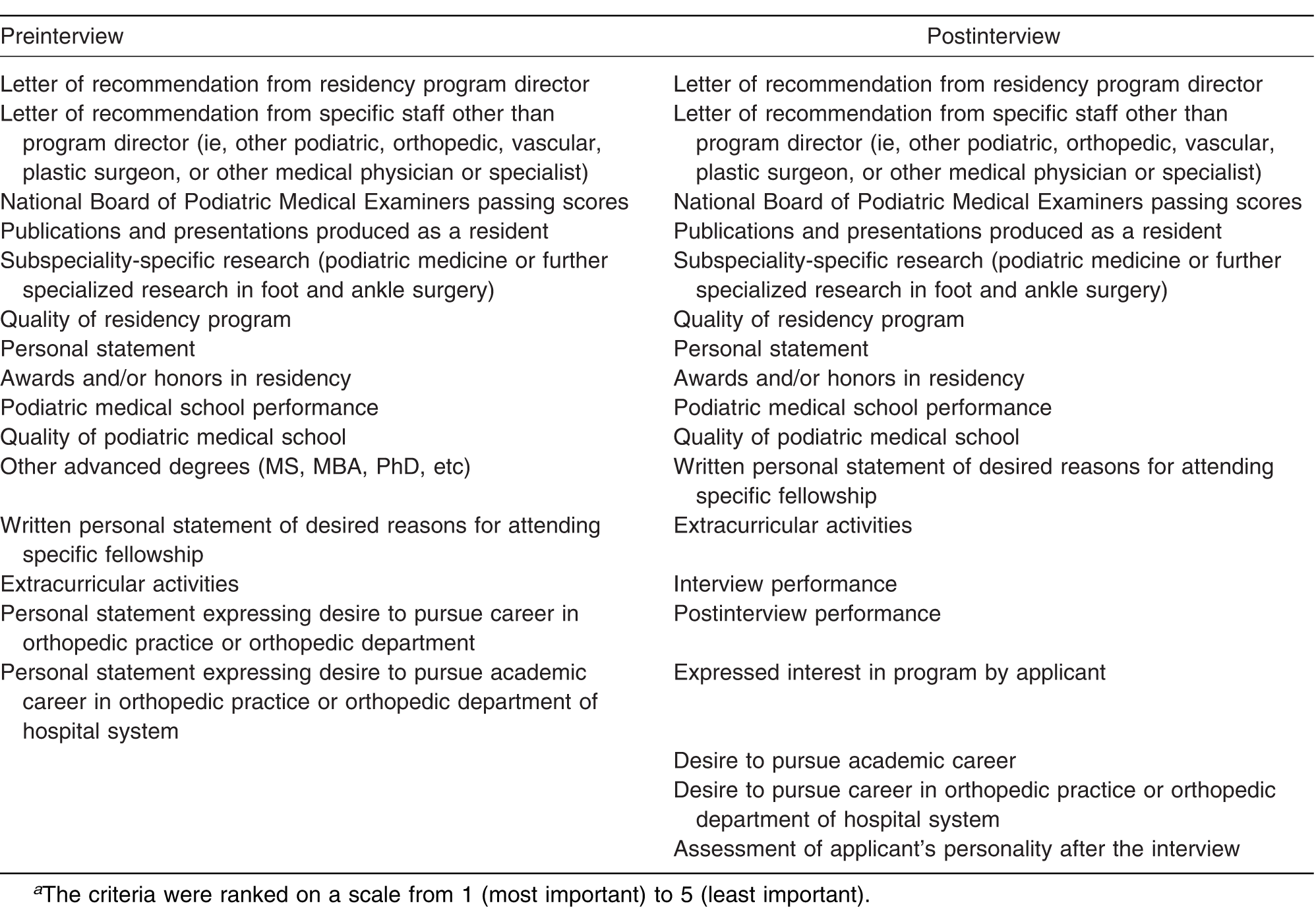
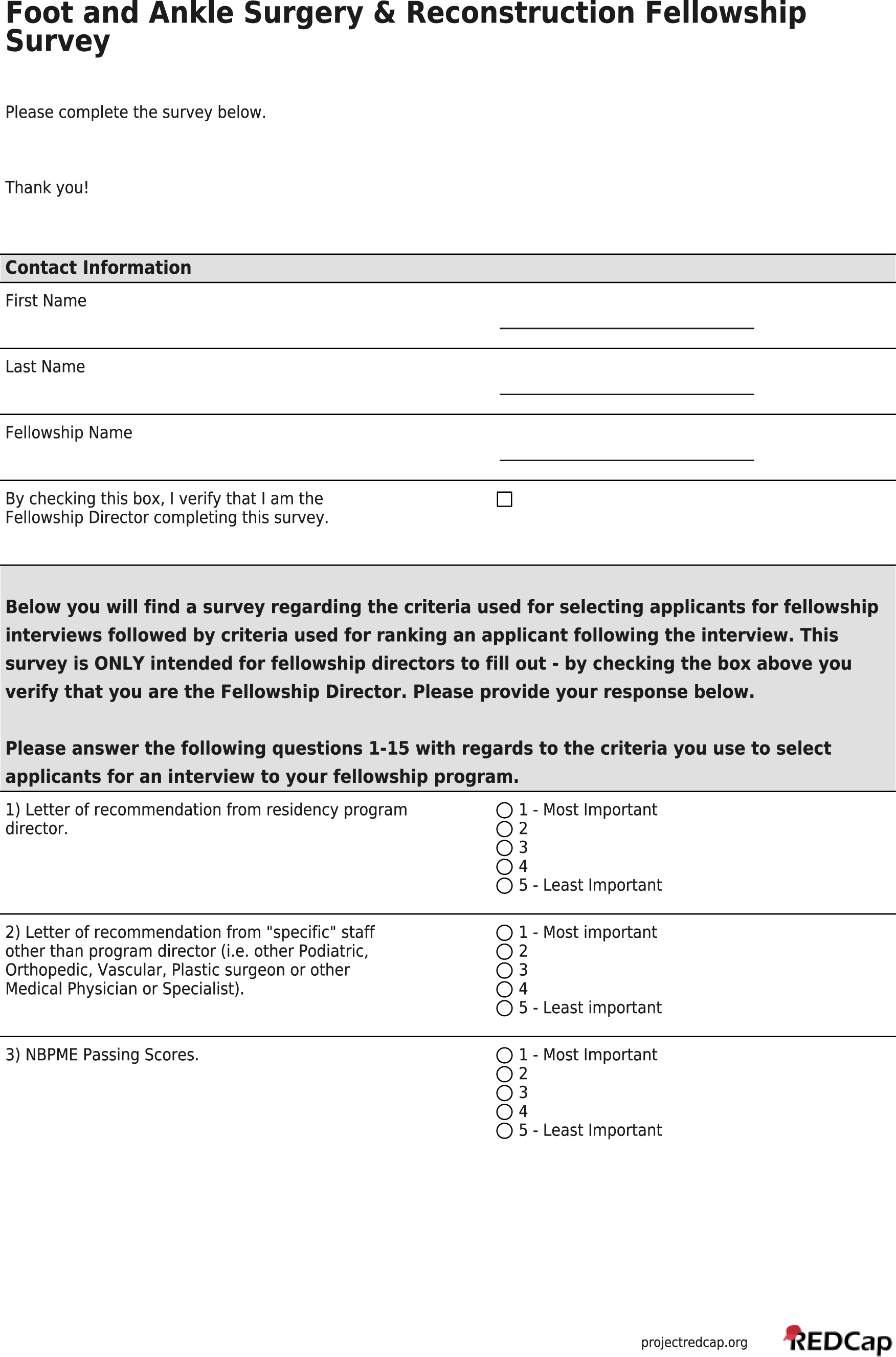
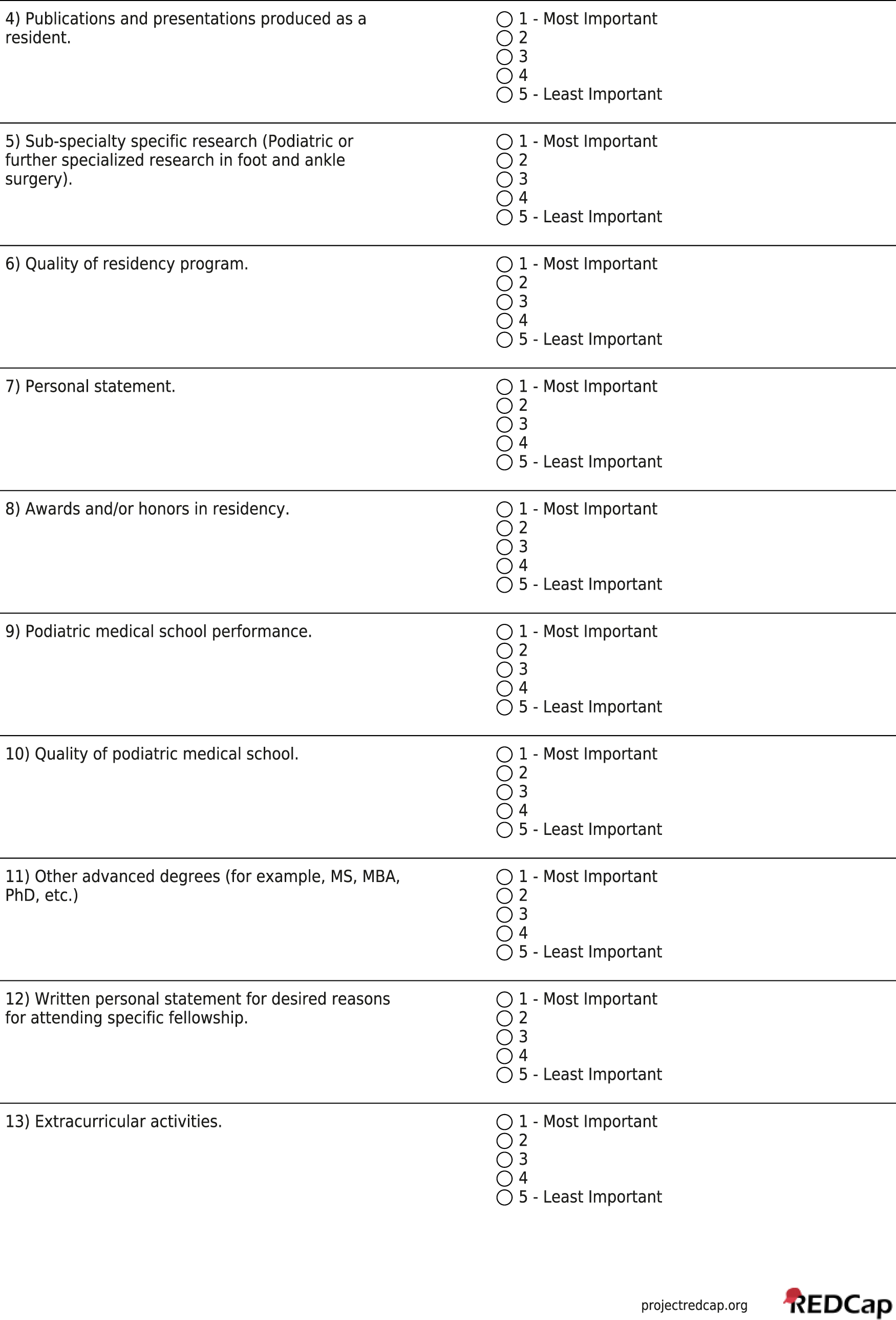
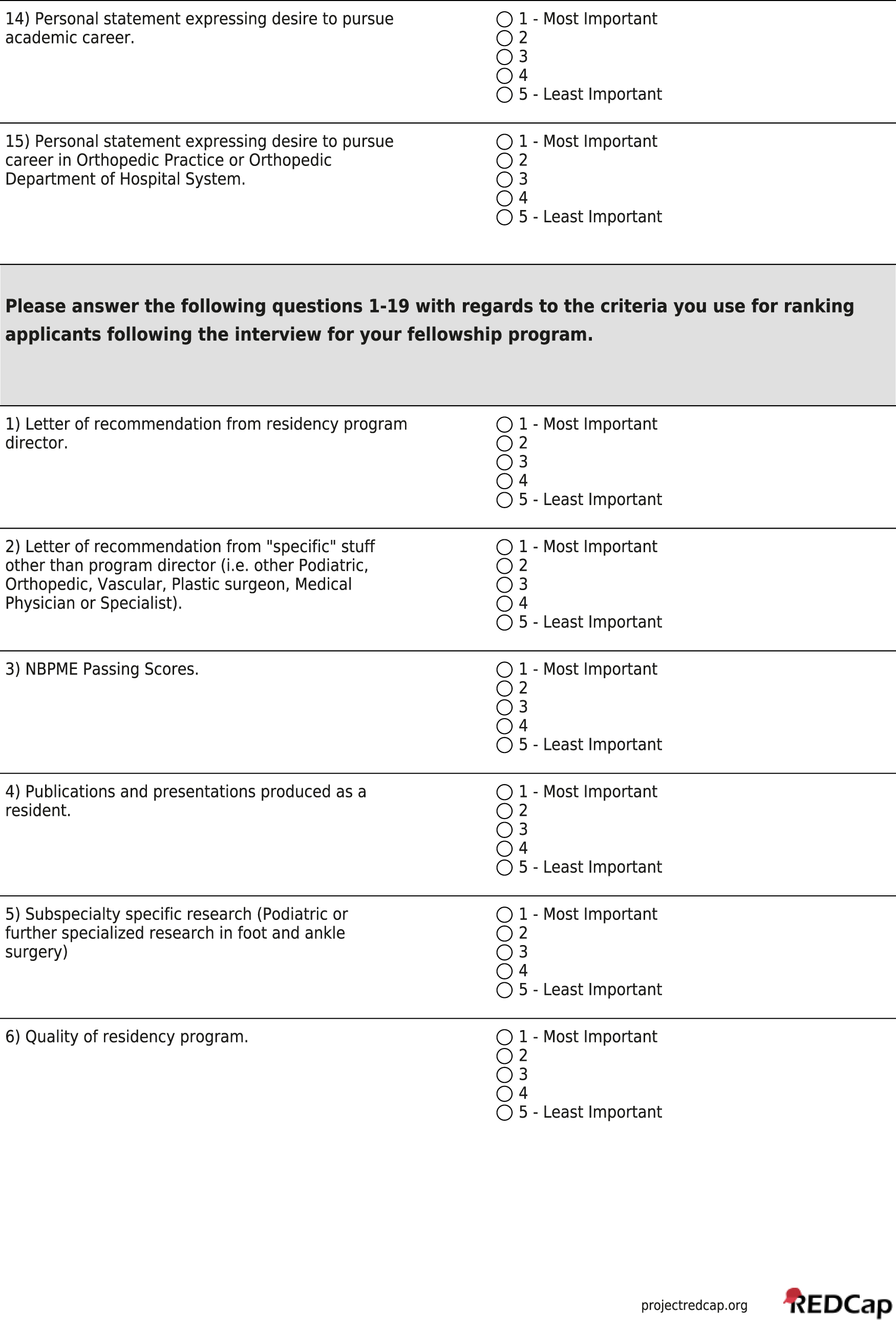
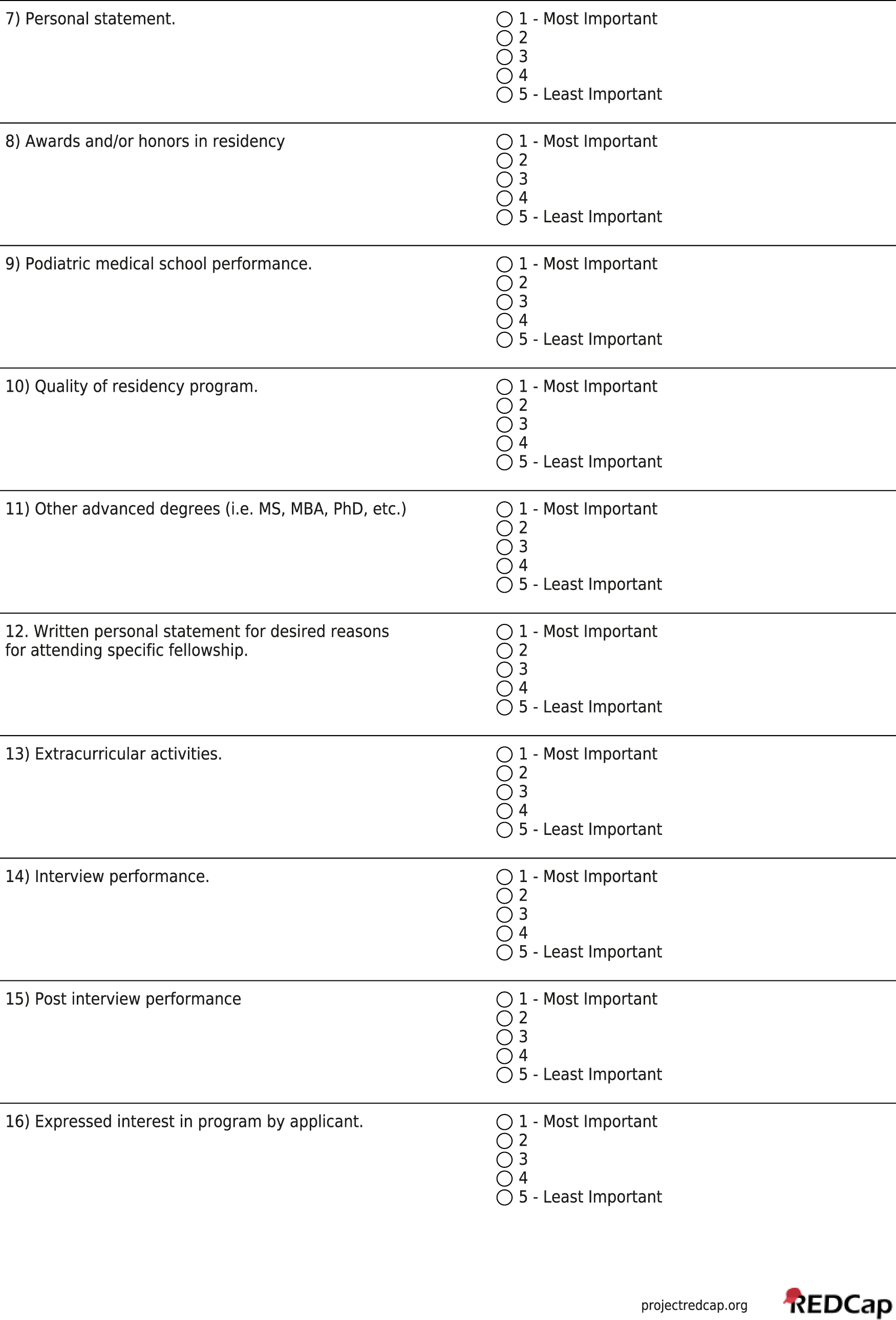
An electronic survey modeled after a study in the orthopedic literature by Grabowski and Walker [2] composed of preselected criteria for granting applicants an interview and for compiling their ranking list after the interviews was created using REDCap and sent to the identified fellowship directors' e-mail addresses (Table 1; Appendix A). A Likert scale [3] from 1 (most important) to 5 (least important) was used to prioritize each criterion; an average rating was then calculated, and the results were placed in order of importance. The survey required verification from each fellowship director that he or she personally completed the survey. Each question had to be answered in order to submit the survey. A completed survey was allowed to be submitted only once. To maximize the response rate, after the initial survey was sent out, a reminder e-mail was sent to each applicant at 1-week intervals for an additional 4 weeks.
Table 1.
Selection Criteria Questionnaire (The criteria were ranked on a scale from 1 (most important) to 5 (least important).
Results
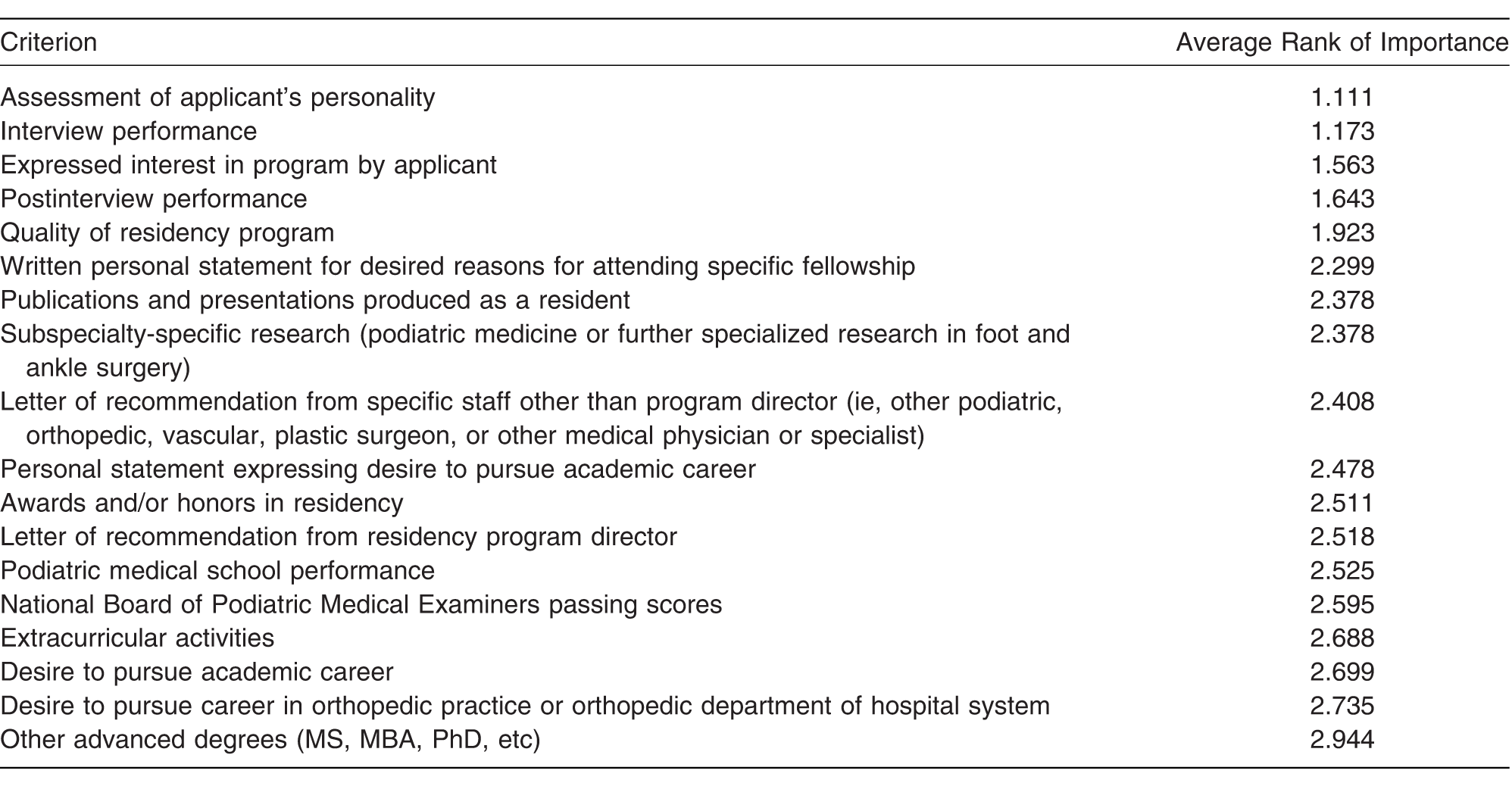
There are 43 ACFAS fellowship programs consisting of three subtypes at the time this study was conducted. In the present study, we received responses from 17 fellowship directors (39.5%). The most important selection criteria for granting an interview (Table 2) were quality of residency program (1.985), a written personal statement of desired reasons for attending that fellowship (2.063), and publications/presentations produced as a resident (2.267). The most important criteria in completing the ranking order after the interview (Table 3) were assessment of applicant's personality (1.111), interview performance (1.173), and expressed interest in program (1.563).
Table 2.
Order of Importance of Criteria When Selecting Applicants for an Interview.
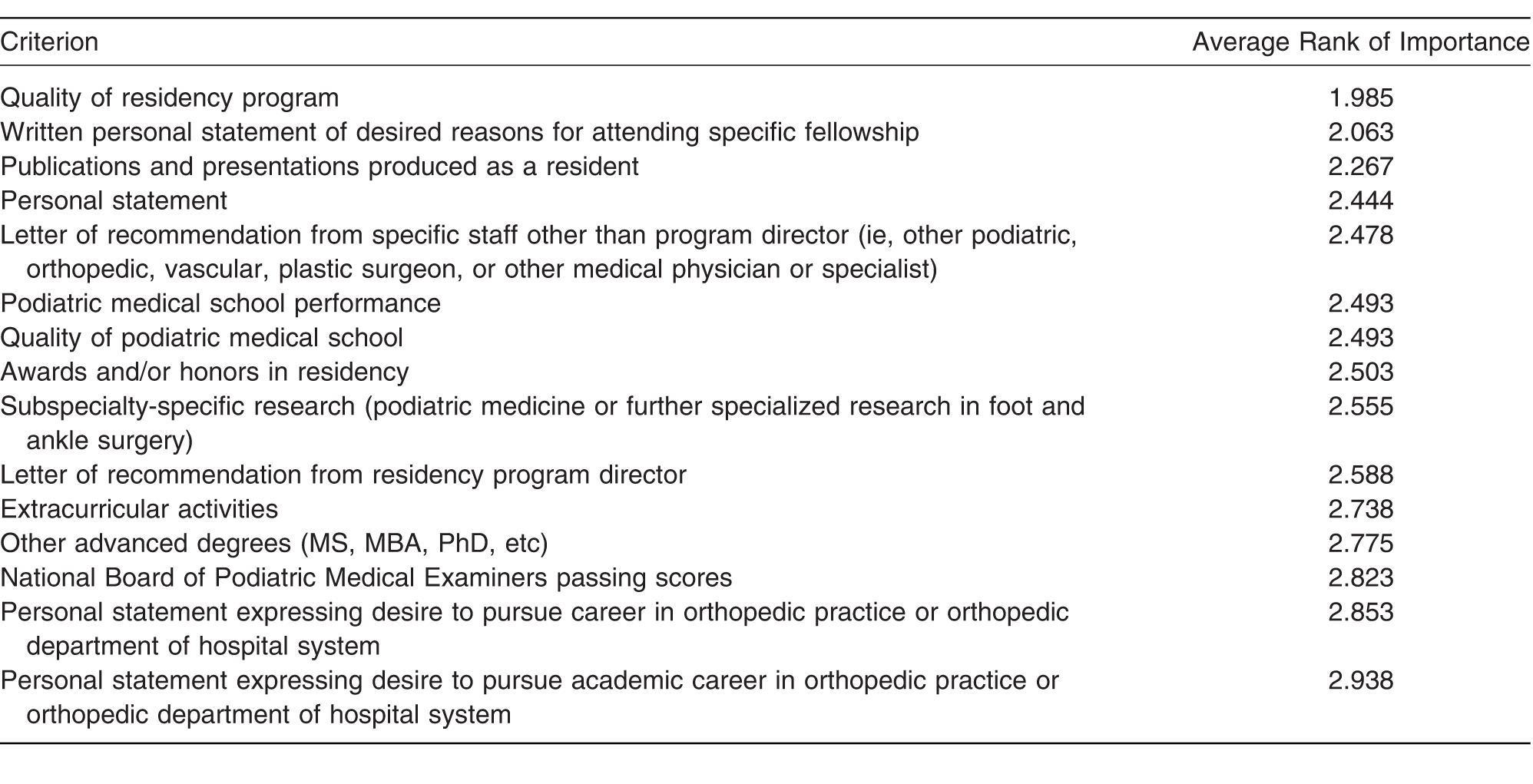
Table 3.
Order of Importance of Criteria When Ranking Applicants After the Interview.
Discussion
Because podiatric medicine fellowships remain in their infancy, fellowships in other surgical specialties are a common occurrence. According to Inclan et al, [4]. 90% of orthopedic residents pursue fellowship training. However, only 6% of US orthopedic residency graduates plan to apply to a foot and ankle fellowship program [5]. When comparing the results of the present study with those of a study by Grabowski and Walker [2], orthopedic fellowship directors placed the most importance on a letter of recommendation from subspecialty faculty, quality of the residency program, and a letter of recommendation from the residency program director when selecting candidates for an interview. The most important criteria in completing the rank order list after the interview were the interview itself, a letter of recommendation from subspecialty faculty, a letter of recommendation from the residency program director, and expressed interest in the program [2]. Knowledge of the selection criteria that podiatric medicine fellowship directors seek in applicants can assist those who desire to further their podiatric medical training.
Limitations of this study include a small sample size and a low response rate. The present study was also complicated by locating a valid personal e-mail address for each fellowship director. A potential selection bias was made by including only ACFAS fellowship programs. As mentioned previously herein, this is the largest subset of podiatric medicine fellowship programs available. Further research is needed comparing the differences in selection criteria among the ACFAS, the Council on Podiatric Medical Education, and the American Podiatric Medical Association fellowship programs. The selection criteria that program directors seek differed between being selected for the interview, which combined both objective and subjective criteria, and when compiling their rankings after the interview, which included only subjective criteria. The results show more emphasis on subjective selection criteria when directors select applicants for an interview and when ranking applicants after the interview.
Financial Disclosure
None reported.
Conflict of Interest
None reported.
References
- American College of Foot and Ankle Surgeons:ACFAS recognized fellowships.Available at: https://www.acfas.org/Fellowship-Center/Recognized-Fellowship-Intiative/List-of-Available-Fellowships/. AccessedJuly2018.
- GrabowskiGWalkerJW:Orthopaedic fellowship selection criteria: a survey of fellowship directors. J Bone Joint Surg Am95: e154, 2013.
- LikertR:A technique for the measurement of attitudes. Arch Psychol22: 1, 1932.
- InclanPMHydeASHulmeM: For love, not money: the financial implications of surgical fellowship training. Am Surg82: 794, 2016.
- HamidKSNunleyJA:Quo vadis? perspectives on the future of foot & ankle fellowship training. Foot Ankle Int37: 1146, 2016.
Appendix A. Foot and Ankle Surgery and Reconstruction Fellowship Survey.

© 2021 American Podiatric Medical Association