


Abstract
Fish pedicure is considered to be an aesthetic treatment, first conceived in Turkey, in Kangal Hot Springs. These hot waters are rich in two species of fish of the Cyprinidae family that feed on the stratum corneum layer of patients with psoriasis. This treatment was later adapted to many spa resorts for “fish pedicure.” In this article, we performed a review of the skin infections already reported, explaining why this procedure, performed usually during summer holidays by tourists, is not risk free and should be discouraged by health workers.
Wadi Bani Khalid is one of the most popular wadis in the Sultanate of Oman. Wadi is the Arabic term traditionally referring to a valley that can be temporarily or permanently flooded. Wadi Bani Khalid maintains a constant flow of water throughout the year, and if you sit on the edge of the wadi and dangle your feet in the water, you can experience an authentic fish pedicure: in the wadi, in fact, you can find the so-called doctor fish, the same little fish you see in some pedicure spas, but in their native environment (Fig. 1).
Figure 1.
Natural fish pedicure in Wadi Bani Khalid, Oman.
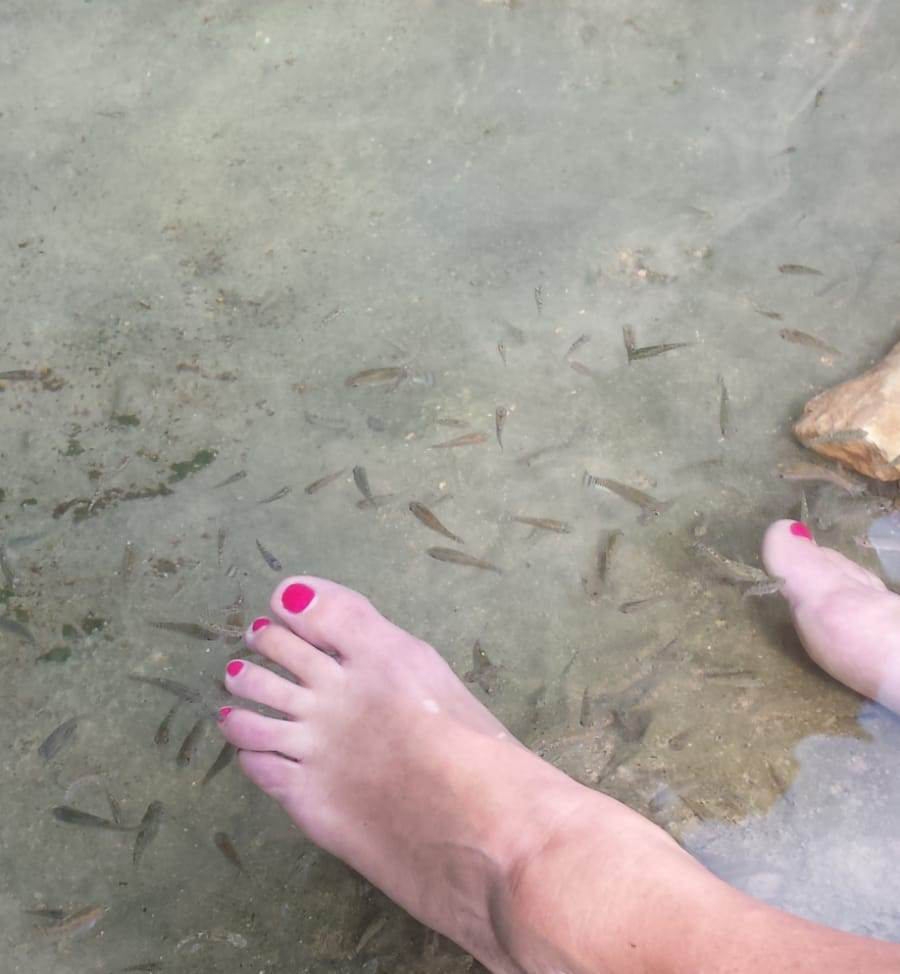
“Doctor fish” is actually the name of two species of fish belonging to the Cyprinidae family: Garra rufa and Cyprinion macrostomus. These species are widespread in various areas of Asia Minor (Iran and Iraq) and Eastern Turkey (Tigris and Euphrates rivers); they live in very hot waters, such as the ones of wadis. Kangal Hot Springs, Turkey, are rich in doctor fish, which were first studied for the treatment of psoriasis[1,2]; subsequently, this unconventional therapy was criticized for the risk of koebnerization in such patients. Doctor fish facilities were therefore opened at spa resorts and subsequently spread in many holiday resorts.
Fish pedicure is an emerging procedure; however, it is not risk free. In fact, some skin infections following fish pedicure in spa resorts have been reported recently, including the following: in 2013, a case of foot infection caused by methicillin-resistant Staphylococcus aureus after fish pedicure in Mallorca, Spain[3]; in 2014, S aureus infection of the feet in a woman who underwent fish pedicure in Karpathos, Greece[4]; in 2015, a case of Aeromonas sobriae superficial necrotic bullous erysipelas in a diabetic person who experienced fish pedicure during a trip to Asia[5]; and in 2017, a case of Mycobacterium marinum infection after a public fish pedicure in Bangkok, Thailand.[6] Furthermore, a case of bilateral onychomadesis in a healthy girl who underwent fish pedicure 6 months previously has been reported.[7]
Zoonotic diseases in fish caused by group B Streptococcus agalactiae and aquatic birnavirus have also been also reported.[8,9] In some countries outside Turkey and the Middle East, where this practice was borne, fish pedicure is increasing in popularity. Nevertheless, we noticed that in a large city such as Milan, Italy, where we work, fish pedicure centers are very rare. Usually, fish pedicure is considered an aesthetic treatment reserved for summer holidays, probably because feet are uncovered and need to be tidy. Therefore, centers and shops that offer tourists tank water crowded with G rufa have rapidly spread in Spain, Greece, and Turkey, especially in seaside resorts. The four patients described in the literature up to now were on holiday, and they all experienced the fish pedicure in public fish spas.
Moreover, more than 10 US states have banned the use of fish pedicure because of hygiene reasons: the tubs cannot be sufficiently cleaned when the fish are present, and the fish themselves cannot be disinfected or sanitized (ie, fish should be changed after each customer). However, because of the cost of the fish, salon owners use the same fish several times, increasing the risk of spreading infection. Both tank water and the fish have proved to contain a great number of microorganisms, acting as reservoirs for drug-resistant bacteria.[10] The potential for transmission increases dramatically in those people with deficient immune systems or underlying medical conditions, including diabetes and psoriasis, but also in those patients with common skin feet abrasions or intertrigo. These concerns should always be considered and, therefore, even if the risk of infection after fish pedicure is considered low, health workers should make their patients aware of this treatment and its possible consequences.
Financial Disclosure
None reported.
Conflict of Interest
None reported.
References
- OzçelikSPolatHHAkyolM: Kangal hot spring with fish and psoriasis treatment. J Dermatol27: 386, 2000.
- GrassbergerMHochW:Ichthyotherapy as alternative treatment for patients with psoriasis: a pilot study. Evid Based Complement Alternat Med3: 483, 2006.
- SugimotoKFreiRGraberP:Methicillin-resistant Staphylococcus aureus foot infection after fish pedicure. Infection41: 1013, 2013.
- VeraldiSNazzaroGÇukaE:Staphylococcus aureus infection of the feet following fish pedicure. Infection42: 925, 2014.
- VanhooteghemOAnseeuwDMichelC: Fish pedicure induced Aeromonas sobria superficial necrotic bullous dermatitis in a previously undiagnosed diabetes patient. What are the risks of fish pedicure for public health?Br J Med Med Res10: 1, 2015.
- VanhooteghemOTheateI:Fish pedicure-induced foot mycobacteriosis infection due to Mycobacterium marinum: a first case report. Eur J Dermatol27: 299, 2017.
- LipnerSR:Onychomadesis following a fish pedicure. JAMA Dermatol154: 1091, 2018.
- RuaneNMCollinsEMGearyM: Isolation of Streptococcus agalactiae and an aquatic birnavirus from doctor fish Garra rufa L. Ir Vet J66: 16, 2013.
- Verner-JeffreysDWBaker-AustinCPondMJ: Zoonotic disease pathogens in fish used for pedicure. Emerg Infect Dis18: 1006, 2012.
- SchetsFMvan den BergHHde ZwaanR: The microbiological quality of water in fish spas with Garra rufa fish, the Netherlands, October to November 2012. Euro Surveill20: 2, 2015.
© 2025 American Podiatric Medical Association