


Abstract
Background: Many regard empathy as a critical component of comprehensive health care. Much interest has been generated in the field of medical empathy, in particular as it relates to education. Many desirable outcomes correlate with perceived empathy during the patient encounter, but paradoxically, empathy levels have been reported to decline during the years of medical education. Several new approaches have been described in the literature that intend to teach or develop empathy skills in health-care students. Methods: PubMed, PsycINFO, and Google Scholar databases were searched for the terms empathy education, medical education, medical student, podiatric medical education, medical empathy, compassion, emotional intelligence, biopsychosocial model, and bedside manner. After implementing inclusion and exclusion criteria, articles were selected for preparation of a literature review. Analysis of the podiatric medical education on empathy was conducted by reviewing descriptions of all courses listed on each of the nine US podiatric medical schools' Web sites. The 2018 Curricular Guide for Podiatric Medical Education was analyzed. Results: In this review, we examine the current state of empathy from a context of medical education in general, followed by a specific analysis in podiatric medicine. We define key terms, describe the measuring of empathy in medicine, explore outcomes of empathy in the health-care setting, review the reports of a decline in medical education, and highlight some of the current efforts to develop the skill in education. An overview of empathy in the podiatric medical curriculum is presented.
Conclusions: To improve the quality of care that physicians provide, a transformation in podiatric medical education is necessary. A variety of tools are available for education reform with the target of developing empathy skills in podiatric medical students.
In health care, empathy contributes to providing complete and comprehensive care. Many positive outcomes, including increased physician sense of duty, reduced malpractice litigation, increased competence in taking histories and performing physical examinations, increased patient satisfaction, increased physician satisfaction, and improved quality of patient-physician relationships, result from the ability of health-care providers to be empathetic toward their patients. [1-4] Studies have also shown that individuals who lack empathy are more likely to cause medical errors, which supports the idea that training medical students to develop empathy could affect the quality of health care provided, as well as the outcomes. [5]
One objective of medical schools is to train physicians to be compassionate and empathetic. [6] Despite an emphasis on bedside manner as implied in this objective, empathy has been shown to decline in medical students during their educational training. [7,8] Although the curriculum of most medical schools emphasizes didactic scientific knowledge, several programs explore modalities that develop interpersonal skills, patient-provider communication, and bedside manner. Among these approaches, mindfulness-based interventions have been shown to increase empathy in students and physicians. [9,10]
In this article, a review of the scientific literature is provided describing the benefits of empathy in health-care education. The topics of the report include the current decline of empathy in students and the emergence of the various approaches being implemented to counteract this decline. All of these elements are taken into account when describing the current state of empathy education in the podiatric medical curriculum.
Methods
Three journal databases were searched for articles in the field of empathy and medical education: PubMed, PsycINFO, and Google Scholar. Search terms included the following, either individually or in combination: empathy education, medical education, medical student, podiatric medical education, medical empathy, compassion, emotional intelligence, biopsychosocial model, and bedside manner. All of the abstracts obtained were compiled for ranking by the authors. Inclusion criteria included relevance to the primary goal of the article, peer-reviewed articles, and any study design. Exclusion criteria included written in a language other than English, studies on the psychology theory of empathy, studies on the neuroscience of empathy, and articles from non–peer-reviewed journals.
Analysis of the podiatric medical education on empathy was conducted by reviewing course descriptions for all courses listed in each of the nine podiatric medical schools' Web sites. In addition, the 2018 Curricular Guide for Podiatric Medical Education, on the American Association of Colleges of Podiatric Medicine (AACPM) Web site, was reviewed.
Definitions
Empathy
Empathy can be defined as the ability of one person to relate to and understand the situational circumstances of another human being. [11] In a medical setting, this definition extends to the psychological, emotional, and physical conditions communicated from the patient to the health-care provider.
Empathy can be classified into two basic categories: emotional and cognitive. [12-16] Emotional empathy is defined as the desire to react with an appropriate emotional response, including the ability to comfort and provide compassion. Second, empathy encompasses a cognitive aspect, seeking to identify with an individual's mental status. These two categories are distinct in that emotional empathy represents a visceral response to the emotional outcry and cognitive empathy is an emotionally intelligent ability to comprehend the situational circumstances of the patient. Empathy should not be confused with sympathy, which is characterized by one's ability to adopt the emotional status of another individual. [17] The National Library of Medicine makes this distinction clear and defines empathy as follows: “An individual's objective and insightful awareness of the feelings and behavior of another person. It should be distinguished from sympathy, which is usually nonobjective and noncritical. It includes caring, which is the demonstration of an awareness of and a concern for the good of others. (From Bioethics Thesaurus, 1992).” [18] Empathy requires an attenuated response coupling intuitive nature with an appropriate sense of emotional restraint and intelligence.
Hojat et al [19] define empathy within the context of medicine as “a cognitive attribute that involves an ability to understand the patient's inner experiences and perspective and a capability to communicate this understanding.” In a health-care setting, such awareness does not require the provider to experience the same emotions as the patient because this could negatively affect the health-care provider's ability to render treatment appropriately. However, this awareness enables the health-care provider to be sensitive to all the needs of the patient and provide treatment humanely and effectively. Empathy allows the provider to reflect on the feelings of the patient and also allows the patient to feel understood.
Empathy in the context of medical education provides the means to improve patient-physician interactions beyond the academic knowledge obtained in basic preclinical and clinical courses. Steuber defines empathy as “... best understood as a dynamic, culturally situated, temporally extended, and dialogical process actively involving not only the interpreter but also his or her interpretee.” [11] This definition is critical in understanding how empathy in medical education could improve the outcomes of the patient-physician interaction. Medicine is a constantly evolving and dynamic field. Physicians will encounter a multitude of diversity in their patient population. A provider-patient relationship is an ongoing process that can last years or even a lifetime and consists of a constant dialogue that involves perspective and insight.
Neurologic studies demonstrate that perspective defines whether an empathetic response is elicited. Experimentally, individuals asked to imagine the struggle of another individual experienced empathy; anxiety and personal distress were felt when asked to visualize the same circumstances happening to themselves. The range of behaviors driven by empathy, therefore, extends to many cognitive abilities, including executive functions, mentalizing, and language. [20] The education of successful physicians requires understanding empathy from biological, psychological, and social viewpoints.
Related Terms
Several terms relating to empathy should be defined to mediate productive medical outcomes successfully. Among these terms are compassion, emotional intelligence, biopsychosocial model, and bedside manner.
Compassion
It is crucial that compassion is considered a component of successful physician training. Compassion is defined as an ability to recognize and conceive an emotional identity with another person. [21] However, is compassion an aspect that can be cultured in budding physicians? It is at this junction that one must separate the two terms empathy and compassion. Whereas empathy allows one person to comprehend the suffering or success of another, compassion indicates an emotional joining of cognitive conditions on a more fundamental psychological level. [22] Although regarded as essential to providing complete and comprehensive care, compassion, unlike empathy, is more challenging to develop and presents a more significant challenge in assessing and creating tools to improve in medical education. [23]
Emotional Intelligence
Empathy is a significant component of emotional intelligence. Birks and Watt [24] define emotional intelligence as “a set of abilities (verbal and nonverbal) that enable a person to generate, recognize, express, understand and evaluate their own and others' emotions to guide thinking and action and successfully cope with environmental demands and pressures.” This skill contributes to assisting physicians in providing a personalized and all-inclusive treatment of patients under a variety of circumstances. Emotional intelligence can be divided into a variety of models, all of which incorporate empathy as a modality for determining levels of emotional intelligence. [25-27] The development of an emotionally intelligent physician is affected by empathy levels.
Biopsychosocial Model
The biopsychosocial model is a three-pronged combination of human biology, psychology, and social constructs describing a more comprehensive form of care in patient-physician interactions. [28] This model addresses several key issues worth exploring. A simple hypothetical example exploring the biopsychosocial aspects of type 2 diabetes demonstrates this argument. Although biologically a patient has developed this chronic illness, be it through genetic precursors or poor nutrition coupled with lack of physical activity, several psychological and social aspects require consideration. Psychologically, the patient may have emotional stressors that elicit poor eating or other poor nutritional habits that need to be addressed. Socially, a patient may be predisposed to poor nutrition based on the confines of their education and financial circumstances. For example, the World Health Organization estimates that 80% of diabetes-related deaths occur in low- to middle-income countries. [29] Thus, the ability of a physician to empathize with a patient beyond the biological aspect of their afflictions demonstrates a more comprehensive form of care. By understanding the psychological struggles of patients and comprehending their social circumstances, a physician can better mediate treatment beyond the didactic forms of education currently in place in medical training.
Bedside Manner
Another definition when considering the importance of empathy in medicine is bedside manner. This term has been described as synonymous with the phrase patient-centered care. Bedside manner involves explaining to a patient the gravity of his or her illness while being able to comfort them, leaving them feeling safe in the care of the physician. [30] It has been postulated that a physician with a higher degree of empathy, both emotionally and cognitively, will be more successful at fulfilling these tasks. Bedside manner is an extension of the physician's personality beyond their medical knowledge, and an aspect of medical practice not conventionally focused on during medical education. The implementation of protocols to increase empathy in physicians demonstrates an overall improvement in bedside manner and increasingly improved outcomes in patient-provider interactions. [31] The ability of a physician to identify with the issues the patient experiences not merely on a physical level but also on a psychological and social level demonstrates an increased level of emotional intelligence and improved bedside manner. [32,33]
Measuring Empathy
There are three basic approaches to measuring empathy using validated methods: first-, second-, and third-person perspectives. The first-person approach relies on self-report instruments in which the participant rates empathy-related statements obtaining an overall empathy score. In the second-person perspective, the patient rates the provider's empathy based on his or her experience during the patient-provider interaction (patient-perceived empathy). Finally, in the third-person perspective, an objective observer evaluates his or her interpretation of the encounter and rates the empathy of the provider (observer-perceived empathy).
Hemmerdinger and colleagues [34] conducted a systematic review of instruments used in evaluating empathy. Of 59 instruments evaluated, six proved to be most valid and reliable. Four of these were from a first-person perspective, one from a second-person perspective, and one from a third-person perspective. Only one instrument was developed specifically for health-care providers. The Jefferson Scale of Physician Empathy (JSPE) measures empathy in physicians from a first-person perspective. The JSPE has subsequently been used in studies involving nurses and medical students and has been shown to be a valid and reliable instrument for measuring empathy in these populations as well. [35] Reliability has been examined using test-retest correlation (r = 0.65 over 3–4 months in physicians and a test-retest change value of P < .05 over 12 months in medical students). The JSPE has an internal consistency total-item score between 0.30 and 0.60 and a Cronbach alpha between 0.81 and 0.89. Validity measures show an association between empathy scores and student competence, with extensive convergent and divergent validity assessments during test development. [7,36-38]
Positive Outcomes of Empathy
Several studies demonstrate that patient satisfaction and compliance increase when a physician exhibits higher levels of empathy. Garcia et al [1] showed that patient satisfaction seems to be particularly important regarding the initial visit to a practitioner. Their study correlated physicians who underwent empathy training and patient satisfaction demonstrating increased levels of compliance and overall contentment. [1] In the pediatric office setting, mothers who felt that a physician was empathetic exhibited higher levels of satisfaction. [2] In studies assessing patient satisfaction via verbal communication, physicians with higher levels of empathy experienced better outcomes. [3]
Increased levels of empathy have been shown to reduce health-care costs; part of this overall reduction related to lower litigation and malpractice fees of practitioners. [1,4] Patients view empathetic physicians as providers who emotionally invest in their overall health rather than perceiving the relationship as a business transaction. [39]
Essential to positive outcomes are effective forms of communication; patients want to feel that they are being heard in addition to being examined. The empathetic physician can communicate with the patient using the specific circumstances of each case to determine the best course of treatment uniquely tailored to the patient using tools from the biopsychosocial model. Thus, increased levels of empathy manifest positively in many aspects of patient care.
Empathy Decline in Medical Education
The decline of empathy during medical education has been documented by many studies. [8,40-43] Although these studies measured different demographics of students, either cross sectionally or longitudinally, each showed a statistically significant decline in empathy. In addition, Newton et al [41,42] showed that medical education plays a role in determining specialty choice and concluded that lower values of empathy were apparent in students with noncore specialties. Hojat et al [40] also correlated levels of cynicism with a decrease of empathy in medical students. Comparing constructs of widely used measures has also been described in medical students. [44] Some of these studies were not exclusive to medical students but also measured levels of empathy in interns and residents, demonstrating similar results. [42,45]
Some studies measured empathy using sex as a demographic of interest. Men in core specialties initially had higher levels of empathy, which fell below national averages after completion of the third year of residency. Men in noncore specialties exhibited levels of empathy on par with national levels, with no decline during residency. Women choosing a core specialty had measured empathy levels comparable with national averages, with no drop during residency. However, women in noncore specialties showed decreased empathy after a few years. [41] Thus, regardless of the areas of medicine in which empathy decreases according to sex, there is an overall decline during residency, just as has been shown for the years in medical school.
For practicing physicians, regarding specific specialty choice, different concentrations show different levels of empathy. Psychiatrists were observed to have higher levels of empathy than surgeons overall. [37] Thus, the source of decline potentially points to training in specific subfields of medicine. However, due to decreased empathy levels seen throughout the nearly decade-long process of medical training, it is possible to conclude that much of the decline takes place during graduate medical education.
Efforts to Improve Empathy
The Association of American Medical Colleges stated in a series of reports on the Medical School Objectives Project that one objective of medical schools is to train physicians who “must be compassionate and empathetic in caring for patients.” [6] This objective is reflected in some medical schools implementing various programs to foster empathy in students. The diversity of the programs being explored includes a wide range of approaches.
Scheffer et al [46] examined the effect of active student participation on quality of care in an integrative inpatient setting as an approach to enhance “patient-centeredness.” Physician empathy was assessed with the Consultation and Relational Empathy measure, and they observed improved scores with their intervention. [46] Participation in medical missions has also been explored as a tool to teach empathy in a medical education setting and seems to have a positive effect on students. [47] Other reports stress patient education as being a fundamental part of caring for patients and detail strategies to improve this element of the patient-provider interaction. [48,49] The importance of improved communication skills and development of specific curricula for medical students to develop empathy and compassion are well documented. [50,51]
Other groups have explored using the arts and humanities as a tool for fostering empathy in medicine. Bleakley and Marshall [51] argue for the inclusion of medical humanities in the curriculum of medical schools as a tool for improving communication skills and empathy. Wolters and Wijnen-Meijer [52] agree with the same concept, explicitly focusing on the use of poetry and prose as a tool for developing empathy in medical students. A perspective published in The New England Journal of Medicine supports the same principle by describing a call for reform of medical education starting as early as the premedical undergraduate curriculum. Muller [53] details a program established in 1987 at Mount Sinai's Icahn School of Medicine, including an alternative to the traditional premedical track: the Humanities and Medicine Program. The program indirectly supports the idea that students with a diverse background in humanities will become more empathetic clinicians.
Interestingly, studies have shown that clinicians who try to convey empathy may downplay their competence. Patients may perceive clinicians' efforts to be empathetic as compensating for lack of proficiency. To prevent this misconception, studies have suggested incorporating empathic nonverbal training into the medical school curriculum. Nonverbal communication provides a more subtle way for clinicians to express empathy without appearing less competent. Some examples of nonverbal communication that have been correlated with increased ratings of empathy and competence are open body posture (uncrossed arms), eye contact, touch, and smiling. [54]
In the early 2000s, a model patient, Stan, was introduced to help students understand how the body reacts in different situations. Stan is a mannequin that is capable of mimicking human physiology; however, he cannot mimic human emotions. As a result, more recently, various medical schools have been using virtual patients as an experimental method that allows students to reinforce their empathetic communication skills. The purpose of the virtual patient is to provide a low-pressure environment that allows prospective physicians to reflect on their interactions to prevent repercussions in the future. Although not yet ubiquitous, this method may prove to be an important tool to avoid the empathy decline that is often experienced throughout medical school education. [55]
Mindfulness-Based Interventions
Many of the commonly used approaches being explored to develop empathy skills use mindfulness-based interventions. One of these programs, Mindfulness-Based Stress Reduction (MBSR), is a course based on the practice and cultivation of mindfulness, a particular quality of attention and awareness described in both Eastern and Western philosophical traditions. Operationally defined, “mindfulness is a non-judgmental, moment-to-moment paying attention on purpose in the present moment that is always nested within a larger conceptual and practice-based ethical framework oriented towards non-harming (an orientation it shares with the Hippocratic tradition of Western medicine).” [56] The MBSR program was founded by Jon Kabat-Zinn, PhD, in 1979 at the University of Massachusetts Medical School to help patients reduce stress and manage emotions through mindfulness meditation. [56-58] It is an 8-week behavioral program and education course that offers first-hand experience of meditation techniques, including mindful awareness of daily activities and communication. The MBSR curriculum, facilitated by certified instructors, has become a life-affirming mind/body practice for comprehensive health care in education and mental health.
The impact of MBSR has been examined in medical education. In 1998, Shapiro et al [59] investigated the effects of MBSR on medical and premedical students. Their findings indicated that participation in the course not only reduced anxiety and depression but also increased empathy levels in participants. In 2009, Krasner et al [60] reported the outcomes of a mindfulness-based educational program among 70 primary-care physicians. Although this study was not conducted with medical students, the methods included a course that was part of continuing medical education. Participation in the course was associated with lower levels of burnout and higher empathy. [60] The implications of this study and similar studies are promising and can be extrapolated to the potential impact of mindfulness-based interventions in medical education. However, one study found that students who were “forced” to participate in mindfulness education felt that they could not fully commit to it. They felt that being forced prevented them from being “open” to the experience, which is imperative to seeing positive results. This finding suggests that the students' willingness to participate must be taken into consideration to achieve maximum benefits with MBSR. [57]
The potential and prospective of mindfulness-based interventions having an impact in improving empathy and patient-centered care are also reflected by the number of medical schools that are now teaching mindfulness. Some of the medical schools that offer alternatives in mindfulness-based training for students and/or residents include the University of Massachusetts Medical School, Stanford University School of Medicine, Columbia University College of Physicians and Surgeons, University of California San Francisco School of Medicine, and Icahn School of Medicine at Mount Sinai. Dobkin and Hutchinson [61] recently published an article titled “Teaching Mindfulness in Medical School: Where Are We Now and Where Are We Going?” that details the state of mindfulness-based interventions in medical schools.
Teaching mindfulness as part of the medical curriculum has potential implications for other critical elements in medicine outside of empathy. Sibinga and Wu [62] wrote an insightful commentary in the Journal of the American Medical Association not only describing the potential benefits of clinician mindfulness as they relate to empathy but also about the potential implications to patient safety and reduction of medical errors.
Virtual and Live Standardized Patient-Based Interventions
During the past several decades the use of standardized patients to provide medical students with simulations of patient interactions has become a common practice of medical education. [63,64] One of the newer approaches being explored to develop empathy skills in medical students is the use of virtual patients in addition to standardized patients. A virtual patient is a character that represents a patient regarding reaction and response. Medical students can ask health-related questions, conduct examinations, observe, and document findings akin to a standardized patient. [65,66] Virtual patients respond similarly with speech, gestures, and text. Although some may argue that virtual patient interactions are too artificial, the low-stress environment they provide for inexperienced medical students has been shown to benefit them by increasing their confidence and empathetic communication skills as they further their education. [55] Both standardized patients and virtual patients have been shown to be promising tools for medical education to teach and develop empathy in medical education, including podiatric medical education. [64,67-72]
Standardized patients have also been used as part of the assessment in observed structured clinical examinations after drama training in medical students. The intervention included training in “how to act-in-role” to improve empathy communication, which proved to increase self-reported empathy and competence significantly. [73] The use of drama has been among the practices used to enhance empathy in medical students. [74,75]
Analysis of the Current State of Podiatric Medical Education
The instruction of empathy in podiatric medical education is a priority in the field. [76,77] It is a common belief that empathy is an important aspect of podiatric medical care, as it is in all health-care fields. However, the teaching of empathy in podiatric medical education is not uniform and standardized, similar to the state of allopathic and osteopathic medical schools. Analysis of course descriptions for all nine DPM schools in the United States reveals the lack of uniformity on the teaching of empathy in podiatric medical education. To evaluate the teaching of empathy in DPM programs, the course descriptions for all courses at each of the nine colleges of podiatric medicine in the United States were assessed as detailed on each of their Web sites. Each course description was scanned for terms related to empathy, as listed previously herein. Courses that had explicit or implicit teaching of empathy were selected. Table 1 lists each course in this category for each of the nine colleges, and specific key words in the course description are also included.
Table 1.
Courses Teaching Empathy or Empathy-Related Concepts in the US Curricula of Podiatric Medical Education.
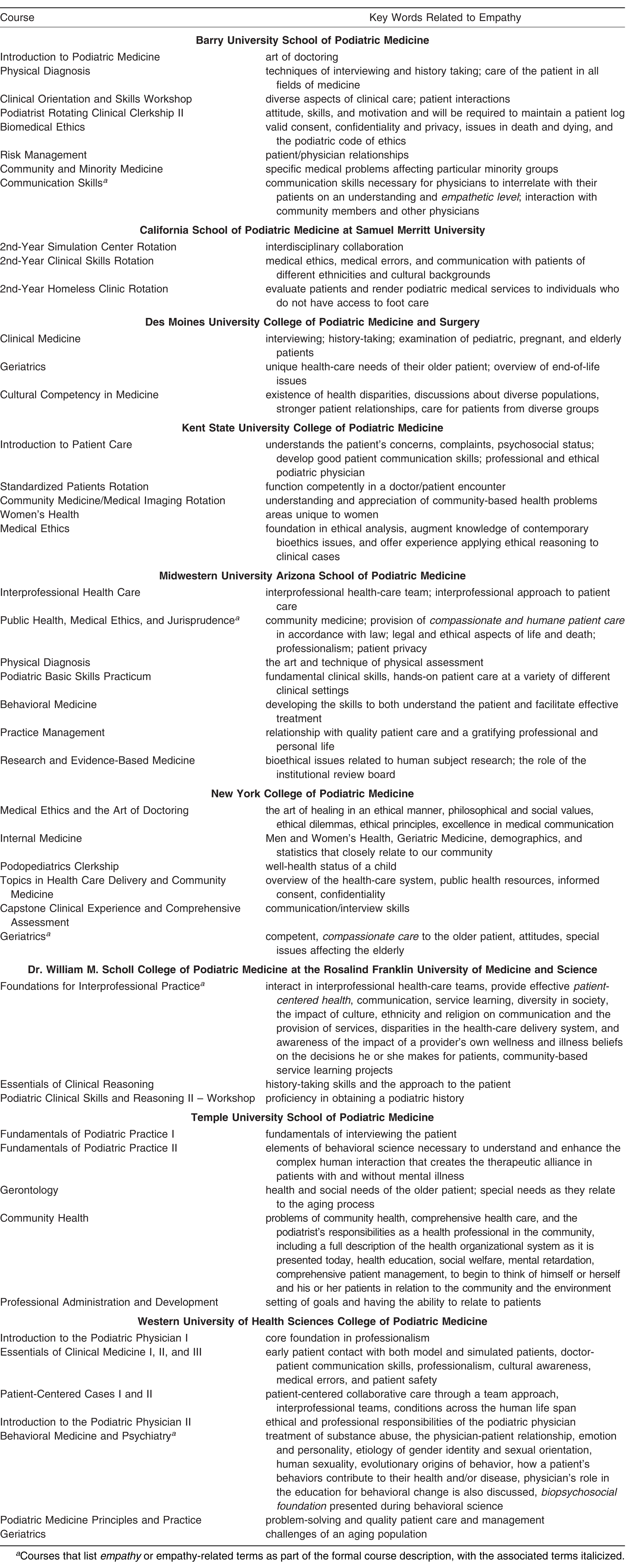
A more comprehensive understanding of the teaching of empathy in podiatric medicine can be ascertained by examining guidelines established by the AACPM. [78] In February 2013, under the direction of the Council of Faculties of the AACPM, the first comprehensive Curricular Guide for Podiatric Medical Education was released. The term empathy, or its related terms as described in this article, did not appear in any of the previous editions of the guide. The most recent version, released in 2018, includes a new section on Community Health in which a few objectives with the Public Health subsection I could potentially relate to empathy. However, the word empathy and its related terms are still absent from the objectives in this most recent edition. [78]
Discussion
Empathy as a component of a competent physician represents a quality that has been demonstrated to be significant in providing a patient with complete and comprehensive care. We define empathy as the ability to comprehend the emotional, social, biological, and overall psychological well-being of a patient in the context of treatment. However, empathy is easily confused with sympathy or compassion, two emotional expressions that we have disregarded as either inappropriate in the medical setting or too visceral to be incorporated into medical training. Thus, empathy provides a process of emotional navigation for the physician, establishing effective communication between patient and provider. Empathy is part of the broader framework of emotional intelligence, essential to providing patients with comprehensive care. Concerning patient satisfaction, return visits, and follow-up, a physician can achieve more favorable outcomes with an increased level of empathy. Classically, patient-centered care, which can be shown to increase levels of patient satisfaction and, thus, better overall treatment, is known as bedside manner. The ability of a practitioner to comfort a patient and communicate a diagnosis significantly affects the outcome of the patient. Inherently, the provider must consider the additional social and psychological circumstances of the patient beyond the didactic knowledge that one obtains during basic medical education (biopsychosocial model). Positive outcomes from physicians with increased levels of empathy show that increased patient satisfaction, as well as reduced malpractice and litigation fees, are attainable.
Although there is a multitude of benefits from training physicians to improve levels of empathy, multiple studies have shown a decline of empathy during medical training. This decrease is not localized to medical school but has also been seen in postgraduate training. In addition, studies of sex differences showed no significant variation between men and women regardless of the field of concentration. The difference in empathy levels in specific specialty choice did not determine chronologically where the decline occurred. It is important to note that because the decrease in empathy was seen at all levels of medical training, the stem of the problem could begin as early as the preclinical science level. Thus, regarding implementation of empathy training, undergraduate medical education seems most feasible.
Several efforts have been made to improve empathy in medical students and, thus, physicians, including incorporation of humanities into the medical school curriculum, participation in medical missions, drama training, and mindfulness-based interventions, such as the MBSR course. Of the solutions attempted to improve empathy, mindfulness-based interventions provide the most feasible and effective methods for enhancing empathy in medical students. Significant increases in empathy were measured by both contemporary scales and functional magnetic resonance imaging. The 8-week course is shorter than a typical medical school semester and has been used at some well-accredited institutions to improve levels of empathy.
Concerning the current state of empathy teaching and training in podiatric medical education in the United States, lack of consistency is the most evident feature, as shown in Table 1. Note that clinical rotation courses, such as clerkships and externships, were not included in the analysis. Although it is assumed that empathy is included as part of the training during clinical teaching, this is not uniform or standardized for all students. This article focuses on instructional and didactic empathy education.
Five courses should be highlighted in the US curricula: 1) Barry's “Communication Skills,” 2) Midwestern's “Public Health, Medical Ethics, and Jurisprudence,” 3) New York's “Geriatrics,” 4) Scholl's “Foundations for Interprofessional Practice,” and 5) Western's “Behavioral Medicine and Psychiatry.” Although it is possible and likely that some of the other courses listed in Table 1 include empathy education, the fact that these five courses list empathy or empathy-related terms as part of the formal course description is indicative of the intentionality of the course design.
At the national level, the AACPM is regarded as one of the most important voices for podiatric medical education. The Curricular Guide for Podiatric Medical Education is considered the highest standard of the DPM curriculum in the United States. The fact that the word empathy and empathy-related terms are entirely absent in the objectives listed in this guide reflects the need for a dialogue at the national level about this topic. Should there be a reform in podiatric medical education to intentionally incorporate empathy teachings into the curricula? Could a uniform approach be established in all nine of the DPM-granting institutions in the United States? These are some of the questions that should guide a national reform dialogue.
In this article, we suggest that to improve the quality of care that physicians provide, a transformation in medical education is necessary to include the teaching of empathy-related topics in the curriculum. A possible route for conducting this reorganization could include the incorporation of mindfulness-based interventions with a focus on improving empathy. As we move further from personal interaction, the time spent in the examination room becomes increasingly essential to positive outcomes in patient care.
Financial Disclosure
None reported.
Conflict of Interest
None reported.
References
- GarciaDBautistaOVenereoL: Training in empathic skills improves the patient-physician relationship during the first consultation in a fertility clinic. Fertil Steril99:1418.e1,2013.
- KorschBMNegreteVF:Doctor-patient communication. Sci Am227: 66, 1972.
- ComstockLMHooperEMGoodwinJM: Physician behaviors that correlate with patient satisfaction. J Med Educ57: 105, 1982.
- KimSSKaplowitzSJohnstonMV:The effects of physician empathy on patient satisfaction and compliance. Eval Health Prof27: 237, 2004.
- WestCPHuschkaMMNovotnyPJ: Association of perceived medical errors with resident distress and empathy: a prospective longitudinal study. JAMA296: 1071, 2006.
- Association of American Medical Colleges: Medical School Objectives Project (MSOP). Available at: https://www.aamc.org/initiatives/msop. Accessed October 14,2018.
- HojatMMangioneSNascaTJ: Empathy scores in medical school and ratings of empathic behavior in residency training 3 years later. J Soc Psychol145: 663, 2005.
- NeumannMEdelhauserFTauschelD: Empathy decline and its reasons: a systematic review of studies with medical students and residents. Acad Med86: 996, 2011.
- GrossmanPNiemannbLSchmidtS: Mindfulness-based stress reduction and health benefits: a meta-analysis. J Psychosom Res57: 35, 2004.
- BarbosaPRaymondGZlotnickC: Mindfulness-Based Stress Reduction (MBSR) training is associated with greater empathy and reduced anxiety for graduate healthcare students. Educ Health26: 6, 2013.
- Stanford Encyclopedia of Philosophy: Empathy. Available at: http://plato.stanford.edu/archives/sum2013/entries/empathy. Accessed October 14,2018.
- RogersKDziobekIHassenstabJ: Who cares? revisiting empathy in Asperger syndrome. J Autism Dev Disord37: 709, 2007.
- Shamay-TsoorySG:The neural bases for empathy. Neuroscientist17: 18, 2011.
- Shamay-TsoorySGAharon-PeretzJPerryD:Two systems for empathy: a double dissociation between emotional and cognitive empathy in inferior frontal gyrus versus ventromedial prefrontal lesions. Brain132: 617, 2009.
- SmithA:Cognitive empathy and emotional empathy in human behavior and evolution. Psychol Rec56: 3, 2006.
- ZakiJ:Moving beyond stereotypes of empathy. Trends Cogn Sci21: 59, 2017.
- SilkJB:“Empathy, Sympathy, and Prosocial Preferences in Primates,”inOxford Handbook of Evolutionary Psychology, edited byBarrett,LDunbar,Rp115, Oxford University Press, Oxford, UK, 2007.
- National Center for Biotechnology Information: Empathy. Available at: http://www.ncbi.nlm.nih.gov/mesh/68004645.
- HojatMGonellaJNascaT: Physician empathy: definition, components, measurement, and relationship to gender and specialty. Am J Psychiatry159: 1563, 2002.
- DecetyJ:The neuroevolution of empathy. Ann N Y Acad Sci1231: 35, 2011.
- CassellE:Oxford Handbook of Positive Psychology, 2nd Ed, Oxford University, New York, 2009.
- HatfieldECacioppoJTRapsonRL:Emotional contagion. Curr Dir Psychol Sci2: 96, 1993.
- PatersonR:Can we mandate compassion?Hastings Cent Rep41: 20, 2011.
- BirksYFWattIS:Emotional intelligence and patient-centred care. J R Soc Med100: 368, 2007.
- BradberryTGreavesJ:Emotional Intelligence 2.0,Publishers Group West, San Francisco, 2009.
- BradberryTRSuLD:Ability-versus skill-based assessment of emotional intelligence. Psicothema18: 59, 2006.
- PetridesKVFurnhamA:On the dimensional structure of emotional intelligence. Pers Indiv Diff29: 313, 2000.
- SantrockJW:A Topical Approach to Human Life-span Development, 3rd Ed, McGraw-Hill, New York, 2007.
- World Health Organization: Diabetes. Available at: http://www.who.int/mediacentre/factsheets/fs312/en/. Published June 8, 2020. Accessed October 14,2018.
- PuiliaM:Simple tips to improve patient satisfaction. Am Acad Emerg Med18: 18, 2011.
- GröneOGarcia-BarberoM:Trends in Integrated Care: Reflections on Conceptual Issues,World Health Organization, Copenhagen, 2002.
- QuilliamS:The “Cringe Report”: why patients don't dare ask questions, and what we can do about that. J Fam Plann Reprod Health Care37: 110, 2011.
- HillTE:How clinicians make (or avoid) moral judgments of patients: implications of the evidence for relationships and research. Philos Ethics Humanit Med5: 11, 2010.
- HemmerdingerJMStoddartSDLilfordRJ:A systematic review of tests of empathy in medicine. BMC Med Educ7: 24, 2007.
- FieldsSKHojatMGonnellaJS: Comparisons of nurses and physicians on an operational measure of empathy. Eval Health Prof27: 80, 2004.
- HojatMMangioneSNascaTJ: The Jefferson Scale of Physician Empathy: development and preliminary psychometric data. Educ Psychol Measure61: 349, 2001.
- HojatMGonnellaJSNascaTJ: The Jefferson Scale of Physician Empathy: further psychometric data and differences by gender and specialty at item level. Acad Med77: S60, 2002.
- HojatMMangioneSKaneGC: Relationships between scores of the Jefferson Scale of Physician Empathy (JSPE) and the Interpersonal Reactivity Index (IRI). Med Teach27: 625, 2005.
- MiaoulisGJr,GutmanJSnowMM:Closing the gap: the patient-physician disconnect. Health Mark Q26: 56, 2009.
- HojatMMangioneSNascaTJ: An empirical study of decline in empathy in medical school. Med Educ38: 934, 2004.
- NewtonBWBarberLClardyJ: Is there hardening of the heart during medical school?Acad Med83: 244, 2008.
- NewtonBSavidgeMBarberL: Differences in medical students' empathy. Acad Med75: 1215, 2000.
- ColliverJAConleeMJVerhulstSJ: Reports of the decline of empathy during medical education are greatly exaggerated: a reexamination of the research. Acad Med85: 588, 2010.
- CostaPde Carvalho-FilhoMASchwellerM: Measuring medical students' empathy: exploring the underlying constructs of and associations between two widely used self-report instruments in five countries. Acad Med92: 860, 2017.
- BelliniLMBaimeMSheaJA:Variation of mood and empathy during internship. JAMA287: 3143, 2002.
- SchefferCTauschelDNeumannM: Active student participation may enhance patient centeredness: patients' assessments of the clinical education ward for integrative medicine. Evid Based Complement Alternat Med2013: 743832, 2013.
- ElliottCMII,ToomeyRJIII,GoodmanBA: Transformative learning: empathy and multicultural awareness in podiatric medical education. JAPMA102: 39, 2012.
- NguyenTVHongJProseNS:Compassionate care: enhancing physician–patient communication and education in dermatology: part I. Patient-centered communication. J Am Acad Dermatol68:353.e8,2013.
- HongJNguyenTVProseNS:Compassionate care: enhancing physician–patient communication and education in dermatology: part II. Patient education. J Am Acad Dermatol68:364.e10,2013.
- MurinsonBBGordinVFlynnS; Medical Student Education Sub-committee of the American Academy of Pain Medicine: Recommendations for a new curriculum in pain medicine for medical students: toward a career distinguished by competence and compassion. Pain Med14: 345, 2013.
- BleakleyAMarshallR:Can the science of communication inform the art of the medical humanities?Med Educ47: 126, 2013.
- WoltersFJWijnen-MeijerM:The role of poetry and prose in medical education: the pen as mighty as the scalpel?Perspect Med Educ1: 43, 2012.
- MullerD:Reforming premedical education—out with the old, in with the new. N Engl J Med368: 1567, 2013.
- Kraft-ToddGTReineroDAKelleyJM: Empathic nonverbal behavior increases ratings of both warmth and competence in a medical context. PLoS One12: e0177758, 2017.
- KleinsmithARivera-GutierrezDFinneyG: Understanding empathy training with virtual patients. Comput Human Behav52: 151, 2015.
- Kabat-ZinnJ:Mindfulness-based interventions in context: past, present, and future. Clin Psychol Sci Pract10: 144, 2003.
- Kabat-ZinnJ:An outpatient program in behavioral medicine for chronic pain patients based on the practice of mindfulness meditation: theoretical considerations and preliminary results. Gen Hosp Psychiatry4: 33, 1982.
- Kabat-ZinnJ:Full Catastrophe Living: Using the Wisdom of Your Body and Mind to Face Stress, Pain, and Illness, Delta Trade Paperbacks, New York, 1990.
- ShapiroSLSchwartzGEBonnerG:Effects of mindfulness-based stress reduction on medical and premedical students. J Behav Med21: 581, 1998.
- KrasnerMSEpsteinRMBeckmanH: Association of an educational program in mindful communication with burnout, empathy, and attitudes among primary care physicians. JAMA302: 1284, 2009.
- DobkinPLHutchinsonTA:Teaching mindfulness in medical school: where are we now and where are we going?Med Educ47: 768, 2013.
- SibingaEMWuAW:Clinician mindfulness and patient safety. JAMA304: 2532, 2010.
- KassebaumDG:Introduction and conference objectives: proceedings of the AAMC's Consensus Conference on the Use of Standardized Patients in the Teaching and Evaluation of Clinical Skills. Acad Med68: 440, 1993.
- RowlandPAndersonMKumagaiAK: Patient involvement in health professionals' education: a meta-narrative review. Adv Health Sci Educ Theory Pract24: 595, 2019.
- HuangGReynoldsRCandlerC:Virtual patient simulation at US and Canadian medical schools. Acad Med82: 446, 2007.
- ChaseJGPreiserJDicksonJL: Next-generation, personalised, model-based critical care medicine: a state-of-the art review of in silico virtual patient models, methods, and cohorts, and how to validation them. Biomed Eng Online17: 24, 2018.
- JonesWSVemulapalliSParikhKS: Treatment Strategies for Patients with Lower Extremity Chronic Venous Disease (LECVD), Agency for Healthcare Research and Quality, Rockville, MD, 2017.
- ColliverJAWillisMSRobbsRS: Assessment of empathy in a standardized-patient examination. Teach Learn Med10: 8, 1998.
- TeheraniAHauerKEO'SullivanP:Can simulations measure empathy? considerations on how to assess behavioral empathy via simulations. Patient Educ Couns71: 148, 2008.
- WilkinsonHWhittingtonRPerryL: Examining the relationship between burnout and empathy in healthcare professionals: a systematic review. Burn Res6: 18, 2017.
- KleinsmithARivera-GutierrezDFinneyG: Understanding empathy training with virtual patients. Comput Hum Behav52: 151, 2015.
- DeladismaAMCohenMStevensA: Do medical students respond empathetically to a virtual patient?Am J Surg193: 756, 2007.
- LimBTMoriartyHHuthwaiteM:“Being-in-role”: a teaching innovation to enhance empathic communication skills in medical students. Med Teach33: e669, 2011.
- Batt-RawdenSAChisolmMSAntonB: Teaching empathy to medical students: an updated, systematic review. Acad Med88: 1171, 2013.
- DeloneyLAGrahamCJ:Developments: wit: using drama to teach first-year medical students about empathy and compassion. Teach Learn Med15: 247, 2003.
- WilliamsBBrownTMcKennaL: Student empathy levels across 12 medical and health professions: an interventional study. J Compassionate Health Care2: 4, 2015.
- WilliamsBBrownTMcKennaL:DVD empathy simulations: an interventional study. Med Educ47: 1142, 2013.
- American Association of Colleges of Podiatric Medicine: Podiatric education. Available at: https://www.aacpm.org/podiatric-education. Accessed October 14,2018.
© 2020 American Podiatric Medical Association