


Abstract
Psoriatic arthritis is an uncommon, chronic inflammatory disease. Laboratory testing for psoriatic arthritis, although necessary for a complete work-up, is generally nondiagnostic for most patients. We present a case of a 26-year-old woman with unilateral plantar forefoot pain and swelling that was diagnosed as psoriatic arthritis. The diagnosis was made without the benefit of skin manifestations or definitive laboratory results, other than those from laboratory tests performed for an initial evaluation of acute-phase reactants. Radiographs showed nonspecific subchondral bone changes at a few metatarsophalangeal joints of the involved foot that suggested an inflammatory arthropathy. This case illustrates that the absence of specific serum markers for psoriatic arthritis can make its diagnosis challenging, especially in the absence of dermatologic changes of psoriasis.
At least 5% of patients with psoriasis will develop psoriatic arthritis [1]. However, not all patients with psoriatic arthritis display the typical dermatologic manifestations of psoriasis at the onset of the arthritic complaints, nor will laboratory findings be helpful in confirming the diagnosis [2]. Commonly ordered laboratory tests for psoriatic arthritis include human leukocyte antigen (HLA)-B27, antinuclear antibodies (ANA), rheumatoid factor (RF), erythrocyte sedimentation rate (ESR), and C-reactive protein (CRP). Unlike other conditions such as rheumatoid arthritis and systemic lupus erythematosus, there are no diagnostic autoimmune markers [2]. Patient signs and symptoms are often the only clinical tools that can be used to diagnose the condition. Common symptoms include psoriasis, dactylitis, and joint pain and stiffness. Radiographs can be helpful for differentiating psoriatic arthritis from other types of inflammatory arthritis. Synovial inflammation caused by an immune response leads to both bone resorption and new bone formation [3]. Mechanical factors are also important in bone remodeling [4]. Common distinguishing findings on radiographs include bone erosions, ‘‘whiskering’’ periostitis, ‘‘pencil-in-cup’’ deformity or arthritis mutilans, ‘‘ivory phalanx,’’ and acral osteolysis [5]. Because of its ability to detect enthesitis, ultrasound is an important diagnostic tool, not only for detecting early disease, (including those patients with psoriasis but without arthritic symptoms) but also for monitoring disease progression during treatment [6,7]. Magnetic resonance imaging can be used to detect subchondral bone marrow edema [7] and soft-tissue swelling.
Chandran et al. [8] conducted a case-control study using 678 cases of psoriatic arthritis and 688 healthy controls. They found that HLA-B27 was present in 20% of psoriatic arthritis cases, with an odds ratio of 3.03. A multivariate regression analysis performed by Eder et al. [9] on 712 patients with psoriatic arthritis (335 with psoriasis alone) and 713 healthy controls showed that HLA-B27 was present in 4.5% of psoriasis cases and 7.2% of healthy controls. The positive predictive value for having psoriatic arthritis was 64% for HLA-B27, 43% for HLA-B38, 42% for HLA-B08, and 35% for HLA-C06. A study performed by Winchester et al. [10] found that HLA-B27 was significantly more commonly associated with psoriatic arthritis than psoriasis with an odds ratio of 3.77. They also found other HLA alleles that had a stronger correlation to psoriatic arthritis than psoriasis: HLA-B18 (odds ratio [OR], 6.59), HLAB39 (OR, 2.86), HLA-C02 (OR, 2.35), HLA-B38 (OR, 1.66), and HLA-B04 (OR, 1.81).
Gladman et al. [11] evaluated 220 patients who had inflammatory arthropathy associated with psoriasis. They were evaluated at admission and at 6-month intervals afterward. It was found that 41% of the patients with active arthritis and psoriasis had an elevated ESR greater than 25 mm/h. Cervini et al. [12] found that abnormal ESR values were seen in 53.3% of cases of psoriatic arthritis.
Silvy et al. [13] conducted a retrospective study of 91 healthy controls and 232 patients that met Classification Criteria for Psoriatic Arthritis (CASPAR) criteria for psoriatic arthritis and had not begun biological treatment. They found that 132 of 232 patients (57%) with psoriatic arthritis and 28 of 70 healthy controls (40%) were positive for ANA with indirect immunofluorescence at a dilution of 1:100. With a sensitivity of 58% and a specificity of 64%, the positive predictive value of ANA at a dilution of 1:100 was 62%, and the negative predictive value was 60%. A subgroup of subjects was also diluted to 1:160. At this new dilution, 33 of 63 psoriatic arthritis patients (52%) and 21 of 91 healthy controls (23%) were positive for ANA. With a sensitivity of 62% and a specificity of 71%, a new positive predictive value of 54% and a new negative predictive value of 77% were found [13]. The CASPAR system was developed in 2006 [14] to classify patients suspected of having psoriatic arthritis if a total of at least three points is accumulated from the following list of features: skin psoriasis (two points), previous history of psoriasis (one point), or family history of psoriasis if the patient is not affected (one point); nail lesions (one point); dactylitis present or past (one point); negative rheumatoid factor (one point); and juxta-articular bone formation on radiographs (one point).
A cross-sectional study of 102 outpatients who presented with both suspected arthritis and confirmed psoriasis were evaluated by Bogliolo et al. [15]. They found that RF was present in 19 of 102 patients (18.6%) with psoriatic arthritis. Rheumatoid factor is often tested to differentiate psoriatic arthritis from rheumatoid arthritis. The sensitivity of RF in rheumatoid arthritis is 28%, and the specificity is 87%. The positive predictive value for rheumatoid arthritis is 24% and the negative predictive value is 89%. The false-positive rate is 65% [16].
Chandran et al [17] performed logistic regression analysis to evaluate the levels of high-sensitivity CRP from the data of 52 patients with chronic plaque psoriasis, 26 of whom were also diagnosed with psoriatic arthritis, as well as 26 healthy controls. They found that high-sensitivity CRP levels are higher in patients with psoriatic arthritis compared to patients with just chronic plaque psoriasis (3.47 mg/L versus 2.11 mg/L, respectively), with a statistically significant odds ratio of 2.057. Cervini et al. [12] found that abnormal CRP values were seen in 53.6% of cases of psoriatic arthritis.
Case Report
A 26-year-old woman presented with a 2- to 3-month history of plantar forefoot pain, with the left much worse than the right, and right knee pain. The patient was seen 1 month earlier for similar but much less intense symptoms. The joint problems were not addressed at that time because of the emergent need for an incision and drainage of a paronychia of the left hallux. The patient related that the plantar left forefoot pain had become significantly more severe over the previous 10 days, making it difficult to walk. She denied trauma or change in shoes or activities. She denied any personal history of or current skin, nail, or mouth lesions. The patient stated that she did not have a family history of rheumatoid arthritis, but that her father had some form of arthritic condition. She did not use tobacco or consume alcohol. She related a normal diet.
Clinical examination revealed significant plantar forefoot swelling across the entire ball of her left foot, which was much worse than what she presented with 1 month earlier. There was sausage digit swelling and mild erythema to the second toe with severe pain and limited range of motion at the proximal interphalangeal joint and metacarpophalangeal joint (MPJ). There was increased warmth to the area. There were no visible skin lesions on the lower extremity, elbows, knees, scalp, or umbilicus, and there was no nail dystrophy. There was no evidence of oral mucosal lesions.
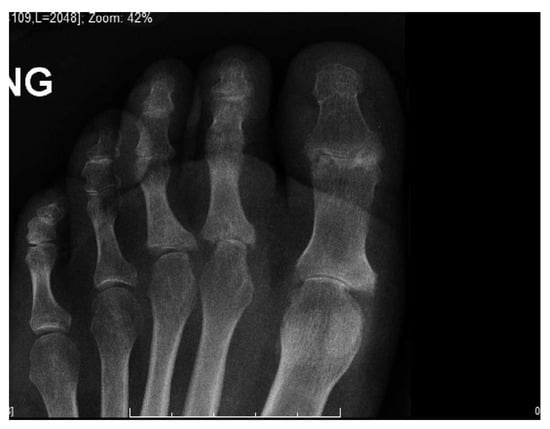
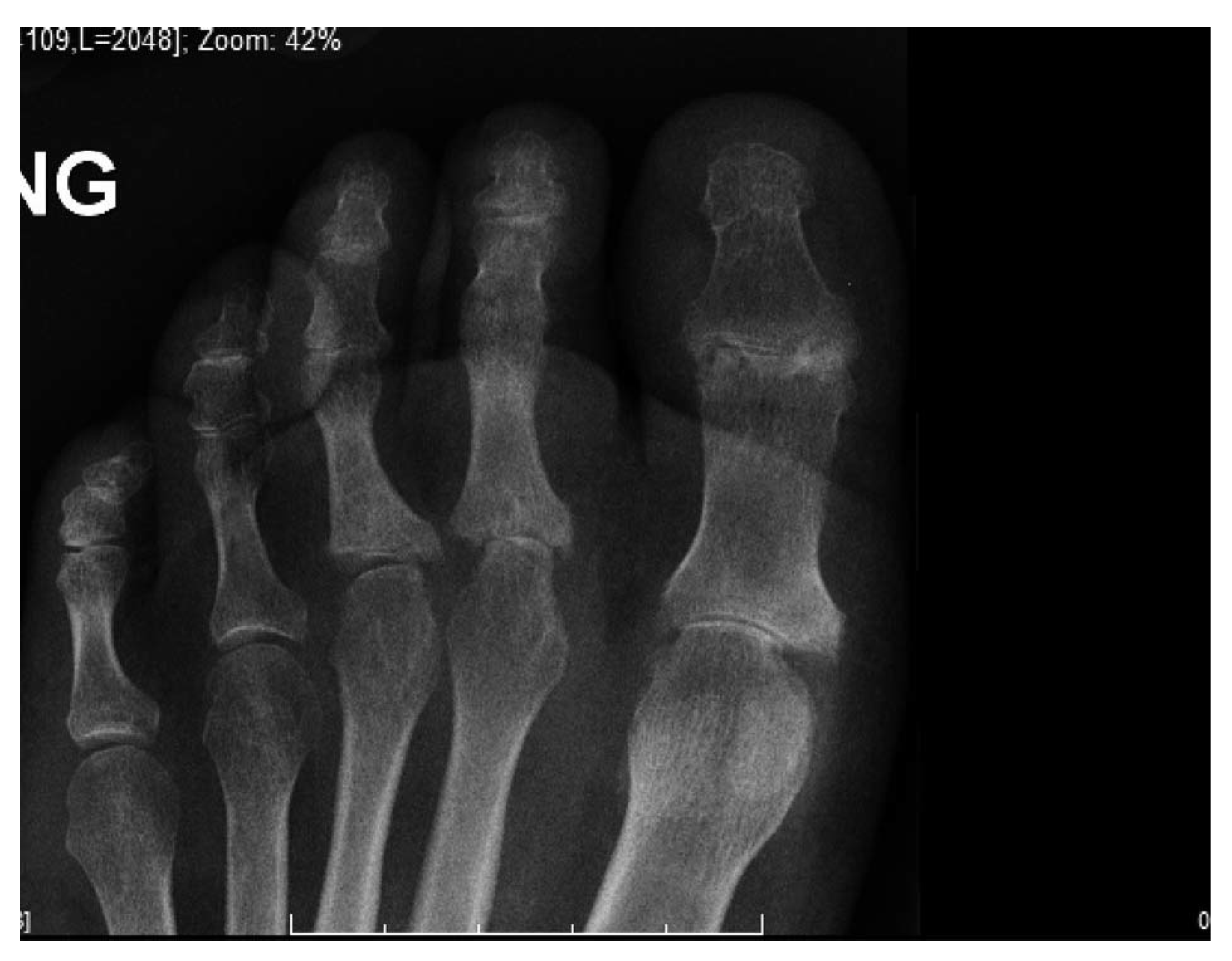
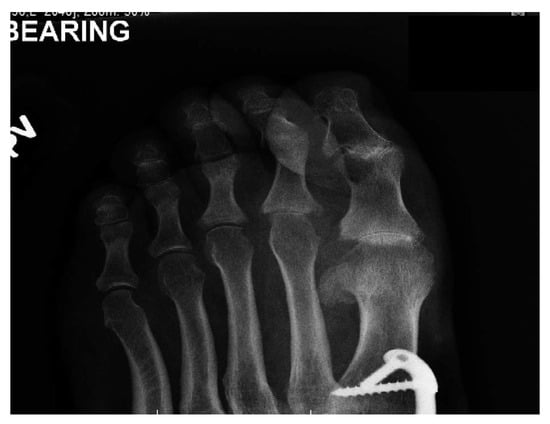
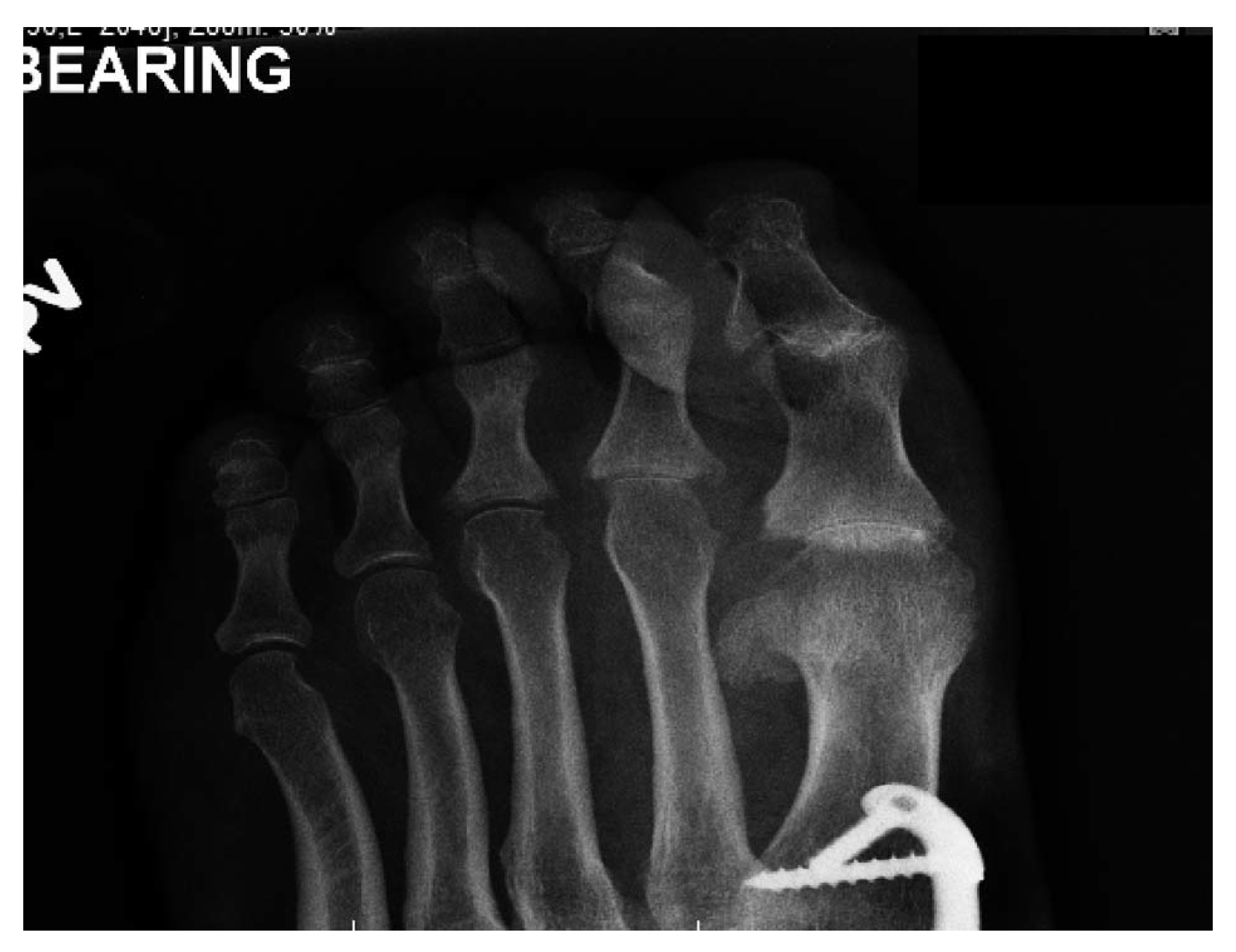
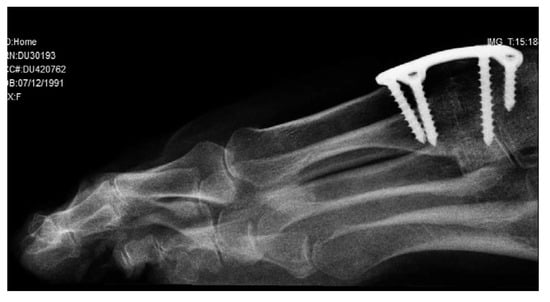
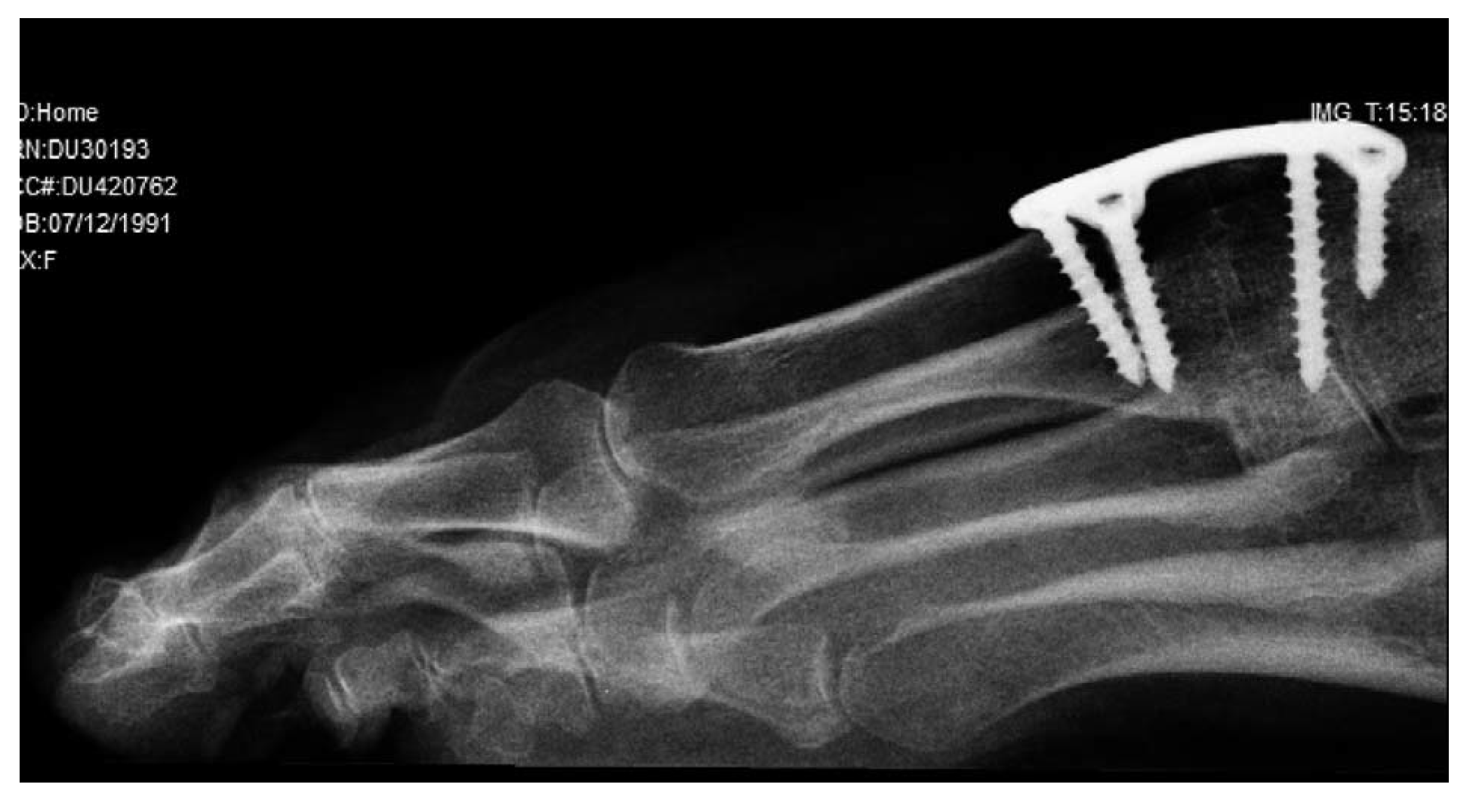
Radiographs of the left foot (Fig. 1,Fig. 2,Fig. 3) revealed soft-tissue swelling at the first, second, and third MPJs and the entire second toe. There was severe joint narrowing to the first, second, and third MPJs, and the interphalangeal joint of the hallux, ‘‘whiskering’’ at the base of the proximal phalanx of the hallux, and early arthritis mutilans of the second MPJ. There was decreased bone density of the metatarsal heads. There was evidence of a surgical fusion of the first metatarsal-medial cuneiform joint with screw-and-plate fixation (Fig. 1). The laboratory findings included a negative ANA test, a negative HLA-B27 test, an ESR of 63 mm/h (reference range, 0–20 mm/h), a CRP level of 2.3 mg/dL (normal reference range, 0.0–0.5 mg/dL), and a RF value less than 20 IU/mL (normal, , 25 IU/mL).
Figure 1.
Anteroposterior radiograph of the left foot showing changes consistent with psoriatic arthritis.
Figure 2.
Medial oblique radiograph of the left foot.
Figure 3.
Lateral radiograph of the left foot.
Based on the CASPAR classification for psoriatic arthritis, the patient’s score was 2, which was nondiagnostic.
Based on the patient’s clinical and radiographic findings, a presumptive diagnosis of psoriatic arthritis was made, and the patient was referred for a rheumatology consultation and discharged on a tapering dose of oral methylprednisolone. Two weeks later, a rheumatologist confirmed a diagnosis of psoriatic arthritis, despite of the paucity of other clinical signs. At this time, the ESR and CRP levels had returned to normal, liver and kidney function was normal, and she was not pregnant, as evidenced by a normal human chorionic gonadotropin level. She was started on oral methotrexate. Her right knee was injected with 2 cc of methylprednisolone acetate (40 mg/mL).
Discussion
Although 80% of patients presenting with psoriatic arthritis symptoms also have nail or skin changes, [1] this case showed symptoms of psoriatic arthritis without signs of psoriasis. Whether skin signs are present or not, practitioners routinely order laboratory tests to aid in diagnosis. Laboratory values such as rheumatoid factor, ANA, HLA-B27, CRP, and ESR are the most commonly evaluated. However, none of these blood tests are highly specific or sensitive for psoriatic arthritis [8-15]. The radiologic changes, along with a single sausage toe deformity, narrowed our focus to psoriatic arthritis. Serologic profiles of both psoriatic arthritis and rheumatoid arthritis can appear similar [16]. However, RF is much more likely to be negative in a patient with psoriatic arthritis [15,17]. Although a correlation exists between the presence of HLA-B27 and psoriatic arthritis, it is only positive in 20% of cases [8] and has a positive predictive value of 64% [9]. CRP is often more elevated in patients with psoriatic arthritis compared to psoriasis alone, [18] but is still not specific. ANA titers are similar in psoriatic arthritis and healthy controls [19]. Although elevations of ESR and CRP are the most characteristic laboratory findings in psoriatic arthritis, studies have shown that normal levels of ESR and CRP can be seen in approximately half of patients diagnosed with psoriatic arthritis [11,12]. However, the ESR and CRP levels can track the disease activity and provide guidance to aid in treatment methods and prognosis [18]. ESR and CRP decreases are associated with a positive response to therapy. They also can predict radiographic progression and the need for major joint replacement caused by conditions such as rheumatoid arthritis [20].
Conclusions
Our case study reinforced the notion that laboratory values provide little guidance in establishing a diagnosis of psoriatic arthritis. In fact, there are no ‘‘autoimmune diagnostic markers’’ [2] for the disorder. However, the more commonly ordered serum tests can be helpful in ruling out other inflammatory arthropathies such as rheumatoid arthritis, systemic lupus erythematosus, and vasculitis [2] or monitoring the course of the disease. The diagnosis of psoriatic arthritis must rely more heavily on clinical presentation and radiographic imaging, including radiography, ultrasound, and magnetic resonance imaging.
Financial Disclosures
None reported.
Conflicts of Interest
None reported.
References
- DIAMOND, HS. AL HAMMADI A: Fast five quiz: can you identify psoriatic arthritis and initiate the best treatment practices? Medscape. Available online: http://reference.medscape.com/viewarticle/835807 (accessed on 20 September 2019).
- MCHUGH, NJ. Early psoriatic arthritis. Rheum Dis Clin North Am 2015, 41, 615. [Google Scholar] [CrossRef] [Scilit] [PubMed]
- MOREZAVI, M; THIELE, R. RITCHLIN C: The joint in psoriatic arthritis. Clin Exp Rheumatol 2015, 33, S20. [Google Scholar]
- HADDAD, A; CHANDRAN, V. Arthritis mutilans. Clin Rheumatol Rep 2013, 15, 231. [Google Scholar] [CrossRef] [Scilit] [PubMed]
- CHRISTMAN, RA. Joint Disease,’’ in Foot and Ankle Radiology, p 367; Wolters Kluwer: Philadelphia, 2015. [Google Scholar]
- DELLE SEDIE, A; RIENTE, L. Psoriatic arthritis: what ultrasound can provide us. Clin Exp Rheumatol 2015, 33 (suppl 93), S60. [Google Scholar] [PubMed]
- SUDOL-SZOPINSKA, I; SCHULLER-WEIDEKAMM, C. TEH J: Ultrasound in arthritis. Radiol Clin North Am 2017, 55, 985. [Google Scholar] [CrossRef] [Scilit] [PubMed]
- CHANDRAN, V; BULL, SB; PELLETT, FJ; et al. Human leukocyte antigen alleles and susceptibility to psoriatic arthritis. Hum Immunol 2013, 74, 1333. [Google Scholar] [CrossRef] [Scilit] [PubMed]
- EDER, L; CHANDRAN, V; PELLET, F; et al. Human leukocyte antigen risk alleles for psoriatic arthritis among patients with psoriasis. Ann Rheum Dis 2012, 71, 50. [Google Scholar] [CrossRef] [Scilit] [PubMed]
- WINCHESTER, R; MINEVICH, G; STESHENKO, V. HLA associations reveal a genetic heterogeneity in psoriatic arthritis and in the psoriasis phenotype. Arthritis Rheum 2012, 64, 1134. [Google Scholar]
- GLADMAN, DD; SHUCKETT, R; RUSSELL, ML; et al. Psoriatic arthritis (PSA): an analysis of 220 patients. Q J Med 1987, 62, 127. [Google Scholar] [PubMed]
- CERVINI, C; LEARDINI, G; MATHIEU, A; et al. Psoriatic arthritis: epidemiological and clinical aspects in a cohort of 1.306 Italian patients [in Italian]. Reumatismo 2005, 57, 283. [Google Scholar] [PubMed]
- SILVY, F; BERTIN, D; BARDIN, N; et al. Antinuclear antibodies in parents with psoriatic arthritis treated or not with biologics. PLoS One 2015, 10, e0134218. [Google Scholar] [CrossRef] [Scilit] [PubMed]
- TAYLOR, W; GLADMAN, D; HELLIWELL, P. Classification criteria for psoriatic arthritis: development of new criteria from a large international study. Arthritis Rheum 2006, 54, 2665. [Google Scholar] [CrossRef] [Scilit] [PubMed]
- BOGLIOLO, L; ALPINI, C; CAPORALI, R; et al. Antibodies to cyclic citrullinated peptides in psoriatic arthritis. J Rheumatol 2005, 32, 511. [Google Scholar] [PubMed]
- VENABLES, PJW; MAINI, RN. Diagnosis and Differential Diagnosis of Rheumatoid Arthritis, edited by JR ODell, PL Romain, Waltham, MA, UpToDate. Available online: https://www.uptodate.com (accessed on 20 September 2019).
- CHANDRAN, V; COOK, RJ; EDWIN, J; et al. Soluble biomarkers differentiate patients with psoriatic arthritis from those with psoriasis without arthritis. Rheumatology (Oxford) 2010, 49, 1399. [Google Scholar] [CrossRef] [Scilit] [PubMed]
- GLADMAN, DD; FAREWELL, VT; WONG, K; ET, AL. Mortality studies in psoriatic arthritis: results from a single outpatient center. II. Prognostic indicators for death. Arthritis Rheum 1998, 41, 1103. [Google Scholar] [CrossRef] [Scilit] [PubMed]
- SHMERLING RH, DELBANCO TL: How useful is the rheumatoid factor? An analysis of sensitivity, specificity, and predictive value. Arch Intern Med 1992, 152, 2417. [CrossRef] [Scilit]
- SAXENA, A; CRONSTEIN, B. Acute Phase Reactants and the Concept of Inflammation. In Kelly’s Textbook of Rheumatology; Elsevier, Inc: Philadelphia, 2013; p. 823. [Google Scholar]
© 2019 American Podiatric Medical Association