Nora's lesion, or bizarre parosteal osteochondromatous proliferation (BPOP), was first described in 1983 by Nora et al,
1 and only 170 cases have been reported.
2 Bizarre parosteal osteochondromatous proliferation is a rare disorder involving feet and hands.
3 Typical sites include the proximal phalanx and metacarpal and metatarsal bones. Hands are four times more likely than feet to be affected.
4 The frequency with which it affects men and women is equal. It most commonly occurs between the ages of 20 and 30 years.
5 The recurrence rate was found to be 28%, but can range from 20% to 55%.
3,6,7 Although it is benign on imaging, aggressive features and mixed histopathology make it difficult to diagnose and differentiate from more harmful tumor types, such as chondrosarcoma and parosteal osteosarcoma. This presents the clinician with a challenge, as the treatment plan varies widely between BPOP and these other malignancies. Bizarre parosteal osteochondromatous proliferation may also be mistaken for other benign lesions such as reactive periostitis, myositis ossificans, periosteal chondroma, and osteochondroma.
8 Case Report
A 51-year-old woman presented with neuritic pain and a soft-tissue mass between her left second and third digits, and denied any history of trauma. She stated that the pain began “over the last couple years” and had worsened steadily.
Clinical examination revealed a nontender plantar mass around the second and third proximal phalanges. The overlying skin was intact without wounds or ulcerations, and the vascular status and sensation overlying the area were intact. The patient denied any nausea, fever, chills, vomiting, or recent weight loss.
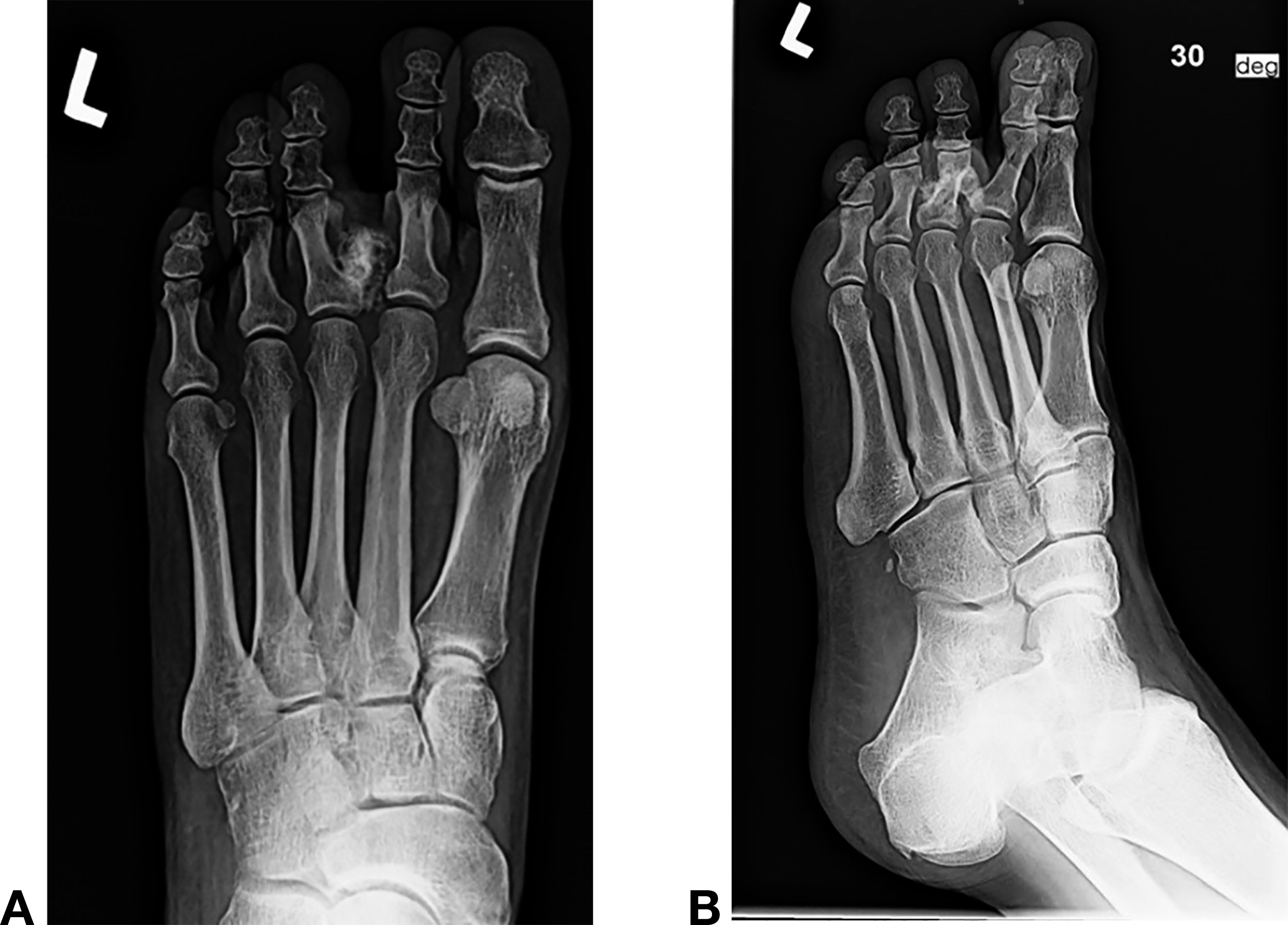
Weightbearing, three-view, plain-film radiographs were obtained (
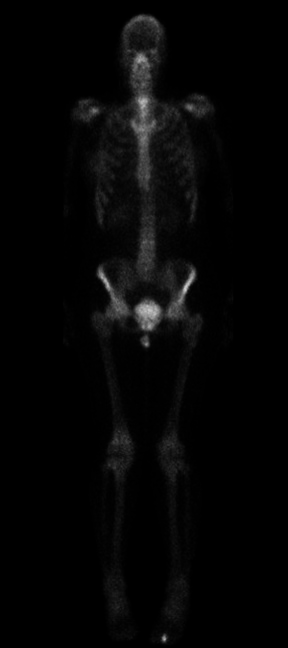
Fig. 1) that demonstrated a radiopaque area between the left second and third proximal phalanges and extending plantarly. The area was circular with diffuse radiopacity that appeared to originate from the third metatarsal metaphyseal medial cortex flare and demonstrated lateral deviation and splay of that digit. The lesion appeared to originate from the proximal phalanx medial cortex but did not demonstrate cortical disruption. Ultrasound examination revealed a hyperechoic lesion with measurements of 9.0 × 7.0 mm dorsally and 1.9 × 1.8 mm plantarly. To further assess the lesion, a technetium-99 bone scan (
Fig. 2) was ordered and showed increased uptake at the left foot second interspace.
Figure 1.
A, Anteroposterior weightbearing view of the left foot. B, Oblique weightbearing view of the foot. In the second interspace, a lesion is present with circularly shaped diffuse radiodensity that appears to originate from the third metatarsal metaphyseal medial cortex flare. The lesion appears to arise from the proximal phalanx medial cortex but does not demonstrate cortical disruption. Lateral deviation of the third digit, causing a splay deformity, can be appreciated.
Figure 1.
A, Anteroposterior weightbearing view of the left foot. B, Oblique weightbearing view of the foot. In the second interspace, a lesion is present with circularly shaped diffuse radiodensity that appears to originate from the third metatarsal metaphyseal medial cortex flare. The lesion appears to arise from the proximal phalanx medial cortex but does not demonstrate cortical disruption. Lateral deviation of the third digit, causing a splay deformity, can be appreciated.
Figure 2.
A technetium-99 bone scan was ordered and showed increased uptake at the left foot second interspace focally, and did not demonstrate signs of invasion or metastasis.
Figure 2.
A technetium-99 bone scan was ordered and showed increased uptake at the left foot second interspace focally, and did not demonstrate signs of invasion or metastasis.
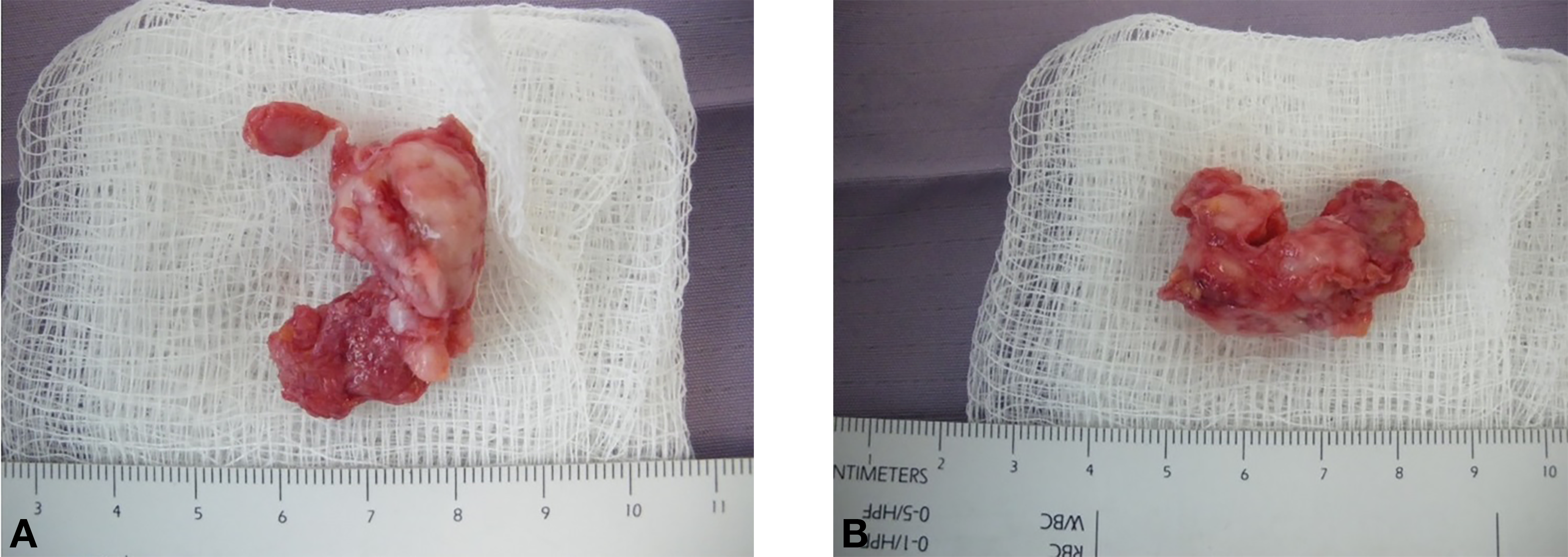
The lesion was treated initially conservatively through offloading, padding, and taping, which was unsuccessful. After completion of the bone scan, it was decided that the lesion should be surgically excised and sent for pathologic examination. The lesion was excised and measured approximately 3.5 × 2.0 × 1.5 cm (
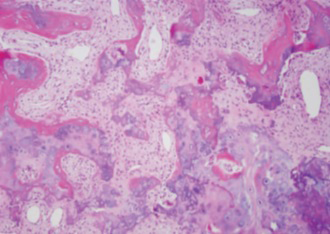
Fig. 3) and was observed intraoperatively to have a fibrous texture and contain small diffuse areas of bone. The lesion was sent for pathologic evaluation and was characterized as being a benign proliferative lesion with small diffuse calcifications, and identified as BPOP (
Fig. 4).
Figure 3.
Macroscopic view of the lesion. The lesion is composed of numerous nodular adherent lobules. Note that the lobules were removed from the underlying cortex of the third metatarsal, without disruption or destruction of the phalanx. The lesion is encapsulated and does not demonstrate any areas of invasion into the bone or underlying tissues. The lesion measured 3.5 × 2.0 × 1.5 cm.
Figure 3.
Macroscopic view of the lesion. The lesion is composed of numerous nodular adherent lobules. Note that the lobules were removed from the underlying cortex of the third metatarsal, without disruption or destruction of the phalanx. The lesion is encapsulated and does not demonstrate any areas of invasion into the bone or underlying tissues. The lesion measured 3.5 × 2.0 × 1.5 cm.
Figure 4.
Photomicrograph demonstrating bizarre parosteal osteochondromatous proliferation (H&E x100). Mixture of fibrous tissue and cartilage undergoing endochondral ossification. Interface between the forming bone and cartilage shows the characteristic purple-blue stain (ie, “blue bone”).
Figure 4.
Photomicrograph demonstrating bizarre parosteal osteochondromatous proliferation (H&E x100). Mixture of fibrous tissue and cartilage undergoing endochondral ossification. Interface between the forming bone and cartilage shows the characteristic purple-blue stain (ie, “blue bone”).
The patient's neuritic pain has since resolved, with some slight loss of sensation of the third digit; the healing course was unremarkable. The patient was lectured on the risk of recurrence, and can follow up as needed. It was noted that the patient also observed mild reduction in digit splay deformity during follow-up.
Discussion
This case highlights some of the classic symptoms and the presentation of Nora's lesion. Bizarre parosteal osteochondromatous proliferation may appear to arise directly from the cortical surface of an underlying metaphyseal bone, but will be well marginated and not disrupt the cortex of the parent bone. This was also the case with the patient's plain film radiographs and with intraoperative findings. Worth noting was the patient's absence of trauma in their history, as BPOP is generally associated with some form of initial trauma.
In our case, the patient had a tumor that exhibited slow growth and a benign nature but had some histopathologic findings possibly consistent with more malignant conditions such as diffuse tissue calcinosis, calcification of cartilage, and spindle cells. The location of the BPOP was noteworthy: it occurred at the metaphysis of the proximal phalanx of the lower extremity, although it is more commonly found in the upper extremity.
Bizarre parosteal osteochondromatous proliferations are rare but have a tendency for recurrence; thus, the patient was educated on this likelihood of recurrence. Surgery is the treatment of choice for patients with BPOP despite the fact that the lesions have been shown to be benign in nature. Because of the clinical presentation and atypical radiographic and histopathologic findings, the clinician may experience heightened anxiety, prompting unnecessary surgical procedures.