


Abstract
Lipofibromatous hamartoma (LFH) is a rare, benign, tumor-like soft-tissue lesion that affects the peripheral nerves and forms a palpable neurogenic mass. Lipofibromatous hamartoma is associated with pain and sensory and/or motor deficits in the area of innervation of the affected nerve. This report describes a rare case of LFH of the plantar nerve. A 48-year-old woman presented to our outpatient orthopedic clinic with pain and a burning sensation on her left foot. The patient had a history of Morton's neuroma and had undergone a tarsal tunnel operation 2 years earlier at another center. None of her symptoms was alleviated by two previous operations. Magnetic resonance imaging with contrast revealed tenosynovitis of the flexor hallucis longus tendon and signal changes at deep tissue planes of the foot at the levels of the second and third toes, on the dorsal site and subcutaneous soft-tissue planes, suggesting edema and Morton's neuroma. The lesion was excised under spinal anesthesia, and histopathologic examination of the specimen revealed a diagnosis of LFH. The patient was discharged without any symptoms and her foot was normal at 8-month outpatient follow-up, with no indications of postoperative complications and/or recurrence.
Lipofibromatous hamartoma (LFH) is a rare, benign, soft-tissue neoplasm also called neural fibrolipomatosis, intraneural or extraneural fibroma, neural lipomatous hamartoma, macrodystrophia lipomatosa, and neural fibrolipoma.[1–4] Lipofibromatous hamartoma is generated by the proliferation of mature adipocytes and nerve sheet fibroblasts, with slow growth, resulting in the formation of a palpable subcutaneous mass.[1,4–7] The pathogenesis of LFH is unknown. Some tumors are believed to be congenital and lack an underlying family history. Previous trauma and chronic irritation of the nerves are likely precipitating factors.[1,6] At surgery, LFH presents as a soft, gray-yellow, fusiform, sausage-shaped mass.[1,4] The clinical symptoms of LFH usually result from the compression of affected nerves. Because the median nerve is most frequently involved (66%–80%), LFH commonly presents as carpal tunnel syndrome.[1,2,5,8,9] Other affected nerves in the upper extremities include the radial and ulnar nerves,[2,3,5,8–10] whereas LFH rarely affects the nerves of the lower extremities.[11–13] However, LFH of the lower extremities has been reported to involve the sciatic, tibial, peroneal, calcaneal, and sural nerves.[12–22] Lipofibromatous hamartoma arising in the plantar nerve is extremely rare.[3,19] This report describes a very rare case of LFH of the plantar nerve in a patient with a history of Morton's neuroma and treatment for tarsal tunnel syndrome.
Case Report
A 48-year-old woman presented to our patient orthopedics clinic with complaints of pain and a burning sensation on the plantar side of her left foot over the second and third toes and difficulty walking. She had previously undergone excision of a Morton's neuroma and a tarsal tunnel operation 2 years earlier at another center, but none of her symptoms was alleviated by these previous operations. Physical examination showed mild swelling and tenderness on the plantar second-third distal metatarsophalangeal architecture, with sensitivity and numbness exhibited in that area on palpation. There was pain especially in the second metatarsal space. There was no pain under the metatarsal heads. The Tinel test was negative. Radiographs showed no abnormal changes.
Magnetic resonance imaging of the deep tissue planes of the foot, at the levels of the second and third toes and of the dorsal site, showed signal changes in subcutaneous soft-tissue planes associated with edema and Morton's neuroma (Fig. 1). Under spinal anesthesia, the lesion was approached by plantar longitudinal incision under the second metatarsal bone. A yellowish tan soft-tissue lesion, 1.7 × 1.7 cm, was excised subcutaneously. The wound was sutured with a nonabsorbable propylene suture. One gram of cefazolin was taken parenterally for prophylaxis. Partial weightbearing was allowed in the first week postoperatively. The excisional biopsy specimen was sent to the pathology department (Fig. 2).
Figure 1.
Coronal (A) and axial (B) fat saturated T2-weighted magnetic resonance images of a plantar lipomatous lesion, showing plantar subcutaneous signal density and edema (arrows).
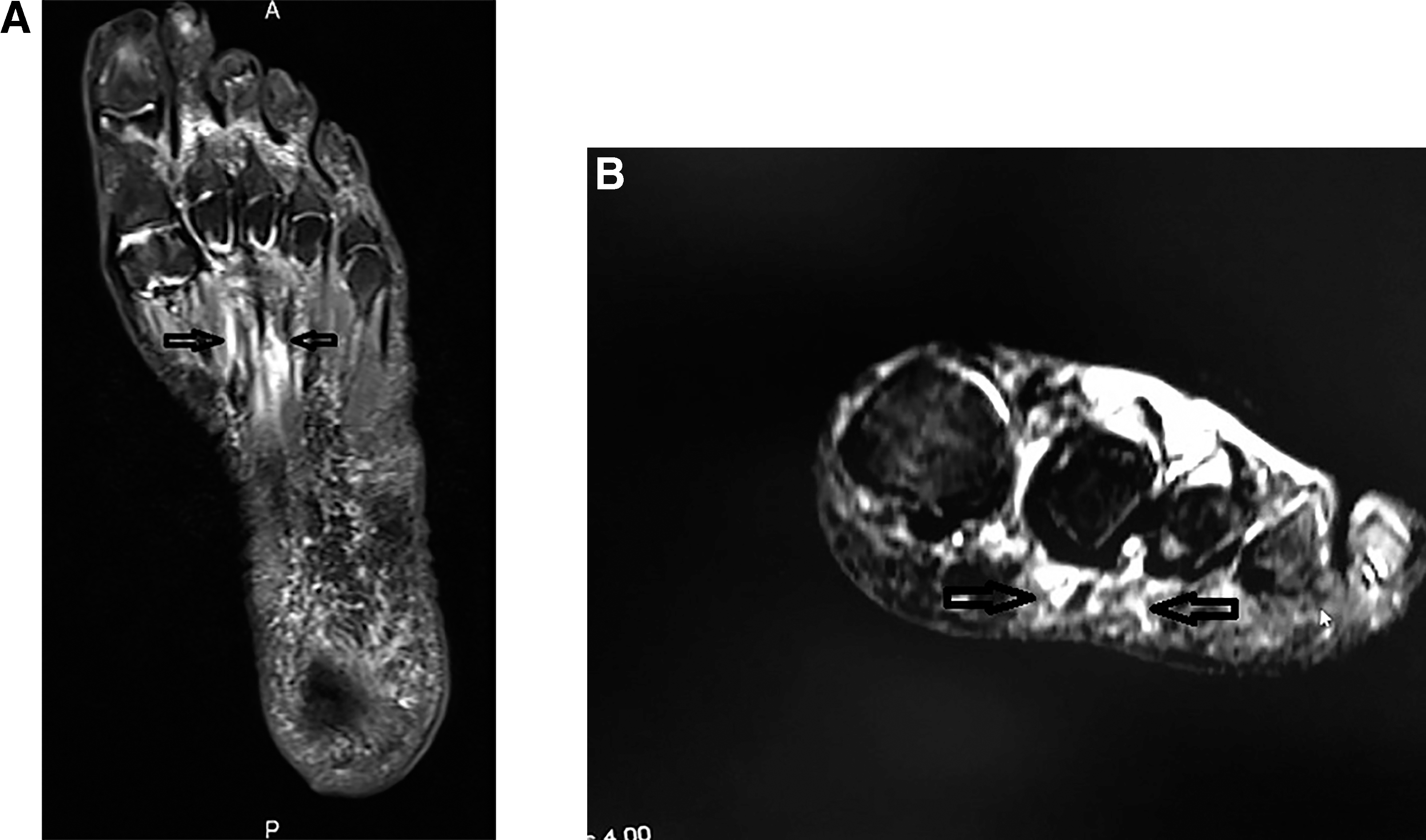
Figure 2.
Intraoperative aspect and a yellowish white tumor specimen with dimensions of 1.7 × 1.7 × 1 cm.
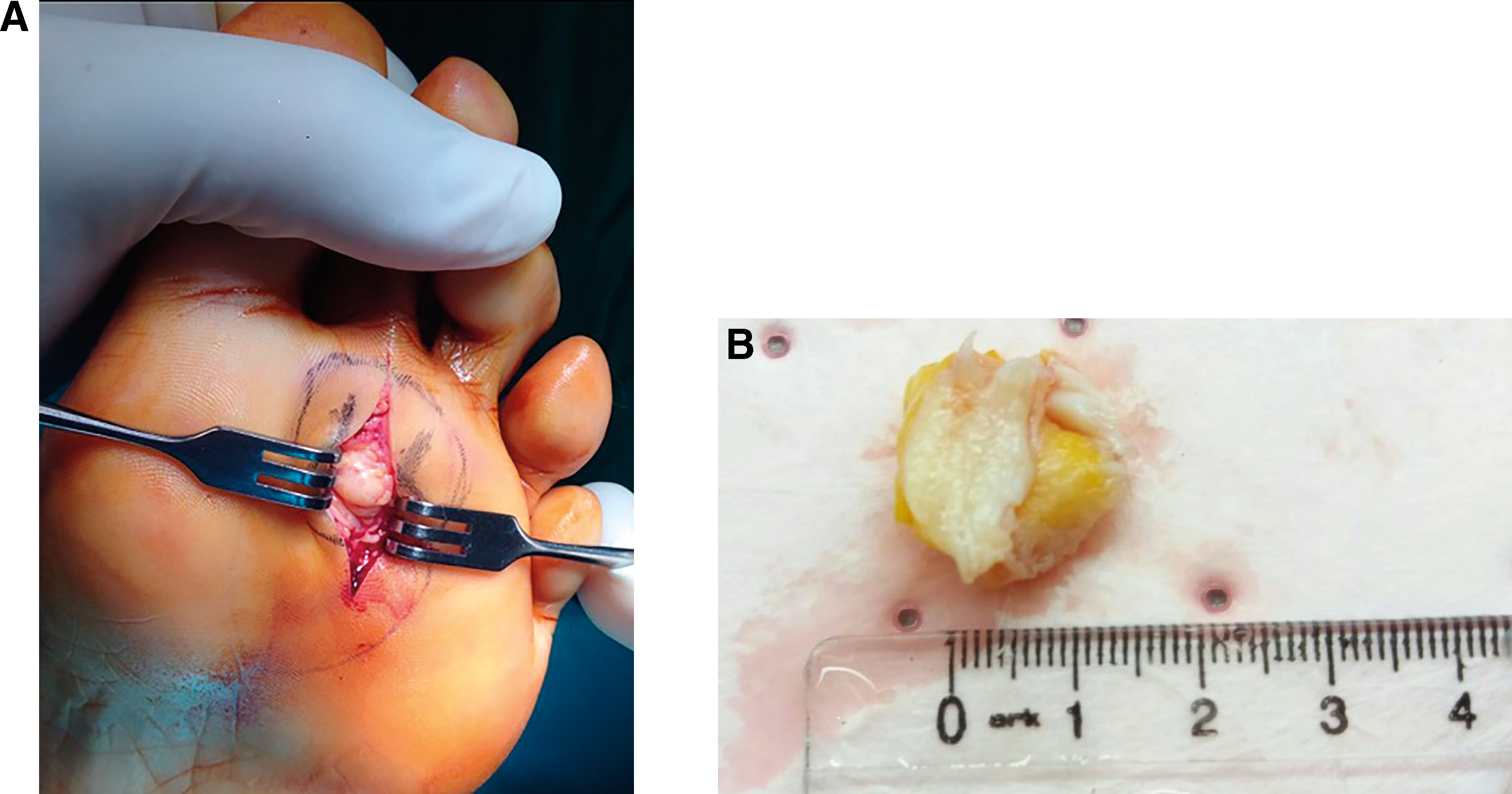
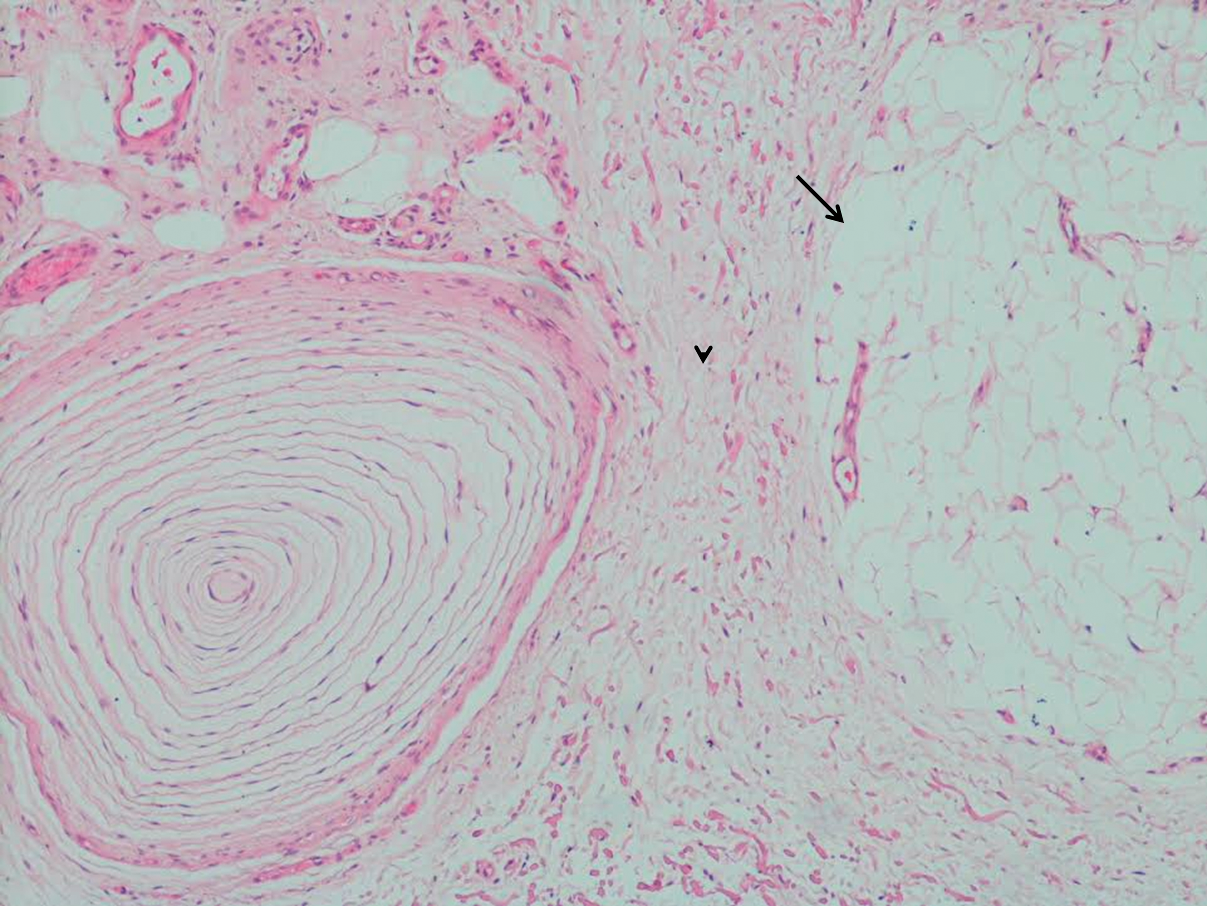
Macroscopic examination showed that this specimen was an unencapsulated soft, yellowish white, fatty tissue–like mass, 1.7 × 1.7 × 1 cm in size, with a yellowish white excisional surface. Microscopic examination revealed a hamartomatous lesion composed of mature adipose tissue and fibrocollagenous mesenchymal tissue encompassing the peripheral nerves with concentric perineural thickening (Fig. 3). In some areas, the mature adipose tissue infiltrated the perineurium and epineurium (Fig. 4). These histopathologic findings suggested a diagnosis of neural LFH. The final examination of the patient revealed no motor or sensory deficits.
Figure 3.
Histopathologic image of mature adipose tissue infiltrating the perineurium (arrow) and epineurium (arrowhead) (H&E, ×200).
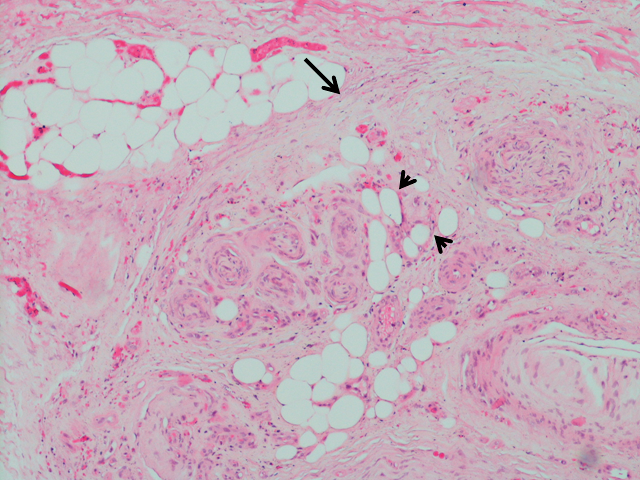
Figure 4.
Histopathologic image of the hamartomatous lesion of our patient. The lesion was composed of mature adipose tissue (arrow) and fibrocollagenous mesenchymal tissue (arrowhead) (H&E, ×400).
Discussion
Lipofibromatous hamartoma is a rare, benign, tumor-like soft-tissue lesion that affects the peripheral nerves and forms a palpable neurogenic mass.[5] Lipofibromatous hamartoma usually develops on the volar aspects of the hands, wrists, and forearms of young persons.[1,4] It has a predilection to form at the median nerve and is frequently associated with carpal tunnel syndrome.[2,8,9] Lipofibromatous hamartoma of the plantar nerve is extremely rare, with one previous report describing a patient with LFH involving the medial plantar nerve, similar to our patient.[19] Moreover, a series of 26 patients with LFH found that only one involved the plantar nerve. Although both of the above patients with plantar LFH had macrodactyly,[4,19] our patient did not. However, she had a history of Morton's neuroma and tarsal tunnel surgery.
Lesions of this type have also been described in the literature.[1,4,22] A diagnosis of LFH in patients presenting with pain and swelling along the innervation area of the affected nerve is confirmed by histopathologic examination.[5] This examination typically shows fibrofatty tissue growing along the epineurium and perineurium, surrounding and infiltrating the nerve trunk.[4] In our patient, mature adipose tissue and fibrocollagenous mesenchymal tissue were found to encompass the peripheral nerves with concentric perineural thickening. Moreover, in some areas, mature adipose tissue had infiltrated the perineurium and epineurium.
Lipofibromatous hamartoma almost always occurs during the first three decades of life, whereas our patient was 48 years old at presentation. Although LFH may be congenital, its exact etiology is still unclear. The recommended management of LFH is either conservative or surgical. Surgery on LFH of the median nerve has been reported to cause ischemic complications, postoperative loss of sensory distribution, and decreased electromyographic function.[11] Among the factors thought to affect prognosis are the degree of involvement, tumor size, patient age, and surgical technique used. Lipofibromatous hamartoma in our patient involved only the sensory nerves. There were no postoperative complications during the 8-month patient follow-up.
Conclusions
In summary, LFH is a rare tumor-like lesion that may mimic tarsal tunnel syndrome, as the two entities may present similarly. Although LFH localizing to the medial plantar nerve is rare, it should be included in the differential diagnoses. Lipofibromatous hamartoma is characterized by several specific magnetic resonance imaging findings, including thickening of the affected nerve with adipose tissue interspersed among the nerve fascicles, thereby mimicking other soft-tissue masses such as Morton's neuroma. Histopathologic evaluation is required for the exact diagnosis of LFH. Patients with tarsal tunnel syndrome or Morton's neuroma should be evaluated carefully for the differential diagnosis of plantar nerve LFH.
Financial Disclosure
None reported.
Conflict of Interest
None reported.
References
- TerrillPJ,BlazarP:Lipofibromatous hamartoma: a review article. Orthop J Harv Med Sch11: 87, 2009.
- FaresJ,NatoutN,FaresYJ:Neural fibrolipoma of the median nerve. J Med Liban64: 47, 2016.
- AymardB,Boman-FerrandF,VernhesL,et al:Fibrolipomatous hamartoma of the peripheral nerves: anatomico-clinical study of 5 cases, including 2 with ultrastructural study [in French]. Ann Pathol7: 320, 1987.
- SilvermanTA,EnzingerFM:Fibrolipomatous hamartoma of nerve: a clinicopathologic analysis of 26 cases. Am J Surg Pathol9: 7, 1985.
- KiniJR,KiniH,RauA,et al:Lipofibromatous hamartoma of the median nerve in association with or without macrodactyly. Turk Patoloji Derg34: 87, 2018.
- KuoY-L,WuY-H,HsiaoP-F,HsiehJ-Y:Lipofibromatous hamartoma of the superficial peroneal nerve: two case reports. Dermatol Sin30: 21, 2012.
- DhinsaBS,LidderS,AbbasianA:Atypical presentation of fibrolipomatous hamartoma of superficial peroneal nerve. J Foot Ankle Surg55: 1067, 2016.
- LouasteJ,ZejjariH,ChkouraM,et al:Carpal tunnel syndrome due to fibrolipomatous hamartoma of the median nerve. Hand (N Y)6: 76, 2011.
- AgrawalR,GargC,AgarwalA,et al:Lipofibromatous hamartoma of the digital branches of the median nerve presenting as carpal tunnel syndrome: a rare case report with review of the literature. Indian J Pathol Microbiol59: 96, 2016.
- UlrichD,UlrichF,SchroederM,et al:Lipofibromatous hamartoma of the median nerve in patients with macrodactyly: diagnosis and treatment of a rare disease causing carpal tunnel syndrome. Arch Orthop Trauma Surg129: 1219, 2009.
- TaddieKL,FallatLM:Lipofibromatous hamartoma of nerve. J Foot Ankle Surg46: 116, 2007.
- HirakawaE,MikiH,KobayashiS,et al:Lipofibromatous hamartoma of nerve in the foot. Acta Pathol Jpn43: 265, 1993.
- NaikG,MitraD,ShettyS,et al:A case report of neural fibrolipoma of foot. J Med Sci Health2: 41, 2016.
- AkisueT,MatsumotoK,YamamotoT,et al:Neural fibrolipoma of the superficial peroneal nerve in the ankle: a case report with immunohistochemical analysis. Pathol Int52: 730, 2002.
- KrzywosinskiTB,BinghamAL,FallatLM:Intraneural lipoma of the tibial nerve: a case report. J Foot Ankle Surg56: 125, 2016.
- DonleyBG,NeelM,MitiasHM:Neural fibrolipoma of the foot: a case report. Foot Ankle Int17: 712, 1996.
- ZengR,Frederick-DyerK,FergusonNL,et al:Fibrolipomatous hamartoma of the inferior calcaneal nerve (Baxter nerve). Skeletal Radiol41: 1323, 2012.
- FandridisEM,KiriakoAS,SpyridonosSG,et al:Lipomatosis of the sciatic nerve: report of a case and review of the literature. Microsurgery29: 66, 2009.
- Van BreuseghemI,SciotR,PansS,et al:Fibrolipomatous hamartoma in the foot: atypical MR imaging findings. Skeletal Radiol32: 651, 2003.
- PariharA,VermaS,SengerM,et al:Fibrolipomatous hamartoma of sural nerve: a new site of an unusual lesion. Malays J Pathol36: 59, 2014.
- MamP,LewisEB,SongT,et al:Fibrolipomatous hamartoma of nerve in the great toe. JAPMA104: 531, 2014.
- FransenBL,BroedersMG,van OosteromFJ,et al:Operative resection is a viable treatment of macrodactyly of the foot caused by lipofibromatous hamartoma: a case study with 5 year follow-up. Foot Ankle Surg20: e47, 2014.
Copyright ©2018 by the American Podiatric Medical Association