Acrokeratoelastoidosis (AKE) is a rare genodermatosis of unknown cause. It typically begins during childhood or adolescence and clinically is characterized by multiple small, firm, yellowish papules located on the lateral aspects of hands and feet. Its pathogenesis is unclear; however, it seems to be related to the accumulation of filaggrin and/or defects in the elastic properties of the dermis.[
1] The diagnosis of AKE can be difficult given its similarity with other papular acrokeratodermas, xanthomas, flat warts, or piezogenic pedal papules, among others entities.
Color Doppler ultrasound has been increasingly used for studying cutaneous conditions. This noninvasive technique may demonstrate the nature (solid or cystic), location, extent in all axes, and presence of vascularity.[
2] This may be relevant to render a better differential diagnosis of cutaneous entities that produce papules on the feet, particularly in the pediatric population. We present a case of AKE with clinical, dermoscopic, sonographic, and histopathologic correlation.
Clinical Case
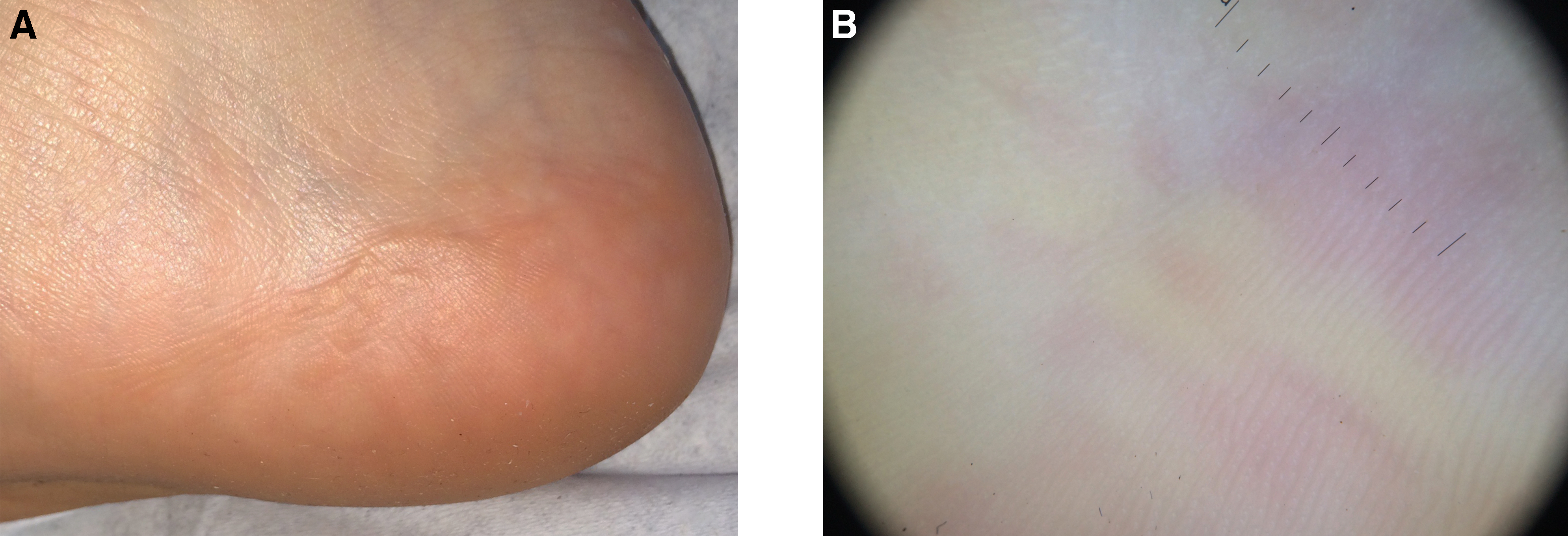
A 7-year-old girl with a history of allergic rhinitis and bronchial asthma, otherwise healthy, was referred to the Department of Dermatology for asymptomatic papular lesions on the feet noted during the past month. The clinical examination showed multiple skin color and yellowish papules, most of them with linear or annular arrangement, along the posteromedial aspects of both feet and the lateral aspects of the base of the fifth toes. Dermoscopy showed yellowish, structureless, linear areas (
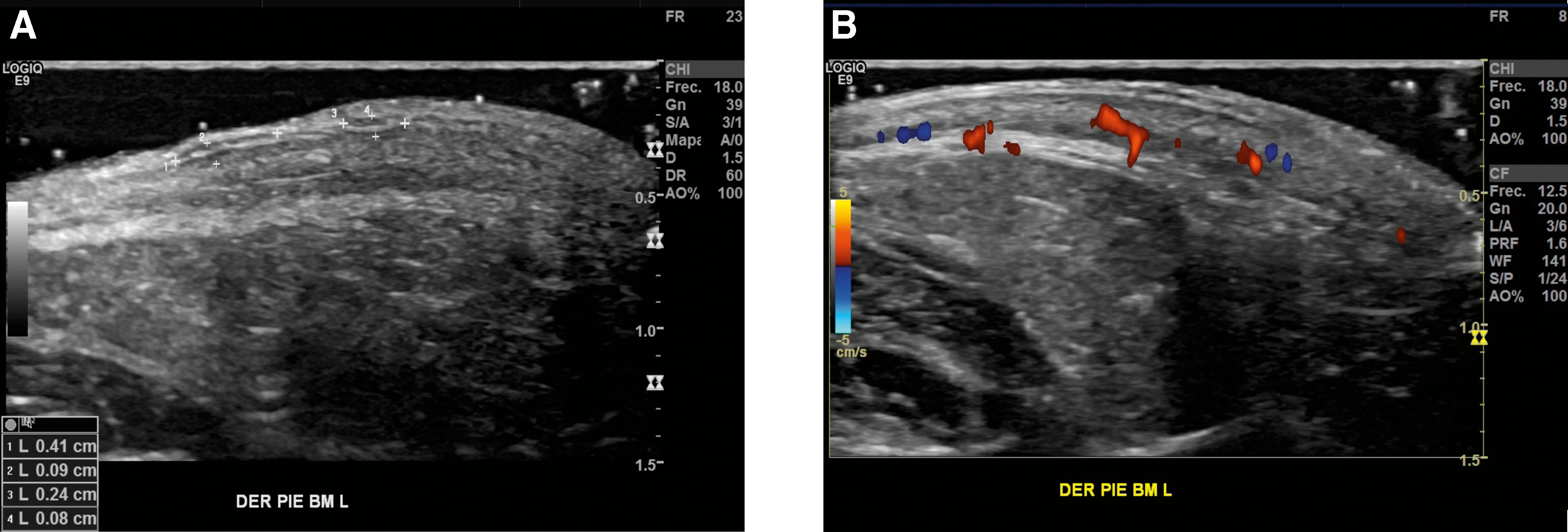
Fig. 1). The patient underwent a color Doppler ultrasound examination that demonstrated several focal solid hypoechoic and hypovascular areas with thickening of the epidermis and upper dermis (
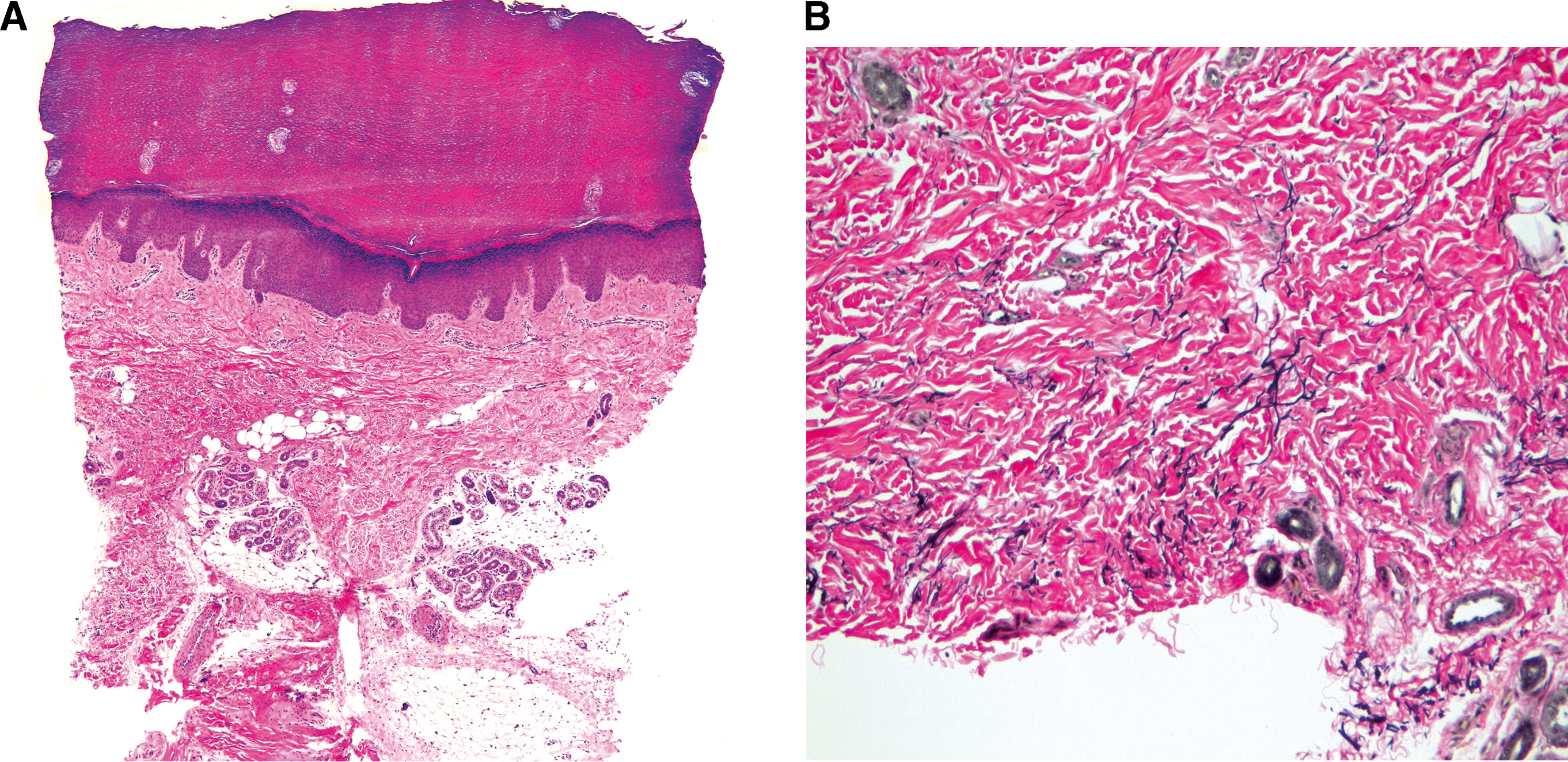
Fig. 2). No well-defined protrusions of fat lobules were detected, suggesting benignancy and ruling out the presence of piezogenic pedal papules and granulomas. The histopathologic study showed hyperorthokeratosis, hypergranulosis, and acanthosis in the epidermis; nonsignificant inflammatory elements in the dermis; and a normal hypodermis. Elastic–van Gieson stain demonstrated the presence of several short and fragmented elastic fibers arranged haphazardly in the reticular dermis, findings that were consistent with AKE (
Fig. 3).
Figure 1.
(A) Yellowish papules with a linear configuration in the posteromedial aspect of the right foot. (B) Dermoscopic appearance with linear structureless and yellowish areas.
Figure 1.
(A) Yellowish papules with a linear configuration in the posteromedial aspect of the right foot. (B) Dermoscopic appearance with linear structureless and yellowish areas.
Figure 2.
Ultrasound imaging. (A) Gray scale and (B) color Doppler images show two neighboring focal hypoechoic and hypovascular areas with thickening of the epidermis and upper dermis. No well-defined fatty lobule protrusions are detected.
Figure 2.
Ultrasound imaging. (A) Gray scale and (B) color Doppler images show two neighboring focal hypoechoic and hypovascular areas with thickening of the epidermis and upper dermis. No well-defined fatty lobule protrusions are detected.
Figure 3.
(A) Photomicrographs showing acral skin with hyperorthokeratosis, hypergranulosis, and acanthosis (H&E, ×20). (B) Elastic–van Gieson staining demonstrates several short and fragmented elastic fibers arranged haphazardly in the reticular dermis.
Figure 3.
(A) Photomicrographs showing acral skin with hyperorthokeratosis, hypergranulosis, and acanthosis (H&E, ×20). (B) Elastic–van Gieson staining demonstrates several short and fragmented elastic fibers arranged haphazardly in the reticular dermis.
Discussion
Acrokeratoelastoidosis is a rare focal acral keratoderma that usually occurs in children and adolescents, but there are some reports of adult onset.[
3] The first case was described by the Brazilian dermatologist Oswaldo Costa.[
4] For familial forms of the disease, the most common inheritance mode is autosomal dominant, with a gene possibly located on chromosome 2,[
5] although sporadic and recessives forms have been reported.[
6] Chronic trauma, intense solar exposure, aquagenic palmoplantar keratoderma, and systemic sclerosis have been linked to AKE.[
7,
8] Clinically, AKE is characterized by multiple asymptomatic; small; firm; round or oval; skin-colored, translucent, or yellowish papules that tend to be located on the lateral margins of hands and/or feet. However, in our case, the posteromedial border of the feet was also involved. Sometimes, AKE can affect the dorsum or the palmoplantar regions and the anterior aspect of the lower legs. The distribution of papules is often bilateral and symmetrical, adopting a linear or cobblestone configuration. Occasionally, AKE patients may present mild itching or hyperhidrosis, coalescent plaques, an umbilicated, hyperkeratotic or violaceous surface, or rarely, a unilateral distribution.[
9,
10]
The histopathologic study confirms the definitive diagnosis and typically reveals focal hyperkeratosis with hypergranulosis and acanthosis, with or without epidermal hyperplasia. The reticular dermis shows a reduced number of elastic fibers, which are thickened, curved, and fragmented, a phenomenon called elastorrhexis.[
1,
11] Elastic–van Gieson or acid orcein stain demonstrates this and suggests altered connective tissue deposition within the affected area. However, elastorrhexis has also been observed in perilesional healthy skin, suggesting a generalized disorder of the elastic tissue.[
11] The dermoscopic appearance of the lesions could be explained by the localized thickening of acral skin.
The differential diagnosis should consider xanthoma, porokeratosis, flat warts, acrokeratosis verruciformis of Hopf, and particularly other acral keratodermas with a clinical presentation similar to marginal papular acrokeratoderma.[
12] Marginal papular acrokeratodermas are divided into hereditary and acquired forms, and it has been suggested that the hereditary marginal papular acrokeratoderma would correspond to a clinicopathologic variant of AKE, attributable to a variable genetic penetrance. It is important to mention that the main differential diagnosis within this group is focal acral hyperkeratosis, clinically identical to the AKE but without elastorrhexis, although there may be subtle changes in elastic fibers visible only with electron microscopy.[
11]
Color Doppler ultrasound has been proved to be a useful, noninvasive imaging tool for assessing the nature, location, extent, and vascularity of common cutaneous conditions.[
3] In this case, color Doppler ultrasound allowed us to localize the condition in the epidermis and upper dermis; measure the extent of the lesion; and assess the lesion's solid, hypovascular, and benign appearance. With this information, color Doppler ultrasound was able to rule out the presence of piezogenic pedal papules that are usually seen as hypoechoic focal protrusions of the hypodermal tissue into the dermis[
13] and the presence of granulomas that tend to show a pseudonodular hypoechoic dermal appearance according to our experience.
Malignant transformation of this entity has not been reported, and its evolution tends to be stable without spontaneous resolution. Only a single case with rapid progression during pregnancy has been reported.[
3,
10] Thus, the decision to treat is made mainly on the basis of its cosmetic impact. For managing AKE, various topical and systemic medications have been reported, with no significant benefit and with common recurrence after treatment discontinuation.[
10,
14]