


Abstract
Background: Foot self-care is key in preventing morbidity in high-risk diabetic patients. Motivational interviewing (MI) is an approach to encourage behavior change by patients that can be used in medical settings. The goal was to explore how podiatric physicians promote self-care in such patients and whether they use MI techniques. Methods: We conducted a 19-question online survey of US-based practicing podiatric physicians. Most answers were on a 5-point scale. The MI index was the sum of answers to five relevant questions. Results: Of 843 podiatric physicians, 86% considered foot self-care to be very important for high-risk diabetic patients, and 90% felt that it was their role to discuss foot self-care with them; 49% felt that they had training and were successful in promoting behavior change, but most were definitely (38%) or possibly (46%) interested in learning more. Only 24% of respondents scored at least 15 of 20 on the MI index. Higher MI scores were associated with more face time and more time discussing foot self-care but were not related to podiatric physicians’ age, sex, geographic location, percentage of time in surgery, or years in practice. Reported barriers to counseling were lack of reimbursed time and poor patient engagement. Conclusions: Most podiatric physicians view self-care behavior among high-risk diabetic patients and their role in promoting it as very important; most feel already proficient, but only a few demonstrate MI skills; most are willing to learn more. Success in behavioral counseling, such as MI, is likely to require more time and may be encouraged by a move from fee-for-service to outcome-based reimbursement.
Screening of diabetic patients for high-risk foot characteristics and consequent provision of enhanced professional and foot self-care are considered to be essential to prevent foot ulcerations and lower-extremity amputations,[1,2] but patient adherence to recommended foot self-care is typically not optimal.[3,4] Many patients have insufficient knowledge about how to reduce the risk of ulceration.[5,6] Therefore, interventions have generally focused on how to improve overall knowledge of foot care in high-risk patients with diabetes.[7] However, although knowledge is necessary for behavior change,[4,8] behavior change that is achieved through educational interventions focused primarily on increasing knowledge may be short-lived.[9,10,11] Thus, knowledge alone is, for many, not sufficient for sustained behavior change.[4,12] Key factors, such as readiness to change, confidence in skills, self-efficacy enhancement, and family support, should be incorporated into behavior change programs.[8,13]
Improvements in knowledge and overall foot self-care are achieved when podiatric physicians engage with their patients toward these goals.[14,15,16,17] Specifically, individuals who received education from podiatric physicians had a lower incidence and reduced size of calluses compared with individuals who received only written instructions for foot care, with the greatest reduction seen in individuals younger than 50 years.[14] Another study expanded on these findings and demonstrated that podiatric medical intervention in an elderly population reduced diabetes-related lower-extremity complications over a 6-year period.[15] Furthermore, the incidence of foot ulcers and amputations may be lower in patients who receive group education by a podiatric physician.[16] However, techniques to promote behavior change, other than education, were explicitly explored in only one of these studies.[17] Moreover, little is known about the attitudes and skills that podiatric physicians have about their role and ability in promoting behavior change in their patients.
One teachable approach to behavior change promotion, motivational interviewing (MI), has been effective in many other health settings.[18,19,20,21,22,23] It is a patient-centered, direct counseling style that uses a patient’s own intrinsic motivations to promote behavior change by exploring and resolving ambivalence.[19,24] The key strategies involved can be summarized using the acronym OARS: Open-ended questions to promote communication; Affirmations to encourage the patient’s efforts; Reflecting on comments made by the patient to enable them to process their thoughts; and Summarizing to let the patient know that the provider was listening and understands what was said. Also, MI allows patients to identify and overcome possible barriers and encourages them to come up with their own solutions. Motivational interviewing has been shown to influence behavior change in patients with type 1 diabetes, with significant lowering of the hemoglobin A1c level and improvement in well-being, quality of life, and personal models of illness.[25] Furthermore, MI has been shown to be effective in the management of obesity in women with type 2 diabetes.[26] A meta-analysis found that MI was effective for various behaviors, such as substance abuse, reducing risky behaviors, and increasing client engagement in treatment.[27] In addition, MI outperforms traditional counseling given in the treatment of various behavior problems and diseases.[23]
Given the success of MI in various fields and the central role of patient education and motivation in preventing diabetes-related foot problems, we previously proposed MI to be potentially useful in promoting foot self-care by high-risk diabetic patients.[28] Podiatric physicians have the potential to use MI skills in treating such patients because they can develop longitudinal relationships with them as patients are seen for periodic professional foot care.[28] Therefore, the purpose of this survey was to understand the perspectives on, experiences with, and challenges that podiatric physicians have with respect to their role in promoting self-care in patients with diabetes. In addition, podiatric physicians were asked specific questions about key MI techniques to determine to what extent podiatric physicians perceived themselves as already using these strategies and to determine their willingness to learn more about MI. This information may be useful in developing training for podiatric physicians in behavior change techniques in general and MI in particular.
Materials and Methods
The General Podiatry Treatment of Diabetic At-Risk Patients Survey was distributed to podiatric physicians primarily through the American Podiatric Medical Association (APMA). The contact list included approximately 8,000 podiatric physicians. Of approximately 11,000 to 12,000 licensed podiatric physicians in the United States, 80% are estimated to be members of APMA. The survey was also promoted in various other ways, which lead to other types of professionals responding. The survey was created and conducted online using SurveyMonkey (http://www.surveymonkey.com), and the site was open from June 7, 2010, to September 3, 2010, with an overall response of 984. Only doctors of podiatric medicine practicing in the United States were included in this analysis (n = 843); students of podiatric medicine and other professionals were excluded. Participants entered into a drawing to win a free Apple iPad as an incentive.
This study was approved by the Penn State Human Subjects Protection Committee. The online survey contained 19 questions. The participants were informed at the beginning of the survey that all of the questions pertained to how they treat high-risk diabetic patients referred for preventive diabetes foot care; patients with an active ulcer were not to be considered. Other questions pertained to the amount of time spent with such patients, the amount of time spent talking about foot care, how the podiatric physician viewed their specific role in discussing foot self-care, and what techniques they were using to inform patients about foot self-care. Most of the questions had five answer choices with instructions to select the best answer, following a scale from least to most, worst to best, etc; in a few cases, the scale was a 3-point scale. Another question type was “check all that apply.” Cognitive interviewing was performed with the help of podiatric physicians to ensure that the intent of questions was clear before survey distribution. Participants were also asked about their demographic characteristics, which included sex, age, years in practice, geographic location, and time spent in surgery.
To assess to what extent the participants already used the MI style of interacting with patients, we developed an MI index, which was derived from five of the 19 survey questions. These questions inquired to what extent participants used the key MI strategies OARS (see the introductory text), with the response options being “almost never,” “not usually,” “about half the time,” “usually,” and “almost always” (with corresponding numerical scores of 0, 1, 2, 3, and 4, respectively). The scores for each question were summed to form the MI index, which, therefore, ranged from 0 to 20. A score of 15 or higher indicated that the participant answered with “usually” or “almost always” for every question. The Chronbach α was used to evaluate internal consistency, which was α = 0.72 for the five items in the MI index.
We examined whether the MI index was associated with demographic variables and other survey questions using analysis of variance models. For models in which the overall F test was significant, we compared mean responses of specific groups using follow-up t tests.
Individual questions that composed the MI index were also investigated by dichotomizing each question as “usually” or “almost always.” χ2 tests were used to test for differences in the proportion answering “usually” or “almost always” by the total time podiatric physicians reported they spent with patients (<15 versus ≥15 min) and by the total time podiatric physicians reported discussing foot care (<7 versus ≥7 min).
Results
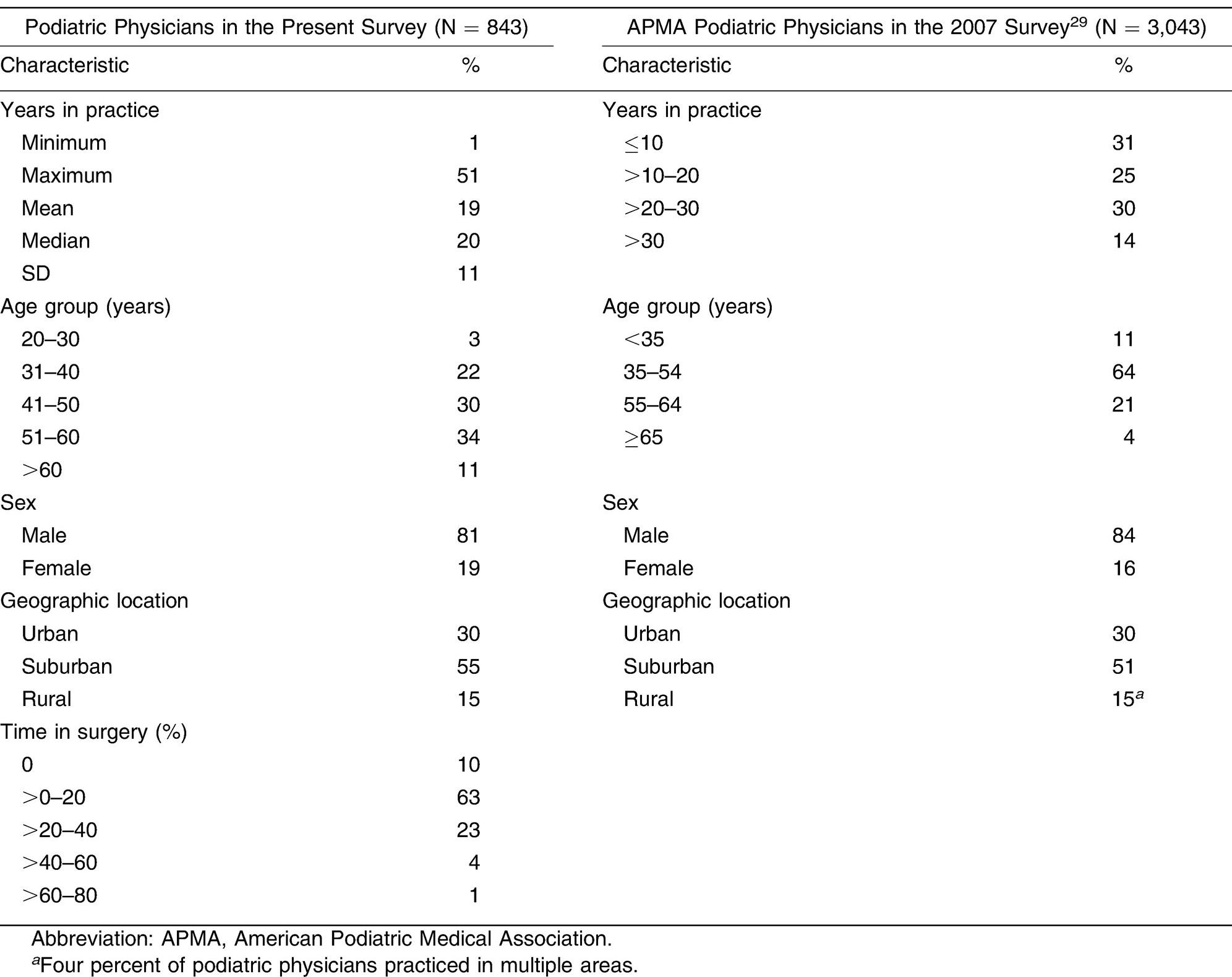
The baseline demographics of the sample were compared with the demographics of APMA members from a podiatric medical practice survey from 2007,[29] demonstrating that the present sample was representative of the approximately 3,000 APMA members who responded to the APMA survey (Table 1). Podiatric physicians from all of the US states except Wyoming and Nebraska participated.
Table 1.
Comparison of Demographic Characteristics.
For 73% of these practitioners, diabetic patients composed 20% to 60% of their patient load, and 74% of these podiatric physicians reported spending 10 to 20 min with each high-risk diabetic patient per visit. During each visit, 67% of podiatric physicians reported spending on average 3 to 7 min discussing self-care with their patients. Regarding foot self-care, 86% of podiatric physicians considered the topic to be very important for at-risk patients (13% selected that it was moderately important), and 90% felt that their role as a podiatric physician to discuss foot self-care with at-risk diabetic patients was very important (the remaining 10% thought that their role was moderately important). Podiatric physicians strongly agreed (12%) or agreed (37%) that they were successful in helping at-risk patients follow good self-care behavior; based on the wording of the question they “felt that they have had specific training in promoting behavior change and there was not much more that they could learn how to do.” A larger number felt that podiatric physicians in general have these skills: 22% strongly agreed and 45% agreed. In addition, 83% of respondents reported an interest (yes or possibly) in a workshop to learn new techniques to encourage behavior change in patients.
Many podiatric physicians felt that significant barriers to discussing self-care with high-risk patients exist: 13% strongly agreed and 41% agreed that lack of time is a problem; 11% strongly agreed and 54% agreed that other pressing issues must be taken care of instead; 9%, 11%, and 15% strongly agreed and 42%, 50%, and 51% agreed that lack of patient interest, cooperation, and awareness, respectively, are barriers; and 14% strongly agreed and 20% agreed that lack of reimbursement is a barrier to providing counseling.
In as much as MI is a technique that focuses on overcoming patient-centered barriers, such as apparent lack of awareness, interest, and cooperation, we next examined to what extent podiatric physicians reported using MI skills in dealing with their high-risk patients. Of the respondents, 24% scored greater than or equal to 15 of 20 on the MI index (use each technique “usually” or “almost always” for every question on the MI index); we consider these podiatric physicians to be knowledgeable of the key MI strategies.
Podiatric physicians who felt that it was their role to discuss foot self-care with at-risk patients (90%) had a higher MI index (mean, 11.7) compared with the 10% who answered that this role was moderately (or less) important to them professionally (mean, 9.0; P for the difference < .001). Also, podiatric physicians who answered that they strongly agreed that they were “successful in helping at-risk patients follow good self-care behavior” had a higher MI index (mean, 13.8) compared with those who disagreed (mean, 10.5) or who were neutral (mean, 10.6; P for the differences < .001).
Two variables analyzed via analysis of variance models had significant overall F tests, indicating an association with the MI index: time spent face to face with patients (<10, 10–15, >15–20, >20 min) and time spent discussing foot care (<3, 3–5, >5–7, >7 min). The mean MI index for each group and follow-up t tests comparing specific groups are shown in Table 2. For each variable, podiatric physicians reporting a larger number of minutes had a larger mean MI index score. Attitudes of podiatric physicians about their success in promoting good self-care behavior was not significantly associated with the amount of time they spent with their at-risk patients discussing foot care.
Table 2.
MI Index Versus Time Spent Face to Face with Patients and Time Spent Discussing Foot Care.
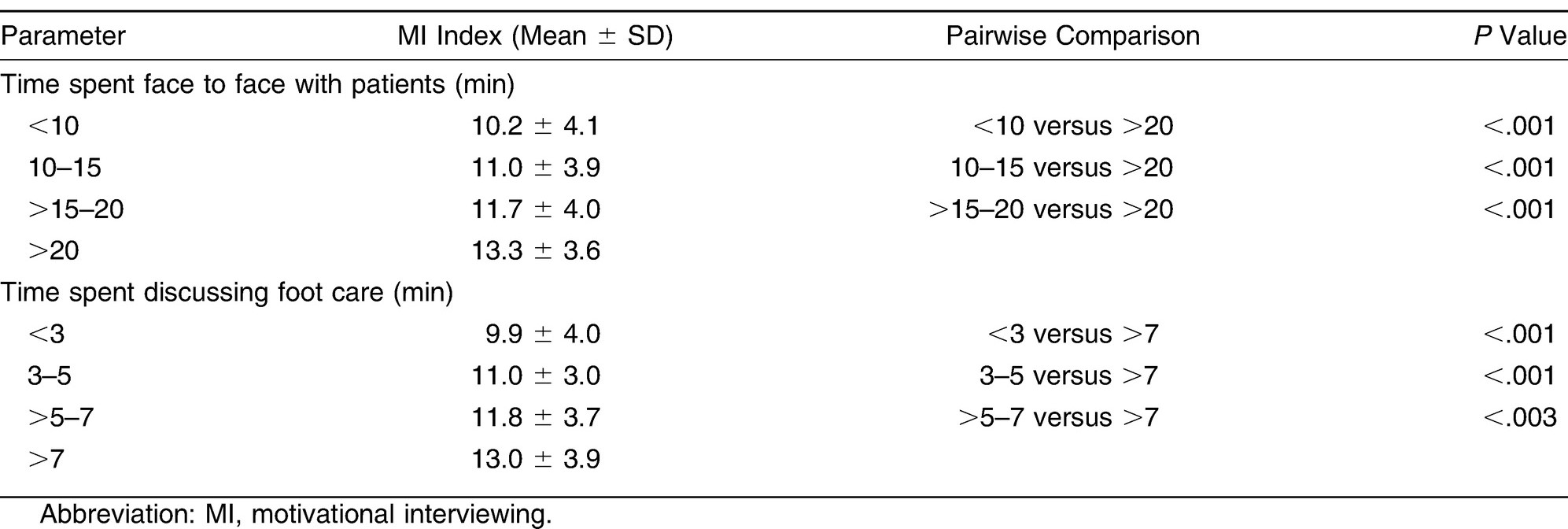
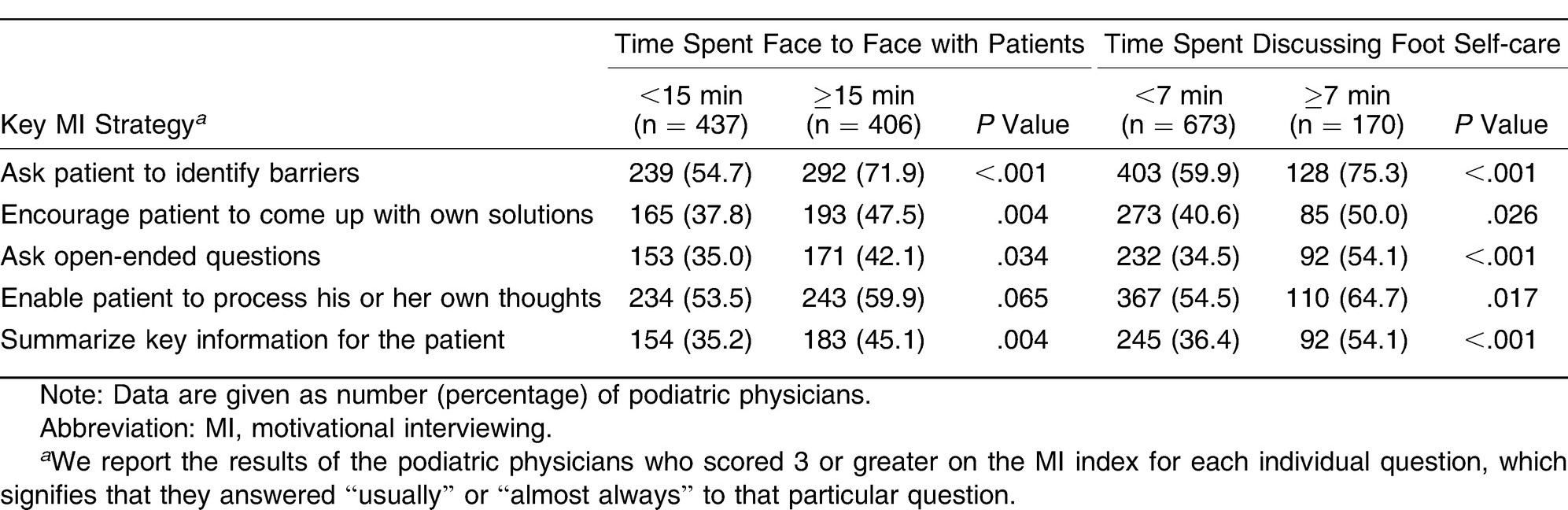
Table 3 compares key MI strategies (individual components of the MI index) by time spent face to face with patients (<15 versus ≥15 min) and time spent discussing foot self-care (<7 versus ≥7 min). Podiatric physicians who spent at least 7 min discussing foot self-care with their patients had significantly larger percentages for each MI strategy than patients who spent less than 7 min. The same finding was observed for podiatric physicians who spent at least 15 min compared with less than 15 min, except for enabling patients to process their own thoughts, in which there was no statistically significant difference.
Table 3.
Comparison of the Key MI Strategies and Total Time Spent with Patients and Time Spent Discussing Foot Self-Care.
There was no correlation between the MI index and the podiatric physician’s age, sex, geographic location, percentage of time in surgery, and years in practice. There was also no relationship between the MI index and the podiatric physician’s perception that a barrier to working with patients is their lack of interest and lack of cooperation.
Discussion
The purpose of this study was to explore how doctors of podiatric medicine perceive their role in promoting best practices self-care in their high-risk patients with diabetes. Most of the responding podiatric physicians felt that foot self-care is very important to at-risk patients, and, more importantly, that it is their role as podiatric physicians to discuss proper foot self-care with their patients. We came to this study expecting to find that most doctors of podiatric medicine, as is probably true of most classically trained health-care providers, would approach their patients with a directive “do this and don’t do that” style.[28] It was, therefore, surprising to find that almost 25% of the present sample scored greater than or equal to 15 on the MI index, which is an indication of them practicing or at least reporting practice of key MI techniques. This result is also gratifying in that this approach to patients is known to be more likely than a directive approach to lead to desired self-care behavior change. The MI skills may not have been learned through formal study by these podiatric physicians (or from experience—no association with years in practice) but rather are a natural way of interacting for some people.
It must be recognized, however, that self-reporting is very much subject to social norm bias, in this case a likely perception that MI-type counseling is “preferred” (akin to an obese person self-reporting less food intake than actual). On the other hand, validity of the higher MI scores among some podiatric physicians is supported by plausible associations with longer patient face-to-face time, longer time discussing foot self-care, greater recognition of the podiatric physician’s role in counseling, and a feeling of greater success with patients (recognizing that all of these are susceptible to the same social norm bias).
A much greater proportion—almost half of the sample—reported adequate training to promote behavior change and that there was not much more that they could learn. A higher number yet—67%—felt that other podiatric physicians have these skills, suggesting a feeling in some that they should have better skills, like they think their peers have. It seems that these results are rather mixed in that more than 80% would possibly (46%) or definitely (38%) attend a workshop to learn more.
The present findings relate to a recent study performed by Graham et al,[30] who interviewed a focus group of 12 podiatric physicians to investigate foot health education for patients with rheumatoid arthritis and the barriers that they encountered. Although no actual data on this point were given in the results section, the discussion section of the paper concluded that there was a lack of MI skills among podiatric physicians who were recently trained and had less clinical experience. Furthermore, certain podiatric physicians felt well prepared with understanding the theory of MI techniques after undergraduate training, yet they were discouraged in promoting behavior change in practice owing to their perception of patients as not willing to comply with foot health advice. In contrast, we found no relationship between years in practice or age of podiatric physicians or podiatric physicians’ perception that patients are uncooperative and disinterested and the MI index.
The use of MI techniques, as assessed by the MI index, was in this study positively associated with time spent face to face with patients at risk for foot ulcer and with time spent discussing how at-risk patients should take care of their feet. Although we cannot from these data say whether more time facilitates use of MI techniques or whether use of MI techniques requires more time, adherence to foot self-care recommendations may be improved with, or may require longer visit times with, at-risk patients. However, simply more focused time discussing self-care may be effective without making the whole appointment longer, which may be a more palatable option for practitioners who still largely practice in a fee-for-service environment. In this study, relatively large increments in the MI index were associated with all of the increments in time spent discussing self-care; even 5 to 7 min was better than less than 3 min. To this point, although traditional MI was developed in the counseling environment, where 1-hour appointments are the norm, briefer versions of MI have since been developed for the medical setting[31,32] and have been used in many different medical settings, including adherence to medication, smoking cessation, physical activity, obesity, and diabetes mellitus.[18,19,20,22,23,33]
Barriers to discussing self-care with patients reported by the podiatric physicians participating in this study reflect those reported in other similar studies and include lack of time (which is often taken up by other pressing issues) and lack of reimbursement. Importantly, lack of patient interest/cooperation/awareness is also cited, and these are precisely the barriers that MI addresses.
Conclusions
Podiatric physicians have the potential to play a key role in promoting behavior change using approaches such as MI in high-risk diabetic patients because they have unique access to and focus on such patients.[28] Based on the present study, diabetic patients compose a large proportion of the caseload of most podiatric physicians, and podiatric physicians view self-care as critical for high-risk diabetic patients and view themselves as an important component of promoting excellent self-care behavior by their patients. These results with respect to the readiness of podiatric physicians to learn more about techniques to promote better self-care in their patients are mixed; only approximately 25% report using MI-type skills, almost 50% believe that they already have the skills needed, but most are at least ready to consider learning more. Many of the patient-centered barriers perceived by podiatric physicians to working with patients could be addressed through MI techniques. The other major barrier is time, and these data confirm that MI takes more time (be it not much more). Perhaps with new reimbursements that focus on patient care outcomes, as part of the health-care reform and the Patient-Centered Medical Home[34] and Medical Neighborhood,[35] podiatric physicians would be further encouraged to and rewarded for focus on behavior change techniques in practice.
Acknowledgment
We are grateful to all who participated in the survey; Kathy Peters, MS, for help with the cognitive interviewing; and all who participated in the cognitive interviewing process.
Financial Disclosure
None reported.
Conflict of Interest
None reported.
References
- Singh N, Armstrong DG, Lipsky BA: Preventing foot ulcers in patients with diabetes. JAMA 293: 217, 2005.
- Boulton AJ, Kirsner RS, Vileikyte L: Clinical practice: neuropathic diabetic foot ulcers. N Engl J Med 351: 48, 2004.
- Perrin BM, Swerissen H, Payne C: The association between foot-care self efficacy beliefs and actual foot-care behaviour in people with peripheral neuropathy: a cross-sectional study. J Foot Ankle Res 2: 3, 2009.
- Vileikyte L, Gonzalez JS, Leventhal H, et al: Patient Interpretation of Neuropathy (PIN) questionnaire: an instrument for assessment of cognitive and emotional factors associated with foot self-care. Diabetes Care 29: 2617, 2006.
- Basu S, Hadley J, Tan RM, et al: Is there enough information about foot care among patients with diabetes? Int J Low Extrem Wounds 3: 64, 2004.
- Pollock RD, Unwin NC, Connolly V:Knowledge and practice of foot care in people with diabetes. Diabetes Res Clin Pract 64: 117, 2004.
- Ward A, Metz L, Oddone EZ, et al: Foot education improves knowledge and satisfaction among patients at high risk for diabetic foot ulcer. Diabetes Educ 25: 560, 1999.
- Vileikyte L: “Psychological and Behavioral Issues in Diabetic Foot Ulceration,” in The Foot in Diabetes, p 132, edited by AJ Boulton, PR Cavanagh, G Rayman, John Wiley & Sons, Chichester, England, 2006.
- Mason J, O’KeeffeC, McIntosh A, et al: A systematic review of foot ulcer in patients with type 2 diabetes mellitus. Diabet Med 16: 801, 1999.
- Valk GD, Kriegsman DM, Assendelft WJ: Patient education for preventing diabetic foot ulceration: a systematic review. Endocrinol Metab Clin North Am 31: 633, 2002.
- Kruger S, Guthrie D: Foot care: knowledge retention and self-care practices. Diabetes Educ 18: 487, 1992.
- Knight KM, Dornan T, Bundy C: The diabetes educator: trying hard, but must concentrate more on behaviour. Diabet Med 23: 485, 2006.
- Price PE: Education, psychology and “compliance.” Diabetes Metab Res Rev 24: S101, 2008.
- Ronnemaa T, Hamalainen H, Toikka T, et al: Evaluation of the impact of podiatrist care in the primary prevention of foot problems in diabetic subjects. Diabetes Care 20: 1833, 1997.
- Sloan FA, Feinglos MN, Grossman DS: Receipt of care and reduction of lower extremity amputations in a nationally representative sample of U.S. elderly. Health Serv Res 45: 1740, 2010.
- Malone JM, Snyder M, Anderson G, et al: Prevention of amputation by diabetic education. Am J Surg 158: 520, 1989.
- Barth R, Campbell LV, Allen S, et al: Intensive education improves knowledge, compliance, and foot problems in type 2 diabetes. Diabet Med 8: 111, 1991.
- Rollnick MP, Butler C : Health Behavior Change: A Guide for Practitioners, Churchill Livingstone, London, 2000.
- Miller RS : Motivational Interviewing: Preparing People for Change, Guilford Press, New York, 2002.
- Britt E, Hudson SM, Blampied NM:Motivational interviewing in health settings: a review. Patient Educ Couns 53: 147, 2004.
- Hettema J, Steele J, Miller WR:Motivational interviewing. Annu Rev Clin Psychol 1: 91, 2005.
- Rollnick MW, Butler CC : Motivational Interviewing in Health Care: Helping Patients Change Behavior, Guilford Press, New York, 2008.
- Ruback S, Sandbaek A, Lauritzen T, et al: Motivational interviewing: a systematic review and meta-analysis. Br J Gen Pract 55: 305, 2005.
- Emmons KM, Rollnick S:Motivational interviewing in health care settings: opportunities and limitations. Am J Prev Med 20: 68, 2001.
- Channon SJ, Huws-Thomas MV, Rollnick S, et al: A multicenter randomized controlled trial of motivational interviewing in teenagers with diabetes. Diabetes Care 30: 1390, 2007.
- West DS, DiLillo V, Bursac Z, et al: Motivational interviewing improves weight loss in women with type 2 diabetes. Diabetes Care 30: 1081, 2007.
- Lundahl B, Burke BL:The effectiveness and applicability of motivational interviewing: a practice-friendly review of four meta-analyses. J Clin Psychol 65: 1232, 2009.
- Gabbay RA, Kaul S, Ulbrecht J, et al: Motivational interviewing by podiatric physicians: a method for improving patient self-care of the diabetic foot. JAPMA 101: 78, 2011.
- Al Fisher Associates: 2007 podiatric practice survey: statistical results. JAPMA 97: 496, 2007.
- Graham AS, Hammond A, Williams AE:Foot health education for people with rheumatoid arthritis: the practitioner’s perspective. J Foot Ankle Res 5: 2, 2012.
- Dunn C, Deroo L, Rivara FP: The use of brief interventions adapted from motivational interviewing across behavioral domains: a systematic review. Addiction 96: 1725, 2001.
- Vasilaki EI, Hosier SG, Cox WM: The efficacy of motivational interviewing as a brief intervention for excessive drinking: a meta-analytic review. Alcohol 41: 328, 2006.
- Hettema JE, Hendricks PS: Motivational interviewing for smoking cessation: a meta-analytic review. J Consult Clin Psychol 78: 868, 2010.
- Bojadzievski T, Gabbay RA: Patient-centered medical home and diabetes. Diabetes Care 34: 1047, 2011.
- American College of Physicians: The Patient-Centered Medical Home Neighbor: The Interface of the Patient-Centered Medical Home with Specialty/Subspecialty Practices, American College of Physicians, Philadelphia, 2010.
© 2014 American Podiatric Medical Association