


Abstract
Background: We sought to investigate the clinical efficacy of the Fuß-sole (Kuroda, Osaka, Japan), a newly developed stocking, in patients with severe foot pain attributable to rheumatoid arthritis. Methods: The Fuß-sole stocking incorporates a plantar insole made of breathable fabric. Twenty patients with rheumatoid arthritis and severe foot pain were enrolled in this study. Clinical efficacy was evaluated using the Japanese Orthopaedic Association’s foot-scoring system. Outcome measures were evaluated before and after a 1-month trial of the Fuß-sole stocking. Results: Use of the Fuß-sole stocking resulted in significant improvements in foot pain, activities of daily living, and total scores. Conclusions: Use of the Fuß-sole improves the quality of life of patients with rheumatoid arthritis.
As rheumatoid arthritis progresses, acquired plantar hyperkeratotic regions, also known as plantar callosities, are associated with elevated mechanical pressures attributable to deformed joints [1,2]. These foot deformities can disturb activities of daily living [3] such as difficulty in walking up or down stairs and sitting upright.
For the joint pain associated with rheumatoid arthritis, nonsteroidal anti-inflammatory drugs are used [4]; however, these drugs are not specialized for plantar pain, and they also induce adverse events such as upper gastrointestinal ulceration, perforation, and bleeding [5]. Insoles have been developed for people with foot deformities to absorb pressure while wearing shoes [6]; however, they are expensive and unwashable, and they do not protect from plantar deformities when patients take off their shoes indoors (among the Japanese, it is a custom to remove shoes when indoors) [7]. Plantar deformities are excised when they deteriorate the activities of daily living of the patient [1]. Thick-sole stockings have also been developed for plantar pain [6]. Although these stockings are washable, their bulk means that they cannot always be worn with ordinary shoes, and, generally speaking, they can sometimes feel stuffy because they are not breathable.
The Fuß-sole is a plantar insole made of breathable fabric (Cubit; Asahi Kasei Fibers Corp, Osaka, Japan) (Fig. 1). Cubit is a novel breathable fabric with a honeycomb structure. Moreover, this fabric is made of polyester and is also used for bed pads, car seats, and more [8]. The fabric also has good breathing structure and elasticity [8] and is washable. Figure 2 shows a microscopic image of Cubit. Fuß-sole stockings are thinner than traditional orthotic stockings, and, therefore, patients with rheumatoid arthritis can wear them with ordinary shoes. We herein evaluate the Fuß-sole to clarify its effects on activities of daily living in patients with severe foot pain attributable to rheumatoid arthritis.
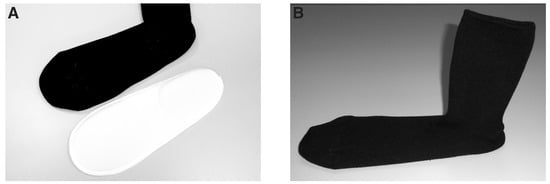
Figure 1.
A, View of the Fuß-sole from the bottom. The Cubit insole (white) is fused with the stocking (black). B, Side view of the Fuß-sole.
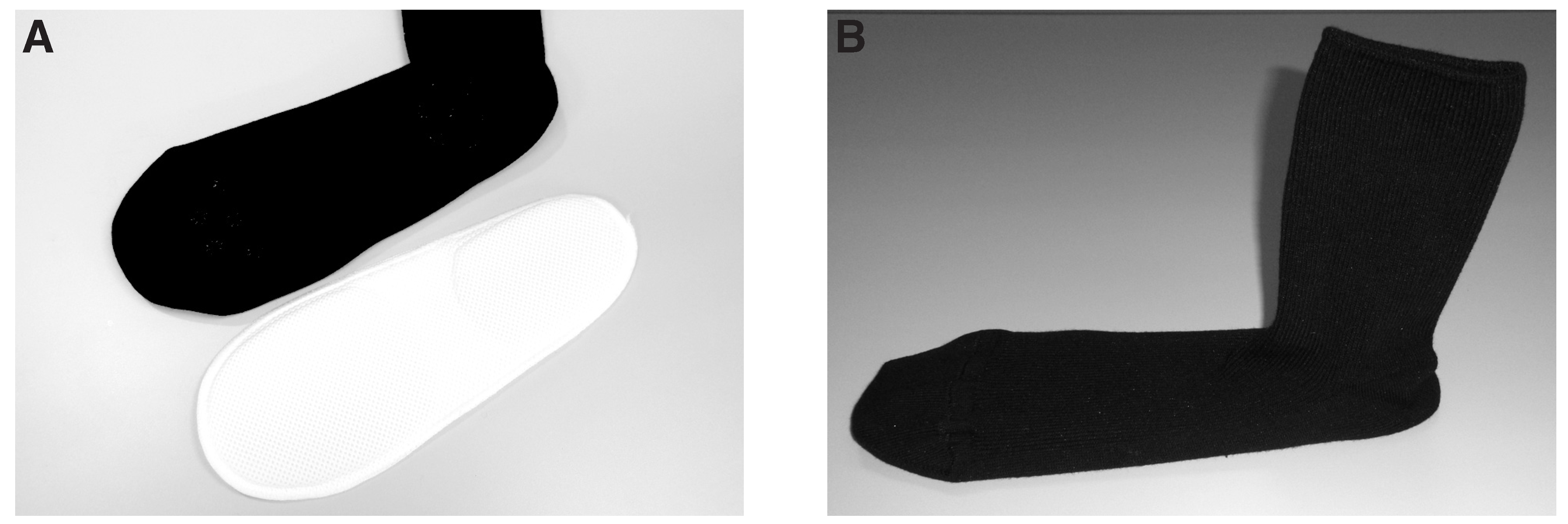
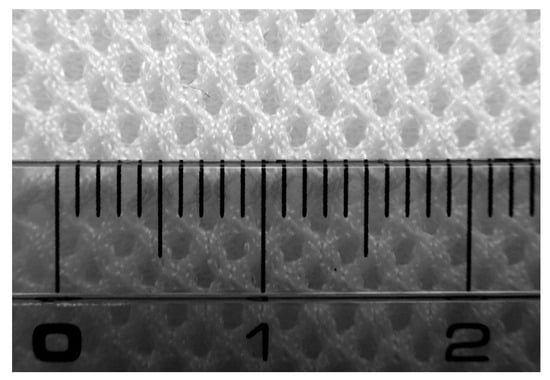
Figure 2.
Microscopic image of Cubit. The diameter of each grid square is approximately 0.3 mm.
Patients and Methods
Patients
Twenty patients with rheumatoid arthritis and plantar pain (5 men and 15 women) were asked to join the evaluation. The mean ± SD duration of disease was 7.2 ± 2.7 years (range, 2–12 years). The mean ± SD age of patients was 58.2 ± 8.2 years (range, 40–71 years). Rheumatoid arthritis severity was classified as stage III in four patients and as stage IV in 16, and the functional status of patients with rheumatoid arthritis was class I in two patients, class II in 16, and class III in two. Because the Matsuno Clinic for Rheumatic Diseases does not have a formal ethics review committee, before starting the evaluation, written informed consent was obtained from all of the patients according to the principles outlined in the Declaration of Helsinki.
Assessments
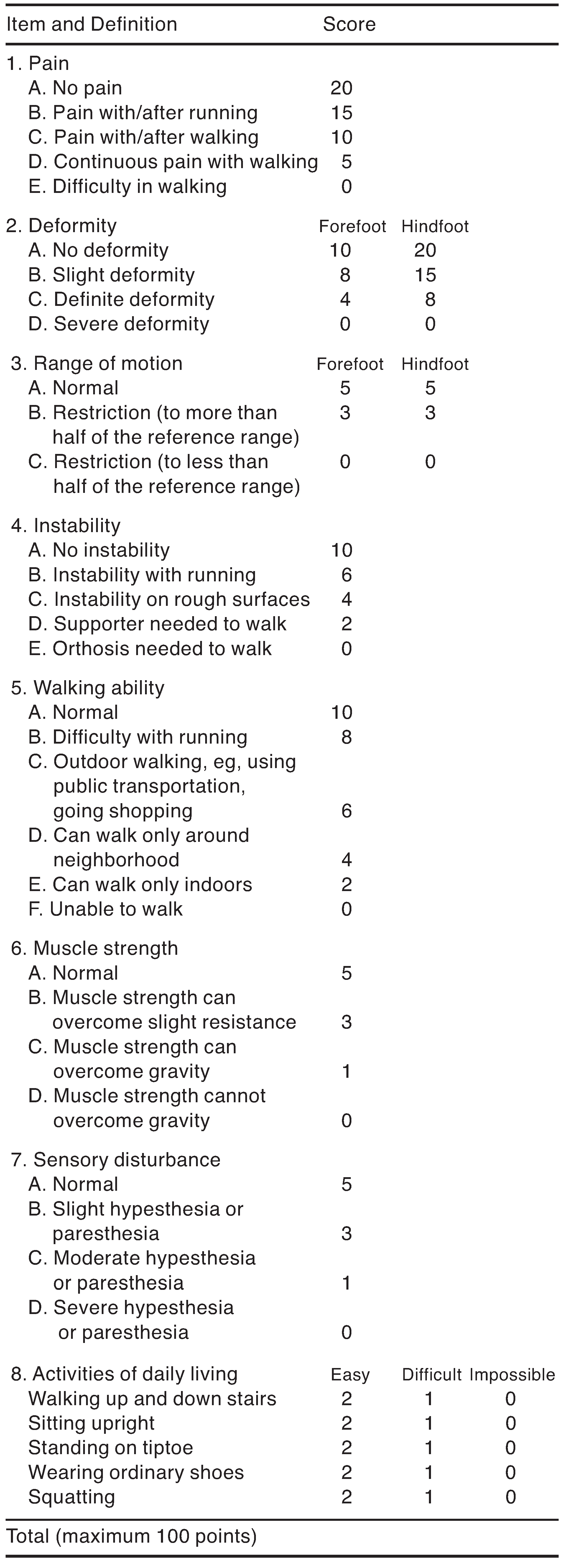
All of the patients were evaluated with an eight-item scoring system endorsed by the Japanese Orthopaedic Association (1991) before and after 1 month of wearing the Fuß-sole (Table 1). This system scores pain, deformity, range of motion, instability, walking ability, muscle strength, paresthesia, and activities of daily living and gives a total score (the sum of these indices). The maximum total score is 100 points, indicating optimal foot health. For statistical analysis, the Wilcoxon signed rank test was used.

Table 1.
Scoring System and Score Allocation
Results
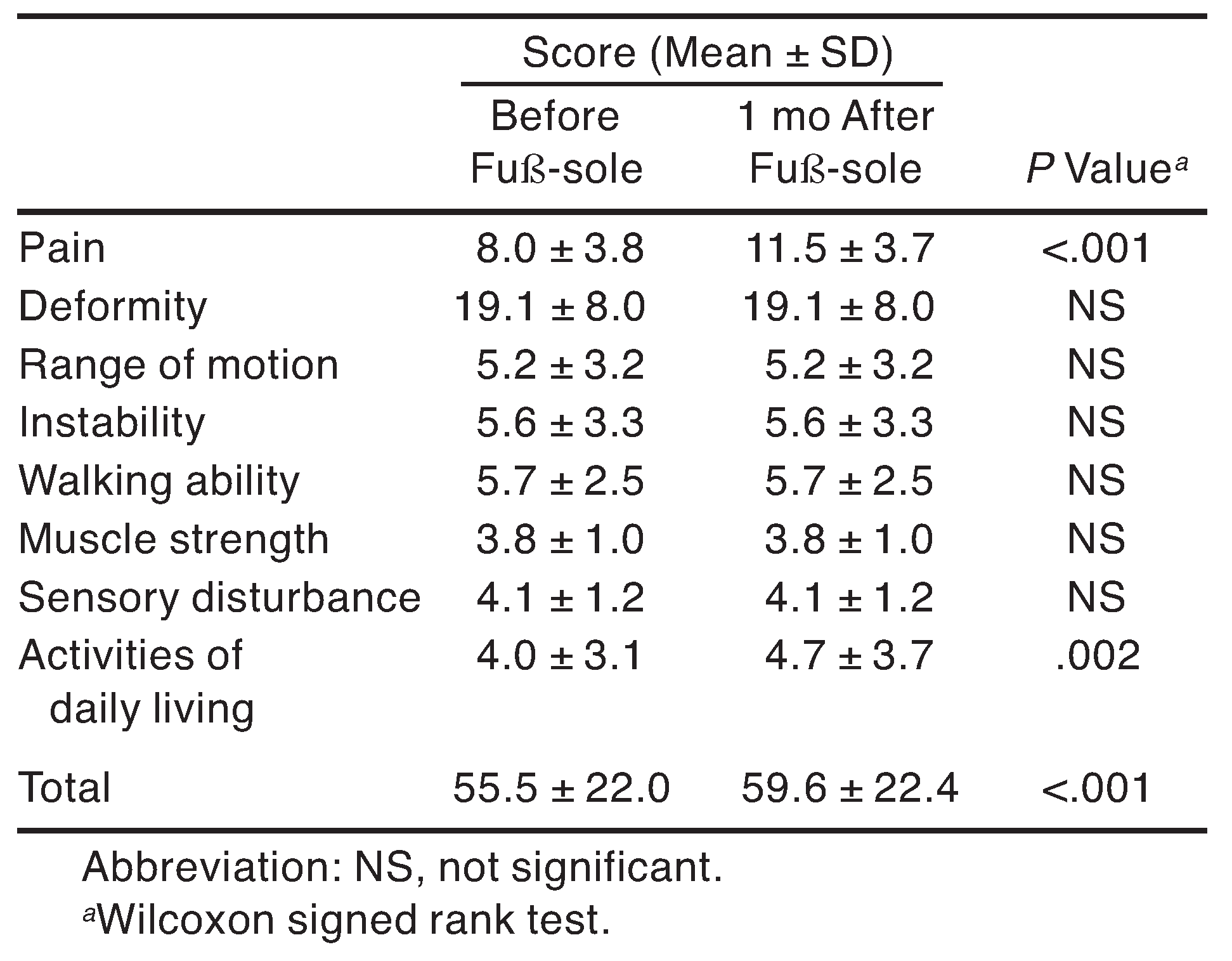
Results are summarized in Table 2. We found significant improvements in foot sole pain, activities of daily living, and total scores (P < .001 for all). The other indices remained unchanged; however, all of the patients had a favorable impression of the Fuß-sole because it was breathable and reduced foot sole pain. No adverse effects were observed during the study.
Table 2.
Results of Assessment
Discussion
Surgical therapy, such as callous debridement, has been performed for patients with rheumatoid arthritis and foot pain [9]. Even after surgical removal of callosities, improvement in quality of life would not be expected because the same part of the foot would keep bearing pressure throughout daily life [9]. On the other hand, in patients with rheumatoid arthritis, an insole with a bar pad was reported to reduce plantar pressure and broaden the contact area [10].
Several studies [11,12] have evaluated the effect of insoles on the quality of life of patients with rheumatoid arthritis and plantar pain attributable to callosities; these studies found that remission of foot sole pain was achieved in 1 to 6 months.
The insole portion of the Fuß-sole is thermally fused with the sock portion. Because the patient keeps the Fuß-sole on, the insole portion of the Fuß-sole is always in contact with the patient’s sole throughout daily life, and this seems to improve activities of daily living for patients with rheumatoid arthritis. Unlike other insoles, which can take 1 to 6 months to relieve forefoot pain [11,12], the Fuß-sole seemed to have rapid efficacy, being evident after only 1 month.
We evaluated the results using the Wilcoxon signed rank test because it is used to test differences between scores for data collected before and after wearing the Fuß-sole. In this evaluation, only two of eight assessments showed significant improvements; however, the total score showed significant improvement because no changes were observed, ie, no differences were observed, in the other six assessments. The Fuß-sole has the following advantages compared with available insoles: improvements in activities of daily living occur within 1 month; low cost; washable at home; made of breathable, stretchy fabric; feet do not feel stuffy; and easy to wear.
In conclusion, the Fuß-sole is a newly developed stocking that improved activities of daily living in patients with rheumatoid arthritis and foot pain attributable to callosities within 1 month. It has many advantages compared with available insoles.
Financial Disclosure
None reported.
Conflicts of Interest
None reported.
References
- Davys HJ, Turner E, Helliwell PS, et al: Debridement of plantar callosities in rheumatoid arthritis: a randomized controlled trial. Rheumatology44: 207, 2005.
- Otter SJ, Bowen CJ, Young AK: Forefoot plantar pressures in rheumatoid arthritis. JAPMA94: 255, 2004.
- Durez P, Fraselle V, Houssiau F, et al: Validation of the ABILHAND questionnaire as a measure of manual ability in patients with rheumatoid arthritis. Ann Rheum Dis66: 1098, 2007.
- Jennifer AE, Howard SS: “NSAIDs for Painful Bone and Joint Conditions,” in Clinical Management of Bone and Joint Pain, ed by G McClean, SS Howard, p 51, Haworth Medical Press, Philadelphia, 2007.
- James DS: The multisystem adverse effects of NSAID therapy. J Am Osteopath Assoc99 (suppl):S1, 1999.
- Knapik JJ, Reynolds KL, Duplantis KL, et al: Friction blisters: pathophysiology, prevention and treatment. Sports Med20: 136, 1995.
- Japanese culture and daily life: removing shoes. The Japan Forum Web site. Available at: http://www.tjf.or.jp/eng/content/japaneseculture/02kutsu.htm. Accessed November 4, 2009.
- Cubit. Asahi Kasei Fibers Corp Web site. Available at: http://www.asahi-kasei.co.jp/fibers/en/cubit/index.html. Accessed November 4, 2009.
- Woodburn J, Stableford Z, Helliwell PS: Preliminary investigation of debridement of plantar callosities in rheumatoid arthritis. Rheumatology (Oxford)39: 652, 2000.
- Jackson L, Binning J, Potter J: Plantar pressures in rheumatoid arthritis using prefabricated metatarsal padding. JAPMA94: 239, 2004.
- Pawelka S, Kopf A, Zwick E, et al: Comparison of two insole materials using subjective parameters and pedobarography (pedar-system). Clin Biomech (Bristol, Avon)12: S6, 1997.
- Carl HD, Putz C, Weseloh G, et al: Insoles for the rheumatic foot: a clinical and pedobarographic analysis. Orthopade35: 1176, 2006.
© 2010 American Podiatric Medical Association