


Abstract
Digital payment systems have become increasingly important in contemporary financial environments; however, understanding the factors that drive their adoption remains a significant research challenge. This study examines the determinants of behavioral intention and actual use of digital payments by applying an extended Technology Acceptance Model (TAM) that incorporates perceived risk and trust alongside the traditional TAM constructs. Data were collected through an online survey of 154 Slovenian and international students enrolled in finance-related programs at the University of Maribor, Slovenia, and analyzed using structural equation modeling (SEM) using WarpPLS (version: 8.0). The results indicate that perceived ease of use positively affects perceived usefulness and behavioral intention, while perceived usefulness significantly increases behavioral intention. Perceived risk negatively influences trust, whereas trust positively affects behavioral intention. Furthermore, behavioral intention is the strongest predictor of actual use. All hypothesized relationships were statistically significant. The findings confirm the suitability of the extended TAM for explaining digital payment adoption in the studied group of young people and highlight the importance of usability, perceived benefits, trust, and risk perceptions in shaping digital payment behavior.
1. Introduction
While card-based payments are well known and present already for long, digital payments have gained momentum in the last decade with technological progress. By digital payment we refer to payments that do not involve cash and refer to the electronic exchange of funds, such as cards, credit transfers or payment application through mobile devices, digital wallets, mobile apps, usage of quick response (QR) codes, contactless/NFC, national schemes like Flik in Slovenia, or others like Apple Pay and similar. The EU has broad regulatory framework which supports the objective to achieve safer, faster and less expensive digital payments. The regulation is based on the Payment Services Directive (PSD2), and has been in 2023 proposed by the Commission with amended directive on payment services and e-money services (PSD3), and a regulation on payment services (the PSR). To tackle future challenges in the field of digital payments the regulation should support an innovative and competitive environment for payments markets (European Court of Auditors, 2025). Digital payments are beneficial to economic growth and development, as indicated by empirical evidence in the literature. Also, digital payments exhibit strong correlations with financial inclusion, and internet penetration, and are associated with greater access to credit and other financial services (Aguilar et al., 2024).
Studying the influence of digital payment adoption in the social-media-induced anxiety context (Petroccione et al., 2025) find how shifting consumer preferences can be addressed through psychologically informed strategies. Financial technology providers can by leveraging psychological insights support the promotion and adoption of innovative digital payment solutions (Petroccione et al., 2025).
Despite the growing adoption of digital payment systems, understanding the factors that influence users’ acceptance and actual usage remains an important research challenge. While technological advancements and regulatory frameworks support the diffusion of digital payments, user-related factors such as perceived benefits, ease of use, trust, and risk perceptions play a crucial role in shaping adoption behavior. To explain users’ acceptance of technology, the Technology Acceptance Model (TAM) has been widely applied in recent research on digital payments and fintech adoption. TAM posits that perceived usefulness and perceived ease of use are key determinants of behavioral intention, which in turn influences actual system usage. More recent studies confirm that these core relationships remain highly relevant in digital financial contexts, including mobile payments and e-banking environments (Krishna, 2025). However, contemporary research also highlights that the traditional TAM framework is often insufficient to capture the complexity of digital payment adoption, particularly in contexts characterized by uncertainty, security concerns, and rapidly evolving technologies (Linh & Huyen, 2025). In response, recent studies increasingly extend TAM by incorporating additional constructs such as trust, perceived risk, and contextual factors. For instance, studies integrating TAM with trust-based frameworks demonstrate that trust plays a central role in shaping both perceived usefulness and behavioral intention, especially in financial environments where users face uncertainty and potential vulnerabilities (Shao et al., 2019; Merhi et al., 2019; Venkatesh & Davis, 2000).
Similarly, systematic literature reviews identify trust, perceived usefulness, and ease of use as the most consistent drivers of digital payment adoption, while perceived risk and security concerns remain key barriers (Jain & Jain, 2024). In the context of digital payments, concerns related to security, privacy, and potential financial loss are particularly salient. Perceived risk has been shown to significantly influence users’ adoption decisions, as individuals may hesitate to use digital payment systems when they perceive a lack of control over their financial data or transaction security (Nurabiah et al., 2024). At the same time, increasing exposure to cybersecurity threats and digital fraud further amplifies users’ sensitivity to risk, reinforcing the importance of perceived security in shaping adoption behavior (Aljaradat & Shukla, 2025). Trust, on the other hand, has been identified as a key mechanism for reducing uncertainty and enabling technology adoption. Recent research emphasizes that users are more likely to adopt and continuously use digital payment systems when they perceive them as secure, reliable, and supported by effective technological and regulatory safeguards (Aljaradat & Shukla, 2025). Moreover, trust has been found to mitigate the negative effects of perceived risk and to act as a critical link between users’ perceptions and their behavioral intentions in digital financial environments (Linh & Huyen, 2025).
Furthermore, the study focuses specifically on university students as a distinct and highly relevant user group which will in the future grow to young adults and be the active working population, thus important for the banks’ future prospects. University students represent a digitally literate population with frequent exposure to mobile technologies and digital financial services, making them particularly suitable for examining contemporary digital payment behaviors. At the same time, their perceptions of risk and trust may differ from those of the general population, emphasizing the importance of context-specific analysis. The study contributes to the literature in three ways. First, it extends the Technology Acceptance Model by integrating perceived risk and trust into a unified analytical framework, providing a more comprehensive explanation of digital payment adoption in environments characterized by uncertainty and security concerns. Second, it simultaneously examines both behavioral intention and actual use, offering a more complete view of the adoption process from users’ perceptions to realized behavior. Third, by focusing on university students, the study provides context-specific insights into digital payment adoption within a technologically advanced and highly active user segment.
The paper is organized as follows. Section 1 presents the theoretical and regulatory background. Section 2 reviews related literature and develops the hypotheses. Section 3 reports the empirical results. Next, Section 4 gives the discussion and goes into implications and limitations. At the end, Section 5 concludes and outlines future research.
2. Literature Review, Materials, Hypothesis Development, and Methods
Building on the theoretical foundations of the Technology Acceptance Model (TAM), this study adopts an extended TAM framework to capture the complexity of digital payment adoption better. While the original TAM focuses on perceived usefulness and perceived ease of use as key determinants of behavioral intention and actual use (Davis, 1989), the present study enhances the model by incorporating two additional constructs, perceived risk and trust, which are particularly relevant in digital financial environments. The inclusion of perceived risk reflects users’ concerns regarding potential financial loss, security breaches, and privacy issues, while trust captures users’ confidence in the reliability, integrity, and security of digital payment systems and their providers. By integrating these constructs, the proposed model enables a more comprehensive understanding of both the drivers and barriers of digital payment adoption. Based on this extended framework, the study aims to examine how perceived usefulness, perceived ease of use, perceived risk, and trust jointly influence users’ behavioral intention and actual use of digital payment systems. In doing so, the study provides an integrated perspective on the adoption process, linking users’ perceptions, attitudes, and actual behavior within a single structural model.
2.1. Literature Review and Hypothesis Development
Perceived ease of use and perceived usefulness represent the core constructs of the Technology Acceptance Model (TAM) (Davis, 1989). Perceived ease of use refers to the extent to which a user believes that using a particular system requires minimal effort, while perceived usefulness reflects the degree to which a user perceives that using the system enhances their performance. According to TAM, perceived ease of use is not only an independent determinant of behavioral intention but also an important antecedent of perceived usefulness (Vărzaru et al., 2021; Siagian et al., 2022). The relationship between perceived ease of use and perceived usefulness is grounded in the notion that systems that are easier to use reduce cognitive effort, allowing users to focus more on the functional benefits of the technology (Davis, 1989). As a result, when users perceive a system as simple and intuitive, they are more likely to evaluate it as useful (Venkatesh & Davis, 2000). This relationship has been consistently validated across various technological contexts, including digital financial services and mobile payment systems (Oliveira et al., 2016. In the context of digital payments, ease of use plays a particularly important role due to the need for fast, seamless, and user-friendly transactions. Digital payment systems that are easy to navigate and require minimal effort can enhance users’ perception of efficiency, convenience, and overall value. Consequently, users who perceive digital payment systems as easy to use are more likely to perceive them as useful (Oliveira et al., 2016). Therefore, the following hypothesis is proposed:
H1.
Perceived Ease of Use (PEOU) has a positive effect on Perceived Usefulness (PU) of digital payments.
Within the TAM, perceived usefulness is recognized as a key determinant of users’ behavioral intention to adopt a technology (Davis, 1989; Venkatesh & Davis, 2000). Unlike perceived ease of use, which primarily reduces the effort associated with system usage, perceived usefulness reflects the extent to which users perceive tangible benefits from using the technology. As such, it plays a central role in shaping users’ adoption decisions (Tian & Chan, 2024; Al-Qudah et al., 2024). From a decision-making perspective, individuals are more likely to form a strong intention to use a technology when they perceive that it offers clear advantages, such as increased efficiency, convenience, and improved performance (Davis, 1989; Venkatesh & Davis, 2000). In digital payment environments, these benefits include faster transactions, ease of financial management, and greater accessibility, which enhance the overall user experience (Al-Qudah et al., 2024). Empirical research in digital financial contexts consistently confirms that perceived usefulness is a significant predictor of behavioral intention to use mobile and digital payment systems (Oliveira et al., 2016 Liébana-Cabanillas et al., 2020). Therefore, the following hypothesis is proposed:
H2.
Perceived Usefulness (PU) has a positive effect on Behavioral Intention (BI) to use digital payments.
While perceived usefulness reflects the benefits of using a system, perceived ease of use reduces the effort associated with its adoption, thereby lowering barriers to initial acceptance (Davis, 1989; Venkatesh & Davis, 2000). From a behavioral perspective, users tend to favor technologies that are simple, intuitive, and easy to operate, as such systems require less cognitive effort and are associated with a more positive user experience (Venkatesh & Bala, 2008). When a system is perceived as easy to use, users are more likely to develop a favorable attitude toward it and, consequently, a stronger intention to adopt it (Oliveira et al., 2016 Liébana-Cabanillas et al., 2020). In digital financial environments, such as mobile and digital payment systems, ease of use is particularly important due to the need for fast, efficient, and seamless transactions. Systems that are intuitive and easy to operate reduce the complexity of financial activities, which encourages users to engage more frequently with digital payment services. Empirical studies confirm that ease of use positively influences users’ intention to adopt digital payment technologies, either directly or indirectly through perceived usefulness (Hasmiana & Syamsuddin, 2025). This relationship is especially relevant among university students, who represent a digitally active population with high exposure to mobile technologies and financial applications. Research indicates that students are generally more willing to adopt digital payment systems when they perceive them as easy to use and convenient for everyday financial transactions, such as managing expenses and making quick payments (Hidayah et al., 2025). Thus, the following hypothesis is proposed:
H3.
Perceived Ease of Use (PEOU) has a positive effect on Behavioral Intention (BI) to use digital payments.
In digital payment environments, perceived risk and trust represent two critical factors influencing users’ adoption behavior. Unlike traditional payment methods, digital payments involve the exchange of sensitive financial and personal information, which exposes users to potential risks such as fraud, privacy breaches, and unauthorized transactions (Oliveira et al., 2016; Ho et al., 2020). As a result, users evaluate not only the functional benefits of digital payment systems but also the level of uncertainty and potential negative consequences associated with their use (Nurabiah et al., 2024). Perceived risk refers to users’ expectations of potential losses or adverse outcomes when using a technology. In the context of digital payments, perceived risk arises primarily from concerns related to security, privacy, and financial reliability. Higher levels of perceived risk increase uncertainty and reduce users’ confidence in digital payment systems, which may hinder their willingness to adopt such technologies (Alrawad et al., 2023; Mondego, 2018). Recent studies further confirm that perceived risk plays a significant role in shaping users’ trust, as higher perceived risk is associated with lower levels of trust in mobile and digital payment environments (Song et al., 2023). Trust, on the other hand, reflects users’ confidence in the reliability, integrity, and security of digital payment systems and their providers. In digital financial environments, trust plays a crucial role in reducing uncertainty and enabling users to engage with technologies that involve potential risks. When users trust a system, they are more likely to perceive it as safe and dependable, which positively influences their willingness to use it (Oliveira et al., 2016; Shao et al., 2019). Recent empirical evidence further confirms that trust remains a key mechanism for facilitating digital payment adoption, particularly in contexts characterized by high perceived uncertainty (Angel-Rodriguez & Vicente-Pascual, 2026). The relationship between perceived risk and trust is particularly important, as higher levels of perceived risk are typically associated with lower levels of trust. When users perceive digital payment systems as risky, their confidence in these systems decreases, which negatively affects trust. This inverse relationship has been consistently supported in recent research on digital financial services and mobile payment adoption (Song et al., 2023). Accordingly, the following is hypothesized:
H4.
Perceived Risk (PR) has a negative effect on Trust (TR) in digital payments.
In addition to its relationship with perceived risk, trust plays a central role in shaping users’ behavioral intention to adopt digital payment systems (Zhou, 2014). Trust reduces uncertainty and increases users’ confidence in engaging with digital financial technologies, thereby facilitating adoption decisions. When users perceive digital payment systems as trustworthy, they are more likely to develop a positive intention to use them (Alalwan et al., 2016). Recent studies confirm that trust is one of the most influential predictors of behavioral intention in digital payment and fintech environments, as it enhances users’ confidence and mitigates perceived risks associated with financial transactions (Ho et al., 2020). Based on the above arguments, the following hypothesis is formulated:
H5.
Trust (TR) has a positive effect on Behavioral Intention (BI) to use digital payments.
Behavioral intention is widely recognized as a key predictor of actual usage behavior in technology acceptance models. Within the Technology Acceptance Model (TAM) and related frameworks, behavioral intention reflects users’ readiness and willingness to engage with a technology, which subsequently translates into actual usage (Davis, 1989). From a behavioral perspective, intention represents a motivational factor that captures the likelihood that an individual will perform a specific behavior. Users who express a strong intention to use a technology are more likely to act upon that intention, particularly when no significant external barriers are present (Maruping et al., 2017). In the context of digital payments, behavioral intention reflects users’ willingness to adopt and regularly use digital payment solutions for financial transactions. As digital payment systems become increasingly integrated into everyday activities, users with stronger intentions to use such systems are more likely to translate these intentions into actual usage behavior (Tian & Chan, 2024). Accordingly, the following is hypothesized:
H6.
Behavioral Intention (BI) has a positive effect on Actual Use (AU) of digital payments.
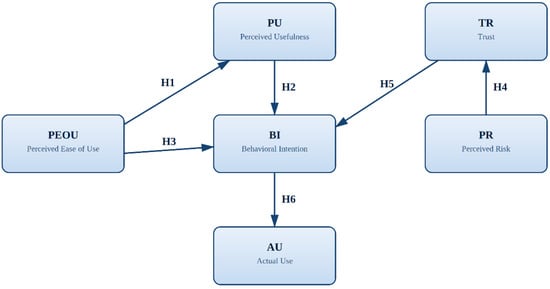
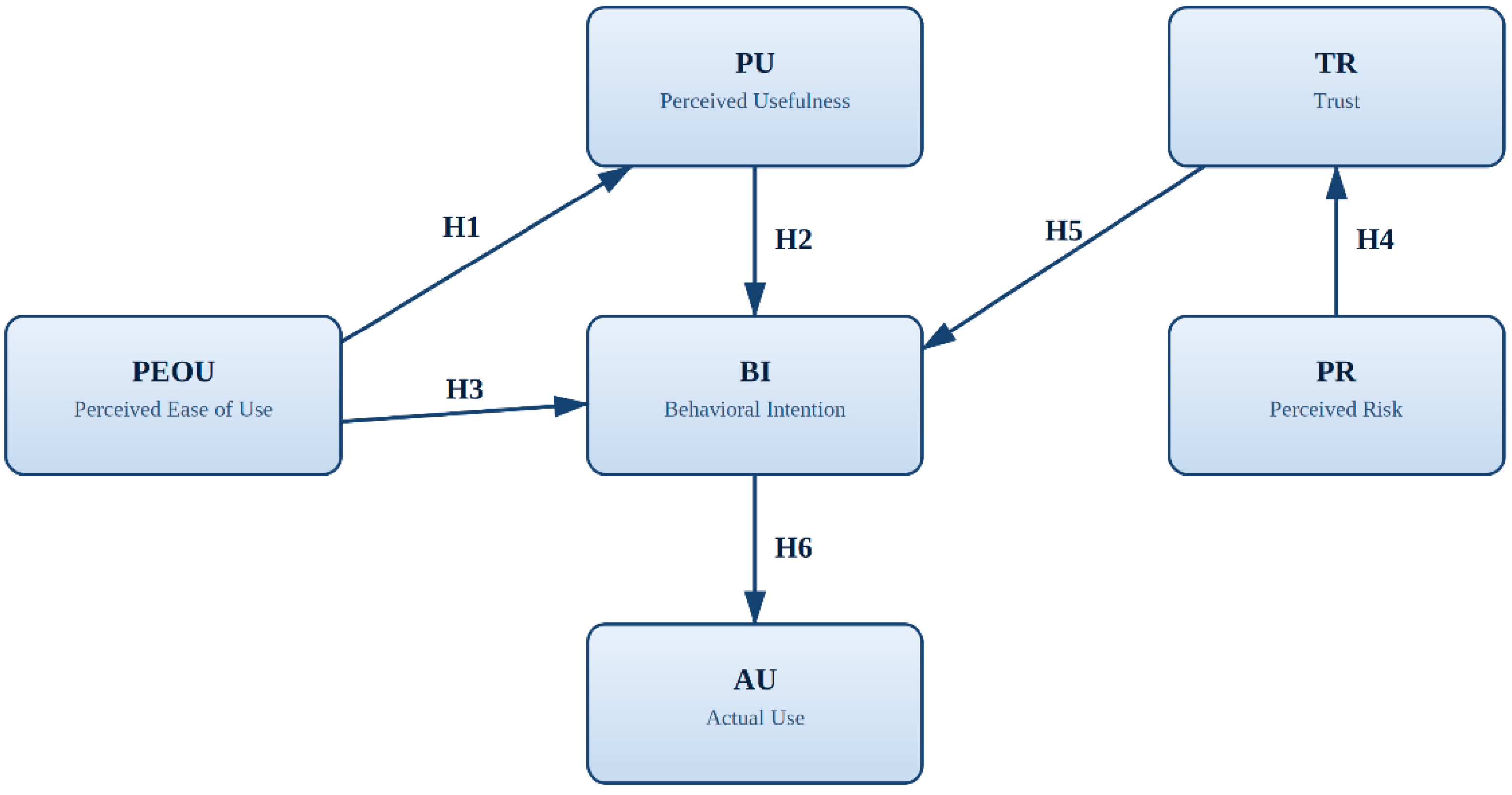
Figure 1 presents the conceptual research model, illustrating the hypothesized relationships between perceived ease of use (PEOU), perceived usefulness (PU), perceived risk (PR), trust (TR), behavioral intention (BI), and actual use (AU), with arrows indicating the proposed paths (H1–H6).
Figure 1.
Conceptual research model: Extended Technology Acceptance Model (TAM) for digital payment adoption.
2.2. Research and Methodology
The data for this study were collected using an online questionnaire. When constructing the hypothesis, the questionnaire was originally developed in Slovenian language. The survey was then conducted on the 1KA platform, where respondents could choose either Slovenian or English at the beginning. The questionnaire was distributed electronically, allowing respondents to complete it voluntarily and anonymously. This approach enabled efficient data collection and ensured accessibility for all participants. We invited students enrolled in finance-related programs at the Faculty of Economics and Business, University of Maribor, Slovenia. To increase heterogeneity within the practical constraints of our study, within the full sample we also invited over 90 international students who were enrolled in English taught programs, participating in Slovenian programs, or present in Slovenia on exchange; all respondents were physically located in Slovenia for a shorter or longer period during data collection. While this composition introduces variation in national background, the sample remains drawn from a single university and therefore is not representative of the broader population of students in Slovenia or other countries. However, since the international students come from a large number of countries, the subsample from each of them would be too small to effectively benchmark against the results of Zhao and Pan (2023).
The sample of collected answers from students consists of 154 students (48.1% male and 51.9% female). Students were selected as the target group due to their frequent use of digital technologies and financial applications, as well as their familiarity with modern payment systems. Their educational background in finance further ensures a higher level of understanding of financial services, making them particularly suitable for this type of analysis.
Sample-size adequacy was assessed using the inverse square root method proposed by Kock and Hadaya (2018). Based on a significance level of 0.05, a statistical power of 0.80, and the smallest absolute statistically significant path coefficient observed in the model (β = 0.286), the estimated minimum required sample size was 76 respondents. The final sample of 154 respondents therefore exceeded the estimated minimum requirement for the PLS-SEM analysis. Moreover, the target population consisted of students enrolled in the second year of undergraduate finance-related study programmes at the Faculty of Economics and Business, University of Maribor. Participants were recruited based on their accessibility and relevance to the research context. Thus, approximately 200 students were enrolled in the relevant study programmes and were invited to participate. A total of 154 students completed the questionnaire, corresponding to an approximate response rate of 77%. The questionnaire was administered online. During lectures, students were provided with a link to the online questionnaire and invited to complete it voluntarily.
2.3. Research Instrument and Data Analysis
The research instrument was developed based on previously validated measurement scales from the existing literature on technology acceptance and digital payment adoption. All constructs were measured using multi-item scales adapted to the context of digital payments among university students. Respondents indicated their level of agreement with each statement using a five-point Likert scale (1 = strongly disagree to 5 = strongly agree). Perceived usefulness (PU) and perceived ease of use (PEOU) were measured using items adapted from the original Technology Acceptance Model (Davis, 1989; Venkatesh & Davis, 2000). Behavioral intention (BI) and actual use (AU) were also operationalized based on prior studies in technology acceptance and digital payment research (Venkatesh et al., 2012; Oliveira et al., 2016). Perceived risk (PR) was measured using items adapted from prior studies on electronic services and digital payment adoption, focusing on security, privacy, and financial risk (Featherman & Pavlou, 2003). Trust (TR) was measured using scales reflecting users’ confidence in the reliability, integrity, and security of digital payment systems, adapted from prior research in e-commerce and fintech contexts (Gefen et al., 2003; Oliveira et al., 2016).
To test the proposed research model and hypotheses, structural equation modeling (SEM) was applied using the WarpPLS software 8.0. This approach enables the simultaneous assessment of both measurement and structural models and is suitable for analyzing complex relationships between latent constructs (Kock, 2015, 2020; Hair et al., 2017). The SEM analysis was conducted in WarpPLS (version 8.0) using the PLS Regression algorithm for outer model estimation and the Warp3 algorithm for inner model estimation. Statistical significance of the path coefficients was assessed using the Stable3 method (Kock, 2018), a stable p-value calculation method based on exponential smoothing that, unlike bootstrapping or jackknifing, does not rely on the generation of resamples. Prior to hypothesis testing, the adequacy of the data for factor analysis was evaluated using the Kaiser–Meyer–Olkin (KMO) measure and Bartlett’s test of sphericity. KMO values above 0.50 indicate sampling adequacy, while a statistically significant Bartlett’s test (p < 0.05) confirms that the correlation matrix is suitable for factor analysis. Exploratory factor analysis (EFA) was conducted to assess the dimensionality of the constructs, with factor loadings above 0.60 considered acceptable (Tabachnick & Fidell, 2019).
3. Results
This section presents the results of the empirical analysis conducted to evaluate the proposed research model. Prior to hypothesis testing, the adequacy of the data for factor analysis was evaluated using the Kaiser–Meyer–Olkin (KMO) measure and Bartlett’s test of sphericity, with the corresponding results reported in Table 1. The EFA results, including factor loadings and communalities, are also presented in Table 1. The reliability of the constructs was evaluated using Cronbach’s alpha and composite reliability (CR), with values above 0.70 indicating satisfactory internal consistency. The overall model quality and fit were evaluated using several WarpPLS-specific indicators. The average path coefficient (APC), average R-squared (ARS), and average adjusted R-squared (AARS) should be statistically significant (p < 0.05). The average block variance inflation factor (AVIF) and average full collinearity VIF (AFVIF) should be below 5.0, indicating no multicollinearity issues. The goodness-of-fit (GoF) index is interpreted as small (≥0.10), medium (≥0.25), and large (≥0.36). Additional quality indicators include Simpson’s paradox ratio (SPR ≥ 0.70), R-squared contribution ratio (RSCR ≥ 0.90), statistical suppression ratio (SSR ≥ 0.70), and nonlinear bivariate causality direction ratio (NLBCD ≥ 0.70), with values closer to 1 indicating better model quality (Kock, 2020). The obtained model fit and quality indicators are presented in Table 2. Convergent validity was assessed using the average variance extracted (AVE), where values above 0.50 suggest that the construct explains more than half of the variance of its indicators. Additionally, CR values exceeding AVE further confirm adequate convergent validity (Hair et al., 2017). To examine potential multicollinearity issues, variance inflation factor (VIF) values were analyzed, with acceptable thresholds below 5.0 (Kock, 2015). The corresponding reliability, convergent validity, and collinearity results are reported in Table 3. Moreover, Table 4 shows discriminant validity assessment using the Fornell–Larcker criterion.Finally, the hypotheses were tested using standardized path coefficients (β) and their statistical significance (p < 0.05). Effect sizes (f2) were interpreted as small (0.02), medium (0.15), and large (0.35), following established guidelines (Hair et al., 2019). The standardized path coefficients, significance levels, standard errors, and effect sizes are reported in Table 5.
The analysis is carried out in several steps. First, the measurement model is assessed using exploratory factor analysis to examine the dimensionality and validity of the constructs (Table 1). Next, the overall model quality and fit are evaluated using a set of established indicators (Table 2). The reliability, convergent validity, explanatory power, and predictive relevance of the constructs are then examined (Table 3). Finally, the proposed hypotheses are tested by analyzing the path coefficients, their statistical significance, and effect sizes (Table 5).
Table 1.
Exploratory factor analysis results.
Table 1 presents the results of the exploratory factor analysis (EFA) conducted to assess the dimensionality and measurement properties of the constructs included in the extended TAM. The adequacy of the data for factor analysis was confirmed for all constructs, as indicated by Kaiser–Meyer–Olkin (KMO) values ranging from 0.804 to 0.873, exceeding the recommended threshold of 0.5. In addition, Bartlett’s test of sphericity was statistically significant in all cases (p < 0.001), confirming that the correlation matrices were suitable for factor analysis. Communalities are also satisfactory, with values above 0.5, suggesting that the underlying factor explains a substantial proportion of variance in each item. The percentage of explained variance for each construct ranges from 60.7% to 71.4%, indicating that the extracted factors account for a substantial portion of the total variance. The results demonstrate that all items load strongly on their respective constructs, with factor loadings ranging from 0.709 to 0.909, well above the commonly accepted threshold of 0.6. This indicates a high level of convergent validity across all constructs.
Furthermore, factor loadings provide insight into the strength of the relationship between individual items and their underlying constructs. Higher factor loadings indicate that the item is a stronger representative of the latent construct. In this study, several items exhibit particularly high loadings, suggesting that they play a key role in capturing the meaning of the constructs. For instance, within the Perceived Ease of Use construct, the item referring to the clarity and understandability of digital payment processes (Q1c) shows the highest loading (0.893). Similarly, for Perceived Usefulness, the item related to increased efficiency of payments (Q2b; 0.811) emerges as the strongest indicator. Within Behavioral Intention, the statement that digital payments will be the first choice whenever possible (Q3b; 0.887) demonstrates the strongest association with the construct. In the case of Trust, the belief that digital payments are performed correctly and reliably (Q4c; 0.889) has the highest loading. For Perceived Risk, concerns about the security of digital payments (Q5d; 0.862) represent the most strongly associated item, while for Actual Use, the frequency of using digital payments (Q6a; 0.909) shows the highest loading, indicating a very strong representation of the construct. These findings suggest that efficiency, reliability, security concerns, and habitual usage are central dimensions in shaping users’ perceptions and behavior regarding digital payments among students. Thus, the EFA results confirm that all constructs are unidimensional and reliably measured, supporting the validity of the measurement model and justifying their inclusion in further structural equation modeling analysis. Following the assessment of the measurement model, the structural model is evaluated using model fit and quality indicators (Table 2).
Table 2.
Model fit and quality indicators.
Table 2 presents the model fit and quality indicators used to evaluate the structural model. The assessment follows recommended criteria for variance-based structural equation modeling (PLS-SEM), ensuring both the reliability and validity of the estimated relationships. The overall explanatory power of the model is confirmed by the average path coefficient (APC), average R-squared (ARS), and average adjusted R-squared (AARS), all of which are statistically significant (p < 0.001).
These indicators demonstrate that the structural relationships specified in the model are meaningful and that the endogenous constructs are adequately explained. To assess potential multicollinearity issues, the average block variance inflation factor (AVIF) and average full collinearity VIF (AFVIF) were examined. Both values (AVIF = 1.318; AFVIF = 2.144) are below the recommended threshold of 5, indicating that collinearity does not pose a threat to the stability or interpretability of the model estimates. The goodness-of-fit (GoF) index, which provides an overall measure of model fit by accounting for both measurement and structural model performance, is 0.588, exceeding the threshold for a large effect size (GoF ≥ 0.36) and indicating strong overall model fit. In addition, several diagnostic indicators were used to assess potential model estimation issues. The Simpson’s paradox ratio (SPR), R-squared contribution ratio (RSCR), statistical suppression ratio (SSR), and nonlinear bivariate causality direction ratio (NLBCD) all reach their ideal values of 1.000. These results indicate the absence of statistical anomalies such as suppression effects, inconsistent causal directions, or distortions in explained variance. Table 3 presents the construct-level descriptive statistics together with the reliability, convergent validity, explanatory power, predictive relevance, and collinearity indicators. The mean values describe respondents’ average evaluations of the constructs, while the standard deviations indicate the variability of responses within the sample.
Table 3.
Construct-level descriptive statistics, reliability, validity, and structural model indicators.
The descriptive statistics indicate that perceived ease of use had the highest mean score (M = 4.351, SD = 0.668), followed by perceived usefulness (M = 4.216, SD = 0.685) and actual use (M = 4.116, SD = 0.785). These findings suggest that respondents generally perceived digital payments as easy to use and useful and reported frequent actual use. Trust (M = 3.986, SD = 0.727) and behavioral intention (M = 3.690, SD = 0.761) were also above the midpoint of the scale, indicating generally positive evaluations. Perceived risk had the lowest mean score (M = 2.818, SD = 0.803), indicating relatively low to moderate risk-related concerns. The standard deviations ranged from 0.668 to 0.803, indicating moderate variability in responses, with the greatest variation observed for perceived risk. Also, Table 3 presents the evaluation of the measurement and structural model, including reliability, convergent validity, collinearity diagnostics, explanatory power, and predictive relevance. Internal consistency reliability is supported by Cronbach’s alpha coefficients ranging from 0.808 to 0.898 and composite reliability (CR) values between 0.867 and 0.925, all exceeding the recommended threshold of 0.70. These results indicate a high level of consistency among the indicators of each construct. Convergent validity is confirmed by the average variance extracted (AVE), with all values above the threshold of 0.50, demonstrating that each construct explains a substantial proportion of variance in its indicators. Collinearity was assessed using full collinearity variance inflation factors (VIFs), with values ranging from 1.385 to 3.290. While VIF values below 5.0 are generally considered acceptable for assessing conventional multicollinearity, the more conservative threshold of 3.3 proposed by Kock (2015) was additionally applied to evaluate potential common method variance.
Because all constructs were measured using a single, self-administered questionnaire completed by the same respondents at the same point in time, the possibility of common method variance (CMV) was additionally assessed using the full collinearity approach proposed by Kock (2015). Unlike conventional collinearity diagnostics, which examine only the predictor variables within a given regression, the full collinearity procedure treats each latent construct in turn as the criterion variable predicted by all remaining constructs in the model, so that both vertical collinearity (between predictors and criteria) and lateral collinearity (among predictors sharing the same measurement method) are captured simultaneously. Because method-related shared variance would be expected to inflate these full collinearity VIFs across constructs, the procedure offers a model-wide diagnostic of potential common method bias. The individual full collinearity VIFs ranged from 1.385 to 3.290, with an average of 2.144 (AFVIF), remaining at or below the conservative threshold of 3.3 recommended by Kock (2015) for identifying pathological levels of common method bias. It is also worth noting that all values fall well within the more lenient VIF thresholds of 5.0 and 10.0 commonly applied in general multicollinearity diagnostics (Hair et al., 2017), providing convergent evidence against a substantial method-bias problem. Nevertheless, the possibility of some residual method-related variance in the self-reported design is acknowledged in the Limitations section. The explanatory power of the model is reflected in the R2 values of the endogenous constructs, which range from 0.288 to 0.794, indicating the proportion of variance explained by the predictor variables in the model. Predictive relevance was evaluated using Stone–Geisser’s Q2 values, all of which are positive (ranging from 0.294 to 0.606), confirming that the model has predictive capability for all endogenous constructs. Thus, the results confirm that the measurement and structural components of the model demonstrate satisfactory reliability, validity, and predictive capability. Discriminant validity was assessed using the Fornell–Larcker criterion. Table 4 reports the square root of the average variance extracted (AVE) for each construct on the diagonal and the correlations among the latent constructs below the diagonal. Discriminant validity is supported when the square root of the AVE for each construct exceeds the absolute value of its correlations with all other constructs.
Table 4.
Discriminant validity assessment using the Fornell–Larcker criterion.
Table 4 presents the assessment of discriminant validity using the Fornell–Larcker criterion. The bold diagonal values represent the square roots of the average variance extracted (AVE), while the off-diagonal values below the diagonal represent the correlations among the latent constructs. Discriminant validity is supported when the square root of the AVE for each construct exceeds the absolute value of its correlations with all other constructs. As shown in Table 4, the diagonal value for each construct was greater than all corresponding inter-construct correlations in absolute terms; therefore, the Fornell–Larcker criterion was satisfied for all constructs. These results support the discriminant validity of the measurement model and indicate that the constructs, including perceived usefulness, perceived risk, and trust, are empirically distinct despite their conceptual relatedness. Also, discriminant validity was assessed using the heterotrait–monotrait ratio of correlations (HTMT). The HTMT ratios ranged from 0.213 to 0.842, with the highest value observed between Behavioral Intention and Actual Use. All HTMT ratios were below the adopted threshold of 0.85. Taken together, these results support the discriminant validity of the measurement model. Finally, the hypothesized relationships are examined through the analysis of standardized path coefficients and their statistical significance (Table 5).
Table 5.
Structural model results and hypothesis testing.
Table 5 presents the standardized path coefficients and the results of hypothesis testing for the proposed structural model. All hypothesized relationships are statistically significant (p < 0.001), supporting all proposed hypotheses and confirming that the relationships among the constructs operate in the expected direction among university students. The results indicate that perceived ease of use plays a central role in shaping both perceived usefulness and behavioral intention. Specifically, Perceived Ease of Use (PEOU) has a strong positive effect on Perceived Usefulness (PU) (β = 0.537), supporting H1 and suggesting that students who perceive digital payment systems as easy to use are more likely to recognize their benefits. In addition, PEOU also directly influences Behavioral Intention (BI) (β = 0.286), supporting H3 and indicating that usability contributes both directly and indirectly to students’ intention to adopt digital payments. Perceived Usefulness (PU) is found to be a key determinant of Behavioral Intention (BI) (β = 0.512), supporting H2. This result highlights the importance of functional benefits, such as efficiency and convenience, in motivating students to adopt digital payment systems. The findings further emphasize the role of perceived risk and trust in the adoption process. Perceived Risk (PR) has a significant negative effect on Trust (TR) (β = −0.544), supporting H4 and indicating that concerns related to security, privacy, and potential financial loss reduce students’ trust in digital payment systems. In turn, Trust (TR) has a positive effect on Behavioral Intention (BI) (β = 0.421), supporting H5, confirming that trust is an important prerequisite for students’ willingness to engage with digital payment technologies. Also, Behavioral Intention (BI) has a strong positive effect on Actual Use (AU) (β = 0.780), supporting H6 and confirming that intention is a key driver of actual usage behavior among university students. Moreover, the effect size (f2) values further support these findings, indicating that the relationships in the model range from moderate to strong, with particularly pronounced effects observed for the influence of Behavioral Intention on Actual Use and Perceived Usefulness on Behavioral Intention. However, we note that Actual Use (AU) was self-reported and measured at the same time as Behavioral Intention (BI); therefore, the observed strong BI → AU path may be partly inflated by common-method/same-source bias.
4. Discussion
The findings of this study provide important insights into the factors influencing the adoption and use of digital payment systems among university students, based on an extended Technology Acceptance Model. By focusing specifically on students as a digitally literate and technologically active population, this study offers context-specific evidence that contributes to a deeper understanding of digital payment behavior in contemporary financial environments. The results of the exploratory factor analysis confirm that all constructs are clearly defined and unidimensional, with strong factor loadings across all items. Importantly, the analysis reveals which dimensions are most salient for students. Within perceived ease of use, the clarity and understandability of digital payment processes emerge as the most influential factor, indicating that intuitive system design is essential for student users. This finding aligns with prior research suggesting that younger users, despite their digital familiarity, still prioritize simplicity and usability when interacting with financial technologies (Venkatesh & Bala, 2008; Raza et al., 2019).
For perceived usefulness, efficiency-related aspects represent the most important dimension, highlighting that students primarily value digital payments for their ability to simplify and accelerate everyday financial transactions. This is consistent with recent fintech research emphasizing convenience, speed, and performance benefits as primary drivers of adoption in younger populations (Purohit et al., 2022). Within behavioral intention, the strongest indicator is the preference for digital payments as the primary payment method, suggesting that among students, digital payments are not merely an alternative but are increasingly becoming the dominant mode of transaction. The construct of trust is most strongly reflected in the perceived reliability and correctness of transactions, indicating that students’ confidence in system performance is a key determinant of trust formation. At the same time, perceived risk is primarily associated with concerns about system security, confirming that security-related uncertainties remain a critical barrier even among digitally experienced users. Recent studies further support the notion that perceived security and trust are closely intertwined and play a decisive role in shaping digital financial behavior, particularly in environments characterized by rapid technological change (Alalwan et al., 2017; Mondego, 2018; Nguyen, 2018). Moreover, research (Purohit et al., 2022) highlights that young users, especially Generation Z, are among the most active adopters of mobile payment technologies due to their frequent use of digital applications in everyday life. Students rely heavily on mobile technologies for various activities, including financial transactions, which makes them more open to adopting innovative payment solutions. In addition, young users are often considered early adopters of emerging technologies and are likely to act as trendsetters in the diffusion of digital payment systems. Their high level of digital engagement and openness to innovation further reinforces the importance of studying this population when examining technology acceptance and usage behavior (Purohit et al., 2022).
Perceived usefulness emerges as a key determinant of behavioral intention, indicating that students are more likely to adopt digital payment systems when they perceive clear practical benefits. This finding is consistent with recent empirical studies demonstrating that performance-related expectations strongly influence adoption decisions in digital financial services (Tian & Chan, 2024; Kumar et al., 2023). In addition, perceived ease of use also directly affects behavioral intention, although to a lesser extent, suggesting that usability contributes both directly and indirectly to adoption behavior. The negative relationship between perceived risk and trust highlights the importance of addressing security concerns in digital payment systems. Among students, even though they are familiar with digital technologies, perceived risk significantly reduces trust, confirming that digital literacy does not eliminate risk perception. This finding is supported by recent research indicating that users are highly aware of cybersecurity threats and are sensitive to potential risks associated with financial technologies (Nguyen, 2018; Kaur et al., 2021). Trust, in turn, has a strong positive effect on behavioral intention, confirming its role as a key enabler of digital payment adoption. This suggests that building trust through secure, reliable, and transparent systems is essential for increasing user acceptance. Importantly, this study demonstrates that trust not only complements traditional TAM constructs but also enhances the explanatory power of the model when applied to financial technologies. The strongest relationship in the model was observed between behavioral intention and actual use, indicating a strong positive association between students’ reported intentions and their contemporaneously self-reported use of digital payments. This pattern is consistent with the expected relationship between intention and use within technology acceptance models. However, given the cross-sectional, same-source measurement of both constructs, the strength of this association should not be interpreted as evidence that intentions necessarily translate into subsequent behavior or that the intention–behavior gap is minimal. Such findings are consistent with recent studies showing that in digitally mature populations, behavioral intention translates more directly into actual usage (Maruping et al., 2017; Dwivedi et al., 2019).
Nevertheless, the empirical literature does not uniformly confirm these relationships. For example, Zhao and Pan (2023) found that perceived ease of use directly influenced behavioral intention among Chinese consumers but had no significant direct effect among Korean consumers. This indicates that the importance of usability may depend on cultural characteristics, market maturity, and users’ prior familiarity with mobile payment technologies. The role of perceived risk also appears to vary across contexts. Możdżyński and Cellary (2022) found that perceived risk did not significantly influence e-merchants’ intention to adopt mobile payment systems, while Apau et al. (2025) similarly reported that perceived risk was not a significant direct predictor of behavioral intention to adopt mobile banking applications. These findings do not necessarily contradict the present negative relationship between perceived risk and trust, but suggest that risk may influence adoption indirectly through trust rather than always operating as a direct determinant of behavioral intention. Differences may also result from the stakeholder group examined, users’ prior experience, and the presence of regulatory and technological safeguards. Mixed findings have also been reported regarding trust and the transition from intention to actual behavior. Maziriri et al. (2026) found that perceived trust did not significantly influence the initial intention to use mobile banking applications, although it significantly affected continued usage. Furthermore, Kaplan and Gürbüz (2021) found no significant relationship between behavioral intention and actual mobile banking use. This contrasts with the strong Behavioral Intention–Actual Use relationship observed in the present study. The discrepancy may be explained by the high digital familiarity and frequent access to payment applications among university students. However, the strength of the relationship in the present study may also partly reflect the contemporaneous self-reported measurement of behavioral intention and actual use. Overall, these contrasting findings suggest that the relationships proposed by technology acceptance models are context-dependent rather than universal.
The results of this study provide strong support for the extended Technology Acceptance Model (TAM) in explaining digital payment adoption among university students. All hypothesized relationships were found to be statistically significant, suggesting the relevance of both the original TAM constructs.
Beyond the statistical significance of all six hypothesized paths, the magnitude of the observed effects deserves particular attention. Beyond statistical significance, the path-specific R2 contributions reported by WarpPLS provide information on the relative contribution of each predictor to the explained variance of the corresponding endogenous construct. The largest R2 contribution was observed for Behavioral Intention → Actual Use (0.608), followed by Perceived Risk → Trust (0.402), Perceived Usefulness → Behavioral Intention (0.361), Trust → Behavioral Intention (0.295), Perceived Ease of Use → Perceived Usefulness (0.288), and Perceived Ease of Use → Behavioral Intention (0.138). These values represent WarpPLS R2-contribution measures and should not be interpreted as classical Cohen’s f2 statistics.
4.1. Theoretical Contribution
This study contributes to the existing literature by extending the Technology Acceptance Model (TAM) through the integration of perceived risk and trust into a unified analytical framework, thereby offering a more comprehensive explanation of digital payment adoption. While the original TAM emphasizes perceived usefulness and perceived ease of use as primary determinants of technology acceptance, the findings of this study demonstrate that these constructs alone are insufficient to capture user behavior in digital financial environments characterized by uncertainty, security concerns, and perceived vulnerability. By incorporating perceived risk and trust, the study advances TAM beyond its traditional cognitive focus and introduces a more context-sensitive perspective that reflects the specific nature of financial technologies. In particular, the results highlight the distinct roles of perceived risk and trust in digital payment adoption. Perceived risk acts as a barrier by reducing trust, while trust facilitates behavioral intention. These findings support the inclusion of both constructs in extensions of TAM for fintech and digital payment contexts. This finding contributes to the growing body of literature emphasizing the importance of trust-based extensions of TAM in fintech and digital payment contexts. Furthermore, this study extends prior research by simultaneously examining both behavioral intention and actual use within a single structural model. While many previous studies focus primarily on intention, the inclusion of actual use provides a more complete and behaviorally grounded understanding of the adoption process, thereby addressing an important gap in the literature. In addition, the study offers a context-specific contribution by focusing on university students as a digitally literate and highly technology-oriented population. Given their frequent interaction with mobile technologies and digital financial services, students represent an important yet often underexplored segment in digital payment research. The findings extend the applicability of TAM to younger user groups and contribute to a better understanding of technology adoption in environments where digital solutions are deeply embedded in everyday life. Also, the study contributes methodologically by empirically validating an extended TAM using structural equation modeling, thereby providing robust evidence of the relationships between key constructs. Overall, the proposed model enhances the explanatory power of TAM and offers a more holistic framework for examining digital payment adoption in contemporary digital economies.
4.2. Practical Implications
The findings of this study provide several important practical implications for financial institutions, fintech companies, and digital payment service providers operating in increasingly competitive and innovation-driven environments. The results suggest that enhancing user experience remains a fundamental priority, as perceived ease of use significantly influences both perceived usefulness and behavioral intention. Therefore, designing intuitive, user-friendly, and seamless payment interfaces is essential, particularly for younger users such as students, who expect fast, efficient, and frictionless digital interactions. In addition to usability, the findings highlight the importance of clearly communicating the functional value of digital payment systems. Perceived usefulness emerges as a key driver of adoption, indicating that users are more likely to engage with digital payments when they recognize tangible benefits such as time savings, convenience, and improved financial management. Service providers should therefore focus on value-based communication strategies that emphasize these advantages in real-life usage contexts. Furthermore, the study underscores the critical role of trust in digital payment adoption. Given the significant negative effect of perceived risk on trust, providers must prioritize the development of secure, reliable, and transparent systems. Investments in advanced security technologies, data protection measures, and clear communication regarding privacy and transaction safety can effectively reduce users’ perceived risk and strengthen their confidence in digital payment solutions. Importantly, the results also suggest that students represent a strategically important user segment, characterized by high digital engagement and frequent use of mobile technologies. As such, digital payment providers should adopt targeted approaches tailored to this group, including mobile-first solutions, integration with everyday platforms (e.g., e-commerce, transport, and campus services), and educational initiatives aimed at improving financial and digital literacy. Also, the findings indicate that successful digital payment adoption strategies should combine technological excellence with trust-building mechanisms and user-centered design, thereby addressing both the functional and psychological dimensions of user behavior.
5. Conclusions
The results suggest that the extended TAM explains digital payment adoption within the studied Slovenia-based student sample; however, caution is warranted when generalizing these findings beyond this specific group, and further research with larger and more diverse samples is needed to confirm their broader applicability. By integrating perceived risk and trust into the original TAM framework, the study provides a more comprehensive understanding of both the drivers and barriers of digital payment adoption in contemporary digital environments. The results confirm that perceived usefulness and perceived ease of use remain key determinants of behavioral intention, consistent with the core assumptions of TAM. Furthermore, the model revealed a particularly strong positive association between behavioral intention and self-reported actual use, underscoring the relevance of intention within the extended TAM framework in this context. The findings therefore suggest that students reporting stronger intentions to use digital payment systems also tended to report more frequent actual use. However, because behavioral intention and actual use were measured contemporaneously using the same self-report questionnaire, this association should not be interpreted as evidence that intention reliably translates into subsequent usage behavior. Longitudinal designs and objective usage measures are needed to assess the temporal intention–behavior relationship more directly. At the same time, the findings demonstrate that trust plays a crucial role in facilitating adoption, while perceived risk acts as an important barrier by negatively influencing trust. Furthermore, behavioral intention was strongly positively associated with self-reported actual use, highlighting the relevance of intention-based models for describing digital payment usage patterns within the studied sample. By focusing on university students, this study provides context-specific insights into a digitally literate and highly technology-oriented population, for whom digital payment systems are increasingly embedded in everyday activities. The findings therefore contribute to a better understanding of how younger users perceive and adopt financial technologies, offering both theoretical and practical relevance.
While this study provides valuable insights, it also opens several avenues for further research. The analysis focuses on students from the Faculty of Economics and Business, University of Maribor, Slovenia; therefore, future research could extend this approach by including students from multiple universities, faculties, or countries, enabling comparative analyses across different educational, cultural, and economic environments. Such extensions would allow for a deeper understanding of how contextual factors shape digital payment adoption and would further enrich the applicability of the proposed model. In addition, the study is based on cross-sectional data, which captures users’ perceptions at a single point in time. Future studies could adopt longitudinal designs to examine how digital payment adoption evolves and how users’ perceptions of risk and trust change with increased experience. Furthermore, the proposed model focuses on key constructs within the extended TAM framework. Future research may enrich the model by incorporating additional factors, such as social influence, habit, or financial literacy, to provide an even more comprehensive understanding of digital payment adoption.
Moreover, the use of a single-method, self-reported survey design represents an additional limitation. All constructs, including actual use, were measured using the same questionnaire and obtained from the same respondents at a single point in time. The results may therefore be subject to common method variance and response tendencies such as social desirability and recall bias (Podsakoff et al., 2003). Although participation was voluntary and anonymous, and the full collinearity assessment indicated that substantial common method bias was unlikely, some residual method-related bias cannot be entirely excluded. In addition, actual use was measured as self-reported behavior rather than through independently observed transaction data. Future research could address these limitations by combining survey data with objective usage records, temporally separating predictor and outcome measures, or employing longitudinal and multi-source research designs. Further, a potential avenue would also be to examine the results across different nationalities, as such an analysis could provide deeper insights into cultural and contextual differences and enhance the robustness of the study’s findings. Additionally, although the theoretical discussion and the sequential specification of the model (PR → TR → BI) suggest that trust may be relevant to the relationship between perceived risk and behavioral intention, this study did not formally test the indirect effect using bootstrapped confidence intervals. The findings therefore provide evidence for the two individual relationships—perceived risk with trust and trust with behavioral intention—but should not be interpreted as confirmation of statistical mediation. In the specified model, perceived risk was included as an antecedent of trust rather than as a direct predictor of behavioral intention, reflecting the study’s specific focus on risk-related trust formation and maintaining a parsimonious extension of the TAM framework. However, this specification does not imply that perceived risk has no direct effect on behavioral intention. As prior studies have also considered a direct PR → BI relationship, future research should compare alternative model specifications by including this direct path and formally testing the PR → TR → BI indirect effect using bootstrapped confidence intervals.
Author Contributions
Conceptualization, V.J. and M.R.; methodology, M.R.; software, M.R.; validation, P.T. and V.J.; formal analysis, M.R. and P.T.; investigation, M.R.; resources, V.J.; data curation, V.J. and M.R.; writing—original draft preparation, V.J. and M.R.; writing—review and editing, P.T.; supervision, M.R. All authors have read and agreed to the published version of the manuscript.
Funding
The authors acknowledge the financial support provided by the University of Maribor within the internal call “Internal Call for Financial Incentives for the Development of Research Activity of the University of Maribor in 2025”, under Scheme A: Strengthening of Research Pro-gramme Units, and by the Slovenian Research Agency (research core funding No. P5–0023, “Entrepreneurship for Innovative Society”).
Institutional Review Board Statement
Ethical review and approval were waived for this study because the research involved an anonymous online questionnaire, voluntary participation, and did not collect any personally identifiable or sensitive information.
Informed Consent Statement
Participant consent was waived due to the anonymous and voluntary nature of the survey, and because no personally identifiable or sensitive information was collected.
Data Availability Statement
The raw data supporting the conclusions of this article will be made available by the authors on request.
Acknowledgments
During the preparation of this manuscript, the authors used an OpenAI language model to support text editing, grammar improvement, and language refinement. The authors reviewed and revised the output and take full responsibility for the final content of this publication.
Conflicts of Interest
The authors declare no conflicts of interest.
References
- Aguilar, A., Frost, J., Guerra, R., Kamin, S., & Tombini, A. (2024). Digital payments, informality and economic growth. BIS Working Papers. Bank for International Settlements, Monetary and Economic Department. [Google Scholar]
- Alalwan, A. A., Dwivedi, Y. K., Rana, N. P., & Williams, M. D. (2016). Consumer adoption of mobile banking in Jordan. Journal of Enterprise Information Management, 29(1), 118–139. [Google Scholar] [CrossRef] [Scilit]
- Alalwan, A. A., Dwivedi, Y. K., Rana, N. P., & Williams, M. D. (2017). Examining factors influencing Jordanian customers’ intentions and adoption of internet banking: Extending UTAUT2 with risk. Journal of Retailing and Consumer Services, 40, 125–138. [Google Scholar] [CrossRef] [Scilit]
- Aljaradat, A., & Shukla, S. K. (2025). Trust and cybersecurity in digital payment adoption: Socioeconomic insights from India. Journal of Business and Socio-Economic Development, 5, 372–386. [Google Scholar] [CrossRef] [Scilit]
- Al-Qudah, A. A., Al-Okaily, M., Shiyyab, F. S., Taha, A. A. D., Almajali, D. A., Masa’deh, R., & Warrad, L. H. (2024). Determinants of digital payment adoption among generation Z: An empirical study. Journal of Risk and Financial Management, 17(11), 521. [Google Scholar] [CrossRef] [Scilit]
- Alrawad, M., Al-Adwan, A. S., Al-Madadha, A., & Al Khasawneh, M. H. (2023). Examining the influence of trust and perceived risk on customers’ intention to use NFC mobile payment systems. Journal of Open Innovation: Technology, Market, and Complexity, 9(2), 100070. [Google Scholar] [CrossRef] [Scilit]
- Angel-Rodriguez, P., & Vicente-Pascual, J. (2026). Exploring the adoption of mobile payments: A hybrid literature review and future research agenda. Future Business Journal, 12, 40. [Google Scholar] [CrossRef] [Scilit]
- Apau, R., Titis, E., & Lallie, H. S. (2025). Towards a better understanding of mobile banking app adoption and use: Integrating security, risk, and trust into UTAUT2. Computers, 14, 144. [Google Scholar] [CrossRef] [Scilit]
- Davis, F. D. (1989). Perceived usefulness, perceived ease of use, and user acceptance of information technology. MIS Quarterly, 13(3), 319–340. [Google Scholar] [CrossRef] [Scilit] [PubMed]
- Dwivedi, Y. K., Rana, N. P., Jeyaraj, A., Clement, M., & Williams, M. D. (2019). Re-examining the unified theory of acceptance and use of technology (UTAUT): Towards a revised theoretical model. Information Systems Frontiers, 21, 719–734. [Google Scholar] [CrossRef] [Scilit]
- European Court of Auditors. (2025). Digital payments in the EU Progress towards making them safer, faster, and less expensive, despite remaining gaps. European Court of Auditors. [Google Scholar]
- Featherman, M. S., & Pavlou, P. A. (2003). Predicting e-services adoption: A perceived risk facets perspective. International Journal of Human-Computer Studies, 59(4), 451–474. [Google Scholar] [CrossRef] [Scilit]
- Gefen, D., Karahanna, E., & Straub, D. W. (2003). Trust and TAM in online shopping: An integrated model. MIS Quarterly, 27(1), 51–90. [Google Scholar] [CrossRef] [Scilit]
- Hair, J. F., Hult, G. T. M., Ringle, C. M., & Sarstedt, M. (2017). A primer on partial least squares structural equation modeling (PLS-SEM) (2nd ed.). Sage Publications. [Google Scholar]
- Hair, J. F., Risher, J. J., Sarstedt, M., & Ringle, C. M. (2019). When to use and how to report the results of PLS-SEM. European Business Review, 31(1), 2–24. [Google Scholar] [CrossRef] [Scilit]
- Hasmiana, H., & Syamsuddin, F. R. (2025). The influence of perceived ease of use on behavioral intention through perceived usefulness as an intervening medium in digital payment DANA. Journal Economic Resource, 7(2), 340–346. [Google Scholar] [CrossRef] [Scilit]
- Hidayah, E., Azkani, I. P., & Puspaningsih, A. (2025). An analysis of behavioral intention to use mobile payment among university students in Indonesia. Review of Integrative Business and Economics Research, 15(1), 667–681. [Google Scholar] [CrossRef] [Scilit]
- Ho, J. C., Wu, C.-G., Lee, C.-S., & Pham, T.-T. (2020). Factors affecting the behavioral intention to adopt mobile banking: An international comparison. Technology in Society, 63, 101360. [Google Scholar] [CrossRef] [Scilit]
- Jain, V., & Jain, N. (2024). From cash to clicks: A systematic review of digital payment adoption using the ADO framework. NMIMS Management Review, 32(4), 277–291. [Google Scholar] [CrossRef] [Scilit]
- Kaplan, H. E., & Gürbüz, E. (2021). An extended UTAUT2 perspective—Determinants of mobile banking use intention and use behavior. Academic Review of Economics and Administrative Sciences, 14, 207–227. [Google Scholar] [CrossRef] [Scilit]
- Kaur, J., Kaur, S., Syan, A. S., & Sharma, R. R. (2021). Factors influencing the adoption of payment banks in India using an extended TAM. Asia-Pacific Journal of Management Research and Innovation, 16(4), 309–321. [Google Scholar] [CrossRef] [Scilit]
- Kock, N. (2015). Common method bias in PLS-SEM: A full collinearity assessment approach. International Journal of e-Collaboration, 11(4), 1–10. [Google Scholar] [CrossRef] [Scilit]
- Kock, N. (2018). Should bootstrapping be used in PLS-SEM? Toward stable p-value calculation methods. Journal of Applied Structural Equation Modeling, 2(1), 1–12. [Google Scholar] [CrossRef] [Scilit] [PubMed]
- Kock, N. (2020). WarpPLS user manual: Version 7.0. ScriptWarp Systems. [Google Scholar]
- Kock, N., & Hadaya, P. (2018). Minimum sample size estimation in PLS-SEM: The inverse square root and gamma-exponential methods. Information Systems Journal, 28(1), 227–261. [Google Scholar] [CrossRef] [Scilit]
- Krishna, R. (2025). Impact of digital payment systems on consumer behavior and financial inclusion. International Journal of Commerce and Management Research Studies (IJCMRS), 2(4), 134. [Google Scholar] [CrossRef] [Scilit]
- Kumar, R., Singh, R., Kumar, K., Khan, S., & Corvello, V. (2023). How does perceived risk and trust affect mobile banking adoption? Empirical evidence from India. Sustainability, 15(5), 4053. [Google Scholar] [CrossRef] [Scilit]
- Liébana-Cabanillas, F., García-Maroto, I., Muñoz-Leiva, F., & Ramos-de-Luna, I. (2020). Mobile payment adoption in the age of digital transformation: The case of Apple Pay. Sustainability, 12(13), 5443. [Google Scholar] [CrossRef] [Scilit]
- Linh, T. T., & Huyen, N. T. T. (2025). An extension of trust and TAM model with TPB in the adoption of digital payment: An empirical study in Vietnam. F1000Research, 14, 127. [Google Scholar] [CrossRef] [Scilit] [PubMed]
- Maruping, L., Bala, H., Venkatesh, V., & Brown, S. (2017). Going beyond intention: Integrating behavioral expectation into the unified theory of acceptance and use of technology. Journal of the Association for Information Science and Technology, 68, 623–637. [Google Scholar] [CrossRef] [Scilit]
- Maziriri, E. T., Rukuni, T. F., Nyagadza, B., & Bepe, T. (2026). The customer’s quest to manage funds digitally: Exploring the factors that influence the intention to use and the ongoing use of mobile banking apps. Computers in Human Behavior Reports, 21, 100907. [Google Scholar] [CrossRef] [Scilit]
- Merhi, M., Hone, K., & Tarhini, A. (2019). A cross-cultural study of the intention to use mobile banking between Lebanese and British consumers: Extending UTAUT2 with security, privacy and trust. Technology in Society, 59, 101151. [Google Scholar] [CrossRef] [Scilit]
- Mondego, D. (2018). Understanding the influence of trust and perceived risk on mobile payment adoption. International Journal of Research in IT and Management (IJRIM), 8(5), 1–5. [Google Scholar]
- Możdżyński, D., & Cellary, W. (2022). Determinants of the acceptance of mobile payment systems by E-merchants. Journal of Electronic Commerce in Organizations, 20, 1–23. [Google Scholar] [CrossRef] [Scilit]
- Nguyen, T. D. (2018). The roles of perceived risk and trust on e–payment adoption. Econometrics for Financial Applications, 760, 926–940. [Google Scholar] [CrossRef] [Scilit]
- Nurabiah, N., Pusparini, H., & Fitriyah, N. (2024). Risks of using digital payment method using the perceived risk (PR) theory approach. Journal of Accounting and Finance in Emerging Economies, 10(3), 371–386. [Google Scholar] [CrossRef] [Scilit]
- Oliveira, T., Thomas, M., Baptista, G., & Campos, F. (2016). Mobile payment: Understanding the determinants of customer adoption and intention to recommend the technology. Computers in Human Behavior, 61, 404–414. [Google Scholar] [CrossRef] [Scilit]
- Petroccione, G., Graziano, E. A., Musella, F., & Hadjielias, E. (2025). Digital payment behaviour and financial well-being: Implications for international marketing. International Marketing Review, 42(6), 1305–1329. [Google Scholar] [CrossRef] [Scilit]
- Podsakoff, P. M., MacKenzie, S. B., Lee, J.-Y., & Podsakoff, N. P. (2003). Common method biases in behavioral research: A critical review of the literature and recommended remedies. Journal of Applied Psychology, 88(5), 879–903. [Google Scholar] [CrossRef] [Scilit] [PubMed]
- Purohit, S., Kaur, J., & Chaturvedi, S. (2022). Mobile payment adoption among youth: Generation Z and developing country perspective. Journal of Content, Community & Communication, 15(8), 194–209. [Google Scholar] [CrossRef] [Scilit]
- Raza, S. A., Shah, N., & Ali, M. (2019). Acceptance of mobile banking in Islamic banks: Evidence from Pakistan. Journal of Islamic Marketing, 10(1), 357–376. [Google Scholar] [CrossRef] [Scilit]
- Shao, Z., Zhang, L., Li, X., & Guo, Y. (2019). Antecedents of trust and continuance intention in mobile payment platforms: The moderating effect of gender. Electronic Commerce Research and Applications, 33, 100823. [Google Scholar] [CrossRef] [Scilit]
- Siagian, H., Jiwa, Z., Basana, S., & Basuki, R. (2022). The effect of perceived security, perceived ease of use, and perceived usefulness on consumer behavioral intention through trust in a digital payment platform. International Journal of Data and Network Science, 6(3), 861–874. [Google Scholar] [CrossRef] [Scilit]
- Song, K., Wu, P., & Zou, S. (2023). The adoption and use of mobile payment: Determinants and relationship with bank access. China Economic Review, 77, 101907. [Google Scholar] [CrossRef] [Scilit]
- Tabachnick, B. G., & Fidell, L. S. (2019). Using multivariate statistics (7th ed.). Pearson. [Google Scholar]
- Tian, Y., & Chan, T. J. (2024). Predictors of mobile payment use applications from the extended technology acceptance model: Does self-efficacy and trust matter? Sage Open, 14(4), 21582440241292525. [Google Scholar] [CrossRef] [Scilit]
- Vărzaru, A. A., Bocean, C. G., Rotea, C. C., & Budică-Iacob, A.-F. (2021). Assessing antecedents of behavioral intention to use mobile technologies in e-commerce. Electronics, 10(18), 2231. [Google Scholar] [CrossRef] [Scilit]
- Venkatesh, V., & Bala, H. (2008). Technology acceptance model 3 and a research agenda on interventions. Decision Sciences, 39(2), 273–315. [Google Scholar] [CrossRef] [Scilit]
- Venkatesh, V., & Davis, F. D. (2000). A theoretical extension of the technology acceptance model: Four longitudinal field studies. Management Science, 46(2), 186–204. [Google Scholar] [CrossRef] [Scilit]
- Venkatesh, V., Thong, J. Y. L., & Xu, X. (2012). Consumer acceptance and use of information technology: Extending the unified theory of acceptance and use of technology. MIS Quarterly, 36(1), 157–178. [Google Scholar] [CrossRef] [Scilit]
- Zhao, Y., & Pan, Y.-H. (2023). A study of the impact of cultural characteristics on consumers’ behavioral intention for mobile payments: A comparison between China and Korea. Sustainability, 15, 6956. [Google Scholar] [CrossRef] [Scilit]
- Zhou, T. (2014). An empirical examination of initial trust in mobile payment. Wireless Personal Communications, 77, 1519–1531. [Google Scholar] [CrossRef] [Scilit]
Disclaimer/Publisher’s Note: The statements, opinions and data contained in all publications are solely those of the individual author(s) and contributor(s) and not of MDPI and/or the editor(s). MDPI and/or the editor(s) disclaim responsibility for any injury to people or property resulting from any ideas, methods, instructions or products referred to in the content. |
© 2026 by the authors. Licensee MDPI, Basel, Switzerland. This article is an open access article distributed under the terms and conditions of the Creative Commons Attribution (CC BY) license.