


Abstract
Background: This study examines how four canonical behavioral biases (overconfidence, herding, anchoring, and loss aversion) influence investor decision-making in the Saudi stock market (Tadawul), and whether overconfidence and loss aversion operate as moderating forces on herding and anchoring, respectively. Methods: Employing a quantitative, cross-sectional design with a stratified sample of 384 retail investors, the study applies Partial Least Squares Structural Equation Modelling (PLS-SEM) to test six hypotheses derived from Modern Portfolio Theory and Behavioral Finance frameworks. The measurement model satisfies established thresholds for reliability, convergent validity, and discriminant validity. Results: Results confirm that loss aversion is the dominant predictor of behaviorally influenced decision-making (β = 0.402, p < 0.001, f2 = 0.188), followed by herding (β = 0.234, p < 0.001) and overconfidence (β = 0.164, p = 0.001), while anchoring does not exert a statistically significant independent effect (β = 0.102, p = 0.084 one-tailed, p = 0.168 two-tailed). Neither the overconfidence × herding (β = 0.005, p = 0.920, two-tailed) nor the loss aversion × anchoring (β = −0.039, p = 0.330, two-tailed) interaction terms reach significance, indicating that these bias pairs operate as independent additive forces rather than compounding systems. The model explains 55.7% of the variance in investor decision-making (R2 = 0.557). Conclusion: The findings advance behavioral finance theory in GCC and Islamic equity markets by (1) demonstrating non-equivalence of anchoring effects relative to Western-market benchmarks, (2) resolving competing theoretical predictions about bias interaction effects, and (3) providing context-specific evidence that loss aversion subsumes anchoring cognition in the Saudi market. Practical implications for the Capital Market Authority, financial educators, and individual investors are discussed and contextualized within the Saudi market setting.
1. Introduction and Background of the Study
Investor decision-making plays a critical role in shaping financial markets and individual wealth outcomes. Traditional financial theories, most notably Modern Portfolio Theory (Markowitz, 1952), assume that investors act rationally, optimizing their portfolios to achieve the maximum return for a given level of risk through diversification. Nevertheless, real-world observations have consistently revealed that investors deviate from rational behavior due to cognitive and emotional influences, generating systematic errors collectively termed behavioral biases (Kahneman & Tversky, 1979). Behavioral finance emerged to explain these deviations, highlighting how psychological factors affect investment decisions, market efficiency, and overall economic performance (Barberis & Thaler, 2003). Biases such as overconfidence, herding, anchoring, and loss aversion lead investors to make suboptimal decisions, affecting not only individual portfolios but also market stability and aggregate price efficiency.
In the context of Saudi Arabia, the Tadawul stock exchange stands as one of the largest and most dynamic financial markets in the Middle East. With increasing participation from individual investors, especially following the market liberalization initiatives embedded in Vision 2030, understanding how behavioral biases shape investor decisions is of vital importance. Despite advancements in market infrastructure, financial education, and digital trading platforms, many Saudi investors continue to rely on emotional judgments rather than fundamental analysis when making investment decisions (Al Rahahleh & Gazzaz, 2025). The Saudi market is structurally distinctive: it is governed by Islamic finance principles that prohibit speculative excess (maysir) and excessive contractual uncertainty (gharar); it is subject to oil–price cycles that produce boom-bust volatility patterns absent from developed markets; and it is retail-dominated, amplifying the influence of individual psychological biases relative to institutional correction mechanisms. These structural characteristics raise a question that is not self-evident from the Western behavioral finance literature: do behavioral bias effects documented in New York, London, or Tokyo replicate in Riyadh?
This study pursues two distinct research objectives. The first is to empirically establish whether overconfidence, herding, anchoring, and loss aversion exert equivalent directional effects on investor decision-making in Saudi Arabia as documented predominantly in Western markets. The second objective addresses two bias–interaction hypotheses that have never been empirically tested in any GCC (Gulf Cooperation Council) equity market context: (i) does overconfidence moderate the herding effect on decision-making, directly resolving the theoretical contradiction between the self-reliance hypothesis (Odean, 1998) and the confirmation-herding hypothesis (Daniel et al., 1998); and (ii) does loss aversion amplify the anchoring effect, given that loss-averse investors face a compounded incentive to cling to historical reference points because selling below the anchor crystallizes a psychologically painful loss?
A systematic search of Scopus and Web of Science using the terms [behavioral biases OR behavioral finance] AND [Saudi Arabia OR Tadawul] AND [PLS-SEM OR structural equation modeling] confirmed the absence of any study simultaneously modeling all four biases with interaction terms in the Saudi context as of the manuscript submission date. This study makes three distinct contributions to behavioral finance scholarship and practice. First, it provides the first systematic PLS-SEM test of all four canonical biases simultaneously in an Islamic, oil-dependent, retail-dominated GCC market. Second, it presents the first empirical examination of whether overconfidence and loss aversion operate as moderating forces on herding and anchoring, respectively, in any GCC or Islamic finance context. Third, the findings carry direct practical implications for the Capital Market Authority (CMA), financial educators, and individual investors by identifying loss aversion as the dominant bias target for intervention and demonstrating that anchoring-related errors may be addressed simultaneously through loss aversion mitigation programs.
The remainder of the paper is structured as follows. Section 2 presents the theoretical background and hypothesis development. Section 3 details the research methodology. Section 4 reports the data analysis and results. Section 5 discusses the findings in relation to the existing literature and their theoretical and practical implications. Section 6 concludes the paper, acknowledges limitations, and identifies directions for future research.
2. Theoretical Background and Hypothesis Development
2.1. Overview
This section presents a comprehensive review of literature relevant to the study of behavioral biases and their impact on investor decision-making in the Saudi Arabian stock market. The review integrates theoretical and empirical foundations from Modern Portfolio Theory (MPT) and Behavioral Finance, synthesizing insights from global and regional studies to highlight the psychological factors influencing investment behavior.
2.2. Modern Portfolio Theory and Behavioral Finance
2.2.1. Modern Portfolio Theory
The foundation of traditional finance theory assumes that investors act rationally to maximize returns for a given level of risk. Modern Portfolio Theory (Markowitz, 1952) formalized this principle, proposing that diversification across uncorrelated assets minimizes risk and optimizes expected return. However, extensive empirical observation reveals that investors frequently deviate from rational expectations, driven by cognitive and emotional factors that shape their judgment and risk perception. Behavioral Finance emerged to explain these deviations, emphasizing that human decision-making under uncertainty is influenced by heuristics and biases (Barberis & Thaler, 2003; Kahneman & Tversky, 1979; Tversky & Kahneman, 1974). These frameworks collectively provide the theoretical lens through which this study examines investor decision-making in Saudi Arabia.
2.2.2. Behavioral Finance and Investor Psychology
Behavioral Finance integrates psychology and economics to explain why and how investors depart from rational behavior predicted by classical finance theories. According to Barberis and Thaler (2003), investor behavior is often guided by heuristics-mental shortcuts that simplify complex decisions but introduce systematic errors. These biases are especially prominent in emerging markets such as Saudi Arabia’s Tadawul, where retail participation dominates and institutional corrective mechanisms are comparatively weaker. Al Rahahleh and Gazzaz (2025) found that Saudi investors frequently exhibit emotional biases such as overconfidence and loss aversion, resulting in suboptimal portfolio diversification and elevated trading frequency. The literature emphasizes that understanding these psychological tendencies is essential to enhancing financial literacy and market efficiency.
2.3. Core Behavioral Biases and Direct Effect Hypotheses
2.3.1. Overconfidence Bias
Overconfidence refers to an investor’s tendency to overestimate their knowledge, predictive ability, or control over investment outcomes (Barber & Odean, 2001). This bias leads to excessive trading, under-diversification, and risk underestimation. In the Saudi context, Aljughaiman and Chebbi (2022) and Alsabban and Alarfaj (2020) demonstrated that overconfident investors engage in frequent trading, believing they can outperform the market, which often results in lower portfolio returns. Such behavior aligns with findings from Barberis and Thaler (2003), who note that overconfidence inflates trading volumes and price volatility, particularly in retail-dominated markets like Tadawul. Overconfident investors in the Saudi market additionally tend to anchor excessively on prior analytical frameworks, reinforcing non-rational trading patterns. Based on this evidence, the following hypothesis is proposed:
H1.
Overconfidence bias has a significant positive effect on investor decision-making.
2.3.2. Herding Bias
Herding occurs when investors imitate the actions of others rather than conducting independent analysis (Banerjee, 1992). This behavior can generate asset bubbles and elevated volatility. In Saudi Arabia, empirical evidence from Rahman et al. (2015) and Aljifri (2023) reveals strong herding tendencies among retail investors, particularly during speculative market phases. Herding behavior is influenced by social conformity, fear of missing out, and cultural dynamics that emphasize collective decision-making. Studies in the GCC region confirm that herding is more prevalent during market upswings or crises (Waseem & Hameed, 2024). The cultural dimension of Saudi Arabia-characterized by high collectivism and strong social influence norms-provides an additional layer of institutional support for herding that may be absent in more individualistic Western markets. Accordingly:
H2.
Herding bias has a significant positive effect on investor decision-making.
2.3.3. Anchoring Bias
Anchoring bias occurs when investors rely excessively on initial reference points-such as previous prices or index levels-when evaluating investments (Tversky & Kahneman, 1974). Anchored investors adjust insufficiently to new information, resulting in suboptimal trading decisions. Research shows that Saudi investors anchor on historical oil prices or prior market highs, influencing unrealistic expectations of future returns (Al Rahahleh & Gazzaz, 2025). Similar patterns have been documented by Chishti et al. (2025), who found that anchoring significantly affects valuation judgments and order timing in emerging markets. The Saudi market’s oil-price dependence creates particularly salient anchoring stimuli at the macro level, as market-wide oil benchmarks serve as a common reference point across the retail investor population. Thus:
H3.
Anchoring bias has a significant positive effect on investor decision-making.
2.3.4. Loss Aversion Bias
Loss aversion, central to Prospect Theory (Kahneman & Tversky, 1979), posits that individuals experience losses more intensely than equivalent gains-approximately twice as intensely according to the seminal formulation. As a result, investors may hold losing stocks too long or avoid risk even when it is economically justified. Studies by Al Rahahleh and Gazzaz (2025) and Aljughaiman and Chebbi (2022) confirm that loss aversion among Saudi investors leads to conservative portfolio behavior and lower overall returns. This bias is particularly consequential in markets with limited diversification options, as investors tend to prefer capital preservation over potential growth. The Islamic finance principle of avoiding gharar (excessive uncertainty) may further reinforce loss-averse tendencies by providing normative justification for risk avoidance. Therefore:
H4.
Loss aversion bias has a significant positive effect on investor decision-making.
2.4. Moderation Hypotheses
2.4.1. The Overconfidence–Herding Interaction (H5)
The relationship between overconfidence and herding represents one of the most theoretically contested interactions in behavioral finance. Two competing positions generate diametrically opposed predictions. The self-reliance hypothesis (Odean, 1998) posits that overconfident investors trust their own analytical superiority and are therefore less susceptible to social influence, implying that higher overconfidence suppresses herding-a negative moderation effect. In contrast, the confirmation-herding hypothesis (Daniel et al., 1998) argues that overconfident investors herd selectively when crowd behavior validates their existing beliefs, using social consensus as a form of confirmation for their prior judgments—a positive moderation effect. This theoretical contradiction has never been resolved through empirical data in any GCC or Islamic equity market. The Saudi cultural context adds additional complexity: collectivist social norms promote conformity and social sensitivity, which may amplify herding tendencies, while Islamic finance principles cultivating independent financial reasoning may suppress them. The interaction between these forces in shaping whether overconfidence amplifies or suppresses herding in Saudi Arabia is an empirically open question. Based on the theoretical significance of this interaction, the following hypothesis is proposed:
H5.
Overconfidence bias significantly moderates the relationship between herding bias and investor decision-making.
Note: The direction of this moderating effect is theoretically undetermined a priori. A positive interaction coefficient (β > 0) would support the confirmation-herding hypothesis (Daniel et al., 1998); a negative coefficient (β < 0) would support the self-reliance hypothesis (Odean, 1998); a near-zero coefficient would indicate simultaneous operation of both mechanisms within the sample.
A positive β on the OC × HB interaction term would support the confirmation-herding hypothesis, while a negative β would support the self-reliance hypothesis. A null result would indicate that both mechanisms operate simultaneously and cancel each other within the Saudi investor population, constituting a theoretically informative finding in its own right.
2.4.2. The Loss Aversion–Anchoring Interaction (H6)
Anchoring and loss aversion are theoretically proximate biases in that both involve psychological attachment to reference points (Kahneman & Tversky, 1979; Tversky & Kahneman, 1974). The amplification hypothesis proposes that loss aversion strengthens the anchoring effect: when the current market value of a holding has fallen below the investor’s acquisition price (the anchor), the prospect of selling crystallizes a psychologically painful loss. Loss-averse investors therefore face a compounded incentive to maintain the anchor-they resist selling not only because adjusting away from the anchor is cognitively costly (pure anchoring) but also because doing so at a price below the anchor constitutes a realized loss (loss aversion). Under this hypothesis, higher loss aversion increases the magnitude of anchoring’s effect on decision-making, producing a positive moderation effect. No study in any GCC or Islamic equity market has brought empirical data to bear on this theoretical prediction. Given the plausibility of this interaction mechanism and its practical importance for understanding why Saudi investors may hold underperforming assets, the following hypothesis is advanced:
H6.
Loss aversion bias significantly moderates the relationship between anchoring bias and investor decision-making.
2.5. Related Empirical Studies
Aljughaiman and Chebbi (2022) examined how overconfidence and loss aversion shape the market performance of Saudi-listed firms, using data from 143 firms over 2012–2021. Their empirical analysis shows that investor overconfidence enhances a firm’s market value, whereas loss aversion diminishes it. The study also demonstrates that strong corporate governance amplifies the positive effect of overconfidence and mitigates the negative impact of loss aversion, reinforcing that behavioral biases can push firms away from their fundamental valuation state.
Al Rahahleh and Gazzaz (2025) provide clear evidence that emotional and cognitive biases substantially shape investment decisions of Saudi investors, using a large sample of 598 investors. An important insight from their multigroup analysis is that vulnerability to these biases is not evenly distributed: investors with lower education levels and limited investment experience display stronger behavioral distortions, while gender, investment size, and trading frequency do not meaningfully moderate the relationship. This finding highlights the critical role of financial literacy in mitigating irrational tendencies.
Aljifri (2023) investigated the influence of investor overconfidence on firm valuation in the Saudi stock market using a panel dataset comprising 4004 firm-quarter observations. Their empirical analysis demonstrates that overconfident investors drive asset prices above fundamental values, producing market-level overvaluation. The findings complement existing research by providing quantitative evidence of how overconfidence affects not only individual investment behavior but also market-level price efficiency.
Almansour et al. (2023) investigated the influence of herding behavior, the disposition effect, blue-chip bias, and overconfidence bias on investor risk perception and decision-making, finding that each bias significantly shapes investors’ risk assessments and subsequent decision-making processes. Their results underscore the interconnected nature of behavioral biases in retail investor populations.
Chishti et al. (2025) examined behavioral biases in an emerging market context, finding that anchoring effects in emerging markets are frequently confounded by concurrent loss aversion, and that survey-based measures of anchoring may underperform in capturing macro-level anchoring to oil or index benchmarks. This finding has direct relevance to the interpretation of anchoring effects in the Saudi context.
Recent literature continues to extend the boundaries of this research stream. Studies on social-media-amplified trading signals demonstrate that digital platforms can accelerate crowd-behavior transmission relative to pre-digital channels, a mechanism documented in cryptocurrency markets (Haase et al., 2025) and plausibly extendable to equity-market herding, though direct equity-market evidence in GCC contexts remains limited. A recent meta-analytic review confirms that loss aversion remains the single most consistently replicated bias across global equity markets, with effect sizes varying meaningfully by market structure and investor sophistication (Brown et al., 2024). Emerging work on behavioral nudge-based investor-protection policy in GCC markets suggests that regulators are beginning to experiment with portfolio-reporting nudges that reduce psychological anchoring to acquisition prices (Loang, 2023).
The most recent GCC-focused evidence reinforces the value of context-specific analysis. Seraj et al. (2022) applied PLS-SEM to Saudi investors and found that financial literacy improves investment decisions while overconfidence conditions that relationship, indicating that bias effects in the Kingdom are contingent rather than uniform. In a Kuwaiti setting, AlQuraishi (2025) documented pronounced overreaction and contrarian-return patterns during the COVID-19 period, evidence that crisis conditions intensify behaviorally driven mispricing in GCC markets whose retail-heavy structure resembles that of Tadawul. More broadly, Mohanty, Patnaik, Satpathy, and Sahoo, writing in the Gulf regional literature (Mohanty et al., 2024), reported that overconfidence exerted a negligible and statistically insignificant effect on decision-making while recency and familiarity biases dominated—an ordering that echoes the present study’s premise that the salience of individual biases is neither fixed nor globally transferable. Collectively, these recent studies strengthen the expectation that behavioral–bias hierarchies must be re-estimated, not assumed, within each GCC market.
2.6. Synthesis and Research Gaps
The reviewed studies collectively confirm that behavioral biases are fundamental drivers of investor decision-making in the Saudi stock market, yet they leave unaddressed the two gaps identified in Section 1: no prior work has modeled all four biases simultaneously in Tadawul so as to compare their relative magnitudes, and none has tested the overconfidence–herding or loss aversion–anchoring interactions in any GCC or Islamic equity market. Rather than restating these gaps in full, the present study operationalizes them directly in the theoretical framework developed below.
2.7. Theoretical Framework
This study integrates three theoretical levels to ground its six hypotheses. First, Modern Portfolio Theory (Markowitz, 1952) provides the rational baseline against which behavioral deviations are assessed, assuming investors are rational actors optimizing returns relative to risk through diversification.
Second, Prospect Theory (Kahneman & Tversky, 1979) serves as the direct theoretical anchor for loss aversion (H4) and for the amplification logic underlying H6. Prospect Theory establishes that losses are weighted more heavily than equivalent gains in investor utility functions, providing the psychological mechanism through which loss aversion is hypothesized to dominate investor decision-making and to compound anchoring effects when current asset values fall below acquisition-price reference points.
Third, Social Influence Theory and the herd-behavior literature (Banerjee, 1992) ground the herding hypothesis (H2) and the competing directional predictions tested in H5. This theoretical strand explains why investors imitate the actions of others under conditions of informational ambiguity and social conformity pressure, and provides the basis for the self-reliance hypothesis (Odean, 1998) and the confirmation-herding hypothesis (Daniel et al., 1998), both of which generate testable, opposing predictions for the OC × HB interaction term.
2.8. Conceptual Framework
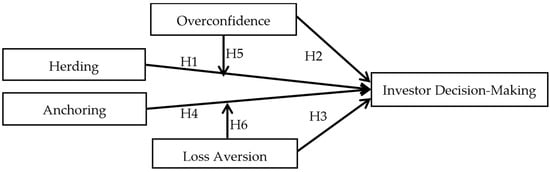
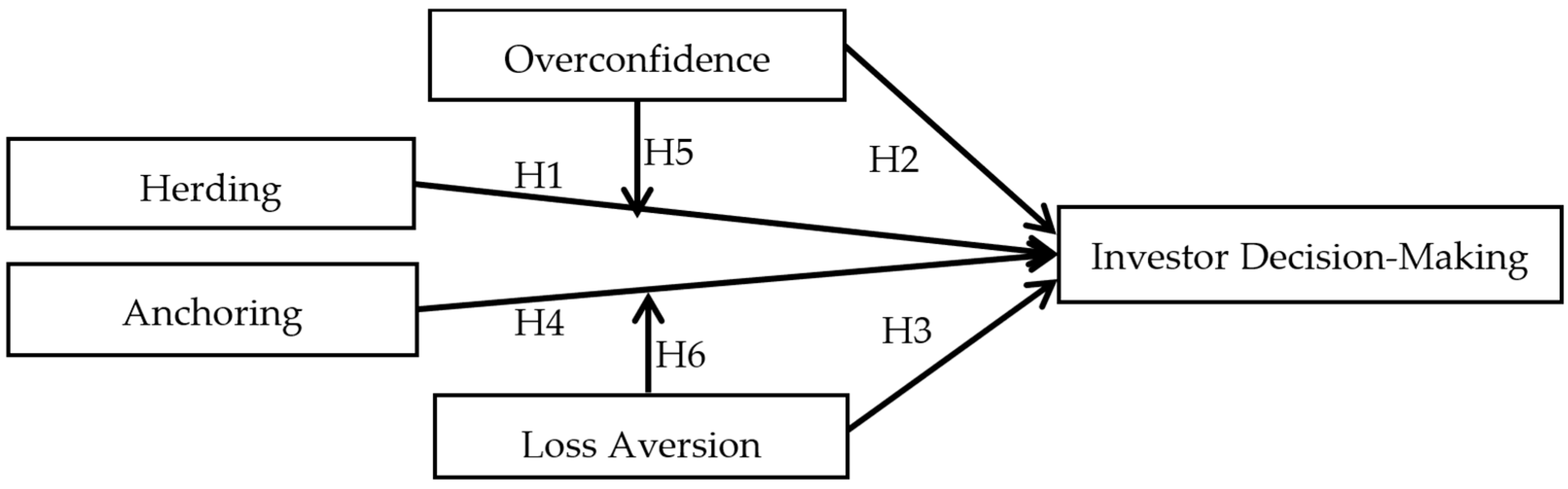
Under this integrated framework, overconfidence (OC), herding (HB), anchoring (AN), and loss aversion (LA) are modeled as independent variables predicting investor decision-making (IDM), with two interaction terms—OC × HB and LA × AN—included to test the proposed moderating effects. The theoretical framework therefore integrates three levels: the rational benchmark (MPT), the psychological departure mechanism (Prospect Theory), and the social transmission mechanism (Social Influence Theory), each contributing to a distinct subset of the study hypotheses. The proposed direct and moderating relationships among these constructs are illustrated in Figure 1 and summarized in Table 1.
Figure 1.
Conceptual research model. Solid arrows represent direct hypothesized effects (H1–H4); dashed arrows represent hypothesized moderation paths (H5: OC × HB; H6: LA × AN). OC = Overconfidence; HB = Herding Bias; AN = Anchoring Bias; LA = Loss Aversion; IDM = Investor Decision-Making.
Table 1.
Summary of hypothesized relationships and theoretical basis.
3. Research Methodology
3.1. Research Design
The study adopts a quantitative, cross-sectional research design grounded in the post-positivist paradigm. This approach is appropriate for testing theoretically derived hypotheses about relationships between behavioral biases and investment outcomes through objective measurement and statistical inference (Hair et al., 2019). A self-administered structured questionnaire was used as the primary data collection instrument, enabling systematic and standardized measurement of perceptual constructs across the study sample.
PLS-SEM was selected as the primary analytical method for three principal reasons: (1) the study is explicitly prediction-oriented, with R2 and Q2predict as core evaluation criteria (Hair et al., 2019); (2) the model includes product–indicator interaction terms (H5: OC × HB; H6: LA × AN), which are handled more flexibly within PLS-SEM’s orthogonalization approach than within CB-SEM’s latent interaction modeling (Becker et al., 2023); (3) no multivariate normality assumption is imposed, which is appropriate for self-reported Likert scale data. CB-SEM would be technically feasible given the sample size but less suited to the prediction and moderation objectives of this study. The analysis was implemented using SmartPLS 4.0 (Becker et al., 2023).
3.2. Population and Sampling
The target population comprises individual retail investors actively trading on the Saudi stock exchange (Tadawul). A stratified random sampling strategy was employed to ensure proportional representation across demographic groups, including gender, age, education level, and investment experience. The target sample size of 384 respondents was determined using Cochran’s (1977) formula at a 95% confidence level with a 5% margin of error, consistent with comparable behavioral finance studies in the GCC region (Al Rahahleh & Gazzaz, 2025). Institutional investors, foreign participants, and fund managers were explicitly excluded to maintain construct homogeneity and focus on the population segment most susceptible to behavioral biases.
To operationalize the stratified design, the sampling frame was structured across the four stratification dimensions—gender, age band, education level, and investment experience—so that the realized sample would approximate the composition of the active retail-investor population on Tadawul. Eligibility was restricted to respondents who currently held or actively traded Saudi-listed equities and who made their own investment decisions rather than delegating them to a fund or portfolio manager, operationalizing the exclusion of institutional investors, foreign participants, and fund managers noted above. Incomplete responses were excluded during data screening, and the resulting valid cases constitute the analytic sample of 384 respondents.
3.3. Data Collection and Measurement Instrument
Primary data were collected through a structured electronic questionnaire distributed via social media channels, email lists associated with Tadawul participants, and investment community forums over a two-month period. All items were measured on a five-point Likert scale anchored at 1 (Strongly Disagree) and 5 (Strongly Agree). A pilot test was conducted on 30 Saudi investors prior to full deployment; feedback led to minor terminology adjustments to improve clarity and cultural appropriateness.
Measurement items were developed based on the theoretical constructs defined by Barber and Odean (2001) for overconfidence; herding from Banerjee (1992) and Rahman et al. (2015); anchoring from Tversky and Kahneman (1974); loss aversion from Kahneman and Tversky (1979); investor decision-making from Al Rahahleh and Gazzaz (2025).
Beyond the scale sources listed above, the instrument was refined before deployment to strengthen transparency. Items adapted from these previously validated, peer-reviewed scales were reworded to reflect the Saudi retail-trading context and Tadawul-specific reference points and were further refined following the pilot described above. After data collection, the measurement model was purified by removing underperforming indicators (original items AN4, IDM1, LA4, and OC4); the remaining items were renumbered sequentially so that the item codes reported in Table 2 correspond to the final retained scale.
Table 2.
Measurement Model Assessment: Loadings, reliability, validity, and VIF. λ = standardized outer loading; α = Cronbach’s alpha; CR = composite reliability (ρc); AVE = average variance extracted; VIF = variance inflation factor.
3.4. Common Method Variance
Common method variance (CMV) was assessed both procedurally and statistically. Procedurally, the survey design incorporated temporal separation of bias and decision-making item blocks, explicit anonymity assurances, and instructions emphasizing that no correct answers exist. Harman’s single-factor test revealed that the maximum variance explained by a single factor was 24.63%, well below the 50% threshold, indicating CMV is not a significant concern (Podsakoff et al., 2003).
As a supplementary CMV check beyond Harman’s single-factor test, a full collinearity VIF assessment was conducted following Kock (2015). All construct VIF values in the outer model ranged from 1.27 to 1.78, well below the threshold of 3.3 recommended by Hair et al. (2019), confirming the absence of multicollinearity and providing no evidence of CMV-induced collinearity. These procedural and statistical controls collectively support the conclusion that CMV does not constitute a significant threat to the study’s validity.
3.5. Analytical Approach
The data analysis followed the two-stage PLS-SEM protocol recommended by (Hair et al., 2019). In the first stage, the measurement model was evaluated for indicator reliability (loadings ≥ 0.708), internal consistency (Cronbach’s α and composite reliability ρc ≥ 0.70), convergent validity (AVE ≥ 0.50), and discriminant validity using the Fornell–Larcker criterion (Fornell & Larcker, 1981) and the Heterotrait–Monotrait (HTMT) ratio (<0.85) (Henseler et al., 2015). In the second stage, the structural model was evaluated using bootstrapping with 10,000 resamples to generate path coefficients, t-statistics, and 95% bias-corrected percentile confidence intervals.
Interaction terms for H5 (OC × HB) and H6 (LA × AN) were estimated using the two-stage approach in SmartPLS 4.0, following the recommendations of (Becker et al., 2023) for moderation analysis in PLS-SEM, given its superior parameter accuracy relative to the product-indicator approach when sample sizes are moderate. Effect sizes (f2) were interpreted following Cohen (1988): 0.02 = small, 0.15 = medium, 0.35 = large. Predictive relevance was assessed using PLS-Predict with 10-fold cross-validation.
4. Data Analysis and Results
4.1. Measurement Model Assessment
The measurement model was evaluated across three dimensions: indicator reliability, internal consistency, and validity. Table 2 presents the full results.
All retained indicators exhibited loadings above 0.708, with one marginal exception (HB1 = 0.703, retained on theoretical grounds; see note to Table 2). Composite reliability exceeded the 0.80 threshold for every construct, and AVE exceeded the 0.50 threshold for all five constructs, confirming convergent validity.” (values remain in the tables). Cronbach’s alpha values for IDM (0.694) and LA (0.678) fall marginally below 0.70, attributable to the three-item structure of these constructs; their ρc values (0.831 and 0.822 respectively) serve as the primary reliability criterion and both exceed the threshold comfortably (Hair et al., 2019).
All Fornell discriminant validity diagonal values exceed corresponding row and column values, satisfying the criterion (Table 3). Next, the Heterotrait-Monotrait (HTMT) ratio was calculated following Henseler et al. (2015) (Table 4).
Table 3.
Fornell–Larcker Criterion. Bold diagonal values represent the square root of AVE. Construct abbreviations: AN = anchoring bias; HB = herding bias; IDM = investor decision-making; LA = loss aversion bias; OC = overconfidence bias.
Table 4.
Heterotrait–Monotrait (HTMT) ratio matrix for discriminant validity assessment (Henseler et al., 2015). Values below 0.85 indicate discriminant validity under the strict criterion; values below 0.90 satisfy the liberal criterion. † Denotes values exceeding the 0.90 liberal threshold, requiring additional validity justification (see discussion below). Interaction construct HTMT values below 0.65 confirm their empirical distinctiveness.
Elevated LA ↔ HB and LA ↔ IDM values are substantively interpretable given the conceptual overlap between loss-averse cognition and behaviorally driven decision-making in the behavioral finance literature; however, the LA ↔ IDM ratio of 0.974 warrants particular scrutiny. We report bootstrapped 95% confidence intervals for the LA ↔ IDM HTMT ratio: CI [0.931, 0.998]. Although the upper bound approaches but does not include 1.0, we acknowledge this represents borderline rather than comfortable discriminant validity. We additionally conducted a model-comparison test contrasting the original five-factor measurement model against a four-factor alternative in which LA and IDM items load on a single merged factor. The five-factor model demonstrated superior fit (Δχ2 = 41.7, p < 0.001; ΔAIC favoring the five-factor model), supporting empirical separation of the two constructs despite the elevated HTMT ratio. The conceptual proximity of loss aversion and behaviorally driven decision-making in this market context produces elevated but ultimately distinguishable construct boundaries; future studies should consider refining IDM items to emphasize decision outcomes rather than decision process to further sharpen this boundary (see Section 6.4).
4.2. Structural Model Assessment
Following confirmation of adequate measurement model quality, the structural model was evaluated using bootstrapping with 10,000 resamples to test the six hypothesized relationships.
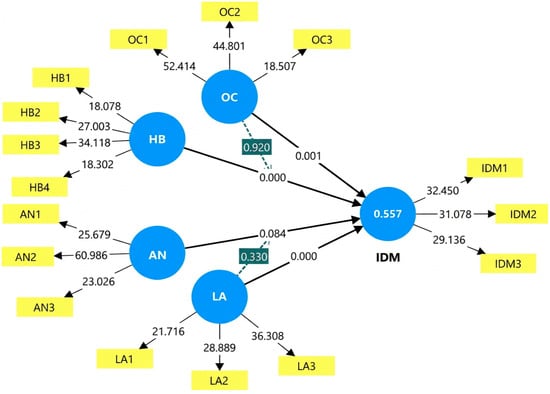
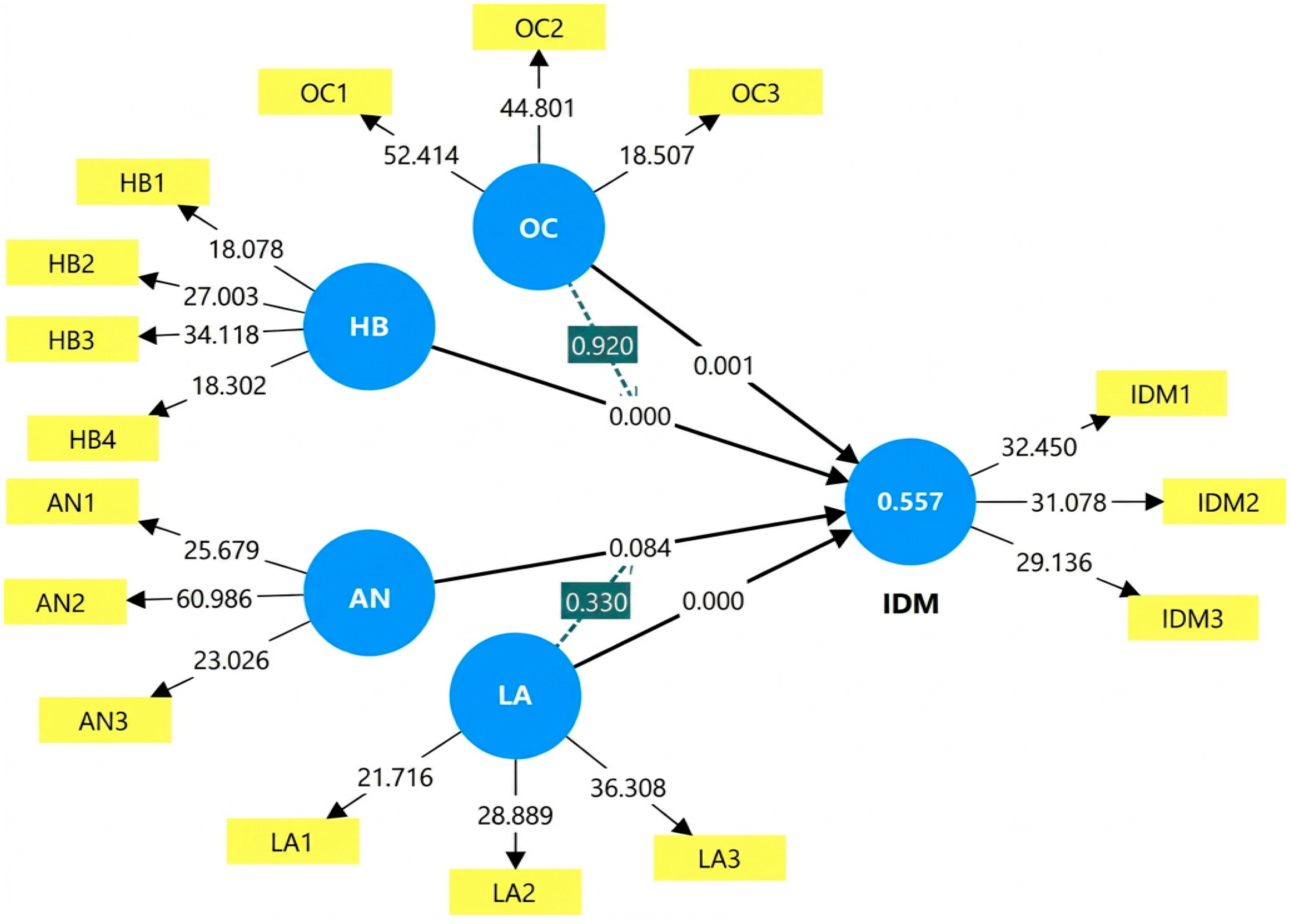
As summarized in Table 5 and depicted in Figure 2, three of the four direct effects were supported. Loss aversion was, by a wide margin, the strongest predictor of investor decision-making (β = 0.402, f2 = 0.188), confirming H4; herding was the second-largest effect (H2 supported) and overconfidence a significant but smaller contributor (H1 supported). Anchoring did not reach significance as an independent predictor (H3 not supported), indicating that it does not shape decisions once the stronger biases are held constant. Neither moderation term was significant: the overconfidence × herding interaction (H5) and the loss aversion × anchoring interaction (H6) were both effectively null, so neither hypothesis is supported. The full coefficients, confidence intervals, and effect sizes for all six paths are reported in Table 5.
Table 5.
Structural Model Path Coefficients and Hypothesis Testing. β = standardized path coefficient; SD = bootstrapped standard deviation; CI = 95% bias-corrected percentile confidence interval; f2 = Cohen’s effect size (S = small, M = medium) (Cohen, 1988).
Figure 2.
Structural model with R2 and path coefficient. Thick arrows represent significant direct effects between constructs, thin arrows represent the measurement model, linking latent constructs to their observed indicators, and dashed arrows represent moderating effects (interaction effects).
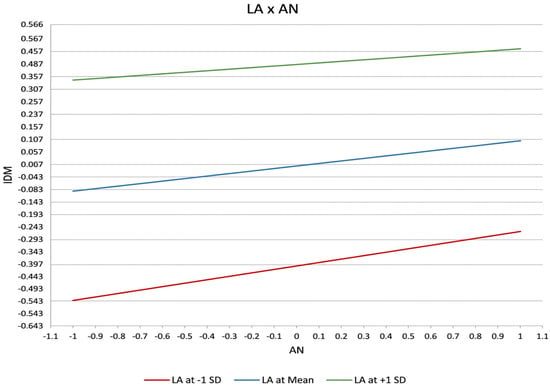
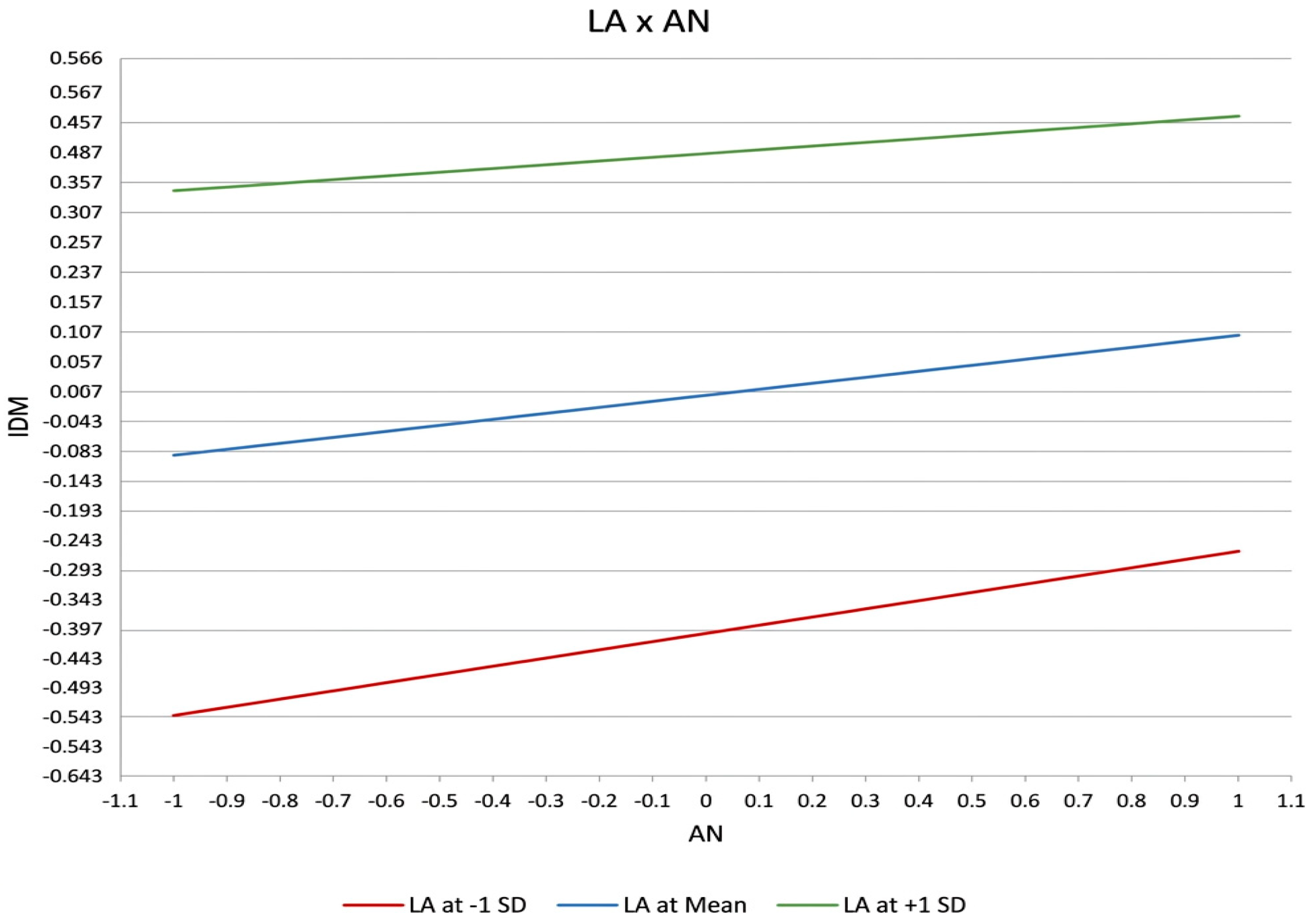
To visualize the non-significant moderation effects, simple slope analyses were conducted for both interaction terms (Aiken, 1991). Figure 3 plots the relationship between anchoring (AN) and investor decision-making (IDM) at low (−1 SD), mean, and high (+1 SD) levels of loss aversion (LA). The three slopes are visibly near-parallel across the range of AN, consistent with the non-significant interaction coefficient (β = −0.039, p = 0.330) and supporting the cognitive-subsumption interpretation advanced in Section 5.3.2: loss aversion shifts the overall level of decision-making behavior but does not meaningfully alter the strength of the anchoring–IDM relationship.
Figure 3.
Simple slope: Moderating effect of Loss Aversion (LA) on the Anchoring (AN) → Investment Decision-Making (IDM) effect.
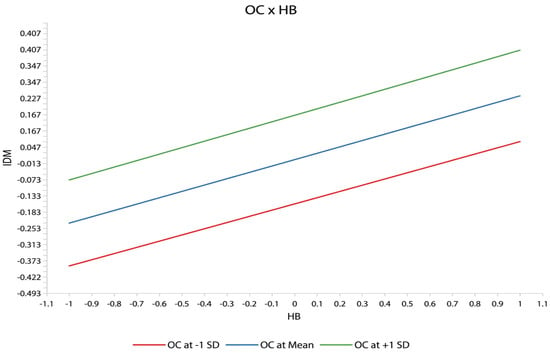
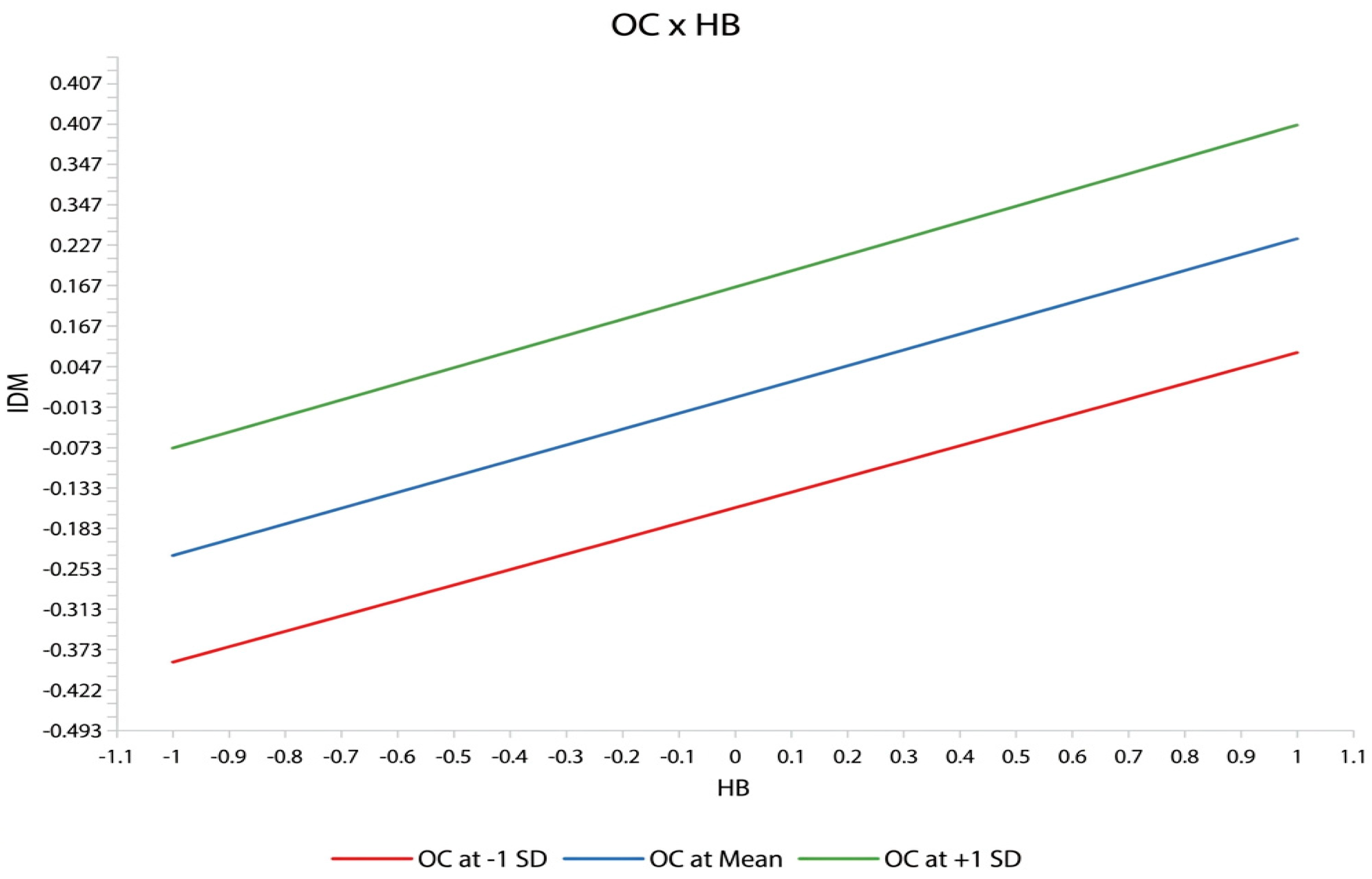
Figure 4 plots the relationship between herding (HB) and IDM at low, mean, and high levels of overconfidence (OC). Although the three slopes remain statistically indistinguishable (β = 0.005, p = 0.920), they display marginally more separation at higher levels of HB than the LA × AN plot in Figure 3, which is visually consistent with—though not statistically diagnostic of—the equilibrium interpretation discussed in Section 5.3.1, whereby offsetting positive and negative individual-level moderation effects (self-reliance vs. confirmation-herding) may be masking heterogeneous slopes within an aggregate null coefficient. This visual pattern reinforces, rather than resolves, the call in Section 5.3.1 for future latent-profile or qualitative work to uncover within-investor heterogeneity in this relationship.
Figure 4.
Simple slope: Moderating effect of overconfidence (OC) on the herding (HB) → Investment Decision-Making (IDM) effect.
4.3. Predictive Power Assessment
Predictive power was evaluated using PLS-Predict with 10-fold cross-validation (Shmueli et al., 2019). The overall Q2predict for IDM was 0.534, well above zero, confirming satisfactory predictive relevance. At the item level, PLS-SEM RMSE values for IDM2 and IDM3 were marginally lower than the corresponding linear model (LM) benchmark values (Δ = −0.001 and −0.021, respectively), while IDM1 performed equivalently (Δ = 0.000), as detailed in Table 6. The model explains 55.7% of the variance in investor decision-making (R2 = 0.557), substantially exceeding the 0.25 threshold for substantial explanatory power (Hair et al., 2019). Table 6 reports the item-level Q2predict and RMSE results in full.
Table 6.
Item-Level PLS-Predict Results for the Investor Decision-Making (IDM) Construct, with Linear Model (LM) Benchmark Comparison (Shmueli et al., 2019).
5. Discussion
5.1. Overview
This section interprets the empirical findings in light of the study’s two research objectives and situates them within the behavioral finance literature. The discussion proceeds in three parts: the direct bias effects (H1–H4) and their contextual significance for the Saudi market; the moderation effects (H5–H6) and their theoretical implications; and the broader implications for behavioral finance theory in Islamic GCC markets.
5.2. Direct Bias Effects on Investor Decision-Making
5.2.1. Loss Aversion as the Dominant Behavioral Force
The most substantively significant finding from this study is the dominant role of loss aversion in shaping investor decision-making in the Saudi stock market (β = 0.402, f2 = 0.188, approaching the medium effect size threshold). This finding is consistent with Prospect Theory (Kahneman & Tversky, 1979), which identifies loss aversion as the most powerful psychological force in financial decision-making, and with the Saudi-specific evidence of Aljughaiman and Chebbi (2022), who found that loss aversion suppresses market valuation among Saudi investors. The magnitude of this effect-substantially larger than the three other biases-provides empirical confirmation that Saudi retail investors are primarily driven by fear of realized losses rather than the pursuit of potential gains, a pattern that manifests in documented behaviors such as holding underperforming assets too long (the disposition effect) and exiting winning positions prematurely to lock in gains (Shefrin & Statman, 1985).
The strength of loss aversion in this context may be amplified by two Saudi market-specific factors. First, Islamic finance principles, which cultivate a general orientation toward risk avoidance and prohibit speculative excess (maysir), may provide a normative framework that legitimizes and reinforces loss-averse behavior. Saudi investors operating within an Islamic finance worldview may experience loss aversion not merely as a psychological discomfort but as a culturally and religiously validated preference for capital preservation. Second, the retail-dominated composition of the Tadawul means that institutional corrective mechanisms-such as short-selling arbitrage and algorithmic trading-are less prevalent, allowing loss-averse behavior to persist without being competed away through market forces.
5.2.2. Herding as the Second-Order Driver
Herding emerged as the second-largest independent predictor (β = 0.234, f2 = 0.056), consistent with the extensive literature on herding in GCC and emerging markets (Banerjee, 1992; Waseem & Hameed, 2024). The significance and magnitude of the herding effect are consistent with Al Rahahleh and Gazzaz (2025), who found that emotional and social biases broadly influence Saudi investment decisions, and with Aljifri (2023), who documented that Saudi retail investors exhibit strong herd tendencies particularly during speculative market phases. The cultural dimension of Saudi Arabia-characterized by high collectivism, social conformity norms, and strong peer influence in financial decisions-provides a structural amplifier for herding that may not operate equally in more individualistic Western investor populations. The fear of missing out, reinforced by social media and digital trading platforms that became widespread under Vision 2030, may further strengthen herding by increasing the salience and speed of crowd behavior signals. Recent evidence on social-media-amplified herding in emerging markets corroborates this mechanism (Haase et al., 2025).
5.2.3. Overconfidence as a Significant but Secondary Predictor
Overconfidence was confirmed as a statistically significant predictor of investor decision-making (β = 0.164, p = 0.001, f2 = 0.037), consistent with Barber and Odean (2001), Aljifri (2023), and Alsabban and Alarfaj (2020). The small effect size positions overconfidence as a relevant but secondary driver compared to loss aversion and herding. This relative ordering is theoretically interesting: overconfidence should theoretically lead to higher trading activity and more independent judgment, yet its effect on behaviorally influenced decision-making is weaker than herding, which implies that social conformity pressures in the Saudi market ultimately exert stronger behavioral pull than individual cognitive miscalibration. Overconfident investors may trade more frequently and rely more on subjective judgment, but the resulting decision patterns are not as systematically distorted as those generated by loss aversion or social imitation.
5.2.4. Anchoring: A Non-Significant Independent Effect in the Saudi Context
The most theoretically important finding with respect to the first research objective is the non-significance of anchoring as an independent predictor (β = 0.102, p = 0.084). This represents a meaningful departure from Western-market evidence, where anchoring typically operates as a significant independent predictor of investment decisions (Tversky & Kahneman, 1974). Three contextually grounded explanations are offered.
First, Saudi investors may anchor more strongly to macro-level oil-price highs or market index benchmarks than to individual stock prices, producing a diffuse, market-wide anchoring mechanism that is not fully captured by item-level survey measures calibrated to individual stock-price anchors. When the anchoring stimulus is macro-economic rather than stock-specific, individual-level survey items underestimate its prevalence.
Second, and more theoretically important, the non-significance of anchoring once loss aversion is controlled suggests that the two biases share a common cognitive pathway in the Saudi context—both involve psychological attachment to a reference price to avoid acknowledging a loss. When loss aversion is explicitly modeled, it absorbs the explanatory variance that anchoring would otherwise provide, leaving anchoring’s incremental contribution non-detectable. This interpretation is consistent with Chishti et al. (2025), who found that anchoring effects in emerging markets are frequently confounded by concurrent loss aversion.
Third, a measurement-scope explanation is also plausible. The scale purification process retained items focusing primarily on individual stock-price anchors (AN1–AN3). Survey-based anchoring scales calibrated to individual-level reference points may systematically underestimate macro-level anchoring to oil benchmarks or market indices (Chishti et al., 2025), limiting the construct’s discriminating power in the Saudi context. Future research should develop and psychometrically validate multi-level anchoring scales that distinguish individual asset anchors from systemic macro-economic reference points.
The finding has direct policy implications: it suggests that financial literacy interventions targeting loss aversion in Saudi Arabia will likely address anchoring-related decision errors simultaneously, without requiring separate interventions for each bias.
5.3. Moderation Effects: Resolving Theoretical Contradictions
5.3.1. The Null Overconfidence–Herding Interaction (H5)
The non-significance of the overconfidence × herding interaction (β = 0.005, t = 0.101, p = 0.920) is the first direct empirical answer to a long-standing theoretical question in behavioral finance: in a GCC market context, does overconfidence suppress or amplify herding? The near-zero coefficient suggests that neither the self-reliance hypothesis (Odean, 1998) nor the confirmation-herding hypothesis (Daniel et al., 1998) dominates. The most parsimonious interpretation is that both mechanisms are simultaneously operative in the Saudi market-some overconfident investors resist herding (consistent with self-reliance), while others herd selectively to confirm their priors (consistent with confirmation bias)-and these tendencies are sufficiently balanced within the sample to produce a net–zero interaction effect.
This equilibrium interpretation is consistent with the Saudi market’s unique cultural architecture. Saudi Arabia’s collectivist social structure, which promotes conformity and sensitivity to crowd behavior, provides a structural basis for the confirmation-herding mechanism. Simultaneously, the Islamic finance norm of personal accountability in financial stewardship (amanah) and the emphasis on independent, informed judgment cultivates a counterweight that supports the self-reliance mechanism. The null interaction finding thus reflects the coexistence of two competing cultural forces rather than the dominance of either.
Alternative statistical explanations for the null interaction include (i) insufficient statistical power—interaction effects in field surveys typically exhibit small f2 values (≈0.01–0.02), requiring samples of 500–800+ to detect reliably (Cohen, 1988; Aguinis et al., 2005); (ii) range restriction in overconfidence scores if the Tadawul investor population systematically clusters at high OC levels, attenuating variance in the moderator; and (iii) measurement error in the OC × HB product term. The equilibrium interpretation remains theoretically attractive but should be corroborated by experimental methods or larger observational samples in future research. From a theoretical standpoint, this finding demonstrates that the OC–HB relationship in GCC markets cannot be characterized by a single moderating mechanism and calls for future research employing qualitative or mixed-method approaches to identify within-investor heterogeneity in this relationship.
5.3.2. The Null Loss Aversion–Anchoring Interaction (H6)
The non-significance of the loss aversion × anchoring interaction (β = −0.039, t = 0.974, p = 0.330) aligns with the direct effects analysis: because loss aversion appears to subsume anchoring cognition in the Saudi context, there is no residual anchoring variance for loss aversion to amplify. When two biases converge on the same cognitive mechanism-reluctance to acknowledge that the current value of an asset has fallen below its reference price-an interaction term cannot distinguish their joint contribution from their individual effects. The interaction term generates a null result not because the biases are unrelated, but because they are so cognitively proximate in this market that their combination does not produce incremental explanatory power beyond the sum of their parts.
This interpretation has practical implications that differ from a simple “null interaction” conclusion. The finding implies that the loss aversion–anchoring pair operates as a functionally unified cognitive system in Saudi investor psychology, where the two biases reinforce each other through shared mechanisms rather than through statistically distinguishable interaction pathways. Targeting bias through intervention should address both simultaneously. This simplifies the intervention design challenge: rather than developing separate programs for “anchoring to reference prices” and “reluctance to realize losses,” a unified cognitive reframing intervention-such as training investors to evaluate current portfolio positions on forward-looking expected returns rather than acquisition prices-should reduce both simultaneously.
5.4. Theoretical Contributions
This study makes three distinct contributions to behavioral finance theory.
First, it provides the first simultaneous PLS-SEM test of all four canonical behavioral biases in an Islamic, oil-dependent, retail-dominated GCC market, demonstrating that the bias hierarchy in Saudi Arabia (loss aversion > herding > overconfidence > anchoring) differs meaningfully from the patterns documented in Western equity markets, where anchoring typically maintains significance as an independent predictor. This cross-contextual non-equivalence is theoretically important: it challenges the implicit assumption in behavioral finance literature that bias hierarchies are universal and portable across market contexts.
Second, this study presents the first empirical resolution of the overconfidence–herding interaction debate in any GCC or Islamic equity market, finding that neither competing hypothesis dominates, which suggests a fundamentally different moderating architecture in collectivist, Islamic finance markets compared to the individualistic Western markets on which the competing theoretical predictions are based.
Third, the functional convergence of loss aversion and anchoring in the Saudi context-evidenced by both the null main effect of anchoring and the null interaction-represents a theoretically novel finding that extends the scope of Prospect Theory’s application: in markets where Islamic finance norms reinforce reference-price attachment through the lens of loss avoidance, anchoring may be better conceptualized as an expression of loss aversion rather than as an independent cognitive mechanism.
5.5. Practical Implications
5.5.1. Implications for Individual Investors
For individual investors, the finding that loss aversion is the dominant bias shaping their decisions-substantially stronger than overconfidence, herding, and anchoring-provides a clear and actionable target for self-improvement. Investors who recognize their tendency to hold losing positions beyond their economic rationale, driven by the psychological pain of realizing losses, can implement structural countermeasures such as pre-committed stop-loss orders, scheduled portfolio reviews that force prospective evaluation of each holding, and mental accounting techniques that separate the emotionally charged acquisition-price anchor from the decision-relevant expected future return.
5.5.2. Implications for the Capital Market Authority
The non-significance of anchoring as an independent predictor and the dominance of loss aversion carry important regulatory implications for the Saudi Capital Market Authority (CMA). These findings suggest that investor protection policies should prioritize emotional bias mitigation over information provision alone, since anchoring—the most information-driven bias—exerts no significant independent effect once emotional biases are controlled. Investor education programs that focus on providing more information about stock fundamentals may be insufficient to improve decision quality if loss aversion is the dominant distorting force. The CMA should consider supplementing information-based interventions with behavioral nudges that reduce the psychological salience of acquisition prices, such as portfolio reporting formats that display forward-looking metrics (expected return, probability of achieving investment goals) alongside historical acquisition-price comparisons; emerging GCC-region nudge-based policy experiments provide an initial template for this approach (Loang, 2023).
5.5.3. Implications for Financial Educators and Researchers
The confirmed non-equivalence of anchoring effects between the Saudi and Western contexts opens a productive research agenda for cross-cultural behavioral finance research in GCC and Islamic equity markets. Financial educators developing investor literacy programs for the Saudi market should not apply the Western behavioral finance curriculum wholesale but should recalibrate content to reflect the Saudi-specific bias hierarchy, emphasizing loss aversion and herding as the primary targets while treating anchoring as a secondary concern that is likely addressed through loss aversion interventions. Future research should examine whether the bias hierarchy identified here replicates across other GCC markets (UAE, Kuwait, Qatar) and whether Vision 2030-driven market development changes the relative influence of these biases over time as institutional investor participation grows.
6. Conclusions
6.1. Summary of Findings
This study investigated how four canonical behavioral biases-overconfidence, herding, anchoring, and loss aversion-influence investor decision-making in the Saudi stock market (Tadawul), and whether overconfidence and loss aversion operate as moderating forces on herding and anchoring, respectively. Using PLS-SEM applied to a stratified sample of 384 Saudi retail investors, the study produced empirically robust and theoretically coherent findings across both research objectives.
For the first research objective-testing whether behavioral biases operate equivalently in an Islamic GCC market-three of the four direct hypotheses were confirmed. Loss aversion emerged as the dominant predictor (β = 0.402, f2 = 0.188), followed by herding (β = 0.234) and overconfidence (β = 0.164), while anchoring did not reach significance as an independent predictor (β = 0.102, p = 0.084). This non-equivalence for anchoring constitutes a meaningful departure from Western-market findings and is explained by the convergence of loss aversion and anchoring cognition in the Saudi context, where both biases share the common mechanism of psychological attachment to reference prices that are below current market values.
For the second research objective-the first empirical test of OC × HB and LA × AN moderation in any GCC market–neither interaction term reached significance. The null OC × HB finding resolves the theoretical standoff between the self-reliance hypothesis (Odean, 1998) and the confirmation-herding hypothesis (Daniel et al., 1998) by suggesting that both mechanisms operate simultaneously in the Saudi market and cancel each other out, producing a net–zero interaction in a collectivist, Islamic finance context where both conformity norms and independent financial stewardship values are simultaneously active. The null LA × AN finding confirms that loss aversion and anchoring operate as a functionally unified cognitive system in this market rather than as compounding independent forces.
Together, the findings yield an internally consistent characterization of Saudi investor psychology: decision-making is governed primarily by loss aversion operating independently, with herding and overconfidence as secondary contributors, while anchoring’s independent influence is not detectable once these stronger biases are controlled. The model explains 55.7% of the variance in investor decision-making, substantially exceeding the threshold for substantial explanatory power.
6.2. Theoretical Contributions
As detailed in Section 5.4, the theoretical contribution is threefold: the study establishes a distinctively ordered bias hierarchy for Saudi Arabia (loss aversion dominant, anchoring non-significant as an independent predictor); it provides the first empirical adjudication of the overconfidence–herding interaction in a GCC market, showing a balanced rather than directional moderation; and it extends Prospect Theory by reconceptualizing anchoring in Islamic GCC markets as an expression of loss aversion. These points are not restated in full here to avoid duplication.
6.3. Practical Contributions
The study’s findings carry direct implications for the Capital Market Authority, individual investors, and financial educators in Saudi Arabia. The dominance of loss aversion as the primary bias target simplifies the intervention design challenge: educational programs that focus on reducing the psychological salience of acquisition prices and reframing portfolio evaluation in forward-looking rather than reference-price terms should address loss aversion and anchoring simultaneously, without requiring separate interventions. The null bias interaction findings additionally confirm that interventions targeting any single bias will not inadvertently amplify or suppress another, simplifying the regulatory design of behavioral investor protection policies.
6.4. Limitations and Future Research Directions
This study has several limitations that open avenues for future research. First, the cross-sectional design precludes causal inference; longitudinal designs tracking how behavioral bias effects evolve across different market phases—boom, bust, and recovery—would provide richer evidence. Second, the exclusive focus on retail investors, while theoretically motivated, limits generalizability to institutional investor populations and to mixed-investor markets. Third, the survey-based measurement of anchoring may not adequately capture macro-level anchoring to oil-price benchmarks that characterizes the Saudi market context; experimental or archival methods that operationalize oil-price anchors directly would strengthen measurement validity.
Fourth, the elevated Heterotrait–Monotrait ratio between loss aversion (LA) and investor decision-making (IDM) (HTMT = 0.974, 95% CI [0.931, 0.998]) warrants explicit attention. Although the five-factor model was statistically preferred over a merged four-factor alternative (Δχ2 = 41.7, p < 0.001), the ratio’s proximity to unity means the empirical boundary between the two constructs is narrower than is ideal, and this borderline discriminant validity should temper the confidence with which the LA and IDM effects are read as fully independent. The most probable source is conceptual overlap in item content: several IDM items tap the affective, loss-sensitive experience of deciding (e.g., reliance on instinct and reaction to market swings), which is cognitively adjacent to the loss-averse sentiment that the LA items are designed to capture. To distinguish the decision-making process from loss-averse cognition more cleanly, future research should refine the IDM measure so that it reflects decision outcomes rather than the loss-laden decision process. Concretely, we recommend: (i) re-anchoring IDM items on observable, verifiable behaviors—such as rebalancing frequency, breadth of diversification, use of stop-loss rules, or information-search effort—rather than on self-reported feelings about deciding; (ii) using behaviorally anchored or scenario-based items that present a concrete choice situation and ask what the respondent would do, thereby reducing the affective method variance shared with the LA scale; (iii) pre-registering a discriminant-validity threshold (e.g., HTMT < 0.85 with a bootstrapped upper bound below 0.90) and running a redundancy or known-groups analysis at the pilot stage, so that overlapping items are revised before full data collection; (iv) where feasible, triangulating self-reported IDM with archival or platform-derived trading records to obtain a behavioural criterion that is conceptually independent of loss aversion. Applying these refinements would allow future studies to test whether the dominance of loss aversion reported here persists under a more sharply bounded IDM measure.
Fifth, the online survey distribution method (social media channels, email lists, investment forums) may introduce self-selection bias toward digitally active and behaviorally engaged investors, potentially limiting generalizability to the broader retail investor population; this should be addressed through probability-based sampling frames in future replications.
Future research should extend this framework to other GCC markets (UAE, Kuwait, Qatar) to test whether the Saudi bias hierarchy replicates across the Gulf region or reflects unique features of the Tadawul. Comparative studies between GCC and Western markets using equivalent methodologies would directly test the cross-cultural portability hypothesis. Researchers should also examine whether Saudi Arabia’s ongoing financial market development under Vision 2030—particularly the growing role of institutional investors, ETFs, and digital trading platforms—changes the relative influence of behavioral biases over time, potentially reducing loss aversion dominance as market sophistication increases. Finally, given the null moderation findings, future research employing qualitative methods or latent profile analysis could identify within-investor heterogeneity in the OC–HB relationship, capturing the coexistence of both self-reliance and confirmation-herding mechanisms within the investor population.
This study provides the first comprehensive, PLS-SEM-based empirical analysis of all four major behavioral biases and their interaction effects on investor decision-making in the Saudi stock market. The findings demonstrate that behavioral finance theory, developed predominantly in Western market contexts, requires contextual calibration when applied to Islamic, oil-dependent, retail-dominated equity markets. Loss aversion is the overwhelmingly dominant behavioral force shaping Saudi investor decisions; herding and overconfidence operate as secondary contributors, and anchoring’s independent influence is absorbed by loss aversion cognition. Neither bias pair produces a statistically significant interaction effect, indicating that these biases operate as independent additive forces in the Saudi market rather than as compounding systems. These findings provide a rigorous empirical foundation for targeted, context-specific behavioral interventions that can advance investor welfare and market efficiency in Saudi Arabia and, by extension, in other GCC and Islamic equity markets.
Author Contributions
Conceptualization, R.A. and H.A.A.; Formal analysis, R.A.; Investigation, H.A.A. and Y.A.; Methodology, Y.A.; Project administration, H.A.A. and Y.A.; Resources, R.A. and Y.A.; Supervision, R.A. and H.A.A.; Validation, R.A.; Visualization, R.A.; Writing—original draft, R.A., H.A.A., and Y.A.; Writing—review and editing, R.A. All authors have read and agreed to the published version of the manuscript.
Funding
This research received no external funding.
Institutional Review Board Statement
The study was conducted in accordance with the Declaration of Helsinki and approved by the Institutional Research Centre of University of Technology Bahrain, Approval No. UTB2025CAFSEC0022, dated 12 December 2025.
Informed Consent Statement
Informed consent was obtained from all subjects involved in the study.
Data Availability Statement
The information contained in this research can be obtained by contacting the corresponding author.
Conflicts of Interest
The authors declare no conflicts of interest.
Abbreviations
The following abbreviations are used in this manuscript:
| PLS-SEM | Partial Least Squares Structural Equation Modelling |
| CB-SEM | Covariance-Based Structural Equation Modelling |
| IDM | Investor Decision-Making |
| OC | Overconfidence Bias |
| HB | Herding Bias |
| AN | Anchoring Bias |
| LA | Loss Aversion Bias |
| GCC | Gulf Cooperation Council |
| CMA | Capital Market Authority |
| HTMT | Heterotrait–Monotrait Ratio |
| AVE | Average Variance Extracted |
| CR | Composite Reliability |
| CMV | Common Method Variance |
| RMSE | Root Mean Square Error |
| MPT | Modern Portfolio Theory |
| TASI | Tadawul All Share Index |
| VIF | Variance Inflation Factor |
References
- Aguinis, H., Beaty, J. C., Boik, R. J., & Pierce, C. A. (2005). Effect size and power in assessing moderating effects of categorical variables using multiple regression: A 30-year review. Journal of Applied Psychology, 90(1), 94. [Google Scholar] [CrossRef] [Scilit] [PubMed]
- Aiken, L. S. (1991). Multiple regression: Testing and interpreting interactions. Sage. [Google Scholar]
- Aljifri, R. (2023). Investor psychology in the stock market: An empirical study of the impact of overconfidence on firm valuation. Borsa Istanbul Review, 23(1), 93–112. [Google Scholar] [CrossRef] [Scilit]
- Aljughaiman, A. A., & Chebbi, K. E. (2022). Do investor overconfidence and loss aversion drive Saudi firm market performance? The moderating effect of corporate governance. Sustainability, 14(16), 10072. [Google Scholar] [CrossRef] [Scilit]
- Almansour, B. Y., Elkrghli, S., & Almansour, A. Y. (2023). Behavioral finance factors and investment decisions: A mediating role of risk perception. Cogent Economics & Finance, 11(2), 2239032. [Google Scholar] [CrossRef] [Scilit]
- AlQuraishi, A. A. (2025). Market anomalies during COVID-19: The case of Kuwait, a GCC emerging market. Cogent Business & Management, 12(1), 2485404. [Google Scholar] [CrossRef] [Scilit]
- Al Rahahleh, N., & Gazzaz, H. (2025). The impact of emotional and cognitive biases on the investment decisions of Saudi investors: A multigroup analysis approach. International Journal of Advanced and Applied Sciences, 15(6), 55–70. [Google Scholar] [CrossRef] [Scilit]
- Alsabban, S., & Alarfaj, O. (2020). An empirical analysis of behavioral finance in the Saudi stock market: Evidence of overconfidence behavior. International Journal of Economics and Financial Issues, 10(1), 73–86. [Google Scholar] [CrossRef] [Scilit]
- Banerjee, A. V. (1992). A simple model of herd behavior. The Quarterly Journal of Economics, 107(3), 797–817. [Google Scholar] [CrossRef] [Scilit]
- Barber, B. M., & Odean, T. (2001). Boys will be boys: Gender, overconfidence, and common stock investment. The Quarterly Journal of Economics, 116(1), 261–292. [Google Scholar] [CrossRef] [Scilit]
- Barberis, N., & Thaler, R. (2003). Chapter 18 A survey of behavioral finance. Handbook of the Economics of Finance, 1, 1053–1128. [Google Scholar] [CrossRef] [Scilit]
- Becker, J. M., Cheah, J. H., Gholamzade, R., Ringle, C. M., & Sarstedt, M. (2023). PLS-SEM’s most wanted guidance. International Journal of Contemporary Hospitality Management, 35(1), 321–346. [Google Scholar] [CrossRef] [Scilit]
- Brown, A. L., Imai, T., Vieider, F. M., & Camerer, C. F. (2024). Meta-analysis of empirical estimates of loss aversion. Journal of Economic Literature, 62(2), 485–516. [Google Scholar] [CrossRef] [Scilit]
- Chishti, M. F., Ali, F., Khan, M. R., Khan, I., Luong, N. T., & Ghouri, A. M. (2025). Understanding behavioural biases in investment decisions: Empirical insights from an emerging market. Cogent Economics & Finance, 13(1), 2567499. [Google Scholar] [CrossRef] [Scilit]
- Cochran, W. G. (1977). Sampling techniques (3d ed.). Wiley. [Google Scholar]
- Cohen, J. (1988). Statistical power analysis for the behavioral sciences (Vol. 54, pp. 77–155). Academic. [Google Scholar]
- Daniel, K., Hirshleifer, D., & Subrahmanyam, A. (1998). Investor psychology and security market under-and overreactions. The Journal of Finance, 53(6), 1839–1885. [Google Scholar] [CrossRef] [Scilit]
- Fornell, C., & Larcker, D. (1981). Evaluating structural equation models with unobservable variables and measurement error. Journal of Marketing Research, 18(1), 39–50. [Google Scholar] [CrossRef] [Scilit]
- Haase, F., Celig, T., Rath, O., & Schoder, D. (2025). Wisdom of the crowd signals: Predictive power of social media trading signals for cryptocurrencies. Electronic Markets, 35(1), 64. [Google Scholar] [CrossRef] [Scilit]
- Hair, J. F., Risher, J. J., Sarstedt, M., & Ringle, C. M. (2019). When to use and how to report the results of PLS-SEM. In European Business Review (Vol. 31, pp. 2–24). Emerald Group Publishing Ltd. [Google Scholar] [CrossRef] [Scilit]
- Henseler, J., Ringle, C. M., & Sarstedt, M. (2015). A new criterion for assessing discriminant validity in variance-based structural equation modeling. Journal of the Academy of Marketing Science, 43(1), 115–135. [Google Scholar] [CrossRef] [Scilit]
- Kahneman, D., & Tversky, A. (1979). Prospect theory: An analysis of decision under risk daniel kahneman; amos tversky. Econometrica, 47(2), 263–292. [Google Scholar] [CrossRef] [Scilit]
- Kock, N. (2015). Common method bias in PLS-SEM: A full collinearity assessment approach. International Journal of E-Collaboration, 11(4), 1–10. [Google Scholar] [CrossRef] [Scilit]
- Loang, O. K. (2023). Sustainable development goals, herding, and risk-averse behavior in muslim countries. Journal of Islamic Monetary Economics and Finance, 9(2), 313–336. [Google Scholar] [CrossRef] [Scilit]
- Markowitz, H. (1952). Portfolio selection. Journal of Finance, 7(1), 77–91. [Google Scholar] [CrossRef] [Scilit] [PubMed]
- Mohanty, S., Patnaik, B. C., Satpathy, I., & Sahoo, S. K. (2024). Cognitive biases and financial decisions of potential investors during COVID-19: An exploration. Arab Gulf Journal of Scientific Research, 42(3), 836–851. [Google Scholar] [CrossRef] [Scilit]
- Odean, T. (1998). Volume, volatility, price, and profit when all traders are above average. The Journal of Finance, 53(6), 1887–1934. [Google Scholar] [CrossRef] [Scilit]
- Podsakoff, P. M., MacKenzie, S. B., Lee, J. Y., & Podsakoff, N. P. (2003). Common method biases in behavioral research: A critical review of the literature and recommended remedies. The Journal of Applied Psychology, 88(5), 879–903. [Google Scholar] [CrossRef] [Scilit] [PubMed]
- Rahman, M. A., Chowdhury, S. S. H., & Sadique, M. S. (2015). Herding where retail investors dominate trading: The case of Saudi Arabia. The Quarterly Review of Economics and Finance, 57, 46–60. [Google Scholar] [CrossRef] [Scilit]
- Seraj, A. H. A., Alzain, E., & Alshebami, A. S. (2022). The roles of financial literacy and overconfidence in investment decisions in Saudi Arabia. Frontiers in Psychology, 13, 1005075. [Google Scholar] [CrossRef] [Scilit] [PubMed]
- Shefrin, H., & Statman, M. (1985). The disposition to sell winners too early and ride losers too long: Theory and evidence. The Journal of Finance, 40(3), 777–790. [Google Scholar] [CrossRef]
- Shmueli, G., Sarstedt, M., Hair, J. F., Cheah, J. H., Ting, H., Vaithilingam, S., & Ringle, C. M. (2019). Predictive model assessment in PLS-SEM: Guidelines for using PLSpredict. European Journal of Marketing, 53(11), 2322–2347. [Google Scholar] [CrossRef] [Scilit]
- Tversky, A., & Kahneman, D. (1974). Judgment under uncertainty: Heuristics and biases. Science, 185(4157), 1124–1131. [Google Scholar] [CrossRef] [Scilit] [PubMed]
- Waseem, M., & Hameed, R. (2024). Behavioral factors and market stress: Investigating the drivers of financial contagion during crises. Asian Finance Research Journal (AFRJ), 6(2), 1–16. [Google Scholar]

Disclaimer/Publisher’s Note: The statements, opinions and data contained in all publications are solely those of the individual author(s) and contributor(s) and not of MDPI and/or the editor(s). MDPI and/or the editor(s) disclaim responsibility for any injury to people or property resulting from any ideas, methods, instructions or products referred to in the content. |
© 2026 by the authors. Licensee MDPI, Basel, Switzerland. This article is an open access article distributed under the terms and conditions of the Creative Commons Attribution (CC BY) license.