


Abstract
In recent years, the integration of Environmental, Social, and Governance (ESG) factors into corporate strategies has become crucial, particularly in the European financial sector. This study analyzes the impact of ESG practices on financial performance indicators, such as Return on Assets (ROA) and Tobin’s Q, using a sample of 192 European financial companies from 2017 to 2022. The results show that environmental scores have a significant positive effect on Tobin’s Q, indicating greater investor confidence, while the influence on ROA is not significant. In contrast, social and governance scores do not significantly affect either ROA or Tobin’s Q. This is likely due to the European financial sector’s stringent regulatory standards and mandatory compliance requirements, which minimize differences in these areas across firms. Additionally, high levels of financial leverage and larger company size are negatively associated with financial performance. This study contributes to understanding ESG dynamics in the financial sector, highlighting the role of environmental practices in creating market value and the need for regulations to prevent greenwashing.
1. Introduction
In recent years, the debate on the importance of businesses in promoting sustainability has accelerated significantly, especially within the context of the European financial sector. This development has been driven by growing investor expectations, regulatory pressure, and the United Nations’ Sustainable Development Goals (SDGs), aimed at addressing environmental and social crises while promoting a more equitable and sustainable global economy. In this context, ESG factors assume a crucial strategic importance (UN Global Compact, 2004; European Commission, 2019). Institutional investors integrate ESG factors with traditional financial analysis, viewing high ESG scores as indicators of managerial quality and considering ESG concerns as risk factors influencing corporate valuation (Hanson et al., 2017). The term ESG was officially introduced in 2004 with the “Who Cares Wins” report from the UN Global Compact initiative, which involved twenty financial institutions in providing guidelines for integrating sustainability into corporate practices (Kell, 2018). Since then, the importance of these criteria has grown significantly due to global initiatives like the Principles for Responsible Investment (PRI) and the Sustainable Stock Exchange Initiative (SSEI), promoting transparency and standardization in ESG reporting. These developments have made ESG data central for investors, highlighting the potential of ESG practices in improving financial performance and mitigating operational risks. While regulatory bodies are increasingly focused on ESG integration, it’s still uncertain if ESG engagement leads to measurable financial benefits for banks, and how. Current evidence doesn’t clearly show whether ESG practices improve short-term operational efficiency, or mainly influence market valuation and risk perception. This is particularly true in highly regulated banking systems, where sustainability disclosure is becoming more standardized.
Adopting ESG criteria requires a profound revision of traditional business models historically focused solely on profit maximization (Friedman, 1970). In a context where social responsibility is increasingly central, it becomes essential to consider the value created for all stakeholders, as suggested by Stakeholder Theory (Freeman & Reed, 1984). Pressure from investors, regulators, and consumers pushes companies to integrate ESG criteria not only to meet social expectations but also to seize sustainable growth opportunities and mitigate risks associated with irresponsible practices. Research shows that investor attention and pressure can significantly promote corporate ESG practices. Increased investor attention has been shown to enhance ESG standards in publicly listed companies, particularly for private firms and highly polluting industries (Z. Zhang & Zhang, 2023). Consequently, there is a need for business models that balance short-term profits with long-term value creation. The European financial sector plays a key role in this scenario, as financial institutions significantly influence capital allocation and market operations. The European Commission emphasizes that “redirecting private capital towards more sustainable investments requires a broad transition in the operating methods of the financial system” (European Commission, 2018). Moreover, transparency in economic and financial activities is fundamental for investors to better assess sustainability risks and long-term corporate value. Recent research highlights how greater ESG transparency in corporate reporting can enhance firm valuation measures, such as Tobin’s Q, with benefits that outweigh the costs for publicly listed companies (Yu et al., 2018). A key element in this transformation is the establishment of a unified EU taxonomy system aimed at clearly defining which economic activities can be considered sustainable, ensuring that investments are directed towards sectors capable of supporting the ecological transition (European Commission, 2018). European financial institutions operate within an advanced regulatory framework that includes the European Green Deal and the Sustainable Finance Disclosure Regulation (SFDR). The European Securities and Markets Authority (ESMA), in its 2022 Annual Report, highlighted that the implementation of the SFDR has enhanced transparency and comparability among sustainable financial products, significantly influencing sustainability-oriented investment strategies and preventing greenwashing practices (ESMA, 2022). The EU’s advanced regulatory context, supported by the sustainability taxonomy, represents a significant opportunity to examine how ESG factors can be integrated into corporate and investment strategies. Alessi et al. (2019) emphasize that the EU taxonomy provides a clear framework to guide capital flows towards sustainable economic activities, facilitating the widespread adoption of ESG practices and promoting greater transparency. The objective of this study is to analyze the integration of ESG practices in the European financial sector and their impact on financial performance indicators, such as ROA and Tobin’s Q. While the literature suggests that adopting ESG criteria can improve corporate performance, many questions remain regarding the actual impact of the different ESG components (environmental, social, and governance) on financial institutions. This study aims to explore how financial institutions and investors can effectively adopt and implement ESG practices in their operations and corporate strategies, contributing to a deeper understanding of these phenomena.
Although recent research on ESG and banking performance has increased, particularly studies that leverage regulatory shocks, supervisory stress tests, climate risk exposure, or ESG-related lending, significant gaps remain. Much of this work examines ESG primarily as a risk-mitigating factor during periods of stress or as a determinant of credit allocation, rather than as an enduring firm-level attribute influencing overall financial performance. Furthermore, many studies are set in institutional contexts where ESG disclosure is still partly voluntary, inconsistent, or poorly enforced. This limits their ability to evaluate how ESG information operates when sustainability reporting becomes mandatory, standardized, and legally binding, as is now the case in the European Union following the implementation of the SFDR. Therefore, it is unclear whether ESG performance will continue to independently explain bank financial outcomes once disclosure requirements are mandatory and cross-firm variability is structurally limited. This study contributes to the literature by investigating the relationship between disaggregated ESG pillars and both accounting-based and market-based performance measures within the European listed financial sector after the SFDR implementation. Consequently, it offers new insights into which ESG dimensions maintain economic significance in a highly regulated environment and how financial markets value sustainability information when disclosure inconsistencies are significantly reduced.
This study makes three key contributions. First, it examines the distinct effects of individual ESG pillars within a fully regulated European banking environment, moving beyond aggregated ESG scores. Second, it differentiates between accounting-based and market-based performance measures to clarify the various channels through which ESG engagement impacts banks. Third, by focusing on the period after the implementation of the SFDR, the analysis provides new insights into the value relevance of ESG information when sustainability disclosure is mandatory and standardized. Practically, these findings suggest that banks should view ESG engagement as a strategic tool for long-term value creation and risk management, rather than a source of immediate operational efficiency. For regulators, the results emphasize the need to prioritize the quality and credibility of environmental disclosures. Meanwhile, investors and bank managers should distinguish between different ESG dimensions when evaluating financial performance and sustainability strategies.
The structure of the document is organized as follows: Section 3 provides a review of existing literature; Section 4 describes the data and methodology used in the analysis; Section 5 presents the empirical results; Section 6 discusses the obtained results; finally, Section 7 offers Conclusions and Recommendations for Financial Institutions, highlighting the main limitations of the study and suggesting potential directions for future research.
2. Literature Review
The growing integration of ESG criteria into corporate strategies represents a fundamental transformation in the way businesses operate, particularly in the European financial sector. This shift reflects both a response to increasingly stringent regulations and an adaptation to the rising expectations of investors for greater transparency and accountability. Stakeholder theory, proposed by Freeman and Reed (1984), provides the conceptual framework necessary to understand and effectively implement these practices. The theory posits that companies should consider the interests of all stakeholders, not just shareholders, to create sustainable value over the long term. This view departs from the traditional focus on profit maximization, offering a more inclusive perspective that considers the social and environmental impacts of corporate decisions. Donaldson and Preston (1995) later expanded this approach by outlining a normative, descriptive, and instrumental framework for stakeholder management, suggesting that the effective integration of ESG criteria can lead to better corporate performance and greater sustainable value. These approaches are closely linked to the concept of Corporate Social Responsibility (CSR), developed by Carroll (1991), which asserts that companies must behave ethically, considering the social, environmental, and economic impacts of their activities. CSR represents one of the first evolutions toward more responsible corporate management, forming the conceptual foundation for subsequent developments such as Porter and Kramer’s (2011) Corporate Shared Value (CSV). CSV emphasizes how businesses can simultaneously generate economic and social value by aligning financial results with tangible societal benefits. ESG practices can thus be viewed as a natural extension of CSR and CSV, with a stronger focus on long-term sustainability and quantitative impact measurement. The integration of ESG factors goes beyond mere ethical commitments and aims to improve overall corporate performance, making companies more competitive and resilient. As Kell (2018) notes, ESG does not have a single definition but represents a set of practices that incorporate long-term sustainability assessments of an investment, going beyond traditional economic and financial parameters. The growing importance of ESG is supported by robust empirical evidence. Friede et al. (2015), in a meta-analysis of over 2000 studies, demonstrated that integrating ESG practices is associated, in most cases, with financial outperformance, providing concrete proof of the added value these practices offer companies. In general, meta-analyses consistently confirm a positive relationship between ESG factors (environmental, social, and governance) and corporate financial performance (CFP). Friede et al. (2015) found that approximately 90% of the 2200 studies analyzed show a non-negative ESG-CFP relationship, with the majority highlighting positive outcomes. This favorable impact has proven consistent over time and across various investment types, such as equities, bonds, and other asset categories. These findings were further confirmed by Atz et al. (2020), who observed that 58% of studies focused on companies and 86% of those focused on investors show positive or neutral relationships between ESG and financial performance. Moreover, Wang et al. (2016) supported the instrumental stakeholder theory by demonstrating that firms’ prior social engagement is linked to subsequent financial outperformance. To provide a detailed overview of the most relevant studies in this field, Table 1 summarizes the 10 most significant contributions analyzing the relationship between ESG and financial performance. The table includes information on authors, publication year, methodology, main findings, and the sample analyzed, offering a clear representation of the diverse perspectives and approaches employed. It is important to note that sectoral and geographical differences can influence the results. Gillan et al. (2021) and Huang (2019) observed that the effectiveness of ESG practices varies significantly depending on the corporate and geographical context, highlighting that the positive impact is not uniform. Specifically, some geographical areas and sectors may derive greater benefits from adopting ESG practices, while others may show more limited impacts due to local regulations, market maturity levels, or stakeholder expectations (Morea et al., 2025). Furthermore, Nollet et al. (2016) suggest that a specific focus on environmental and social aspects, in addition to governance, can lead to reduced operating costs and improved corporate reputation. This is because adopting environmentally responsible practices often results in greater resource-use efficiency, while social initiatives contribute to building stronger relationships with stakeholders. These factors, combined with robust governance, can strengthen investor trust, enhancing companies’ competitiveness in the long term. However, while the general literature on ESG practices across various sectors is extensive, few studies focus specifically on the European financial sector. Buallay (2018) is one of the few exceptions, analyzing 235 listed European banks from 2007 to 2016. The study found that different ESG components influence bank performance heterogeneously. Environmental disclosure showed a positive impact on ROE and Tobin’s Q, suggesting that environmental practices may be perceived positively by investors. Conversely, social responsibility disclosure had a negative effect on ROA, ROE, and Tobin’s Q, raising questions about the perceived value of social practices in financial institutions. Beyond financial performance, integrating ESG factors also impacts risk management. Dai (2021) and Jagannathan et al. (2017) demonstrated that companies incorporating ESG practices into their investment strategies can significantly reduce portfolio risk and improve risk-adjusted returns, especially during periods of economic crisis or high market volatility. Specifically, companies with high ESG scores are better prepared to manage regulatory and market uncertainty, enhancing their long-term financial resilience. Citterio and King (2023) demonstrated that integrating ESG factors into credit risk evaluation models improves default prediction accuracy, contributing to more effective financial risk management in banking institutions (Baldissarro et al., 2024). The inclusion of ESG parameters allows for a more precise assessment of insolvency risk. Despite the positive evidence regarding the adoption of ESG practices, some authors have raised concerns about the strategic use of such practices rather than as an expression of genuine commitment to sustainability. Specifically, greenwashing represents a major issue, where companies adopt ESG practices to enhance their public image without generating actual sustainability benefits. Fatemi et al. (2018) highlight that excessive disclosure of ESG initiatives may reduce their positive impact on corporate value, as markets may perceive such disclosures as an attempt to justify overinvestment in these activities. Similarly, Clarkson et al. (2008) point out that companies with inferior environmental performance may resort to unverifiable disclosures to legitimize their actions, thus increasing the risk of greenwashing and undermining the transparency and effectiveness of ESG practices. In this regard, the European regulatory framework has played a significant role in countering these risks. Starting with Directive 2014/95/EU, regulations have imposed greater transparency, requiring companies to include non-financial information in their reports, allowing investors to better assess ESG-related risks and opportunities. These measures have been further strengthened by the European Commission through the European Green Deal, which has directed capital flows toward more sustainable investments, promoting the transition to a greener economy. In light of this evidence, it is clear that integrating ESG factors into corporate strategies can not only enhance firms’ operational and market financial performance but also provide significant protection against external risks. However, the effectiveness of these practices can vary greatly depending on the context in which they are applied, the specific sector, and the ESG component considered (Latella et al., 2025). While extensive global research exists on the relationship between ESG factors and Corporate Financial Performance (CFP), a notable gap persists concerning the European financial sector operating under the new sustainable finance regulatory framework. The majority of empirical studies either analyze ESG effects across diverse industries or concentrate on non-European settings, often implicitly assuming that ESG scores are comparable across different regulatory environments. However, this assumption is becoming increasingly tenuous in Europe, where recent regulations have fundamentally transformed ESG disclosure, classification, and market oversight. Specifically, the implementation of the SFDR and the EU Taxonomy has established a unique institutional setting. European financial institutions now face mandatory, standardized, and legally binding ESG disclosure requirements. This contrasts sharply with the voluntary or market-driven ESG approaches seen in other regions. The European framework significantly reduces information asymmetry, enhances comparability between firms, and strengthens enforcement mechanisms to combat greenwashing. Consequently, ESG performance within the European financial sector may possess distinct informational content and have different economic implications for corporate financial performance compared to other regions. Therefore, existing ESG–CFP studies conducted prior to or outside the SFDR framework may not fully capture the structural impact of this regulatory shift, especially within a highly regulated and systemically important industry like finance. This study aims to fill this gap by empirically investigating how the individual ESG pillars influence both accounting-based (ROA) and market-based (Tobin’s Q) performance of European listed financial companies in the post-SFDR period. In doing so, it contributes to the existing literature by isolating the ESG–CFP relationship within a regulatory environment where sustainability disclosure is not merely voluntary but an essential element of financial market governance.
Table 1.
Relevant studies.
Banking institutions differ fundamentally from non-financial firms in their production processes, revenue generation, and risk exposure. Unlike industrial corporations that generate value through physical production, banks create value through financial intermediation, maturity transformation, and capital allocation. Consequently, ESG practices affect bank performance indirectly, largely mediated by risk management, lending policies, and funding conditions. In the banking sector, ESG considerations primarily influence financial performance by shaping credit allocation, risk pricing, asset quality, and exposure to regulatory and reputational risks. Environmentally and socially responsible lending practices can affect portfolio risk and capital requirements, while governance quality influences internal controls, compliance, and strategic decision-making. Furthermore, following the post-crisis strengthening of capital buffers in Europe, banks have increasingly integrated ESG criteria into their strategic expansion and balance-sheet optimization. Therefore, ESG investments in banks are more likely to affect market perceptions, funding costs, and long-term stability than short-term operational efficiency. This suggests that market-based performance measures may capture ESG effects more effectively than accounting-based indicators.
In banking, the connection between ESG engagement and financial performance is more closely tied to risk management than to direct operational efficiency. Banks function under prudential regulations that prioritize capital adequacy, asset quality, and portfolio risk over short-term profits. Therefore, ESG practices can affect performance through banking-specific channels, such as capital resilience, credit portfolio composition, and efficient capital allocation.
For example, environmentally and socially responsible lending policies can improve asset quality by reducing exposure to environmentally vulnerable sectors and high-risk borrowers, potentially decreasing non-performing loan ratios over time. Furthermore, strong governance structures enhance internal controls, compliance, and risk oversight, leading to more effective capital deployment and regulatory capital optimization. These mechanisms suggest that ESG engagement primarily reinforces balance-sheet resilience and protects against downside risk, rather than producing immediate, accounting-based efficiency gains.
Unlike recent studies leveraging regulatory shocks, climate stress tests, or ESG-linked lending outcomes to identify ESG effects under specific conditions, this paper adopts a complementary perspective by conceptualizing ESG performance as a structural and continuous attribute of financial institutions. This approach allows us to assess whether ESG scores continue to convey value-relevant information once regulatory harmonization limits cross-firm variability, particularly in the social and governance dimensions. The inconsistent results reported in the literature suggest that ESG engagement does not consistently lead to better financial performance, particularly for banks operating in highly regulated environments. This discrepancy underscores the importance of a more refined analysis that considers the distinct effects of individual ESG pillars and differentiates between accounting-based and market-based performance measures. In these settings, ESG practices might influence banks mainly by shaping risk perception and market valuation, rather than by directly improving operational efficiency. Consequently, a hypothesis-driven framework that acknowledges these distinctions is crucial for determining the specific conditions under which ESG performance becomes financially significant.
Development of Hypotheses
From the literature and analysis of the ten most relevant studies, it is clear that the integration of ESG factors into corporate strategies can significantly influence the financial performance of firms in the European financial sector. Specifically, it has been highlighted that adopting ESG practices can improve operational efficiency and risk management, contributing to higher operational profitability as measured by ROA. Studies such as Buallay (2018) and Alareeni and Hamdan (2020) demonstrate that the disclosure of ESG practices in the banking sector in Europe and the United States is positively correlated with ROA, reinforcing the idea that operational sustainability leads to better financial results. Furthermore, Tobin’s Q, representing investor confidence and market valuation, is positively influenced by high ESG scores, indicating better corporate management and reduced exposure to future risks. The literature also supports the correlation between high ESG performance and superior market valuation, as evidenced by studies such as Alareeni and Hamdan (2020) and Buallay (2018).
In light of these considerations, the following research hypotheses are formulated:
- Hypothesis 1 (H1): The ESG pillars, considered individually, are positively associated with the operational performance (ROA) of companies in the European financial sector.
- Hypothesis 2 (H2): The ESG pillars, considered individually, have a positive impact on Tobin’s Q of companies in the European financial sector.
3. Sample and Data
The dataset employed in this study comprises 711 companies operating in the European financial sector, encompassing sub-sectors such as banking, financial services, and other related financial activities. For the purposes of this research, the ‘European financial sector’ is defined as companies headquartered in EU member states and the United Kingdom. This geographic delimitation ensures a high degree of comparability with respect to market maturity, regulatory frameworks, and reporting standards. The sample exhibits a primary concentration in Western and Southern European countries (notably France, Germany, Italy, and Spain) as well as the Nordic region. Emerging Eastern European economies were deliberately excluded from the analysis to mitigate potential heterogeneity arising from divergent levels of ESG disclosure maturity and differential systemic risk exposures that could introduce significant noise into the empirical analysis. The observation period covers 2017 to 2022, providing a sufficiently broad temporal perspective to analyze the dynamics between financial performance and sustainability practices. However, due to missing values for some companies, these were removed from the dataset, resulting in a final sample of 192 companies with a total of 1149 observations. This data-cleaning process was essential to ensure robust analysis free from biases caused by missing data. While the reduction in sample size from 711 to 192 companies may raise concerns regarding potential selection bias, several considerations support the robustness of the final dataset. First, the data-cleaning process prioritized companies with consistent ESG reporting throughout the observation period (2017–2022), which is methodologically preferable to including incomplete or sporadic data that could introduce measurement error and compromise the reliability of the longitudinal analysis. Second, the use of Thomson Reuters Eikon as the data source inherently focuses on companies with established disclosure practices, which is consistent with the study’s objective of examining the ESG-performance nexus in a context of mature reporting standards. Third, while it is plausible that larger and more resource-rich firms are overrepresented in the final sample, this characteristic aligns with the European financial sector’s structure, where systemic importance and market capitalization are concentrated among major institutions. Nevertheless, we acknowledge that the generalizability of findings to smaller, less transparent financial firms may be limited, and this represents an avenue for future research examining ESG dynamics across the full spectrum of firm sizes in the European financial sector. The dependent variables used in the study include two key measures of corporate performance: ROA and Tobin’s Q. ROA, recognized by Griffin and Mahon (1997) as one of the most common metrics for evaluating operational efficiency, is calculated as the ratio of net income to the average total assets of a company. This measure reflects a company’s ability to generate profits from its assets, providing an indication of its operational efficiency. On the other hand, Tobin’s Q, employed by various scholars as a proxy for a company’s growth potential, is manually calculated for each selected company as the ratio of market capitalization to total assets. Previous studies, such as those by Atan et al. (2018) and Dalal and Thaker (2019), have used Tobin’s Q as a measure of market valuation and an indicator of long-term corporate growth. The primary independent variable in this study is the ESG score, a measure of the company’s environmental, social, and governance performance. The ESG score was collected through the Thomson Reuters Eikon database, a recognized source for high-quality and reliable data, used by numerous scholars in previous research (Garcia et al., 2017; Duque-Grisales & Aguilera-Caracuel, 2019). The score ranges from 0 (D−) to 100 (A+), providing a comprehensive evaluation of corporate sustainability practices. Finally, to ensure that the analysis of results is accurate and not influenced by confounding variables, several control variables were included. These include firm size, measured as the natural logarithm of total assets, which is a key indicator since previous studies (Clarkson et al., 2008; Atan et al., 2018) have shown a positive correlation between firm size and ESG disclosure. Additionally, leverage, defined as the ratio of total debt to equity, is included to control for the effect of indebtedness on financial performance. Literature has shown that companies with high levels of leverage may face greater financial constraints, which could affect their performance and adoption of ESG practices. This structuring of variables allows for an in-depth analysis of the relationships between ESG practices and financial performance, with particular attention to how these variables interact within the European financial sector context.
4. Methodology
Given the longitudinal structure of the dataset, the empirical analysis is conducted using panel data regression techniques. Panel data models allow controlling for unobserved firm-specific heterogeneity and exploiting both cross-sectional and time-series variation. Accordingly, pooled Ordinary Least Squares (OLS), fixed effects, and random effects models are estimated and formally compared in order to identify the most appropriate specification for the data. To examine the effect of ESG performance on corporate financial outcomes, we constructed regression models as shown in Equations (1) and (2). These models aim to evaluate the relationship between ESG factors and financial results, represented by Tobin’s Q and ROA, in companies within the financial sector in Europe. If the regression coefficients of the ESG pillars—Environmental Pillar Score, Social Pillar Score, and Governance Pillar Score (β1, β2, and β3)—are significantly positive, it can be confirmed that ESG performance has a positive effect on corporate financial outcomes, supporting the hypothesis that better ESG practices lead to improved corporate performance. Conversely, if the coefficients are significantly negative, ESG performance may harm corporate value. The first model is designed to assess the impact on Tobin’s Q, which captures the company’s market value relative to its book value, reflecting investors’ perceptions of the company’s growth and value.
The second model evaluates the impact on ROA, which is a measure of operational efficiency calculated as the ratio of net income to total assets.
where:
- TobinQn,t and ROAn,t are the dependent variables representing the financial performance of company n in year t. Tobin’s Q measures the market valuation relative to the book value of the company’s assets, while ROA captures the company’s profitability and operational efficiency.
- EnvironmentalPillarScoren,t, SocialPillarScoren,t, and GovernancePillarScoren,t are the independent variables representing the company’s ESG performance. These scores reflect the company’s commitment to environmentally responsible practices, social responsibility, and good corporate governance.
- Leveragen,t is a control variable measuring the company’s financial leverage, defined as the ratio of total debt to equity. Financial leverage is a key determinant of financial performance, as it indicates the level of risk associated with corporate debt.
- lnTotalAssetsn,t represents the natural logarithm of the company’s total assets and is included to control for company size, as larger companies exhibit different financial dynamics compared to smaller ones.
- tYear controls for year-specific effects by including dummy variables for years to account for time-specific factors that may influence financial performance.
- ϵn,t is the error term that captures unobserved factors affecting financial outcomes.
Equations (1) and (2) are estimated using panel data regression models. Based on the results of the Breusch–Pagan Lagrangian Multiplier test and the Hausman specification test, random effects estimators are adopted for both the ROA and Tobin’s Q specifications. While potential complementarities or substitution effects among ESG pillars are acknowledged in the literature, the empirical strategy deliberately focuses on estimating their effects jointly without interaction terms. This choice reflects the study’s objective to assess whether and which ESG dimensions are individually priced by the market in a highly regulated financial environment, where regulatory harmonization may attenuate interaction effects, particularly for social and governance practices, thereby allowing the partial effect of each ESG pillar to be identified conditional on the inclusion of the other dimensions. Model selection follows a sequential testing strategy commonly adopted in panel data analysis. To ensure the robustness and adequacy of the model in panel data analysis, a structured methodological approach was adopted, including several statistical tests to select the most appropriate model. Initially, the Breusch and Pagan Lagrangian Multiplier (LM) test was applied to assess whether unobserved panel-level effects are present, thereby comparing the pooled OLS specification against a random effects model. This test is crucial for deciding whether to use a pooled OLS model or a random effects model. If the null hypothesis (H0) of the LM test is rejected, indicating the presence of heteroscedasticity, the random effects model is preferred as it accounts for unobserved differences across companies, improving estimation accuracy. Subsequently, after identifying the adequacy of the random effects model, a more in-depth evaluation was conducted to determine whether a fixed effects model or random effects model was more appropriate. To this end, the Hausman test was used, a critical tool for deciding between the two models. The fixed effects model controls for unobservable differences between companies that remain constant over time, estimating parameters by focusing on within-company variations. In contrast, the random effects model assumes these differences are random and uncorrelated with the explanatory variables, offering greater efficiency in estimates by considering both between-company and within-company variations. However, if a correlation exists between firm-specific effects and the independent variables, the random effects model becomes inconsistent (Baltagi, 1995). The Hausman test evaluates this correlation: if the null hypothesis is rejected, it indicates that the fixed effects model is more appropriate, as it adjusts for the correlation between firm-specific effects and independent variables. If the null hypothesis is not rejected, the random effects model is confirmed as appropriate and remains more efficient. Consistent with prior ESG–performance literature in the financial sector, the model includes firm size and financial leverage as primary control variables (Buallay, 2018; Atan et al., 2018). These factors capture scale effects, capital structure, and risk exposure, which are particularly relevant for financial institutions. The parsimonious specification reduces model complexity while retaining the most robust determinants of financial performance identified in previous studies.
5. Results
5.1. Descriptive Statistics
Table 2 presents the descriptive statistics of the variables. The minimum value of Tobin’s Q is 0.00047, and the maximum value is 13.91, indicating a significant variation in corporate valuation among the sampled firms. The average ROA is 0.026, with a minimum of −0.523 and a maximum of 0.415, reflecting differences in financial performance across companies. The mean score for the Environmental Pillar is 49.77, with a minimum value of 0 and a maximum of 98.99, highlighting considerable variability in the level of environmental responsibility among firms. Similarly, the Social Pillar Score varies significantly, with a minimum of 0.38, a maximum of 98.29, and a mean value of 57.72, indicating marked differences in companies’ social commitment. Regarding governance, the average score is 60.75, ranging from 3.02 to 97.14, signaling significant variations in corporate governance practices. These findings suggest that although the sampled companies generally exhibit good ESG performance levels, there are substantial differences among them, particularly across the three specific dimensions (environmental, social, and governance), as previously noted in the literature.
Table 2.
Summary statistics.
5.2. Correlation Test
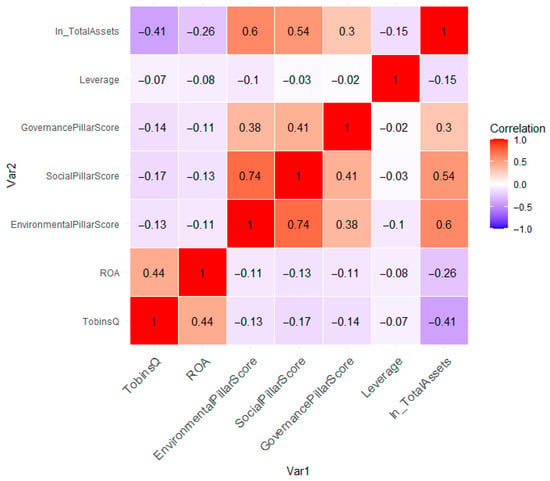
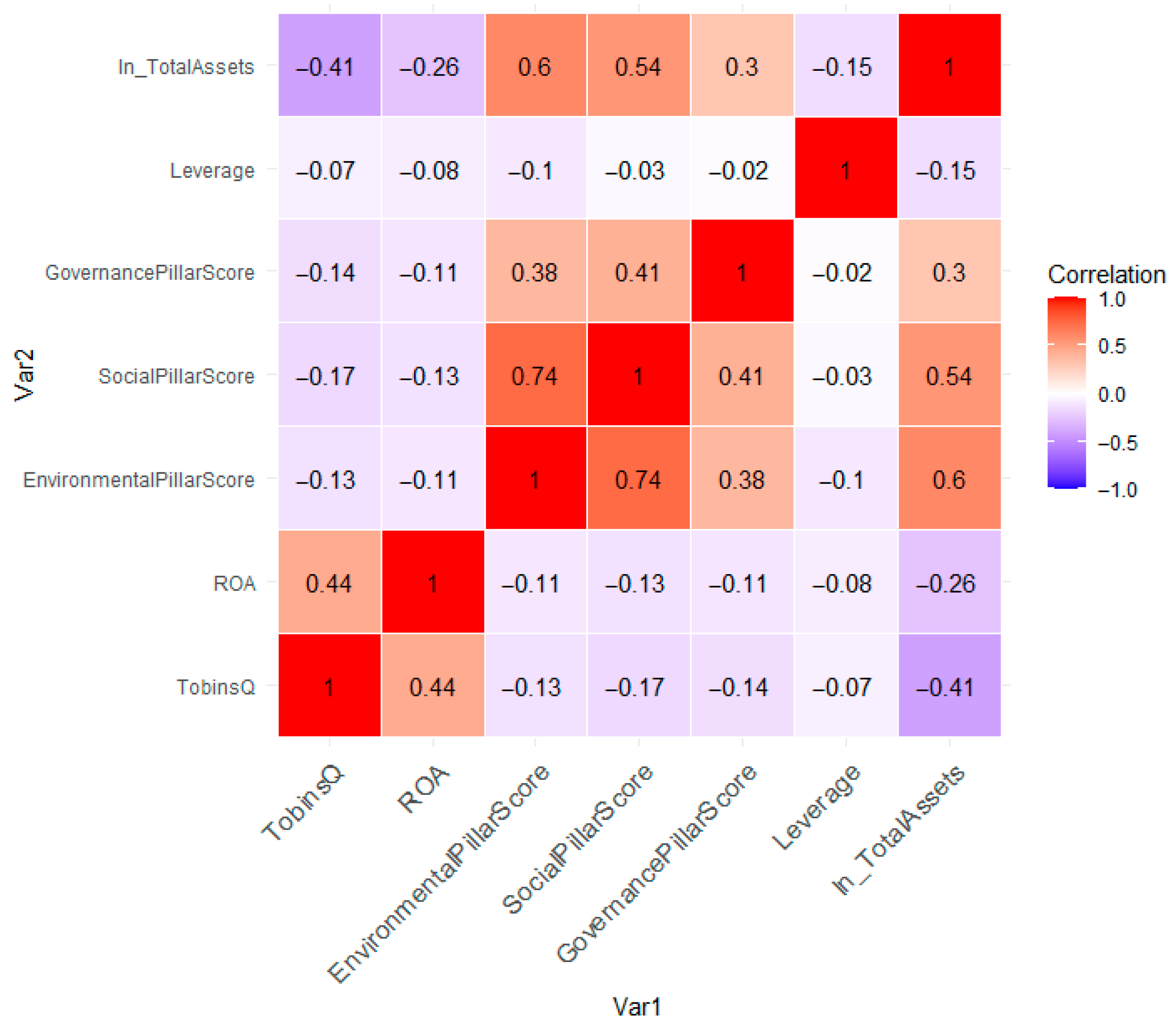
Based on the results of the Pearson correlation analysis (Table 3) conducted to rule out the presence of collinearity among the explanatory variables, the correlation coefficients reported in the table show values below 0.8 for most variables. According to common criteria, a correlation below 0.8 can be considered weak or insignificant in terms of multicollinearity. Specifically, none of the calculated correlation coefficients among the variables exceed the critical threshold of 0.8, indicating that there are no strong correlations among the explanatory variables that could negatively affect the validity of the model’s conclusions. This suggests that there are no multicollinearity issues within the dataset. The heatmap shown in Figure 1 clearly visualizes the individual correlation coefficients between the variables. The colors indicate either a positive or negative relationship, but as indicated by the numerical values, no relationship is strong enough to raise concerns regarding multicollinearity. Consequently, we can conclude that the explanatory variables do not exhibit problematic multicollinearity and are statistically adequate for joint estimation. This statistical result does not imply conceptual independence among ESG dimensions, but rather indicates that their joint inclusion does not distort coefficient estimates.
Table 3.
Correlation Analysis.
Figure 1.
Heatmap.
5.3. Panel Regression Analysis
Before conducting the panel regression analysis, several diagnostic tests were performed to assess the appropriateness of the models. The Breusch-Pagan test was used to compare the Pooled OLS model with the Random Effects model. The test results for Tobin’s Q (χ2 = 1738.2, p-value < ) and ROA (χ2 = 387.85, p-value < ) indicate the presence of significant effects, suggesting that the Random Effects model is more suitable than the Pooled OLS model. Subsequently, the Hausman test was employed to determine whether a Fixed Effects or Random Effects model should be used. The test did not reject the null hypothesis for Tobin’s Q (p-value = 0.08576) and ROA (p-value = 0.2965), indicating that the Random Effects model is the most appropriate choice for both financial indicators. Table 4 and Table 5 present the results of the Random Effects models, including coefficients, standard errors, z-values, and p-values. The regressions were performed using R version 4.4.1 to analyze the impact of ESG factors on financial performance, measured through ROA and Tobin’s Q. The coefficients represent the extent to which each independent variable affects the dependent variables, holding other factors constant. The p-values indicate the statistical significance of these relationships and are marked with * when significant at the 5% level.
Table 4.
Random Effects Model for ROA.
Table 5.
Random Effects Model for Tobin’s Q.
In the Random Effects model for ROA:
- The Environmental Pillar shows a positive but very modest effect on ROA (coefficient = 0.00012), though the p-value of 0.34 indicates that this relationship is not statistically significant.
- Similarly, the Social and Governance Pillars do not significantly influence ROA, with p-values of 0.715 and 0.913, respectively.
- However, Financial Leverage has a significant and negative impact on ROA (coefficient = −0.044, p-value = 0.004), suggesting that increased leverage is associated with lower returns on assets.
- Firm size, represented by the natural logarithm of total assets, also has a negative and highly significant effect on ROA (coefficient = −0.009, p-value < 0.001).
The R-squared value of 0.029 indicates that only a small portion of the variance in ROA is explained by the model, implying that other factors may influence this performance measure.
For Tobin’s Q:
- The Environmental Pillar has a positive and statistically significant effect (coefficient = 0.0026, p-value = 0.049), indicating that better environmental performance contributes to higher firm valuation as reflected in Tobin’s Q.
- The Social and Governance Pillars, however, do not have a statistically significant effect on Tobin’s Q, with p-values of 0.667 and 0.250, respectively.
- Financial Leverage exhibits a negative and marginally significant impact (coefficient = −0.417, p-value = 0.079), while firm size is negatively and highly significantly associated with Tobin’s Q (coefficient = −0.259, p-value < 0.001).
The R-squared value of 0.074 suggests that the model explains a moderate portion of the variance in Tobin’s Q, though there is room for improvement in the model’s fit.
The empirical findings do not support Hypothesis 1 (H1), as none of the individual ESG pillars demonstrate a statistically significant relationship with Return on Assets (ROA). However, the results offer partial support for Hypothesis 2 (H2) regarding market-based performance. Only the Environmental Pillar shows a positive and statistically significant relationship with Tobin’s Q; the Social and Governance pillars do not exhibit significant effects. These findings suggest that the European financial sector selectively prices ESG engagement, rather than uniformly pricing all dimensions of financial performance.
6. Discussion
The existing literature on the influence of ESG practices on financial performance has yet to reach a clear consensus regarding the relationship between companies’ ESG behavior and key financial metrics. Studies such as those by Alareeni and Hamdan (2020) and Albitar et al. (2020) focus on cross-sectoral data or specific indices, highlighting a positive correlation between ESG practices and financial performance but without considering sector-specific characteristics. Therefore, this study’s focus on the European financial sector (banks, financial services, and related services) aims to enhance the understanding of how ESG ratings influence financial performance, measured through ROA and Tobin’s Q, while accounting for the peculiarities of a highly regulated industry.
6.1. Environmental Pillar: Risk Management and Reputation
The results of this study suggest that the Environmental Pillar has a significant positive impact on Tobin’s Q, but not on ROA. The different behavior observed between ROA and Tobin’s Q is consistent with the view that, in the financial sector, ESG practices primarily affect firm value through market expectations and risk perception rather than through immediate improvements in operational profitability. This finding aligns with the evidence from Alareeni and Hamdan (2020), who found a positive correlation between ESG scores and the market value of firms. Buallay (2018) confirms that, although the financial sector is not directly involved in high environmental impact activities, environmental practices can have a significant influence on the market valuation of firms, particularly measured by Tobin’s Q. This result can be explained by the fact that high environmental scores signal to investors effective management of climate risks and sustainability opportunities, which are crucial for protecting long-term value. Our study confirms that, for European financial firms, a focus on environmental sustainability builds trust among investors, improving corporate reputation and market value. This is consistent with the findings of Clark et al. (2015), who emphasize that companies integrating environmental considerations tend to enjoy a more favorable perception, attracting sustainable investments. The case of ING Groep N.V., which implemented the Terra Approach to align with the goals of the Paris Agreement and was included in the Dow Jones Sustainability Index (DJSI), demonstrates how such strategies can be effective in enhancing investor perception and market value. Moreover, as highlighted by Chiaramonte et al. (2021) and Bruno and Lagasio (2021), European regulations, such as the Non-Financial Reporting Directive (NFRD) and the Taxonomy Regulation, have improved transparency in ESG practices, increasing investor confidence and encouraging financial firms to integrate sustainable strategies to enhance resilience and financial stability. This supports our findings, which show a positive impact of the Environmental Pillar on Tobin’s Q, a market value indicator. However, the lack of a significant impact of the Environmental Pillar on ROA can be explained by the temporal nature of the benefits associated with environmental sustainability. According to Porter and van der Linde (1995), the economic benefits of environmental policies primarily manifest in the long term, which may explain why, in the short term, firms in the financial sector do not register immediate improvements in terms of operational profitability.
6.2. Social Pillar and Governance Pillar
Contrary to expectations, the Social Pillar and Governance Pillar did not show a significant impact on either ROA or Tobin’s Q. This result contrasts with findings by Buallay (2018), who highlighted a positive correlation between overall ESG scores and financial performance in the European banking sector. However, our results could be explained by the strong regulation and standardization of social and governance practices in the European financial sector. As observed by Albitar et al. (2020), regulation tends to reduce variability between companies, making ESG practices less differentiating in terms of impact on financial performance. In particular, Directive 2014/95/EU introduced transparency requirements for non-financial information, making these practices more homogeneous and limiting their differential effect on company performance. Nollet et al. (2016) further suggest that social and governance issues, while important, might not be perceived as differentiating factors in the financial sector, where investors tend to assume the adherence to high governance standards imposed by existing regulations. The article by Chiaramonte et al. (2021) confirms that the social and governance pillars influence the stability of banks, especially during financial crises. However, as also highlighted by Bruno and Lagasio (2021), European regulations aim to improve the transparency of social and governance practices, though the contribution of these practices may require time to fully manifest and depend on sustained commitment. The absence of statistically significant effects for the social and governance pillars may reflect limited marginal differentiation within the European financial sector. Strong regulatory frameworks and standardized disclosure requirements reduce cross-sectional variability, thereby attenuating both individual and interaction effects. The lack of a significant relationship between social and governance pillars and financial performance may initially seem to contradict previous research. For example, Alareeni and Hamdan (2020) found a positive correlation between ESG dimensions and firm performance in US-listed companies. However, this discrepancy can be attributed to significant differences in institutional and regulatory environments. In the European financial sector, social and governance practices face extensive regulatory harmonization and mandatory compliance. Frameworks like Directive 2014/95/EU, the Capital Requirements Directive (CRD), and fit-and-proper requirements for bank management have substantially decreased cross-firm variation in governance structures and social standards. Consequently, these dimensions may no longer offer investors additional differentiating information, as adherence to stringent governance and social standards might be viewed as a fundamental requirement rather than a competitive edge. Conversely, studies like Alareeni and Hamdan (2020) concentrate on settings where ESG adoption is more varied and partly voluntary, enabling governance and social practices to function as stronger market signals. Within the European context, the marginal informational value of governance and social scores seems lower, potentially explaining their limited effect on both accounting-based and market-based performance metrics in this study.
6.3. Financial Leverage and Firm Size
The results related to financial leverage confirm that high debt levels have a significant negative impact on both ROA and Tobin’s Q. In the financial sector, a high level of debt reduces operational flexibility and increases risk, thus compromising both profitability and market value. This result is particularly relevant for financial institutions, where managing liquidity and debt is crucial to ensuring long-term stability. Similarly, firm size had a significant negative impact on both financial performance measures, as observed by Zhao et al. (2018). Large companies in the financial sector, despite having the resources to implement ESG practices on a large scale, face higher operational costs and greater managerial complexity. This complexity can reduce operational efficiency and, consequently, negatively impact both profitability and the ability to attract investments. Research further supports these findings, highlighting how diseconomies of scale and bureaucratic inefficiencies can negatively affect the financial performance of large firms (Lazăr, 2016). Additionally, issues such as bureaucratic isolation and communication distortion can exacerbate these effects (Canback et al., 2006). Finally, indebtedness may negatively mediate the relationship between firm size and performance, further complicating financial management (Lopez-Valeiras et al., 2016).
6.4. Risk Management and Resilience
Another key aspect that emerged from this study concerns the role of ESG practices in risk management. Studies such as those by Dai (2021) and Jagannathan et al. (2017) have shown that integrating ESG practices into business strategies reduces overall risk, particularly during periods of high market volatility. This is especially relevant in the financial sector, where resilience to market and regulatory risks is crucial for the stability of institutions. Chiaramonte et al. (2021) further confirm that banks with high ESG scores, especially in environmental and social areas, have benefited from greater stability during periods of economic crisis. The results of this study support the idea that companies with high ESG scores, particularly in environmental aspects, are better prepared to manage regulatory uncertainty and risks related to climate change.
6.5. Potential Criticisms: Greenwashing and Authenticity of ESG Practices
Despite generally positive evidence, some authors have raised concerns about the risk of greenwashing. Fatemi et al. (2018) pointed out that some companies may adopt ESG practices for strategic or marketing reasons rather than for a genuine commitment to sustainability. This aspect is crucial for investors, who need to be able to distinguish between companies that are genuinely sustainable and those using ESG practices merely as a tool to improve their image. This study did not directly explore the presence of greenwashing, but the results suggest that stricter regulation, such as that promoted by Directive 2014/95/EU and supported by Bruno and Lagasio (2021), could be useful in ensuring greater transparency and authenticity in ESG practices.
7. Conclusions and Implications
This study’s results indicate that the relationship between ESG engagement and financial performance in European financial institutions is selective and varies by dimension. Specifically, environmental performance is positively associated with market valuation (Tobin’s Q), but no significant short-term effects on accounting-based profitability (ROA) were found. This finding suggests that environmental sustainability is priced by investors in the European financial sector, particularly in terms of forward-looking market expectations. However, no statistically significant association emerges between ESG pillars and short-term accounting performance, as measured by ROA, indicating that the financial benefits of ESG engagement may materialize primarily through market-based valuation rather than immediate operational profitability. Overall, the findings should be interpreted as associative rather than causal and reflect correlations observed within a highly regulated financial environment. Regarding the research hypotheses, this study found no support for Hypothesis 1, as the ESG pillars did not have a statistically significant effect on short-term accounting performance (ROA). Hypothesis 2 received only partial support; environmental performance positively influenced market valuation (Tobin’s Q), but the social and governance dimensions did not show significant effects. These findings emphasize the selective value relevance of ESG factors within a highly regulated financial environment.
Below are some concrete suggestions for financial institutions on how to effectively integrate ESG criteria into their strategies:
- 1.
- Integrate ESG Criteria into Business Strategies and Decision-Making Processes
Financial institutions should consider adopting ESG criteria as an integral part of their long-term business strategies. It is advisable to create internal policies that promote the integration of sustainable practices in every aspect of business activity, from investment processes to daily operations. This could include establishing internal committees dedicated to sustainability, overseeing the implementation of ESG practices and ensuring alignment with the company’s overall strategy. A concrete step in this direction could be the adoption of ESG assessment tools to evaluate investment opportunities, ensuring that investments are directed toward sectors committed to sustainability. Investments in renewable energy projects, green infrastructure, and clean technologies not only meet regulatory requirements but also enhance long-term investor trust (Friede et al., 2015).
- 2.
- Develop Sustainable Financial Products
The positive association between environmental performance and Tobin’s Q suggests that sustainability-oriented financial products and environmentally focused investments can enhance market valuation, particularly when supported by credible and transparent disclosure. However, the lack of significant short-term effects on ROA indicates that these initiatives may not directly drive immediate accounting profitability.
- 3.
- Promote Transparency and Improve ESG Reporting Quality
Greater transparency in ESG reports can strengthen investor confidence and improve the market valuation of financial institutions. Studies show that accurate and standardized reporting is crucial for attracting responsible investments and avoiding the risk of greenwashing (Fatemi et al., 2018). Financial institutions should implement detailed and verifiable ESG reporting systems, using recognized standards such as the Global Reporting Initiative (GRI) or the Sustainability Accounting Standards Board (SASB). Adopting more rigorous reporting practices will not only meet regulatory demands but also increase transparency for investors and other stakeholders, strengthening the link between ESG performance and financial performance. In this context, it is essential to ensure that the data provided is reliable, verifiable, and comparable over time.
- 4.
- Training and Internal Awareness on the Value of ESG Practices
Given that ESG factors tend to influence market valuation more significantly than short-term profitability, internal training and awareness programs should focus on enhancing the consistency and credibility of ESG implementation, rather than on producing immediate efficiency improvements.
- 5.
- Link Executive Compensation to ESG Goals
Although incentive mechanisms tied to ESG objectives can foster long-term strategic alignment, their limited impact on short-term profitability indicates that these schemes should be designed carefully. Their effectiveness should be assessed based on their capacity for long-term value creation and risk mitigation, rather than immediate financial returns.
- 6.
- Monitor and Actively Manage ESG Risks
Financial institutions need to develop risk management models that include ESG considerations, particularly regarding climate, regulatory, and reputational risks. The adoption of advanced ESG risk metrics allows companies to anticipate regulatory changes and stakeholder expectations, thereby reducing exposure to potential crises and improving operational resilience (Jagannathan et al., 2017). Tools such as climate stress tests or social impact assessments can be integrated into existing risk management models to ensure that financial institutions are prepared to respond to unforeseen events related to climate change or social expectations. These tools not only protect the company but can also enhance investor and stakeholder confidence over the long term.
- 7.
- Strengthening the Social Pillar: Policy Implications for ESG Regulation
From a policy perspective, the finding that only the Environmental pillar demonstrates a significant relationship with firm value has important implications for the future design of ESG regulation in the European financial sector. This result suggests that the current frameworks for Social and Governance reporting may lack the standardization, granularity, and outcome-oriented metrics necessary to be fully value-relevant for investors. Environmental disclosure has benefited from a relatively advanced regulatory architecture. In contrast, social reporting remains characterized by more qualitative disclosure, greater firm-level discretion, and heterogeneity in indicators, making it more difficult for investors to incorporate social performance into valuation and risk assessment processes. These findings suggest that future regulatory efforts could focus on strengthening the Social pillar by implementing more harmonized and measurable social impact metrics. Increased standardization of indicators related to workforce stability, diversity outcomes, human capital development, and social risk exposure may increase the informational content and economic relevance of social disclosures, allowing them to play a role in financial decision-making comparable to that of environmental metrics.
8. Limitations and Future Research
The limitations of this study, stemming from its theoretical and methodological scope, suggest clear directions for future research.
Specifically, the empirical findings should be interpreted as associative rather than causal. While the panel structure and firm-level controls mitigate some sources of omitted variable bias, the study does not aim to identify causal effects. The results are specific to the European financial sector and may not be generalizable to other sectors or geographic contexts. The high level of regulation and advanced ESG standards in Europe may have influenced the results, reducing the variability observed in governance and social practices. Additionally, the analysis is based on a relatively short time frame (2017–2022), which may not fully capture the long-term effects of ESG practices. A longer period or analysis of other sectors could provide further insights. Future studies could explore how the integration of ESG practices evolves over time and how regulatory changes influence business strategies and could address endogeneity concerns through instrumental variable approaches, dynamic panel estimators, or exogenous regulatory shocks affecting ESG adoption. It would also be useful to examine the specific impact of initiatives related to individual ESG pillars on corporate and financial performance, distinguishing between environmental, social, and governance practices. Another limitation involves the potential time lag between ESG impacts and accounting-based performance measures like ROA. ESG investments—particularly in environmental transition, organizational restructuring, and human capital development—often incur short-term costs. Efficiency gains and profitability improvements, however, may materialize only over longer periods. Consequently, our five-year observation window might not fully capture the long-term operational benefits of ESG integration. Future research could use longer time spans and dynamic panel models—incorporating lagged ESG variables or generalized method of moments (GMM) estimators—to better identify these delayed effects on firm profitability. This approach would provide a more comprehensive understanding of how ESG investments translate into operational efficiency over time, especially in highly regulated sectors like financial services. Finally, an interesting area of research concerns the study of the impact of new technologies, such as blockchain and artificial intelligence, in improving the transparency and verifiability of ESG reporting. These tools could revolutionize how financial institutions manage and communicate their sustainable practices, reducing the risk of greenwashing and increasing investor trust.
Author Contributions
Conceptualization, G.B., G.I. and F.I.; formal analysis, G.B., G.I. and F.I.; methodology, G.B. and F.I.; investigation, G.B. and F.I.; software, G.B. and F.I.; supervision, G.B. and G.I.; validation, G.B. and G.I.; visualization, G.B., G.I. and F.I.; writing—original draft preparation, G.B., G.I. and F.I.; writing—review and editing, G.B., G.I. and F.I.; project administration, G.I.; funding acquisition, G.I. All authors have read and agreed to the published version of the manuscript.
Funding
This research received no external funding.
Institutional Review Board Statement
Not applicable.
Informed Consent Statement
Not applicable.
Data Availability Statement
Upon request from the corresponding author.
Conflicts of Interest
Author Ferdinando Ielapi is currently employed by the company Accenture. The remaining authors declare that the research was conducted in the absence of any commercial or financial relationships that could be construed as a potential conflict of interest.
References
- Ahmad, N., Mobarek, A., & Roni, N. N. (2021). Revisiting the impact of ESG on financial performance of FTSE350 UK firms: Static and dynamic panel data analysis. Cogent Business & Management, 8(1), 1900500. [Google Scholar] [CrossRef] [Scilit]
- Alareeni, B. A., & Hamdan, A. (2020). ESG impact on performance of US S&P 500-listed firms. Corporate Governance, 20(7), 1409–1428. [Google Scholar] [CrossRef] [Scilit]
- Albitar, K., Hussainey, K., Kolade, N., & Gerged, A. M. (2020). ESG disclosure and firm performance before and after IR. International Journal of Accounting & Information Management, 28, 429–444. [Google Scholar] [CrossRef] [Scilit]
- Alessi, L., Battiston, S., Melo, A. S., & Roncoroni, A. (2019). The EU sustainability taxonomy: A financial impact assessment (EUR 29970 EN). Publications Office of the European Union. ISBN 978-92-76-12991-2. [Google Scholar] [CrossRef]
- Atan, R., Alam, M., Said, J., & Zamri, M. (2018). The impacts of environmental, social and governance factors on firm performance: Panel study of Malaysian companies. Management Environmental Quality, 29, 182–194. [Google Scholar] [CrossRef] [Scilit]
- Atz, U., Van Holt, T., & Liu, Z. Z. (2020). Do corporate sustainability and sustainable finance generate better financial performance? A review and meta-analysis. Proceedings of the Academy of Management. Available online: https://api.semanticscholar.org/CorpusID:229020610 (accessed on 23 May 2025).
- Baldissarro, G., Bruni, M. E., Iazzolino, G., Morea, D., & Veltri, S. (2024). Does It Pay Off to Integrate ESG Performance into Bank Investment Portfolio Selection? Empirical Evidence in the European Energy Sector. Sustainability, 16(23), 10766. [Google Scholar] [CrossRef] [Scilit]
- Baltagi, B. H. (1995). Econometric analysis of panel data (3rd ed.). John Wiley & Sons Inc. [Google Scholar]
- Bruno, M., & Lagasio, V. (2021). An overview of the European policies on ESG in the banking sector. Sustainability, 13, 12641. [Google Scholar] [CrossRef] [Scilit]
- Buallay, A. (2018). Is sustainability reporting (ESG) associated with performance? Evidence from the European banking sector. Management of Environmental Quality, 30(1), 98–115. [Google Scholar] [CrossRef] [Scilit]
- Canback, S., Samouel, P., & Price, D. (2006). Do diseconomies of scale impact firm size and performance? A theoretical and empirical overview. Econometrics: Econometric & Statistical Methods—General eJournal. Available online: https://api.semanticscholar.org/CorpusID:152813197 (accessed on 18 May 2025).
- Carroll, A. B. (1991). The pyramid of corporate social responsibility: Toward the moral management of organizational stakeholders. Business Horizons, 34(4), 39–48. [Google Scholar] [CrossRef] [Scilit]
- Chen, S., Song, Y., & Gao, P. (2023). Environmental, social, and governance (ESG) performance and financial outcomes: Analyzing the impact of ESG on financial performance. Journal of Environmental Management, 345, 118829. [Google Scholar] [CrossRef] [Scilit]
- Chiaramonte, L., Dreassi, A., Girardone, C., & Piserà, S. (2021). Do ESG strategies enhance bank stability during financial turmoil? Evidence from Europe. The European Journal of Finance, 28, 1173–1211. [Google Scholar] [CrossRef] [Scilit]
- Citterio, A., & King, T. (2023). The role of Environmental, Social, and Governance (ESG) in predicting bank financial distress. Finance Research Letters, 51, 103411. [Google Scholar] [CrossRef] [Scilit]
- Clark, G. L., Feiner, A., & Viehs, M. (2015). From the stockholder to the stakeholder: How sustainability can drive financial outperformance. Smith School of Enterprise and the Environment, University of Oxford. [Google Scholar]
- Clarkson, P. M., Li, Y., Richardson, G. D., & Vasvari, F. P. (2008). Revisiting the relation between environmental performance and environmental disclosure: An empirical analysis. Accounting, Organisations and Society, 33, 303–327. [Google Scholar] [CrossRef] [Scilit]
- Dai, Y. (2021). Can ESG Investing beat the market and improve portfolio diversification? Evidence from China. The Chinese Economy, 54(4), 272–285. [Google Scholar] [CrossRef] [Scilit]
- Dalal, K. K., & Thaker, N. (2019). ESG and corporate financial performance: A panel study of Indian companies. IUP Journal of Corporate Governance 18, 44–59. [Google Scholar]
- Donaldson, T., & Preston, L. E. (1995). The stakeholder theory of the corporation: Concepts, evidence, and implications. The Academy of Management Review, 20(1), 65–91. [Google Scholar] [CrossRef] [Scilit]
- Duque-Grisales, E., & Aguilera-Caracuel, J. (2019). Environmental, social and governance (ESG) scores and financial performance of multilatinas: Moderating effects of geographic international diversification and financial slack. Journal of Business Ethics, 168, 315–334. [Google Scholar] [CrossRef] [Scilit]
- ESMA. (2022). 2022 annual report. Available online: https://www.esma.europa.eu/document/2022-annual-report (accessed on 15 June 2025).
- European Commission. (2018). Action plan: Financing sustainable growth [PDF file]. Available online: https://eur-lex.europa.eu/legal-content/EN/TXT/PDF/?uri=CELEX:52018DC0097 (accessed on 27 May 2025).
- European Commission. (2019). The EUROPEAN green deal [PDF file]. Available online: https://eur-lex.europa.eu/resource.html?uri=cellar:b828d165-1c22-11ea-8c1f-01aa75ed71a1.0002.02/DOC_1&format=PDF (accessed on 6 June 2025).
- Fatemi, A., Glaum, M., & Kaiser, S. (2018). ESG performance and firm value: The moderating role of disclosure. Global Finance Journal, 38, 45–64. [Google Scholar] [CrossRef] [Scilit]
- Freeman, R. E., & Reed, D. L. (1984). Stockholders and stakeholders: A new perspective on corporate governance. California Management Review, 25, 88–106. [Google Scholar] [CrossRef] [Scilit]
- Friede, G., Busch, T., & Bassen, A. (2015). ESG and financial performance: Aggregated evidence from more than 2000 empirical studies. Journal of Sustainable Finance & Investment, 5(4), 210–233. [Google Scholar] [CrossRef] [Scilit]
- Friedman, M. (1970, September 13). The social responsibility of business is to increase its profits. New York Times Magazine. 122–126.
- Garcia, A. S., Da-Silva, W. M., & Orsato, R. J. (2017). Sensitive industries produce better ESG performance: Evidence from emerging markets. Journal of Cleaner Production, 150, 135–147. [Google Scholar] [CrossRef] [Scilit]
- Giannopoulos, G., Kihle Fagernes, R. V., Elmarzouky, M., & Afzal Hossain, K. A. B. M. (2022). The ESG disclosure and the financial performance of Norwegian listed firms. Journal of Risk and Financial Management, 15(6), 237. [Google Scholar] [CrossRef] [Scilit]
- Gillan, S. L., Koch, A., & Starks, L. T. (2021). Firms and social responsibility: A review of ESG and CSR research in corporate finance. Journal of Corporate Finance, 66, 101889. [Google Scholar] [CrossRef] [Scilit]
- Griffin, J., & Mahon, J. F. (1997). The corporate social performance and corporate financial performance debate: Twenty-five years of incomparable research. Business & Society, 36, 5–31. [Google Scholar]
- Hanson, D. C., Bender, J. C., Lamy, B., Lyons, T. P., & Bertocci, B. (2017). Analysts’ roundtable on integrating ESG into investment decision-making. Journal of Applied Corporate Finance, 29(2), 1–8. [Google Scholar] [CrossRef] [Scilit]
- Huang, D. Z. X. (2019). Environmental, social and governance (ESG) activity and firm performance: A review and consolidation. Accounting & Finance, 61, 335–360. [Google Scholar] [CrossRef] [Scilit]
- Jagannathan, R., Ravikumar, A., & Sammon, M. (2017). Environmental, social, and governance criteria: Why investors are paying attention. (Working Paper 24063). NBER. [Google Scholar] [CrossRef] [Scilit]
- Kell, G. (2018, July 11). The remarkable rise of ESG. Forbes. Available online: https://www.forbes.com/sites/georgkell/2018/07/11/the-remarkable-rise-of-esg/ (accessed on 3 June 2025).
- Khalfaoui, H., Guenichi, H., & Moufida, B. (2022). Does corporate financial performance promote ESG: Evidence from US firms. Cogent Business & Management, 9, 2154053. [Google Scholar] [CrossRef] [Scilit]
- Kim, S., & Li, Z. F. (2021). Understanding the impact of ESG practices in corporate finance. Sustainability, 13(7), 3746. [Google Scholar] [CrossRef] [Scilit]
- Latella, P., Morea, D., Baldissarro, G., Iazzolino, G., Veltri, S., & Farinelli, E. (2025). Corporate governance and impact on eco-efficiency: A comparative empirical analysis on European Union and united states listed companies. Business Strategy and the Environment, 34(6), 6442–6456. [Google Scholar] [CrossRef] [Scilit]
- Lazăr, S. (2016). Does size influence firm performance? Evidence from Romanian listed companies. Annals of Faculty of Economics, 1, 682–689. [Google Scholar]
- Lopez-Valeiras, E., Gomez-Conde, J., & Fernandez-Rodriguez, T. (2016). Firm size and financial performance: Intermediate effects of indebtedness. Agribusiness, 32, 454–465. [Google Scholar] [CrossRef] [Scilit]
- Morea, D., Iazzolino, G., Giglio, C., Bruni, M. E., Baldissarro, G., & Farinelli, E. (2025). The role of digitalization and ESG on financial performance: An empirical analysis on the energy and utilities sectors. PLoS ONE, 20(2), e0314078. [Google Scholar]
- Nollet, J. W., Filis, G., & Mitrokostas, E. (2016). Corporate social responsibility and financial performance: A non-linear and disaggregated approach. Economic Modelling, 52, 400–407. [Google Scholar] [CrossRef] [Scilit]
- Porter, M. E., & Kramer, M. R. (2011). The big idea: Creating shared value. Harvard Business Review, 89, 2–17. [Google Scholar]
- Porter, M. E., & van der Linde, C. (1995). Toward a new conception of the environment-competitiveness relationship. Journal of Economic Perspectives, 9(4), 97–118. [Google Scholar] [CrossRef] [Scilit]
- Taliento, M., Favino, C., & Netti, A. (2019). Impact of environmental, social, and governance information on economic performance: Evidence of a corporate ‘sustainability advantage’ from Europe. Sustainability, 11, 1738. [Google Scholar] [CrossRef] [Scilit]
- United Nations, The Global Compact. (2004). Who cares wins: Connecting the financial markets to a ChangingWorld? United Nations. Available online: https://www.unglobalcompact.org/docs/issues_doc/Financial_markets/who_cares_who_wins.pdf (accessed on 23 May 2025).
- Wang, Q., Dou, J., & Jia, S. (2016). A meta-analytic review of corporate social responsibility and corporate financial performance. Business & Society, 55(8), 1083–1121. [Google Scholar] [CrossRef] [Scilit]
- Xie, J., Nozawa, W., Yagi, M., Fujii, H., & Managi, S. (2019). Do environmental, social, and governance activities improve corporate financial performance? Business Strategy and the Environment, 28(2), 286–300. [Google Scholar] [CrossRef] [Scilit]
- Yu, E. P., Guo, C. Q., & Luu, B. V. (2018). Environmental, social and governance transparency and firm value. Business Strategy and the Environment, 27(7), 987–1004. [Google Scholar] [CrossRef] [Scilit]
- Zhang, S., Yin, X., Xu, L., Li, Z., & Kong, D. (2022). Effect of environmental, social, and governance performance on corporate financialization: Evidence from China. Sustainability, 14(17), 10712. [Google Scholar] [CrossRef] [Scilit]
- Zhang, Z., & Zhang, L. (2023). Investor attention and corporate ESG performance. Finance Research Letters, 55, 104942. [Google Scholar]
- Zhao, C., Guo, Y., Yuan, J., Wu, M., Li, D., Zhou, Y., & Kang, J. (2018). ESG and corporate financial performance: Empirical evidence from China’s listed power generation companies. Sustainability, 10(8), 2607. [Google Scholar] [CrossRef] [Scilit]

Disclaimer/Publisher’s Note: The statements, opinions and data contained in all publications are solely those of the individual author(s) and contributor(s) and not of MDPI and/or the editor(s). MDPI and/or the editor(s) disclaim responsibility for any injury to people or property resulting from any ideas, methods, instructions or products referred to in the content. |
© 2026 by the authors. Licensee MDPI, Basel, Switzerland. This article is an open access article distributed under the terms and conditions of the Creative Commons Attribution (CC BY) license.