


Abstract
Control over a bank’s lending decisions can be separated from exposure to its lending losses. A controlling borrower may then benefit privately from having the bank prop up her firm even though the firm’s liquidation value exceeds its going concern value. We call such a bank an organ bank and such a firm a zombie firm. We present exploratory cross-economy correlational evidence associating zombie firm prevalence with the prevalence of business family-controlled banks. A simple model shows how this separation can induce the continued financing of firms an independent lender would liquidate. The distortion is larger when the controlling borrower controls the bank with a smaller cash-flow ownership stake. The model and discussion show how bank governance, related lending, and anticipated government support may contribute to the preservation of zombie firms, inefficient capital allocation, and systemic risk.
1. Introduction
An organ bank is a bank, shadow bank, or other lending institution whose governance is subordinated to a controlling borrower. The defining feature of an organ bank is not merely a close lending relationship, concentrated exposure, or a lender’s desire to avoid recognizing losses. Rather, it is that a borrower, or another borrower-side actor benefiting from the borrower’s continuation, can materially influence the lender’s restructuring or liquidation decision while bearing only part, or none, of the resulting loss ex-post imposed on the lender. The term originates in Japanese business history to describe banks in early 20th-century pyramidal business groups (zaibatsu) controlled by tycoons or business families (Kato, 1957). Controlling borrowers can direct organ banks by dint of equity voting control, board interlocks, political influence, social connections, or family connections. Central bank pressure on banks to lend in synchrony with expansionary monetary policies can induce organ-bank-like behavior (Álvarez et al., 2023; Deng et al., 2015). Concentrated lending can create de-facto organ banks, reluctant to trigger a default that could critically erode the bank’s capital. Bank managers may also face political pressure, social ties, herding, or career concerns that lead them to evergreen loans rather than recognize losses.
We therefore take an organ bank as a lender that, subject to a controlling borrower’s influence, rolls over or forgives loans to that borrower’s financially unviable firms when an independent lender would have liquidated them. Borrower firms thus become zombie firms. Zombie firms can be identified by interest payments below a benchmark minimum rate, implying subsidized credit (Caballero et al., 2008) or interest-coverage ratios persistently below one (Banerjee & Hofmann, 2018). Sectors with more zombie firms post slower productivity growth (Caballero et al., 2008) and show signs suggesting resource misallocation (Hoshi, 2006; Peek & Rosengren, 2005).
In Japan, after the 1990 asset-price collapse, keiretsu banks became de-facto organ banks and propped up “zombie” firms (Morck & Nakamura, 1999; Morck et al., 2000). Such organ bank-like behavior might reflect bankers’ career incentives to avoid recognizing losses, suggesting that organ-bank influence and weak-bank evergreening can coexist, although they are analytically distinct mechanisms.
Mexico’s bank privatization put its major banks under the control of business group families, and the 1994–1995 tequila crisis left banks with massive nonperforming loans to firms in their business groups, which they obligingly rolled over, prolonging the crisis (La Porta et al., 2003). In Turkey, after the 2001 crisis and again in the 2018–19 period, state-influenced and politically connected banks rolled over loans to firms controlled by powerful business families (Kaplan & Aksoy, 2025). Zombie firms arose in Europe after the 2008 global financial crisis bank bailouts (Acharya et al., 2021; Storz et al., 2017). Hoshi et al. (2023) link COVID-era subsidies to zombie firm perpetuation in Japan. Lam et al. (2017) conclude that “zombie firms have become a key concern in China.” Li et al. (2025) link Chinese bank deregulation to reduced zombie firm formation. Chang et al. (2021) highlight politicized lending and shadow banks as important factors. These cases involve different mechanisms, but each illustrates how lending decisions can become distorted when those influencing continuation do not bear the full economic cost.
Existing research on zombie-sustaining lending has emphasized weak bank capitalization, regulatory forbearance, and lenders’ incentives to avoid recognizing losses (Caballero et al., 2008; Peek & Rosengren, 2005; Storz et al., 2017; Acharya et al., 2021). This paper examines a complementary governance problem: the separation between control over a lender’s continuation decisions and exposure to the resulting lending losses. Specifically, we ask: How can this separation, combined with private benefits of control, distort lending and liquidation decisions, and what are the resulting economic and policy implications? We develop a stylized theoretical model to illustrate these distortions, examine their economic consequences, and discuss their implications for bank governance and public policy.
Our paper makes three contributions. First, we conceptualize organ banking as a distinct governance mechanism through which borrower-side influence can distort lending and liquidation decisions. Unlike explanations centered primarily on lender incentives or regulatory forbearance, this mechanism arises when an actor benefiting from a borrower’s continuation can influence the lender’s decision while bearing only part of the resulting losses. Second, we develop a parsimonious two-period model showing how private benefits from continued operation, combined with the separation between decision-making control and cash-flow exposure, can induce the continuation of firms that an independent lender would liquidate. The model also considers how risk-premium repression and anticipated government bailouts may affect the distribution of losses and the broader consequences of such lending. Third, we examine the broader economic and policy implications of organ-bank governance, highlighting how distorted lending decisions can contribute to inefficient resource allocation, weaken financial institutions, and potentially generate systemic risks. We also discuss the implications for bank governance, regulatory oversight, and government intervention.
The remainder of the paper proceeds as follows. Section 2 reviews the relevant literature and presents the exploratory empirical evidence motivating the model. Section 3 develops the theoretical framework and its implications. Section 4 discusses potential policy implications, distinguishing those supported by the model from broader considerations. Section 5 concludes.
2. Model Motivation
Kato (1957) coined the term organ bank to describe banks in early 20th-century Japan that operated as financing organs of controlling business groups, rather than as independent lenders. Their lending and continuation decisions could be subordinated to the interests of other business group firms or controlling families. For example, the Suzuki family used its political influence with Japan’s colonial government in Taiwan to pressure the Taiwan Bank, then serving as the Japanese colonial government’s instrument in Taiwan (Myers & Peattie, 1984), to roll over the nonperforming debts of companies in the Suzuki pyramidal business group, or zaibatsu. Okazaki and Yokoyama (2001) argue that organ banks were generally important in this period of Japanese history and identify board interlocks as a key mechanism for borrower control over banks. Colpan and Morck (2022) further distinguish such banks from banks more fully owned by controlling families, arguing that differences in cash-flow ownership affected their vulnerability during the financial crises of the 1920s.
Zombie firms gained prominence in research on Japan’s “lost decade.” Using industry- and firm-level Japanese data from the 1990s, Caballero et al. (2008) document banks rolling over loans to chronically unprofitable “zombie” firms to avoid recognizing dramatic losses, which would adversely affect earnings-linked top bank executive pay (Bennett et al., 2021). Identifying zombie firms as those paying interest below a benchmark minimum rate, implying subsidized credit, they associate higher industry zombie density with significantly lower productivity growth and a perverse reallocation of market share toward low-productivity firms. This “zombie lending” is shown to have delayed creative destruction by keeping capital, employment, and other inputs from flowing more robustly towards higher-productivity innovative firms, and thereby prolonged Japan’s stagnation (Adalet McGowan et al., 2018; Ahearne & Shinada, 2005; Hoshi, 2006; Peek & Rosengren, 2005).
Zombie firms are not a uniquely Japanese phenomenon. Banerjee and Hofmann (2018) report that the share of zombie firms in fourteen developed economies rose from roughly 2% in the late 1980s to 12% in 2016. B. Albuquerque and Iyer (2024), using a larger sample of economies, report that zombies average just over 9% of listed firms. Zombies are prevalent in Jordan (20%), Greece (16.5%), and Brazil (14.6%), but are also commonplace in Canada (13.7%), South Korea (13.5%), Turkey (13.2%), and the United States (9.8%). Despite Japan’s prominence in this literature, zombie firms account for only 5.6 percent of its listed firms in this dataset.
Studies of individual economies associate rising incidences of zombie firms with economic problems in China (Bu et al., 2024; Cai et al., 2022; Guo et al., 2022; Lam et al., 2017; Shen & Chen, 2017; Upadhyay & Baag, 2024; Wang & Zhu, 2021; H. Zhu et al., 2019), Europe (Andrews & Petroulakis, 2019; Storz et al., 2017), Italy (Ascani & Nair, 2025; Rodano & Sette, 2019), Mexico (La Porta et al., 2003), Spain (Urionabarrenetxea et al., 2018), Portugal (Carreira et al., 2022; Osterhold & Gouveia, 2020), Turkey (Kaplan & Aksoy, 2025) and the United States (Favara et al., 2021). A rising prevalence of zombie firms necessarily implies continued access to financing, but the institutional mechanisms supporting that financing vary. Organ-bank governance is one such mechanism. Banks controlled by families that also control larger stables of non-financial firms are primary candidates for such service (Morck et al., 2011). Governments and central banks can press banks into service as organ banks. Monetary stimuli can channel credit disproportionately toward zombie firms, particularly through weakly capitalized or state-controlled banks, suggesting that monetary expansions can aggravate the economic problems zombie firms cause (Acharya et al., 2019; Acharya et al., 2021; B. Albuquerque & Mao, 2025; Charoenwong et al., 2021). State-run banks are especially sensitive transmitters of monetary stimuli (Morck et al., 2019) and are apt to be especially subject to political pressure to roll over state-owned or politically connected firms’ nonperforming loans.
Organ-bank governance is related to, but analytically distinct from, several established explanations of zombie lending. Table 1 summarizes the principal mechanisms and highlights the distinctive governance problem associated with organ banking. The defining feature of organ banking is thus borrower-side influence over the lender’s continuation or liquidation decision combined with incomplete exposure to the resulting lending losses (Colpan & Morck, 2022). These mechanisms are not mutually exclusive. Political influence or regulatory forbearance may facilitate organ-bank behavior, while lender incentives may reinforce it. Organ banking nevertheless identifies a distinct governance mechanism that can coexist with other explanations of zombie lending.
Table 1.
Organ Banking and Alternative Explanations of Zombie Lending.
These strands of literature motivate the key assumptions of our model. First, historical research on organ banks and related-party lending provides the basis for assuming that a borrower-side actor can influence the lender’s continuation or liquidation decision (Okazaki & Yokoyama, 2001; Colpan & Morck, 2022). Second, the literature on private benefits of control motivates our assumption that the controlling borrower may derive benefits from keeping a financially distressed firm operating, even when its going-concern value is below its liquidation value. These benefits may include power, influence, social status, or advantages accruing to other firms controlled by the same owner. Third, research on the separation of control rights and cash-flow rights motivates our distinction between the borrower’s influence over lending decisions and the fraction of the resulting bank losses that she bears through her ownership stake. Finally, the assumption that an independent lender chooses liquidation when the recoverable liquidation value exceeds the firm’s going-concern value provides the benchmark against which the distortion associated with organ banking can be assessed. Together, these assumptions allow us to isolate the governance mechanism through which borrower influence, combined with incomplete exposure to lending losses, may result in inefficient continuation. The discussion above suggests that the prevalence of zombie firms might correlate with the prevalence of organ banks. To investigate this, we combine economy-level measures of the incidence of zombie firms from B. Albuquerque and Iyer (2024) with bank equity control block data from Morck et al. (2011).
Family-controlled business groups may contain banks that provide financing to affiliated firms, making family control of large banks a potentially relevant, though indirect, proxy for the institutional conditions under which organ banking may arise. However, family ownership of a bank does not necessarily imply that its lending decisions are subordinated to the interests of controlling borrowers. Nor does the ownership measure establish whether family-controlled firms receive preferential financing, whether nonperforming loans are rolled over, or whether borrowers influence restructuring and liquidation decisions. Conversely, organ-bank behavior may arise without family equity control, through board interlocks, political influence, social connections, or other mechanisms. Accordingly, our measure captures a possible institutional setting for organ banking rather than organ-bank behavior itself. The empirical analysis should therefore be interpreted as examining the association between family control of large banks and zombie-firm prevalence, not as directly identifying organ banks or their lending practices.
The zombie firm incidence data are country-year panels from 1994 to 2021, one counting zombie firms as a percent of listed firms, the other counting zombie firms as a percent of private firms, each year in each economy. B. Albuquerque and Iyer (2024) classify a firm as a zombie if, for at least two consecutive years, its interest coverage ratio is below one, its leverage exceeds that of the median firm in the same country and industry, and its real sales growth is negative. We match zombie firm incidence in years adjacent to our 2001 cross-section of bank control block measures, as explained below.
Tests using cross-sectional data are useful as motivations for more nuanced research, but cannot identify causality. The following analysis is thus exploratory and intended only to establish whether the cross-economy pattern is broadly consistent with the paper’s argument. Table 2 provides summary statistics for the variables used below.
Table 2.
Summary statistics.
Figure 1 graphs the fraction of listed firms B. Albuquerque and Iyer (2024) classify as zombies in 2002 (vertical axis) against the fractions of large banks Morck et al. (2011) classify as controlled by a business family (left panel), controlled by state organs (middle panel), or widely held and thus deemed independent (right panel). Despite substantial scatter, where more large banks are controlled by business families, more zombie firms are evident.
Figure 1.
Zombie firms and controlled banks. (A). Zombie firms as % of listed firms (vertical axis) in 2002 versus business family-controlled, state-controlled, and independent banks as % of large bank sector in 2001 (horizontal axis) in left, center and right panels, respectively; (B). Zombie firms as % of private firms (vertical axis) in 2002 versus business family-controlled, state-controlled, and independent banks as % of large bank sector in 2001 (horizontal axis) in left, center and right panels, respectively. Note: Listed zombie firms as a fraction of all listed firms correlate positively with family-controlled (first panel, in blue) and state-controlled (second panel, in red) bankls, bu tnegatively with independent banks (third panel, in black), each as percent of all large banks. Listed zombie firms correlate negatively with independent banks—that is, banks with no controlling shareholder—as a percent of all large banks, which equals 100% minus controlled banks. Two-digit country codes identify economies included in the data. Country codes: AR = Argentina; AU = Australia; AT = Austria; BR = Brazil; CA = Canada; CH = Switzerland; CL = Chile; CO = Colombia; DE = Germany; DK = Denmark; EG = Egypt; ES = Spain; FI = Finland; FR = France; GB = United Kingdom; GR = Greece; HK = Hong Kong; ID = Indonesia; IE = Ireland; IL = Israel; IN = India; IT = Italy; JO = Jordan; JP = Japan; KR = South Korea; MX = Mexico; MY = Malaysia; NL = Netherlands; NO = Norway; PE = Peru; PH = Philippines; PK = Pakistan; PT = Portugal; SE = Sweden; SG = Singapore; TH = Thailand; TR = Turkey; TW = Taiwan; US = United States; ZA = South Africa; ZW = Zimbabwe. The dashed lines represent fitted linear trend lines.
Note that the fraction of large banks that are independent—that is, have no controlling shareholder—is 100% minus the fraction of large banks that are controlled. Reversing the horizontal axis of the right panel in Figure 1 thus shows a lower incidence of zombie firms where more banks are independent.
Table 3 summarizes correlations of the prevalence of zombie firms with the fractions of each economy’s largest 20 banks controlled by business families, governments, or neither (and so deemed independent). Figure 1 presents the same data graphically.
The baseline correlations in Table 3 show significantly higher incidences of zombie firms in economies whose large banking sectors are more fully controlled by business families. Zombie firm incidence is significantly negatively correlated with the fraction of banks deemed independent and uncorrelated with the fraction controlled by the state. Because the independent-bank share is 100% minus the sum of the state-controlled and family-controlled shares, the variation associated with zombie firm incidence arises from family control over large banks. We therefore focus on this measure below.
Table 4 summarizes regressions of the prevalence of zombie firms among each economy’s listed or private firms, from B. Albuquerque and Iyer (2024), on the fraction of the economy’s large banks that are family controlled from Morck et al. (2011). The explained variable on the left side of the table is zombie firms as a percent of listed firms in 2002; that on the right half of the table uses zombie firms as a percent of private sector firms in 2002.
We follow the convention of lagging explanatory variables by at least one period, so all are for 2001 or earlier. The control variables include economy size (log of USD PPP GDP in 2001), economic development (log of per capita USD PPP GDP in 2001), and financial development (stock market capitalization over GDP and private domestic credit provided by banks over GDP), all from the World Bank’s World Development Indicators database. Additional controls are creditor rights and effective shareholder rights indexes, from Table 2 and Table 4 in La Porta et al. (1998). The last is a statutory shareholder rights index times a rule of law index because the shareholder rights measure has been criticized as reflecting regulations and statutes, rather than their impact (Wurgler, 2000). Both are based on data collected circa 1995. Summary statistics for these are also in Table 2.
Table 3.
Correlations of zombie firm incidence with control of large banks.
Table 4.
Regressions of zombie firm incidence on business family-controlled banks as fraction of large banks.
The regressions show a significantly greater incidence of zombie firms in economies whose large banking sectors are more fully controlled by business families. This is evident, at the 10% level or better, across all regressions in the table, regardless of which explained variable (listed or private zombie firm incidence) is used and which subsets of the control variables are included.
The correlation is economically significant. Regression 4.4, which explains the incidence of listed zombie firms and includes all the control variables, associates a one standard deviation increase in family control over large banks with a 0.29 standard deviation increase in the incidence of listed zombie firms.1 Regression 4.8 associates the same increase in business family control over the large banking sector with a 0.46 standard deviation increase in the incidence of private zombie firms.2
Additional robustness checks, reported in Appendix A Table A1, Table A2, Table A3, Table A4 and Table A5, broadly support the baseline patterns, although some qualifications are warranted. The associations for private firms are weaker in certain years, with some estimates falling below conventional significance levels. In addition, tests excluding influential economies show that some specifications are sensitive to the inclusion of particular observations, especially India in specifications 4.5 and 4.8. These results underscore the exploratory and correlational nature of the empirical analysis.
Hence, we reiterate that these results are in no way econometric tests of any hypothesis. Rather, they are patterns in the data. The small sample sizes (41 economies for listed zombie firm incidence, or 40 in regressions 4.3 and 4.4 because the shareholder rights index is missing for one economy, and 27 for private zombie firm incidence) and the purely correlational nature of these regressions preclude any conclusions about causality. Organ banks might give rise to zombie firms; or the owners of troubled firms might opt to gain influence over their banks; or other economy characteristics may promote both.
These results must be interpreted conservatively for several reasons. First, the 2001 bank-ownership measure is an indirect proxy. Second, although these measures are shown elsewhere to proxy for related-party lending (Morck et al., 2011), they do not directly statistically identify organ-bank behavior. Moreover, the observed association may reflect reverse causation: rather than organ banks creating zombie firms, owners of financially distressed firms may acquire or strengthen their influence over lending institutions to secure continued financing. Omitted institutional factors, such as creditor protection, regulatory independence, political connections, or broader differences in financial development and corporate governance, may also influence both bank ownership structures and zombie-firm prevalence. Furthermore, zombie lending may arise through alternative mechanisms, including weak-bank evergreening, regulatory forbearance, and politically directed lending. Although our regressions control for several financial and institutional characteristics, these controls cannot eliminate concerns about endogeneity or establish which mechanism underlies the observed association.
The empirical analysis is also constrained by reliance on a single 2001 cross-section of bank ownership for a statistically small sample of economies. While banking-system control structures may be persistent, aligning the timing of zombie-firm measures with the ownership data does not resolve potential measurement error, changes in bank control over time, or concerns about causal identification. Accordingly, we interpret the results as exploratory cross-economy associations that are consistent with, but not conclusive evidence of, the organ-bank mechanism developed in our theoretical model. Our empirical analysis does not directly observe actual loan rollovers, politically directed lending, relationship-lending practices, or borrower influence over individual lending and liquidation decisions. Further research using direct measures of these behaviors would be needed to identify and test the organ-bank mechanism more conclusively.
3. Model
This section describes a model of bank lending consistent with the literature reviewed above and with these patterns in the data. The model identifies a mechanism, not the direction of causation in the data. It takes both an organ bank and a zombification-prone firm as given, and shows how separating control over the liquidation decision from exposure to the resulting losses leads to inefficient continuation. It is agnostic about how that control structure arises. Pre-existing organ banks might create zombie firms, the owners of soon-to-be zombie firms might acquire influence over their bank, or common institutional factors might promote both. The model thus accords with the cross-economy correlational findings above, which likewise leave causality unresolved.
The model has two periods, denoted and . In , a bank lends to let an entrepreneur set up a new firm and the firm invests the money. At , payoffs are paid, and whether this was a good or bad loan becomes evident. However, at , when the bank extends the loan, only the probabilities of the good and bad outcomes, denoted and , respectively, and the values of the firm in each of those states, in the good state and in the bad state, are known.
Once the state is known, the bank either liquidates the firm to recover or lets the firm continue with a going concern value and a marked-down debt to the bank equal to . We assume that , that the firm’s undertaking initially has a positive net present value, , and that , so in the good state the firm can repay its loan plus a risk premium , set in various ways in the different scenarios below.
3.1. Baseline Case: Independent Banks
If the independent bank lends to break even, it charges a risk premium . That is, the firm borrows at and promises to repay at . The borrower repays the loan in the good state, since . However, in the bad state, the firm’s value , the entrepreneur’s firm defaults on the loan, the bank liquidates the firm for , and the entrepreneur, protected by limited liability, walks away with neither gain nor loss.
A value-maximizing independent bank sets the risk premium to break even, so
Solving this for the risk premium,
The risk premium increases as the probability of the bad state rises, and the gap between the loan principal and the value recoverable in liquidation widens.
If the bad state occurs at , the bank liquidates her firm because and the borrower ends up owning nothing. If the good state occurs at t = 1, the entrepreneur ends up owning her firm, worth . In addition, she can also have private benefits derived from owning the firm in . For simplicity, we take the private benefit as not detracting from the value of the firm. Because she owns all of her firm, transfers from it to herself would cost her as much as they gain her. Her private benefits thus include power, influence, and social status, as well as gains to her other business interests, but not wealth transfers from this firm.3 Her wealth is
Substituting (2) into (3), the entrepreneur’s expected wealth at t = 0 is
This is the expected value of the firm to her, including private benefits she derives from running it, minus the nominal value of the loan.
3.2. A Generic Organ Bank
Now consider the same situation, but with the bank being an organ bank whose controlling borrower, the entrepreneur setting up the firm, can force the bank to forego default in the bad state and let the firm continue. Let the entrepreneur own fraction of the bank’s cash flow rights but exercise total control over its liquidation decision.
We assume the controlling borrower derives a private benefit, denoted , receivable at only if her firm has not been liquidated. We view as arising from her control of her firm, and as lost if her firm is liquidated. This benefit may be nonpecuniary, such as power, influence, or social status, or pecuniary, such as tunnelling via related-party dealings that benefit her other business-group firms at . What matters is that it is available only if the firm continues. A private benefit also available in liquidation, or extracted at , would enter both branches of her continuation decision equally and so would not affect it. Private benefits obtained by stripping assets would also reduce the firm’s liquidation and going-concern values; we abstract from this to keep the algebra parsimonious.
In the good state at , the entrepreneur receives her private benefit, , plus the value of her equity stake in the firm, , plus the portion of her loan repayment accruing back to her due to her partial ownership of the bank, .
A rational organ banker, anticipating the controlling borrower’s actions, sets the risk premium accordingly at to break even in expectations. Although the t = 1 state of the world (good or bad) is unknown at t = 0, the parameter values let the organ banker know whether, should the bad state occur, the controlling borrower will intervene to prevent liquidation. Solving for this gives two risk premiums, depending on whether the organ bank foresees continuation or liquidation. Specifically, it sets the risk premium to
The controlling borrower’s expected wealth at is thus
Intuitively, in the good state, the controlling borrower receives her private benefit, , plus the value of her equity stake in the firm, , plus the portion of her loan repayment accruing back to her due to her cash flow rights in the bank, . In the bad state, if the firm continues, she receives private benefit plus her fraction of the bank’s marked-down debt claim of the firm. If she permits liquidation in the bad state, she receives only her fraction of the bank’s liquidation proceeds.
In the bad state at , the bank either liquidates the firm for or lets the firm continue, effectively writing down its debt claim from to . Because she owns of the organ bank, of this reverts to her. If she lets the organ bank liquidate her firm, it writes down its debt claim to , with reverting to her. She thus favors continuation if .
Substituting (5) into (6) shows the controlling borrower’s expected wealth to be
Note that the controlling borrower receives her private benefit in the good state and in the bad state if she forces continuation. Consequently, we see in the continuation branch of (7), not as in (4); the liquidation branch retains , as in (4). The term in (7) brings in the value of her stake in the organ bank, which is worth in expectation because the bank expects to break even. Net of the of bank capital, which she effectively lends herself at , the liquidation branch of (7) equals (4) exactly, and the continuation branch becomes . Her stake therefore leaves her ex-ante wealth unaffected, but matters by affecting her ex-post continuation decision.
Two features of (7) merit emphasis.
First, for , the controlling borrower forces continuation if in (7), whereas an independent bank would have continued the loan only if . The organ bank’s liquidation decision is thus distorted only if the controlling borrower has private benefits to protect. If , she permits liquidation when , precisely tracking the independent bank liquidating whenever . Greater private benefits mean the organ bank rolls over bad loans under more conditions where an independent bank would have forced liquidation.
Second, the controlling borrower’s condition for forcing the organ bank to continue the loan can be rewritten as . This differs more from the independent bank’s condition for continuing the loan, , as her fractional ownership of the organ bank falls. If she has any private benefits , and controls the organ bank but owns of it, is infinitely positive, and she always forces continuation.
Thus, the distortion has two ingredients: (a) a private benefit that the controlling borrower loses if her firm is liquidated, and (b) control over the organ bank’s liquidation decision, which lets her act on that benefit while bearing only fraction α of the bank’s loss from continuation.
Note that the organ bank anticipates continuation and sets the risk premium in (5) to break even, so the bank’s expected recovery gap is priced into her loan, and its outside shareholders lose nothing. Subtracting the liquidation branch of (7) from its continuation branch gives , so ex ante the controlling borrower bears the full recovery gap whatever her stake α. At t = 0, she would therefore prefer to commit to liquidation unless . If she cannot credibly so commit, once the risk premium is set, she weighs B against only the fraction of the gap she bears at t = 1. To this extent, the distortion is a credible commitment problem that arises whenever .
For , continuation maximizes her expected wealth, private benefit included, even though it destroys of firm value. Further losses fall on the organ bank’s outside shareholders if she can also suppress the risk premium the bank charges, as in Section 3.5, and on taxpayers if the government bails out the bank, as in Section 3.6.
3.3. Zombie Social Costs
A complete assessment of the social welfare costs of zombie firms is beyond the scope of this stylized model. The benefit , though a private benefit to the controlling borrower, can nonetheless also have positive or negative externalities. We can extend the model to highlight key social costs associated with zombie lending.
First, the zombie firm sustained as a going concern is worth less than its dissolution value, . The gap is the cost of keeping assets within the zombie firm rather than reallocating them to their highest-value use.
Second, the continuation rule sets the range of parameter values under which this cost arises. The controlling borrower is motivated to block liquidation if her private benefit exceeds the share she internalizes of the cost of that gap, .
Third, any externalities her private benefits generate also matter. Positive externalities might arise if keeping the firm a going concern benefits its employees, customers, suppliers, or the local economy, e.g., by slowing down adjustment (assuming that high adjustment speed is costly). If the zombie firm produced products of military or social importance, its continuation might have national security externalities. Negative externalities arise if keeping the firm a going concern leads to elite entrenchment (Morck et al., 2005) or financial system atrophy (Rajan & Zingales, 2003). Legal systems that allow corporate insiders greater private benefits are associated with less economic dynamism (La Porta et al., 2008) and less efficient economy-wide capital allocation (Wurgler, 2000). R. Albuquerque and Schroth (2010) determine that private benefits of control have net negative externalities. Let the externalities of the controlling borrower’s private benefit be . The externalities are positive if or negative if .
Combining these considerations, zombie social costs are
We adopt the term zombie social costs because our toy model captures only some of the social welfare consequences of zombie lending. In particular, it omits general-equilibrium effects, such as zombie firms crowding out healthier competitors, that a complete social welfare analysis would include.
Zombie social costs are the expected misallocation cost of continuation in the bad state, , minus the expected value of the private benefit to the controlling borrower and its externalities, . This counts the costs and benefits of all parties, including the controlling borrower. We might plausibly assume that , so that the externalities of her private benefit, whether large and positive () or large and negative (), dwarf the private benefit itself. The evidence above that private benefits of control have net negative externalities makes the latter case especially plausible. The controlling borrower’s private benefit is then a rounding error relative to , that is, . However, for completeness we carry the term throughout.
Zombie social costs are negative, meaning continuation is socially efficient, only if . Who bears these costs depends on how the loan is priced. Because the organ bank anticipates continuation and charges , the expected misallocation cost is priced into her loan, so the controlling borrower bears it ex ante. Ex post, once the risk premium is set, continuation costs the bank’s outside shareholders and gives others . She ignores this external cost, , when forcing continuation. It is zero at the social threshold if , which is feasible if , so a stake of this size aligns her continuation decision with the social criterion.
Note that the controlling borrower’s stake in the organ bank, , does not scale zombie social costs, . However, a smaller expands the range of parameter values for which they arise. also determines who bears the bank’s losses ex post: its outside shareholders bear the share (Section 3.5 and Section 3.6).
3.4. An Organ Bank Controlled but Not Owned by the Controlling Borrower
Section 3.2 shows that zombie lending is more pervasive if the controlling borrower can control the bank’s lending decisions while bearing a smaller fraction of the bank’s losses. The most extreme case is the controlling borrower owning of the organ bank. This can arise if she controls the bank via political connections, as the Suzuki family controlled the Taiwan Bank. Board interlocks might also create an organ bank with . A bank might render itself an organ bank with by lending so much to a large borrower that a liquidation would ruin the bank; the bankers may volunteer organ bank services to preserve their own careers from association with ex-post bad lending decisions (Blattner et al., 2023; Caballero et al., 2008; Peek & Rosengren, 2005; Rajan, 1994). Or, a controlling borrower with political connections might evoke the power of the state to compel a bank to serve as an organ bank.
Regardless of how it arises, in this extreme case, the organ bank’s controlling borrower always orders the organ bank to continue the loan in the bad state. As in (7), she always favors continuation because her private benefit and loses nothing because her zero financial stake in the organ bank leaves . The controlling borrower’s ex ante expected wealth, from (7), becomes
Continuation is certain, so her private benefit is certain. The organ bank, anticipating continuation and recovering in the bad state, prices this in, setting the risk premium to such that . She repays in full in the good state, because with α = 0 none of the repayment reverts to her. Her expected repayment is thus , so the firm’s full expected going-concern value, , enters (9) alongside , less . Zombie social costs (8) reduce to
If the private benefit has no net social value, then and (10) reduces to the probability the bad state occurs times the inefficiency cost of the zombie firm’s continued existence, which always occurs in the bad state because, with and , she always forces continuation. She still bears this expected misallocation cost ex ante, through the risk premium . Ex post, however, the bank’s outside shareholders bear all of its continuation loss, , because she has no stake in the bank.
While the case is extreme, low controlling borrower organ bank stakes have similar private gains and zombie social costs. Cases of seeming organ bank lending in Asia (Bae et al., 2008; Charumilind et al., 2006; Cheung et al., 2006), Latin America (Edwards et al., 2007; La Porta et al., 2003; Maurer & Haber, 2007), and Turkey (Kaplan & Aksoy, 2025) appear to involve banks controlled by business families that care much more about their other firms than about their banks—that is, is relatively low, if not zero.
In the alternative corner solution, when , (7) has the controlling borrower still blocking liquidation if . Her full ownership of the bank internalizes the bank’s recovery gap, so continuation occurs only when the controlling borrower’s private benefits exceed the organ bank’s recovery gap. Her continuation decision matches the social criterion only if her private benefit has no externalities. If its externalities are negative, she still continues too often; if they are positive, too seldom (Section 3.3).
Our model is agnostic as to whether creating organ banks causes zombie firms or creating zombie firms causes organ banks (or something else causes both). One interpretation of the zero-stake polar case is that an organ bank’s controlling borrower with no interest in the organ bank’s financial health, but a real interest in the health of its nonperforming borrowers, creates zombies without reservations. This accords with La Porta et al. (2003), who find that after privatization, Mexico’s formerly state-owned banks fell under the control of the country’s most prominent business families and came to serve as organ banks for their business groups.
However, as the American tycoon J. Paul Getty explains, “If you owe the bank $100, that’s your problem. If you owe the bank $100 million, that’s the bank’s problem.” Bankers who, through ill fortune or poor judgement, find themselves responsible for sufficiently vast nonperforming loans may well work to avoid triggering a default that would expose their problems. Morck and Nakamura (1999); Morck et al. (2000) and others argue that this explains Japanese banks propping up troubled borrower firms in the 1990s and thereafter. Thus, another interpretation of the polar case might be banks that find themselves made organ banks by the unfolding of time. A controlling borrower need not own stock in the organ bank to influence its continuation decisions.
Throughout the above scenarios, the bank sets a risk premium on its loans that leaves it whole in expectations. This may not be realistic. The Suzuki business family came to use Japan’s Taiwan Bank as an organ bank via political connections, despite owning no shares in it (). The bank lent generously to Suzuki firms and, when an earthquake temporarily disrupted supply chains, the bank found itself insolvent and unable to provide bridge financing. The bank had not been breaking even in expectation, but had lent so generously to the family’s firms that they had come to “own the bank” by dint of their importance to it. The next section therefore considers how controlling borrowers might further lever their controlling borrower status to leave their organ bank damaged.
3.5. Risk-Premium Repression
Section 3.2, Section 3.3 and Section 3.4 assume the organ bank sets the risk premium at fully anticipating the controlling borrower’s intervention in the bad state. Which state occurs is unknown until , but at the organ bank, given parameter values to substitute into (5), knows whether the controlling borrower will allow liquidation or not, and sets the risk premium to one or the other of the two branches in (5), which then applies to the corresponding branch of (7).
However, a controlling borrower who can intervene to control the organ bank’s liquidation decision might also intervene to force it to reduce the risk premium. Suppose such a controlling borrower forces the organ bank to reduce the risk premium to an arbitrary , . She borrows at and, at , in the good state, repays only .
Her wealth (6) must include these gains, and so becomes
which exceeds her wealth in (6) by and thus rises as β* is repressed further below the rational risk premiums in (5).
Two implications of this merit emphasis.
First, zombie social costs do not change. The social criterion for continuation remains and the controlling borrower’s private continuation condition remains . Repressing the risk premium is a transfer set at . It changes neither her continuation condition, , nor the terms in (8). Consequently, zombie social costs remain as in (8).
Second, what does change is the organ bank’s financial health. The more severely the controlling borrower suppresses the risk premium the organ bank charges her, the larger her private gain becomes. The organ bank loses by charging a suppressed risk premium. The controlling borrower bears fraction of this, leaving the organ bank’s outside investors’ net transfer to her . The greater the risk premium suppression, the worse the impairment to the organ bank’s balance sheet.
The key impact of the controlling borrower suppressing her borrowing rate is an erosion of the organ bank’s financial health. The more the controlling borrower suppresses the interest rate she pays, the weaker the organ bank becomes. If the organ bank becomes sufficiently weak, the government can intervene by bailing it out. If the economy’s banking system is predominantly organ banks, and all of them become financially weakened at the same time, government officials are especially apt to provide bailouts.
3.6. Organ Bank Bailouts
In financial crises, governments have often bailed out banks, not just their insured depositors, by injecting sufficient funds to cover most or all banks’ nonperforming loan exposures (Stern & Feldman, 2004), as many did again in 2008. Bailouts create a well-known moral hazard problem: banks extend low risk-premium loans to high-risk borrowers because they expect bailouts in bad states to make them whole. Because such bailouts let borrower firms survive states that would otherwise have led to bankruptcy, they can also, by circumventing bankruptcy proceedings, create zombie firms.
Financial regulators, politicians, and central bankers have historically been prone to bailing out large banks that have made bad loans because the failure of a larger bank can cause greater collateral damage to other parts of the economy (Stern & Feldman, 2004). Bankers consequently enact strategies to make their banks too big to fail (Hughes et al., 2003). Expansion might occur through rapid leverage-increasing lending (Dávila & Walther, 2020) or empire-building mergers (Brewer & Jagtiani, 2013).
Government bailouts and expectations of government bailouts readily exacerbate organ bank problems, and can even leave independent banks looking distinctly organlike. We therefore extend our model to consider government bailouts.
In the good state, the controlling borrower repays to the organ bank, and in the bad state the government tops up the organ bank’s position to . Because the organ bank rationally expects in either state, it can lend at risk premium . Also, because the bank receives in either state, the controlling borrower’s fractional ownership in the bank is worth in either state. Effectively, a bailout sets the bank’s recovery to regardless of or .
With bailouts anticipated, the controlling borrower always forces continuation because this gives her private benefits at no cost to her bank stake, which the bailout makes worth αK in the bad state whether or not her firm is liquidated. This means we need only consider the continuation branches in exploring bailouts. Noting this and substituting into (6), with the bank recovering K in the bad state, gives her expected wealth
The final term reflects her ownership of the bank after it is bailed out in the bad state. The bailout also shifts the expected misallocation cost from the controlling borrower to taxpayers. With a risk premium, that cost is no longer priced into her loan, as it is in Section 3.3.
Let φ ≥ 0 denote the deadweight cost per dollar of public funds raised to finance the bailout Zombie social costs, which now arise for all parameter values and exceed the continuation branch of (8) by the expected cost of financing the bailout, are
Zombie social costs (13) are the expected resource misallocation due to the firm continuing in the bad state, , minus the expected private benefit in the bad state, , and its externalities, , plus the cost in the bad state of the distortions the government creates to finance the bailout . The last includes distortions from reduced program spending or higher income, consumption, inflation or other taxes with which the government finances the bailout. The final term also includes moral hazard and adverse selection costs, which arise from altered expectations throughout the financial system and plausibly rise with the probability of the bad state and the scale of the bailout.
Zombie social costs can further proliferate if government bailouts and zombie lending reinforce each other in a vicious cycle. Expectations of future bailouts can weaken lenders’ incentives to price risk appropriately, encouraging more underpriced loans to controlling borrowers with riskier projects, further weakening organ banks’ financial positions, and necessitating more bailouts.
3.7. Summary
In summary, this section uses a simple stylized micro-level model to illustrate several useful analytical observations about organ banks.
First, a borrowing firm may survive even when its going-concern value is below its liquidation value, and it is unable to service its debt, if the borrower can forestall liquidation. Allowing the firm to remain in operation destroys value equal to the difference between the firm’s liquidation value and its going-concern value. Because the parameters are common knowledge at t = 0, the bank foresees whether she will force continuation or permit liquidation and prices the loss from inefficient continuation into the loan. This leaves the controlling borrower bearing this cost ex ante. Unless her private benefit exceeded the full recovery gap (Section 3.2), she would therefore gain by promising at to permit efficient liquidation, but the promise is not credible: once the loan is made, she bears only her fractional share of the loss, and the bank, knowing she will then forestall liquidation, charges the higher continuation risk premium regardless.
We refer to such a lender as an organ bank. This situation arises when the firm’s owner retains effective control over the liquidation decision, preventing the bank from taking control of the firm and liquidating it.
Second, the organ-bank phenomenon reflects a fundamental governance problem. Where a poorly performing borrower owner controls its lender’s decision to evergreen its loans rather than liquidate it, a bias towards evergreening arises. Such a controlling borrower forces evergreening if her private benefit from keeping the firm in operation is sufficiently large, even if the firm’s going concern value is below its liquidation value. Indeed, if this private benefit is sufficiently large, she may continue to forestall liquidation even when she bears the full economic cost of doing so, for example, when she is also the sole owner of the lending bank.
Third, if the common knowledge assumption at is relaxed, a controlling borrower with may benefit further by concealing her intention and ability to forestall liquidation following de facto default. An extension of the model might consider an unsuspecting banker, who fails to foresee the looming loss from continued lending and so charges too low a risk premium. The results would parallel Section 3.5, with the liquidation risk premium replacing the suppressed premium : the bank’s outside shareholders transfer to her, while zombie social costs in (8) are unchanged.
Fourth, the private benefit that motivates the borrowing owner to forestall liquidation may have broader social externalities. Zombie social costs, as in (8), account not only for the gap between the firm’s liquidation and going-concern values but also for these external effects—albeit in a very general way. They may be positive, for example, if unimpeded liquidation causes costly rapid job displacement, or negative, if delaying liquidation impedes economic adjustment and causes longer-term economy-wide damage. Such externalities are often difficult to infer from market data and may be inherently subjective. Nevertheless, they may provide the controlling owner with a rationale for forestalling liquidation, with the support of politicians, even when doing so reduces the loan’s value and harms the lending institution.
Finally, prolonged forestalling of liquidation can lead to an accumulation of nonperforming loans and, eventually, to precipitous government bailouts. Anticipation of such bailouts can create a vicious, self-perpetuating cycle: expectations of government support encourage continued lending to distressed firms, which increases the stock of nonperforming loans and, in turn, heightens the likelihood of future bailouts. If unchecked, this cycle can culminate in a major banking-sector collapse.
For the reasons laid out in the toy model above, we argue that a banking system more dominated by organ banks is apt to be more fragile. This may explain the patterns revealed in Section 2 that zombie firms are more common where more large banks are controlled by business families, which we posit can facilitate organ banking.
The model is intentionally stylized and two-period. Two periods let us cleanly separate the t = 0 lending decision from the t = 1 payoff. This allows us to isolate the governance mechanism clearly, but precludes potentially interesting dynamic considerations. In a multi-period setting, repeated lending and restructuring could allow zombie exposures to accumulate over time, while expectations of future bailouts could affect lending incentives ex ante. Borrowers and lenders could also learn from past outcomes, and repeated relationships might sometimes make continued lending efficient rather than distortionary. These dynamics are beyond the scope of the present model, but invite future research.
Other simplifying assumptions also affect the scope of our results. The model assumes that the controlling borrower obtains private benefits from continuation and can influence the lender’s liquidation decision. Under the baseline assumptions, if private benefits are absent, or if effective governance arrangements prevent the borrower from influencing that decision, the specific organ-bank distortion identified in the model does not arise. The model also assumes that the lender anticipates the controlling borrower’s actions and prices the loan accordingly. Relaxing this assumption could result in underpricing of the loan and additional losses for the lender’s outside shareholders. This possibility is related to, but distinct from, the deliberate risk-premium repression examined in Section 3.5. Allowing private benefits to affect going-concern or liquidation values could also alter the conditions under which continuation is inefficient. These qualifications help clarify the boundaries of the model’s propositions without requiring a fundamentally different theoretical framework.
4. Discussion and Policy Implications
This paper identifies a governance mechanism that complements established explanations of zombie lending. Prior research commonly emphasizes weak bank capitalization, regulatory forbearance, accommodative monetary conditions, and banks’ incentives to avoid recognizing losses (Acharya et al., 2021; Caballero et al., 2008; Peek & Rosengren, 2005; Storz et al., 2017). The organ-bank mechanism is different. It arises when a borrower-side actor controls or materially influences the lender’s continuation decision while bearing only part, or even none, of the associated lender-side losses. The relevant separation is therefore not simply between ownership and control inside a firm, but between influence over credit allocation and exposure to its consequences.
The policy implications of our analysis should be distinguished according to their relationship to the theoretical model. The model directly establishes that borrower-side influence over continuation decisions, combined with incomplete exposure to lending losses, can create incentives for inefficient continuation. It also illustrates how risk-premium repression and anticipated government bailouts may affect the distribution of losses and lending incentives. Broader implications for financial stability, productivity, and regulatory policy require additional institutional assumptions and cannot be established by our stylized model or exploratory cross-economy evidence alone. Accordingly, the following discussion distinguishes the governance implications arising from the model from potential policy considerations that warrant further empirical investigation.
4.1. Systemic Risk
The toy model suggests that organ-bank governance can have implications for systemic risk, for productivity growth, and for allocative efficiency. Interpreting the model as a representative bank hit by aggregate good or bad states, the same comparative statics scale to the macroeconomy. If each bank recognizes the coincidence of its fortunes with those of all other banks, some of the parameters might change. For example, if all banks try to liquidate their borrower firms simultaneously, fire sale conditions would depress their liquidation proceeds, , making continuation more favored (Coval & Stafford, 2007; Shleifer & Vishny, 2011). Our toy model can admit fire sale problems by adjusting estimated liquidation values.
Remarkably, banks’ self-administered stress tests, mandated under successive Basel regulatory frameworks, assume the rest of the economy is unaffected (Kapinos et al., 2018). These microprudential stress tests are criticized as inadequate because, as a recent Bloomberg opinion piece notes, they do not “account for the ripple effects that amplify financial distress.”4 Organ banks, damaged by controlling borrowers propping up their underperforming firms, can scale back lending to other healthy borrower firms. Consequently, regulators might wish to consider possible organ bank control linkages, formal or informal, as transmission conduits for financial stress in macroprudential tests.
Banking systems rife with organ banks can thus generate waves of zombie firms whilst curtailing lending to more productive firms. Organ banks whose controlling borrowers have scant direct financial exposure to their organ bank—that is, if α is low or zero—are especially vulnerable to these forces, and are therefore especially efficient conduits for spreading financial stress.
Our model can be interpreted as posing alternative organizational forms of a macroeconomically significant part of an economy’s banking sector if our good and bad states affect enough banks simultaneously. This is defensible in that increased synchrony in financial data during bad states is the essence of a financial crisis (Kindleberger & Aliber, 2015).
To illustrate, consider an economy in which state-owned firms and local governments effectively treat state-owned banks as organ banks. During an economic downturn, particularly when the government emphasizes maintaining economic stability, state-owned banks may lack the effective authority to liquidate state-owned firms, local-government borrowers, or even large private firms that are de facto in default. The result can be a persistent accumulation of nonperforming loans, as banks continue financing distressed borrowers while awaiting an eventual large-scale government bailout. This mechanism is particularly relevant in economies where systemic concerns about economic stability can constrain banks’ ability to liquidate politically or economically important borrowers. Such widespread zombie lending can tie up financial resources in unproductive firms, delay economic restructuring, and weaken consumer and investor confidence, ultimately prolonging the downturn and reducing long-run economic dynamism and growth.
Within our model, independent banks liquidate distressed firms when liquidation maximizes bank value, whereas organ banks may continue financing such firms even when liquidation would be economically preferable. This distortion is more pronounced when controlling borrowers have smaller cash-flow stakes in their banks and derive larger private benefits from keeping their troubled firms operating. Although zombie lending can arise through other mechanisms, our analysis highlights how the governance structure of banks may contribute to the persistence of zombie firms and, consequently, represent a relevant consideration in macroprudential assessments of systemic risk (Morck et al., 2011).
In our toy model, fire sale asset price reductions can enter as depressed liquidation values— is not what the firm’s assets would fetch under current conditions in a liquidation, but what they would fetch amid a torrent of liquidations. Systemic risk obviously affects banks in other ways too—their loan portfolios become riskier, and their equity valuations shrink. Our model is illustrative only, so systemic risk assessment is necessarily narrative.
If the controlling borrower of an organ bank is a state-owned enterprise, local government, or other public-sector entity, public-sector governance enters systemic risk calculations. Higher levels of government might systematically identify and monitor such controlling borrowers in lower levels of government to limit zombie firm production. Possible policy interventions include severing public-sector controlling borrowers from their organ banks, mandating that public-sector controlling borrowers have economically significant equity stakes in their organ banks, charging bailout costs to public-sector controlling borrowers, and—perhaps most incisively—limiting the career advancements of public-sector officials whose decisions burden the economy with zombie firms.
Official corruption can magnify these problems by increasing the private benefits of control of the de facto controlling borrowers, the officials in charge of the public sector entities that are the organ bank’s de jure controlling borrowers. Thus, systemic risk reduction can be added to the already lengthy list of reasons for curtailing official corruption (Shleifer & Vishny, 1998).
Economy-wide negative shocks do precipitate widespread bailouts. Kindleberger and Aliber (2015) highlight a fundamental time inconsistency problem regarding bailouts. In normal times, governments pledge that no bailouts are possible to deter zombie firm creation. Amid a crisis, when fire sales deeply depress capital goods prices, continuation can be preferable to deeply discounted liquidation proceeds and governments forget their pledges.
Ideally, bailouts would be temporary. However, zombie firms tend to remain going concerns long after fire sale conditions abate. This is, in large part, because zombie firms can become what Lewis (1972) calls “corporate welfare bums”—firms that persist off serial bailouts, subsidies, and official favors. The concept is not hyperbole. Unproductive firms actually do respond to bailouts, not by boosting productivity, but by honing their skills as rent-seekers—that is, as panhandlers outside the doors of government (Morck et al., 2001). Larger firms are especially adept at this because they are readily deemed “too big to fail.” Thus larger organ banks and their larger borrower firms are better positioned to resist liquidation, congealing larger aggregate losses, keeping more capital, labor and resources in low productivity firms, making capital, labor and resources less readily available to high productivity firms, and leaving the economy more vulnerable to subsequent systemic crises (Strahan, 2013; N. Zhu, 2012).
Consequently, bailouts tend to be sustained and repeated. Explicitly putting time limits on bailouts creates other problems. Firms scheduled for liquidation as soon as a crisis abates cannot readily enter long-term business or financial contracts without costly guarantees. Moreover, bank bailouts relieve banks’ other investors—first their depositors and, if the bailouts are more generous, banks’ other creditors and minority shareholders—of the costs of organ banking. In many economies, depositors have substantial voting power and banks’ large creditors and other shareholders wield substantial campaign financing.
Bank bailouts are often financed with monetary expansions, which spur inflation. Bank bailouts thus link macroeconomic bad states to heightened inflation. Persistent or unexpected inflation can undermine confidence in the currency, trigger capital outflows, and further weaken economic activity, potentially producing prolonged periods of macroeconomic stagnation or stagflation. Those conditions readily raise the pressure on politicians to provide bailouts and thus to breed and sustain more zombie firms.
4.2. Relationship Banking Versus Organ Banking
Close borrower–lender relationships can arise spontaneously and may generate substantial economic benefits where information asymmetry problems are severe. Affiliated banks may possess superior information about borrowers and thus can better assess their distressed borrowers’ going concern values (Boot & Thakor, 2000). Close borrower–lender relationships let business groups run internal capital markets, which can help them overcome institutional gaps (Khanna & Palepu, 2000; Khanna & Yafeh, 2007). A business group’s controlled bank can allocate capital to a group’s many member firms in diverse sectors, so that each firm expands just as other group firms’ demand for its outputs and production of its inputs expand. Consequently, controlled banks in large business groups are a general feature of economies undergoing rapid catch-up “big push” growth in emerging economies (Morck, 2009). Close borrower–lender relationships can also help bankers assess the social value of externalities associated with a stressed firm’s continued survival—notably its firm-specific assets, organizational capital, human capital, and supply-chain relationships.
However, close borrower–lender relationships could give a bank power to extract rents from a borrower. Firms with longstanding relationships to a bank can have difficulty switching banks because other banks wonder why their legacy bank might be pulling away. This fear can lead other banks to charge higher rates on loans to such firms. Consequently, legacy banks can charge higher rates too, shy of levels that would make switching banks cost-effective (Rajan, 1992). This can be problematic for borrower firms where information about true risks is scarce, but need not amplify systemic risk.
In economies dominated by business groups whose controlling owners have more wealth invested in their groups’ banks than in potential zombie firms, the governance of their borrower firms becomes subservient to the financial health of the bank. This situation, in which the banks are sometimes called head banks, can cause other economic problems—such as a myopic emphasis on steady profits to cushion interest payments over growth through risky innovation (Lin et al., 2018; Morck et al., 2000).
Organ banks invert this power dynamic. Rather than the bank extracting rents from its relationship borrower, organ banking lets a controlling borrower extract rents from a subservient bank. Of course, organ banks also have close borrower–lender relationships, and thus can generate these sorts of advantages too. Problems arise when these advantages cannot justify keeping the stressed borrower afloat. Such advantages are likely largest during rapid catch-up growth, when a group bank can assess each group firm’s expansion prospects by how demand for its products by other group firms is apt to expand.
Once catch-up growth is complete, and firms’ expansion prospects come to depend on their agility in developing innovations and new markets, the benefits of relationship banking fade. If new rounds of innovative upstart firms erode the dominance of legacy business group firms, business group controlling families may appreciate using their group’s bank as an organ bank. Subsidized financing can keep business groups notionally competitive, and preserve their controlling families’ economic and social positions—for a time. Thus, zombie firms and financial stresses often arise after episodes of rapid catch-up growth (Colpan & Hikino, 2018a, 2018b; Colpan & Morck, 2022). If these zombie firms capture regulators sufficiently to erect barriers to entry against high productivity upstarts, subsequent economic growth can suffer (Rajan & Zingales, 2003, 2004). The conditions are conducive to financial crises.
4.3. Implications for Resource Allocation
Zombie firms created by organ banks have consequences beyond the bank and zombie borrowers. Continued financing of firms ties up capital, labor, and managerial attention that could otherwise be allocated to more productive firms. Bank capital remains committed to weak borrowers, while credit may be rationed away from healthier firms (Adalet McGowan et al., 2018; Caballero et al., 2008; Hoshi, 2006). Zombie firms can lobby governments not just for repeated bailouts, but also for impediments to competition that serve as indirect bailouts. Tariffs, barriers to entry, and financial development reversals to keep entrant firms from accessing capital all serve to bail out incumbent firms. These indirect bailouts are financed by consumers, who pay higher prices, sustained by restricted competition, for dated products, produced by zombie firms adept at bailout solicitation, rather than innovation (Morck et al., 2005; Murphy et al., 1993).
The most important of these costs may well be the diversion of financing and other factors of production away from entrants, especially innovative entrants. Because such firms are often organized by upstart outsiders, they lack relationship bankers and rely on arm’s-length financial markets. Also, because yet-to-be entrant firms are less credible than established firms as favor-trading partners for corrupt officials, established firms have readier political sway. Zombie lending can therefore not just delay the exit and restructuring of unproductive firms, but also weaken competitive forces and distort government decision-making to hamper the entry and expansion of more productive firms. A complete welfare comparison is thus not simply between liquidating and continuing a particular borrower. It must also account for the opportunity cost of the resources committed to keeping that borrower alive.
These political-economy and distributional consequences of organ-bank lending may reinforce its persistence. Its benefits are concentrated among controlling borrowers and other stakeholders of their affiliated firms—their employees, suppliers, and local constituencies. In contrast, its costs are widely dispersed across depositors, minority shareholders, consumers, taxpayers, and innovators denied capital to found new firms. This concentration of benefits and dispersion of costs can make reform politically difficult (Olson, 1971, 1993), allowing organ-bank arrangements to persist even when their aggregate economic consequences are negative.
4.4. Control Rights, Ownership, and Alternative Governance Mechanisms
Formal ownership alone does not determine whether a lender functions as an organ bank. A bank may be influenced by a borrower, business group, or political actor regardless of its ownership structure, while an affiliated bank may operate independently if connected transactions are properly reviewed and the controlling actor bears a substantial share of the resulting losses. Effective influence may arise through board appointments, pyramidal ownership, family ties, political connections, or dependence created by concentrated lending exposure (Colpan & Morck, 2022; La Porta et al., 2003; Okazaki & Yokoyama, 2001).
Bank supervisors may therefore wish to assess effective control, not just formal ownership. Disclosure of beneficial ownership and voting arrangements, recusal of connected directors from decisions on related loans, and monitoring of board interlocks and other networks can help reveal borrower-side influence that equity data miss. Given these multiple ways to separate control from ownership in an organ bank, the model varies the alignment of influence over its lending decisions with exposure to its lending losses. A borrower who controls or materially influences the bank while holding only a small financial stake in it captures the benefits of continuation but bears only a limited share of the resulting loss. As that borrower’s cash-flow stake in the bank rises, more of the cost is internalized, reducing the incentive to preserve an economically unviable borrower.
Historical evidence is broadly consistent with this logic. As discussed in Section 2, prewar Japanese business groups that influenced banks without bearing a corresponding share of their losses appear to have been more vulnerable than groups whose controlling families held larger financial stakes in their banks (Kato, 1957; Okazaki & Yokoyama, 2001). Evidence from Mexico similarly shows that related-party loans made on favorable terms subsequently had higher default rates and lower recovery rates than arm’s-length loans (La Porta et al., 2003). In the current era, a perhaps greater concern is that banks in economies dominated by politically connected elites may have limited ability to liquidate large nonperforming borrowers that sustain those elites. As a result, banks, even if they fully anticipate the situation, as in our model, may still effectively operate as organ banks, fostering widespread zombie lending, misallocating financial resources, and ultimately eroding economic dynamism.
4.5. Government Support, Institutional Conditions, and Implications
Government intervention in banking can be socially valuable. Deposit insurance protects small depositors and reduces the risk of bank runs, while liquidity support and recapitalization can prevent disorderly failure. Such support does not necessarily preserve zombie firms. Authorities can protect depositors or recapitalize a bank while still requiring recognition of impaired loans, restructuring of affiliated borrowers, changes in management, and losses for shareholders. These measures may usefully be distinguished from policies that shield controlling shareholders or affiliated borrowers from the consequences of failed lending decisions (Acharya et al., 2021; Stern & Feldman, 2004).
Organ-bank arrangements can be especially problematic because support for the borrower and support for the bank can reinforce each other. Continued lending protects an affiliated borrower but weakens the bank, while anticipated government support reduces the perceived cost of further connected lending. This can allow losses to accumulate until authorities feel compelled to intervene. Controlling borrowers may even conceal their organ banks’ deteriorating financial health to trap governments into providing bailouts.
Public policy makers intent on enhancing financial stability may wish to consider reforming the organ bank governance arrangement that produced the losses. Assistance might be contingent on banks reorganizing themselves into independent firms, wholly separated from past or potential controlling borrowers, as well as checking off the usual set of reforms: recognizing bad loans, undergoing independent review, improving governance, and proscribing related lending in general. Protecting depositors need not require protecting the bank’s controlling borrower or keeping every distressed borrower firm in operation (Acharya et al., 2021; Stern & Feldman, 2004; Storz et al., 2017).
During a broad economic shock, direct government bank bailouts and indirect measures such as forbearance can help prevent viable firms from being liquidated too cheaply if fire sale conditions depress liquidation proceeds. However, if forbearance continues for too long, it can hide losses and keep nonviable firms alive (Hoshi et al., 2023; Storz et al., 2017). It might therefore have a clear end date, simple criteria for judging borrower viability, and independent review. The effects of organ-bank governance also depend on lending rules, transparency, board independence, bankruptcy procedures, and expectations of government support. Where restructuring works well, lenders have better alternatives to evergreening. Where insolvency procedures are slow or destroy firm value, continued lending may sometimes be justified.
Our exploratory cross-economy evidence is consistent with a relationship between bank-control and zombie-firm incidence, but it does not establish causality. Future research could examine borrower-level loan renewals, interest concessions, restructuring outcomes, and changes in bank ownership or connected-lending regulation. A particularly useful test would be whether zombie lending is more likely when borrower-side control is strong but the controller’s cash-flow stake in the bank is low. The analysis remains limited by the simplified model, with no distinction between temporary and permanent distress, and with systemic risk discussed rather than formally modeled. The empirical evidence is likewise limited by its reliance on a single 2001 cross-section of bank control and by its dependence on a small number of influential economies.
4.6. Governance Safeguards
The model also suggests potential governance safeguards against organ-bank lending. Greater transparency concerning related-party lending, including the disclosure of loans to controlling shareholders, affiliated firms, and other connected borrowers, could make borrower influence over credit allocation more visible to regulators, investors, and other stakeholders. Such disclosure would not necessarily prevent inefficient continuation, but could facilitate scrutiny of lending relationships in which conflicts of interest arise.
Independent oversight of credit decisions could address the governance mechanism more directly. For example, requiring lending and restructuring decisions involving connected borrowers to be reviewed by independent credit committees or directors without conflicts of interest could limit the ability of controlling borrowers to influence continuation decisions. These arrangements would seek to separate the interests of borrowers benefiting from continued financing from the authority to determine whether lending or liquidation is economically justified.
These measures follow from the governance concerns highlighted by our model, but their effectiveness depends on institutional conditions, including enforcement quality, regulatory independence, and the practical independence of bank decision-makers. Our analysis does not empirically evaluate these interventions, and their effectiveness remains a question for future research.
5. Conclusions
This paper highlights organ banking as a governance mechanism that can sustain zombie firms. Zombie firms are firms that are worth more dead than alive—that is, their liquidation values exceed their going concern values. They impede economic growth by using capital, labor and other factors of production that could otherwise be reallocated to higher productivity uses. This raises costs for higher productivity firms, slows productivity growth, and elevates financial fragility and systemic risk (Caballero et al., 2008; Peek & Rosengren, 2005).
Zombie firms exist because their creditors roll over their nonperforming loans, rather than force liquidation. Banks may do this when their governance is subject to pressure from the zombie firm, its principals, or its political allies. We call such banks organ banks because they are organs of the debtor, not independent firms, and we call the external influence controlling their liquidation decisions their controlling borrower. Organ banks’ controlling borrowers may be influential equity block holders, politically or socially connected borrowers able to control liquidation decisions with no equity stakes, or others who benefit from the troubled borrower firm’s continued existence. Near-banks, shadow banks, state-controlled banks, and non-bank lenders can all serve as organ banks.
Our exploratory cross-economy evidence is broadly consistent with this proposed mechanism. The association is strongest for the share of major banks controlled by business families, though it rests substantially on a few economies. These correlations do not directly identify organ banks or establish causality, but they motivate a model that is likewise agnostic about whether organ banks create zombie firms or the owners of failing firms capture banks.
We model organ banks as subject to a separation of ownership from control problem: the controlling borrower manages to forestall liquidation but, once the loan is made, bears only part of the costs of that decision. A simple model of this agency problem shows that organ banks are apt to generate more zombie firms when their controlling borrowers have less stake in the health of the bank or have greater private benefits associated with the firm’s continuation. Organ banks that anticipate government bailouts are likewise associated with elevated zombie firm perpetuation, and controlling borrowers who can also depress their own borrowing rates further weaken their organ banks.
Organ banks and the zombie firms they sustain need not be socially inefficient. Close links between bankers and borrowers can facilitate the ready transmission of information, especially where impersonal institutions are weak. Moreover, sustaining zombie firms can preserve jobs, local economic activity, supply chains, domestic munitions production, and the like. Balancing these positive externalities of zombie firm preservation against productivity growth is a social welfare decision our model cannot fully capture. Given sufficiently large such positive externalities, public policymakers may favor organ banking and zombie firm persistence via regulatory forbearance, bailouts, barriers to competition, or other interventions.
To the extent that these externalities arise from delayed adjustments to capital, labor and resource allocation, such interventions need only be temporary. However, once created, zombie firms can adapt by investing in greater political influence to increase their sway as controlling borrowers. Entrenched zombie firms can power a vicious cycle: more influential zombies requiring more bailouts that create more and more influential zombies. More bailouts necessarily elevate government debt, inflation, or other taxes. Serial systemic debt and/or sovereign debt crises can ensue. The ultimate result is a weak banking system, inefficient resource allocations, and economic stagnation.
Possible public policy interventions to limit organ banking and zombie firm creation include mandatory disclosure or independent reviews of related lending, limits on concentrated lending, supervisory intervention, provisioning requirements, and other institutional constraints. In practice, such safeguards are only as good as the regulators, courts and governments that enforce them.
Proscribing borrowers from owning equity in banks would not eliminate organ banks, because equity blocks are only one way of controlling a bank. It could even worsen the problem: a borrower who retains influence through other channels would then bear none of the bank’s losses, the zero-stake case of Section 3.4. Board interlocks, political influence, social pressures or even top bankers’ private interests in concealing ex-post bad loans from bank shareholders and regulators can render a bank a de facto organ bank.
More generally, the policy challenge is to preserve the potential benefits of temporary support while limiting governance arrangements in which those who benefit from continued support do not bear its full economic costs. Aligning influence over lending decisions more closely with exposure to lending losses may therefore help curb the inefficient persistence of zombie firms without undermining information and coordination benefits of relationship lending.
Author Contributions
Conceptualization, A.M.C., R.K.M. and B.Y.; methodology, A.M.C., R.K.M. and B.Y.; validation, A.M.C., R.K.M. and B.Y.; formal analysis, R.K.M.; investigation, A.M.C., R.K.M. and B.Y.; resources, A.M.C., R.K.M. and B.Y.; data curation, R.K.M.; writing—original draft preparation, A.M.C., R.K.M. and B.Y.; writing—review and editing, A.M.C., R.K.M. and B.Y.; visualization, R.K.M.; supervision, A.M.C., R.K.M. and B.Y.; project administration, A.M.C., R.K.M. and B.Y. All authors have read and agreed to the published version of the manuscript.
Funding
This research received no external funding.
Institutional Review Board Statement
Not applicable.
Informed Consent Statement
Not applicable.
Data Availability Statement
The raw data supporting the conclusions of this article will be made available by the authors on request.
Acknowledgments
We thank the editor and anonymous reviewers for their suggestions. During the preparation of this manuscript, the authors used ChatGPT-6 (OpenAI) and Grok (xAI/SpaceXAI) for proofreading, language editing and improvement of readability. The authors reviewed and edited all outputs and take full responsibility for the content of the manuscript.
Conflicts of Interest
The authors declare no conflict of interest.
Appendix A
This section describes a series of robustness tests applied to the correlations and regressions in the main tables.5
While we have only one year’s data for banking system control, we have multiple years’ data for both listed and private zombie firm incidence. Table A1 replicates the correlation coefficients in Table 3, but associates 2001 banking system control with the zombie firm incidence measures from 2001 to 2010. Table A1 omits earlier years because missing values are markedly more prevalent before 2001. The patterns in Table 3 are replicated in every year for listed zombies, and for private zombie firms, albeit only at 10% in 2004, 2005, and 2010, in all years except 2006 and 2007, when the family-control correlation is not significant, even at 10%, and private zombie firm incidence instead correlates with state control over the banking system.
Table A2 shows the regression coefficients on the family-controlled bank variable to be similarly robust for the incidence of listed zombies in 2002 and later years, though not in 2000 and only marginally in 2001, years in which zombie incidence is measured before or alongside bank control. The results for private zombies are weaker, often falling short of conventional significance levels, from 2003 through 2008, and in two of the four specifications using private zombie incidence averaged over 2002–2006. These patterns might reflect state-run banks extending credit in the run-up to the 2007–2008 financial crisis, but we are reluctant to press this conclusion.6
Another issue arises because zombies are zero percent of listed firms in four economies in 2002. Tobit regressions, robust to censored explained variables, generate results almost identical to those in Table 4.
Table A3 reports regressions in which all variables are winsorized at the 5% level. The coefficient estimates and statistical significance are generally similar to the baseline results, although the coefficient on family bank control loses conventional statistical significance in specifications A3.5 and A3.8. This suggests that the Table 4 coefficients are generally not driven by outliers.
Influential observations are a separate concern. Table A4 summarizes jackknife resampling regressions, which replicate the regressions in Table 4 dropping one economy at a time. The first row reproduces the coefficients (p-levels) on the fraction of large banks under family control in regressions 4.1 through 4.8 from Table 4 as a baseline for comparison. Each subsequent row provides the coefficients (p-levels) from regressions using the same variables, but dropping the economy indicated. In general, the point estimates and p-levels change little.
The left set of columns summarise regressions explaining listed zombie prevalence. In analogs of 4.1, 4.2 or 4.3, the point estimate does not lose significance. Dropping Egypt reduces the coefficient on the family-controlled banking system measure in the analogs of regression 4.4, which contains the full set of control variables, to 2.71 (p = 0.15); dropping Israel reduces it to 3.13 (0.13); dropping Mexico reduces it to 3.46 (0.14); and dropping Pakistan reduces it to 3.25 (0.13). Dropping any other economy leaves the coefficient and p-level little affected. The coefficient in 4.4 is 3.82 (0.07), so the changes in the point estimates and p-levels are modest given the small sample sizes. We conclude that none of the regressions explaining listed zombie incidence are distorted by an influential observation.
The right set of columns summarise regressions explaining private zombie prevalence. In analogs of 4.5, dropping Finland reduces the point estimate to 5.88 (p = 0.11); dropping Malaysia reduces it to 6.46 (0.12), and dropping India cuts it to 2.66 (0.64). Dropping any other economy leaves the coefficients and p-levels little affected. Thus, dropping India renders the key coefficient of interest insignificant. In analogs of 4.6, dropping Malaysia reduces the coefficient to 6.37 (0.12) and dropping any other economy leaves the coefficient significant at 10%. Dropping any economy for 4.7 reproduces the baseline. Regression 4.8 is robust to dropping any economy except Malaysia, which cuts the point estimate to 6.12 (p = 0.15) and India, which cuts it to 5.74 (0.48). Again, only dropping India seriously erodes the baseline result in4.8. We conclude that two of the four regressions explaining the prevalence of private zombies are sensitive to the inclusion of India.
An alternative approach to identifying influential observations is to calculate DFBETAS (Belsley et al., 2005)—that is, how much dropping each economy decreases the absolute value of the coefficient point estimate for the family-control over banking coefficient in each regression in Table 4. The results are summarized in Table A5, which lists the economies flagged, using the conventional cutoff, from each regression in Table 4 and the results of rerunning the same specification after dropping those economies. Dropping both Egypt and Israel reduces the coefficient on family bank control to insignificance in 4.4, and dropping India, Malaysia and the Philippines does the same in 4.8.
The jackknifing and dfbeta tests load a great deal of econometrics onto small datasets, and so must also be taken as exploratory.
Table A1.
Correlations of zombie firm incidence from 2001 to 2010 with measures of control of an economy’s large banks in 2001. (A) Zombie firms as a percentage of listed firms; (B) zombie firms as a percentage of private firms.
Table A2.
Regressions of zombie firm incidence on business family-controlled banks as fraction of large banks, alternative years of zombie firm incidence.
Table A3.
Regressions of zombie firm incidence on business family-controlled banks as fraction of large banks, Winsorizing all variables at 5% and 95%.
Table A4.
Jackknife tests for influential economies.
Table A5.
Regressions of zombie firm incidence on business family-controlled banks as fraction of large banks, dropping all influential economies.
Notes
| 1 | Regression 4.4 assigns a coefficient of 3.82 to the family-controlled banking system measure. Multiplying 3.82 by the standard deviation of the family bank incidence variable (0.285) implies a 1.09 increase in the explained variable, the incidence of listed zombie firms. This is 29% of the standard deviation of that variable (3.71). |
| 2 | Regression 4.8 assigns a coefficient of 8.00 to the family-controlled banking system measure. Multiplying this by the standard deviation of the family bank incidence variable (0.285) implies a 2.28 increase in the explained variable, the incidence of private zombie firms. This is 46% of the standard deviation of that variable (5.00). |
| 3 | If private benefits instead arise through tunneling or asset extraction, they could reduce either recoverable liquidation value or going concern value or both, and could do so in either the good state or the bad state or both. For example, asset expropriation at could reduce the project’s value across all contingencies. If the controlling borrower’s tunneling altered the probabilities or asymmetrically altered values across probabilities or decision branches, the model becomes algebraically more complicated. We opt for a parsimonious baseline model that encapsulates a few key intuition points and relegate elaboration to future research. |
| 4 | Bloomberg Opinion. Banks’ stress tests are still flawed. 11 July 2024. (https://www.bloomberg.com/opinion/articles/2024-07-11/big-banks-need-a-clearer-view-of-their-own-risks-after-stress-tests), accessed on 31 July 2026. |
| 5 | We are grateful to the editors and reviewers for suggesting these tests. |
| 6 | The switchover is consistent with prior work showing that rapid monetary expansions can channel credit disproportionately toward zombie firms, particularly through weakly capitalized or state-controlled banks (Acharya et al., 2019; Acharya et al., 2021; B. Albuquerque & Mao, 2025; Charoenwong et al., 2021). |
References
- Acharya, V. V., Eisert, T., Eufinger, C., & Hirsch, C. (2019). Whatever it takes: The real effects of unconventional monetary policy. The Review of Financial Studies, 32(9), 3366–3411. [Google Scholar] [CrossRef] [Scilit]
- Acharya, V. V., Lenzu, S., & Wang, O. (2021). Zombie lending and policy traps. National Bureau of Economic Research.
- Adalet McGowan, M., Andrews, D., & Millot, V. (2018). The walking dead? Zombie firms and productivity performance in OECD countries. Economic Policy, 33(96), 685–736. [Google Scholar] [CrossRef] [Scilit]
- Ahearne, A., & Shinada, N. (2005). Zombie firms and economic stagnation in Japan. International Economics and Economic Policy, 2(4), 363–381. [Google Scholar] [CrossRef] [Scilit]
- Albuquerque, B., & Iyer, R. (2024). The rise of the walking dead: Zombie firms around the world. Journal of International Economics, 152, 104019. [Google Scholar] [CrossRef] [Scilit]
- Albuquerque, B., & Mao, C. (2025). The zombie lending channel of monetary policy. Management Science, 72(9), 8166–8195. [Google Scholar] [CrossRef] [Scilit]
- Albuquerque, R., & Schroth, E. (2010). Quantifying private benefits of control from a structural model of block trades. Journal of Financial Economics, 96(1), 33–55. [Google Scholar] [CrossRef] [Scilit]
- Andrews, D., & Petroulakis, F. (2019). Breaking the shackles: Zombie firms, weak banks and depressed restructuring in Europe (ECB Working Paper). ECB. [Google Scholar]
- Ascani, A., & Nair, L. B. (2025). Innovation and zombie firms: Empirical evidence from Italy. Research Policy, 54(3), 105172. [Google Scholar] [CrossRef] [Scilit]
- Álvarez, L., García-Posada, M., & Mayordomo, S. (2023). Distressed firms, zombie firms and zombie lending: A taxonomy. Journal of Banking & Finance, 149, 106762. [Google Scholar] [CrossRef] [Scilit]
- Bae, G. S., Cheon, Y. S., & Kang, J. K. (2008). Intragroup propping: Evidence from the stock-price effects of earnings announcements by Korean business groups. The Review of Financial Studies, 21(5), 2015–2060. [Google Scholar] [CrossRef] [Scilit]
- Banerjee, R., & Hofmann, B. (2018). The rise of zombie firms: Causes and consequences. BIS Quarterly Review, 9, 67–78. [Google Scholar]
- Belsley, D. A., Kuh, E., & Welsch, R. E. (2005). Regression diagnostics: Identifying influential data and sources of collinearity. John Wiley & Sons. [Google Scholar]
- Bennett, B., Gopalan, R., & Thakor, A. (2021). How are bankers paid? The Review of Corporate Finance Studies, 10(4), 788–812. [Google Scholar] [CrossRef] [Scilit]
- Blattner, L., Farinha, L., & Rebelo, F. (2023). When losses turn into loans: The cost of weak banks. American Economic Review, 113(6), 1600–1641. [Google Scholar] [CrossRef] [Scilit]
- Boot, A. W. A., & Thakor, A. V. (2000). Can relationship banking survive competition? Journal of Finance, 55(2), 679–713. [Google Scholar] [CrossRef] [Scilit]
- Brewer, E., & Jagtiani, J. (2013). How much did banks pay to become too-big-to-fail and to become systemically important? Journal of Financial Services Research, 43(1), 1–35. [Google Scholar] [CrossRef] [Scilit]
- Bu, J., Du, J., & Pi, J. (2024). Do zombie firms affect healthy firms’ exporting? Evidence from China. Economics of Transition and Institutional Change, 32(3), 707–738. [Google Scholar] [CrossRef] [Scilit]
- Caballero, R. J., Hoshi, T., & Kashyap, A. K. (2008). Zombie lending and depressed restructuring in Japan. American Economic Review, 98(5), 1943–1977. [Google Scholar] [CrossRef] [Scilit]
- Cai, G., Zhang, X., & Yang, H. (2022). Fiscal stress and the formation of zombie firms: Evidence from China. China Economic Review, 71, 101720. [Google Scholar] [CrossRef] [Scilit]
- Carreira, C., Teixeira, P., & Nieto-Carrillo, E. (2022). Recovery and exit of zombie firms in Portugal. Small Business Economics, 59(2), 491–519. [Google Scholar] [CrossRef] [Scilit]
- Chang, Q., Zhou, Y., Liu, G., Wang, D., & Zhang, X. (2021). How does government intervention affect the formation of zombie firms? Economic Modelling, 94, 768–779. [Google Scholar] [CrossRef] [Scilit]
- Charoenwong, B., Morck, R. K., & Wiwattanakantang, Y. (2021). Bank of Japan equity purchases: The (non-)effects of extreme quantitative easing. Review of Finance, 25(3), 713–743. [Google Scholar] [CrossRef] [Scilit]
- Charumilind, C., Kali, R., & Wiwattanakantang, Y. (2006). Connected lending: Thailand before the financial crisis. The Journal of Business, 79(1), 181–218. [Google Scholar] [CrossRef] [Scilit]
- Cheung, Y.-L., Rau, P. R., & Stouraitis, A. (2006). Tunneling, propping, and expropriation: Evidence from connected party transactions in Hong Kong. Journal of Financial Economics, 82(2), 343–386. [Google Scholar] [CrossRef] [Scilit]
- Colpan, A. M., & Hikino, T. (2018a). Business groups in the West: Origins, evolution, and resilience (1st ed.). Oxford University Press. [Google Scholar]
- Colpan, A. M., & Hikino, T. (2018b). The evolutionary dynamics of diversified business groups in the West: History & theory. In A. M. Colpan, & T. Hikino (Eds.), Business groups in the west: The evolutionary dynamics of big business. Oxford University Press. [Google Scholar]
- Colpan, A. M., & Morck, R. K. (2022). Business groups: Panics, runs, organ banks and zombie firms. Emerald Publishing Limited. [Google Scholar]
- Coval, J., & Stafford, E. (2007). Asset fire sales (and purchases) in equity markets. Journal of Financial Economics, 86(2), 479–512. [Google Scholar] [CrossRef] [Scilit]
- Dávila, E., & Walther, A. (2020). Does size matter? Bailouts with large and small banks. Journal of Financial Economics, 136(1), 1–22. [Google Scholar] [CrossRef] [Scilit]
- Deng, Y., Morck, R., Wu, J., & Yeung, B. (2015). China’s Pseudo-monetary Policy. Review of Finance, 19(1), 55–93. [Google Scholar] [CrossRef] [Scilit]
- Edwards, S., Esquivel, G., & Márquez, G. (2007). The decline of Latin American economies: Growth, institutions, and crises. University of Chicago Press. [Google Scholar]
- Favara, G., Minoiu, C., & Perez-Orive, A. (2021). US zombie firms: How many and how consequential? Board of Governors of the Federal Reserve System.
- Guo, X., Ye, J., Su, W., Luo, D., & Jin, X. (2022). Do zombie firms crowd out healthy firms and slow their growth? Evidence from China. Development Policy Review, 40(6), e12623. [Google Scholar] [CrossRef] [Scilit]
- Hoshi, T. (2006). Economics of the living dead. The Japanese Economic Review, 57(1), 30–49. [Google Scholar] [CrossRef] [Scilit]
- Hoshi, T., Kawaguchi, D., & Ueda, K. (2023). Zombies, again? The COVID-19 business support programs in Japan. Journal of Banking & Finance, 147, 106421. [Google Scholar] [CrossRef] [Scilit] [PubMed]
- Hughes, J. P., Lang, W. W., Mester, L. J., Moon, C.-G., & Pagano, M. S. (2003). Do bankers sacrifice value to build empires? Managerial incentives, industry consolidation, and financial performance. Journal of Banking & Finance, 27(3), 417–447. [Google Scholar] [CrossRef] [Scilit]
- Kapinos, P. S., Martin, C., & Mitnik, O. A. (2018). Stress testing banks: Whence and whither? Journal of Financial Perspectives, 5(1), 68–87. [Google Scholar]
- Kaplan, Z., & Aksoy, E. E. (2025). The effects of zombie companies on the economy: An application on Türkiye. The South East European Journal of Economics and Business, 20(1), 42–52. [Google Scholar] [CrossRef] [Scilit]
- Kato, T. (1957). Honpo ginkoshiron [History of banks in Japan]. University of Tokyo Press. [Google Scholar]
- Khanna, T., & Palepu, K. (2000). Is group affiliation profitable in emerging markets? An analysis of diversified Indian business groups. Journal of Finance, 55(2), 867–891. [Google Scholar] [CrossRef] [Scilit]
- Khanna, T., & Yafeh, Y. (2007). Business groups in emerging markets: Paragons or parasites? Journal of Economic Literature, 45(2), 331–372. [Google Scholar] [CrossRef] [Scilit]
- Kindleberger, C. P., & Aliber, R. Z. (2015). Manias, panics, and crashes (seventh edition): A history of financial crises. Palgrave Macmillan. [Google Scholar]
- Lam, W. R., Schipke, M. A., Tan, Y., & Tan, Z. (2017). Resolving China’s zombies: Tackling debt and raising productivity. International Monetary Fund. [Google Scholar]
- La Porta, R., Lopez-de-Silanes, F., & Shleifer, A. (2008). The economic consequences of legal origins. Journal of Economic Literature, 46(2), 285–332. [Google Scholar] [CrossRef] [Scilit]
- La Porta, R., Lopez-de-Silanes, F., Shleifer, A., & Vishny, R. W. (1998). Law and finance. Journal of Political Economy, 106(6), 1113–1155. [Google Scholar] [CrossRef] [Scilit] [PubMed]
- La Porta, R., Lopez-de-Silanes, F., & Zamarripa, G. (2003). Related lending. Quarterly Journal of Economics, 118(1), 231–268. [Google Scholar] [CrossRef] [Scilit]
- Lewis, D. (1972). Louder voices: The corporate welfare bums. James Lorimer & Company. [Google Scholar]
- Li, X., Shao, X., Shen, G., & Zou, J. (2025). Bank competition and formation of zombie firms: Evidence from banking deregulation in China. Journal of Banking & Finance, 172, 107390. [Google Scholar] [CrossRef] [Scilit]
- Lin, C., Schmid, T., & Xuan, Y. (2018). Employee representation and financial leverage. Journal of Financial Economics, 127(2), 303–324. [Google Scholar] [CrossRef] [Scilit]
- Maurer, N., & Haber, S. (2007). Related lending and economic performance: Evidence from Mexico. The Journal of Economic History, 67(3), 551–581. [Google Scholar] [CrossRef] [Scilit]
- Morck, R. K. (2009). The riddle of the great pyramids. In A. M. Colpan, T. Hikino, & J. R. Lincoln (Eds.), The Oxford handbook of business groups. Oxford University Press. [Google Scholar]
- Morck, R. K., & Nakamura, M. (1999). Banks and corporate control in Japan. Journal of Finance, 54(1), 319–339. [Google Scholar] [CrossRef] [Scilit]
- Morck, R. K., Nakamura, M., & Shivdasani, A. (2000). Banks, ownership structure, and firm value in Japan. The Journal of Business, 73(4), 539–567. [Google Scholar] [CrossRef] [Scilit] [PubMed]
- Morck, R. K., Sepanski, J., & Yeung, B. (2001). Habitual and occasional lobbyers in the US steel industry: An EM algorithm pooling approach. Economic Inquiry, 39(3), 365–378. [Google Scholar] [CrossRef] [Scilit]
- Morck, R. K., Wolfenzon, D., & Yeung, B. (2005). Corporate governance, economic entrenchment, and growth. Journal of Economic Literature, 43(3), 655–720. [Google Scholar] [CrossRef] [Scilit]
- Morck, R. K., Yavuz, M. D., & Yeung, B. (2011). Banking system control, capital allocation, and economy performance. Journal of Financial Economics, 100(2), 264–283. [Google Scholar] [CrossRef] [Scilit]
- Morck, R. K., Yavuz, M. D., & Yeung, B. (2019). State-run banks, money growth, and the real economy. Management Science, 65(12), 5914. [Google Scholar] [CrossRef] [Scilit]
- Murphy, K. M., Shleifer, A., & Vishny, R. W. (1993). Why is rent-seeking so costly to growth? The American Economic Review, 83(2), 409–414. [Google Scholar]
- Myers, R. H., & Peattie, M. R. (1984). The Japanese colonial empire, 1895–1945. Princeton University Press. [Google Scholar]
- Okazaki, T., & Yokoyama, K. (2001). Governance and performance of banks in prewar Japan: Testing the “Organ Bank” hypothesis quantitatively (Discussion paper series: CIRJE-F CF-111 2001-04). Center for International Research on the Japanese Economy, University of Tokyo.
- Olson, M. (1971). The logic of collective action: Public goods and the theory of groups, with a new preface and appendix (Vol. 124). Harvard University Press. [Google Scholar]
- Olson, M. (1993). Dictatorship, democracy, and development. American Political Science Review, 87(3), 567–576. [Google Scholar] [CrossRef] [Scilit]
- Osterhold, C., & Gouveia, A. F. (2020). Productivity, zombie firms and exit barriers in Portugal. International Productivity Monitor, 38, 29–49. [Google Scholar]
- Peek, J., & Rosengren, E. (2005). Unnatural selection: Perverse incentives and the misallocation of credit in Japan. American Economic Review Papers & Proceedings, 95(2), 114–119. [Google Scholar] [CrossRef] [Scilit]
- Petersen, M. A., & Rajan, R. G. (1994). The benefits of lending relationships: Evidence from small business data. Journal of Finance, 49(1), 3–37. [Google Scholar] [CrossRef]
- Rajan, R. G. (1992). Insiders and outsiders: The Choice between informed and Arm’s-Length Debt. Journal of Finance, 47(4), 1367–1400. [Google Scholar] [CrossRef] [Scilit]
- Rajan, R. G. (1994). Why bank credit policies fluctuate: A theory and some evidence. Quarterly Journal of Economics, 109(2), 399–441. [Google Scholar] [CrossRef] [Scilit]
- Rajan, R. G., & Zingales, L. (2003). The great reversals: The politics of financial development in the twentieth century. Journal of Financial Economics, 69(1), 5–50. [Google Scholar] [CrossRef] [Scilit]
- Rajan, R. G., & Zingales, L. (2004). Saving capitalism from the capitalists: Unleashing the power of financial markets to create wealth and spread opportunity. Princeton University Press. [Google Scholar]
- Rodano, G., & Sette, E. (2019). Zombie firms in Italy: A critical assessment (Bank of Italy Occasional Paper No. 483). Bank of Italy. [Google Scholar]
- Shen, G., & Chen, B. (2017). Zombie firms and over-capacity in Chinese manufacturing. China Economic Review, 44, 327–342. [Google Scholar] [CrossRef] [Scilit]
- Shleifer, A., & Vishny, R. (2011). Fire sales in finance and macroeconomics. Journal of Economic Perspectives, 25(1), 29–48. [Google Scholar] [CrossRef] [Scilit]
- Shleifer, A., & Vishny, R. W. (1998). The grabbing hand: Government pathologies and their cures. Harvard University Press. [Google Scholar]
- Stern, G. H., & Feldman, R. J. (2004). Too big to fail: The hazards of bank bailouts. Rowman & Littlefield. [Google Scholar]
- Storz, M., Koetter, M., Setzer, R., & Westphal, A. (2017). Do we want these two to tango? On zombie firms and stressed banks in Europe. European Central Bank. [Google Scholar]
- Strahan, P. E. (2013). Too big to fail: Causes, consequences, and policy responses. Annual Review of Financial Economics, 5(1), 43–61. [Google Scholar] [CrossRef] [Scilit]
- Upadhyay, A. P., & Baag, P. K. (2024). Surviving beyond expiry: A systematic literature review of zombie firms. China Accounting and Finance Review, 26(1), 31–54. [Google Scholar] [CrossRef] [Scilit]
- Urionabarrenetxea, S., Garcia-Merino, J. D., San-Jose, L., & Retolaza, J. L. (2018). Living with zombie companies: Do we know where the threat lies? European Management Journal, 36(3), 408–420. [Google Scholar] [CrossRef] [Scilit]
- Wang, Y., & Zhu, Y. (2021). The financing and investment crowding-out effect of zombie firms on non-zombie firms: Evidence from China. Emerging Markets Finance and Trade, 57(7), 1959–1985. [Google Scholar] [CrossRef] [Scilit]
- Wurgler, J. (2000). Financial markets and the allocation of capital. Journal of Financial Economics, 58(1/2), 187–214. [Google Scholar] [CrossRef] [Scilit]
- Zhu, H., He, F., Wang, S., Ye, Q., & Liang, C. (2019). Zombie firms and debt accumulation: A theoretical framework and Chinese experience. China & World Economy, 27(6), 104–126. [Google Scholar] [CrossRef] [Scilit]
- Zhu, N. (2012). The misunderstanding of finance: The myth of too big to fail. CITIC Press. [Google Scholar]
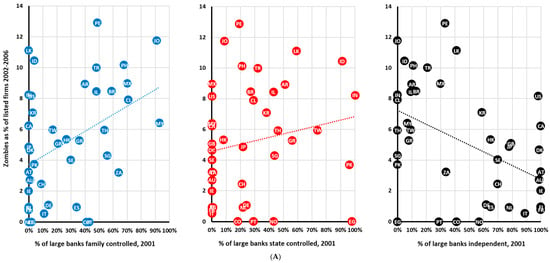
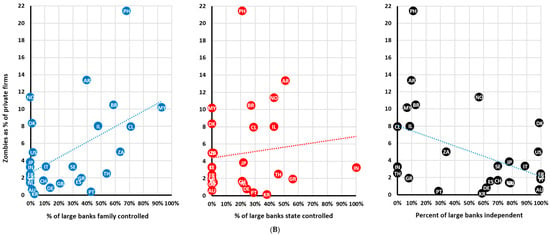
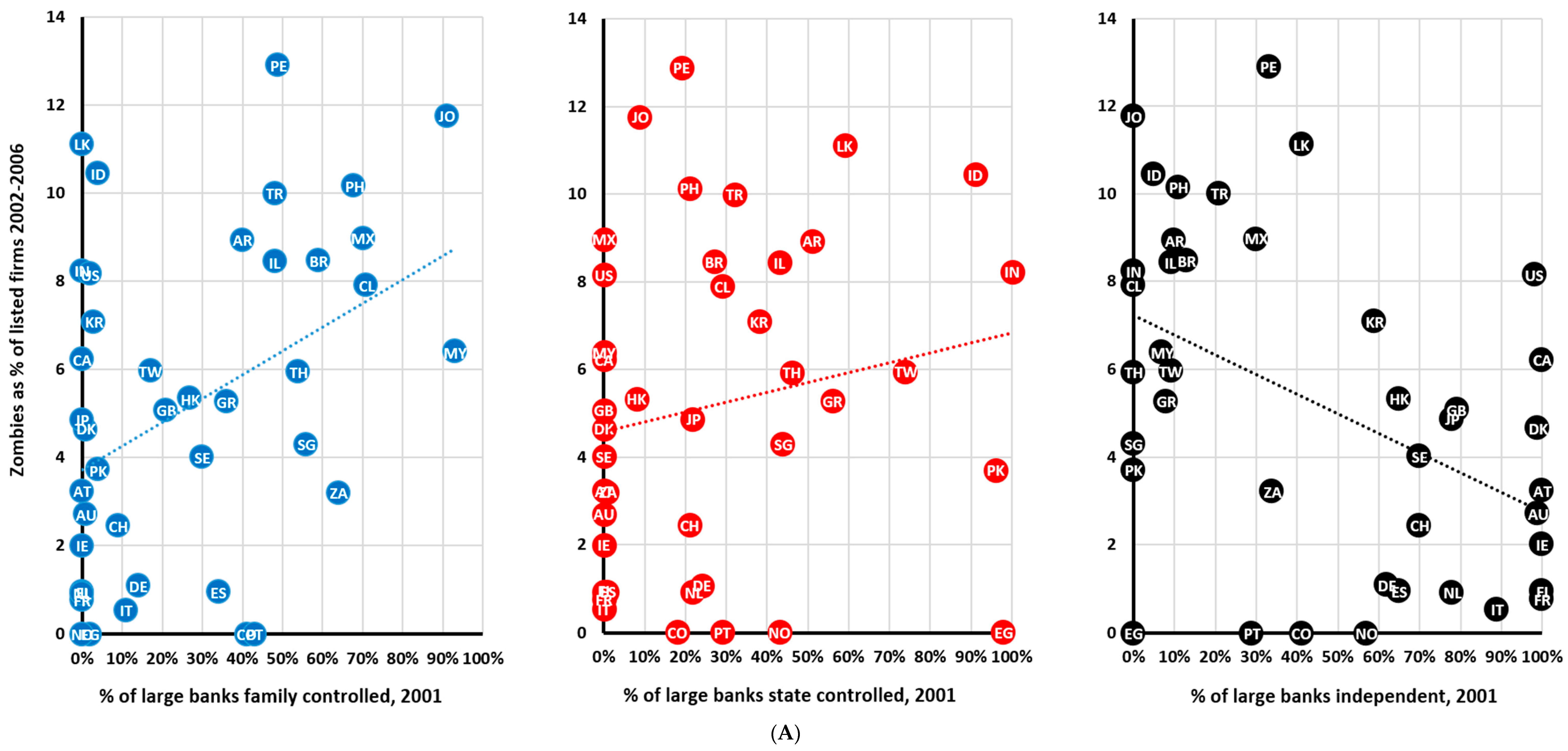
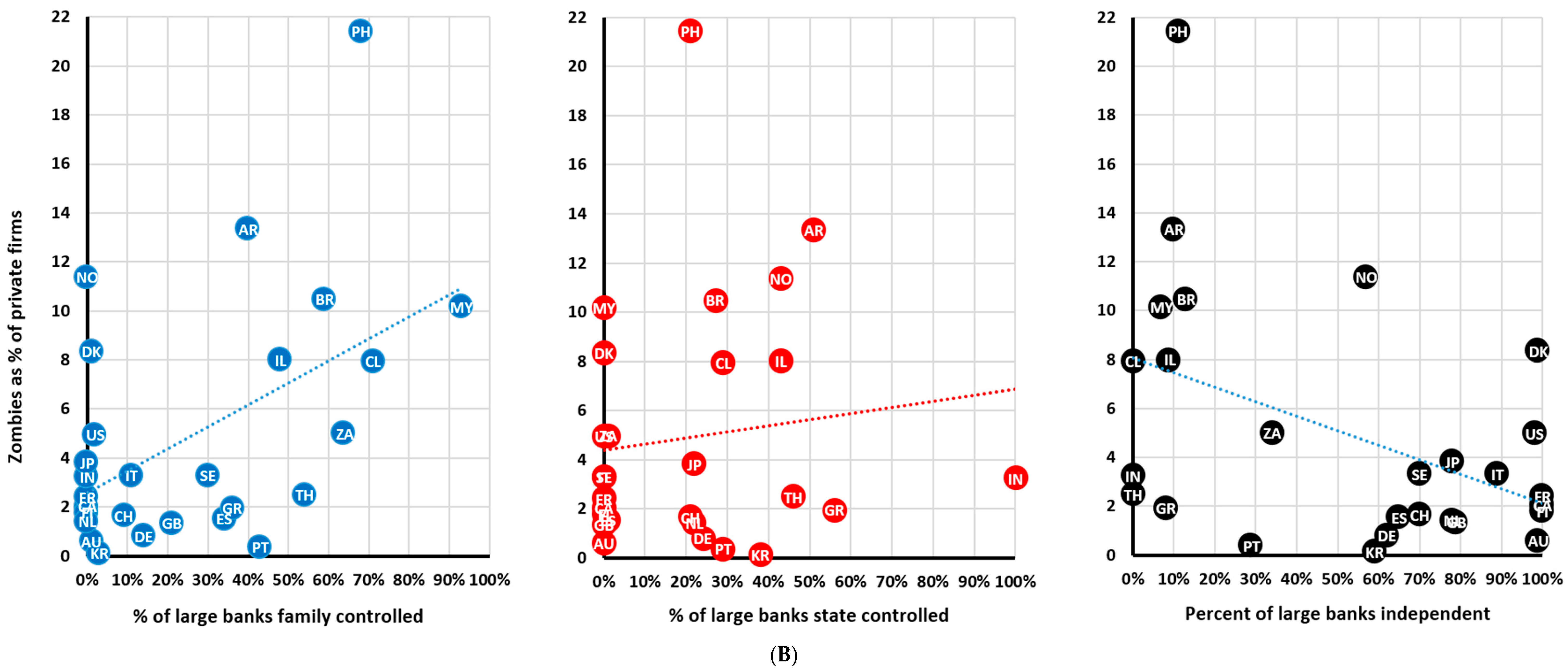

Disclaimer/Publisher’s Note: The statements, opinions and data contained in all publications are solely those of the individual author(s) and contributor(s) and not of MDPI and/or the editor(s). MDPI and/or the editor(s) disclaim responsibility for any injury to people or property resulting from any ideas, methods, instructions or products referred to in the content. |
© 2026 by the authors. Licensee MDPI, Basel, Switzerland. This article is an open access article distributed under the terms and conditions of the Creative Commons Attribution (CC BY) license.