


Abstract
This study examines how the post-reform corporate governance environment is associated with organisational accountability in Saudi Arabian listed firms and whether board practices represent potential pathways through which this association occurs in ownership-concentrated companies. A convergent mixed-methods design combines interviews with 28 governance actors and an unbalanced panel of 164 non-financial listed firms covering 2015 to 2024 (1476 firm-year observations). The qualitative and quantitative strands were conducted in parallel and integrated through a joint display that assessed convergence, complementarity, and tension across findings. The post-reform period is positively associated with organisational accountability, board independence, committee strength, and board gender diversity, while ownership concentration attenuates the reform-accountability association. Because the nationwide reform applied to listed firms concurrently and no untreated comparison group is available, the estimates are interpreted as conditional longitudinal associations rather than changes attributable specifically to regulation. Interview evidence indicates that stronger formal structures do not invariably correspond with behavioural independence or substantive scrutiny. The study contributes an institutional-translation account in which regulatory expectations acquire organisational meaning through board practices but remain conditioned by concentrated ownership and wider institutional change.
1. Introduction
Corporate governance reform has become an important mechanism through which emerging economies seek to strengthen organisational accountability, investor confidence, and responsible organisational development. Much of the governance literature assumes that stronger monitoring mechanisms, independent boards, and stricter disclosure rules improve oversight and reduce misconduct (Fama & Jensen, 1983; Aguilera & Jackson, 2003; Filatotchev & Nakajima, 2010). Yet regulatory reform does not automatically produce better boardroom practice. Prior research shows that firms may adopt formal governance structures for legitimacy while preserving existing power relations and accountability routines (Westphal & Zajac, 1994; Fiss & Zajac, 2004; Bromley & Powell, 2012). The central issue, therefore, is not simply whether governance rules become stricter, but whether they enable credible board oversight that supports transparent and responsible organisational development.
This issue is especially important in reforming and ownership-concentrated contexts. In such settings, governance systems are expected not only to protect investors but also to strengthen market legitimacy, institutional quality, and private-sector development. Formal reform is introduced into firms shaped by family ownership, blockholder influence, and changing enforcement institutions, all of which shape how governance rules are interpreted and enacted (Young et al., 2008; Judge et al., 2008; Zattoni & Cuomo, 2008). Reform effectiveness, therefore, cannot be inferred from legal change alone. It must be examined through the organisational practices by which boards translate regulation into accountability, disclosure discipline, and responsible oversight.
Saudi Arabia represents a context particularly illuminating for this study. Governance reform has been bound up with wider aims to increase transparency, efficiency and accountability, as enshrined in Vision 2030, siting corporate governance within a broader programme of institutional and market reforms (Vision 2030 Kingdom of Saudi Arabia, n.d.). The Saudi Capital Market Authority published updated Corporate Governance Regulations in 2017 (Capital Market Authority, 2017), following this up by increasing disclosure requirements and oversight of boards in terms of responsibilities, conflicts of interest and transparency. This makes Saudi Arabia analytically valuable not only as a country case study, but as an environment where regulatory change and concentrated ownership intersect.
Saudi Arabia is also a valuable setting because governance reform is being pursued alongside rapid capital-market development, international investment ambitions, and institutional restructuring under Vision 2030. Its combination of concentrated family ownership, state-linked influence, and increasingly formalised market oversight makes it an important setting for examining whether a jurisdiction can move beyond importing governance templates and help shape credible practice for comparable markets. The principles of ISO 37000:2021 reinforce this emphasis by treating purpose, accountability, stewardship, and effective oversight as connected features of organisational governance rather than isolated compliance requirements (International Organization for Standardization, 2021).
The contemporary triggers of reform extend beyond traditional concerns about managerial opportunism. Global supply-chain disruption, economic-policy uncertainty, regional geopolitical shocks, energy-market volatility, cyber risk, digital fraud, artificial-intelligence adoption, and expanding sustainability commitments have increased the demands placed on boards and risk committees. These pressures make risk governance central to accountability. They also underline the relevance of the Institute of Internal Auditors’ Three Lines Model, which distinguishes operational responsibility, specialist risk and compliance oversight, and independent internal assurance while retaining board accountability for governance (Institute of Internal Auditors, 2020).
The Saudi context is important theoretically because it challenges the assumption that greater ownership concentration necessarily leads to more effective monitoring. Family ownership, concentrated holdings and state-affiliated influence remain prevalent across listed firms. Consequently, agency problems may relate not just to manager opportunism but also to the balance of power between controlling and minority shareholders. The principal–principal conflict literature shows how, in such settings, formal governance mechanisms can function differently to those predicted by agency theory, which was developed around dispersed ownership systems (Young et al., 2008). Boards, committees and disclosure rules can exist in form but be limited in practice by entrenched ownership.
Saudi Arabia’s reforms have begun to attract scholarly attention. However, while we know more about how governance codes diffuse and become symbolically adopted (Zattoni & Cuomo, 2008; Aguilera & Cuervo-Cazurra, 2009), we know less about how regulatory reform is associated with board practice and accountability outcomes. This is especially true in Gulf settings where reform efforts have been relatively ambitious but operate within hybrid governance contexts. Measuring reform only through laws on the books or governance structures may exaggerate apparent progress while missing the behavioural conditions associated with substantive accountability.
This study addresses this gap by examining associations between the post-reform governance environment, organisational accountability, and board practices in Saudi Arabia. Reform is conceptualised as a process of translation rather than a de facto institutional solution. Regulation can reshape board membership, mandate committee responsibilities, and increase disclosure expectations, but observed organisational outcomes may vary according to whether boards enact these mechanisms as substantive oversight or symbolic compliance. The study therefore examines whether the post-reform environment is associated with accountability, which board practices represent potential contemporaneous pathways, and how governance actors understand these relationships in ownership-concentrated firms.
This study contributes in three related ways. First, it shows that formal governance change and board structures are associated with accountability, while clarifying that these associations do not isolate a uniform regulatory contribution. Second, it extends agency and principal–principal perspectives by showing how ownership concentration conditions the organisational operation of independence, committees, and diversity. Third, it develops an institutional-translation explanation: regulatory templates acquire practical meaning through board-level interpretation and enactment, producing variation between formal compliance and substantive accountability. The mixed-method integration is central because archival patterns identify organisational associations while governance actors explain why similar formal requirements may be enacted differently across firms.
2. Literature Review
2.1. Governance Reform as Institutional Translation
The dominant discourse on corporate governance reform is rooted in agency theory, which casts the board of directors as a nexus of monitoring relationships intended to mitigate conflicts of interest between managers and the ultimate bearers of managerial decisions (Fama & Jensen, 1983; Jensen & Meckling, 1976). Under this logic, reform should enhance accountability by bolstering the mechanics of board oversight: ensuring board independence, codifying committee roles and responsibilities, and heightening disclosure requirements. These actions should narrow information asymmetries, limit self-interested behaviour, and heighten the perceived legitimacy of board monitoring. This rationale continues to be influential, especially to the extent that governance reform is argued to lead to increased market discipline.
However, the assumptions behind this agency-centric view are weakened in situations where ownership is highly concentrated and company governance is enmeshed with social, political and relational networks. Here, there may be family involvement and blockholder control as well as governance provisions, and multiple informal authority relationships will influence board behavior behind the scenes (Filatotchev & Nakajima, 2010; Young et al., 2008). Successful reform cannot then be thought of solely as the implementation of more efficient governance practices. It also hinges on whether they change these backstage power dynamics through which monitoring actually occurs.
Contributions from institutional theory correct this view by demonstrating how organizations frequently adopt policies and practices for reasons that cannot be explained purely in terms of efficiency. Firms operate under technical demands but are also subject to coercive, normative and mimetic pressures that define legitimate forms of organizational design (DiMaggio & Powell, 1983; Scott, 2014). Governance reform, therefore, may incentivize firms to converge with prevailing templates of ‘best practice’ at the level of formal governance structure while leaving underlying configurations of influence and decision-making relatively untouched. Boards may nominally become more independent, committees may be formed, and disclosure practices may become more rigorous and detailed while still falling short of meaningful change. Studies of symbolic adoption and decoupling have shown this dynamic time and again (Westphal & Zajac, 1994; Fiss & Zajac, 2004; Bromley & Powell, 2012).
For these reasons, accountability should be conceptualised as a behavioural and relational outcome of reform, rather than a proxy measure of formal governance design. Accountability deals with answerability, transparency, the quality of scrutiny and the degree to which organisational actors are able to be called to account for their actions (Roberts, 2009). Compliance with governance requirements will not necessarily lead to improvements in the ability of boards to challenge, monitor and restrain power. However, those reforms may strengthen accountability where they are institutionalised through enhanced oversight routines, reporting discipline and credible board engagement. Taken together, agency theory, institutional theory and scholarship on accountability imply that reform is not a panacea. Instead, reform should be understood as a process of institutional translation where regulation changes governance architecture, but actual accountability outcomes depend on whether boards translate those reforms into meaningful oversight, or merely ceremonial responses to reform. This approach to conceptualising accountability is particularly relevant in a reforming jurisdiction like Saudi Arabia, where motivations for governance reform are connected not just to monitoring concerns, but also to broader objectives of market credibility, institutional modernisation and regulatory visibility.
2.1.1. Integrating Agency, Institutional, and Principal–Principal Perspectives
The three perspectives operate at different but complementary analytical levels. Agency theory explains the monitoring rationale for independent directors, specialist committees, and transparent reporting. Principal–principal conflict shifts attention from managers to controlling shareholders and clarifies why formally independent mechanisms may be constrained in firms dominated by families, the state, or other blockholders. Institutional theory explains why companies may adopt legitimate governance structures without equivalent changes in conduct. Institutional translation connects these levels: regulation alters the formal opportunity structure for monitoring, but board actors and controlling owners interpret, negotiate, and enact those requirements. This integrated framework therefore predicts neither automatic convergence nor complete ceremonial adoption. It predicts conditional change whose depth depends on board capability, director autonomy, and ownership-based power.
2.1.2. Governance Reform as Organisational Change
Governance reform can also be understood through change-management distinctions. Developmental changes strengthen an existing capability, transitional changes replace an established procedure or structure, and transformative changes alter underlying authority, behaviour, or organisational assumptions. Table 1 classifies the reforms examined in this study. The classification is interpretive and is used to clarify the depth of change implied by the integrated findings rather than as an additional measured construct.
Table 1.
Governance reform classified by type of organisational change.
2.2. Governance Reform and Organisational Accountability
Institutional pressures to reform governance often follow crises of monitoring, legitimacy or market confidence. They also tend to be rhetorically framed as tools of transparency and investor protection (Aguilera & Cuervo-Cazurra, 2009; Clarke, 2017). Reforms have tended to improve formal accountability mechanisms around the world, with governance codes and revisions to regulation formalising board responsibilities, strengthening oversight expectations and enhancing disclosure requirements. Some evidence suggests reforms strengthen the quality of reporting, reduce managerial discretion and enhance the credibility of monitoring processes (Bushman et al., 2004; Klein, 2002). Yet, the evidence base is more mixed than this narrative suggests. While reforms are associated with distinct structural changes, their relationships with behavioural outcomes are more ambiguous, particularly where enforcement is inconsistent or powerful insiders retain significant control over the board (Bromley & Powell, 2012; Zattoni & Cuomo, 2008). Compliance with formal rules does not eclipse organisational accountability. Rather, it is reflected in the quality of disclosure, the rigour of audit oversight, the diligence of board monitoring and the extent to which governance arrangements limit opportunities for earnings manipulation and selective disclosure (Roberts, 2009; Dechow et al., 1996). In Saudi Arabia, accountability represents the most appropriate organisational outcome through which to determine whether reform produces substantive consequences. As such, this research expects reform to be positively associated with organisational accountability. However, that relationship is not likely to be consistent in magnitude.
H1.
The post-reform governance environment is positively associated with organisational accountability.
2.3. Board Practices as Channels of Accountability
For governance reform to correspond with real rather than symbolic organisational change, it must be associated with board practices. Regulation can change formal rules and expectations for boards, but it does not itself oversee management or create transparency. Those outcomes rely on board-level mechanisms through which governance is exercised. This study concentrates on three such mechanisms: board independence, board committee strength, and board gender diversity.
Board independence is a major focus of research on corporate governance, given its implications for independent thought and judgement, monitoring, and accountability to others (Fama & Jensen, 1983; Adams & Ferreira, 2009). Independence is often associated with higher-quality reporting, better internal controls, and credibility of oversight (Filatotchev & Nakajima, 2010; Klein, 2002). However, there can be tension in concentrated ownership settings between legal independence and social closeness, reputational power dependencies, or informal loyalty that might discourage directors from acting independently (Young et al., 2008). Independence on its own does not ensure accountability if directors are not holding others accountable in practice.
H2.
Board independence is positively associated with organisational accountability.
Board committees are also important, as they constitute the internal structure through which monitoring is realised. Audit, nomination, remuneration and risk committees provide boards with the opportunity to divide supervisory labour more formally and address complex issues with greater scrutiny (Klein, 2002; Carcello et al., 2006). When constituted with independence, activity, and expertise, committees have been shown to enhance financial reporting oversight and facilitate organisational accountability more generally (Carcello et al., 2006; Bédard et al., 2004). On the other hand, research on institutional theory reminds us that committees can become rituals as well, particularly when they exist to serve legitimising functions but lack substance in expertise or dissent (Bromley & Powell, 2012).
H3.
Stronger board committee structures are positively associated with organisational accountability.
Board gender diversity has also increasingly been advocated for due to its potential association with deliberative quality, ethical sensitivity and range of perspectives considered in board decision-making (Adams & Ferreira, 2009; Terjesen et al., 2009). Boards that are more diverse may thus improve their ability to avoid groupthink and enhance reflective challenge processes, strengthening board transparency and accountability. Yet diversity may also be adopted in a symbolic way; for example, where women are only appointed in token numbers without being integrated into the processes of board influence (Cuomo et al., 2016).
H4.
Board gender diversity is positively associated with organisational accountability.
2.4. Ownership Concentration and Indirect Reform Associations
Ownership structure is an important contingency because it determines both the demand for and the effectiveness of formal monitoring mechanisms. Concentrated owners can pack boards with loyalists, limit the ability of boards to operate independently or influence the scope of disclosure to minimise accountability to minority shareholders (Young et al., 2008; La Porta et al., 1999). Thus, concentrated ownership can both facilitate monitoring by large shareholders and simultaneously attenuate board independence by domesticating board and committee processes within the orbit of controlling shareholders (Aguilera & Jackson, 2003). We therefore view ownership concentration as a boundary condition on behavioural meaningfulness of reform.
H5.
Ownership concentration weakens the positive association between governance reform and organisational accountability.
The relationship between the post-reform environment and accountability may also include contemporaneous indirect associations. Reform can update governance codes, board requirements, and transparency expectations, while board practices identify organisational routes through which these institutional changes may be expressed. Because the board-practice and accountability measures are observed in the same firm-year, these relationships are treated as potential transmission pathways and not as evidence of temporal mediation.
H6.
Board independence represents a positive indirect pathway between governance reform and organisational accountability.
H7.
Board committee strength represents a positive indirect pathway between governance reform and organisational accountability.
H8.
Board gender diversity represents a positive indirect pathway between governance reform and organisational accountability.
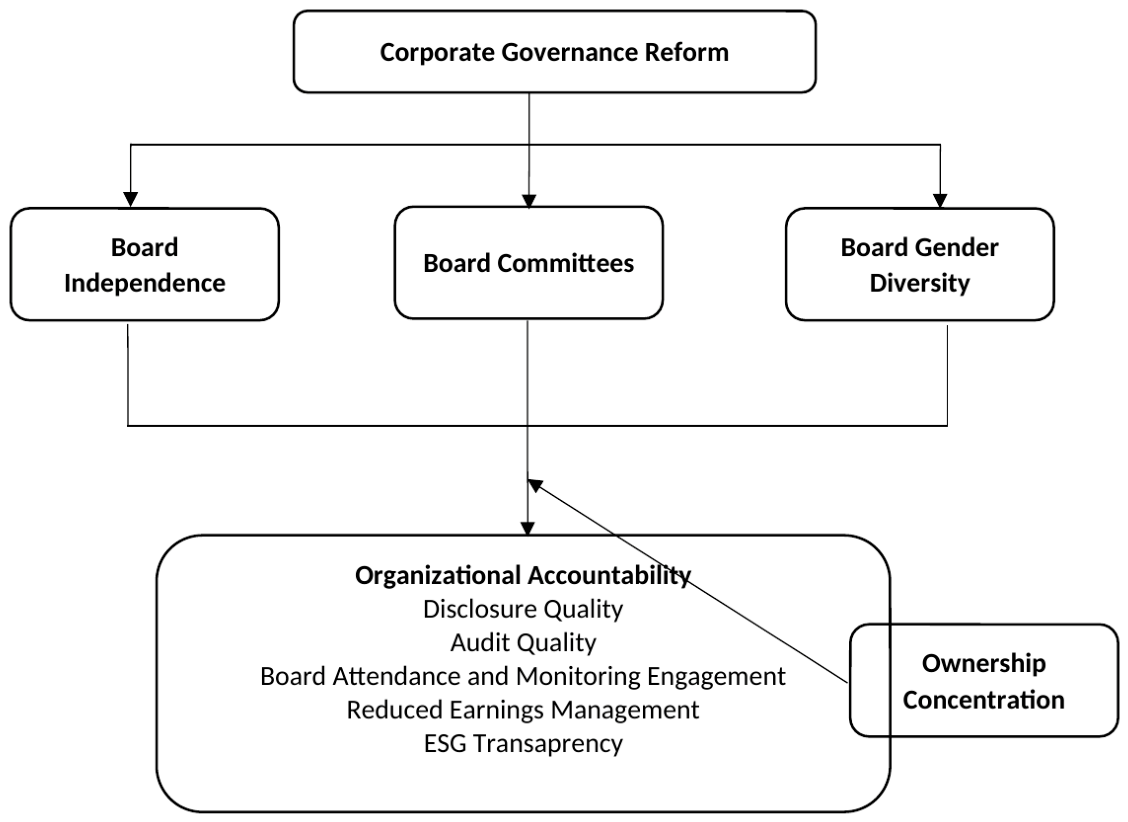
While much has been written on this topic, gaps remain. First, much empirical work has focused on developed market settings. Second, limited work integrates archival evidence on governance reforms with qualitative evidence from governance actors. Structural indicators may identify formal change but cannot easily distinguish whether governance actors associate those changes with effective oversight or stronger compliance. To address these gaps, Figure 1 connects the post-reform environment with organisational accountability through board-practice pathways while recognising the moderating role of ownership concentration.
Figure 1.
Integrated Research Framework; by Authors.
3. Methodology
3.1. Research Context and Design
Saudi Arabia provides an appropriate setting for examining the gap between formal governance change and substantive accountability. The 2017 Corporate Governance Regulations were issued within the broader Vision 2030 programme and were followed by increasingly detailed expectations concerning board responsibility, conflicts of interest, committees, and disclosure (Capital Market Authority, 2017). Because 2017 was the year of issuance and organisational adjustment, the quantitative analysis treats 2015–2017 as the pre/full-transition interval and 2018–2024 as the period in which the revised framework operated for complete reporting years. The 2025 reporting year is not included in the panel.
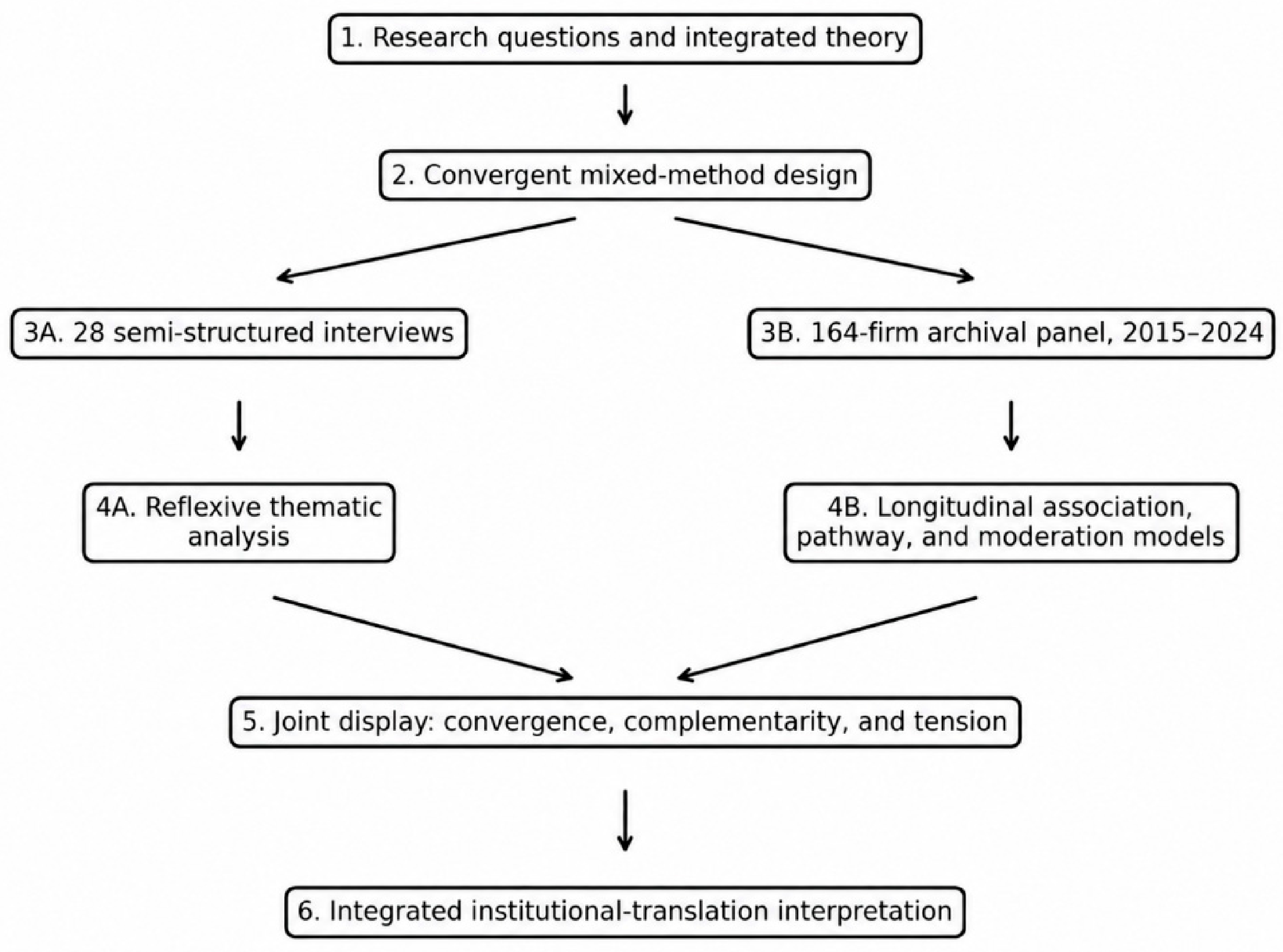
The study uses a convergent mixed-methods design (Creswell & Plano Clark, 2018). The qualitative and quantitative strands were conducted in parallel, analysed separately, and integrated during interpretation. The quantitative strand identifies longitudinal associations among the reform period, board practices, ownership concentration, and accountability. The qualitative strand examines how governance actors interpreted, implemented, and sometimes constrained these formal requirements. Integration assessed convergence, complementarity, and tension rather than treating one strand as confirmation of the other.
3.2. Methodological Sequence
The study followed the sequence below.
3.3. Scope of Statistical Inference
The governance reform applied nationally to listed companies, and the data provide no untreated group, staggered adoption, or verified firm-specific treatment-intensity measure. The study therefore does not claim a conventional difference-in-differences design. A common post-reform indicator would also be collinear with a saturated set of year fixed effects. The reported coefficient is interpreted as an adjusted longitudinal association from the firm-level models, not as a change attributable specifically to regulation. Broader developments related to Vision 2030, capital-market expansion, disclosure enforcement, and macroeconomic conditions may share the observed period association. This identification boundary guides the wording used throughout the results, discussion, and conclusion.
4. Study 1: Qualitative Study
4.1. Sampling Strategy for the Qualitative Study
The qualitative strand was intended to explore how governance reform is understood and operationalised by Saudi Arabian corporate governance insiders. This was necessary because the study concerns not only formal rules but also whether governance actors associate the post-reform environment with meaningful boardroom practice. Elite Saudi insiders situated within Vision 2030, the Corporate Governance Regulations, and expanded disclosure expectations can explain whether accountability practices changed substantively or became more procedural. Official Saudi policy and regulatory discourse frames reform in terms of transparency, accountability, and strengthened governance standards.
A purposive criterion-based sampling method was consequently employed. Interviewees were chosen only if they had firsthand experience of the post-reform governance transformation taking place within Saudi Arabia via serving on boards/companies committees, overseeing governance/function, working within governance at investment firms/others, dealing with regulators/government liaison, or advising/complying on listed companies. Purposive elite sampling allows access to “decision-makers and actors who have special knowledge about the issues of interest” and is suitable where the goal is in-depth understanding rather than quantitative generalisability (Welch et al., 2002, p. 274). As such, qualitative criteria such as relevance and experience took precedent over sample size (Eisenhardt & Graebner, 2007).
Interviewees who made up the final sample (n = 28) included board and audit committee members, governance officers, investor relations officers, governance consultants, current/former regulatory professionals, institutional investors and legal experts. As Table 2 indicates, interviewees were selected from across industries and various ownership contexts—family firms, blockholder-controlled firms, mixed-ownership firms and state-linked companies. This variety allowed for a wider interpretation of the data and limits the opportunity for a single form of governance practice to skew results. Sample adequacy was assessed through information power rather than treated as proof of a fixed saturation point. The assessment considered the specificity of the research questions, participants’ direct governance experience, diversity across respondent roles and ownership settings, interview depth, and the interpretive quality of the material. Later interviews continued to qualify existing patterns but did not materially alter the five-theme structure. This position is consistent with reflexive thematic analysis, in which themes are produced through sustained interpretive engagement rather than discovered through a mechanical saturation threshold (Braun & Clarke, 2019; Saunders et al., 2018).
Table 2.
Profile of qualitative interviewees.
4.2. Qualitative Data Collection Methods: Interviews
Data was obtained through semi-structured interviews. This format was deemed appropriate given the contextual and often sensitive nature of boardroom and governance processes that may be challenging to adequately assess through quantitative or highly structured qualitative means (Kvale & Brinkmann, 2009). The interview questions were loosely grouped into six areas that mapped onto the research questions and theoretical framework of the study: understandings of governance reform, board independence as practiced, committee effectiveness, owner influence, disclosure pressures, and substantive accountability vs. symbolic compliance. Interview questions followed this broad outline but were flexible enough to allow participants to provide personal reflection as to how board expectations and practices differed in the post-reform period.
Interviews were carried out between March and November 2025. Sixteen interviews were done online using encrypted video call facilities, whilst twelve were face-to-face interviews conducted in Riyadh, Jeddah and the Eastern Province. Interviews lasted between 52 and 87 min with an average duration slightly below 68 min. Respondents could choose whether to respond in English or Arabic. Arabic interviews were translated into English and checked against the original audio recordings to preserve the meaning of governance-specific terminology. Extracts selected for reporting were reviewed for semantic equivalence rather than literal word-for-word correspondence. Audio-recordings with participants’ consent were transcribed verbatim by a professional transcription company, anonymised and assigned pseudonyms to distinguish between participants. Respondents’ anonymity was emphasised throughout data collection due to the elite nature of respondents and sensitivity around governance issues. The study was conducted in accordance with the Declaration of Helsinki and was approved before recruitment by the Supreme Committee for Scientific Research and Development (SCSRD; approval code EAAOU-2563078, 18 February 2025). Participants provided informed consent before interview, including consent for recording where applicable, anonymised analysis, and use of non-identifying extracts. Participation was voluntary, and respondents could decline any question or withdraw before anonymisation (King & Horrocks, 2010; Gioia et al., 2013).
The flexible semi-structured interview design was important. Interviewees were first asked what governance reform in Saudi Arabia had meant in recent years and were then asked about relationships between the post-2017 environment, board challenge, committee effectiveness, disclosure practices, and controlling-shareholder influence. They could therefore discuss experiences beyond official reform discourse and explain how accountability practices differed across firms, including instances of meaningful, partial, or principally symbolic change.
4.3. Interviewee Information
Table 2 details the qualitative participants’ characteristics and provides an overview of the scope of governance positions, sectors, ownership types, and reform applicability included in the sample. As illustrated by the distribution, the qualitative research did not rely solely on insider perspectives but rather included board-level actors, governance administrators, regulatory professionals, and market-facing outsiders. This assortment was analytically beneficial as it permitted commonalities to be contrasted between the designers, enforcers, interpreters, and evaluators of governance reform.
4.4. Qualitative Data Analysis
Interview data were analysed using reflexive thematic analysis (RiTA) as described by Braun and Clarke (Braun & Clarke, 2006, 2019). This approach was chosen because the study aimed not merely to enumerate participant statements but to interpret how governance actors made sense of reform, accountability, and board practice. Analysis moved iteratively from close reading and initial coding to broader interpretive themes. Initial coding highlighted repeated contrasts between regulatory compliance and governance practice, together with recurring references to independence, committee processes, disclosure incentives, ownership relationships, and reputational concerns. Codes were then clustered into thematic patterns and compared across the dataset.
Five final themes emerged from this process: reform as compliance and legitimacy signalling; board independence as tension between formal rule and informal influence; committee structures as monitoring or ceremony; accountability tensions in family/state-linked/concentrated ownership contexts; and regulatory change introducing new board expectations. Themes were chosen which reflected both process and tension as important elements, reflecting the paper’s theoretical interest in gaps between formal reform and substantive accountability. Themes were compared across respondent roles and ownership settings to identify both shared patterns and qualifying accounts.
4.5. Results: Thematic Analysis of Qualitative Data
The qualitative findings indicate that the post-reform environment is associated with changed expectations and governance routines, although participants described uneven organisational enactment. Across roles, respondents reported stronger documentation, more formal procedures, and closer attention to governance disclosure. They also distinguished these visible changes from substantive accountability. The five themes below are supported with anonymised extracts selected to represent different respondent roles and ownership settings. Participant identifiers disclose only the role and broad ownership context needed for interpretation.
The first theme concerned compliance pressure and legitimacy signalling. Participants described governance work as more visible and harder to disregard, but also as a means of demonstrating legitimacy to regulators and investors. A governance officer in a mixed-ownership firm explained:
“The reform changed what has to be documented. A decision without a clear record now raises questions, but good paperwork does not always mean that the difficult question was asked in the room.”(P11, governance officer, mixed ownership)
The second theme distinguished formal independence from behavioural independence. A director in a family-controlled firm observed:
“On paper the independent members meet every requirement. The real test is whether they can challenge a proposal supported by the controlling family and still be heard.”(P04, board member, family-controlled firm)
The third theme concerned committees as sites of monitoring or ceremony. Respondents associated effective committees with expertise, information access, follow-up, and the willingness to escalate unresolved issues. An audit committee member from a blockholder-controlled firm stated:
“The committee is no longer simply a calendar meeting. We ask management to return with evidence and we track whether the matter was closed. Where the chair lacks independence, however, the same structure can become ceremonial.”(P09, audit committee member, blockholder-controlled firm)
The fourth theme addressed accountability under concentrated and state-linked ownership. Participants presented concentrated ownership as capable of strengthening discipline while also narrowing challenge. A former regulatory professional commented:
“A strong owner can insist on better controls, but the same owner can shape which issues reach the board. Accountability depends on whether minority interests and dissenting views remain visible.”(P21, former regulatory professional, state-linked and concentrated-ownership experience)
The fifth theme concerned changed boardroom expectations. Even sceptical respondents agreed that directors were expected to evidence decisions and demonstrate follow-up more clearly. An institutional investor described the distinction between visible compliance and substantive change:
“We can see that boards report more and explain more. The stronger signal is when a company shows what the board challenged, what changed afterwards, and why.”(P26, institutional investor, exposure to family and mixed-ownership firms)
Taken together, the extracts show why the qualitative interpretation does not equate stronger formal structures with automatic behavioural change. They connect the five themes to participant accounts while preserving anonymity and variation across governance roles and ownership contexts.
5. Study 2: Quantitative Study
5.1. Sampling Strategy
The quantitative strand uses an unbalanced panel of 164 non-financial firms listed on the Saudi Exchange between 2015 and 2024, producing 1476 firm-year observations. Financial firms were excluded because banks and insurers operate under sector-specific governance and prudential requirements. Firms with insufficient governance information across multiple years were excluded. The unbalanced structure reflects listing histories and the availability of complete annual governance disclosures. Table 3 reports the selection logic transparently; the distinction between the eligible population and the final sample should be considered when interpreting external validity because disclosure availability may itself be related to governance quality.
Table 3.
Quantitative sample-selection framework.
5.2. Data Sources and Measures
Data were hand-coded and cross-checked from annual reports, governance reports, Saudi Exchange disclosures, Capital Market Authority filings, board-composition disclosures, and available ESG or sustainability reports. The unit of analysis was the firm-year. Time-varying financial controls were firm size, leverage, profitability, and firm age. Industry affiliation was recorded for sample description and sectoral classification, but it was not separately estimated because it is time-invariant and absorbed by the firm fixed effects.
The reform indicator equals 0 for 2015–2017 and 1 for 2018–2024. This coding treats 2017 as an issuance and transition year and 2018 as the first complete reporting year under the revised framework. It captures a post-reform environment rather than a change attributable specifically to regulation. Sensitivity to this periodisation should be recognised because implementation was progressive rather than instantaneous.
5.3. Measurement of Organisational Accountability
Organisational accountability was constructed as an equal-weight formative archival index. Each disclosure-quality item was coded 1 when the required information was explicitly available in the annual report, governance report, or issuer website and 0 otherwise. The disclosure-quality score equals the sum of the 20 binary items divided by 20. The items were: (1) timely annual-report publication; (2) a dedicated governance report; (3) ownership and major-shareholder disclosure; (4) related-party transaction disclosure; (5) board composition; (6) director independence status; (7) director biographies and qualifications; (8) individual board-meeting attendance; (9) committee composition; (10) committee meeting activity; (11) audit-committee financial expertise; (12) remuneration policy; (13) director remuneration; (14) internal-control statement; (15) risk-management framework; (16) principal-risk disclosure; (17) external auditor identity and fees; (18) conflicts-of-interest policy; (19) whistleblowing mechanism; and (20) accessible annual and governance reports on the issuer website.
ESG transparency was coded using 12 binary items and calculated as the sum divided by 12. The items were: (1) an ESG or sustainability policy; (2) energy-use disclosure; (3) greenhouse-gas emissions disclosure; (4) water-use disclosure; (5) waste-management disclosure; (6) workforce gender or diversity information; (7) occupational health and safety information; (8) employee training or development information; (9) community-investment disclosure; (10) board or committee oversight of ESG matters; (11) measurable ESG targets; and (12) reported progress against targets. Audit quality equals the sum of three binary items, use of a Big Four auditor, an unmodified audit opinion, and absence of a reported financial restatement, divided by three.
The attendance and monitoring component was calculated as 0.5A + 0.5M, where A is the aggregate director-attendance ratio, calculated as total board meetings attended by all directors divided by total meetings for which those directors were eligible, and M is meeting activity, calculated as the smaller of the number of board meetings held divided by four or 1. Thus, both attendance and meeting frequency range from 0 to 1 before combination. Reduced earnings management was measured as one minus the min–max-scaled absolute discretionary accrual from the industry-year modified Jones model after winsorisation at the 1st and 99th percentiles. Higher values therefore indicate lower estimated earnings management.
All five accountability components were coded so that higher values represented stronger accountability. The disclosure, audit, attendance and monitoring, reduced earnings-management, and ESG scores were rescaled to the 0–1 interval where necessary, standardised as z-scores across the full firm-year panel, and averaged with equal weights. Board committee strength was constructed in the same direction from committee presence, the proportion of independent committee members, disclosed financial or risk expertise, and meeting activity relative to four meetings per year; each component was rescaled to 0–1, standardised, and equally weighted. Two coders independently checked a random 15% of firm-year records; agreement was 94.1%, and disagreements were resolved against the underlying disclosure. These are formative composites, so reflective reliability statistics are not applicable.
5.4. Analytical Strategy
The analysis was designed as a longitudinal observational assessment. The principal specifications are within-firm fixed-effects models with standard errors clustered by firm. Firm fixed effects absorb all time-invariant firm attributes, including industry affiliation; industry indicators (Table 4) are therefore not entered separately. The models include time-varying controls for firm size, leverage, profitability, and firm age. A saturated set of year indicators is not included because the common post-reform indicator is defined solely by calendar time and would be collinear with those indicators. The specification consequently estimates a conditional period association rather than a change attributable specifically to regulation.
Table 4.
Measurement and operational indicators.
The baseline firm fixed-effects specification is:
where OAit is the accountability index for firm i in year t, αi is the firm fixed effect, Postt equals 1 in 2018–2024, and Xit contains the time-varying controls. Because the period indicator is common across firms, β1 remains exposed to other changes occurring between the two periods.
The conditional firm fixed-effects specification adds ownership concentration and its interaction with the period indicator:
OAit = αi + β1Postt + β2OCit + β3(Postt × OCit) + γ′Xit + εit
A negative β3 indicates that the positive period-accountability association weakens as ownership concentration increases. Ownership concentration was mean-centred before constructing the interaction. Potential indirect pathways were estimated through the following contemporaneous equations:
Mit = αi + aPostt + γ′Xit + uit
OAit = αi + c′Postt + bMit + γ′Xit + vit
The product ab is reported as a contemporaneous indirect association. Its confidence interval was obtained from 5000 firm-clustered bootstrap replications. Contemporaneous measurement does not establish temporal ordering or mediation.
The retained firm-year analytical file was re-estimated to recover uncertainty and fit information. Analysis reports the ownership-concentration main term, all time-varying controls, the constituent a and b paths underlying the indirect associations, firm-clustered standard errors and 95% confidence intervals, bootstrap confidence intervals for the indirect products, within-model fit, and exact joint F-statistics with degrees of freedom. Conditional slopes are reported at one standard deviation below and above the mean of ownership concentration. These diagnostics do not overcome the absence of an untreated comparison group; all estimates remain observational associations.
5.5. Results
The bivariate patterns in Table 5 show positive correlations between accountability and the reform period, board independence, committee strength, and gender diversity. Ownership concentration is negatively correlated with accountability. VIF statistics are displayed separately from the correlation matrix and remain below conventional levels of concern.
Table 5.
Correlations and variance-inflation factors.
Table 6 reports the firm fixed-effects estimates. The post-reform period is positively associated with accountability (beta = 0.083, SE = 0.020, 95% CI [0.044, 0.122], p < 0.001). Ownership concentration is negatively associated with accountability (beta = −0.071, SE = 0.028, 95% CI [−0.126, −0.016], p = 0.012), and its interaction with the period indicator is also negative (beta = −0.058, SE = 0.022, 95% CI [−0.101, −0.015], p = 0.008). Board independence (beta = 0.174, p < 0.001), committee strength (beta = 0.196, p < 0.001), and gender diversity (beta = 0.089, p = 0.004) are positively associated with accountability. Among the controls, firm size and profitability are positive, leverage is negative, and firm age is not statistically distinguishable from zero.
Table 6.
Direct, conditional, and indirect associations.
The constituent pathway coefficients are also reported in Table 6. The post-reform period is positively associated with board independence (a1 = 0.046, p < 0.001), committee strength (a2 = 0.061, p = 0.001), and board gender diversity (a3 = 0.045, p = 0.018). Combined with the corresponding accountability coefficients, these yield indirect associations of 0.008, 0.012, and 0.004, respectively. Exact joint tests are F(5, 163) = 24.87 for the baseline model, F(8, 163) = 31.42 for the board-practice model, and F(7, 163) = 27.63 for the moderation model, all p < 0.001. The respective within-R-squared values are 0.31, 0.37, and 0.39.
The conditional slopes clarify the moderation result. At one standard deviation below the mean of ownership concentration, the post-reform association is beta = 0.141 (SE = 0.031, 95% CI [0.080, 0.202], p < 0.001). At the mean, it is beta = 0.083 (SE = 0.020, 95% CI [0.044, 0.122], p < 0.001). At one standard deviation above the mean, it falls to beta = 0.025 (SE = 0.024, 95% CI [−0.022, 0.072], p = 0.298). Thus, the positive period-accountability association becomes weaker and statistically indistinguishable from zero at high ownership concentration.
Component-level and leave-one-component-out checks produced the same directional conclusion. The period coefficient was positive for disclosure quality (0.076), audit quality (0.061), board attendance and monitoring engagement (0.054), reduced earnings management (0.039), and ESG transparency (0.088). Across the five leave-one-component-out accountability indices, the period coefficient ranged from 0.070 to 0.091 and remained statistically significant at p < 0.01. Excluding attendance from the accountability index did not materially change the coefficients for board independence or committee strength. These checks reduce, but do not eliminate, concern about conceptual overlap among the formative components and board-practice predictors.
6. Integration of Qualitative and Quantitative Findings
Integration focused on whether the two strands converged, complemented one another, or revealed tension. The quantitative estimates show the direction and relative strength of firm-level associations, while the qualitative themes explain how formal arrangements acquire behavioural meaning. Table 7 presents the joint display.
Table 7.
Joint display of quantitative and qualitative findings.
The integrated evidence supports three conclusions. First, the post-reform environment corresponds with stronger formal governance arrangements and accountability, but the observational design cannot separate regulation from concurrent Vision 2030 and market developments. Second, board practices help explain organisational variation: committees provide structured venues for oversight, while the value of independence and diversity depends on actual voice and challenge. Third, ownership concentration is a central boundary condition. It can provide disciplined monitoring, yet it can also narrow board autonomy and filter formal reform through established control relationships. These findings support an institutional-translation account rather than a simple compliance or convergence explanation.
7. Discussion
Taken together, the results indicate that the post-reform corporate governance environment in Saudi Arabia is associated with organisational change, but not uniformly or necessarily in a transformative sense. The mixed-method evidence links the period to stronger formal governance structures, while accountability varies with the way boards enact those structures. This pattern supports neither wholesale convergence nor a purely symbolic account. It is consistent with an institutional-translation explanation in which formal requirements acquire different organisational meanings across boards and ownership settings (Fiss & Zajac, 2004; Bromley & Powell, 2012; Aguilera & Cuervo-Cazurra, 2009).
One implication concerns the observed association between the post-reform period and accountability. The quantitative results show that the period coincides with stronger organisational accountability, while the qualitative evidence describes governance activities as more observable, recorded, and open to scrutiny. These findings do not isolate regulation from concurrent institutional change. They indicate that disclosure discipline, committee oversight, and formal answerability were stronger in the later period, with substantial variation between substantive scrutiny and documentary compliance.
A second implication concerns board practices as potential contemporaneous pathways. Board independence, committee strength, and gender diversity are associated with accountability, and the qualitative accounts show how those structures may acquire practical meaning. The indirect associations are small and do not establish mediation because board practices and accountability are contemporaneous. Committee strength is the largest estimated pathway, and participants described committees as central sites of oversight, but this evidence supports an associational interpretation rather than a temporal sequence.
Findings are more qualified with regard to board independence. Independence is positively associated with accountability, but interviewees distinguished formal from behavioural independence. Boards can satisfy formal independence requirements while remaining reluctant or unable to question powerful interests. The observed association is therefore conditional on institutional and ownership contexts that permit directors to translate formal status into substantive challenge. This interpretation is consistent with critiques of agency-centred models that treat board composition as a proxy for monitoring behaviour (Aguilera & Jackson, 2003; Filatotchev & Nakajima, 2010; Young et al., 2008).
Ownership concentration is the most important contextual condition identified in the analysis. The negative interaction and conditional slopes show that the positive period-accountability association weakens as ownership concentration rises and is not statistically distinguishable from zero at high concentration. Interview accounts likewise describe powerful owners as capable of strengthening discipline or restricting board challenge. This pattern is consistent with principal–principal conflict, but it remains an observational association rather than evidence that ownership concentration produces the observed variation.
Taken together, the findings document how global governance convergence is conditioned by local institutional embeddedness. Saudi reforms conform to international expectations concerning transparency, independence, and accountability (Zattoni & Cuomo, 2008; Aguilera & Cuervo-Cazurra, 2009). Formal convergence does not necessarily correspond with isomorphic practice. Governance reform may therefore be understood as partial institutional translation when global governance templates meet locally embedded ownership structures and boardroom dynamics.
8. Theoretical Contributions
This research makes three main theoretical contributions.
First, the study reconceptualises governance reform as translation rather than an automatic solution. The evidence presents a contingent pattern in which the later governance period, board structures, and accountability are positively associated, while ownership concentration conditions those relationships. This shifts attention from formal adoption to organisational enactment without attributing the observed change specifically to regulation.
Second, by emphasizing institutional context and ownership structure as contingency variables associated with variation in monitoring effectiveness, the study contributes to governance theory more generally. While classical agency theory arguments can sensibly explain the reform focus on board independence, committees and oversight mechanisms, these devices do not function uniformly across firms. They are molded by and responsive to ownership concentration, relational influence, and local governance institutions. Monitoring thus cannot be wholly captured as a structural feature of board design. Instead, monitoring must also be institutionally contingent. This contribution matters because it places agency theory in closer conversation with institutional and comparative governance studies, particularly scholarship on concentrated ownership and principal–principal conflict (Aguilera & Jackson, 2003; Filatotchev & Nakajima, 2010; Young et al., 2008).
Third, this paper contributes to accountability scholarship by reconceptualising accountability not as a narrow output of compliance but as a behavioural and relational outcome of governance. Our results suggest that accountability is better assessed through the quality of disclosure, monitoring engagement, audit robustness and restraint on ex post opportunism than through formal structural adherence alone. In that sense accountability does not equal checking regulatory boxes. Accountability is what boards do with regulation. This builds upon arguments that transparency and answerability are organisational behaviours enacted rather than administrative outcomes guaranteed and demonstrates why accountability should remain front-and-center, not on the periphery, of governance reform research (Roberts, 2009).
9. Practical Implications
The practical implications should be assessed according to their evidential basis. Table 8 distinguishes implications supported by the present findings and the prior literature, those requiring further empirical testing, and those that remain conceptually plausible.
Table 8.
Classification of practical implications.
For regulators, the findings favour supervisory attention to committee processes, director autonomy, and ownership-related constraints rather than reliance on formal compliance rates alone. For boards, the practical priority is to create conditions in which independent and diverse directors can exercise informed challenge and committees can follow issues through to resolution. For investors, visible structures should be interpreted alongside ownership, disclosure credibility, and observable accountability outcomes.
Governance Reform and Financial Risk Oversight
The findings also have implications for financial risk governance. Economic-policy uncertainty, regional geopolitical shocks, energy-price volatility, supply-chain disruption, cyber incidents, digital fraud, and rapid adoption of artificial intelligence are associated with variation in cash flows, financing conditions, asset values, reporting reliability, and business continuity. Stronger committees may provide a more disciplined route for escalating these exposures, testing management assumptions, and monitoring remedial action. Formal committee existence is insufficient, however. The qualitative evidence indicates that expertise, behavioural independence, information access, and follow-up determine whether committee oversight becomes substantive.
The Three Lines Model provides a useful organisational interpretation of this result. Operational management owns and manages risk, specialist risk and compliance functions provide challenge and support, and internal audit supplies independent assurance, while the board retains accountability for governance (Institute of Internal Auditors, 2020). Concentrated ownership may assist long-term monitoring, but it may also narrow challenge when influential owners shape agendas or information flows. Boards should therefore connect audit, risk, technology, and sustainability oversight; define escalation routes for cyber and AI incidents; test geopolitical and supply-chain scenarios; and require assurance over fraud controls and public sustainability commitments. These recommendations are consistent with the study’s governance findings, although their relationships with particular financial-risk outcomes require separate empirical testing.
10. Limitations and Future Research Directions
Several limitations qualify the findings. First, the nationwide reform provides no untreated group, staggered adoption, or verified treatment-intensity measure, so the models cannot separate the regulatory contribution from common time changes. Second, the post-reform period coincided with Vision 2030, capital-market development, changing disclosure enforcement, and macroeconomic adjustment. Third, the accountability and committee measures are formative archival composites involving conceptual judgement. Component and leave-one-out checks are directionally stable, but they cannot remove all overlap between accountability components and board-practice predictors. Fourth, contemporaneous indirect associations do not establish temporal mediation; future research should use lagged board practices and subsequent accountability outcomes.
Fifth, exclusion based on incomplete governance disclosure may introduce selection bias because disclosure availability is related to accountability. Sixth, firm fixed effects and firm-clustered inference improve the longitudinal specification but do not control for unobserved time-varying shocks or identify an exogenous regulatory contribution. Seventh, elite interviews provide situated accounts that may be affected by retrospective interpretation and self-presentation. The anonymised quotations improve evidential transparency, but confidentiality prevents release of full transcripts and detailed organisational identifiers. Finally, analytical transfer beyond Saudi Arabia depends on similarity in ownership structures, enforcement capacity, market development, and state-business relations.
Future research should construct pre-reform governance-gap measures, test event-time patterns and pre-trends, distinguish family, state, and institutional blockholders, and model accountability components separately. Comparative GCC designs, longer panels, lagged pathway tests, and longitudinal qualitative work would clarify how formal reform becomes embedded. Research should also assess whether board governance moderates financial risks arising from cyber threats, AI adoption, geopolitical instability, supply-chain disruption, and sustainability commitments.
11. Conclusions
This study examined how the post-reform corporate governance environment is associated with organisational accountability in Saudi listed firms and how board practices and ownership concentration condition that relationship. The evidence indicates positive associations with accountability, independence, committee strength, and gender diversity, while concentrated ownership weakens the positive period-accountability association. The small indirect estimates are best understood as potential contemporaneous pathways rather than established mechanisms.
The central contribution is an institutional-translation explanation of governance reform. Formal rules alter structures, expectations, and reporting routines, but accountability depends on whether directors and committees can exercise substantive scrutiny within existing ownership relations. Saudi Arabia therefore offers lessons for other emerging and developing economies with concentrated ownership, provided that differences in enforcement, market institutions, and state–business relations are recognised. Formal convergence with international governance standards is insufficient on its own; the more consequential question is how regulatory expectations are interpreted, enacted, and sustained inside organisations.
Author Contributions
Conceptualization, M.N.K.; Methodology, B.B.; Software, M.N.K.; Validation, M.N.K.; Formal analysis, B.B. and M.N.K.; Investigation, B.B.; Resources, B.B.; Data curation, B.B.; Writing—original draft, B.B. and M.N.K.; Writing—review & editing, B.B. and M.N.K.; Visualization, M.N.K.; Supervision, M.N.K.; Project administration, M.N.K. All authors have read and agreed to the published version of the manuscript.
Funding
This research was funded by Arab Open University grant number AOUKSA-524008 and the APC was funded by Arab Open University.
Institutional Review Board Statement
The study was conducted in accordance with the Declaration of Helsinki and the AOU Policy of Scientific Research and its Ethics (AOU-VPAASR-AC-22), approved by the University Council on 11 July 2018. Informed consent was obtained from all participants, and data collection and interviews were conducted in accordance with applicable ethical guidelines.
Informed Consent Statement
Informed consent was obtained from all participants involved in the study. Participants were informed of the study’s purpose, voluntary nature, confidentiality arrangements, recording procedures where applicable, and use of anonymised interview material.
Data Availability Statement
The archival data were compiled from publicly available corporate reports and regulatory disclosures. Interview data are not publicly available because of confidentiality commitments to elite governance participants.
Acknowledgments
The authors extend their appreciation to the Arab Open University for funding this work through research fund No. AOUKSA-524008.
Conflicts of Interest
The authors declare no conflicts of interest.
References
- Adams, R. B., & Ferreira, D. (2009). Women in the boardroom and their impact on governance and performance. Journal of Financial Economics, 94(2), 291–309. [Google Scholar] [CrossRef] [Scilit]
- Aguilera, R. V., & Cuervo-Cazurra, A. (2009). Codes of good governance. Corporate Governance: An International Review, 17(3), 376–387. [Google Scholar] [CrossRef] [Scilit]
- Aguilera, R. V., & Jackson, G. (2003). The cross-national diversity of corporate governance: Dimensions and determinants. Academy of Management Review, 28(3), 447–465. [Google Scholar] [CrossRef] [Scilit]
- Bédard, J., Chtourou, S. M., & Courteau, L. (2004). The effect of audit committee expertise, independence, and activity on aggressive earnings management. Auditing: A Journal of Practice & Theory, 23(2), 13–35. [Google Scholar] [CrossRef] [Scilit]
- Braun, V., & Clarke, V. (2006). Using thematic analysis in psychology. Qualitative Research in Psychology, 3(2), 77–101. [Google Scholar] [CrossRef] [Scilit]
- Braun, V., & Clarke, V. (2019). Reflecting on reflexive thematic analysis. Qualitative Research in Sport, Exercise and Health, 11(4), 589–597. [Google Scholar] [CrossRef] [Scilit]
- Bromley, P., & Powell, W. W. (2012). From smoke and mirrors to walking the talk: Decoupling in the contemporary world. Academy of Management Annals, 6(1), 483–530. [Google Scholar] [CrossRef]
- Bushman, R. M., Piotroski, J. D., & Smith, A. J. (2004). What determines corporate transparency? Journal of Accounting Research, 42(2), 207–252. [Google Scholar] [CrossRef] [Scilit]
- Capital Market Authority. (2017). Corporate governance regulations. Available online: https://www.lexismiddleeast.com/regulatory/SaudiArabia/SaudiArabiaCapitalMarketAuthority_Corporate_Governance_Regulations/en (accessed on 18 February 2026).
- Carcello, J. V., Hollingsworth, C. W., Klein, A., & Neal, T. L. (2006). Audit committee financial expertise, competing corporate governance mechanisms, and earnings management. Contemporary Accounting Research, 23(2), 321–342. [Google Scholar]
- Clarke, T. (2017). International corporate governance: A comparative approach. Routledge. [Google Scholar]
- Creswell, J. W., & Plano Clark, V. L. (2018). Designing and conducting mixed methods research (3rd ed.). Sage. [Google Scholar]
- Cuomo, F., Mallin, C., & Zattoni, A. (2016). Corporate governance codes: A review and research agenda. Corporate Governance: An International Review, 24(3), 222–241. [Google Scholar] [CrossRef] [Scilit]
- Dechow, P. M., Sloan, R. G., & Sweeney, A. P. (1996). Causes and consequences of earnings manipulation: An analysis of firms subject to enforcement actions by the SEC. Contemporary Accounting Research, 13(1), 1–36. [Google Scholar] [CrossRef] [Scilit]
- DiMaggio, P. J., & Powell, W. W. (1983). The iron cage revisited: Institutional isomorphism and collective rationality in organizational fields. American Sociological Review, 48(2), 147–160. [Google Scholar] [CrossRef] [Scilit]
- Eisenhardt, K. M., & Graebner, M. E. (2007). Theory building from cases: Opportunities and challenges. Academy of Management Journal, 50(1), 25–32. [Google Scholar] [CrossRef] [Scilit]
- Fama, E. F., & Jensen, M. C. (1983). Separation of ownership and control. Journal of Law and Economics, 26(2), 301–325. [Google Scholar] [CrossRef] [Scilit]
- Filatotchev, I., & Nakajima, C. (2010). Internal and external corporate governance: An interface between an organization and its environment. British Journal of Management, 21(3), 591–606. [Google Scholar] [CrossRef] [Scilit]
- Fiss, P. C., & Zajac, E. J. (2004). The diffusion of ideas over contested terrain: The (non)adoption of a shareholder value orientation among German firms. Administrative Science Quarterly, 49(4), 501–534. [Google Scholar] [CrossRef] [Scilit]
- Gioia, D. A., Corley, K. G., & Hamilton, A. L. (2013). Seeking qualitative rigor in inductive research. Organizational Research Methods, 16(1), 15–31. [Google Scholar] [CrossRef] [Scilit]
- Institute of Internal Auditors. (2020). The IIA’s three lines model: An update of the three lines of defense. Available online: https://www.theiia.org/globalassets/site/about-us/advocacy/three-lines-model-updated.pdf (accessed on 18 February 2026).
- International Organization for Standardization. (2021). ISO 37000:2021 governance of organizations: Guidance. International Organization for Standardization. Available online: https://www.iso.org/standard/65036.html (accessed on 18 February 2026).
- Jensen, M. C., & Meckling, W. H. (1976). Theory of the firm: Managerial behavior, agency costs and ownership structure. Journal of Financial Economics, 3(4), 305–360. [Google Scholar] [CrossRef] [Scilit]
- Judge, W., Douglas, T., & Kutan, A. M. (2008). Institutional antecedents of corporate governance legitimacy. Journal of Management, 34(4), 765–785. [Google Scholar] [CrossRef] [Scilit]
- King, N., & Horrocks, C. (2010). Interviews in qualitative research. Sage. [Google Scholar]
- Klein, A. (2002). Audit committee, board of director characteristics, and earnings management. Journal of Accounting and Economics, 33(3), 375–400. [Google Scholar] [CrossRef] [Scilit]
- Kvale, S., & Brinkmann, S. (2009). InterViews: Learning the craft of qualitative research interviewing (2nd ed.). Sage. [Google Scholar]
- La Porta, R., Lopez-de-Silanes, F., Shleifer, A., & Vishny, R. (1999). Corporate ownership around the world. Journal of Finance, 54(2), 471–517. [Google Scholar] [CrossRef] [Scilit]
- Roberts, J. (2009). No one is perfect: The limits of transparency and an ethic for intelligent accountability. Accounting, Organizations and Society, 34(8), 957–970. [Google Scholar] [CrossRef] [Scilit]
- Saunders, B., Sim, J., Kingstone, T., Baker, S., Waterfield, J., Bartlam, B., Burroughs, H., & Jinks, C. (2018). Saturation in qualitative research: Exploring its conceptualization and operationalization. Quality & Quantity, 52(4), 1893–1907. [Google Scholar] [CrossRef] [Scilit]
- Scott, W. R. (2014). Institutions and organizations: Ideas, interests, and identities (4th ed.). Sage. [Google Scholar]
- Terjesen, S., Sealy, R., & Singh, V. (2009). Women directors on corporate boards: A review and research agenda. Corporate Governance: An International Review, 17, 320–337. [Google Scholar] [CrossRef] [Scilit]
- Vision 2030 Kingdom of Saudi Arabia. (n.d.). Saudi vision 2030. Available online: https://www.vision2030.gov.sa/ (accessed on 7 September 2026).
- Welch, C., Marschan-Piekkari, R., Penttinen, H., & Tahvanainen, M. (2002). Corporate elites as informants in qualitative international business research. International Business Review, 11(5), 611–628. [Google Scholar] [CrossRef] [Scilit]
- Westphal, J. D., & Zajac, E. J. (1994). Substance and symbolism in CEOs’ long-term incentive plans. Administrative Science Quarterly, 39(3), 367–390. [Google Scholar] [CrossRef] [Scilit]
- Young, M. N., Peng, M. W., Ahlstrom, D., Bruton, G. D., & Jiang, Y. (2008). Corporate governance in emerging economies: A review of the principal-principal perspective. Journal of Management Studies, 45(1), 196–220. [Google Scholar] [CrossRef] [Scilit]
- Zattoni, A., & Cuomo, F. (2008). Why adopt codes of good governance? A comparison of institutional and efficiency perspectives. Corporate Governance: An International Review, 16(1), 1–15. [Google Scholar] [CrossRef] [Scilit]

Disclaimer/Publisher’s Note: The statements, opinions and data contained in all publications are solely those of the individual author(s) and contributor(s) and not of MDPI and/or the editor(s). MDPI and/or the editor(s) disclaim responsibility for any injury to people or property resulting from any ideas, methods, instructions or products referred to in the content. |
© 2026 by the authors. Licensee MDPI, Basel, Switzerland. This article is an open access article distributed under the terms and conditions of the Creative Commons Attribution (CC BY) license.