


Abstract
Industry 5.0 frames digital and circular investment as a capital-allocation problem under risk. This study examines how a small open economy allocates limited public capital between two demands. The first is civil protection against hybrid and military threats. The second is the transition to a digital circular economy. Lithuania serves as the case. The study combines doctrinal analysis of EU and national law with documentary analysis of budgetary and program data. It assesses three hypotheses on displacement, funding composition, and the early identification of dual-benefit investment. The data combine state budget allocations for 2021–2024 with planned needs and allocations up to 2030. All figures from 2025 onward are planning commitments, not outturns. Civil protection funding rose from EUR 12.7 million in 2021 to EUR 43.0 million in 2023. It stood at EUR 39.7 million in 2024. A further EUR 284.7 million is required for 2025–2030. Circular economy measures are planned at EUR 4.27 billion against an assessed need of EUR 4.44 billion (96.0% coverage). The displacement hypothesis is not supported. On a like-for-like annual basis, the circular program remains eight to thirteen times larger. The main constraint is composition. The circular industry receives 32.8% of its assessed need and accounts for 90.8% of the program’s funding gap. The horizontal line for digitalization, research, and coordination receives only 0.3% of planned funds. The findings have three policy implications. Project appraisal should include a dual-benefit test. Civil protection procurement should apply lifecycle criteria. Digital traceability infrastructure needs dedicated funding because both circular finance and supply-chain security depend on it.
1. Introduction
Digital and circular transformation is often treated as a technological project. From the standpoint of public finance, however, it is also a claim on scarce capital. This claim competes with other claims under uncertainty and over long time horizons, during which the security environment may change more than once. Small open economies on the eastern edge of the European Union now face this competition in acute form. As an EU Member State, Lithuania is legally committed to a circular transition that requires investment through 2035 (Government of the Republic of Lithuania, 2023). At the same time, Russia’s full-scale war against Ukraine has changed the role of civil protection. Since February 2022, civil protection has become part of national defense rather than only a peacetime public service (Seimas of the Republic of Lithuania, 2024). A state can respond to such competing demands in three ways. It can sequence them, substitute one for the other, or identify spending that serves both. This choice affects the economy’s resilience as well as its environmental performance.
The two demands are connected. The linear economy expanded considerably during globalization. It is a major driver of climate change and environmental degradation. It also increases dependence on external supplies of materials and energy (Nygaard, 2022; Gorokhova et al., 2023; Chabowski et al., 2025). Dense interdependence has turned energy, migration, and climate into security issues, calling for a more critical reading of modernization (Aliyeva, 2026). Security and environmental threats therefore share a common channel: exposure to disrupted supply chains. The EU has addressed the environmental side through several instruments. These include its Paris Agreement commitments, the European Green Deal, the EU Strategy on Adaptation to Climate Change, and two Circular Economy Action Plans (European Council, 2025; European Commission, 2019, 2020; European Environment Agency, 2021; Štareikė, 2022). On the security side, the EU has built a growing set of preparedness and defense-readiness instruments.
Lithuanian policymakers must therefore pursue deterrence and the circular transition simultaneously. A common concern is that fragmented financing will shift priorities toward the security sector. In that case, investment in circularity would decline (Kryvoshlykov, 2025). The opposite argument is also made. In the long run, circular practices may strengthen national resilience by reducing material dependence (Government of the Republic of Lithuania, 2023, para. 4). Which view fits the Lithuanian case is an empirical question. It has not yet been examined using financing data.
The question sits at the intersection of two studies. Research on defense and public expenditure has long examined trade-offs between security and civilian spending. Most of this work uses cross-country econometric analyses of executed budgets. It typically measures the civilian outcome as growth, health, or education spending (Russett, 1969; Dunne & Tian, 2013). Circular economy research has focused on definitions, business models, and waste-sector implementation. It pays limited attention to who bears the financing burden (Kirchherr et al., 2017; Dagilienė et al., 2021). The two studies rarely intersect. Security and circular programs are analyzed in separate policy fields. As a result, the displacement concern is usually asserted rather than examined. The possibility that one allocation serves both objectives is recognized only after the fact, if at all (Mayrhofer & Gupta, 2016). Three gaps follow. The first is empirical: no study has compared Lithuanian security and circular financing data. The second is compositional: aggregate budget comparisons obscure how funds are distributed within programs. The third is methodological: public appraisal lacks a criterion for identifying dual-benefit investment in advance. This study addresses these gaps. It treats public security financing and circular economy financing in Lithuania as a single allocation problem under compound risk.
Three research questions guide this study. First, has the growth in public security financing since 2022 been sufficient to displace planned circular economy financing? Second, where do planned circular economy allocations fall short of assessed needs? Third, can the current EU and Lithuanian framework identify dual-benefit investments before funds are committed? In this study, dual-benefit investment refers to spending that serves both public security and circularity simultaneously. Section 2 links each question to a hypothesis. Section 4 assesses the hypotheses using documentary evidence and descriptive statistics.
The article makes four contributions. First, it brings Lithuanian civil protection and circular-economy financing data into a single analytical framework. To the authors’ knowledge, no earlier study has done so. This enables an assessment of the displacement hypothesis rather than an assumption. Second, it underscores the importance of like-for-like comparisons. Comparing annual flows with multi-year program envelopes overstates the scale difference by about an order of magnitude. Third, it shifts the analysis from aggregate totals to the internal composition of the circular program. It identifies the main constraint as funding for circular industry and for the horizontal line for digitalization and coordination. Fourth, it proposes a lifecycle-based dual-benefit criterion for public appraisal. It also identifies digital traceability infrastructure as a precondition for both circular finance and supply-chain security.
The remainder of the article is organized as follows. Section 2 reviews the theoretical and empirical literature and develops the hypotheses. Section 3 describes the research design, data, and indicators. Section 4 presents the results. Section 5 discusses the results in relation to the literature and draws policy implications. Section 6 concludes, outlines the study’s limitations, and suggests directions for future research.
2. Literature Review and Hypothesis Development
2.1. Theoretical Foundations
Three bodies of theory inform the analysis. The first concerns the political economy of public budgeting under competing priorities. The classic “guns versus butter” argument holds that higher security spending is financed, at least in part, by cuts in civilian expenditure. Early evidence for the United States found that defense growth came largely at the expense of investment (Russett, 1969). Later surveys of the military expenditure literature report mixed but predominantly negative effects on growth, with results that vary by sample, period, and estimation method (Dunne & Tian, 2013). Budget theory adds a dynamic dimension. Allocations tend to change incrementally for long periods and then shift abruptly when an external shock redirects political attention (Baumgartner & Jones, 1993; Jones et al., 1998). The security shock experienced by the Baltic states after February 2022 is such a punctuation. From this perspective, attention and money would be expected to move away from long-horizon programs such as the circular transition.
The second body of theory concerns the valuation of resilience. When digitalization is viewed as efficiency, investment is justified by productivity gains. When it is viewed as resilience, part of the return takes the form of avoided losses. Examples include the continuity of essential functions, lower exposure to supply disruptions, and faster recovery after a shock (Breque et al., 2021). The disaster-risk literature describes a “triple dividend” of avoided losses, stimulated economic activity, and co-benefits that arise even if no disaster occurs (Tanner et al., 2015; Hallegatte et al., 2019). Portfolio theory explains why such returns matter under compound risk. When two risks are positively correlated, the efficient allocation reduces joint exposure. It is not the one that maximizes expected return in each domain separately (Markowitz, 1952). A state facing both military escalation and dependence on imported materials is in this position, because the same disruption tends to raise both risks. Appraisal, however, is organized by program. The co-benefits literature shows that returns outside the funding program rarely influence allocation decisions (Mayrhofer & Gupta, 2016).
The third body of theory is the information economics of circular finance. The circular economy is defined as a regenerative system that reduces resource inputs, waste, emissions, and energy leakage by slowing, closing, and narrowing material and energy loops (Geissdoerfer et al., 2017). It therefore lowers exposure to external supply disruptions and reduces environmental pressure. On the capital side, the Taxonomy Regulation turns environmental objectives into investment criteria. It does so through three tests: substantial contribution, do no significant harm, and minimum safeguards (European Parliament and Council of the European Union, 2020). These tests make circular projects legible to investors. However, they require material-flow, lifecycle, and provenance data, which most firms do not routinely keep. The financing problem of circularity is thus partly a problem of missing information infrastructure. This gap raises verification costs and the risk premium charged by lenders (Gorokhova & Simanavičienė, 2026). Such data are created by digital product passports under the Ecodesign for Sustainable Products Regulation (ESPR), material-flow registers, lifecycle databases, and interoperable procurement systems (European Parliament and Council of the European Union, 2024b). The same traceability that lets an investor verify recycled content also lets a public authority detect single-source dependencies in a critical supply chain. In this article, an investment is called dual-benefit when it has its main rationale in one policy domain and also produces a measurable, non-incidental benefit in the other.
2.2. Public Security, Civil Protection and Total Defence
Public security is part of national security and encompasses the protection of individuals, society, and the state against criminal acts, other breaches of the law, and natural and man-made disasters. In EU law, the term includes both the internal and external security of a Member State (European Parliament and Council of the European Union, 2004, Art. 28(3)). According to the Court of Justice, public security may also cover threats to institutions and essential public services, the survival of the population, and military interests (Court of Justice of the European Union, 2010, paras. 43–44). In a narrow sense, public security is close to civil protection: preparing society for emergencies, organizing rescue and response, and mitigating consequences (Survila et al., 2017). In a broader sense, it covers all social, natural, and technical systems whose disruption can cause harm. These include global ecological conditions such as climate change (Novikovas et al., 2019; Šlapkauskas, 2022). Globalization, which Tomlinson (2002) associates with an epochal shift in cultural outlook, has made these systems more tightly interconnected.
Civil protection in Europe developed after the Cold War as a public service focused primarily on natural and technological hazards that did not threaten the state’s existence. It emphasized risk reduction, preparedness, response, and recovery. It also classified incidents by severity, from emergencies to disasters and catastrophes (Hagen et al., 2013; Survila & Smalskys, 2017; Survila et al., 2018). Two governance models are commonly distinguished (Survila et al., 2018). The “command-and-control” model resembles military preparation and response. The “problem-solving” model relies more on community involvement. Since 2014, and decisively since 2022, hybrid threats have rendered the peacetime model inadequate. Hostile states blur the lines between internal and external politics, between legal and illegal action, and between peace and war. Their tools include disinformation, election interference, cyber operations, and attacks on critical infrastructure (Juurvee, 2022; Štareikė, 2024). Lithuania has responded by shifting from a civil safety framework toward public security defense and by adopting the command-and-control model.
The Nordic and Baltic states have reframed these changes through the concept of total defense. It is a whole-of-society approach that deters aggression by raising its costs and lowering its likelihood of success (Wither, 2020; Wrange et al., 2024). Total defense has both a military and a civil component. The civil component gives the approach its “total” character. It now ranges from early warning, evacuation, and shelters to psychological and economic defense. Its purpose is to keep society functioning in crisis or war (Visuotinė lietuvių enciklopedija, n.d.; Berndtsson, 2024; Wrange, 2026). Its implementation depends on reserves and supply chains for essential goods, hospital capacity, and the participation of citizens, non-governmental organizations, and local communities (Novikovas, 2020; Birmontienė et al., 2022). Scholars had warned about the growing Russian threat well before 2022 (Novikovas et al., 2017). What has changed is the fiscal consequence: civil protection has become a budgetary claim comparable in urgency to defense.
2.3. The Circular Economy: Concept, Policy and Implementation
The circular economy has intellectual roots older than its current policy prominence suggests. Its modern form emerged in ecological economics, notably in the work of Pearce and Turner, who built on Boulding (Žilinskienė & Žilinskas, 2020, p. 98). The concept has since evolved from a narrow idea linked to industrial ecology into a broader model of economic transformation. The European Court of Auditors (2023, p. 55) describes it as a system that relies on reuse, sharing, repair, refurbishment, remanufacturing, and recycling to reduce resource use, waste, and emissions. EU policy has followed the same path. The 7th Environment Action Programme treated circularity as a precondition for prosperity within planetary limits (European Parliament and Council of the European Union, 2013). The 2015 Action Plan set out 54 actions across the value chain. The 2020 Action Plan shifted attention toward sustainable products, empowered consumers, and green public procurement (European Commission, 2015, 2020).
Implementation has lagged behind ambition. The European Court of Auditors (2023) reports slow progress among Member States despite EU action. Circular material use also remains highly uneven across the Union (Eurostat, 2026). Two strands of research help explain this. A review of 114 definitions found that circularity is mostly operationalized through recycling and reuse. Systemic change, business-model redesign, and financing receive far less attention (Kirchherr et al., 2017). Studies of Lithuania point in the same direction. Municipalities tend to treat the circular economy mainly as waste management and regulatory compliance. Resilience and systemic transformation remain underdeveloped (Dagilienė et al., 2021; Bruneckienė et al., 2021). A newer strand treats circularity as a matter of strategic autonomy. The EU critical raw materials agenda links recovery rates to security of supply (Baldassarre & Carrara, 2025). Research on post-war reconstruction treats circular business models as financeable assets. Their bankability depends on digital verification (Gorokhova & Simanavičienė, 2026). The 2025 advisory opinion of the International Court of Justice adds a legal dimension. It links adaptation obligations to reduced vulnerability. Its examples include weatherproofing buildings and land management to reduce wildfire risk (International Court of Justice, 2025, para. 258).
2.4. Synthesis: Divergent Views and Methodological Inconsistencies
Table 1 compares the main strands of the literature by setting, period, method and principal finding. Three positions emerge from the comparison.
Table 1.
Comparative synthesis of the literature informing the hypotheses.
The first position, rooted in the trade-off literature, expects security shocks to crowd out civilian and environmental spending. The second position comes from the resilience and total defence literature. It expects complementarity, because investment in preparedness and in circularity reinforces both objectives. The third position appears in the co-benefits and circular implementation studies. It is conditional. It holds that complementarity is possible but does not arise on its own. The reason is that appraisal and budgeting are organised by sector. They reward measurable, programme-specific returns.
The comparison also reveals methodological inconsistencies that make these positions difficult to reconcile. Trade-off studies rely on actual budgets and aggregate cross-country data. Circular economy and total defense studies rely mostly on qualitative case and policy analyses. Outcome measures also differ. One tradition measures growth, social spending, and capability. The other measures material circularity and implementation practice. Time frames rarely overlap. Policy analyses also often compare annual budget flows with multi-year program envelopes without adjustment. Almost no study examines the internal composition of a circular program. Yet aggregate coverage can hide large gaps in individual intervention areas.
2.5. Research Gap and Hypotheses
Three gaps emerge from this review. No empirical study compares security financing with circular economy financing in a frontline EU Member State using comparable units. Little is known about how circular program budgets are distributed across intervention areas. It is also unclear which areas are left short. Finally, no established method exists for identifying dual-benefit investments at the appraisal stage, even though EU law increasingly permits such investments. The hypotheses below translate these gaps into testable expectations. The evidence is documentary and covers a single country. The hypotheses are therefore assessed as analytical propositions, using descriptive indicators and legal analysis. They are not tested statistically.
H1 (displacement).
The post-2022 increase in civil protection financing is large enough to crowd out planned circular-economy allocations. This hypothesis follows from the trade-off and budget-punctuation literature.
H2 (composition).
Coverage of assessed needs is lower in intervention areas that rely on industrial restructuring, coordination, and information than in those delivered through capital projects. This hypothesis follows from the resilience-valuation and circular implementation literature.
H3 (identification).
The EU and Lithuanian frameworks permit dual-benefit investment but do not provide criteria to identify it in advance during appraisal, budgeting, or procurement. This hypothesis follows from the co-benefits literature.
The study therefore uses three analytical variables. The first concerns the scale and growth of security financing (H1). The second concerns the level and internal composition of circular economy financing (H2). The third concerns the presence or absence of ex ante dual-benefit criteria in legal and programming instruments (H3).
3. Materials and Methods
3.1. Research Design
The study uses a single-case design in the sense of Yin (2018). Lithuania is treated as an information-rich case. It is a small, open economy on the EU’s eastern border. It faces an acute security shock and is legally committed to a circular transition. The aim is analytical rather than statistical generalization. The study asks whether the mechanisms proposed in the literature operate where their conditions are most clearly present. The design combines two established qualitative methods. Doctrinal legal research examines EU and national law on public security, civil protection, and the circular transition. The sources include statutory provisions, programming documents, and the case law of the Court of Justice of the European Union. The analysis examines how these fields interact and where their competences and financing instruments overlap (Hutchinson & Duncan, 2012). Document analysis is the systematic selection, appraisal, and synthesis of documentary evidence (Bowen, 2009). It is used here to reconstruct the financing architecture of each domain from primary budgetary and programming sources.
3.2. Data
Three data sources underpin the analysis. Public security financing is reconstructed from two sources. The first comprises state budget allocations to the crisis management and civil protection system for 2021–2024. The second comprises funding projections for 2025–2030 annexed to the Programme for the Strengthening and Development of Civil Protection (Seimas of the Republic of Lithuania, 2024). Circular economy financing is reconstructed from the Guidelines for Lithuania’s Transition to a Circular Economy until 2035 (Government of the Republic of Lithuania, 2023). The Guidelines specify the assessed funding need and the planned allocation for each intervention area. Comparative positioning draws on the Eurostat circular material use rate, indicator cei_srm030 (Eurostat, 2026). The data thus combine two types of figures. Allocations for 2021–2024 are budgeted amounts for past years. All figures for 2025 onward are planning commitments, not outturns. All values are reported in nominal euros, in the units and at the precision given in the sources, without deflation or currency conversion.
3.3. Indicators and Analytical Procedure
The analysis proceeds in three steps, each linked to one hypothesis (Table 2). For H1, civil protection allocations are tracked over time using year-over-year changes, a fixed-base index (2021 = 100), and the compound annual growth rate. Their scale is then compared with circular economy financing in three ways. The headline ratio compares the multi-year circular envelope with a single year of civil protection funding. The annualized ratio spreads the circular envelope over its programming horizon. The cumulative ratio covers 2021–2030. The annualized ratio is reported for two horizons, 2023–2030 and 2023–2035. The Guidelines monitor implementation to 2030 but set objectives to 2035. An upper-bound stress test asks how far circular coverage would fall if the entire additional civil protection need for 2025–2030 were financed by cutting circular allocations. For H2, circular financing is decomposed by intervention area. Three measures are calculated for each area: the coverage ratio (planned divided by required funding), the share of total planned funding, and the share of the total funding gap. Concentration is summarized with the Herfindahl–Hirschman index, which is the sum of squared shares (Rhoades, 1993). Its inverse gives the effective number of intervention areas. For H3, the doctrinal analysis examines whether the relevant EU and Lithuanian instruments contain criteria that would identify dual-benefit investment before funds are committed.
Table 2.
Operationalization of the hypotheses.
Because the circular data are programmatic, the analysis speaks to allocation intent rather than to disbursement or outcomes. All descriptive indicators are computed directly from the figures in the source documents; no values were estimated or imputed.
4. Results
4.1. Security Financing and the Displacement Hypothesis (H1)
The legal reorientation of civil protection preceded and justified the budgetary reorientation. On 8 December 2022, the Seimas adopted a revised Law on Crisis Management and Civil Protection (Seimas of the Republic of Lithuania, 1998/2022). The law established an integrated system for emergency and crisis management. The National Crisis Management Centre is the operational core of this system (Ministry of the Interior of the Republic of Lithuania, 2022). The law now extends civil protection to the preparation of critical entities for resilience. On 18 July 2024, the Seimas approved the Programme for the Strengthening and Development of Civil Protection. In line with the total defense model, the Programme sets priorities through 2030 in seven areas. These include shelters, warning and public information, the preparedness of crisis management actors, healthcare resilience, civil protection assistance teams, preparedness for chemical, biological, radiological, and nuclear threats, and training capacity (Seimas of the Republic of Lithuania, 2024). The state budget is the primary source of funding for this system.
Table 3 presents the budgetary response. Allocations rose from EUR 12.677 million in 2021 to EUR 22.525 million in 2022 and EUR 42.976 million in 2023, before easing to EUR 39.684 million in 2024. The 2023 level was 3.4 times that of 2021. The compound annual growth rate over 2021–2024 was 46.3 percent. Growth was concentrated in the first two years of the war (77.7 and 90.8 percent), followed by a 7.7 percent decline in 2024. In addition, Lithuania received EUR 112.239 million in external assistance for civil protection in 2022–2025. The Programme identifies a further EUR 284.656 million needed in 2025–2030 (Seimas of the Republic of Lithuania, 2024, section II, paras. 11.1–11.2; Annex 2). Spread evenly, this additional need amounts to about EUR 47.4 million per year. This exceeds the 2024 allocation, so budgetary pressure is set to persist.
Table 3.
State budget allocations to the crisis management and civil protection system, 2021–2024, and programmed needs to 2030 (EUR million). Source: calculated by the authors from Seimas of the Republic of Lithuania (2024), section II, paras. 11.1–11.2 and Annex 2.
The question for H1 is whether this growth is large enough to displace circular financing. Table 4 compares the two domains on three bases. The headline comparison sets the full circular envelope of EUR 4267.788 million against a single year of civil protection funding. It yields a ratio of 107.5, suggesting a difference of two orders of magnitude. That comparison is misleading because it sets a multi-year envelope against an annual flow. Once the circular envelope is spread over its programming horizon, the ratio falls to between 8.3 (2023–2035) and 13.4 (2023–2030). On a cumulative basis, planned circular funding is 10.6 times the sum of budgeted civil protection allocations for 2021–2024 and the additional need for 2025–2030. The difference in scale is therefore about one order of magnitude, not two.
Even on this like-for-like basis, the evidence does not support H1. First, the Guidelines were approved on 21 June 2023, after the security shock. Their planned allocations therefore already reflect the post-2022 fiscal environment. They still cover 96.0 percent of the assessed need. Second, the upper-bound stress test assumes that the entire additional civil protection need for 2025–2030 (EUR 284.656 million) is taken from the circular envelope. Under this assumption, coverage would fall from 96.0 to 89.6 percent. This would be a real loss. It would not, however, compromise the programme as a whole. There is no pre-2022 circular baseline. For this reason, displacement over time cannot be ruled out entirely. It should be checked against executed spending. Within the planned allocations, however, displacement is not the operative mechanism.
4.2. The Composition of Circular Economy Financing (H2)
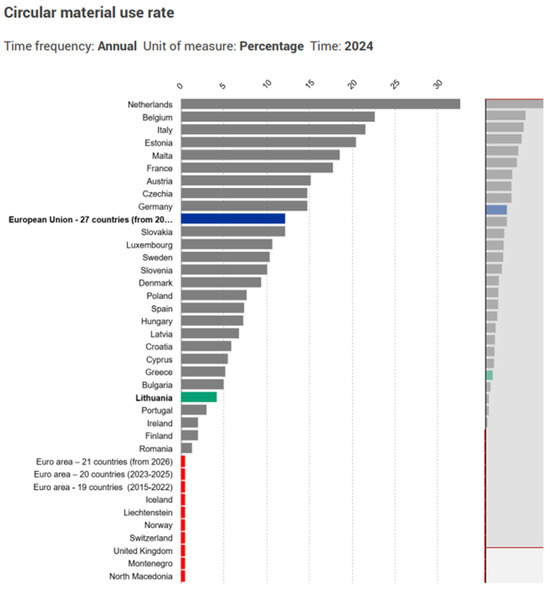
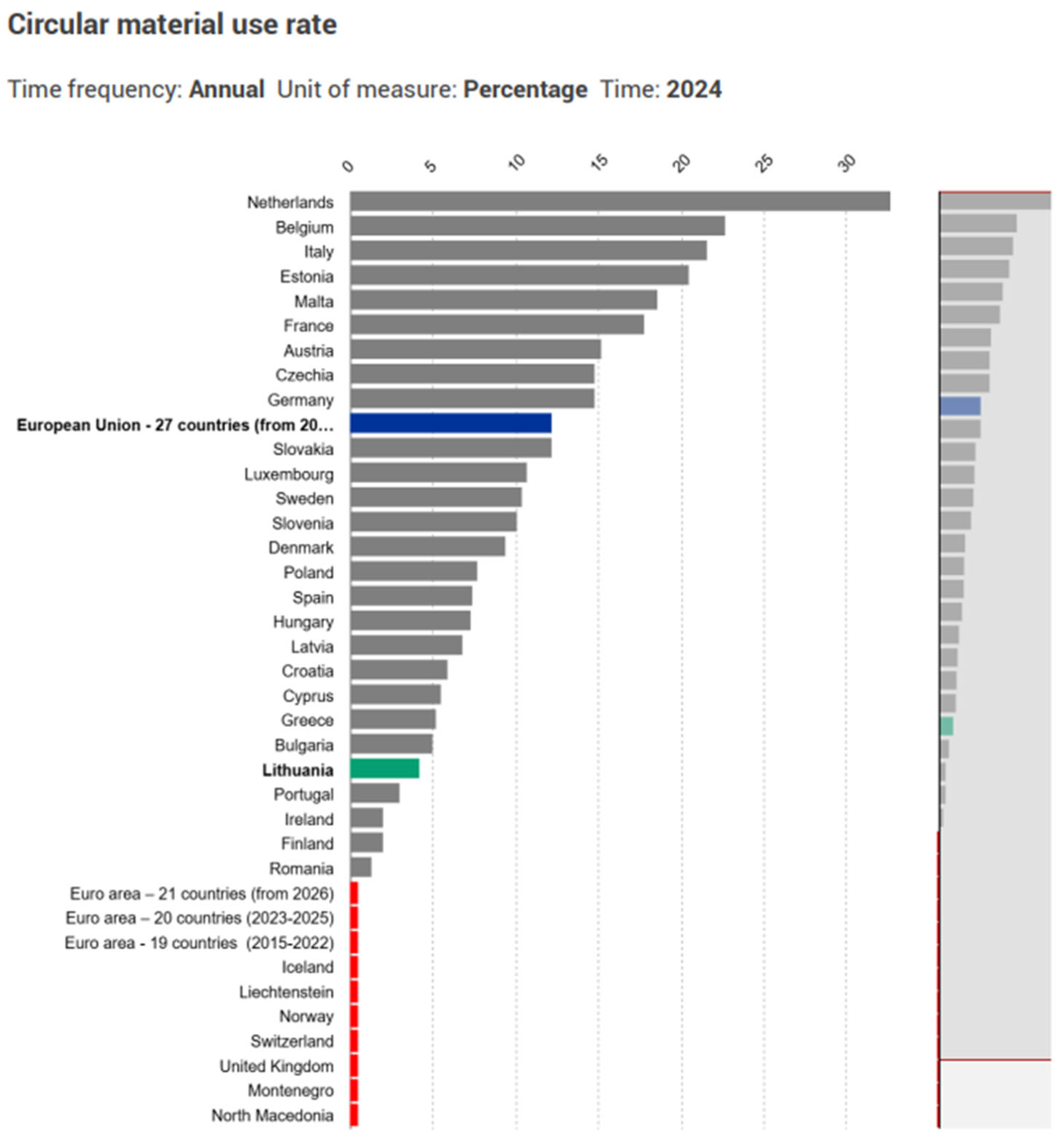
Lithuania enters the circular transition from a weak position. In 2024, its circular material use rate was among the five lowest in the EU and far below the EU average of 12.2 percent (Figure 1; Eurostat, 2026). The Guidelines explicitly link the transition to resilience and strategic autonomy in energy, food, security, critical resources, and advanced technologies (Government of the Republic of Lithuania, 2023, para. 4). However, they were adopted by a government protocol decision, not by a formal resolution. They were also published on the Ministry of the Environment’s website, not in the Register of Legal Acts. This gives them less normative force than a Government resolution.
Figure 1.
Circular material use rate in the EU Member States, 2024 (per cent). Source: compiled by the authors on the basis of Eurostat (2026), indicator cei_srm030.
Table 5 decomposes the circular program. Aggregate coverage is high at 96.0 percent. The total funding gap is EUR 176.125 million. The gap is not evenly distributed. The circular industry is covered at 32.8 percent and alone accounts for EUR 160.0 million, or 90.8 percent, of the entire gap. Circular use of waste (93.9 percent coverage) accounts for a further 7.4 percent. The horizontal principle (80.1 percent coverage) accounts for 1.7 percent. Construction, the bioeconomy, and consumption are fully covered. Transport is almost fully covered. Across the seven areas, coverage ranges from 32.8 to 100 percent. The median is almost 100 percent. The mean is 86.7 percent (standard deviation 24.9 percentage points).
Table 5.
Funding required and funding planned for circular economy measures in Lithuania, by intervention area, with coverage, shares and gap decomposition. Source: compiled and calculated by the authors on the basis of Government of the Republic of Lithuania (2023), para. 189, Table 2.
The programme is also highly concentrated. Construction, transport and the bioeconomy together receive 93.1 percent of planned funds. Construction alone receives 73.3 percent. The Herfindahl–Hirschman index of planned shares is 0.56, equivalent to fewer than two intervention areas of equal size (1.8). The pattern is systematic. Areas that deliver circularity through capital projects are financed in full. The area that depends on industrial restructuring receives only a third of its assessed need. This is notable given the weight of industry in the Lithuanian economy, discussed in Section 5.4. The evidence supports H2 for circular industry.
The horizontal principle requires careful reading. It covers research, innovation, digitalization, and cross-sectoral coordination. Through these functions, circularity is intended to be built into industrial, construction, transport, procurement, and financial policy. Its coverage ratio of 80.1 percent is moderate. The problem is the size of the need itself. The assessed need is only EUR 15.165 million, or 0.34 percent of the program’s total requirement. The planned EUR 12.140 million equals 0.28 percent of planned funds. Here, the constraint arises at the needs-assessment stage rather than in the allocation. H2 is therefore supported with a qualification. In the circular industry, the shortfall lies in coverage. In the horizontal line, it lies in the small scale at which the need was defined.
4.3. The Digital Layer and the Identification of Dual-Benefit Investment (H3)
The composition result matters because of the role of digital infrastructure in circular finance. Circularity claims concern a material’s history: its origin, the number of use cycles, its composition, and what can be recovered from it. Such claims cannot be verified from a firm’s financial statements. They require traceability systems that record data at the point of production and carry them through later transactions. Without such records, a firm cannot demonstrate a substantial contribution to the circular economy objective under the Taxonomy Regulation (European Parliament and Council of the European Union, 2020). A lender then has to price the resulting uncertainty. Digital product passports under the ESPR are designed to provide these data (European Parliament and Council of the European Union, 2024b). Their roll-out, however, depends on complementary infrastructure and on firms’ capacity to use it. In Lithuania, this infrastructure falls under the horizontal line and, for industrial firms, under the underfunded circular industry line. The program therefore finances physical circularity at scale: EUR 3129.022 million for construction, EUR 442.500 million for transport, and EUR 400.000 million for the bioeconomy. By contrast, the information layer that would make circular performance verifiable and financeable receives marginal funding.
The doctrinal analysis shows that EU law now permits dual-benefit investment. The Commission’s 2025 Notice clarifies that the sustainable finance framework does not prevent investment in the defense sector and should not lead to the unjustified exclusion of this sector. The Notice recognizes that peace, security, and resilience can contribute to social sustainability (European Commission, 2025). Regulation (EU) 2025/1914 amended the ERDF and Cohesion Fund rules. The amended rules allow support for resilient defense and dual-use infrastructure, including military mobility, and for civil preparedness (European Parliament and Council of the European Union, 2025). The Corporate Sustainability Due Diligence Directive keeps security-related production within the scope of sustainability obligations. Certain downstream activities involving military and dual-use products are treated separately (European Parliament and Council of the European Union, 2024a). None of these instruments, however, contains a criterion for identifying dual-benefit investment at the appraisal stage.
The national framework shows the same gap. The Law on Crisis Management and Civil Protection and the Guidelines pursue different immediate aims. The law focuses on preparedness, continuity of essential functions, and protection against threats. The Guidelines focus on resource efficiency, waste prevention, and longer product life. The two instruments operate within partly overlapping institutions. Ministries, agencies, and municipalities work simultaneously on civil protection, infrastructure planning, procurement, transport, and waste management. The law, the Guidelines, and the Civil Protection Programme do not require security spending to be assessed for its circular effects. They also do not require circular spending to be assessed for its resilience effects. The Guidelines provide for monitoring to 2030 under the Strategic Planning Methodology. They also provide for a review considering implementation progress and new EU requirements (Government of the Republic of Lithuania, 2023, para. 188). This review offers an entry point for a dual-benefit criterion. The evidence supports H3.
Comparing the two portfolios identifies the categories where a single allocation can generate returns in both domains (Table 6). In each case, security-oriented spending can also reduce material dependence, extend asset life and improve resource efficiency. The overlap is clearest in repair, refurbishment and reuse. In normal times, these are circular practices. When external supply chains break, they serve as decentralized resilience infrastructure. They keep essential goods in service.
Table 6.
Categories of dual-benefit investment and their current position in Lithuanian financing. Source: authors’ analysis of Seimas of the Republic of Lithuania (2024) and Government of the Republic of Lithuania (2023).
Table 7 summarises the assessment of the three hypotheses.
Table 7.
Summary of hypothesis assessment.
5. Discussion
5.1. Displacement Reconsidered
The main finding is that, in Lithuania, the relationship between security financing and circular financing is not one of displacement. This result runs counter to expectations from the trade-off literature, which finds that defense growth is financed partly by cuts elsewhere (Russett, 1969; Dunne & Tian, 2013). Two features of the case explain the difference. The first is scale. Even after tripling, civil protection remains about one order of magnitude smaller than the circular program on a like-for-like basis. It cannot absorb a large share of circular funds. The second is timing. The Guidelines were drafted and approved after the shock. The punctuation predicted by budget theory (Jones et al., 1998) is therefore already built into the planned allocations. It does not appear as a later cut. The finding also carries a methodological lesson. Policy debate often compares annual security budgets with multi-year sustainability envelopes. Such comparisons overstate the difference in scale by roughly tenfold.
The result should not be read as evidence that concerns about displacement are unfounded. The trade-off literature rests on executed budgets and on defense spending. This study covers civil protection and planned allocations. Military defense spending, which in Lithuania is far larger than civil protection, lies outside the data. It remains unclear whether planned circular allocations will survive annual budget rounds. The stress test shows that the margin is finite.
5.2. Composition and the Appraisal Bias
Where the evidence departs from the displacement view, it converges with the conditional view. The circular program finances what appraisal methods can measure, namely capital projects with measurable physical outputs. It leaves short the areas whose returns take the form of coordination, information, and avoided losses. This is consistent with Kirchherr et al. (2017), who find that circularity is usually operationalized through recycling and reuse rather than systemic change. It is also consistent with Dagilienė et al. (2021), who observe that Lithuanian municipalities approach the circular economy mainly as waste management. The present results suggest that this pattern owes as much to the structure of funding as to administrative culture. Institutions are asked to work across sectors. However, the horizontal line receives only 0.28 percent of planned funds. In this situation, institutions tend to fall back on the sectoral tasks for which they have resources.
The finding also connects to the resilience-valuation literature. Avoided losses and co-benefits are real but seldom enter allocation decisions (Tanner et al., 2015; Mayrhofer & Gupta, 2016). Under compound risk, this matters more than usual. For a frontline state, military escalation and supply dependence are positively correlated risks. Portfolio logic (Markowitz, 1952) implies that the most valuable allocations reduce both exposures simultaneously. Programme-based appraisal assesses spending only against the objectives of the funding program. Dual-benefit returns therefore remain invisible when decisions are made. On one point, the evidence is inconsistent with the more optimistic strand of the literature. The regulatory framework has moved faster than the appraisal machinery. EU law now allows dual-benefit investment (European Commission, 2025; European Parliament and Council of the European Union, 2025). Without a method of identification, however, this permission is unlikely to be used.
5.3. Digital Traceability and the Industry 5.0 Framing
Industry 5.0 provides the vocabulary for this gap. Its human-centric orientation is often interpreted as a statement about work and skills. It also implies that the return on public investment should account for what happens to people when systems fail (Breque et al., 2021). The value of shelters, warning systems, healthcare resilience, and community repair capacity is realized mainly in the tail of the risk distribution. The Lithuanian civil protection program rests explicitly on whole-of-society participation. The total defense literature regards civil capability as what makes deterrence credible (Wither, 2020; Wrange et al., 2024). On the circular side, local repair networks, spare parts, and design for maintenance are both circular practices and civil preparedness measures. Treating them as only one or the other reflects departmental boundaries, not the nature of the investment.
Digital traceability is where the two objectives meet most directly. The results align with studies on circular reconstruction. These studies link circular bonds to digital product passports and make blended finance conditional on verified impact (Gorokhova & Simanavičienė, 2026). The results also align with research that places critical raw materials where circularity and security of supply converge (Baldassarre & Carrara, 2025). In both cases, the digital component performs a financial function: it turns an unobservable environmental attribute into one that can be written into a contract. The Lithuanian case adds a public-finance dimension to this argument. In Lithuania, the state funds physical circularity at scale but not the information layer. As a result, the circular character of its investments cannot be demonstrated to private capital. Nor can it be used as evidence of resilience.
5.4. Policy Implications for Lithuania
The implications stem from specific features of the evidence and of Lithuania’s economic model. Industry accounted for 20.8 percent of GDP in 2021, up from 13.4 percent in 1995. Expert estimates place its total contribution to the economy at 35–45 percent. Each industrial job supports four to five jobs in other sectors (Government of the Republic of Lithuania, 2023, para. 129). Thus, the sector most important to Lithuania’s growth model is the one whose circular transition is least funded. Five recommendations follow.
First, a dual-benefit test should be introduced into project appraisal. The review of circular measures foreseen under the Strategic Planning Methodology offers an opportunity to do so (Government of the Republic of Lithuania, 2023, para. 188). The test would ask whether the spending reduces exposure in the domain that does not fund it and, if so, by how much. Such a test would add little administrative cost. It would, however, change the ranking of candidate projects.
Second, the EUR 160 million gap in the circular industry should be the first priority for new resources. Regulation (EU) 2025/1914 introduced flexibility for resilience and dual-use investment. Combined with blended instruments that share risk with private lenders, this flexibility offers a way to close the gap without cutting other lines.
Third, the horizontal line should be reassessed rather than merely topped up. Its allocation was set at 0.34 percent of the program. This amount is too small to finance digital traceability infrastructure before digital product passports are rolled out under the ESPR.
Fourth, the Civil Protection Programme should apply lifecycle and green public procurement criteria to its investments in shelters, warning systems, and equipment. Procurement is the stage at which most public spending either acquires or loses its circular character.
Fifth, monitoring should report on spending executed against planned spending in both domains, using common units. The Guidelines would also gain weight if they were adopted as a formal Government resolution.
For investors and lenders, Lithuania exemplifies a situation likely to be common in the region. It has a large public circular program without a funded data infrastructure. As a result, environmental performance is difficult to verify at the project level. Taxonomy-aligned lending in such a setting entails higher verification costs and screening risk. Investors interested in circular assets in eastern EU markets therefore have a direct stake in the traceability layer. Blended structures that explicitly finance this layer are more prudent than assuming it already exists (Gorokhova & Simanavičienė, 2026).
6. Conclusions
This article examined the financing of public security and the circular transition in Lithuania as a problem of allocating public capital under compound risk. Regarding the first research question, civil protection allocations more than tripled between 2021 and 2023, from EUR 12.677 million to EUR 42.976 million. They eased to EUR 39.684 million in 2024. An additional EUR 284.656 million is needed by 2030. On a like-for-like basis, the circular program remains eight to thirteen times larger than annual civil protection funding. Its planned allocations were approved after the security shock and cover 96.0 percent of the assessed need. The displacement hypothesis (H1) is not supported.
Regarding the second question, the main constraint is the composition of circular financing, not its total. Circular industry receives 32.8 percent of its need and accounts for 90.8 percent of the program’s funding gap. Construction absorbs 73.3 percent of planned funds. The horizontal line for research, innovation, digitalization, and coordination receives 0.28 percent of planned funds. This constraint stems from how its need was assessed (H2 supported). Regarding the third question, EU law now permits investment that serves security and circularity simultaneously. However, neither EU nor Lithuanian instruments provide a criterion to identify such investment before funds are committed (H3 supported).
Digital traceability infrastructure is the clearest example of a dual-benefit investment. Digital product passports, material-flow registers, lifecycle inventories, and interoperable procurement data allow investors to verify circular performance under the Taxonomy. They also make supply-chain dependencies visible to the authorities responsible for security of supply. Adequately funded, this infrastructure serves both objectives. At current levels, it serves neither well.
For policymakers, the practical task is to define dual-benefit criteria, embed them in appraisal and procurement, close the funding gap in the circular industry, and verify results against outcome data. Industry accounts for a large share of output and employment in Lithuania. For this reason, these steps would link the circular transition to the competitiveness and security of the industrial base.
The study has several limitations. The analysis is based on budget and program documents rather than on actual spending, so it reflects allocation intent. Figures from 2025 onward are commitments that may be revised. The absence of a pre-2022 circular baseline limits the assessment of displacement over time. Military defense spending, which is much larger than civil protection, falls outside the data. The study covers one Member State whose security position is not typical of the Union. Its findings therefore generalize analytically rather than statistically. The coverage ratios rest on needs assessed in the Guidelines, whose methodology is not fully documented. Finally, the dual-benefit categories are derived from legal and policy analysis. The article does not quantify the resilience return of specific investments.
These limits suggest a research agenda. Comparing planned and actual allocations as the programming period unfolds would show whether the composition problem persists in practice. The Baltic and Nordic states face similar compound risks under different fiscal and institutional arrangements. Comparative work on these states could show whether the underfunding of industrial and horizontal circularity is specific to Lithuania. Future work could also quantify dual benefits, for example, the contribution of distributed repair capacity to faster recovery after a supply disruption. This would turn the argument into a testable financial proposition. Firm-level research on the cost of Taxonomy compliance without traceability infrastructure would measure the verification penalty that this study can identify only in principle.
Author Contributions
Conceptualization, E.Š. and V.Š.; methodology, E.Š., V.Š., L.Ž. and A.N.; formal analysis, L.Ž. and A.N.; investigation, E.Š., V.Š., L.Ž. and A.N.; data curation, L.Ž.; writing—original draft preparation, E.Š., V.Š., L.Ž. and A.N.; writing—review and editing, E.Š. and A.N.; supervision, V.Š. All authors have read and agreed to the published version of the manuscript.
Funding
This research received no external funding.
Institutional Review Board Statement
Not applicable.
Informed Consent Statement
Not applicable.
Data Availability Statement
The study draws exclusively on publicly available documents and datasets. The Eurostat circular material use rate is available under indicator cei_srm030; Lithuanian budgetary and programme data are contained in the sources cited in Section 3. No new data were created or analysed in this study.
Acknowledgments
During the preparation of this manuscript, the authors used generative artificial intelligence tools for translation and language editing of selected passages. The authors reviewed and edited the output and take full responsibility for the content of this publication.
Conflicts of Interest
The authors declare no conflicts of interest.
References
- Aliyeva, M. (2026). Historical development of modernization theory and its main provisions. Ankara Üniversitesi Sosyal Bilimler Dergisi, 17, 73–82. [Google Scholar]
- Baldassarre, B., & Carrara, S. (2025). Critical raw materials, circular economy, sustainable development: EU policy reflections for future research and innovation. Resources, Conservation and Recycling, 215, 108060. [Google Scholar] [CrossRef] [Scilit]
- Baumgartner, F. R., & Jones, B. D. (1993). Agendas and instability in American politics. University of Chicago Press. [Google Scholar]
- Berndtsson, J. (2024). Hybrid threats and the “new” total defence: The case of Sweden. In Preparing for hybrid threats to security (pp. 150–164). Routledge. [Google Scholar]
- Birmontienė, T., Miliuvienė, J., Novikovas, A., Gailiūtė-Janušonė, D., Jočienė, D., Chochrin, T., Lazauskaitė, R., Vasarienė, D., Jokubauskas, R., Valantiejus, G., Vilčinskaitė, S., Speičys, O., Mulevičienė, S., Krasauskas, R., Jakulevičienė, L., Žilinskas, T., Zaksaitė, S., Ažubalytė, R., Bilevičiūtė, E., … Žilinskas, J. (2022). Teisė ir COVID-19 pandemija [Law and the COVID-19 pandemic]. Mykolo Romerio Universitetas. [Google Scholar]
- Bowen, G. A. (2009). Document analysis as a qualitative research method. Qualitative Research Journal, 9, 27–40. [Google Scholar] [CrossRef] [Scilit]
- Breque, M., De Nul, L., & Petridis, A. (2021). Industry 5.0: Towards a sustainable, human-centric and resilient european industry. Publications Office of the European Union. [Google Scholar]
- Bruneckienė, J., Dagilienė, L., Varaniūtė, V., Zykienė, I., Stasiškienė, Ž., Kliaugaitė, D., & Gurauskienė, I. (2021). Žiedinės ekonomikos iššūkiai ir galimybės lietuvoje [Challenges and opportunities of the circular economy in lithuania]. KTU leidykla “Technologija”. [Google Scholar]
- Chabowski, B. R., Gabrielsson, P., Hult, G. T. M., & Morgeson, F. V. I. (2025). Sustainable international business model innovations for a globalizing circular economy: A review and synthesis. Journal of International Business Studies, 56, 383–402. [Google Scholar] [CrossRef] [Scilit]
- Court of Justice of the European Union. (2010). Land baden-württemberg v panagiotis tsakouridis. Case C-145/09. Available online: http://curia.europa.eu (accessed on 6 March 2026).
- Dagilienė, L., Varaniūtė, V., & Bruneckienė, J. (2021). Local governments’ perspective on implementing the circular economy: A framework for future solutions. Journal of Cleaner Production, 310, 127340. [Google Scholar] [CrossRef] [Scilit]
- Dunne, J. P., & Tian, N. (2013). Military expenditure and economic growth: A survey. The Economics of Peace and Security Journal, 8, 5–11. [Google Scholar] [CrossRef] [Scilit]
- European Commission. (2015). Closing the loop—An EU action plan for the circular economy. COM(2015) 614 final. Available online: https://eur-lex.europa.eu/legal-content/EN/TXT/?uri=celex:52015DC0614 (accessed on 10 March 2026).
- European Commission. (2019). The european green deal. COM(2019) 640 final. Available online: https://eur-lex.europa.eu/legal-content/EN/TXT/?uri=CELEX:52019DC0640 (accessed on 16 March 2026).
- European Commission. (2020). A new circular economy action plan for a cleaner and more competitive europe. COM(2020) 98 final. Available online: https://eur-lex.europa.eu/legal-content/EN/TXT/?uri=celex:52020DC0098 (accessed on 16 March 2026).
- European Commission. (2025). Commission notice on the application of the sustainable finance framework and the corporate sustainability due diligence directive to the defence sector. C/2025/4950. Official Journal of the European Union C. Available online: https://eur-lex.europa.eu/eli/C/2025/4950/oj/eng (accessed on 1 October 2026).
- European Council. (2025). Paris agreement on climate change. Available online: https://www.consilium.europa.eu/en/policies/paris-agreement-climate/ (accessed on 16 April 2026).
- European Court of Auditors. (2023). Special report 17/2023: Circular economy—Slow transition by member states despite EU action. Publications Office of the European Union. [Google Scholar]
- European Environment Agency. (2021). Forging a climate-resilient europe: The new EU strategy on adaptation to climate change. European Environment Agency. [Google Scholar]
- European Parliament and Council of the European Union. (2004). Directive 2004/38/EC on the right of citizens of the union and their family members to move and reside freely within the territory of the member states. Official Journal of the European Union L, 158, 77–123. [Google Scholar]
- European Parliament and Council of the European Union. (2013). Decision No 1386/2013/EU on a general union environment action programme to 2020 “living well, within the limits of our planet”. Available online: http://data.europa.eu/eli/dec/2013/1386/oj (accessed on 17 May 2026).
- European Parliament and Council of the European Union. (2020). Regulation (EU) 2020/852 on the establishment of a framework to facilitate sustainable investment (taxonomy regulation). Official Journal of the European Union L, 198, 13–43. [Google Scholar]
- European Parliament and Council of the European Union. (2024a). Directive (EU) 2024/1760 on corporate sustainability due diligence and amending. PE/9/2024/REV/1. Official Journal of the European Union L. Available online: https://eur-lex.europa.eu/eli/dir/2024/1760/oj/eng (accessed on 1 October 2026).
- European Parliament and Council of the European Union. (2024b). Regulation (EU) 2024/1781 establishing a framework for the setting of ecodesign requirements for sustainable products. PE/106/2023/REV/1. Official Journal of the European Union L. Available online: https://eur-lex.europa.eu/eli/reg/2024/1781/oj/eng (accessed on 1 October 2026).
- European Parliament and Council of the European Union. (2025). Regulation (EU) 2025/1914 amending regulations (EU) 2021/1058 and (EU) 2021/1056 as regards specific measures to address strategic challenges in the context of the mid-term review. PE/35/2025/REV/1. Official Journal of the European Union L. Available online: https://eur-lex.europa.eu/eli/reg/2025/1914/oj/eng (accessed on 1 October 2026).
- Eurostat. (2026). Circular material use rate. Indicator cei_srm030. Available online: https://ec.europa.eu/eurostat/databrowser/view/cei_srm030/default/bar?lang=en (accessed on 16 May 2026).
- Geissdoerfer, M., Savaget, P., Bocken, N. M. P., & Hultink, E. J. (2017). The circular economy—A new sustainability paradigm? Journal of Cleaner Production, 143, 757–768. [Google Scholar] [CrossRef] [Scilit]
- Gorokhova, T., Shpatakova, O., Toponar, O., Zolotarova, O., & Pavliuk, S. (2023). Circular economy as an alternative to the traditional linear economy: Case study of the EU. Environmental and Social Management Journal, 17, e04162. [Google Scholar] [CrossRef] [Scilit]
- Gorokhova, T., & Simanavičienė, Ž. (2026). Financing post-war circular reconstruction: Digital tools and investment pathways for ukraine’s industrial regions. Journal of Risk and Financial Management, 19, 293. [Google Scholar] [CrossRef] [Scilit]
- Government of the Republic of Lithuania. (2023). Lietuvos perėjimo prie žiedinės ekonomikos iki 2035 m. gairės [Guidelines for Lithuania’s transition to a circular economy by 2035]. Available online: https://am.lrv.lt/uploads/am/documents/files/%C5%BDE%20gair%C4%97s_patvirtintos.pdf (accessed on 7 April 2026).
- Hagen, R., Statler, M., & Penuel, K. B. (2013). Encyclopedia of crisis management. SAGE Publications. [Google Scholar]
- Hallegatte, S., Rentschler, J., & Rozenberg, J. (2019). Lifelines: The resilient infrastructure opportunity. World Bank. [Google Scholar]
- Hutchinson, T., & Duncan, N. (2012). Defining and describing what we do: Doctrinal legal research. Deakin Law Review, 17, 83–119. [Google Scholar] [CrossRef] [Scilit]
- International Court of Justice. (2025). Obligations of states in respect of climate change. Advisory Opinion. Available online: https://www.icj-cij.org/case/187/advisory-opinions (accessed on 16 April 2026).
- Jones, B. D., Baumgartner, F. R., & True, J. L. (1998). Policy punctuations: U.S. Budget authority, 1947–1995. The Journal of Politics, 60, 1–33. [Google Scholar] [CrossRef] [Scilit]
- Juurvee, I. (2022). Civil defence in ukraine: Preliminary lessons from the first months of war. International Centre for Defence and Security. [Google Scholar]
- Kirchherr, J., Reike, D., & Hekkert, M. (2017). Conceptualizing the circular economy: An analysis of 114 definitions. Resources, Conservation and Recycling, 127, 221–232. [Google Scholar] [CrossRef] [Scilit]
- Kryvoshlykov, S. (2025). Genesis of civil-protection systems in EU member states: A state-administrative perspective. Visegrad Journal on Human Rights, 2, 72–78. [Google Scholar] [CrossRef] [Scilit]
- Markowitz, H. (1952). Portfolio selection. The Journal of Finance, 7, 77–91. [Google Scholar] [CrossRef] [Scilit]
- Mayrhofer, J. P., & Gupta, J. (2016). The science and politics of co-benefits in climate policy. Environmental Science & Policy, 57, 22–30. [Google Scholar] [CrossRef] [Scilit]
- Ministry of the Interior of the Republic of Lithuania. (2022). Seimas approved a new model for crisis management and civil protection. Available online: https://vrm.lrv.lt (accessed on 10 May 2026).
- Novikovas, A. (2020). Viešojo administravimo ir kitų subjektų įgaliojimai ekstremaliosios situacijos metu. In Lietuvos teisė (pp. 23–31). Mykolo Romerio Universitetas. [Google Scholar]
- Novikovas, A., Novikovienė, L., & Solntseva, K. (2017). The peculiarities of motivation and organization of civil defence service in lithuania and Ukraine. Journal of Security and Sustainability Issues, 7, 369–380. [Google Scholar] [CrossRef] [Scilit]
- Novikovas, A., Tvaronavičienė, A., & Shapoval, R. (2019). National security maintenance by legal measures: Case study lithuania/ukraine. Journal of Security and Sustainability Issues, 8, 735–746. [Google Scholar] [CrossRef] [Scilit]
- Nygaard, A. (2022). From linear to circular economy: A transaction cost approach. Circular Economy and Sustainability, 2, 1127–1142. [Google Scholar] [CrossRef] [Scilit]
- Rhoades, S. A. (1993). The herfindahl-hirschman index. Federal Reserve Bulletin, 79, 188–189. [Google Scholar]
- Russett, B. M. (1969). Who pays for defense? American Political Science Review, 63, 412–426. [Google Scholar] [CrossRef] [Scilit]
- Seimas of the Republic of Lithuania. (2022). Lietuvos Respublikos krizių valdymo ir civilinės saugos įstatymas [Law on crisis management and civil protection of the Republic of Lithuania]. Available online: https://www.e-tar.lt/portal/lt/legalAct/TAR.C15592B096FA/asr (accessed on 13 March 2026). (Original work published 1998).
- Seimas of the Republic of Lithuania. (2024). Resolution No XIV-2946 on the approval of the programme for the strengthening and development of civil protection. Available online: https://www.e-tar.lt (accessed on 16 April 2026).
- Survila, A., & Smalskys, V. (2017). Incident management structure modernization. Public Policy and Administration, 16, 138–153. [Google Scholar] [CrossRef] [Scilit]
- Survila, A., Smalskys, V., Novikovas, A., Tvaronavičienė, A., & Shapoval, R. (2017). Community involvement into incident management structure. Polish Journal of Management Studies, 16, 248–258. [Google Scholar] [CrossRef] [Scilit]
- Survila, A., Smalskys, V., Novikovas, A., Tvaronavičienė, A., & Stasiukynas, A. (2018). Community involvement into incident management. Public Policy and Administration, 17, 255–269. [Google Scholar]
- Šlapkauskas, V. (2022). Theoretical and methodological aspects of the definition of security of a small state. In D. Schultz, A. Pūraitė, & V. Giedraitytė (Eds.), Europe alone: Small state security without the united states. Rowman & Littlefield. [Google Scholar]
- Štareikė, E. (2022). Ecological threats. In D. Schultz, A. Pūraitė, & V. Giedraitytė (Eds.), Europe alone: Small state security without the united states. Rowman & Littlefield. [Google Scholar]
- Štareikė, E. (2024). Countering hybrid threats: Problematic aspects in the european region. Public Security and Public Order, 36, 228–240. [Google Scholar]
- Tanner, T., Surminski, S., Wilkinson, E., Reid, R., Rentschler, J., & Rajput, S. (2015). The triple dividend of resilience: Realising development goals through the multiple benefits of disaster risk management. Overseas Development Institute; GFDRR and World Bank. [Google Scholar]
- Tomlinson, J. (2002). Globalizacija ir kultūra [Globalization and culture]. Mintis. [Google Scholar]
- Visuotinė lietuvių enciklopedija. (n.d.). Civilinė gynyba [Civil defence]. Available online: https://www.vle.lt (accessed on 16 March 2026).
- Wither, J. K. (2020). Back to the future? Nordic total defence concepts. Defence Studies, 20, 61–81. [Google Scholar] [CrossRef] [Scilit]
- Wrange, J. (2026). Strategic autonomy: A quantum leap forward on european total defence? European Journal of International Security, 1–22. [Google Scholar] [CrossRef] [Scilit]
- Wrange, J., Bengtsson, R., & Brommesson, D. (2024). Resilience through total defence. European Journal of International Security, 9, 511–532. [Google Scholar] [CrossRef] [Scilit]
- Yin, R. K. (2018). Case study research and applications: Design and methods (6th ed.). SAGE. [Google Scholar]
- Žilinskienė, L., & Žilinskas, T. (2020). Žiedinės ekonomikos ir atliekų teisinio reguliavimo aspektai. Jurisprudencija, 27, 95–112. [Google Scholar] [CrossRef]

Disclaimer/Publisher’s Note: The statements, opinions and data contained in all publications are solely those of the individual author(s) and contributor(s) and not of MDPI and/or the editor(s). MDPI and/or the editor(s) disclaim responsibility for any injury to people or property resulting from any ideas, methods, instructions or products referred to in the content. |
© 2026 by the authors. Licensee MDPI, Basel, Switzerland. This article is an open access article distributed under the terms and conditions of the Creative Commons Attribution (CC BY) license.