


Abstract
This study examines the effects of geopolitical risks on the investment efficiency of Vietnamese firms from 2017 to 2024 using fixed effect models and a series of robustness tests. The research findings reveal a negative effect of geopolitical risks on corporate investment efficiency through the channel of information asymmetry. Additionally, the negative effects of geopolitical risks on Vietnamese firms’ investment efficiency are more pronounced for financially constrained firms, underinvested firms, or UPCOM-listed firms. Based on the main findings, both policymakers and corporate managers should consider the geopolitical risks and their impacts when designing new government policies and corporate strategies in order to mitigate the negative effects of these risks on Vietnamese firms.
1. Introduction
Corporate investment decisions and investment efficiency have become increasingly challenging due to the rising global economic and political uncertainties (Gulen & Ion, 2015; Le & Tran, 2021). These uncertainties, ranging from economic and policy uncertainties (Ilyas et al., 2021; Xiang & Li, 2022; X. Liu et al., 2022), geopolitical tensions, and military confrontations (Le & Tran, 2021; Rumokoy et al., 2023), can seriously disrupt corporate performance and financing conditions (Bajaj et al., 2021). Therefore, under these uncertainties, corporate investment incentives can be weakened, and firms may scale back or ignore additional investments, and allocate resources inefficiently, leading to deviations from optimal investment decisions. The investment efficiency challenge can be particularly pronounced for firms operating in emerging countries, where external uncertainties and shocks can have serious spillover effects on domestic firms’ investment conditions and decisions (J. Yang & Yang, 2021; Truong et al., 2025a).
Geopolitical risks represent a new source of such global external shocks and uncertainties (Caldara & Iacoviello, 2022). These risks encompass a wide range of events, from political and economic confrontations to wars between nations that can seriously disrupt global economic development and stability. From a corporate finance perspective, these geopolitical risks can disrupt investment decisions and investment efficiency by increasing uncertainties about future firm performance (Blank & Hadley, 2021), financing constraints, and information asymmetry (Bajaj et al., 2021; Zhu & Zhao, 2022; Wu et al., 2023), and encouraging more precautionary approaches (Lee & Wang, 2021; K.-H. Wang et al., 2021; Hasan et al., 2022). As a result, under these risks, firms may engage in underinvestment or overinvestment in financially questionable projects and deviate from their intended optimal investment decisions (Biddle et al., 2009; F. Chen et al., 2011).
The literature of corporate finance has identified geopolitical risks as a determinant of corporate decision-making. However, the majority of the empirical evidence comes from major economies, such as the U.S., China, and European countries. Geopolitical risks have been empirically proven to influence various corporate decisions, such as capital structure policies (Lee et al., 2021; Khoo & Cheung, 2021; Bajaj et al., 2021; Xiang & Li, 2022), investment decisions (J. Yang & Yang, 2021; Rumokoy et al., 2023; Truong et al., 2025a), cash holdings (Lee & Wang, 2021; K.-H. Wang et al., 2021; Hasan et al., 2022), and dividend policies (Zhao et al., 2025). The general consensus is that geopolitical risks usually have negative effects on various corporate decisions. Additionally, the empirical evidence of the effects of geopolitical risks on emerging and developing countries remains limited (G. Nguyen & Vo, 2024).
The literature gap of the effects of geopolitical risks and corporate decision-making in emerging and developing countries is particularly relevant in Vietnam (G. Nguyen & Vo, 2024). From a macroeconomic perspective, Vietnam’s deeply integrated economy means that Vietnam is exposed to external geopolitical risks. Additionally, the majority of Vietnamese firms are small and medium enterprises (Huynh & Phan, 2024), and this can potentially make the impacts of geopolitical risks on the corporate sector more prominent. From a practical perspective, Vietnam is currently facing multiple geopolitical concerns, most notably the current East Sea dispute with China, the Thai–Cambodian border confrontations, and the U.S.–China Trade War and its spillover effects (Hiep, 2019; C. Yang & Chan, 2023; Choi & Nguyen, 2023; Tu et al., 2024). Theoretically, these geopolitical events can increase economic uncertainties and difficult financing conditions for the corporate sector, therefore disrupting corporate investment decisions and investment efficiency (C. Yang & Chan, 2023; Dang et al., 2024; Truong et al., 2025b). The lack of empirical evidence of geopolitical risks and Vietnamese firms’ decision-making constitutes a literature gap that demands academic attention.
We tap into this new literature gap by exploring the relationship between geopolitical risks and Vietnam’s corporate investment efficiency. We also focus on the channel of geopolitical risks and investment efficiency and the subsample analysis across different firm-level characteristics of Vietnamese firms. This approach allows us to examine how the relationship between geopolitical risks and investment efficiency in Vietnam may vary. The key independent variable of our study is the Vietnam Geopolitical Risk Index proposed by Caldara and Iacoviello (2022) and retrieved from the Baker Uncertainty Index database. Our main prediction is that geopolitical risks can reduce investment efficiency (Song & Chung, 2023; Yadav et al., 2025). The full-sample analysis supports our main prediction; that is, Vietnamese firms’ investment becomes less efficient and exhibits underinvestment problems under the effects of geopolitical risks. These results are still consistent after we apply several robustness tests, including the use of an alternative measurement of investment efficiency, the system generalized method of moments, and a two-stage least squares analysis with several instrumental variables.
We contribute to the literature in several ways. Firstly, we contribute to the expansion of the current literature on geopolitical risks and corporate finance in emerging markets. To the best of our knowledge, we are the first to examine the effects of geopolitical risks on the corporate investment efficiency of Vietnamese firms. Secondly, several policy and corporate implications for Vietnamese government, policymakers, and corporate managers can be derived based on our empirical findings. As geopolitical risks can magnify investment efficiency concerns, these risks and their impacts should be incorporated into new policy designs at the government level. Both the government and the corporate sectors should be well prepared to deal with further waves of upcoming geopolitical concerns at both the regional and global levels.
As for the remainder of our study, we divide our study into five different sections. In Section 2, we present the main channel through which geopolitical risks can influence Vietnamese firms’ corporate investment efficiency and the hypothesis development. In Section 3, we illustrate the main methodology and the modified baseline regressions, variable construction, and data sources of our study. In Section 4, we provide the empirical findings and discussion of the full-sample analysis; we also conduct multiple robustness tests and additional subsample analyses to examine how the relationship between geopolitical risks and Vietnamese firms’ corporate investment efficiency varies across different firm characteristics. Finally, in Section 5, we conclude our findings along with several policy implications.
2. Theoretical Foundation and Hypotheses’ Development
2.1. Literature on Geopolitical Risks
Geopolitical risks refer to a series of negative geopolitical events or activities, such as terrorist attacks, political and economic conflicts between countries, country-level military confrontations, and climate change-related events, among others. These events are violent in nature, with severe consequences in terms of economic stability and corporate decision-making (Caldara & Iacoviello, 2022). The War on Terror, the current U.S.–China Trade War, the Russia–Ukraine War, the Israel–Hamas War, or the Israel–Arab conflicts are but a few notable examples of geopolitical risks with devastating global economic and societal consequences.
Since the creation of the geopolitical risk index by Caldara and Iacoviello (2022), various empirical studies have focused on examining the impacts of geopolitical risks at both macroeconomic and microeconomic levels. Regarding macroeconomic empirical studies, prior studies have documented the impacts of geopolitical risk on economic development and financial stability (Hoque & Zaidi, 2020; Soltani et al., 2021), government policies (Bilgin et al., 2020), and the price of common commodities (Bouoiyour et al., 2019; Qian et al., 2022; Salisu et al., 2022). At the microeconomic levels, geopolitical risks have been empirically documented to influence corporate decision-making, such as corporate innovation and investment (Pan, 2018; Le & Tran, 2021; Rumokoy et al., 2023), financing options and policies (Lee et al., 2021; Khoo & Cheung, 2021), cash holdings decision (Lee & Wang, 2021; K.-H. Wang et al., 2021; Hasan et al., 2022), and so on. Therefore, geopolitical risks have been proven to influence decision-making processes at both corporate and government levels.
2.2. Relationship Between Geopolitical Risks and Investment Efficiency
Corporate investment serves as a critical factor of a firm’s competitive advantage, financial and operational performance, and survival capabilities; therefore, corporate investment policies and investment efficiency are among the fundamental decisions of a firm. However, there are various market frictions, such as information asymmetry, agency concerns, financing options and costs, that can deviate a firm from its optimal investment and result in investment inefficiency. Through these market friction mechanisms, geopolitical risks can influence the investment efficiency and result in either overinvestment or underinvestment (F. Chen et al., 2011; D. H. B. Phan et al., 2022; Z. Hui, 2023; Yadav et al., 2025). Therefore, identifying the determinants of investment efficiency and their respective extent of effects has recently attracted considerable academic interest (Stephie Tsai et al., 2021; D. H. B. Phan et al., 2022; Z. Hui, 2023; Song & Chung, 2023; Gao et al., 2024).
From a theoretical standpoint, several common corporate finance theories can explain the relationship between geopolitical risks, corporate investment, and investment efficiency. Among these theories, the agency theory plays a central role in explaining both the investment decisions and investment efficiency. Agency theory suggests that due to the relationship between managers, shareholders, and investors, when information asymmetry arises, managers may commit suboptimal investment decisions, and this leads to investment inefficiency concerns (Myers & Majluf, 1984; F. Chen et al., 2011). Next, the financing constraint theory is another common theory of corporate investment behavior under financing constraints (Fazzari et al., 1987). The financing constraint theory suggests that firms may reduce investment decisions when financing costs increase. Additionally, real option theory can explain corporate investment behavior under uncertainty; that is, firms reduce investment decisions, or choose a “wait and see” option when facing uncertainties (Y. Wang et al., 2014; Goodell et al., 2021).
Although these theories provide valuable insights into corporate investment behaviors under uncertainty, the agency theory may be the most appropriate theory to explain how investment decisions and efficiency are influenced when a firm faces external uncertainties. This is because agency theory reflects the internal corporate decision-making and the agency conflicts between managers and shareholders. That is, agency theory can explain how firms, through managers, can engage in either overinvestment or underinvestment, leading to investment inefficiency under rising uncertainties, information asymmetry, and financing and agency costs. We believe that while financing constraint theory and real option theory can explain how firms invest under uncertainty, both theories may not address the overinvestment concerns, whether such changes in investment behavior are efficient, or additional internal corporate governance mechanisms. Therefore, we select the agency theory as the main theoretical framework for geopolitical risks and investment efficiency.
The main channel through which geopolitical risk can influence corporate investment efficiency is through agency concerns and CEO characteristics (Myers & Majluf, 1984; F. Chen et al., 2011; P. Hui et al., 2023; Z. Hui, 2023). As the agency theory dictates, the relationship between the shareholders and managers, along with specific manager characteristics, can influence the investment decisions of the firms (Jensen & Meckling, 1976; Jensen, 1986). Due to the conflicts between shareholders and managers and the subsequent information asymmetry and agency costs, managers tend to pursue their own goals rather than maximizing firm values; therefore, there is always a possibility that managers may overinvest in risky or low-return projects (Jensen, 1986), or underinvest by rejecting potential and beneficial projects (Myers & Majluf, 1984; Myers, 1984).
The geopolitical risks have been known to increase the uncertainties in firms’ business environments (M. Wang & Wang, 2025). As a result, geopolitical risks lead to an increase in information asymmetry and agency conflicts between managers and shareholders, and subsequently result in suboptimal investment decisions (Le & Tran, 2021; Yadav et al., 2025). Geopolitical risk-related information asymmetry may allow the managers to possess more information about firm-specific risks and opportunities that external investors may not have access to or verify (Lee et al., 2021; Le & Tran, 2021; M. Wang & Wang, 2025). Consequently, corporate monitoring may gradually become less effective and more costly, and the managers have more discretion over investment and other corporate decisions. This can result in higher agency costs and suboptimal investment behaviors (Le & Tran, 2021; Yadav et al., 2025).
In addition to the information asymmetry between shareholders and managers, the experience of those managers whose firms were exposed to geopolitical risks further explains how geopolitical risk could influence corporate investment decisions. The most direct empirical evidence supporting this notion comes from Bernile et al. (2017) and Zhang et al. (2022). Bernile et al. (2017) find empirical evidence to suggest that there exists a non-monotonic relationship between investment and U.S. CEOs’ exposure to natural disasters. These CEOs who directly experienced these events tend to act more conservatively when it comes to corporate investment decisions. Zhang et al. (2022) further illustrate that Chinese CEOs who experienced poverty may engage more in risk-taking corporate decisions. These Chinese CEOs’ past experiences with poverty were considered a serious survival threat that carried its influence into the CEOs’ decision-making processes. Additionally, there are other empirical studies illustrating that managers who were exposed to past negative events tend to act either conservatively (Hu et al., 2019; C. Chen et al., 2022) or more aggressively (Y. Chen et al., 2021; O’Sullivan et al., 2021).
2.3. Geopolitical Risks and Investment Efficiency in Vietnam
In Vietnam, geopolitical risks and economic uncertainties have become a new source of systemic risk that could significantly affect Vietnam’s economy and stability (Hiep, 2019; Choi & Nguyen, 2023; G. Nguyen & Vo, 2024; Truong et al., 2025a, 2025b). The most common form of geopolitical risk in Vietnam is the territorial and sovereign tensions between Vietnam and the surrounding countries, most notably China (C. Yang & Chan, 2023). Additionally, political and military tensions between countries are another common form of Vietnam’s geopolitical risks, such as the current U.S.–China Trade War and its spillover effects (Hiep, 2019; Choi & Nguyen, 2023; Tu et al., 2024), the current Thailand–Cambodia border conflict, and the Myanmar Civil War (Caballero-Anthony, 2022). Although Vietnam is mostly free of domestic terrorist attacks, there are still rare and isolated terrorist attacks in which fatalities and property damage occur. Therefore, these events are likely to increase information asymmetry and financial constraints, which would be a channel through which Vietnamese geopolitical risks may influence investment efficiency (C. Yang & Chan, 2023; Choi & Nguyen, 2023).
The geopolitical risks have been proven to further intensify the information asymmetry in Vietnam (Truong et al., 2025a, 2025b; H. C. Nguyen et al., 2025). Additionally, in the absence of Vietnam-specific evidence on geopolitical risk and corporate decision-making, related international studies suggest that geopolitical risks are generally negatively related to investment decisions, both at the corporate and government levels (J. Yang & Yang, 2021; Le & Tran, 2021; X. Liu et al., 2022; Rumokoy et al., 2023). Geopolitical risks are also proven to increase financial constraint conditions and costs of financing (Alter & Elekdag, 2020; Bajaj et al., 2021), thus further increasing difficulties in corporate investment decisions (Tsai, 2008; Lee et al., 2018). Therefore, it is reasonable to expect that geopolitical risks may have a significant impact on Vietnamese firms’ investment decisions and efficiency.
Combining the previous arguments, as the agency theory dictates, we believe that geopolitical risks in Vietnam can influence investment decisions and efficiency, and information asymmetry between shareholders and managers may serve as a channel between Vietnam’s geopolitical risks and suboptimal investment decisions. As a result, Vietnamese firms can either overinvest or underinvest. These two hypotheses express our prediction.
Hypothesis 1:
The geopolitical risks in Vietnam affect corporate investment efficiency, leading to underinvestment problems.
Hypothesis 2:
The geopolitical risks in Vietnam affect corporate investment efficiency, leading to overinvestment problems.
3. Data and Methodology
3.1. Data and Variable Description
We retrieve FiinPro’s yearly firm-level accounting data of Vietnamese firms across Ho Chi Minh Stock Exchange (HOSE), Hanoi Stock Exchange (HNX), and Unlisted Public Company Market (UPCOM) from 2017 to 2024. We employ the database due to the data availability, and listed firms must comply with strict financial information disclosure compared to non-listed firms. We remove firms from the financial industry as they are subjected to different government financial regulations and supervisory constraints. Additionally, we remove observations with missing values, and all of our firm-level dependent and independent variables are further winsorized at 1% and 99% levels to remove outliers. The finalized full sample consists of 9987 yearly observations of 1578 listed non-financial firms from 2017 to 2024.
In our full sample, the number of firm-level observations by industry types and their respective percentages are provided in Table 1.
Table 1.
Observation numbers by industry type.
We retrieve the Geopolitical Risk Index for Vietnam from the Baker Economic Uncertainty Database as the main independent variable of this study. The Geopolitical Risk Index, commonly referred to as the Caldara–Iacoviello Geopolitical Risk Index, is defined as an index illustrating the threat, escalation, and realization of various activities of geopolitical risks, such as terrorist attacks within a country, political, economic, and military tensions between two or more countries, etc., that can potentially affect global stability (Caldara & Iacoviello, 2022). Similar to the Baker Economic Policy Uncertainty Index (Baker et al., 2016), an increase in the value of the Geopolitical Risk Index indicates a rising geopolitical risk and vice versa. We average the index values and use the natural logarithm value to create the yearly values for the study; this is to avoid the data skewness of the original geopolitical risk values (Su et al., 2021; Li & Wei, 2022; M. Chen et al., 2023).
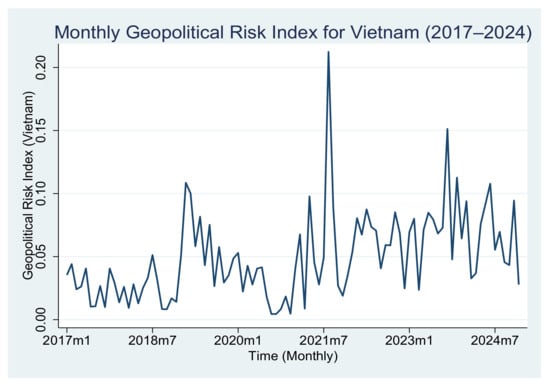
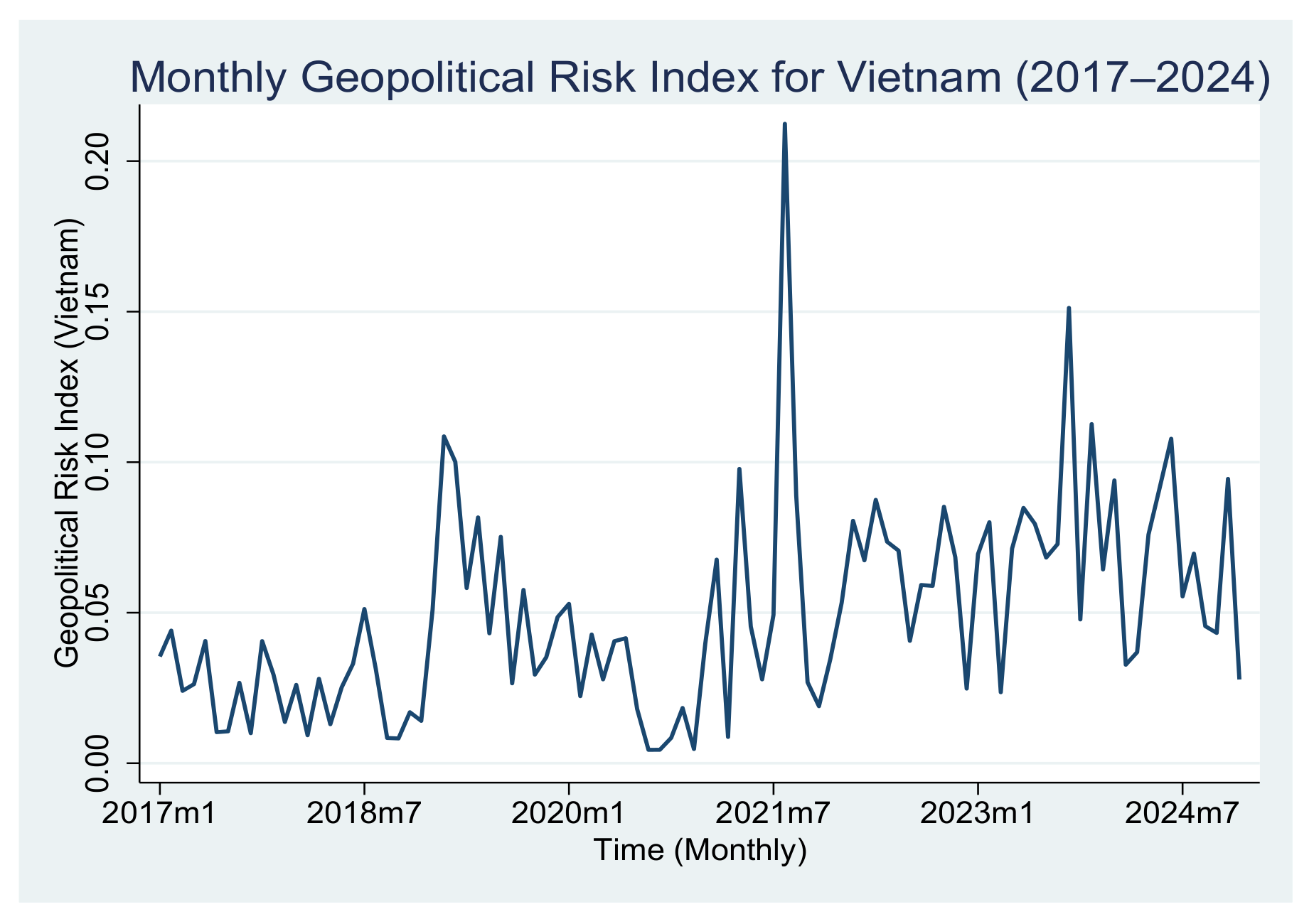
The monthly values of the Geopolitical Risk Index in Vietnam from 2017 to 2024 are provided in Figure 1. The most striking feature is the peaks of the Geopolitical Risk Index during 2019, 2021, and 2023. These years saw several intense geopolitical concerns in Vietnam. For example, in 2019, the Chinese survey vessels directly entered Vietnam’s exclusive economic zone of the East Sea for an extended period. This incident triggered intense diplomatic protests, military posturing, and sustained media coverage in Vietnam. Additionally, the U.S.–China tension reached its peak in 2019 with significant spillover effects in Vietnam’s economy. Similarly, in 2021 and 2023, various events triggered geopolitical concerns in Vietnam, such as the Israel–Hamas War, the Russia–Ukraine War, the COVID-19 pandemic and its disruption effects on global supply chains. These events explain the peaks and fluctuations of Geopolitical Risk Index in Vietnam from 2017 to 2024.
Figure 1.
Monthly values of Geopolitical Risk Index for Vietnam from 2017 to 2024.
In terms of the dependent variables, we employ the two residual-based proxies of investment inefficiency as our main dependent variables. Originally proposed by Biddle et al. (2009) and F. Chen et al. (2011), the two proxies of the investment inefficiency are the deviations from expected optimal investment using a model that predicts investment as a function of growth opportunities. These proxies of investment inefficiency are defined as residuals of the regressions of Vietnamese firms’ investment and several firm-level determinants. A positive residual value indicates that the firm is currently overinvesting compared to its optimal investment, and vice versa.
Although Tobin’s Q is another common proxy for investment efficiency literature, we do not make use of Tobin’s Q measurement in our study for the following reasons. Firstly, we do not have enough data to calculate Tobin’s Q measurement. Secondly, Tobin’s Q measurement reflects firm investment opportunities and incentives rather than corporate investment efficiency (Biddle et al., 2009). Therefore, the proxies of Biddle et al. (2009) and F. Chen et al. (2011) may reflect corporate resource allocation better than Tobin’s Q measurement does. Thirdly, Tobin’s Q measurement reflects market expectations and fluctuations, which can become erroneous when the markets become less informative and volatile (Erickson & Whited, 2000; Biddle et al., 2009).
Regarding the independent variables, a set of firm-level and country-level variables is included in the regression model. In terms of the firm-level variables, we include the return on equity, firm size, corporate leverage, cash holdings, and asset tangibility as the firm-level determinants of investment inefficiency. Additionally, the country-level variable Consumer Price Index of Vietnam is included in the baseline regression. A more detailed variable description and data source are provided in Section 3.2 and Table 2.
Table 2.
Description of variables and data source.
3.2. Empirical Methodology
We follow F. Chen et al. (2011) and Song and Chung (2023) to measure the main dependent variables of investment inefficiency. Originally based on the neo-classical framework of corporate investment, investment decisions are fundamentally determined by growth opportunities. That is, firms will invest until the marginal benefit of capital investment equals the marginal costs, and any deviation from this condition creates investment inefficiency (Biddle et al., 2009). Additionally, F. Chen et al. (2011) later expanded this framework by showing that the investment can also vary with the changes in revenue growth. Therefore, we measure investment efficiency as residuals of the model predicting investment based on revenue growth. The measurement is illustrated by the following two steps.
Firstly, we designate the annual growth of total assets as a proxy for investment, then we retrieve annual revenue and revenue growth as potential determinants of annual growth in total assets. Next, we regress the annual asset growth on a number of revenue-related firm-level determinants as follows:
where is the annual growth in total assets, equals “1” if the previous year’s revenue growth rate is negative and “0” otherwise. is the annual rate of revenue growth in the previous year. We retrieve the residuals of Equation (1) as the proxies for investment inefficiency and our main dependent variable. The dependent variable is designated as , this variable serves as the main dependent variable in this study.
As part of the robustness tests, we also employ another alternative measurement of investment efficiency proposed by Biddle et al. (2009) as follows:
Based on the methodology of Song and Chung (2023), we modify the following baseline regression, a fixed effect model, to measure the effects of geopolitical risks on Vietnamese firms’ investment inefficiency as follows:
in which is the investment efficiency variable. The term stands for the key independent variable, the geopolitical risk. is firm size and is calculated as the natural logarithm of total assets. is the return on equity. and are the corporate leverage cash holdings, respectively; these variables are the ratio of total debt and cash to total assets. represents asset tangibility. Finally, is the annual consumer price index of Vietnam. Additional year and industry fixed effects are included to account for year and industry unobserved heterogeneity, and the standard errors are robust to heteroskedasticity.
In Equation (3), is the key coefficient of this study. A positive and statistically significant coefficient value of indicates that the geopolitical risk leads to an increase in Vietnamese firms’ investment inefficiency in the form of overinvestment, and vice versa.
3.3. Endogeneity Concern and Instrumental Variable Approach
We acknowledge that the baseline regression, as shown in Equation (3), may still face endogeneity issues. Therefore, to properly address the endogeneity issues and re-examine the robustness of the baseline regression’s results, we use different instrumental variables for Vietnam’s geopolitical risks and employ the two-stage least squares approach.
For the first instrumental variable, we use the Vietnam country-level variable of manufactures exports as the instrumental variable for Vietnam’s geopolitical risks. This variable is defined as the percentage of merchandise exports and is retrieved from the World Bank Indicator database.
Various studies have empirically documented and discussed the impact of tensions between geopolitical risks and countries’ exports. The empirical evidence suggests that geopolitical risks generally have a negative impact on the countries’ exports; this is due to the exposure of both exporters and importers to geopolitical risks, according to K. Liu et al. (2024). The most direct empirical evidence comes from K. Liu et al. (2024), who show that Vietnam’s geopolitical risks are negatively related to the country’s exports in the short run. Therefore, geopolitical risks can influence Vietnam’s exports.
In addition to the manufacturing exports of Vietnam, we also retrieve the geopolitical risks of China and the U.S. as the next two instrumental variables for the Vietnam geopolitical risk variable. Both China and the U.S. are major trading partners of Vietnam, with the export and import of Vietnam to these countries accounting for around 40% annually (H.-T. Nguyen et al., 2019; Hiep, 2019; Tu et al., 2024; Dang et al., 2024). Additionally, the geopolitical risk values of both countries are significantly higher than those of Vietnam, and these results suggest that both China and the U.S. have more geopolitical concerns and related events compared to Vietnam.
While various empirical studies have empirically documented the relationship between Vietnam’s exports and geopolitical risks of Vietnam, China, and the U.S., it is unlikely that either Vietnam’s manufacturing exports or geopolitical risks of China and the U.S. have a direct impact on Vietnam’s corporate decision-making. To the best of our knowledge, there is no empirical evidence that links these factors to the corporate decisions of Vietnamese firms. Therefore, we select the manufacturing exports of Vietnam and geopolitical risks of both China and the U.S. as the instrumental variable for the Vietnam geopolitical risk variable.
4. Discussion
4.1. Sample Description and Summary Statistics
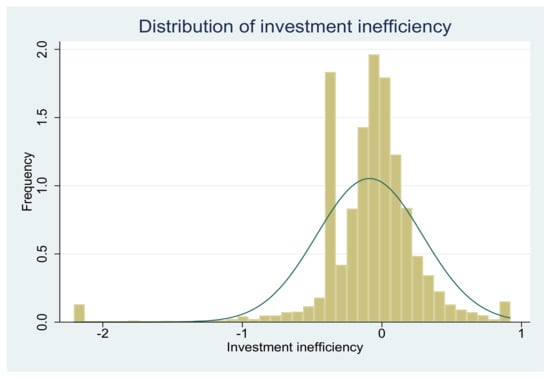
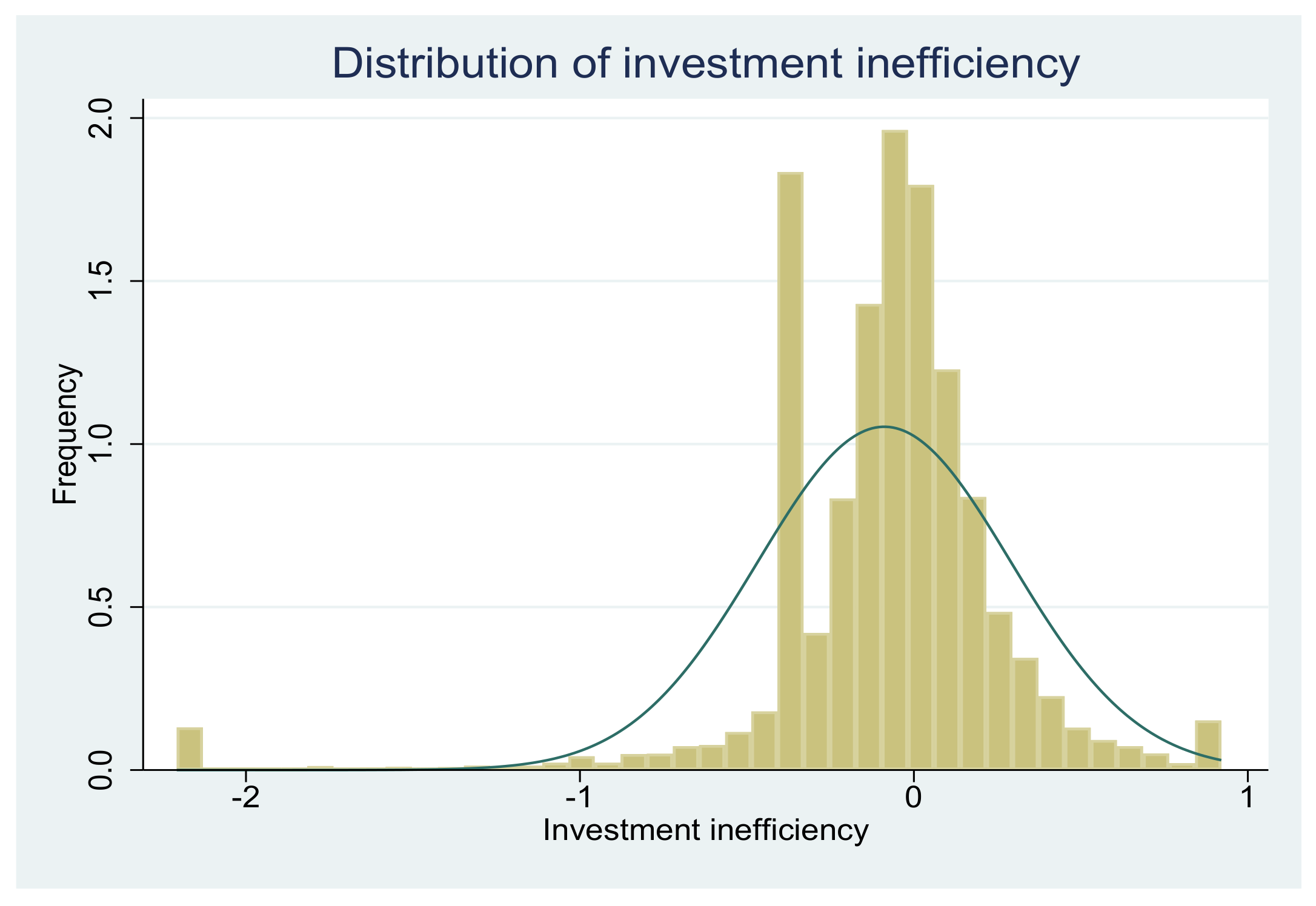
We present the statistical summary and correlation matrix of the variables in Table 3 and Table 4 for investment inefficiency, geopolitical risk, and the remaining control variables. The finalized full sample contains 11,530 observations of 1599 listed firms from 2017 to 2024. Regarding the investment inefficiency variable, the mean and standard deviation values are −0.089 and 0.379, respectively. These values indicate a general underinvestment trend with a significant degree of variation within the full sample. The distribution of investment efficiency variable is provided in Figure 2.
Table 3.
Summary statistics. This table reports the summary statistics of all variables used in this study: the number of observations (N), the mean value (Mean), and the standard deviation (Std. Dev). We also incorporate 25th quantile, median, and 75th quantile value of each variable.
Table 4.
Correlation matrix. This table reports the correlation matrix of all variables.
Figure 2.
Distribution of investment inefficiency from 2017 to 2024.
Regarding the key independent variable of the study, the mean and standard deviation values of the Vietnam geopolitical risk variable are −3.108 and 0.489, indicating a significant variation of the geopolitical risks of Vietnam from 2017 to 2024.
As shown by the correlation matrix, the geopolitical risk variable is negatively related to the investment inefficiency proxy; this is the first indication of a potential negative relationship between the two variables. Additionally, to ensure we do not have multicollinearity concerns, we run a baseline pooled Ordinary Least Squares regression with the full database, including only the firm-level variables, year, and industry fixed effects. The mean value of the variance inflation factor is 3.27, indicating no presence of multicollinearity concerns within the firm-level variables.
4.2. Baseline Results
Table 5 presents the baseline regression results examining the effect of geopolitical risk on Vietnamese firms’ investment efficiency. Columns 1 and 2 demonstrate the regression results of the random effect model and fixed effect model, respectively, without including year or industry fixed effects. A Hausman test is conducted to determine the appropriate model specification, and the test result indicates the presence of firm-specific unobserved heterogeneity correlating with the regressor. As a result, the fixed effects model is chosen as the main specification in this study. Therefore, the subsequent estimations in Columns 3–5 employ the fixed effects approach with additional fixed effects for year and industry to control for time- and sector-specific characteristics.
Table 5.
The result of the random effect model and fixed effect model of the geopolitical risk on Vietnamese firms’ investment inefficiency. T-statistics are enclosed in parentheses; the statistical significance is denoted as *, **, and *** for 1%, 5%, and 10% levels, respectively.
Across all specifications, the coefficient of the geopolitical risk variable is negative and statistically significant at the 1% level, with the value ranging from −0.0419 to −4.913. These negative coefficient values directly align with the agency theory illustrated in Section 2; that is, Vietnamese firms’ investment decisions become inefficient due to underinvestment when facing increasing geopolitical risks. Based on Column 5, a one percent increase in the Geopolitical Risk Index value can lead to a reduction of investment efficiency by nearly 5%. From a theoretical and empirical perspective, this result is possible as these external risks and uncertainties have been proven to increase information asymmetry (Truong et al., 2025a, 2025b; H. C. Nguyen et al., 2025), financial constraints, and declining corporate investment (Huynh & Phan, 2024). Therefore, as predicted by the agency theory, geopolitical risks lead to deviations of Vietnamese firms from optimal investment decisions due to managerial risk aversion and agency frictions. This result also verifies Hypothesis 1.
In addition to the agency theory illustrated in Section 2, the result is also supported by the literature on geopolitical risks, economic uncertainties, and corporate investment. That is, corporate investment and investment efficiency are generally negatively related to these economic and policy uncertainties (Ilyas et al., 2021; Rumokoy et al., 2023) as well as geopolitical risks (Le & Tran, 2021; Yadav et al., 2025).
Regarding the control variables, the coefficient values of return on equity and tangibility show a negative and statistically significant relationship with investment efficiency, while firm size is positive and significant. These results illustrate that firms with higher returns on equity and tangibility, and larger firms, are more likely to experience lower and higher investment deviations, respectively. The coefficient values of leverage and cash holdings are statistically insignificant. Finally, inflation becomes positive and significant once year and industry effects are included, indicating that macroeconomic conditions also play a role in shaping investment behavior. These results are generally in line with the literature on investment efficiency (Z. Hui, 2023; Song & Chung, 2023; Gao et al., 2024; Yadav et al., 2025).
Overall, the results provide robust evidence that geopolitical risk exerts a negative and statistically significant influence on firms’ investment efficiency. The consistency of this relationship across multiple model specifications reinforces the conclusion that geopolitical uncertainty acts as a key determinant of corporate investment inefficiency and the underinvestment concerns in Vietnam.
4.3. Robustness Tests
4.3.1. Alternative Measurement of Investment Efficiency and Generalized Methods of Moments
In the first two robustness tests, we employ the alternative measurement of investment efficiency and generalized method of moments, respectively. Regarding the alternative measurement of investment efficiency, we follow (Biddle et al., 2009) to construct the second measurement of the dependent variable, as shown in Equation (2). The results of the first two robustness tests are illustrated in Table 6. Columns 1–3 illustrate the results of the alternative measurement test using the fixed effect model and including year and industry fixed effects. Column 4 presents the result of the generalized methods of moments.
Table 6.
The result of the robustness tests of the effect of geopolitical risk on Vietnamese firms’ investment inefficiency. The robustness tests include the employment of the alternative measurement of investment efficiency and two-way system generalized methods of moments. T-statistics are enclosed in parentheses; the statistical significance is denoted as *, **, and *** for 1%, 5%, and 10% levels, respectively.
As shown in Table 6, the coefficient values of the key independent variable remain negative and statistically significant across all Columns. Regarding the generalized method of moments, the AR(1), AR(2), and Hansen test values confirm the validity of the regression estimation. This result is consistent with the baseline regression results, as shown in Table 5, and geopolitical risk is associated with the underinvestment problem. Additionally, the coefficient signs and statistical significance are also consistent with the baseline regression result. These results verify the regression result and Hypothesis 1.
4.3.2. Two-Stage Least Squares Analysis
Table 7 presents the results of the two-stage least squares analysis; the instrumental variables are Vietnam’s manufacturing exports (at the current and lagged period) and the geopolitical risks of China and the U.S. (both instrumental variables are at the current time period) across Columns 1–3, respectively.
Table 7.
The result of the two-stage least squares analysis of the effect of geopolitical risk on Vietnamese firms’ investment inefficiency. The instrumental variables are Vietnam’s manufacturing exports and the geopolitical risks of China and the U.S. T-statistics are enclosed in parentheses; the statistical significance is denoted as *, **, and *** for 1%, 5%, and 10% levels, respectively.
The two-stage least squares estimations in Columns 1–3 consistently reveal a negative and statistically significant effect of Vietnam’s geopolitical risk on investment efficiency, regardless of the chosen instrumental variable. These findings suggest that higher geopolitical risk in Vietnam is associated with a significant reduction in investment efficiency and leads to underinvestment concerns. The control variables still retain their expected signs and statistical significance; this is consistent with the baseline model. Lastly, the values of the identification statistics, Cragg–Donald, and Kleibergen–Paap F-tests confirm that the instruments’ relevance is valid, with no weak instrumental variable concerns. These results again verify the baseline regression results, as shown in Table 5, and confirm Hypothesis 1: geopolitical risks in Vietnam reduce corporate investment efficiency of Vietnamese firms and induce underinvestment problems.
4.4. The Information Asymmetry Channel
As illustrated in Section 2, the information asymmetry and agency costs between managers and shareholders are the main channel through which geopolitical risks can influence investment efficiency in Vietnam. In order to examine the information asymmetry channel through which geopolitical risks can influence investment efficiency, we employ the mechanism analysis of MacKinnon et al. (2012) and MacKinnon (2012). We employ the ratio of sales and total assets as the proxy for agency costs as proposed by Ang et al. (2000); the rationale of this proxy relates to the efficiency of managers in using firms’ assets to generate sales and revenues. An increase in the value of this ratio indicates a better asset utilization rate as managers make better use of corporate assets and generate more revenue, resulting in lower information asymmetry and agency costs, and vice versa. The ratio of sales and total assets is also appropriate in Vietnam, as managerial compensation-based proxies for agency costs are not common and subject to potential accounting errors (Huu Nguyen et al., 2020).
We specify a two-equation system proposed by MacKinnon et al. (2012) and MacKinnon (2012) to examine the mechanism of information asymmetry in the relationship between geopolitical risks and investment efficiency in Vietnam. Following Florackis (2008) and A. T. Nguyen et al. (2025), we specify the first regression of the mechanism analysis of agency cost, geopolitical risks, and other control variables to examine whether there exists a channel of information asymmetry. We regress the agency cost variable of Vietnamese firms on geopolitical risks and other control variables. In the second regression, we regress the investment efficiency on the variables of geopolitical risks and agency costs, along with all other control variables in the baseline regression. The two regressions of the mechanism analysis are shown as follows:
In the first regression, as shown in Equation (4), the coefficient value of is the key coefficient; a statistically significant value of suggests that there exists a mechanism through which geopolitical risks can influence investment efficiency. We expect the coefficient value of in Equation (4) to be negative; that is, geopolitical risks lead to an increase in information asymmetry and agency costs in Vietnamese firms.
In the second regression, as shown in Equation (5), the coefficient values of and can indicate whether the information asymmetry has a partial mediation effect or a total mediation effect on the relationship between geopolitical risks and investment efficiency. If a total mediation effect occurs, the coefficient value of becomes insignificant; that is, geopolitical risks directly affect investment efficiency through the information asymmetry channel. Alternatively, if a partial mediation effect occurs, the coefficient values of both and are statistically significant. That is, information asymmetry can partially mediate the effects of geopolitical risks on investment efficiency of Vietnamese firms.
Table 8 illustrates the results of the information asymmetry mechanism of the relationship between geopolitical risks and investment efficiency. Columns 1 and 2 illustrate the results of Equations (4) and (5), respectively. In Column 1, the coefficient value of geopolitical risks is negative and statistically significant. This result indicates the existence of the information asymmetry channel. That is, geopolitical risks lead to higher levels of information asymmetry (M. Wang & Wang, 2025), and various empirical studies also support this notion in Vietnam (Truong et al., 2025a, 2025b; H. C. Nguyen et al., 2025). In Column 2, the coefficient values of both geopolitical risks and agency costs are negative and statistically significant. The findings in Column 2 provide evidence of a partial mediation effect of information asymmetry, indicating that geopolitical risks influence investment efficiency in Vietnam both directly and indirectly through the channel of information asymmetry and agency costs (Le & Tran, 2021; M. Wang & Wang, 2025; Yadav et al., 2025). These results further verify the prediction of Hypothesis 1 based on the agency theory, as illustrated in Section 2.
Table 8.
The result of the mechanism analysis of the effect of geopolitical risk on Vietnamese firms’ investment efficiency with the information asymmetry mechanism, using fixed effect models with year–industry fixed effects. T-statistics are enclosed in parentheses; the statistical significance is denoted as *, **, and *** for 1%, 5%, and 10% levels, respectively.
The presence of a partial mediation effect of the information asymmetry channel has important theoretical implications. The results in Table 8 suggest that while information asymmetry and agency costs constitute a channel through which geopolitical risks affect investment efficiency of Vietnamese firms, this channel is not the only one. Theoretically, there may exist multiple mechanisms through which geopolitical risks affect corporate investment efficiency of Vietnamese firms, such as financing frictions or managerial abilities. Due to limitations in our data availability, we do not cover these additional channels.
4.5. Subsample Analysis: Overinvestment and Underinvestment
In the first subsample analysis, we focus on examining the relationship between geopolitical risks and investment efficiency for Vietnamese firms with overinvestment and underinvestment tendencies, respectively.
Although the full sample result illustrates a negative relationship between geopolitical risks and investment efficiency through underinvesting, it is unknown if such a relationship remains the same for both underinvested and overinvested firms. Theoretically, corporate managers may overinvest or underinvest (Myers & Majluf, 1984; Myers, 1984; Jensen, 1986), and the managers of overinvested firms are characterized by risk-taking behaviors and confidence in their managerial abilities (Tang & Chang, 2024). Empirically, in Vietnam, risk-taking managers have been proven to take more drastic and aggressive corporate decisions (D. V. Nguyen et al., 2020; Song & Chung, 2023). Therefore, it is possible that Vietnamese overinvested firms may still take more risk-taking actions, including investment decisions, when facing external shocks and uncertainties compared to their counterparts. As a result, we conjecture that the effects of geopolitical risks on investment efficiency may differ across overinvested and underinvested firms.
Columns 1–2 of Table 9 represent the results of the effects of geopolitical risks on underinvested firms and overinvested firms, respectively. As shown in Table 9, the coefficient values of geopolitical risks are statistically significant across all Columns; however, the coefficient signs are positive (negative) in Column 1 (2). This result indicates that geopolitical risks in Vietnam may cause overinvested firms to invest even more, and underinvested firms to experience further underinvestment problems. Although the result for the underinvested firms is consistent with the baseline regressions and subsequent robustness tests, the result for the overinvestment subsample suggests a different pattern for overinvested firms. However, the underinvestment issue is still more prevalent compared to overinvestment concerns, given the size of the coefficient values in both Columns.
Table 9.
The result of the subsample analysis of the effect of geopolitical risk on Vietnamese firms’ investment efficiency for the overinvested and underinvested firms, using fixed effect models with year–industry fixed effects. T-statistics are enclosed in parentheses; the statistical significance is denoted as *, **, and *** for 1%, 5%, and 10% levels, respectively.
There are several reasons why geopolitical risks may cause overinvestment in Vietnamese overinvested firms. Based on the agency theory, the first plausible explanation is that overinvested firms may be exposed to a higher level of information asymmetry compared to underinvested firms. As a result, managers in these firms may have more discretion and personal power at their disposal, and commit overinvestment to retain or hoard more power and personal benefits (Lee et al., 2021; Le & Tran, 2021; M. Wang & Wang, 2025). Additionally, the overconfident and risk-taking attitude of corporate managers can serve as another explanation, as these managers, driven by their perceived superiority, may engage in more risk-taking corporate investment decisions (Y. Chen et al., 2021; O’Sullivan et al., 2021; Zhang et al., 2022). The most direct empirical evidence comes from D. V. Nguyen et al. (2020), who show that Vietnamese overconfident CEOs tend to invest significantly more than their counterparts, and this can lead to a significant increase in related financial and operational risks (O. T. K. Tran et al., 2023). Song and Chung (2023) also suggest that female CEOs in the Northern region of Vietnam tend to engage more in risk-taking investment, which results in overinvestment concerns.
4.6. Subsample Analysis: Financial Constraints
The next subsample analysis examines whether financial constraints condition the impact of geopolitical risks on the investment efficiency of Vietnamese firms. From a theoretical perspective, various empirical studies suggest that the negative effects of external shocks and uncertainties on corporate investment decisions and efficiency are more prominent for financially constrained firms mainly due to increased financing costs (D. H. B. Phan et al., 2022; Xiang & Li, 2022; Yadav et al., 2025). Additionally, financial constraints remain a persistent concern for Vietnamese firms, as the majority of Vietnamese firms are small and medium enterprises and depend on the banking system for financing (Huynh, 2025). Therefore, combining the financial constraint conditions with our agency theory-based prediction of geopolitical risks and investment efficiency, we conjecture that increasing financial constraints may exacerbate information asymmetry and hinder optimal investment decisions. As a result, the negative effects of geopolitical risks on the investment efficiency of Vietnamese firms may be more prominent for financially constrained firms.
Following Almeida et al. (2004), we use firm size and sales as proxies for financial constraints and split the database by the annual median value of firm size and sales, respectively. Table 10 illustrates the results of the geopolitical risks and Vietnamese firms’ investment efficiency for the financial constraint subsample analysis using firm size and sales. Columns 1 and 3 (2 and 4) illustrate the results for the non-financially constrained (financially constrained) firms, respectively. The geopolitical risks have a negative and statistically significant effect on the investment efficiency across all Columns of the two subsamples, and the effect is more profound for Vietnamese financially constrained firms. This result is in line with Hypothesis 1 and the prediction of the agency theory; that is, the negative effects of geopolitical risks on investment efficiency are more prominent for Vietnamese financially constrained firms. Various studies show that Vietnamese financially constrained firms are more likely to reduce investment, thus contributing to the underinvestment concerns (N. H. Tran & Le, 2017; Q. T. Phan, 2018). Overall, the subsample analysis suggests that financial constraints can enhance the negative effects of geopolitical risks on Vietnamese firms’ investment efficiency and reinforces Hypothesis 1.
Table 10.
The result of the subsample analysis of the effect of geopolitical risk on Vietnamese firms’ investment efficiency for the financial constraint subsample analysis proxied by firm size and sales, using fixed effect models with year–industry fixed effects. T-statistics are enclosed in parentheses; the statistical significance is denoted as *, **, and *** for 1%, 5%, and 10% levels, respectively.
4.7. Subsample Analysis: HOSE, HNX, and UPCOM
The last subsample analysis of the study examines how the relationship between geopolitical risks and investment efficiency may vary across firms listed on different centers. This is due to the different firm characteristics, which depend on which center the firms are listed on.
Currently, Vietnam has three major trading centers, namely HOSE, HNX, and UPCOM; firms listed on these centers have different characteristics due to different regulations and listing conditions across centers (Huang et al., 2023). The listing criteria for HOSE are the strictest, followed by HNX, as firms must satisfy various financial and operational conditions before being allowed to be listed on HOSE, such as financial and operational performance requirements, financial disclosure and transparency, liquidity requirements, and strict corporate governance mechanisms (Huang et al., 2023). On the contrary, firms that do not meet the requirements of either HOSE or HNX can apply for UPCOM. These UPCOM-listed firms are generally characterized by a lack of information transparency and effective corporate governance channels, and they tend to be of smaller size and have restricted access to financing conditions compared to firms listed on either HOSE or HNX (H. C. Nguyen et al., 2025). Therefore, due to different firm characteristics, it is plausible that the relationship between geopolitical risks and investment efficiency may vary across HOSE, HNX, and UPCOM.
Columns 1–3 of Table 11 present the results of the relationship between geopolitical risks and investment efficiency across Vietnamese firms listed on HOSE, HNX, and UPCOM, respectively. The coefficient values of the key independent variables are negative and statistically significant only in Columns 1 and 3, with the coefficient value in Column 3 being the largest. This result indicates that firms listed in UPCOM are more exposed to the negative effects of geopolitical risks on investment efficiency. This is possibly due to the fact that UPCOM-listed firms generally have a higher degree of information asymmetry and financial constraints compared to HOSE- and HNX-listed firms (L. T. H. Tran et al., 2023; Huang et al., 2023; H. C. Nguyen et al., 2025).
Table 11.
The result of the subsample analysis of the effect of geopolitical risk on Vietnamese firms’ investment efficiency for firms listed on HOSE, HNX, and UPCOM, respectively, using fixed effect models with year–industry fixed effects. T-statistics are enclosed in parentheses; the statistical significance is denoted as *, **, and *** for 1%, 5%, and 10% levels, respectively.
5. Conclusions
Although the literature on geopolitical risks indicates the effects of such risks on corporate decision-making, the empirical evidence of such effects on Vietnamese firms’ corporate decisions is ambiguous and lacking. Therefore, we expand the literature by exploring the effects of geopolitical risks and Vietnamese firms’ investment efficiency. To conduct our study, we retrieve the database of Vietnam geopolitical risk index values from the Baker Uncertainty Index website and Vietnamese accounting variables from the FiinPro database. Additionally, we focus on investigating the channel of geopolitical risks and investment efficiency of Vietnamese firms, and how the relationship varies across different firm characteristics.
In our study, we find that geopolitical risks reduce the investment efficiency of Vietnamese firms through the channel of information asymmetry. Furthermore, Vietnamese financially constrained firms, firms that are already underinvesting, or firms listed on UPCOM center, are more likely to experience a more pronounced negative effect of geopolitical risks on investment efficiency compared to their counterparts.
Based on our empirical findings, several policy implications can be formulated. In terms of government policy implementation, the Vietnamese government should formulate additional financial and other related policies to facilitate corporate investment and reduce information asymmetry. These policies include expansionary fiscal and monetary policies, such as implementing quantitative easing policies, reducing corporate taxes and interest rates, and increasing government spending and consumption. This is particularly important for financially constrained firms. Additionally, the government should tighten and improve corporate information disclosure requirements during the heightened periods of geopolitical uncertainties. Furthermore, expanding international relationships to new trading partners should also be incorporated into Vietnam’s foreign policies. This is for Vietnamese firms to have access to new international markets to mitigate the negative effects of geopolitical risks. These policies should mitigate Vietnamese firms’ underinvestment decisions and improve investment efficiency.
At the firm level, we offer several recommendations based on our findings. The first recommendation is about reducing information asymmetry. That is, Vietnamese firms should attempt to reduce information asymmetry between managers and shareholders and increase the quantity and quality of related information disclosure and transparency. This serves as an internal corporate governance mechanism that forces managers to make better corporate investment decisions and improve investment efficiency.
The second corporate recommendation relates to investment strategies. Firms should diversify their investment decisions to seek more potentially beneficial investment projects. Additionally, we believe staged investment strategies may be more beneficial compared to upfront investment, as these strategies allow firms to have better flexibility in investment decisions, and protect firms from sudden negative geopolitical events and subsequent financial losses. Therefore, Vietnamese firms should seek real options investment strategies to increase their resilience against the impacts of geopolitical risks. Lastly, proper capital structure policies can help Vietnamese firms to facilitate investment decisions even under external risks and uncertainty.
In this study, we would like to acknowledge our data availability limitations and offer future research directions. Firstly, we only use listed firms’ accounting data from 2017 to 2024, and our full database may not account for all Vietnamese firms operating in the market. Additionally, our results review information asymmetry as a potential channel between geopolitical risks and investment efficiency in Vietnam, leaving much to be desired. We expect additional channels of geopolitical risks and investment efficiency, such as corporate governance, information opacity, or financial disclosure. Thirdly, our methodology is not completely free of potential omitted variable bias. Therefore, future studies could improve upon our work and offer new empirical findings about geopolitical risks and investment efficiency in Vietnam.
Author Contributions
Conceptualization, T.T.B., H.T.M.L. and N.T.M.L.; methodology, T.T.B.; software, T.T.B.; validation, T.T.B., H.T.M.L. and N.T.M.L.; formal analysis, T.T.B.; investigation, H.T.M.L. and N.T.M.L.; resources, T.T.B.; data curation, T.T.B.; writing—original draft preparation, T.T.B. and H.T.M.L.; writing—review and editing, H.T.M.L. and N.T.M.L.; visualization, H.T.M.L. and N.T.M.L.; supervision, T.T.B.; project administration, T.T.B. All authors have read and agreed to the published version of the manuscript.
Funding
This research received no external funding.
Institutional Review Board Statement
Not applicable.
Informed Consent Statement
Not applicable.
Data Availability Statement
The firm-level dataset used in this study is obtained from FiinPro and contains accounting information. The database can be provided by the corresponding author upon reasonable request. The macroeconomic variables (consumer price index) are publicly available from the World Bank Indicators database, and the geopolitical risk indices are publicly accessible through the Baker, Bloom, and Davis Economic Uncertainty website. All authors confirm that the data sources have been appropriately acknowledged.
Conflicts of Interest
The authors declare no conflicts of interest.
References
- Almeida, H., Campello, M., & Weisbach, M. S. (2004). The cash flow sensitivity of cash. The Journal of Finance, 59(4), 1777–1804. [Google Scholar] [CrossRef] [Scilit]
- Alter, A., & Elekdag, S. (2020). Emerging market corporate leverage and global financial conditions. Journal of Corporate Finance, 62, 101590. [Google Scholar] [CrossRef] [Scilit]
- Ang, J. S., Cole, R. A., & Lin, J. W. (2000). Agency costs and ownership structure. The Journal of Finance, 55(1), 81–106. [Google Scholar] [CrossRef] [Scilit]
- Bajaj, Y., Kashiramka, S., & Singh, S. (2021). Economic policy uncertainty and leverage dynamics: Evidence from an emerging economy. International Review of Financial Analysis, 77, 101836. [Google Scholar] [CrossRef] [Scilit]
- Baker, S. R., Bloom, N., & Davis, S. J. (2016). Measuring economic policy uncertainty. The Quarterly Journal of Economics, 131(4), 1593–1636. [Google Scholar] [CrossRef] [Scilit]
- Bernile, G., Bhagwat, V., & Rau, P. R. (2017). What doesn’t kill you will only make you more risk-loving: Early-life disasters and CEO behavior. The Journal of Finance, 72(1), 167–206. [Google Scholar] [CrossRef] [Scilit]
- Biddle, G. C., Hilary, G., & Verdi, R. S. (2009). How does financial reporting quality relate to investment efficiency? Journal of Accounting and Economics, 48(2–3), 112–131. [Google Scholar] [CrossRef] [Scilit]
- Bilgin, M. H., Gozgor, G., & Karabulut, G. (2020). How do geopolitical risks affect government investment? An empirical investigation. Defence and Peace Economics, 31(5), 550–564. [Google Scholar] [CrossRef] [Scilit]
- Blank, D. B., & Hadley, B. (2021). When CEOs adapt: An investigation of manager experience, policy and performance following recessions. Journal of Corporate Finance, 71, 102118. [Google Scholar] [CrossRef] [Scilit]
- Bouoiyour, J., Selmi, R., Hammoudeh, S., & Wohar, M. E. (2019). What are the categories of geopolitical risks that could drive oil prices higher? Acts or threats? Energy Economics, 84, 104523. [Google Scholar] [CrossRef] [Scilit]
- Caballero-Anthony, M. (2022). The ASEAN way and the changing security environment: Navigating challenges to informality and centrality. International Politics, 1–21. [Google Scholar] [CrossRef] [Scilit] [PubMed]
- Caldara, D., & Iacoviello, M. (2022). Measuring geopolitical risk. American Economic Review, 112(4), 1194–1225. [Google Scholar] [CrossRef] [Scilit]
- Chen, C., He, Y., Wang, K., & Yan, S. (2022). The impact of early-life natural disaster experiences on the corporate innovation by CEOs. Emerging Markets Finance and Trade, 58(14), 3953–3975. [Google Scholar] [CrossRef] [Scilit]
- Chen, F., Hope, O.-K., Li, Q., & Wang, X. (2011). Financial reporting quality and investment efficiency of private firms in emerging markets. The Accounting Review, 86(4), 1255–1288. [Google Scholar] [CrossRef] [Scilit]
- Chen, M., Hu, X., Zhang, J., Xu, Z., Yang, G., & Sun, Z. (2023). Are firms more willing to seek green technology innovation in the context of economic policy uncertainty?—Evidence from China. Sustainability, 15(19), 14188. [Google Scholar] [CrossRef] [Scilit]
- Chen, Y., Fan, Q., Yang, X., & Zolotoy, L. (2021). CEO early-life disaster experience and stock price crash risk. Journal of Corporate Finance, 68, 101928. [Google Scholar] [CrossRef] [Scilit]
- Choi, B., & Nguyen, T. L. (2023). Trade diversion effects of the US–China trade war on Vietnam. Pacific Economic Review, 28(4), 570–588. [Google Scholar] [CrossRef] [Scilit]
- Dang, B. T. T., Yawei, W., & Abdullah, A. J. (2024). The impact of the US-China trade war on Vietnamese exports to the US: A quantitative study using DiD approach. Journal of Trade Science, 12(4), 304–318. [Google Scholar] [CrossRef] [Scilit]
- Erickson, T., & Whited, T. M. (2000). Measurement error and the relationship between Investment and q. Journal of Political Economy, 108(5), 1027–1057. [Google Scholar] [CrossRef] [Scilit]
- Fazzari, S., Hubbard, R. G., & Petersen, B. (1987). Financing constraints and corporate investment. National Bureau of Economic Research. [Google Scholar] [CrossRef] [Scilit]
- Florackis, C. (2008). Agency costs and corporate governance mechanisms: Evidence for UK firms. International Journal of Managerial Finance, 4(1), 37–59. [Google Scholar] [CrossRef] [Scilit]
- Gao, D., Wang, Z., & Zhang, W. (2024). Supply chain network, digital transformation, and investment efficiency. Applied Economics, 45(8), 5562–5576. [Google Scholar] [CrossRef] [Scilit]
- Goodell, J. W., Goyal, A., & Urquhart, A. (2021). Uncertainty of uncertainty and firm cash holdings. Journal of Financial Stability, 56, 100922. [Google Scholar] [CrossRef] [Scilit]
- Gulen, H., & Ion, M. (2015). Policy uncertainty and corporate investment. Review of Financial Studies, 29(3), 523–564. [Google Scholar] [CrossRef] [Scilit]
- Hasan, S. B., Alam, M. S., Paramati, S. R., & Islam, M. S. (2022). Does firm-level political risk affect cash holdings? Review of Quantitative Finance and Accounting, 59(1), 311–337. [Google Scholar] [CrossRef] [Scilit]
- Hiep, N. Q. (2019). Vietnam-China trade relations and the effects of the US-China trade war. Business and Economic Research, 9(4), 1–11. [Google Scholar] [CrossRef] [Scilit]
- Hoque, M. E., & Zaidi, M. A. S. (2020). Global and country-specific geopolitical risk uncertainty and stock return of fragile emerging economies. Borsa Istanbul Review, 20(3), 197–213. [Google Scholar] [CrossRef] [Scilit]
- Hu, J., Li, A., & Luo, Y. (2019). CEO early life experiences and cash holding: Evidence from China’s great famine. Pacific-Basin Finance Journal, 57, 101184. [Google Scholar] [CrossRef] [Scilit]
- Huang, X., Liu, C., & Shu, T. (2023). Factors and anomalies in the Vietnamese stock market. Pacific-Basin Finance Journal, 82, 102176. [Google Scholar] [CrossRef] [Scilit]
- Hui, P., Zhao, H., Liu, D., & Li, Y. (2023). How does digital finance affect regional innovation capacity? A spatial econometric analysis. Economic Modelling, 122, 106250. [Google Scholar] [CrossRef] [Scilit]
- Hui, Z. (2023). Supply-chain concentration and inefficient investment. Emerging Markets Finance and Trade, 59(7), 2129–2144. [Google Scholar] [CrossRef] [Scilit]
- Huu Nguyen, A., Thuy Doan, D., & Ha Nguyen, L. (2020). Corporate governance and agency cost: Empirical evidence from Vietnam. Journal of Risk and Financial Management, 13(5), 103. [Google Scholar] [CrossRef] [Scilit]
- Huynh, J. (2025). Banking uncertainty and corporate financial constraints. International Journal of Finance & Economics, 30(1), 626–651. [Google Scholar] [CrossRef] [Scilit]
- Huynh, J., & Phan, T. M. H. (2024). Uncertainty in banking and debt financing of firms in Vietnam. PLoS ONE, 19(7), e0305724. [Google Scholar] [CrossRef] [Scilit] [PubMed]
- Ilyas, M., Khan, A., Nadeem, M., & Suleman, M. T. (2021). Economic policy uncertainty, oil price shocks and corporate investment: Evidence from the oil industry. Energy Economics, 97, 105193. [Google Scholar] [CrossRef] [Scilit]
- Jensen, M. C. (1986). Agency cost of free cash flow, corporate finance, and takeovers. The American Economic Review, 76(2), 323–329. [Google Scholar] [CrossRef] [Scilit]
- Jensen, M. C., & Meckling, W. H. (1976). Theory of the firm: Managerial behavior, agency costs and ownership structure. Journal of Financial Economics, 3(4), 305–360. [Google Scholar] [CrossRef] [Scilit]
- Khoo, J., & Cheung, A. W. K. (2021). Does geopolitical uncertainty affect corporate financing? Evidence from MIDAS regression. Global Finance Journal, 47, 100519. [Google Scholar] [CrossRef] [Scilit]
- Le, A. T., & Tran, T. P. (2021). Does geopolitical risk matter for corporate investment? Evidence from emerging countries in Asia. Journal of Multinational Financial Management, 62, 100703. [Google Scholar] [CrossRef] [Scilit]
- Lee, C.-C., Lee, C.-C., & Xiao, S. (2021). Policy-related risk and corporate financing behavior: Evidence from China’s listed companies. Economic Modelling, 94, 539–547. [Google Scholar] [CrossRef] [Scilit]
- Lee, C.-C., & Wang, C.-W. (2021). Firms’ cash reserve, financial constraint, and geopolitical risk. Pacific-Basin Finance Journal, 65, 101480. [Google Scholar] [CrossRef] [Scilit]
- Lee, C.-C., Wang, C.-W., Chiu, W.-C., & Tien, T.-S. (2018). Managerial ability and corporate investment opportunity. International Review of Financial Analysis, 57, 65–76. [Google Scholar] [CrossRef] [Scilit]
- Li, R., & Wei, N. (2022). Economic policy uncertainty and government spending multipliers. Economics Letters, 217, 110693. [Google Scholar] [CrossRef] [Scilit]
- Liu, K., Fu, Q., Ma, Q., & Ren, X. (2024). Does geopolitical risk affect exports? Evidence from China. Economic Analysis and Policy, 81, 1558–1569. [Google Scholar] [CrossRef] [Scilit]
- Liu, X., Wang, Y., Du, W., & Ma, Y. (2022). Economic policy uncertainty, oil price volatility and stock market returns: Evidence from a nonlinear model. The North American Journal of Economics and Finance, 62, 101777. [Google Scholar] [CrossRef] [Scilit]
- MacKinnon, D. P. (2012). Introduction to statistical mediation analysis. Routledge. [Google Scholar] [CrossRef] [Scilit]
- MacKinnon, D. P., Coxe, S., & Baraldi, A. N. (2012). Guidelines for the investigation of mediating variables in business research. Journal of Business and Psychology, 27(1), 1–14. [Google Scholar] [CrossRef] [Scilit]
- Myers, S. C. (1984). The capital structure puzzle. The Journal of Finance, 39(3), 575–592. [Google Scholar] [CrossRef] [Scilit]
- Myers, S. C., & Majluf, N. S. (1984). Corporate financing and investment decisions when firms have information that investors do not have. Journal of Financial Economics, 13(2), 187–221. [Google Scholar] [CrossRef] [Scilit]
- Nguyen, A. T., Thi, D., Tran, T., & Vuong, A. T. (2025). Determinants of agency cost: Evidence from listed real estate firms on the Vietnam stock exchange. Ho Chi Minh City Open University Journal of Science-Economics and Business Administration, 16(1), 75–91. [Google Scholar] [CrossRef] [Scilit]
- Nguyen, D. V., Dang, D. Q., Pham, G. H., & Do, D. K. (2020). Influence of overconfidence and cash flow on investment in Vietnam. Journal of Asian Finance, Economics and Business, 7(2), 99–106. [Google Scholar] [CrossRef] [Scilit]
- Nguyen, G., & Vo, V. (2024). Economic policy uncertainty around the world: Implications for Vietnam. International Review of Economics & Finance, 94, 103349. [Google Scholar] [CrossRef] [Scilit]
- Nguyen, H. C., Tran, T. D., Huynh, B. D., Tran, T. T. T., Nguyen, T. L., & Nguyen, T. N. H. (2025). Exploring CSR disclosure practices in unlisted public enterprises: Evidence from Vietnam. Journal of Financial Reporting and Accounting. [Google Scholar] [CrossRef] [Scilit]
- Nguyen, H.-T., Hoang Tien, N., & Ba Hung Anh, D. (2019). Vietnam’s international trade policy in the context of China-US trade war. International Journal of Commerce and Management Research, 5(3), 92–95. [Google Scholar]
- O’Sullivan, D., Zolotoy, L., & Fan, Q. (2021). CEO early-life disaster experience and corporate social performance. Strategic Management Journal, 42(11), 2137–2161. [Google Scholar] [CrossRef] [Scilit]
- Pan, W.-F. (2018). Political uncertainty and corporate innovations in the United States. SSRN Electronic Journal. [Google Scholar] [CrossRef] [Scilit]
- Phan, D. H. B., Tran, V. T., Ming, T. C., & Le, A. (2022). Carbon risk and corporate investment: A cross-country evidence. Finance Research Letters, 46, 102376. [Google Scholar] [CrossRef] [Scilit]
- Phan, Q. T. (2018). Corporate debt and investment with financial constraints: Vietnamese listed firms. Research in International Business and Finance, 46, 268–280. [Google Scholar] [CrossRef] [Scilit]
- Qian, L., Zeng, Q., & Li, T. (2022). Geopolitical risk and oil price volatility: Evidence from Markov-switching model. International Review of Economics & Finance, 81, 29–38. [Google Scholar] [CrossRef] [Scilit]
- Rumokoy, L. J., Omura, A., & Roca, E. (2023). Geopolitical risk and corporate investment in the metals and mining industry: Evidence from Australia. Pacific-Basin Finance Journal, 79, 101991. [Google Scholar] [CrossRef] [Scilit]
- Salisu, A. A., Ogbonna, A. E., Lasisi, L., & Olaniran, A. (2022). Geopolitical risk and stock market volatility in emerging markets: A GARCH–MIDAS approach. The North American Journal of Economics and Finance, 62, 101755. [Google Scholar] [CrossRef] [Scilit]
- Soltani, H., Triki, M., Ghandri, M., & Abderzag, F. (2021). Does geopolitical risk and financial development matter for economic growth in MENA countries? Journal of International Studies, 14(1), 103–116. [Google Scholar] [CrossRef] [Scilit]
- Song, J. M., & Chung, C. Y. (2023). Female CEOs and investment efficiency in the Vietnamese market. Finance Research Letters, 58, 104362. [Google Scholar] [CrossRef] [Scilit]
- Stephie Tsai, H.-J., Wu, Y., & Xu, B. (2021). Does capital market drive corporate investment efficiency? Evidence from equity lending supply. Journal of Corporate Finance, 69, 102042. [Google Scholar] [CrossRef] [Scilit]
- Su, K., Kong, D., & Wu, J. (2021). Can economic policy uncertainty reduce a firm’s trade credit? International Review of Finance, 21(3), 1089–1099. [Google Scholar] [CrossRef] [Scilit]
- Tang, H.-W., & Chang, C.-C. (2024). CEO overconfidence, risk-taking, and firm value: Influence of incentive compensation and financial constraints. The North American Journal of Economics and Finance, 69, 102034. [Google Scholar] [CrossRef] [Scilit]
- Tran, L. T. H., Tu, T. T. K., Nguyen, T. T. H., Nguyen, H. T. L., & Vo, X. V. (2023). Annual report narrative disclosures, information asymmetry and future firm performance: Evidence from Vietnam. International Journal of Emerging Markets, 18(2), 351–375. [Google Scholar] [CrossRef] [Scilit]
- Tran, N. H., & Le, C. D. (2017). Financial conditions and corporate investment: Evidence from Vietnam. Pacific Accounting Review, 29(2), 183–203. [Google Scholar] [CrossRef] [Scilit]
- Tran, O. T. K., Nguyen, A. H. V., Nguyen, P. Y. N., & Duong, K. D. (2023). CEO overpower and stock price crash risk: Evidence from family businesses in Vietnam. Journal of Eastern European and Central Asian Research (JEECAR), 10(3), 425–438. [Google Scholar] [CrossRef] [Scilit]
- Truong, L. D., Friday, H. S., & Nguyen, A. T. K. (2025a). The effects of geopolitical risks on market returns in a frontier market: Evidence from Ho Chi Minh stock exchange. Asia-Pacific Financial Markets, 1–21. [Google Scholar] [CrossRef] [Scilit]
- Truong, L. D., Nguyen, N. T., & Nguyen, D. T. (2025b). The asymmetric effects of geopolitical risks on Vietnam’s exports. Risks, 13(11), 218. [Google Scholar] [CrossRef] [Scilit]
- Tsai, S. (2008). Information asymmetry and corporate investment decisions: A dynamic approach. Financial Review, 43(2), 241–271. [Google Scholar] [CrossRef] [Scilit]
- Tu, T. A., Chu, T. M. P., & Truong, T. L. H. (2024). Impacts of the US-China trade tension and RCEP on Vietnam-China trade balance. The Russian Journal of Vietnamese Studies, 8(1), 38–51. [Google Scholar] [CrossRef] [Scilit]
- Wang, K.-H., Xiong, D.-P., Mirza, N., Shao, X.-F., & Yue, X.-G. (2021). Does geopolitical risk uncertainty strengthen or depress cash holdings of oil enterprises? Evidence from China. Pacific-Basin Finance Journal, 66, 101516. [Google Scholar] [CrossRef] [Scilit]
- Wang, M., & Wang, X. (2025). Geopolitical risk and corporate maturity mismatch. Journal of Financial Stability, 78, 101408. [Google Scholar] [CrossRef] [Scilit]
- Wang, Y., Chen, C. R., & Huang, Y. S. (2014). Economic policy uncertainty and corporate investment: Evidence from China. Pacific-Basin Finance Journal, 26, 227–243. [Google Scholar] [CrossRef] [Scilit]
- Wu, X., Luo, L., & You, J. (2023). Actions speak louder than words: Environmental law enforcement externalities and access to bank loans. Journal of Banking & Finance, 153, 106882. [Google Scholar] [CrossRef] [Scilit]
- Xiang, J., & Li, L. (2022). Monetary policy uncertainty, debt financing cost and real economic activities: Evidence from China. International Review of Economics & Finance, 80, 1025–1044. [Google Scholar] [CrossRef] [Scilit]
- Yadav, A. S., Yadav, I. S., & Wali Ullah, G. M. (2025). Geopolitical risk and corporate investment inefficiency: Evidence from India. Journal of Accounting Literature, 47(5), 622–664. [Google Scholar] [CrossRef] [Scilit]
- Yang, C., & Chan, D. Y.-T. (2023). Geopolitical risks of strategic decoupling and recoupling in the mobile phone production shift from China to Vietnam: Evidence from the Sino-US trade war and COVID-19 pandemic. Applied Geography, 158, 103028. [Google Scholar] [CrossRef] [Scilit]
- Yang, J., & Yang, C. (2021). The impact of mixed-frequency geopolitical risk on stock market returns. Economic Analysis and Policy, 72, 226–240. [Google Scholar] [CrossRef] [Scilit]
- Zhang, Z., Wang, X., & Jia, M. (2022). Poverty as a double-edged sword: How CEOs’ childhood poverty experience affect firms’ risk taking. British Journal of Management, 33(3), 1632–1653. [Google Scholar] [CrossRef] [Scilit]
- Zhao, N., Zhang, L., & Huang, H. (2025). Influence of China’s geopolitical risk on corporate dividend policies. Finance Research Letters, 72, 106579. [Google Scholar] [CrossRef] [Scilit]
- Zhu, B., & Zhao, Y. (2022). Carbon risk and the cost of bank loans: Evidence from China. Technological Forecasting and Social Change, 180, 121741. [Google Scholar] [CrossRef] [Scilit]

Disclaimer/Publisher’s Note: The statements, opinions and data contained in all publications are solely those of the individual author(s) and contributor(s) and not of MDPI and/or the editor(s). MDPI and/or the editor(s) disclaim responsibility for any injury to people or property resulting from any ideas, methods, instructions or products referred to in the content. |
© 2026 by the authors. Licensee MDPI, Basel, Switzerland. This article is an open access article distributed under the terms and conditions of the Creative Commons Attribution (CC BY) license.