


Simple Summary
Many women continue to experience physical, sensory, and emotional problems after breast cancer treatment, even when pain levels appear to improve. Understanding how recovery evolves over time is essential to provide appropriate follow-up and support during survivorship. In this prospective longitudinal study, women were assessed before surgery and throughout treatment using clinical, sensory, functional, and quality-of-life measures. Recovery was not uniform across these domains: pain remained relatively stable, whereas fear of movement increased, quality of life worsened, and objective sensory changes persisted over time. These findings show that pain intensity alone does not adequately reflect recovery after breast cancer treatment. A multidimensional assessment may help clinicians identify women at risk of persistent recovery-related difficulties and support more personalized survivorship care.
Abstract
Background: Breast cancer survivors frequently experience persistent sensory, psychosocial, and functional sequelae that may not be captured by pain measures alone. Understanding recovery trajectories throughout treatment and survivorship may help identify women at risk of long-term recovery-related difficulties. Objective: To investigate sensory, psychosocial, functional, and quality-of-life trajectories throughout breast cancer treatment. Methods: This prospective longitudinal study included women undergoing unilateral breast cancer surgery assessed at six time points before and after surgery, including before and after adjuvant treatments when applicable. Outcomes included sensory function, pain, upper-limb function, psychosocial variables, and quality of life. Results: Seventy-two women (57 ± 11 years) were included. Despite stable pain intensity and self-reported sensitization symptoms, fear of movement increased (TSK-11: MD [95%CI] = +9[0;22]), quality of life deteriorated (FACT-B: 3–12 month MD [95%CI] = −10[−19;−1]), and upper-limb function initially worsened before partially recovering. Objective sensory alterations suggested dynamic changes in somatosensory processing but were not consistently accompanied by greater pain intensity or self-reported sensitization symptoms. Conclusions: Recovery after breast cancer treatment is multidimensional and cannot be adequately reflected by pain intensity alone. Multidimensional assessment may help identify women at risk of persistent recovery-related difficulties and support personalized survivorship care.
1. Introduction
Breast cancer is the most frequently diagnosed cancer among women worldwide, accounting for 11.6% of new cancer cases and 6.9% of cancer-related deaths [1]. Advances in early detection and treatment have substantially improved survival [2,3], resulting in a growing population of breast cancer survivors. However, many women continue to experience persistent treatment-related sequelae that may affect physical function, participation, psychosocial well-being and health-related quality of life (HRQoL) long after completion of treatment [4,5]. Persistent pain affects up to 60% of breast cancer survivors and remains one of the most common long-term sequelae of cancer treatment [4].
Recovery after breast cancer treatment is complex and multidimensional. Oncological treatments may contribute to persistent symptoms through multiple biological, physical and psychosocial mechanisms [6,7,8,9]. Surgical treatment may contribute to musculoskeletal pain, joint dysfunction and persistent postsurgical pain, which affects approximately 50% of women and is moderate-to-severe in up to 25% [8,10]. Radiotherapy and chemotherapy may further contribute to sensory disturbances, neuropathic symptoms and altered pain modulation through inflammatory and neural mechanisms [8,11,12]. Hormonal therapies such as aromatase inhibitors may also contribute to musculoskeletal pain and altered pain perception [13,14]. Additional factors including obesity, low educational level and lymphedema may further influence symptom persistence and recovery [6]. Up to 30% of survivors report pain a decade after treatment [6], with substantial consequences for function, psychosocial well-being and HRQoL. The latter is particularly relevant as a multidimensional construct encompassing physical, psychological and social aspects of health and functioning [15]. The broader importance of quality-of-life assessment is reflected in multidimensional instruments developed by the World Health Organization, such as the WHOQOL-BREF, which assesses physical, psychological, social and environmental domains [16]. Psychosocial factors such as anxiety, distress, depression and catastrophizing may further influence symptom persistence and recovery trajectories [17,18]. Collectively, these treatment-related sequelae may contribute to heterogeneous survivorship trajectories and ongoing supportive care needs.
Pain-related symptoms after breast cancer treatment are multidimensional and may involve nociceptive, neuropathic and nociplastic mechanisms [19,20]. Neuropathic and nociplastic pain have been associated with poorer HRQoL and psychosocial functioning [21]. Central and peripheral sensitization may contribute to altered pain processing and pain chronification [22,23,24,25]. Nevertheless, pain intensity alone may not adequately capture the multidimensional nature of recovery after breast cancer treatment. A more comprehensive understanding of sensory, psychosocial and functional recovery patterns may help identify women at risk of persistent difficulties and support more personalized survivorship care.
Quantitative sensory testing (QST) provides an objective approach to characterizing sensory alterations that may accompany breast cancer treatment and survivorship [26,27,28]. Previous studies have identified sensory abnormalities at different stages of treatment and recovery [29,30,31,32,33,34,35]. However, most available evidence is cross-sectional, focused on isolated treatment stages, or based on partial sensory assessment protocols, limiting understanding of how sensory, psychosocial, functional and quality-of-life outcomes evolve longitudinally throughout the breast cancer continuum. Thus, longitudinal studies integrating these different dimensions across the treatment continuum remain limited. Understanding these trajectories may facilitate identification of women at risk of persistent recovery-related difficulties and unmet survivorship needs.
Therefore, this study aimed to investigate longitudinal sensory, psychosocial, functional and health-related quality-of-life trajectories during and after breast cancer treatment using quantitative sensory testing alongside patient-reported outcomes related to pain, upper-limb function, psychosocial factors and HRQoL.
We hypothesized that women undergoing breast cancer treatment would exhibit time-dependent sensory and psychosocial changes across the recovery trajectory and that objective changes in sensory processing would not necessarily parallel pain intensity, self-reported sensitization symptoms or other patient-reported outcomes.
2. Materials and Methods
2.1. Design
A prospective observational study was conducted at the Physiotherapy “BLINDED” Research Unit “BLINDED” to investigate longitudinal sensory, psychosocial, functional and HRQoL trajectories across breast cancer treatment and survivorship. All participants provided written informed consent. Study procedures complied with the ethical standards of the institutional and national research committees and with the Declaration of Helsinki. Data were pseudonymized according to European data protection regulations. The study was approved by the Research Ethics Committee of Hospital Universitario Príncipe de Asturias (protocol code OE 16/2019; approved 4 November 2019). The study was reported according to the Strengthening Reporting of Observational Studies in Epidemiology (STROBE) guidelines [36]. As this was an observational cohort study, clinical trial registration was not applicable.
2.2. Participants
Women with unilateral breast cancer scheduled for surgery with axillary lymph node dissection or sentinel lymph node biopsy were consecutively recruited by a physician from the Gynaecology and Obstetrics Department at “BLINDED”. Exclusion criteria included neurological disorders, previous shoulder surgery or severe upper-limb conditions, cognitive impairment, and receipt of oncological treatment within the previous year. All participants provided written informed consent before enrolment.
All participants underwent breast cancer surgery. Additionally, 15 participants received chemotherapy and 34 participants received radiotherapy, with partial overlap between treatment modalities. Chemotherapy and radiotherapy were administered according to standard clinical protocols and initiated after surgery. The timing and duration of adjuvant treatments varied across individuals, reflecting routine clinical practice.
2.3. Assessment
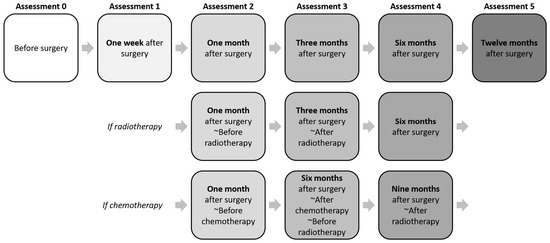
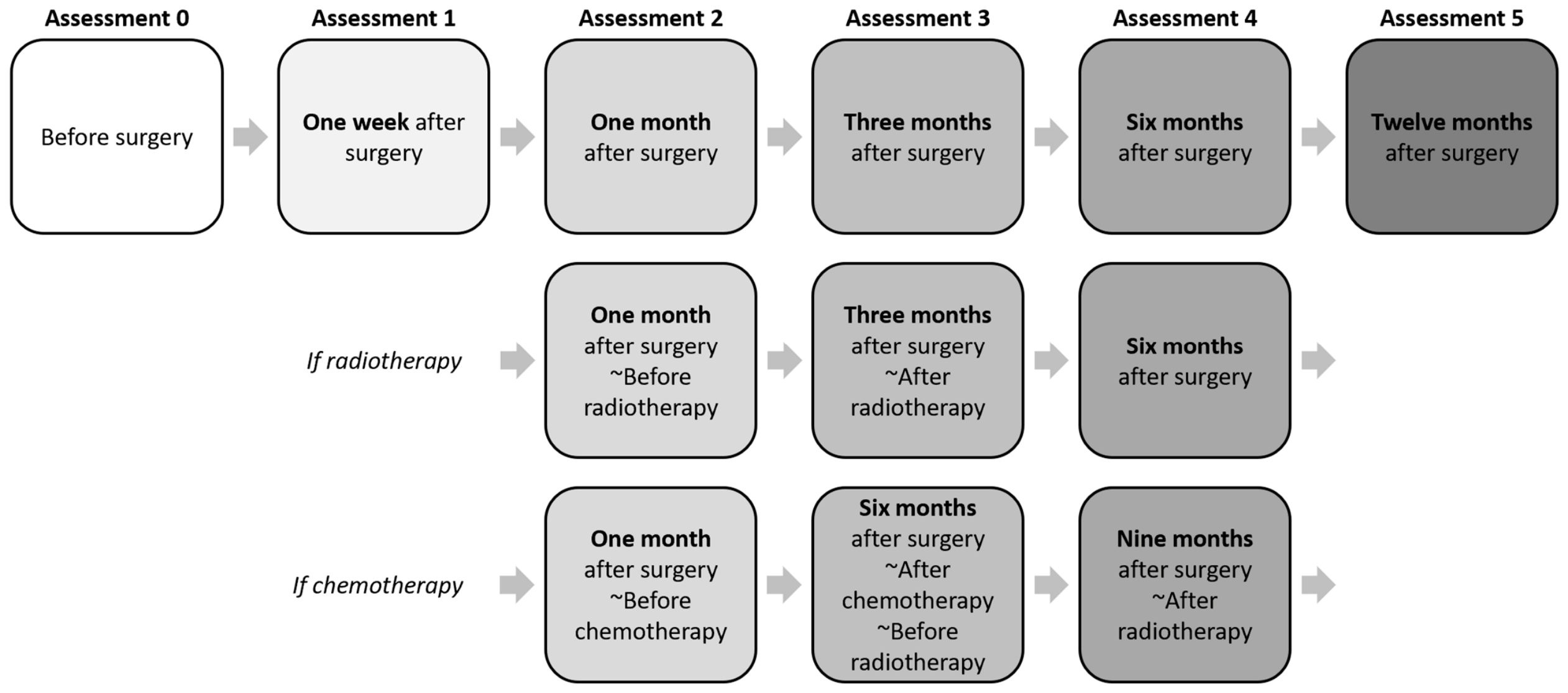
Assessments were conducted at six predefined time points corresponding to key milestones across the breast cancer treatment trajectory (Figure 1), selected to capture the preoperative period, acute and early postoperative recovery, adjuvant-treatment phases, and longer-term survivorship. This assessment schedule is consistent with the expected sequencing of oncological treatments [2,37], established longitudinal outcome assessment frameworks in breast cancer [38], and previous prospective evidence on postsurgical pain trajectories [39]. Assessments were scheduled according to predefined clinical phases (i.e., 1 week before surgery, 1 week after surgery, and approximately 1, 3, 6, and 12 months after surgery); however, variability in actual calendar timing occurred, particularly during the adjuvant-treatment phases (A3–A5), depending on individual treatment pathways. Accordingly, not all assessment points had the same clinical meaning across participants, and intervals between assessments differed across individuals. The actual timing of assessments relative to surgery is reported in Supplementary Table S1. Therefore, assessment points should be interpreted as nominal clinical follow-up phases rather than identical calendar-time points across participants.
Figure 1.
Assessment schedule across breast cancer treatment and follow-up. Seventy-two participants were enrolled at baseline before surgery. Assessments were conducted at six predefined time points aligned with key clinical milestones: before surgery (Assessment 0), one week after surgery (Assessment 1), and follow-up assessments approximately one (Assessment 2), three (Assessment 3), six (Assessment 4), and twelve months (Assessment 5) after surgery. These assessment time points represent predefined clinical assessment phases and were modelled as such in the statistical analyses, rather than as fixed calendar intervals. For participants receiving adjuvant treatments, Assessments 2–4 coincided with periods before and after chemotherapy and/or radiotherapy, when applicable, depending on individual clinical pathways. Not all assessment points applied to all participants. Note: ~ indicates approximate timing in relation to oncological treatment.
At baseline, sociodemographic characteristics were collected. During follow-up, anthropometric variables (weight, height, body mass index [BMI], menopausal status) and clinical variables (upper-limb history, affected side, surgery type, complications such as seroma, superficial lymphatic thrombosis and acute pain, adjuvant treatments, and breast reconstruction) were recorded.
Information regarding chemotherapy (e.g., anthracyclines, taxanes), hormone therapy (e.g., tamoxifen, aromatase inhibitors) and biological therapy (e.g., trastuzumab, CDK4/6 inhibitors) was collected throughout follow-up. Analgesic or pain medication use was not systematically recorded because few participants reported clinically relevant pain at baseline and medication use was not routinely documented during follow-up.
Pain onset, location, and intensity, functional impact, sensory descriptors, psychosocial variables (pain catastrophizing, kinesiophobia and pain acceptance), HRQoL and pain sensitization were assessed at each time point. Pain sensitization was evaluated using complementary objective and self-report measures as part of a multidimensional assessment of recovery.
2.4. Outcome Measures
2.4.1. Objective Sensory Assessment
QST followed the standardized protocol proposed by Rolke et al. [27] and adapted for breast cancer populations [40]. The protocol included mechanical detection threshold (MDT), mechanical allodynia, vibration detection threshold (VDT), thermal perception and pain thresholds, temporal summation (TS), pressure pain threshold (PPT), supra-threshold pressure stimulation, and conditioned pain modulation (CPM).
2.4.2. Mechanical Detection Threshold
Von Frey filaments (Aesthesiometer, Stoelting Co., Wood Dale, IL, USA) ranging from 0.23 to 512 mN were applied in ascending and descending order to the medial third of the humerus bilaterally. Participants indicated the presence or absence of tactile sensation. Painful responses were classified as allodynia.
2.4.3. Vibration Detection Threshold
VDT was assessed using a Rydel–Seiffer 64 Hz tuning fork (Valuemed®, Edmonton, AB, Canada) applied bilaterally to the epicondyle, radial styloid and acromion. VDT was operationalized and recorded as vibration decay time (seconds), consistent with the device output and previous studies.
2.4.4. Thermal Detection and Pain Thresholds
Cold (25 °C) and heat (40 °C) stimuli (Rolltemp II, Somedic SenseLab AB, Sösdala, Sweden) were applied bilaterally to the posterior deltoid, serratus anterior and rectus abdominis muscles. Presence or absence of thermal sensation and pain intensity were recorded.
2.4.5. Temporal Summation
Punctate stimuli (256 mN) were applied bilaterally to the mid-deltoid. Pain ratings were recorded following a single stimulus and after 10 consecutive stimuli delivered at one stimulus per second, repeated five times. The wind-up ratio (WUR) was calculated by dividing the mean pain rating following repeated stimuli by the mean pain rating following single stimuli. WUR values > 1 indicated facilitation, values = 1 no change, and values < 1 reduced summation [41]. WUR values > 1 were not considered indicative of a clinically abnormal response, as no universal clinical cut-off has been established and interpretation of abnormality requires consideration of appropriate normative reference data and the assessment methodology [27,41,42].
2.4.6. Pressure Pain Threshold
PPT was assessed on the non-affected side using a handheld algometer (Wagner Instruments, Greenwich, CT, USA) at the serratus anterior, middle scalene, lateral epicondyle tendon and vastus lateralis. Three measurements were obtained at each site and averaged, with 30 s rest periods between assessments.
Supra-Threshold Pressure Stimulation
A stimulus corresponding to 120% of the PPT was applied using the algometer to the infraspinatus on the non-affected side. Pain location and associated sensations were recorded using a body map [43].
2.4.7. Conditioned Pain Modulation
CPM was evaluated using a submaximal effort tourniquet test performed on the contralateral arm [22,44]. PPTs were first assessed at the infraspinatus (bilaterally) and contralateral quadriceps. Following one minute of arm elevation, a cuff was inflated to 270 mmHg and participants performed wrist extensions using a 1 kg weight. Pain intensity was assessed using an 11-point numerical rating scale (NRS, 0–10). After 20 repetitions, participants reported pain intensity; if pain remained below 3 points, the task continued up to a maximum of 45 repetitions or until pain intensity reached ≥3. The final NRS value achieved during the conditioning task was recorded. Immediately after the conditioning stimulus, PPTs were reassessed at the same sites. The CPM effect was calculated as the difference between post-conditioning and pre-conditioning PPT values (ΔPPT = post-PPT minus pre-PPT), with lower ΔPPT values indicating reduced endogenous pain inhibition.
2.4.8. Patient-Reported Outcomes
Participants completed a battery of validated self-report instruments.
Central sensitization-related symptoms were assessed using the Spanish version of the Central Sensitization Inventory (CSI) [45].
Psychological variables relevant to pain sensitization and survivorship outcomes included pain catastrophizing, measured using the Pain Catastrophizing Scale (PCS) [46,47], fear of movement, evaluated using the Tampa Scale of Kinesiophobia (TSK-11) [48], and pain acceptance, assessed using the Chronic Pain Acceptance Questionnaire (CPAQ) [49], selected based on their relevance to pain-related psychological responses and their previous use in cancer populations [50,51,52].
HRQoL was assessed using the Functional Assessment of Cancer Therapy-Breast (FACT-B, version 4), a breast cancer-specific instrument validated in Spanish women, which evaluates physical, emotional, social and functional well-being, together with breast cancer-specific and arm-related symptoms [53].
Pain and Upper-Limb Function
When present, pain location, intensity and impact were assessed using the Brief Pain Inventory (BPI) [54,55], the Shoulder Pain and Disability Index (SPADI) [56], and the Self-report Leeds Assessment of Neuropathic Symptoms and Signs (S-LANSS) [57]. For longitudinal analyses, the BPI pain severity score (mean of worst, least, average and current pain; range 0–10) was used.
2.4.9. Statistical Analysis
Sample-size estimation was based on expected within-subject longitudinal changes in pain sensitivity measures derived from CPM. Based on previously reported mean differences in pain intensity (2.3 ± 3.6 points on the numerical rating scale in the infraspinatus muscle) and PPT (−13.33 ± 19.12 N in the infraspinatus muscle), effect sizes ranging from 0.68 to 0.74 were estimated [58]. Assuming α = 0.05 and 95% statistical power, a minimum sample size of 38–44 participants was required. Anticipating a 40% dropout rate, a target sample size of 53–62 participants was established. Seventy-two participants were eventually enrolled; this sample size was computed specifically for CPM/PPT-related outcomes and therefore was not intended to provide outcome-specific power for other exploratory QST and patient-reported outcomes.
Descriptive statistics were calculated for all variables. Continuous variables are presented as mean ± standard error or median (Q1;Q3), depending on distributional assumptions assessed using the Shapiro–Wilk test, visual inspection of histograms and Q-Q plots, and skewness and kurtosis indices. Categorical variables are presented as absolute and relative frequencies.
Longitudinal changes in continuous outcomes across the six assessment points were analysed using linear mixed-effects models with restricted maximum likelihood estimation. Time was modelled as a fixed within-subject effect and participant as a random intercept. Assessment was modelled as a categorical within-participant factor representing predefined clinical follow-up phases rather than exact calendar time. Therefore, the model estimates average changes across these nominal assessment phases and should not be interpreted as representing homogeneous treatment-specific trajectories. Models were prespecified to adjust for age, baseline BMI, number of chemotherapy cycles and number of radiotherapy sessions. Mixed-effects models allowed inclusion of all available observations under the missing-at-random assumption, without restricting analyses to participants with complete follow-up data [59].
To explore potential attrition-related differences, baseline characteristics and outcome measures were compared descriptively between participants who completed the 12-month assessment and those who did not (i.e., completers and non-completers). An estimation-based approach was used. For approximately normally distributed continuous variables, unadjusted mean differences (non-completers minus completers) and 95% bias-corrected and accelerated bootstrap confidence intervals were computed using 5000 bootstrap resamples. For non-normally distributed continuous variables, Hodges–Lehmann estimates of the between-group location shift and 95% confidence intervals were calculated.
Results are presented as estimated marginal means ± standard errors, estimated mean differences and adjusted 95% confidence intervals.
For outcomes that did not satisfy model assumptions despite transformation attempts, complementary Friedman tests were performed. Repeated categorical outcomes were analysed using Cochran’s Q test.
As there were several multidimensional outcome measures, analyses were classified as primary/confirmatory or exploratory. Primary QST measures, i.e., PPT- and CPM-related measures underpinning the a priori sample-size computation, constituted the principal outcome family. For this principal outcome family, family-wise Type I error across omnibus longitudinal tests was controlled using the Holm procedure, with Holm-adjusted p < 0.05 considered statistically significant. The remaining QST and patient-reported outcome measures were considered exploratory; their omnibus p-values are reported unadjusted and interpreted as hypothesis-generating rather than according to a formal significance threshold. Where post hoc pairwise comparisons were performed, p-values were adjusted using the Bonferroni procedure, with Bonferroni-adjusted p < 0.05 considered statistically significant.
Subgroup analyses according to treatment modality were not performed because the study was not powered to detect between-group differences. Treatment exposure was instead incorporated through covariate adjustment within the longitudinal models.
All analyses were performed using IBM SPSS Statistics version 29 (IBM Corp., Armonk, NY, USA).
3. Results
3.1. Participant Characteristics
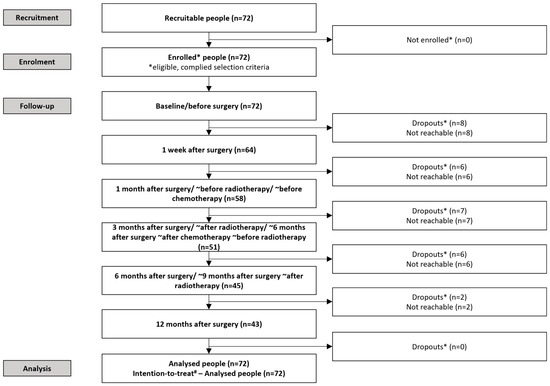
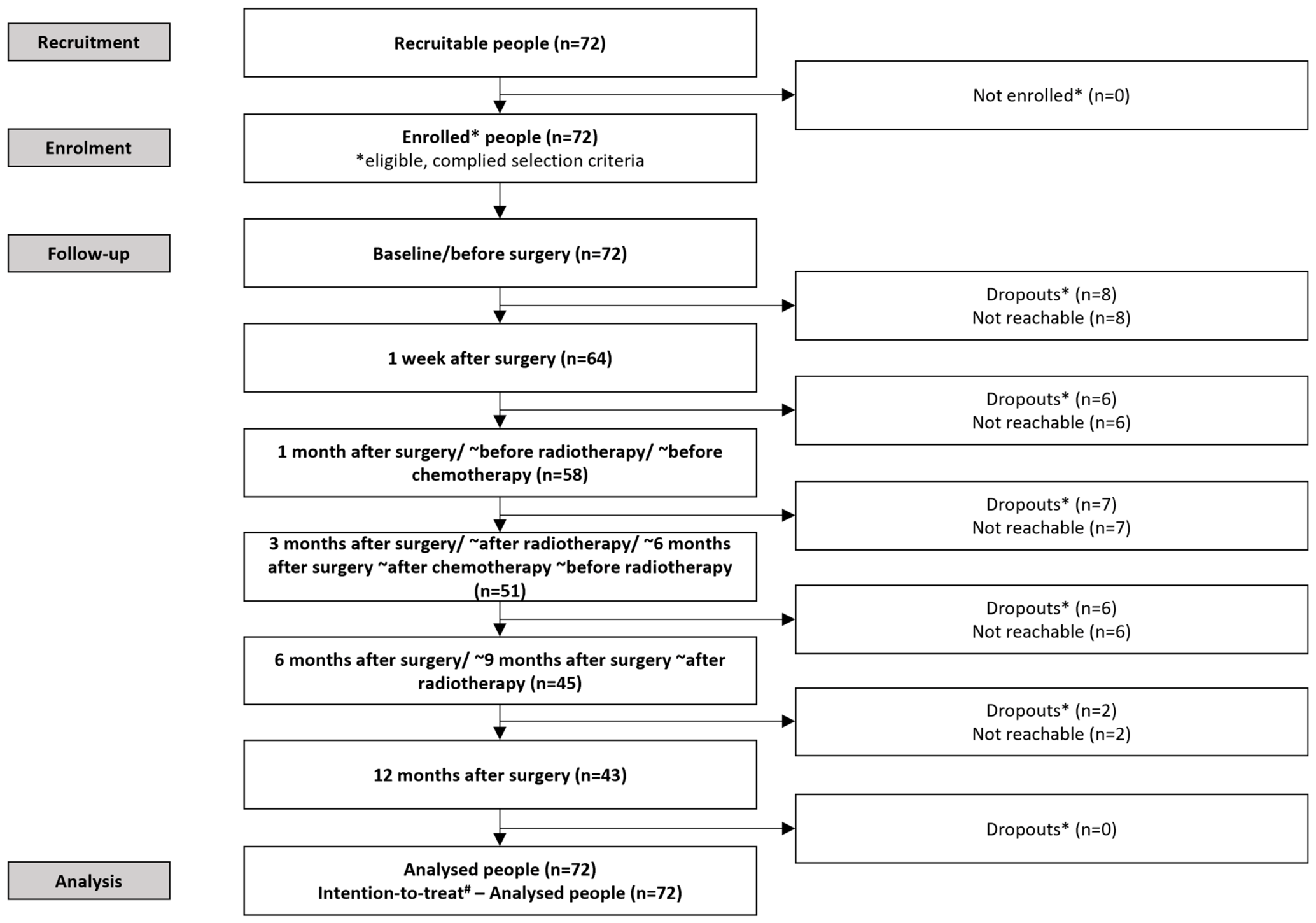
Seventy-two women (mean age 57 ± 11 years; BMI 27.5 ± 5.6 kg·m−2) were enrolled, and 43 completed the 12-month follow-up assessment (Figure 2).
Figure 2.
Flow diagram of participant recruitment, follow-up, and inclusion in longitudinal analyses. Abbreviation: n = number of participants; ~ indicates approximate assessment timing.
Baseline sociodemographic and clinical characteristics are presented in Table 1. All available observations were included in the longitudinal analyses using linear mixed-effects models. The actual timing of assessments relative to surgery is reported in Supplementary Table S1. Although assessments followed the predefined clinical schedule, variability in calendar timing was observed, particularly during the intermediate follow-up assessments, when participants followed different adjuvant-treatment pathways.
Table 1.
Baseline characteristics of women with breast cancer undergoing oncological treatment.
Forty-three participants completed the 12-month assessment and 29 did not. Baseline comparisons according to follow-up completion status are presented in Supplementary Table S2. Most between-group differences in quantitative sensory testing and psychosocial outcomes were small or imprecisely estimated. However, non-completers reported greater pain intensity during the conditioning stimulus than completers (NRS 0–10: MD[BCa95%CI] = +1.67[0.26;3.06]) and poorer baseline HRQoL (FACT-B total score: estimate [95%CI] = −13[−22;−4]; FACT-B TOI score: −7[−14;−2]; FACT-G total score: −13[−21;−4]).
3.2. Quantitative Sensory Testing and Sensory Processing
Quantitative sensory testing outcomes and longitudinal sensory trajectories are presented in Table 2A,B. Graphical representations of sensory trajectories are provided in the Supplementary Materials (Figures S1–S6).
Table 2.
(A) Longitudinal changes in primary/confirmatory quantitative sensory testing outcomes in women undergoing breast cancer treatment. (B) Longitudinal changes in exploratory quantitative sensory testing outcomes in women undergoing breast cancer treatment.
Objective sensory changes were observed throughout follow-up. These changes were dynamic and heterogeneous and were not consistently reflected by pain severity or self-reported sensitization symptoms.
3.2.1. Pressure Pain Sensitivity and Pain Modulation
PPTs exhibited muscle-specific and non-uniform changes over time (Table 2A). Significant overall time effects were observed in the scalene (A4-A2: MD [95%CI] = +0.53[0.03;1.03]; A4-A3: MD [95%CI] = +0.59[0.03;1.15]) and serratus anterior (A4-A1: MD [95%CI] = −0.94[−1.70;−0.17]; A4-A3: MD [95%CI] = −0.86[−1.67;−0.06]) muscles on the non-affected side, although post hoc analyses revealed heterogeneous patterns without a consistent directional trend across follow-up.
CPM responses changed progressively over time. Conditioning pain intensity increased significantly (A4-A0: MD [95%CI] = +4.12[0.24;8.01]; A5-A0: MD [95%CI] = +4.19[0.01;8.37]; main time effect, p = 0.031), while CPM responses at the rectus femoris progressively decreased, indicating reduced endogenous pain inhibitory capacity (Table 2A). Changes in CPM responses at the infraspinatus did not reach statistical significance.
For supra-threshold pressure stimulation, referred pain became less frequent over time (11% at baseline to 5% at 12 months), whereas pain intensity showed a non-significant decrease (Table 2A).
3.2.2. Detection Thresholds
Mechanical detection thresholds, thermal detection thresholds, and thermal pain thresholds remained largely stable throughout follow-up (Table 2B). No significant longitudinal changes were observed for MDTs on either the affected or non-affected side, and no evidence of mechanical allodynia was identified at any assessment point.
In contrast, longitudinal changes were identified in selected quantitative sensory testing parameters (Table 2B), particularly vibration detection thresholds, temporal summation, conditioned pain modulation and selected pressure pain threshold measures.
VDT demonstrated site-specific changes over time. Overall time effects were observed at the acromion (A1-A0: MD [95%CI] = −3.35[−6.58;−0.13]), epicondyle (A4-A1: MD [95%CI] = +7.55[2.61;12.48]; A4-A2: MD [95%CI] = +6.58[3.29;9.88], A4-A3: MD [95%CI] = +4.26[0.08;8.44]) and radial styloid (A5-A2: +4.80[0.78;9.10]) on the affected side and at the epicondyle (A4-A1: MD [95%CI] = +8.33[1.71;14.97]; A4-A2: MD [95%CI] = +8.17[3.82;12.52]) and radial styloid (A3-A0: MD [95%CI] = +5.11[0.00;10.51]) on the non-affected side (all p < 0.01). On the affected side, VDT at the acromion showed a transient decline one week after surgery, whereas VDT values at the epicondyle and radial styloid increased during later follow-up assessments. Similar increases were observed at selected sites on the non-affected side, particularly during mid-to-late follow-up. These findings suggest evolving sensory changes throughout the recovery trajectory.
Temporal summation remained facilitated throughout follow-up, with WUR values consistently greater than 1 (Table 2B). An overall time effect was observed on the affected side (p < 0.01), characterized by an initial increase following surgery and a gradual decline thereafter. No clear longitudinal changes were identified on the non-affected side.
3.3. Recovery-Related Outcomes
3.3.1. Pain, Psychosocial Variables and Health-Related Quality of Life
Pain, psychosocial variables, upper-limb function and HRQoL outcomes are summarized in Table 3.
Table 3.
Longitudinal changes in exploratory patient-reported outcomes of women undergoing breast cancer treatment: pain, sensitization indicators, psychological factors, and health-related quality of life.
Recovery trajectories differed across outcome domains. While pain intensity and self-reported sensitization symptoms remained relatively stable throughout follow-up, clinically relevant changes were observed in psychosocial outcomes, HRQoL and upper-limb function.
Pain intensity remained relatively stable across the study period, with no clear longitudinal changes in BPI pain severity scores (0[−1;1] points at 12 months after surgery from baseline; p = 0.255) (Table 3). Similarly, self-reported central sensitization symptoms, pain catastrophizing and pain acceptance did not demonstrate significant overall time effects (CSI: p = 0.86; PCS: p = 0.11; CPAQ: p = 0.34) (Table 3). The proportion of participants reporting severe pain remained low throughout follow-up (5%).
In contrast, kinesiophobia increased over time (main time effect, p < 0.002), rising +9[0;22] points at 12 months after surgery from baseline (Table 3). The largest increase was observed during the later stages of follow-up, suggesting persistent fear of movement despite the absence of worsening pain severity.
HRQoL also deteriorated throughout follow-up (FACT-B, main time effect, p < 0.001) (Table 3). The largest decline was observed between 3 and 12 months after surgery (MD [95%CI] = −10[−19;−1]), indicating a deterioration in perceived HRQoL during survivorship.
3.3.2. Upper-Limb Function
Upper-limb function deteriorated transiently following surgery (Table 3). SPADI scores worsened during the early and mid-follow-up assessments before partially recovering at 12 months after surgery. Neuropathic pain-related symptoms (S-LANSS) increased modestly during mid-to-late follow-up without evidence of progressive worsening.
Overall, quantitative sensory testing revealed dynamic changes in somatosensory processing throughout the breast cancer continuum that were not consistently paralleled by pain severity or self-reported sensitization symptoms.
4. Discussion
This prospective observational study provides a multidimensional perspective on recovery after breast cancer treatment by integrating sensory, psychosocial, functional and HRQoL outcomes across the treatment continuum. Overall, the findings indicate that survivorship trajectories are heterogeneous and multidimensional, characterized by dynamic changes in sensory processing, fear of movement and quality of life that were not consistently reflected by pain severity alone. Notably, pain intensity remained relatively stable, whereas kinesiophobia increased and HRQoL deteriorated over time. These findings reinforce the importance of multidimensional survivorship assessment beyond pain intensity or isolated physical outcomes and support the integration of sensory, psychosocial and functional domains within breast cancer survivorship care.
Although upper-limb function declined initially after surgery, scores returned to near-baseline levels by the end of follow-up. In contrast, HRQoL decreased over time, suggesting that recovery after breast cancer treatment extends beyond restoration of physical function alone. The dissociation between relatively preserved upper-limb function and worsening HRQoL highlights the complexity of survivorship experiences and supports the use of multidimensional biopsychosocial assessment approaches. Psychological, social and emotional factors are likely to contribute to perceived well-being after treatment [60]. Furthermore, increased kinesiophobia has previously been associated with poorer HRQoL in breast cancer survivors [61], a pattern consistent with the trajectories observed in the present cohort. Deteriorated CPM responses may also be clinically relevant, as impaired endogenous pain inhibitory capacity has been associated with greater pain interference, poorer HRQoL and persistent survivorship-related difficulties in chronic pain populations [62]. Together, these findings suggest that survivorship challenges may persist despite partial physical recovery.
Psychosocial outcomes followed distinct trajectories throughout follow-up. While pain catastrophizing remained stable and pain acceptance showed little change, kinesiophobia increased significantly, particularly during the later stages of follow-up. From a survivorship and rehabilitation perspective, this finding may be especially relevant because fear of movement can contribute to activity restriction, reduced participation, avoidance behaviours and delayed recovery despite relatively stable pain intensity. Psychological distress of this kind has previously been associated with prolonged pain and poorer outcomes in breast cancer survivors [17,18,63]. Factors such as fatigue or lymphedema-related concerns have been associated with kinesiophobia in previous studies [64,65,66,67,68,69], but their contribution to the trajectory observed here cannot be established because they were not assessed in the present study. These findings reinforce the importance of incorporating psychosocial assessment and behavioural rehabilitation strategies within survivorship care.
Pain intensity remained moderate and relatively stable throughout follow-up, whereas neuropathic pain features fluctuated over time. Stable pain intensity should not necessarily be interpreted as the absence of ongoing recovery-related difficulties, as sensory alterations, psychosocial challenges and HRQoL impairments may persist despite relatively low symptom severity [30,70,71,72,73,74]. These findings suggest that reliance on pain intensity alone may underestimate the complexity of survivorship recovery.
Objective sensory changes were observed throughout follow-up despite relatively stable pain intensity and self-reported sensitization symptoms, suggesting that somatosensory recovery may evolve independently from subjective symptom severity in some breast cancer survivors. While mechanical detection thresholds and thermal sensitivity remained largely stable, vibration detection thresholds and pressure pain thresholds demonstrated longitudinal changes. VDT alterations were site-specific and occurred on both the affected and non-affected sides, with more pronounced changes at distal anatomical locations. These findings are consistent with broader alterations in sensory processing that may reflect the combined influence of surgery, adjuvant treatments, recovery processes and individual adaptation mechanisms rather than isolated local effects [30,75,76,77]. However, given the observational design and heterogeneous treatment pathways, causal attribution to specific oncological therapies cannot be established.
Reduced pressure pain thresholds observed during follow-up are consistent with previous studies reporting lower thresholds after breast cancer surgery [35,77] and associations with pain presence and intensity among breast cancer survivors [33]. These findings support the potential value of pressure pain thresholds as indicators of altered pain sensitivity. Nevertheless, the variability observed across muscles and assessment points suggests that sensory recovery may follow heterogeneous and non-linear trajectories rather than a single directional pattern [30]. Accordingly, these findings should be interpreted as evidence of dynamic sensory adaptation rather than a uniform mechanistic pathway.
Previous studies have reported increased thermal perception thresholds and MDT alterations following surgery [29,31,71,78], with more pronounced impairments after mastectomy and axillary lymph node dissection compared with breast-conserving surgery or sentinel node biopsy [79]. Similar findings have been reported following chemotherapy and in patients with treatment-related neuropathy. In contrast, the relative stability of these measures in the present cohort may reflect differences in surgical techniques, adjuvant-treatment exposure or assessment timing.
Temporal summation declined over time whereas CPM responses deteriorated, characterized by increased conditioning pain intensity and reduced post-conditioning pressure pain thresholds. This apparent dissociation underscores the complexity of pain modulation during survivorship recovery and suggests that facilitatory and inhibitory mechanisms may evolve differently over time rather than reflecting a single underlying process. Similar dissociations have been reported in other chronic pain and cancer-related pain populations [22,63,80]. Rather than indicating recovery from central sensitization, reduced temporal summation may reflect adaptive or compensatory changes in spinal nociceptive processing [35,63,75], particularly in a cohort characterized by relatively low pain intensity and CSI scores consistently below the clinical threshold. In contrast, CPM may be more sensitive to contextual and psychological influences [81,82], underscoring the multifactorial nature of pain modulation following cancer treatment.
Self-reported symptoms of central sensitization remained below the clinical threshold throughout follow-up despite objective sensory alterations detected by QST. This dissociation between objective sensory alterations and subjective symptom perception suggests that sensory changes do not necessarily translate into clinically perceived symptom worsening [83]. Consistently low levels of pain catastrophizing may partly explain the relative stability of symptom perception despite objective sensory changes, highlighting the value of combining objective and self-reported measures when evaluating recovery after breast cancer treatment.
From a clinical perspective, these findings suggest that survivorship assessment based solely on pain intensity may underestimate ongoing recovery-related difficulties. Incorporating psychosocial outcomes, HRQoL measures and selected sensory assessments may help identify women at risk of persistent dysfunction despite relatively low symptom severity. Such multidimensional approaches may facilitate more personalized rehabilitation and supportive care strategies throughout breast cancer survivorship.
Strengths and Limitations
To our knowledge, this is the first study to longitudinally evaluate sensory trajectories across multiple stages of breast cancer treatment up to 12 months after surgery, integrating QST with psychosocial, functional and HRQoL outcomes. The study additionally provides a multidimensional perspective on survivorship recovery by capturing sensory, psychosocial and quality-of-life changes throughout the treatment continuum. The longitudinal design enabled the identification of dynamic recovery patterns and temporal divergences between objective and subjective outcomes, enhancing the ecological validity and clinical relevance of the findings.
Several limitations should nevertheless be acknowledged. First, the single-centre design may limit generalizability.
Second, participant attrition was substantial, with 43 of 72 participants completing the 12-month assessment. Baseline comparisons suggested potential selective attrition, as non-completers reported greater pain intensity during the conditioning stimulus and poorer HRQoL before starting the oncological treatment pathway. However, these differences cannot establish whether these baseline characteristics influenced subsequent follow-up completion, and reasons for dropout were not systematically retrieved. Although linear mixed-effects models incorporated all available data under a missing-at-random assumption, this assumption cannot be empirically verified. Therefore, attrition may have influenced some estimated longitudinal changes.
Third, while QST and the Central Sensitization Inventory provide valuable insights into pain-related sensory processing and sensitization, both measures have inherent limitations and should not be considered direct biomarkers of underlying neurophysiological mechanisms. Furthermore, although analyses were adjusted for relevant confounders, unmeasured factors such as fatigue, physical activity, sleep quality or cognitive function may have influenced recovery trajectories. Pain-related medication use was not systematically recorded, which represents an important limitation when interpreting pain-related outcomes and CPM. Analgesic use may reduce perceived pain intensity, potentially masking changes in the underlying pain experience, while pharmacological modulation of descending pain pathways may also influence CPM responses. Consequently, the relative stability of pain intensity observed throughout follow-up may partly reflect effective but unmeasured analgesic use, potentially leading to an underestimation of changes in pain severity. Similarly, unmeasured medication use may have contributed to the observed variability in CPM, limiting the extent to which longitudinal changes can be attributed to changes in endogenous pain modulation alone.
In addition, the broad multidimensional assessment resulted in multiple longitudinal comparisons. Family-wise error was controlled for the principal outcome family underpinning the sample-size calculation; however, the remaining outcomes were exploratory and were not individually powered or adjusted for multiplicity. Furthermore, the a priori sample-size calculation was based specifically on CPM/PPT-related measures and therefore did not provide outcome-specific power for these exploratory outcomes. Estimates for these outcomes should consequently be interpreted cautiously, considering the magnitude and precision of the observed changes, and as hypothesis-generating rather than definitive evidence of longitudinal change, particularly where isolated changes were observed without a consistent longitudinal pattern.
Finally, participants followed heterogeneous treatment pathways, and the nominal assessment phases did not necessarily represent the same clinical event or exact calendar time for all participants, particularly during intermediate follow-up. Although chemotherapy and radiotherapy exposure were included as covariates in the longitudinal analyses, this adjustment cannot fully account for differences in the timing or clinical meaning of individual assessment points. The longitudinal effects should therefore be interpreted as average changes across predefined follow-up phases rather than treatment-specific trajectories. A sensitivity analysis restricted to participants undergoing surgery alone was considered; however, this subgroup comprised only 25 participants at baseline and was further reduced across follow-up, with only seven contributing data at the final assessment. Such an analysis would therefore have produced highly imprecise and potentially unstable longitudinal estimates. Future adequately powered, treatment-stratified studies are needed to characterize treatment-specific trajectories.
5. Conclusions
Recovery after breast cancer treatment was characterized by heterogeneous sensory, psychosocial and health-related quality-of-life trajectories that were not consistently reflected by pain severity alone. Although pain intensity remained relatively stable, kinesiophobia increased and HRQoL deteriorated over time, suggesting that important survivorship challenges may persist despite partial physical recovery.
Objective sensory alterations additionally suggest evolving changes in somatosensory processing throughout survivorship. Together, these findings support the view that recovery after breast cancer treatment is multidimensional and extends beyond pain reduction or isolated functional outcomes.
Integrating sensory assessment, psychosocial evaluation and patient-reported outcomes may help identify women at risk of persistent recovery-related difficulties and facilitate more personalized rehabilitation and supportive care strategies. Future research should investigate the prognostic value of sensory alterations, the contribution of specific oncological therapies and the effectiveness of targeted interventions, including exercise, pain education, behavioural approaches and neuromodulation, to optimize survivorship care.
Supplementary Materials
The following supporting information can be downloaded at https://www.mdpi.com/article/10.3390/curroncol33090567/s1, Figure S1: Quantitative sensory testing—Mechanical detection threshold in women undergoing breast cancer treatment over 12 months of follow-up; Figure S2: Quantitative sensory testing—Vibration detection threshold in women undergoing breast cancer treatment over 12 months of follow-up; Figure S3: Quantitative sensory testing—Temporal summation in women undergoing breast cancer treatment over 12 months of follow-up; Figure S4: Quantitative sensory testing—Pressure pain threshold in women undergoing breast cancer treatment over 12 months of follow-up; Figure S5: Quantitative sensory testing—Conditioned pain modulation in women undergoing breast cancer treatment over 12 months of follow-up; Figure S6: Quantitative sensory testing—Supra-threshold pressure stimulation in women undergoing breast cancer treatment over 12 months of follow-up; Table S1: Baseline characteristics and outcome measures of completers vs. non-completers among women treated for breast cancer undergoing longitudinal follow-up; Table S2: Actual calendar timing of assessments relative to breast cancer surgery.
Author Contributions
Conceptualization, M.T.-L.; methodology, M.T.-L., F.R.-G. and N.S.D.; formal analysis, N.S.D.; investigation, L.L.-G., N.S.D., V.P.-G. and A.C.-G.; data curation, L.L.-G., N.S.D. and F.R.-G.; writing—original draft preparation, L.L.-G., N.S.D. and M.T.-L.; writing—review and editing, N.S.D., F.R.-G., V.P.-G., A.C.-G. and M.T.-L.; supervision, M.T.-L.; project administration, M.T.-L. All authors have read and agreed to the published version of the manuscript.
Funding
This research received no external funding.
Institutional Review Board Statement
The study was conducted in accordance with the Declaration of Helsinki and approved by the Ethics Committee of Príncipe de Asturias University Hospital, Alcalá de Henares, Madrid, Spain (protocol code OE16/2019; date of approval: 4 November 2019).
Informed Consent Statement
Informed consent was obtained from all subjects involved in the study.
Data Availability Statement
The data presented in this study are available on request from the corresponding author due to privacy and ethical restrictions related to the protection of participants’ confidential data.
Acknowledgments
The authors sincerely thank the women who participated in this study for their time and commitment.
Conflicts of Interest
The authors declare no conflicts of interest.
Abbreviations
| BMI | Body Mass Index |
| BPI | Brief Pain Inventory |
| CPM | Conditioned Pain Modulation |
| CPAQ | Chronic Pain Acceptance Questionnaire |
| CSI | Central Sensitization Inventory |
| FACT-B | Functional Assessment of Cancer Therapy-Breast |
| HRQoL | Health-Related Quality of Life |
| MDT | Mechanical Detection Threshold |
| PCS | Pain Catastrophizing Scale |
| PPT | Pressure Pain Threshold |
| QST | Quantitative Sensory Testing |
| SPADI | Shoulder Pain and Disability Index |
| S-LANSS | Self-report Leeds Assessment of Neuropathic Symptoms and Signs |
| TSK-11 | Tampa Scale of Kinesiophobia (11-Item Version) |
| TS | Temporal Summation |
| VDT | Vibration Detection Threshold |
| WUR | Wind-Up Ratio |
References
- Bray, F.; Laversanne, M.; Sung, H.; Ferlay, J.; Siegel, R.L.; Soerjomataram, I.; Ahmedin, J. Global Cancer Statistics 2022: GLOBOCAN Estimates of Incidence and Mortality Worldwide for 36 Cancers in 185 Countries. CA Cancer J. Clin. 2024, 74, 229–263. [Google Scholar] [CrossRef] [Scilit] [PubMed]
- Loibl, S.; André, F.; Bachelot, T.; Barrios, C.H.; Bergh, J.; Burstein, H.J.; Cardoso, M.J.; Carey, L.A.; Dawood, S.; Mastro, L.D.; et al. Early Breast Cancer: ESMO Clinical Practice Guideline for Diagnosis, Treatment and Follow-Up☆. Ann. Oncol. 2024, 35, 159–182. [Google Scholar] [CrossRef] [Scilit] [PubMed]
- Pascual, M.C.; Montaño, J.J.; Franch, P.; Sánchez-Contador, C.; Ramos, M. Survival of Breast Cancer by Stage, Grade and Molecular Groups in Mallorca, Spain. J. Clin. Med. 2022, 11, 5708. [Google Scholar] [CrossRef] [Scilit] [PubMed]
- Pérez, C.; Ochoa, D.; Sánchez, N.; Ballesteros, A.I.; Santidrián, S.; López, I.; Mondéjar, R.; Carnaval, T.; Villoria, J.; Colomer, R. Pain in Long-Term Cancer Survivors: Prevalence and Impact in a Cohort Composed Mostly of Breast Cancer Survivors. Cancers 2024, 16, 1581. [Google Scholar] [CrossRef] [Scilit] [PubMed]
- Pimentel-Parra, G.A.; García-Vivar, C.; Escalada-Hernández, P.; San Martín-Rodríguez, L.; Soto-Ruiz, N. Systematic Review of Clinical Practice Guidelines for Long-Term Breast Cancer Survivorship: Assessment of Quality and Evidence-Based Recommendations. Br. J. Cancer 2025, 133, 178–193. [Google Scholar] [CrossRef] [Scilit] [PubMed]
- Leysen, L.; Beckwée, D.; Nijs, J.; Pas, R.; Bilterys, T.; Vermeir, S.; Adriaenssens, N. Risk Factors of Pain in Breast Cancer Survivors: A Systematic Review and Meta-Analysis. Support. Care Cancer 2017, 25, 3607–3643. [Google Scholar] [CrossRef] [Scilit] [PubMed]
- Nishigami, T.; Manfuku, M.; Lahousse, A. Central Sensitization in Cancer Survivors and Its Clinical Implications: State of the Art. J. Clin. Med. 2023, 12, 4606. [Google Scholar] [CrossRef] [Scilit] [PubMed]
- Van Lishout, V.; Rex, S.; Fieuws, S.; Han, S.; Teunkens, A. Chronic Pain after Major Breast Surgery: A Retrospective Cohort Study. Eur. J. Anaesthesiol. 2025, 42, 1056–1063. [Google Scholar] [CrossRef] [Scilit] [PubMed]
- Wang, K.; Yee, C.; Tam, S.; Drost, L.; Chan, S.; Zaki, P.; Rico, V.; Ariello, K.; Dasios, M.; Lam, H.; et al. Prevalence of Pain in Patients with Breast Cancer Post-Treatment: A Systematic Review. Breast 2018, 42, 113–127. [Google Scholar] [CrossRef] [Scilit] [PubMed]
- Wang, L.; Cohen, J.C.; Devasenapathy, N.; Hong, B.Y.; Kheyson, S.; Lu, D.; Oparin, Y.; Kennedy, S.A.; Romerosa, B.; Arora, N.; et al. Prevalence and Intensity of Persistent Post-Surgical Pain Following Breast Cancer Surgery: A Systematic Review and Meta-Analysis of Observational Studies. Br. J. Anaesth. 2020, 125, 346–357. [Google Scholar] [CrossRef] [Scilit] [PubMed]
- Kanda, M.H.; da Costa Vieira, R.A.; Lima, J.P.S.N.; Paiva, C.E.; de Araujo, R.L.C. Late Locoregional Complications Associated with Adjuvant Radiotherapy in the Treatment of Breast Cancer: Systematic Review and Meta-Analysis. J. Surg. Oncol. 2020, 121, 766–776. [Google Scholar] [CrossRef] [Scilit] [PubMed]
- Lovelace, D.L.; McDaniel, L.R.; Golden, D. Long-Term Effects of Breast Cancer Surgery, Treatment, and Survivor Care. J. Midwifery Women’s Health 2019, 64, 713–724. [Google Scholar] [CrossRef] [Scilit] [PubMed]
- Nobre, I.; Silva, M.N.; Franco, S.; Rodrigues, B.; Silva, P.F.; Teixeira, P.J.; Carraça, E.V. Longitudinal Predictor Analysis of Pain in Breast Cancer Survivors on Aromatase Inhibitors-the PAC-WOMAN Trial. Front. Pain Res. 2026, 7, 1700365. [Google Scholar] [CrossRef] [Scilit] [PubMed]
- Zhu, Y.; Loggia, M.L.; Edwards, R.R.; Flowers, K.M.; Muñoz-Vergara, D.W.; Partridge, A.H.; Schreiber, K.L. Increased Clinical Pain Locations and Pain Sensitivity in Women After Breast Cancer Surgery: Influence of Aromatase Inhibitor Therapy. Clin. J. Pain 2022, 38, 721–729. [Google Scholar] [CrossRef] [Scilit] [PubMed]
- Amat-Fernandez, C.; Garin, O.; Luer-Aguila, R.; Pardo, Y.; Briseño, R.; Lizano-Barrantes, C.; Rojas-Concha, L.; Thong, M.S.Y.; Apolone, G.; Brunelli, C.; et al. Systematic Review of the Needs and Health-Related Quality of Life Domains Relevant to People Surviving Cancer in Europe. Qual. Life Res. 2025, 34, 913–936. [Google Scholar] [CrossRef] [Scilit] [PubMed]
- The WHOQOL Group. Development of the World Health Organization WHOQOL-BREF Quality of Life Assessment. Psychol. Med. 1998, 28, 551–558. [Google Scholar] [CrossRef] [Scilit] [PubMed]
- Moloney, N.A.; Pocovi, N.C.; Dylke, E.S.; Graham, P.L.; De Groef, A. Psychological Factors Are Associated with Pain at All Time Frames After Breast Cancer Surgery: A Systematic Review with Meta-Analyses. Pain Med. 2021, 22, 915–947. [Google Scholar] [CrossRef] [Scilit] [PubMed]
- Strijbos, B.T.M.; Janssen, L.; Voogd, A.C.; Zwaans, W.A.R.; Roumen, R.M.H.; Maaskant-Braat, A.J.G. Persistent Pain After Breast Cancer Treatment, an Underreported Burden for Breast Cancer Survivors. Ann. Surg. Oncol. 2024, 31, 6753–6763. [Google Scholar] [CrossRef] [Scilit] [PubMed]
- De Groef, A.; Meeus, M.; Heathcote, L.C.; Wiles, L.; Catley, M.; Vogelzang, A.; Olver, I.; Runciman, W.B.; Hibbert, P.; Dams, L.; et al. Treating Persistent Pain after Breast Cancer: Practice Gaps and Future Directions. J. Cancer Surviv. 2023, 17, 1698–1707. [Google Scholar] [CrossRef] [Scilit] [PubMed]
- Freynhagen, R.; Parada, H.A.; Calderon-Ospina, C.A.; Chen, J.; Rakhmawati Emril, D.; Fernández-Villacorta, F.J.; Franco, H.; Ho, K.-Y.; Lara-Solares, A.; Li, C.C.-F.; et al. Current Understanding of the Mixed Pain Concept: A Brief Narrative Review. Curr. Med. Res. Opin. 2019, 35, 1011–1018. [Google Scholar] [CrossRef] [Scilit] [PubMed]
- Saracoglu, I.; Isintas, M.; Turk, A.; Leysen, L.; Nijs, J. Phenotyping of Chronic Pain in Breast Cancer Survivors: An Original Study Using the Cancer Pain Phenotyping (CANPPHE) Network Multidisciplinary International Guidelines. Support. Care Cancer 2024, 32, 383. [Google Scholar] [CrossRef] [Scilit] [PubMed]
- Kosek, E.; Clauw, D.; Nijs, J.; Baron, R.; Gilron, I.; Harris, R.E.; Mico, J.-A.; Rice, A.S.C.; Sterling, M. Chronic Nociplastic Pain Affecting the Musculoskeletal System: Clinical Criteria and Grading System. Pain 2021, 162, 2629–2634. [Google Scholar] [CrossRef] [Scilit] [PubMed]
- Manfuku, M.; Nishigami, T.; Mibu, A.; Yamashita, H.; Imai, R.; Kanamori, H.; Sumiyoshi, K. Predictors of Persistent Post-Surgical Pain Intensity and Interference at 1 Year after Breast Cancer Surgery: Assessing Central Sensitization, Central Sensitivity Symptoms, and Psychological Factors. Breast Cancer 2023, 30, 271–281. [Google Scholar] [CrossRef] [Scilit] [PubMed]
- Nijs, J.; Lahousse, A.; Fernández-de-Las-Peñas, C.; Madeleine, P.; Fontaine, C.; Nishigami, T.; Desmedt, C.; Vanhoeij, M.; Mostaqim, K.; Cuesta-Vargas, A.I.; et al. Towards Precision Pain Medicine for Pain after Cancer: The Cancer Pain Phenotyping Network Multidisciplinary International Guidelines for Pain Phenotyping Using Nociplastic Pain Criteria. Br. J. Anaesth. 2023, 130, 611–621. [Google Scholar] [CrossRef] [Scilit] [PubMed]
- Schaible, H.G. Mechanisms of Chronic Pain in Osteoarthritis. Curr. Rheumatol. Rep. 2012, 14, 549–556. [Google Scholar] [CrossRef] [Scilit] [PubMed]
- Pavlaković, G.; Petzke, F. The Role of Quantitative Sensory Testing in the Evaluation of Musculoskeletal Pain Conditions. Curr. Rheumatol. Rep. 2010, 12, 455–461. [Google Scholar] [CrossRef] [Scilit] [PubMed]
- Rolke, R.; Baron, R.; Maier, C.; Tölle, T.R.; Treede, D.R.; Beyer, A.; Binder, A.; Birbaumer, N.; Birklein, F.; Bötefür, I.C.; et al. Quantitative Sensory Testing in the German Research Network on Neuropathic Pain (DFNS): Standardized Protocol and Reference Values. Pain 2006, 123, 231–243. [Google Scholar] [CrossRef] [Scilit] [PubMed]
- Uddin, Z.; MacDermid, J.C. Quantitative Sensory Testing in Chronic Musculoskeletal Pain. Pain Med. 2016, 17, 1694–1703. [Google Scholar] [CrossRef] [Scilit] [PubMed]
- Andersen, K.G.; Duriaud, H.M.; Aasvang, E.K.; Kehlet, H. Association between Sensory Dysfunction and Pain 1 Week after Breast Cancer Surgery: A Psychophysical Study. Acta Anaesthesiol. Scand. 2016, 60, 259–269. [Google Scholar] [CrossRef] [Scilit] [PubMed]
- De Groote, A.; Dams, L.; Van der Gucht, E.; Scheperss, J.; Merterns, M.; De Groef, A.; Meeus, M. From Breast Cancer Diagnosis to Survivorship: Analyzing Perioperative Biopsychosocial Phenotypes and Their Relationship to Pain on Long Term. J. Pain 2025, 26, 104709. [Google Scholar] [CrossRef] [Scilit] [PubMed]
- De Groote, A.; Meeus, M.; Coppens, L.; Kumar-Singh, S.; Dams, L.; Mosselmans, J.; Tjalma, W.; De Groef, A.; Gcam, M.M. Cytokines, Somatosensory Functioning, and Psychological Distress in Post-Breast Cancer Surgery Pain: A Longitudinal Study. Brain Behav. Immun. 2026, 133, 106281. [Google Scholar] [CrossRef] [Scilit] [PubMed]
- Hershman, D.L.; Weimer, L.H.; Wang, A.; Kranwinkel, G.; Brafman, L.; Fuentes, D.; Awad, D.; Crew, K.D. Association between Patient Reported Outcomes and Quantitative Sensory Tests for Measuring Long-Term Neurotoxicity in Breast Cancer Survivors Treated with Adjuvant Paclitaxel Chemotherapy. Breast Cancer Res. Treat. 2011, 125, 767–774. [Google Scholar] [CrossRef] [Scilit] [PubMed]
- Kanzawa-Lee, G.A.; Harte, S.E.; Bridges, C.M.; Brummett, C.; Clauw, D.J.; Williams, D.A.; Knoerl, R.; Smith, E.M.L. Pressure Pain Phenotypes in Women Before Breast Cancer Treatment. Oncol. Nurs. Forum 2018, 45, 483–495. [Google Scholar] [CrossRef] [Scilit] [PubMed]
- Puonti, H.K.; Jääskeläinen, S.K.; Hallikainen, H.K.; Partanen, T.A. Improved Sensory Recovery with a Novel Dual Neurorrhaphy Technique for Breast Reconstruction with Free Muscle Sparing TRAM Flap Technique. Microsurgery 2017, 37, 21–28. [Google Scholar] [CrossRef] [Scilit] [PubMed]
- Schreiber, K.L.; Zinboonyahgoon, N.; Xu, X.; Spivey, T.; King, T.; Dominici, L.; Partridge, A.; Golshan, M.; Strichartz, G.; Edwards, R.R. Preoperative Psychosocial and Psychophysical Phenotypes as Predictors of Acute Pain Outcomes After Breast Surgery. J. Pain 2019, 20, 540–556. [Google Scholar] [CrossRef] [Scilit] [PubMed]
- Vandenbroucke, J.P.; Von Elm, E.; Altman, D.G.; Gøtzsche, P.C.; Mulrow, C.D.; Pocock, S.J.; Poole, C.; Schlesselman, J.J.; Egger, M. Strengthening the Reporting of Observational Studies in Epidemiology (STROBE): Explanation and Elaboration. Epidemiology 2007, 18, 805–835. [Google Scholar] [CrossRef] [Scilit] [PubMed]
- de la Peña, F.A.; Novoa, S.A.; Gregori, J.G.; Cortijo, L.G.; Carrasco, F.H.; Martínez Martínez, M.T.; Estévez, C.M.; Stradella, A.; Losada, M.J.V.; Ciruelos, E. SEOM-GEICAM-SOLTI Clinical Guidelines for Early-Stage Breast Cancer (UPDATE 2025). Clin. Transl. Oncol. 2026, 28, 105–125. [Google Scholar] [CrossRef] [Scilit] [PubMed]
- Ong, W.L.; Schouwenburg, M.G.; van Bommel, A.C.M.; Stowell, C.; Allison, K.H.; Benn, K.E.; Browne, J.P.; Cooter, R.D.; Delaney, G.P.; Duhoux, F.P.; et al. A Standard Set of Value-Based Patient-Centered Outcomes for Breast Cancer: The International Consortium for Health Outcomes Measurement (ICHOM) Initiative. JAMA Oncol. 2017, 3, 677–685. [Google Scholar] [CrossRef] [Scilit] [PubMed]
- Martinez, V.; Lehman, T.; Lavand’homme, P.; Harkouk, H.; Kalso, E.; Pogatzki-Zahn, E.M.; Komann, M.; Meissner, W.; Weinmann, C.; Fletcher, D. Chronic Postsurgical Pain: A European Survey. Eur. J. Anaesthesiol. 2024, 41, 351–362. [Google Scholar] [CrossRef] [Scilit] [PubMed]
- Andersen, K.G.; Kehlet, H.; Aasvang, E.K. Test-Retest Agreement and Reliability of Quantitative Sensory Testing 1 Year after Breast Cancer Surgery. Clin. J. Pain 2015, 31, 393–403. [Google Scholar] [CrossRef] [Scilit] [PubMed]
- Anderson, R.J.; Craggs, J.G.; Bialosky, J.E.; Bishop, M.D.; George, S.Z.; Staud, R.; Robinson, M.E. Temporal Summation of Second Pain: Variability in Responses to a Fixed Protocol. Eur. J. Pain 2013, 17, 67–74. [Google Scholar] [CrossRef] [Scilit] [PubMed]
- Kielstra, S.C.; Reezigt, R.R.; Coppieters, M.W.; de Vries, R.; Arendt-Nielsen, L.; Petersen, K.K.; Yarnitsky, D.; Scholten-Peeters, G.G.M. A Myriad of Methods to Determine Temporal Summation of Pain in People with Musculoskeletal Pain and Healthy Participants: A Scoping Review. Pain Rep. 2024, 9, e1176. [Google Scholar] [CrossRef] [Scilit] [PubMed]
- Doménech-García, V.; Palsson, T.S.; Herrero, P.; Graven-Nielsen, T. Pressure-Induced Referred Pain Is Expanded by Persistent Soreness. Pain 2016, 157, 1164–1172. [Google Scholar] [CrossRef] [Scilit] [PubMed]
- Yarnitsky, D.; Bouhassira, D.; Drewes, A.M.; Fillingim, R.B.; Granot, M.; Hansson, P.; Landau, R.; Marchand, S.; Matre, D.; Nilsen, K.B.; et al. Recommendations on Practice of Conditioned Pain Modulation (CPM) Testing. Eur. J. Pain 2015, 19, 805–806. [Google Scholar] [CrossRef] [Scilit] [PubMed]
- Cuesta-Vargas, A.I.; Roldan-Jimenez, C.; Neblett, R.; Gatchel, R.J. Cross-Cultural Adaptation and Validity of the Spanish Central Sensitization Inventory. SpringerPlus 2016, 5, 1837. [Google Scholar] [CrossRef] [Scilit] [PubMed]
- García Campayo, J.; Rodero, B.; Alda, M.; Sobradiel, N.; Montero, J.; Moreno, S. Validation of the Spanish version of the Pain Catastrophizing Scale in fibromyalgia. Med. Clin. 2008, 131, 487–492. [Google Scholar] [CrossRef] [Scilit] [PubMed]
- Olmedilla Zafra, A.; Ortega Toro, E.; Abenza Cano, L. Validación de La Escala de Catastrofismo Ante El Dolor (Pain Catastrophizing Scale) En Deportistas Españoles. Cuad. Psicol. Deporte 2013, 13, 83–94. [Google Scholar] [CrossRef] [Scilit]
- Gómez-Pérez, L.; López-Martínez, A.E.; Ruiz-Párraga, G.T. Psychometric Properties of the Spanish Version of the Tampa Scale for Kinesiophobia (TSK). J. Pain 2011, 12, 425–435. [Google Scholar] [CrossRef] [Scilit] [PubMed]
- Rodero, B.; García-Campayo, J.; Casanueva, B.; del Hoyo, Y.L.; Serrano-Blanco, A.; Luciano, J.V. Validation of the Spanish Version of the Chronic Pain Acceptance Questionnaire (CPAQ) for the Assessment of Acceptance in Fibromyalgia. Health Qual. Life Outcomes 2010, 8, 37. [Google Scholar] [CrossRef] [Scilit] [PubMed]
- de la Rosa-Díaz, I.; Barrero-Santiago, L.; Acosta-Ramírez, P.; Martín-Peces-Barba, M.; Iglesias-Hernández, E.; Plisset, B.; Lutinier, N.; Belzanne, M.; La Touche, R.; Grande-Alonso, M. Cross-Sectional Comparative Study on Central Sensitization-Psychosocial Associated Comorbidities and Psychological Characteristics in Breast Cancer Survivors with Nociceptive Pain and Pain with Neuropathic Features and without Pain. Life 2022, 12, 1328. [Google Scholar] [CrossRef] [Scilit] [PubMed]
- Ghorbani, V.; Zanjani, Z.; Omidi, A.; Sarvizadeh, M. Efficacy of Acceptance and Commitment Therapy (ACT) on Depression, Pain Acceptance, and Psychological Flexibility in Married Women with Breast Cancer: A Pre- and Post-Test Clinical Trial. Trends Psychiatry Psychother. 2021, 43, 126–133. [Google Scholar] [CrossRef] [Scilit] [PubMed]
- Pérez-Cruzado, D.; Roldan-Jimenez, C.; Iglesias-Campos, M.; Pajares, B.; Alba, E.; Cuesta-Vargas, A. Validation of Pain Catastrophizing Scale on Breast Cancer Survivor. Pain Pract. 2022, 22, 711–717. [Google Scholar] [CrossRef] [Scilit] [PubMed]
- Martínez, R.B.; Boronat, O.G.; Badía, M.S.; Latiesas, J.S.; Navarro, E.M.; Fores, M.F. Validación de La Versión Española Del Functional Assessment of Cancer Therapy Questionnaire for Breast Cancer (FACT-B+4). Med. Clin. 2011, 137, 685–688. [Google Scholar] [CrossRef] [Scilit] [PubMed]
- Badia, X.; Muriel, C.; Gracia, A.; Manuel Núñez-Olarte, J.; Perulero, N.; Gálvez, R.; Carulla, J.; Cleeland, C.S. Validation of the Spanish Version of the Brief Pain Inventory in Patients with Oncological Pain. Med. Clin. 2003, 120, 52–59. [Google Scholar] [CrossRef] [PubMed]
- Mathias, S.D.; Crosby, R.D.; Qian, Y.; Jiang, Q.; Dansey, R.; Chung, K. Estimating Minimally Important Differences for the Worst Pain Rating of the Brief Pain Inventory-Short Form. J. Support. Oncol. 2011, 9, 72–78. [Google Scholar] [CrossRef] [Scilit] [PubMed]
- Torres-Lacomba, M.; Sánchez-Sánchez, B.; Prieto-Gómez, V.; Pacheco-da-Costa, S.; Yuste-Sánchez, M.J.; Navarro-Brazález, B.; Gutiérrez-Ortega, C. Spanish Cultural Adaptation and Validation of the Shoulder Pain and Disability Index, and the Oxford Shoulder Score after Breast Cancer Surgery. Health Qual. Life Outcomes 2015, 13, 63. [Google Scholar] [CrossRef] [Scilit] [PubMed]
- López-de-Uralde-Villanueva, I.; Gil-Martínez, A.; Candelas-Fernández, P.; de Andrés-Ares, J.; Beltrán-Alacreu, H.; La Touche, R. Validity and Reliability of the Spanish-Language Version of the Self-Administered Leeds Assessment of Neuropathic Symptoms and Signs (S-LANSS) Pain Scale. Neurologia 2018, 33, 505–514. [Google Scholar] [CrossRef] [Scilit] [PubMed]
- Lorenzo-Gallego, L.; Arranz-Martín, B.; Romay-Barrero, H.; Prieto-Gómez, V.; Lluch, E.; Torres-Lacomba, M. Changes in Pain Sensitivity in Treatment for Breast Cancer: A 12-Month Follow-Up Case Series. Int. J. Environ. Res. Public Health 2022, 19, 4055. [Google Scholar] [CrossRef] [Scilit] [PubMed]
- Twisk, J.; De Boer, M.; De Vente, W.; Heymans, M. Multiple Imputation of Missing Values Was Not Necessary before Performing a Longitudinal Mixed-Model Analysis. J. Clin. Epidemiol. 2013, 66, 1022–1028. [Google Scholar] [CrossRef] [Scilit] [PubMed]
- Phoosuwan, N.; Lundberg, P.C. Psychological Distress and Health-Related Quality of Life among Women with Breast Cancer: A Descriptive Cross-Sectional Study. Support. Care Cancer 2022, 30, 3177–3186. [Google Scholar] [CrossRef] [Scilit] [PubMed]
- Sunar, İ.; Sunar, V. Kinesiophobia in Breast Cancer Survivors and Its Relationship with Quality of Life, Comorbidity, and Other Clinical Parameters. Acta Haematol. Oncol. Turc. 2021, 54, 198–205. [Google Scholar] [CrossRef] [Scilit]
- Castelo-Branco, L.; Pacheco-Barrios, K.; Cardenas-Rojas, A.; de Melo, P.S.; Gianlorenco, A.C.; Gonzalez-Mego, P.; Marduy, A.; Shaik, E.S.; Teixeira, P.; Caumo, W.; et al. Cross-Sectional and Longitudinal Analysis of Conditioned Pain Modulation and Pain in Fibromyalgia: CPM as an Effect Modifier of Pain Changes over Time. Physiother. Res. Int. 2024, 29, e2072. [Google Scholar] [CrossRef] [Scilit] [PubMed]
- Edwards, R.R.; Mensing, G.; Cahalan, C.; Greenbaum, S.; Narang, S.; Belfer, I.; Schreiber, K.L.; Campbell, C.; Wasan, A.D.; Jamison, R.N. Alteration in Pain Modulation in Women with Persistent Pain after Lumpectomy: Influence of Catastrophizing. J. Pain Symptom Manag. 2013, 46, 30–42. [Google Scholar] [CrossRef] [Scilit] [PubMed]
- Allam, O.; Park, K.E.; Chandler, L.; Mozaffari, M.A.; Ahmad, M.; Lu, X.; Alperovich, M. The Impact of Radiation on Lymphedema: A Review of the Literature. Gland Surg. 2020, 9, 596–602. [Google Scholar] [CrossRef] [Scilit] [PubMed]
- Dhruva, A.; Dodd, M.; Paul, S.M.; Cooper, B.A.; Lee, K.; West, C.; Aouizerat, B.E.; Swift, P.S.; Wara, W.; Miaskowski, C. Trajectories of Fatigue in Patients with Breast Cancer Before, During, and After Radiation Therapy. Cancer Nurs. 2010, 33, 201–212. [Google Scholar] [CrossRef] [Scilit] [PubMed]
- Hajj, A.; Chamoun, R.; Salameh, P.; Khoury, R.; Hachem, R.; Sacre, H.; Chahine, G.; Kattan, J.; Rabbaa Khabbaz, L. Fatigue in Breast Cancer Patients on Chemotherapy: A Cross-Sectional Study Exploring Clinical, Biological, and Genetic Factors. BMC Cancer 2022, 22, 16. [Google Scholar] [CrossRef] [Scilit] [PubMed]
- Jeong, S.H.; Chun, S.M.; Lee, H.; Kim, M.; Choi, M.; Leigh, J.H. Association between Chemotherapy and the Risk of Developing Breast Cancer-Related Lymphedema: A Nationwide Retrospective Cohort Study. Support. Care Cancer 2025, 33, 143. [Google Scholar] [CrossRef] [Scilit] [PubMed]
- Malchrowicz-Mośko, E. Kinesiophobia among Breast Cancer Survivors One Year after Hospital Treatment. Int. J. Environ. Res. Public Health 2022, 19, 14565. [Google Scholar] [CrossRef] [Scilit] [PubMed]
- Monteiro, A.J.; de Labra, C.; Losa-Iglesias, M.E.; Dias, A.; Becerro-de-Bengoa-Vallejo, R.; Silva-Migueis, H.; Macedo, F.; López-López, D.; Gómez-Salgado, J. The Relationship of Kinesiophobia in Patients with Lymphedema: A Case-Control Investigation. Front. Psychiatry 2024, 15, 1293614. [Google Scholar] [CrossRef] [Scilit] [PubMed]
- Curatolo, M. Central Sensitization and Pain: Pathophysiologic and Clinical Insights. Curr. Neuropharmacol. 2024, 22, 15–22. [Google Scholar] [CrossRef] [Scilit] [PubMed]
- Haenen, V.; Dams, L.; Meeus, M.; Devoogdt, N.; Morlion, B.; De Groote, A.; De Groef, A. Continuum of Somatosensory Profiles in Breast Cancer Survivors with and without Pain, Compared to Healthy Controls and Patients with Fibromyalgia. Eur. J. Pain 2024, 28, 1226–1241. [Google Scholar] [CrossRef] [Scilit] [PubMed]
- Karshikoff, B.; Jensen, K.B.; Kosek, E.; Kalpouzos, G.; Soop, A.; Ingvar, M.; Olgart Höglund, C.; Lekander, M.; Axelsson, J. Why Sickness Hurts: A Central Mechanism for Pain Induced by Peripheral Inflammation. Brain Behav. Immun. 2016, 57, 38–46. [Google Scholar] [CrossRef] [Scilit] [PubMed]
- Woolf, C.J. Central Sensitization: Implications for the Diagnosis and Treatment of Pain. Pain 2011, 152, S2–S15. [Google Scholar] [CrossRef] [Scilit] [PubMed]
- Edirisinghe, N.P.; Makuloluwa, P.T.R.; Amarasekara, T.; Goonewardena, C.S.E. Coping with Cancer Pain: A Qualitative Study to Explore Pain Perception and Self-Coping Strategies of Patients with Cancer in Sri Lanka. BMJ Open 2024, 14, e085510. [Google Scholar] [CrossRef] [Scilit] [PubMed]
- Krøigård, T.; Schrøder, H.D.; Qvortrup, C.; Eckhoff, L.; Pfeiffer, P.; Gaist, D.; Sindrup, S.H. Characterization and Diagnostic Evaluation of Chronic Polyneuropathies Induced by Oxaliplatin and Docetaxel Comparing Skin Biopsy to Quantitative Sensory Testing and Nerve Conduction Studies. Eur. J. Neurol. 2014, 21, 623–629. [Google Scholar] [CrossRef] [Scilit] [PubMed]
- Park, S.B.; Lin, C.S.Y.; Krishnan, A.V.; Friedlander, M.L.; Lewis, C.R.; Kiernan, M.C. Early, Progressive, and Sustained Dysfunction of Sensory Axons Underlies Paclitaxel-Induced Neuropathy. Muscle Nerve 2011, 43, 367–374. [Google Scholar] [CrossRef] [Scilit] [PubMed]
- Zhi, W.I.; Baser, R.E.; Kwon, A.; Chen, C.; Li, S.Q.; Piulson, L.; Seluzicki, C.; Panageas, K.S.; Harte, S.E.; Mao, J.J.; et al. Characterization of Chemotherapy-Induced Peripheral Neuropathy Using Patient-Reported Outcomes and Quantitative Sensory Testing. Breast Cancer Res. Treat. 2021, 186, 761–768. [Google Scholar] [CrossRef] [Scilit] [PubMed]
- Dams, L.; Van der Gucht, E.; Haenen, V.; Lauwers, M.; De Pauw, S.; Steurs, T.; Devoogdt, N.; Smeets, A.; Bernar, K.; De Vrieze, T.; et al. Biopsychosocial Risk Factors for Pain and Pain-Related Disability 1 Year after Surgery for Breast Cancer. Support Care Cancer 2022, 30, 4465–4475. [Google Scholar] [CrossRef] [Scilit] [PubMed]
- Andersen, K.G.; Duriaud, H.M.; Kehlet, H.; Aasvang, E.K. The Relationship Between Sensory Loss and Persistent Pain 1 Year After Breast Cancer Surgery. J. Pain 2017, 18, 1129–1138. [Google Scholar] [CrossRef] [Scilit] [PubMed]
- Arribas-Romano, A.; Fernández-Carnero, J.; Beltran-Alacreu, H.; Alguacil-Diego, I.M.; Cuenca-Zaldívar, J.N.; Rodríguez-Lagos, L.; Runge, N.; Mercado, F. Conditioned Pain Modulation and Temporal Summation of Pain in Patients with Traumatic and Non-Specific Neck Pain: A Systematic Review and Meta-Analysis. J. Pain 2024, 25, 312–330. [Google Scholar] [CrossRef] [Scilit] [PubMed]
- Billens, A.; Van Oosterwijck, S.; Dhondt, E.; Meeus, M.; De Greef, I.; Van Damme, S.; Van Oosterwijck, J. The Influence of Expectations and Attention on Conditioned Pain Modulation: A Systematic Review and Meta-Analysis. Clin. Psychol. Rev. 2024, 114, 102517. [Google Scholar] [CrossRef] [Scilit] [PubMed]
- Mansfield, M.; Roviello, G.; Thacker, M.; Willett, M.; Bannister, K.; Smith, T. The Association between Conditioned Pain Modulation and Psychological Factors in People with Chronic Spinal Pain: A Systematic Review. Br. J. Pain 2024, 18, 314–324. [Google Scholar] [CrossRef] [Scilit] [PubMed]
- Colgan, D.D.; Eddy, A.; Green, K.; Oken, B. Adaptive Body Awareness Predicts Fewer Central Sensitization-Related Symptoms and Explains Relationship between Central Sensitization-Related Symptoms and Pain Intensity: A Cross-Sectional Study among Individuals with Chronic Pain. Pain Pract. 2021, 22, 222. [Google Scholar] [CrossRef] [Scilit] [PubMed]

Disclaimer/Publisher’s Note: The statements, opinions and data contained in all publications are solely those of the individual author(s) and contributor(s) and not of MDPI and/or the editor(s). MDPI and/or the editor(s) disclaim responsibility for any injury to people or property resulting from any ideas, methods, instructions or products referred to in the content. |
© 2026 by the authors. Licensee MDPI, Basel, Switzerland. This article is an open access article distributed under the terms and conditions of the Creative Commons Attribution (CC BY) license.