


Simple Summary
Patients with BRAFV600E-mutated metastatic lung cancer benefit from first-line BRAF plus MEK inhibitors and immune checkpoint inhibitor–chemotherapy. Nevertheless, a cost-effectiveness analysis comparing both treatments is lacking. This study suggests that despite the longer survival of first-line immune checkpoint inhibitor–chemotherapy compared with BRAF plus MEK inhibitors, the incremental cost-effectiveness ratios (Taiwan: $73,561/QALY; US: $290,279/QALY) exceeded the respective willingness-to-pay thresholds. Namely, first-line immune checkpoint inhibitor–chemotherapy is not a cost-effective strategy for patients with BRAFV600E-mutated metastatic lung cancer.
Abstract
Patients with BRAFV600E-mutated metastatic lung cancer benefit from both BRAF plus MEK inhibitors and immune checkpoint inhibitor (ICI)–chemotherapy. This study evaluated the cost-effectiveness of first-line ICI–chemotherapy compared with BRAF plus MEK inhibitors in these patients. This economic analysis, with a 15-year time horizon and an annual 3% discount, was conducted from the perspective of the healthcare sectors in Taiwan and the US. Simulated patients were entered into partitioned survival models upon initiation of first-line therapies. The model inputs were derived from the FRONT-BRAF study (progression-free/overall survival, adverse events, and subsequent therapies), insurance payments or retail prices (costs of drugs, physician visits, monitoring, adverse events, and end-of-life care), and a hospital cohort (health utility). Deterministic and probabilistic analyses were performed. The incremental cost-effectiveness ratios (ICERs) of ICI–chemotherapy compared with BRAF plus MEK inhibitors (Taiwan: $73,561/QALY; US: $290,279/QALY) exceeded the willingness-to-pay (WTP) thresholds (Taiwan: $70,000/QALY; US: $150,000/QALY). The drug costs of subsequent therapies and the utility values of the progressive-disease state were the major determinants of ICERs. In Taiwan, ICI–chemotherapy had a 41.0% probability of being cost-effective at the WTP threshold. ICI–chemotherapy had a higher probability of being cost-effective than BRAF plus MEK inhibitors when the WTP exceeded $300,000/QALY in the US. Our analysis suggests that, despite the longer survival of first-line ICI–chemotherapy compared with BRAF plus MEK inhibitors, ICI–chemotherapy is not a cost-effective strategy for patients with BRAFV600E-mutated metastatic lung cancer.
1. Introduction
The v-Raf murine sarcoma viral oncogene homolog B, Val600Glu (BRAFV600E) mutation is found in 1–3% of non-small cell lung cancer (NSCLC) [1]. Patients with BRAFV600E-mutated metastatic NSCLC benefit from BRAF plus mitogen-activated protein kinase (MEK) inhibitors [2]. Dabrafenib plus trametinib were found to have a durable effect in treatment-naïve and previously treated patients [3,4,5], whereas encorafenib plus binimetinib showed even longer overall survival (OS) in untreated patients [6,7]. Additionally, BRAFV600E mutation is frequently associated with elevated programmed death-ligand 1 (PD-L1) expression levels, which makes tumors susceptible to immune checkpoint inhibitors (ICIs) [8].
To date, no head-to-head trials have compared first-line BRAF plus MEK inhibitors with ICI-based therapies in patients with BRAFV600E-mutated metastatic NSCLC. A German real-world study found that time to treatment failure and OS were identical for patients receiving first-line therapies with dabrafenib-trametinib and ICI alone/ICI–chemotherapy, and there was a trend toward superior median OS in patients receiving ICI–chemotherapy (ICI alone: 21.0 months, dabrafenib-trametinib: 28.0 months, and ICI–chemotherapy: 31.8 months) [9]. Another retrospective study across 17 centers and four countries found that ICI-based therapies were associated with identical progression-free survival (PFS, p = 0.69) but improved median OS (40.9 months) compared with BRAF plus MEK inhibitors (22.7 months, hazard ratio = 0.63, p = 0.04) in the propensity score-matched cohort [10]. These findings are of clinical relevance as a randomized controlled trial comparing outcomes of both treatment strategies might not be easily performed, given that BRAFV600E is a relatively rare gene alteration in lung cancer.
Given that the economic burden of lung cancer has increased substantially over the past decade [11], selecting a cost-effective first-line treatment for patients with BRAFV600E-mutated metastatic NSCLC is important. Although first-line ICI–chemotherapy is associated with improved post-progression survival, subsequent therapy imposes substantial costs on the healthcare sector. Associated adverse events (AEs) also have financial consequences. Further investigation is required to determine whether the benefits outweigh the costs. To the best of our knowledge, there has been no economic analysis examining the cost-effectiveness of first-line ICI–chemotherapy compared with BRAF plus MEK inhibitors. Based on the results of the FRONT-BRAF study [10], we aimed to evaluate the cost-effectiveness of ICI–chemotherapy and BRAF plus MEK inhibitors as first-line treatments in patients with BRAFV600E-mutated metastatic lung cancer.
2. Materials and Methods
2.1. Model Overview
Partitioned survival models were adopted to simulate treatment-naïve patients with BRAFV600E-mutated metastatic lung cancer who received ICI–chemotherapy or BRAF plus MEK inhibitors as the first-line therapy (Supplementary Figure S1). We selected a model length of three weeks because ICI and chemotherapy are administered every three weeks. The time horizon was 15 years, and we applied an annual rate of 3% to discount future costs and life-years. This cost-effectiveness analysis followed the guidelines of the Consolidated Health Economic Evaluation Reporting Standards (CHEERS) (Supplementary Table S1) [12].
We selected pembrolizumab, pemetrexed, and carboplatin as the ICI–chemotherapy regimen and considered maintenance therapy with pembrolizumab and pemetrexed after four cycles of carboplatin. Based on the FRONT-BRAF study, 87.2% of patients received dabrafenib and trametinib, and 12.8% of patients received encorafenib and binimetinib as the BRAF plus MEK inhibitors [10]. After disease progression, 80.3% of patients starting with ICI–chemotherapy received subsequent therapy (24.5% chemotherapy, 75.5% BRAF and MEK inhibitors), whereas a smaller proportion (56.6%) of patients on BRAF and MEK inhibitors received subsequent therapy (13.1% chemotherapy, 84.4% ICI–chemotherapy, and 2.4% BRAF and MEK inhibitors) (Table 1).
Table 1.
Model parameters.
2.2. Survival Estimates
We used web-based software (WebPlotDigitizer, version 5.2) [17] to extract PFS and OS curves for first-line ICI–chemotherapy and BRAF and MEK inhibitors in the propensity score-matched cohort of the FRONT-BRAF study. The PFS and OS data were translated into patient-level information using the function “digitise()” in R [18,19]. We fitted parametric (loglogistic, Weibull, lognormal, gamma, generalized gamma, exponential) models to the data and selected the one with the most appropriate fit based on the Akaike Information Criterion (AIC) or Bayes Information Criterion (BIC) to extrapolate PFS and OS beyond the study follow-up period. Accordingly, the proportions of patients with progression-free disease, progressive disease, or deaths in each cycle were derived. We compared the modeled PFS and OS curves of first-line ICI–chemotherapy and BRAF and MEK inhibitors with those of the FRONT-BRAF study [10].
2.3. Cost and Health Utility
This economic analysis was conducted from the perspective of the healthcare sectors in Taiwan and the US. The Taiwan National Health Insurance (NHI) program is a single-payer system in which the drug prices for immunotherapy and targeted therapy are low. However, limited resources are available for drug reimbursements. Most individuals in the US receive insurance from private companies. Drug prices are high. We considered direct medical costs for drugs, physician visits, general monitoring (hemogram, biochemistry tests, and chest radiography), computed tomography with contrast, and end-of-life care [13,14,15]. We used the example of a 65-year-old man with a serum creatinine level of 1.0 mg/mL, average body surface area of 1.68 (1.90) m2, body weight of 60 (90) kg, and glomerular filtration rate of 73 (84) mL/min, to estimate the doses of intravenous agents in Taiwan (the US). Drug waste was accounted for by rounding up partially used vials while calculating drug costs (Supplementary Table S2). The incidence rates of AEs for ICI–chemotherapy and BRAF and MEK inhibitors were directly derived from the FRONT-BRAF study [10]. We multiplied the incidence rates of AE by the costs of AE management to estimate the costs attributable to AEs under each therapy (Supplementary Table S3) [20,21]. All costs were made equivalent to 2025 US dollars (USD).
Based on a hospital cohort’s European Quality of Life-Five Dimensions (EQ-5D) data, we applied a health utility value of 0.80 for patients in the progression-free state under ICI–chemotherapy [16]. For patients in the progression-free state under BRAF and MEK targeted therapy, we assigned a health utility value of 0.84. Patients in the progressive disease state receiving ICI–chemotherapy or targeted therapy received a health utility value of 0.72. These values echo the health utilities in metastatic NSCLC patients under ICI–chemotherapy [22] and targeted therapy [23].
2.4. Base-Case Analysis
We estimated the incremental cost-effectiveness ratio (ICER) as the incremental cost divided by quality-adjusted life years (QALY). In accordance with previous Taiwanese studies [24,25,26,27], we selected a willingness-to-pay (WTP) threshold of 70,000 USD per QALY, which is approximately two per capita gross domestic products (GDPs) in 2025 [28] and consistent with the most prominent practice of 1 to 3 times the GDP per capita [29]. For the US, a WTP threshold of 150,000 USD per QALY was selected [30]. We calculated the net monetary benefit (NMB) of each strategy as the product of QALYs and WTP minus the total cost. The incremental NMB was defined as the difference in NMB between the two strategies.
2.5. Deterministic and Probabilistic Analyses
One-way deterministic analyses were performed by varying the model parameters within plausible ranges (Table 1 and Supplementary Table S3) to generate tornado diagrams. To address the effects of parameter uncertainties, probabilistic analyses using a Monte Carlo simulation with 1000 iterations were conducted to generate the acceptability curves. R version 4.5.1 (R Foundation, Boston, MA, USA) was used to perform all the analyses.
2.6. Exploratory Analysis of TP53 Mutant and Wild-Type Subgroups
The FRON-BRAF study demonstrated PFS and OS curves of subgroups with and without TP53 co-mutations [10]. First-line ICI–chemotherapy, compared with BRAF plus MEK inhibitors, was associated with longer OS in patients with TP53 co-mutations. However, first-line ICI–chemotherapy was associated with a shorter PFS in patients with wild-type TP53. We fitted the PFS and OS data of patients with TP53 co-mutations and wild-type TP53 for the exploratory analysis.
2.7. Sensitivity Analysis Using Alternative Models for Survival Extrapolation
The most common parametric models for OS extrapolation included Weibull, loglogistic, lognormal, and exponential models [31]. To test the validity of our results, we used these alternative models to extrapolate the OS for sensitivity analysis.
3. Results
3.1. Base-Case Analysis
Based on the AIC and BIC of each parametric model (Supplementary Table S4), we selected log-normal distributions to extrapolate the PFS of patients receiving first-line ICI–chemotherapy and BRAF plus MEK inhibitors. Log-normal and log-logistic distributions were selected to extrapolate the OS of patients undergoing first-line ICI–chemotherapy and BRAF plus MEK inhibitors, respectively. The modeled PFS and OS curves resembled those demonstrated in the FRONT-BRAF study [10], indicating a good fit for the selected parametric models (Supplementary Figure S2).
Patients receiving first-line ICI–chemotherapy incurred an additional 101,183 USD (US: 399,278 USD) and effected an additional 1.37 QALYs compared with those receiving BRAF plus MEK inhibitors (Table 2), resulting in an ICER of 73,561 USD per QALY (US: 290,279 USD per QALY). Drug costs constituted the main component of the total costs and the cost difference between the two strategies. Pre-progression (ICI–chemotherapy: 1.36, BRAF plus MEK inhibitors: 1.30) QALYs did not differ significantly; however, patients receiving first-line ICI–chemotherapy had much longer post-progression QALYs compared with those receiving BRAF plus MEK inhibitors (2.35 versus 1.04 QALYs). The incremental NMB of ICI–chemotherapy compared with BRAF plus MEK inhibitors was −4899 USD (US: −192,953 USD).
Table 2.
Base-case results.
3.2. Deterministic and Probabilistic Analyses
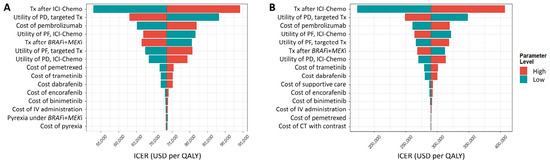
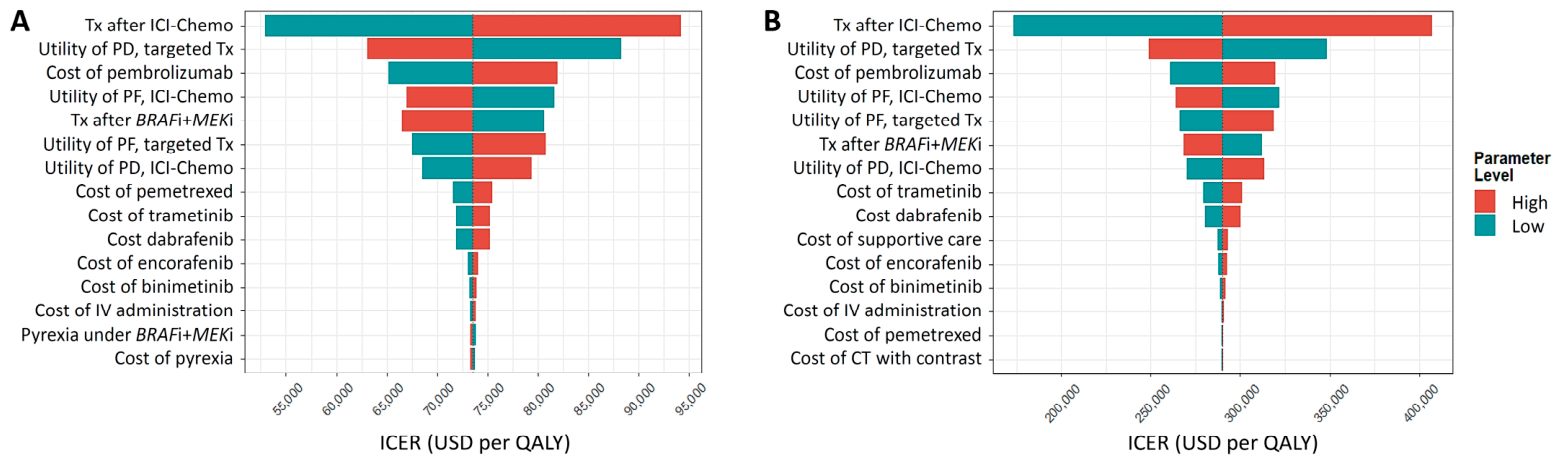
Tornado diagrams of first-line ICI–chemotherapy compared with BRAF plus MEK inhibitors showed that the probability of subsequent therapy for the ICI–chemotherapy group was the major determinant of ICERs (Figure 1). Notably, given that less than 77.2% of patients receive subsequent therapy after disease progression, ICI–chemotherapy could become a cost-effective strategy in Taiwan. Additionally, the higher the health utility of the progressive-disease state under targeted therapy or the progressive-free state under ICI–chemotherapy, the lower the ICER values.
Figure 1.
Tornado diagrams of ICI–chemotherapy versus BRAF plus MEK inhibitors ((A): Taiwan; (B): US). The dotted lines represent the base-case incremental cost-effectiveness ratios (ICERs). BRAFi, v-Raf murine sarcoma viral oncogene homolog B inhibitor; CT, computed tomography; ICI-Chemo, immune checkpoint inhibitor plus chemotherapy; IV, intravenous; MEKi, mitogen-activated protein kinase inhibitor; PD, progressive disease; PF, progression-free; QALY, quality-adjusted life-year; Tx, therapy; USD, US dollars.
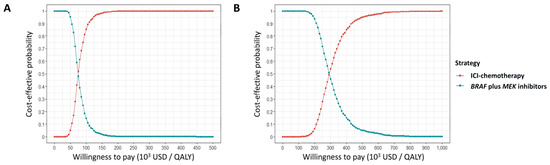
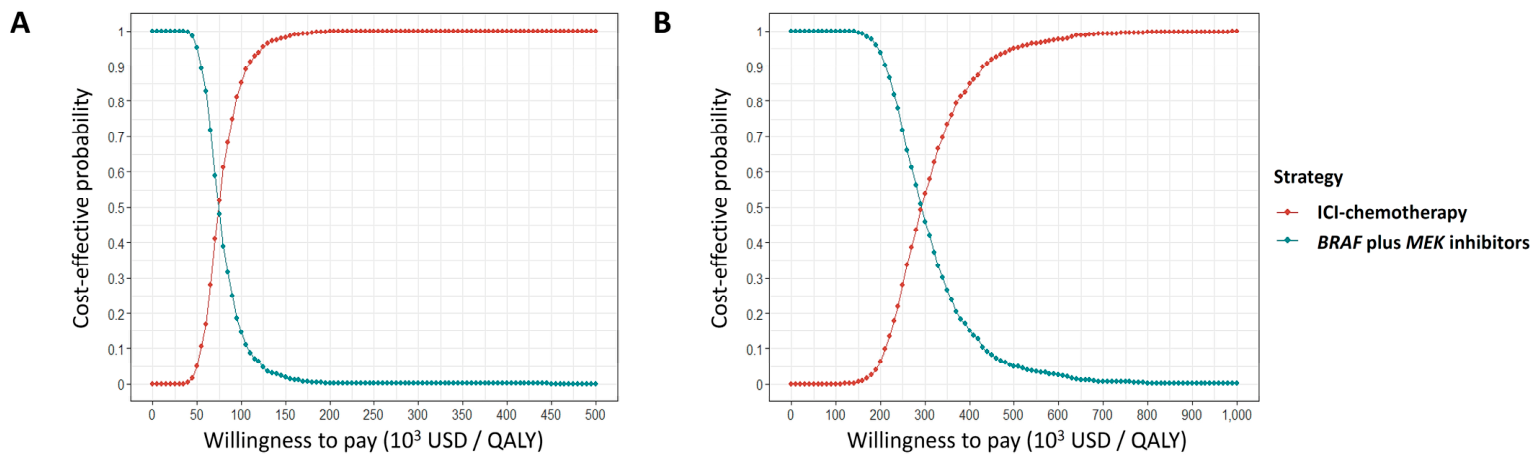
In Taiwan, the ICI–chemotherapy strategy had 41.0% and 89.0% probabilities of being cost-effective at the WTP threshold of 70,000 USD (2 per capita GDP) and 105,000 USD (3 per capita GDP) per QALY, respectively (Figure 2). In the US, first-line ICI–chemotherapy was unlikely to be cost-effective at the WTP threshold of 150,000 USD per QALY. If the WTP threshold was increased to 300,000 USD per QALY, ICI–chemotherapy had a higher probability of being cost-effective compared with BRAF plus MEK inhibitors.
Figure 2.
Acceptability curves for ICI–chemotherapy and BRAF plus MEK inhibitors ((A): Taiwan; (B): US). BRAF, v-Raf murine sarcoma viral oncogene homolog B; ICI, immune checkpoint inhibitor; MEK, mitogen-activated protein kinase; QALY, quality-adjusted life-year; USD, US dollars.
3.3. Exploratory Analysis of TP53 Mutant and Wild-Type Subgroups
In the TP53 mutant subgroup, patients receiving first-line ICI–chemotherapy had longer (3.96 − 1.95 = 2.01) QALYs than those receiving BRAF and MEK inhibitors. The ICER was 70,528 USD per QALY (US: 307,133 USD per QALY), whereas the incremental NMB was −960 USD (US: −315,846 USD, Table 3). However, in the TP53 wild-type subgroup, patients receiving first-line BRAF and MEK inhibitors had slightly longer QALYs than those receiving ICI–chemotherapy. The ICER of BRAF and MEK inhibitors compared with ICI–chemotherapy was 90,924 USD per QALY (US: 696,767 USD per QALY), with an incremental NMB of −9356 USD (US: −244,486 USD).
Table 3.
Exploratory analysis of TP53 mutant and wild-type subgroups.
3.4. Sensitivity Analysis Using Alternative Models for Survival Extrapolation
Varying the models to extrapolate the OS of patients receiving ICI–chemotherapy or BRAF plus MEK inhibitors, the ICERs were similar to those in the base case (Supplementary Table S5).
4. Discussion
The selection of ICI–chemotherapy or BRAF plus MEK inhibitors as first-line therapy for patients with BRAFV600E-mutated metastatic lung cancer is an issue under constant debate. Although real-world studies have found that first-line ICI–chemotherapy improved OS compared with BRAF plus MEK inhibitors [9,10], cost-effectiveness analyses comparing both treatment strategies have not been conducted. Based on the FRONT-BRAF study [10], our economic analysis demonstrated that first-line ICI–chemotherapy greatly increased the post-progression QALYs and drug costs of subsequent therapy. The ICERs of first-line ICI–chemotherapy compared with BRAF and MEK inhibitors exceeded the WTP thresholds in both countries (Taiwan: 73,561 USD per QALY; US: 290,279 USD per QALY). Probabilistic analysis and sensitivity analysis using alternative models to extrapolate the OS further validated that first-line ICI–chemotherapy is unlikely to be cost-effective.
In line with two important cohort studies [9,10], the pre-progression life years of ICI–chemotherapy and BRAF plus MEK inhibitors were similar. Longer post-progression life years of the ICI–chemotherapy group might reflect the delayed and sustainable benefits commonly observed in ICI-based therapies [32]. Owing to a major life-year difference in the post-progression state, subsequent drug costs and utility values of the progressive-disease state play important roles in determining the cost-effectiveness. For example, if the ICI–chemotherapy (BRAF plus MEK inhibitors) group’s probability of subsequent therapy could be decreased (increased) to 77.2% (62.4%) without affecting the effectiveness, first-line ICI–chemotherapy would become a cost-effective strategy in Taiwan. Similarly, given a utility value of the progressive-disease state under targeted therapy of >0.74, the ICER could be lower than the WTP threshold.
Probabilistic analyses of the two different healthcare environments revealed that first-line ICI–chemotherapy was unlikely to be cost-effective under the respective WTP thresholds. Given the increase in healthcare spending on cancer care, we acknowledge that the WTP thresholds might be underestimated. Researchers have inferred higher WTP thresholds, such as 3 per capita GDP per QALY in Taiwan and 300,000 USD per QALY in the US [33,34]. Our results indicated that first-line ICI–chemotherapy had an 89.0% probability of being cost-effective at the elevated WTP threshold in Taiwan; however, it only had a 54.0% probability of being cost-effective at the WTP threshold of 300,000 USD in the US. Such a discrepancy might result from the lower drug cost of subsequent therapy in Taiwan compared to that in the US, reducing the incremental cost and enhancing cost-effectiveness in Taiwan.
Exploratory analysis of TP53 wild-type patients showed that first-line ICI–chemotherapy no longer resulted in longer QALYs than BRAF plus MEK inhibitors. Patients without TP53 co-mutations may be less likely to develop resistance to BRAF plus MEK inhibitors and have a better OS than those with TP53 co-mutations. The OS benefit of first-line ICI–chemotherapy was mainly driven by the TP53 mutant subgroup. Nevertheless, the ICERs still exceeded the WTP thresholds. As the PFS of ICI–chemotherapy and BRAF plus MEK inhibitors were similar in the TP53 mutant subgroup [10]; a plausible reason for the high ICERs was the high cost incurred for subsequent therapy.
This study has several limitations. First, the PFS and OS were not simulated from a randomized controlled trial comparing first-line ICI–chemotherapy with BRAF plus MEK inhibitors. Although we used PFS and OS data in the propensity score-matched cohort of the FRONT-BRAF study [10], residual confounding still existed after balancing the age, smoking status, Eastern Cooperative Oncology Group performance status, PD-L1 expression levels, and brain metastasis of the two treatment groups. Patients receiving first-line ICI–chemotherapy were more likely to be healthier than those receiving BRAF plus MEK inhibitors. As a result, the survival benefit of ICI–chemotherapy might be overestimated, leading to a lower ICER value. Second, we did not consider dose reduction or interruption of therapy, leading to an overestimation of drug costs. This phenomenon is particularly apparent in subsequent ICI–chemotherapy after first-line BRAF plus MEK inhibitors, as more AEs leading to dose reduction or interruption are thought to occur in this state. Dose reduction or interruption would lower the costs for patients receiving first-line BRAF plus MEK inhibitors, thus making first-line ICI–chemotherapy less likely to be cost-effective. Third, exploratory analysis according to TP53 mutation status was based on small retrospective subgroups without propensity score matching; the results should be interpreted cautiously.
5. Conclusions
In conclusion, despite the longer OS of first-line ICI–chemotherapy compared with BRAF plus MEK inhibitors in a real-world scenario [10], our analysis suggests that first-line ICI–chemotherapy is unlikely to be a cost-effective strategy for patients with BRAFV600E-mutated metastatic lung cancer. Selecting subsequent therapies to reduce drug costs and increase health utility in the progressive-disease state would enhance cost-effectiveness.
Supplementary Materials
The following supporting information can be downloaded at https://www.mdpi.com/article/10.3390/curroncol33070384/s1, Figure S1: Model structure; Figure S2: Study and modeled progression-free survival and overall survival curves for patients under ICI-chemotherapy and BRAF plus MEK inhibitors; Table S1: The CHEERS 2022 checklist; Table S2: Doses and costs of drugs; Table S3: Parameter values for any grade AEs; Table S4: AIC and BIC for each parametric model of progression-free survival and overall survival; Table S5: Sensitivity analysis using alternative models to extrapolate the overall survival.
Author Contributions
C.-W.C.: Conceptualization, Data curation, Formal analysis, Writing—original draft, Writing—review and editing. J.-H.T.: Conceptualization, Data curation, Writing—review and editing. S.-H.T.: Data curation, Formal analysis, Methodology, Writing—review and editing. L.-J.C.: Investigation, Visualization, Project administration, Writing—review and editing. S.-C.Y.: Conceptualization, Data curation, Formal analysis, Investigation, Methodology, Project administration, Resources, Validation, Writing—original draft, Writing—review and editing. All authors have read and agreed to the published version of the manuscript.
Funding
The work was supported by the National Science and Technology Council (grant number NSTC 114-2314-B-006-107-MY3) and National Cheng Kung University Hospital (grant number NCKUH-11502015). The funding organization had no role in the design and conduct of the study; the collection, management, analysis, and interpretation of the data; the preparation, review, or approval of the manuscript; or the decision to submit the manuscript for publication.
Institutional Review Board Statement
The study was conducted in accordance with the Declaration of Helsinki and approved by the Institutional Review Board of the National Cheng Kung University Hospital (A-ER-113-443 on 2 December 2024 and A-ER-114-541 on 3 December 2025).
Informed Consent Statement
This model-based economic analysis received a consent exemption from the Institutional Review Board of the National Cheng Kung University Hospital.
Data Availability Statement
Study protocol and dataset: Not applicable. Statistical code: A partitioned survival model can be created from the information in the article. Codes are available on reasonable request to the corresponding author.
Conflicts of Interest
Dr. Yang reports grants from the National Science and Technology Council and National Cheng Kung University Hospital during this study. No other disclosures are made.
References
- Sánchez-Torres, J.M.; Viteri, S.; Molina, M.A.; Rosell, R. BRAF mutant non-small cell lung cancer and treatment with BRAF inhibitors. Transl. Lung Cancer Res. 2013, 2, 244–250. [Google Scholar] [CrossRef] [Scilit] [PubMed]
- Planchard, D.; Sanborn, R.E.; Negrao, M.V.; Vaishnavi, A.; Smit, E.F. BRAF(V600E)-mutant metastatic NSCLC: Disease overview and treatment landscape. npj Precis. Oncol. 2024, 8, 90. [Google Scholar] [PubMed]
- Planchard, D.; Smit, E.F.; Groen, H.J.M.; Mazieres, J.; Besse, B.; Helland, A.; Giannone, V.; D’Amelio, A.M., Jr.; Zhang, P.; Mookerjee, B.; et al. Dabrafenib plus trametinib in patients with previously untreated BRAF(V600E)-mutant metastatic non-small-cell lung cancer: An open-label, phase 2 trial. Lancet Oncol. 2017, 18, 1307–1316. [Google Scholar] [PubMed]
- Planchard, D.; Besse, B.; Groen, H.J.M.; Souquet, P.J.; Quoix, E.; Baik, C.S.; Barlesi, F.; Kim, T.M.; Mazieres, J.; Novello, S.; et al. Dabrafenib plus trametinib in patients with previously treated BRAF(V600E)-mutant metastatic non-small cell lung cancer: An open-label, multicentre phase 2 trial. Lancet Oncol. 2016, 17, 984–993. [Google Scholar] [CrossRef] [Scilit] [PubMed]
- Planchard, D.; Besse, B.; Groen, H.J.M.; Hashemi, S.M.S.; Mazieres, J.; Kim, T.M.; Quoix, E.; Souquet, P.J.; Barlesi, F.; Baik, C.; et al. Phase 2 study of dabrafenib plus trametinib in patients with BRAF V600E-mutant metastatic NSCLC: Updated 5-year survival rates and genomic analysis. J. Thorac. Oncol. 2022, 17, 103–115. [Google Scholar] [PubMed]
- Riely, G.J.; Smit, E.F.; Ahn, M.J.; Felip, E.; Ramalingam, S.S.; Tsao, A.; Johnson, M.; Gelsomino, F.; Esper, R.; Nadal, E.; et al. Phase II, open-label study of encorafenib plus binimetinib in patients with BRAF(V600)-mutant metastatic non-small-cell lung cancer. J. Clin. Oncol. 2023, 41, 3700–3711. [Google Scholar] [PubMed]
- Johnson, M.L.; Smit, E.F.; Felip, E.; Ramalingam, S.S.; Ahn, M.J.; Tsao, A.; Johnson, B.E.; Offin, M.; Hussein, M.; Dagogo-Jack, I.; et al. Updated overall survival analysis from the phase II PHAROS study of encorafenib plus binimetinib in patients with BRAF V600E-mutant metastatic non-small cell lung cancer. J. Clin. Oncol. 2025, 43, 3706–3713. [Google Scholar] [CrossRef] [Scilit] [PubMed]
- Negrao, M.V.; Skoulidis, F.; Montesion, M.; Schulze, K.; Bara, I.; Shen, V.; Xu, H.; Hu, S.; Sui, D.; Elamin, Y.Y.; et al. Oncogene-specific differences in tumor mutational burden, PD-L1 expression, and outcomes from immunotherapy in non-small cell lung cancer. J. Immunother. Cancer 2021, 9, e002891. [Google Scholar] [CrossRef] [Scilit] [PubMed]
- Wiesweg, M.; Alaffas, A.; Rasokat, A.; Saalfeld, F.C.; Rost, M.; Assmann, C.; Herster, F.; Hilbrandt, M.; Griesinger, F.; Kron, A.; et al. Treatment sequences in BRAF-V600-mutated NSCLC: First-line targeted therapy versus first-line (chemo-) immunotherapy. J. Thorac. Oncol. 2025, 20, 1328–1335. [Google Scholar] [CrossRef] [Scilit] [PubMed]
- Di Federico, A.; Wang, K.; Chen, M.F.; Barsouk, A.A.; Pagliaro, A.; Chen, L.N.; Ogliari, F.R.; Stockhammer, P.; Thawani, R.; Raslan, S.; et al. First-line immunotherapy with or without chemotherapy versus BRAF plus MEK inhibitors in BRAF(V600E)-mutated metastatic non-small-cell lung cancer (FRONT-BRAF): A multicentre, retrospective cohort study. Lancet Oncol. 2025, 26, 1357–1369. [Google Scholar] [CrossRef] [Scilit] [PubMed]
- Gourzoulidis, G.; Kastanioti, C.; Mavridoglou, G.; Kotsilieris, T.; Voudigaris, D.; Tzanetakos, C. Does real-world evidence of the economic burden of lung cancer in Greece exist? A systematic review of the literature. Curr. Oncol. 2025, 32, 130. [Google Scholar] [CrossRef] [Scilit] [PubMed]
- Husereau, D.; Drummond, M.; Augustovski, F.; de Bekker-Grob, E.; Briggs, A.H.; Carswell, C.; Caulley, L.; Chaiyakunapruk, N.; Greenberg, D.; Loder, E.; et al. Consolidated Health Economic Evaluation Reporting Standards 2022 (CHEERS 2022) statement: Updated reporting guidance for health economic evaluations. Value Health 2022, 25, 3–9. [Google Scholar] [CrossRef] [Scilit] [PubMed]
- Centers for Medicare & Medicaid Services. Search the Physician Fee Schedule. Available online: https://www.cms.gov/medicare/physician-fee-schedule/search (accessed on 25 January 2026).
- Drugs.com®. Drug Price Information. Available online: https://www.drugs.com/price-guide/ (accessed on 25 January 2025).
- Criss, S.D.; Mooradian, M.J.; Watson, T.R.; Gainor, J.F.; Reynolds, K.L.; Kong, C.Y. Cost-effectiveness of atezolizumab combination therapy for first-line treatment of metastatic nonsquamous non-small cell lung cancer in the United States. JAMA Netw. Open 2019, 2, e1911952. [Google Scholar] [CrossRef] [Scilit] [PubMed]
- Yang, S.C.; Kuo, C.W.; Lai, W.W.; Lin, C.C.; Su, W.C.; Chang, S.M.; Wang, J.D. Dynamic changes of health utility in lung cancer patients receiving different treatments: A 7-year follow-up. J. Thorac. Oncol. 2019, 14, 1892–1900. [Google Scholar] [CrossRef] [Scilit] [PubMed]
- Automeris.io. Extract Data from Charts. Available online: https://automeris.io/ (accessed on 25 January 2026).
- Krijkamp, E.M.; Alarid-Escudero, F.; Enns, E.A.; Pechlivanoglou, P.; Hunink, M.G.M.; Yang, A.; Jalal, H.J. A multidimensional array representation of state-transition model dynamics. Med. Decis. Mak. 2020, 40, 242–248. [Google Scholar] [CrossRef] [Scilit]
- Krijkamp, E.M.; Alarid-Escudero, F.; Enns, E.A.; Jalal, H.J.; Hunink, M.G.M.; Pechlivanoglou, P. Microsimulation modeling for health decision sciences using R: A tutorial. Med. Decis. Mak. 2018, 38, 400–422. [Google Scholar] [CrossRef] [Scilit]
- Lin, C.Y.; Wu, T.I.; Yang, S.C. Estimating costs associated with adverse events in patients with advanced lung cancer. Clin. Outcomes Res. 2024, 16, 761–769. [Google Scholar] [CrossRef] [Scilit]
- Patel, A.; Schuldt, R.; Sussell, J. New estimates of the costs of adverse events in patients with cancer. PLoS ONE 2025, 20, e0332703. [Google Scholar] [CrossRef] [Scilit] [PubMed]
- Huang, M.; Chandwani, S.; Insinga, R.; Burke, T.A.; Pellisier, J.; Pickkard, A.S. Health state utilities in metastatic NSCLC: A study of multiple immuno-oncology trials. Value Health 2018, 21, S72–S73. [Google Scholar] [CrossRef] [Scilit]
- Ku, L.E.; Tsai, J.H.; Chen, L.J.; Yang, S.C. Cost-effectiveness of lazertinib as first-line treatment in patients with EGFR-mutated advanced lung cancer. Ther. Adv. Med. Oncol. 2025, 17, 17588359241312143. [Google Scholar] [PubMed]
- Chen, P.; Lee, Y. Willingness to pay per quality-adjusted life in Taiwan. Value Health 2018, 21, S92. [Google Scholar] [CrossRef] [Scilit]
- Ou, H.T.; Tsai, J.H.; Chen, Y.L.; Wu, T.I.; Chen, L.J.; Yang, S.C. Cost-effectiveness of exclusionary EGFR testing for Taiwanese patients newly diagnosed with advanced lung adenocarcinoma. Pharmacoeconomics 2025, 43, 429–440. [Google Scholar] [PubMed]
- Tsai, S.H.; Tsai, J.H.; Chen, L.J.; Yang, S.C. Cost-effectiveness of durvalumab after chemoradiotherapy in limited-stage SCLC. JTO Clin. Res. Rep. 2025, 6, 100879. [Google Scholar] [CrossRef] [Scilit] [PubMed]
- Tsai, J.H.; Tsai, S.H.; Chen, L.J.; Yang, S.C. Cost-effectiveness of combination amivantamab-lazertinib, osimertnib plus chemotherapy, and osimertinib monotherapy in lung cancer. J. Natl. Compr. Canc Netw. 2026; in press. [PubMed]
- National Statistics, Republic of China (Taiwan). Economic Growth Rate: Per Capita GDP (US Dollars). Available online: https://eng.stat.gov.tw//Point.aspx?sid=t.1&n=4200&sms=11713 (accessed on 25 January 2025).
- Tzanetakos, C.; Gourzoulidis, G. Does a standard cost-effectiveness threshold exist? The case of Greece. Value Health Reg. Issues 2023, 36, 18–26. [Google Scholar] [CrossRef] [Scilit] [PubMed]
- Neumann, P.J.; Cohen, J.T.; Weinstein, M.C. Updating cost-effectiveness—The curious resilience of the $50,000-per-QALY threshold. N. Engl. J. Med. 2014, 371, 796–797. [Google Scholar] [PubMed]
- Latimer, N.R.; Adler, A.I. Extrapolation beyond the end of trials to estimate long term survival and cost effectiveness. BMJ Med. 2022, 1, e000094. [Google Scholar] [CrossRef] [Scilit] [PubMed]
- Kobayashi, T.; Nakamura, S.; Hakozaki, T. Capturing durable benefits: Interpreting six-year treatment-free survival and restricted mean survival time in CheckMate 227. J. Thorac. Dis. 2025, 17, 10600–10604. [Google Scholar] [CrossRef] [Scilit] [PubMed]
- Iino, H.; Hashiguchi, M.; Hori, S. Estimating the range of incremental cost-effectiveness thresholds for healthcare based on willingness to pay and GDP per capita: A systematic review. PLoS ONE 2022, 17, e0266934. [Google Scholar] [CrossRef] [Scilit] [PubMed]
- Seabury, S.A.; Goldman, D.P.; Maclean, J.R.; Penrod, J.R.; Lakdawalla, D.N. Patients value metastatic cancer therapy more highly than is typically shown through traditional estimates. Health Aff. 2012, 31, 691–699. [Google Scholar] [CrossRef] [Scilit]

Disclaimer/Publisher’s Note: The statements, opinions and data contained in all publications are solely those of the individual author(s) and contributor(s) and not of MDPI and/or the editor(s). MDPI and/or the editor(s) disclaim responsibility for any injury to people or property resulting from any ideas, methods, instructions or products referred to in the content. |
© 2026 by the authors. Licensee MDPI, Basel, Switzerland. This article is an open access article distributed under the terms and conditions of the Creative Commons Attribution (CC BY) license.