


Simple Summary
Muscle-invasive bladder cancer is an aggressive disease associated with a high risk of recurrence and poor survival. Recent clinical evidence has shown that adding durvalumab, an immunotherapy drug, to chemotherapy before surgery and continuing treatment with durvalumab after surgery improves survival compared with chemotherapy alone. This study evaluated whether this new treatment strategy represents good value for money within the Spanish National Health System. Using an economic model to estimate long-term costs and health outcomes, we found that adding durvalumab resulted in longer survival and better quality of life, at an additional cost considered acceptable in Spain. These findings remained consistent across different sensitivity analyses. Overall, durvalumab given before and after surgery in combination with chemotherapy represents a cost-effective treatment option for Spanish patients with muscle-invasive bladder cancer. These findings may help guide healthcare decisions and support the introduction of new treatments into clinical practice in Spain.
Abstract
Background: Muscle-invasive bladder cancer (MIBC) is associated with poor prognosis and high recurrence rates despite multimodal treatment. In the phase III NIAGARA trial, perioperative durvalumab plus neoadjuvant chemotherapy (gemcitabine and cisplatin; gem-cis) and radical cystectomy, significantly improved event-free survival (EFS) and overall survival (OS) compared with neoadjuvant gem-cis chemotherapy. This study assessed the cost-effectiveness of this strategy from the perspective of the Spanish National Health System (NHS). Methods: A Semi-Markov state transition model with three mutually exclusive health states (event-free, recurrent disease, and death) was developed to evaluate the lifetime costs and health outcomes of perioperative durvalumab and standard therapy, discounted at 3% annually. Clinical efficacy and safety data were derived from the NIAGARA trial. Time-to-recurrence, time-to-death prior to recurrence, and post-recurrence survival were extrapolated using parametric and spline-based survival models. Direct healthcare costs included drug acquisition and administration, disease management, adverse events, radical cystectomy, subsequent treatments, and end-of-life care and were derived from Spanish databases, where available. Health outcomes were expressed as life–years (LYs) and quality-adjusted life–years (QALYs). Deterministic and probabilistic sensitivity analyses were performed to assess model uncertainty. Results: In the base-case analysis, perioperative durvalumab + gem-cis generated incremental cost-effectiveness ratio (ICER) of € 18,984 per LY gained, and incremental cost–utility ratio (ICUR) of € 23,791 per QALY gained versus gem-cis. Sensitivity analyses demonstrated robust results, with ICUR values ranging from € 16,221 to € 29,778 per QALY. Conclusions: Perioperative durvalumab + gem-cis provides clinically meaningful benefits for patients with MIBC, improving survival and quality-adjusted survival compared with standard chemotherapy. From the perspective of the Spanish NHS, the strategy is cost-effective, supporting its adoption in clinical practice.
1. Introduction
Bladder cancer arises from the urothelial cells lining the inner surface of the urinary tract and remains the most common malignancy of the urinary system [1]. In Spain, it is second most prevalent cancer among men, after prostate cancer [2], and the country has the highest age-standardized incidence rates of bladder cancer worldwide [3].
Urothelial carcinoma (UC) represents the predominant histological subtype of bladder cancer, accounting for approximately 95% of cases worldwide [4]. At diagnosis, around 75% of patients present with non–muscle-invasive bladder cancer (NMIBC), confined to the mucosa or lamina propria. In contrast, 25% of patients are diagnosed with muscle-invasive bladder cancer (MIBC) or metastatic disease at presentation [1,5,6]. MIBC is defined by tumor invasion into the muscularis propria (detrusor muscle) of the bladder wall (stage T2 or higher), with potential progression into perivesical tissue, adjacent tissues or distant metastases [7].
Patients with bladder cancer commonly present with hematuria and irritative urinary symptoms, such as dysuria, urinary frequency, urgency, or nocturia [8]. Bladder or pelvic pain is less frequent and may suggest locally advanced or muscle-invasive disease [6,8]. In advanced stages, systemic symptoms such as weight loss, fatigue, or bone pain may occur, indicating metastatic disease [8].
Muscle-invasive bladder cancer carries a poor prognosis, with a 5-year overall survival (OS) rate of approximately 40–50% [5,9]. Radical cystectomy is the standard surgical treatment for localized MIBC. In the perioperative setting, cisplatin-based neoadjuvant chemotherapy has demonstrated improvements in OS and disease-free survival [8]. Despite multimodal treatment, approximately 50% of patients experience disease recurrence within three years, highlighting a substantial unmet clinical need [10].
Beyond its clinical burden, bladder cancer is associated with substantial healthcare costs, particularly in patients with MIBC [11]. The need for radical cystectomy, systemic therapies, intensive follow-up, and management of recurrent disease contributes significantly to healthcare resource utilization, making bladder cancer one of the most costly malignancies to manage on a per-patient basis [10,11,12,13].
In this context, perioperative immunotherapy has emerged as a relevant therapeutic strategy [8]. Historically, the standard-of-care (SoC) for patients with MIBC has been neoadjuvant cisplatin-based chemotherapy followed by radical cystectomy. For patients who do not receive neoadjuvant chemotherapy, adjuvant cisplatin-based chemotherapy may be considered after surgery.
Adjuvant immunotherapy (nivolumab) may be recommended for selected patients [8]. In Spain, it is reimbursed as adjuvant monotherapy for patients with PD-L1 tumour expression ≥ 1%, based on the CheckMate 274 trial. Eligible patients include those with residual disease after neoadjuvant chemotherapy (≥pT2 or ypN+) and selected patients who did not receive neoadjuvant cisplatin-based chemotherapy [14,15]. Evidence for other adjuvant immuno-therapies has not been consistent.
Durvalumab is an anti-PD-L1 monoclonal antibody that restores antitumour immune responses by blocking the interaction between PD-L1 and its receptors [16,17]. PD-L1 is frequently overexpressed across multiple malignancies, and higher expression has been consistently associated with poor prognosis [16].
In the phase III NIAGARA trial, perioperative durvalumab plus neoadjuvant gemcitabine and cisplatin (gem-cis) followed by radical cystectomy, demonstrated a statistically significant improvement in event-free survival (EFS) (hazard ratio [HR] 0.68; 95% CI 0.59–0.82; p < 0.001) and OS (HR 0.75; 95% CI 0.59–0.93; p = 0.0106) compared with neoadjuvant gem-cis alone in patients with MIBC [18]. The safety profile was manageable and consistent with prior experience [18].
On the basis of these results, the Spanish Society of Medical Oncology (SEOM) and the Spanish Society of Oncological Urology (SOGUG) have positioned perioperative durvalumab as the preferred treatment option for cisplatin-eligible patients with MIBC, assigning it the maximum clinical benefit rating (level A) on the ESMO-Magnitude of Clinical Benefit Scale (ESMO-MCBS) for curative treatments. International health technology assessment agencies (HTA), including National Institute for Health and Care Excellence (NICE), the German Federal Joint Committee (G-BA), and the French Haute Autorité de Santé (HAS), have also issued favorable assessments.
The objective of this study is to assess the cost-effectiveness, from the perspective of the Spanish NHS, of neoadjuvant durvalumab in combination with gem-cis, followed by radical cystectomy and adjuvant durvalumab monotherapy, compared with neoadjuvant gem-cis followed by radical cystectomy, as the SoC used in Spanish clinical practice.
2. Methods
This economic evaluation was conducted and reported in accordance with the Consolidated Health Economic Evaluation Reporting Standards (CHEERS) 2022 checklist. The completed checklist is provided as Supplementary Material (Table S1).
A semi-Markov state transition model (STM) was developed to assess the cost-effectiveness of perioperative durvalumab in patients with MIBC. The model was adapted to the Spanish healthcare setting by incorporating local costs, epidemiological data, and clinical practice assumptions. A STM was selected over a partitioned survival model because this approach provides a more explicit structural link between intermediate (e.g., EFS) and final endpoints (e.g., OS), improving transparency around the mechanisms and processes underpinning results [19]. Further, this approach facilitates meaningful sensitivity analyses around the impact of pre- and post-recurrence survival on outcomes. The STM used a semi-Markov approach that relaxes the memoryless feature of standard Markov models by allowing transition probabilities to vary based on the time spent in each state. All inputs and assumptions were reviewed and validated by an expert panel composed of a hospital pharmacist, and two oncologists specializing in bladder cancer. The model was developed using Microsoft Excel for Microsoft 365 (2025).
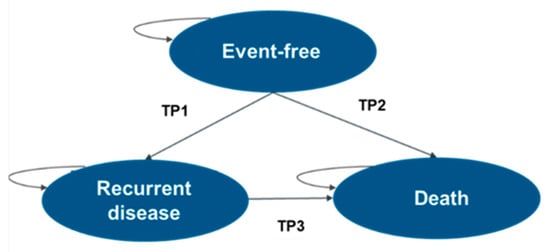
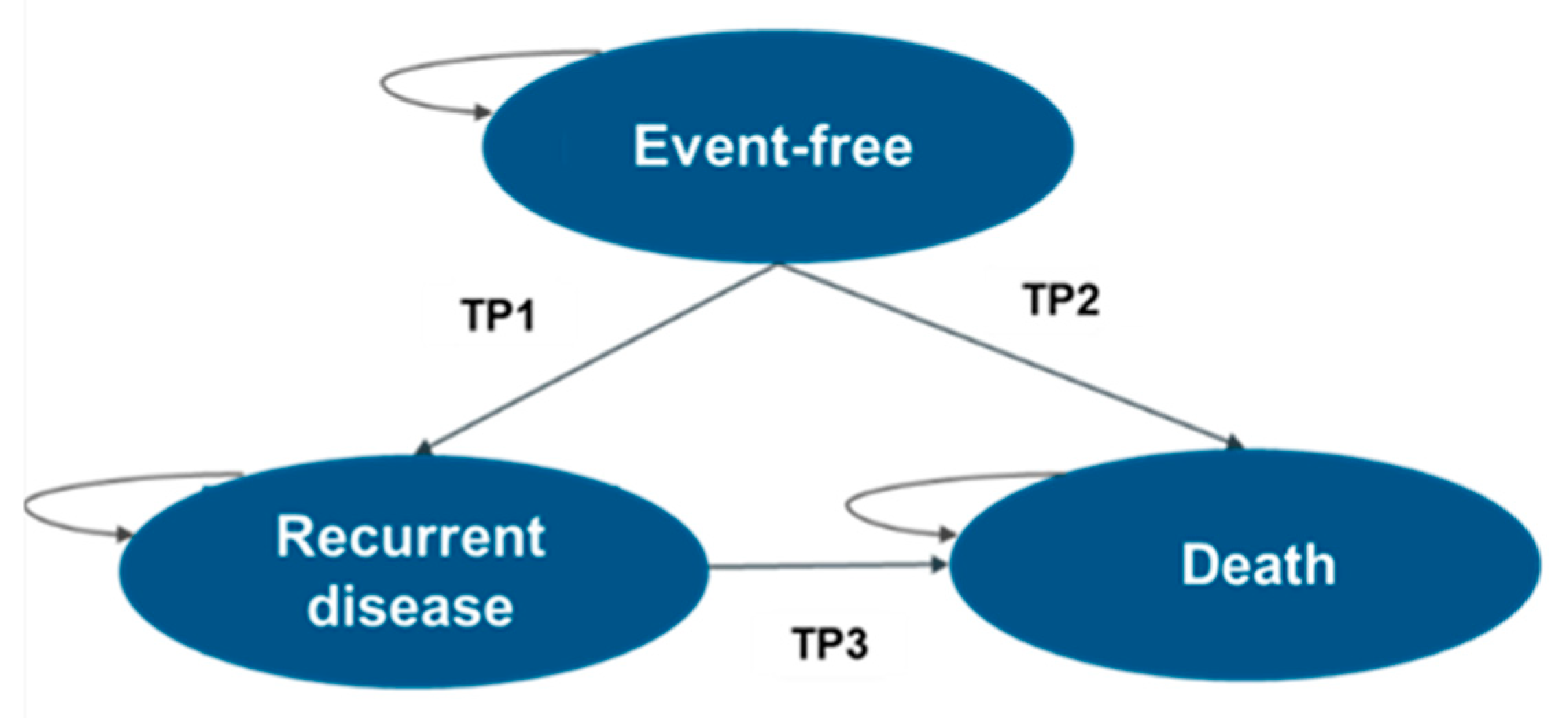
The model comprised three mutually exclusive health states: event-free (EF), recurrent disease (RD), and death (Figure 1). All patients entered the model in the EF state at treatment initiation. Over time, patients could remain EF, experience RD, or die. Following recurrence, patients could receive subsequent treatments for locally advanced or distant metastatic disease, up to the second line, with treatment distribution based on the NIAGARA trial [18,20] and complemented with assumptions to reflect expected clinical practice. Dosing was based on published sources (Tables S2 and S3) [18,20,21,22,23,24,25,26,27,28,29,30,31].
Figure 1.
Model structure. TP1: EF → RD (informed by TTR); TP2: EF → death (informed by TTD-PR); TP3: RD → death (informed by PRS); EF: event-free; RD: recurrent disease; TP: transition probability.
Transitions between health states were informed by three time-to-event endpoints derived from NIAGARA individual patient data. Non-fatal EFS events comprised recurrence after radical cystectomy, progression precluding cystectomy, and failure or refusal to undergo cystectomy with residual disease. Time to recurrence (TTR) was defined as the time from randomization to the first non-fatal EFS event, with deaths occurring before any such event censored, and informed the transition from EF to RD (TP1). Time to death prior to recurrence (TTD-PR) was defined as the time from randomization to death without a prior non-fatal EFS event, with non-fatal EFS events censored, and informed the transition from EF to death (TP2). Post-recurrence survival (PRS) was defined as the time from the first non-fatal EFS event to death from any cause (OS time minus EFS time) and was estimated only in patients who experienced a non-fatal EFS event; it informed the transition from RD to death (TP3). As each patient’s first event contributes to either TTR or TTD-PR but not both, and PRS starts at the time of that non-fatal event, each event is counted once and assigned to a single health state.
The model used a lifetime horizon (38 years), a 28-day cycle length, and half-cycle correction. The lifetime horizon was selected based on the mean baseline age of the NIAGARA population (62.31 years) and extended until patients reached approximately 100 years of age, by which time virtually all simulated patients had transitioned to the death state. Costs and health outcomes, including life–years (LYs) and quality-adjusted life–years (QALYs), were discounted at an annual rate of 3%, in accordance with Spanish standard practice [32].
The analysis included direct healthcare costs (drug acquisition, administration, disease management, adverse events [AEs], and end-of-life care) and health-related quality of life (utilities and disutilities due to AEs).
2.1. Patients and Treatments
The target population consisted of patients with MIBC eligible for cisplatin-based chemotherapy and radical cystectomy. Baseline characteristics were based on published sources and were representative of the Spanish population. Treatment regimens were based on the NIAGARA trial [18,20] and complemented with clinical expert input to reflect current practice in Spain.
The intervention consisted of neoadjuvant durvalumab, administered in combination with gem-cis as neoadjuvant treatment, followed by radical cystectomy and durvalumab monotherapy in the adjuvant setting. Patients received up to 4 cycles of 21 days neoadjuvant durvalumab plus gem-cis followed by up to 8 cycles of 28 days adjuvant durvalumab monotherapy. The comparator was neoadjuvant gem-cis followed by radical cystectomy, with patients receiving up to four 21-day treatment cycles. Dosing schedules are provided in Table S4 and were informed by an average body weight of 70.4 kg and a body surface area of 1.70 m2 [32].
2.2. Efficacy and Safety Estimates
For both treatment arms, TTR, TTD-PR, and PRS were modelled using parametric and spline-based survival models fitted to data from the NIAGARA trial [20,21] to project outcomes over the model time horizon [33]. As recurrence and pre-recurrence death are competing first events from the EF state, TTR and TTD-PR were modelled as cause-specific hazards [34], and per-cycle transition probabilities were derived as described by Ades et al. [35]:
where λ1(t) and λ2(t) are the cause-specific hazards of recurrence and pre-recurrence death in cycle t. This ensures that TP1 + TP2 ≤ 1, with the remaining probability corresponding to staying in the EF state. TP3 was derived from the PRS hazard as 1 − , where τ is the time since entry into the RD state, tracked using tunnel states. Spline-based models were selected for TTR (3-knot on the hazard scale) and TTD-PR (2-knot on the normal scale) based on the balance between statistical fit (AIC/BIC), visual inspection of the fit to the Kaplan–Meier data, and clinical plausibility of long-term projections [24]. Using the same criteria, a standard parametric generalized gamma model was used for PRS. The same functional forms were applied across treatment arms because separate models did not show clinically meaningful differences in fit (Table S5; Figures S1–S12).
General population mortality was incorporated using Spanish life tables [36], adjusted for the age and sex distribution of the target population (mean age 62.31 year [37,38]; 18.52% female [2]). To ensure that extrapolated survival did not exceed that of the age- and sex-matched general population, hazards for TTD-PR and PRS at each cycle were compared with the corresponding general population mortality hazards applying the corresponding age at that cycle [39]. If the extrapolated hazard fell below the general population hazard, the general population value was used instead (i.e., the hazard was always greater than or equal to the general population level). This constraint was applied cycle by cycle from the start of the model.
The model accounted for treatment-related AEs reported in the NIAGARA trial [18,20]. Only Grade 3–4 AEs with an incidence of ≥5% in either treatment arm were included (Table 1). This criterion was adopted as a pragmatic modelling approach to capture the most common severe toxicities, which were considered the most likely to generate substantial healthcare resource use, while preserving model parsimony. AE incidence was modelled separately for each treatment arm based on trial data.
Table 1.
Model parameters.
2.3. Utility Estimates
The utility difference observed in NIAGARA between the event-free (EF) and recurrent disease (RD) health states was considered too small by clinical experts to adequately reflect the quality-of-life impact of disease recurrence [18,20]. Therefore, the EF utility derived from NIAGARA was retained, while the relative utility decrement associated with progression was informed by Smith et al. [46]. As this study used a different HRQoL instrument (EORTC QLQ-C30), a validated mapping algorithm was applied to derive EQ-5D utilities [47,48,49,50]. The resulting relative utility decrement was then applied to the NIAGARA EF utility to estimate the RD utility. Finally, both health-state utilities were converted to Spanish preference-based values using the algorithm published by Oddershede et al. [51]. Utility values were subsequently adjusted for age and sex using Spanish general population norms [52].
The model also accounted for the utility loss associated with treatment-related AEs. AE-related disutilities were obtained from published sources and applied to the corresponding events included in the analysis (Table 1) [36,40,41,42].
2.4. Costs
The analysis included direct medical costs related to treatment acquisition and administration, including subsequent treatments, radical cystectomy, disease management, AE management, and end-of-life care.
Drug acquisition costs were obtained from BotPLUS (€, 2025) [53], using publicly available prices and adjusted according to the mandatory deductions under Spanish legislation (Royal Decree-Law 8/2010) [54], assuming vial sharing. Treatment acquisition costs were estimated on a cost-per-milligram basis and multiplied by the required dose according to the corresponding treatment regimen. No confidential rebates or negotiated net prices were considered in the base-case analysis. Drug acquisition costs were further adjusted by relative dose intensity (RDI) to reflect the actual dose received, accounting for dose reductions and delays (Table S6) [18,20,52]. Administration costs were applied to intravenous and intramuscular therapies (€ 252.18; eSalud [43]), while oral treatments were assumed to be self-administered. Treatment duration for neoadjuvant and adjuvant therapies was modelled using the observed proportions of patients who received each scheduled cycle in the NIAGARA trial (Table S7) [18,20].
Radical cystectomy costs were estimated based on the proportion of patients undergoing the procedure in the NIAGARA trial and its cost in Spain, obtained from the eSalud database (Table 1) [18,20].
Disease management resource use was informed by clinical expert opinion. Resource use was assumed to be the same across treatment arms but varied according to health state. Unit costs were obtained from Spanish sources (Table 1) [43].
Grade 3–4 AEs costs were obtained from hospital databases (RAE-CMBD) [44] and inflated to 2025 values using the Spanish Consumer Price Index published by the National Institute of Statistics (INE) [55]. End-of-life costs were applied in the cycle of death (Table 1) [45].
2.5. Model Outcomes and Sensitivity Analyses
Deterministic analyses were conducted to estimate total costs, life–years (LYs), and QALYs for each treatment strategy. The incremental cost-effectiveness ratio (ICER) and the incremental cost–utility ratio (ICUR) were calculated as the difference in costs divided by the difference in LYs and QALYs, respectively.
Univariate sensitivity analysis was performed to identify key drivers of model outcomes. Model parameters varied individually within plausible ranges, using 95% confidence intervals where available or assuming a standard error equal to 10% of the mean otherwise. Results were presented using a tornado diagram.
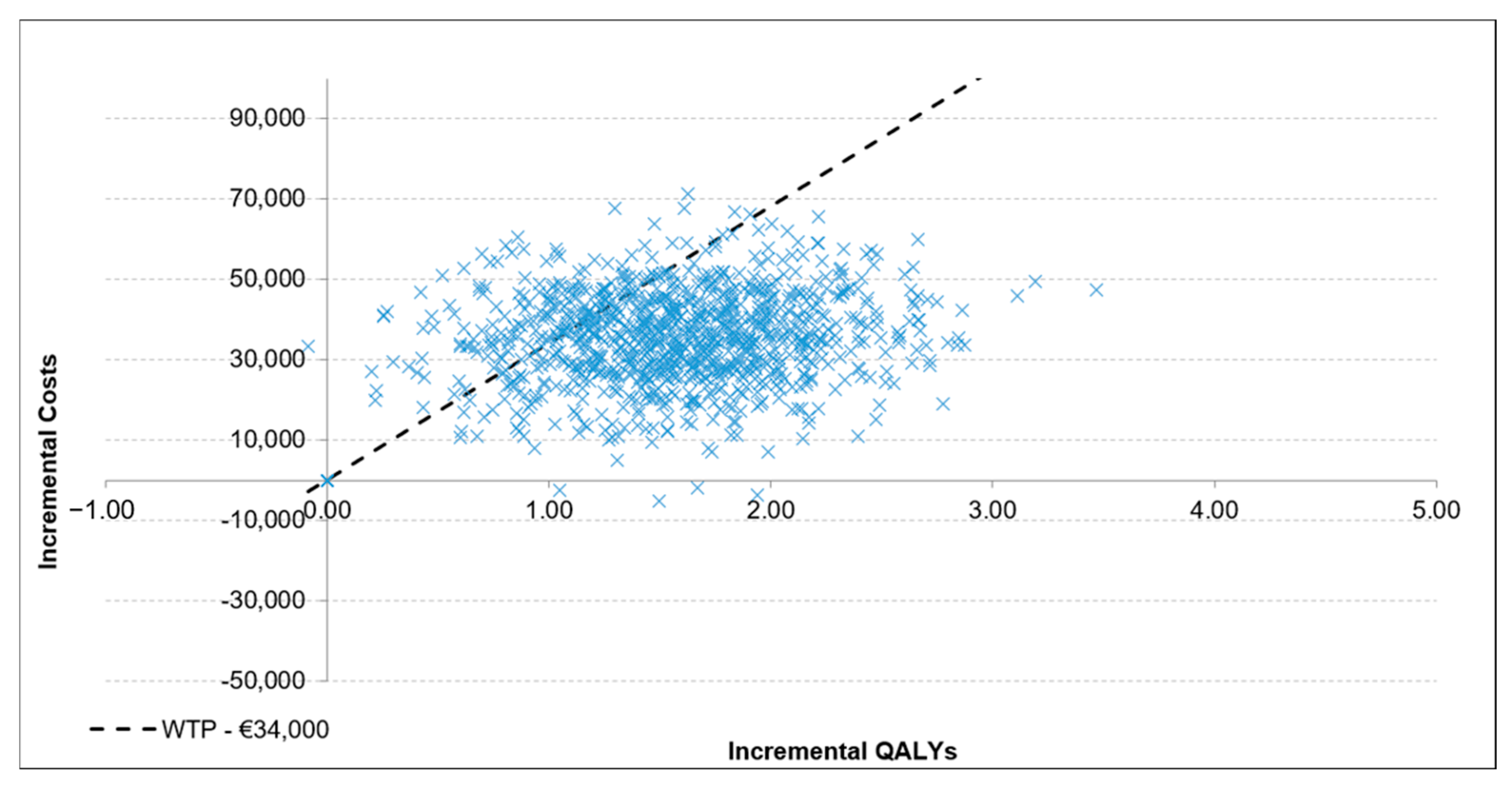
Probabilistic sensitivity analysis was conducted by simultaneously varying all model inputs according to predefined probability distributions (e.g., beta distributions for utilities and probabilities, and gamma distributions for costs) and performing 1000 Monte Carlo simulations to assess overall parameter uncertainty. The probability of cost-effectiveness was assessed at a willingness-to-pay (WTP) threshold of € 34,000 per QALY, based on recent empirical estimates of health opportunity costs in Spain [56].
3. Results
3.1. Baseline Results
In the base-case analysis, patients receiving durvalumab + gem-cis gained an additional 1.61 QALYs and 2.01 LYs compared with gem-cis. This was associated with an incremental cost of € 38,247, resulting in a deterministic ICER of € 18,984/LY gained and a deterministic ICUR of € 23,791/QALY gained (Table 2).
Table 2.
Summary of baseline results.
Patients receiving durvalumab + gem-cis accrued a total of 8.98 QALYs compared with 7.37 QALYs for gem-cis, with most QALYs accumulated in the EF state in both treatment arms. The contribution of the EF state was higher with durvalumab + gem-cis (8.21 QALYs) than with gem-cis (5.98 QALYs), while QALYs accrued after recurrence were lower in the durvalumab + gem-cis arm (0.78 vs. 1.39). Disutilities associated with AEs were comparable between treatments (−0.0029 vs. −0.0032) (Table 2).
In the durvalumab + gem-cis arm, drug acquisition was the main cost driver (€ 64,905; 42% of total costs). Subsequent treatments were substantially lower (€ 23,167; 15%) than in the gem-cis arm (€ 43,705; 37%), reflecting delayed recurrence and reduced need for second-line therapies. The reduction in subsequent treatment costs partially offset the upfront drug cost of durvalumab, resulting in a net incremental cost of € 38,247. All prices used in the analysis were list prices, which are substantially higher than the actual net acquisition prices; therefore, the estimated drug acquisition costs and net incremental cost overstate the costs incurred in real-world practice.
Durvalumab + gem-cis increased the mean time spent in the EF state to 171.88 months (vs. 119.67 months for gem-cis) and reduced the mean time in the RD state to 16.41 months (vs. 31.96 months). In addition, a higher proportion of patients remained alive at 5 years with durvalumab + gem-cis compared with gem-cis alone (69.2% vs. 59.3%). Health state membership over time is shown in Figure S13.
3.2. Sensitivity Analyses
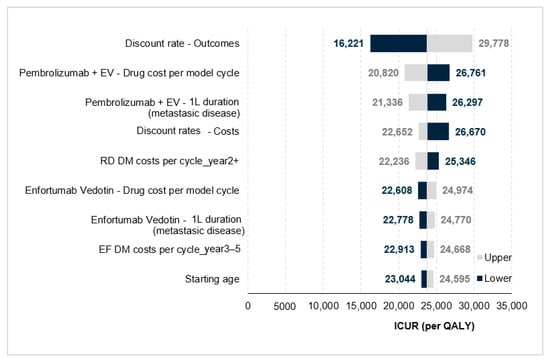
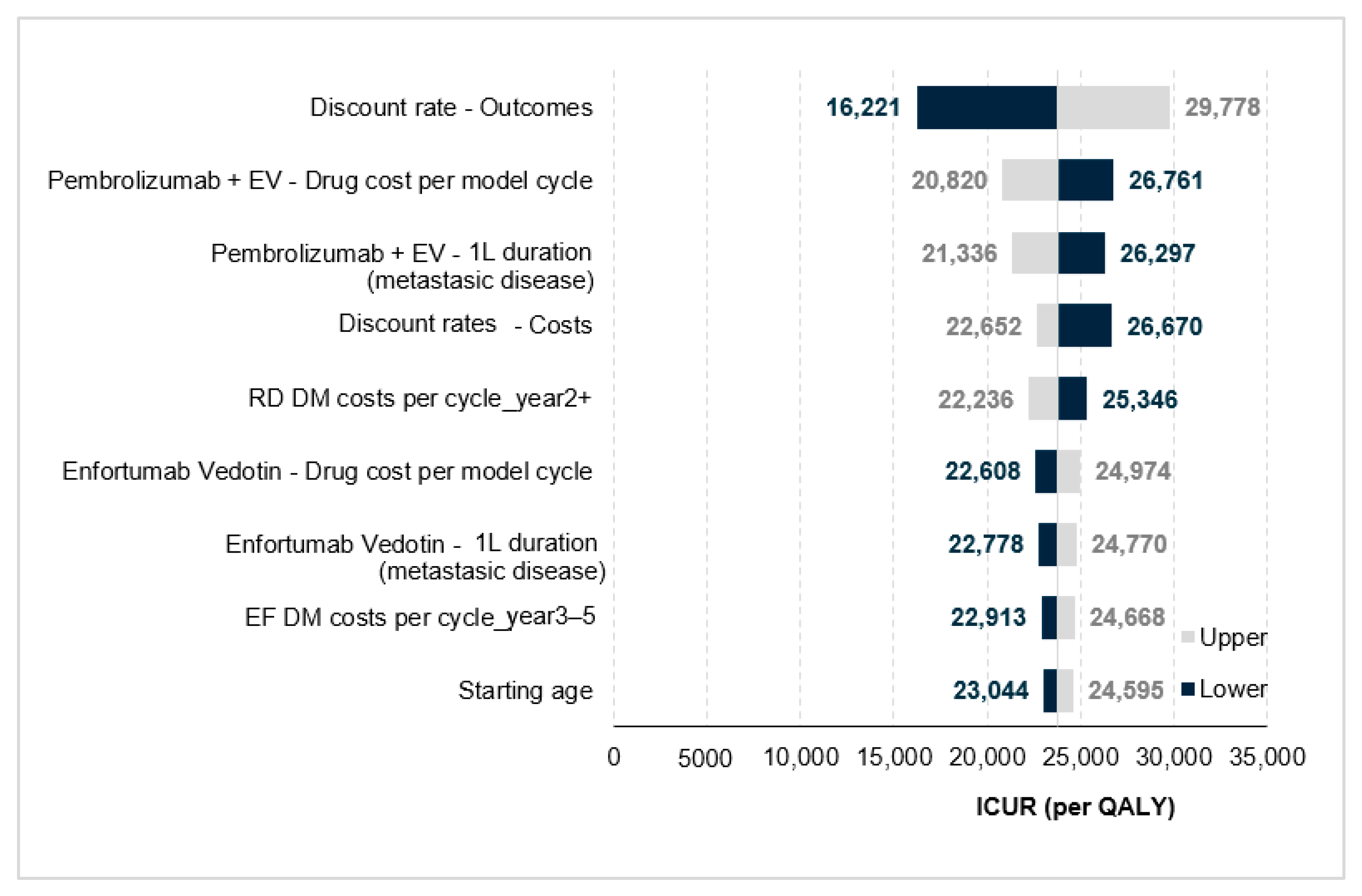
In one-way sensitivity analyses, model outcomes were most sensitive to the discount rate of outcomes and, to a lesser extent, to selected subsequent treatment costs, including pembrolizumab + enfortumab vedotin in the second-line setting. Across the ranges tested, the ICUR varied from € 16,221/QALY to € 29,778/QALY, while variations in other parameters had a limited impact on results (Figure 2). Overall, parameter uncertainty did not materially affect the direction of results, supporting the robustness of the model.
Figure 2.
Deterministic sensitivity analysis. 1L: first line; DM: disease management; EF: event-free; EV: enfortumab vedotin; QALY: Quality-Adjusted Life–Year; RD: recurrent disease.
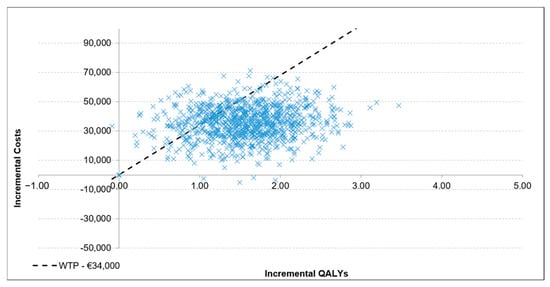
Probabilistic sensitivity analysis (1000 simulations) showed that 99.50% of iterations fell in the northeast quadrant of the cost-effectiveness plane (Figure 3). The mean probabilistic ICUR was € 22,554/QALY gained. The probability of durvalumab + gem-cis being cost-effective increased with higher WTP thresholds and reached 73.7% at € 34,000/QALY (Figure S14).
Figure 3.
Probabilistic sensitivity analysis. QALYs: Quality-Adjusted Life–Year; WTP: willingness-to-pay.
4. Discussion
Bladder cancer remains a significant clinical and economic burden due to its high incidence, recurrence rates, and the complexity of its management across disease stages [57,58]. In patients with MIBC, prognosis remains poor despite multimodal treatment, with high rates of recurrence following radical cystectomy [5,8,9,10]. In this context, perioperative immunotherapy has emerged as a strategy to improve long-term outcomes, as demonstrated in the NIAGARA trial, where the addition of durvalumab to neoadjuvant chemotherapy followed by adjuvant therapy resulted in clinically meaningful improvements in EFS and OS [8,18].
The present analysis evaluated the cost-effectiveness of perioperative durvalumab + gem-cis compared with standard chemotherapy (gem-cis) from the perspective of the Spanish NHS. The results indicate that the combination provides additional clinical benefit, with gains of 1.61 QALYs and 2.01 LY, at an incremental cost of € 38,247. This translates into an ICER of € 18,984/LY gained and an ICUR of € 23,791/QALY gained, which is below the commonly cited WTP thresholds in Spain of € 34,000/QALY, based on recent empirical estimates of health opportunity costs in Spain [56]. These results suggest that the intervention is likely to be considered cost-effective.
The results are broadly consistent with recent assessments by European HTA agencies. NICE recommended perioperative durvalumab for use in the NHS, with an ICER of £14,048/QALY [59]. The German G-BA concluded that durvalumab provides an additional benefit [60], while the French HAS issued a favorable opinion and assigned a minor added benefit (ASMR IV) [61].
The improved effectiveness observed with durvalumab + gem-cis is primarily driven by a prolonged duration in the EF state, which contributes most of the total QALYs accrued. This reflects delayed recurrence and improved disease control. In contrast, patients receiving gem-cis experienced earlier transitions to RD, resulting in higher downstream costs associated with subsequent treatments and disease management. These findings underscore the importance of early disease control: in the durvalumab arm, drug acquisition costs (€ 64,905; 42% of total costs) were partially offset by lower subsequent treatment costs (€ 23,167 vs. € 43,705 in the control arm), driven by fewer recurrences and a lower proportion of patients progressing to metastatic disease.
Sensitivity analyses confirmed the robustness of the model. The ICUR remained within a relatively narrow range across parameter variations, and the probability of cost-effectiveness increased with higher WTP thresholds, reaching 73.7% at € 34,000/QALY, a value relevant to the Spanish setting. The model was most sensitive to the cost per cycle of durvalumab and to the discount rate. This reflects the impact of treatment costs and discounting assumptions on economic outcomes.
Despite the incremental budget impact associated with the NIAGARA regimen compared with gem-cis alone, perioperative durvalumab represents a cost-effective strategy. This study provides quantitative evidence that durvalumab offers a favorable balance between costs and health outcomes, which should be considered in healthcare decision-making in Spain. In addition, it should be noted that the analysis was conducted using publicly available list prices.
This study exhibits several notable strengths. First, it contributes to the emerging cost-effectiveness evidence evaluating perioperative durvalumab in patients with MIBC based on the phase III NIAGARA trial. Given the growing role of immunotherapy in earlier stages of disease, economic evidence in this setting is still emerging, and this analysis adds to the currently limited data. Second, the model was informed by randomized clinical trial data demonstrating statistically significant improvements in both EFS and OS, thereby strengthening the internal validity of the analysis. Third, this evaluation was conducted from the perspective of the Spanish NHS, incorporating country-specific costs, clinical practice patterns, and epidemiological characteristics, thereby increasing the relevance of the findings for local healthcare decision-makers. Furthermore, the use of a lifetime horizon (38 years) and a Semi-Markov model with clinically validated extrapolations allowed for a comprehensive assessment of long-term costs and outcomes. Although NIAGARA currently provides approximately 3–4 years of follow-up, a lifetime horizon was considered appropriate to capture all future costs and survival benefits associated with treatment, in line with standard practice for oncology cost-effectiveness evaluations. Additionally, the analysis was conducted using publicly available list prices; therefore, the results should be considered conservative, as the use of confidential net prices would further improve the cost-effectiveness of durvalumab.
However, certain limitations should be acknowledged. First, as no long-term follow-up data beyond the NIAGARA trial observation period (approximately 3 to 4 years) are currently available, survival outcomes beyond this period were extrapolated using parametric and spline models. This introduces uncertainty in long-term projections, particularly for post-recurrence survival. Longer-term follow-up from the NIAGARA clinical development program (phase IIIb, results expected 2029) may help reduce this uncertainty. Second, health-related quality of life data was collected in the NIAGARA trial using EQ-5D, but the difference between EF and RD states was small. Utility for the RD state was therefore adjusted using a mapping algorithm from EORTC QLQ-C30 to EQ-5D, based on EORTC QLQ-C30 data obtained from an external study rather than from NIAGARA [52]. Although sensitivity analyses showed limited impact, future studies should consider collecting stage-specific utilities directly from MIBC patients using the Spanish EQ-5D value set. Third, the distribution of second-line treatments differed substantially between treatment arms, with pembrolizumab plus enfortumab vedotin used in 5% of patients in the durvalumab arm compared with 80% in the control arm; this asymmetry was based on clinical expert input and reflects anticipated treatment pathways following perioperative immunotherapy.
Adverse events were modelled by including Grade 3–4 events with an incidence of at least 5% in either treatment arm. This approach was selected to focus on the most frequent severe toxicities while maintaining model parsimony and ensuring consistent cost estimation using the Spanish RAE-CMBD, an official source of information on hospital activity and costs. However, this criterion may have resulted in the exclusion of clinically relevant toxicities, particularly immune-mediated AEs associated with durvalumab. While some of these events may require specific management and generate additional healthcare costs, the model was designed to capture the adverse events most likely to drive healthcare resource use and costs. Therefore, although their omission may introduce some uncertainty into the estimation of treatment-related costs, the impact on the overall economic results is not expected to be substantial, as the excluded events are generally of lower severity and, consequently, are likely to be associated with lower healthcare resource use and management costs.
Regarding the choice of comparators, nivolumab was not included as a comparator in the cost-effectiveness analysis, despite being reimbursed in Spain for a restricted subgroup of patients. Based on expert clinical input, a standard indirect treatment comparison between durvalumab and nivolumab was considered infeasible, as treatment decisions for each therapy are made at different points in the treatment pathway and in patients with different disease trajectories, limiting the comparability of the available clinical evidence. Furthermore, durvalumab is currently the only reimbursed perioperative immunotherapy to have demonstrated a statistically significant overall survival benefit in bladder cancer in Spain and is recommended as the preferred treatment option for eligible patients in the national SEOM/SOGUG guidelines [8]. Based on available treatment cost estimates, the use of durvalumab is not anticipated to result in substantially higher per-patient costs than nivolumab [53]. However, the exclusion of nivolumab limits the applicability of our findings to patients for whom adjuvant nivolumab is a relevant treatment option. Its inclusion could affect incremental costs and cost-effectiveness results, although the magnitude and direction of this impact cannot be reliably estimated given the lack of comparative evidence. As a result, the present analysis does not provide evidence on the relative cost-effectiveness of perioperative durvalumab versus adjuvant nivolumab, and conclusions should therefore be interpreted in the context of the comparators evaluated.
Finally, equity considerations should be noted. Over 80% of the modelled cohort were male, reflecting the higher incidence of MIBC in men. However, women with MIBC may have worse outcomes due to diagnostic delays and differences in treatment patterns. The model did not account for sex-specific differences in resource use or outcomes. Regional variation in access to radical cystectomy in Spain may also affect the applicability of the results.
Future evidence from ongoing studies, including NIAGARA 2, KEYNOTE-905/EV-303, KEYNOTE-B15 and VOLGA, together with longer-term follow-up from NIAGARA, will help reduce uncertainty regarding long-term outcomes and further inform the value of perioperative immunotherapy in MIBC.
5. Conclusions
Perioperative durvalumab + gem-cis offers clinically meaningful benefits in patients with MIBC, prolonging event-free and overall survival. From an economic perspective, it resulted in an ICUR of € 23,791/QALY compared with standard chemotherapy (gem-cis) and is likely to be considered cost-effective at commonly cited willingness-to-pay thresholds in Spain, with a probability of 73.7% at € 34,000/QALY. These findings support the consideration of perioperative durvalumab as a treatment option in clinical practice.
Supplementary Materials
The following supporting information can be downloaded at: https://www.mdpi.com/article/10.3390/curroncol33120738/s1: Table S1. CHEERS list; Table S2. First- and second-line treatments dose and duration in metastatic disease [51,52,53,54,55,56,57,58,59,60,61]; Table S3. First- and second-line treatment distribution in metastatic disease; Table S4. Treatment regimens and dosing schedules (first-line); Table S5. AIC and BIC goodness-of-fit measures for parametric models; Table S6. Relative dose intensity by treatment; Table S7. Proportion of patients receiving each treatment cycle; Figure S1. TTR for Gem-cis (BICR); Figure S2. Long-term extrapolation for TTR and Gem-cis (BICR); Figure S3. TTR for durvalumab + gem-cis (BICR); Figure S4. Long-term extrapolation for TTR and durvalumab + gem-cis (BICR); Figure S5. TTD-PR for gem-cis (BICR); Figure S6. Long-term extrapolation for TTD-PR gem-cis (BICR); Figure S7. TTD-PR for durvalumab + gem-cis (BICR); Figure S8. Long-term extrapolation for TTD-PR and durvalumab + gem-cis (BICR); Figure S9. PRS for gem-cis; Figure S10. Long-term extrapolation for PRS and gem-cis; Figure S11. PRS for durvalumab + gem-cis; Figure S12. Long-term extrapolation for PRS and durvalumab + gem-cis; Figure S13. Health state membership; Figure S14. Cost-effectiveness Acceptability Curve.
Author Contributions
P.M.R. and V.G.B.: Conceptualization, Methodology, Validation, Formal Analysis, Writing—Review & Editing. M.S. and D.P.: Conceptualization, Methodology, Validation, Formal Analysis, Data Curation, Writing—Original Draft Preparation, writing—Review & Editing. S.R.d.P.: Conceptualization, Writing—Review & Editing, Supervision. L.B. and R.H.: Conceptualization, Methodology, Writing—Review & Editing, Supervision. All authors have read and agreed to the published version of the manuscript.
Funding
The authors declare that this study received funding from Astrazeneca Spain.
Institutional Review Board Statement
Not applicable.
Informed Consent Statement
Not applicable.
Data Availability Statement
All model inputs, assumptions, and publicly available data sources used in this analysis are reported in the manuscript, supplementary materials, tables, figures, and references. Additional information supporting the findings of this study is available from the corresponding author upon reasonable request.
Acknowledgments
This study was funded by Astrazeneca and developed by Outcomes’10 with the support of an expert panel, who provided clinical input and validated model assumptions.
Conflicts of Interest
José Pablo Maroto Rey has received consulting fees and honoraria (for lectures, presentations, speakers’ bureaus, manuscript writing or educational events) from Johnson & Johnson; support for attending meetings and/or travel from Bayer and AstraZeneca; and has participated on a Data Safety Monitoring Board or Advisory Board from MSD and Astellas. Leana Bellanca and Robert Hettle are employees of AstraZeneca Global, United Kingdom. Silvia Ruiz del Palacio is an employee of AstraZeneca Spain. Daniel Pérez and María Soler state that their employer, Outcomes’10, has received fees from Astrazeneca Spain for contributing to the study design, the collection, analyses or interpretation of data, the project coordination, as well as the drafting of this manuscript. Vicente Gimeno Ballester has received personal fees for participation in an advisory board from AstraZeneca. This study was funded by AstraZeneca, whose employees participated in the study design and in the development and review of the economic model and manuscript.
References
- Dobruch, J.; Oszczudłowski, M. Bladder Cancer: Current Challenges and Future Directions. Medicina 2021, 57, 749. [Google Scholar] [CrossRef] [Scilit] [PubMed]
- Las Cifras del Cáncer en España 2025. Sociedad Española de Oncología Médica: Madrid, Spain, 2025; Available online: https://www.seom.org/images/LAS_CIFRAS_DMC2025.pdf (accessed on 1 June 2026).
- World Cancer Research Fund International. Cancer Statistics. Available online: https://www.wcrf.org/cancer-trends/ (accessed on 1 June 2026).
- Compérat, E.; Amin, M.B.; Cathomas, R.; Choudhury, A.; De Santis, M.; Kamat, A.; Stenzl, A.; Thoeny, H.C.; Witjes, J.A. Current best practice for bladder cancer: A narrative review of diagnostics and treatments. Lancet 2022, 400, 1712–1721. [Google Scholar] [CrossRef] [Scilit] [PubMed]
- Tan, T.Z.; Rouanne, M.; Tan, K.T.; Huang, R.Y.; Thiery, J.P. Molecular Subtypes of Urothelial Bladder Cancer: Results from a Meta-cohort Analysis of 2411 Tumors. Eur. Urol. 2019, 75, 423–432. [Google Scholar] [CrossRef] [Scilit] [PubMed]
- Okada, M.; Shindo, T.; Fujino, K.; Maeda, T.; Ito, N.; Takahashi, A.; Hotta, H.; Kunishima, Y.; Matsukawa, M.; Takayanagi, A.; et al. Prevention of local symptoms in muscle invasive bladder cancer patients: Clinical significance of local radiation therapy. Support. Care Cancer 2023, 31, 607. [Google Scholar] [CrossRef] [Scilit] [PubMed]
- Krishna, S.R.; Konety, B.R. Current Concepts in the Management of Muscle Invasive Bladder Cancer. Indian J. Surg. Oncol. 2017, 8, 74–81. [Google Scholar] [CrossRef] [Scilit] [PubMed]
- Puente, J.; Rodríguez-Vida, A.; Sevillano, E.; Estévez, S.V.; Fernández, C.Á.; Chirivella, I.; Climent, M.Á.; Fernández, O.; de Liaño, A.G.; Valderrama, B.P. SEOM–SOGUG clinical guideline for urothelial cancer (2025). Clin. Transl. Oncol. 2025, 27, 4142–4159. [Google Scholar] [CrossRef] [Scilit] [PubMed]
- Wilson, F.; Joseph, N.; Choudhury, A. Biomarkers in muscle invasive bladder cancer. Adv. Clin. Chem. 2022, 107, 265–297. [Google Scholar] [CrossRef] [Scilit] [PubMed]
- García-Rayo, C.; Juste-Álvarez, S.; Gómez-Cañizo, C.; Hernández-Arroyo, M.; Velasco, G.; Castellano, D.; Rodríguez-Antolín, A.; Guerrero-Ramos, F. The Dynamic Field of Perioperative Treatment for Localized Muscle-Invasive Bladder Cancer: A Review of the Current Research Landscape. J. Clin. Med. 2025, 14, 5653. [Google Scholar] [CrossRef] [Scilit] [PubMed]
- Scilipoti, P.; Moschini, M.; Li, R.; Lerner, S.P.; Black, P.C.; Necchi, A.; Rouprêt, M.; Shariat, S.F.; Gupta, S.; Morgans, A.K.; et al. The Financial Burden of Localized and Metastatic Bladder Cancer. Eur. Urol. 2025, 87, 536–550. [Google Scholar] [CrossRef] [Scilit] [PubMed]
- Michaeli, J.C.; Boch, T.; Albers, S.; Michaeli, T.; Michaeli, D.T. Socio-economic burden of disease: Survivorship costs for bladder cancer. J. Cancer Policy 2022, 32, 100326. [Google Scholar] [CrossRef] [Scilit] [PubMed]
- Leal, J.; Luengo-Fernandez, R.; Sullivan, R.; Witjes, J.A. Economic Burden of Bladder Cancer Across the European Union. Eur. Urol. 2016, 69, 438–447. [Google Scholar] [CrossRef] [Scilit] [PubMed]
- BIFIMED: Buscador de la Información Farmacoterapéutica del SNS. Ministerio de Sanidad. Available online: https://www.sanidad.gob.es (accessed on 1 June 2026).
- A Study of Adjuvant Nivolumab Versus Placebo in Participants with High Risk Invasive Urothelial Carcinoma (CheckMate 274) (NCT02632409). ClinicalTrials.gov. Available online: https://clinicaltrials.gov/study/NCT02632409 (accessed on 1 June 2026).
- Syed, Y.Y. Durvalumab: First Global Approval. Drugs 2017, 77, 1369–1376. [Google Scholar] [CrossRef] [Scilit] [PubMed]
- Ibrahim, R.; Stewart, R.; Shalabi, A. PD-L1 Blockade for Cancer Treatment: MEDI4736. Semin. Oncol. 2015, 42, 474–483. [Google Scholar] [CrossRef] [Scilit] [PubMed]
- Powles, T.; Catto, J.W.F.; Galsky, M.D.; Al-Ahmadie, H.; Meeks, J.J.; Nishiyama, H.; Vu, T.Q.; Antonuzzo, L.; Wiechno, P.; Atduev, V.; et al. Perioperative Durvalumab with Neoadjuvant Chemotherapy in Operable Bladder Cancer. N. Engl. J. Med. 2024, 391, 1773–1786. [Google Scholar] [CrossRef] [Scilit] [PubMed]
- Woods, B. Partitioned Survival Analysis for Decision Modelling in Health Care: A Critical Review. Technical Support Document 19. Available online: https://sheffield.ac.uk/sites/default/files/2022-02/TSD19-Partitioned-Survival-Analysis-final-report.pdf (accessed on 1 September 2026).
- AstraZeneca. NIAGARA Clinical Study Report (Version 1.0); Data on file; AstraZeneca: Cambridge, UK, 2024. [Google Scholar]
- Tecentriq: European Public Assessment Report (EPAR). European Medicines Agency (EMA). Available online: https://www.ema.europa.eu/en/medicines/human/EPAR/tecentriq (accessed on 1 June 2026).
- Tecentriq: Risk Management Plan. European Medicines Agency (EMA). Available online: https://www.ema.europa.eu/en/medicines/human/EPAR/tecentriq (accessed on 1 June 2026).
- Powles, T.; Durán, I.; van der Heijden, M.S.; Loriot, Y.; Vogelzang, N.J.; De Giorgi, U.; Oudard, S.; Retz, M.M.; Castellano, D.; Bamias, A.; et al. Atezolizumab versus Chemotherapy in Patients with Platinum-Treated Locally Advanced or Metastatic Urothelial Carcinoma (IMvigor211): A Multicentre, Open-Label, Phase 3 Randomised Controlled Trial. Lancet 2018, 391, 748–757. [Google Scholar] [CrossRef] [Scilit] [PubMed]
- Bavencio: European Public Assessment Report (EPAR). European Medicines Agency (EMA). Available online: https://www.ema.europa.eu/en/medicines/human/EPAR/bavencio (accessed on 1 June 2026).
- Powles, T.; Park, S.H.; Caserta, C.; Valderrama, B.P.; Gurney, H.; Ullén, A.; Loriot, Y.; Sridhar, S.S.; Sternberg, C.N.; Bellmunt, J.; et al. Avelumab First-Line Maintenance for Advanced Urothelial Carcinoma: Results From the JAVELIN Bladder 100 Trial After ≥2 Years of Follow-Up. J. Clin. Oncol. 2023, 41, 3486–3492. [Google Scholar] [CrossRef] [Scilit] [PubMed]
- Keytruda: European Public Assessment Report (EPAR). European Medicines Agency (EMA). Available online: https://www.ema.europa.eu/en/medicines/human/EPAR/keytruda (accessed on 1 June 2026).
- Keytruda: Risk Management Plan. European Medicines Agency (EMA). Available online: https://www.ema.europa.eu/en/medicines/human/EPAR/keytruda (accessed on 1 June 2026).
- Bellmunt, J.; de Wit, R.; Vaughn, D.J.; Fradet, Y.; Lee, J.L.; Fong, L.; Vogelzang, N.J.; Climent, M.A.; Petrylak, D.P.; Choueiri, T.K.; et al. Pembrolizumab as Second-Line Therapy for Advanced Urothelial Carcinoma. N. Engl. J. Med. 2017, 376, 1015–1026. [Google Scholar] [CrossRef] [Scilit] [PubMed]
- A Study of Pembrolizumab (MK-3475) Versus Paclitaxel, Docetaxel, or Vinflunine for Participants with Advanced Urothelial Cancer (MK-3475-045/KEYNOTE-045). ClinicalTrials.gov. Available online: https://clinicaltrials.gov/study/NCT02256436 (accessed on 1 July 2026).
- Padcev: European Public Assessment Report (EPAR). European Medicines Agency (EMA). Available online: https://www.ema.europa.eu/en/medicines/human/EPAR/padcev (accessed on 1 June 2026).
- Powles, T.; Rosenberg, J.E.; Sonpavde, G.P.; Loriot, Y.; Durán, I.; Lee, J.L.; Matsubara, N.; Vulsteke, C.; Castellano, D.; Wu, C.; et al. Enfortumab Vedotin in Previously Treated Advanced Urothelial Carcinoma. N. Engl. J. Med. 2021, 384, 1125–1135. [Google Scholar] [CrossRef] [Scilit] [PubMed]
- Trapero-Bertran, M.; Oliva, J.; Catalá-López, F.; García-Pérez, L.; Segú, L.; Alegre-del-Rey, E.J.; Clopés, A.; Lobo, F.; Ortega, A.; Puig-Junoy, J. Guideline for the economic evaluation of medicines: A proposal by the Spanish National Health System’s Advisory Committee for Pharmaceutical Financing. Gac. Sanit. 2025, 39, 102448. [Google Scholar] [CrossRef] [Scilit] [PubMed]
- Trouiller, J.B.; Quenéchdu, A.; Toumi, M.; Boyer, L.; Laramée, P. The Acceptance of Overall Survival Extrapolation Methods in Solid Tumor Treatments by Health Technology Assessment Agencies in England, France, and Australia between 2017 and 2022. Med. Decis. Mak. 2025, 45, 951–964. [Google Scholar] [CrossRef] [Scilit] [PubMed]
- Woods, B.S.; Sideris, E.; Palmer, S.; Latimer, N.; Soares, M. Partitioned survival and state transition models for healthcare decision making in oncology: Where are we now? Value Health 2020, 23, 1613–1621. [Google Scholar] [CrossRef] [Scilit] [PubMed]
- Ades, A.; Mavranezouli, I.; Dias, S.; Welton, N.J.; Whittington, C.; Kendall, T. Network meta-analysis with competing risk outcomes. Value Health 2010, 13, 976–983. [Google Scholar] [CrossRef] [Scilit] [PubMed]
- Zemdegs, J.; Iroz, A.; Vecchio, M.; Roze, S.; Lotan, Y. Water intake and recurrent urinary tract infections prevention: Economic impact analysis in seven countries. BMC Health Serv. Res. 2023, 23, 1197. [Google Scholar] [CrossRef] [Scilit] [PubMed]
- Llorente, C.; López, B.; Hernández, V.; Guijarro, A.; Pérez-Fernández, E. Variability in complications and operative mortality after radical cystectomy in Spain. Actas. Urol. Esp. 2017, 41, 32–38. [Google Scholar] [CrossRef] [Scilit]
- Pichler, R.; Fritz, J.; Mari, A.; Cadenar, A.; von Deimling, M.; Marcq, G.; Del Giudice, F.; Leonardo, C.; Bologna, E.; Mori, K.; et al. Cisplatin eligibility in the neoadjuvant setting of patients with muscle-invasive bladder cancer undergoing radical cystectomy. Oncologist 2024, 29, e1511–e1522. [Google Scholar] [CrossRef] [Scilit] [PubMed]
- Tablas de Mortalidad por año, sexo, edad y Funciones. Resultados Nacionales, por Comunidades Autónomas y Provincias. Instituto Nacional de Estadística, 2023. Available online: https://www.ine.es (accessed on 1 June 2026).
- Pixantrone Monotherapy for Treating Multiply Relapsed or Refractory Aggressive Non-Hodgkin’s B-Cell Lymphoma 2014. National Institute for Health and Care Excellence (NICE). Available online: https://www.nice.org.uk/guidance/ta306 (accessed on 1 June 2026).
- Lu, Y.; Dai, Z.; Chang, F.; Wang, L.; He, J.; Shi, P.; Zhang, H.; Lu, Y. Whether and How Disutilities of Adverse Events were Used in the Economic Evaluation of Drug Therapy for Cancer Treatment. Pharmacoeconomics 2023, 41, 295–306. [Google Scholar] [CrossRef] [Scilit] [PubMed]
- Porte, F.; Granghaud, A.; Chang, J.; Kearney, M.; Morel, A.; Plessala, I.; Cawston, H.; Roiz, J.; Xiao, Y.; Solbes, M.N.; et al. Cost-effectiveness of avelumab first-line maintenance therapy for adult patients with locally advanced or metastatic urothelial carcinoma in France. PLoS ONE 2024, 19, e0302548. [Google Scholar] [CrossRef] [Scilit] [PubMed]
- Oblikue Consulting. eSalud Database. Available online: https://www.oblikue.com/bddcostes/ (accessed on 1 June 2026).
- Ministerio de Sanidad. Registro de Actividad de Atención Especializada; RAE-CMBD: Madrid, Spain, 2025. [Google Scholar]
- Nuño-Solinís, R.; Herrera Molina, E.; Librada Flores, S.; Orueta Mendía, J.F.; Cabrera-León, A. Actividad asistencial y costes en los últimos 3 meses de vida de pacientes fallecidos con cáncer en Euskadi. Gac. Sanit. 2017, 31, 524–530. [Google Scholar] [CrossRef] [Scilit] [PubMed]
- Smith, A.B.; McCabe, S.; Deal, A.M.; Guo, A.; Gessner, K.H.; Lipman, R.; Chisolm, S.; Ahlschlager, L.; Gore, J.L. Quality of Life and Health State Utilities in Bladder Cancer. Bladder Cancer 2022, 8, 55–70. [Google Scholar] [CrossRef] [Scilit] [PubMed]
- Pickard, A.S.; Ray, S.; Ganguli, A.; Cella, D. Comparison of FACT- and EQ-5D-based utility scores in cancer. Value Health 2012, 15, 305–311. [Google Scholar] [CrossRef] [Scilit] [PubMed]
- Park, M.; Yu, S.Y.; Jeon, H.L.; Song, I. Factors Affecting Health-Related Quality of Life in Patients With Metastatic Breast Cancer. J. Breast Cancer 2023, 26, 436–445. [Google Scholar] [CrossRef] [Scilit] [PubMed]
- Poonyakanok, V.; Eagjeen, J.; Kwangngoen, T.; Leelahavarong, P.; Chitpim, N. Assessment of Health-Related Quality of Life in Thai Endometrial Cancer Patients: A Comparative Analysis Using EQ5D Utility Scores Across States. Cancer Rep. 2025, 8, e70139. [Google Scholar] [CrossRef] [Scilit] [PubMed]
- McKenzie, L.; van der Pol, M. Mapping the EORTC QLQ C-30 onto the EQ-5D instrument: The potential to estimate QALYs without generic preference data. Value Health 2009, 12, 167–171. [Google Scholar] [CrossRef] [Scilit] [PubMed]
- Oddershede, L.; Petersen, K.D. Adjustment of foreign EQ-5D-3L utilities can increase their transferability. Clin. Outcomes Res. 2015, 7, 629–636. [Google Scholar] [CrossRef] [Scilit] [PubMed]
- Garcia-Gordillo, M.A.; Adsuar, J.C.; Olivares, P.R. Normative values of EQ-5D-5L: In a Spanish representative population sample from Spanish Health Survey, 2011. Qual. Life Res. 2016, 25, 1313–1321. [Google Scholar] [CrossRef] [Scilit] [PubMed]
- Consejo General de Colegios Oficiales de Farmacéuticos. BotPLUS 2022. Available online: https://botplusweb.farmaceuticos.com/ (accessed on 1 June 2026).
- Listado de medicamentos afectados por las deducciones del real decreto-ley 8/2010 (Marzo 2025). Minsiterio de Sanidad. Available online: https://www.sanidad.gob.es/areas/farmacia/infoIndustria/infoDeducciones/ley8_2010/docs/Deducciones_MARZO_2025.pdf (accessed on 1 June 2026).
- Instituto Nacional de Estadística. Índices nacionales: General y de Grupos ECOICOP; Instituto Nacional de Estadística: Madrid, Spain, 2025. [Google Scholar]
- Vallejo-Torres, L. Estimating the Incremental Cost Per QALY Produced by the Spanish NHS: A Fixed-Effect Econometric Approach. Pharmacoeconomics 2025, 43, 109–122. [Google Scholar] [CrossRef] [Scilit] [PubMed]
- Filho, A.M.; Briganti, A.; Jemal, A.; Bray, F. Bladder Cancer Incidence and Mortality: A Global Overview and Recent Trends. Eur. Urol. 2026, 89, 426–436. [Google Scholar] [CrossRef] [Scilit] [PubMed]
- Lenis, A.T.; Lec, P.M.; Chamie, K.; Mshs, M.D. Bladder Cancer: A Review. JAMA 2020, 324, 1980–1991. [Google Scholar] [CrossRef] [Scilit] [PubMed]
- Durvalumab with Gemcitabine and Cisplatin for Neoadjuvant Treatment then Alone for Adjuvant Treatment of Muscle-invasive Bladder Cancer (TA1138). National Institute for Health and Care Excellence (NICE). Available online: https://www.nice.org.uk/guidance/ta1138 (accessed on 1 July 2026).
- Arzneimittel-Richtlinie/Anlage XII: Durvalumab (neues Anwendungsgebiet: Muskelinvasives Blasenkarzinom [MIBC], Neoadjuvante/Adjuvante Therapie nach Zystektomie, Kombination mit Gemcitabin und Cisplatin). Gemeinsamer Bundesausschuss (G-BA). Available online: https://www.g-ba.de/beschluesse/7656/ (accessed on 1 July 2026).
- IMFINZI (Durvalumab)—Cancer de la Vessie TVIM (Tumeur de la Vessie Infiltrant le Muscle). Haute Autorité de Santé (HAS). Available online: https://www.has-sante.fr/jcms/p_3859386/fr/imfinzi-durvalumab-cancer-de-la-vessie-tvim (accessed on 1 July 2026).

Disclaimer/Publisher’s Note: The statements, opinions and data contained in all publications are solely those of the individual author(s) and contributor(s) and not of MDPI and/or the editor(s). MDPI and/or the editor(s) disclaim responsibility for any injury to people or property resulting from any ideas, methods, instructions or products referred to in the content. |
© 2026 by the authors. Licensee MDPI, Basel, Switzerland. This article is an open access article distributed under the terms and conditions of the Creative Commons Attribution (CC BY) license.