


Simple Summary
Lung cancer care often requires specialists in surgery, medical oncology, radiation oncology, radiology, pathology, respiratory medicine, and other fields to make coordinated decisions. Multidisciplinary team meetings bring these professionals together, but Canada has no national-level lung-cancer-specific guidance on how these meetings should be organized or supported. In this quality-improvement project, an expert panel of 14 Canadian healthcare professionals, with input from a patient representative, adapted international good practices to the Canadian context. The findings show current variation in participation, access to shared medical records, documentation, and communication with patients. All participants approved 13 recommendations on team composition, case registration and preparation, discussion and decision-making, and documentation and patient feedback, as well as four statements on the broader value of these meetings. The recommendations are kept deliberately general, so that cancer programs can adapt them to provincial and local contexts.
Abstract
Multidisciplinary team meetings (MDTMs) support coordinated lung cancer care, but Canada lacks national lung-cancer-specific guidance on their structure and processes. We conducted a quality-improvement initiative in which an expert panel adapted international good practices for lung cancer MDTMs to the Canadian context. Fourteen purposively selected healthcare professionals completed an electronic questionnaire describing 14 MDTMs and participated in semi-structured interviews, while one patient representative provided a separate perspective. Findings informed draft recommendations, which were rated electronically before an in-person workshop, refined at the workshop, and approved by all 15 participants. Key variations observed included that only 7 of 14 respondents reported mechanisms to promote participation by every profession, and MDT coordinators always or often attended meetings in 4 of 14 MDTMs. Identified shared challenges include inconsistent representation of core disciplines, variable access to unified electronic patient records, and non-standardized documentation. The panel agreed on 13 recommendations and four statements on the perceived value of MDTMs. The recommendations are deliberately kept general and flexible, to allow adaptation to provincial and local resources, organization, and culture. These recommendations and statements can support MDT consistency, communication, and patient-centred care.
1. Introduction
Multidisciplinary team meetings (MDTMs) are an essential component of modern cancer care [1,2]. These regularly scheduled meetings bring together healthcare professionals from multiple disciplines to discuss the diagnosis and management of individual patients, supporting adherence to evidence-based practice, coordinated decision-making where evidence is incomplete, and shared accountability [1,3]. For patients, MDTMs may improve diagnostic accuracy, optimize treatment selection, and enhance care quality [4,5].
Lung cancer remains the leading cause of cancer-related mortality worldwide and is one of the most commonly diagnosed malignancies [6]. Its management is inherently multidisciplinary, involving diagnostic imaging, pathology, surgery, radiation therapy, systemic therapy, supportive care, and increasingly complex treatment sequencing [7,8]. Advances in imaging, biomarker testing, next-generation sequencing, targeted therapies, immunotherapy, multimodal treatment approaches, and lung cancer screening have further increased the need for timely and integrated multidisciplinary decision-making [7,8,9,10].
Despite their recognized importance, relatively little literature addresses how lung cancer MDTMs should be optimally structured, organized, and supported [11,12]. International studies have demonstrated substantial variation in MDTM composition, governance, workflow, and operational processes [13,14]. While the core purpose of MDTMs is consistent (to improve patient care through coordinated expert review), there is less consensus regarding how they should function in practice.
In Canada, there are currently no integrated national-level guidelines specifically addressing the structure, functioning, and quality improvement of lung cancer MDTMs. Although Canadian consensus recommendations exist for selected non-small-cell lung cancer clinical scenarios, these do not address MDTM structure or processes [15,16]. Some provinces provide guidance, including Ontario and Quebec, but these provincial resources, apart from Ontario’s lung-specific attendance and case-selection criteria, focus largely on general conference structure [17,18,19]. Consequently, MDTMs may vary considerably across provinces, often relying on local practice patterns, institutional precedent, and available resources. This contrasts with several countries outside Canada where more formal MDTM frameworks have been developed [20,21,22,23,24,25,26,27,28,29]. These frameworks aim to make multidisciplinary care a standard component of cancer care [28], although the evidence that MDTMs improve outcomes comes largely from observational studies [4].
To address this gap, we undertook a quality-improvement initiative in which an expert panel adapted international good practices for lung cancer MDTMs to the Canadian context. Canadian centres had taken part in an international project describing good practices for lung cancer multidisciplinary team (MDT) processes [11], but these did not fully reflect Canadian care, in which lung cancer intake is largely regionalized and health services are organized and funded provincially. The Canadian recommendations were therefore kept general and flexible, to allow provincial and local adaptation. The objectives of this initiative were: (1) to understand and describe the current structure and functioning of Canadian lung cancer MDTMs; and (2) to develop expert panel recommendations for clinicians, MDT leads, cancer programs, and health-system decision-makers to support continuous improvement.
2. Materials and Methods
2.1. Design
We conducted a quality-improvement initiative in which an expert panel carried out an evidence-informed adaptation of international good practices [11] to develop practical recommendations for optimizing lung cancer MDTMs in Canada. This initiative was not designed as a research study or as a formal consensus process. The process comprised three sequential phases:
- Baseline electronic questionnaire and semi-structured interviews to characterize current practices in the panel members’ MDTMs.
- An electronic pre-workshop rating exercise to prioritize topics for discussion, followed by a facilitated face-to-face workshop.
- Collective review and approval of the final statements after the workshop.
2.2. Ethics and Governance
This initiative was undertaken as a quality-improvement project and did not involve the collection or analysis of personal health information. Participants received written information regarding the project objectives, procedures, and intended use of the data and provided informed consent to complete the survey, participate in recorded and transcribed interviews, and permit publication of de-identified aggregate findings.
2.3. Panel Composition
The project co-leads, M.M.G. (pathology) and D.E.D. (medical oncology), purposively selected healthcare professionals involved in lung cancer MDTMs to provide diversity across geographic region, discipline, practice setting, and sex. A panel of 14 was chosen to ensure at least one member per core treatment and diagnostic discipline while covering most geographic areas, practice settings, and both sexes. Panel members were drawn mainly from academic regional referral centres, which also support community hospitals [30,31]. A separate patient perspective was obtained from one patient representative, an experienced lung cancer patient advocate. Participants were invited by email. All invited healthcare professionals (n = 14) and the patient representative agreed to participate.
The panel comprised 14 healthcare professionals from Alberta, British Columbia, Saskatchewan, Ontario, Quebec, and Nova Scotia, representing medical oncology, thoracic surgery, radiation oncology, pathology, respirology, nursing, radiology, and nuclear medicine. Each described a different MDTM across three practice settings: 11 of 14 were based in academic regional referral centres, 1 in a community hospital, and 2 in other settings (an affiliated academic regional centre and a provincial MDT); 13 of the 14 served as regional MDTMs, with centralized intake or support to other hospitals (Supplementary Appendix S1). The 15 participants comprised the 14 healthcare professionals and one patient representative; 8 participants were male and 7 were female. Broader expertise also included molecular pathology and nurse navigation. Together with the project co-leads, who did not serve as panelists, the initiative included representation from Alberta, British Columbia, Manitoba, Saskatchewan, Ontario, Quebec, and Nova Scotia.
2.4. Survey and Semi-Structured Interviews
Electronic questionnaire and healthcare-professional interview data were collected between 26 July and 21 October 2024. Fourteen healthcare professionals completed the questionnaire, each reporting on a different lung cancer MDTM. Qualitative input was obtained through online semi-structured interviews with all 14 healthcare professionals, conducted by M.M.G. and lasting approximately 60 min, and through a separate interview with the patient representative (Section 2.5). The questionnaire and qualitative materials explored MDT structures, participation models, operational processes, case registration pathways, case discussion practices, documentation, patient communication, perceived barriers, and sources of value. They were used to describe practice in the panel members’ MDTMs and to inform the adaptation, not to characterize all practice settings across Canada. The instruments were adapted from the MDT process framework of the international project [11] and from a published framework for thoracic oncology MDTMs [12]. The baseline questionnaire (with aggregate responses) and interview guide are provided in Supplementary Appendices S1 and S2.
2.5. Patient Involvement
The patient representative, who represented the voices of many patients through his advocacy work, was interviewed separately by M.M.G., with a focus on care coordination, transparency, communication of MDT recommendations and delays, patient values and quality-of-life priorities, and the potential contribution of social work and psychosocial care. This input was synthesized with the healthcare-professional findings, included in the pre-workshop materials, and considered by the panel in developing the recommendations.
2.6. Recommendation Development
Baseline questionnaire, interview, and patient-interview findings were synthesized into a narrative summary and, informed by the international good practices [11] and the published literature, a preliminary set of recommendations. Participants received this summary, together with relevant literature references, as pre-workshop reading. The draft recommendations were then assessed through an electronic pre-workshop rating exercise (10–25 January 2025) intended to prioritize areas for discussion. The instrument contained 14 agreement items, a 13-discipline relevance matrix, a five-category patient-selection relevance matrix with an optional comments field, and two open-text questions (Supplementary Appendix S3, Tables S1–S4). All 15 participants, including the patient representative, completed the exercise. Ratings were submitted anonymously. A pragmatic threshold of at least 80% agreement (strongly agree or agree) was set to prioritize items for workshop discussion; it was not used to select or exclude recommendations. If all items met the threshold, items without unanimous agreement were to be discussed. Agreement items used a five-point scale from strongly agree to strongly disagree, and relevance items used a five-point scale from essential to not relevant. Aggregated ratings (Supplementary Tables S5–S7) were presented to participants at a face-to-face workshop, held in Vancouver on January 30, 2025, and focused on current strengths and gaps, MDT participation, case selection, and refinement of the draft recommendations. The final wording was agreed through facilitated discussion and refinement of the statements.
All 15 participants (14 healthcare professionals and one patient representative) attended the workshop, together with the workshop lead (M.M.G.); Vintura B.V. and representatives of the funder attended as observers and did not take part in the discussion.
Owing to a quality-control error, radiation oncology was omitted from the discipline-relevance matrix; this was resolved at the workshop, where all participants agreed to include it in statement 1.1.
All participants reviewed and approved the wording of the 17 final statements by email after the workshop (April 2025).
2.7. Data Analysis and Integration
Closed-response questionnaire data were summarized descriptively; all denominators are the 14 MDTMs, and ‘I don’t know’ responses are included in the denominators. Qualitative questionnaire comments, patient input, and interview records were reviewed to identify recurring patterns related to MDT functioning, strengths, barriers, and opportunities for improvement. M.M.G. prepared the narrative synthesis, which D.E.D. and M.G.-L. reviewed, and the findings were used to inform recommendation development. Workshop discussion, in which the patient representative also participated, was documented in facilitator notes and informed statement refinement and interpretation. Divergent views on the draft recommendations were discussed at the Vancouver workshop, in a discussion facilitated by M.M.G., until participants agreed on the wording; no further disagreements arose when the final statements were circulated by email. Although this was not a formal consensus process, the expert panel process is reported following the ACCORD (ACcurate COnsensus Reporting Document) guideline where applicable [32]; the completed checklist is provided in Supplementary Table S8.
3. Results
Findings are presented across five domains: (1) MDT structure and participation, (2) case registration and preparation, (3) case discussion and decision-making, (4) documentation and patient feedback, and (5) perceived broader value. Table 1 summarizes current practice across the 14 MDTMs; complete questionnaire response distributions are provided in Supplementary Appendix S1.
Table 1.
Current practice in the 14 participating lung cancer MDTMs.
3.1. MDT Structure and Participation
Most MDTMs met weekly for 60 min; 12 of 14 met virtually and the other 2 in a hybrid format (Table 1). Most had a fixed or rotating Chair drawn from a treating specialty. MDT coordinators commonly supported case registration and communication, although they attended the meeting itself always or often in only 4 of 14 MDTMs.
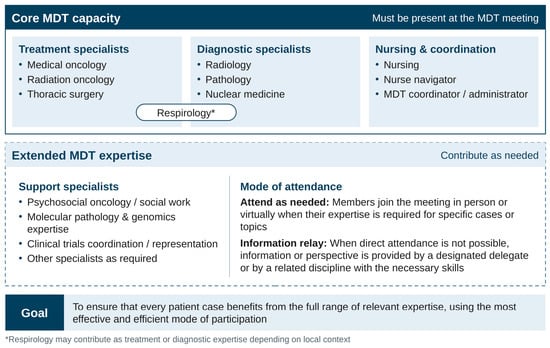
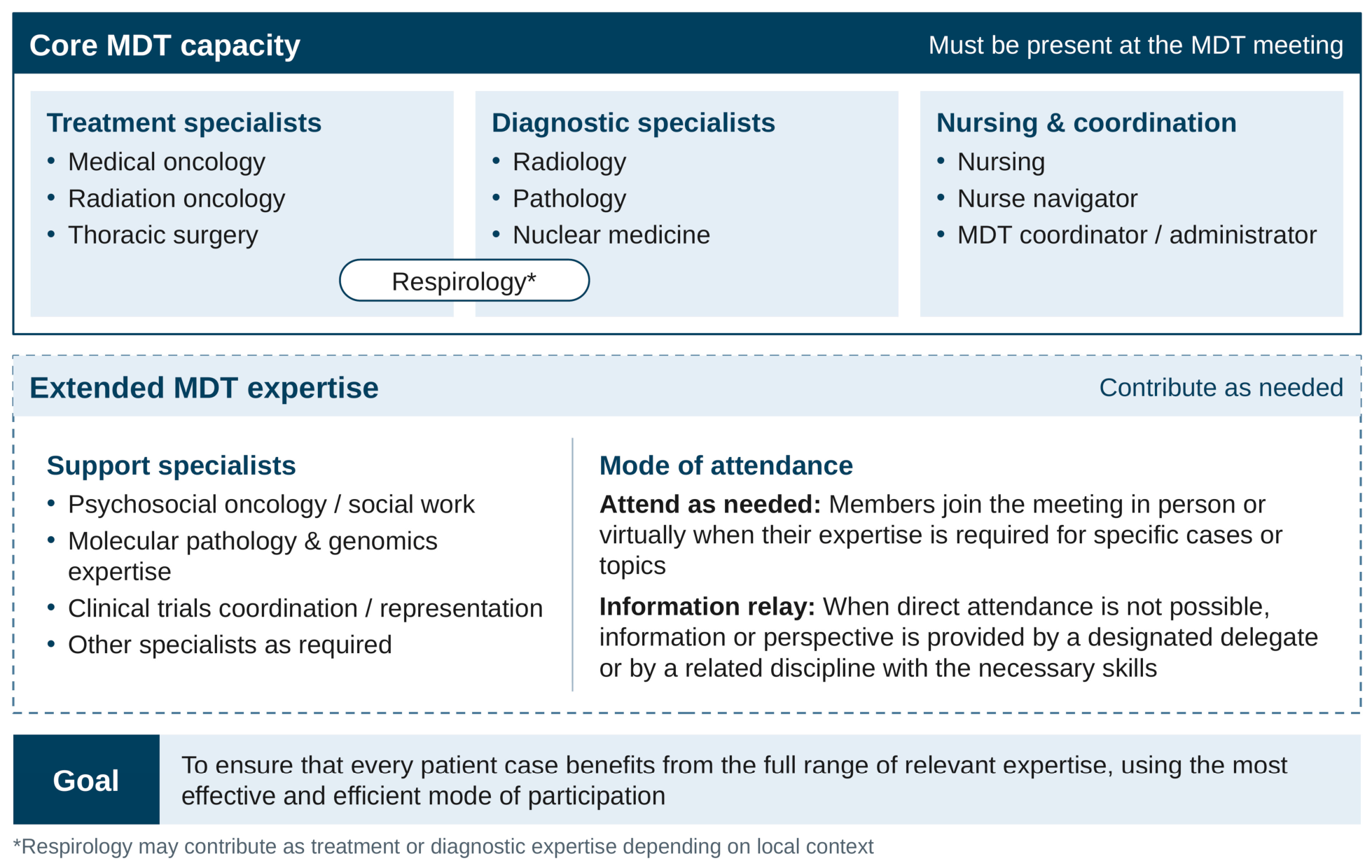
Treating specialties attended almost every MDTM, whereas attendance by other disciplines, particularly respirology, nuclear medicine, nursing and navigation, MDT coordination, and genomics expertise, was less consistent (Table 1). Reported reasons for missing disciplines included workforce limitations, scheduling barriers, limited engagement, and perceptions of limited added value. Some respondents suggested regular participation by clinical-trial personnel, pharmacy, or social work, and most MDTMs included professionals from other institutions. In the pre-workshop exercise, all 15 participants rated medical oncology, radiology, and thoracic surgery as essential or highly relevant, compared with 7 of 15 for nursing (Supplementary Table S6). Figure 1 summarizes the recommended composition. The inclusion of nursing within core MDT capacity was proposed and accepted during the workshop: although nurses attended only some MDTMs, mainly because of funding and service organization, they were considered well placed to bring patients’ biopsychosocial circumstances and preferences to the discussion (Section 3.3).
Figure 1.
Recommended composition of lung cancer multidisciplinary team meetings (MDTMs) (statement 1.1). Core problem-solving capacity must be present at every meeting, and other expertise should be available when needed: not every discipline can attend every meeting, but the perspectives of the multidisciplinary community involved in lung cancer care should be represented. * Respirology may contribute as treatment or diagnostic expertise depending on local context. MDT, multidisciplinary team.
Virtual participation was perceived to improve convenience and attendance, particularly across geographically distributed networks. However, participants frequently reported lower engagement than during in-person meetings and emphasized the value of informal interactions, relationship-building, and spontaneous discussions associated with in-person attendance.
3.2. Case Registration and Preparation
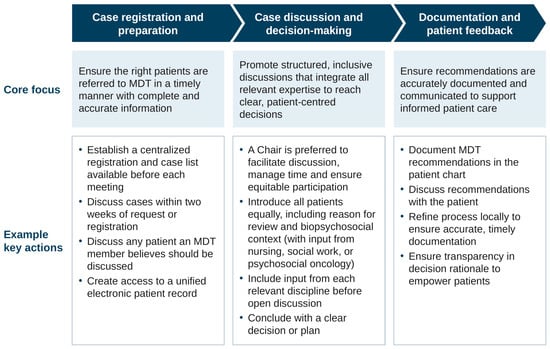
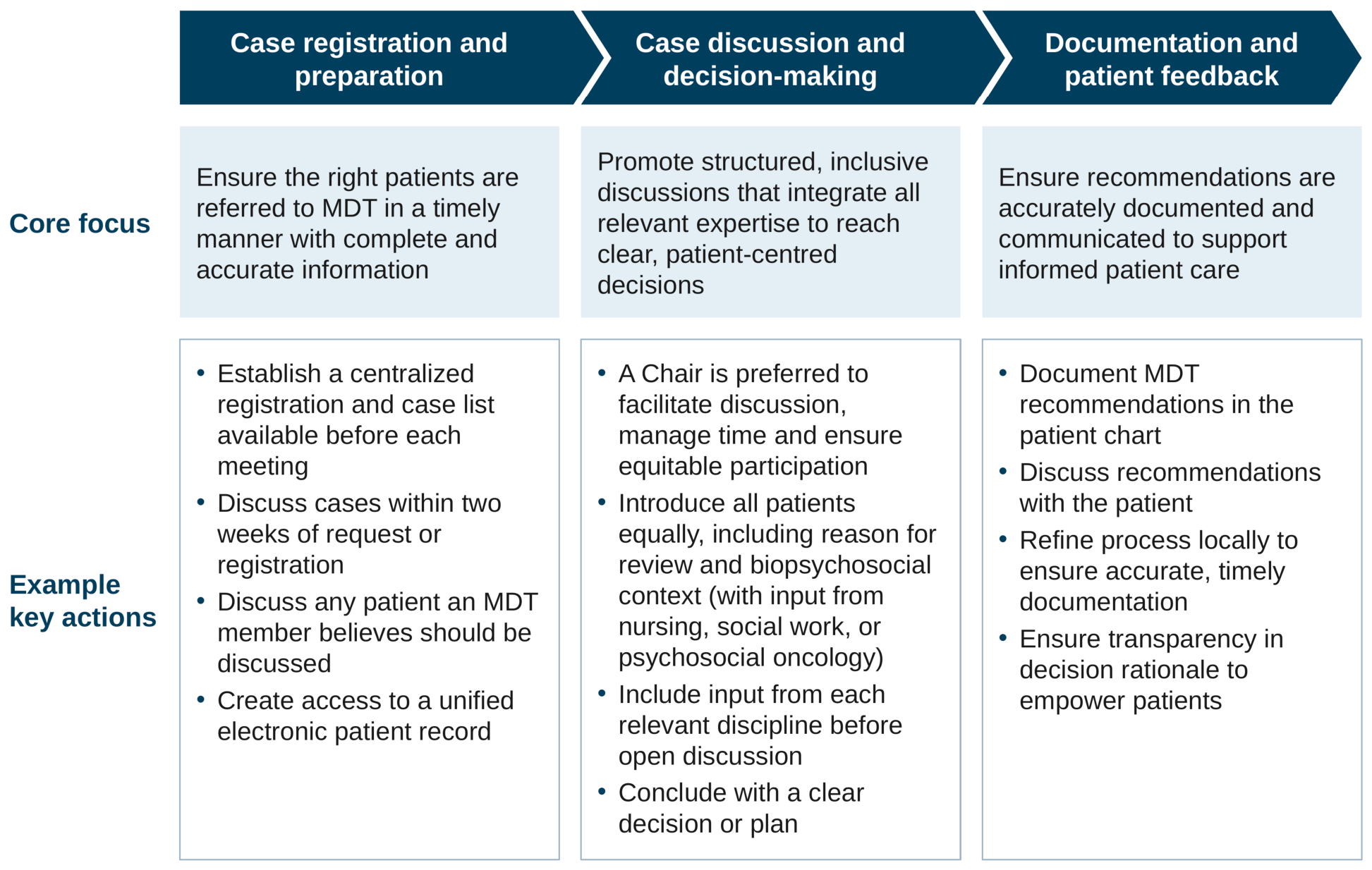
Case registration was centralized in all 14 MDTMs and was generally coordinator-led; the corresponding recommendations are illustrated in Figure 2. All MDTMs shared case lists in advance, either by circulation or through a central repository, and most set registration deadlines for cases requiring radiology or pathology review, although timing varied (Table 1). Electronic-record access ranged from integrated platforms to multiple systems and partial reliance on paper charts.
Figure 2.
Example key operational actions for optimizing lung cancer multidisciplinary team meetings (MDTMs). The figure illustrates key actions drawn from the recommendations and the panel’s discussion; the approved wording of the 13 recommendations is given in Table 2. MDT, multidisciplinary team.
Thirteen of 14 respondents reported discussion within two weeks of referral, most within one week (Table 1). All MDTMs allowed healthcare professionals to add cases at their discretion. Physicians generally referred complex cases or those outside established care pathways. Some MDTMs also reviewed all patients meeting defined criteria, such as neoadjuvant-treatment eligibility; these criteria evolved as new guidelines became embedded into practice.
Patients were almost exclusively referred by treating physicians, although diagnostic specialists occasionally added patients for discussion in a small number of MDTMs. Patients could be referred at any stage of the care pathway, although most were discussed during diagnostic/staging workup or prior to treatment initiation.
Most MDTMs discussed 5–10 cases per session (Table 1), and participants generally reported no substantial backlog, although some suggested more time or capacity to discuss more cases.
Participants identified lack of access to unified electronic patient records as the principal threat to the integrity and validity of MDT discussions. In addition, some MDTMs lacked deadlines for submission of cases requiring diagnostic review. These issues increased the risk of discussions proceeding with incomplete or inaccurate information.
Participants supported patient registration whenever an MDT member considered review beneficial and opposed rigid exclusion criteria, viewing MDTMs as a safety and support net. In the pre-workshop exercise, only 8 of 15 participants rated discussion of every new patient (for quality assurance) as essential or highly relevant, compared with at least 14 of 15 for non-standard, complex, criteria-based, and member-requested cases (Supplementary Table S7). They also supported reviewing all patients in selected, locally defined scenarios and allowing criteria to evolve as practices became established. A two-tier model—full discussion for MDTM members’ registered cases and quality review for all other lung cancer cases—was of interest but considered infeasible within current Canadian resources and care organization. Statements 2.3 and 2.4 (Table 2) are therefore complementary: any member may bring a case, and complex, non-standard, or criteria-based cases should be discussed. The two-week interval in statement 2.2 is a general maximum, to be adapted to clinical urgency through add-on cases, prioritization within the meeting, or direct communication among clinicians.
Table 2.
Expert panel recommendations for lung cancer MDTMs in Canada.
3.3. Case Discussion and Decision-Making
The Chair was described as central to maintaining process integrity, managing the agenda and time, distributing participation, and ensuring that as many patients as possible were discussed. Cases were typically presented by the treating physician who referred the patient. Most respondents agreed that biopsychosocial factors were routinely incorporated, but fewer that the patient’s perspective was consistently presented (Table 1). Case discussions almost invariably included radiological imaging, even when a radiologist was not present. Positron emission tomography–computed tomography scans were often reviewed and presented by radiologists because dedicated nuclear medicine participation was less common.
Pathology input was more variable and often summarized by the presenting physician; direct image review occurred mainly when specifically requested. Most MDTMs presented predictive biomarker results for every case, most often through a pathologist or medical oncologist, and almost half also discussed genomic alterations outside current standards of care (Table 1). Only 4 of 14 MDTMs reported clinical-trial-coordinator participation; although most reported regularly considering patients for clinical trials, eligibility was usually raised ad hoc or left to the most responsible physician rather than treated as a primary MDTM function.
The presentation and discussion style followed one of three principal models or an ad hoc process:
- The presenting physician introduced the case, each discipline provided discipline-specific information, and discussion was then opened to the group (6 of 14).
- The presenting physician summarized the relevant information and opened discussion (5 of 14).
- The presenting physician summarized the case and directed questions to specific disciplines (2 of 14).
- One MDTM reported an ad hoc process that evolved case by case.
Respondents described a collegial climate: 13 of 14 perceived no hierarchy among participating professions, and most agreed that all members felt welcome and safe to express their opinions and that all professions took part in problem-solving (Table 1). Yet only 7 of 14 reported mechanisms to promote participation by every profession or specialty. Interview findings identified the same distinction between a generally collegial atmosphere and the consistency with which inclusive participation was actively facilitated.
Most respondents reported that decisions were deferred for missing information, or not reached despite complete information, in fewer than 10% of cases (Table 1). Common reasons were incomplete staging, pending biomarker results, or an absent specialist. Some recommendations therefore called for further investigation or consultation before treatment was finalized.
Although most questionnaire respondents perceived no hierarchy, some participants raised concerns in interviews regarding hierarchy and exclusion of certain voices. Treating physicians were perceived in some MDTMs to dominate discussions, while nurses were described as more passive contributors and diagnosticians as sometimes excluded from broader problem-solving. Some participants also reported that strong personalities could inhibit disagreement, reducing psychological safety. Others suggested that nurses and social workers were often best positioned to present patients’ biopsychosocial circumstances and preferences, a view strongly supported by the patient representative, who emphasized their closer therapeutic relationships with patients and greater understanding of patient needs. Various explanations were proposed for limited participation by some disciplines, including excessive workload, lack of engagement, limited interest, reduced sense of agency, or personality factors. Some participants felt that certain disciplines had little to add; however, others emphasized that diversity of thought and collaborative problem-solving could generate insights and solutions that might not otherwise emerge. Participants emphasized the Chair’s role in ensuring that all voices were heard, managing dominant personalities, maintaining focus, and clearly summarizing recommendations. Many also noted the value of agreed “ground rules” to preserve fairness and process integrity.
3.4. Documentation and Patient Feedback
Most respondents reported that MDT recommendations were always or often documented in the chart, implemented, and discussed with the patient, but 4 of 14 did not know whether recommendations were implemented and 6 of 14 whether they were discussed with the patient (Table 1). That even active MDTM members often did not know what happened after the meeting points to limited feedback to MDTMs and an area for development. These were perceptions because formal monitoring and audit were generally absent. Documentation was rarely completed live and usually fell to the presenting physician, Chair, or delegate. A few MDTMs reviewed charts and followed up on missing documentation, but most relied on reminders.
The patient representative expressed a preference for full transparency when MDT recommendations differed from the treating physician’s proposed plan, citing the importance of understanding the rationale for decisions. This was viewed as important for trust and patient empowerment, particularly when management diverged from expected pathways. The patient representative also suggested that MDTMs improve communication regarding diagnostic waiting periods, helping patients understand that delays may reflect necessary comprehensive care rather than inaction, thereby reducing anxiety during waiting periods. Additionally, the patient representative described how patients often have to relay information and negotiate coordination between specialists, illustrating the burden of patient-facilitated coordination and the need for stronger direct communication among providers and documentation of MDTM discussions.
Participants felt that documenting MDT conclusions and recommendations in the clinical chart was in the best interests of patients, clinicians, MDTMs, and institutions. They also emphasized that documentation should accurately reflect the discussion and consensus reached. Establishing locally appropriate, fit-for-purpose processes was viewed as important to improve the integrity, fidelity, and accountability of MDT recommendations.
3.5. Perceived Broader Value
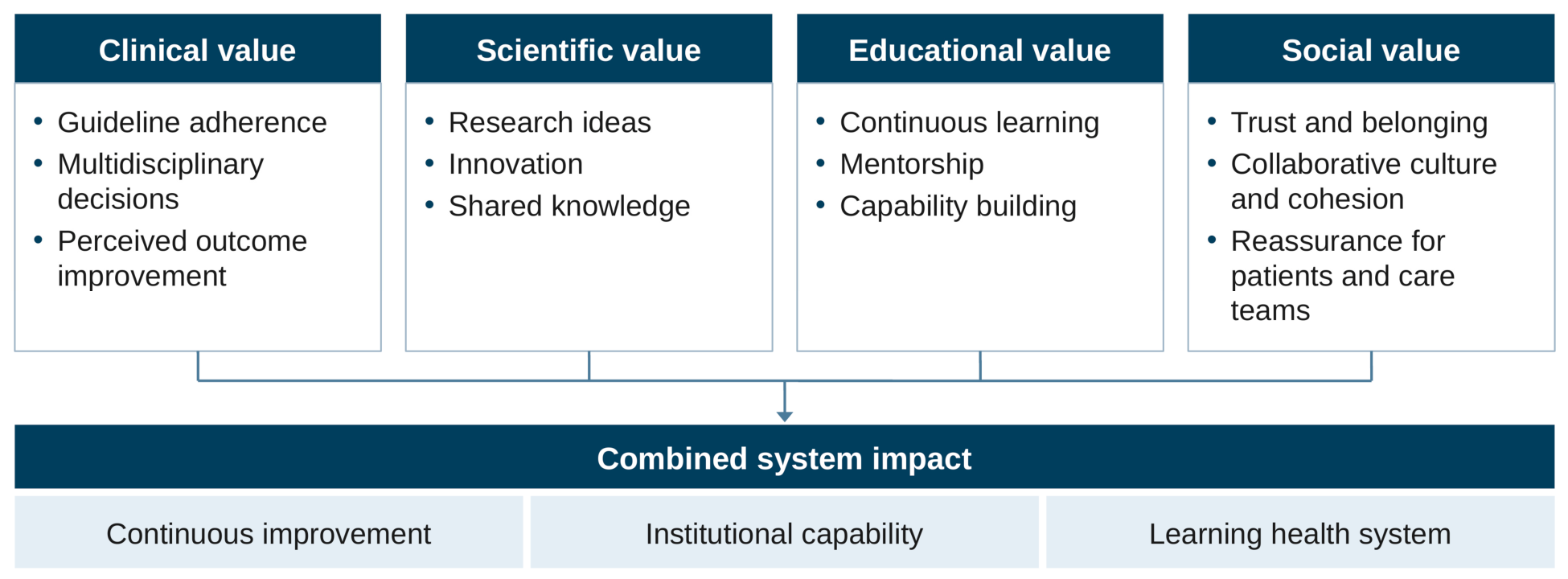
Thirteen of 14 respondents agreed or strongly agreed that MDTMs increased the likelihood of treatment according to current guidelines, and 13 perceived improved patient outcomes (Table 1). Participants attributed these perceived benefits to collective problem-solving and multiple professional perspectives. Most also viewed MDTMs as learning platforms where exchanges about emerging evidence, protocols, and innovation supported shared expertise and continuous improvement.
Participants also valued MDTMs for trainee education, junior-staff mentorship, clinical standards, and real-time learning from senior colleagues. Some institutions used case discussions to identify quality-improvement opportunities and organized multidisciplinary continuing professional development, extending the meetings’ clinical and educational roles.
MDTMs were also seen as hubs for developing new collaborative projects. Many participants reported initiating research studies, quality-improvement initiatives, or educational activities with other MDT members as a direct result of ideas or recurring challenges identified during meetings.
Participants consistently emphasized the social value of MDTMs, linking professional identity, belonging, interpersonal relationships, and trust with team cohesion, personal fulfilment, and collaboration. Several advocated nurturing this dimension through in-person interaction, team building, and attention to equity, diversity, and inclusion.
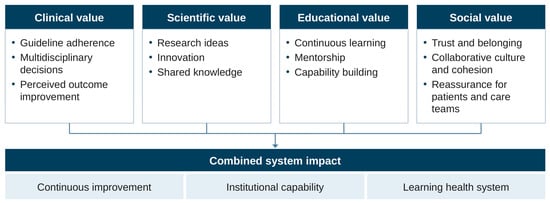
Overall, MDTMs were valued as communities of practice with potential to improve patient care and institutional capability. Participants saw an opportunity to develop interprofessional learning systems beyond siloed specialty education. Figure 3 summarizes the perceived sources of value, and the corresponding statements are given in Table 3.
Figure 3.
Perceived sources of value generated by lung cancer multidisciplinary teams (MDTs), as described by participants (see Table 3).
Table 3.
Statements on the perceived value of lung cancer MDTMs.
3.6. Expert Panel Recommendations
All 15 participants approved the wording of the 17 final statements: 13 recommendations (Table 2) and four statements on the perceived value of MDTMs (Table 3); their lineage is provided in Supplementary Table S9. All 14 pre-workshop agreement items met the threshold (80% to 100% agreement; Supplementary Table S5), and the seven without unanimous agreement were prioritized for discussion: items 1, 5, 6, 8, and 15 (14 of 15 each), item 11 (13 of 15), and item 14 (12 of 15); all other ratings of these items were neutral, except one ‘disagree’ for item 8. After discussion, two agreement items (1, meeting frequency; 8, case-specific discussion time) and one row of the patient-selection matrix (Q10a, discussion of every new patient; 8 of 15 rated it essential or highly relevant) were not retained because the appropriate approach depends on local hospital and MDTM models. The remaining 12 agreement items were consolidated into ten statements (items 5 and 7 were merged into statement 2.3, and items 11 and 14 into statement 3.1), two statements (1.1 and 2.4) were derived from the relevance matrices, and five (1.3 and 5.1–5.4) were added by the steering group (M.M.G., D.E.D., and M.G.-L.) from the qualitative synthesis and workshop discussion. Detailed pre-workshop response distributions are provided in Supplementary Tables S5–S7.
4. Discussion
In this quality-improvement initiative, an expert panel adapted international good practices for lung cancer MDTMs to the Canadian context. Findings indicate that MDTMs are widely valued but vary in participation, infrastructure, and documentation, and in the resources that support them. This variation appears to reflect local clinician-led development rather than coordinated national governance. The recommendations address how MDTMs are organized rather than the clinical content of lung cancer care, and many are therefore applicable to MDTMs for other tumour sites.
4.1. Adapting International Good Practices to the Canadian Context
In European jurisdictions such as the United Kingdom, France, Denmark, and the Netherlands, published descriptions place multidisciplinary cancer meetings within governance structures that define expectations for case review, core membership, protected time, administrative support, documentation, audit, and links to accreditation or cancer-network performance frameworks [20,21,22,23,24,25,26,27,28,29]. These frameworks, together with the international good practices from which this initiative started [11], informed the panel’s work, but they were developed for other health systems. Rather than templates for direct transfer, they offered principles that the panel adapted to Canadian conditions.
The Dutch standards, for example, set a minimum meeting frequency and expect nearly all patients to be discussed before primary treatment [24], and the English guidance allows patients on agreed standards of care to be listed rather than discussed, so that complex cases can be discussed in full [20]. The panel instead left meeting frequency, the number of cases per meeting, and discussion of every new patient to local programs, considered such a two-tier model infeasible within current Canadian resources and care organization, and recommended open access to review together with discussion of complex, non-standard, or locally defined cases (statements 2.3 and 2.4). It also left the role of respirology to local context and placed nursing within core capacity despite its limited attendance today (Section 3.1; Figure 1).
Workshop discussion suggested that Canadian MDTMs, although highly valued, often depend on local champions, variable administrative coordination, fragmented digital infrastructure, and clinician participation without formal protected time. This model supports flexibility but may contribute to uneven access, quality, and accountability. Essential MDT functions require dependable institutional support rather than reliance on individual commitment. These findings suggest a need for more intentional system stewardship while preserving the adaptive strengths of locally developed teams.
4.2. MDTMs as Core Clinical Services
Workshop discussion supported the view that MDTMs should be regarded as core clinical services rather than optional administrative activities. Increasingly complex lung cancer care requires coordinated interpretation of imaging, pathology, biomarker and genomic testing, and multimodality treatment options. MDTMs provide a mechanism to integrate this expertise.
International literature associates MDT care with improved guideline adherence, timeliness, coordination, patient assessment, and, in some settings, clinical outcomes [3,4,5,33,34]. Because this evidence is largely observational and context-dependent, causality is difficult to establish, and statement 5.2 records participants’ perceptions rather than an evidence-based conclusion. Nevertheless, these findings support formal recognition of MDTMs within cancer services.
4.3. Governance, Structure, and Local Adaptation
No single organizational model is likely to suit all Canadian settings. Geography, regionalized care networks, provincial funding and organization of health services, and workforce distribution differ substantially across jurisdictions. The recommendations were therefore kept general, defining core functions and principles rather than a uniform configuration, so that provinces and local programs can adapt them to their resources, structure, organization, and culture. Regardless of format or membership, MDTMs should enable timely case review, access to relevant expertise, meaningful multidisciplinary discussion, and clear communication of recommendations.
This approach is consistent with implementation science, which emphasizes fidelity to core functions while allowing adaptation to local context [35,36].
4.4. The Virtual–Hybrid Opportunity
Participants perceived that virtual MDTMs improved accessibility and attendance, particularly in distributed Canadian networks, consistent with published experience [37,38].
Participants nevertheless described reduced engagement, weaker spontaneous interaction, and fewer opportunities for relationship-building, and workshop discussion also raised multitasking during virtual meetings. Similar concerns have been raised regarding team cohesion, communication richness, and psychological safety [37,39,40]. Hybrid models may offer a pragmatic balance by retaining virtual access while creating opportunities for in-person interaction where feasible.
4.5. Participation, Inclusion, and Teamwork
Effective MDTMs depend not only on attendance but on whether different forms of expertise are heard and integrated. Reported dominance by treating physicians and less active participation by nursing and diagnosticians, possibly extending to other allied health professionals, therefore warrant attention.
Team-science literature identifies shared mental models, psychological safety, inclusive communication, and distributed expertise as determinants of high-performing teams [41,42]. Skilled facilitation and deliberate management of hierarchy may promote more balanced participation [43], while broader involvement of psychosocial care, navigation, genomics, and clinical-trial expertise may strengthen patient-centred decisions.
4.6. MDTMs as Learning Systems and Communities of Practice
Beyond individual case decisions, participants described MDTMs as settings for learning, mentoring, onboarding of junior staff, quality improvement, and collaborative projects. These perceptions suggest that the value of MDTMs may extend beyond the cases discussed and strengthen institutional capability over time.
This interpretation is consistent with the concept of learning health systems, in which routine clinical work generates knowledge, feedback, and adaptation [44,45]. MDTMs may function as local learning systems in which frontline teams integrate emerging evidence, examine recurring problems, and refine practice. Because formal monitoring of whether recommendations are implemented was generally absent (Section 3.4), this learning cycle is likely to remain incomplete in many settings.
The findings are also consistent with Wenger’s theory of communities of practice, in which groups sharing a common domain develop collective capability through sustained interaction, mutual engagement, a shared repertoire, and negotiation of meaning [46,47]. MDTMs may therefore be understood not only as decision forums but also as distributed professional communities that sustain and advance multidisciplinary oncology practice [12,48]. This perspective may also help explain the importance participants attached to the social value of MDTMs (statement 5.4) and to opportunities for in-person interaction.
4.7. Documentation, Accountability, and Measurement
Reliable documentation and accountability are necessary to translate discussion into care. More formalized MDT systems often use documentation templates, attendance logs, quality dashboards, and audit processes [23,29]. Canadian provincial guidance likewise provides practical examples, including recording recommendations, physician-patient discussions, and treatment decisions [49]. Such approaches could be adapted selectively rather than imposed uniformly. Recent national guidance from the Canadian Association of Radiologists also addresses MDTM processes across clinical contexts, but it is not specific to lung cancer [50].
Quality indicators, for example for timeliness of review, attendance by key disciplines, documentation, implementation of recommendations, and communication with patients, would help programs monitor improvement but would need to be developed and tested before use. Measurement should support learning and improvement without creating disproportionate administrative burden.
MDT leads may use the 13 recommendations to review current practices and identify local priorities for improvement.
4.8. Strengths, Limitations, and Future Directions
This initiative brought together healthcare professionals from several disciplines and provinces and a patient representative to adapt international good practices to the Canadian context. It was not designed as a research study or a formal consensus process, and the recommendations represent the views of the expert panel. The final statements were approved by email without independent or anonymous re-rating, and five (1.3 and 5.1–5.4) were added after the pre-workshop rating exercise. As in any facilitated group discussion, conformity cannot be excluded, nor can the influence of more vocal participants, of the facilitator (a project co-lead, who also conducted the interviews and prepared the synthesis), or of the funder’s observers; the anonymous pre-workshop ratings were shown before the discussion so that divergent views were visible. The purposively selected panel was not intended to be fully representative; the predominance of academic regional referral centres reflects the regionalized organization of lung cancer care in Canada but may limit transferability to some community settings. Current practice was self-reported by one panel member per MDTM, and patient input came from one experienced advocate. Equity of access, including for rural, remote, and Indigenous communities and for language of service, was beyond our scope and should be considered in local adaptation. The initiative was funded by AstraZeneca, and participants received honoraria; although the funder did not select participants or take part in developing or approving the recommendations, its potential influence cannot be fully excluded. The recommendations have not been formally endorsed by any professional organization and should complement local clinical judgment.
Future work could develop and test quality indicators based on these recommendations and evaluate their effects on MDT functioning, timeliness, guideline adherence, patient experience, workforce development, and sustainability.
5. Conclusions
The healthcare professionals who described 14 lung cancer MDTMs valued these meetings highly, although practices varied considerably in participation, digital infrastructure, documentation, and support. The resulting expert panel recommendations adapt international good practices to the Canadian context and offer a practical framework for strengthening lung cancer MDTMs that provinces and local programs can adapt to their own circumstances. With stewardship, MDTMs can become consistently supported clinical, educational, scientific, social, and learning-system assets across Canadian cancer care.
Supplementary Materials
The following supporting information can be downloaded at https://www.mdpi.com/article/10.3390/curroncol33110718/s1: Supplementary Appendix S1: MDT questionnaire and aggregate responses; Supplementary Appendix S2: semi-structured interview guide; Supplementary Appendix S3: pre-workshop electronic rating instrument and response distributions (Tables S1–S7); Supplementary Appendix S4: completed ACCORD checklist (Table S8); and Supplementary Appendix S5: lineage of the 17 final statements (Table S9).
Author Contributions
Conceptualization, M.M.G. and D.E.D.; methodology, M.M.G., D.E.D., and M.G.-L.; investigation, M.M.G., D.E.D., and M.G.-L.; formal analysis, M.M.G., D.E.D., and M.G.-L.; validation, M.M.G., D.E.D., H.B., S.B., C.F., D.H., S.J., E.L., M.M., R.M., S.N., B.S.S., A.S., R.Y., K.E.F., and D.M.; project administration, M.M.G., D.E.D., and M.G.-L.; supervision, M.M.G. and D.E.D.; writing—original draft preparation, M.M.G., D.E.D., and M.G.-L.; writing—review and editing, all authors. All authors have read and agreed to the published version of the manuscript.
Funding
This initiative was funded by AstraZeneca Canada Inc. Panel members, the patient representative, and the project co-leads (M.M.G. and D.E.D.) received honoraria and travel support from AstraZeneca Canada Inc. for their participation. The APC was funded by AstraZeneca Canada Inc.
Institutional Review Board Statement
This initiative was undertaken as a quality-improvement activity to characterize and support improvement of lung cancer multidisciplinary team meeting practices in Canada. In accordance with Article 2.5 of the Tri-Council Policy Statement: Ethical Conduct for Research Involving Humans (TCPS 2, 2022), quality assurance and quality improvement activities used exclusively for assessment, management, or improvement purposes do not constitute research requiring Research Ethics Board review. Accordingly, this initiative was not submitted for Research Ethics Board review. No personal health information was collected or analyzed.
Informed Consent Statement
Informed consent, including consent to publish deidentified aggregate findings, was obtained from all participants involved in the initiative.
Data Availability Statement
The aggregate data supporting the reported findings are contained within the article and Supplementary Materials. Interview recordings and transcripts are not publicly available to protect participant confidentiality.
Acknowledgments
The authors gratefully acknowledge the late Angus Pratt, who served as the patient representative in this initiative, contributing the patient perspective, participating in the pre-workshop rating exercise and workshop, and approving the final wording of the statements, and who co-authored the preliminary abstract of this work [51]. The authors also thank M. Kothari for contributions to the early stages of this work. This article is a revised and expanded version of a conference abstract entitled “Canadian Consensus Recommendations for Multi-Disciplinary Team Meetings in Lung Cancer Care,” which was presented as a poster at the 2025 World Conference on Lung Cancer, Barcelona, Spain, 6–9 September 2025 [51]. The present manuscript reports the final analysis, the final wording of the statements, and the final intended scope of the work. During the preparation of this manuscript, M.M.G. used ChatGPT (versions GPT-5 and GPT-6, by OpenAI) for language editing and readability, and M.G.-L. used Claude (Opus 5 and 5.5, by Anthropic) for language editing and readability. The authors have reviewed and edited the output and take full responsibility for the content of this publication. The tools were not used to generate or interpret data, perform analyses, develop figures, or develop the scientific conclusions.
Conflicts of Interest
M.M.G. has received honoraria for advisory board participation from AstraZeneca and Boehringer Ingelheim; owns an education consulting company, Logic Path–Education Solutions Inc., which received consulting fees for designing and delivering educational programs from multiple companies, including Amgen, AstraZeneca, Merck, and Hoffmann-La Roche; and owns stocks of AbCellera. D.E.D. reports grants and research support from AstraZeneca; speakers bureau and honoraria from AstraZeneca, Roche, Merck, Pfizer, Novartis, Janssen, Jazz Pharmaceuticals, and Daiichi Sankyo; and consulting fees from AstraZeneca. H.B. reports advisory board membership for AstraZeneca, EMD Serono, and Regeneron; speaker honoraria from Pfizer, AstraZeneca, and Varian Medical Systems; and consulting fees from AstraZeneca. S.B. has received honoraria for advisory committee participation and educational presentations from Bristol Myers Squibb, Merck, Hoffmann-La Roche, Jazz Pharmaceuticals, AstraZeneca, and Boehringer Ingelheim. C.F. has received remuneration from Merck, AstraZeneca, Medtronic, and Boehringer Ingelheim. D.H. has received honoraria for advisory board participation and speaker activities from AstraZeneca, Merck, Pfizer, and Roche, and consulting fees from Apotex. M.M. has received consultancy fees, speaker honoraria, and institutional research grants from multiple pharmaceutical companies, including AstraZeneca, Merck, Novartis, Pfizer, Roche, Eli Lilly, Gilead Sciences, and Daiichi Sankyo. S.N. has received speaker honoraria from AstraZeneca, Merck, Roche, and Bristol Myers Squibb. B.S.S. has received consulting fees, advisory board honoraria, and/or research support from AbbVie, Amgen, Apotex, Astellas, AstraZeneca, Bayer, Eli Lilly, EMD Serono, Incyte, Janssen, Jazz Pharmaceuticals, Merck, Novartis, Pfizer, Roche, Servier, Thermo Fisher, and others. A.S. has received honoraria and advisory board fees from AstraZeneca and Merck. M.M.G., D.E.D., all panel members, and the patient representative received honoraria and travel support from AstraZeneca for their participation in this initiative. M.G.-L. is an employee of Vintura B.V., which was funded by AstraZeneca to coordinate the initiative. Other than these and the disclosures listed above, the authors declare no further conflicts of interest. Project organization, coordination, data collection, and analysis were undertaken jointly by M.M.G., D.E.D., and Vintura B.V.; all interviews were conducted by M.M.G., and the workshop was facilitated by M.M.G. and Vintura B.V. M.M.G. and D.E.D. purposively selected individual panel members to represent diversity across geographic regions, specialties, practice settings, and sex. AstraZeneca requested diversity across geographic region, sex, and specialty but did not nominate or select individual participants or institutions. AstraZeneca funded the initiative and administered the honoraria and travel support; it also funded the earlier international project on lung cancer MDT processes, coordinated by Vintura B.V., from which this initiative started [11]. AstraZeneca did not attend the interviews or review the study instruments; its representatives attended the workshop as observers only; and it had no role in data analysis or interpretation or in the development or approval of the recommendations. AstraZeneca reviewed the manuscript for legal accuracy only and requested no changes; the authors retained full control over its content, conclusions, and decision to submit. Potential conflicts of interest were managed by collecting disclosures from all authors and participants and by excluding the funder from the development and approval of the recommendations.
Abbreviations
The following abbreviations are used in this manuscript:
| ACCORD | ACcurate COnsensus Reporting Document |
| MDT | Multidisciplinary team |
| MDTM | Multidisciplinary team meeting |
| TCPS 2 | Tri-Council Policy Statement: Ethical Conduct for Research Involving Humans |
References
- Berardi, R.; Morgese, F.; Rinaldi, S.; Torniai, M.; Mentrasti, G.; Scortichini, L.; Giampieri, R. Benefits and limitations of a multidisciplinary approach in cancer patient management. Cancer Manag. Res. 2020, 12, 9363–9374. [Google Scholar] [CrossRef] [Scilit] [PubMed]
- Wright, F.C.; De Vito, C.; Langer, B.; Hunter, A. Multidisciplinary cancer conferences: A systematic review and development of practice standards. Eur. J. Cancer 2007, 43, 1002–1010. [Google Scholar] [CrossRef] [Scilit] [PubMed]
- Peckham, J.; Mott-Coles, S. Interprofessional lung cancer tumor board: The role of the oncology nurse navigator in improving adherence to national guidelines and streamlining patient care. Clin. J. Oncol. Nurs. 2018, 22, 656–662. [Google Scholar] [CrossRef] [Scilit] [PubMed]
- Kočo, L.; Weekenstroo, H.H.A.; Lambregts, D.M.J.; Sedelaar, J.P.M.; Prokop, M.; Fütterer, J.J.; Mann, R.M. The effects of multidisciplinary team meetings on clinical practice for colorectal, lung, prostate and breast cancer: A systematic review. Cancers 2021, 13, 4159. [Google Scholar] [CrossRef] [Scilit] [PubMed]
- Forrest, L.M.; McMillan, D.C.; McArdle, C.S.; Dunlop, D.J. An evaluation of the impact of a multidisciplinary team, in a single centre, on treatment and survival in patients with inoperable non-small-cell lung cancer. Br. J. Cancer 2005, 93, 977–978. [Google Scholar] [CrossRef] [Scilit] [PubMed]
- Bray, F.; Laversanne, M.; Sung, H.; Ferlay, J.; Siegel, R.L.; Soerjomataram, I.; Jemal, A. Global cancer statistics 2022: GLOBOCAN estimates of incidence and mortality worldwide for 36 cancers in 185 countries. CA Cancer J. Clin. 2024, 74, 229–263. [Google Scholar] [CrossRef] [Scilit] [PubMed]
- Vicidomini, G. Current challenges and future advances in lung cancer: Genetics, instrumental diagnosis and treatment. Cancers 2023, 15, 3710. [Google Scholar] [CrossRef] [Scilit] [PubMed]
- Herbst, R.S.; Morgensztern, D.; Boshoff, C. The biology and management of non-small cell lung cancer. Nature 2018, 553, 446–454. [Google Scholar] [CrossRef] [Scilit] [PubMed]
- de Koning, H.J.; van der Aalst, C.M.; de Jong, P.A.; Scholten, E.T.; Nackaerts, K.; Heuvelmans, M.A.; Lammers, J.-W.J.; Weenink, C.; Yousaf-Khan, U.; Horeweg, N.; et al. Reduced lung-cancer mortality with volume CT screening in a randomized trial. N. Engl. J. Med. 2020, 382, 503–513. [Google Scholar] [CrossRef] [Scilit] [PubMed]
- Mazzone, P.J.; Silvestri, G.A.; Souter, L.H.; Caverly, T.J.; Kanne, J.P.; Katki, H.A.; Wiener, R.S.; Detterbeck, F.C. Screening for lung cancer: CHEST guideline and expert panel report. Chest 2021, 160, e427–e494. [Google Scholar] [CrossRef] [Scilit] [PubMed]
- Cui, P.; Blanshard, P.; Campos-Partera, M.T.; Moucquot, A.; Naqvi, S.H.R.; Dellamonica, D.; Moses, H. Enhancing multidisciplinary team processes in lung cancer care: A self-assessment toolkit and best practices. J. Clin. Pathw. 2024, 10, 19–25. [Google Scholar] [CrossRef] [Scilit]
- Gomes, M.M.; Dennie, C.; Laurie, S.A.; Shamji, F.M. How to design and foster thoracic oncology multidisciplinary cancer conferences. Thorac. Surg. Clin. 2021, 31, 229–235. [Google Scholar] [CrossRef] [Scilit] [PubMed]
- Zasada, M.; Harris, J.; Groothuizen, J.; Aroyewun, E.; Mendis, J.; Taylor, C.; Hewish, M. Investigating the efficiency of lung multi-disciplinary team meetings—A mixed methods study of eight lung multi-disciplinary teams. Cancer Med. 2023, 12, 9999–10007. [Google Scholar] [CrossRef] [Scilit] [PubMed]
- Alfieri, S.; Brunelli, C.; Borreani, C.; Capri, G.; Angi, M.; Bianchi, G.V.; Lo Dico, S.; Spada, P.; Fusetti, V.; Zecca, E.; et al. Characterizing different multidisciplinary team models implemented within one comprehensive cancer center. J. Multidiscip. Healthc. 2023, 16, 1845–1855. [Google Scholar] [CrossRef] [Scilit] [PubMed]
- Tankel, J.; Spicer, J.; Chu, Q.; Fiset, P.O.; Kidane, B.; Leighl, N.B.; Joubert, P.; Maziak, D.; Palma, D.; McGuire, A.L.; et al. Canadian consensus recommendations for the management of operable stage II/III non-small-cell lung cancer: Results of a modified Delphi process. Curr. Oncol. 2023, 30, 10363–10384. [Google Scholar] [CrossRef] [Scilit] [PubMed]
- Laurie, S.A.; Banerji, S.; Blais, N.; Brule, S.; Cheema, P.K.; Cheung, P.; Daaboul, N.; Hao, D.; Hirsh, V.; Juergens, R.; et al. Canadian consensus: Oligoprogressive, pseudoprogressive, and oligometastatic non-small-cell lung cancer. Curr. Oncol. 2019, 26, e81–e93. [Google Scholar] [CrossRef] [Scilit] [PubMed]
- Wright, F.C.; De Vito, C.; Langer, B.; Hunter, A.; Expert Panel on Multidisciplinary Cancer Conference Standards. Multidisciplinary Cancer Conference Standards; Cancer Care Ontario: Toronto, ON, Canada, 2006; Available online: https://www.cancercareontario.ca/guidelines-advice/types-of-cancer/286 (accessed on 3 May 2026).
- Cancer Care Ontario. Multidisciplinary Cancer Conferences (MCCs): Disease Site Attendance Criteria and Patient Discussion Guidance; Cancer Care Ontario: Toronto, ON, Canada, 2014; Available online: https://www.cancercareontario.ca/sites/ccocancercare/files/assets/CCOMultidisciplinaryCancerConfCriteria.pdf (accessed on 3 May 2026).
- Ministère de la Santé et des Services sociaux du Québec. Recommandations Concernant le Guide D’exercice du Collège des Médecins du Québec sur la Création et le Fonctionnement d’un Comité de Diagnostic et du Traitement du Cancer dans les Etablissements du Québec: Rapport du Groupe de Travail sur la Mise en Place des Comités du Diagnostic et du Traitement du Cancer; Publication No. 17-902-10W; MSSS: Québec, QC, Canada, 2017; Available online: https://publications.msss.gouv.qc.ca/msss/document-001913/ (accessed on 3 May 2026).
- NHS England and NHS Improvement. Streamlining Multi-Disciplinary Team Meetings: Guidance for Cancer Alliances; NHS England: London, UK, 2020; Available online: https://www.england.nhs.uk/publication/streamlining-mdt-meetings-guidance-cancer-alliances/ (accessed on 3 May 2026).
- National Institute for Health and Care Excellence. Lung Cancer in Adults: Quality Standard [QS17]; NICE: London, UK, 2012; updated 13 December 2019; Available online: https://www.nice.org.uk/guidance/qs17 (accessed on 3 May 2026).
- Institut national du cancer. La réunion de concertation pluridisciplinaire en cancérologie: Champ d’application, organisation et déroulement; Référence REFRCP23; INCa: Boulogne-Billancourt, France, 2023; Available online: https://www.cancer.fr/catalogue-des-publications/la-reunion-de-concertation-pluridisciplinaire-en-cancerologie (accessed on 3 May 2026).
- Danish Multidisciplinary Cancer Groups. Multidisciplinary Cancer Treatment—A Guide to the MDT Conference; DMCG.dk: Copenhagen, Denmark, 2016; Available online: https://www.dmcg.dk/siteassets/dmcg-udvalg/mdt-udvalget/multidisciplinary-cancer-treatment---a-guide-to-the-mdt-conference.pdf (accessed on 3 May 2026).
- SONCOS. Multi-Disciplinary Standardisation of Oncology Care in The Netherlands: SONCOS Standardisation Report 11; SONCOS: Utrecht, The Netherlands, 2023; Available online: https://demedischspecialist.nl/sites/default/files/2023-06/soncos_normeringsrapport_11_english_version.pdf (accessed on 3 May 2026).
- Blum, T.G.; Morgan, R.L.; Durieux, V.; Chorostowska-Wynimko, J.; Baldwin, D.R.; Boyd, J.; Faivre-Finn, C.; Galateau-Salle, F.; Gamarra, F.; Grigoriu, B.; et al. European Respiratory Society guideline on various aspects of quality in lung cancer care. Eur. Respir. J. 2023, 61, 2103201. [Google Scholar] [CrossRef] [Scilit] [PubMed]
- Gouliaev, A.; Berg, J.; Bibi, R.; Arshad, A.; Leira, H.O.; Neumann, K.; Aamelfot, C.; Christensen, N.L.; Rasmussen, T.R. Multi-disciplinary team meetings for lung cancer in Norway and Denmark: Results from national surveys and observations with MDT-MODe. Acta Oncol. 2024, 63, 678–684. [Google Scholar] [CrossRef] [Scilit] [PubMed]
- De Belvis, A.G.; Catalani, M.C.; Morsella, A.; Sessa, G.; Palinuro, A.; Giubbini, G.; Watteble, F.; Angioletti, C. Critical pathways for continuous quality improvement: A multicentric analysis on the management of patients with lung cancer in Italian best performing hospitals. J. Prev. Med. Hyg. 2023, 64, E92–E100. [Google Scholar] [CrossRef] [Scilit] [PubMed]
- Borras, J.M.; Albreht, T.; Audisio, R.; Briers, E.; Casali, P.; Esperou, H.; Grube, B.; Hamoir, M.; Henning, G.; Kelly, J.; et al. Policy statement on multidisciplinary cancer care. Eur. J. Cancer 2014, 50, 475–480. [Google Scholar] [CrossRef] [Scilit] [PubMed]
- Beck, N.; Hoeijmakers, F.; Wiegman, E.M.; Smit, H.J.M.; Schramel, F.M.; Steup, W.H.; Verhagen, A.F.T.M.; Schreurs, W.H.; Wouters, M.W.J.M. Lessons learned from the Dutch Institute for Clinical Auditing: The Dutch model for quality assurance in lung cancer treatment. J. Thorac. Dis. 2018, 10, S3472–S3485. [Google Scholar] [CrossRef] [Scilit] [PubMed]
- Canadian Partnership Against Cancer. Pan-Canadian Standards for Thoracic Surgery; Canadian Partnership Against Cancer: Toronto, ON, Canada, 2018; Available online: https://www.partnershipagainstcancer.ca/wp-content/uploads/2019/01/Pan-Canadian-Standards-Thoracic-Surgery-EN.pdf (accessed on 1 November 2026).
- Bendzsak, A.M.; Baxter, N.N.; Darling, G.E.; Austin, P.C.; Urbach, D.R. Regionalization and outcomes of lung cancer surgery in Ontario, Canada. J. Clin. Oncol. 2017, 35, 2772–2780. [Google Scholar] [CrossRef] [Scilit] [PubMed]
- Gattrell, W.T.; Logullo, P.; van Zuuren, E.J.; Price, A.; Hughes, E.L.; Blazey, P.; Winchester, C.C.; Tovey, D.; Goldman, K.; Hungin, A.P.; et al. ACCORD (ACcurate COnsensus Reporting Document): A reporting guideline for consensus methods in biomedicine developed via a modified Delphi. PLoS Med. 2024, 21, e1004326. [Google Scholar] [CrossRef] [Scilit] [PubMed]
- Pillay, B.; Wootten, A.C.; Crowe, H.; Corcoran, N.; Tran, B.; Bowden, P.; Crowe, J.; Costello, A.J. The impact of multidisciplinary team meetings on patient assessment, management and outcomes in oncology settings: A systematic review of the literature. Cancer Treat. Rev. 2016, 42, 56–72. [Google Scholar] [CrossRef] [Scilit] [PubMed]
- Coory, M.; Gkolia, P.; Yang, I.A.; Bowman, R.V.; Fong, K.M. Systematic review of multidisciplinary teams in the management of lung cancer. Lung Cancer 2008, 60, 14–21. [Google Scholar] [CrossRef] [Scilit] [PubMed]
- Perez Jolles, M.; Lengnick-Hall, R.; Mittman, B.S. Core functions and forms of complex health interventions: A patient-centered medical home illustration. J. Gen. Intern. Med. 2019, 34, 1032–1038. [Google Scholar] [CrossRef] [Scilit] [PubMed]
- Wiltsey Stirman, S.; Baumann, A.A.; Miller, C.J. The FRAME: An expanded framework for reporting adaptations and modifications to evidence-based interventions. Implement. Sci. 2019, 14, 58. [Google Scholar] [CrossRef] [Scilit] [PubMed]
- Groothuizen, J.E.; Aroyewun, E.; Zasada, M.; Harris, J.; Hewish, M.; Taylor, C. Virtually the same? Examining the impact of the COVID-19-related shift to virtual lung cancer multidisciplinary team meetings in the UK National Health Service: A mixed-methods study. BMJ Open 2023, 13, e065494. [Google Scholar] [CrossRef] [Scilit] [PubMed]
- Davis, C.H.; Ho, J.; Stephenson, R.; August, D.A.; Gee, H.; Weiner, J.; Alexander, H.R.; Pitt, H.A.; Berger, A.C. Virtual tumor board increases provider attendance and case presentations. JCO Oncol. Pract. 2022, 18, e1603–e1610. [Google Scholar] [CrossRef] [Scilit] [PubMed]
- Sidpra, J.; Chhabda, S.; Gaier, C.; Alwis, A.; Kumar, N.; Mankad, K. Virtual multidisciplinary team meetings in the age of COVID-19: An effective and pragmatic alternative. Quant. Imaging Med. Surg. 2020, 10, 1204–1207. [Google Scholar] [CrossRef] [Scilit] [PubMed]
- Onifade, A.; Quaife, S.L.; Holden, D.; Chung, D.; Birchall, M.; Peake, M.D.; Mughal, M.; McInnerney, D. Understanding the effectiveness and quality of virtual cancer multidisciplinary team meetings (MDTMs): A systematic scoping review. BMC Health Serv. Res. 2024, 24, 1481. [Google Scholar] [CrossRef] [Scilit] [PubMed]
- Rosen, M.A.; DiazGranados, D.; Dietz, A.S.; Benishek, L.E.; Thompson, D.; Pronovost, P.J.; Weaver, S.J. Teamwork in healthcare: Key discoveries enabling safer, high-quality care. Am. Psychol. 2018, 73, 433–450. [Google Scholar] [CrossRef] [Scilit] [PubMed]
- Edmondson, A.C. Psychological safety and learning behavior in work teams. Adm. Sci. Q. 1999, 44, 350–383. [Google Scholar] [CrossRef] [Scilit]
- Lamb, B.W.; Green, J.S.A.; Benn, J.; Brown, K.F.; Vincent, C.A.; Sevdalis, N. Improving decision making in multidisciplinary tumor boards: Prospective longitudinal evaluation of a multicomponent intervention for 1,421 patients. J. Am. Coll. Surg. 2013, 217, 412–420. [Google Scholar] [CrossRef] [Scilit] [PubMed]
- Institute of Medicine. Best Care at Lower Cost: The Path to Continuously Learning Health Care in America; National Academies Press: Washington, DC, USA, 2013. [Google Scholar] [CrossRef] [Scilit] [PubMed]
- Enticott, J.; Johnson, A.; Teede, H. Learning health systems using data to drive healthcare improvement and impact: A systematic review. BMC Health Serv. Res. 2021, 21, 200. [Google Scholar] [CrossRef] [Scilit] [PubMed]
- Wenger, E. Communities of Practice: Learning, Meaning, and Identity; Cambridge University Press: Cambridge, UK, 1998. [Google Scholar] [CrossRef] [Scilit]
- Wenger-Trayner, E.; Wenger-Trayner, B.; Reid, P.; Bruderlein, C. Communities of Practice within and across Organizations: A Guidebook, 2nd ed.; Social Learning Lab: Sesimbra, Portugal, 2023. [Google Scholar]
- Fingrut, W.; Beck, L.A.; Lo, D. Oncology communities of practice: Insights from a qualitative analysis. Curr. Oncol. 2018, 25, 378–383. [Google Scholar] [CrossRef] [Scilit] [PubMed]
- Ontario Cancer Care. Documenting the Multidisciplinary Cancer Conference Process: Advice; Cancer Care Ontario: Toronto, ON, Canada, 2013; Available online: https://www.cancercareontario.ca/sites/ccocancercare/files/assets/CCOMultidisciplinaryDocAdvice.pdf (accessed on 3 May 2026).
- Canadian Association of Radiologists. CAR Recommendations for Improving Multidisciplinary Team Meetings and Processes; Canadian Association of Radiologists: Ottawa, ON, Canada, 2026; Available online: https://car.ca/wp-content/uploads/2026/06/CAR-PS_MultiDisciplinary-Teams_EN_FINAL.pdf (accessed on 19 August 2026).
- Dawe, D.; Bahig, H.; Burelle, S.; Finley, C.; Hao, D.; Johnson, S.; Leung, E.; Manna, M.; Myers, R.; Najmeh, S.; et al. P1.17.42 Canadian Consensus Recommendations for Multi-Disciplinary Team Meetings in Lung Cancer Care. J. Thorac. Oncol. 2025, 20, S230–S231. [Google Scholar] [CrossRef] [Scilit]

Disclaimer/Publisher’s Note: The statements, opinions and data contained in all publications are solely those of the individual author(s) and contributor(s) and not of MDPI and/or the editor(s). MDPI and/or the editor(s) disclaim responsibility for any injury to people or property resulting from any ideas, methods, instructions or products referred to in the content. |
© 2026 by the authors. Licensee MDPI, Basel, Switzerland. This article is an open access article distributed under the terms and conditions of the Creative Commons Attribution (CC BY) license.