


Simple Summary
Thoracic radiotherapy and Osimertinib are used to treat advanced EGFR lung cancer, and both may increase the risk of pneumonitis. We reviewed 41 patients with lung cancer who received thoracic radiotherapy in the context of osimertinib treatment. Six patients developed pneumonitis, including five with symptomatic cases and two with severe or fatal pneumonitis. The study was too small to determine whether continuing osimertinib during radiotherapy increased risk or whether temporarily stopping treatment reduced it. Larger studies incorporating detailed radiation dosimetry and clear documentation of osimertinib timing are needed to better define risks and guide decisions about combining these treatments.
Abstract
Introduction: Pneumonitis is a clinically important toxicity associated with both osimertinib and thoracic radiotherapy (TRT) in patients with metastatic EGFR NSCLC. The objective of this study was to characterize the incidence, severity, and clinical features of pneumonitis in patients receiving TRT in close temporal association with osimertinib. Materials and Methods: A retrospective study of patients who received both osimertinib and TRT was conducted at a tertiary Canadian academic cancer centre from 2016 to 2020. TRT was defined as any course of radiotherapy with lung parenchyma in the treated field. The primary endpoint was incidence and time to symptomatic pneumonitis. Variables predictive of time to pneumonitis were determined using multivariable Cox proportional hazards regression. Results: In total, 41 patients received osimertinib and TRT to 68 lesions. Five patients developed grade ≥ 2 pneumonitis (12.2%), of which one was grade 4 (2.4%) and one was grade 5 (2.4%). Median time to any-grade pneumonitis was 56 days. Among the 41 patients, TRT preceded osimertinib in 13, osimertinib was confirmed to be held during TRT in 12, confirmed to overlap TRT in 5, and status was undocumented in 11. Two of the five symptomatic cases occurred after re-irradiation, and four occurred after treatment of centrally located lesions. Exploratory multivariable analyses were highly uncertain given the five grade ≥ 2 events; the association with confirmed osimertinib overlap had a wide confidence interval (HR 3.36, 95% CI 0.13–86.56). Concluoksion: Symptomatic pneumonitis occurred in 12.2% of this selected cohort, including rare severe and fatal events. Findings are hypothesis generating and do not establish the safety or harm of overlapping osimertinib with TRT.
1. Introduction
Epidermal Growth Factor Receptor (EGFR) mutations are among the most common actionable molecular alterations in metastatic non-small cell lung cancer (mNSCLC). Compared with cytotoxic chemotherapy, oral EGFR Tyrosine Kinase Inhibitors (TKIs) have demonstrated significantly superior progression-free survival (PFS) and overall survival (OS), with a more tolerable adverse event profile [1,2,3]. Osimertinib, a third-generation, irreversible EGFR-TKI, is now the standard first-line TKI for patients with common sensitizing EGFR mutations, owing to its improved efficacy and added clinical benefit of central nervous system penetration.
With contemporary first-line therapies, radiotherapy is commonly utilized for the purpose of reducing tumour burden for symptom control, or to treat drug-resistant oligoprogressive sites with the intent to extend the duration of the same line of TKI [4]. Thoracic radiotherapy (TRT) in particular is commonly used in EGFRm mNSCLC to prevent or improve symptoms, reduce tumour burden, and extend the duration of targeted therapy [5]. However, pneumonitis is a clinically important toxicity associated with both osimertinib and TRT [6,7,8]. Osimertinib alone has an estimated 4% risk of pneumonitis, and 0.4% risk of grade 5 pneumonitis [9,10]. Case reports of severe pneumonitis from overlapping osimertinib and TRT have been published [11], including a case series from China (n = 11) in 2020 reporting a grade ≥ 3 pneumonitis rate of 54.5% and one fatal event with concurrent treatment [12]. Herein, we report the incidence and severity of pneumonitis in EGFRm mNSCLC patients receiving osimertinib and TRT in close temporal association at our institution.
2. Materials and Methods
2.1. Study Design and Population
This was a single-institution retrospective cohort study at a tertiary academic centre. Patients with EGFRm mNSCLC who received osimertinib and TRT between 2016 and 2020 were included. TRT was defined as any course of radiotherapy treatment that involved any volume of lung parenchyma within the treated field receiving at least 95% of the prescribed dose, regardless of whether the treated lesion was in the lung.
Patients who received TRT within a 6-month eligibility window relative to osimertinib initiation were included. The temporal relationship between radiotherapy and osimertinib was categorized as thoracic radiotherapy before osimertinib initiation, confirmed interruption of osimertinib during radiotherapy, confirmed treatment overlap, or undocumented treatment status.
Patients were excluded if they received radiotherapy that did not involve the lung parenchyma or if they had a history of interstitial lung disease. This study was reviewed and approved by the Institutional Research Ethics Board at Sunnybrook Health Sciences Centre, Odette Cancer Centre.
2.2. Radiotherapy and Systemic Therapy
All TRT was delivered as external beam photon therapy, with dose and fractionation at the discretion of the treating radiation oncologist. All patients received treatment either daily or, in the case of stereotactic body radiation therapy (SBRT), daily or every other day. Palliative fractionation schemes were delivered either with a parallel opposed pair (POP) or intensity-modulated radiotherapy (IMRT) beam arrangements. TRT plans were developed using computed tomography (CT) simulation, typically with four-dimensional breathing motion. Treatments were delivered with daily image guidance using cone-beam CT.
Patients received osimertinib with dose and frequency adjustments as directed by the treating medical oncologists. Patients who progressed to a metastatic state with previous localized lung cancer, or who were on previous systemic therapies (e.g., earlier generation TKI or chemotherapy) were included, if they met the study eligibility criteria. Radiation following a previous course of radical lung radiotherapy or re-irradiation of a previously treated area was allowed as long as the cumulative dose to critical organs at risk (OARs) were reviewed and deemed acceptable by the treating radiation oncologist.
2.3. Statistical Analysis
The primary endpoint was the incidence, severity, and time to development of pneumonitis, with symptomatic pneumonitis defined as CTCAE version 5.0 grade ≥ 2. Pneumonitis events were identified retrospectively from clinical documentation and adverse event records and were reviewed in relation to available clinical and imaging information. Attribution was based on the treatment clinical documentation and available imaging; there was no independent blinded radiology adjudication and a uniform infectious work-up was not consistently available in the retrospective database. Baseline patient characteristics, smoking history, ECOG performance status, tumour location, number of osimertinib cycles, radiation dose/fractionation, and available dosimetric parameters were recorded. BED10 using an α/β ratio of 10 was available for thoracic lesions. Time-to-event estimates were calculated from the start of first thoracic radiotherapy using Kaplan–Meier methods and cumulative incidence functions with death from any cause as a competing event; a sensitivity analysis used the most recent thoracic radiotherapy. Univariable and multivariable Cox proportional hazards regression was performed as an exploratory analysis. The multivariable models incorporated recorded osimertinib cycle count, total radiation dose, and osimertinib timing relative to TRT. Because only five grade ≥ 2 events occurred, the three-covariate grade ≥ 2 model is statistically overfit and all regression estimates were considered exploratory and hypothesis generating. Importantly, the recorded osimertinib cycle variable was not specifically defined as exposure accrued before TRT or before pneumonitis and therefore may be affected by time-dependent, survival-related, and ascertainment biases. Time-to-event and regression analyses were performed at the patient level. Statistical analyses were performed using SAS version 9.4 software (SAS Institute, Cary, NC, USA) with two-sided statistical testing (α = 0.05).
3. Results
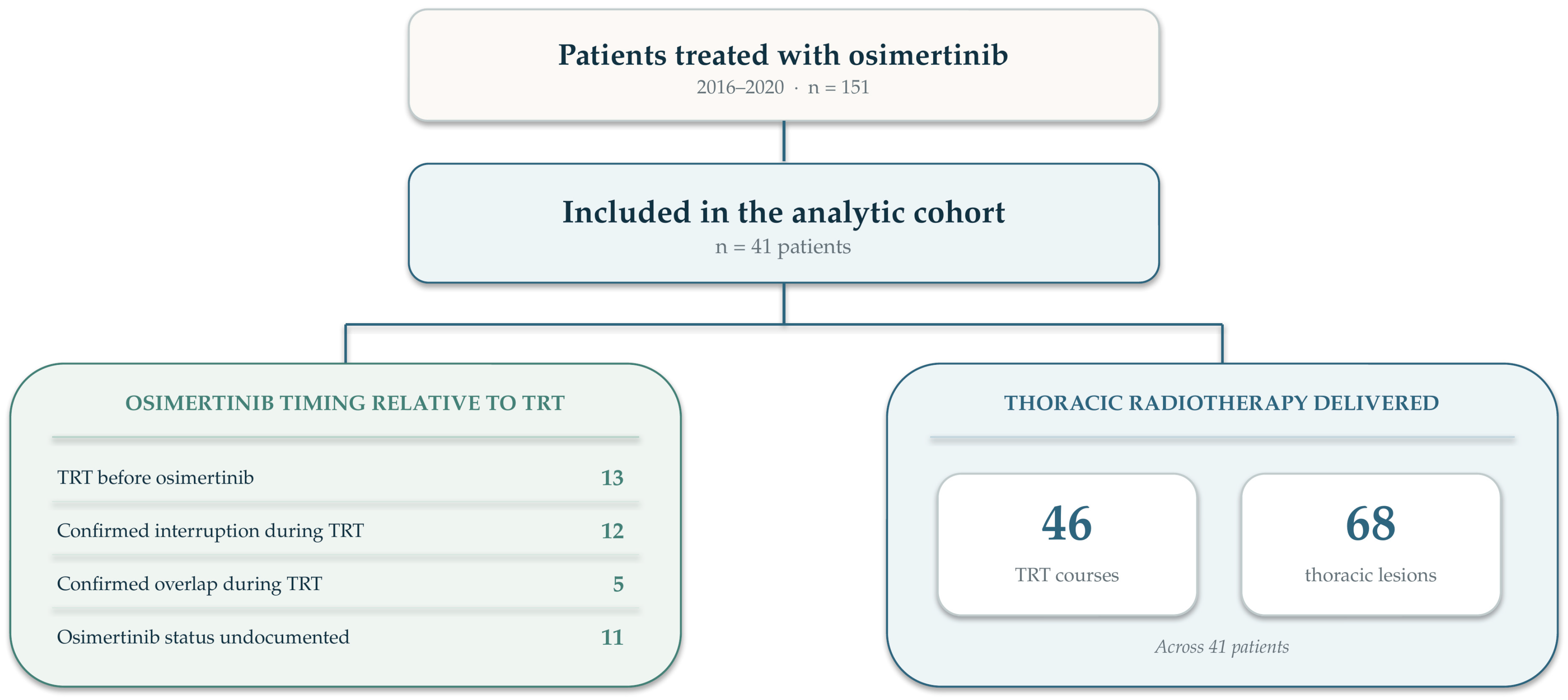
Between 2016 and 2020, 151 patients at our institution were treated with osimertinib, of whom 41 patients underwent 46 (31.3%) courses of TRT involving 68 thoracic lesions that met the study eligibility criteria (Figure 1). Median age at TRT was 66.7 years (interquartile range [IQR]: 58.3–72.4). The majority were diagnosed with de novo metastatic disease (n = 31; 75.6%), with mostly adenocarcinoma histology (n = 39; 95.1%). A total of 11 patients (26.8%) were current or former smokers, and 30 (73.2%) were never smokers. Sixteen patients (39%) started osimertinib as first-line systemic therapy, and the median number of cycles of osimertinib received was 9 (IQR: 7–13). Median total radiation dose and fractionations were 20 Gy (IQR: 20–30 Gy) and 5 fractions (IQR: 1–5). The median BED10 for the most recent treated thoracic lesion was 39.0 Gy (IQR: 28.0–52.8). Of the 46 TRT courses, 29 involved lung/mediastinal sites, 12 involved the spine, and 5 involved other thoracic sites.
Figure 1.
Patient selection and temporal relationship between osimertinib and thoracic radiotherapy.
Thirteen patients (31.7%) received TRT before osimertinib initiation, 12 (29.3%) had a documented interruption of osimertinib during TRT, 5 (12.2%) had documented overlap, and 11 (26.8%) had undocumented status. Among the 12 patients with documented interruption, the recorded duration was 1 day in 4, 2 days in 3, 4 days in 1, and unspecified in 4. Median follow-up from first thoracic radiotherapy, estimated by the reverse Kaplan–Meier method, was 21.7 months (95% CI: 15.9–26.9). Additional demographic and treatment information is provided in Table 1.
Table 1.
Baseline demographic information and treatment details of all patients (n = 41).
Median time to any-grade pneumonitis was 56 days. Six patients developed any-grade pneumonitis (14.6%), including one grade 1 event and five symptomatic grade ≥ 2 events (12.2%): three grade 2, one grade 4, and one grade 5. All five symptomatic cases involved TRT to a primary lung lesion, of which 4 were centrally located within 2 cm of the proximal bronchial tree (PBT). Three were treated with an IMRT technique, one with SBRT, and one with POP. Two symptomatic cases occurred after re-irradiation. The grade 5 case had overlapping prior TRT of 48 Gy in 4 fractions 3 years earlier, while the patient with grade 2 toxicity was treated with 30 Gy in 10 fractions to an overlapping area with parallel opposed pair technique 1 year prior. The grade 4 event occurred in the non-irradiated lung and was clinically characterized as drug-related in the statistical dataset, underscoring the uncertainty of attributing all events to radiation. Osimertinib was knowingly held in all three of these patients. At the course level, all five symptomatic events occurred among the 29 lung/mediastinal TRT courses (17.2%), whereas none occurred among the 17 spine/other courses; because pneumonitis was analyzed at the patient level and patients could contribute more than one TRT course, these descriptive course-level proportions should not be interpreted as independent incidence estimates. A reliable cohort-level denominator for central lesions or re-irradiation was not available. Additional demographic and treatment data for patients who developed symptomatic pneumonitis are presented in Table 2.
Table 2.
Demographic information and treatment details of patients with symptomatic pneumonitis (n = 5).
Exploratory regression analyses were performed using the first and most recent treated thoracic lesions. In multivariable Model #8A, each additional recorded cycle of osimertinib was associated with time to any-grade pneumonitis (HR: 1.52, 95% CI: 1.12–2.07, p = 0.01) and grade ≥ 2 pneumonitis (HR: 1.54, 95% CI: 1.15–2.07, p = 0.004). Total radiation dose to the most recent treated thoracic lesion was associated with any-grade pneumonitis (HR per 5 Gy: 1.38, 95% CI: 1.03–1.86, p = 0.03), but not grade ≥ 2 pneumonitis (HR per 5 Gy: 1.22, 95% CI: 0.90–1.65, p = 0.19). The estimate for confirmed osimertinib overlap was highly imprecise (HR: 3.36, 95% CI: 0.13–86.56, p = 0.47), while TRT before osimertinib was not significantly associated with pneumonitis (HR: 0.20, 95% CI: 0.02–2.21, p = 0.19). In univariable analysis, BED10 of the most recent treated thoracic lesion was associated with any-grade pneumonitis (HR per 5 Gy: 1.13, 95% CI: 1.02–1.26, p = 0.02), but not grade ≥ 2 pneumonitis (HR per 5 Gy: 1.09, 95% CI: 0.98–1.22, p = 0.10). The five-event grade ≥ 2 model with three covariates is overfit and the estimates should not be interpreted as reliable independent predictors. In particular, the cycle-count variable is not a validated cumulative pre-TRT exposure measure and cannot establish a causal biological relationship between osimertinib duration and pneumonitis.
Pneumonitis in the three patients with grade 2 toxicities resolved with supportive management and steroids and was alive and continued on osimertinib at last known follow-up. Pneumonitis in the patient with grade 4 toxicity required admission to the intensive care unit (ICU), oxygen and intravenous (IV) steroids and was still alive at last known follow-up, although osimertinib was stopped as a result. The patient with grade 5 pneumonitis passed away 10 days after development of pneumonitis despite treatment with steroids, antibiotics, and best supportive care.
4. Discussion
In this single-institution retrospective case series of EGFRm mNSCLC patients receiving osimertinib and TRT in close temporal association with osimertinib, the incidence of symptomatic (grade ≥ 2) pneumonitis was 12.2%, including one grade 4 and one grade 5 events. Notably, continuation of osimertinib during TRT was not associated with an increased risk of pneumonitis, whereas greater cumulative osimertinib use and higher radiation dose were associated with increased pneumonitis risk. The small number of events and heterogeneous temporal relationship between TRT and osimertinib limit the ability of this study to determine whether confirmed overlap or temporary interruption modifies pneumonitis risk. Regarding cumulative osimertinib, the recorded cycle count was not consistently anchored to the timing of RT or pneumonitis onset and therefore its association with pneumonitis should be interpreted with caution given the potential for time-dependent and survival-related bias. Although interruption of osimertinib during TRT was variable during the study period, our present institutional preference is to hold osimertinib for 2 days prior to and after TRT, and in scenarios of 5 or fewer fractions of RT, to schedule treatment on consecutive weekdays to avoid increasing the time off TKI from the weekend break.
The available, largely retrospective, data evaluating the safety of osimertinib and TRT have markedly heterogeneous rates of pneumonitis. Smith et al. reported a grade ≥ 2 pneumonitis rate of 56% (n = 9/16), of which six were grade ≥ 3 [13]. In all six patients, osimertinib was administered concurrently with TRT. Jia et al. described a similarly high rate of pneumonitis, with 7/11 (64%) patients experiencing grade ≥ 2 pneumonitis, including a single grade 5 event. In the multi-institutional study by Banla et al., 102 patients receiving TRT while on active osimertinib were evaluated; 14 (13.7%) developed grade ≥ 2 pneumonitis [14]. Among 22 patients with documented osimertinib overlap, 2 (9.1%) developed grade ≥ 2 pneumonitis, compared with 12 of 80 (15.0%) among patients in whom osimertinib was held (p = 0.729). The present study is smaller, but provides longer median follow-up (21.7 months versus 10.2 months in Banla et al.) and detailed characterization of severe events, including re-irradiation, central lesion location, temporal treatment patterns, and individual lung dosimetry. These studies should therefore be viewed as complementary rather than as establishing the safety or harm of osimertinib overlap with TRT.
The risk of pneumonitis with combination TRT and earlier generations of EGFR-TKIs has been well documented, with inconsistency with respect to both rate and severity. Retrospective studies of geftinib, erlotinib and icotinib report symptomatic pneumonitis rates in the 35–40% range [15], with one study describing three cases of grade 5 toxicity [16]. In considering the overall, largely retrospective literature, a meta-analysis of 37 studies (1143 patients) found that combined TRT and EGFR TKIs was associated with a relatively low incidence of severe pneumonitis (3.8%) and rare fatal events (0.1%), although concurrent treatment carried a higher risk than sequential therapy (4.9% vs. 0.4%) [17]. In our cohort, the observed association between recorded cycle count and pneumonitis should be interpreted cautiously, as the cycle variable is not specifically defined as exposure accrued before TRT or pneumonitis; greater recorded exposure may reflect longer survival, longer follow-up or treatment response rather than cumulative pulmonary toxicity.
Prospective phase II and phase III studies with similar TKIs have generally been more reassuring. Peng et al. conducted a phase II trial of 62 patients with mNSCLC patients receiving gefitinib, erlotinib and icotinib, randomized to receive SBRT in addition to TKI or TKI alone [18]. SBRT (30–50 Gy in 5 fractions) was delivered without interruption of TKI therapy. The addition of SBRT significantly improved PFS and OS, without increasing the incidence of pneumonitis (6.7% vs. 3.2%). These findings were subsequently recapitulated in the phase III SINDAS trial, which similarly demonstrated improved OS with the addition of radiotherapy, whilst maintaining an acceptable safety profile, wherein grade 3–4 pneumonitis was observed in 6% of cases [19]. Overall, these prospective data suggest that appropriately selected patients may derive meaningful clinical benefit from local consolidative radiotherapy, but they do not resolve the specific question of whether brief osimertinib interruption modifies a modest risk of pulmonary toxicity.
Emerging prospective data specific to osimertinib are similarly reassuring regarding the overall integration of local therapy with osimertinib, although these studies were not specifically designed to compare osimertinib interruption during TRT. In the phase II NORTHSTAR trial, the addition of local consolidative therapy to osimertinib was not associated with an increase in grade ≥ 3 adverse events, and grade 1–2 pneumonitis occurred in only 10% of patients, with numerically fewer grade 3 pneumonitis events observed in the local therapy arm [20]. In the setting of locally advanced, unresectable EGFR NSCLC, the phase III LAURA trial established osimertinib as the standard of care following definitive chemoradiotherapy [21]. While radiation pneumonitis was more common in the osimertinib arm, the majority of cases were grade 1–2, and severe pneumonitis was uncommon. Neither trial specifically evaluated short-term continuation versus interruption of osimertinib around TRT.
These data should also be considered in the context of the growing evidence supporting local consolidative radiotherapy in EGFR mNSCLC. Randomized studies including SINDAS, Sun et al., and CURB have consistently demonstrated improvements in PFS, and in some cases OS, with the addition of radiotherapy to TKI, which is in contrast to emerging data in the immunotherapy space [22]. As the use of metastasis-directed radiotherapy continues to expand, confirming the safety of combining TRT with novel systemic therapies becomes increasingly important.
This study has several important limitations. It was retrospective and single institution, with only five grade ≥ 2 pneumonitis events, limiting statistical power and resulting in an overfit three-covariate grade ≥ 2 regression model. There was no contemporaneous osimertinib-only or TRT-only comparator cohort, and treatment-selection bias cannot be excluded. Documentation of osimertinib interruption was incomplete. The recorded osimertinib cycle variable was not defined as cumulative pre-TRT exposure and may therefore be affected by time-dependent and survival-related biases. Cohort-level MLD, V5, and V20 were not available for comparative analysis; detailed lung dosimetry was available for the five symptomatic cases. BED10 was available at the lesion level, but target-volume metrics and cumulative composite dosimetry for re-irradiated patients were not available in the analytic dataset. A cohort-level denominator for re-irradiation and central/ultracentral treatment was also not available, precluding reliable comparative incidence estimates. Although smoking history and ECOG performance status were available, COPD/other pulmonary comorbidity, baseline steroid use, and concurrent non-osimertinib systemic therapy were not systematically captured in the analytic dataset. Pneumonitis attribution was uncertain in individual cases because both osimertinib and TRT can cause pulmonary toxicity; there was no independent blinded imaging adjudication and infectious evaluation was not standardized. Finally, the primary time-to-event analyses were conducted at the patient level, while 46 TRT courses and 68 thoracic lesions were descriptive treatment-level data; repeated courses within a patient were not treated as independent observations. Accordingly, the present findings should be considered hypothesis generating and primarily descriptive.
Although many institutions, including our own, continue to recommend holding osimertinib for approximately two days before and after thoracic radiotherapy as a precautionary measure [23], the present study was not designed or powered to determine whether this practice reduces pneumonitis. Given the small number of patients with documented overlap or interruption and the limited number of symptomatic events, decisions regarding temporary treatment interruption should therefore be individualized. This is consistent with the 2026 ESMO–ESTRO consensus on the safety of combining radiotherapy with EGFR, ALK, or BRAF/MEK inhibitors [24]. Specific to osimertinib, this Delphi consensus recommends major treatment adaptation, which can include avoiding the combination of osimertinib with high-dose conventionally fractionated radiotherapy or SBRT, although this specific recommendation is based on limited evidence (level V). Major adaptation may also involve treatment interruption, dose reduction, or substantial radiotherapy modification, depending on the clinical scenario. Ultimately, treatment decisions should be individualized, balancing the potential toxicity against the expected oncologic benefit and considering treatment intent, dose and fractionation, and prior radiotherapy.
Author Contributions
Conceptualization, D.Y.M., H.N., M.Y. and A.V.L.; methodology, D.Y.M., H.N., M.Y., A.P., I.P., M.T., M.C.T., Y.U., A.W., P.C. and A.V.L.; software, A.W. and A.V.L.; validation, A.V.L.; formal analysis, D.Y.M., H.N., M.Y., A.P., I.P., M.T., M.C.T., Y.U., A.W., P.C. and A.V.L.; Resources, A.V.L.; data curation, D.Y.M., H.N., A.W. and A.V.L.; writing—original draft, D.Y.M., M.Y., A.W. and A.V.L.; writing—review and editing, D.Y.M., H.N., M.Y., A.P., I.P., M.T., M.C.T., Y.U., A.W., P.C. and A.V.L.; supervision, H.N., A.P., A.W. and A.V.L. All authors have read and agreed to the published version of the manuscript.
Funding
This research received no external funding.
Institutional Review Board Statement
The study was conducted in accordance with the Declaration of Helsinki, and approved by the Institutional Research Ethics Board at Sunnybrook Health Sciences Centre, Odette Cancer Centre (protocol code: # 5053; 7 September 2021).
Informed Consent Statement
Patient consent was waived due to the retrospective nature of the study, the exclusive use of de-identified or anonymized data, and the fact that the research posed minimal risk to participants.
Data Availability Statement
The datasets generated and analyzed during the current study are not publicly available due to patient privacy and institutional review board restrictions. However, de-identified data may be made available from the corresponding author upon reasonable request, subject to ethical approval.
Conflicts of Interest
Louie reports receiving personal fees for Speaker’s Bureau and Advisory Board participation from AstraZeneca, unrelated to the present study. The other authors declare no conflicts of interest.
References
- Ramalingam, S.S.; Vansteenkiste, J.; Planchard, D.; Cho, B.C.; Gray, J.E.; Ohe, Y.; Zhou, C.; Reungwetwattana, T.; Cheng, Y.; Chewaskulyong, B.; et al. Overall Survival with Osimertinib in Untreated, EGFR-Mutated Advanced NSCLC. N. Engl. J. Med. 2020, 382, 41–50. [Google Scholar] [CrossRef] [Scilit] [PubMed]
- Rosell, R.; Carcereny, E.; Gervais, R.; Vergnenegre, A.; Massuti, B.; Felip, E.; Palmero, R.; Garcia-Gomez, R.; Pallares, C.; Sanchez, J.M.; et al. Erlotinib versus standard chemotherapy as first-line treatment for European patients with advanced EGFR mutation-positive non-small-cell lung cancer (EURTAC): A multicentre, open-label, randomised phase 3 trial. Lancet Oncol. 2012, 13, 239–246. [Google Scholar] [CrossRef] [Scilit] [PubMed]
- Wu, Y.L.; Zhou, C.; Liam, C.K.; Wu, G.; Liu, X.; Zhong, Z.; Lu, S.; Cheng, Y.; Han, B.; Chen, L.; et al. First-line erlotinib versus gemcitabine/cisplatin in patients with advanced EGFR mutation-positive non-small-cell lung cancer: Analyses from the phase III, randomized, open-label, ENSURE study. Ann. Oncol. 2015, 26, 1883–1889. [Google Scholar] [CrossRef] [Scilit] [PubMed]
- Reinfuss, M.; Mucha-Malecka, A.; Walasek, T.; Blecharz, P.; Jakubowicz, J.; Skotnicki, P.; Kowalska, T. Palliative thoracic radiotherapy in non-small cell lung cancer. An analysis of 1250 patients. Palliation of symptoms, tolerance and toxicity. Lung Cancer 2011, 71, 344–349. [Google Scholar] [CrossRef] [Scilit] [PubMed]
- Moeller, B.; Balagamwala, E.H.; Chen, A.; Creach, K.M.; Giaccone, G.; Koshy, M.; Zaky, S.; Rodrigues, G. Palliative thoracic radiation therapy for non-small cell lung cancer: 2018 Update of an American Society for Radiation Oncology (ASTRO) Evidence-Based Guideline. Pract. Radiat. Oncol. 2018, 8, 245–250. [Google Scholar] [CrossRef] [Scilit] [PubMed]
- Fairchild, A.; Harris, K.; Barnes, E.; Wong, R.; Lutz, S.; Bezjak, A.; Cheung, P.; Chow, E. Palliative thoracic radiotherapy for lung cancer: A systematic review. J. Clin. Oncol. 2008, 26, 4001–4011. [Google Scholar] [CrossRef] [Scilit]
- Sato, Y.; Sumikawa, H.; Shibaki, R.; Morimoto, T.; Sakata, Y.; Oya, Y.; Tamiya, M.; Suzuki, H.; Matsumoto, H.; Yokoi, T.; et al. Drug-Related Pneumonitis Induced by Osimertinib as First-Line Treatment for Epidermal Growth Factor Receptor Mutation-Positive Non-Small Cell Lung Cancer: A Real-World Setting. Chest 2022, 162, 1188–1198. [Google Scholar] [CrossRef] [Scilit] [PubMed]
- Voruganti Maddali, I.S.; Cunningham, C.; McLeod, L.; Bahig, H.; Chaudhuri, N.; Chua, K.L.M.; Evison, M.; Faivre-Finn, C.; Franks, K.; Harden, S.; et al. Optimal management of radiation pneumonitis: Findings of an international Delphi consensus study. Lung Cancer 2024, 192, 107822. [Google Scholar] [CrossRef] [Scilit] [PubMed]
- Planchard, D.; Janne, P.A.; Cheng, Y.; Yang, J.C.; Yanagitani, N.; Kim, S.W.; Sugawara, S.; Yu, Y.; Fan, Y.; Geater, S.L.; et al. Osimertinib with or without Chemotherapy in EGFR-Mutated Advanced NSCLC. N. Engl. J. Med. 2023, 389, 1935–1948. [Google Scholar] [CrossRef] [Scilit] [PubMed]
- Li, M.S.C.; Lee, K.W.C.; Mok, K.K.S.; Loong, H.H.F.; Lam, K.C.; Mok, F.S.T.; Chan, L.L.; Lau, Y.; Chan, K.; Ng, J.T.; et al. Brief Report: Risk of Recurrent Interstitial Lung Disease From Osimertinib Versus Erlotinib Rechallenge After Symptomatic Osimertinib-Induced Interstitial Lung Disease. JTO Clin. Res. Rep. 2024, 5, 100648. [Google Scholar] [CrossRef] [Scilit] [PubMed]
- Sanchis-Borja, M.; Parrot, A.; Sroussi, D.; Rivin Del Campo, E.; Fallet, V.; Cadranel, J. Dramatic Radiation Recall Pneumonitis Induced by Osimertinib after Palliative Thoracic Radiotherapy for Lung Cancer. J. Thorac. Oncol. 2019, 14, e224–e226. [Google Scholar] [CrossRef] [Scilit] [PubMed]
- Jia, W.; Guo, H.; Jing, W.; Jing, X.; Li, J.; Wang, M.; Yu, J.; Zhu, H. An especially high rate of radiation pneumonitis observed in patients treated with thoracic radiotherapy and simultaneous osimertinib. Radiother. Oncol. 2020, 152, 96–100. [Google Scholar] [CrossRef] [Scilit] [PubMed]
- Smith, C.P.; Xiang, M.; Yoon, S.M.; Lee, A.; Ruan, D.; Goldman, J.W.; Cummings, A.L.; Lisberg, A.; Garon, E.B.; Moghanaki, D. Brief Report: Severe Pneumonitis After Combined Thoracic Radiotherapy and Osimertinib. JTO Clin. Res. Rep. 2023, 4, 100468. [Google Scholar] [CrossRef] [Scilit] [PubMed]
- Banla, L.I.; Tzeng, A.; Baillieul, J.P.; Kandekhar, M.J.; Fitzgerald, K.J.; LoPiccolo, J.; Poitras, H.A.; Soto, D.E.; Rotow, J.K.; Singer, L.; et al. Pneumonitis in Patients Receiving Thoracic Radiotherapy and Osimertinib: A Multi-Institutional Study. JTO Clin. Res. Rep. 2023, 4, 100559. [Google Scholar] [CrossRef] [Scilit] [PubMed]
- Xu, K.; Liang, J.; Zhang, T.; Zhou, Z.; Chen, D.; Feng, Q.; Xiao, Z.; Hui, Z.; Lu, J.; Wang, X.; et al. Clinical outcomes and radiation pneumonitis after concurrent EGFR-tyrosine kinase inhibitors and radiotherapy for unresectable stage III non-small cell lung cancer. Thorac. Cancer 2021, 12, 814–823. [Google Scholar] [CrossRef] [Scilit] [PubMed]
- Zhuang, H.; Yuan, Z.; Chang, J.Y.; Wang, J.; Pang, Q.; Zhao, L.; Wang, P. Radiation pneumonitis in patients with non--small-cell lung cancer treated with erlotinib concurrent with thoracic radiotherapy. J. Thorac. Oncol. 2014, 9, 882–885. [Google Scholar] [CrossRef] [Scilit] [PubMed]
- Meng, Y.; Sun, H.; Wang, S.; Yang, H.; Kong, F.S. Treatment-Related Pneumonitis of EGFR Tyrosine Kinase Inhibitors Plus Thoracic Radiation Therapy in Patients With Non-Small Cell Lung Cancer: A Systematic Review and Meta-Analysis. Int. J. Radiat. Oncol. Biol. Phys. 2024, 118, 415–426. [Google Scholar] [CrossRef] [Scilit] [PubMed]
- Peng, P.; Gong, J.; Zhang, Y.; Zhou, S.; Li, Y.; Han, G.; Meng, R.; Chen, Y.; Yang, M.; Shen, Q.; et al. EGFR-TKIs plus stereotactic body radiation therapy (SBRT) for stage IV Non-small cell lung cancer (NSCLC): A prospective, multicenter, randomized, controlled phase II study. Radiother. Oncol. 2023, 184, 109681. [Google Scholar] [CrossRef] [Scilit] [PubMed]
- Wang, X.S.; Bai, Y.F.; Verma, V.; Yu, R.L.; Tian, W.; Ao, R.; Deng, Y.; Zhu, X.-Q.; Liu, H.; Pan, H.-X.; et al. Randomized Trial of First-Line Tyrosine Kinase Inhibitor With or Without Radiotherapy for Synchronous Oligometastatic EGFR-Mutated Non-Small Cell Lung Cancer. J. Natl. Cancer Inst. 2023, 115, 742–748. [Google Scholar] [CrossRef] [Scilit] [PubMed]
- Khan, T.M.; Verbus, E.A.; Gandhi, S.; Heymach, J.V.; Hernandez, J.M.; Elamin, Y.Y. Osimertinib, Surgery, and Radiation Therapy in Treating Patients with Stage IIIB or IV Non-Small Cell Lung Cancer with EGFR Mutations (NORTHSTAR). Ann. Surg. Oncol. 2022, 29, 4688–4689. [Google Scholar] [CrossRef] [Scilit] [PubMed]
- Lu, S.; Kato, T.; Dong, X.; Ahn, M.J.; Quang, L.V.; Soparattanapaisarn, N.; Inoue, T.; Wang, C.-L.; Huang, M.; Yang, J.C.-H.; et al. Osimertinib after Chemoradiotherapy in Stage III EGFR-Mutated NSCLC. N. Engl. J. Med. 2024, 391, 585–597. [Google Scholar] [CrossRef] [Scilit] [PubMed]
- O’Dwyer, N.; Palma, D.A. Treatment of oligometastatic lung cancers: New data, new drivers, new approaches. BMJ Oncol. 2026, 5, e001052. [Google Scholar] [CrossRef] [Scilit] [PubMed]
- Guimond, E.; Tsai, C.J.; Hosni, A.; O’Kane, G.; Yang, J.; Barry, A. Safety and Tolerability of Metastasis-Directed Radiation Therapy in the Era of Evolving Systemic, Immune, and Targeted Therapies. Adv. Radiat. Oncol. 2022, 7, 101022. [Google Scholar] [CrossRef] [Scilit] [PubMed]
- van Aken, E.S.M.; O’Cathail, S.M.; Gandhi, A.K.; Bussink, J.; Castelo-Branco, L.; Eriksen, J.G.; Argilés, G.; Hiley, C.; Atkinson, V.; Kaźmierska, J.; et al. ESMO-ESTRO consensus statements on the safety of combining radiotherapy with EGFR, ALK, or BRAF/MEK inhibitors. ESMO Open 2026, 11, 106076. [Google Scholar] [CrossRef] [Scilit] [PubMed]

Disclaimer/Publisher’s Note: The statements, opinions and data contained in all publications are solely those of the individual author(s) and contributor(s) and not of MDPI and/or the editor(s). MDPI and/or the editor(s) disclaim responsibility for any injury to people or property resulting from any ideas, methods, instructions or products referred to in the content. |
© 2026 by the authors. Licensee MDPI, Basel, Switzerland. This article is an open access article distributed under the terms and conditions of the Creative Commons Attribution (CC BY) license.