


Abstract
Background: Rotational atherectomy is used as a lesion preparation tool in severely calcified coronary arteries prior to stent implantation. Controversy exists over whether rotablation should be performed due to the presence of severe calcifications in the coronary angiogram (primary rotablation) or only after failed conventional coronary intervention (secondary rotablation). Methods: At Zurich University Hospital periprocedural and 6-month clinical outcomes of 50 consecutive rotational atherectomy patients were collected retrospectively. Rotational atherectomy was performed using the Rotalink plus system® (Boston Scientific, MA); burr speed was set between 160000 to 180000 rpm. Results: Mean age was 73 8 9 years, 82% were males; 66% had stable angina, 18% unstable angina, and 16% acute myocardial infarction. Rotablation was performed in the left anterior descending coronary artery in 70%, the right coronary artery in 20%, the left circumflex artery in 8%, and the left main stem in 4%. Mean burr-to-artery ratio was 0.47 8 0.09. In 49 patients a mean 1.3 8 0.6 stents (82% drug-eluting) were placed. Overall, 26 patients underwent primary rotablation and 24 secondary rotablation. Periprocedural troponin elevation was found in 27% and 29% of the primary and secondary rotablation groups respectively (p = 0.90), and periprocedural myocardial infarction (CK-MB >3 ULN) in 8% of both groups (p = 0.69). Overall 6-month mortality was 4% and the combined clinical endpoint of death, myocardial infarction, stroke, target vessel revascularisation or hospitalisation for heart failure at 6 months occurred in 12% and 13% in the primary and secondary rotablation groups (p = 0.86). Conclusion: At Zurich University Hospital rotational atherectomy of severely calcified coronary artery lesions was associated with a satisfactory clinical outcome at 6 months. In patients with failed conventional intervention rotablation is feasible and associated with periprocedural complications and clinical outcomes at 6 months similar to those for primary rotablation.
Introduction
Since the development of rotational coronary atherectomy in the early 80s the indications for the procedure have changed. In complex coronary lesions no difference in the rate of restenosis at 6 months was evident when rotational atherectomy was compared with conventional PTCA, but procedural complications were somewhat higher with rotablation [1,2]. The singlecentre ERBAC study of 685 patients compared excimer laser, rotational atherectomy and PTCA in complex lesions and demonstrated a higher procedural success rate for rotational atherectomy but higher target lesion revascularisation (TLR) rates [3]. The multicentre COBRA trial demonstrated higher procedural success rates with rotational atherectomy compared to PTCA, but no difference in clinical outcomes [4].
The use of rotational atherectomy has continued as a lesion preparation tool for better delivery and implantation of coronary stents [5], especially drug-eluting stents (DES) [6,7]. Debulking complex atherosclerotic lesions prior to stenting resulted in higher luminal gain and smaller late luminal loss [8]. Rotational atherectomy may also be used to treat restenosis [9,10]. The success of the intervention depends on the rotablation technique (burr-to-artery ratio, revolutions per minute) and operator experience [11,12]. In a comparison of rotational atherectomy with coronary artery bypass grafting (CABG) for patients with failed conventional PCI, there was no significant difference in major cardiovascular events but rotational atherec-tomy carried a lower risk of periprocedural complications and a higher rate of target vessel revascularisation [13].
Based on the existing results, rotational atherectomy can be used as a lesion preparation tool in severely calcified coronary artery lesions. Possible but rare complications include myocardial infarction, emergency CABG, coronary artery dissection, no reflow phenomenon, perforation or severe coronary artery spasm [14]. In the present study we explored procedural details and clinical outcomes of rotational atherectomy at Zurich University Hospital, with special focus on patients who underwent secondary rotablation after a failed conventional intervention.
Methods
Patient population
This single centre retrospective study included consecutive patients treated by rotational atherectomy between January 2006 and April 2009 at Zurich University Hospital. The proportion of patients who underwent rotablation in relation to the total PCI population was 1.5%.
Data was collected by medical record review and follow-up was performed by interview of the attending general practitioner. Follow-up was complete for 100% of the patients. The local institutional ethics committee approved this retrospective analysis, and patient consent was waived.
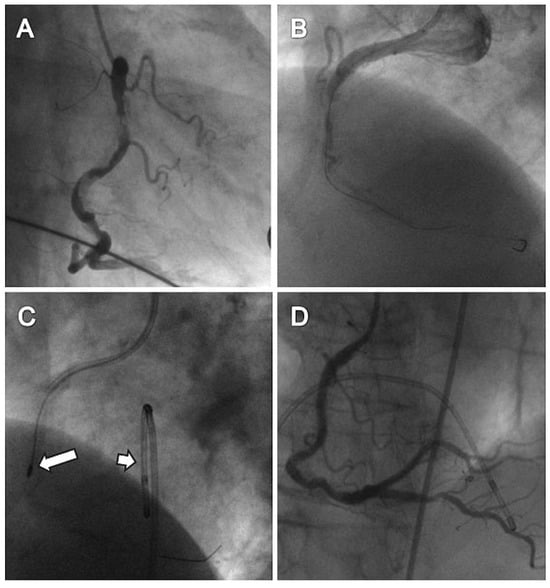
Patients were either treated by primary or secondary rotablation. Primary rotablation was defined as rotablation of severely calcified coronary lesions without prior attempt at conventional percutaneous coronary intervention (PCI). Secondary rotablation was defined as rotablation of severely calcified coronary lesions with prior-failed attempt at conventional PCI (fig. 1). Failed conventional PCI was defined as failure to cross the calcified coronary lesion with balloon catheters (failure to cross) or absent or incomplete balloon expansion during angioplasty (failure to inflate).
Figure 1.
Example of secondary rotablation. A 72-year-old female patient presented with acute inferior ST elevation myocardial infarction and a subtotal calcified lesion in the mid-right coronary artery (A). After passage of the stenosis by a wire there was abrupt vessel closure and it was not possible to advance several low-profile balloon catheters into the stenosis (B). A transvenous pacemaker (short arrow) and a balloon-pump were inserted due to haemodynamic instability and the vessel was successfully treated by rotational atherectomy (long arrow, C) and stenting (D).
Rotablation details
We used the Rotalink plus system, Boston Scientific, with the exchange-length rotablator floppy wire or extra support. Rotational burr speed was set between 160000 to 180000 revolutions per minute. Additionally, a pressurised saline solution containing verapamil 5 mg / 500 ml, nitroglycerine 2 mg / 500 ml and heparin 5000 IU / 500 ml was used for continuous flushing of the rotablator system to prevent thrombosis and severe coronary spasm.
Endpoints
Procedural complications were defined as coronary dissection, no reflow phenomenon, new coronary thrombus formation during PCI, distal embolisation, vessel closure, collateral closure, rotablator failure (no burr crossage, no wire crossage), rotablator complications, bailout use of glycoprotein IIb/IIIa inhibitors and the need for an intraaortal balloon pump (IABP).
The combined clinical endpoint was the combination of death, stroke, myocardial infarction (MI), stent thrombosis (according to the ARC definition [15]), target vessel revascularisation (TVR) and rehospitalisation for heart failure at 6 months. In addition, the combination of death, MI, stroke, TVR, major bleeding and hospitalisation for heart failure was assessed. Secondary clinical outcomes were major bleeding defined as gastrointestinal, intracranial, intraocular, retroperitoneal, abdominal, urological, gynaecological bleeding, haemoglobin decrease >3 mg/dl or haematoma at the access site >5 cm in diameter; periprocedural MI defined as CK-MB elevation >3 times the upper limit of normal (ULN); postprocedural troponin T elevation >0.1 µg/l.
Statistical analysis
Continuous variables with a normal distribution are described as means with standard deviations, and group comparisons were performed with the t-test. Continuous variables with skewed distribution are presented as median values with interquartile ranges, and group comparisons were performed with a rank test. Discrete variables are presented as frequencies and percentages, and group comparisons were performed using the Fisher’s exact test. Cumulative KaplanMeier event curves of the combined endpoint of death, MI, stroke, TVR, major bleeding and hospitalisation for heart failure were compared between the primary and secondary rotablation groups using the log rank test. All p-values are twotailed, and analyses were performed using STATA software.
Results
Overall patients
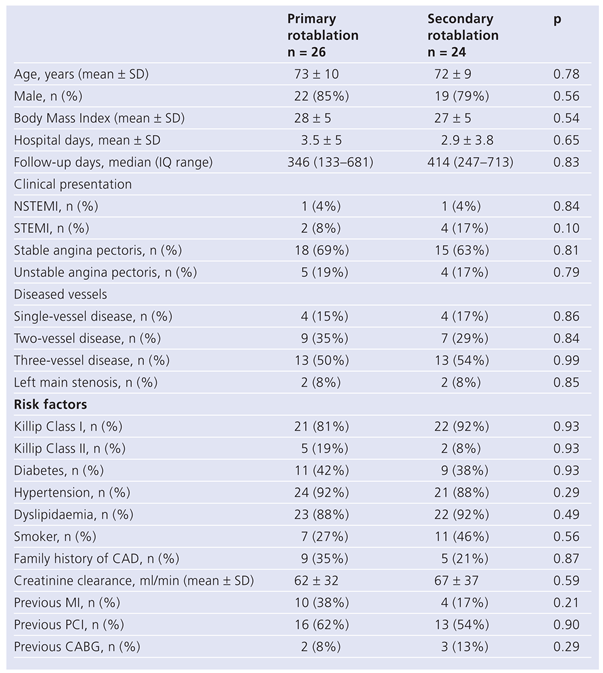
Between January 2006 and April 2009, 50 patients underwent rotational atherectomy at our institution: 26 patients were in the primary and 24 in the secondary rotablation groups. In the secondary rotablation group the reasons for failed conventional intervention were failure-to-cross in 14 (54%) patients and failure-to-inflate in 10 (42%). Mean duration of hospital stay was 3.0 8 4.4 days. Mean age was 73 8 9 years, 82% were male. Overall, 66% presented with stable angina, 18% with unstable angina and 16% had acute myocardial infarction (MI); 86% were in Killip class I, 14% in Killip class II, and one patient in Killip class IV. In total, 52% patients had three-vessel disease, 90% had hypertension and 90% had dyslipidaemia. Diabetes was present in 40% of patients and 58% had undergone a prior PCI. On admission, 94% of patients were on aspirin and 54% on clopidogrel. There were no significant differences in patient demographics, clinical presentation, cardiovascular risk factors and cardiovascular medications between the primary and the secondary rotablation groups (table 1).
Table 1.
Patient characteristics.
Procedural data
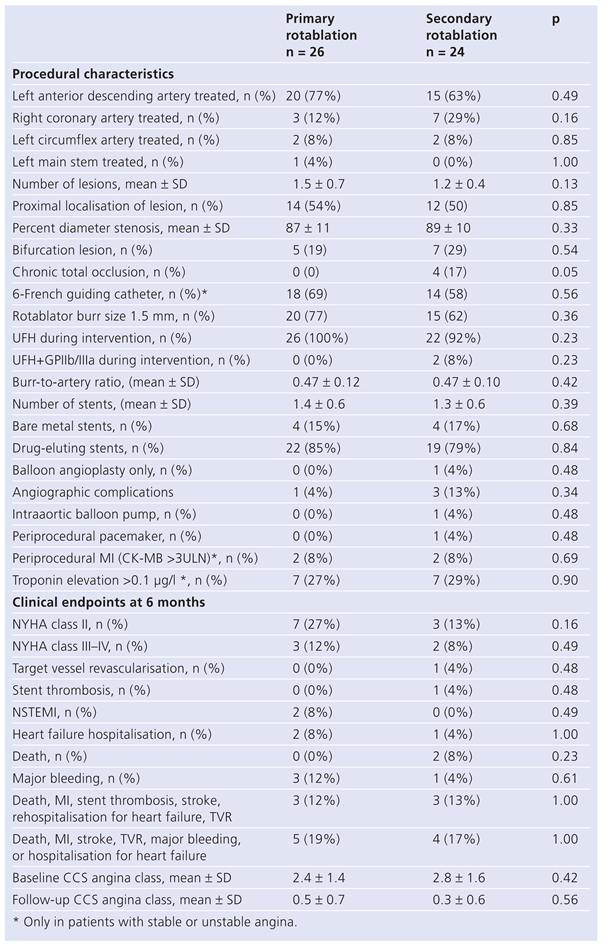
The most commonly treated vessel was the left ante-rior descending coronary artery (LAD; 70%) followed by the right coronary artery (RCA; 20%). Eight percent underwent rotablation of the left circumflex artery and 4% of the left main stem. All patients received unfractionated heparin treatment (UFH) and 4% glycoprotein IIb/IIIa inhibitors during the intervention. One patient from the secondary rotablation group received an intraaortic balloon pump (IABP) for ongoing systemic hypotension.
In 49 patients a mean of 1.3 8 0.6 stents were placed; 82% were drug-eluting stents (DES). Mean burr-to-artery ratio was 0.47 8 0.09.
Periprocedural complications were similar in the groups (table 2). Periprocedural laboratory myocardial infarction occurred in 8% in both groups and periprocedural troponin elevation was found in 27% and 29% of the primary and secondary rotablation groups respectively. In one 89-year-old patient from the secondary rotablation group the rotablator 0.5 mm burr became transiently jammed within the calcified lesion and caused dissection of the LAD with non-ST elevation myocardial infarction. In one patient from the primary rotablation group the rotablator wire could not be advanced and conventional PCI was successfully performed. In all cases from the secondary rotablation group rotab-lator wire insertion was successful.
Table 2.
Procedural characteristics and clinical outcomes.
Clinical events
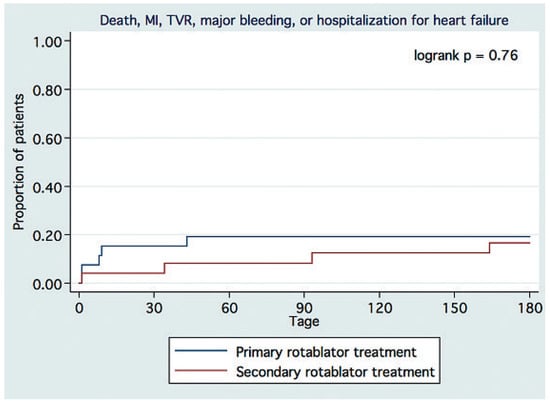
The overall 6-month mortality rate was 4%, and the combined clinical endpoint of death, myocardial infarction, stroke, target vessel revascularisation or hospitalisation for heart failure at 6 months occurred in 12% and 13% in the primary and secondary rotablation groups (p = 0.86) (table 2). There was no difference between the groups in the rate of the combined clinical endpoint that included ischaemic and bleeding complications (fig. 2). Postprocedural bleeding occurred in 4 patients (8%), 2 puncture site bleedings, 1 gastrointestinal and 1 gynaecological bleeding.
Figure 2.
Cumulative event curves for the combined clinical endpoint.
At a mean of 482 8 365 days of follow-up 24% patients had recurrent chest pain and 26% dyspnoea; 20% of patients were in NYHA class II and 10% in NYHA class III–IV. Nearly all patients were taking aspirin (92% vs 100%), beta-blockers (80% vs 85%, p = 0.37), statins (88% vs 83%, p = 0.45) and clopidogrel (46% vs 58%, p = 0.97).
Discussion
At Zurich University Hospital, rotational atherectomy of severely calcified coronary artery lesions was associated with a favourable clinical outcome at 6 months. The observed mortality of 4% at 6 months was similar to the rates (7%) from other rotational atherectomy studies [6,7]. In patients with failed conventional intervention rotablation is feasible and is associated with similar periprocedural complications and clinical outcomes at 6 months compared with primary rotablation. Rotational atherectomy appears to be particularly useful in patients with acute myocardial infarction and failed conventional intervention, since in these patients it allowed successful stent implantation.
The overall procedural complication rate of 8% compares well with the results of a previous study combining rotational atherectomy with stent implantation [16]. The coronary dissection rate of 6% was lower than reported in the literature [14]. This may be partially attributed to the low burr-to-artery ratio of 0.5 used in our patients. In addition, there were no cases of coronary artery perforation (risk 0–1.5%), slow-flow phenomenon (risk 1.2–7.6%), severe spasm (risk 1.6–6.6%) or abrupt vessel closure (risk 1.8–11.2%), and there was no emergency CABG (risk 1.0–2.5%) [14].
Periprocedural laboratory myocardial infarction was found in 8% of patients, which is comparable to the 4–6% from other studies [14,17]. However, more than one quarter of the elective patients had evidence of minor myocardial damage as assessed by increased postprocedural troponin levels. This reflects the possibility that distal embolisation of the atherectomy fragments may cause measurable but clinically less important myocardial micro-injury.
The equipment for conventional coronary intervention has improved substantially in recent years, including sophisticated wires, low-profile and high-pressure balloon catheters, and low-profile stents with increased flexibility and deliverability. Hence the indication for secondary rotablation may be less often established in the future. However, the role of secondary rotablation for failed conventional intervention may become more important in the future, because our patients are getting older and have more frequent comorbidities that increase coronary calcifications. Less experience has been gained with the use of rotational atherectomy for patients with failed conventional coronary intervention. We found that secondary rotablation is safe and effective in allowing stent placement in almost all patients. In another study of 41 patients who underwent rotational atherectomy after failed conventional intervention [18], the 7% rate of periprocedural complications was very similar to the 8% rate seen in our study.
This study was not randomised and not powered for the comparison of primary and secondary rotational atherectomy. The results are therefore hypothesis-generating and should be interpreted with caution. In addition, many patients who underwent primary rotablation due to visible, severe calcifications on the angiogram might also have been treated successfully with conventional coronary intervention. Thus the two groups may not compare very well and potential bias is likely. On the other hand, the groups may not necessarily be different, because some of the primary rotablation cases might have turned into secondary rotablation cases if conventional balloon angioplasty had been tried first.
In conclusion, rotational atherectomy appears to be safe in patients with failed conventional PCI. As a lesion preparation tool for severely calcified coronary artery lesions it helps to resolve such cases, though they are rare due to the ongoing improvement of conventional PCI equipment.
Conflicts of Interest
Dr Kucher received honoraria from Boston Scientific, Switzerland, for the organisation and conduct of the Swiss rotablator workshops for interventional cardiologists 2008 and 2009.
References
- Villanueva, E.V.; Wasiak, J.; Petherick, E.S. Percutaneous transluminal rotational atherectomy for coronary artery disease. Cochrane Database Syst Rev. 2003, CD003334. [Google Scholar]
- Bittl, J.A.; et al. Meta-analysis of randomized trials of percutaneous transluminal coronary angioplasty versus atherectomy, cutting balloon atherotomy, or laser angioplasty. J Am Coll Cardiol. 2004, 43, 936–42. [Google Scholar] [CrossRef] [Scilit] [PubMed]
- Reifart, N.; et al. Randomized comparison of angioplasty of complex coronary lesions at a single center. Excimer Laser, RotationalAtherectomy, and Balloon Angioplasty Comparison (ERBAC) Study. Circulation 1997, 96, 91–8. [Google Scholar] [PubMed]
- Dill, T.; et al. Arandomized comparison of balloon angioplasty versus rotational atherectomy in complex coronary lesions (COBRAstudy). Eur Heart J. 2000, 21, 1759–66. [Google Scholar] [CrossRef] [Scilit] [PubMed]
- Niccoli, G.; et al. Directional atherectomy before stenting versus stenting alone in percutaneous coronary interventions: a meta-analysis. Int J Cardiol. 2006, 112, 178–83. [Google Scholar] [CrossRef] [Scilit] [PubMed]
- Clavijo, L.C.; et al. Sirolimus-eluting stents and calcified coronary lesions: clinical outcomes of patients treated with and without rotational atherectomy. Catheter Cardiovasc Interv. 2006, 68, 873–8. [Google Scholar] [CrossRef] [Scilit] [PubMed]
- Khattab, A.A.; et al. Drug-eluting stents versus bare metal stents following rotational atherectomy for heavily calcified coronary lesions: late angiographic and clinical follow-up results. J Interv Cardiol. 2007, 20, 100–6. [Google Scholar] [CrossRef] [Scilit] [PubMed]
- Bramucci, E.; et al. Adjunctive stent implantation following directional coronary atherectomy in patients with coronary artery disease. J Am Coll Cardiol. 1998, 32, 1855–60. [Google Scholar] [CrossRef] [Scilit] [PubMed]
- Goldberg, S.L.; et al. Rotational atherectomy or balloon angioplasty in the treatment of intra-stent restenosis: BARASTER multicenter registry. Catheter Cardiovasc Interv. 2000, 51, 407–13. [Google Scholar] [CrossRef] [Scilit] [PubMed]
- Sharma, S.K.; et al. Randomized trial of Rotational Atherectomy Versus Balloon Angioplasty for Diffuse In-stent Restenosis (ROSTER). Am Heart J. 2004, 147, 16–22. [Google Scholar] [CrossRef] [Scilit] [PubMed]
- Hinohara, T. Percutaneous coronary intervention: current perspective. Keio J Med, 2001, 50, 152–60. [Google Scholar] [CrossRef] [Scilit] [PubMed]
- Whitlow, P.L.; et al. Results of the study to determine rotablator and transluminal angioplasty strategy (STRATAS). Am J Cardiol. 2001, 87, 699–705. [Google Scholar] [CrossRef] [Scilit] [PubMed]
- Brambilla, N.; et al. Directional coronary atherectomy plus stent implantation vs left internal mammary artery bypass grafting for isolated proximal stenosis of the left anterior descending coronary artery. Catheter Cardiovasc Interv. 2005, 64, 45–52. [Google Scholar] [CrossRef] [Scilit] [PubMed]
- Cavusoglu, E.; et al. Current status of rotational atherectomy. Catheter Cardiovasc Interv. 2004, 62, 485–98. [Google Scholar] [CrossRef] [Scilit] [PubMed]
- Mauri, L.; et al. Comparison of rotational atherectomy with conventional balloon angioplasty in the prevention of restenosis of small coronary arteries: results of the Dilatation vs Ablation Revascularization Trial Targeting Restenosis (DART). Am Heart J. 2003, 145, 847–54. [Google Scholar] [CrossRef] [Scilit] [PubMed]
- Khattab, A.A.; Richardt, G. Rotational atherectomy followed by drug-eluting stent implantation (Rota-DES): a rational approach for complex calcified coronary lesions. Minerva Cardioangiol. 2008, 56, 107–15. [Google Scholar] [PubMed]
- Kiesz, R.S.; et al. Novel approach to rotational atherectomy results in low restenosis rates in long, calcified lesions: long-term results of the San Antonio Rotablator Study (SARS). Catheter Cardiovasc Interv. 1999, 48, 48–53. [Google Scholar] [CrossRef]
- Brogan, W.C., 3rd. Rotational coronary atherectomy after unsuccessful coronary balloon angioplasty. Am J Cardiol. 1993, 71, 794–8. [Google Scholar] [CrossRef] [Scilit] [PubMed]

© 2010 by the authors. Attribution - Non-Commercial - NoDerivatives 4.0.