


Summary
For many years, aspirin has set the standard for platelet inhibition in cardiovascular prophylaxis and therapy. With the advent of newer, invasive techniques and new potent antiplatelet agents, antiplatelet therapy will be likely to change and diversify in the near future. This brief review summarises present and future developments. Essentially, two trends are crystallizing: (a) the combination of established antiplatelet agents such as aspirin with ticlopidin or newly with others such as clopidogrel and (b) the platelet glycoprotein 11b/IIIa antagonists in their different, optimized molecular forms and dosages.
Zusammenfassung
Seit vielen Jahren stellt Aspirin die Standardmedikation zur Plättchenhemmung in der kardiovaskulären Prophylaxe und Therapie dar. Durch die Einführung von neuen, invasiven Techniken und neuen potenten Aggregationshemmern wird Sich die Behandlung mit Plättchenhemmern in naher Zukunft wahrscheinlich verändern.
Diese kurze Review fasst gegenwärtige und künftige Entwicklungen auf diesem Gebiet zusammen. Zwei Trends kristallisieren Sich besonders heraus: a) die Kombination von etablierten Aggregationshemmern wie Aspirin mit Ticlopidin Oder anderen, wie Clopidogrel, und b) die Blutplättchen Glykoprotein-llb/ Ila-Antagonisten in ihren unterschiedlichen, optimierten molekularen Formen und Dosierungen.
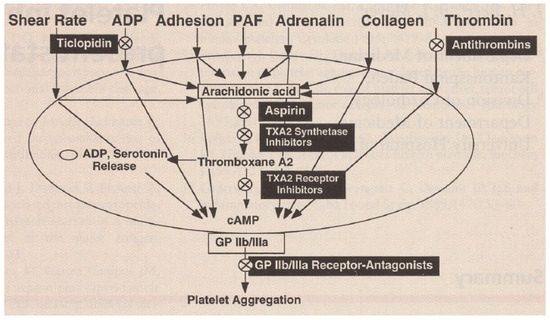
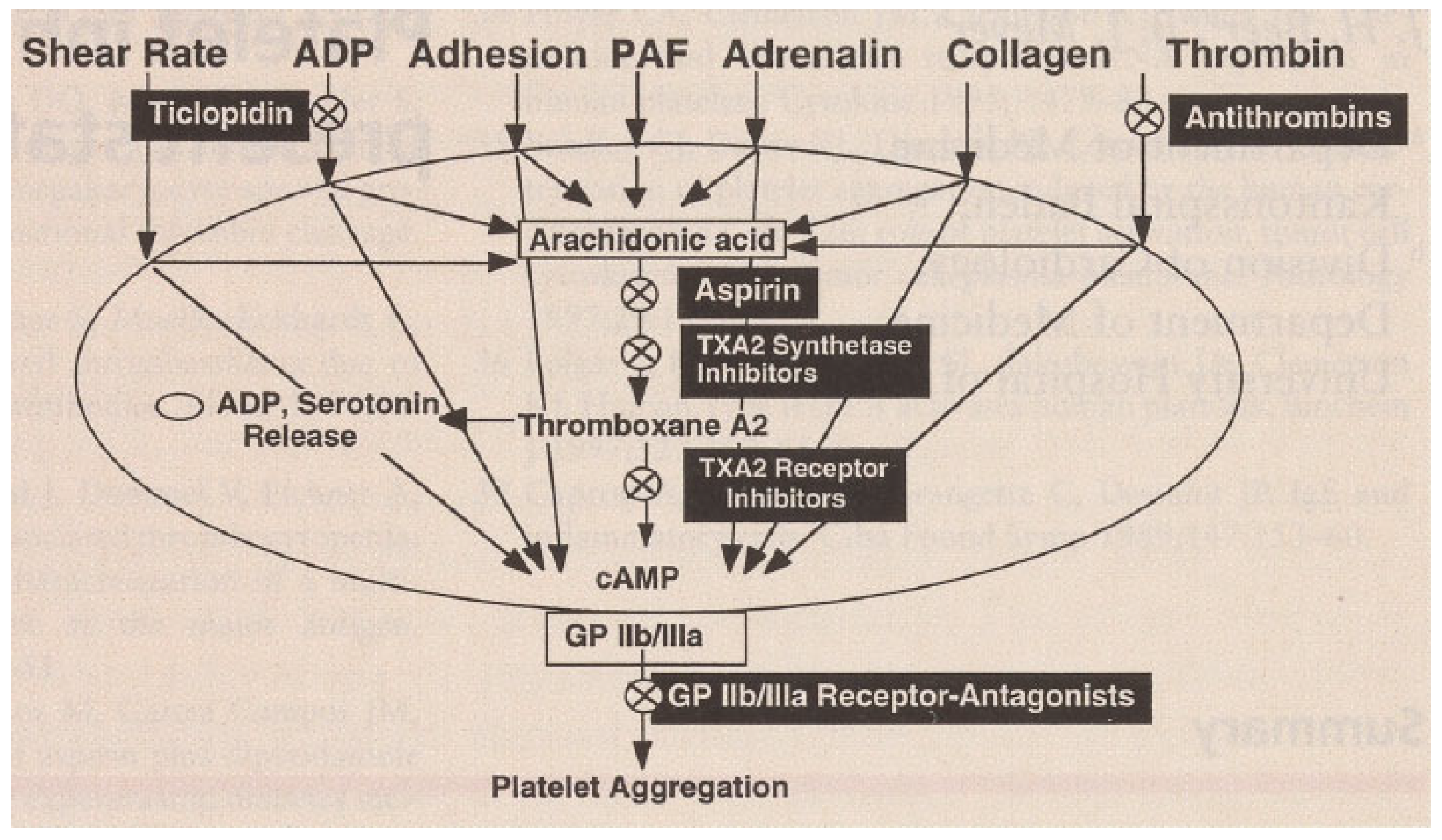
The principles of platelet activation and the potential of pharmacological interventions are summarised and illustrated in figure 1: multiple agonists, such as thrombin, collagen or ADP, but also turbulent flow with increased shear rates and the adhesion itself will lead to platelet activation. Agonist effects may be potentiated by endogenous platelet activation pathways such as the release of ADP, serotonin and the production of thromboxane. Combinations of so-called "weak" agonists (ADP, epinephrine, PAF) or low concentrations of "strong" agonists (thrombin, collagen) will act synergistically and result in platelet activation, the exposure of competent GPIIb/IIIa receptors, with subsequent fibrinogen binding, and in primary, reversible and then secondary, irreversible aggregation with release reaction. Platelet thrombus stabilisation and liberation of procoagulant activity (microvesicles) are further events in the course of platelet activation which are subject of current intensive study and of potential therapeutic options. The latter are also illustrated in Figure 1.
Figure 1.
Pathway of platelet activation: platelet adhesion and aggregation is a key step in vascular repair following vessel wall injury. Several stimuli cause platelet activation, including substances in the milieu of plaque rupture such as ADP, adrenalin, collagen, and thrombin. In addition, mechanical stimuli such as shear forces cause platelet activation. Activation of platelet occurs through several internal pathways of which one is thromboxane A2 production in the arachidonic acid pathway which can be blocked irreversible by aspirin. However, platelet aggregation can still occur through TxA2-independent pathways, particularly at high agonist concentrations. The final common pathway of platelet activation is the expression of the activated platelet GP 11b/IIIa receptor. Therefore, agents that block the glycoprotein GP 11b/IIIa receptor may inhibit platelet aggregation completely irrespective of the agonist.
Present and future potential therapeutic interventions with platelet inhibitory drugs, their possibilities and problems are depicted. Aspirin and — less known — the thromboxane receptor inhibitors are able to inhibit low dose agonist induced platelet activation of a number of platelet activating agents but will not prevent activation by higher concentrations. Specific inhibition of pathways may be achieved by antithrombins or the thienopyridines (ticlopidine or clopidogrel) [5,34], which interfere with the ADP and collagen-pathway perhaps with GPIIb/IIIa and may reduce shear-induced activation [7].
Combinations of antagonists will have additive or perhaps synergistic activities as has been shown clinically for combinations of aspirin with ticlopidin [9] and perhaps of aspirin with dipyridamole ([6], study dosages: 2 × 25 mg ASA and 2 × 200 mg dipyramidole). Aspirin will be tested in combination with clopidogrel in future studies.
A completely different concept is the inhibition of aggregation by the 11b/IIIa antagonists, which inhibit the final common pathway of platelet activation. Dose-dependent full inhibition irrespective of the agonist involved offers a potent and clinically tailored protection at the expense of bleeding at the high degree of inhibition.
The bottom line questions, however, for present and future antiplatelet therapies will remain the following:
- What is the number needed to treat (NNT, effect) and what is the number needed to harm (NNH, side effects) in a given, well characterised target population?
- Are effects of the new agent studied for primary or secondary prophylaxis or for acute treatment? For which endpoint precisely?
- Is the preventive benefit continuing after short-term treatment applicable to both men and women? What is the effect in certain subpopulations (old age etc.)? Are there subgroups that fare better with one antiplatelet agent than with another depending on the site of disease (neurovascular, cardiovascular and peripheral vascular disease)? Local vascular factors may modulate mechanisms of atherothrombotic disease. Is the enteral and parenteral application possible? What are the pharmacodynamics? What if the patient is already on aspirin and has suffered an event? Should aspirin be continued in addition?
In the case of aspirin the data are well established and — as an example — they may be summarised as follows:
The NNT for primary prophylaxis in the physicians' health study [9] was 550 for myocardial infarction and 3440 for death. For secondary prophylaxis after myocardial infarction or other events, it is 62, respective 186 [10]; even patients in their seventies and octogenerians will still profit from secondary prophylaxis [11]. Patients will benefit from the treatment during myocardial infarction and stroke [1,2,3]. The NNH is 200 for severe bleeding and 500–1000 for intracerebral bleeding [5,9,12,13]. The initial dose for treatment should be at least 250 mg of non-retarded aspirin, the maintenance dose in cardiology and peripheral vascular disease is usually 100 mg of retarded aspirin, for cerebrovascular indications there is a widespread consensus for 250-300 mg aspirin daily among neurologists; whether anti-inflammatory properties of this dose are operational in addition to the effective anti-platelet dose given the increased risk of cardiovascular events in patients with elevated CRP [15] remains to be established. On the other hand, theoretical evidence, some clinical studies, and the dose-dependent frequency of side effects suggest that much lower doses might be at least as adequate: presystemic, continuous acetylation of the platelets between gut and liver will inhibit the platelet cyclooxygenase but not the prostacyclin production of endothelial cells of the vascular bed due to an almost complete first pass effect [16]. The Swedish aspirin low dose trial (SALT) [12] and the Dutch TIA trial [13] have successfully used 30 and 50 mg of aspirin with at least equal results as in the higher dose group, however, with less bleeding.
Thienopyridines are somewhat more effective than aspirin but are more expensive and ticlopidin carries the risk of important hematological and gastrointestinal side effects. These side effects appear to have now been eliminated with the introduction of clopidogrel. This agent reduced the combined endpoint compared to aspirin significantly from 53 to 42 (NNT) [5]. Subgroup analysis in this study might suggest that clopidogrel is particularly effective in preventing peripheral vascular disease. Therefore, patients suffering an event while under treatment with aspirin may be considered for a clopidogrel therapy. However, enthusiasm must be tempered because 200 patients must be switched from aspirin in order to spare one event.
This leads us to the questions of the potential alternatives ("What do we have?" ) and of the future directions of antiplatelet therapy ("What do we need?").
The following 3 principles likely to be further applied in the future:
- 1.
- Combinations of two or more "weak" antagonists to block several independent pathways. Examples which have already shown their effectiveness include:
- –
- aspirin and ticlopidin after placement of intracoronary stents [8];
- –
- aspirin and dipyridamole in the secondary prophylaxis of stroke [6];
- –
- aspirin and LMW heparin [4].
- 2.
- The GP 11b/IIIa antagonists (inhibiting platelet fibrinogen binding and platelet aggregation) individually dosed (adapted according to the clinical situation) and given over the proper route (i.v. or p.o.).
- 3.
- GP 1b antagonists (inhibiting von Willebrand factor binding to platelets and platelet adhesion) would have the potential of being particularly effective in the pathologically high shear rate situation of high grade stenoses, but to a lesser extent in the physiological hemostatic situation, thus potentially approaching the ideal of platelet inhibition without the bleeding risk.
Ad 1) Combinations of weak antagonists (= type I therapy)
Since aspirin in combination with ticlopidin has already been shown to be effective in one clinical situation [8], and since safety and efficacy have been demonstrated for clopidogrel, clinicians await the trials of the combination of the two in secondary prophylaxis or treatment (unstable angina) or at least in a high risk subgroup compared to aspirin or clopidogrel alone. One preliminary trial in which aspirin is continued with ticlopidine appears promising [30] in secondary prevention and others are under way.
The ESPS trial [6] has shown superior effects of aspirin in combination with dipyridamol in the secondary prevention of stroke. The fact that aspirin 2 × 25 mg alone had a lesser effect in this trial than in most others, however, appears to reduce the strength of the study somewhat.
Prolonged application of LMW heparin in combination with aspirin has been used in unstable angina and the results collectively appear to indicate that it may be beneficial to add heparin to aspirin for 6 days but not for 40 days [17].
Ad 2) GP 11b/IIIa antagonism at different levels of receptor blockade (type Il therapy)
A large number of these novel agents are either already available for therapy or in phase Il-IV trials. Each of these substances needs to be analysed separately because they may differ substantially in their spectres (and side effects).
The earliest development was the chimeric monoclonal antibody, more precisely the Fab fragment of antibody 7E3 (Abciximab or Reopro® [18]), which binds GP 11b/IIIa with a high affinity, inhibits ligand binding, has a relatively long biological half-life of several hours [32] and will also bind to the vitronectin-receptor and to the MAC-I -receptor of activated monocytes, the significance of which is not yet entirely clear. The antibody causes a thrombasthenia Glanzmann-like state and is effective in acute PTCA and instable angina of complex lesions as has been shown in the EPIC, EPILOG and CAPTURE trials [19,20,21]. The antibody was also the first anti-GP 11b/IIIa antagonist which appeared to have favourable long-term results as well [22]. However, it can be used for short-term application only and has the potential problems of antigeneicity and an incidence of thrombocytopenia of approximately 1% [23].
The other development started out with the RGD adhesion sequence found in fibronectin and also present in snake venoms, which inhibits in its soluble form ligand binding to a large number of RGD-dependent adhesion receptors. RGD was cyclized [33] to gain specificity and has been successfully applied in a PTCA study [241 with favourable effects after 24 hours, 30 days and 6 months.
Peptidomimetics (fibans) have been developed from RGD with increased affinity, specificity and with or without the effect of altering the conformation of the receptor (inducing the socalled "LIBS" (the ligand induced binding sites) which represents one potential mechanism of the generation of antibodies that may lead to thrombocytopenia). Some fibans have shown to be effective [25] whereas others [34] have not, perhaps due to a dosage problem. Prodrugs of the fibans are now orally active and under investigation.
Monitoring of antiplatelet therapy
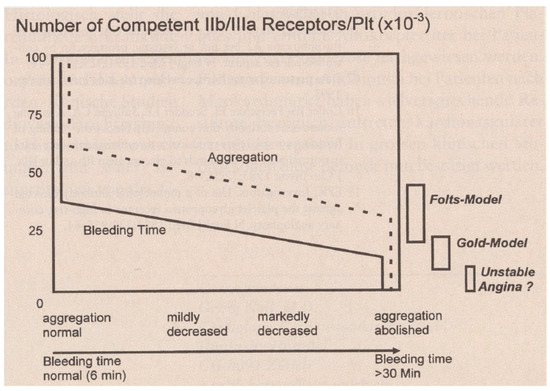
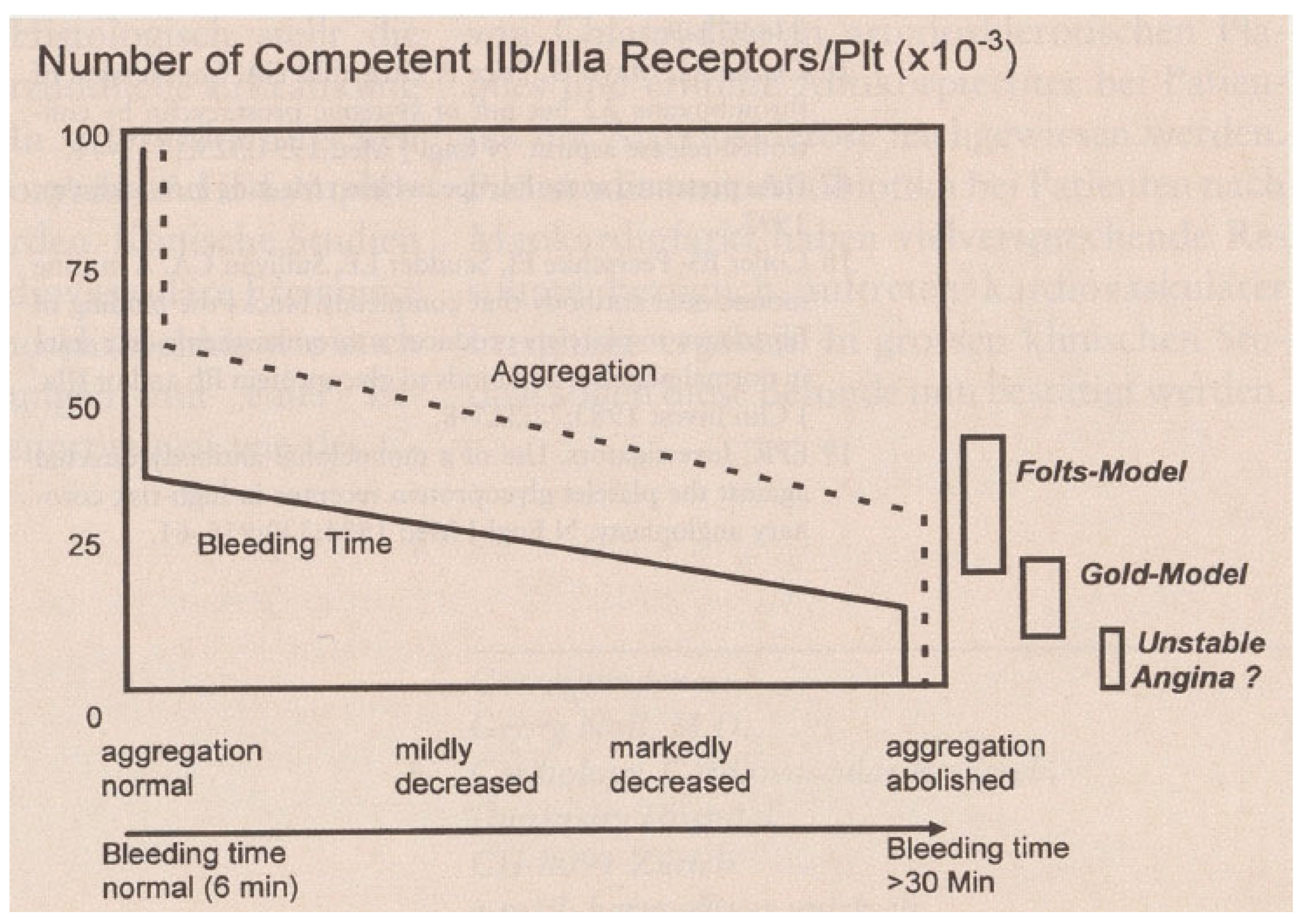
Monitoring of the occupied receptors in a given individual will become an increasingly important issue. A simple, rapidly performed bed-side test is a necessity because the available tests such as bleeding time, aggregation studies (and perhaps flow cytometric examinations) do not reflect the degree of required platelet inhibition or are methodologically difficult. As illustrated in Figure 2, a 90—95% occupancy of the GP 11b/IIIa which appears to be required in high grade stenoses such as in unstable angina pectoris, cannot be controlled or identified by the bleeding time; (which will be over 20—30 minutes long, cumbersome and carries a number of well known methodological problems [15]). Platelet aggregation studies with ADP and collagen are not possible at this upper range of receptor occupancy. A simple bed-side agglutination test has been proposed [26]. If the problems of individual variability of absorption and the variable percentage of receptor occupancy, respectively its analysis can be solved, an individually tailored antiplatelet therapy appears possible in the future; one speculative hypothesis could be that for primary prophylaxis as little as 50—70% receptor occupancy without relevant bleeding as in the case of the heterozygous Glanzmann's thrombasthenia could suffice. Secondary prophylaxis may require 75—85% depending on the severity of the disease whereas therapy may approach 90—95% receptor occupancy. Particularly, the latter will require careful, reliable and rapid monitoring to prevent bleeding and inadequate therapy. A high degree of inhibition will require a very reproducible absorption and stable and predictive plasma levels.
Figure 2.
Number of competent IIb/IIIa receptors per platelet: effects on aggregation, bleeding time and coronary stenosis in unstable angina and in animal models. The figure illustrates that the bleeding time remains normal with less than 50% of competent receptors available on platelets, it will then rapidly approach 30 minutes at approximately 15 – 20% or less of the receptors available. The aggregation with ADP or collagen will be reduced starting at approximately 60% of the available receptors and will be completely inhibited at approximately 25 – 30% of the receptors available. This means that the situation of the unstable angina and similar animal models in primates and dogs [28,29] are likely not to be reflected by the methods of aggregation and bleeding time. Therefore, it is urgent to have a simple platelet function assay to assess glycoprotein IIb/IIIa receptor blockade, e.g. as proposed by Coller et al. [26]. The figure is a summary of the data presented in [30].
The winner of the race of type I vs. type Il therapy will have the satisfaction of having set the standard (if better than aspirin) with which the competitors will have to treat their control population. Alternatively, it appears possible that one regimen will be preferable for one disease (or degree of stenosis) while the other will prove superior in a different setting.
References
- Mattle, H.P. Neues in der Therapie und Prophylaxe des ischämischen Hirninfarktes. Schweiz Med Wochenschr 1997, 127, 1963–1966. [Google Scholar]
- International Stroke Trial Collaborative Group. The International Stroke Trial (IST): A randomized trial of aspirin, subcutaneous heparin, both or neither among 19435 patients with acute ischemic stroke. Lancet 1997, 349, 1569–1581. [Google Scholar] [CrossRef] [Scilit]
- CAST (Chinese Acute Stroke Trial) Collaborative Group. Randomized placebo-controlled trial of early aspirin use in 20000 patients with acute ischemic stroke. Lancet 1997, 349, 1641–1649. [Google Scholar] [CrossRef] [Scilit]
- Kay, R.; Wong, K.S.; Yu, Y.L.; et al. Low-molecular-weight heparin for the treatment of acute ischemic stroke. N Engl J Med 1995, 333, 1588–1593. [Google Scholar] [CrossRef] [Scilit]
- CAPRIE Steering Committee. A randomized, blinded, trial of clopidogrel versus aspirin in patients at risk of ischemic events. Lancet 1996, 348, 1329–1339. [Google Scholar] [CrossRef] [Scilit]
- Diener, H.C.; Cunha, L.; Forbes, C.; Sivenius, J.; Smets, P.; et al. European Stroke Prevention Study 2. Dipyridamole and acetylsalicylic acid in the secondary prevention of stroke. J Neurol Sci 1996, 143, 1–13. [Google Scholar] [CrossRef] [Scilit]
- Kroll, M.H.; Heliums, J.D.; McIntire, I.N.; Schafer, A.l.; Moake, J.L. Platelets and shear stress. Blood 1996, 88, 1525–1541. [Google Scholar] [CrossRef] [Scilit]
- Schömig, A.; Neumann, F.J.; Kastrati, A.; Schuhlen, H.; Blasini, R.; Hadamitzky, M.; et al. A randomized comparison of antiplatelet and anticoagulant therapy after the placement of coronary-artery stents. N Engl J Med 1996, 334, 1984–1989. [Google Scholar] [CrossRef] [Scilit]
- Steering Committee of the Physicians' Health Study Research Group. Final report on the aspirin component of the ongoing Physicians' Health Study. N Engl J Med 1989, 321, 129–135. [Google Scholar] [CrossRef] [Scilit]
- Antiplatelet Trialists' Collaboration. Collaborative overview of randomised trials of antiplatelet therapy: Prevention of death, myocardial infarction, and stroke by prolonged antiplatelet therapy in various categories of patients. Br Med J 1994, 308, 81–106. [CrossRef] [Scilit]
- Il Sivenius, J.; Riekkinen, P.; Markku, L. Antiplatelet treatment in elderly people with transient ischemic attacks or ischemic strokes. Br Med J 1995, 310, 25–26. [Google Scholar] [CrossRef] [Scilit]
- The SALT Collaborative Group. Swedish Aspirin Low-Dose Trial (SALT) of 75 mg aspirin as secondary prophylaxis after cerebrovascular ischaemic events. Lancet 1991, 338, 1345–1349. [Google Scholar] [CrossRef] [Scilit]
- The Dutch TIA Trial Study Group. A comparison of two doses of aspirin (30 mg vs. 283 mg a day) in patients after a transient ischemic attack or minor ischemic stroke. N Engl J Med 1991, 325, 1261–1266. [Google Scholar]
- Lind, SE. The bleeding time does not predict surgical bleeding. Blood 1991, 77, 2547–2552. [Google Scholar] [CrossRef] [Scilit] [PubMed]
- Ridker, P.M.; Cushman, M.; Stampfer, M.J.; Tracy, R.P.; Hennekens, C.H. Inflammation, aspirin, and the risk of cardiovascular disease in apparently healthy men. N Engl J Med 1997, 336, 973–979. [Google Scholar] [CrossRef] [Scilit] [PubMed]
- Clarke, R.J.; Mayo, G.; Price, P.; Fitzgerald, G.A. Suppression of thromboxane A2 but not of systemic prostacyclin by controlled-release aspirin. N Engl J Med 1991, 325, 1137–1141. [Google Scholar] [CrossRef] [Scilit]
- Data presented at the European Heart Meeting in Stockholm. 1997.
- Coller, B.S.; Peerschke, E.l.; Scudder, L.E.; Sullivan, C.A. A murine monoclonal antibody that completely blocks the binding of fibrinogen to platelets produces a thrombasthenic—like state in normal platelets and binds to glycoprotein 11b and/or Illa. J Clin Invest 1983, 72, 325–328. [Google Scholar] [CrossRef] [Scilit]
- EPIC Investigators. Use of a monoclonal antibody directed against the platelet glycoprotein receptor in high-risk coronary a gioplasty. N Engl J Med 1994, 330, 956–961. [Google Scholar] [CrossRef] [Scilit]
- The EPILOG Investigators. Platelet glycoprotein 11b/IIIa receptor blockade and low-dose heparin during percutaneous coronary revascularization. N Engl J Med 1997, 336, 1689–1696. [CrossRef] [Scilit]
- The CAPTURE Study. Randomised placebo-controlled trial of abciximab before and during coronary intervention in refractory unstable angina. Lancet 1997, 349, 1429–1435.
- Topol, E.J.; Ferguson, J.J.; Weisman, H.E.; Tcheng, J.E.; Ellis, S.G.; Kleiman, N.S.; et al. Long-term protection from myocardial ischemic events in a randomized trial of brief integrin beta3 blockade with percutaneous coronary intervention. EPIC Investigator Group. Evaluation of Platelet 11b/IIIa Inhibition for Prevention of Ischemic Complication. JAMA 1997, 278, 479–484. [Google Scholar] [CrossRef] [Scilit] [PubMed]
- Berkowitz, S.D.; Harrington, R.A.; Rund, M.M.; Tcheng, J.E. Acute profound thrombocytopenia after c7E3 Fab (Abciximab) therapy. Circulation 1997, 95, 809–813. [Google Scholar] [CrossRef] [Scilit]
- Data of the Resolved-study presented at the European Heart Meeting in Stockholm. 1997.
- The RESTORE Investigators. Effects of platelet glycoprotein 11b/IIIa Blockade with Tirofiban on adverse cardiac events in patients with unstable angina or acute myocardial infarction undergoing coronary angioplasty. Circulation 1997, 96, 1445–1453. [Google Scholar] [CrossRef] [Scilit] [PubMed]
- Coller, B.S.; Lang, D.; Scudder, L.E. Rapid and simple platelet function assay to assess glycoprotein 11b/IIIa receptor blockade. Circulation 1997, 95, 860–867. [Google Scholar] [CrossRef] [Scilit] [PubMed]
- Ishikawa, K.; Kanamasa, K.; Hama, J.; Ogawa, I.; Takenaka, T.; Naito, T.; et al. Aspirin plus either dipyridamole or ticlopidine is effective in preventing recurrent myocardial infarction. Secondary Prevention Group. Jpn Circ J 1997, 61, 38–45. [Google Scholar] [CrossRef] [Scilit]
- Gold, H.I.C.; Coiler, B.S.; Yasuda, T.; Saito, T.; Fallon, J.T.; Guerrero, J.L.; et al. Rapid and sustained coronary artery recanalization with combined bolus injection of recombinant tissue-type plasminogen activator and monoclonal antiplatelet GPIIb/IIa antibody in a canine preparation. Circulation 1988, 77, 670–677. [Google Scholar] [CrossRef] [Scilit]
- Coller, B.S.; Folts, J.D.; Scudder, L.E.; Smith, S.R. Antithrombotic effect of a monoclonal antibody to the platelet glycoprotein 11b/IIIa receptor in an experimental animal model. Blood 1986, 68, 783–786. [Google Scholar] [CrossRef] [Scilit]
- Coiler, B.S.; Scudder, L.E.; Beer, J.; Gold, H.I.C.; Folts, J.D.; Cavagnaro, J.; et al. Monoclonal antibodies to platelet glycoprotein 11b/IIIa as antithrombotic agents. Ann NY Acad Sci 1991, 614, 193–213. [Google Scholar] [CrossRef] [Scilit]
- Hass, W.H.; Easton, D.; Adams, H.P.; Pryse-Phillips, W.; Molony, B.A.; Anderson, S.; Kamm, B. for the Ticlopidine Aspirin Stroke Study Group. A randomized trial comparing ticlopidine hydrochloride with aspirin for the prevention of stroke in high-risk patients. N Engl J Med 1989, 321, 501–507. [Google Scholar] [CrossRef] [Scilit]
- Faulds, D.; Sorkin, E.M. Abciximab (c7E3 Fab): a review of its pharmacology and therapeutic potential in ischemic heart disease. Drugs 1994, 48, 583–598. [Google Scholar] [CrossRef] [Scilit]
- Phillips, D.R.; Teng, W.; Arfsten, A.; Nannizzi-Alaimo, L.; White, M.M.; Longhurst, C.; et al. Effect of Ca2+ on GP Ilb—lla intractions with Integrelin. Enhanced GP Ilb-lla binding and inhibition of platelet aggregation by reductions in the concentration of ionized calcium in plasma anticoagulated with citrate. Circulation 1997, 96, 1488–1494. [Google Scholar] [CrossRef] [Scilit]
- Theroux, P.; Kouz, S.; Roy, L.; Knudtson, M.L.; Diodati, J.G.; Marquis, J.F.; et al. Platelet membrane receptor glycoprotein 11b/IIIa antagonism in unstable angina. The Canadian Lamifiban Study. Circulation 1996, 94, 899–905. [Google Scholar] [CrossRef] [Scilit]
© 1998 by the author. Attribution - Non-Commercial - NoDerivatives 4.0.