


Highlights
Public health relevance—How does this work relate to a public health issue?
- Functional decline and cardiometabolic disorders are major contributors to disability and loss of independence among older adults.
- This study examined whether cumulative cardiometabolic burden provides greater insight into functional exercise capacity than the conventional binary classification of metabolic syndrome.
Public health significance—Why is this work of significance to public health?
- Binary MetS status was not associated with the evaluated functional outcomes after FDR correction, whereas cumulative MetS component burden was associated with selected outcomes in the age- and sex-adjusted model.
- Greater cumulative MetS component burden was associated with slower sit-to-stand performance and shorter walking distance in the age- and sex-adjusted model; both associations were attenuated and no longer statistically significant after additional BMI adjustment.
Public health implications—What are the key implications or messages for practitioners, policy makers and/or researchers in public health?
- The observed cross-sectional associations warrant prospective investigation before cumulative MetS burden or adiposity measures can be considered for risk identification or screening.
- Observed associations with sit-to-stand and walking performance warrant prospective validation before clinical or public health application.
Abstract
Metabolic syndrome (MetS) is highly prevalent among older adults and has been associated with impaired physical function and reduced exercise capacity. However, the relationships of binary MetS status and cumulative MetS component burden with different dimensions of functional capacity remain unclear. This cross-sectional study examined these associations and evaluated whether they were attenuated after adjustment for body mass index (BMI) among community-dwelling Thai older adults. A total of 182 participants aged ≥ 60 years were included. The outcomes represented complementary dimensions of functional capacity: lower-extremity functional performance assessed using the Five-Times Sit-to-Stand Test (5TSTS), stepping endurance assessed using the 2-Minute Step Test (2MST), cadence-derived estimated oxygen uptake, and externally paced walking capacity assessed using the Incremental Shuttle Walk Test (ISWT). Overall, 55 participants (30.2%) had MetS. Functional outcomes did not differ significantly between participants with and without MetS. After false-discovery-rate (FDR) correction, BMI was inversely correlated with ISWT distance, waist circumference was correlated with slower 5TSTS performance and shorter ISWT distance, and cumulative MetS component burden was inversely correlated with ISWT distance. Binary MetS status was not independently associated with any outcome after FDR correction. In Model 1, each additional MetS component was associated with a 0.27-s longer 5TSTS completion time (95% CI: 0.07 to 0.46; p = 0.008; q = 0.030) and a 27.80-m shorter ISWT distance (95% CI: −45.01 to −10.59; p = 0.002; q = 0.014). Both associations were attenuated and no longer statistically significant after additional adjustment for BMI. These findings suggest that cumulative MetS burden was associated with sit-to-stand and walking performance before BMI adjustment. Both associations were attenuated and no longer statistically significant after additional adjustment for BMI.
1. Introduction
Population aging is accompanied by a growing burden of cardiometabolic abnormalities, functional limitations, and loss of independence [1]. Among older adults, the coexistence of abdominal obesity, elevated blood pressure, impaired glucose regulation, hypertriglyceridemia, and reduced high-density lipoprotein cholesterol (HDL-C) is commonly characterized as metabolic syndrome (MetS) [2,3]. MetS is associated with increased risks of type 2 diabetes mellitus, cardiovascular disease, disability, and premature mortality [4]. Its increasing prevalence therefore represents an important public health concern, particularly in rapidly aging populations where maintaining mobility and functional independence is a central component of healthy aging [5].
Age-related physiological changes may contribute to cardiometabolic deterioration and reduced physical capacity [6]. Aging is frequently accompanied by increased visceral and ectopic fat accumulation, reduced skeletal muscle quality, impaired insulin sensitivity, vascular dysfunction, and chronic low-grade inflammation [7,8]. These alterations may limit oxygen delivery and utilization, reduce muscular strength and endurance, and impair the ability to perform sustained physical activity [9,10]. Conversely, low functional exercise capacity and insufficient physical activity can promote central adiposity, insulin resistance, dyslipidemia, and elevated blood pressure, potentially creating a bidirectional relationship between cardiometabolic risk and functional decline [11,12]. These physiological alterations may compromise the ability of older adults to perform sustained ambulatory activities and maintain functional independence.
Cardiorespiratory fitness, physical performance, and functional exercise capacity are related but distinct constructs. Cardiorespiratory fitness refers to the integrated ability of the cardiovascular, respiratory, and muscular systems to support sustained aerobic activity and is commonly quantified using directly measured peak oxygen uptake (VO2peak) or maximal oxygen uptake (VO2max). Cardiorespiratory fitness was not directly measured in the present study; instead, cadence-derived estimated oxygen uptake was included as a secondary exploratory field-based indicator and was not considered equivalent to directly measured VO2peak [13]. Physical performance refers to the observable execution of standardized functional tasks and may reflect specific attributes such as strength, balance, mobility, and movement efficiency. Functional exercise capacity is a broader, task-based construct representing an individual’s ability to perform standardized activities that require the coordinated contribution of multiple physiological systems. In the present study, the Five-Times Sit-to-Stand Test (5TSTS) primarily assessed lower-extremity functional strength and transitional performance, the 2-Minute Step Test (2MST) assessed stepping endurance, and the Incremental Shuttle Walk Test (ISWT) assessed externally paced walking capacity. Although these outcomes and cadence-derived estimated oxygen uptake are not interchangeable, they were examined within a broader functional exercise capacity framework because they capture complementary dimensions of the physical capacity required for mobility and sustained activity in older adults. Higher cardiorespiratory fitness and better physical performance have been associated with lower risks of cardiovascular disease, functional limitation, disability, and mortality [14,15], whereas previous studies have generally reported poorer fitness and physical performance among adults with MetS than among those without MetS [16,17]. However, most previous studies have relied on binary MetS classification rather than examining the cumulative burden of individual metabolic abnormalities.
Adiposity was considered from two complementary analytical perspectives. First, BMI and waist circumference were examined as independent adiposity-related correlates of the functional outcomes because greater overall and central adiposity may adversely affect mobility and exercise performance through increased mechanical demand, metabolic dysfunction, inflammation, and impaired muscle quality [18,19]. Second, BMI was included in Model 2 as an additional adiposity-related sensitivity covariate in analyses of binary MetS status and cumulative MetS component burden. This model was used to examine whether the estimated associations observed after adjustment for age and sex were sensitive to additional adjustment for overall adiposity. Waist circumference was not included as an adjustment variable because abdominal obesity defined using waist circumference is a component of both binary MetS status and cumulative MetS component burden; its inclusion could therefore condition on part of the exposure definition and result in overadjustment. Accordingly, attenuation after BMI adjustment was interpreted only as sensitivity to additional adjustment for BMI and not as evidence that BMI confounds, explains, or mediates the observed associations.
Evidence from Southeast Asian older populations remains comparatively limited. Asian populations may develop metabolic abnormalities at lower BMI levels than Western populations and may exhibit greater cardiometabolic risk for a given degree of overall adiposity [20]. This issue is particularly relevant in Thailand, which is experiencing rapid population aging alongside an increasing burden of hypertension, diabetes, dyslipidemia, and abdominal obesity [21]. However, the relationships of binary MetS status, cumulative MetS component burden, adiposity, and multiple field-based measures of functional exercise capacity have rarely been examined together in Thai older adults. Addressing this gap may improve understanding of how different representations of cardiometabolic risk relate to functional impairment in this population.
Therefore, this cross-sectional study aimed to investigate the associations of binary MetS status and cumulative MetS component burden with functional exercise capacity among community-dwelling Thai older adults. Because dichotomous MetS classification may obscure variation in the number of metabolic abnormalities present below and above the diagnostic threshold, we hypothesized that a greater cumulative MetS component burden would be associated with poorer functional exercise capacity. We further compared the patterns of association for cumulative MetS burden and binary MetS status and examined whether these associations were attenuated after additional adjustment for BMI.
2. Materials and Methods
2.1. Study Design and Participants
This cross-sectional study recruited 203 community-dwelling older adults aged ≥ 60 years. The study protocol was approved by the Burapha University Human Ethical Committee (approval no. IRB1-051/2566). All participants provided written informed consent before participating in the study.
2.2. Sample Size Calculation
The original recruitment target was estimated using a single-population proportion formula for a cross-sectional study based on the estimated population of older adults in Chonburi Province (N = 226,963). A conservative expected proportion of 50%, a 95% confidence level (Z = 1.96), and a margin of error of approximately 7.2% yielded a minimum sample size of 184 participants. The target was increased by 10% to account for incomplete assessments, missing data, and withdrawals, resulting in a planned recruitment of 203 participants. This calculation was used to establish a conservative sample size for the descriptive cross-sectional component of the study and was not specifically based on the planned regression analyses. Therefore, a regression-based sensitivity analysis was subsequently performed using the final analytical sample of 182 participants. For the most extensively adjusted model, comprising one focal exposure and three covariates (age, sex, and BMI), this sample provided 80% power at a two-sided α of 0.05 to detect an incremental effect size of approximately f2 = 0.044 for the focal exposure. For the overall four-predictor model, the corresponding minimum detectable effect size was approximately f2 = 0.067. Thus, the analytical sample was capable of detecting effects between the conventional small and medium ranges, although smaller associations may have remained undetected.
2.3. Eligibility Criteria
2.3.1. Inclusion Criteria
Participants were eligible if they: (a) were male or female and aged ≥ 60 years; (b) reported no known unstable or severe medical condition or musculoskeletal disorder that substantially limited their usual physical activity; (c) reported no acute symptoms at the initial screening, including chest pain or tightness, dizziness, palpitations, or diplopia; and (d) had no active infectious illness, including coronavirus disease 2019 (COVID-19), influenza, or another communicable infection. Eligibility at this stage was determined from an interview and self-reported medical and health history rather than from a diagnostic medical examination or exercise test.
2.3.2. Exclusion Criteria
Participants were excluded from the analysis or withdrawn from testing if they developed any adverse symptoms during the study assessments, including chest pain or tightness, dizziness, palpitations, dyspnea, leg pain or muscle cramps, diplopia, or syncope.
2.4. Participant Recruitment and Screening
Participants were recruited during May 2023 and April 2024 through advertisements posted at community health centers, hospitals, and municipal offices, as well as through announcements distributed via the LINE application. The recruitment materials included the study title, eligibility criteria, a brief description of the study procedures, and contact details for the research assistant, including a telephone number and LINE application.
Individuals who expressed an interest in participating received an initial explanation of the study objectives and procedures by telephone or through the LINE application. They were then scheduled to attend an in-person screening session, during which the research assistant provided a detailed explanation of the study and collected information regarding their medical and health history. The initial screening was intended to identify known conditions or current symptoms that clearly precluded participation. Because it was based primarily on participant-reported history and symptoms at rest, intermittent symptoms and activity-related musculoskeletal limitations that became apparent only during attempted physical testing could not always be identified at this stage. Body weight and height were measured, and BMI was calculated as part of the eligibility assessment.
Individuals who met the eligibility criteria and agreed to participate were asked to provide written informed consent. Eligible participants were subsequently scheduled to attend the research laboratory for data collection.
2.5. Participant Preparation
Following the screening visit, each participant was scheduled to attend the research laboratory at approximately 7:30 a.m. Before the assessment visit, participants were instructed to: (a) obtain at least 7 h of sleep; (b) fast for at least 8 h, during which only a small amount of plain water was permitted; (c) abstain from tea, coffee, alcohol consumption, and smoking for at least 4 h before testing; and (d) avoid moderate-to-vigorous physical activity, including exercise and physically demanding household activities, before the assessment.
2.6. Vital Signs Assessment
Upon arrival at the laboratory, participants rested in a seated position for 10 min before undergoing the vital signs assessments. Blood pressure and heart rate were measured using a cardiovascular and vital-sign monitoring device (HEM-7121, Omron Healthcare Co., Ltd., Kyoto, Japan). Three measurements were obtained at 2-min intervals, and the mean of the three measurements was used in the analyses.
2.7. Anthropometric and Fat Distribution Measurements
Anthropometric assessments included body weight, height, waist circumference, and hip circumference. Body weight was measured to the nearest 0.1 kg using a calibrated digital scale with participants wearing light clothing and no shoes. Standing height was measured to the nearest 0.1 cm using a stadiometer (Health-O-Meter ProSeries, Pelstar LLC, McCook, IL, USA) with participants standing upright, barefoot, and looking straight ahead in the Frankfort horizontal plane. BMI was calculated as body weight in kilograms divided by height in meters squared (kg/m2).
Waist circumference was measured using a non-elastic measuring tape at the midpoint between the lower margin of the last palpable rib and the upper border of the iliac crest. Participants stood upright with their feet shoulder-width apart and arms relaxed at their sides. Measurements were obtained at the end of a normal expiration with the tape positioned horizontally around the abdomen without compressing the skin.
Hip circumference was measured at the level of the maximum circumference of the buttocks with participants standing in a relaxed upright position. The measuring tape was placed horizontally around the hips and buttocks and maintained parallel to the floor throughout the measurement. The waist-to-hip ratio was subsequently calculated by dividing waist circumference by hip circumference.
All anthropometric measurements were obtained by trained research personnel. Two measurements were recorded for each circumference assessment, and the mean value was used for analysis. If the two measurements differed by more than 0.5 cm, a third measurement was obtained and the average of the two closest values was used. Measurements were recorded to the nearest 0.1 cm.
2.8. Body Composition Measurement
Body composition was assessed using bioelectrical impedance analysis (InBody 270, Biospace Co., Ltd., Seoul, Republic of Korea). Variables obtained included body fat mass, percentage body fat, skeletal muscle mass, fat-free mass, and visceral fat level.
2.9. Blood Collection and Biochemical Analyses
Approximately 8 mL of venous blood was collected from each participant following an overnight fast. Blood samples were analyzed for fasting plasma glucose, hemoglobin A1c (HbA1c), serum insulin, triglycerides, total cholesterol, low-density lipoprotein cholesterol (LDL-C), and high-density lipoprotein cholesterol (HDL-C). All biochemical analyses were conducted according to standard clinical laboratory procedures at RIA Laboratory Co., Ltd. (Chonburi, Thailand). Insulin resistance was estimated using the homeostatic model assessment of insulin resistance (HOMA-IR).
HOMA-IR = fasting insulin (µIU/mL) × fasting glucose (mg/dL)/405
Definition of MetS
MetS was defined according to the revised National Cholesterol Education Program Adult Treatment Panel III (NCEP ATP III) criteria for Asian populations [22]. Participants were classified as having MetS if they met at least three of the following five components: (1) abdominal obesity, defined as a waist circumference ≥ 90 cm in men or ≥80 cm in women; (2) elevated blood pressure, defined as systolic blood pressure ≥ 130 mmHg, diastolic blood pressure ≥ 85 mmHg, or current use of antihypertensive medication; (3) elevated fasting plasma glucose, defined as fasting glucose ≥ 100 mg/dL or current use of antidiabetic medication; (4) elevated triglycerides, defined as triglyceride concentration ≥ 150 mg/dL or specific treatment for hypertriglyceridemia; and (5) reduced HDL-C, defined as <40 mg/dL in men or <50 mg/dL in women. Participants meeting fewer than three criteria were classified as non-MetS. The cumulative cardiometabolic risk burden was quantified as the total number of MetS components present, ranging from 0 to 5, with higher scores indicating a greater burden of metabolic abnormalities.
Participants’ medical histories and current medication use were ascertained through self-report. For each prespecified medical condition, participants indicated whether they had previously received a diagnosis using dichotomous response options (Yes/No). They were also asked to report their current use of antihypertensive, antidiabetic, and lipid-lowering medications. These self-reported data were recorded and used to characterize participants’ medical histories and, where applicable, to classify the corresponding MetS components according to the predefined criteria. The reported diagnoses and medication use were not independently verified against medical records or prescription data.
2.10. Physical Fitness and Functional Exercise Capacity Assessments
After blood collection, participants completed a series of physical fitness and functional exercise capacity assessments, including leg muscle strength, the five-times sit-to-stand test (5TSTS), a one-min rapid walking test (1MRWT), the two-min step test (2MST), and the ISWT. Participants rested for at least 3 min between tests or until they indicated that they were ready to proceed.
On the assessment day, participants were asked about their current symptoms and readiness to undertake the physical tests. Their ability to begin and continue each test safely was evaluated by the supervising licensed physical therapist. A test was not initiated or was discontinued if the participant reported pain or symptoms that limited performance, or if the physical therapist considered continued testing unsafe or unlikely to yield a valid result.
Before testing, a research team member explained and demonstrated each procedure and provided standardized safety instructions. Participants were informed of symptoms that could occur during or after testing, including chest pain or tightness, dizziness, palpitations, dyspnea, leg pain or muscle cramps, diplopia, syncope, and excessive fatigue, and were instructed to report any such symptoms immediately. The assessors conducting the physical fitness and functional tests were unaware of participants’ MetS status at the time of assessment.
Each participant was individually supervised by a licensed physical therapist throughout the assessments. Participants performed muscle-stretching exercises before and after testing as part of the study’s safety procedures. Testing was stopped if pain, excessive fatigue, cardiovascular symptoms, or another clinical concern prevented safe continuation. When leg pain, muscle cramps, or another musculoskeletal symptom occurred, the supervising physical therapist provided appropriate first aid and determined whether further assessment or care was required. Participants who experienced a musculoskeletal injury were subsequently followed up by the research team and provided with appropriate advice or referral for further care when indicated.
2.10.1. Leg Muscle Strength
Leg muscle strength was assessed using a dynamometer. Participants were instructed to extend their legs and pull against the dynamometer with maximal effort, maintaining the contraction for 2 s [23]. Three trials were performed, with a 1-min rest period between trials. The highest value obtained from the three trials was used in the analyses.
2.10.2. Five-Times Sit-to-Stand Test
Functional lower-extremity strength was assessed using the 5TSTS. Participants began in a seated position on a standard chair with a backrest and a seat height of 43 cm, with their feet placed flat on the floor. They were instructed to stand up fully and return to the seated position five times as quickly and safely as possible without using their arms for assistance [24]. The time required to complete the five repetitions was recorded in seconds.
2.10.3. Cadence-Derived Estimated Oxygen Uptake
Cadence-derived estimated oxygen uptake was calculated from performance on the 1-min rapid walking test (1MRWT). The test was conducted on a level, unobstructed 30-m indoor walkway. Participants were instructed to walk as quickly as possible for 1 min while maintaining safety and without running. Standardized verbal encouragement was provided, and an investigator recorded the total number of steps using a handheld tally counter, with each foot strike counted as one step.
The physiological rationale for this exploratory estimate was that faster walking cadence generally represents greater ambulatory intensity and metabolic demand. Cunningham et al. [25] reported an association between self-selected walking pace and treadmill-measured maximal aerobic power in 84 men aged 19–66 years, providing general physiological support for a relationship between walking performance and aerobic capacity. He et al. [26] reported an estimated VO2max outcome in a brisk-walking intervention involving older Chinese adults with essential hypertension. However, neither study evaluated the 1MRWT or constituted a derivation or independent validation study of the specific cadence-based equation used in the present analysis.
For the present analysis, cadence-derived estimated oxygen uptake was calculated as follows:
where X represents the number of steps completed during the 1MRWT. Because this equation has not been independently validated against directly measured VO2peak in Thai older adults, the derived value was treated as a secondary exploratory indicator rather than a direct or validated measurement of cardiorespiratory fitness.
Estimated oxygen uptake (mL/kg/min) = 0.234X − 13.24,
2.10.4. Two-Minute Step Test
Functional exercise capacity was assessed using the 2MST. Participants were instructed to march in place, alternately raising each knee to the designated height, and to complete as many steps as possible within 2 min [27]. The total number of correctly completed steps was recorded.
2.10.5. Incremental Shuttle Walk Test
Functional exercise capacity was also evaluated using the ISWT. The ISWT was chosen because it provides a standardized externally paced walking assessment with progressively increasing intensity, thereby reducing variability associated with self-paced walking tests and enabling assessment of walking capacity under incrementally increasing physiological demand. The test was performed on a flat 10-m course marked by two turning points. Participants walked back and forth along the course, with their walking speed externally controlled by standardized audio signals [28].
The test comprised 12 progressively more demanding levels. During the first level, participants were required to complete each 10-m shuttle within 10 s. The required walking speed subsequently increased at 1-min intervals. Participants were instructed to continue for as long as possible while maintaining the pace indicated by the audio signals.
The test was terminated if the participant was unable to maintain the required walking speed or could not reach the designated turning point within the time allowed by the audio signal. Testing was also discontinued if the participant developed symptoms or requested to stop. The total distance completed was recorded in meters.
2.11. Statistical Analysis
Continuous variables were summarized as mean ± standard deviation (SD) when approximately normally distributed and as median with interquartile range (IQR) when non-normally distributed. Categorical variables were presented as frequencies and percentages. The distributions of continuous variables were evaluated using histograms and quantile–quantile plots. Comparisons between the MetS and non-MetS groups were performed using Welch’s independent-samples t-test for approximately normally distributed continuous variables, the Mann–Whitney U test for non-normally distributed continuous variables, and Pearson’s chi-square test or Fisher’s exact test for categorical variables, as appropriate. Fisher’s exact test was used when expected cell frequencies were insufficient for Pearson’s chi-square test. Effect sizes were reported as Cohen’s d, calculated as the difference between group means standardized by the pooled SD, for comparisons performed using Welch’s t-test; rank-biserial correlation (rrβ) for comparisons performed using the Mann–Whitney U test; and Cramér’s V for categorical comparisons. Absolute effect-size values are presented.
Associations between cardiometabolic characteristics and functional exercise capacity outcomes were initially assessed using Spearman’s rank correlation coefficients (ρ). Multivariable associations were subsequently examined using linear regression with HC3 heteroscedasticity-consistent robust standard errors, which provide reliable variance estimates in the presence of heteroscedasticity and moderate sample sizes. Binary MetS status was coded as 0 (non-MetS) and 1 (MetS). Cumulative cardiometabolic risk burden was represented by the number of MetS components present (range: 0–5) and modeled as a continuous variable. Regression coefficients (B) with corresponding 95% confidence intervals (CIs) were reported. Model 1 was adjusted for age and sex, which were treated as potential demographic confounders. Model 2 additionally included BMI as an additional adiposity-related sensitivity covariate. The two models addressed complementary questions. Model 1 estimated the association of binary MetS status or cumulative MetS component burden with each functional outcome after controlling for age and sex, whereas Model 2 examined whether this association remained after additional adjustment for BMI.
BMI was selected for Model 2 because it represents overall body mass relative to height and may affect weight-bearing functional tasks through mechanical loading, reduced movement efficiency, metabolic dysfunction, and impaired muscle quality. BMI was not included as a defining component of MetS and was not treated as a formally tested mediator. Waist circumference was examined separately as an independent correlate of functional outcomes but was not entered as a covariate because abdominal obesity, defined using waist circumference, was one of the five components used to determine both binary MetS status and cumulative MetS burden. Adjustment for waist circumference could therefore remove part of the exposure definition and result in overadjustment. Accordingly, changes in the regression coefficients after BMI adjustment were interpreted only as indicating sensitivity to additional adjustment for overall adiposity. Such changes do not establish that BMI confounds, explains, or mediates the observed associations. For analyses of cumulative MetS burden, the regression coefficient represented the expected change in each functional exercise capacity outcome associated with a one-component increase in MetS burden. Multicollinearity was assessed using variance inflation factors (VIFs), with values < 5 considered indicative of acceptable collinearity.
To account for multiple testing, the Benjamini–Hochberg false-discovery-rate (FDR) procedure was applied separately to three families of tests: the correlation analyses, regressions involving binary MetS status, and regressions involving MetS component burden. FDR-adjusted q values were reported. Statistical significance was defined as a two-sided p-value < 0.05 for analyses not subject to FDR correction and an adjusted q value < 0.05 for the correlation and regression analyses. Statistical analyses were performed using IBM SPSS Statistics for Windows, version 25.0 (IBM Corp., Armonk, NY, USA).
3. Results
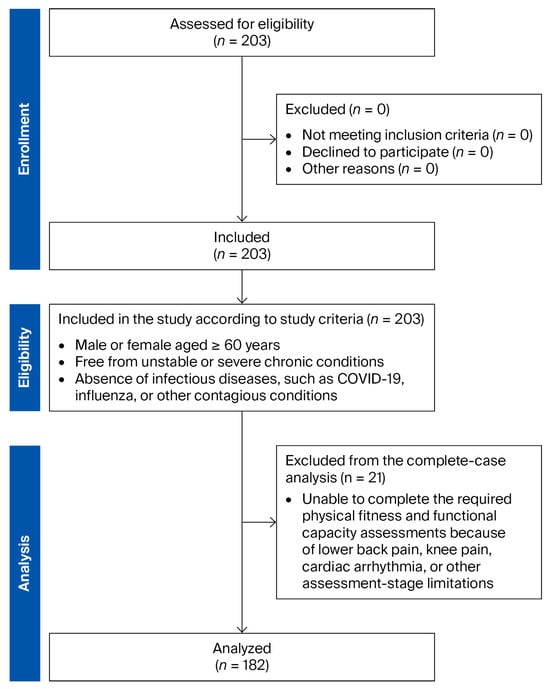
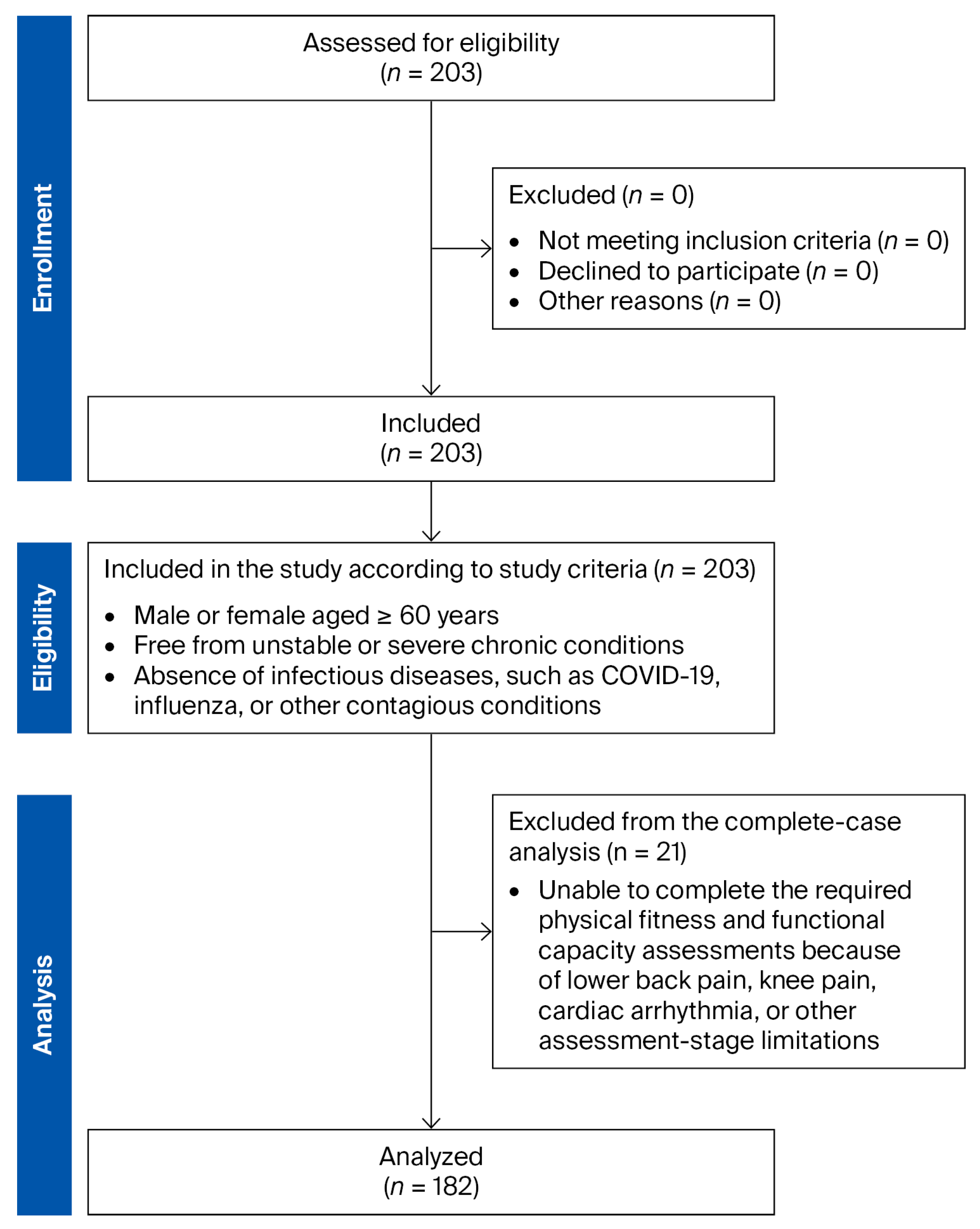
All 203 enrolled participants had passed the initial eligibility screening based on their self-reported medical and health history. However, during the assessment-day evaluation or attempted testing, 21 participants (10.34%) were unable to complete the required physical fitness and functional capacity assessments because of limitations that became apparent at that stage, including lower back pain, knee pain, and cardiac arrhythmia. Because complete outcome data were required for the primary analyses, these participants were excluded from the complete-case analysis. The final analytical sample therefore comprised 182 participants (89.66%). Participant flow is presented in Figure 1.
Figure 1.
STROBE flow diagram illustrating participant recruitment, eligibility assessment, enrollment, and inclusion in the final analysis.
3.1. Participant Characteristics
Of the 182 participants included in the analytical sample, 147 (80.8%) were women and 35 (19.2%) were men. Fifty-five participants (30.2%) met the diagnostic criteria for MetS, whereas 127 (69.8%) were classified as non-MetS. The prevalence of the individual MetS components was 59.3% for abdominal obesity, 54.9% for elevated blood pressure or antihypertensive medication use, 29.1% for elevated fasting glucose or antidiabetic medication use, 26.4% for elevated triglycerides, and 12.1% for reduced HDL-C. Participants were represented across the full range of cumulative MetS component burden: 37 (20.3%) had no components, 42 (23.1%) had one component, 48 (26.4%) had two components, 37 (20.3%) had three components, 15 (8.2%) had four components, and 3 (1.6%) had all five components (Supplementary Table S1).
Participants with MetS had significantly higher BMI, waist circumference, fasting glucose, triglyceride concentrations, systolic and diastolic blood pressure, and lower HDL-C concentrations than those without MetS (all p < 0.05; Table 1). Those with MetS also had significantly greater skeletal muscle mass, fat-free mass, body fat mass, percent body fat, and visceral fat level than those without MetS (all p ≤ 0.006; Table 1).
Table 1.
Participant characteristics according to metabolic syndrome status.
3.2. Comparison of Functional Exercise Capacity According to Metabolic Syndrome Status
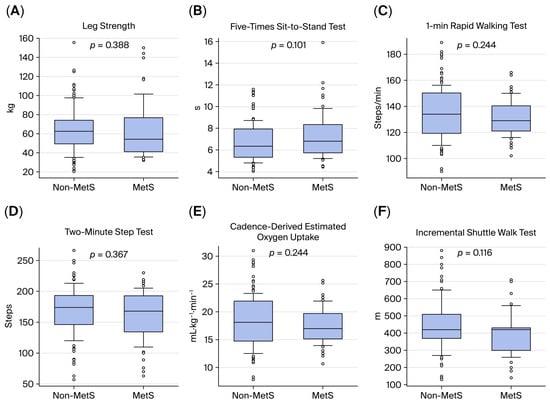
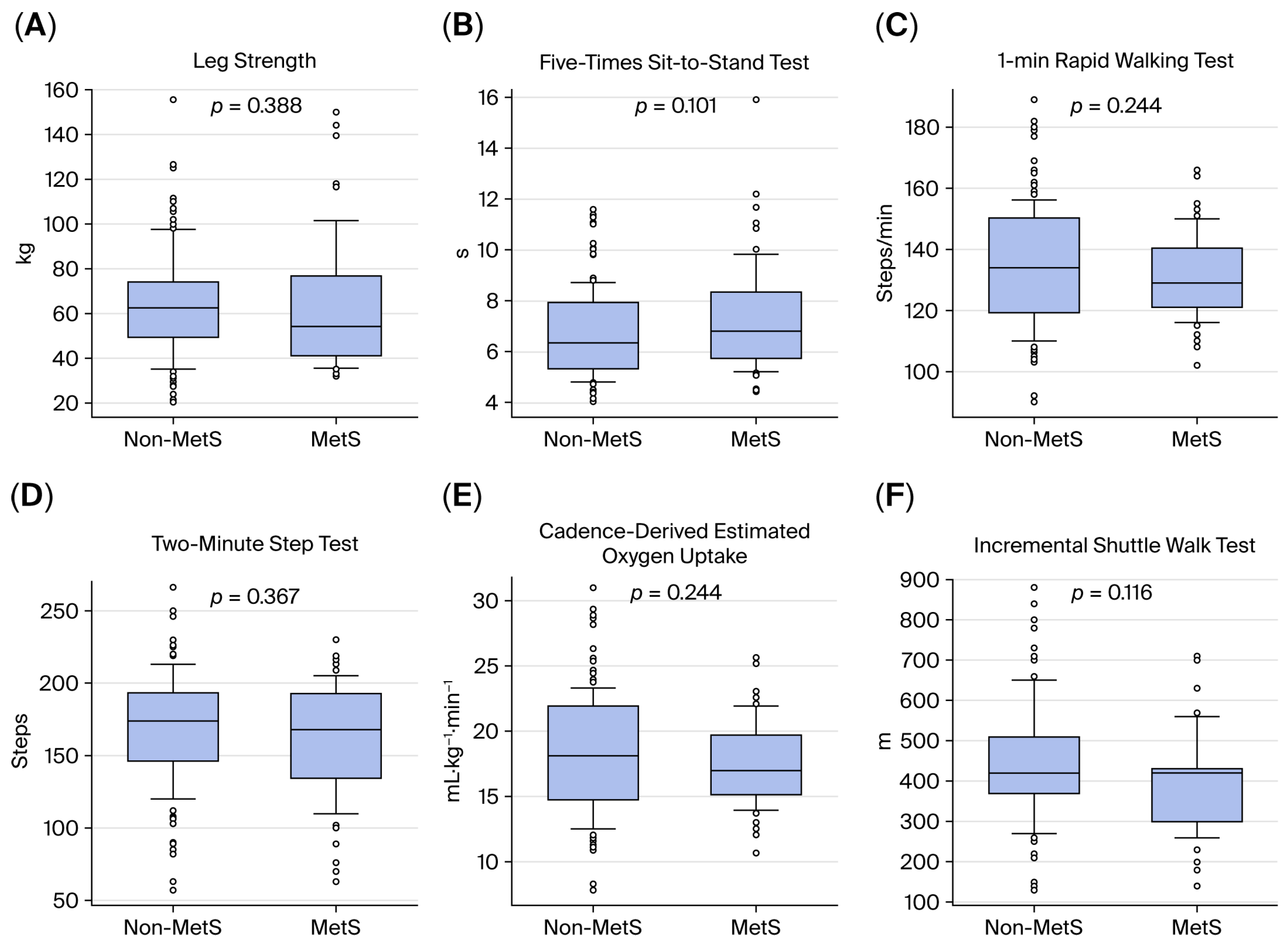
As shown in Figure 2, no statistically significant between-group differences were observed in leg strength, 5TSTS, 1MRWT, 2MST, cadence-derived estimated oxygen uptake, or ISWT (all p > 0.05). Effect sizes were small across all comparisons (Table 2).
Figure 2.
Box-and-whisker plots comparing leg strength (A), five-times sit-to-stand test (5TSTS) (B), 1-min rapid walking test (1MRWT) (C), 2-min step test (2MST) (D), cadence-derived estimated oxygen uptake (E), and incremental shuttle walk test (ISWT) (F) between non-metabolic syndrome (Non-MetS) and metabolic syndrome (MetS) participants. Boxes indicate the interquartile range, horizontal lines indicate medians, and whiskers extend to the 10th and 90th percentiles. p-values were obtained using the Mann–Whitney U test.
Table 2.
Functional exercise capacity in non-metabolic syndrome (Non-MetS) and metabolic syndrome (MetS) participants.
3.3. Bivariate Correlations of Cardiometabolic Risk Factors with Functional Outcomes
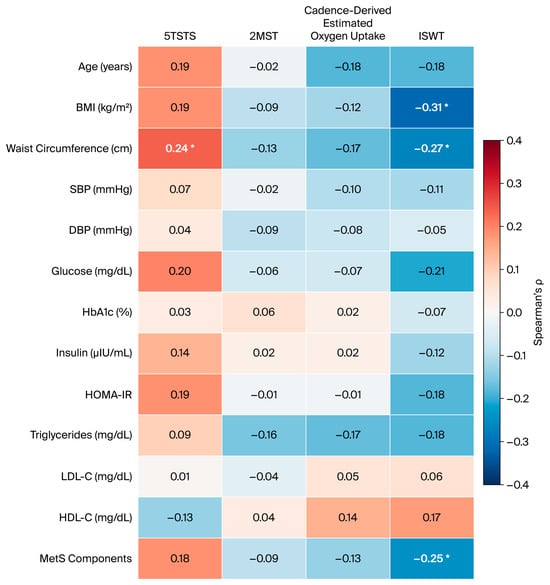
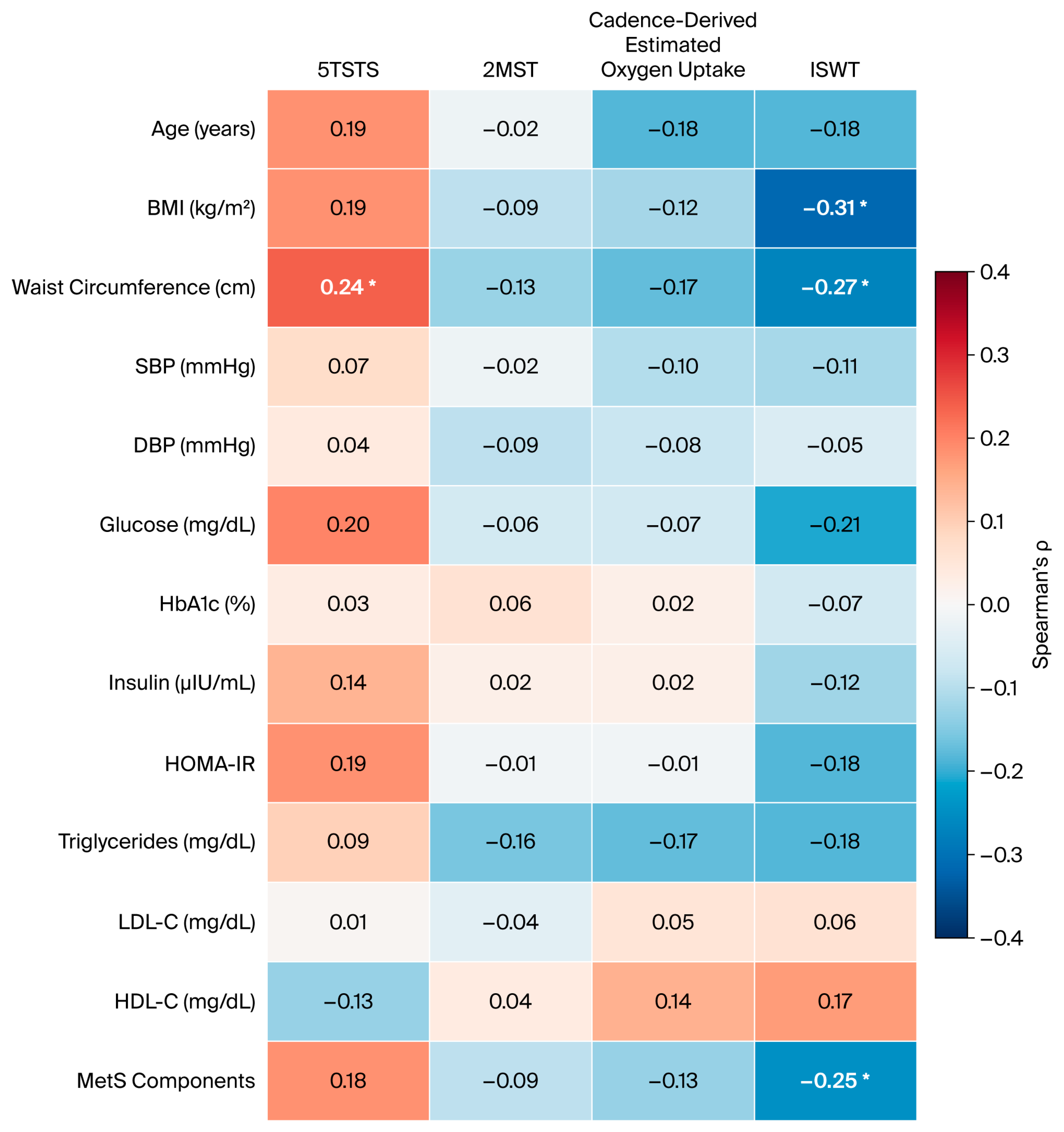
After Benjamini–Hochberg FDR correction, higher BMI was correlated with a shorter ISWT distance (ρ = −0.313, q = 0.008). Greater waist circumference was correlated with a longer 5TSTS completion time (ρ = 0.238, q = 0.023) and a shorter ISWT distance (ρ = −0.266, q = 0.023). A greater number of MetS components was also correlated with a shorter ISWT distance (ρ = −0.247, q = 0.040). No cardiometabolic variable was significantly correlated with 2MST performance or cadence-derived estimated oxygen uptake after FDR correction (Figure 3 and Table 3).
Figure 3.
Spearman correlation heatmap showing associations between cardiometabolic characteristics and the five-times sit-to-stand test (5TSTS), 2-min step test (2MST), cadence-derived estimated oxygen uptake, and incremental shuttle walk test (ISWT). Asterisks indicate q < 0.05 after Benjamini–Hochberg FDR correction.
Table 3.
Correlations between cardiometabolic risk factors and functional exercise capacity.
3.4. Regression Results for Binary Metabolic Syndrome Status
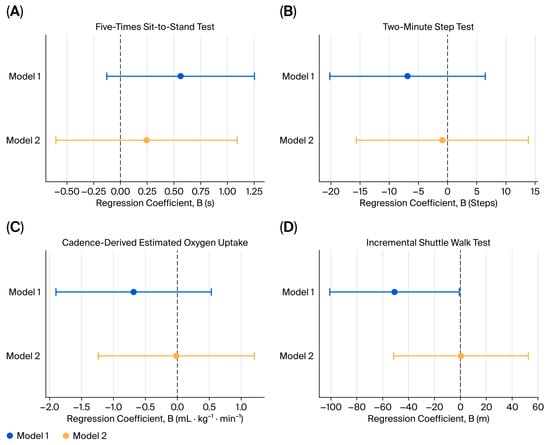
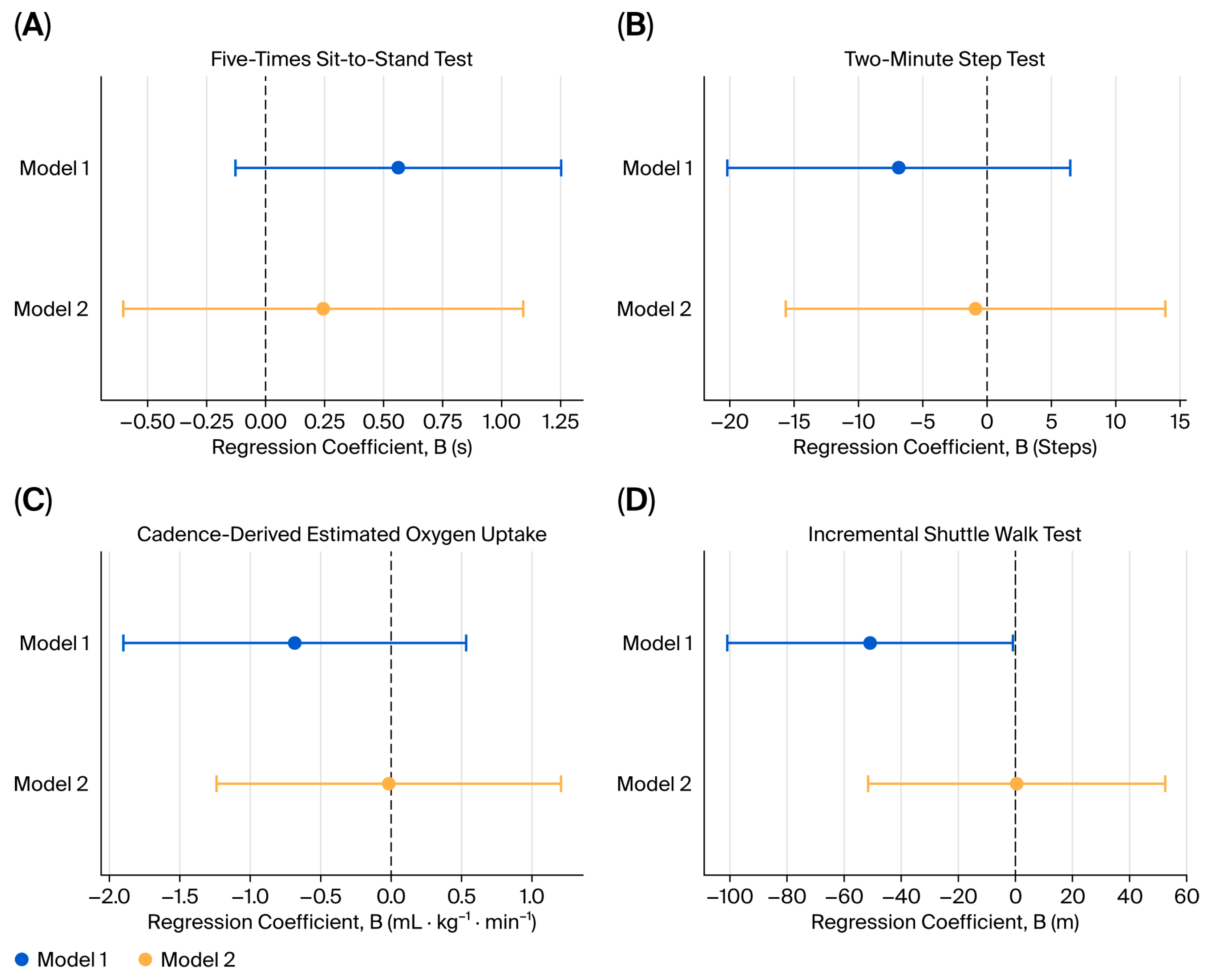
Binary MetS status was not independently associated with any functional outcome after FDR correction. In Model 1, the association with ISWT distance was nominally significant (B = −50.94 m; 95% CI: −100.98 to −0.90; p = 0.046) but did not remain significant after FDR correction (q = 0.293). After additional adjustment for BMI (Model 2), binary MetS status was not associated with 5TSTS (B = 0.24 s; p = 0.570), 2MST (B = −0.91 steps; p = 0.904), cadence-derived estimated oxygen uptake (B = −0.02 mL·kg−1·min−1; p = 0.980), or ISWT (B = 0.44 m; p = 0.987) (Figure 4 and Table 4).
Figure 4.
Forest plots of HC3 robust regression coefficients and 95% confidence intervals for the associations between binary metabolic syndrome status and functional exercise capacity outcomes: (A) five-times sit-to-stand test; (B) two-minute step test; (C) cadence-derived estimated oxygen uptake; and (D) incremental shuttle walk test. Model 1 was adjusted for age and sex, and Model 2 was additionally adjusted for body mass index (BMI). Binary MetS status was coded as 0 = non-MetS and 1 = MetS. The vertical dashed lines indicate null associations (B = 0).
Table 4.
Association between binary MetS status and functional exercise capacity.
In Model 1, each additional MetS component was associated with a 0.27-s longer 5TSTS completion time (95% CI: 0.07 to 0.46; p = 0.008; q = 0.030) and a 27.80-m shorter ISWT distance (95% CI: −45.01 to −10.59; p = 0.002; q = 0.014). Associations with 2MST performance and cadence-derived estimated oxygen uptake were not statistically significant after FDR correction. After additional adjustment for BMI in Model 2, the associations with both 5TSTS (B = 0.15 s; p = 0.294; q = 0.411) and ISWT (B = −9.45 m; p = 0.352; q = 0.411) were attenuated and no longer statistically significant (Table 5).
Table 5.
Associations between MetS component burden and functional exercise capacity.
4. Discussion
The present study investigated associations of binary MetS status and cumulative MetS component burden with complementary functional outcomes among community-dwelling Thai older adults. Binary MetS status was not independently associated with any outcome after FDR correction. In contrast, each additional MetS component was associated with slower 5TSTS performance and a shorter ISWT distance after adjustment for age and sex; however, both associations were attenuated and no longer statistically significant after additional adjustment for BMI. Adiposity-related measures, particularly BMI and waist circumference, were correlated with poorer walking performance, while waist circumference was also correlated with slower sit-to-stand performance.
Previous studies have generally reported lower cardiorespiratory fitness and poorer physical performance among individuals with MetS than among those without MetS [16,17]. In the present study, however, binary MetS status was not associated with any evaluated functional outcome after FDR correction. Differences in study populations, outcome assessments, MetS definitions, and analytical approaches may contribute to these inconsistent findings. Binary MetS classification applies a diagnostic threshold and may not capture variation in the number of metabolic abnormalities among individuals within the same category [29,30]. In contrast, the cumulative number of MetS components represents variation in the observed metabolic burden [31]. However, the present study did not evaluate whether cumulative MetS burden has greater predictive or diagnostic value than binary MetS status.
Among the outcomes evaluated, cumulative MetS component burden was associated with both sit-to-stand performance and externally paced walking capacity in the age- and sex-adjusted model. The association with longer 5TSTS completion time may reflect the combined influence of cardiometabolic abnormalities on lower-extremity strength, transitional movement, and movement efficiency. The association with shorter ISWT distance may reflect cumulative effects on cardiovascular, respiratory, neuromuscular, and musculoskeletal functions. Neither association persisted after BMI adjustment, and no FDR-significant association was observed for 2MST performance or cadence-derived estimated oxygen uptake.
The present findings should be interpreted in relation to the specific walking test used. Although the Incremental Shuttle Walk Test (ISWT) and the 6-Minute Walk Test (6MWT) both assess functional walking capacity, they represent related but distinct testing approaches and are not directly interchangeable. The 6MWT is self-paced and primarily reflects submaximal functional walking endurance, whereas the ISWT uses externally controlled walking speeds that increase progressively at predefined intervals. The ISWT was originally developed as a standardized, externally paced, incremental field walking test. In patients with chronic airways obstruction, it elicited a graded cardiovascular response and higher maximal heart rates than the 6MWT, indicating that its incremental protocol imposed progressively increasing exercise demand [28]. Nevertheless, ISWT performance reflects the integrated contribution of cardiovascular, respiratory, neuromuscular, and musculoskeletal systems and should not be interpreted as a direct or exclusively cardiovascular measure. The ISWT has subsequently been administered in healthy middle-aged and older adults, with age-specific reference values reported in a healthy British population. In that study, age, BMI, pulmonary function, quadriceps strength, and self-reported functional capacity contributed to variation in ISWT performance, indicating that ISWT distance reflects multiple participant characteristics rather than a single physiological determinant [32]. In patients with MetS, the ISWT elicited a higher percentage of predicted maximal heart rate and greater blood pressure responses than the 6MWT, suggesting that it may impose a greater physiological challenge and reveal exercise limitations that are less apparent during a self-paced test [33]. The ISWT has also been applied in Thai adults with type 2 diabetes to assess functional walking capacity and peripheral arterial disease [34,35]. In this clinical population, participants with asymptomatic peripheral arterial disease demonstrated poorer ISWT performance, whereas no corresponding between-group difference was detected using the 6MWT, suggesting that the ISWT may be more sensitive to subtle walking limitations in this particular context [35]. However, these studies do not establish the population-specific validity of the ISWT in community-dwelling Thai older adults. Its selection in the present study was therefore based primarily on its standardized incremental protocol and practical suitability for assessing externally paced walking capacity rather than on established validation in this specific population.
The associations observed in Model 1 were attenuated after BMI was included in Model 2. Model 1 estimates associations after controlling for age and sex, whereas Model 2 estimates associations after additional adjustment for BMI. These findings do not establish whether BMI is a confounder, mediator, or consequence of cardiometabolic burden because the cross-sectional design does not establish temporal or causal ordering and no formal mediation analysis was performed. The results from both models should therefore be interpreted together.
In the present study, higher BMI and greater waist circumference were correlated with shorter ISWT distance, while greater waist circumference was also correlated with slower sit-to-stand performance. Although participants with MetS had greater skeletal muscle mass and fat-free mass, these unadjusted between-group differences should not be interpreted as indicating better muscle status. Absolute skeletal muscle mass and fat-free mass are influenced by overall body size, sex, and other participant characteristics; therefore, their higher values may partly reflect the greater body mass observed in the MetS group. These findings are consistent with a complex, although not necessarily causal, relationship among body composition, adiposity, and functional limitation in older adults [36]. Excess body mass may increase the mechanical and energetic demands of walking [37] and is associated with insulin resistance, chronic low-grade inflammation, and adverse changes in skeletal muscle quality and metabolism [38,39,40,41], which may collectively compromise mobility and exercise tolerance. Santarém et al. reported that BMI was inversely correlated with 6-min walk distance, whereas fat-free mass was positively correlated with walking distance among patients with severe obesity [42]. Ramírez-Vélez et al. found that gait speed modified the association between obesity and dependence in activities of daily living among older Colombian adults [43]. Nakamura et al. similarly reported that gait speed modified the relationship between BMI and prognosis among older patients with cardiovascular disease [44]. Longitudinal evidence has also associated adiposity markers with subsequent decline in maximal walking speed [45]. Collectively, these findings indicate that the relationships among adiposity, body composition, and functional performance are complex and population-dependent, and their temporal and causal directions cannot be determined from the present cross-sectional analysis.
The present findings should be regarded as exploratory and hypothesis-generating. Greater cumulative MetS component burden was associated with slower sit-to-stand performance and shorter ISWT distance after adjustment for age and sex, but neither association remained statistically significant after additional adjustment for BMI. These cross-sectional associations do not establish the predictive or diagnostic value of cumulative MetS burden, BMI, waist circumference, or field-based functional tests. Moreover, because no intervention was evaluated, the findings do not demonstrate that weight management, reduction in abdominal adiposity, or improvement in cardiometabolic health would preserve mobility or functional independence. Prospective studies are required to determine whether these measures predict subsequent functional decline, while diagnostic-accuracy studies would be needed to establish clinically useful screening thresholds. Randomized intervention studies are also required before recommendations regarding weight or cardiometabolic management for preserving functional capacity can be made.
Strengths and Limitations
To our knowledge, this is among the first studies to examine binary MetS status, cumulative MetS component burden, adiposity, and multiple field-based functional outcomes within the same analytical framework in community-dwelling Thai older adults. The inclusion of complementary assessments of lower-extremity functional performance, stepping endurance, and externally paced walking capacity enabled the evaluation of distinct dimensions of physical function rather than reliance on a single test. Additional strengths included the use of standardized assessment procedures, HC3 heteroscedasticity-consistent robust standard errors, and false-discovery-rate correction to address heteroscedasticity and multiple testing. Furthermore, the assessors conducting the physical fitness and functional tests were unaware of participants’ MetS status at the time of assessment, thereby reducing the potential for observer bias related to knowledge of group classification.
Several limitations should nevertheless be considered. First, the cross-sectional design precludes conclusions regarding temporal ordering or causality among cardiometabolic risk, adiposity, and functional outcomes. Although the final analytical sample provided sufficient sensitivity to detect effects within the small-to-moderate range, the study was not prospectively powered specifically for the regression analyses and may have had insufficient power to detect very small associations. Second, the predominance of women may limit the generalizability of the findings to older men. Third, residual confounding by unmeasured or incompletely measured factors, including habitual physical activity, dietary intake, comorbidity severity, medication type and dosage, treatment duration, medication adherence, and socioeconomic status, cannot be excluded. Medical history and medication use were based on self-report and were not independently verified against medical records or prescription data; consequently, recall error or inaccurate reporting may have resulted in misclassification of medical conditions or medication-related MetS components.
Fourth, 21 participants who passed the initial eligibility screening were excluded from the complete-case analysis because they were unable to complete the required physical assessments. These exclusions may have introduced selection bias toward participants with better musculoskeletal and functional status. The observed associations may therefore not be generalizable to older adults with substantial musculoskeletal limitations, symptomatic cardiovascular conditions, or poorer functional capacity. Fifth, although body composition was assessed using bioelectrical impedance analysis, this method is affected by hydration status and provides less precise estimates than reference techniques such as dual-energy X-ray absorptiometry, computed tomography, or magnetic resonance imaging. Moreover, the primary analyses focused on BMI and waist circumference; therefore, the independent contributions of fat mass, fat distribution, and lean mass to the functional outcomes remain to be established.
Finally, cadence-derived estimated oxygen uptake was calculated from the number of steps completed during the 1-min rapid walking test rather than measured directly using cardiopulmonary exercise testing (CPET). The available literature supports a general relationship between walking cadence, ambulatory intensity, and aerobic demand but does not establish the derivation or criterion validity of the specific equation used in this study. In particular, the equation has not been independently validated against CPET-measured VO2peak in Thai older adults. Differences in age, sex, gait characteristics, body composition, cardiovascular function, walking economy, and population-specific anthropometric characteristics may affect the relationship between cadence and oxygen uptake and introduce prediction error. Accordingly, cadence-derived estimated oxygen uptake should be regarded as a secondary exploratory indicator rather than a direct measurement or validated estimate of VO2peak or cardiorespiratory fitness. Future studies should validate the equation against CPET-measured VO2peak in Thai older adults and evaluate its prediction error, calibration, and agreement.
Prospective studies are needed to determine whether the accumulation of cardiometabolic abnormalities predicts subsequent changes in functional performance. Future investigations should incorporate direct measurements of cardiorespiratory fitness, more precise assessments of body composition and muscle quality, detailed information on comorbidities and medication use, inflammatory biomarkers, and longitudinal follow-up. Randomized intervention studies would be required to determine whether changes in adiposity or cardiometabolic health lead to improvements in mobility or functional exercise capacity.
5. Conclusions
In conclusion, binary MetS status was not independently associated with the evaluated functional outcomes after FDR correction. Greater cumulative MetS component burden was associated with slower sit-to-stand performance and shorter ISWT-assessed walking distance after adjustment for age and sex, but both associations were attenuated and no longer statistically significant after additional BMI adjustment. BMI and waist circumference showed more consistent correlations with walking performance, and waist circumference was also correlated with slower sit-to-stand performance. These findings suggest that cumulative cardiometabolic burden may provide information about specific dimensions of physical function, but its associations should be interpreted alongside overall adiposity. Longitudinal studies are required to clarify temporal and causal relationships.
Supplementary Materials
The following supporting information can be downloaded at: https://www.mdpi.com/article/10.3390/ijerph23091237/s1, Table S1: Distribution of cumulative metabolic syndrome components in the analytical sample.
Author Contributions
Conceptualization, O.B.; methodology, O.B.; software, O.B. and P.P. (Piyapong Prasertsri); validation, N.S. and O.S.; formal analysis, O.B. and P.P. (Piyapong Prasertsri); investigation, O.B. and S.B.; resources, P.A.; data curation, P.P. (Piyapong Prasertsri); writing—original draft preparation, O.B., P.P. (Piyapong Prasertsri) and P.P. (Puttipong Poncumhak); writing—review and editing, P.P. (Piyapong Prasertsri) and P.P. (Puttipong Poncumhak); visualization, P.P. (Piyapong Prasertsri); supervision, O.B.; project administration, O.B.; funding acquisition, O.B., P.P. (Piyapong Prasertsri), and N.S. All authors have read and agreed to the published version of the manuscript.
Funding
This research was funded by the Faculty of Allied Health Sciences, grant number AHS07/2566, Burapha University.
Institutional Review Board Statement
This study was conducted in accordance with the Declaration of Helsinki and approved by the Burapha University Human Ethical Committee (approval no. IRB1-051/2566; approval date: 9 May 2023).
Informed Consent Statement
Informed consent was obtained from all subjects involved in the study.
Data Availability Statement
The data are available upon request from the corresponding author. Restrictions apply to the availability of these data due to privacy and ethical considerations.
Acknowledgments
This research was partially supported by the Healthcare Innovation Research Unit for Well-Being, Faculty of Allied Health Sciences, Burapha University.
Conflicts of Interest
The authors declare no conflicts of interest.
Abbreviations
The following abbreviations are used in this manuscript:
| 1MRWT | One-min rapid walking test |
| 2MST | Two-min step test |
| 5TSTS | Five-times sit-to-stand test |
| ASCVD | Atherosclerotic cardiovascular disease |
| BMI | Body mass index |
| CI | Confidence interval |
| CPET | Cardiopulmonary exercise testing |
| CV | Cardiovascular |
| DBP | Diastolic blood pressure |
| FDR | False-discovery-rate |
| HbA1c | Hemoglobin A1c |
| HDL-C | High-density lipoprotein cholesterol |
| HOMA-IR | Homeostatic model assessment of insulin resistance |
| IQR | Interquartile range |
| ISWT | Incremental shuttle walk test |
| LDL-C | Low-density lipoprotein cholesterol |
| MetS | Metabolic syndrome |
| SBP | Systolic blood pressure |
| SD | Standard deviation |
| VIF | Variance inflation factors |
| VO2max | Maximal oxygen uptake |
| VO2peak | Peak oxygen uptake |
References
- Zhou, M.; Zhao, G.; Zeng, Y.; Zhu, J.; Cheng, F.; Liang, W. Aging and cardiovascular disease: Current status and challenges. Rev. Cardiovasc. Med. 2022, 23, 135. [Google Scholar] [CrossRef] [Scilit] [PubMed]
- Swarup, S.; Zeltser, R. Metabolic syndrome. In StatPearls; StatPearls Publishing: Treasure Island, FL, USA, 2024. [Google Scholar]
- Lin, F.-A.; Hwang, L.-C.; Tsou, M.-T.; Huang, W.-H. Incidence of metabolic syndrome and its risk factors in elderly with nonalcoholic fatty liver disease. Diabetes Metab. Syndr. Obes. 2023, 16, 2835–2842. [Google Scholar] [CrossRef] [Scilit] [PubMed]
- Obeidat, A.A.; Ahmad, M.N.; Ghabashi, M.A.; Alazzeh, A.Y.; Habib, S.M.; Abu Al-Haijaa, D.; Azzeh, F.S. Developmental trends of metabolic syndrome in the past two decades: A narrative review. J. Clin. Med. 2025, 14, 2402. [Google Scholar] [CrossRef] [Scilit] [PubMed]
- Anton, S.D.; Cruz-Almeida, Y.; Singh, A.; Alpert, J.; Bensadon, B.; Cabrera, M.; Clark, D.J.; Ebner, N.C.; Esser, K.A.; Fillingim, R.B.; et al. Innovations in geroscience to enhance mobility in older adults. Exp. Gerontol. 2020, 142, 111123. [Google Scholar] [CrossRef] [Scilit] [PubMed]
- Ribeiro, A.S.F.; Zerolo, B.E.; Lopez-Espuela, F.; Sanchez, R.; Fernandes, V.S. Cardiac system during the aging process. Aging Dis. 2023, 14, 1105–1122. [Google Scholar] [CrossRef] [Scilit] [PubMed]
- Li, C.; Yu, K.; Shyh-Chang, N.; Jiang, Z.; Liu, T.; Ma, S.; Luo, L.; Guang, L.; Liang, K.; Ma, W.; et al. Pathogenesis of sarcopenia and the relationship with fat mass: Descriptive review. J. Cachexia Sarcopenia Muscle 2022, 13, 781–794. [Google Scholar] [CrossRef] [Scilit] [PubMed]
- Boccardi, V.; Sinclair, A.J. Rethinking insulin resistance in aging: A reserve-oriented clinical framework. Ageing Res. Rev. 2026, 119, 103180. [Google Scholar] [CrossRef] [Scilit] [PubMed]
- Yu, M.; Ge, L.; Fu, C.; Zhao, R. Unraveling the metabolic pathways between atherosclerosis and sarcopenia. Front. Endocrinol. 2026, 16, 1762825. [Google Scholar] [CrossRef] [Scilit] [PubMed]
- Koceva, A.; Janež, A.; Jensterle, M. Impact of incretin-based therapy on skeletal muscle health. Medicina 2025, 61, 1691. [Google Scholar] [CrossRef] [Scilit] [PubMed]
- Bowden Davies, K.A.; Pickles, S.; Sprung, V.S.; Kemp, G.J.; Alam, U.; Moore, D.R.; Tahrani, A.A.; Cuthbertson, D.J. Reduced physical activity in young and older adults: Metabolic and musculoskeletal implications. Ther. Adv. Endocrinol. Metab. 2019, 10, 2042018819888824. [Google Scholar] [CrossRef] [Scilit] [PubMed]
- Malaikah, S.; Willis, S.A.; Henson, J.; Sargeant, J.A.; Yates, T.; Thackray, A.E.; Goltz, F.R.; Roberts, M.J.; Bodicoat, D.H.; Aithal, G.P.; et al. Associations of objectively measured physical activity, sedentary time and cardiorespiratory fitness with adipose tissue insulin resistance and ectopic fat. Int. J. Obes. 2023, 47, 1000–1007. [Google Scholar] [CrossRef] [Scilit] [PubMed]
- Raghuveer, G.; Hartz, J.; Lubans, D.R.; Takken, T.; Wiltz, J.L.; Mietus-Snyder, M.; Perak, A.M.; Baker-Smith, C.; Pietris, N.; Edwards, N.M. Cardiorespiratory fitness in youth: An important marker of health: A scientific statement from the American Heart Association. Circulation 2020, 142, e101–e118. [Google Scholar] [CrossRef] [Scilit] [PubMed]
- Lang, J.J.; Prince, S.A.; Merucci, K.; Cadenas-Sanchez, C.; Chaput, J.-P.; Fraser, B.J.; Manyanga, T.; McGrath, R.; Ortega, F.B.; Singh, B.; et al. Cardiorespiratory fitness is a strong and consistent predictor of morbidity and mortality among adults: An overview of meta-analyses representing over 20.9 million observations from 199 unique cohort studies. Br. J. Sports Med. 2024, 58, 556–566. [Google Scholar] [CrossRef] [Scilit] [PubMed]
- Ross, R.; Blair, S.N.; Arena, R.; Church, T.S.; Després, J.-P.; Franklin, B.A.; Haskell, W.L.; Kaminsky, L.A.; Levine, B.D.; Lavie, C.J.; et al. Importance of assessing cardiorespiratory fitness in clinical practice: A case for fitness as a clinical vital sign: A scientific statement from the American Heart Association. Circulation 2016, 134, e653–e699. [Google Scholar] [CrossRef] [Scilit] [PubMed]
- Kim, B.; Ku, M.; Kiyoji, T.; Isobe, T.; Sakae, T.; Oh, S. Cardiorespiratory fitness is strongly linked to metabolic syndrome among physical fitness components: A retrospective cross-sectional study. J. Physiol. Anthropol. 2020, 39, 30. [Google Scholar] [CrossRef] [Scilit] [PubMed]
- Câmara, M.; Browne, R.A.V.; Souto, G.C.; Schwade, D.; Lucena Cabral, L.P.; Macêdo, G.A.D.; Farias-Junior, L.F.; Gouveia, F.L.; Lemos, T.M.A.M.; Lima, K.C.; et al. Independent and combined associations of cardiorespiratory fitness and muscle strength with metabolic syndrome in older adults: A cross-sectional study. Exp. Gerontol. 2020, 135, 110923. [Google Scholar] [CrossRef] [Scilit] [PubMed]
- Menoth Mohan, D.; Al Anouti, F.; Kohli, N.; Khalaf, K. Association of obesity with musculoskeletal health and functional mobility in females—A systematic review. Int. J. Obes. 2025, 49, 2184–2205. [Google Scholar] [CrossRef] [Scilit] [PubMed]
- Batsis, J.A.; Zbehlik, A.J.; Barre, L.K.; Mackenzie, T.A.; Bartels, S.J. The impact of waist circumference on function and physical activity in older adults: Longitudinal observational data from the osteoarthritis initiative. Nutr. J. 2014, 13, 81. [Google Scholar] [CrossRef] [Scilit] [PubMed]
- Khanna, S.; Gan, G.C.H.; Sindone, A.P.; Tromp, J.; Butler, J.; Foo, R.; Nerlekar, N.; Bhat, A. Asia at the epicenter of the global cardiometabolic shift. JACC Asia 2026, 6, 269–283. [Google Scholar] [CrossRef] [Scilit] [PubMed]
- Aekplakorn, W.; Chariyalertsak, S.; Bumrerraj, S.; Assanangkornchai, S.; Taneepanichskul, S.; Neelapaichit, N.; Ongphiphadhanakul, B.; Nitiyanant, W.; Patanavanich, R. Diabetes trends and determinants among Thai adults from 2004 to 2020. Sci. Rep. 2025, 15, 31620. [Google Scholar] [CrossRef] [Scilit] [PubMed]
- Grundy, S.M.; Cleeman, J.I.; Daniels, S.R.; Donato, K.A.; Eckel, R.H.; Franklin, B.A.; Gordon, D.J.; Krauss, R.M.; Savage, P.J.; Smith, S.C., Jr.; et al. Diagnosis and management of the metabolic syndrome: An American Heart Association/National Heart, Lung, and Blood Institute Scientific Statement. Circulation 2005, 112, 2735–2752, Correction in Circulation 2005, 112, 17. https://doi.org/10.1161/CIRCULATIONAHA.105.170797. [Google Scholar] [CrossRef] [Scilit] [PubMed]
- Garcia, D.; de Sousa Neto, I.V.; de Souza Monteiro, Y.; Magalhães, D.P.; Ferreira, G.M.L.; Grisa, R.; Prestes, J.; Rosa, B.V.; Abrahin, O.; Martins, T.M.; et al. Reliability and validity of a portable traction dynamometer in knee-strength extension tests: An isometric strength assessment in recreationally active men. Healthcare 2023, 11, 1466. [Google Scholar] [CrossRef] [Scilit] [PubMed]
- Whitney, S.L.; Wrisley, D.M.; Marchetti, G.F.; Gee, M.A.; Redfern, M.S.; Furman, J.M. Clinical measurement of sit-to-stand performance in people with balance disorders: Validity of data for the five-times-sit-to-stand test. Phys. Ther. 2005, 85, 1034–1045. [Google Scholar] [CrossRef] [Scilit]
- Cunningham, D.A.; Rechnitzer, P.A.; Pearce, M.E.; Donner, A.P. Determinants of self-selected walking pace across ages 19 to 66. J. Gerontol. 1982, 37, 560–564. [Google Scholar] [CrossRef] [Scilit] [PubMed]
- He, L.; Wei, W.R.; Can, Z. Effects of 12-week brisk walking training on exercise blood pressure in elderly patients with essential hypertension: A pilot study. Clin. Exp. Hypertens. 2018, 40, 673–679. [Google Scholar] [CrossRef] [Scilit] [PubMed]
- Ishigaki, T.; Kubo, H.; Yoshida, K.; Shimizu, N.; Ogawa, T. Validity and Reliability of the 2-min Step Test in Individuals with Stroke and Lower-Limb Musculoskeletal Disorders. Front. Rehabil. Sci. 2024, 5, 1384369. [Google Scholar] [CrossRef] [Scilit] [PubMed]
- Singh, S.J.; Morgan, M.D.; Scott, S.; Walters, D.; Hardman, A.E. Development of a Shuttle Walking Test of Disability in Patients with Chronic Airways Obstruction. Thorax 1992, 47, 1019–1024. [Google Scholar] [CrossRef] [Scilit] [PubMed]
- Honarvar, M.; Masoumi, S.; Mehran, L.; Khalili, D.; Amouzegar, A.; Azizi, F. Development and Validation of a Continuous Metabolic Syndrome Severity Score in the Tehran Lipid and Glucose Study. Sci. Rep. 2023, 13, 7529. [Google Scholar] [CrossRef] [Scilit] [PubMed]
- Brown, R.C.C.; Coombes, J.S.; Conley, M.M.; Webb, L.; Mayr, H.L.; Isbel, N.M.; Jegatheesan, D.K.; Macdonald, G.A.; Burton, N.W.; Kelly, J.T.; et al. Evaluating the Potential of a Novel Metabolic Syndrome Severity Score to Inform Exercise Interventions for People with Complex Chronic Conditions. Metab. Syndr. Relat. Disord. 2024, 22, 516–524. [Google Scholar] [CrossRef] [Scilit] [PubMed]
- Liaw, F.-Y.; Kao, T.-W.; Wu, L.-W.; Wang, C.-C.; Yang, H.-F.; Peng, T.-C.; Sun, Y.-S.; Chang, Y.-W.; Chen, W.-L. Components of Metabolic Syndrome and the Risk of Disability among the Elderly Population. Sci. Rep. 2016, 6, 22750. [Google Scholar] [CrossRef] [Scilit] [PubMed]
- Harrison, S.L.; Greening, N.J.; Houchen-Wolloff, L.; Bankart, J.; Morgan, M.D.; Steiner, M.C.; Singh, S.J. Age-specific normal values for the incremental shuttle walk test in a healthy British population. J. Cardiopulm. Rehabil. Prev. 2013, 33, 309–313. [Google Scholar] [CrossRef] [Scilit] [PubMed]
- Bozdemir Ozel, C.; Arikan, H.; Demirtas, R.N.; Saglam, M.; Calik-Kutukcu, E.; Vardar-Yagli, N.; Inal-Ince, D.; Akalin, A.; Celer, O.; Sonbahar-Ulu, H.; et al. Evaluation of exercise capacity using two field tests in patients with metabolic syndrome. Disabil. Rehabil. 2021, 43, 1015–1021. [Google Scholar] [CrossRef] [Scilit] [PubMed]
- Chuatrakoon, B.; Nantakool, S.; Waisayanand, N.; Reanpang, T.; Wanichsuksombat, L.; Konghakote, S.; Phisitbuntoon, K.; Jaiin, N.; Rattanaphan, S. Functional walking capacity as a screening indicator for peripheral arterial disease in patients with type 2 diabetes mellitus: Development of a clinical risk equation. Diagnostics 2026, 16, 1750. [Google Scholar] [CrossRef] [Scilit] [PubMed]
- Nantakool, S.; Chuatrakoon, B.; Sittichoke, C.; Konghakote, S.; Rerkasem, K.; Buranapin, S.; Kanlayanee, S.; Pothaya, N.; Kidarn, J. A comparison of walking performance between individuals with and without asymptomatic peripheral artery disease using the six-minute walk test and the incremental shuttle walk test. Sci. Prog. 2024, 107, 368504241305822. [Google Scholar] [CrossRef] [Scilit] [PubMed]
- Roh, E.; Choi, K.M. Health consequences of sarcopenic obesity: A narrative review. Front. Endocrinol. 2020, 11, 332. [Google Scholar] [CrossRef] [Scilit] [PubMed]
- Primavesi, J.; Fernández Menéndez, A.; Hans, D.; Favre, L.; Crettaz von Roten, F.; Malatesta, D. The effect of obesity class on the energetics and mechanics of walking. Nutrients 2021, 13, 4546. [Google Scholar] [CrossRef] [Scilit] [PubMed]
- Choo, Y.N.; Ravi, R.N.; Subramaniyan, V. Insulin resistance induced by obesity: Mechanisms, metabolic implications and therapeutic approaches. Mol. Biol. Rep. 2026, 53, 357. [Google Scholar] [CrossRef] [Scilit] [PubMed]
- Macleod, M.; Price, J.; Tsonou, E.; Baker, D.J.; Tsintzas, K.; Jones, S.W. Adipose-derived extracellular vesicles and intercellular crosstalk with skeletal muscle: Implications for sarcopenic obesity and metabolic dysregulation. Obes. Rev. 2025, 27, 1–22. [Google Scholar] [CrossRef] [Scilit] [PubMed]
- Zheng, X.; Zhang, C. Vitamin D and exercise in obesity: A neurovascular–muscle axis. Front. Nutr. 2026, 13, 1750915. [Google Scholar] [CrossRef] [Scilit] [PubMed]
- Guillet, C.; Masgrau, A.; Walrand, S.; Boirie, Y. Impaired protein metabolism: Interlinks between obesity, insulin resistance and inflammation. Obes. Rev. 2012, 13, 51–57. [Google Scholar] [CrossRef] [Scilit] [PubMed]
- Correia de Faria Santarém, G.; de Cleva, R.; Santo, M.A.; Bernhard, A.B.; Gadducci, A.V.; Greve, J.M.D.A.; Silva, P.R.S. Correlation between body composition and walking capacity in severe obesity. PLoS ONE 2015, 10, e0130268. [Google Scholar] [CrossRef] [Scilit] [PubMed]
- Ramírez-Vélez, R.; Pérez-Sousa, M.A.; Venegas-Sanabria, L.C.; Chavarro-Carvajal, D.A.; Cano-Gutierrez, C.A.; Correa-Bautista, J.E.; González-Ruíz, K.; Izquierdo, M. Gait speed moderates the adverse effect of obesity on dependency in older Colombian adult. Exp. Gerontol. 2019, 127, 110732. [Google Scholar] [CrossRef] [Scilit] [PubMed]
- Nakamura, T.; Kamiya, K.; Matsunaga, A.; Hamazaki, N.; Matsuzawa, R.; Nozaki, K.; Yamashita, M.; Maekawa, E.; Noda, C.; Yamaoka-Tojo, M.; et al. Impact of gait speed on the obesity paradox in older patients with cardiovascular disease. Am. J. Med. 2019, 132, 1458–1465.e1. [Google Scholar] [CrossRef] [Scilit] [PubMed]
- Wennman, H.; Jerome, G.J.; Simonsick, E.M.; Sainio, P.; Valkeinen, H.; Borodulin, K.; Stenholm, S. Adiposity markers as predictors of 11-year decline in maximal walking speed in late midlife. J. Appl. Gerontol. 2020, 40, 1110–1115. [Google Scholar] [CrossRef] [Scilit] [PubMed]

Disclaimer/Publisher’s Note: The statements, opinions and data contained in all publications are solely those of the individual author(s) and contributor(s) and not of MDPI and/or the editor(s). MDPI and/or the editor(s) disclaim responsibility for any injury to people or property resulting from any ideas, methods, instructions or products referred to in the content. |
© 2026 by the authors. Licensee MDPI, Basel, Switzerland. This article is an open access article distributed under the terms and conditions of the Creative Commons Attribution (CC BY) license.