


Highlights
Public health relevance—How does this work relate to a public health issue?
- Family offenses during adolescence and emerging adulthood may undermine psychological well-being at a developmental stage in which family relationships remain central to emotional adjustment.
- Understanding forgiveness and relational repair after family offenses can help identify protective processes associated with young people’s mental health.
Public health significance—Why is this work of significance to public health?
- In a Spanish sample of young people aged 16–25 years, the desire for reconciliation was associated with the link between forgiveness and psychological well-being, particularly for its positive affective and cognitive components.
- These findings highlight that the benefits of forgiveness for well-being may depend not only on reducing negative emotions, but also on relational processes involved in rebuilding or redefining family bonds.
Public health implications—What are the key implications or messages for practitioners, policy makers and/or researchers in public health?
- Preventive and psychoeducational interventions for young people should address both emotional regulation following family offenses and informed, voluntary decisions about relational repair.
- Clinical and public health approaches should distinguish healthy reconciliation from pressure to preserve family relationships when distance or boundary-setting may be more protective.
Abstract
Family offenses constitute relational experiences that can have a profound impact on the psychological well-being of sons and daughters. Although forgiveness has been consistently associated with higher levels of well-being, the relational processes that account for this association remain underexplored, particularly from the perspective of adolescent and emerging adult sons and daughters. The present study used a cross-sectional design to examine whether the desire for reconciliation mediates the relationship between the positive and negative dimensions of forgiveness (affective, behavioral, and cognitive) and psychological well-being following a family offense. A non-probability convenience sample of 419 Spanish young people and emerging adults from the general population, aged between 16 and 25 years (M = 20.54, SD = 2.69), was recruited across Spain through university channels, social media and snowball sampling, and an online survey was completed. Participants completed the Enright Forgiveness Inventory (EFI-30), the Desire for Reconciliation Scale (DRS) and the Psychological Well-Being Scales for Youths–Short Form (PWB-YS-SF). Results indicated a pattern of associations consistent with the desire for reconciliation, mediating the relationship between all forgiveness dimensions and psychological well-being. These associations remained significant after adjusting for sociodemographic and offense-related covariates. However, the distinction between partial and full mediation across dimensions was not robust enough to correct for multiple testing, and when the overlap among the six highly intercorrelated dimensions was controlled, only positive affect and positive cognition retained a unique association with the desire for reconciliation. Overall, the findings suggest that the link between forgiveness and well-being in young people is partly accounted for by the desire to repair the family relationship.
1. Introduction
Family offenses and conflicts constitute an important source of relational and emotional stress, particularly when they occur within relationships that are central to individuals’ development and well-being. Family offenses can be understood as interpersonal transgressions or violations of relational expectations within close relationships, including experiences involving betrayal, criticism, neglect, or other harmful behaviors [1]. Epidemiological evidence indicates that exposure to frequent interparental conflict is relatively common during childhood and adolescence, and that persistent exposure to such conflict is associated with increased risk of emotional and behavioral difficulties [2]. Research further indicates that adverse family dynamics, including chronic interparental conflict, limited emotional support, and problematic parental interactions, may negatively affect psychological development and adjustment [3,4,5]. Parental rejection, characterized by the absence or withdrawal of warmth, affection, and emotional availability, represents another dysfunctional family pattern associated with psychological difficulties during adolescence [6]. From the perspective of sons and daughters, understanding the processes that may help them adapt to interpersonal offenses within the family is therefore relevant for identifying protective factors and informing interventions aimed at promoting psychological well-being and healthier family relationships. Throughout this manuscript, the terms sons and daughters and filial refer to the offspring role within the family system, that is, to the position individuals occupy in relation to their parents, rather than to a specific developmental stage. Accordingly, these terms are used here in reference to adolescents and emerging adults aged 16 to 25 years and should not be understood as denoting childhood.
The family constitutes a particularly complex context in which to examine responses to interpersonal offenses. Family relationships are characterized by high levels of interdependence, continuity of interaction, and, particularly during childhood and adolescence, emotional and material dependence [7,8]. Consequently, distancing oneself from the person who caused the offense may not always be possible or desirable. Intrafamilial offenses may also involve violations of expectations concerning care, safety, trust, and emotional availability, which can intensify their subjective impact [1,9]. In this context, forgiveness has been associated with family satisfaction and healthier family functioning, as well as with indicators of psychological and physical well-being [10,11,12]. These findings suggest that forgiveness may represent an important process through which individuals respond to family offenses and potentially protect their well-being.
However, forgiveness should not be understood as a unitary response to interpersonal transgressions. Contemporary conceptualizations describe forgiveness as a multidimensional process involving affective, behavioral, and cognitive changes that may be oriented toward a reduction in negative responses or the development of more positive responses toward the offender [13,14]. Importantly, the Enright Forgiveness Inventory-30 (EFI-30) conceptualizes interpersonal forgiveness across six dimensions: negative affect, negative behavior, negative cognition, positive affect, positive behavior, and positive cognition [15,16]. This distinction allows forgiveness to be examined not simply as the presence or absence of a favorable response to an offense, but as a combination of emotional, behavioral, and cognitive responses toward the offending person. These dimensions may not change simultaneously or to the same extent. For example, an individual may reduce avoidance or revenge while continuing to experience resentment, or may develop more benevolent attitudes without fully restoring previous patterns of interaction [15]. Thus, examining the different dimensions of forgiveness may provide a more precise understanding of its relationship with psychological well-being.
The distinction between positive and negative dimensions is particularly relevant in family relationships. Negative dimensions of forgiveness involve reductions in affective, behavioral, or cognitive responses such as resentment, avoidance, and revenge, whereas positive dimensions involve the emergence of more favorable emotional, behavioral, or cognitive responses toward the offender [15]. These dimensions may have different relational implications. Reductions in avoidance or revenge may facilitate continued interaction without necessarily reflecting a profound transformation of the relationship, whereas positive responses such as benevolence, compassionate reinterpretation, or approach behaviors may be more closely related to the motivation to repair the relationship [17,18]. Research on forgiveness and relational repair suggests that changes in the offended person’s internal responses may influence subsequent relational processes, although these processes are not necessarily equivalent to forgiveness itself [17,18]. This multidimensional perspective is therefore particularly useful when examining forgiveness in family contexts, where sons and daughters may continue interacting with an offending family member despite unresolved negative emotions or affective ambivalence.
The perspective of sons and daughters is particularly important in this context. Research on forgiveness within families has traditionally focused on parental relationships and couples, whereas the experiences of adolescent and young adult sons and daughters have received comparatively less attention [10,19]. During adolescence and emerging adulthood, individuals progressively renegotiate their relationships with their families while maintaining important attachment and interdependence processes [7]. Family conflicts may therefore acquire new meanings during these developmental stages. Evidence indicates that forgiveness among children and adolescents is associated with lower levels of anger and better psychological adjustment [20,21]. Similarly, forgiveness following parental divorce has been associated with psychological well-being, whereas differential parental treatment may contribute to internalizing and externalizing difficulties [22,23]. Other evidence from large youth samples also indicates associations between forgiveness and indicators of mental health among children and adolescents [19]. Together, these findings suggest that forgiveness may play a protective role in the adjustment of sons and daughters following family-related offenses. Nevertheless, the relational context in which forgiveness occurs may determine whether this process is accompanied by broader improvements in well-being.
One important relational process that may help explain this association is reconciliation. Forgiveness and reconciliation are related but conceptually distinct processes [17,24]. Forgiveness primarily involves an intrapsychic transformation in the offended person, such as reductions in negative emotions or the emergence of more benevolent attitudes, whereas reconciliation involves the restoration or reorganization of the relationship through renewed contact, cooperation, communication, or relational repair [17,18]. This distinction is particularly important in family relationships because the continuity of the relationship may be shaped not only by individual preferences but also by family obligations, emotional dependence, and the practical difficulty of completely disengaging from the offending person [18]. Consequently, forgiveness does not necessarily imply reconciliation, and reconciliation may occur even when some negative emotional responses remain. For sons and daughters, whose relationships with parents and other family members may be characterized by strong interdependence, the motivation to restore the relationship may therefore reflect processes that are not captured by forgiveness alone [7,18].
Accordingly, the desire for reconciliation may represent an important motivational process linking forgiveness to relational and psychological outcomes. The desire to restore or maintain a relationship following an offense may reflect the individual’s motivation to reorganize the relational bond and resume a more constructive pattern of interaction [17,18]. This process may be particularly relevant in family relationships, where the offending person remains embedded within the individual’s relational environment. Recent evidence from the Spanish population has specifically supported the assessment of desire for reconciliation as a distinct construct, providing a basis for examining its role in interpersonal forgiveness processes [7]. From this perspective, changes in affective, behavioral, and cognitive responses toward the offender may influence the motivation to restore or maintain the relationship, which may subsequently be associated with well-being. Positive dimensions of forgiveness may be particularly relevant to this process because benevolent and compassionate responses may facilitate a genuine motivation toward relational repair, whereas reductions in avoidance or revenge may facilitate continued interaction without necessarily implying deeper relational restoration [17,18].
Despite these advances, important gaps remain in the literature. First, although research has established associations between forgiveness, family relationships, and well-being, relatively little research has examined these processes specifically from the perspective of sons and daughters who have experienced offenses within family relationships [10,19]. Second, forgiveness is multidimensional, yet the six dimensions involving negative and positive affective, behavioral, and cognitive responses may not have equivalent implications for psychological well-being. The availability of validated measures of these dimensions, including evidence supporting the EFI-30 in Spanish samples, provides an appropriate framework for examining these potentially differentiated associations [15,16]. Third, although forgiveness and reconciliation are related, they represent distinct processes, and the mechanisms through which different dimensions of forgiveness may be associated with well-being remain insufficiently understood. In particular, the existing literature has not adequately integrated the six dimensions of forgiveness, the desire for reconciliation, and well-being within a single explanatory framework.
The Aim of the Study
Therefore, the present study aims to examine the associations between six dimensions of forgiveness (negative affect, negative behavior, negative cognition, positive affect, positive behavior, and positive cognition) and well-being following family offenses from the perspective of sons and daughters. Specifically, the study examines whether the desire for reconciliation mediates these associations.
The study is novel in three main respects. First, rather than conceptualizing forgiveness as a unitary construct, it examines six distinct dimensions reflecting negative and positive affective, behavioral, and cognitive responses to a family offense. This approach allows us to determine whether these dimensions are differentially associated with well-being. Second, the study focuses specifically on the perspective of sons and daughters who have experienced family offenses, a perspective that has received comparatively less attention than parental or couple perspectives in forgiveness research. Third, the study moves beyond examining a direct association between forgiveness and well-being by testing whether the desire for reconciliation helps explain these associations. Thus, the proposed model integrates intrapersonal responses to an offense with a relational motivational process and psychological well-being.
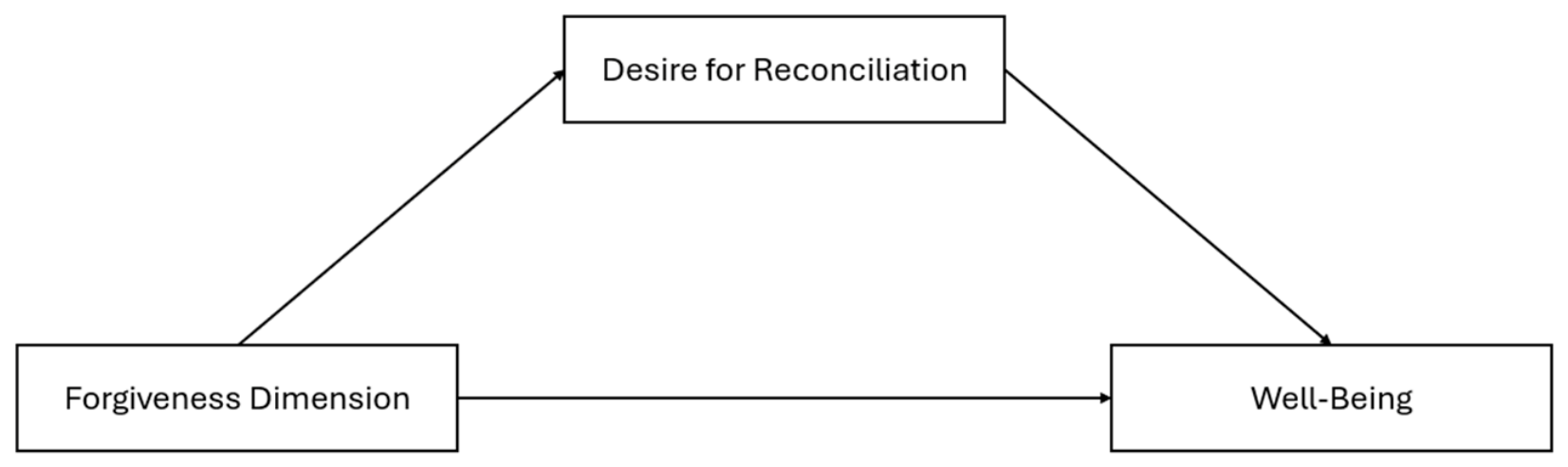
Accordingly, the present study tests a mediation model in which the six dimensions of forgiveness are specified as predictor variables, with the desire for reconciliation as the mediating variable, and well-being as the outcome variable. The model examines both the direct associations between each dimension of forgiveness and well-being and the indirect associations operating through the desire for reconciliation.
Based on the theoretical and empirical literature reviewed above, we formulated the following hypotheses:
H1.
All six dimensions of forgiveness (negative affect, negative behavior, negative cognition, positive affect, positive behavior, and positive cognition) will be positively associated with psychological well-being following a family offense.
H2.
All six dimensions of forgiveness will be positively associated with the desire for reconciliation. Because the positive dimensions reflect the emergence of benevolent affective, behavioral and cognitive responses toward the offender, whereas the negative dimensions primarily reflect a reduction in resentment, avoidance and hostile cognitions, we expect the positive dimensions to show comparatively stronger associations with the desire for reconciliation.
H3.
The desire for reconciliation will be positively associated with psychological well-being.
H4.
The desire for reconciliation will mediate the associations between each of the six dimensions of forgiveness and psychological well-being, such that significant indirect associations will be observed across all dimensions. Given the exploratory nature of comparisons between dimensions, no specific predictions are made regarding the relative magnitude of these indirect associations or regarding whether they will fully or partially account for the association between each forgiveness dimension and well-being.
2. Materials and Methods
This study followed a cross-sectional design, with all variables assessed at a single time point through an online survey. Participants were young people from the general population living in different regions of Spain, and data were collected over a seven-month period, between July 2025 and January 2026.
2.1. Participants
The sample consisted of 419 participants: 313 female participants and 106 male participants, aged between 16 and 25 years (M = 20.54; SD = 2.69). All participants were residents of Spain. The age range of 16 to 25 years was selected to encompass late adolescence and emerging adulthood, a developmental period characterized by the progressive renegotiation of relationships with parents while attachment and interdependence processes remain salient [25]. The upper limit of 25 years corresponds to the conventional boundary of emerging adulthood, whereas the inclusion of participants from 16 years of age allowed us to capture the later phase of adolescence, during which family offenses are already appraised and processed in ways comparable to those observed in young adults.
Regarding family status, 94 participants (22.4%) reported that their parents were separated, whereas 325 (77.6%) indicated that their parents were not separated. Concerning perceived parental relationship quality, participants reported a mean of 5.36 (SD = 1.54) for their relationship with their mother and 5.82 (SD = 1.26) for their relationship with their father.
Participants were selected through a non-probability convenience sampling method, according to the following inclusion criteria: (1) between 16 and 25 years old, (2) voluntarily agreeing to participate in the study, (3) reporting having experienced a specific interpersonal offense committed by a member of their family, and (4) residing in Spain.
2.2. Measures
2.2.1. Sociodemographic Questionnaire
Data were collected regarding age, sex, nationality, city of residence and information related to the family system, such as the quality of the relationship with both parents and household composition.
2.2.2. Offense Context
An ad hoc questionnaire was designed to gather contextual information regarding the offense reported by the participants. The following data were collected: a brief description of the event, the perceived level of severity, the time elapsed since its occurrence and the nature of the relationship with the offender. Additionally, information was included regarding the current persistence of the offense.
2.2.3. Well-Being
Psychological well-being was assessed using the Psychological Well-Being Scales for Youths-Short Form (PWB-YS-SF), adapted and validated by Stavraki et al. [25] in a Spanish child and adolescent population. This version consists of six items (one for each dimension of the model: self-acceptance, positive relations, autonomy, environmental mastery, purpose in life, and personal growth) and presents a unidimensional structure. Previous studies have shown adequate evidence of validity and reliability in the Spanish population, with a Cronbach’s alpha of 0.78 [25]. In the present study, a Cronbach’s alpha of 0.87 was obtained.
2.2.4. Specific Forgiveness
Interpersonal forgiveness was assessed using the Enright Forgiveness Inventory (EFI-30) [14]. This instrument consists of 30 items distributed across six subscales: positive affect and negative affect, positive behavior and negative behavior, and positive cognition and negative cognition. The Spanish adaptation conducted by Kasprzak et al. [15] provides psychometric evidence (Cronbach’s alpha of 0.97) in the Spanish context, supporting its suitability for measuring interpersonal forgiveness of a specific offense in clinical settings. In the present study, the following Cronbach’s alpha coefficients were obtained: 0.89 for positive affect, 0.92 for negative affect, 0.88 for positive behavior, 0.91 for negative behavior, 0.87 for positive cognition and 0.83 for negative cognition.
2.2.5. Desire for Reconciliation
The desire for reconciliation was assessed using the Desire for Reconciliation Scale developed by Woodyatt and Wenzel [26] and adapted to the Spanish context by Gallo-Giunzioni et al. [24]. This instrument evaluates the intention to repair the relationship after an offense has been committed through four items. Previous studies have shown adequate evidence of reliability, with a Cronbach’s alpha of 0.88 [24]. In the present study, a Cronbach’s alpha of 0.86 was obtained.
2.3. Procedure
This study was reviewed and approved by the Research Ethics Committee (approval number 2P/2025, 5 February 2025) and was conducted in accordance with the ethical standards outlined in the Declaration of Helsinki.
Prior to data collection, informed consent was obtained from all participants, who were informed about the objectives and nature of the research. Data processing complied with the Spanish Organic Law on the Protection of Personal Data and Guarantee of Digital Rights (Law 5/2018), ensuring confidentiality and anonymity. The instruments were administered online via the Google Forms platform. Participants were recruited through a combination of university channels and social media, complemented by snowball sampling, whereby initial participants were invited to share the study link within their own networks. The invitation described the general aims of the study, the inclusion criteria, and the voluntary and anonymous nature of participation. No incentives, rewards, or course credit were offered for participation. The resulting data were stored on a password-protected server with access restricted exclusively to the principal investigators for subsequent anonymized analysis.
Data were collected between July 2025 and January 2026.
2.4. Data Analysis
All analyses were conducted using SPSS (Version 27). First, descriptive statistics and Pearson correlation coefficients were computed among the study variables.
To examine the role of desire for reconciliation as a mediating mechanism in the association between forgiveness and psychological well-being, simple mediation analyses were conducted using PROCESS macro v5.0 (Model 4) [27]. Separate models were estimated for each forgiveness dimension with desire for reconciliation specified as the mediator and well-being as the outcome variable.
The distributional properties of the study variables were examined empirically. All variables showed negative skewness, indicating a concentration of scores at the upper end of their respective scales, with skewness values ranging from −0.47 to −1.95 and kurtosis values from −0.81 to 3.81 (see Table 1). Although these values fall within the thresholds conventionally taken to indicate substantial departures from normality [28], the most pronounced deviations were observed for the desire for reconciliation and positive cognition. In addition, Breusch–Pagan tests indicated the presence of heteroskedasticity in all estimated models (p < 0.05). For these reasons, all regression coefficients were estimated using heteroskedasticity-consistent standard errors (HC3).
Table 1.
Descriptive statistics, distributional properties and correlations of forgiveness, reconciliation and well-being.
The significance of the indirect effects was tested using 95% bias-corrected bootstrap confidence intervals based on 5000 resamples, a procedure that does not require the assumption of normality of the sampling distribution. Indirect effects were considered significant when the confidence interval did not include zero. A fixed random seed (12,345) was set to ensure the exact reproducibility of the bootstrap estimates.
Because six models sharing the same mediator and outcome were estimated, the robustness of the indirect effects to multiple testing was additionally assessed by re-estimating the bootstrap confidence intervals at a Bonferroni-adjusted confidence level of 99.17% (i.e., 1 − 0.05/6). Both sets of intervals are reported.
All models were then re-estimated including participant sex, age, perceived severity of the offense, time elapsed since the offense and parental separation status as covariates in both the mediator and the outcome equations. Time elapsed was coded ordinally (1 = a few days ago, 2 = a few weeks ago, 3 = a few months ago, 4 = a few years ago): an ordering that approximates a logarithmic time scale. The current persistence of the offense and the perceived quality of the relationship with each parent were not entered as covariates; although both were assessed, they are conceptually posterior to the offense and are plausibly outcomes of the relational processes under study, such that adjusting for them would risk introducing post-treatment bias.
Finally, a sensitivity power analysis for indirect effects was conducted using Monte Carlo simulation [29]. With N = 419, α = 0.05, and the a-path fixed at the median value observed in the present models (β = 0.60), the design provided 80% power to detect a completely standardized indirect effect of approximately β_cs = 0.10. Applying the same procedure to the parameter estimates obtained, statistical power ranged from 0.91 to 0.99 across the six models, indicating that the study was adequately powered to detect indirect effects of the magnitude observed.
3. Results
Table 1 presents the descriptive statistics of the questionnaires and the correlations among the main study variables. As can be observed, the different dimensions of forgiveness were positively and significantly correlated with well-being (r = 0.24–0.27) and with the desire for reconciliation, showing correlations of moderate to high magnitude (r = 0.50–0.73). Likewise, the desire for reconciliation was positively and significantly associated with well-being (r = 0.29, p < 0.01). Overall, these results demonstrate significant associations among the study variables.
Simple mediation analyses were then conducted for each forgiveness dimension, following the procedure described in Section 2.4. Figure 1 presents the conceptual model tested.
Figure 1.
Conceptual Mediation Model Linking Forgiveness Dimensions, Desire for Reconciliation, and Well-Being.
All six dimensions of forgiveness were positively and significantly associated with the desire for reconciliation (a = 0.41–0.83, β = 0.50–0.73, p < 0.001) and the desire for reconciliation was positively and significantly associated with well-being across all models (b = 0.18–0.22, β = 0.20–0.24, p < 0.05). The models accounted for between 24.8% and 53.8% of the variance in the desire for reconciliation, and between 8.6% and 9.7% of the variance in well-being. Significant indirect associations between forgiveness and well-being via the desire for reconciliation were observed across all six dimensions, as the 95% bootstrap confidence intervals did not include zero (see Table 2).
Table 2.
Simple Mediation Analyses Examining the Indirect Association Between Forgiveness Dimensions and Well-Being Through the Desire for Reconciliation. (A) Paths a and b and variance explained; (B) total, direct and indirect effects.
It should be noted, however, that although the unstandardized a-paths varied considerably across dimensions (from 0.41 for negative behavior to 0.83 for positive cognition), the completely standardized indirect effects fell within a comparatively narrow band (β = 0.113–0.173) and the standardized total effects were almost identical across dimensions (β = 0.24–0.27). This indicates that much of the apparent variability in the unstandardized coefficients reflects differences in the standard deviations of the subscales rather than genuine differences in the strength of association.
Regarding the direct effects (c′), the dimensions of negative affect (c′ = 0.098, p = 0.028), negative behavior (c′ = 0.094, p = 0.030), negative cognition (c′ = 0.143, p = 0.040) and positive behavior (c′ = 0.111, p = 0.048) remained significantly associated with well-being after controlling for the desire for reconciliation, suggesting a pattern consistent with partial mediation. In contrast, for the dimensions of positive affect (c′ = 0.090, p = 0.176) and positive cognition (c′ = 0.076, p = 0.384), the direct association was no longer significant when the mediator was included, indicating a pattern consistent with full mediation. These patterns should nonetheless be interpreted with caution, as the bootstrap confidence intervals for several indirect effects were comparatively wide, indicating limited precision in the estimation of their magnitude.
Given that six models sharing the same mediator and outcome were estimated, the robustness of these findings to multiple testing was examined by re-estimating the bootstrap confidence intervals at a Bonferroni-adjusted confidence level of 99.17%. Under this conservative criterion, the indirect associations remained significant for negative affect (99.17% CI [0.012, 0.149]), negative behavior ([0.018, 0.150]), positive affect ([0.002, 0.243]) and positive behavior ([0.004, 0.200]), but no longer excluded zero for negative cognition ([−0.008, 0.230]) or positive cognition ([−0.016, 0.359]). None of the direct effects remained significant under the adjusted criterion. These results indicate that the distinction between partial and full mediation observed at the conventional 95% level is not robust to correction for multiple testing and should therefore be regarded as exploratory. It should be noted, however, that the Bonferroni adjustment is markedly conservative in the present context, given the substantial intercorrelations among the six forgiveness dimensions (r = 0.64–0.80), which render the six tests far from independent.
To rule out potential confounding, all six models were re-estimated including participant sex, age, perceived severity of the offense, time elapsed since the offense, and parental separation status as covariates in both the mediator and the outcome equations (see Table 3). The pattern of results was substantively unchanged. Indirect associations via the desire for reconciliation remained significant across all six forgiveness dimensions, with magnitudes that were, if anything, slightly larger than in the unadjusted models (ab = 0.091–0.191; β_cs = 0.125–0.183). Direct associations remained significant for negative affect (c′ = 0.129, p = 0.007), negative behavior (c′ = 0.096, p = 0.030) and negative cognition (c′ = 0.183, p = 0.013), whereas they were non-significant for positive affect (c′ = 0.105, p = 0.117), positive behavior (c′ = 0.113, p = 0.050) and positive cognition (c′ = 0.081, p = 0.360). Variance inflation factors ranged from 1.03 to 2.28, indicating no problematic multicollinearity.
Table 3.
Covariate-Adjusted Mediation Analyses: Indirect Association Between Forgiveness Dimensions and Well-Being Through the Desire for Reconciliation. (A) Paths a and b and variance explained; (B) total, direct and indirect effects.
Among the covariates, time elapsed since the offense was negatively and significantly associated with the desire for reconciliation in five of the six models (p = 0.0002–0.024), indicating that a greater time lapse since the offense was associated with a lower desire to repair the relationship. Participant sex, age, perceived severity of the offense and parental separation status were not significantly associated with either the mediator or the outcome in any of the models.
Finally, because the six forgiveness dimensions were substantially intercorrelated (r = 0.64–0.80), a further set of models was estimated in which each dimension was specified as the predictor while the remaining five dimensions were entered as covariates in both equations, in order to determine whether each dimension retained a unique association with the mediator and the outcome once shared variance was accounted for (see Table 4). Variance inflation factors ranged from 3.25 to 4.54, remaining below conventional thresholds of concern.
Table 4.
Unique Associations of Each Forgiveness Dimension with the Desire for Reconciliation and Well-Being, Controlling for the Remaining Five Dimensions.
In these models, only positive affect (a = 0.223, β = 0.23, p = 0.001) and positive cognition (a = 0.601, β = 0.53, p < 0.001) retained a significant unique association with the desire for reconciliation; negative affect, negative behavior, negative cognition and positive behavior did not (p = 0.239–0.842). The association between the desire for reconciliation and well-being remained significant (b = 0.198, β = 0.22, p = 0.035), whereas none of the forgiveness dimensions retained a significant unique direct association with well-being (p = 0.295–0.760). Consequently, significant unique indirect associations were observed only for positive affect (ab = 0.044, 95% CI [0.008, 0.103]) and positive cognition (ab = 0.119, 95% CI [0.016, 0.246]). These results indicate that the six dimensions do not contribute independently to the model and that the association between forgiveness and the desire for reconciliation is carried primarily by its positive affective and cognitive components.
4. Discussion
The present study aimed to examine the role of reconciliation as a potential mediating mechanism in the association between the positive and negative dimensions of forgiveness (affective, behavioral and cognitive) and psychological well-being in the context of family offenses from the perspective of sons and daughters. Results were consistent with the desire for reconciliation functioning as a statistical mediator of the association between all dimensions of forgiveness and well-being, suggesting that the link between forgiveness and well-being in young people may be associated, at least in part, with processes of relational repair. This pattern remained substantively unchanged after adjusting for participant sex, age, perceived severity of the offense, time elapsed since the offense, and parental separation status.
Overall, H1 and H3 were supported: all six forgiveness dimensions showed significant positive total associations with well-being, and the desire for reconciliation was positively associated with well-being across all models. H4 was supported at the conventional level, with significant indirect associations observed for all six dimensions, although two of these did not survive Bonferroni correction. H2 received clear support: the positive dimensions showed stronger associations with the desire for reconciliation than the negative ones, and this difference became particularly evident when the overlap among dimensions was controlled, as only positive affect and positive cognition retained a unique association with the mediator.
These results extend previous evidence [10,27,30,31] linking forgiveness to higher levels of well-being by identifying the desire for reconciliation as a relational process associated with this link within the family context. Earlier research [32,33,34] primarily examined forgiveness-promoting interventions among older adults or couples, emphasizing the regulation of emotional distress and a reduction in resentment as the main pathway to improved outcomes, largely without addressing relational motivation as a distinct mechanism. The present findings extend this literature to a younger, family-based population by suggesting that, alongside emotion-focused processes, an explicitly relational and motivational component—the desire for reconciliation—is also associated with well-being outcomes. This pattern is broadly consistent with evidence on intergenerational solidarity during emerging adulthood [12], which similarly points to the relevance of relational closeness, beyond intrapersonal adjustment, for well-being during this developmental period.
This differentiated pattern can be further interpreted through an interdependence perspective on forgiveness within close relationships [16]. From this perspective, forgiveness and relational repair, although related, depend on partially distinct conditions: forgiveness primarily reflects a change in how the offended person appraises and feels toward the transgressor, whereas relational repair additionally depends on relational and motivational factors, such as the perceived trustworthiness of the offender and the value placed on continuing the relationship [16]. This distinction is consistent with the classic separation between emotional and decisional forgiveness [12], whereby reductions in negative affect, behavior, and cognition may reflect a more internal, decisional shift away from resentment and avoidance, while the presence of positive affect and cognition toward the offender may be more closely tied to an emotional openness that, in family contexts, appears particularly likely to be channeled through an explicit motivation to reconcile. Read together with the present results, this may help account for why the negative dimensions of forgiveness were directly associated with well-being even after accounting for the desire for reconciliation, whereas positive affect and positive cognition were associated with well-being mainly in connection with this relational motivation.
Thus, well-being in the family context is associated not only with intrapersonal changes, but, as evidenced by the findings of the present study, also with the desire for reconciliation following an offense. In filial relationships characterized by their continuity over time and dynamics of emotional interdependence, this relational dimension acquires particular significance. This dimension cannot be fully understood without situating it within the developmental context of adolescence and emerging adulthood. Recent studies on family dynamics during adolescence and emerging adulthood indicate that this period involves a gradual transformation of the bond between young people and their parents, in which roles, boundaries and forms of interaction are renegotiated [7]. From this perspective, during a period in which young people seek greater independence without completely disengaging from the family system, reconciliation may function as an adaptive strategy that allows the bond to be maintained while the foundations of the relationship are redefined. Indeed, patterns of intergenerational solidarity and family support have been associated with higher levels of psychological well-being in emerging adults [35]. In this sense, the results of this study suggest that the desire for reconciliation may act as a bridge between internal emotional transformation and the reconstruction of the bond, and, in turn, with higher psychological well-being. However, this pattern did not manifest uniformly across the dimensions of forgiveness, which provides relevant information about the differentiated nature of its components.
Specifically, the positive dimensions (affect and cognition) showed a pattern consistent with full mediation, although the wide confidence intervals surrounding these indirect effects indicate that their magnitude was estimated with limited precision, and this pattern should therefore be regarded as suggestive rather than conclusive. This may indicate that the presence of positive thoughts or emotions toward the offender is associated with well-being primarily through its relational expression, such as the desire for reconciliation. However, given the cross-sectional nature of the data, the reverse pathway in which higher well-being fosters more positive cognitions and a greater desire for reconciliation remains equally plausible and cannot be ruled out. Longitudinal designs are needed to test the temporal ordering of these processes. This interpretation received further support from the models controlling for the overlap among dimensions. When all six dimensions were considered simultaneously, only positive affect and positive cognition retained a unique association with the desire for reconciliation and, through it, with well-being. This convergence suggests that the relational motivation to repair the bond is linked specifically to the emergence of benevolent emotional and cognitive responses toward the offender, rather than to a reduction in resentment, avoidance and hostile cognitions, which appear to operate largely in common across the negative dimensions. This finding supports the idea that forgiveness is a multidimensional construct in which intrapersonal and relational processes coexist with differentiated functions [12,17].
Overall, the findings support an integrative conception of filial forgiveness as a bidimensional process that articulates both intrapersonal and relational components. On the one hand, internal emotional regulation associated with the reduction in negative effects and cognitions is directly associated with well-being; on the other hand, the relational dimension expressed through the desire for reconciliation is associated with a stronger link between forgiveness and well-being, potentially through the restoration of the bond. This differentiation allows for a more precise understanding of forgiveness within the family context and underscores the importance of approaching it as a phenomenon that is simultaneously psychological and relational. It should be noted, however, that this differentiation emerged more clearly for the positive than for the negative dimensions, as the latter did not retain unique associations once their substantial shared variance was accounted for.
4.1. Practical Implications
Regarding practical implications, the results of the present study suggest that interventions targeting young people who have experienced family offenses should not focus exclusively on reducing resentment or the distress associated with the offense, but should also address motivations toward repairing the bond and the conditions that foster healthy reconciliation. Given that the desire for reconciliation emerged as a significant correlate of the association between forgiveness and well-being across all dimensions, interventions aimed at young people could integrate strategies oriented both toward emotional regulation (e.g., processing negative affect, reducing avoidance and revenge-related responses) and toward the development of relational competencies (e.g., communication skills, boundary-setting, and reflection on the conditions under which reconciliation is desirable).
The analyses controlling for the overlap among dimensions add a further nuance of practical relevance. Because only positive affect and positive cognition retained a unique association with the desire for reconciliation, interventions that aim to support relational repair may need to go beyond reducing hostility and avoidance, and explicitly foster benevolent emotional and cognitive responses toward the offending family member, such as compassionate reinterpretation of the event or a renewed appreciation of the relationship. The reduction in negative responses, while valuable in itself, may not translate into a motivation to rebuild the bond.
In the clinical context, this implies assessing the extent to which the young person wishes to restore, redefine, or maintain a certain distance in the relationship, distinguishing voluntary reconciliation from normative or family pressure to preserve the bond regardless of its cost to the individual’s well-being. Practitioners working with adolescents and emerging adults should remain attentive to situations in which the pursuit of reconciliation may not be adaptive, such as those involving ongoing mistreatment, abuse, or persistent offenses, where distance and boundary-setting may protect psychological well-being more effectively than relational repair.
From a preventive and public health perspective, psychoeducational programs aimed at adolescents and young adults could incorporate content on managing family conflicts, recognizing the distinction between forgiveness and reconciliation, and making informed, voluntary relational decisions. Because family relationships during adolescence and emerging adulthood are actively being renegotiated, such programs may be particularly well placed within school-based and community youth services, where forgiveness can be addressed not only as an intrapersonal process but also as a relational experience with implications for well-being.
4.2. Limitations
Some limitations of the present study should be acknowledged. First, the cross-sectional design prevents the establishment of causal or temporally ordered conclusions among the variables analyzed. Although the results are consistent with a coherent mediational model, alternative directional pathways—including the possibility that higher well-being fosters more positive forgiveness responses and a greater desire for reconciliation—cannot be ruled out. Future longitudinal or experimental designs would allow for the examination of the temporal ordering of these processes and the exploration of possible bidirectional or reciprocal relationships between forgiveness, reconciliation and well-being.
Second, the sample was markedly skewed toward female participants. This gender imbalance, which is common in survey-based studies relying on voluntary participation, limits the generalizability of the findings, particularly to young male participants. Because prior research suggests that men and women may differ in how they experience and express forgiveness, emotional regulation and relational motivations following interpersonal offenses, the pattern of associations observed here, and in particular, the relative weight of the emotional, behavioral, and cognitive dimensions of forgiveness, may not generalize directly to male samples. Future studies should aim for more balanced samples or oversample male participants to allow for a formal test of gender as a moderator of these associations. An additional limitation of the present study is that potential gender differences in the model results were not examined; future research should explore whether gender differences exist in the observed relationships.
Third, all data were obtained exclusively through self-report measures administered online, which may introduce biases related to social desirability, shared method variance and retrospective recall, particularly for offenses that occurred further in the past.
Fourth, psychological well-being was assessed using a short form in which each of the six Ryff dimensions is represented by a single item. Although this instrument has shown adequate evidence of validity and reliability in Spanish youth samples and displayed good internal consistency in the present study (α = 0.87), single-item indicators inevitably constrain content validity: broad, multifaceted constructs such as autonomy, purpose in life, or environmental mastery cannot be fully represented by one item each. As a consequence, the measure is best interpreted as a global index of psychological well-being rather than as a profile of its constituent dimensions, and the present design did not permit examination of whether the desire for reconciliation is differentially associated with specific facets of well-being. This would be of particular interest for the positive relations with others dimension, which is conceptually closest to the relational processes examined here. Future research employing the full-length Ryff scales would allow for a more fine-grained assessment of which components of well-being are most closely associated with forgiveness and relational repair.
Fifth, participants were recruited through non-probability convenience sampling, primarily through university channels and social media within a single country (Spain), which may limit the generalizability of the findings to other cultural contexts in which family norms, expectations of filial obligation, or attitudes toward reconciliation differ.
Sixth, although the perceived severity of the offense was assessed, other potentially relevant moderating variables were not analyzed, such as the prior quality of the parent–child bond, the frequency of transgressions, the specific type of offense, or characteristics of the family context (e.g., family structure, socioeconomic status), which could nuance the pattern of associations between forgiveness, reconciliation and well-being.
Finally, the sample combined adolescents and emerging adults within a relatively wide age range (16–25 years); although this range was chosen to capture a developmental period in which family relationships are actively renegotiated, developmental differences within this range were not directly tested and could influence the strength of the associations examined.
5. Conclusions
In a Spanish sample of adolescents and emerging adults who reported a family offense, all dimensions of forgiveness were positively associated with psychological well-being, and these associations were partly accounted for by the desire for reconciliation, most clearly for the positive affective and cognitive components of forgiveness. These findings suggest that the link between forgiveness and well-being during this developmental period is not exclusively intrapersonal, but is also connected to relational processes involved in rebuilding or redefining family bonds. Given the cross-sectional design of the study, the direction of these associations cannot be established, and longitudinal research is needed to clarify their temporal ordering. Nevertheless, the results support preventive and clinical approaches that address both emotional regulation following family offenses and informed, voluntary decisions about relational repair.
Author Contributions
Conceptualization (A.K., K.G.G.-G.); methodology (A.K.); formal analysis (A.K.); investigation (A.K., K.G.G.-G.); data curation (A.K.); writing—original draft preparation(A.K., K.G.G.-G.); writing—review and editing (A.K., K.G.G.-G.); visualization (A.K., K.G.G.-G.); project administration (A.K., K.G.G.-G.); funding acquisition (A.K.).All authors have read and agreed to the published version of the manuscript.
Funding
This research was funded by Universidad Francisco de Vitoria under project Ref. UFV2026-57.
Institutional Review Board Statement
The study was conducted in accordance with the Declaration of Helsinki and approved by the Research Ethics Committee of Andrés Bello Catholic University (approval number 2P/2025, 5 February 2025).
Informed Consent Statement
Informed consent was obtained from all subjects involved in the study.
Data Availability Statement
The data that support the findings of this study are available from the corresponding author, upon reasonable request.
Conflicts of Interest
The authors declare no conflicts of interest.
References
- Hoyt, W.T.; Fincham, F.D.; McCullough, M.E.; Maio, G.R.; Davila, J. Responses to interpersonal transgressions in families: Forgivingness, forgivability, and relationship-specific effects. J. Pers. Soc. Psychol. 2005, 89, 375–394. [Google Scholar] [CrossRef] [Scilit] [PubMed][Green Version]
- Harold, G.T.; Sellers, R. Annual Research Review: Interparental conflict and youth psychopathology: An evidence review and practice focused update. J. Child Psychol. Psychiatry 2018, 59, 376–402. [Google Scholar] [CrossRef] [Scilit] [PubMed]
- Zemp, M.; Fang, S.; Johnson, M.D. Family shapes child development: The role of codevelopmental trajectories of interparental conflict and emotional warmth for children's longitudinal development of internalizing and externalizing problems. Dev. Psychopathol. 2025, 37, 1971–1984. [Google Scholar] [CrossRef] [Scilit] [PubMed]
- Groh, A.M.; Roisman, G.I.; van IJzendoorn, M.H.; Bakermans-Kranenburg, M.J.; Fearon, R.M.P. The significance of insecure and disorganized attachment for children's internalizing symptoms: A meta-analytic study. Child Dev. 2012, 83, 591–610. [Google Scholar] [CrossRef] [Scilit] [PubMed]
- Yap, M.B.; Pilkington, P.D.; Ryan, S.M.; Jorm, A.F. Parental factors associated with depression and anxiety in young people: A systematic review and meta-analysis. J. Affect. Disord. 2014, 156, 8–23. [Google Scholar] [CrossRef] [Scilit] [PubMed]
- Fabris, M.A.; Longobardi, C.; Zdankiewicz-Ścigala, E.; Ścigała, D.K. Parental rejection and generalized anxiety disorder in early adolescents: The mediating role of alexithymia. Front. Psychol. 2025, 16, 1511983. [Google Scholar] [CrossRef] [Scilit] [PubMed]
- Oliveira, C.; Fonseca, G.; Sotero, L.; Crespo, C.; Relvas, A.P. Family dynamics during emerging adulthood: Reviewing, integrating, and challenging the field. J. Fam. Theory Rev. 2020, 12, 350–367. [Google Scholar] [CrossRef] [Scilit]
- Worthington, E.L., Jr.; Sandage, S.J. Forgiveness in couples and family therapy. In Forgiveness and Spirituality in Psychotherapy: A Relational Approach; Worthington, E.L., Jr., Sandage, S.J., Eds.; American Psychological Association: Washington, DC, USA, 2016; pp. 223–245. [Google Scholar] [CrossRef] [Scilit]
- Strelan, P.; Karremans, J.C.; Krieg, J. What determines forgiveness in close relationships? The role of post-transgression trust. Br. J. Soc. Psychol. 2017, 56, 161–180. [Google Scholar] [CrossRef] [Scilit] [PubMed]
- Fincham, F.D. Forgiveness, family relationships and health. In Forgiveness and Health: Scientific Evidence and Theories; Toussaint, L.L., Worthington, E.L., Jr., Williams, D.R., Eds.; Springer: New York, NY, USA, 2015; pp. 255–270. [Google Scholar]
- Maio, G.R.; Thomas, G.; Fincham, F.D.; Carnelley, K.B. Unraveling the role of forgiveness in family relationships. J. Pers. Soc. Psychol. 2008, 94, 307–319. [Google Scholar] [CrossRef] [Scilit] [PubMed]
- Worthington, E.L., Jr.; Witvliet, C.V.; Pietrini, P.; Miller, A. Forgiveness, health, and well-being: A review of evidence for emotional versus decisional forgiveness, dispositional forgivingness, and reduced unforgiveness. J. Behav. Med. 2007, 30, 291–302. [Google Scholar] [CrossRef] [Scilit] [PubMed]
- Guzmán, M. El perdón en relaciones cercanas: Conceptualización desde una perspectiva psicológica e implicancias para la práctica clínica. Psykhe 2010, 19, 19–30. [Google Scholar] [CrossRef] [Scilit]
- Enright, R.; Rique, J.; Lustosa, R.; Song, J.Y.; Komoski, M.C.; Batool, I.; Bolt, D.; Sung, H.; Huang, S.T.T.; Park, Y.; et al. Validating the Enright Forgiveness Inventory-30 (EFI-30). Eur. J. Psychol. Assess. 2021, 38, 113–123. [Google Scholar] [CrossRef] [Scilit]
- Kasprzak, A.; Martínez-Diaz, P.; Caparrós, C.M.; Enright, R. Interpersonal forgiveness: Validation of the Enright Forgiveness Inventory (EFI-30) in the Spanish sample. Ann. Psychol. 2023, 39, 364–373. [Google Scholar] [CrossRef] [Scilit]
- Green, J.D.; Reid, C.A.; Coy, A.E.; Hedgebeth, M.V.; Kneuer, M.A. An interdependence analysis of forgiveness, amends, and relational repair in family and work relationships. In Handbook of Forgiveness, 2nd ed.; Worthington, E.L., Jr., Wade, N.G., Eds.; Routledge/Taylor & Francis Group: New York, NY, USA, 2020; pp. 131–141. [Google Scholar] [CrossRef] [Scilit]
- Enright, R.D.; Fitzgibbons, R.P. Forgiveness Therapy: An Empirical Guide for Resolving Anger and Restoring Hope; American Psychological Association: Washington, DC, USA, 2015. [Google Scholar] [CrossRef] [Scilit]
- Flaherty, E.M.; Strelan, P.; Kohler, M. Forgiveness, self-forgiveness, and child and adolescent mental health: Big data findings from an Australian youth cohort. J. Youth Adolesc. 2025, 55, 847–863. [Google Scholar] [CrossRef] [Scilit] [PubMed]
- Rapp, H.; Wang Xu, J.; Enright, R.D. A meta-analysis of forgiveness education interventions’ effects on forgiveness and anger in children and adolescents. Child Dev. 2022, 93, 1249–1269. [Google Scholar] [CrossRef] [Scilit] [PubMed]
- Barcaccia, B.; Pallini, S.; Pozza, A.; Milioni, M.; Baiocco, R.; Mancini, F.; Vecchio, G.M. Forgiving adolescents: Far from depression, close to well-being. Front. Psychol. 2019, 10, 1725. [Google Scholar] [CrossRef] [Scilit] [PubMed]
- Van der Wal, R.C.; Levelt, L.; Kluwer, E.; Finkenauer, C. Exploring associations between children’s forgiveness following parental divorce and psychological well-being. Fam. Transit. 2024, 65, 248–270. [Google Scholar] [CrossRef] [Scilit]
- Jensen, A.C.; Thomsen, A.E. Parental differential treatment of siblings linked with internalizing and externalizing behavior: A meta-analysis. Child Dev. 2024, 95, 1384–1405. [Google Scholar] [CrossRef] [Scilit] [PubMed]
- Barragán Martín, A.B.; Molero Jurado, M.D.; Pérez-Fuentes, M.D.C.; Oropesa Ruiz, N.F.; Martos Martínez, Á.; Simón Márquez, M.M.; Gázquez Linares, J.J. Interpersonal support, emotional intelligence and family function in adolescence. Int. J. Environ. Res. Public Health 2021, 18, 5145. [Google Scholar] [CrossRef] [Scilit] [PubMed]
- Gallo-Giunzioni, K.; Kasprzak, A.; Prieto-Ursúa, M.; Fernández-Belinchón, C. Validation of the perceived personal responsibility and desire for reconciliation scales in the Spanish population. PLoS ONE 2025, 20, e0336599. [Google Scholar] [CrossRef] [Scilit] [PubMed]
- Stavraki, M.; García-Márquez, R.; Bajo, M.; Callejas-Albiñana, A.I.; Paredes, B.; Díaz, D. Brief version of the Ryff Psychological Well-Being Scales for children and adolescents: Evidence of validity. Psicothema 2022, 34, 316–322. [Google Scholar] [CrossRef] [Scilit] [PubMed]
- Woodyatt, L.; Wenzel, M. A needs-based perspective on self-forgiveness: Addressing threat to moral identity as a means of encouraging interpersonal and intrapersonal restoration. J. Exp. Soc. Psychol. 2013, 50, 125–135. [Google Scholar] [CrossRef] [Scilit]
- Hayes, A.F. Introduction to Mediation, Moderation, and Conditional Process Analysis: A Regression-Based Approach; Guilford Press: New York, NY, USA, 2013. [Google Scholar]
- West, S.G.; Finch, J.F.; Curran, P.J. Structural equation models with nonnormal variables: Problems and remedies. In Structural Equation Modeling: Concepts, Issues, and Applications; Hoyle, R.H., Ed.; Sage: Thousand Oaks, CA, USA, 1995; pp. 56–75. [Google Scholar]
- Schoemann, A.M.; Boulton, A.J.; Short, S.D. Determining power and sample size for simple and complex mediation models. Soc. Psychol. Personal. Sci. 2017, 8, 379–386. [Google Scholar] [CrossRef] [Scilit]
- Wade, N.G.; Hoyt, W.T.; Kidwell, J.E.M.; Worthington, E.L. Efficacy of psychotherapeutic interventions to promote forgiveness: A meta-analysis. J. Consult. Clin. Psychol. 2014, 82, 154–170. [Google Scholar] [CrossRef] [Scilit] [PubMed]
- Záhorcová, L.; Enright, R.; Halama, P. The effectiveness of a forgiveness intervention on mental health in bereaved parents: A pilot study. OMEGA-J. Death Dying 2021, 87, 614–631. [Google Scholar] [CrossRef] [Scilit] [PubMed]
- Allemand, M.; Steiner, M.; Hill, P.L. Effects of a forgiveness intervention for older adults. J. Couns. Psychol. 2013, 60, 279–286. [Google Scholar] [CrossRef] [Scilit] [PubMed]
- Fincham, F.D.; Beach, S.R.H.; Davila, J. Forgiveness and conflict resolution in marriage. J. Fam. Psychol. 2004, 18, 72–81. [Google Scholar] [CrossRef] [Scilit] [PubMed]
- Wade, N.G.; Meyer, J.E. Comparison of brief group interventions to promote forgiveness: A pilot outcome study. Int. J. Group Psychother. 2009, 59, 199–220. [Google Scholar] [CrossRef] [Scilit] [PubMed]
- García-Mendoza, M.C.; Coimbra, S.; Sánchez-Queija, I.; Parra, Á. Intergenerational solidarity during emerging adulthood: Associations with psychological distress and satisfaction with life in southern Europe. Psychol. Res. Behav. Manag. 2024, 17, 2449–2463. [Google Scholar] [CrossRef] [Scilit] [PubMed]

Disclaimer/Publisher’s Note: The statements, opinions and data contained in all publications are solely those of the individual author(s) and contributor(s) and not of MDPI and/or the editor(s). MDPI and/or the editor(s) disclaim responsibility for any injury to people or property resulting from any ideas, methods, instructions or products referred to in the content. |
© 2026 by the authors. Licensee MDPI, Basel, Switzerland. This article is an open access article distributed under the terms and conditions of the Creative Commons Attribution (CC BY) license.