


Highlights
Public health relevance—How does this work relate to a public health issue?
- Premature ovarian insufficiency (POI) and early ovarian insufficiency (EOI) are rare but serious conditions that disrupt normal puberty and reproductive health in adolescents and young adult (AYAs). This study uses large-scale Medicaid data to show how these diagnoses are linked to mental health (MH) conditions in this population.
Public health significance—Why is this work of significance to public health?
- Over half of AYAs with POI/EOI have documented MH conditions, often both before and after diagnosis, indicating substantial and ongoing need. These youth also have high chronic disease burden and healthcare use, and racially and ethnically minoritized patients appear less likely to receive MH diagnoses, suggesting possible unmet need.
Public health implications—What are the key implications or messages for practitioners, policy makers and/or researchers in public health?
- Care for AYAs with POI/EOI should routinely include early and repeated MH screening using developmentally and culturally responsive approaches. Health systems and policymakers should build integrated reproductive and MH care pathways, with specific attention to reducing racial and ethnic inequities in identification and treatment.
Abstract
POI and EOI are rare but impactful conditions among adolescents and young adults (AYAs). Little is known about the timing and incidence of mental health (MH) conditions among AYAs diagnosed with POI/EOI. Data were collected using MarketScan Medicaid administrative claims among females aged 12–25 with POI/EOI. Merative™ MarketScan® Research Databases are large, de-identified U.S. administrative healthcare claims databases that contain individual-level information on enrollment, inpatient and outpatient medical services, and outpatient prescription drug claims. The databases include commercially insured individuals, Medicare beneficiaries with employer-sponsored supplemental coverage, and selected Medicaid populations. Claims are linked longitudinally using unique encrypted patient identifiers, allowing individuals to be followed over time across healthcare settings. In addition to healthcare utilization, the databases include demographic characteristics, diagnosis and procedure codes, dates of service, and payment information, making them well suited for epidemiologic, health services, and outcomes research. We characterized prevalence and timing of MH diagnoses, examined MH subtypes, and estimated new-onset MH among those without prior MH. Comparisons were made to demographically matched controls without POI/EOI (matched on age and calendar time) and to diagnosis-anchored comparator groups. Among 859 AYAs with POI/EOI, 53.9% had any MH diagnosis, including 32.9% with MH diagnoses before and after POI/EOI diagnosis and 11.9% with new-onset MH after POI/EOI diagnosis. Of all anxiety disorders, 60.1% were present pre- and post-diagnosis, while 25.4% were new-onset after diagnosis. Depressive disorders showed a similar pattern, with 58.1% being pre- and post-diagnosis MH group and 22.3% being new-onset. In total, 49.4% of individuals with trauma-related disorders had the diagnosis both before and after POI/EOI diagnosis, while 30.1% had it as a new-onset. In adjusted models, POI/EOI was associated with increased odds of MH diagnoses after diagnosis (aOR ~2.1, 95% CI ~1.4–3.1). Prior MH diagnoses were the strongest predictor of MH after diagnosis (aOR ~12.1). AYAs with POI/EOI experience substantial MH burden, with elevated risk of new-onset MH conditions following diagnosis. Findings highlight the importance of early MH screening and integrated care models for AYAs.
1. Introduction
Premature ovarian insufficiency, historically termed primary ovarian insufficiency in earlier literature, and early ovarian insufficiency are rare but clinically significant conditions characterized by impaired ovarian function prior to age 40 [1]. Terminology varies across clinical and research contexts, with some guidelines using the term premature ovarian insufficiency to encompass both spontaneous and iatrogenic (including surgical) loss of ovarian function. In this study, we use premature ovarian insufficiency (POI) to refer to loss of ovarian function before age 40, whether spontaneous or resulting from medical treatments (iatrogenic), and early ovarian insufficiency (EOI) to describe POI occurring during adolescence and young adulthood, substantially earlier than expected age of menopause [2,3,4]. POI/EOI have particularly profound implications when occurring [5] among adolescent and young adult (AYA) females, defined here as ages 12–25 years based on our cohort inclusion criteria and developmental considerations [6,7]. POI/EOI disrupts normal reproductive development and is associated with infertility, hormonal changes, and long-term health consequences [2,3,4] including the potential for neurocognitive, cardiovascular, and skeletal impairments [8]. In addition to these physical health effects, POI/EOI is characterized by hypoestrogenism, which can give rise to menopausal-like symptoms such as hot flashes, sleep disturbance, fatigue, cognitive difficulties (often described as “brain fog”), and irritability [5]. In adult populations, these symptoms have been closely linked to increased risk of depression and anxiety, as well as reduced quality of life, likely through both direct neuroendocrine mechanisms and indirect pathways such as sleep disruption and chronic symptom burden [5].
Despite well-established physical health implications, the mental health (MH) burden associated with POI/EOI in AYA populations remains poorly understood [9]. Adolescence and young adulthood represent a uniquely vulnerable developmental period marked by identity formation, social transitions, and evolving reproductive health awareness [10]. A diagnosis of POI/EOI during this period may carry distinct psychological and emotional consequences [5]. These effects may be further amplified by the early onset of menopausal symptoms during a developmental stage when such experiences are unexpected and may conflict with expected pubertal development and future reproductive expectations [10]. Yet, population-level evidence examining the timing, incidence, and types of MH conditions in this group remains limited.
At the same time, developmental experiences are not uniform and may be shaped by structural and social determinants of health. Racial and ethnic disparities in adolescent sexual and reproductive health, including differences in access to care, diagnostic pathways, co-occurring conditions, and MH service access and quality may shape both the recognition and timing of POI/EOI and associated MH outcomes [11]. These disparities may also influence the likelihood of receiving MH evaluation and appropriate support [12]. Prior literature in adult populations suggests that POI/EOI may be more prevalent among racial and ethnic minority groups [13]. However, disparities in healthcare access and utilization may result in underdiagnosis or delayed diagnosis, as well as differences in the identification and treatment of MH conditions [11].
Understanding how MH diagnoses occur before and after POI/EOI diagnosis, and how these patterns compare to other reproductive or endocrine conditions common in AYA such as polyendocrine metabolic ovarian syndrome (PMOS; formerly polycystic ovary syndrome (PCOS)) [14] or thyroid disorders, is critical for informing integrated and equitable models of care. PMOS and thyroid disorders also involve hormonal dysregulation and are associated with elevated MH burden [15]. PMOS is characterized by hyperandrogenism, menstrual irregularity, and metabolic dysfunction, and has been linked to increased rates of depression, anxiety, and body image concerns among adolescents [15]. Thyroid disorders, including hypothyroidism and hyperthyroidism, can present with symptoms such as fatigue, mood changes, and cognitive difficulties, which may overlap with both POI/EOI symptomatology and MH conditions [16]. While the underlying hormonal profiles differ—hypoestrogenism in POI/EOI, hyperandrogenism in PMOS, and thyroid hormone dysregulation in thyroid disease—these conditions share common features, including chronic symptom burden, disruption of reproductive health, and the need for ongoing medical management [17]. However, they differ in the mechanisms and potential reversibility of reproductive and hormonal dysfunction, with POI/EOI more often characterized by early and potentially permanent loss of ovarian function, compared to typically treatable ovulatory dysfunction in PMOS and generally reversible hormonal dysregulation in thyroid disease [18]. We selected PMOS and thyroid disorders as diagnosis-anchored comparator conditions because they represent common chronic endocrine and reproductive disorders diagnosed during adolescence and young adulthood that require ongoing medical management and have established associations with MH conditions. Although these disorders differ biologically and clinically, they provide a clinically relevant comparison group representing adolescents managing chronic endocrine disease rather than healthy controls. Such comparisons may help isolate the extent to which MH risk is attributable to condition-specific factors vs. shared chronic disease burden.
To address these gaps, we used administrative claims data to examine MH burden among AYAs with POI/EOI. Specifically, we aimed to (1) estimate the prevalence of POI/EOI diagnoses in AYAs; (2) characterize the timing of MH diagnoses relative to their POI/EOI diagnosis; (3) describe MH subtypes; (4) estimate the incidence of new-onset MH conditions following diagnosis; and (5) assess adjusted associations between POI/EOI and MH outcomes compared with demographically matched controls and diagnosis-anchored comparator groups.
2. Materials and Methods
We conducted a retrospective cohort study using administrative claims data from the MarketScan Medicaid Claims Database (Merative) from 2016–2023. Merative™ MarketScan® Research Database is a large, de-identified U.S. administrative healthcare claims databases that contain individual-level information on enrollment, inpatient and outpatient medical services, and outpatient prescription drug claims. The databases include commercially insured individuals, Medicare beneficiaries with employer-sponsored supplemental coverage, and selected Medicaid populations. Claims are linked longitudinally using unique encrypted patient identifiers, allowing individuals to be followed over time across healthcare settings. In addition to healthcare utilization, the databases include demographic characteristics, diagnosis and procedure codes, dates of service, and payment information, making them well suited for epidemiologic, health services, and outcomes research [19].
Cohort Characteristics. We identified healthcare encounters among females aged 12–25 years old with a diagnosis of POI/EOI identified using ICD-10 codes (‘E28.3’, ‘E28.31’, ‘E28.39’,’E89.4’, ‘E28.310’, ‘E28.319’, ‘Z90.722’) and with at least 6 months of continuous enrollment in Medicaid before and after the first POI/EOI diagnosis, which was defined as an index encounter. A single documented diagnosis code was sufficient for cohort inclusion and both spontaneous and iatrogenic (including postoperative) cases were included in the primary cohort.
Comparator Group Characteristics. Two comparator groups were constructed: (1) controls without POI/EOI diagnoses and (2) a diagnosis-anchored comparator group including individuals with PMOS or thyroid disorders. PMOS was defined using ICD-10-CM E28.2, and thyroid disorders were defined using E03.x, E05.x, and E06.x. A two-step matching approach was used, matching on demographic and enrollment characteristics (age, calendar time, and enrollment duration); groups were not matched on healthcare utilization or prior morbidity. We first determined the index visit of the POI/EOI group, defined as first event with ICD-10 diagnosis of POI/EOI. We then matched on age and calendar time (quarter/year of encounter) to the non-POI/EOI to establish the index encounter for the comparator groups. We then matched on enrollment duration before and after diagnosis. Up to three comparator/controls per case were randomly selected for each comparator/control group using a random sampling from eligible matched individuals.
Measures. MH conditions were classified into diagnosis categories using ICD-9-CM or ICD-10-CM codes based on a previously developed scheme that identifies pediatric MH conditions from hospital discharge data [20]. MH timing from index encounter was classified into four mutually exclusive groups: (1) MH diagnoses occurring before diagnosis only, (2) MH diagnoses occurring after diagnosis only (new-onset), (3) MH diagnoses occurring both before and after diagnosis, and (4) no MH diagnoses. MH subtypes were further categorized into clinically relevant groups, including anxiety disorders, depressive disorders, trauma-related disorders, attention-deficit/hyperactivity disorder (ADHD) or neurocognitive disorders, substance-related and addictive disorders, and other MH conditions/disorders (i.e., bipolar, communication, delay, disruptive, dissociative, elimination, feeding, intellectual disability, motor, personality, sexuality, somatic, sleep-wake, suicidality, OCD, schizophrenia).
Covariates included demographic and clinical characteristics. Age was examined as both a continuous variable and a categorical variable (12–15, 16–20, and 21–25 years). Race and ethnicity were included as reported in the dataset. Healthcare utilization prior to POI/EOI diagnosis was assessed using indicators of outpatient visits, emergency department visits, and hospitalizations. The presence of any MH diagnosis prior to POI/EOI diagnosis was included as a key covariate in adjusted analyses. In addition, the model was adjusted for the number of body systems affected by chronic condition indicators (CCIs) to account for overall chronic condition burden. CCIs were defined using the Healthcare Cost and Utilization Project’s CCI tool [21].
Statistical Analysis. Descriptive statistics were used to characterize cohort demographics and MH prevalence. Categorical variables were summarized as counts and percentages, and continuous variables were summarized using means and standard deviations (SD) as well as medians and interquartile ranges (IQR). Comparisons between study groups were performed using the chi-square test, Student’s T-test, or Wilcoxon rank-sum test, as appropriate. Among individuals without prior MH diagnoses, we estimated the incidence of new-onset MH following diagnosis. Multivariable logistic regression models were used to estimate adjusted odds ratios (aORs) and 95% confidence intervals (CIs) for MH diagnoses after POI/EOI diagnosis. Models adjusted for demographic and clinical covariates and included an interaction term between exposure and age group to assess effect modification. Comparisons were performed relative to both controls and diagnosis-anchored comparator groups.
A series of sensitivity analyses were performed to assess the robustness of the findings and address potential sources of bias. First, to evaluate whether the observed associations reflected POI/EOI itself rather than underlying disease processes or their treatment, analyses were repeated after excluding individuals with potential iatrogenic POI/EOI, defined by the presence of malignancy, gonadotoxic therapy, transplant conditioning, or ovarian surgery. Second, to assess the potential impact of surveillance or detection bias, the primary models were re-run, replacing healthcare utilization indicators with overall healthcare utilization intensity. Finally, to assess the robustness of the findings to the composition of the diagnosis-anchored comparator group, POI/EOI cases were compared separately with patients with PMOS, hypothyroidism, and thyroiditis. This analysis evaluated whether the observed association between POI/EOI and the outcome was consistent across individual comparator diagnoses rather than being driven by a single diagnostic subgroup.
All analyses were conducted in SAS Enterprise Guide v8.6 (SAS Institute Inc., Cary, NC, USA) and statistical analysis evaluated at p < 0.05.
This study was reviewed and approved by the Institutional Review Board at Ann & Robert H. Lurie Children’s Hospital of Chicago as exempt (STUDY00001155). The analysis used deidentified administrative claims data and did not require informed consent from individual participants in accordance with IRB determination and applicable regulations.
3. Results
Using MarketScan data from 2016–2023, we identified 293,749,752 healthcare encounters among females aged 12–25 years. Within this population, 1347 unique individuals with a diagnosis of POI/EOI were identified, of whom 859 met inclusion criteria requiring continuous enrollment before and after diagnosis. These individuals were matched to 2160 controls without POI/EOI and 1846 individuals with PMOS or thyroid disorders.
Table 1 describes the cohort characteristics by diagnostic group. The mean age at diagnosis was approximately 17 years across groups. Age distributions were similar between individuals with POI/EOI and controls, as well as between POI/EOI and those with PMOS/thyroid disorders, consistent with the matching strategy and supporting comparability on this variable. There were notable differences in race/ethnicity (p < 0.001), with the POI/EOI group showing a greater proportion of non-Hispanic White individuals compared with controls. Compared to the PMOS/thyroid group, individuals with POI/EOI had a lower proportion of non-Hispanic White individuals and a slightly higher proportion of non-Hispanic Black individuals (p = 0.015).
Table 1.
Cohort characteristics by exposure group (POI/EOI, matched controls, and PMOS/thyroid comparator).
Additionally, healthcare utilization prior to diagnosis differed substantially across groups. A total of 42% of individuals with POI/EOI had a MH diagnosis prior to POI/EOI diagnosis compared to 6% of controls (p < 0.001), suggesting a higher baseline MH burden. Compared to controls, POI/EOI had greater proportion of cases with at least one outpatient visit before diagnosis (96.6% vs. 34.0%, p < 0.001), at least one emergency department visit (27.2% vs. 7.2%, p < 0.001), and at least one hospitalization (9.0% vs. 1.5%, p < 0.001) compared to match controls. Among those with any healthcare utilization, individuals with POI/EOI also had higher utilization intensity across outpatient, emergency department, and hospitalization settings based on both mean and median counts (all p < 0.001, Table 1). A higher proportion of individuals with POI/EOI had involvement of multiple body systems from chronic conditions compared with controls (4 or more CCIs: POI/EOI 5% vs. control 0.1% vs. PMOS/thyroid 1.6%, p < 0.001).
In contrast, prior MH diagnoses (42.0% vs. 41.1%, p = 0.655) and healthcare utilization patterns were largely similar between the POI/EOI and PMOS/thyroid group. Individuals with POI/EOI had a modest but significantly higher outpatient visit frequency before diagnosis (96.6% vs. 94.3%, p = 0.010) and had higher outpatient visit frequency (mean 18.6 vs. 12.2, p < 0.001; median 7 vs. 6, p = 0.005) compared to the PMOS/thyroid group. Emergency department utilization did not differ significantly between the POI/EOI and PMOS/thyroid groups in terms of having at least one visit (27.2% vs. 30.3%, p = 0.100) or visit frequency (no significant difference in mean or median counts). Likewise, the proportion with at least one hospitalization was similar between groups (9.0% vs. 7.1%, p = 0.057), although individuals with POI/EOI had slightly higher hospitalization frequency among those hospitalized (mean 2.0 vs. 1.4, p = 0.008; median 1 [1,2] vs. 1 [1,1], p = 0.003, Table 1).
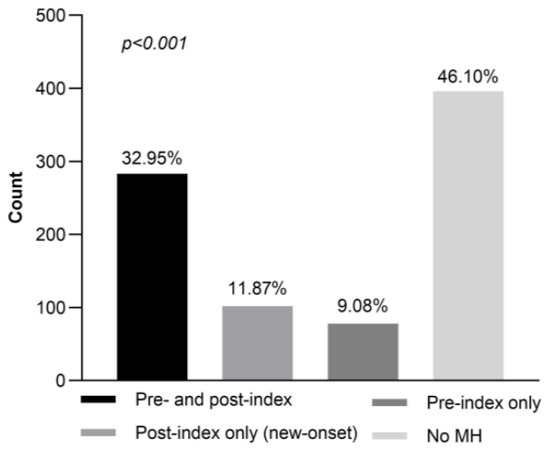
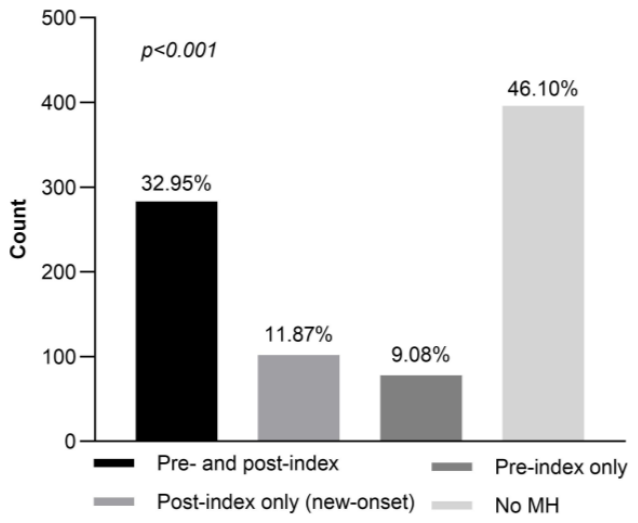
Figure 1 describes MH diagnosis and timing among AYAs with POI/EOI. We found that more than half (53.9%) had at least one MH diagnosis at any time. When examining timing relative to diagnosis, 33.0% had MH diagnoses both before and after diagnosis, 11.9% had MH diagnoses occurring only after diagnosis (new-onset), and 9.1% had MH diagnoses only prior to diagnosis. Nearly half of the cohort (46.1%) had no MH diagnoses before or after diagnosis.
Figure 1.
Distribution of mental health diagnosis timing relative to POI/EOI diagnosis among the POI/EOI cohort.
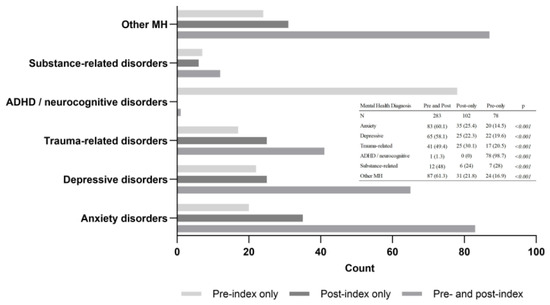
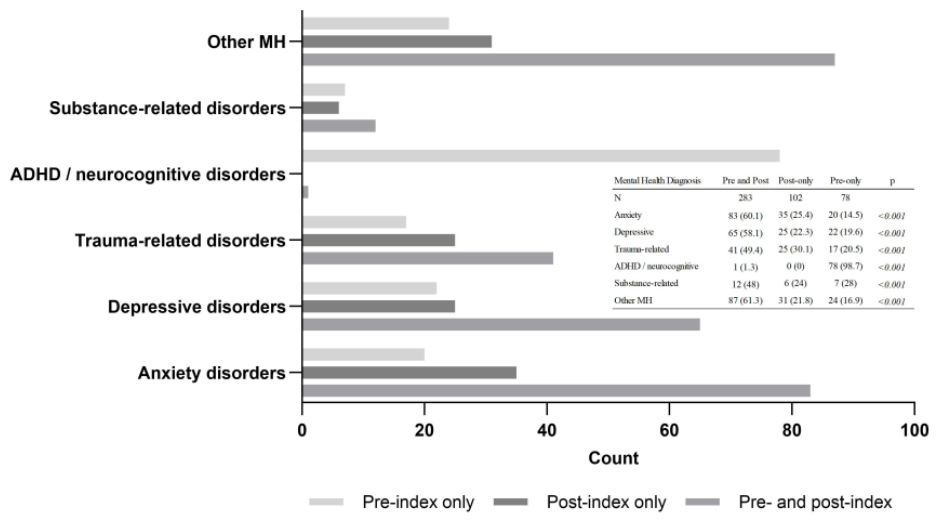
Figure 2 describes the timing of MH conditions. Of all anxiety disorders, 60.1% were present pre- and post-diagnosis MH, while 25.4% were new-onset MH after diagnosis. Depressive disorders showed a similar pattern, with 58.1% being pre- and post-diagnosis MH group and 22.3% being new-onset MH. Of the individuals with trauma-related disorders, 49.4% had the MH diagnosis both before and after POI/EOI diagnosis, while 30.1% had it as a new-onset MH. Lastly, ADHD and other neurocognitive disorders were predominantly observed prior to POI/EOI diagnosis (98.7%), with minimal representation as a new-onset MH. Approximately 48% of the substance-related disorders were present before and after POI/EOI diagnosis.
Figure 2.
Timing distribution of MH subtypes among AYAs with POI/EOI and a documented diagnosis in each subtype.
Table 2 presents the adjusted associations of development of MH after diagnosis. The significant interaction in the multivariable models indicated that the effect of POI/EOI on the outcome varied by age group. Individuals aged 12–15 years with POI/EOI had significantly higher odds of MH diagnoses after POI/EOI diagnosis compared to controls in the same age group (aOR 2.1, 95% CI 1.4–3.1, p < 0.001), as did those aged 21–25 years (aOR 2.5, 95% CI 1.4–4.7, p = 0.003). In contrast, no statistically significant difference was observed among individuals aged 16–20 years relative to their controls.
Table 2.
Adjusted odds of post-index MH for POI/EOI compared to control (probability modeled post-index MH = yes).
Race and ethnicity were also significantly associated with MH outcomes. Compared to non-Hispanic White individuals, non-Hispanic Black individuals had lower odds of MH diagnoses after POI diagnosis (aOR 0.7, 95% CI 0.6–0.9, p = 0.003), as did Hispanic individuals (aOR 0.6, 95% CI 0.4–0.9, p = 0.006). Individuals classified as “Other” race/ethnicity did not differ significantly from non-Hispanic White individuals.
Healthcare utilization and prior MH history were strongly associated with MH diagnoses after index date. Individuals with a prior MH diagnosis had substantially higher odds of MH diagnoses after POI/EOI diagnosis (aOR 12.1, 95% CI 9.1–16.2, p < 0.001). Having at least one outpatient visit prior to POI/EOI diagnosis was associated with lower odds of subsequent MH diagnoses (aOR 0.7, 95% CI 0.6–0.9, p = 0.011, Table 2), whereas prior emergency department visits and hospitalizations were not significantly associated with subsequent MH diagnosis.
Table 3 presents the adjusted associations comparing POI/EOI to the diagnosis-anchored comparator group (i.e., PMOS or thyroid disorders). The significant interaction in the multivariable models indicated that the effect of POI/EOI on the outcome varied by age group. Individuals aged 16–20 years with POI/EOI had significantly lower odds of MH diagnoses after POI/EOI diagnosis compared to those with PMOS or thyroid disorders (aOR 0.7, 95% CI 0.5–0.9, p = 0.014). No statistically significant differences were observed among individuals aged 12–15 years or 21–25 years relative to the comparison group. To further evaluate whether this comparator-group association was driven by a single diagnosis, we separately examined PMOS, hypothyroidism, and thyroiditis subgroups (comprising 47.9%, 45.2%, and 9.9% of the comparator group, respectively; no hyperthyroidism cases were identified); results were consistent across all three subgroups and are reported in full under Sensitivity Analyses (Table 4).
Table 3.
Adjusted odds of post-index MH for POI/EOI compared to PMOS or thyroid disorders (probability modeled post-index MH = yes).
Table 4.
Adjusted odds of post-index MH for POI/EOI across sensitivity analyses, by age group.
Within the model comparing individuals with POI/EOI to those with PMOS or thyroid disorders, race and ethnicity were significantly associated with MH diagnoses after group-specific diagnosis timing. Compared to non-Hispanic White individuals, non-Hispanic Black individuals had lower odds of MH diagnoses (aOR 0.6, 95% CI 0.4–0.7, p < 0.001), as did Hispanic individuals (aOR 0.5, 95% CI 0.4–0.7, p < 0.001, Table 3).
Across both diagnostic groups, prior MH diagnosis was the strongest predictor of MH diagnoses after group-specific diagnosis timing (aOR 18.1, 95% CI 14.5–22.4, p < 0.001). After adjustment for chronic condition burden and other covariates, prior outpatient visits were not significantly associated with MH outcomes, nor were prior emergency department visits and hospitalizations.
Among POI/EOI cases, 3.8% in the POI/EOI versus control comparison and 4.8% in the POI/EOI versus diagnosis-anchored comparator comparison met criteria for potential treatment-related (iatrogenic) ovarian insufficiency. Exclusion of these cases did not meaningfully alter the study findings. After removal of potentially iatrogenic cases, POI/EOI remained associated with significantly greater odds of the outcome compared with controls among individuals aged 12–15 years (aOR 2.3, 95% CI 1.5–3.4, p < 0.001) and 21–25 years (aOR 2.5, 95% CI 1.3–4.6, p = 0.005). POI/EOI also remained associated with lower odds of the outcome compared with the diagnosis-anchored comparator group among individuals aged 16–20 years (aOR 0.6, 95% CI 0.5–0.9, p = 0.006).
Substituting the healthcare utilization flag with healthcare utilization intensity yielded results that were directionally consistent with the primary analysis. Compared with controls, the odds of the outcome among individuals with POI/EOI remained higher at ages 12–15 years (aOR 1.5, 95% CI 1.1–2.2, p = 0.028) and 21–25 years (aOR 1.7, 95% CI 0.9–3.2, p = 0.090). Similarly, the association between POI/EOI and lower odds of the outcome relative to the diagnosis-anchored comparator group at ages 16–20 years remained unchanged (aOR 0.6, 95% CI 0.5–0.9, p = 0.003).
When the diagnosis-anchored comparator group was analyzed by individual diagnostic subgroup, the magnitude and direction of the associations were generally consistent with the primary analysis. Among patients in the PMOS/thyroid comparator group, 47.9% had PMOS, 45.2% had hypothyroidism, and 9.9% had thyroiditis; overlap between diagnostic categories ranged from 1% to 4%. No cases of hyperthyroidism were identified in the comparator group. Compared with patients with POI/EOI, those with PMOS (aOR 0.7, 95% CI 0.5–0.99, p = 0.029) and hypothyroidism (aOR 0.7, 95% CI 0.5–0.99, p = 0.037) had lower odds of this outcome. The estimate for the thyroiditis subgroup was similar in direction but was not statistically significant (aOR 0.7, 95% CI 0.3–1.44, p = 0.267), with wider confidence intervals reflecting the smaller sample size.
4. Discussion
In this large national sample of AYA females, we found that individuals with POI/EOI experience a substantial burden of MH conditions across the care continuum. More than half of individuals with POI/EOI had a MH diagnosis at any point, and nearly half of these individuals experienced MH conditions both before and after POI/EOI diagnosis. These findings underscore the persistence and complexity of MH needs in this population and suggest that POI/EOI occurs within a broader context of psychological vulnerability rather than as an isolated clinical event. Consistent with this, we observed that AYAs with POI/EOI also had greater chronic condition burden, reflected in higher multisystem involvement based on chronic condition indicators. This supports the notion that POI/EOI may function as a marker of broader chronic health complexity rather than a stand-alone driver of MH risk [10].
When compared to controls and adjusting for demographic characteristics and prior healthcare utilization, individuals with POI/EOI had more than twice the odds of developing MH diagnoses after their POI/EOI diagnosis. Notably, this association varied by developmental stage, with the strongest effects observed among early adolescents (12–15 years) and young adults (21–25 years), but not among those aged 16–20 years. These differences suggest developmental effect modification rather than uniform risk across age groups. Sensitivity analyses yielded findings that were largely consistent with the primary analysis. The direction and magnitude of associations were maintained after excluding potentially iatrogenic cases and when individual diagnosis-anchored comparator groups were evaluated separately. Although adjustment for healthcare utilization intensity modestly attenuated some effect estimates, the overall conclusions were unchanged. This pattern may reflect differences in how POI/EOI and its associated menopausal symptomatology are experienced and interpreted across age and developmental stages [10]. Younger adolescents diagnosed with POI/EOI may be anticipating the onset and regulation of menses as a central marker of pubertal development [10]. The absence or disruption of menses, along with potential symptoms of hypoestrogenism (e.g., vasomotor symptoms, sleep disturbance, and mood changes), may be experienced as a deviation from expected developmental milestones [10,18]. This disruption may contribute to heightened psychological distress by interfering with emerging body awareness, identity formation, and perceptions of normalcy among peers [10]. In contrast, mid-adolescents and emerging adults (16–20 years) diagnosed with POI/EOI may be less immediately impacted by the reproductive implications of this diagnosis, as this developmental stage is often characterized by increasing autonomy, educational and vocational identity formation, and a relative distancing from immediate concerns about fertility [10]. Although menopausal symptoms may still be present, individuals in this age group may be more likely to deprioritize or cognitively defer the long-term implications of the diagnosis, potentially attenuating its observable association with MH diagnoses during this period [18]. Young adults (21–25 years) diagnosed with POI/EOI may have a shift in developmental priorities and the association between POI/EOI and MH diagnoses re-emerges. This group may prioritize long-term relationships, family planning, and reproductive decision-making [10]. At this stage, the implications of POI/EOI for fertility, longevity, and physical health may become more salient, and the persistence of menopausal symptoms may serve as ongoing reminders of health changes [18]. Together, these factors may contribute to increased psychological distress as individuals reconcile the diagnosis with evolving life goals and expectations.
When comparing individuals with POI/EOI to those with other reproductive or endocrine conditions such as PMOS or thyroid disorders, the overall association between POI/EOI and MH diagnoses was no longer statistically significant. This suggests that elevated MH burden may not be unique to POI/EOI but instead reflects a broader pattern among AYAs managing chronic reproductive or endocrine conditions. Moreover, once we accounted for overall chronic condition burden using chronic condition indicators, the association between POI/EOI and subsequent MH diagnoses attenuated relative to diagnosis-anchored comparators, indicating that differences in multimorbidity may partially explain observed MH risk (rather than condition-specific effects [15]. This reframes POI/EOI not as an outlier condition, but as part of a larger group of diagnoses that share common psychosocial challenges, including uncertainty about health, chronic symptom management, and potential impacts on reproductive health [15]. In this context, POI/EOI may act as a clinical flag for AYAs with substantial chronic disease burden who are likely to have persistent and complex MH needs.
Across both comparison groups, prior MH diagnosis emerged as the strongest predictor of post-chronic condition diagnosis MH outcomes, highlighting the importance of pre-existing vulnerability. This suggests that MH risk in this population is cumulative and reinforces the need for early identification and continuity of MH care [22]. Healthcare utilization patterns provided additional insight into patient complexity. While outpatient care was associated with lower odds of subsequent MH diagnoses for POI/EOI compared with controls, this association was not observed when comparing to the PMOS or thyroid group, likely reflecting higher baseline healthcare engagement across both chronic condition groups. In contrast, prior hospitalization was consistently associated with increased MH risk, suggesting that greater medical complexity or severity may contribute to psychological burden [23].
We also observed consistent racial and ethnic differences in MH diagnoses across models, with non-Hispanic Black and Hispanic individuals demonstrating lower odds of diagnosed MH conditions compared to non-Hispanic White individuals. Importantly, this pattern contrasts with the prior literature in adult populations suggesting that POI/EOI may be more prevalent among racial and ethnic minority groups, including Black, Hispanic, and East Asian individuals [13]. This discrepancy raises important questions about whether differences observed in the present study reflect true variation in MH burden, or rather differential patterns of diagnosis, recognition, and access to care within younger populations [12]. As differential missingness in race and ethnicity data (more prevalent in the POI/EOI cohort) may contribute to these differences and complicate direct comparisons with prior literature, these findings should be interpreted cautiously. Observed differences may also reflect disparities in access to MH care, differences in help-seeking behaviors, or structural barriers to diagnosis and treatment rather than lower true prevalence of MH conditions [12]. For example, structural inequities such as differences in insurance coverage, stigma related to MH, and limited availability of culturally concordant providers may reduce the likelihood that MH conditions are formally diagnosed among minoritized adolescents, even when symptoms are present [11]. Given well-documented inequities in MH service utilization, these patterns highlight the need for culturally responsive screening and equitable access to MH services for adolescents with reproductive health conditions [12]. From a reproductive justice and broader health equity perspective, these findings are particularly concerning, as a POI/EOI diagnosis during this period represents not only a medical diagnosis but a disruption to expected reproductive and developmental trajectories during adolescence and young adulthood [18]. Individuals with POI/EOI often experience irregular or absent menses, vasomotor symptoms, fatigue, and early concerns about infertility [18]. These symptoms can be both physically distressing and psychologically destabilizing at a life stage when peers are navigating normative pubertal development and forming expectations about future family building [18]. Such experiences may contribute to elevated risk of anxiety, depression, and identity-related distress. Within this context, access to timely and appropriate MH support is a critical component of care. Furthermore, reproductive justice frameworks emphasize the right to bodily autonomy and to have or not have children [18] but these rights are only meaningful when individuals have equitable access to the resources needed to understand, process, and respond to reproductive medical conditions such as POI/EOI. Our findings suggest that racial and ethnic minoritized AYAs may be less likely to receive MH diagnoses following POI/EOI, which may reflect differential access to care rather than lower clinical need [12]. This gap may limit opportunities to address the psychological impact of POI/EOI symptoms and their implications for fertility, long-term health, and life planning, thereby compounding existing inequities in both mental and reproductive health care [18].
Taken together, these findings have important clinical and implementation implications. First, the high prevalence of MH conditions both before and after diagnosis suggests that MH screening should be integrated into routine care for AYAs with POI/EOI, beginning prior to or at the time of diagnosis and continuing longitudinally. Importantly, ensuring that such screening is implemented equitably across clinical settings is critical, as our findings suggest that racial and ethnic minority youth may be less likely to receive MH diagnoses, raising concern that MH needs may be under-recognized or undertreated in these groups [12]. Embedding standardized, culturally responsive screening approaches may help reduce disparities in identification and access to care [12]. Second, compared with a diagnosis-anchored comparator group composed of PMOS and thyroid disorders, the prevalence of post-diagnosis MH conditions was generally similar and suggests that there may be opportunities to adapt or draw from interventions developed for other chronic endocrine conditions, while also tailoring approaches to the unique needs of AYAs with POI/EOI [15]. Our findings that AYAs with POI/EOI frequently have multisystem chronic condition involvement further support designing care pathways that frame POI/EOI within a broader multimorbidity rather than as a singular condition. From a health equity perspective, this also highlights an opportunity to develop scalable, cross-condition models of integrated care that can more efficiently reach diverse populations of adolescents with reproductive and endocrine conditions, rather than relying on condition-specific pathways that may inadvertently exacerbate inequities in access [11]. In practice, this could include using a POI/EOI diagnosis, particularly when accompanied by high chronic condition burden, as a trigger for proactive MH assessment and care coordination across specialties. Hormone replacement therapy (HRT) is also a central component of clinical management for adolescents and young adults with POI/EOI [24]. Unlike menopausal hormone therapy initiated after the expected age of menopause, treatment in POI/EOI is intended to replace hormones that would ordinarily be produced during adolescence and young adulthood [24]. When not contraindicated, physiologic estrogen replacement, with progestogen for patients with an intact uterus, is recommended to address symptoms of hypoestrogenism and support bone, cardiovascular, sexual, and urogenital health [24,25]. In select patients, additional hormonal therapies, including testosterone, may also be considered on an individualized basis for specific indications, although evidence regarding their role in adolescents and young adults remains limited [25]. Although HRT may improve vasomotor symptoms, sleep, and quality of life, its relationship with MH outcomes in adolescents and young adults with POI/EOI remains insufficiently understood [26]. Treatment initiation, adherence, symptom response, and contraindications, particularly among patients with medically complex or iatrogenic POI/EOI, may contribute to heterogeneity in MH trajectories [27]. Future longitudinal studies should examine whether HRT use modifies the association between POI/EOI and subsequent MH conditions.
Third, the strong influence of prior MH history underscores the importance of coordinated care models that integrate MH and specialty care, particularly for patients with known vulnerability. Lastly, the absence of a significant association among mid-adolescents, in contrast to the younger and older groups, highlights the importance of considering both developmental timing and symptom context when interpreting the MH impact of POI/EOI. These developmental differences may also overlap with disparities in healthcare access and engagement, further shaping when and how MH needs are identified and addressed [10]. Together these findings suggest that the psychological burden of POI/EOI is heterogeneous and shaped by the interplay between biological changes and developmentally specific expectations and priorities [10]. Interventions may therefore need to emphasize body image, pubertal development, and diagnostic uncertainty in early adolescence, and fertility, relationship, and long-term health concerns in young adulthood, while ensuring accessible, developmentally appropriate supports for mid-adolescents who may not yet fully recognize or prioritize the implications of POI/EOI.
Limitations. Administrative claims data rely on documented diagnoses and may underestimate the true prevalence of MH conditions, particularly among populations with limited access to care [28]. Additionally, we were unable to capture psychosocial factors such as family support, stigma, or patient-reported outcomes, which may further shape MH trajectories. Although matching and statistical adjustment were used to improve comparability between groups, we were limited to variables available in claims data, and unmeasured factors such as psychosocial stressors, patient experiences, or symptom burden may influence the observed associations. While we incorporated chronic condition indicators to approximate overall medical complexity and body-system involvement, these measures may not fully capture the severity or functional impact of chronic disease, and residual confounding by unmeasured health status and socio-contextual factors burden may persist.
An additional limitation relates to the composition of our diagnosis-anchored comparator group. Although PMOS and thyroid disorders were selected because they represent common, clinically relevant chronic endocrine and reproductive conditions requiring ongoing medical management, their underlying pathophysiology differs fundamentally from that of POI/EOI: PMOS is characterized by hyperandrogenism and typically reversible ovulatory dysfunction, whereas POI/EOI reflects hypoestrogenism arising from an early and often irreversible loss of ovarian function. This mechanistic divergence means that the attenuated MH risk observed when comparing POI/EOI with the PMOS/thyroid group should be interpreted with caution, as it may partly reflect differences in underlying disease biology and reversibility rather than solely a shared chronic-disease burden. Relatedly, because comparator groups were matched on demographic and enrollment characteristics rather than on healthcare utilization, the substantial differences in outpatient, ED, hospitalization, and prior MH diagnosis rates observed in Table 1 raise the possibility of surveillance or detection bias—individuals with greater healthcare contact may simply have more opportunities to receive a MH diagnosis. While our adjusted models included binary utilization indicators and a sensitivity analysis substituting utilization intensity, neither approach fully equalizes baseline morbidity between groups, and residual detection bias cannot be excluded.
A further limitation is that our POI/EOI cohort combined spontaneous and iatrogenic cases (e.g., resulting from malignancy and gonadotoxic treatment, genetic syndromes, transplantation, or surgery). These distinct etiologies may independently contribute to MH and multisystem morbidity, and adjustment for chronic condition burden using CCIs cannot fully disentangle disease- or treatment-specific effects from the effect of ovarian insufficiency itself. Etiology-specific stratification was not feasible in the current analysis given sample size constraints and the limited granularity of etiology information in administrative claims data; dedicated future studies with etiology-stratified cohorts and adequate power are needed to disentangle these pathways. As a partial mitigation, our sensitivity analysis excluding potentially iatrogenic cases (Section 3, sensitivity analyses) approximates a spontaneous-only estimate and yielded directionally consistent findings (aOR 2.3, 95% CI 1.5–3.4 at ages 12–15; aOR 2.5, 95% CI 1.3–4.6 at ages 21–25), suggesting the primary associations are not solely driven by iatrogenic cases. However, this exclusion approach cannot fully substitute for a direct head-to-head comparison of spontaneous versus iatrogenic subgroups.
Despite these limitations, this study provides one of the first large-scale examinations of MH trajectories among AYAs with POI/EOI and situates these findings within a broader clinical context. By demonstrating both elevated MH risk relative to controls and burden relative to a diagnosis-anchored comparator group consisting of adolescents with PMOS or thyroid disorders, this work highlights the need for integrated, developmentally informed, and equity-focused approaches to care.
5. Conclusions
AYAs with POI and EOI experience a substantial and persistent MH burden that begins well before diagnosis and continues afterward, intersecting with high chronic disease complexity and intensive healthcare use. Our findings underscore that POI and EOI are not solely reproductive endocrine conditions, but developmental events that can disrupt identity formation, body image, and future family-building plans during a critical life stage, especially for youth who are already medically or socially vulnerable. Routine, developmentally appropriate, and culturally responsive MH screening and linkage to care should therefore be embedded into clinical pathways for AYAs with POI and EOI, with particular attention to racially and ethnically minoritized youth who appear less likely to receive documented MH diagnoses despite comparable or greater risk. Future research should delineate causal pathways between POI/EOI and MH conditions, identify modifiable factors across healthcare and social systems, and test integrated care models that simultaneously address endocrine, reproductive, and psychological needs. Together, this work highlights POI and EOI as priority conditions for coordinated reproductive and MH interventions aimed at reducing long-term psychiatric morbidity and advancing health equity across the adolescent and young adult life course.
Author Contributions
Conceptualization, F.S.W., I.Z. and L.F.S.; methodology, F.S.W., I.Z., L.F.S. and L.M.K.; software, I.Z.; validation, I.Z., F.S.W., L.F.S., R.G., L.M.K., Y.L. and M.S.; formal analysis, I.Z.; investigation, F.S.W., I.Z. and L.F.S.; resources, F.S.W., R.G., L.M.K. and M.S.; data curation, I.Z.; writing—original draft preparation, F.S.W. and I.Z.; writing—review and editing, F.S.W., I.Z., L.F.S., R.G., L.M.K., K.F., Y.L. and M.S.; visualization, I.Z. and Y.L.; supervision, R.G., L.M.K. and M.S.; project administration, F.S.W. and I.Z.; funding acquisition, F.S.W. and M.S. All authors have read and agreed to the published version of the manuscript.
Funding
This research was funded by Northwestern University Feinberg School of Medicine.
Institutional Review Board Statement
This study was reviewed and approved by the Institutional Review Board at Ann & Robert H. Lurie Children’s Hospital of Chicago as exempt (STUDY00001155, Approval date 12 June 2026).
Informed Consent Statement
The analysis used deidentified administrative claims data and did not require informed consent from individual participants in accordance with IRB determination and applicable regulations.
Data Availability Statement
The data underlying this study are available from the corresponding author on reasonable request. The data are not publicly available due to privacy and confidentiality restrictions related to protected health information.
Conflicts of Interest
The authors declare no conflicts of interest.
References
- Touraine, P.; Chabbert-Buffet, N.; Plu-Bureau, G.; Duranteau, L.; Sinclair, A.H.; Tucker, E.J. Premature ovarian insufficiency. Nat. Rev. Dis. Prim. 2024, 10, 63. [Google Scholar] [CrossRef] [Scilit]
- Kapoor, E. Premature Ovarian Insufficiency. Curr. Opin. Endocr. Metab. Res. 2023, 28, 100435. [Google Scholar] [CrossRef] [Scilit]
- Anagnostis, P.; Lambrinoudaki, I.; Goulis, D.G. Is Early Menopause a Different Entity From Premature Ovarian Insufficiency? Clin. Endocrinol. 2025, 102, 67–74. [Google Scholar] [CrossRef] [Scilit]
- Ruan, X.; Xu, C.; Huang, H.; Xu, B.; Yin, C.; Wu, Y.; Kong, W.; Tian, Q.; Yang, X.; Cao, Y.; et al. Practice guideline for the treatment and management of iatrogenic premature ovarian insufficiency. Maturitas 2026, 205, 108807. [Google Scholar] [CrossRef] [Scilit]
- Bakhsh, H. An Evidence-Based Approach to the Management of Primary Ovarian Insufficiency in Adolescents and Young Women. Life 2025, 15, 1366. [Google Scholar] [CrossRef] [Scilit]
- National Academies of Sciences, Engineering, and Medicine; Health and Medicine Division; Board on Health Care Services; Committee on Childhood Cancers and Disability. 8, The Transition from Adolescence to Young Adulthood. In Childhood Cancer and Functional Impacts Across the Care Continuum; Aiuppa, L., Cartaxo, T., Spicer, C.M., Volberding, P.A., Eds.; National Academies Press: Washington, DC, USA, 2020. Available online: https://www.ncbi.nlm.nih.gov/books/NBK569413/ (accessed on 17 June 2026).
- Hardin, A.P.; Hackell, J.M.; Committee on Practice and Ambulatory Medicine; Simon, G.R.; Boudreau, A.D.A.; Baker, C.N.; Barden, G.A.; Meade, K.E.; Moore, S.B.; Richerson, J. Age Limit of Pediatrics. Pediatrics 2017, 140, e20172151. [Google Scholar] [CrossRef] [Scilit]
- Shuster, L.T.; Rhodes, D.J.; Gostout, B.S.; Grossardt, B.R.; Rocca, W.A. Premature menopause or early menopause: Long-term health consequences. Maturitas 2010, 65, 161–166. [Google Scholar] [CrossRef] [Scilit]
- Xi, D.; Chen, B.; Tao, H.; Xu, Y.; Chen, G. The risk of depressive and anxiety symptoms in women with premature ovarian insufficiency: A systematic review and meta-analysis. Arch. Women’s Ment. Health 2023, 26, 1–10. [Google Scholar] [CrossRef] [Scilit]
- Branje, S. Adolescent identity development in context. Curr. Opin. Psychol. 2022, 45, 101286. [Google Scholar] [CrossRef] [Scilit]
- Braveman, P.; Egerter, S.; Williams, D.R. The social determinants of health: Coming of age. Annu. Rev. Public Health 2011, 32, 381–398. [Google Scholar] [CrossRef] [Scilit]
- Alegría, M.; Chatterji, P.; Wells, K.; Cao, Z.; Chen, C.N.; Takeuchi, D.; Jackson, J.; Meng, X.L. Disparity in depression treatment among racial and ethnic minority populations in the United States. Psychiatr. Serv. 2008, 59, 1264–1272. [Google Scholar] [CrossRef] [Scilit]
- Luborsky, J.L.; Meyer, P.; Sowers, M.F.; Gold, E.B.; Santoro, N. Premature menopause in a multi-ethnic population study of the menopause transition. Hum. Reprod. 2003, 18, 199–206. [Google Scholar] [CrossRef] [Scilit]
- Teede, H.J.; Khomami, M.B.; Morman, R.; Laven, J.S.E.; Joham, A.E.; Costello, M.F.; Patil, M.; Rees, D.A.; Berry, L.; Cree, M.G.; et al. Polyendocrine metabolic ovarian syndrome, the new name for polycystic ovary syndrome: A multistep global consensus process. Lancet 2026, 407, 2329–2339. [Google Scholar] [CrossRef] [Scilit]
- Cooney, L.G.; Lee, I.; Sammel, M.D.; Dokras, A. High prevalence of moderate and severe depressive and anxiety symptoms in polycystic ovary syndrome: A systematic review and meta-analysis. Hum. Reprod. 2017, 32, 1075–1091. [Google Scholar] [CrossRef] [Scilit]
- Bauer, M.; Whybrow, P.C. Role of thyroid hormone therapy in depressive disorders. J. Endocrinol. Investig. 2021, 44, 2341–2347. [Google Scholar] [CrossRef] [Scilit]
- Teede, H.J.; Misso, M.L.; Costello, M.F.; Dokras, A.; Laven, J.; Moran, L.; Piltonen, T.; Norman, R.J.; International PCOS Network. Recommendations from the international evidence-based guideline for the assessment and management of polycystic ovary syndrome. Fertil. Steril. 2018, 110, 364–379. [Google Scholar] [CrossRef] [Scilit]
- Nelson, L.M. Clinical practice. Primary ovarian insufficiency. N. Engl. J. Med. 2009, 360, 606–614. [Google Scholar] [CrossRef] [Scilit]
- Kulaylat, A.S.; Schaefer, E.W.; Messaris, E.; Hollenbeak, C.S. Truven Health Analytics MarketScan Databases for Clinical Research in Colon and Rectal Surgery. Clin. Colon Rectal Surg. 2019, 32, 54–60. [Google Scholar] [CrossRef] [Scilit]
- Zima, B.T.; Rodean, J.; Hall, M.; Bardach, N.S.; Coker, T.R.; Berry, J.G. Psychiatric Disorders and Trends in Resource Use in Pediatric Hospitals. Pediatrics 2016, 138, e20160909. [Google Scholar] [CrossRef] [Scilit]
- Agency for Healthcare Research and Quality. Chronic Condition Indicator Refined (CCIR) for ICD-9-CM. 2025. Available online: https://hcup-us.ahrq.gov/toolssoftware/chronic_icd10/chronic_icd10.jsp (accessed on 17 June 2026).
- Kessler, R.C.; Berglund, P.; Demler, O.; Jin, R.; Koretz, D.; Merikangas, K.R.; Rush, A.J.; Walters, E.E.; Wang, P.S. National Comorbidity Survey Replication. The epidemiology of major depressive disorder: Results from the National Comorbidity Survey Replication (NCS-R). JAMA 2003, 289, 3095–3105. [Google Scholar] [CrossRef] [Scilit]
- Prince, M.; Patel, V.; Saxena, S.; Maj, M.; Maselko, J.; Phillips, M.R.; Rahman, A. No health without mental health. Lancet 2007, 370, 859–877. [Google Scholar] [CrossRef] [Scilit]
- Butts, S.F.; American College of Obstetricians and Gynecologists’ Committee on Gynecologic. Committee Opinion No. 698: Hormone Therapy in Primary Ovarian Insufficiency. Obstet. Gynecol. 2017, 129, e134–e141. [Google Scholar] [CrossRef] [Scilit]
- Panay, N.; Anderson, R.A.; Bennie, A.; Cedars, M.; Davies, M.; Ee, C.; Gravholt, C.H.; Kalantaridou, S.; Kallen, A.; Kim, K.Q.; et al. Evidence-based guideline: Premature ovarian insufficiency. Hum. Reprod. Open 2024, 2024, hoae065. [Google Scholar] [CrossRef] [Scilit]
- Menezes, C.; Pravata, G.R.; Yela, D.A.; Benetti-Pinto, C.L. Women with premature ovarian failure using hormone therapy do not experience increased levels of depression, anxiety and stress compared to controls. J. Affect. Disord. 2020, 273, 562–566. [Google Scholar] [CrossRef] [Scilit]
- Cattoni, A.; Parissone, F.; Porcari, I.; Molinari, S.; Masera, N.; Franchi, M.; Cesaro, S.; Gaudino, R.; Passoni, P.; Balduzzi, A. Hormonal replacement therapy in adolescents and young women with chemo- or radio-induced premature ovarian insufficiency: Practical recommendations. Blood Rev. 2021, 45, 100730. [Google Scholar] [CrossRef] [Scilit]
- Davis, K.A.; Sudlow, C.L.; Hotopf, M. Can mental health diagnoses in administrative data be used for research? A systematic review of the accuracy of routinely collected diagnoses. BMC Psychiatry 2016, 16, 263. [Google Scholar] [CrossRef] [Scilit]

Disclaimer/Publisher’s Note: The statements, opinions and data contained in all publications are solely those of the individual author(s) and contributor(s) and not of MDPI and/or the editor(s). MDPI and/or the editor(s) disclaim responsibility for any injury to people or property resulting from any ideas, methods, instructions or products referred to in the content. |
© 2026 by the authors. Licensee MDPI, Basel, Switzerland. This article is an open access article distributed under the terms and conditions of the Creative Commons Attribution (CC BY) license.