


Highlights
Public health relevance—How does this work relate to a public health issue?
- Non-communicable diseases (NCDs) remain the leading cause of premature mortality worldwide, and increasing physical activity (PA) is a public health priority.
- Understanding how sport sciences graduates (SSGs) are incorporated into healthcare systems may inform strategies to strengthen PA promotion.
Public health significance—Why is this work of significance to public health?
- Functional integration of SSGs into primary care was associated with lower national NCD mortality after adjustment for demographic and economic factors.
- These findings identify healthcare workforce organization as a potentially important system-level determinant of preventive health delivery.
Public health implications—What are the key implications or messages for practitioners, policymakers and/or researchers in public health?
- Health systems may benefit from evaluating policies that enable SSG to contribute to primary care-based PA promotion.
- Prospective and longitudinal studies are required to confirm causality and guide implementation of SSG integration models.
Abstract
Globally, physical activity is increasingly acknowledged as an effective strategy for combating non-communicable diseases (NCDs). However, there is a significant global disparity in the integration of sport sciences graduates (SSGs) into national health systems. This study assessed the professional roles of SSGs within healthcare systems and their association with NCD mortality across (n = 34) countries that met the selection criteria, using a cross-national, ecological, and cross-sectional design. Principal component analysis was conducted to reduce the dimensions of the correlated structural indicators. A pre-specified generalized linear model (Gamma family, log link) with HC3 robust standard errors estimated the association between SSG integration and age-standardized NCD mortality, alongside a descriptive analysis of public funding (national or subnational) for SSG services. The findings indicate that integrating SSGs into primary care was associated with approximately 23% lower age-standardized NCD mortality (rate ratio 0.77, 95% CI 0.63–0.94, p = 0.011; approximately 16% to 23% across model specifications) after adjusting for demographic and economic factors, with near-universal public funding (100% of integrated versus 24% of other countries; Fisher’s exact p < 0.001). To our knowledge, this is the first cross-national analysis to link the functional integration of SSGs into primary care with population NCD mortality, and this relationship remained consistent across multiple robustness checks. The implications suggest that functional integration and its public funding may represent promising policy approaches for strengthening preventive health services. Given the ecological, cross-sectional design, longitudinal studies are warranted to establish causality.
1. Introduction
The global community is currently experiencing a significant escalation in health challenges, primarily due to elevated mortality rates associated with non-communicable diseases (NCDs) [1,2]. These diseases, particularly those affecting the circulatory and respiratory systems [3], have been shown to reduce life expectancy by up to 30 years in certain countries. Key risk factors include elevated body mass index, high blood pressure, and blood sugar disorders. Regionally [4], the African continent is experiencing a marked increase in the health burden from NCDs, as evidenced by a 53.3% rise in associated mortality rates. The rate of premature death varies by region, ranging from 36.5% to 72.1%, with the probability of premature NCD death estimated at approximately one in five for males and one in fifteen for females [5]. Further, evidence suggests a promising potential for the prevention of these diseases through physical activity (PA) [1,6].
Physical inactivity is recognized as one of the leading causes of premature mortality [7], accounting for an estimated 6% of adult deaths globally, which equates to approximately 5 million deaths annually. It is estimated that health-promoting PA contributes to the prevention of 1.8 million deaths annually [8]. PA plays a crucial role in preventing cardiovascular diseases, type 2 diabetes, and several types of cancers [9,10,11,12]. The challenge posed by NCDs extends beyond a mere health burden, as it also represents a substantial economic burden. The cost of healthcare services for NCDs attributable to physical inactivity is estimated at 46.7 billion USD annually [4], while productivity losses in Europe alone are estimated at 514.5 billion USD annually [1]. In the United States, healthcare expenditures for diseases resulting from physical inactivity amount to 192 billion dollars, constituting 12.5% of total health expenditure during the period from 2015 to 2025 [13].
The World Health Organization (WHO) addresses the health burden by advocating for the integration of PA as a therapeutic intervention within primary and secondary healthcare settings [14]. According to WHO guidelines, engaging in moderate-intensity PA for 150 to 300 min per week can reduce the risk of premature mortality by 20 to 30% [15]. In response, various countries and organizations have initiated programs such as “Exercise is Medicine” by the American College of Sports Medicine [16], the Royal College of General Practitioners’ physical-activity guidance [17], and the Canadian Diabetes Association’s stance on PA. These initiatives have yielded positive outcomes, enhancing PA levels [18], improving mental health, and identifying suitable exercise forms for patients [19].
Despite these efforts, the Global Observatory of Physical Activity (GoPA) reports that health responses remain inadequate, with over 60% of countries yet to incorporate PA into primary healthcare interventions, and only 21% of countries committed to including PA in primary care prescriptions [20]. This shortfall is attributed to several barriers [21], including limited physician time, insufficient expertise in exercise dosing and prescription, lack of confidence in PA service providers [22,23], and the absence of approved referral networks or insurance coverage for these services [24].
Clarifying what these services comprise is a precondition for evaluating them. The health-oriented services delivered by sport sciences graduates (SSGs) extend well beyond generic advice to be more active: they comprise pre-participation risk stratification and functional assessment, individualized exercise prescription, supervised delivery of structured exercise for people with established disease, and behavior-change support to sustain adherence [25]. Central to these services is the concept of exercise dosing—the specification of frequency, intensity, time and type, adjusted to the patient’s condition, as set out for clinical populations in consensus guidance such as that for type 2 diabetes [12]—which distinguishes a therapeutic prescription from general counselling. Delivering such dosing at scale depends on organizational structures: an explicit scope of practice locating the SSGs within the health system, a formal referral pathway from the general practitioner to that provider, a reimbursement or budget line covering the encounter, and a record system through which outcomes return to the referrer [25]. These structures vary widely between countries, from statutory licensure with a dedicated fee schedule to purely private, out-of-pocket provision outside the health system altogether, and it is precisely this variation that the present study sets out to classify and to relate to population outcomes.
The lack of appropriate organizational structures—specifically, the absence of a defined scope of practice, an approved referral pathway, or a financing mechanism for the encounter—impedes the formal employment of SSGs within healthcare systems, particularly in the absence of accredited health staff [25,26], thereby restricting physicians’ ability to refer patients to them [27]. These barriers are compounded by workforce under-use: only 20–30% of physicians routinely discuss PA with patients, and registered exercise professionals are embedded in only a handful of primary-care teams despite a large trained workforce [28]. Accordingly, where these structures are absent, the referral has no destination inside the health system, and exercise prescription reverts to brief verbal advice delivered by a clinician who reports insufficient training in exercise dosing. The degree to which each structure is present differs markedly across countries, and these differences are not captured by whether a country has a national PA policy: countries meeting the same policy criteria may place SSGs anywhere from full statutory practice in primary care to no health-system role at all.
Although evidence supports the return on investment of employing specialized SSGs in healthcare systems [25], regulatory challenges persist, with 40% of countries experiencing a lack of institutional structures and insufficient funding to integrate these graduates [29]. Health financing systems often prioritize acute care costs over preventive measures or quality of life improvements. Consequently, some countries have adopted performance-based funding mechanisms to incentivize health facilities to offer PA as an intervention for NCD patients [30].
The theoretical integration of SSGs into the healthcare system is posited to alleviate the health and economic burdens associated with NCDs [31]. However, there exists a paucity of quantitative research evaluating the global cumulative impact of this integration—specifically in terms of legal recognition, funding, and the delineation of professional roles—on mortality rates attributable to NCDs. This gap is confirmed by a systematic review [32] that identified the healthcare domain as the least evaluated of all policy settings in PA policy studies. In addition, the application and barriers of integrating PA into healthcare have recently been mapped in a scoping review [33]. Furthermore, the significant disparities in demographic and economic characteristics, such as population age structure, population density, health expenditure, and income level, across countries present a substantial challenge for comparative analysis. These disparities necessitate an approach that adjusts for these factors when evaluating policy impacts.
The primary objective of this study is to evaluate how the institutional integration of SSGs within healthcare systems is associated with the epidemiological burden of NCDs and with public financing mechanisms, controlling for global demographic, economic, and structural factors. Specifically, it investigates two dimensions: first, whether functional integration—particularly within primary care—is associated with a quantifiable reduction in NCD mortality, and second, which organizational determinants are critical in establishing a public financing framework for services provided by SSGs within healthcare systems.
2. Materials and Methods
2.1. Research Design
This study adopted a cross-national, ecological, and cross-sectional design to examine the relationships among key variables using data from selected countries. This design enabled a quantitative assessment of the influence of regulatory and institutional frameworks for the integration of SSGs on public health indicators. The analysis was conducted in two stages:
- Principal component analysis (PCA): Employed for dimensionality reduction to capture the underlying demographic and economic profiles of each country.
- Generalized linear modeling (Gamma family, log link): Used to estimate the association between SSG institutional integration and age-standardized NCD mortality, complemented by a descriptive analysis of funding mechanisms.
2.2. Research Population and Sample
The study population comprised the 194 countries assessed in the GoPA country profiles [20]. Countries were included in the sample if they met the following criteria:
- Implementation of brief PA interventions within primary healthcare.
- The presence of a national NCD policy including PA (either operational or non-operational).
- Availability of national PA guidelines covering adolescents, adults, and older adults.
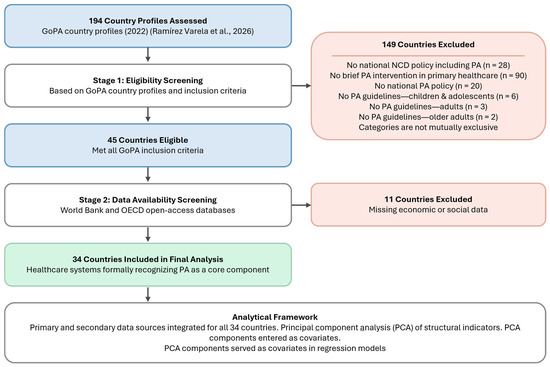
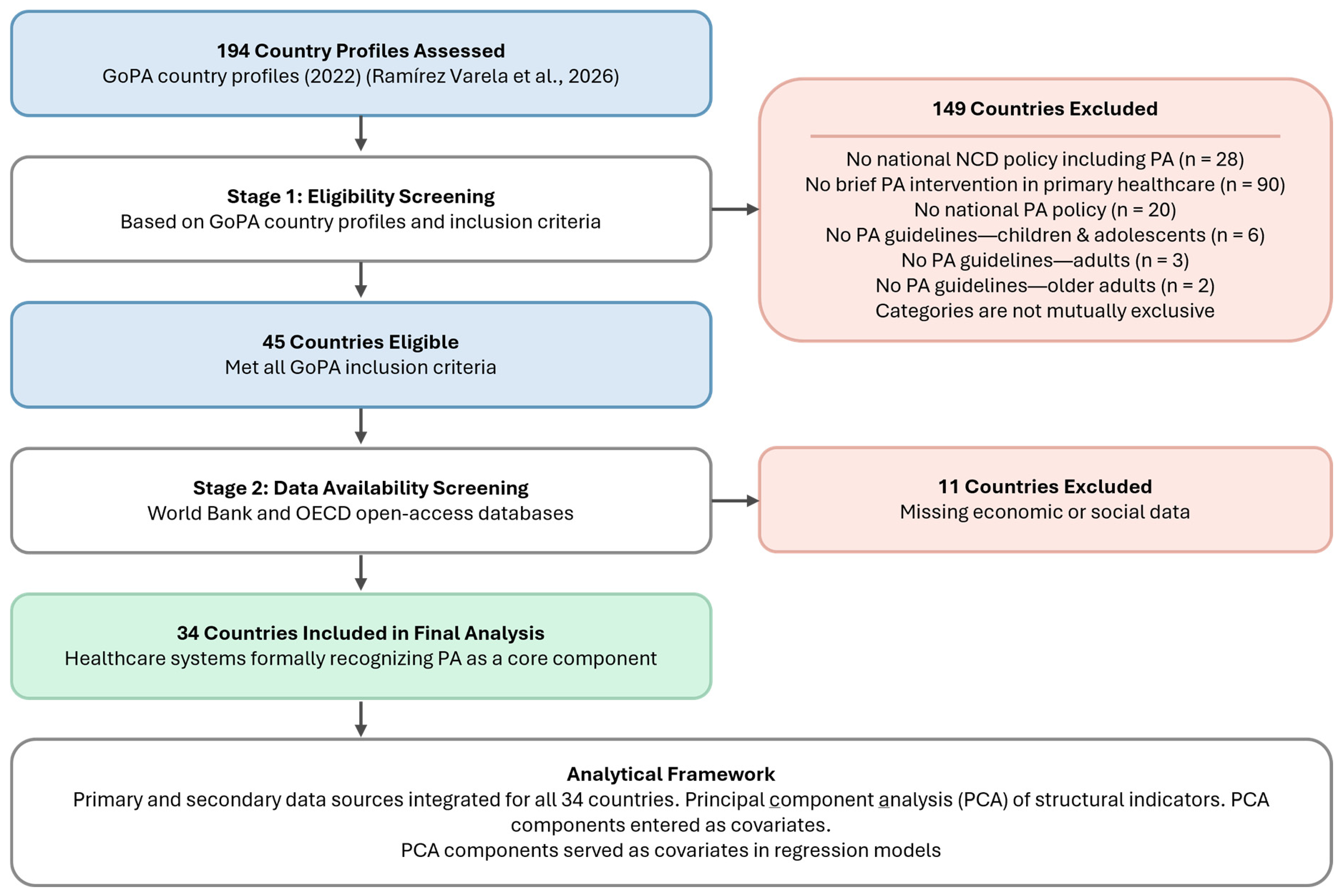
Countries that did not satisfy these criteria were excluded. Additional exclusion criteria included the lack of valid economic and social data in open-access databases from the World Bank (WB) and the Organization for Economic Co-operation and Development (OECD). Consequently, a total of 34 countries met the inclusion criteria after a two-stage selection process; in the first stage, 45 countries were identified as eligible based on the GoPA country profiles, and in the second stage, 11 countries were excluded due to missing economic or social data. The final sample therefore represents countries with healthcare systems that formally recognize PA as a core component of healthcare practice. The complete sample selection process is illustrated in Figure 1.
Figure 1.
Sample selection flowchart. Abbreviations: GoPA = Global Observatory for Physical Activity; NCD = non-communicable disease; PA = physical activity; OECD = Organisation for Economic Co-operation and Development; PCA = principal component analysis [20].
2.3. Data Collection
A multi-source approach was adopted for data collection, employing both primary and secondary sources to enhance the transparency of classification procedures and the reliability of institutional variables as follows:
2.3.1. Primary Sources (Institutional Classification)
A thorough content analysis of primary sources was undertaken to ascertain the professional status of SSGs within healthcare systems. This analysis involved the examination of: (a) national laws and government regulations pertinent to healthcare practices, (b) legislation governing professional practice, including licensing and accreditation, (c) policies and regulatory bodies of the Ministry of Health such as unions and medical boards, (d) funding mechanisms, including insurance coverage and direct government funding, (e) professional guidance and models of intersectoral cooperation, (f) peer-reviewed studies addressing the scope of practice for SSGs within healthcare systems.
SSGs were defined functionally as graduates of sport, exercise, or movement-science programs with health-oriented competencies (exercise physiology, sport health, and sports injury and rehabilitation) qualified to deliver exercise assessment, medically oriented physical-activity prescription, and exercise-based rehabilitation. Because this workforce carries different professional titles and legal statuses across countries (for example, kinesiologists in Chile, exercise physiologists in Australia, physiotherapists with an exercise-prescription scope elsewhere, or sport science graduates in Egypt), the exposure was coded based on the operational scope of practice within the health system, independently of legal recognition (which was coded separately).
The organizational and institutional determinants were categorized into three distinct variables: recognition of the health role, scope of practice, and funding mechanisms. Collectively, these variables constituted the functional empowerment factors for SSGs within healthcare systems. Given the observed heterogeneity among countries, a hierarchical coding scheme was developed to classify these levels as follows: (a) Type of Legal Recognition: Coded as 0 = unregulated or excluded, 1 = semi-formal/institutional, 2 = integrated functional recognition, 3 = full legal-health recognition (statutory). (b) Scope of Professional Practice: Coded as 0 = absence of healthcare role; 1 = integrated in secondary care; 2 = integrated in primary care. For regression analysis, this ordinal variable was decomposed into two binary (dummy) indicators—primary care integration (0/1) and secondary care integration (0/1)—with the absence of healthcare role as the reference category. (c) Funding Mechanisms: Coded as 0 = out-of-pocket payment (private), 1 = partial/subnational public funding (restricted), 2 = direct national public funding. Per-country documentary evidence and the verified source for every coded value are tabulated in Supplementary File S1.
This coding followed a directed (deductive) content-analysis approach: each country was scored on the three pre-specified, literature-derived ordinal dimensions (scope of practice, recognition, and funding), anchored in the Donabedian structure–process–outcome framework, using a fixed codebook applied to per-country documentary evidence, with inter-rater reliability reported. The content-analysis coding frame, including the full codebook and the per-country documentary evidence, is provided in Supplementary File S1.
2.3.2. Secondary Data Sources (Quantitative Data)
- Demographic indicators: Data on population density and the proportion of the urban population were obtained from the United Nations Population Division [34].
- Economic and health indicators: Information on economic and health-related characteristics was retrieved from the WB and the OECD databases [35,36]. The variables included national income level, government health expenditure as a percentage of gross domestic product (GDP), and the Gini coefficient as a measure of income inequality.
- NCD mortality rate: The outcome was the age-standardized NCD mortality rate (deaths per 100,000 both sexes, 2019) obtained from the WHO Global Health Observatory (indicator WHS2_131) [37] and standardized to the WHO World Standard Population. The 2019 vintage was the most recent complete pre-pandemic estimate; re-estimating Model A with the 2020 and 2021 vintages confirmed a stable association in direction and magnitude (Supplementary File S2).
2.3.3. Inter-Rater Reliability
To verify the reliability of the institutional classification, all 34 countries were independently re-coded on the three determinants by two investigators (NA and AA), each blinded to the original codes and to one another and working only from the per-country evidence and the pre-specified codebook. Inter-rater agreement was substantial to almost perfect: weighted Cohen’s kappa was 0.89 for scope of practice, 0.94 for recognition, and 0.84 for funding (0.72 for the binary primary-care integration indicator). Disagreements were few and were resolved to the original analyst’s code. Re-estimating Model A from each rater’s independent classification produced materially similar results (rate ratios: 0.82 and 0.78), confirming a robust exposure classification.
2.4. Statistical Analysis
First, PCA was applied to seven structural variables: income level, population density, urban population percentage, population age structure (<20 years), population age structure (>60 years), the Gini coefficient, and health expenditure as a percentage of GDP. The objective was to reduce dimensionality into uncorrelated (orthogonal) components. The first three principal components were retained as shown in Table 1, cumulatively explaining 80.74% of the total variance. Sampling adequacy was modest (overall Kaiser-Meyer–Olkin measure: 0.62; per-variable measures of sampling adequacy ranged from 0.33 to 0.86, lowest for the Gini coefficient; see Supplementary File S2), consistent with the limited sample.
Table 1.
Principal component loadings (PCA), eigenvalues, and explained variance for the seven structural indicators (unrotated PCA; n = 34).
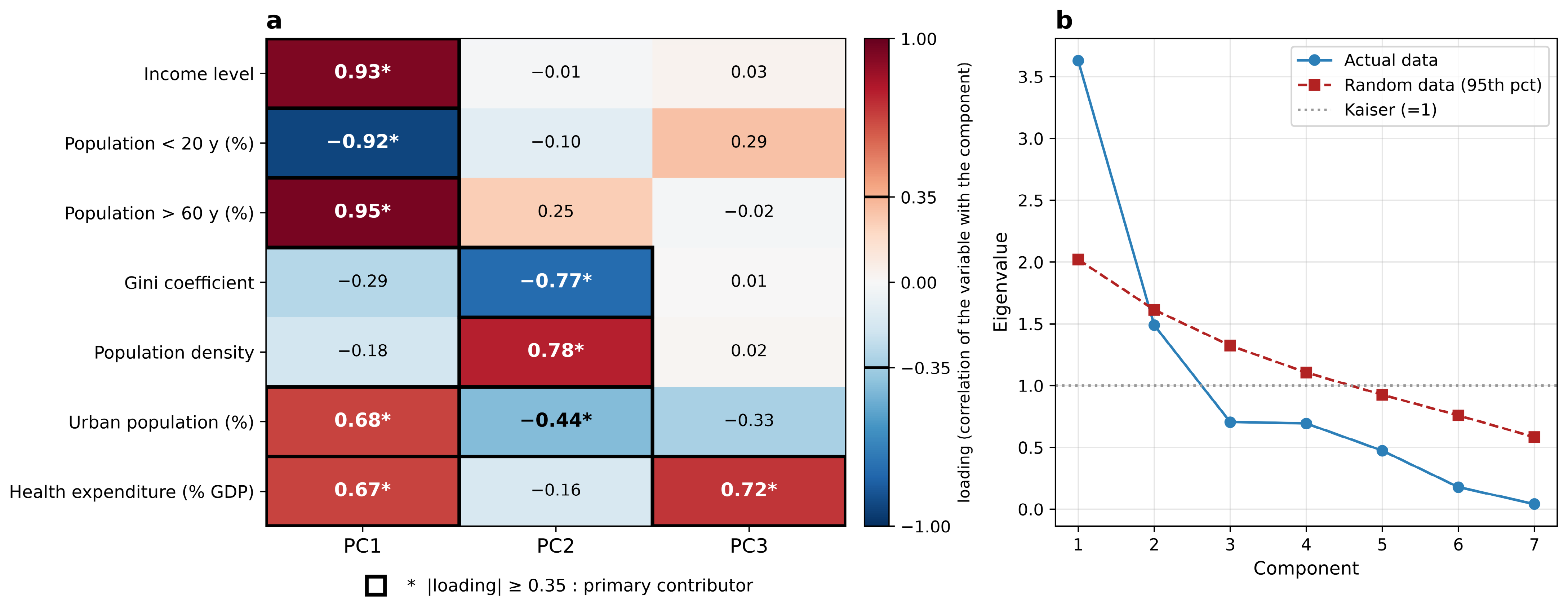
Because the components served as adjustment covariates rather than interpreted factors, retention was deliberately inclusive. The Development and Aging Index (PC1) satisfied both the Kaiser criterion and Horn’s parallel analysis; the Inequality and Density Index (PC2) satisfied the Kaiser criterion only; and the Health Investment Index (PC3) (eigenvalue 0.71) met neither rule but was retained a priori, as a pre-specified adjustment, to capture the health-investment dimension. Retaining these additional components makes the confounding adjustment more conservative, not less valid; PC3’s label is descriptive, carries no inferential weight, and was non-significant in the outcome model (p = 0.33). The primary association was, moreover, robust across specifications retaining one, two, or three components (Supplementary File S2).
Further, PCA was conducted without rotation to reduce the dimensionality of structural demographic and economic variables. Highlighted cells indicate primary contributing variables (absolute components coefficient ≥ 0.35). PC1 is driven by income level and, age structure urbanization, and health expenditure; PC2 by population density and the Gini coefficient and PC3 by health expenditure as a percentage of GDP.
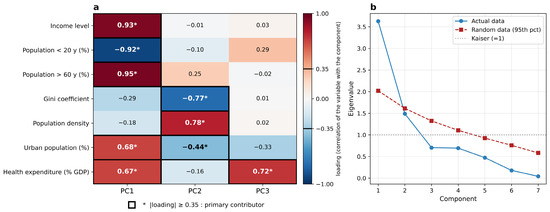
In addition, a heatmap of PCA loadings for seven structural socioeconomic indicators (n = 34) was generated to visually display the magnitude and direction of each variable’s contribution to the three retained components. Highlighted loadings (loading ≥ 0.35) indicate primary contributing variables; the component loadings and the scree plot with parallel analysis are shown in Figure 2.
Figure 2.
(a) Heatmap of PCA of the seven structural indicators: component loadings; (b) Scree plot with parallel analysis. In panel (a), a bold and black boarder cell with an asterisk denote an absolute loading of 0.35 or above, and identifying a primary contributing variable. Abbreviations: * = absolute loading ≥ 0.35; PCA = principal component analysis; PC1 = Development and Aging Index; PC2 = Inequality and Density Index; PC3 = Health Investment Index.
Second, two models were constructed:
- Model A: Estimating age-standardized NCD mortality from the three principal components together with the primary- and secondary-care integration indicators, entered simultaneously as a single pre-specified model (no stepwise selection).
- Model B: Predicting public funding mechanisms in relation to scope of practice and recognition indicators. Given complete separation between primary-care integration and public funding at this sample size, Model B was analyzed descriptively (cross-tabulation with Fisher’s exact test) rather than by stepwise regression.
Model Quality Analysis
Model A’s fit was summarized by the deviance explained and residual deviance (AIC = 399.7 for the full model and 397.6 for the reduced model), with effect sizes reported as rate ratios (the exponentiated coefficients; full fitted coefficients are in Table 2). The absence of multicollinearity was verified using variance inflation factors (VIF < 3.0). Descriptive statistics are provided in Supplementary File S3. Reporting was guided by the STROBE statement for observational studies (Supplementary File S4). All analyses were performed using Python (version 3.11).
Table 2.
Institutional classification of SSGs across the 34 countries: scope of practice by level of legal recognition, with public funding.
- Fitted model (Model A): log (E [age-standardized NCD mortality]) = β0 + β1·PC1 + β2·PC2 + β3·PC3 + β4·(primary-care integration) + β5·(secondary-care integration), estimated with a Gamma family and log link; the rate ratio for each predictor is exp(β).
The robustness of Model A was assessed with HC3 robust standard errors, a restricted wild bootstrap, bias-corrected and accelerated (BCa) bootstrap intervals, Huber and Tukey robust regression, leave-one-out and influence diagnostics, a specification-curve (multiverse) analysis, an E-value for unmeasured confounding, a statistical-power/MDE assessment, and a permutation test; full specifications and results are reported in Supplementary File S5.
3. Results
Initially, the study conducted a content analysis that classified each country in the sample according to the three pre-specified dimensions. SSGs held a defined role in primary care in 13 of the 34 countries, were confined to secondary care in seven countries, and had no recognized role within the health system in 14 countries. The level of professional recognition did not necessarily align with the placement of SSGs within the health system, as presented in Table 2.
Scope of practice and legal recognition were the two coded content-analysis dimensions, as defined earlier. Public funding was coded as a binary indicator, combining partial or subnational public funding with direct national funding. By funding mechanism, 16 countries relied exclusively on out-of-pocket funding, 16 received partial or subnational public funding, and two received direct national public funding. Further, 8 of the 13 countries with primary care integration had achieved this integration without functional or statutory recognition: four were classified as unregulated or excluded (Chile, Finland, the Netherlands, and Thailand) and four as semi-formal (Denmark, Latvia, Norway, and Sweden). Conversely, three of the seven countries in which SSGs were confined to secondary or rehabilitation care—Germany, the United Kingdom, and the United States—had integrated functional recognition without primary care placement. On this evidence, formal recognition was neither necessary nor sufficient for an operational role within primary care.
When examined alongside funding, the classification revealed a consistent gradient: the prevalence of public funding increased monotonically across the scope-of-practice categories, from 7% of countries with no health-system role, to 57% among those with secondary or rehabilitation care integration, and to 100% among those with primary care integration. The classification also revealed a strong alignment between integration and national income level. All 13 countries with primary care integration were either high-income (11 countries) or upper-middle-income (two countries), whereas all four lower-middle-income countries in the sample had no SSG role within the health system. Moreover, none of the lower-middle-income countries contributed an observation with integrated primary or secondary care placement.
This alignment between SSG integration and national development is an important consideration when interpreting associations in the subsequent analysis. An unadjusted comparison across the scope-of-practice gradient could reflect differences in national development and health-system capacity as much as differences in models of service delivery. Accordingly, income level and other structural characteristics should be considered potential confounding factors when estimating the association between SSG integration and health-system or population-level outcomes.
Estimating the association between SSG integration and NCD mortality required adjustment for the demographic and economic context in which the health system operates. With only 34 countries against seven correlated structural indicators, entering all of them directly would risk overfitting and loss of power. The indicators were therefore reduced to a smaller set of orthogonal components before modeling.
To address this, PCA of the seven indicators yielded three retained components—the Development and Aging, Inequality and Density, and Health Investment Indices. These components served as covariates in Model A to separate the net contribution of the policy variables from demographic and economic confounding affecting mortality rates. The component loadings and explained variance for all three components are presented in Table 1 and Figure 2. These components provide a robust methodological foundation to test the study’s core hypotheses. By adjusting for these structural confounders, the subsequent regression analysis isolated the specific influence of policy variables on health outcomes, as detailed in Table 3.
Table 3.
Model A (Gamma generalized linear model, log link) rate ratios for age-standardized NCD mortality.
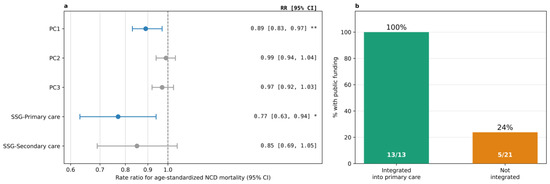
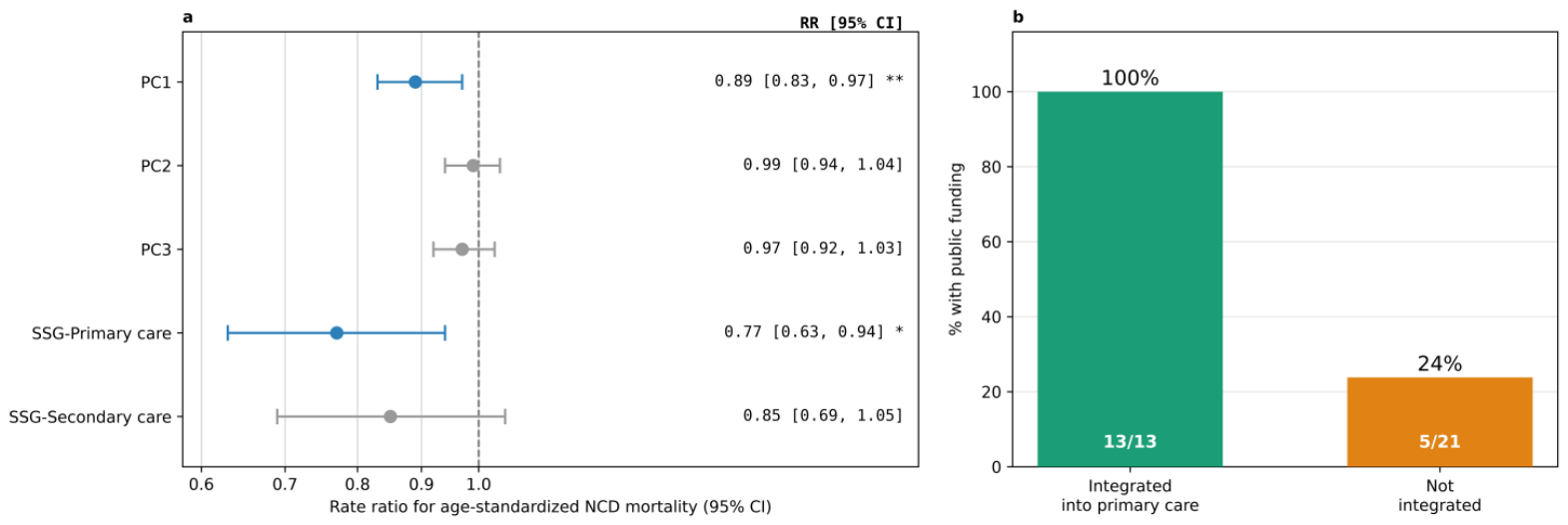
The pre-specified generalized linear model (Gamma, log link; deviance explained = 0.586, AIC = 399.7) identified PC1, PC3 and SSG primary-care integration as the principal correlates of age-standardized NCD mortality. PC1 (development–aging) was associated with lower age-standardized NCD mortality (RR = 0.89, 95% CI 0.83–0.97, p = 0.005), and PC3 showed a non-significant protective direction (RR = 0.97, 95% CI 0.92–1.03, p = 0.33). Critically, SSG integration into primary care was associated with approximately 23% lower age-standardized NCD mortality (rate ratio 0.77, 95% CI 0.63–0.94, p = 0.011; the estimate ranged from about 16% to 23% across model specifications, the reduced sensitivity model giving rate ratio 0.84) after full adjustment for the structural covariates.
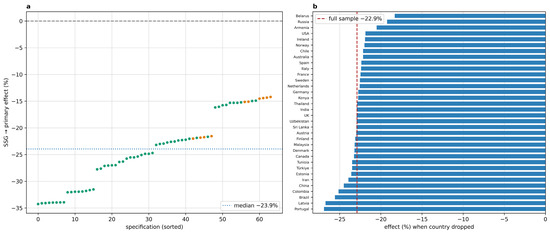
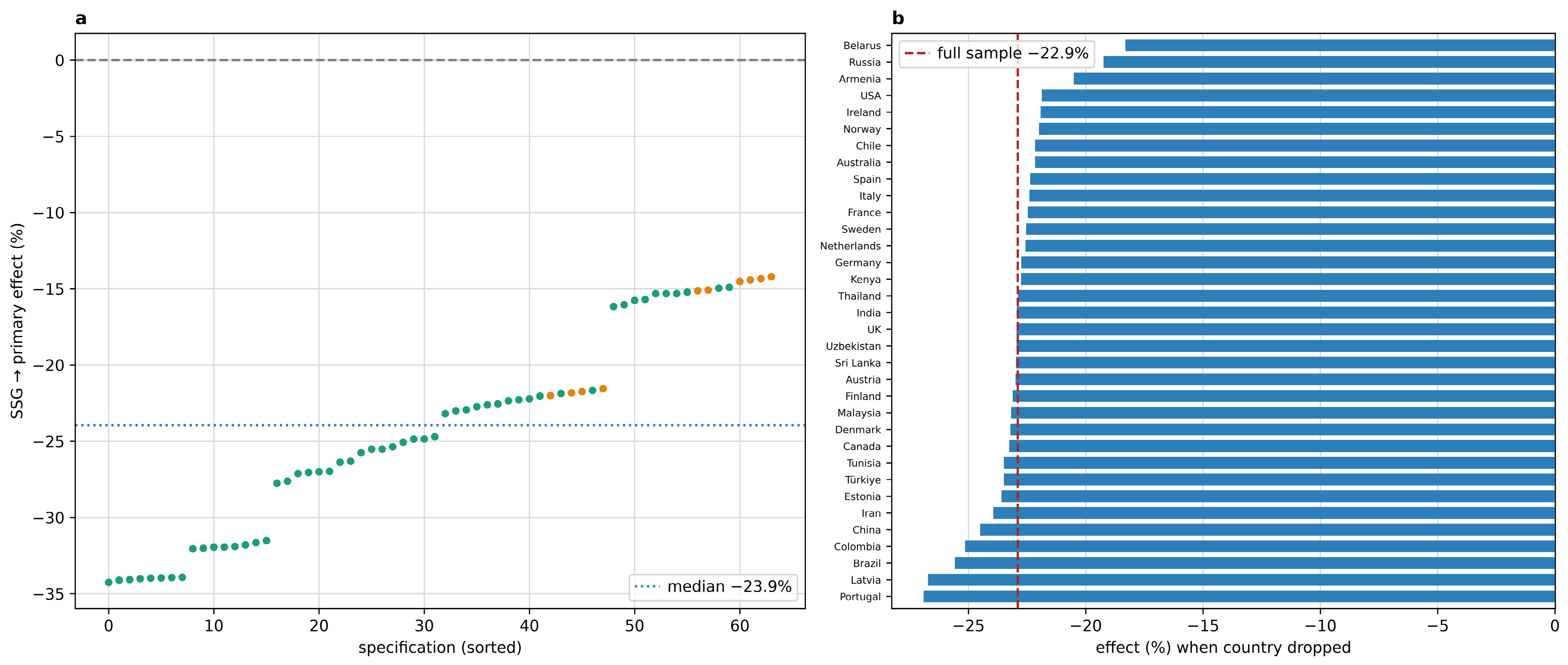
The estimate rested on only 34 countries. This raises three concerns: a false positive, one influential country, or a biased analytic choice. Robust (HC3) standard errors and a restricted wild bootstrap both preserved significance (p = 0.023): the result is not a false positive from the small sample or non-normal errors. The next concern was influence. No observation proved unduly influential (maximum Cook’s distance 0.233), and leave-one-out re-estimation kept the reduction between 18.3% and 26.9% and significant in all 34 iterations. That left the analytic choice. Across all 64 specifications, the estimate stayed negative and was significant in 84%, and a permutation test returned p = 0.001, excluding chance. The association also held across the 2019–2021 outcome vintages (rate ratio 0.76–0.78) and attenuated only modestly in a reduced model (rate ratio 0.84). Full diagnostics appear in Supplementary Files S2 and S3. In the same model, PC2 and secondary-care integration were not statistically significant (p > 0.05); the secondary-care estimate (rate ratio 0.85) is imprecise at n = 7 integrated countries and not statistically distinguishable from the primary-care estimate, indicating that it is functional integration into primary care specifically—not secondary care—that carries independent predictive power beyond demographic and economic context.
Further, Figure 3 visualizes the primary-care association across both models. Panel (a) shows Model A’s rate ratios with 95% confidence intervals (all three principal components and both integration indicators entered simultaneously), and panel (b) shows the descriptive funding contrast (2 × 2; Fisher’s exact p < 0.001). Primary-care integration emerged as the dominant correlate in both panels.
Figure 3.
Primary-care integration and (a) age-standardized NCD mortality (Model A rate ratios, log axis) and (b) public funding (2 × 2 contingency; Fisher’s exact p < 0.001). In panel (a), blue markers denote statistically significant estimates and grey markers refer to non-significant estimates; the dashed vertical line marks a rate ration of 1 (no association); asterisks denote significance (* p < 0.05; ** p < 0.001). In panel (b), the fraction inside each bar is the number of countries with public funding out of the group total. Abbreviations: PC1 = Development and Aging Index; PC2 = The Inequality and Density Index; PC3 = Health Investment Index; SSG—primary care = sport sciences graduate integration into primary care; SSG—secondary care = sport sciences graduate integration into secondary care; CI = confidence interval; RR = rate ratio.
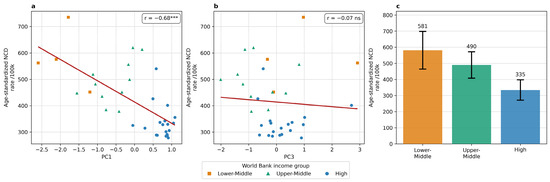
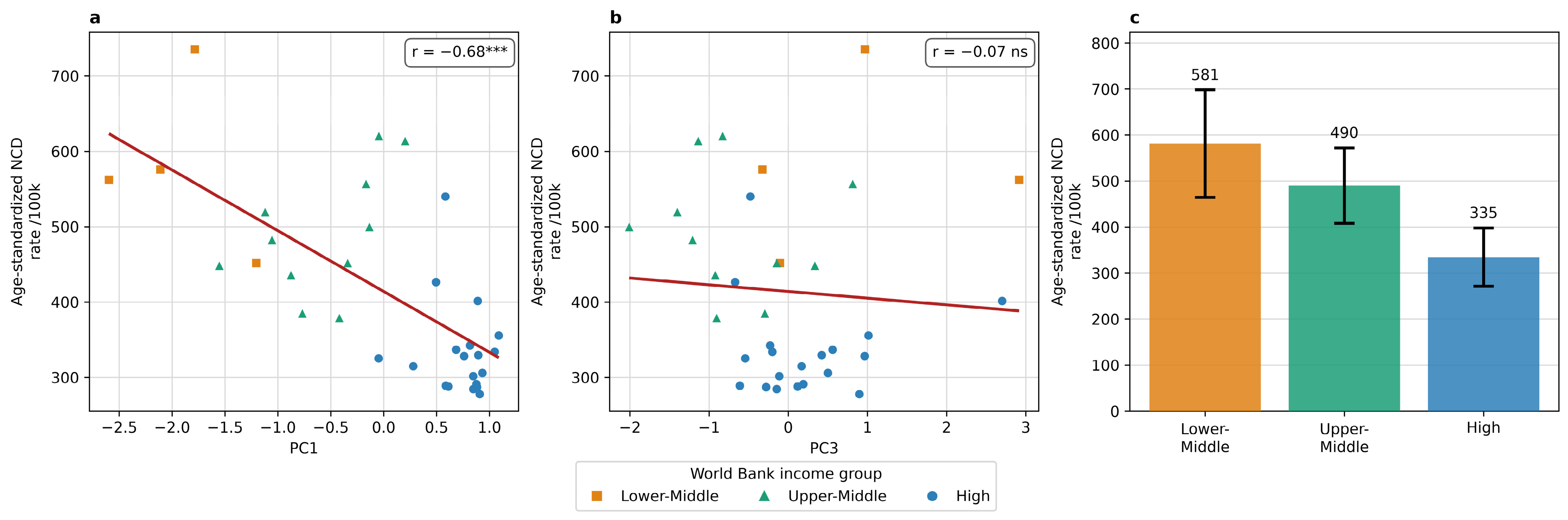
Because this adjusted estimate could still reflect the structural context, those determinants were examined directly (Figure 4). Figure 4a shows a strong negative correlation between PC1 and age-standardized NCD mortality (r = −0.68, p < 0.001): more developed, older populations have lower mortality once it is placed on a common age structure. Figure 4b, by contrast, shows only a weak, non-significant association for PC3 (health investment; r = −0.07), consistent with its non-significant coefficient in Model A (Table 2). Figure 4c confirms the pattern categorically: mortality was highest in lower-middle-income countries and lowest in high-income countries, echoing the PC1 gradient.
Figure 4.
Structural determinants of age-standardized NCD mortality: (a) PC1 (development–aging); (b) PC3 (health investment); (c) distribution by World Bank income group. In panels (a,b), the dark red line is the ordinary least-square fit and the boxed value is the Pearson correlation coefficient with (***) denoting p < 0.001 and (ns) denote non-significant. Abbreviations: PC1 = Development and Aging Index; PC3 = Health Investment Index; NCD = non-communicable disease.
The same integration that tracked lower mortality also tracked how the role is financed: 100% of countries that integrated SSGs into primary care provided public funding, compared with 24% of the remaining countries (risk difference 76 percentage points; Fisher’s exact p < 0.001), and public funding rose monotonically across the scope-of-practice gradient (7% with no health-system role, 57% with secondary-care integration, and 100% with primary-care integration). Legal recognition was itself associated with funding (87% of recognized versus 26% of unrecognized countries funded; Spearman rho = 0.63, Fisher p < 0.001) but less deterministically than integration, indicating that funding allocation tracks the perceived operational value of SSGs most closely, with recognition acting as a weaker, upstream correlate. Because of complete separation, this pattern is reported descriptively rather than as a fitted regression coefficient; the 2 × 2 cross-tabulation and Fisher’s exact test are presented in Table 4.
Table 4.
Model B: Public funding of SSG services by primary-care integration (n = 34).
Collectively, these analyses position functional integration as the proximal correlate of both outcomes, with legal recognition operating upstream rather than being inert. Primary care integration was the dominant correlate in both models. Recognition was not entered in the mortality model; in the funding analysis, it tracked funding less tightly than integration did (Spearman rho 0.63 versus 0.74). The pattern is therefore not that recognition is unimportant but that its association with outcomes appears to operate through funding and functional integration rather than directly. The robustness of the primary-care association across the 64-specification multiverse and the leave-one-out re-estimation are summarized in Figure 5. Figure 5a presents the specification-curve analysis, determining that all 64 pre-specified models returned a protective estimate (significant in 84%). Figure 5b presents the leave-one-out re-estimation, where the effect persists (18.3–26.9% reduction, significant in all 34 iterations) as each country is removed in turn.
Figure 5.
Robustness of the primary-care association. (a) Specification-curve analysis; the dots represent one of the 6 pre-specified models ordered by effect size, green dots are estimates significant at p < 0.05 and orange dots represent non-significant estimates, the grey dashed line marks no effect, and the blue dotted line is the median across specifications. (b) leave-one-out re-estimation; each bar is the estimate obtained when that country is removed, and the red dashed line is the full sample estimate. Abbreviations: SSG = sport sciences graduate integration.
4. Discussion
The findings of the present study indicate that functional integration of SSGs into primary care was associated with lower age-standardized NCD mortality and that among the institutional determinants examined it was integration, rather than statutory recognition, that accompanied public funding most closely. The evidential basis of those two statements differs, and the distinction should be stated plainly. The mortality estimate comes from the pre-specified model, in which the exposure was scope of practice; recognition was coded as one of the three institutional determinants but was deliberately not entered, so this design does not test a mortality comparison between the two. The contrast between operational and statutory status is established in the funding analysis (Model B), where both were examined, and integration tracked funding near-deterministically while recognition did so more loosely. Legal recognition therefore appears to operate as an upstream enabler of funding and integration rather than as a variable this design evaluates against mortality, and the emphasis of workforce policy shifts accordingly toward operational empowerment. These consistent patterns warrant closer examination of the structural factors that contextualize, and the policy variables that independently drive, the observed outcomes.
The result of Model A indicates that NCD mortality within the study sample is patterned primarily by structural demographic forces. PC1 was the dominant structural correlate; PC3 was not a statistically significant predictor. Once mortality is age-standardized, more developed and older countries showed lower NCD mortality, reflecting the greater treatment access and health-system capacity that accompany development, even as the epidemiological transition concentrates the NCD burden in these aging populations [9]. It is noteworthy that PC2 failed to achieve statistical significance in Model A, suggesting that, once development level and health investment are accounted for, inequality and population density do not independently predict the NCD burden within this sample of policy-active countries. These structural findings provide the analytical foundation against which the independent contribution of the policy variable can be evaluated.
Beyond these structural determinants, countries in which SSGs were integrated into primary care showed substantially lower age-standardized NCD mortality than countries without a defined healthcare role of SSGs, after full adjustment for demographics and economic structural factors. This association does not reflect the mere existence of national PA policies alone; rather, it tracks the functional empowerment of SSGs within primary healthcare pathways—their capacity to provide evidence-based exercise consultation and PA prescription tailored to patients’ specific clinical needs. This result is in line with findings of a recent systematic review confirming that the healthcare domain is the least evaluated PA policy setting, and that low-agency structural approaches, such as embedding SSGs within primary-care referral pathways, are among the least assessed [32]. Consistent with this, emerging service models place exercise professionals in extended scope-of-practice roles within rehabilitation pathways, offering an operational template for the functional empowerment described here [38].
Similarly, Dennis et al. [39] characterized effective allied health policies as those that integrate behavioral interventions into routine clinical contact points. This further corroborates the findings of Craike et al. [40], who confirmed that referral from general practitioners to exercise professionals significantly increased patient uptake of preventive services. This functional integration reflects the practical application of the “Exercise is Medicine” initiative (American College of Sports Medicine, with the American Medical Association) and analogous national programs such as the Royal College of General Practitioners’ physical-activity work [17] and the Canadian Diabetes Association’s guidance [18], and it is operationalized in specific national contexts as the “Green Prescription” [41].
This operational mechanism—whereby SSGs deliver evidence-based exercise prescription, monitoring, and feedback as part of primary care pathways—aligns conceptually with the closed-loop service model for scientific fitness described by Wang et al. [31], who proposed that the integration of sports science expertise into chronic disease management requires defined professional roles, interdisciplinary collaboration, and a structured feedback mechanism between exercise professionals and medical staff. This alignment is interpretive, and its limits should be stated plainly. The exposure tested in Model A was a binary indicator of whether SSGs hold a defined role within primary care, derived from the content analysis reported earlier; interdisciplinary collaboration and the presence of a structured feedback loop were not coded as separate constructs and were therefore not tested. What the regression supports is accordingly narrower than the closed-loop model as a whole: countries in which SSGs occupy a primary-care role showed lower aggregate age-standardized NCD mortality after adjustment for structural context, while the individual components proposed by Wang et al. remain untested in these data and are a target for the prospective work outlined below. The contribution is nonetheless a population-level one, in that the association attaches to the systematic placement of SSGs within primary care rather than to any individual clinical intervention—a perspective that becomes equally significant when examining the determinants of public funding of SSG services.
This primary-care association is proportional rather than fixed, so a single relative effect corresponds to absolute differences that vary with baseline burden. Applied to the highest-burden country (Uzbekistan, 735.4 age-standardized NCD deaths per 100,000, without integration), the pooled rate ratio implies a counterfactual of about 567 per 100,000—an absolute difference of roughly 169—whereas for the lowest-burden country (France, 277.8, integrated) the same ratio implies an absolute difference of only about 83. The larger arithmetic differences therefore arise where baseline burden is highest, an intuitive reading being that integration would deliver its greatest absolute return in the highest-burden systems.
This expectation, however, holds only partially. A development-by-integration interaction was not statistically significant, so the main-effects specification was retained; a null interaction, however, is not evidence of uniform effect. More consequentially, the highest-burden systems lie outside the range these data cover—the countries with the greatest NCD burden (Uzbekistan, the Russian Federation, Belarus, and India) are all non-integrated. Applying the pooled rate ratio to those settings would be an extrapolation beyond the region of common support, not a prediction. Consequently, these data’s support is narrower but more useful: within the range of contexts where primary-care integration is actually observed, its association with age-standardized NCD mortality is proportional and stable; whether it would persist in the highest-burden systems is a question this design cannot answer and is the single most valuable target for prospective evaluation.
The result of Model B illustrated that public funding for SSG services rose monotonically with scope of practice and was near-deterministic at the primary-care level. Legal recognition tracked funding as well, but far less tightly than integration did, consistent with recognition acting as an enabler rather than a guarantor of financing. This is consistent with a hierarchy in which recognition acts as an upstream enabler of funding, and funding in turn accompanies functional integration: notably, the two countries that were recognized but not publicly funded achieved no primary-care integration, indicating that recognition without funding is insufficient. This supports the second hypothesis—functional empowerment, more than nominal recognition, accompanies public financing.
This coupling raises a direction-of-causation question: does funding drive integration, or respond to need? The literature suggests that preventive services appear, in part, to respond to population health needs [42]. This is further consistent with evidence from Brazil’s PA Incentive Program, where Carvalho et al. [43] demonstrated that program uptake was positively associated with municipalities facing a higher health burden, suggesting that incentive in preventive services is, in part, a compensatory response to worsening population health indicators. This interpretation requires longitudinal investigation to establish the causal direction of the relationship, and should be understood within the cross-sectional limitations of the present design.
The analysis reveals a counter-intuitive phenomenon that challenges prevailing assumptions in health policy: within the present sample of 34 policy-active countries, formal legal recognition of SSGs was not evaluated as a mortality correlate (it was not entered in the mortality model) and was not the strongest correlate of funding, although it remained associated with funding as an upstream condition. It is imperative to note that this finding should not be interpreted as evidence that legislative recognition holds no value in all contexts; rather, the results suggest that, among countries already meeting the GoPA criteria for PA policy implementation, the observed variation in health outcomes and funding levels is more strongly associated with the functional operational role of SSGs than with their level of statutory recognition.
This conclusion diverges from the recommendations of Pearce and Longhurst [44], who posited legislative recognition as a prerequisite for achieving health returns, aligning with Zhou et al. [26], who identified the operational role of practice—rather than formal professional title—as a primary differentiator of SSG impact across healthcare systems. These patterns illustrate that operational scope of practice, rather than formal recognition, tracked most closely with outcomes. Sweden and Chile reached functional primary-care integration with public funding despite only semi-formal (Sweden) or no (Chile) statutory recognition: in Sweden, prescriptions are issued by licensed clinicians while the activity is delivered through municipally funded community organizers and FaR-trained exercise professionals (the FaR program) [45], and in Chile, publicly funded primary-care physical-activity programs (Programa Vida Sana) are delivered by a multidisciplinary team that includes kinesiologists—a profession regulated under its own health statute but not incorporated into the Código Sanitario’s list of core health professions, a status under active legislative review [46,47]. Conversely, recognition without primary-care integration did not show the same pattern: in the United States, the role is recognized only partially (state-level licensure of clinical exercise physiologists and federal recognition within the Veterans Affairs system) [48] and is concentrated in secondary and rehabilitation settings rather than primary care.
Where statutory recognition and integration coincide, as in France [49] and Italy [50], integration was nonetheless not deterministic of low mortality: Latvia was primary-care-integrated [51] yet recorded the highest age-standardized mortality among the integrated countries (540 per 100,000), consistent with the associational, development-confounded reading above. These cross-national contrasts are better understood within the theoretical framework that accounts for the institutional conditions in which SSGs operate.
Based on these findings, this study proposes the integrated institutional empowerment (IIE) model, which identifies three interdependent conditions for successful SSG integration: operational role specificity, targeted incentivized funding, and epistemic legitimacy (the profession’s recognized standing, captured here by the statutory-recognition variable). The model’s contribution is mainly empirical rather than theoretical: it builds upon the Donabedian structure–process–outcome framework [52], which posits that structural arrangements must activate functional processes to produce measurable health outcomes; the IIE model extends this by specifying that population-level results are associated not with regulatory structure in isolation, but with the functional activation of the workforce role within it.
The interdependent nature of these three conditions aligns with the “12345 pyramid model” proposed by Wang et al. [31]—the same closed-loop conditions recast as a pyramid—whose elements map directly onto the IIE pillars and corroborate the architecture identified in the present cross-national analysis. Several institutional patterns are illustrative rather than a validated typology: functional integration with limited or no statutory recognition (Sweden, semi-formal; Chile, none), integration coupled with full statutory recognition (France, Italy and Brazil), and public funding without primary-care integration (Estonia). The diversity of these archetypes underscores that the institutional ecosystem—rather than isolated policy instruments—appears most consistently associated with whether SSG integration coincides with measurable health outcomes, a conclusion with direct and actionable policy implications.
Any policy inference drawn here applies, on the present evidence, only to the policy-active, mostly high- and upper-middle-income countries in the sample; as shown in Table 2, no lower-middle-income country had integrated SSGs into primary care, and all four afforded them no health-system role at all. This gap is itself a finding and not only a limitation, since the countries with the highest NCD burden are also those without integration. Extending functional integration to lower-resource settings will require adapted, lower-cost models.
A transitional framework for such settings might proceed in three stages, each already recognizable within existing NCD service architecture. The first recognizes the function rather than the profession: physical-activity assessment, prescription and follow-up are written into the job descriptions of cadres that already exist—community health workers, primary-care nurses, and health-promotion officers—under a competency standard defining what constitutes an adequate exercise dose for the common NCD presentations, with a small central cadre of SSGs responsible for training, protocol authorship and clinical supervision rather than for direct delivery.
Task-shifting is an established mechanism for extending hypertension and diabetes care in low-resource systems, where community health workers and nurses deliver care traditionally reserved for physicians and where training and supervisory structures are consistently identified as conditions of success [53]. Whether physical-activity assessment and prescription can be shared in the same way is not established: the reviewed interventions concentrate on screening, management and general health promotion rather than structured exercise, and that extension is precisely what these findings would motivate. The second stage attaches financing to that function: instead of creating a new professional fee schedule, physical-activity delivery is added as a reportable indicator within existing NCD program budgets or performance-based financing arrangements, so that funding follows delivery before any statutory reform is attempted. The third stage consolidates statutory recognition once a workforce and a financing stream exist to be regulated—the sequence visible in Chile and Sweden in the present sample, where operational delivery and public funding preceded rather than followed formal incorporation into the core list of health professions.
Practically, digital health is often proposed as the way to make such a sequence feasible where specialist density is low, but the evidence is uneven in an instructive way. Of the twenty-eight digital intervention categories WHO recommends, only fourteen were found in use for non-communicable disease management in low- and middle-income primary care, and referral coordination was not among them [54]—so the function this analysis identifies as decisive is the one digital health has least developed. What guidance does support is health worker decision support and provider-to-provider telemedicine, each recommended in defined contexts, and the first conditional on the task falling within the health worker’s existing scope of practice [55]. That condition restates this study’s central finding in a different register: the digital tool does not substitute for the operational role; it presupposes it.
Consequently, these findings suggest that policymakers may consider prioritizing functional integration and its funding alongside, rather than only after, legal recognition—recognition being an enabling but, on its own, insufficient condition. As evidenced by the Swedish model, integrating SSGs as implementers of PA prescription within primary care is associated with measurable preventive indicators even in the absence of rigid legislation; accordingly, funding mechanisms could be linked to operational performance, tying financial support to functional delivery rather than to professional certification or institutional presence alone—a direction that would require prospective evaluation before adoption. It may also be worth considering whether the WHO could include SSGs as a distinct professional category within the National Health Workforce Accounts database, thereby enabling nations to track policy implementation and accurately measure its impact on the NCD burden. These recommendations collectively position SSGs not as a complementary activity, but as a core preventive workforce whose functional empowerment may warrant consideration as a policy priority.
Strengths and Limitations
To date, this is the first cross-national analysis to link functional integration of SSGs into primary care with population NCD mortality. Several features strengthen the inference. The model was pre-specified with no variable selection, guarding against data-driven fitting; the exposure was coded from primary legislative and policy sources and validated by blinded independent re-coding with substantial to almost-perfect agreement; the outcome was the age-standardized mortality rate, the appropriate measure for cross-country comparison; and the structural context was controlled through PCA rather than by overfitting a small sample. The primary association proved robust across an extensive, convergent sensitivity battery and held under independent re-coding, with an E-value reported to bound its sensitivity to unmeasured confounding transparently.
These findings are nonetheless subject to important limitations. The composition of the sample constrains the generalizability of the findings. All countries in which SSGs held a primary care role were classified as either high-income or upper-middle-income, whereas all four lower-middle-income countries in the sample had no SSG role within the health system. Thus, the observed association was estimated predominantly across the higher end of the national development spectrum and cannot be assumed to extend to low- or lower-middle-income health systems. In addition, the small sample limits power and generalizability beyond the policy-active countries studied, and the cross-sectional design cannot establish causation or exclude reverse causality. Because national development correlates with both integration and mortality, some residual confounding cannot be excluded even after adjustment for development (PC1). The reported E-value (1.92 for the point estimate, 1.32 at the confidence limit) transparently bounds this residual sensitivity. Consistent with this, within the high-income stratum alone (n = 19) the effect was directionally unchanged, but its interval overlapped the full sample—an underpowered check rather than a null result, indicating the association is partly, but not wholly, entangled with development. The exposure relied on author coding of ordinal policy variables, which carries interpretive subjectivity; although inter-rater agreement was substantial to almost perfect, external verification on a subsample is warranted, and secondary documents may not fully capture on-the-ground practice. The SSG construct also spans professions differing in title and licensure across countries, adding heterogeneity. As an ecological analysis, these country-level associations do not license individual-level inference (the ecological fallacy), and the contemporaneous measurement (both around 2019) captures association without latency. These constraints mark the findings as exploratory and call for longitudinal, standardized cross-national design.
Advancing beyond these constraints requires designs capable of ordering exposure and outcome in time. Three are directly available. Quasi-experimental evaluation of implementations that have already occurred is the most immediate: several countries in this sample introduced primary-care integration at datable moments—the Swedish FaR program [45], the Chilean Program Vida Sana [46,47] and the French sport sur ordonnance provisions [49] among them—permitting interrupted time-series analysis around implementation and difference-in-differences estimation against matched non-implementing countries. Longitudinal panel analysis would convert this cross-section into a country-year panel, allowing country fixed effects to absorb the time-invariant structural confounding that principal-component adjustment can only attenuate. Multilevel modeling of individual outcomes nested within practices and countries would test the mechanism at the level at which it operates and address the ecological fallacy directly; a stepped-wedge cluster design would provide the strongest evidence and is feasible within a single health system. Each depends on the workforce being counted, which is a further reason to record SSGs as a distinct category within the WHO National Health Workforce Accounts. Larger cross-national or longitudinal datasets would also allow the funding analysis to be estimated as an adjusted regression rather than descriptively, using penalized maximum likelihood such as Firth logistic regression, which returns finite estimates under the complete separation encountered at this sample size while permitting continuous covariate adjustment.
5. Conclusions
The present study indicates that the effective functional empowerment of SSGs within healthcare systems—particularly in primary care—is the institutional feature most consistently associated with lower NCD mortality; legal recognition, rather than being irrelevant, appears to act as an upstream enabler of the funding and integration through which this association arises. Across 34 countries meeting the GoPA criteria for PA policy implementation, primary-care integration was consistently associated with lower mortality in Model A and with public funding in the descriptive Model B—a dual association of lower mortality alongside more widespread public funding. The results do not argue against the value of legislative recognition; rather, they indicate that functional operational empowerment is the variable most strongly associated with population-level health outcomes in the present sample, and that demonstrated impact may, in return, provide the empirical foundation for the legislative reforms that follow. These findings suggest that health policy may benefit from greater attention to operational empowerment within healthcare systems; given the observational design, this proposition warrants prospective evaluation before implementation. Consequently, it is explicitly recommended that future studies adopt longitudinal, quasi-experimental, and multilevel designs to strengthen causal inference, assess temporal relationships, and account for contextual and hierarchical factors.
Supplementary Materials
The following supporting information can be downloaded at https://www.mdpi.com/article/10.3390/ijerph23091106/s1, Supplementary File S1: Coding frame (codebook) and per-country evidence. Supplementary File S2: Robustness and sensitivity analyses (consolidated). Panels A–H. Supplementary File S3: Descriptive statistics of all analytical variables (n = 34). Supplementary File S4: STROBE checklist. Supplementary File S5: Robustness analyses for Model A.
Author Contributions
H.Z. contributed to the conceptualization, methodology, writing (original draft preparation, review, and editing), formal analysis, data collection, and data curation. N.A. and A.A.-N. contributed to data collection and data curation. M.A.H. contributed to the conceptualization, methodology, writing (review and editing), and supervision. All authors have read and agreed to the published version of the manuscript.
Funding
This research was supported by the Deanship of Scientific Research, Vice Presidency for Graduate Studies and Scientific Research, King Faisal University, Saudi Arabia (Project No. KFU264633).
Institutional Review Board Statement
Not applicable.
Informed Consent Statement
Not applicable.
Data Availability Statement
All data required to interpret the findings are contained within the article and its Supplementary Materials. The underlying indicators derive from publicly available databases (WHO Global Health Observatory, https://www.who.int/data/gho (accessed on 18 October 2025); World Bank; OECD; and United Nations).
Acknowledgments
The authors would like to thank Ahmed Mohamed Saleh Ali, who helped with data analysis and data interpretation. In addition, we acknowledge that a poster has previously been accepted for publication at the 31st Annual Congress of the European College of Sport Science—ECSS Lausanne 7–10 July 2026. During the preparation of this work, the authors used a generative artificial intelligence assistant (a large language model) to support manuscript drafting and formatting, reference verification, statistical code assistance, and language editing; the authors reviewed and edited all AI-assisted output and take full responsibility for the content and integrity of the publication.
Conflicts of Interest
The authors declare no conflicts of interest.
References
- World Health Organization. Noncommunicable Diseases. Available online: https://www.who.int/news-room/fact-sheets/detail/noncommunicable-diseases (accessed on 22 April 2026).
- Freihat, O.; Sipos, D.; Aamir, M.; Kovacs, A. Global burden and future projections of non-communicable diseases (2000–2050): Progress toward SDG 3.4 and disparities across regions and risk factors. PLoS ONE 2025, 20, e0336036. [Google Scholar] [CrossRef] [Scilit] [PubMed]
- Global Health Data Exchange. Global Burden of Disease Study 2023 (GBD 2023) Meningitis Mortality and Incidence Estimates 1990–2023. Available online: https://ghdx.healthdata.org/record/ihme-data/gbd-2023-meningitis-1990-2023 (accessed on 1 May 2026).
- Santos, A.C.; Willumsen, J.; Meheus, F.; Ilbawi, A.; Bull, F.C. The cost of inaction on physical inactivity to public health-care systems: A population-attributable fraction analysis. Lancet Glob. Health 2023, 11, e32–e39. [Google Scholar] [CrossRef] [Scilit]
- Barry, A.; Impouma, B.; Wolfe, C.; Campos, A.; Richards, N.C.; Kalu, A.; Diallo, C.B.; Barango, P.; Farham, B. Non-Communicable Diseases in the WHO African Region: Analysis of Risk Factors, Mortality, and Responses based on WHO data. Sci. Rep. 2025, 15, 12288. [Google Scholar] [CrossRef] [Scilit] [PubMed] [PubMed Central]
- Liu, W.; Dostdar-Rozbahani, A.; Tadayon-Zadeh, F.; Akbarpour-Beni, M.; Pourkiani, M.; Sadat-Razavi, F.; Barfi, V.; Shahedi, V. Insufficient Level of Physical Activity and Its Effect on Health Costs in Low- and Middle-Income Countries. Front. Public Health 2022, 10, 937196. [Google Scholar] [CrossRef] [Scilit]
- World Health Organization. Global Recommendations on Physical Activity for Health. Available online: https://www.who.int/publications/i/item/9789241599979 (accessed on 25 April 2026).
- Strain, T.; Flaxman, S.; Guthold, R.; Semenova, E.; Cowan, M.; Riley, L.M.; Bull, F.C.; Stevens, G.A.; Abdul Raheem, R.; Agoudavi, K.; et al. National, regional, and global trends in insufficient physical activity among adults from 2000 to 2022: A pooled analysis of 507 population-based surveys with 5·7 million participants. Lancet Glob. Health 2024, 12, e1232–e1243. [Google Scholar] [CrossRef] [Scilit]
- Katzmarzyk, P.T.; Friedenreich, C.; Shiroma, E.J.; Lee, I.M. Physical inactivity and non-communicable disease burden in low-income, middle-income and high-income countries. Br. J. Sports Med. 2021, 56, 101–106. [Google Scholar] [CrossRef] [Scilit]
- Friedenreich, C.M.; Stone, C.R.; Cheung, W.Y.; Hayes, S.C. Physical Activity and Mortality in Cancer Survivors: A Systematic Review and Meta-Analysis. JNCI Cancer Spectr. 2019, 4, pkz080. [Google Scholar] [CrossRef] [Scilit]
- Liang, Z.D.; Zhang, M.; Wang, C.Z.; Yuan, Y.; Liang, J.H. Association between sedentary behavior, physical activity, and cardiovascular disease-related outcomes in adults—A meta-analysis and systematic review. Front. Public Health 2022, 10, 1018460. [Google Scholar] [CrossRef] [Scilit]
- Kanaley, J.A.; Colberg, S.R.; Corcoran, M.H.; Malin, S.K.; Rodriguez, N.R.; Crespo, C.J.; Kirwan, J.P.; Zierath, J.R. Exercise/Physical Activity in Individuals with Type 2 Diabetes: A Consensus Statement from the American College of Sports Medicine. Med. Sci. Sports Exerc. 2022, 54, 353–368. [Google Scholar] [CrossRef] [Scilit] [PubMed]
- Matjasko, J.L.; Chen, Z.; Whitfield, G.P.; Whitsel, L.P.; Rose, K.; Roy, K. Inadequate Aerobic Physical Activity and Healthcare Expenditures in the United States: An Updated Cost Estimate. Am. J. Health Promot. 2025, 39, 1085–1087. [Google Scholar] [CrossRef] [Scilit]
- World Health Organization. Global Action Plan on Physical Activity 2018–2030: More Active People for a Healthier World. Available online: https://www.who.int/publications/i/item/9789241514187 (accessed on 29 March 2026).
- World Health Organization. WHO Guidelines on Physical Activity and Sedentary Behaviour; WHO: Geneva, Switzerland, 2020; Available online: https://www.who.int/publications/i/item/9789240015128 (accessed on 10 July 2026).
- O’Regan, A.; Pollock, M.; D’Sa, S.; Niranjan, V. ABC of prescribing exercise as medicine: A narrative review of the experiences of general practitioners and patients. BMJ Open Sport Exerc. Med. 2021, 7, e001050. [Google Scholar] [CrossRef] [Scilit]
- Leese, C.J.; Mann, R.H.; Al-Zubaidi, H.; Cockcroft, E.J. A movement for movement: An exploratory study of primary healthcare professionals’ perspectives on implementing the Royal College of General Practitioners’ active practice charter initiative. BMC Prim. Care 2024, 25, 112. [Google Scholar] [CrossRef] [Scilit]
- Sigal, R.J.; Armstrong, M.J.; Bacon, S.L.; Boulé, N.G.; Dasgupta, K.; Kenny, G.P.; Riddell, M.C. Physical Activity and Diabetes. Can. J. Diabetes 2018, 42, S54–S63. [Google Scholar] [CrossRef] [Scilit]
- Du Plooy, K.; Wishart, B.; Scarf, D. A qualitative study of former participants’ experiences of the Green Prescription program in Aotearoa New Zealand. BMC Public Health 2025, 25, 3251. [Google Scholar] [CrossRef] [Scilit]
- Ramírez Varela, A.; Martins, J.; Pratt, M.; Mejía-Grueso, J.; Cristão, R.; Onofre, M.; Hallal, P.C. The Global Observatory for Physical Activity (GoPA!) and Global Observatory for Physical Education (GoPE!) 2025 Country Cards. J. Phys. Act. Health 2026, 23, S1–S54. [Google Scholar] [CrossRef] [Scilit]
- World Health Organization. Global Status Report on Physical Activity 2022: Country Profiles. Available online: https://www.who.int/publications/i/item/9789240064119 (accessed on 1 November 2025).
- Tchirkov, V.; Didierjean, R.; Schuft, L.; Thomas, J.; Hupin, D. Methods and Barriers to the Prescription of Physical Activity to Patients with Chronic Illness: The Viewpoint of General Practitioners. Am. J. Biomed. Sci. Res. 2023, 19, 64–70. [Google Scholar] [CrossRef] [Scilit]
- O’Brien, M.W.; Shields, C.A.; Oh, P.I.; Fowles, J.R. Health care provider confidence and exercise prescription practices of Exercise is Medicine Canada workshop attendees. Appl. Physiol. Nutr. Metab. 2017, 42, 384–390. [Google Scholar] [CrossRef] [Scilit]
- Dunphy, R.; Blane, D.N. Understanding exercise referrals in primary care: A qualitative study of General Practitioners and Physiotherapists. Physiotherapy 2024, 124, 1–8. [Google Scholar] [CrossRef] [Scilit]
- Carrard, J.; Gut, M.; Croci, I.; McMahon, S.; Gojanovic, B.; Hinrichs, T.; Schmidt-Trucksäss, A. Exercise Science Graduates in the Healthcare System: A Comparison Between Australia and Switzerland. Front. Sports Act. Living 2022, 4, 766641. [Google Scholar] [CrossRef] [Scilit]
- Zhou, S.; Davison, K.; Qin, F.; Lin, K.F.; Chow, B.C.; Zhao, J.X. The roles of exercise professionals in the health care system: A comparison between Australia and China. J. Exerc. Sci. Fit. 2019, 17, 81–90. [Google Scholar] [CrossRef] [Scilit]
- O’Brien, M.W.; Shivgulam, M.E.; Waghorn, J.; Courish, M.K.; Fowles, J.R.; Nagpal, T.S. A content-analysis of job advertisements for exercise professionals in Canada: A need for clarification of qualifications. Appl. Physiol. Nutr. Metab. 2025, 50, 1–8. [Google Scholar] [CrossRef] [Scilit]
- Fortier, M.; Morgan, T.; Tomasone, J.; Jain, R. Integration of exercise professionals to help patients adopt and maintain healthy movement behaviour. Can. Fam. Physician 2024, 70, 611–613. [Google Scholar] [CrossRef] [Scilit]
- Kennedy, M.A.; Bayes, S.; Newton, R.U.; Zissiadis, Y.; Spry, N.A.; Taaffe, D.R.; Hart, N.H.; Galvão, D.A. Implementation barriers to integrating exercise as medicine in oncology: An ecological scoping review. J. Cancer Surviv. 2021, 16, 865–881. [Google Scholar] [CrossRef] [Scilit]
- World Bank. The Economic Impact of Non-Communicable Diseases in the Caribbean. Available online: https://www.worldbank.org/en/country/caribbean/brief/the-economic-impact-of-non-communicable-diseases-in-the-caribbean (accessed on 15 January 2026).
- Wang, C.; Zhang, P.; Zhu, Y.; Li, J.; Yang, Y.; Tan, X.; Yang, L.; Zeng, L.; Huang, W. A theoretical model of sports and health integration to promote active health. BMC Public Health 2025, 25, 1039. [Google Scholar] [CrossRef] [Scilit]
- Heuvelman, F.; Birkholz, L.; Tcymbal, A.; Lakerveld, J.; Beulens, J.W.J.; Woods, C.; Abu-Omar, K.; Volf, K.; Sandu, P.; Jankauskiene, R.; et al. The impact of public policy on socioeconomic equity in physical activity: A systematic review. Int. J. Behav. Nutr. Phys. Act. 2026, 23, 20. [Google Scholar] [CrossRef] [Scilit]
- Sun, J.; Ren, Y.; Qian, G.; Yue, S.; Szumilewicz, A. Development and application of the integration of physical activity into health care—A scoping review. Ann. Agric. Environ. Med. 2024, 31, 160–169. [Google Scholar] [CrossRef] [Scilit]
- United Nations, Department of Economic and Social Affairs, Population Division. World Population Prospects 2022. Available online: https://population.un.org/wpp/ (accessed on 10 July 2026).
- World Bank Gini Index. Available online: https://data.worldbank.org/indicator/SI.POV.GINI (accessed on 3 January 2026).
- World Bank Current Health Expenditure. Available online: https://data.worldbank.org/indicator/SH.XPD.CHEX.GD.ZS (accessed on 1 March 2026).
- World Health Organization. Global Health Estimates. Available online: https://www.who.int/data/global-health-estimates (accessed on 1 March 2026).
- McCormick, S.; Cukic, I.; Alexanders, J.; Yeowell, G.; Fatoye, F.; Kelly, B.M.; Fitzgerald, V.; Cable, T.; Doherty, P.; Deniszczyc, D.; et al. Exercise professionals in extended scope of practice roles: A qualitative exploration of a new model of rehabilitation. BMJ Public Health 2025, 3, e002322. [Google Scholar] [CrossRef] [Scilit]
- Dennis, S.; Ball, L.; Harris, M.; Refshauge, K. Allied health are key to improving health for people with chronic disease: But where are the outcomes and where is the strategy? Aust. J. Prim. Health 2021, 27, 437–441. [Google Scholar] [CrossRef] [Scilit]
- Craike, M.; Britt, H.; Parker, A.; Harrison, C. General practitioner referrals to exercise physiologists during routine practice: A prospective study. J. Sci. Med. Sport 2019, 22, 478–483. [Google Scholar] [CrossRef] [Scilit]
- Stanhope, J.; Weinstein, P. What are green prescriptions? A scoping review. J. Prim. Health Care 2023, 15, 155–161. [Google Scholar] [CrossRef] [Scilit]
- Mi, M.Y.; Perry, A.S.; Krishnan, V.; Nayor, M. Epidemiology and Cardiovascular Benefits of Physical Activity and Exercise. Circ. Res. 2025, 137, 120–138. [Google Scholar] [CrossRef] [Scilit]
- Carvalho, F.F.B.D.; Vieira, L.A.; Malhão, T.A.; Loch, M.R. Analysis of the implementation of the federal incentive for Physical Activity in primary care: Equity in focus. Saúde Debate 2025, 49, e9804. [Google Scholar] [CrossRef] [Scilit]
- Pearce, A.; Longhurst, G. The Role of the Clinical Exercise Physiologist in Reducing the Burden of Chronic Disease in New Zealand. Int. J. Environ. Res. Public Health 2021, 18, 859. [Google Scholar] [CrossRef] [Scilit]
- Brorsson Lundqvist, E.; Praetorius Björk, M.; Bernhardsson, S. Physical activity on prescription in Swedish primary care: A survey on use, views, and implementation determinants amongst general practitioners. Scand. J. Prim. Health Care 2023, 42, 61–71. [Google Scholar] [CrossRef] [Scilit]
- OECD. OECD Reviews of Public Health: Chile—A Healthier Tomorrow; OECD Publishing: Paris, France, 2019; Available online: https://www.oecd.org/health/oecd-reviews-of-public-health-chile-9789264309593-en.htm (accessed on 12 July 2026).
- Mellado Pena, F.; Leyton Dinamarca, B.; Kain Berkovic, J. Evaluation of the Chilean program “Vida Sana 2017” in participants under 20 years of age after 6 months of intervention. Nutr. Hosp. 2020, 37, 559–567. Available online: https://scielo.isciii.es/scielo.php?script=sci_arttext&pid=S0212-16112020000400020 (accessed on 12 July 2026).
- Louisiana State Board of Medical Examiners. Clinical Exercise Physiologists—Licensure (La. R.S. 37:3421 et Seq.). Available online: https://www.lsbme.la.gov/licensure/clinical-exercise-physiologists (accessed on 12 July 2026).
- Decree No. 2016-1990 of 30 December 2016 on the Conditions for Dispensing Adapted Physical Activity Prescribed by the Attending Physician to Patients with a Long-Term Condition. Available online: https://www.legifrance.gouv.fr/jorf/id/JORFTEXT000033748987 (accessed on 12 July 2026).
- Greco, G.; Fischetti, F. Adapted Exercise and Adapted Sport as Rights of Health Citizenship in Italy: A Legal–Policy Rationale and Framework for Inclusion in the Livelli Essenziali di Assistenza (LEA) and the Role of the Chinesiologo. Societies 2025, 15, 339. [Google Scholar] [CrossRef] [Scilit]
- World Health Organization. Latvia—Country Physical Activity Factsheet 2024; WHO: Geneva, Switzerland, 2024; Available online: https://cdn.who.int/media/docs/librariesprovider2/country-profiles/physical-activity/2024-country-profiles/physical-activity-2024-lva.pdf (accessed on 12 July 2026).
- Donabedian, A. Evaluating the Quality of Medical Care. Milbank Q. 2005, 83, 691–729. [Google Scholar] [CrossRef] [Scilit] [PubMed]
- Tesema, A.G.; Mabunda, S.A.; Chaudhri, K.; Sunjaya, A.; Thio, S.; Yakubu, K.; Jeyakumar, R.; Godinho, M.; John, R.; Eltigany, M.; et al. Task-sharing for non-communicable disease prevention and control in low- and middle-income countries in the context of health worker shortages: A systematic review. PLoS Glob. Public Health 2025, 5, e0004289. [Google Scholar] [CrossRef] [Scilit] [PubMed] [PubMed Central]
- Xiong, S.; Lu, H.; Peoples, N.; Duman, E.K.; Najarro, A.; Ni, Z.; Gong, E.; Yin, R.; Ostbye, T.; Palileo-Villanueva, L.M.; et al. Digital health interventions for non-communicable disease management in primary health care in low-and middle-income countries. npj Digit. Med. 2023, 6, 12. [Google Scholar] [CrossRef] [Scilit] [PubMed] [PubMed Central]
- World Health Organization. WHO Guideline: Recommendations on Digital Interventions for Health System Strengthening; WHO: Geneva, Switzerland, 2019; Available online: https://www.who.int/publications/i/item/9789241550505 (accessed on 10 August 2026).

Disclaimer/Publisher’s Note: The statements, opinions and data contained in all publications are solely those of the individual author(s) and contributor(s) and not of MDPI and/or the editor(s). MDPI and/or the editor(s) disclaim responsibility for any injury to people or property resulting from any ideas, methods, instructions or products referred to in the content. |
© 2026 by the authors. Licensee MDPI, Basel, Switzerland. This article is an open access article distributed under the terms and conditions of the Creative Commons Attribution (CC BY) license.