


Highlights
Public health relevance—How does this work relate to a public health issue?
- Effective HIV prevention in South Africa requires implementing pre-exposure prophylaxis (PrEP) service delivery options responsive to adolescents and young people (AYP) with diverse characteristics and needs.
- De-medicalised, differentiated, community-based platforms like mobile clinics for PrEP delivery might reach more AYP who may benefit from PrEP.
Public health significance—Why is this work of significance to public health?
- Findings support AYP’s strong preference for community-based HIV prevention services (mobile clinics) and emphasise the need for accessibility and service location autonomy.
- AYP’s broader SRH (sexual and reproductive health services) needs influence their choice of PrEP service delivery platform, with public health facilities better positioned to serve more complex healthcare needs.
Public health implications—What are the key implications or messages for practitioners, policy makers and/or researchers in public health?
- HIV prevention programmes should offer both community-based and public health facility PrEP delivery options to maximise accessibility and meet the diverse healthcare needs of AYP.
- AYP-responsive PrEP services should incorporate mental health support, alcohol use screening and broader SRH to improve HIV prevention engagement and outcomes.
Abstract
Background: Effective HIV prevention in South Africa requires implementing pre-exposure prophylaxis (PrEP) service delivery options responsive to adolescents and young people (AYP) with diverse characteristics and needs. We aimed to identify characteristics associated with AYP’s choice of PrEP initiation setting. Methods: Fast-PrEP is an ongoing phase 4 HIV prevention programme in Cape Town, South Africa. Oral PrEP (TDF/FTC) is offered to AYP (15–29 years) within sexual and reproductive health services from four community-based mobile clinics and 12 public primary healthcare facilities. Descriptive statistics and logistic regression models evaluated sociodemographic, behavioural, and clinical factors associated with PrEP initiation from mobile clinics and public health facilities in 13,807 AYP between Aug’22 and Dec’24. Results: Most AYP (70.7%; n = 9760) initiated PrEP from mobile clinics. AYP with more complex healthcare needs, such as pregnancy, parenthood, known sero-different relationships, or currently having STI symptoms, were significantly more likely to use the public health facilities. Both male and female AYP initiating PrEP at mobile clinics had four times the odds of moderate-to-severe depression. Previous PrEP experience was not associated with the choice of PrEP service delivery platform. Conclusions: Our results indicate that offering community-based PrEP alongside public sector facilities increases the reach of a diverse group of AYP who may benefit from PrEP.
1. Introduction
More than 40 million people are living with HIV, and global targets for reducing new HIV infections have been consistently unmet due to inequalities in HIV programme accessibility [1,2]. Pre-exposure prophylaxis (PrEP) has been a transformative advancement in HIV prevention. However, by 2024, only 69% of 194 countries (n = 133; with missing country data for n = 47) had approved at least one PrEP technology (primarily oral PrEP), and <50% (n = 93; with missing country data for n = 22) had provided access to all population groups [3]. Sub-optimal PrEP uptake has also been observed in East and Southern African (ESA) countries, where PrEP has been approved for several years [4,5]. While South Africa has scaled up oral PrEP to most primary healthcare public health facilities, with >1.6 million people initiating PrEP since 2015, approximately 3500 people still acquire HIV every week [6,7]. Factors limiting PrEP initiation and optimal use in ESA include healthcare system barriers such as provider attitudes and insufficient training to discuss and prescribe PrEP; structural healthcare access challenges (distance to facilities, waiting times, and inconvenient clinic hours); limited awareness and stigma in communities that raise concerns about unintentional disclosure or intimate partner violence (IPV); and low risk perception or social support for PrEP use, especially in young people [8,9,10,11,12,13,14,15,16].
In 2022, the World Health Organisation (WHO) published a technical report encouraging differentiated service delivery approaches that support PrEP uptake and continued use by making services more accessible and acceptable to all populations who may benefit from PrEP [17]. The WHO highlights that “the way services are organised and provided can either limit or enable access”, and AYP, especially, have indicated a preference for services that fit into their lifestyles and routines [18]. Recent delivery models supporting increased PrEP accessibility have included the integration of PrEP into family planning [19,20,21] or antenatal care services [22,23,24], community-based mobile clinics [25,26], private pharmacies [27], the inclusion of HIV self-testing [28], and peer-delivery approaches [29,30,31,32,33].
While various differentiated delivery approaches have been adopted in recent years, there is limited evidence on (1) young people’s preferences when offered a choice of PrEP delivery platforms and (2) the effectiveness of different PrEP delivery platforms in reaching young people who may benefit from PrEP [17]. Fast-PrEP is an ongoing programme designed to scale up and evaluate oral PrEP (TDF/FTC) delivery to AYP from community-based mobile clinics, government public health facilities, and schools in Cape Town, South Africa [34]. In this manuscript, we evaluated the association of AYP’s sociodemographic, sexual behaviour, clinical and PrEP-related characteristics with their choice of PrEP initiation at community-based mobile clinics versus public health facilities. This paper focused on AYP’s delivery site engagement at the time of PrEP initiation only.
2. Materials and Methods
2.1. Research Setting and Study Participants
The Fast-PrEP programme in Cape Town, South Africa, provided integrated sexual and reproductive health (SRH) services, including oral PrEP, to young people focusing on adolescent girls and young women (AGYW; 15–29 years old), pregnant and breastfeeding people (PBFW), men who have sex with men (MSM) and intimate male partners (IMP; 15 years and older). Participants were recruited from self-presenting AYP during individual SRH consultations at Fast-PrEP mobile clinics and participating public health facilities in the Klipfontein Mitchells Plain health sub-district. Eligibility criteria included an HIV-negative test result, self-identification as a candidate for PrEP, interest in initiating PrEP for HIV prevention on that day, meeting South Africa’s national PrEP eligibility criteria, and the ability and willingness to provide electronic informed consent for data collection. People with existing HIV infection or those newly testing HIV-positive were ineligible for enrolment and were referred for treatment and care at nearby public health facilities. Study procedures have been described in detail previously [34]. Before the study commenced, ethical clearance was obtained from the University of Cape Town (HREC 713/2021), the City of Cape Town Department of Health (#9522), and the Department of Basic Education (#20220609-2975). Prior to data collection, participants were informed about the focus and procedures of the research, and electronic informed consent was obtained in English or isiXhosa (predominant local language). Parental proxy consent was waived in consultation with the ethical review board and community advisors for participants aged 15–17 years old (18 years is considered the age of adulthood in South Africa).
2.2. PrEP Delivery Platforms
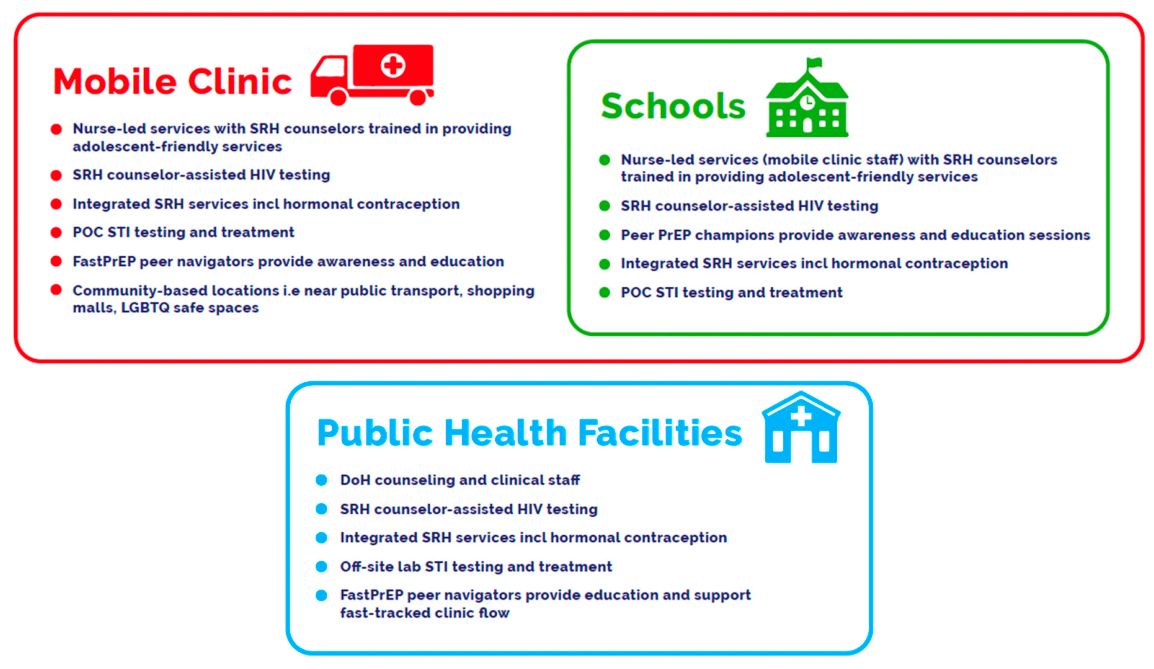
Young people could initiate PrEP from four community-based mobile clinics or 12 fixed-site government public health facilities in the Klipfontein Mitchells Plain health sub-district (Figure 1).
Figure 1.
Fast-PrEP project delivery platforms. Young people initiate PrEP within integrated SRH services from nurse-led community mobile clinics (which also provided services at select schools) and public health facilities with peer navigator support.
Mobile clinics (n = 4) provided oral PrEP as part of a nurse-led service staffed with SRH counsellors, peer navigators, and a driver. Peer navigators (trained lay young people aged 18–29 years) provided awareness and education on SRH, including PrEP, outside the mobile clinics. The nurses had medical clinician support available by telephone if needed. All staff working in the mobile clinics were trained in providing adolescent-friendly and gender-inclusive services. The mobile clinics provided point-of-care (POC) HIV and pregnancy testing; STI testing and treatment; and offered a range of hormonal contraception options (oral, injectable and implant). Services were provided in community settings, including public transport spaces, shopping malls, key population safe spaces and schools. At schools (n = 16), mobile clinic staff and peer PrEP champions first provided awareness and education sessions to students, followed by service provision on school premises. The Fast-PrEP mobile clinics’ schedule was posted weekly on social media.
Fixed-site public health facilities (n = 12) were each supported by two Fast-PrEP peer navigators (n = 24 total; aged 18–29 years) providing SRH and PrEP education [35], while the counselling and clinical staff were existing Department of Health (DoH) facility staff. Public health facilities offered a range of SRH, HIV, and antenatal care (ANC) services (full process described previously) [34] (Figure 1).
During the enrollment visit, AYP were informed of all the alternative delivery sites for their PrEP refills. A biometric tracking system was utilised to track participants’ usage of the different delivery sites from initiation and through all follow-up visits (described previously) [34].
2.3. Data Collection and Study Variables
The primary outcome was the PrEP initiation site, categorised as a mobile clinic (including school-based mobile services) or a fixed-site government public health facility. PrEP initiation was defined as receipt of a 28-day supply of oral PrEP tablets. Data were collected at the enrollment visit and managed using REDCap electronic data tools.
Candidate explanatory variables included sociodemographic, behavioural, clinical and PrEP-related characteristics. Demographic characteristics included age group (15–19, 20–24, 25–29, >29), sex, relationship status (married/single), and parental status (number of children). Behavioural characteristics included participants’ self-reported knowledge of a partner living with HIV (yes/no/do not know), engagement in casual sex in past month (yes/no), multiple concurrent sexual partners in the past month (yes/no), having a partner ≥ 10 years older or younger (yes/no/do not know), and whether participants believed their sexual partners had other partners (yes/no/do not know). Clinical characteristics included depressive symptoms, hazardous alcohol use, current STI symptoms (yes/no), having an STI or a partner with an STI in the past month yes/no), and pregnancy status for females. Depression and anxiety were measured with the PHQ-4 (the four-item Patient Health Questionnaire) [36,37] and dichotomised as showing no/mild (score of 0–5) or moderate/severe (score ≥ 6) signs of mental health concerns. Hazardous alcohol consumption was assessed using the AUDIT-C tool (Alcohol Use Disorder Identification Test–Concise) [38,39,40] and defined by a score of ≥3 for women or ≥4 for men. PrEP-related characteristics included prior PrEP use (yes/no), disclosure of intended PrEP use, and anticipated partner reaction to PrEP (positive/negative/unsure).
2.4. Statistical Analysis
Descriptive statistics were generated for three sets of baseline characteristics, including (1) sociodemographic and behavioural characteristics (including characteristics related to relationship dynamics); (2) clinical (including mental health) characteristics; and (3) PrEP-related characteristics. We hypothesised (based on previous literature on PrEP uptake) that factors related to these characteristics may influence the choice of PrEP initiation setting. Categorical variables were summarised using frequencies and percentages and compared between participants initiating PrEP at mobile clinics and fixed-site public health facilities using Pearson’s χ2 tests. To reflect sex-specific differences, these comparisons were performed separately among male and female participants. Continuous variables were summarised using means (standard deviations) and compared between service delivery platforms within each sex using Student’s t-tests.
Univariable logistic regression models were initially fitted to estimate the association between each characteristic and choice of PrEP initiation site. Variables were selected a priori based on clinical relevance and previous literature and entered simultaneously within each conceptual domain. Subsequently, multivariate logistic regression models were used to explore the relationship between each set of baseline characteristics (sociodemographic and behavioural, PrEP-related characteristics, and clinical characteristics) and PrEP initiation at a mobile clinic. Odds ratios (OR) and adjusted odds ratios (aOR) are presented with 95% confidence intervals (95% CI). Model fit was assessed using the Hosmer-Lemeshow goodness-of-fit test. Model discrimination was evaluated using the area under the receiver operating characteristic curve (AUC). Multicollinearity was assessed using variance inflation factors (VIF), with no evidence of problematic collinearity (mean VIF = 1.66 all VIFs < 3). To assess the potential impact of missing data, a sensitivity analysis using multiple imputations by chained equations was performed. The results were consistent with those of the complete-case analysis.
IBM SPSS Statistics Version 30.0.0.0 was used for all analyses. Missing data were handled using complete-case analysis for regression models.
3. Results
3.1. Demographic, Behavioural and Clinical Characteristics of Cohort Initiating PrEP
A total of 13,807 people initiated oral PrEP between August 2022 and December 2024. The cohort had a median age of 23 (21 years for AGYW and 28 years for IMP), with the majority (58.6%; n = 8092) between the ages of 15–24. Most were AGYW (58.5%; n = 8082) or IMP (36.3%; n = 5016); followed by men who have sex with men (MSM; n = 317, 2.3%) and pregnant people (n = 392, 2.8%). The cohort was mostly unmarried (94.4%), with about half having ≥1 child (46.2%; n = 5101). The four community-based mobile clinics were the PrEP initiation platform for 70.7% (n = 9760; with n = 259 (2.7%) initiations on public school grounds) compared to 29.3% (n = 4047) of people initiating across the 12 fixed-site public health facilities (Table 1).
Table 1.
Sociodemographic characteristics of cohort by PrEP initiation site.
Table 2 presents the behavioural, clinical and PrEP-related characteristics of the PrEP cohort among participants with available data for each measure. Among those with available data, 3.9% (n = 506) were in sero-different relationships (as high as 16.1% for men accessing public health facilities) and 5.3% (n = 689) were in age-disparate relationships. Most participants (59.7%; n = 7830) were unsure whether their primary sexual partner had other partners, and half (51.0%; n = 6691) did not know their partner’s serostatus. While 13.3% (n = 1039) of females were in multiple concurrent relationships, 36.7% (n = 1902) of all men (with as high as 43.6% of those attending public facilities; p < 0.001) had multiple partners in the past month. During the month before PrEP initiation, 30.4% (n = 1084) of men attending mobile clinics and 42.8% (n = 488) of men at public health facilities (p < 0.001) engaged in casual sex compared to 16.5% (n = 787) and 13.5% (n = 305), respectively, in the female cohort.
Table 2.
Behavioural and clinical characteristics of cohort at PrEP initiation, stratified by PrEP initiation site and gender.
Moderate-to-severe depressive symptoms were reported by 11.9% (n = 872) of participants attending mobile clinics and 2.6% (n = 66) of those attending public facilities. Across PrEP delivery sites, more than half (57%; n = 4602) of men and women displayed hazardous alcohol use levels. Among participants with available STI-related data, 8.5% (n = 1110; and as high as 22.5% of men at public health facilities; p < 0.001) reported that they or a sex partner had an STI in the past month, and 10.4% (n = 1078) displayed symptoms of an STI at the PrEP initiation visit (28.3% of men at public health facilities; p < 0.001).
The majority of the cohort was PrEP-naïve, with only 17.3% (n = 2336) having used PrEP prior to enrolment into Fast-PrEP. However, 41.4% (n = 3357) of participants for whom data were available indicated that they had disclosed their intention to start using PrEP to someone. While 54.6% predicted that their sex partner would have a positive reaction to their PrEP use, 38.2% were unsure what their partner’s reaction would be, and 7.2% expected a negative reaction (Table 2).
3.2. Sociodemographic, Behavioural and Clinical Characteristics Associated with PrEP Service Delivery Platform Choice
When comparing people who initiated PrEP from a community-based mobile clinic with those who initiated PrEP at government public health facilities (Table 3), those at the mobile clinic were significantly more likely to be older than 15–19 years, and less likely to have a child (aOR 0.560, 95% CI: 0.55 to 0.66, p < 0.001) or be single (unmarried) (aOR 0.746, 95% CI: 0.60 to 0.92, p = 0.007). Females were less likely to initiate PrEP at a mobile clinic (aOR: 0.696, 95% CI: 0.62 to 0.78, p < 0.001). People in a known HIV sero-different relationship (aOR 0.276, 95% CI: 0.22 to 0.34, p < 0.001) were less likely to initiate PrEP at the mobile clinic, while people who were unsure of their partner’s HIV status were more likely to use this platform (aOR 1.417, 95% CI: 1.30 to 1.55, p < 0.001). Neither participants nor their sex partners having other sex partners or having casual sex in the past month was significantly associated with PrEP service delivery platform engagement.
Table 3.
Sociodemographic, behavioural, and clinical characteristics associated with PrEP initiation at a mobile clinic vs. public health facilities: univariate and multivariate analyses.
Participants currently showing symptoms of an STI or whose primary sex partners had an STI in the past month were significantly associated with lower odds of initiating PrEP at a mobile clinic for both male (aOR 0.278, 95% CI: 0.22 to 0.36, p < 0.001; aOR 0.585, 95% CI: 0.43 to 0.79, p < 0.001) and female participants (aOR 0.732, 95% CI: 0.55 to 0.97, p = 0.030; aOR 0.634, 95% CI: 0.46 to 0.88, p = 0.006).
Both men and women initiating PrEP at the mobile clinic had four times the odds of having symptoms of moderate-to-severe depression (aOR 3.892, 95% CI: 2.44 to 6.22, p < 0.001; and aOR 4.102, 95% CI: 2.56 to 6.57, p < 0.001, respectively). Pregnant women were significantly less likely to initiate PrEP from a community-based mobile clinic compared to a fixed-site public health clinic (aOR 0.089, 95% CI: 0.05 to 0.15, p < 0.001). Hazardous alcohol use was not significantly associated with PrEP initiation location.
People accessing PrEP from the mobile clinic were more likely to be unsure of their partner’s reaction to their PrEP use (aOR 1.863, 95% CI: 1.62 to 2.14, p < 0.001) or predict that their partner would have a positive reaction (aOR 4.528, 95% CI: 3.94 to 5.20, p < 0.001) compared to a negative partner reaction. Previous PrEP experience was not significantly associated with the PrEP service delivery platform (aOR 1.085, 95% CI: 0.98 to 1.21, p = 0.126).
4. Discussion
The Fast-PrEP phase 4 programme in South Africa attracted a diverse group of adolescents and young people and corroborates the benefit of a differentiated HIV prevention delivery service to ensure greater coverage of populations who can benefit from PrEP. This has also been shown in other models [17,41,42]. While participants were allowed to self-determine whether PrEP was appropriate for them, most reported multiple factors associated with HIV acquisition, including having multiple concurrent sex partners, casual sex partners, not knowing sex partners’ HIV status, and/or hazardous alcohol use.
AYP in our study showed a strong preference for community-based HIV prevention services (70.7% of the Fast-PrEP cohort initiated at mobile clinics), similar to studies conducted across southern Africa, emphasising the need for accessibility and service location autonomy [21,25,33,43]. People accessing community-based services, including mobile clinics, expect to receive youth-friendly, non-judgmental, and flexible services [21,25,44]. Our study showed that young people accessing mobile clinics appropriately identified themselves as candidates for PrEP and were more likely to be unsure of their partners’ HIV status. Men (intimate male partners) were more likely to initiate PrEP at mobile clinics compared to public facilities, which confirms the limited qualitative research on this population’s PrEP uptake facilitators [45,46]. In addition, young people accessing PrEP from a mobile clinic were also more likely to predict that their partners would be supportive of their PrEP use (i.e., expecting less stigma for service attendance and PrEP initiation). Interestingly, young people seeking out community-based mobile clinics were four times more likely to have symptoms of moderate-to-severe depression. In South Africa, there is a high burden of depression among young people seeking SRH services [47]. Previous research has shown that help-seeking behaviour among adolescents and young people with depressive symptoms is influenced by perceived service accessibility and ease of access to care providers, short waiting times, and support from peers, and it is notable that they found the community-based, mobile services to be more accessible than public sector clinics in this programme [48,49].
Young people with more complex healthcare needs beyond SRH, such as those who were pregnant or had children, were in known HIV sero-different relationships, had STI symptoms, or recently had an STI in their relationship (themselves or their partner), opted to initiate PrEP in public health facilities. While evidence to support a preference for government public health facilities is limited, some participants in studies from South Africa and Namibia appreciated the professional oversight, infrastructure, integration and access to other services [44,50,51]. Participants’ previous or co-morbid conditions may have meant they had already accessed the public sector service, facilitating re-engagement for prevention services. The candidacy framework [52] (used previously in South African contexts [53,54,55]) recognises that perceived eligibility (candidacy) for an intervention or service is shaped by social and contextual factors. First, a person determines whether they are a good candidate for an intervention (i.e., PrEP), then decides where to go (community or public health facility) based on their past experiences and the service’s signals about who is a good candidate for that delivery platform [52]. A similar pattern emerged in our study. Pregnant people and mothers were more likely to access public health facilities, underscoring the need to prioritise targeted PrEP engagement in antenatal, postnatal and early childhood care services [23,56,57,58,59,60].
Our results indicated that the choice of PrEP service delivery location was influenced by clinical characteristics and perceived health needs rather than prior PrEP use experience. In summary, we found that the majority of AYP initiating oral PrEP from mobile clinics were driven by general SRH needs, while AYP with other healthcare needs beyond SRH initiated PrEP at public health facilities. Of note, our study demonstrated that more than half of participants displayed hazardous alcohol consumption (even though it was not significantly associated with a specific PrEP delivery site). Alcohol use may contribute to HIV acquisition and may undermine PrEP use (including delayed refill visits) [61,62,63,64]. It is important that places where PrEP is offered incorporate screening and brief counselling, and long-acting PrEP formulations to support this key population who typically avoid healthcare systems or struggle to effectively use these interventions [61,65,66].
The strength of our study is the large cohort of young people initiating PrEP in a real-world setting that simulated a free, government service with no study-specific reimbursement offered, allowing identification of factors associated with PrEP service delivery platform choice not previously assessed at scale and outside of a controlled study setting. However, the PrEP delivery setting might have been biased geographically by proximity of services to young people with mobile clinics available near schools, malls and major transport hubs. While the public health facilities in this study provided enhanced adolescent-friendly services through the availability of peer navigators, this is not the reality in other government facilities. Given the large sample size, even relatively modest associations may achieve statistical significance. Therefore, the findings should be interpreted based on the magnitude and precision of the adjusted odds ratios, rather than statistical significance alone. Furthermore, because this was a cross-sectional analysis, the reported associations should not be interpreted as causal relationships. Residual confounding and unmeasured factors may have influenced the observed associations despite adjustment for measured covariates. A further limitation of this study was that several of the behavioural and clinical variables, including PHQ-4 and AUDIT-C measures, had substantial and differential missingness across service delivery platforms (for the first year of study implementation, these scales were only administered to every 4th participant), which may have influenced the magnitude of observed associations. Further, while the study initiated a large cohort of young people, these findings may not be generalisable beyond high-density peri-urban settings in South Africa.
5. Conclusions
Most adolescents and young people prefer and use community-based PrEP delivery that is easily accessible from mobile clinics and public schools. Our study also showed the benefit of providing PrEP delivery platform choice and integrated SRH services to reach a greater diversity of populations that may benefit from a variety of prevention needs, including HIV, and demonstrated how young people continuously assess the perceived accessibility and appropriateness of healthcare systems (delivery platforms) for their needs. Sometimes this goes beyond HIV prevention, highlighting the importance of integrated health delivery and ensuring that demand generation for PrEP services highlights the availability of other health interventions as well. Ultimately, service delivery models that include both community-based and public health fixed facility platforms may be needed to provide PrEP (including newer longer-acting methods) at scale to all young people who may benefit from HIV prevention.
Author Contributions
E.R., L.-G.B. and M.W. conceptualised the project. Methodology, E.R., K.L. and C.B. Software: K.L., L.M. and C.B. Data curation, K.L. and L.M. Formal analysis was conducted by C.B. and validated by D.J.D. Investigation: P.M. and O.V., E.R. wrote the original draft of the manuscript. All co-authors listed (C.B., K.L., L.M., N.M., F.B., P.M., C.P., O.V., L.F., D.J.D., C.C., M.W. and L.-G.B.) reviewed and edited the manuscript. Supervision: L.-G.B. Project administration, E.R. and N.M. Funding acquisition, E.R. and L.-G.B. All authors have read and agreed to the published version of the manuscript.
Funding
This programme was funded by the Bill and Melinda Gates Foundation (Grant number INV-033649). We also thank Cepheid, South Africa, for the generous loan of GeneXpert machines, the National Dept of Health and the health departments of the Western Cape and the City of Cape Town for their support and commodities.
Institutional Review Board Statement
The study was conducted in accordance with the Declaration of Helsinki, and approved by the Human Research Ethics Committee (HREC REF# 713/2021, 8 February 2022) from the University of Cape Town, as well as the City of Cape Town Department of Health (#9522, 5 April 2022), and the Department of Basic Education (#20220609-2975, 9 June 2022).
Informed Consent Statement
Participation in the project is voluntary. Participants are asked to provide digital informed consent for data collection, and parental waiver of consent to participate has been approved for adolescents aged 15–17.
Data Availability Statement
Data are available from the corresponding author upon reasonable request.
Acknowledgments
We acknowledge and thank the entire Fast-PrEP team, including the nurses, counsellors, peer navigators and drivers.
Conflicts of Interest
The authors declare no competing interests.
References
- UNAIDS. The Urgency of Now: AIDS at a Crossroads—2024 Global AIDS Update. 2024. Available online: https://www.unaids.org/sites/default/files/media_asset/2024-unaids-global-aids-update_en.pdf (accessed on 13 May 2025).
- GBD 2021 HIV Collaborators. Global, regional, and national burden of HIV/AIDS, 1990–2021, and forecasts to 2050, for 204 countries and territories: The Global Burden of Disease Study 2021. Lancet HIV 2024, 11, e807–e822. [Google Scholar] [CrossRef] [Scilit] [PubMed]
- Kavanagh, M.; Katz, I.; Sharp, A.; Dubula, V.; Srivatsan, V.; Warren, M. HIV Pre-Exposure Prophylaxis Policies Worldwide. In Proceedings of the IAS2024, Munich, Germany, 22–26 July 2024. [Google Scholar]
- Allison, B.A.; Widman, L.; Stewart, J.; Evans, R.; Perry, M. Adherence to pre-exposure prophylaxis in adolescents and young adults: A systematic review and meta-analysis. J. Adolesc. Health 2022, 70, 28–41. [Google Scholar] [CrossRef] [Scilit] [PubMed]
- Zhang, J.; Li, C.; Xu, J.; Hu, Z.; E Rutstein, S.; Tucker, J.D.; Ong, J.J.; Jiang, Y.; Geng, W.; Wright, S.T.; et al. Discontinuation, suboptimal adherence, and reinitiation of oral HIV pre-exposure prophylaxis: A global systematic review and meta-analysis. Lancet HIV 2022, 9, e254–e268. [Google Scholar] [CrossRef] [Scilit] [PubMed]
- The Global PrEP Tracker: PrEP in South Africa. 2025. Available online: https://data.prepwatch.org/ (accessed on 13 May 2025).
- Turning the Tide—SA HIV Survey Shows Encouraging Trends in Prevalence, Prevention and Treatment. 2024. Available online: https://hsrc.ac.za/press-releases/sabssm/turning-the-tide-sa-hiv-survey-shows-encouraging-trends-in-prevalence-prevention-and-treatment/ (accessed on 13 May 2025).
- Jackson-Gibson, M.; Ezema, A.U.; Orero, W.; Were, I.; Ohiomoba, R.O.; Mbullo, P.O.; Hirschhorn, L.R. Facilitators and barriers to HIV pre-exposure prophylaxis (PrEP) uptake through a community-based intervention strategy among adolescent girls and young women in Seme Sub-County, Kisumu, Kenya. BMC Public Health 2021, 21, 1284. [Google Scholar] [CrossRef] [Scilit] [PubMed]
- Stoebenau, K.; Muchanga, G.; Ahmad, S.S.-O.; Bwalya, C.; Mwale, M.; Toussaint, S.; Maambo, C.; Peters, C.J.; Baumhart, C.; Mwango, L.K.; et al. Barriers and facilitators to uptake and persistence on prep among key populations in Southern Province, Zambia: A thematic analysis. BMC Public Health 2024, 24, 1617. [Google Scholar] [CrossRef] [Scilit] [PubMed]
- Pillay, D.; Stankevitz, K.; Lanham, M.; Ridgeway, K.; Murire, M.; Briedenhann, E.; Jenkins, S.; Subedar, H.; Hoke, T.; Mullick, S. Factors influencing uptake, continuation, and discontinuation of oral PrEP among clients at sex worker and MSM facilities in South Africa. PLoS ONE 2020, 15, e0228620. [Google Scholar] [CrossRef] [Scilit] [PubMed]
- Gombe, M.M.; Cakouros, B.E.; Ncube, G.; Zwangobani, N.; Mareke, P.; Mkwamba, A.; Prescott, M.R.; Bhatasara, T.; Murwira, M.; Mangwiro, A.Z.; et al. Key barriers and enablers associated with uptake and continuation of oral pre-exposure prophylaxis (PrEP) in the public sector in Zimbabwe: Qualitative perspectives of general population clients at high risk for HIV. PLoS ONE 2020, 15, e0227632. [Google Scholar] [CrossRef] [Scilit] [PubMed]
- Mapetla, K.S.; Mokgatle, M.M.; Oguntibeju, O.O. Barriers and facilitators influencing the uptake and acceptability of HIV pre-exposure prophylaxis amongst commercial female sex workers in Tshwane district, Gauteng province: A descriptive study. Int. J. Innov. Res. Sci. Stud. 2023, 6, 753–761. [Google Scholar] [CrossRef] [Scilit]
- O’MAlley, G.; Beima-Sofie, K.M.; Roche, S.D.; Rousseau, E.; Travill, D.; Omollo, V.; Delany-Moretlwe, S.; Bekker, L.-G.; Bukusi, E.A.; Kinuthia, J.; et al. Health care providers as agents of change: Integrating PrEP with other sexual and reproductive health services for adolescent girls and young women. Front. Reprod. Health 2021, 19, 668672. [Google Scholar]
- Rousseau, E.; Katz, A.W.K.; O’rOurke, S.; Bekker, L.-G.; Delany-Moretlwe, S.; Bukusi, E.; Travill, D.; Omollo, V.; Morton, J.F.; O’mAlley, G.; et al. Adolescent girls and young women’s PrEP-user journey during an implementation science study in South Africa and Kenya. PLoS ONE 2021, 16, e0258542. [Google Scholar] [CrossRef] [Scilit] [PubMed]
- Cassidy, T.; Ntuli, N.; Kilani, C.; Malabi, N.; Rorwana, B.; Mutseyekwa, T.; O’Connell, R.; Steele, S.J.; Ndlovu, Z.; Ellman, T.; et al. Delivering PrEP to Young Women in a Low-Income Setting in South Africa: Lessons for Providing Both Convenience and Support. AIDS Behav. 2022, 26, 147–159. [Google Scholar] [PubMed]
- Alashek, W.; Elgares, M. Challenges to PrEP use in adolescent girls young women in Sub-Saharan Africa: A systematic review of qualitative studies. J. HIV/AIDS Soc. Serv. 2024, 22, 16–50. [Google Scholar]
- Differentiated and Simplified Pre-Exposure Prophylaxis for HIV Prevention: Update to WHO Implementation Guidance. 2022. Available online: https://www.who.int/publications/i/item/9789240053694 (accessed on 13 May 2025).
- WHO. Integrated People-Centred Care. 2023. Available online: https://www.who.int/health-topics/integrated-people-centered-care#tab=tab_1 (accessed on 13 May 2025).
- Celum, C.; Baeten, J. PrEP for HIV prevention: Evidence, global scale-up, and emerging options. Cell Host Microbe 2020, 27, 502–506. [Google Scholar] [CrossRef] [Scilit] [PubMed]
- Irungu, E.; Khoza, N.; Velloza, J. Multi-level Interventions to Promote Oral Pre-exposure Prophylaxis Use Among Adolescent Girls and Young Women: A Review of Recent Research. Curr. HIV/AIDS Rep. 2021, 18, 490–499. [Google Scholar] [CrossRef] [Scilit] [PubMed]
- Rousseau, E.; Julies, R.F.; Madubela, N.; Kassim, S. Novel platforms for biomedical HIV prevention delivery to key populations—Community mobile clinics, peer-supported, pharmacy-led PrEP delivery, and the use of telemedicine. Curr. HIV/AIDS Rep. 2021, 18, 500–507. [Google Scholar] [CrossRef] [Scilit] [PubMed]
- Pintye, J.; Davey, D.L.J.; Wagner, A.D.; John-Stewart, G.; Baggaley, R.; Bekker, L.-G.; Celum, C.; Chi, B.H.; Coates, T.J.; Groves, A.K.; et al. Defining gaps in pre-exposure prophylaxis delivery for pregnant and post-partum women in high-burden settings using an implementation science framework. Lancet HIV 2020, 7, e582–e592. [Google Scholar] [CrossRef] [Scilit] [PubMed]
- Davey, D.L.J.; Mvududu, R.; Mashele, N.; Bheemraj, K.; Khadka, N.; Johnson, L.F.; Dean, S.S.; Gorbach, P.; Bekker, L.-G.; Coates, T.J.; et al. Initiation and continued use of oral pre-exposure prophylaxis among pregnant and postpartum women in South Africa (PrEP-PP): A demonstration cohort study. Lancet HIV 2024, 11, e746–e755. [Google Scholar] [CrossRef] [Scilit] [PubMed]
- de Vos, L.; Mussa, A.; Rousseau, E.; Strauss, M.; George, G.; Vundhla, P.; Gebengu, A.; Tsuaneng, M.; Tamuthiba, L.; Tumagole, A.; et al. Preferences for Service Delivery for Long-acting Pre-exposure Prophylaxis for HIV Infection among Pregnant and Breastfeeding Women in South Africa and Botswana. AIDS Behav. 2024, 29, 2963–2975. [Google Scholar] [CrossRef] [Scilit] [PubMed]
- Rousseau, E.; Bekker, L.-G.; Julies, R.F.; Celum, C.; Morton, J.; Johnson, R.; Baeten, J.M.; O’mAlley, G. A community-based mobile clinic model delivering PrEP for HIV prevention to adolescent girls and young women in Cape Town, South Africa. BMC Health Serv. Res. 2022, 21, 888. [Google Scholar]
- Naidoo, N.P.; Mthimkulu, N.; Jama, N.; Chidumwa, G.; Chabalala, B.; Mhakakora, T.; Parmley, L.; Mullick, S. Community PrEP delivery for adolescent girls and young women: Insights from the DREAMS PrEP Choice Study in Johannesburg, South Africa. Front. Reprod. Health 2025, 7, 1474067. [Google Scholar] [CrossRef] [Scilit] [PubMed]
- Nakambale, H.N.; Roche, S.D.; Mogere, P.; Omollo, V.; Kuo, A.P.; Stergachis, A.; Baeten, J.M.; Bukusi, E.; Ngure, K.; Mugambi, M.L.; et al. Barriers to and strategies for early implementation of pharmacy-delivered HIV PrEP services in Kenya: An analysis of routine data. Front. Reprod. Health 2023, 5, 1023568. [Google Scholar] [CrossRef] [Scilit] [PubMed]
- Kiptinness, C.; Kuo, A.P.; Reedy, A.M.; Johnson, C.C.; Ngure, K.; Wagner, A.D.; Ortblad, K.F. Examining the Use of HIV Self-Testing to Support PrEP Delivery: A Systematic Literature Review. Curr. HIV/AIDS Rep. 2022, 19, 394–408. [Google Scholar] [CrossRef] [Scilit] [PubMed]
- Nakalega, R.; Mukiza, N.; Menge, R.; Kizito, S.; Babirye, J.A.; Kuteesa, C.N.; Mawanda, D.; Mulumba, E.; Nabukeera, J.; Ggita, J.; et al. Feasibility and acceptability of peer-delivered HIV self-testing and PrEP for young women in Kampala, Uganda. BMC Public Health 2023, 23, 1163. [Google Scholar] [CrossRef] [Scilit] [PubMed]
- Shahmanesh, M.; Okesola, N.; Chimbindi, N.; Zuma, T.; Mdluli, S.; Mthiyane, N.; Adeagbo, O.; Dreyer, J.; Herbst, C.; McGrath, N.; et al. Thetha Nami: Participatory development of a peer-navigator intervention to deliver biosocial HIV prevention for adolescents and youth in rural South Africa. BMC Public Health 2021, 21, 1393. [Google Scholar] [CrossRef] [Scilit] [PubMed]
- Rousseau, E.; Bennin, F.; Bekker, L.-G. Effective preexposure prophylaxis in young women and girls, a key population for HIV prevention. Curr. Opin. HIV AIDS 2024, 19, 287–292. [Google Scholar] [CrossRef] [Scilit] [PubMed]
- Butler, V.; Kutywayo, A.; Martin, C.E.; Pleaner, M.; Mojapele, M.V.; Ncube, S.; Fipaza, Z.; Mundeta, B.; Mullick, S. Implementing differentiated and integrated HIV prevention services for adolescent girls and young women: Experiences from oral PrEP rollout in primary care services in South Africa. J. Adolesc. Health 2023, 73, S58–S66. [Google Scholar] [CrossRef] [Scilit] [PubMed]
- Ramraj, T.; Chirinda, W.; Jonas, K.; Govindasamy, D.; Jama, N.; Appollis, T.M.; Zani, B.; Mukumbang, F.C.; Basera, W.; Hlongwa, M.; et al. Service delivery models that promote linkages to PrEP for adolescent girls and young women and men in sub-Saharan Africa: A scoping review. BMJ Open 2023, 13, e061503. [Google Scholar] [CrossRef] [Scilit] [PubMed]
- Rousseau, E.; Davey, D.; Fynn, L.; Wallace, M.; Macdonald, P.; Pike, C.; Mathola, N.; Little, F.; Lebelo, K.; Bekker, L. FastPrEP: A protocol to evaluate uptake, coverage, and effectiveness of a youth-focused, decentralised and differentiated district-wide HIV pre-exposure prophylaxis program. BMC Public Health 2025, 25, 3714. [Google Scholar] [CrossRef] [Scilit] [PubMed]
- Coakley, C.; Vundhla, P.; Toska, E.; Fynn, L.; Rousseau, E.; Bekker, L.-G. Peer navigators in PrEP implementation: Barriers and facilitators among adolescent girls and young women in South African primary healthcare facilities. VeriXiv 2026, 3, 132. [Google Scholar]
- Kroenke, K.; Spitzer, R.L.; Williams, J.B.; Löwe, B. An ultra-brief screening scale for anxiety and depression: The PHQ–4. Psychosomatics 2009, 50, 613–621. [Google Scholar] [CrossRef] [Scilit] [PubMed]
- Stockton, M.A.; Mazinyo, E.W.; Mlanjeni, L.; Sweetland, A.C.; Scharf, J.Y.; Nogemane, K.; Ngcelwane, N.; Basaraba, C.; Bezuidenhout, C.; Sansbury, G.; et al. Validation of screening instruments for common mental disorders and suicide risk in south African primary care settings. J. Affect. Disord. 2024, 362, 161–168. [Google Scholar] [CrossRef] [Scilit] [PubMed]
- Bush, K.; Kivlahan, D.R.; McDonell, M.B.; Fihn, S.D.; Bradley, K.A. The AUDIT alcohol consumption questions (AUDIT-C): An effective brief screening test for problem drinking. Arch. Intern. Med. 1998, 158, 1789–1795. [Google Scholar] [CrossRef] [Scilit] [PubMed]
- Stockton, M.A.; Mazinyo, E.W.; Mlanjeni, L.; Ngcelwane, N.; Nogemane, K.; Nobatyi, P.; Sweetland, A.C.; Basaraba, C.; Greene, M.; Bezuidenhout, C.; et al. Validation of screening instruments for alcohol and substance use disorders among men and women in Eastern Cape, South Africa. Drug Alcohol Depend. 2025, 268, 112559. [Google Scholar] [CrossRef] [Scilit] [PubMed]
- Bhana, A.; Mntambo, N.; Gigaba, S.G.; Luvuno, Z.P.B.; Grant, M.; Ackerman, D.; Ntswe, E.; Nomathemba, M.; Petersen, I. Validation of a brief mental health screening tool for common mental disorders in primary healthcare. S. Afr. Med. J. 2019, 109, 278–283. [Google Scholar] [CrossRef] [Scilit] [PubMed]
- Grimsrud, A.; Bygrave, H.; Doherty, M.; Ehrenkranz, P.; Ellman, T.; Ferris, R.; Ford, N.; Killingo, B.; Mabote, L.; Mansell, T.; et al. Reimagining HIV service delivery: The role of differentiated care from prevention to suppression. J. Int. AIDS Soc. 2016, 19, 21484. [Google Scholar] [CrossRef] [Scilit] [PubMed]
- Grimsrud, A.; Wilkinson, L.; Delany-Moretlwe, S.; Ehrenkranz, P.; Green, K.; Murenga, M.; Ngure, K.; Otwoma, N.J.; Phanuphak, N.; Vandevelde, W.; et al. The importance of the “how”: The case for differentiated service delivery of long-acting and extended delivery regimens for HIV prevention and treatment. J. Int. AIDS Soc. 2023, 26, e26095. [Google Scholar] [CrossRef] [Scilit] [PubMed]
- Nicol, E.; Basera, W.; Turawa, E.; Lombard, C.; Funani, N.; Chavhalala, D.; the SHeS’Cap-PrEP Group. Assessing PrEP initiation and adherence among high-risk, sexually active adolescents and young adults: A population-based prospective study across diverse service delivery models in a high HIV prevalent district in South Africa. AIDS Behav. 2025, 29, 2588–2609. [Google Scholar] [CrossRef] [Scilit] [PubMed]
- Mathole, T.; Nicol, J.U.; Hlongwa, M.; Turawa, E.; Basera, W.; Funani, N.; Nicol, E. A primary health care Re-Engineering approach to enhance PrEP initiation and adherence among high-risk, sexually active adolescents and young adults in KwaZulu-Natal, South Africa. BMC Public Health 2025, 25, 4308. [Google Scholar] [CrossRef] [Scilit] [PubMed]
- Smith, P.J.; Daniels, J.; Bekker, L.-G.; Medina-Marino, A. What motivated men to start PrEP? A cross-section of men starting PrEP in Buffalo city municipality, South Africa. BMC Public Health 2023, 23, 418. [Google Scholar] [CrossRef] [Scilit] [PubMed]
- Smith, P.J.; Daniels, J.; Bekker, L.-G.; Medina-Marino, A. Motivations and Barriers to Sustained PrEP Use Among Men in Buffalo City Metro, South Africa: A Qualitative Study. AIDS Behav. 2026, 1–10. [Google Scholar] [CrossRef] [Scilit] [PubMed]
- Gordon, K.J.; Martin, C.E.; Kutywayo, A.; Cox, L.A.; Nongena, P.; Mullick, S. Mental health needs of adolescent and young adult PrEP users in South Africa: Implications for sexual and reproductive health programming. J. Adolesc. Health 2023, 73, S73–S80. [Google Scholar] [CrossRef] [Scilit] [PubMed]
- Eigenhuis, E.; Waumans, R.C.; Muntingh, A.D.T.; Westerman, M.J.; van Meijel, M.; Batelaan, N.M.; van Balkom, A.J.L.M. Facilitating factors and barriers in help-seeking behaviour in adolescents and young adults with depressive symptoms: A qualitative study. PLoS ONE 2021, 16, e0247516. [Google Scholar] [CrossRef] [Scilit] [PubMed]
- Waumans, R.C.; Muntingh, A.D.T.; Veldwijk, J.; Hoogendoorn, A.W.; van Balkom, A.J.L.M.; Batelaan, N.M. Treatment preferences of adolescents and young adults with depressive symptoms: A discrete choice experiment. Appl. Health Econ. Health Policy 2024, 22, 401–413. [Google Scholar] [CrossRef] [Scilit] [PubMed]
- Mataboge, P.; Nzenze, S.; Mthimkhulu, N.; Mazibuko, M.; Kutywayo, A.; Butler, V.; Naidoo, N.; Mullick, S. Planning for decentralized, simplified prEP: Learnings from potential end users in Ga-Rankuwa, gauteng, South Africa. Front. Reprod. Health 2023, 4, 1081049. [Google Scholar] [CrossRef] [Scilit] [PubMed]
- Barnabee, G.; Billah, I.; Ndeikemona, L.; Silas, L.; Ensminger, A.; MacLachlan, E.; Korn, A.K.; Mawire, S.; Fischer-Walker, C.; Ashipala, L.; et al. PrEP uptake and early persistence among adolescent girls and young women receiving services via community and hybrid community-clinic models in Namibia. PLoS ONE 2023, 18, e0289353. [Google Scholar] [CrossRef] [Scilit] [PubMed]
- Dixon-Woods, M.; Cavers, D.; Agarwal, S.; Annandale, E.; Arthur, A.; Harvey, J.; Hsu, R.; Katbamna, S.; Olsen, R.; Smith, L.; et al. Conducting a critical interpretive synthesis of the literature on access to healthcare by vulnerable groups. BMC Med. Res. Methodol. 2006, 6, 35. [Google Scholar] [CrossRef] [Scilit] [PubMed]
- Nkosi, B.; Seeley, J.; Ngwenya, N.; Mchunu, S.L.; Gumede, D.; Ferguson, J.; Doyle, A.M. Exploring adolescents and young people’s candidacy for utilising health services in a rural district, South Africa. BMC Health Serv. Res. 2019, 19, 195. [Google Scholar] [CrossRef] [Scilit] [PubMed]
- Adeagbo, O.; Herbst, C.; Blandford, A.; McKendry, R.; Estcourt, C.; Seeley, J.; Shahmanesh, M. Exploring people’s candidacy for mobile health–supported HIV testing and care services in rural KwaZulu-Natal, South Africa: Qualitative study. J. Med. Internet Res. 2019, 21, e15681. [Google Scholar] [CrossRef] [Scilit] [PubMed]
- Gumede, N.A.; Hlongwane, S.; Nxumalo, V.; Gumede, D.; Shahmanesh, M.; Seeley, J.; Harling, G. Finding knowledge: How youth identify their candidacy and sources of information regarding sexual and reproductive health in rural KwaZulu-Natal. South Africa. BMC Public Health 2025, 25, 1422. [Google Scholar] [CrossRef] [Scilit] [PubMed]
- Nelson, A.; Bheemraj, K.; Dean, S.S.; de Voux, A.; Hlatshwayo, L.; Mvududu, R.; Berkowitz, N.; Neumuller, C.; Jacobs, S.; Fourie, S.; et al. Integration of HIV pre-exposure prophylaxis (PrEP) services for pregnant and breastfeeding women in eight primary care clinics: Results of an implementation science study. BMC Glob. Public Health 2024, 2, 57. [Google Scholar] [CrossRef] [Scilit] [PubMed]
- Chen-Charles, J.; Davey, D.J.; Rousseau, E.; Little, F.; Toska, E.; Mathola, N.; Macdonald, P.; Vanto, O.; Wallace, M.; Bekker, L.-G. Oral PrEP use among pregnant or parenting young women in South Africa: Evidence from a large community-based implementation study. BMC Public Health 2026, 26, 927. [Google Scholar] [CrossRef] [Scilit] [PubMed]
- Atukunda, E.C.; Owembabazi, M.; Pratt, M.C.; Psaros, C.; Muyindike, W.; Chitneni, P.; Bwana, M.B.; Bangsberg, D.; Haberer, J.E.; Marrazzo, J.; et al. A qualitative exploration to understand barriers and facilitators to daily oral PrEP uptake and sustained adherence among HIV-negative women planning for or with pregnancy in rural Southwestern Uganda. J. Int. AIDS Soc. 2022, 5, e25894. [Google Scholar] [CrossRef] [Scilit] [PubMed]
- Moran, A.; Mashele, N.; Mvududu, R.; Gorbach, P.; Bekker, L.-G.; Coates, T.J.; Myer, L.; Davey, D.J. Maternal PrEP use in HIV-uninfected pregnant women in South Africa: Role of stigma in PrEP initiation, retention and adherence. AIDS Behav. 2022, 26, 205–217. [Google Scholar] [CrossRef] [Scilit] [PubMed]
- Pintye, J.R.; Kinuthia, J.M.; Roberts, D.A.B.; Wagner, A.D.; Mugwanya, K.M.; Abuna, F.B.; Lagat, H.B.; Owiti, G.B.; Levin, C.E.; Barnabas, R.V.; et al. Integration of PrEP services into routine antenatal and postnatal care: Experiences from an implementation program in Western Kenya. J. Acquir. Immune Defic. Syndr. 2018, 79, 590–595. [Google Scholar] [CrossRef] [Scilit] [PubMed]
- Hasan, M.R.; Muna, M.A.; Rahman, S. Impact of Hazardous Alcohol Use on Pre-Exposure Prophylaxis Adherence: A Meta-Analysis of Biological and Psychological Pathways. J. Clin. Pract. Med. Res. 2025, 1, 67–76. [Google Scholar] [CrossRef] [Scilit] [PubMed]
- Avanceña, A.L.; Okoye, G.; Yokananth, R.; Norwood, A.; Schnarrs, P.W.; Barner, J.C. Alcohol Use Disorder Diagnoses and HIV Preexposure Prophylaxis Adherence and Continuation: A Retrospective Cohort Study. J. General. Intern. Med. 2026, 1–10. [Google Scholar] [CrossRef] [Scilit] [PubMed]
- Schneider, M.; Chersich, M.; Temmerman, M.; Degomme, O.; Parry, C.D. The impact of alcohol on HIV prevention and treatment for South Africans in primary healthcare. Curationis 2014, 37, 1–8. [Google Scholar] [CrossRef] [Scilit] [PubMed]
- Scott, V.; Schaay, N.; Schneider, H.; Sanders, D. Addressing social determinants of health in South Africa: The journey continues. S. Afr. Health Rev. 2017, 1, 77–87. [Google Scholar]
- Castle, A.C.; Busang, J.; Dreyer, J.; Herbst, C.; Okesola, N.; Chimbindi, N.; Zuma, T.; Jarolimova, J.; Hahn, J.A.; Psaros, C.; et al. Alcohol Use and the Pre-exposure Prophylaxis Continuum of Care Among Men in Rural South Africa: Results from a Longitudinal Study. AIDS Behav. 2025, 29, 2312–2323. [Google Scholar] [CrossRef] [Scilit] [PubMed]
- Miller, A.P.; Shoptaw, S.; Moucheraud, C.M.; Mvududu, R.; Essack, Z.; Gorbach, P.M.D.; Myer, L.; Davey, D.L.J. Recent alcohol use is associated with increased pre-exposure prophylaxis (PrEP) continuation and adherence among pregnant and postpartum women in South Africa. JAIDS J. Acquir. Immune Defic. Syndr. 2023, 92, 204–211. [Google Scholar] [CrossRef] [Scilit] [PubMed]

Disclaimer/Publisher’s Note: The statements, opinions and data contained in all publications are solely those of the individual author(s) and contributor(s) and not of MDPI and/or the editor(s). MDPI and/or the editor(s) disclaim responsibility for any injury to people or property resulting from any ideas, methods, instructions or products referred to in the content. |
© 2026 by the authors. Licensee MDPI, Basel, Switzerland. This article is an open access article distributed under the terms and conditions of the Creative Commons Attribution (CC BY) license.