


Highlights
Public health relevance—How does this work relate to a public health issue?
- The COVID-19 pandemic magnified and exacerbated already existing health inequities.
- Utilizing learnings from pandemic responses to COVID-19 could help mitigate further health inequities in the face of future crises.
Public health significance—Why is this work of significance to public health?
- Long-term care in Canada was a sector that was disproportionately affected by COVID-19, providing an opportunity for learning and for mitigating health disparities in future pandemics.
- This project employed an integrated knowledge translation (iKT) approach utilizing expert and lived experience to co-create best practices for managing future pandemics/epidemics in the LTC sector, strengthen this sector, and protect it against future health crises.
Public health implications—What are the key implications or messages for practitioners, policy makers and/or researchers in public health?
- Investing in current recruitment and retention strategies for the LTC workforce, standardizing evaluations of staffing adequacy and resident outcomes, engaging in contingency planning, and utilizing volunteers as appropriate were identified as key steps.
- This unique, iKT-driven approach to co-create suggested actions for staffing in the LTC sector provides rich, invaluable information; this approach could be utilized in other sectors to decrease health inequities fueled by the COVID-19 pandemic.
Abstract
Utilizing an integrated knowledge translation framework (iKT), the purpose of this study was to identify best practices for long-term care (LTC) staffing in British Columbia, Canada, based on learnings from the COVID-19 pandemic. Through multiple data sources, including an electronic survey provided to LTC operators and knowledge-generation forums held with LTC community members, four staffing recommendations were created. Our major findings emphasize how the pandemic exposed and further exacerbated LTC workforce shortcomings and provide rich, contextual information to help create efficacious and practical outcomes and enhance public health. Our recommendations include conducting contingency planning for potential crises, increasing the use of volunteers, implementing recruitment and retention strategies for the LTC workforce, and standardizing evaluations of staffing adequacy and resident outcomes. These investments can serve to strengthen LTC currently and to protect against potential future health crises. This project highlights how lived experience can be utilized to address health inequities and bolster public health outcomes.
1. Introduction
The COVID-19 outbreak, declared a global pandemic in March 2020, brought to light long-standing inequities within Canada’s long-term care (LTC) sector [1,2]. Health inequities—defined by the World Health Organization as avoidable and unjust differences in health outcomes and access to care [3]—were tragically magnified during this crisis. While older adults were disproportionately impacted by COVID-19 globally, the effects were particularly devastating within LTC homes. In the early stages of the pandemic, LTC residents in Organization for Economic Co-Operation and Development (OECD) countries reported higher COVID-19-related death rates compared to community-living older adults, and Canada was among the hardest hit [4]. Despite having one of the lowest overall mortality rates among OECD nations, Canada saw nearly 70% of its COVID-19 deaths occur in LTC homes, far surpassing the OECD average of 41% [5]. These elevated death rates were attributed not only to the COVID-19 pandemic but also to persistent structural deficiencies in Canada’s LTC system that made it under-prepared for managing the COVID-19 pandemic [1,2]. While tragic, these systemic weaknesses provide learning opportunities highlighting how to mitigate such shortcomings in the future. Further, there is a marked paucity of guidelines for LTC sector leaders regarding future pandemic preparedness and management. The purpose of this study was to co-create best pandemic management staffing practices for the LTC sector using integrated knowledge translation (iKT) methods that captured the perspectives of diverse LTC experts, including LTC providers, leaders, managers, residents, and family caregivers [1,6]. These recommendations can help guide LTC leaders and operators with more effective management of future pandemics in this sector and highlight how lived experience can be integrated into public health matters.
1.1. Long-Term Care Sector in Canada: Residents and Staff
The LTC sector in Canada plays a critical role in supporting older adults who require continuous care due to aging, chronic illness, or cognitive decline. The resident population in Canadian LTC homes is largely composed of older individuals living with complex medical conditions, including dementia, frailty, and multiple chronic illnesses. Approximately 63% of LTC residents identify as female, slightly over half (51%) are 85 years of age or older, and nearly two-thirds of the population experience moderate to severe cognitive impairments [7].
In Canada, as much as 90% of direct hands-on care is provided by unregulated providers known as healthcare aides (HCAs) [1,8]. The remaining 10% of direct care is provided by regulated nurses; most frequently by licensed practical nurses (LPNs) and less frequently by registered nurses (RNs) [1,8]. Evidence suggests the proportion of regulated nurses to unregulated HCAs has decreased, meaning there are fewer LPNs and RNs and increased numbers of HCAs for the same expected level of care compared to two decades ago in Western Canada [9]. This staffing shift has been linked to poorer care outcomes for LTC residents [10]. Longstanding issues in LTC were magnified by the COVID-19 pandemic, highlighting the urgent need for systemic reform to ensure safe, equitable, and high-quality care for some of Canada’s most vulnerable citizens.
1.2. Pandemic Management Policies and Practices
In an effort to contain the spread of COVID-19, the BC Public Health Office implemented a series of pandemic management policies and practices in LTC, including restrictions on visitors, pre-entry screening protocols, and the Single Site Order (SSO) limiting staff from working across multiple high-risk areas such as LTC homes [11,12,13,14]. While these measures were effective in slowing the spread of the virus [15,16], they had far-reaching unintended consequences, including delayed care and isolation for residents and burnout for LTC staff and leaders due to drastically heightened workloads [14]. The COVID-19 pandemic exposed and exacerbated critical weaknesses in LTC management [11,12,13,14], making this an important area of ongoing research.
Early in the pandemic, our team conducted a case study to evaluate the consequences of various LTC pandemic management strategies in British Columbia (BC) [13,17]. Subsequently, we conducted an iKT project with other BC LTC knowledge users, co-creating best practices for managing future pandemics/epidemics in the LTC sector.
2. Materials and Methods
In order to bridge the gap between academic knowledge generation and practical usability, this project utilized an iKT approach. As the terminology suggests, an iKT approach integrates knowledge translation through all stages of the research, collaborating with knowledge users (individuals who are likely to be influenced by research results to make decisions) [6] throughout the process. Such participatory research approaches can have a multitude of positive effects on the research process and associated outcomes, including enhancing sustainability and capacity building [18].
Guided by these principles, our research team collaborated with an advisory group comprising LTC sector experts, including government officials, provincial association representatives, nurses, residents and family members, and researchers. The advisory group was engaged throughout the research process and collaboratively aided in outlining study methods and procedures, including survey development, recruitment, data collection, data analysis and interpretation, and knowledge dissemination. During the first six months of the project, the advisory group met monthly to support the project’s takeoff; in the second six months, meetings were held bimonthly to guide ongoing data collection and analysis.
The project took place over three phases that investigated seven overarching pandemic management practices and policy areas, including (1) infection screening, (2) visitation, (3) staffing, (4) infection prevention and control procedures, (5) communication, (6) physical layout, and (7) leadership and organizational support. This study reports on data pertaining to staffing strategies. Throughout the iKT process, LTC operators and staff identified staffing shortages and subsequent heavy workloads as the most concerning unintended consequences of COVID-19 and the most impactful factor of the pandemic management strategies. Descriptions for the other management strategies are in Appendix A.
In Phase I, an electronic survey was sent via Qualtrics to LTC operators who were purposefully identified by the research advisory group. The survey asked respondents to identify their LTC home characteristics (Table 1) and rate 34 different strategies based on the seven key pandemic management areas. A total of 97 LTC operators across BC’s six health authorities were contacted in August 2021 and invited to participate; a total of 19 individuals completed the survey (21% response rate). Descriptive statistics were used to analyze the quantitative data.
Table 1.
LTC Home Information (Phase I).
Phase II involved the convening of LTC community members across BC’s health authorities. In order to encourage maximum participation congruent with equity, diversity, and inclusion principles, inclusion/exclusion criteria were not communicated beyond specifying that interested participants must play a role in the LTC community (e.g., as an LTC operator, staff member, resident, or family member). A total of four virtual discussion forums were held between August and October 2021 for four of the five BC health authorities responsible for delivering healthcare services within their specific geographic regions. All participants in the focus groups were fluent in English, which ensured effective communication and facilitated the analysis of data. Table 2 shows participant roles at each virtual discussion forum.
Table 2.
Phase II and III discussion forum participants’ roles.
A conversation guide was developed to help facilitate the knowledge generation forums and gather rich, detailed, and authentic insights. The guide included a list of open-ended questions and follow-up questions related to the overall research goals for the two moderators (FH, IA) to cover during the discussion forums. The guide was reviewed and revised based on feedback from the advisory group to ensure that questions were clearly and appropriately worded. Some of these questions were modified and reformulated to increase interactions and uncover deeper insights into participants’ experiences of the pandemic, all of which resulted in the generation of new ideas and a better understanding of the complex, often contradictory, viewpoints. A complete copy of the conversation guide is included in Appendix B.
The group discussions ranged from 90 to 120 min. Each Phase II forum began with an overview of the Phase I survey findings, followed by a moderated discussion and dialogue with forum participants about the effectiveness, implementation, and uptake of pandemic management strategies across LTC homes affiliated with each regional health authority. Input from the forum participants was used to develop a series of recommendations on best pandemic management strategies in LTC homes. After conducting four virtual discussion forums, the researchers (FH, IA) determined that the information gathered was sufficient and that additional sessions would have provided no new insights.
Phase III included a three-hour final virtual debrief in February 2022, with LTC members from all five regional health authorities and the research advisory group. During the final virtual debrief, the research team provided an overview of the project findings, shared the Phase II recommendations, and facilitated consensus-building on best pandemic management strategies across BC LTC homes.
3. Data Analysis
Quantitative data were analysed descriptively using IBM SPSS Statistics version 31 (IBM, Armonk, NY, USA). Qualitative data were analysed using content analysis [19]. Coding was conducted using pre-defined codes, including the pandemic management areas, and was focused primarily on identifying patterns, themes and trends related to the impact of the pandemic and its related public health measures. To ensure consistency in coding, two members of the research team with expertise in coding qualitative data (FH, IA) coded the transcripts independently. A codebook was then created and included a list of all identified codes, their definitions, and example quotes from the transcripts of the focus groups. Research team and advisory group members met regularly to review the codes, negotiate a common understanding of the codebook, analyze the results, make interpretations, and draw conclusions. Disagreements among the team (occurring very minimally) were resolved through open discussion and reviewing the project goals and objectives until a consensus was reached. Research team and advisory group members also met regularly to analyze the results, make interpretations, draw conclusions, and finally, propose recommendations for addressing staffing challenges in a pandemic.
4. Results
4.1. Phase I: LTC Operator Survey
As mentioned above, LTC operators were most concerned with pandemic management staffing strategies. Table 3 provides an overview of the operator survey responses pertaining to staffing strategies during COVID-19.
Table 3.
Pandemic Management Staffing Strategies Survey Results.
4.2. Phases II and III: Virtual Forums
The virtual forums reinforced the importance of effective pandemic/epidemic staffing strategies. As one participant stated, “Staffing levels prior to COVID-19 were already challenged with not being able to hire adequate, qualified staff. Empty lines and positions everywhere.” (LTC Staff Member).
Participants also expressed a multitude of concerns specific to the SSO, which prevented certain LTC providers from employment in more than one LTC home. There was a strong sense that the SSO exacerbated LTC staffing shortages (e.g., prohibiting or limiting casual staff from working in LTC homes, reducing staff’s choices of location to work, etc.). One LTC operator commented:
“Even with updated staffing plans and plans for increased staffing, due to single-site orders and a lack of staff…in LTCs in general, it was difficult to [get] staff to where we wanted and needed to be. During an outbreak, it was nearly impossible—people completely refused to work at times because we were in outbreak.”
LTC operators and staff also expressed concern about the lack of human and non-human resources to appropriately implement the SSO. For example, LTC homes were tasked with tracking where each staff member worked without being provided additional support to effectively complete this undertaking. Finally, LTC operators and staff identified another key limitation of the SSO as its operationalization and management by health authorities with no or only limited involvement and input from LTC operators and staff.
LTC operators also expressed concern about LTC working conditions and their impact on widening the supply and demand gap in the LTC workforce. Illustrated by one LTC operator, “I think we need to consider the fact is that long term care has been under-funded, under-resourced, under-staffed for a long, long time.”
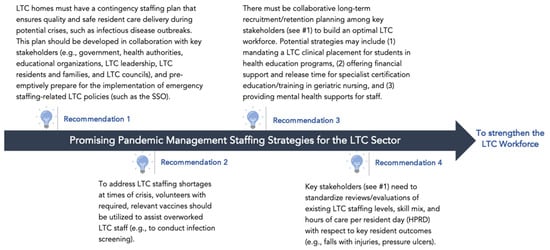
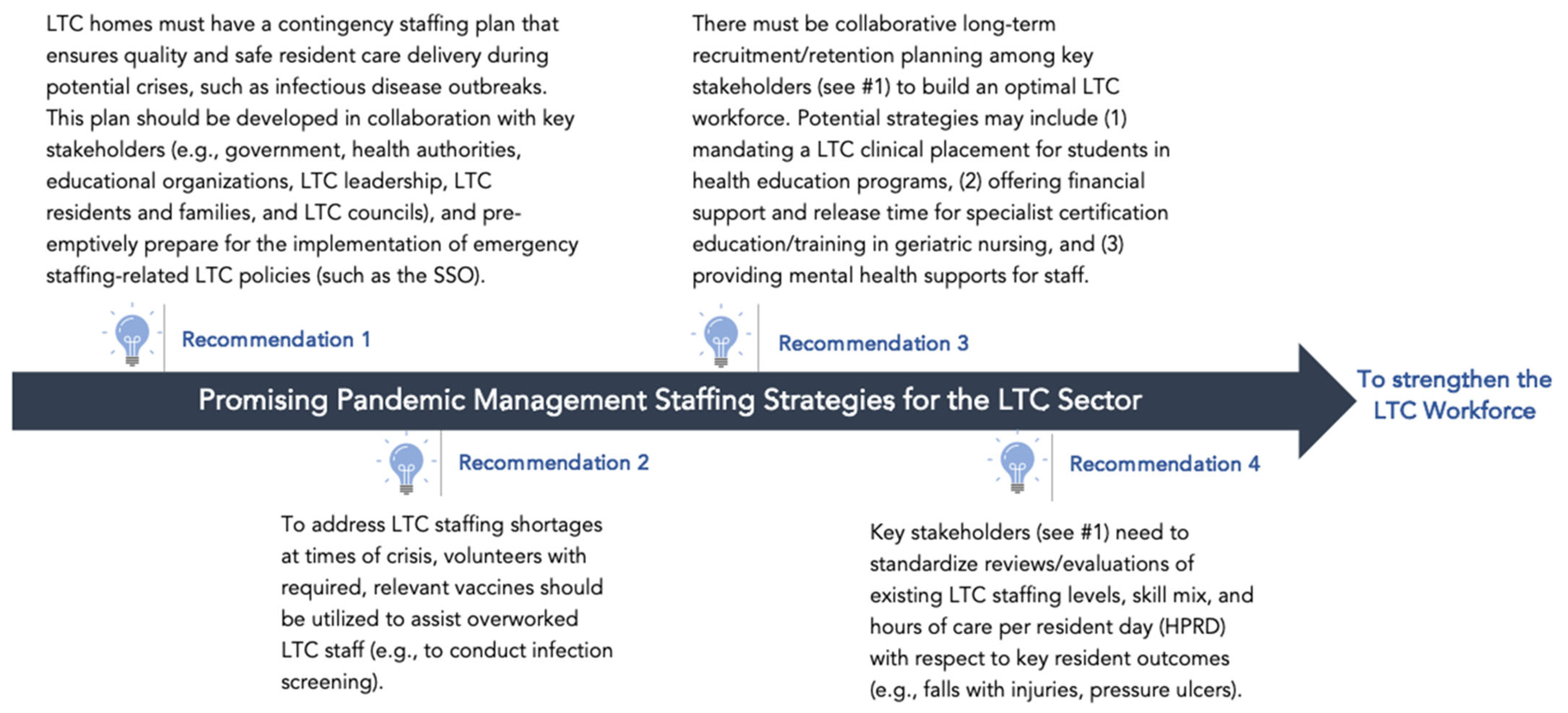
Finally, LTC operators also shared concerns about the impact of LTC staffing shortages on the mental health of existing LTC staff and leaders and, subsequently, on quality and safe resident care delivery. LTC operators were most significantly concerned about the mental health of the newly graduated health workforce and novice leaders in the sector. As stated by one participant, “A newly graduated registered nurse won’t survive long in long-term care without support and mentorship. It is a different kind of environment.” See Figure 1 for recommendations based on these findings.
Figure 1.
Recommendations for Addressing Staffing Challenges in a Pandemic.
5. Discussion
Our iKT project aimed to co-create a series of best practices in BC LTC staffing based on knowledge gained through the COVID-19 pandemic [1]. Key post-pandemic recommendations focused on collaborative contingency staffing for potential crises, enhanced recruitment and retention strategies for the LTC workforce, and standardized evaluations of LTC staffing.
Contingency planning for LTC staffing depends on the co-development of supportive human resource policies that include LTC leadership and health emergency management experts at regional and provincial levels [20]. Post-COVID-19, lack of communication and coordination among LTC leaders and health authorities was associated with delays in receiving necessary resources and supports [21]. A plan co-created by LTC key stakeholders (e.g., LTC leadership, staff, residents, and family members alongside government and health authority leadership) should be made to pre-emptively take action in future public health emergencies [11,22,23,24]. A previous report exploring the BC Ministry of Health response to COVID-19 in the LTC sector highlights gaps in coordination, role clarity, and consistency across health authorities and LTC providers, which contributed to variability in staffing support and operational responses [11]. It also underscored how pre-existing workforce shortages, compounded by policies such as the single-site order, exposed the absence of a coordinated, system-wide approach to staffing during emergencies [11]. These findings directly support our recommendation, reinforcing the need for collaborative workforce planning mechanisms to enable effective and equitable emergency response in LTC.
LTC staffing for emergencies is currently hampered by significant national health human resource shortages. The 2025 Canadian Institute for Health Information (CIHI) report highlights that there are fewer healthcare workers employed in the LTC sector compared to before the pandemic [25]. Therefore, creative staffing strategies need to be employed, such as through the use of volunteers. However, while volunteers could support non-clinical tasks, their onboarding, training, and responsibilities would require careful planning.
Longer-term recruitment and retention staffing strategies are needed to address negative stereotypes associated with LTC that make this sector unattractive to healthcare workers. The need for improved career pipelines in LTC is evident. Some options for increasing interest in LTC careers include collaborations between LTC homes and academic programs where faculty introduce students to geriatric nursing as a specialty practice [26], or implementing residency programs that support the transition of new nurses into LTC [22]. In terms of staff retention, participants in our study raised the importance of protecting LTC staff and leadership mental health. One promising approach, borrowed from acute care, is the Schwartz Rounds Program. This is a peer-support program that offers staff a safe space to express their emotional and psychological challenges and share their experiences through a storytelling approach [23,24,27]. Research has shown the benefits of this program in increasing emotional resilience, instilling compassion, and supporting the well-being of healthcare workers [23,24,28,29].
Recent Canadian data from the LTC sector point to a clear and concerning contraction of the workforce, particularly among regulated nurses, alongside growing strain in the unregulated workforce. By 2023, only 13.6% of Canada’s health workforce was employed primarily in LTC—lower than pre-pandemic levels—suggesting a broader shift away from the sector [25]. This decline is most pronounced among RNs, whose numbers in LTC decreased by 42.5% between 2014 and 2023 (from 548 to 315 per reporting unit) [25]. Although LPNs and RPNs continue to comprise the largest segments of the regulated workforce in LTC, they have also experienced modest declines since 2021 (−6.1% and −2.1%, respectively) [25]. These trends are particularly concerning in the context of increasing resident complexity, which has risen by approximately 4.5%, thereby intensifying demand for professional nursing care [25]. This growing mismatch is further underscored by a robust body of evidence demonstrating that higher levels of regulated nurse staffing are associated with improved resident outcomes [10,30]. Taken together, these findings highlight a need to strengthen recruitment and retention strategies targeting the regulated nursing workforce in LTC.
Finally, evaluating LTC sector performance requires the use of standardized data to ensure consistent, comparable, and evidence-based assessments over time. CIHI provides a valuable source of such data, enabling sector-wide monitoring and benchmarking. Using CIHI data more regularly to examine trends in staffing (e.g., actual hours per resident per day) and resident outcomes (e.g., falls, the use of antipsychotic medication) could provide valuable information on LTC sector functioning. As noted by CIHI, data collection on HCAs is inconsistent across Canada [25] and requires standardization to fully capture LTC sector functioning. This is particularly important as an overwhelming majority of care is delivered by HCAs in Canadian LTC homes. Complementing these quantitative measures, qualitative insights should also be gathered through informal or formal methods of data collection, such as conversations and focus groups with residents, families, and care providers, which would offer an essential, human perspective on care quality and the lived experience in LTC settings. Without regular data monitoring, proactive staffing planning is not possible [25]. This recommendation is consistent with a growing body of literature linking staffing levels and skill mix to resident outcomes, while also highlighting ongoing challenges related to inconsistent data collection and the need to complement standardized quantitative indicators with qualitative insights [10,30]. Together, these findings suggest that while standardized indicators are increasingly being used in Canada, gaps in data completeness and comparability continue to limit their full utility, reinforcing the need for more consistent and standardized approaches to evaluating both staffing adequacy and resident outcomes [31].
Overall, these suggestions provide rich data based on lived experience that pave the way for decreased health inequities and provide a method for integrating lived experience into public health decisions.
Strengths and Limitations
A limitation of note is that the quantitative data gathered from LTC operators via electronic survey yielded a low response rate, potentially influenced by the fact that the study took place during the early stages of the COVID-19 pandemic. The participants who did respond may represent a subset of operators (e.g., those with enough organizational support to participate in knowledge translation efforts), affecting the outcomes presented in this paper. Relatedly, the findings of this knowledge translation project are contextual, and it is unclear how generalizable the learnings from the COVID-19 pandemic could be to future health crises. Despite these limitations, this study has a number of important strengths to highlight. First, this iKT study sought to involve LTC community members and experts through all phases of our project. Grounded in participants’ lived experiences, participatory research approaches are associated with enhanced potential for effecting real-world change [18]. Additionally, our study utilized a combination of quantitative and qualitative data in our research approach, allowing for a more robust exploration of the effects of the COVID-19 pandemic on staffing in long term care. While we are not able to generalize these findings, the contextual and rich nature of our data is a noteworthy strength. Building upon our findings with more robust qualitative and quantitative research would be a warranted area of future work.
6. Conclusions
The COVID-19 pandemic revealed the inadequate preparedness of the LTC sector to meet the challenges of a crisis. Direct knowledge gained from the front lines of the LTC sector during the COVID-19 crisis provides rich information to help create effective, impactful, and practical outcomes. The recommendations garnered through this process outline the importance of contingency planning for potential crises, implementing recruitment and retention strategies for the LTC workforce, and standardizing evaluations of staffing adequacy and resident outcomes. Strategic investments and workforce planning are needed now to protect this vital healthcare sector. The recommendations of best practices, derived through the iKT approach, can inform ongoing LTC staffing efforts for potential crises and eventual creation of a viable LTC workforce. Further, the unique iKT approach of our project provides a roadmap for the inclusion of lived experience to address health inequities and bolster public health outcomes.
Author Contributions
Conceptualization, F.H., M.K., M.M. and A.P.; Methodology, F.H., I.A., M.K., M.M., D.K., L.C. and A.P.; Software, F.H. and I.A.; Validation, F.H., I.A., M.M., L.C. and A.P.; Formal Analysis, F.H., I.A. and M.M.; Investigation, F.H. and I.A.; Resources, F.H.; Data Curation, I.A.; Writing—Original Draft Preparation, F.H., H.E.B.-A., M.K. and R.H.; Writing—Review and Editing, F.H., I.A., H.E.B.-A., M.K., M.M., D.K., L.C., R.H. and A.P.; Visualization, H.E.B.-A.; Supervision, F.H., M.M. and A.P.; Project Administration, F.H. and M.K.; Funding Acquisition, F.H. All authors have read and agreed to the published version of the manuscript.
Funding
This project was funded by a Michael Smith Health Research BC Convening & Collaborating (C2) award (C2-2020-1386).
Institutional Review Board Statement
The project goal was to develop recommendations for the LTC sector; as such, a quality improvement approach with participatory methods was used to achieve our objectives. Ethics were not required as per Canadian ethics guidelines (see Tri-Council Policy Statement (TCPS-2), Article 2.5: https://ethics.gc.ca/eng/tcps2-eptc2_2022_chapter2-chapitre2.html, accessed on 2 February 2026).
Informed Consent Statement
This study was intended as a quality improvement initiative for the LTC sector; as such, informed consent was not applicable.
Data Availability Statement
The data presented in this study are available on request from the corresponding author.
Conflicts of Interest
Author Lara Croll is from British Columbia Care Providers Association. The remaining authors declare that the research was conducted in the absence of any commercial or financial relationships that could be construed as a potential conflict of interest.
Appendix A. Key Pandemic Management Areas
| Area | Description |
| Screening | Practices and procedures relating to COVID-19 screening of LTC home visitors prior to entry. |
| Visitation | The policy restricting visitors from visiting their loved ones residing in LTC homes during COVID-19. |
| Staffing | Practices and strategies relating to ensuring adequate staffing levels and appropriate skill mix to meet the needs of LTC residents in the context of COVID-19. |
| Infection Prevention and Control Procedures | Practices and procedures relating to preventing the spread of COVID-19 and ensuring the safety of LTC residents and staff. |
| Communication | Practices and procedures relating to the exchange of important information, updates and policies with LTC homes, their staff, residents and their families in the context of COVID-19. |
| Physical Layout | The design/re-design of the physical environment consistent with infection prevention and control guidelines and to ensure the safety of LTC residents and staff in the context of COVID-19. |
| Leadership and Organizational Support | Practices and strategies adopted by LTC homes and their leadership to support the health and safety of LTC residents and staff in the context of COVID-19. |
Appendix B. Forum Conversation Guide
| Domain | Key Questions & Prompts |
| Screening, Visitation & Family Engagement |
|
| Staffing & Workforce Capacity |
|
| Infection Prevention & Control (IPC) |
|
| Communication & Information Flow |
|
| Physical Environment & Infrastructure |
|
| Leadership & Organizational Support |
|
| Innovations & Promising Practices |
|
References
- Estabrooks, C.A.; Straus, S.E.; Flood, C.M.; Keefe, J.; Armstrong, P.; Donner, G.J.; Boscart, V.; Ducharme, F.; Silvius, J.L.; Wolfson, M.C. Restoring Trust: COVID-19 and the Future of Long-Term Care in Canada. Facets 2020, 5, 651–691. [Google Scholar] [CrossRef] [Scilit]
- Hsu, A.T.; Lane, N.; Sinha, S.K.; Dunning, J.; Dhuper, M.; Kahiel, Z.; Sveistrup, H. Understanding the Impact of COVID-19 on Residents of Canada’s Long-Term Care Homes—Ongoing Challenges and Policy Responses. Int. Long-Term Care Policy Netw. 2020, 17, 1–18. [Google Scholar]
- World Health Organization. Health Equity and Its’ Determinants; World Health Organization: Geneva, Switzerland, 2021.
- Sepulveda, E.R.; Stall, N.M.; Sinha, S.K. A Comparison of COVID-19 Mortality Rates Among Long-Term Care Residents in 12 OECD Countries. J. Am. Med. Dir. Assoc. 2020, 21, 1572–1574.e3. [Google Scholar] [CrossRef] [Scilit] [PubMed]
- Canadian Institute for Health Information. The Impact of COVID-19 on Long-Term Care in Canada: Focus on the First 6 Months; Canadian Institute for Health Information: Ottawa, ON, Canada, 2021. [Google Scholar]
- Canadian Institutes for Health Research. Guide to Knowledge Translation Planning at CIHR: Integrated and End-of-Grant Approaches; Canadian Institutes for Health Research: Ottawa, ON, Canada, 2012. [Google Scholar]
- Canadian Institute for Health Information. Profile of Residents in Residential and Hospital-Based Continuing Care, 2023–2024; Canadian Institute for Health Information: Ottawa, ON, Canada, 2024. [Google Scholar]
- Estabrooks, C.A.; Squires, J.E.; Carleton, H.L.; Cummings, G.G.; Norton, P.G. Who Is Looking After Mom and Dad? Unregulated Workers in Canadian Long-Term Care Homes. Can. J. Aging 2015, 34, 47–59. [Google Scholar] [CrossRef] [Scilit]
- Squires, J.E.; Baumbusch, J.; Demery Varin, M.; MacDonald, I.; Chamberlain, S.; Boström, A.-M.; Thompson, G.; Cummings, G.; Estabrooks, C.A. A Profile of Regulated Nurses Employed in Canadian Long-Term Care Facilities. Can. J. Aging 2019, 38, 130–142. [Google Scholar] [CrossRef] [Scilit]
- Clemens, S.; Wodchis, W.; McGilton, K.; McGrail, K.; McMahon, M. The Relationship between Quality and Staffing in Long-Term Care: A Systematic Review of the Literature 2008–2020. Int. J. Nurs. Stud. 2021, 122, 104036. [Google Scholar] [CrossRef] [Scilit]
- Ernst & Young BC Ministry of Health. Long-Term Care COVID-19 Response Review; Ernst & Young BC Ministry of Health: Vancouver, BC, Canada, 2020.
- Liu, M.; Maxwell, C.J.; Armstrong, P.; Schwandt, M.; Moser, A.; McGregor, M.J.; Bronskill, S.E.; Dhalla, I.A. COVID-19 in Long-Term Care Homes in Ontario and British Columbia. Can. Med. Assoc. J. 2020, 192, E1540–E1546. [Google Scholar] [CrossRef] [Scilit]
- Havaei, F.; Abughori, I.; Mao, Y.; Staempfli, S.; Ma, A.; MacPhee, M.; Phinney, A.; Keselman, D.; Tisdelle, L.; Galazka, D.; et al. The Impact of Pandemic Management Strategies on Staff Mental Health, Work Behaviours, and Resident Care in One Long-Term Care Facility in British Columbia: A Mixed Method Study. J. Long Term Care 2022, 71–87. [Google Scholar] [CrossRef] [Scilit]
- Staempfli, S.; Havaei, F.; Phinney, A.; MacPhee, M. Unintended Consequences of Pandemic Management Strategies on Residents and Family in One Long-Term Care Home in British Columbia: A Patient-Supported Qualitative Study. J. Innov. Aging 2022, 6, igac036. [Google Scholar] [CrossRef] [Scilit]
- Brown, K.A.; Buchan, S.A.; Chan, A.K.; Costa, A.; Daneman, N.; Garber, G.; Hillmer, M.; Jones, A.; Johnson, J.M.; Kain, D.; et al. Association between Delayed Outbreak Identification and SARS-CoV-2 Infection and Mortality among Long-Term Care Home Residents, Ontario, Canada, March to November 2020: A Cohort Study. Euro Surveill. 2024, 29, 2300719. [Google Scholar] [CrossRef] [Scilit]
- Vijh, R.; Prairie, J.; Otterstatter, M.C.; Hu, Y.; Hayden, A.S.; Yau, B.; Daly, P.; Lysyshyn, M.; McKee, G.; Harding, J.; et al. Evaluation of a Multisectoral Intervention to Mitigate the Risk of Severe Acute Respiratory Coronavirus Virus 2 (SARS-CoV-2) Transmission in Long-Term Care Facilities. Infect. Control Hosp. Epidemiol. 2021, 42, 1181–1188. [Google Scholar] [CrossRef] [Scilit] [PubMed]
- Havaei, F.; MacPhee, M.; Keselman, D.; Staempfli, S. Leading a Long-Term Care Facility through the COVID-19 Crisis: Successes, Barriers and Lessons Learned. Health Q. 2021, 23, 28–34. [Google Scholar] [CrossRef] [Scilit] [PubMed]
- Jagosh, J.; Macaulay, A.C.; Pluye, P.; Salsberg, J.; Bush, P.L.; Henderson, J.; Sirett, E.; Wong, G.; Cargo, M.; Herbert, C.P.; et al. Uncovering the Benefits of Participatory Research: Implications of a Realist Review for Health Research and Practice. Milbank Q. 2012, 90, 311–346. [Google Scholar] [CrossRef] [Scilit] [PubMed]
- Hsieh, H.-F.; Shannon, S.E. Three Approaches to Qualitative Content Analysis. Qual. Health Res. 2005, 15, 1277–1288. [Google Scholar] [CrossRef] [Scilit]
- Peterson, L.J.; Dobbs, D.; June, J.; Dosa, D.M.; Hyer, K. “You Just Forge Ahead”: The Continuing Challenges of Disaster Preparedness and Response in Long-Term Care. Innov. Aging 2021, 5, igab038. [Google Scholar] [CrossRef] [Scilit]
- Siu, H.Y.-H.; Kristof, L.; Elston, D.; Hafid, A.; Mather, F. A Cross-Sectional Survey Assessing the Preparedness of the Long-Term Care Sector to Respond to the COVID-19 Pandemic in Ontario, Canada. BMC Geriatr. 2020, 20, 421. [Google Scholar] [CrossRef] [Scilit]
- Cadmus, E.; Salmond, S.W.; Hassler, L.J.; Black, K.; Bohnarczyk, N. Creating a Long-Term Care New Nurse Residency Model. J. Contin. Educ. Nurs. 2016, 47, 234–240. [Google Scholar] [CrossRef] [Scilit]
- McCarthy, I.; Taylor, C.; Leamy, M.; Reynolds, E.; Maben, J. ‘We Needed to Talk about It’: The Experience of Sharing the Emotional Impact of Health Care Work as a Panellist in Schwartz Center Rounds® in the UK. J. Health Serv. Res. Policy 2021, 26, 20–27. [Google Scholar] [CrossRef] [Scilit]
- Hofmeyer, A.; Taylor, R.; Kennedy, K. Fostering Compassion and Reducing Burnout: How Can Health System Leaders Respond in the COVID-19 Pandemic and Beyond? Nurse Educ. Today 2020, 94, 104502. [Google Scholar] [CrossRef] [Scilit]
- Canadian Institute for Health Information. Recent Staffing and Quality Indicator Trends in Canadian Long-Term Care; Canadian Institute for Health Information: Ottawa, ON, Canada, 2025. [Google Scholar]
- Naughton, C.; O’Shea, K.L.; Hayes, N. Incentivising a Career in Older Adult Nursing: The Views of Student Nurses. Int. J. Older People Nurs. 2019, 14, e12256. [Google Scholar] [CrossRef] [Scilit]
- Ben-Ahmed, H.E.; Bourgeault, I.L. Sustaining the Canadian Nursing Workforce: Targeted Evidence-Based Reactive Solutions in Response to the Ongoing Crisis. Can. J. Nurs. Leadersh. 2023, 35, 14–28. [Google Scholar] [CrossRef] [Scilit]
- Golding, L. Schwartz Rounds: Supporting the Emotional Wellbeing of Our Future Healthcare Workforce. Future Healthc. J. 2024, 11, 100010. [Google Scholar] [CrossRef] [Scilit]
- Maben, J.; Taylor, C.; Reynolds, E.; McCarthy, I.; Leamy, M. Realist Evaluation of Schwartz Rounds® for Enhancing the Delivery of Compassionate Healthcare: Understanding How They Work, for Whom, and in What Contexts. BMC Health Serv. Res. 2021, 21, 709. [Google Scholar] [CrossRef] [Scilit]
- Yang, B.K.; Carter, M.W.; Trinkoff, A.M.; Nelson, H.W. Nurse Staffing and Skill Mix Patterns in Relation to Resident Care Outcomes in US Nursing Homes. J. Am. Med. Dir. Assoc. 2021, 22, 1081–1087.e1. [Google Scholar] [CrossRef] [Scilit]
- Canadian Institute for Health Information. Aging with Dignity: Using Data to Strengthen Long-Term Care for Canadians; Canadian Institute for Health Information: Ottawa, ON, Canada, 2026. [Google Scholar]

Disclaimer/Publisher’s Note: The statements, opinions and data contained in all publications are solely those of the individual author(s) and contributor(s) and not of MDPI and/or the editor(s). MDPI and/or the editor(s) disclaim responsibility for any injury to people or property resulting from any ideas, methods, instructions or products referred to in the content. |
© 2026 by the authors. Licensee MDPI, Basel, Switzerland. This article is an open access article distributed under the terms and conditions of the Creative Commons Attribution (CC BY) license.