


Highlights
Public health relevance—How does this work relate to a public health issue?
- •
- Bystander intervention is a critical component of the chain of survival following out-of-hospital cardiac arrest and acute trauma.
- •
- In rural communities with limited emergency medical service access and prolonged transport times, layperson proficiency in basic first aid, bleeding control, and CPR is essential.
Public health significance—Why is this work of significance to public health?
- •
- Despite high willingness to help, rural Chiang Mai residents demonstrated suboptimal first-aid and CPR knowledge.
- •
- Major skill-specific gaps emerged in critical actions, particularly proper tourniquet application, scene safety assessment, and correct chest compression rates.
Public health implications—What are the key implications or messages for practitioners, policymakers and/or researchers in public health?
- •
- Extend community emergency and first-aid education beyond health volunteers to high-risk, underserved groups, particularly older adults and manual workers.
- •
- Prioritizing theoretical knowledge, hands-on practice, and regular refreshers to maintain readiness.
Abstract
Early bystander intervention is important in rural trauma and out-of-hospital cardiac arrest, where emergency response times are often prolonged. This study assessed first-aid and cardiopulmonary resuscitation (CPR) knowledge and identified predictors of passing knowledge among rural residents in Chiang Mai, Thailand. A cross-sectional anonymous questionnaire was administered to rural adults in Chiang Mai between October 2025 and March 2026. The survey assessed sociodemographic characteristics, emergency experiences, prior training, willingness to help, attitudes, and knowledge using 10 multiple-choice items covering first aid, hemorrhage control, and CPR. Passing required meeting the minimum score in all three knowledge domains. Multivariable logistic regression identified factors associated with passing. Among 451 participants, 29.7% passed the knowledge assessment, despite high willingness to call for help (98.0%) and provide first aid (84.5%). Passing was independently associated with previous first-aid experience (aOR 2.04, 95% CI 1.04–3.99) and witnessing cardiac arrest (aOR 2.56, 95% CI 1.18–5.55), while older age and current smoking were negatively associated with passing; formal training was not independently associated. Key knowledge gaps involved scene safety, tourniquet use, and appropriate chest compression rates. First-aid and CPR knowledge was suboptimal despite high willingness to help. Targeted community training incorporating hands-on practice is needed to address specific skill deficits, particularly among older adults and non-healthcare occupational groups.
1. Introduction
Trauma and sudden cardiac arrest are major causes of global mortality and disability [1,2]. In particular for patients with severe traumatic injury or sudden cardiac arrest, the period before professional emergency personnel arrive is particularly important for improving survival and overall clinical outcomes [3]. During this interval, nearby community members may be the first individuals able to recognize the emergency, activate emergency medical services, prevent further harm, control external bleeding, and initiate cardiopulmonary resuscitation (CPR). However, bystander response remains underutilized despite high potential survivability [4,5]. A study of prehospital trauma deaths in the UK revealed that 46 to 59% of prehospital trauma deaths were potentially survivable, but bystander intervention was performed in only 25 to 30% of cases [5]. Similarly, the provision and quality of first aid varied according to the type of injury and the responder’s previous training [6].
Bystander intervention is also an essential component of the chain of survival following out-of-hospital cardiac arrest [7]. According to evidence from systematic reviews and meta-analyses, community interventions designed to increase CPR training and bystander participation have been associated with higher rates of bystander CPR and improved survival [8,9]. However, willingness alone does not ensure competence; positive attitudes frequently coexist with substantial knowledge gaps, creating barriers to effective intervention [10].
Formal training is an important strategy for improving community preparedness. A systematic review found that first-aid training probably improves laypersons’ knowledge, practical skills, and self-efficacy [11]. However, the benefits of a single training session may diminish over time. Previous research has demonstrated deterioration in first-aid and basic-life-support performance following training, supporting the need for periodic refresher courses and repeated practical exercises [12]. Identifying population groups with limited knowledge or inadequate access to training is therefore necessary for designing effective and sustainable educational interventions.
Community preparedness may be especially important in rural settings, where geographic distance and limitations in emergency medical resources may delay access to professional care. Thailand has developed community-based first-responder networks involving village health volunteers (VHVs) and other trained community members. The Ministry of Public Health established a standardized 43 h VHV training curriculum, including basic first aid, initial care before referral, health promotion, disease prevention, and essential primary healthcare services [13]. Additional training programs have subsequently been introduced, including an 18 h curriculum in 2022 for selected VHVs, focusing on digital health, health screening, elderly care, and chronic disease management [14]. However, specific CPR, Automated External Defibrillator (AED), and bleeding-control skills are not explicitly established as mandatory components of these curricula. Furthermore, these programs are intended for VHVs rather than all community residents, and first-aid training experiences may therefore vary across the general rural population. A rural Thai case study demonstrated that trained community responders could recognize cardiac arrest, initiate CPR, activate emergency medical services, and continue resuscitation until the ambulance team arrived [15]. While trained lay responders strengthen rural emergency systems, baseline knowledge—including CPR and bleeding control—and its associated sociodemographic or behavioral determinants among rural residents remain poorly defined.
This study therefore aimed to assess knowledge of general first aid, bleeding control, and CPR among adult residents of rural communities in Chiang Mai, Thailand, and to identify factors associated with passing the knowledge assessment. Identifying groups with limited knowledge may support the development of targeted, practical, and sustainable community-based first-aid programs for resource-limited countries.
2. Materials and Methods
2.1. Study Design and Populations
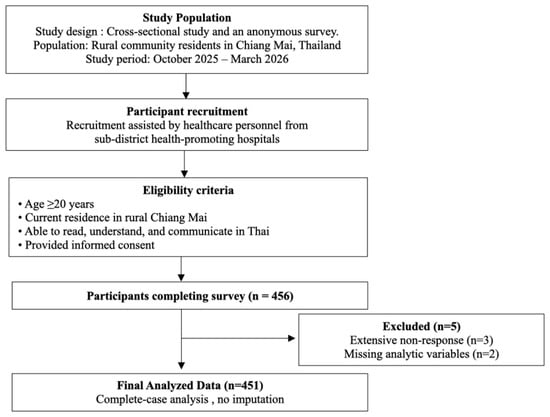
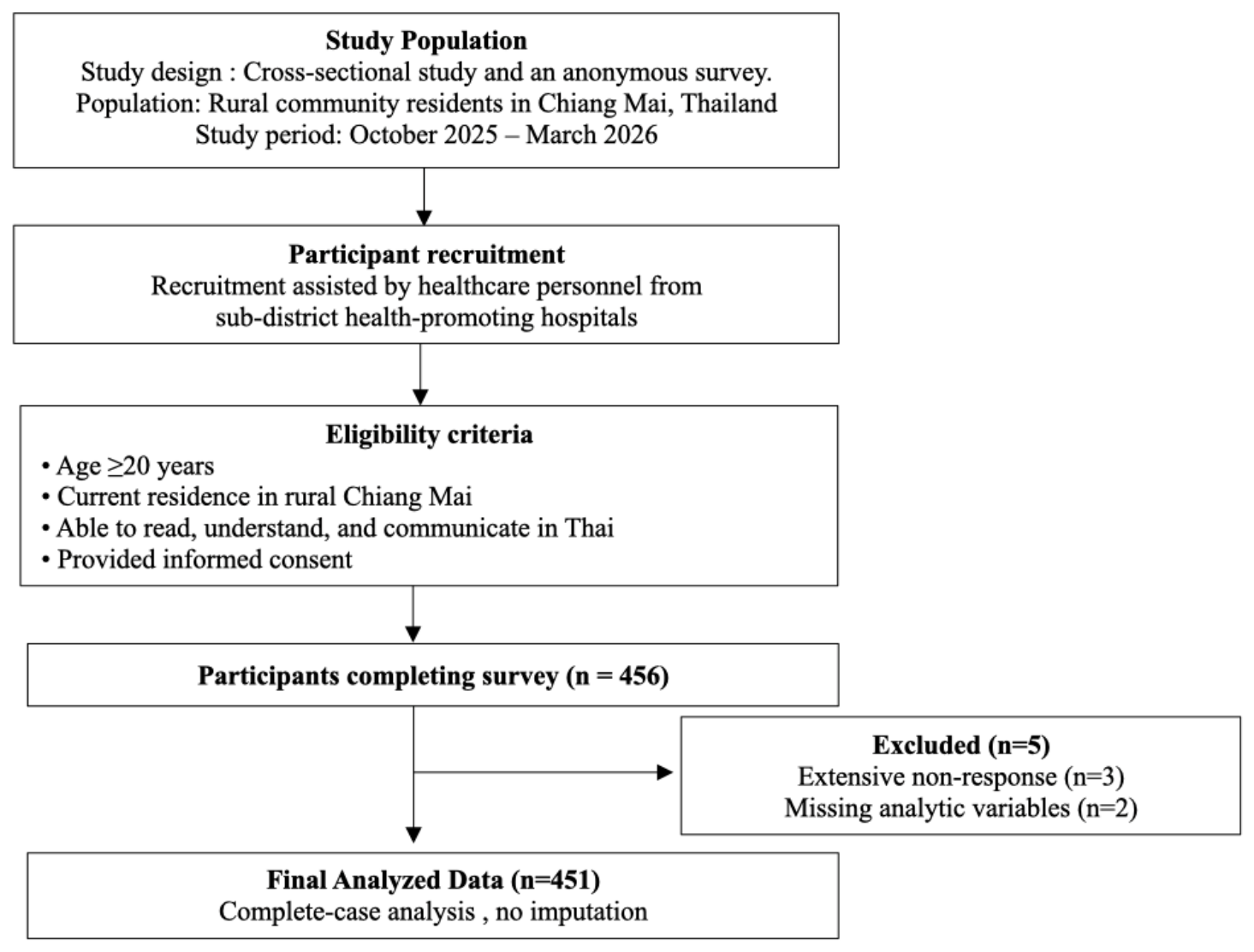
This cross-sectional study was conducted among rural residents in Chiang Mai, Thailand, between October 2025 and March 2026. Data were collected via non-probability convenience sampling using an anonymous online survey distributed by subdistrict health-promoting hospital staff, with recruitment announcements disseminated across all districts of Chiang Mai Province. Door-to-door visits were also conducted, with trained survey administrators providing in-person assistance using a standardized script and recording responses verbatim. Eligible participants were aged ≥20 years, a resident in rural Chiang Mai, Thai-literate, and provided informed consent. Participants with incomplete responses were excluded from the analysis. Based on Krejcie’s and Morgan’s table [16], for a target population of 1,423,306 residents aged over 20 years in Chiang Mai [17], the minimum required sample size of 384 was increased by 20% to 460 to account for non-response. The study flow diagram is presented in Figure 1.
Figure 1.
Flowchart of the study process, participant selection, and final analyzed data.
2.2. Data Collection
Data were collected via an anonymous online survey distributed with the assistance of village health volunteers and subdistrict health-promoting hospital staff in Chiang Mai. Participants provided informed consent before completing the questionnaire. The questionnaire comprised four parts:
- (1)
- Demographics included age, sex, educational level, occupation, village health volunteer status, marital status, religion, underlying diseases, smoking status, and alcohol consumption.
- (2)
- Participants’ experiences related to injuries, cardiac arrest, and first aid: Responses were recorded as dichotomous variables (yes/no). Information collected included personal and family history of injury and severe cardiac event/collapse, experience witnessing injury and cardiac arrest events, previous training in first aid and CPR, prior experience performing first aid and CPR, and willingness to help by calling for help and providing first aid. Occupational injury risk was also assessed using a self-reported measure in which participants categorized their risk of sustaining a work-related injury as no risk, low risk, moderate risk, or high risk.
- (3)
- First-aid and CPR Theoretical Knowledge: The questionnaire was developed based on recommendations from published bystander first aid and CPR recommendations [18,19] and covered three domains: (1) general first aid, (2) bleeding control, and (3) CPR. The knowledge assessment consisted of 10 multiple-choice questions, each with four response options. Participants received one point for each correct answer and zero points for an incorrect answer, resulting in a total score ranging from 0 to 10. The full knowledge assessment items and answers are provided in Supplementary File S1. To achieve a passing score, participants were required to demonstrate subdomain mastery by correctly answering more than half of the items within each individual domain, namely general first aid (≥1/2), bleeding control (≥3/5), and CPR (≥2/3), ensuring balanced competence. Meeting all subdomain criteria resulted in an overall passing threshold of ≥60% based on an adapted version of Bloom’s taxonomy cut-off [20]. Scores were categorized as “pass” or “fail”.
- (4)
- First-aid and CPR attitudes were measured using five 4-point Likert-scale items (1 = strongly disagree to 4 = strongly agree; total score: 5–20). Reverse-coded sentences were reverse-scored prior to interpretation. For analysis, responses were grouped into two categories: “disagree”, which included “strongly disagree” and “disagree” (scores 1–2), and “agree”, which included “agree” and “strongly agree” (scores 3–4).
Content validity was established through expert review by two trauma surgeons and one emergency physician from a university-affiliated medical center using a 4-point relevance scale (1 = not relevant to 4 = highly relevant). Out of 38 items across 4 sections, 35 items achieved perfect item-level agreement (Item-Level Content Validity Index, I-CVI = 1.00), three demographic items fell below the acceptance threshold: the item on the number of children (I-CVI = 0.33) was excluded, and items regarding smoking status and underlying medical conditions (I-CVI = 0.67) were refined based on expert qualitative feedback. Notably, all items within the knowledge and attitude sections achieved perfect item-level agreement (I-CVI = 1.00). Scale-level validity was quantified using the Scale-Level Content Validity Index Average method (S-CVI/Ave, mean of all item I-CVI values = 0.96), reflecting excellent scale validity, and the universal agreement method (S-CVI/UA, proportion of items achieving universal agreement = 0.92) is considered excellent.
2.3. Missing Data
Three records with extensive non-response (up to 55/79 blank variables) were excluded. In this remaining dataset, 451 out of 453 participants (99.56%) had complete records. Missing data were limited to two participants (0.44%): one was missing a single variable (health volunteer status) and the other was missing three variables (calling for emergency assistance, helping behavior, and occupational risk level). Because the proportion of participants with missing data was very small (0.44%), a complete-case analysis was performed and these two participants were excluded, leaving 451 participants (99.56%) in all the analyses (Figure 1).
2.4. Statistical Analysis
Baseline characteristics were summarized using descriptive statistics: continuous variables as mean ± SD (compared with independent t-tests) and categorical variables as frequencies and percentages [n (%)] (compared using Pearson’s χ2 or Fisher’s exact tests, as appropriate). Multivariable logistic regression identified independent factors associated with passing the knowledge assessment (pass vs. fail), yielding adjusted odds ratios (aORs) and 95% confidence intervals (CIs). Covariate selection for multivariable logistic regression was guided by clinical relevance and statistical parsimony. The covariates adjusted in the model included sociodemographic, lifestyle and medical history, occupation and job-related risk, emergency response behaviors, prior training and hands-on first-aid/CPR experience, and primary sources of information.
All statistical tests were two-tailed, with p < 0.05 considered statistically significant. Data preprocessing and descriptive statistics were performed using Python (v3.14.3), and multivariable logistic regression was conducted using R (v4.5.2). Generative AI tools (Claude Sonnet 5.5 and Gemini Flash 3.8) were used to assist with code generation, optimization, data analysis, visualization, proofreading, editing, and translation under full human supervision.
2.5. Ethical Considerations
The study was conducted in accordance with the Declaration of Helsinki and approved by the Research Ethics Committee of the Faculty of Medicine, Chiang Mai University, Thailand (IRB No. 308/2025, STUDY CODE: COM-2568-0510, Research ID: 0510, date of approval: 23 July 2025). Informed consent was obtained from all volunteers before data collection. Complete anonymity was maintained across both online and in-person survey modes, with no personal identifiers collected, linked, or stored.
3. Results
Of 456 respondents, 451 community residents were included in the analysis after excluding three records with extensive non-response and two with missing data (Figure 1). Participants were recruited from four rural subdistricts of Chiang Mai (101–137 participants each); 62.1% were female and 65.9% were married, with a mean age of 56.0 ± 13.9 years. Most had primary education (59.9%) and 12.0% had a bachelor’s degree or higher; the most common occupations were farming (38.4%) and elementary occupations (29.5%), and 28.2% were village health volunteers. The most frequent underlying diseases were hypertension (32.4%), dyslipidemia (22.2%), and diabetes mellitus (12.6%), and 15.1% were current smokers (Table 1). Based on the overall knowledge assessment (passing required meeting the minimum score in all three domains), participants were categorized into a fail group (n = 317, 70.3%) and a pass group (n = 134, 29.7%).
Table 1.
Descriptive statistics of the study population grouped by knowledge passing level (complete-case analysis, N = 451).
Analysis revealed significant differences in several sociodemographic variables, including age, education, occupation, underlying diseases, smoking status, and alcohol consumption. Participants in the pass group were significantly younger (p < 0.001), had a higher proportion of individuals with a bachelor’s degree, and were more likely to be academic personnel or office clerks.
Exposure to medical emergencies and prior training differed significantly between the two groups. Participants in the pass group had significantly higher proportions of individuals with any occupational injury risk (90.3% vs. 78.5%; p = 0.018), a history of witnessing injuries (53.7% vs. 41.0%, p = 0.017) or cardiac arrests (20.1% vs. 10.1%, p = 0.006), prior formal first-aid and CPR training (64.2% vs. 43.8% and 59.0% vs. 38.5%, p < 0.001), hands-on first-aid experience (27.6% vs. 13.2%, p < 0.001), and healthcare personnel as their primary source of health information (81.3% vs. 63.4%, p < 0.001).
Willingness to call for help was nearly universal among participants, with 97.8% of participants in the fail group and 98.5% in the pass group. Similarly, willingness to provide first aid was high in both groups, reported by 82.3% of participants in the fail group and 89.6% in the pass group (Table 1; p = 1.000 and p = 0.073, respectively).
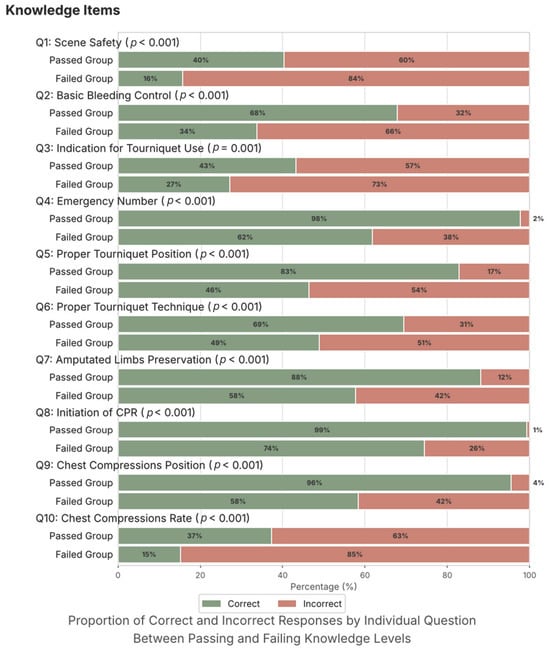
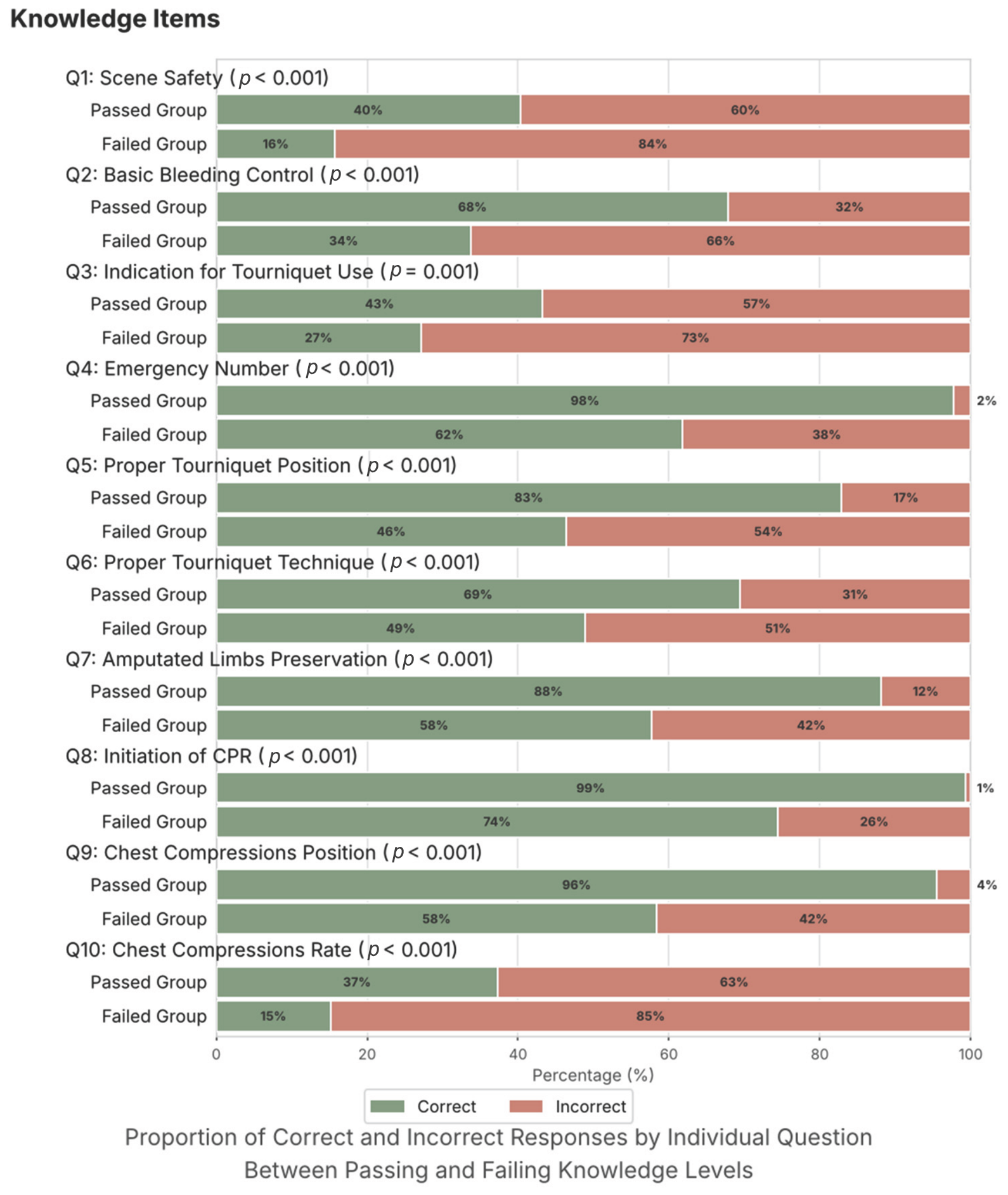
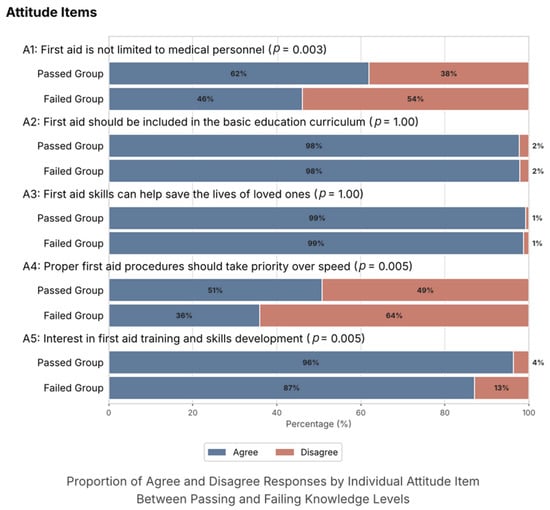
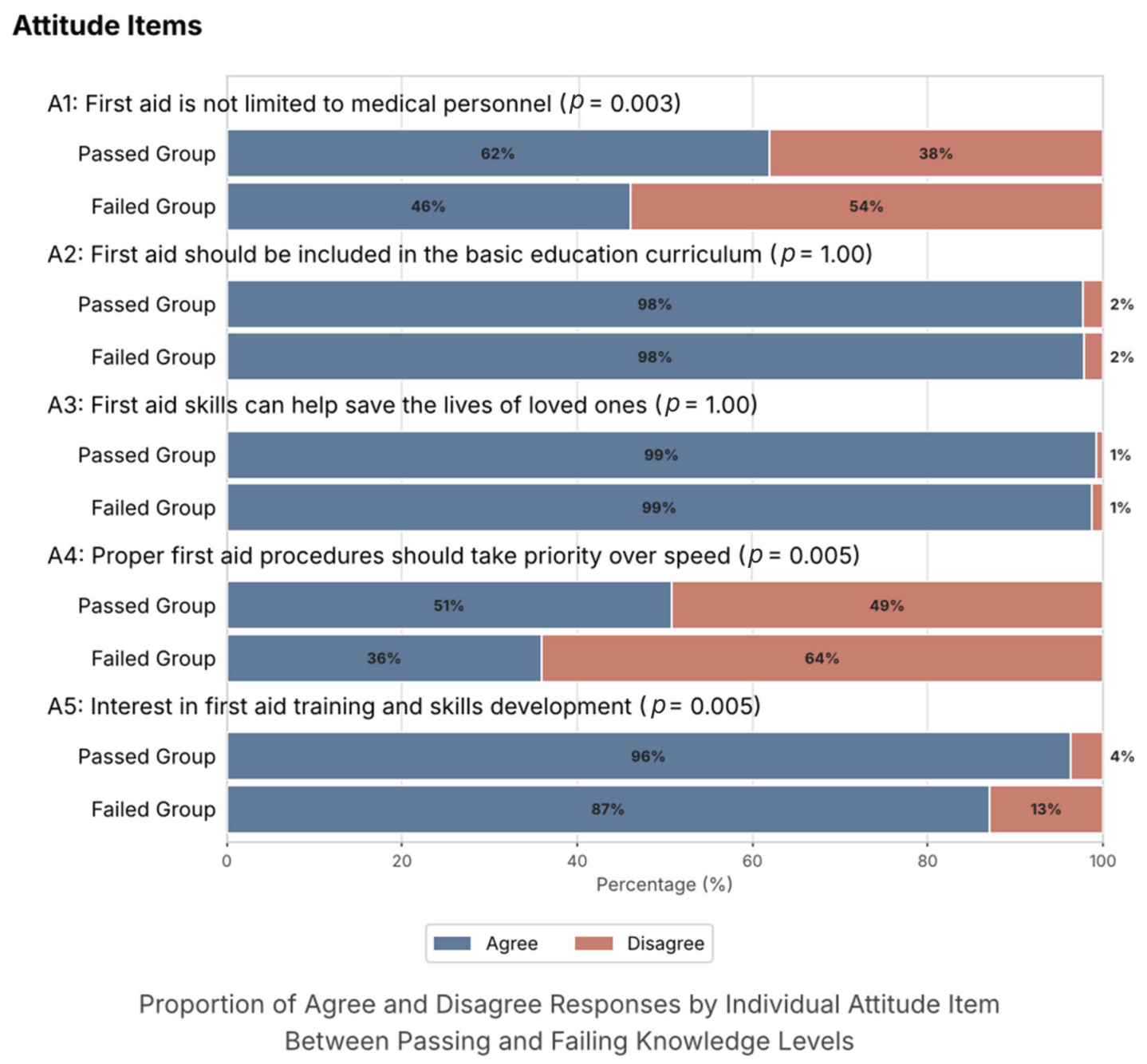
Individual knowledge items differed significantly between groups (p < 0.05). Initiating CPR and the emergency number in Thailand were most frequently correct, whereas CPR compression rate, tourniquet use, and scene safety yielded >60% error rates overall (Figure 2). Regarding attitudes toward first aid and CPR, the passing group showed a significantly higher proportion of agreement with the statements that first aid should not be provided solely by healthcare professionals (p = 0.003), correct procedure matters more than speed (p = 0.005), and interest in training (p = 0.005), while agreement on curriculum integration and the belief that it is better to know for saving loved ones was high across both groups (Figure 3).
Figure 2.
Comparison of correct and incorrect responses for individual first-aid knowledge questions between participants who overall passed (n = 134) and failed (n = 317) the assessment. The bars show the percentage distribution within each group. The green bars represent correct responses, and the red bars represent incorrect responses.
Figure 3.
Distribution of agreement and disagreement rates for individual first-aid attitude items between passing and failing subgroups. Original 4-point Likert scale responses are dichotomized into agree (Likert scale 3–4) and disagree (Likert scale 1–2). Blue bars represent agreement, and red bars represent disagreement.
The factors associated with passing the theoretical knowledge assessment are presented in Table 2. Positive factors were a history of witnessing a cardiac arrest (aOR = 2.56, 95% CI: 1.18–5.55; p = 0.018) and previous first-aid experience (aOR = 2.04, 95% CI: 1.04–3.99; p = 0.037). Formal first-aid and CPR training were not independently associated with passing (aOR = 1.20, 95% CI: 0.56–2.59 and aOR = 1.00, 95% CI: 0.47–2.13, respectively). Compared with no occupational injury risk, low risk was associated with higher odds of passing (aOR = 2.71, 95% CI: 1.22–6.05; p = 0.015). Negative factors included increasing age (aOR = 0.971 per year, 95% CI: 0.947–0.995; p = 0.018) and current smoking (aOR = 0.29, 95% CI: 0.11–0.75; p = 0.011). Separated, widowed, or divorced participants had higher odds than single participants (aOR = 2.95, 95% CI: 1.11–7.81; p = 0.029). Compared with academic personnel as the reference group, all other occupational categories had lower odds of passing, but only technical/craft was nominally significant (aOR = 0.07, 95% CI: 0.01–0.88; p = 0.039); these intervals are very wide because few participants worked in academic personnel (n = 13) or technical/craft occupations (n = 9).
Table 2.
Multivariable logistic regression results for factors associated with theoretical knowledge passing level.
4. Discussion
In this cross-sectional study of rural community residents in Chiang Mai, Thailand, fewer than one-third of participants passed the first-aid and CPR knowledge assessment. Previous first-aid experience and witnessing cardiac arrest were independently associated with approximately two-fold higher odds of passing the assessment (aOR 2.04 and 2.56, respectively; formal training was not independently associated after adjustment), whereas increasing age and current smoking were associated with lower odds of passing (aOR 0.97 per year and 0.29, respectively). Knowledge also varied across occupational groups, with lower odds of passing observed in several non-healthcare occupations. Although willingness to call for help and willingness to provide first aid were high in our study, objective knowledge remained limited. This discrepancy highlights a gap between self-reported willingness and theoretical knowledge. However, because practical competence and actual bystander responses were not assessed, our findings cannot establish whether insufficient knowledge is the principal barrier to effective first-aid intervention.
Our finding of inadequate first-aid knowledge is consistent with previous community-based studies. A study in the United Arab Emirates demonstrated that while 67% of residents were willing to help, 54.2% possessed poor knowledge of basic first-aid procedures [10]. Similar knowledge gaps have been reported across diverse populations, including students, workers, and general community members, suggesting that limited first-aid knowledge remains a global public health problem rather than a region-specific issue [10,11,21]. In prehospital trauma care, where preventable deaths often stem from absent or poor-quality bystander response [5,6], expanding community knowledge represents a vital opportunity to strengthen the prehospital chain of survival.
Although previous first-aid training was more common among participants who passed the knowledge assessment, it was not independently associated with passing after multivariable adjustment. However, the cross-sectional design cannot establish whether first-aid experience contributed to greater knowledge or whether individuals with greater pre-existing knowledge were more likely to engage in first-aid activities. Furthermore, training recency, duration, content, and frequency were not collected, limiting our ability to examine their associations with knowledge retention. Although previous studies have demonstrated that first-aid training can improve knowledge, these effects cannot be established from our study [11,21,22]. Despite variations in training content, duration, and delivery, these consistent findings highlight the importance of sustained and repeated training, which could support the association between increasing age and a lower likelihood of passing the knowledge assessment further supporting the need for ongoing refresher training. This finding is consistent with previous studies reporting poorer CPR and first-aid knowledge among older adults [23]. Several mechanisms may explain this association. Older individuals may have had fewer opportunities to receive contemporary first-aid or CPR training, less exposure to online educational resources, and longer intervals since their last training. In addition, knowledge and skills in basic life support are known to deteriorate over time, sometimes within months after training [12,24]. These findings suggest that first-aid education programs should not only expand initial training coverage but also incorporate periodic refresher courses, particularly for older community members.
Participants who had previously witnessed a cardiac arrest had significantly higher odds of passing the knowledge assessment. However, the underlying explanation for this association remains unclear. Previous studies have described emotional and psychological responses among individuals involved in cardiac arrest events [25,26]. However, these findings do not establish whether witnessing such events improves subsequent first-aid or CPR knowledge. Furthermore, individuals with greater pre-existing knowledge may be more likely to recognize and report an event as cardiac arrest. Therefore, it is important to understand that cross-sectional design cannot establish a causal relationship between witnessing cardiac arrest and knowledge acquisition.
Occupation was another important dimension of knowledge disparity. Academic personnel workers demonstrated better knowledge than other occupational groups, whereas technical workers, farmers, and elementary workers showed lower odds of passing. This pattern likely reflects differences in educational opportunities and routine exposure to health information. The finding is particularly relevant in rural communities because agricultural and manual occupations may carry substantial occupational injury risk [27]. In our study, participants with occupational injury risk tended to have better knowledge than those with no occupational risk, but this did not eliminate the knowledge gap among several non-healthcare occupations. Workplace-based and community-based first-aid education should be prioritized for occupational groups that face injury risk but have limited access to formal training.
Current smoking was independently associated with lower odds of passing the knowledge assessment. A previous study of burn first-aid knowledge similarly reported an association between smoking and lower knowledge scores [28]. Although smoking has been associated with lower health literacy in some populations, findings across studies have been inconsistent [29]. Therefore, differences in health literacy or engagement with health information may represent possible explanations, but these factors were not directly assessed in our study. The observed association should be interpreted cautiously.
An important observation was the gap between willingness and competence. Nearly all participants reported willingness to call for help, and more than four-fifths were willing to provide first aid; however, 70.3% failed the knowledge assessment. Similar discrepancies between willingness and knowledge have been reported in previous community-based studies [10]. Although willingness to help is encouraging, insufficient knowledge may limit the ability to select appropriate first-aid actions during emergencies. However, because practical competence and actual bystander responses were not assessed, the potential impact of these knowledge gaps on real-world first-aid performance remains uncertain.
Item-level analysis revealed persistent knowledge gaps across all participants, including those who passed. The highest rates of incorrect responses were observed for the recommended chest compression rate, tourniquet use, and scene safety, with more than 50% of participants in both the passing and failing groups answering these items incorrectly. These findings identify specific areas that should receive greater emphasis in future community first-aid education. Training priorities must target both knowledge deficit frequency and clinical risk. First, high-quality CPR requires major emphasis, as compression quality directly determines resuscitation success [3,30]. Second, tourniquet application must be reinforced to manage life-threatening extremity hemorrhage [31]. Third, scene safety assessment should be emphasized to prevent secondary harm to responders and victims [19]. Thus, priorities for community first-aid education should be determined not only by how frequently knowledge deficits occur but also by the potential clinical consequences of incorrect performance. Aligning high community willingness with targeted, high-yield skill training will enable lay responders to deliver safe, timely, and effective emergency care.
The findings have several implications for rural trauma and emergency care. First, community first-aid training should expand beyond health volunteers to target older adults and manual workers. Second, because practical performance was not directly assessed, educational programs should focus on high-yield, core theoretical and practical competencies relevant to trauma and sudden collapse, including emergency activation, bleeding control, safe positioning, recognition of cardiac arrest, chest compression, and AED awareness where available. Third, given knowledge decay over time [12,24], regular refresher courses evaluated through longitudinal research are needed.
This study has several strengths. It focused on rural community residents, a population in which bystander first aid may be particularly important because emergency medical service response times may be longer than in urban areas. The study also evaluated multiple demographic, experiential, occupational, and behavioral factors and used multivariable regression to identify independent predictors of knowledge. In addition, the questionnaire underwent expert content validation, supporting its relevance to trauma and CPR knowledge assessment.
Several limitations should be acknowledged. First, the cross-sectional design precludes causal inference regarding whether training directly improved knowledge or if health-conscious individuals selectively sought training. Furthermore, specific training characteristics (timing, duration, and program) were uncaptured to assess knowledge decay. Second, knowledge was assessed using multiple-choice questions rather than direct observation of first-aid or CPR performance. Theoretical knowledge may not necessarily translate into practical performance or competence in real-world scenarios. Future implementation research should incorporate practical skill simulations alongside knowledge assessments. Third, findings from rural Chiang Mai may not be generalizable to urban settings or other regions. Third, self-reported variables such as prior training, medical history, witnessing experience, and willingness to help may be affected by recall or social desirability bias. Furthermore, although the questionnaire demonstrated excellent expert content validity (I-CVI = 1.00), pilot testing to assess item difficulty, discrimination, and internal consistency reliability was not conducted before deployment. Finally, open survey access could allow duplicate entries by the same individual, which remains an inherent limitation of anonymous digital data collection.
5. Conclusions
Among the surveyed rural community residents in Chiang Mai, first-aid and CPR knowledge was suboptimal despite high self-reported willingness to help. Previous first-aid experience and witnessing cardiac arrest were positively associated with passing the knowledge assessment, whereas increasing age and current smoking were negatively associated. These findings highlight specific knowledge gaps and population groups that may benefit from targeted community education. Further longitudinal and interventional studies are needed to evaluate the effectiveness of training programs, appropriate refresher intervals, and their impact on practical first-aid performance.
Supplementary Materials
The following supporting information can be downloaded at: https://www.mdpi.com/article/10.3390/ijerph23111414/s1, Table S1. Knowledge Assessment Items.
Author Contributions
Conceptualization, C.V., N.I., A.K., and J.P.; methodology, C.V. and J.P.; software, N.I. and J.P.; validation, C.V., A.K., and J.P.; formal analysis, N.I.; investigation, C.V., N.I., A.K., and J.P.; resources, C.V., A.K., and J.P.; data curation, N.I. and J.P.; writing—original draft preparation, C.V., N.I., A.K., and J.P.; writing—review and editing, C.V., N.I., A.K., and J.P.; visualization, N.I. and J.P.; supervision, J.P.; project administration, C.V. and J.P. All authors have read and agreed to the published version of the manuscript and have declared that it is written originally and there is no data fabrication.
Funding
This research received no external funding.
Institutional Review Board Statement
The study was conducted in accordance with the Declaration of Helsinki and approved by the Research Ethics Committee of the Faculty of Medicine, Chiang Mai University, Thailand (IRB No. 308/2025, STUDY CODE: COM-2568-0510, Research ID: 0510, date of approval: 23 July 2025).
Informed Consent Statement
Informed consent was obtained from all subjects involved in the study.
Data Availability Statement
The data presented in this study are available on request from the corresponding author due to ethical considerations and the requirement for approval from the relevant authorities before data sharing.
Acknowledgments
The authors would like to express their sincere gratitude to the Subdistrict Health Promoting Hospitals in Chiang Mai Province for their valuable cooperation and assistance with data collection. The authors declare the use of generative AI in the research and writing process. According to the GAIDeT taxonomy (2026), the following tasks were delegated to GAI tools under full human supervision: code generation, code optimization, process automation, data analysis, visualization, proofreading and editing, summarizing text, and translation. The GAI tool used was Claude Sonnet 5.5 and Gemini Flash 3.8. Responsibility for the final manuscript lies entirely with the authors. GAI tools are not listed as authors and do not bear responsibility for the final outcomes.
Conflicts of Interest
The authors declare no conflicts of interest.
Abbreviations
The following abbreviations are used in this manuscript:
| AED | Automated External Defibrillator |
| CPR | Cardiopulmonary Resuscitation |
| CVI | Content Validity Index |
| SD | Standard Deviation |
References
- Haagsma, J.A.; Graetz, N.; Bolliger, I.; Naghavi, M.; Higashi, H.; Mullany, E.C.; Abera, S.F.; Abraham, J.P.; Adofo, K.; Alsharif, U.; et al. The global burden of injury: Incidence, mortality, disability-adjusted life years and time trends from the Global Burden of Disease study 2013. Inj. Prev. 2016, 22, 3–18. [Google Scholar] [CrossRef] [Scilit]
- Lou, J.; Xiang, Z.; Zhu, X.; Fan, Y.; Song, J.; Cui, S.; Li, J.; Jin, G.; Huang, N.; Le, X. Trends and levels of the global, regional, and national burden of injuries from 1990 to 2021: Findings from the global burden of disease study 2021. Ann. Med. 2025, 57, 2537917. [Google Scholar] [CrossRef] [Scilit]
- Sasson, C.; Rogers, M.A.; Dahl, J.; Kellermann, A.L. Predictors of survival from out-of-hospital cardiac arrest: A systematic review and meta-analysis. Circ. Cardiovasc. Qual. Outcomes 2010, 3, 63–81. [Google Scholar] [CrossRef] [Scilit]
- Nichols, R.; Horstman, J. Recommendations for Improving Stop the Bleed: A Systematic Review. Mil. Med. 2022, 187, e1338–e1345. [Google Scholar] [CrossRef] [Scilit]
- Oliver, G.J.; Walter, D.P.; Redmond, A.D. Prehospital deaths from trauma: Are injuries survivable and do bystanders help? Injury 2017, 48, 985–991. [Google Scholar] [CrossRef] [Scilit]
- Bakke, H.K.; Steinvik, T.; Eidissen, S.I.; Gilbert, M.; Wisborg, T. Bystander first aid in trauma—Prevalence and quality: A prospective observational study. Acta Anaesthesiol. Scand. 2015, 59, 1187–1193. [Google Scholar] [CrossRef] [Scilit]
- Lafrance, M.; Recher, M.; Javaudin, F.; Chouihed, T.; Wiel, E.; Helft, G.; Hubert, H.; Canon, V.; on behalf of the GR-RéAC. Bystander basic life support and survival after out-of-hospital cardiac arrest: A propensity score matching analysis. Am. J. Emerg. Med. 2023, 67, 135–143. [Google Scholar] [CrossRef] [Scilit]
- Yu, Y.; Meng, Q.; Munot, S.; Nguyen, T.N.; Redfern, J.; Chow, C.K. Assessment of Community Interventions for Bystander Cardiopulmonary Resuscitation in Out-of-Hospital Cardiac Arrest: A Systematic Review and Meta-analysis. JAMA Netw. Open 2020, 3, e209256. [Google Scholar] [CrossRef] [Scilit]
- Soar, J.; Becker, L.B.; Berg, K.M.; Einav, S.; Ma, Q.; Olasveengen, T.M.; Paal, P.; Parr, M.J.A. Cardiopulmonary resuscitation in special circumstances. Lancet 2021, 398, 1257–1268. [Google Scholar] [CrossRef] [Scilit]
- Midani, O.; Tillawi, T.; Saqer, A.; Hammami, M.B.; Taifour, H.; Mohammad, H. Knowledge and attitude toward first aid: A cross-sectional study in the United Arab Emirates. Avicenna J. Med. 2019, 9, 1–7. [Google Scholar] [CrossRef] [Scilit]
- Kendall, I.; Laermans, J.; D’Aes, T.; Borra, V.; McCaul, M.; Aertgeerts, B.; De Buck, E. First aid training for laypeople. Cochrane Database Syst. Rev. 2025, 8, CD015538. [Google Scholar] [CrossRef] [Scilit]
- Anderson, S.; Gaetz, M.; Masse, J. First aid skill retention of first responders within the workplace. SJTREM 2011, 19, 11. [Google Scholar] [CrossRef] [Scilit]
- Department of Health Service Support, Ministry of Public Health. Standard Training Curriculum for Village Health Volunteers, B.E. 2550 (2007); Ministry of Public Health: Nonthaburi, Thailand, 2007.
- Department of Health Service Support, Ministry of Public Health. Training Manual for Smart Village Health Volunteers and Family Health Volunteers, Fiscal Year 2022; Ministry of Public Health: Nonthaburi, Thailand, 2021.
- Pattanarattanamolee, R.; Sanglun, R.Y.; Nakahara, S. Community-Based First Responder Network in Rural Thailand: A Case Study of Out-of-Hospital Cardiac Arrest. Prehospital Disaster Med. 2021, 36, 234–236. [Google Scholar] [CrossRef] [Scilit]
- Krejcie, R.V.; Morgan, D.W. Determining Sample Size for Research Activities. Educ. Psychol. Meas. 1970, 30, 607–610. [Google Scholar] [CrossRef] [Scilit]
- Chiang Mai Provincial Statistical Office. Chiang Mai Provincial Statistical Report: 2024; Chiang Mai Provincial Statistical Office: Chiang Mai, Thailand, 2024.
- American Heart Association. American Heart Association Guidelines for Cardiopulmonary Resuscitation and Emergency Cardiovascular Care; American Heart Association: Dallas, TX, USA, 2025. [Google Scholar]
- International Federation of Red Cross and Red Crescent Societies. International First Aid, Resuscitation, and Education Guidelines 2020; International Federation of Red Cross and Red Crescent Societies: Geneva, Switzerland, 2020. [Google Scholar]
- Bloom, B.S.; Engelhart, M.D.; Furst, E.J. Taxonomy of Educational Objectives; Longmans, Green: New York, NY, USA, 1956; Volume 2. [Google Scholar]
- He, Z.; Wynn, P.; Kendrick, D. Non-resuscitative first-aid training for children and laypeople: A systematic review. Emerg. Med. J. 2014, 31, 763–768. [Google Scholar] [CrossRef] [Scilit]
- Van de Velde, S.; Heselmans, A.; Roex, A.; Vandekerckhove, P.; Ramaekers, D.; Aertgeerts, B. Effectiveness of nonresuscitative first aid training in laypersons: A systematic review. Ann. Emerg. Med. 2009, 54, 447–457.e5. [Google Scholar] [CrossRef] [Scilit]
- Dolenc, E.; Slabe, D.; Kovacic, U. The needs and opportunities of older laypeople to acquire first aid skills. PLoS ONE 2021, 16, e0255964. [Google Scholar] [CrossRef] [Scilit]
- Srivilaithon, W.; Amnuaypattanapon, K.; Limjindaporn, C.; Diskumpon, N.; Dasanadeba, I.; Daorattanachai, K. Retention of Basic-Life-Support Knowledge and Skills in Second-Year Medical Students. Open Access Emerg. Med. 2020, 12, 211–217. [Google Scholar] [CrossRef] [Scilit]
- Dobbie, F.; MacKintosh, A.M.; Clegg, G.; Stirzaker, R.; Bauld, L. Attitudes towards bystander cardiopulmonary resuscitation: Results from a cross-sectional general population survey. PLoS ONE 2018, 13, e0193391. [Google Scholar] [CrossRef] [Scilit]
- Mathiesen, W.T.; Bjorshol, C.A.; Braut, G.S.; Soreide, E. Reactions and coping strategies in lay rescuers who have provided CPR to out-of-hospital cardiac arrest victims: A qualitative study. BMJ Open 2016, 6, e010671. [Google Scholar] [CrossRef] [Scilit]
- Gholipour, C.; Vahdati, S.; Ghaffarzade, E.; Zonouzy, K. Characteristics of Fatal Occupational Traumatic Injuries; Drama in East Azerbaijan Province of Iran. Bull. Emerg. Trauma. 2015, 3, 27–31. [Google Scholar] [CrossRef]
- Burgess, J.D.; Watt, K.A.; Kimble, R.M.; Cameron, C.M. Knowledge of childhood burn risks and burn first aid: Cool Runnings. Inj. Prev. 2019, 25, 301–306. [Google Scholar] [CrossRef] [Scilit]
- Li, M.; Sonoda, N.; Koh, C.; Yasumoto, R.; Morimoto, A. Meta-analysis of the association between health literacy and smoking. Popul. Med. 2022, 4, 1–11. [Google Scholar] [CrossRef] [Scilit]
- Idris, A.H.; Guffey, D.; Pepe, P.E.; Brown, S.P.; Brooks, S.C.; Callaway, C.W.; Christenson, J.; Davis, D.P.; Daya, M.R.; Gray, R.; et al. Chest compression rates and survival following out-of-hospital cardiac arrest. Crit. Care Med. 2015, 43, 840–848. [Google Scholar] [CrossRef] [Scilit]
- Teixeira, P.G.R.; Brown, C.V.R.; Emigh, B.; Long, M.; Foreman, M.; Eastridge, B.; Gale, S.; Truitt, M.S.; Dissanaike, S.; Duane, T.; et al. Civilian Prehospital Tourniquet Use Is Associated with Improved Survival in Patients with Peripheral Vascular Injury. J. Am. Coll. Surg. 2018, 226, 769–776 e761. [Google Scholar] [CrossRef] [Scilit]

Disclaimer/Publisher’s Note: The statements, opinions and data contained in all publications are solely those of the individual author(s) and contributor(s) and not of MDPI and/or the editor(s). MDPI and/or the editor(s) disclaim responsibility for any injury to people or property resulting from any ideas, methods, instructions or products referred to in the content. |
© 2026 by the authors. Licensee MDPI, Basel, Switzerland. This article is an open access article distributed under the terms and conditions of the Creative Commons Attribution (CC BY) license.