


Highlights
Public health relevance—How does this work relate to a public health issue?
- Coronary heart disease is a leading global cause of mortality and disability that requires effective secondary prevention strategies, such as physical activity, to reduce recurrent cardiovascular events.
- More than one in three patients with established coronary heart disease in Kazakhstan were in the low IPAQ-SF physical activity category, and fewer than one in ten met WHO/ESC recommendations through moderate- or vigorous-intensity activity.
Public health significance—Why is this work of significance to public health?
- Low physical activity was associated with depressive symptoms, obesity, and the region of care rather than with conventional cardiovascular risk factors, such as hypertension, diabetes, or smoking.
- Physical activity advice was frequently given but inconsistently followed, and uptake of fitness clubs and organized walking groups was negligible regardless of patients’ activity level.
Public health implications—What are the key implications or messages for practitioners, policymakers and/or researchers in public health?
- Specific, repeated exercise counseling, combined with screening for depressive symptoms and weight management, may be preferable to general advice, but this requires evaluation in interventional studies.
- Home-based and digitally supported delivery merits evaluation as an alternative to facility-based referral, and policymakers should account for regional and environmental disparities when designing secondary prevention programs.
Abstract
Background: Physical activity (PA) is central to the secondary prevention of coronary heart disease (CHD), yet real-world adherence is poor, and data from Central Asia are scarce. Methods: In this cross-sectional study (October 2024–May 2025), 402 patients were recruited 6–24 months after an index coronary event at two Kazakh centers. PA was measured by IPAQ-SF and dichotomized as low versus moderate/high IPAQ-SF category. Multivariable logistic regression identified independent associations with low PA. Results: A total of 152 patients (37.8%) had low PA. Activity was almost exclusively ambulatory: 86.3% reported walking but only 19.9% had any moderate and 11.7% any vigorous activity, and only 29 (7.2%) met WHO/ESC recommendations without counting walking. Low PA was independently associated with recruitment in Aktobe (aOR 3.76, 95% CI 1.98–7.34) and obesity (aOR 1.68, 1.04–2.69); professional exercise advice (aOR 0.45, 0.27–0.73) and the absence of depressive symptoms (aOR 0.42, 0.23–0.76) were associated with lower odds of low PA. Advice was often given but inconsistently followed, and the uptake of fitness clubs (5.6%) and walking groups (10.8%) was minimal. Conclusions: More than one in three patients had low PA, and fewer than one in ten met WHO/ESC recommendations when excluding walking. Depression, obesity, and regional disparity and not conventional risk factors characterized inactive patients.
1. Introduction
Coronary heart disease (CHD) is known to be and remains a leading cause of morbidity and mortality worldwide despite a substantial decrease in incidence and case-fatality rates over recent decades [1,2]. Widespread availability of effective pharmacological interventions, combined with noticeable advances in acute and chronic management, have significantly improved survival, yet regardless of these findings, CHD carries a residual cardiovascular system (CVS) risk [2]. Moreover, the age-standardized disability-adjusted life year (DALY) rates per 100,000 for ischemic heart disease in 2023 were 1.5 times higher in Kazakhstan than the global average, underscoring the significant burden of CHD [3]. Current clinical guidelines underline the importance of lifestyle modifications since physical activity contributes to reduced recurrent CVS events, improved functional capacity, better health-related quality of life [1,4]. According to the World Health Organization (WHO) and European Society of Cardiology (ESC) guidelines, adults should engage in at least 150 min of moderate-intensity or 75 min of vigorous-intensity physical activity, or an equivalent combination, per week [1,4]. Nevertheless, sedentary behavior remains highly prevalent among patients with CHD, underscoring a persistent gap between guideline recommendations and real-world clinical practice.
A large systematic review and meta-analysis of longitudinal cohorts has shown that patients with CHD who remain physically active or who increase their activity after diagnosis experience substantially lower risks of all-cause and cardiovascular mortality compared to those who remain inactive, whereas the benefits are attenuated when activity levels decline over time [5].
Importantly, limited knowledge and skills, low self-efficacy, negative emotional states, restricted access to care, financial constraints, and variable social support have been shown to substantially influence patients’ ability to either initiate or maintain physical activity [6]. Thus, interventions integrating cognitive-behavioral strategies on top of PA appear more effective than exercise-only approaches, emphasizing that PA behavior in CHD is a complex interaction of multiple individual, social, and healthcare-related factors [7].
The main objective of this study is to assess the physical activity levels and the factors associated with low physical activity in patients with established CHD. Specifically, we aimed to: (1) evaluate physical activity levels, and (2) examine the association between sociodemographic and functional capabilities and physical activity.
2. Materials and Methods
2.1. Study Design and Ethics
Patients with established coronary heart disease were enrolled in this cross-sectional observational study from October 2024 through to May 2025, as part of a national research project supported by the Ministry of Science and Higher Education of the Republic of Kazakhstan. Two centers in different regions of the country took part: the Research Institute of Cardiology and Internal Diseases in Almaty, and the Medical Center of West Kazakhstan Marat Ospanov Medical University in Aktobe. This cohort, its recruitment procedures, and its data collection protocol were also used in our earlier analysis of sleep quality [8]. Between 6 months and 2 years after their index coronary event, participants came for one standardized visit that combined a structured interview with a clinical examination; the discharge letters from the index admission were reviewed retrospectively.
This research adhered to the principles of the Declaration of Helsinki, and its protocol received approval from the Local Ethics Committee of Kazakh National Medical University on 28 November 2023 (protocol No. 144).
2.2. Study Participants
Eligibility required patients aged of at least 18 years, with established coronary heart disease and, in the 6 months to 2 years preceding recruitment, either a hospital admission for an acute coronary event (ST-elevation or non-ST-elevation myocardial infarction, or unstable angina) or a planned revascularization procedure (percutaneous coronary intervention or coronary artery bypass grafting). Patients under 18 years of age, those with a severe physical disability or a known diagnosis of dementia or cognitive impairment, those admitted for another diagnosis, and those whose index admission fell outside this time window were not enrolled. These criteria match those of our earlier report from the same cohort [8].
2.3. Bias
Several measures were implemented to minimize potential sources of bias. Selection bias was addressed by applying a retrospective consecutive sampling strategy, whereby all eligible patients within the predefined time window were identified from hospital registries and screened for inclusion. To ensure representativeness, patient selection was not restricted to specific clinical pathways or subgroups (e.g., cardiac rehabilitation attendees) but included all eligible patients irrespective of their post-discharge care.
Non-response bias was mitigated through systematic patient invitation procedures, including multiple contact attempts using available communication methods. Reasons for non-participation were documented for all invited patients who did not attend the study visit. Information bias was reduced by using standardized data collection procedures, including structured interviews, validated questionnaires, and uniform clinical examination protocols conducted by trained study personnel. Where possible, self-reported information was cross-checked against medical records. Recall bias was minimized by limiting the inclusion period from 6 to 24 months after the index event.
To reduce measurement variability, all clinical measurements were performed using standardized equipment and protocols across study centers. Both centers followed the same study protocol and case report forms, and all questionnaires, including the IPAQ-SF, were administered as structured interviews by study personnel trained in the protocol before recruitment began.
2.4. Study Size
The target sample size of approximately 400 participants was based on the previous ESC collaborative survey conducted in Kazakhstan during 2016–2018 (EUROASPIRE V), in which about 400 patients were enrolled per country, so that the results could be compared [9,10]. No formal power calculation for regression analyses was performed. The adequacy of this target for estimating prevalence was checked with Cochran’s formula with finite population correction, n0 = z2p(1 − p)/e2 and n = n0/[1 + (n0 − 1)/N]. Assuming an expected proportion (p) of 50%, a 95% confidence level (z = 1.96), a 5% margin of error (e), and approximately 40,000 incident cases of ischemic heart disease in Kazakhstan in 2023 (N), at least 381 participants were required [3]. In each center, eligible patients identified from the hospital registries were invited consecutively until the pre-specified target of 201 interviewed participants was reached, which required 677 invitations in Almaty and 475 in Aktobe, yielding 402 participants.
2.5. Variables, Data Sources and Measurement
We assessed physical activity using the International Physical Activity Questionnaire—Short Form (IPAQ-SF), scored with the official algorithm that places respondents into low-, moderate-, or high-activity categories according to their weekly energy expenditure in MET-minutes [11,12]. Respondents met the moderate category if they reported vigorous activity of at least 20 min for 3 or more days; moderate activity or walking of at least 30 min for 5 or more days; or any combination of walking, moderate and vigorous activity for 5 or more days totaling at least 600 MET-min/week. The high category required vigorous activity for at least 3 days, amounting to 1500 MET-min/week or more, or any combination of activities for all 7 days, amounting to 3000 MET-min/week or more. Respondents who met neither set of criteria were classified as low. For the analysis, participants were dichotomized into the low IPAQ-SF category (low PA) and the moderate or high IPAQ-SF category (moderate/high PA). Because the moderate category can be reached through walking alone, this classification does not by itself indicate adherence to WHO/ESC recommendations. As a supplementary outcome, adherence to WHO/ESC recommendations was defined as ≥150 min/week of moderate-intensity activity or an equivalent combination, with each minute of vigorous activity counted as two minutes of moderate activity. IPAQ-SF walking was excluded from this definition because walking pace is not recorded, so brisk walking cannot be distinguished from unhurried walking.
Covariates were defined as in our previous report from this cohort [8]. Sociodemographic information included age, dichotomized at 60 years; sex; ethnicity, grouped as Kazakh or other Asian versus White or other; marital status (married, separated or divorced, widowed, or never married); education, grouped as higher versus primary; whether the participant lived alone or with others; whether social support was available; urban/suburban versus rural residence; income (low, middle, or high); and employment in the preceding 6 months (employed versus unemployed or retired). We also recorded the type of index event (STEMI, non-STEMI, unstable angina/acute ischemia, elective PCI, or elective CABG) and whether the participant attended cardiac rehabilitation after discharge.
Following NICE guidance, body mass index (BMI) was used to classify weight status (below 18.5 kg/m2, underweight; 18.5 to 24.9 kg/m2, normal; 25.0 to 29.9 kg/m2, overweight; 30 kg/m2 or more, obese), and the waist-to-height ratio (WHtR) was used to classify central adiposity (below 0.40, underweight; 0.40 to 0.49, healthy range; 0.50 to 0.59, increased risk; 0.60 or more, high risk) [13]. Left ventricular ejection fraction (LVEF), taken from the discharge letters, was grouped as more than 50%, at least 40% but less than 50%, at least 30% but less than 40%, and less than 30%.
Participants were considered to have type 2 diabetes if they reported the diagnosis at the interview, or if the discharge letter recorded the diagnosis or any of the following laboratory values: glycated hemoglobin (HbA1c) of at least 6.5%, fasting plasma glucose of at least 7.0 mmol/L, or a random or 2 h oral glucose tolerance test glucose of at least 11.1 mmol/L [14,15].
Hypertension was assigned when participants reported previously diagnosed high blood pressure, when the mean of two resting measurements obtained five minutes apart at the visit reached 140 mmHg systolic and/or 90 mmHg diastolic or more, or when a value at or above these limits was recorded in the discharge letter [16].
Chronic kidney disease (CKD) was ascertained from either self-report at the interview or the discharge letter, in which a documented CKD diagnosis or an estimated glomerular filtration rate corresponding to one of the CKD stages was accepted.
Self-reported current drinkers were classed as consuming alcohol, whereas never and former drinkers were not. Smoking was first assessed by self-report in the same way and then checked objectively with an exhaled carbon monoxide monitor [17]. Anyone with an exhaled carbon monoxide concentration above 6 ppm on the Smokerlyzer was recorded as a current smoker, regardless of their self-report.
Risk of frailty was screened with the PRISMA-7 questionnaire, whose items cover limitations of activities, the need for regular help, being confined at home due to health problems, the availability of someone to help, and the use of a walking aid [18].
Health-related quality of life and functional limitations were measured with the EQ-5D questionnaire, which covers mobility, self-care, usual activities, pain/discomfort, and anxiety/depression, together with the EQ visual analogue scale (EQ-VAS) for self-rated overall health [19].
The Pittsburgh Sleep Quality Index (PSQI) global score served as the measure of sleep quality, with scores above 5 indicating poor sleep and scores of 5 or below indicating adequate sleep [20,21].
The Hospital Anxiety and Depression Scale (HADS) was used to screen for anxiety and depressive symptoms; on either subscale, scores of 0 to 7 were regarded as normal and scores of 8 or above as abnormal [22,23].
2.6. Statistical Analysis
Statistical analysis was performed using R programming language (version 4.5.3). Categorical variables were given as frequency with column percentages, chi-squared test and Fisher’s exact test were used to compare the differences between two groups. The continuous variables are reported as median and interquartile range (IQR), Mann–Whitney U-test was used for analysis. Statistical significance was set at a two-sided p < 0.05. Logistic regression models were implemented to identify factors independently associated with low PA, presenting the odds ratio (OR) with 95% confidence intervals (CIs) while controlling for confounders. Model 1 was unadjusted, whereas model 2 was adjusted for age, sex, study center, living location, education, social support, sitting time, obesity, smoking, alcohol, hypertension, diabetes, chronic kidney disease, left ventricular function, index diagnosis, time since the index event, receipt of professional exercise advice, and cardiac rehabilitation attendance, as well as the PRISMA-7 frailty, HADS anxiety, HADS depression, and EQ-VAS scores. “Don’t know” responses were treated as missing. The model was fitted on complete cases. The adjusted model contained 24 parameters and was fitted on 380 complete cases with 140 low-PA events (5.8 events per parameter). Because this is below the conventional threshold of 10 events per variable, two sensitivity models were fitted on the same sample: the same model estimated with Firth’s penalized likelihood, and a parsimonious model with nine pre-specified parameters (age, sex, study center, obesity, left ventricular function, PRISMA-7 frailty, HADS depression, receipt of professional exercise advice, and time since the index event). Optimism in discrimination and calibration was estimated by bootstrap internal validation with 500 resamples. To explain the change in the study-center estimate after adjustment, each covariate was added in turn to the center-only model and removed in turn from the full model. Because only 29 participants met WHO/ESC recommendations, associations with not meeting recommendations were estimated with Firth’s penalized logistic regression, unadjusted and adjusted for age, sex and study center. Missing variables were dropped from the analysis.
3. Results
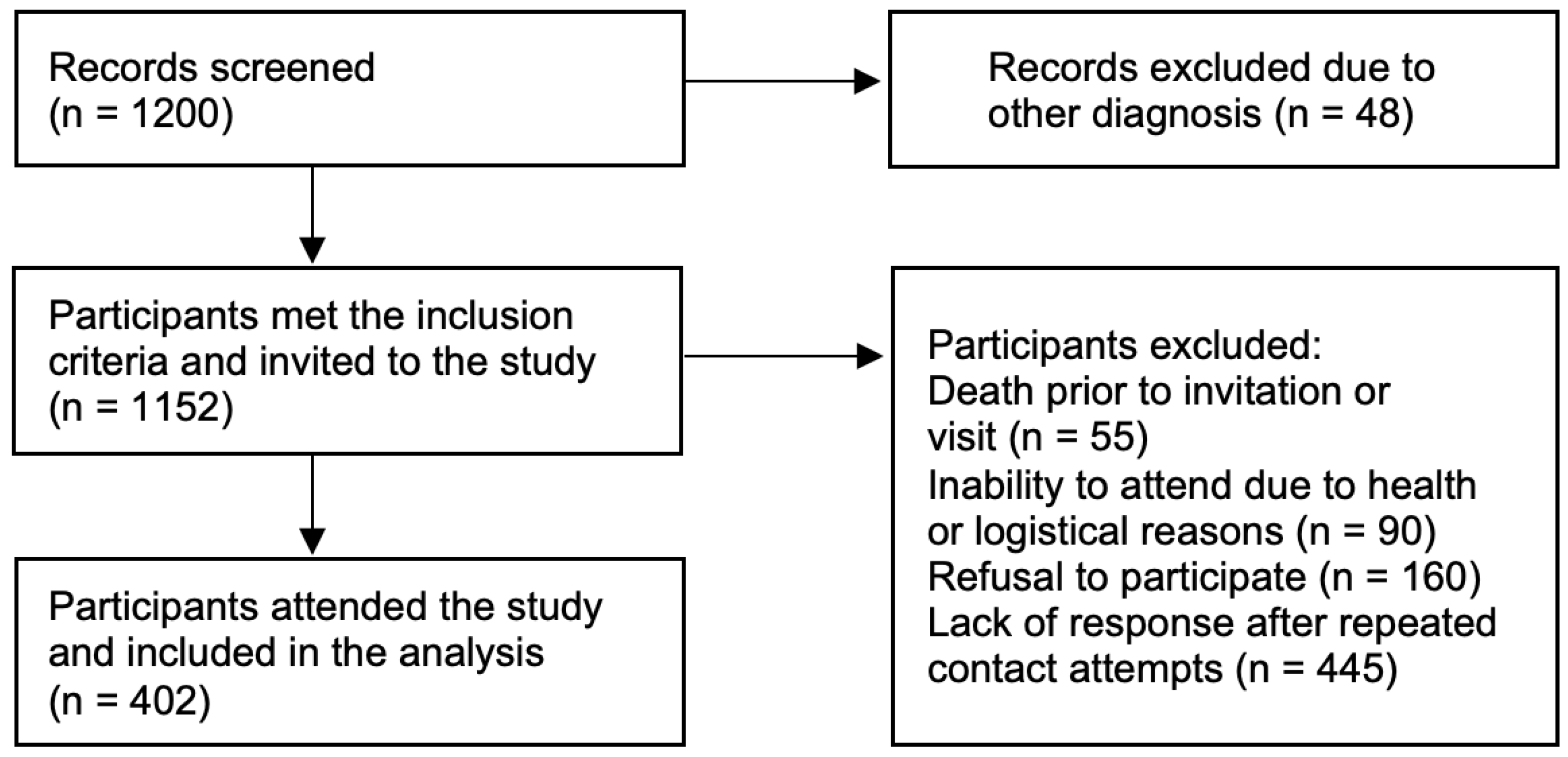
A total of 1200 patients were identified from hospital registries and screened for eligibility (Figure 1). Of these, 1152 met the inclusion criteria and were invited to participate in the study. Among invited patients, 402 attended the study visit and completed the interview and examination, while 750 did not participate. Reasons for non-participation included death prior to invitation or visit (55), inability to attend due to health or logistical reasons (90), refusal to participate (160), and a lack of response after repeated contact attempts (445). The response rate was 29.7% in Almaty (201/677) and 42.3% in Aktobe (201/475). Participants were younger than non-participants (46.3% vs. 56.5% aged ≥65 years at the index event, p < 0.001), a difference observed in both centers, whereas the proportion of men was similar (63.7% vs. 60.8%, p = 0.337) (Table S9).
Figure 1.
Flowchart of patient enrollment.
Based on IPAQ-SF scoring, 152 participants (37.8%) were classified as having low physical activity, 183 (45.5%) as moderately active, and 67 (16.7%) as highly active (Table 1). Therefore, 250 participants (62.2%) were in the moderate/high IPAQ-SF category (moderate/high PA).
Table 1.
Physical activity volume and intensity, including group comparisons.
A long-standing illness, disability, or infirmity was reported by 162 participants (40.3%) and was more frequent in the low-PA group (47.4% vs. 36.0%, p = 0.007). Among these 162 participants, 109 (67.3%) stated that the condition limited their physical activity, without a significant between-group difference (73.6% vs. 62.2%, p = 0.068).
Walking was reported by 347 participants (86.3%), whereas only 80 (19.9%) reported any moderate-intensity activity and 47 (11.7%) any vigorous-intensity activity. The median contribution of walking to total energy expenditure was 100% of total MET-min/week (IQR 100–100) in the cohort as a whole, and remained 100% (IQR 71–100) in the moderate/high-PA group. Median total physical activity was 1015 MET-min/week (IQR 347–2079).
All indices of activity volume differed markedly between groups. Median total activity was 198 MET-min/week (IQR 0–462) in the low-PA group versus 1386 MET-min/week (IQR 990–3039) in the moderate/high-PA group (p < 0.001), and the same pattern was seen for walking (198 vs. 1386 MET-min/week; p < 0.001) and moderate activity (p < 0.001). Vigorous activity had a median of 0 MET-min/week in both groups (p = 0.063). Among participants classified as low PA, 99 (65.1%) reported any walking, while only eight (5.3%) reported any moderate and eight (5.3%) any vigorous activity. Sitting time did not differ between groups (median 6 h/day [IQR 4–8] in both, p = 0.554).
Self-reported activity outside work mirrored the IPAQ classification (p < 0.001), with 254 participants (63.2%) describing only light activity in most weeks, 49 (12.2%) reporting no weekly activity, and only 79 (19.7%) reporting vigorous activity at least once weekly (Table S1). The intention to exercise also differed between groups: 85 low-PA participants (55.9%) reported neither exercising nor intending to do so within the next six months compared to 67 (26.8%) in the moderate/high-PA group, whereas 84 moderate/high PA participants (33.6%) reported exercising regularly for more than six months versus 15 (9.9%) in the low-PA group.
When adherence was assessed from moderate- and vigorous-intensity activity alone, only 29 participants (7.2%, 95% CI 4.9–10.2) met WHO/ESC recommendations and 373 (92.8%) did not (Tables S3 and S4). Of the 250 participants in the moderate/high-PA group, 26 (10.4%) met recommendations. Among those who met recommendations, walking contributed a median of 33% (IQR 22–46) of total MET-min/week, compared with 100% among those who did not (Table S4).
The median age of the cohort was 64.0 years (IQR 58.0–71.0), with 280 participants (69.7%) were aged 60 years or older, while 256 (63.7%) were male (Table 2). Most participants identified as Kazakh or of another Asian background (298/402, 74.1%), were married (303/402, 75.4%), lived with somebody (370/402, 92.0%), and resided in urban or suburban areas (365/402, 90.8%). Reported income was at the middle level for 378 participants (94.0%), 263 (65.4%) had a primary education, and 273 (68.4%) were not employed or had retired in the preceding six months. The median time from the index coronary event to the study visit was 9.0 months (IQR 8.0–11.0). Recruitment was balanced between centers by design (201 participants per center) and demonstrated a significantly higher prevalence of low PA in Aktobe compared to Almaty (46.8% vs. 28.9%, p < 0.001).
Table 2.
Sociodemographic characteristics with group comparisons.
Index diagnosis was unstable angina or acute ischemia in 171 participants (42.5%), STEMI in 81 (20.1%), NSTEMI in 78 (19.4%), and elective revascularization in 72 (17.9%), with no difference between activity groups (p = 0.798, Table 3). Cardiac rehabilitation attendance was reported by 160 participants (40.3%) and was likewise similar in the two groups (39.3% vs. 40.9%, p = 0.759). The cohort carried a high comorbidity burden: 368 participants (91.5%) had arterial hypertension, 174 (43.8%) had diabetes, 155 (38.6%) were current smokers, and 104 (25.9%) had chronic kidney disease. None of these differed significantly by activity group.
Table 3.
Clinical and behavioral characteristics with group comparisons.
Differences were confined to adiposity, ventricular function, and psychological and sleep-related measures. Median BMI was higher in the low-PA group (29.7 kg/m2 vs. 28.6 kg/m2, p = 0.044), and obesity (BMI ≥ 30 kg/m2) was more frequent (46.7% vs. 34.0%, p = 0.011). The waist-to-height ratio and central adiposity categories did not differ (p > 0.05). Median LVEF was modestly lower in the low-PA group (52.0% vs. 54.0%, p = 0.039), although the categorical distribution of LVEF was not significantly different (p = 0.217). Poor sleep quality was more common in the low-PA group (43.7% vs. 32.8%, p = 0.029), as was depression according to the HADS-D scores (34.9% vs. 16.0%, p < 0.001). HADS-A did not differ between groups (p = 0.319).
Advice to increase everyday physical activity was the most received recommendation, reported by 264 participants (66.5%), followed by specific advice from a health or exercise professional (191, 48.5%), joining a community walking group (116, 29.4%), and attending a fitness club (88, 22.3%, Table 4). For each recommendation, the proportion of patients who reported acting on the advice was significantly lower than the proportion who received it (McNemar p < 0.001 for all four): 213 participants (53.9%) reported doing more everyday activity, 120 (31.2%) followed specific professional advice, 42 (10.8%) joined a walking group, and 22 (5.6%) attended a fitness club.
Table 4.
Physical activity recommendations received and their adherence by physical activity group.
Adherence among those advised was 69.8% for general activity, 53.6% for specific professional advice, 22.4% for walking groups, and 9.1% for fitness clubs. Adherence differed sharply by activity group for the two advice-based recommendations: general everyday activity (51.6% in the low-PA group vs. 79.5% in the moderate/high-PA group, p < 0.001) and specific professional advice (25.4% vs. 66.9%, p < 0.001). No difference was found for facility- or group-based recommendations, where uptake was low in both groups (fitness club 12.0% vs. 7.9%, p = 0.683; walking group 21.1% vs. 23.1%, p = 1.000).
On the EQ-5D, the low-PA group reported more problems across four of the five dimensions (Table 5). Any problems with mobility were reported by 59 low-PA participants (39.1%) versus 56 moderate/high-PA participants (22.4%) (p < 0.001), any problems with self-care by 24 (15.9%) versus eight (3.2%) (p < 0.001), and any problems with usual activities by 52 (34.4%) versus 46 (18.4%) (p < 0.001). The anxiety/depression dimension also differed (p = 0.003), whereas pain/discomfort did not (p = 0.288). The EQ-VAS score was identical between groups (median 75 [IQR 60–80], p = 0.445).
Table 5.
EuroQol 5D questionnaire and PA grouping.
Individual PRISMA-7 items followed the same direction (Table S2). Health problems limiting activities (44.4% vs. 33.2%, p = 0.025), needing regular help (18.5% vs. 6.4%, p < 0.001), health problems requiring the patient to stay at home (30.5% vs. 14.8%, p < 0.001) and the regular use of a walking aid (10.6% vs. 4.0%, p = 0.009) were all more frequent in the low-PA group. However, the total PRISMA-7 score (median 2.0 in both groups, p = 0.276) and the dichotomized risk-of-frailty category (36.2% vs. 29.2%, p = 0.145) did not differ significantly.
In the unadjusted logistic regression, recruitment at the Aktobe center (OR 2.17, 95% CI 1.44–3.28, p < 0.001), obesity (OR 1.70, 95% CI 1.13–2.57, p = 0.012), receipt of professional exercise advice (OR 0.63, 95% CI 0.41–0.94, p = 0.026), and absence of depression on the HADS-D (OR 0.36, 95% CI 0.22–0.57, p < 0.001) were associated with the odds of low physical activity (Table 6).
Table 6.
Odds of low physical activity using unadjusted and adjusted logistic regression models.
All four associations persisted in the multivariable model. Patients recruited in Aktobe had substantially higher adjusted odds of low physical activity than those in Almaty (aOR 3.76, 95% CI 1.98–7.34, p < 0.001). The increase from the crude estimate (OR 2.33 in the same complete-case sample) reflected negative confounding by several covariates that were more favorable in Aktobe and were associated with lower odds of low PA. The largest contributions came from receipt of professional exercise advice (56.1% in Aktobe vs. 39.8% in Almaty) and a longer interval since the index event; removing either from the full model reduced the center ORs to 3.06 and 3.24, respectively. A lower prevalence of frailty risk (20.6% vs. 42.4%) and chronic kidney disease (12.2% vs. 39.3%) in Aktobe contributed to a smaller extent, and no single covariate accounted for the change (Table S8). Obesity remained independently associated with low activity (aOR 1.68, 95% CI 1.04–2.69, p = 0.033). Conversely, receiving professional exercise advice (aOR 0.45, 95% CI 0.27–0.73, p = 0.001) and the absence of depressive symptoms (aOR 0.42, 95% CI 0.23–0.76, p = 0.004) were associated with lower odds of low activity. A longer interval since the index event was also associated with lower odds of low activity, although the estimate was of borderline significance (aOR 0.87 per additional month, 95% CI 0.76–0.99; p = 0.047). The adjusted model was fitted on 380 complete cases with 140 events. The associations with study center, obesity, professional exercise advice, and depressive symptoms were materially unchanged in the Firth penalized model and in the parsimonious model, whereas the association with time since the index event was attenuated (parsimonious model aOR 0.89, 95% CI 0.78–1.00, p = 0.069) (Table S6). Bootstrap validation indicated optimism in the full model (optimism-corrected AUC 0.663, calibration slope 0.64), which was smaller in the parsimonious model (0.682 and 0.85, respectively; Table S7).
No independent association was observed for age, sex, living location, education, social support, sitting time, smoking, alcohol consumption, hypertension, diabetes, chronic kidney disease, left ventricular function, index diagnosis, cardiac rehabilitation attendance, PRISMA-7 frailty risk, HADS-A score, or EQ-VAS score.
For the guideline-based outcome (Table S5), not meeting WHO/ESC recommendations was associated—after adjustment for age, sex, and study center—with recruitment in Aktobe (aOR 3.27, 95% CI 1.47–7.98), older age (aOR 1.25 per 5 years, 95% CI 1.02–1.54), and LVEF < 50% (aOR 2.70, 95% CI 1.08–7.98), whereas the absence of depressive symptoms (aOR 0.19, 95% CI 0.02–0.75) and cardiac rehabilitation attendance (aOR 0.40, 95% CI 0.18–0.89) were associated with lower odds. Obesity (aOR 1.17, 95% CI 0.53–2.76) and professional exercise advice (aOR 0.67, 95% CI 0.30–1.45) were not associated with this outcome.
Model performance and diagnostics are presented in the Supplementary Materials (Figures S1–S3 and Table S7).
4. Discussion
Our primary findings of the study indicate that 37.8% of patients with coronary heart disease were in the low IPAQ-SF physical activity category, and only 7.2% met WHO/ESC recommendations when walking was excluded. Recruitment at the Aktobe center, obesity, depressive symptoms, the absence of professional exercise advice, and a shorter interval since the index event were independently associated with low-PA odds. Beyond the dichotomous classification, the pattern of activity was as informative as its volume. Activity in this cohort was almost entirely walking. Overall, 86.3% reported walking, whereas only 19.9% reported any moderate-intensity activity and 11.7% any vigorous-intensity activity, and the median contribution of walking to total energy expenditure was 100% of MET-min/week. Median vigorous activity was zero in both activity groups. Finally, although physical activity advice was commonly delivered, the proportion of patients who acted on it was consistently and significantly lower than the proportion who received it, and the uptake of structured, facility-based options was minimal.
This study positions the Kazakhstan-based cohort within the broader context of secondary prevention failures [24,25,26]. A previous study based on the EUROASPIRE V registry showed that 66% of patients across 27 countries were classified as insufficiently active [9,10]. It is worth noting that this might reflect the inclusion of low-intensity walking in our moderate/high-PA category, and the EUROASPIRE V study was conducted approximately a decade ago. A recent global INTERASPIRE study demonstrated a similar result to EUROAPIRE V, with 67% not reaching target levels of physical activity, thus confirming that optimal guideline adherence remains the exception rather than the rule [27]. Studies using the IPAQ for patients with established coronary disease have reported inactivity in 76% of a Jordanian cohort, 86.7% of an Indian cohort, 56.7% in Sri Lanka, and 56.3% in a Brazilian acute coronary syndrome sample [28,29,30,31]. From a nationwide perspective, the prevalence of low PA in our cohort was about twice that reported for the general adult population of Kazakhstan, in which 19.7% of 6720 adults were insufficiently active [32]. Differences in age structure and survey methods limit this comparison, and the cross-sectional design does not allow the difference to be attributed to the CHD diagnosis.
The most clinically salient finding is arguably not the proportion classified as inactive but the near-total absence of moderate and vigorous activity across the whole cohort. Because the IPAQ-SF assigns walking a fixed metabolic value and counts it toward the moderate-activity totals used for categorization, a patient whose activity consists exclusively of unhurried walking can be classified as meeting recommended levels. In our data, walking accounted for a median of 100% of total MET-min/week, even within the moderate/high-PA group. When walking was excluded, only 7.2% of the cohort and 10.4% of the moderate/high-PA group met WHO/ESC recommendations through moderate- or vigorous-intensity activity. Because the IPAQ-SF does not record walking pace, true guideline adherence probably lies between this figure and the 62.2% classified as moderate/high PA. The study center and participants’ depressive symptoms were also associated with this stricter outcome, whereas obesity and professional advice were not, possibly reflecting the small number of adherent patients. Validation studies support this concern directly; in patients with coronary artery disease assessed before cardiac rehabilitation, the IPAQ-SF overestimated moderate-to-vigorous activity relative to tri-axial accelerometry, and similar overestimation has been demonstrated in patients with heart failure [33,34].
The higher prevalence of low PA in Aktobe persisted after adjustment and became stronger, because patients in Aktobe more often had characteristics associated with higher activity, such as the receipt of professional exercise advice and a longer interval since the index event (Table S8). The remaining difference may reflect regional differences in climate, built environment or the organization of follow-up care [35]. Meta-analysis of seasonal movement patterns found that sedentary behavior peaks in winter while light activity and moderate-to-vigorous activity peak in summer [36]. Aktobe experiences a longer and more severe cold season than Almaty, and cold-weather air pollution and temperature inversions may further discourage outdoor activity, compounded by the recognized winter excess of cardiovascular events [37,38,39]. However, the season of assessment was not recorded, so a climatic explanation could not be examined directly and should be regarded as a hypothesis.
Obesity was independently associated with low PA, a relationship that is plausibly bidirectional. Although some analyses have described an obesity paradox in coronary and heart failure populations, this apparent protective effect largely disappears once cardiorespiratory fitness is accounted for, and fitness rather than adiposity emerges as the dominant prognostic determinant [40,41]. Depression was among the strongest correlates of inactivity in our cohort, 34.9% of the low-PA group screened positive on the HADS-D compared with 16.0% of the active group, and the absence of depressive symptoms remained independently associated with lower odds of low PA after adjustment. The corresponding EQ-5D anxiety/depression dimension differed in the same direction, whereas HADS anxiety did not, suggesting that the association is relatively specific to depressive rather than anxious symptomatology. Depression affects a substantial minority of patients after an acute coronary syndrome and is an established predictor of non-adherence to medical treatment generally and in coronary disease specifically [42,43,44]. The relationship with physical activity is bidirectional. Higher activity levels are associated with a lower subsequent risk of depression in dose–response meta-analysis, while depressive symptoms reduce motivation, self-efficacy, and engagement with rehabilitation [45].
Patients who reported receiving professional exercise advice had less than half the adjusted odds of low physical activity. This is consistent with meta-analytic evidence that physical activity promotion delivered through primary care increases the odds of meeting recommended activity levels after 12 months, and that interventions delivered or prompted by health professionals produce modest but real increases in moderate-to-vigorous activity [46,47]. The counseling delivered, however, translated inconsistently into behavior. While advice was common, for each recommendation received, the proportions of patients who acted were significantly lower than the proportion advised (McNemar p < 0.001 throughout). For recommendations a patient can enact independently, adherence differed sharply between activity groups: 51.6% of low activity versus 79.5% of active patients increased their everyday activity, and 25.4% versus 66.9% followed specific professional advice. For recommendations requiring access to external facilities or organized groups, uptake was uniformly poor irrespective of the activity level (fitness club 12.0% vs. 7.9%; walking group 21.1% vs. 23.1%; both non-significant). This dissociation may suggest that facility-based options are limited by structural rather than motivational barriers. Costs, transport, distance, and limited local provisions are consistently identified as dominant barriers to structured exercise participation, particularly in lower-resource settings. Given Cochrane’s evidence that home-based and center-based cardiac rehabilitation produce comparable outcomes in mortality, exercise capacity, and quality of life—with some evidence favoring home-based programs for adherence and completion—home-based and digitally supported models may merit evaluation in settings where uptake of facility-based options was low; however, this implication was not tested directly in our study [48,49].
To our knowledge, this is the first detailed characterization of physical activity in patients requiring secondary prevention of coronary heart disease in Kazakhstan, and among the few from Central Asia. The study’s strengths include consecutive recruitment across two geographically distinct centers; a standardized protocol combining structured interview; validated instruments and clinical examination; verification of self-reported data against discharge documentation; and the simultaneous assessment of clinical, functional, psychological, and behavioral domains.
Study Limitations
Several limitations should be considered when interpreting these findings. First, physical activity was measured only by self-report with the IPAQ-SF, which is prone to recall and social desirability bias, and overestimates moderate-to-vigorous activity compared with accelerometry in cardiac patients [33,34]. Because the IPAQ-SF does not record walking pace, brisk and unhurried walking could not be separated, so adherence to WHO/ESC recommendations could only be bounded (between 7.2% and 62.2%) rather than measured directly. The questionnaire also does not distinguish occupational from leisure-time activity, which may have different cardiovascular effects [50]. Second, the cross-sectional design does not allow causal inference, and reverse causation is plausible for each association reported: depressive symptoms, obesity, and functional limitations may be both consequences and causes of inactivity, and more active patients may be more likely to recall or seek professional advice. Third, the study was conducted in two urban centers, with only 9.2% of participants living in rural areas compared to 36.2% of the national population [51], which limits its generalizability to rural patients and to the country as a whole.
Fourth, selection bias is possible. Only 34.9% of invited patients took part, with a lower response in Almaty (29.7%) than in Aktobe (42.3%). Participants were younger than non-participants, patients who died or could not attend for health reasons (n = 145) were not examined, and the index diagnosis of non-participants was not recorded, so this comparison could not be made. Because older and sicker patients tend to be less active, the prevalence of low PA is more likely to be underestimated than overestimated. Recruitment stopped once each center reached its target of 201 participants; this rule was administrative and unrelated to activity levels, but the unequal response rates may have contributed to the differences observed between centers.
Fifth, the differences between centers should be interpreted cautiously. With only two centers, the study-center variable combines several regional factors, including climate, built environment, organization of follow-up care, and local data collection, which cannot be separated. The season of assessment was not recorded, so the climatic explanation could not be tested, and although both centers used the same protocols, case report forms, and trained interviewers, interviewer effects cannot be fully excluded.
Sixth, the receipt of exercise advice, cardiac rehabilitation attendance, and adherence to recommendations were self-reported and not verified against clinical records. Recall of advice may have differed by activity level, which could exaggerate the associations with advice and adherence. Depressive and anxiety symptoms were measured with the HADS, which is a screening instrument and not a clinical diagnosis, and the interval since the index event ranged from 6 to 24 months, during which activity may have changed.
Seventh, the adjusted model had fewer than 10 events per parameter. The main associations were consistent in penalized and parsimonious models, but bootstrap validation indicated overfitting of the full model (calibration slope 0.64), so the magnitude of individual estimates, particularly the borderline association with time since the index event, should be interpreted with caution. Only 29 participants met WHO/ESC recommendations, so the guideline-based analysis was adjusted only for age, sex and study center, and its estimates are imprecise. No formal power calculation was performed for the regression analyses, and the descriptive comparisons were not corrected for multiple testing and should be regarded as exploratory.
Finally, residual confounding cannot be excluded. Medication use, angina severity, cardiorespiratory fitness, and more detailed socioeconomic measures were not included in the models, and activity before the index event was not recorded, so changes in activity after the event could not be assessed.
5. Conclusions
In conclusion, more than one in three patients with CHD were in the low IPAQ-SF physical activity category, and fewer than one in ten met WHO/ESC recommendations through moderate- or vigorous-intensity activity. Obesity, depressive symptoms, the absence of professional exercise advice, and the center of recruitment were independently associated with low physical activity. The gap between advice given and advice acted upon was consistent across all recommendations, and the uptake of facility-based options was minimal. Given the cross-sectional design and substantial non-participation, these associations do not establish causality. Specific, repeated, and individually tailored counseling; home-based or digitally supported formats; and attention to regional disparities in provisions are potential implications that require evaluation in interventional studies. Future work should incorporate device-based activity measurement and longitudinal follow-up, and it should extend recruitment to rural populations, which were substantially underrepresented here.
Supplementary Materials
The following supporting information can be downloaded at: https://www.mdpi.com/article/10.3390/ijerph23111347/s1, Figure S1. Receiver-operating-characteristic (ROC) curve for the multivariable logistic regression model of low physical activity; Figure S2. Calibration plot for the multivariable logistic regression model of low physical activity; Figure S3. Multicollinearity diagnostics for the multivariable logistic regression model of low physical activity; Table S1. Self-reported activity level, exercise regularity and IPAQ scoring criteria by physical activity group; Table S2. PRISMA-7 frailty questionnaire by physical activity group; Table S3. Sociodemographic and clinical characteristics by adherence to WHO/ESC physical activity recommendations; Table S4. Physical activity volume and intensity, professional advice, EQ-5D and PRISMA-7 by adherence to WHO/ESC recommendations; Table S5. Odds of not meeting WHO/ESC physical activity recommendations: Firth penalized logistic regression; Table S6. Sensitivity analyses of the main model: standard, Firth penalized and parsimonious logistic regression; Table S7. Model performance, collinearity and bootstrap internal validation of the multivariable models of low physical activity; Table S8. Change-in-estimate analysis for the association between study center and low physical activity; Table S9. Comparison of participants and non-participants by study center.
Author Contributions
K.D. contributed to conceptualization, data curation, funding acquisition, and reviewing and editing the manuscript; D.D. contributed to writing the original draft, formal analysis, resources, investigation, and visualization; B.A. and B.Z. contributed to project administration, data curation, methodology, resources, and supervision; M.K. contributed to data curation, formal analysis, and supervision; G.K., V.M., N.Y., F.I., L.A., M.P., J.K. and G.O. contributed to data curation; A.M. contributed to formal analysis, writing the original draft, and validation; D.O. contributed to investigation, validation, and reviewing and editing the manuscript. All authors have read and agreed to the published version of the manuscript.
Funding
This research was funded by the Science Committee of the Ministry of Science and Higher Education of the Republic of Kazakhstan (Grant No. AP23489421).
Institutional Review Board Statement
The study was performed in accordance with the Declaration of Helsinki and was approved by the Local Ethics Committee of Kazakh National Medical University (protocol No. 144; 28 November 2023).
Informed Consent Statement
All participants provided written informed consent before participation.
Data Availability Statement
The data presented in this study are available on request from the corresponding author.
Acknowledgments
The authors express their gratitude for the administrative and technical support provided by the staff of Asfendiyarov Kazakh National Medical University, West Kazakhstan Marat Ospanov Medical University, and the Research Institute of Cardiology and Internal Diseases.
Conflicts of Interest
The authors declare no conflicts of interest. The funders had no role in the design of the study; in the collection, analyses, or interpretation of data; in the writing of the manuscript; or in the decision to publish the results.
Abbreviations
The following abbreviations are used in this manuscript:
| AMI | Acute Myocardial Infarction |
| BMI | Body Mass Index |
| CABG | Coronary Artery Bypass Grafting |
| CHD | Coronary Heart Disease |
| CI | Confidence Interval |
| CVD | Cardiovascular Disease |
| CVS | Cardiovascular System |
| DALY | Disability-Adjusted Life Year |
| IPAQ-SF | International Physical Activity Questionnaire—Short Form |
| IQR | Interquartile Range |
| MACE | Major Adverse Cardiovascular Event |
| MET | Metabolic Equivalent of Task |
| OR | Odds Ratio |
| PA | Physical Activity |
| PCI | Percutaneous Coronary Intervention |
| STEMI | ST-Elevation Myocardial Infarction |
| VAS | Visual Analogue Scale (from EuroQol-VAS) |
| WHtR | Waist-to-Height Ratio |
References
- Visseren, F.L.J.; Mach, F.; Smulders, Y.M.; Carballo, D.; Koskinas, K.C.; Bäck, M.; Benetos, A.; Biffi, A.; Boavida, J.-M.; Capodanno, D.; et al. 2021 ESC Guidelines on Cardiovascular Disease Prevention in Clinical Practice. Eur. Heart J. 2021, 42, 3227–3337. [Google Scholar] [CrossRef] [Scilit]
- Virani, S.S.; Newby, L.K.; Arnold, S.V.; Bittner, V.; Brewer, L.C.; Demeter, S.H.; Dixon, D.L.; Fearon, W.F.; Hess, B.; Johnson, H.M.; et al. 2023 AHA/ACC/ACCP/ASPC/NLA/PCNA Guideline for the Management of Patients with Chronic Coronary Disease: A Report of the American Heart Association/American College of Cardiology Joint Committee on Clinical Practice Guidelines. Circulation 2023, 148, E9–E119, Erratum in Circulation 2023, 148, e148. https://doi.org/10.1161/CIR.0000000000001183. Erratum in Circulation 2023, 148, e186. https://doi.org/10.1161/CIR.0000000000001195. [Google Scholar] [CrossRef] [Scilit]
- Global Burden of Cardiovascular Diseases and Risks 2023 Collaborators. Global, Regional, and National Burden of Cardiovascular Diseases and Risk Factors in 204 Countries and Territories, 1990–2023. JACC 2025, 86, 2167–2243. [Google Scholar] [CrossRef] [Scilit]
- WHO. WHO Guidelines on Physical Activity and Sedentary Behaviour, 1st ed.; World Health Organization: Geneva, Switzerland, 2020. [Google Scholar]
- Gonzalez-Jaramillo, N.; Wilhelm, M.; Arango-Rivas, A.M.; Gonzalez-Jaramillo, V.; Mesa-Vieira, C.; Minder, B.; Franco, O.H.; Bano, A. Systematic Review of Physical Activity Trajectories and Mortality in Patients with Coronary Artery Disease. J. Am. Coll. Cardiol. 2022, 79, 1690–1700. [Google Scholar] [CrossRef] [Scilit]
- Zhao, X.; Zhang, S.; Zhang, F.; Wu, X.; Zhang, Z.; Liu, Y.; Jiang, J.; Li, Z.; Li, S.; Zheng, S.; et al. Barriers and Facilitators to Adherence to Exercise-Based Cardiac Rehabilitation Among Coronary Artery Disease Patients: A Scoping Review. J. Multidiscip. Healthc. 2025, 18, 2825–2844. [Google Scholar] [CrossRef] [Scilit]
- Graham, H.; Prue-Owens, K.; Kirby, J.; Ramesh, M. Systematic Review of Interventions Designed to Maintain or Increase Physical Activity Post-Cardiac Rehabilitation Phase II. Rehabil. Process Outcome 2020, 9, 1179572720941833. [Google Scholar] [CrossRef] [Scilit]
- Davletov, K.; Davletov, D.; Zholdin, B.; Kulimbet, M.; Osser, D.; Kurmanalina, G.; Medovchshikov, V.; Yeshniyazov, N.; Ibragimova, F.; Makhmutov, A.; et al. Prevalence and Determinants of Poor Sleep Quality Among Patients with Established Coronary Heart Disease in Kazakhstan: A Multi-Center Cross-Sectional Study. Med. Sci. 2026, 14, 439. [Google Scholar] [CrossRef] [Scilit]
- Kotseva, K.; De Backer, G.; De Bacquer, D.; Rydén, L.; Hoes, A.; Grobbee, D.; Maggioni, A.; Marques-Vidal, P.; Jennings, C.; Abreu, A.; et al. Lifestyle and Impact on Cardiovascular Risk Factor Control in Coronary Patients across 27 Countries: Results from the European Society of Cardiology ESC-EORP EUROASPIRE V Registry. Eur. J. Prev. Cardiol. 2019, 26, 824–835. [Google Scholar] [CrossRef] [Scilit]
- Fras, Z.; Jankowski, P.; Jug, B.; Gaita, D.; Wood, D.A.; De Bacquer, D.; Kotseva, K. Physical Activity in Patients with Coronary Heart Disease: Results from the EUROASPIRE V Survey. Eur. Heart J. 2020, 41, ehaa946.2881. [Google Scholar] [CrossRef] [Scilit]
- Cheng, H.L. A simple, easy-to-use spreadsheet for automatic scoring of the International Physical Activity Questionnaire (IPAQ) Short Form (updated November 2016). ResearchGate, 2016. [CrossRef]
- Craig, C.L.; Marshall, A.L.; Sjöström, M.; Bauman, A.E.; Booth, M.L.; Ainsworth, B.E.; Pratt, M.; Ekelund, U.; Yngve, A.; Sallis, J.F.; et al. International Physical Activity Questionnaire: 12-Country Reliability and Validity. Med. Sci. Sports Exerc. 2003, 35, 1381–1395. [Google Scholar] [CrossRef] [Scilit]
- NICE. Overweight and Obesity Management. In National Institute for Health and Care Excellence: Clinical Guidelines; National Institute for Health and Care Excellence (NICE): London, UK, 2026. [Google Scholar]
- Marx, N.; Federici, M.; Schütt, K.; Müller-Wieland, D.; Ajjan, R.A.; Antunes, M.J.; Christodorescu, R.M.; Crawford, C.; Di Angelantonio, E.; Eliasson, B.; et al. 2023 ESC Guidelines for the Management of Cardiovascular Disease in Patients with Diabetes. Eur. Heart J. 2023, 44, 4043–4140. [Google Scholar] [CrossRef] [Scilit]
- American Diabetes Association Professional Practice Committee for Diabetes; Bajaj, M.; McCoy, R.G.; Balapattabi, K.; Bannuru, R.R.; Bellini, N.J.; Bennett, A.K.; Beverly, E.A.; Briggs Early, K.; ChallaSivaKanaka, S.; et al. 2. Diagnosis and Classification of Diabetes: Standards of Care in Diabetes—2026. Diabetes Care 2026, 49, S27–S49. [Google Scholar] [CrossRef] [Scilit]
- McEvoy, J.W.; McCarthy, C.P.; Bruno, R.M.; Brouwers, S.; Canavan, M.D.; Ceconi, C.; Christodorescu, R.M.; Daskalopoulou, S.S.; Ferro, C.J.; Gerdts, E.; et al. 2024 ESC Guidelines for the Management of Elevated Blood Pressure and Hypertension. Eur. Heart J. 2024, 45, 3912–4018. [Google Scholar] [CrossRef] [Scilit]
- Ramani, V.K.; Mhaske, M.; Naik, R. Assessment of Carbon Monoxide in Exhaled Breath Using the Smokerlyzer Handheld Machine: A Cross-Sectional Study. Tob. Use Insights 2023, 16, 1179173X231184129. [Google Scholar] [CrossRef] [Scilit]
- Raîche, M.; Hébert, R.; Dubois, M.-F. PRISMA-7: A Case-Finding Tool to Identify Older Adults with Moderate to Severe Disabilities. Arch. Gerontol. Geriatr. 2008, 47, 9–18. [Google Scholar] [CrossRef] [Scilit]
- Devlin, N.; Parkin, D.; Janssen, B. An Introduction to EQ-5D Instruments and Their Applications. In Methods for Analysing and Reporting EQ-5D Data; Springer International Publishing: Cham, Switzerland, 2020; pp. 1–22. [Google Scholar]
- Buysse, D.J.; Reynolds, C.F.; Monk, T.H.; Berman, S.R.; Kupfer, D.J. The Pittsburgh Sleep Quality Index: A New Instrument for Psychiatric Practice and Research. Psychiatry Res. 1989, 28, 193–213. [Google Scholar] [CrossRef] [Scilit]
- Carpi, M. The Pittsburgh Sleep Quality Index: A Brief Review. Occup. Med. 2025, 75, 14–15, Erratum in Occup. Med. 2025, 75, 214. https://doi.org/10.1093/occmed/kqaf038. [Google Scholar] [CrossRef] [Scilit]
- Montazeri, A.; Vahdaninia, M.; Ebrahimi, M.; Jarvandi, S. The Hospital Anxiety and Depression Scale (HADS): Translation and Validation Study of the Iranian Version. Health Qual. Life Outcomes 2003, 1, 14. [Google Scholar] [CrossRef] [Scilit]
- Zigmond, A.S.; Snaith, R.P. The Hospital Anxiety and Depression Scale. Acta Psychiatr. Scand. 1983, 67, 361–370. [Google Scholar] [CrossRef] [Scilit]
- Guthold, R.; Stevens, G.A.; Riley, L.M.; Bull, F.C. Global Trends in Insufficient Physical Activity among Adolescents: A Pooled Analysis of 298 Population-Based Surveys with 1·6 Million Participants. Lancet Child Adolesc. Health 2020, 4, 23–35. [Google Scholar] [CrossRef] [Scilit]
- Guthold, R.; Stevens, G.A.; Riley, L.M.; Bull, F.C. Worldwide Trends in Insufficient Physical Activity from 2001 to 2016: A Pooled Analysis of 358 Population-Based Surveys with 1·9 Million Participants. Lancet Glob. Health 2018, 6, e1077–e1086, Erratum in Lancet Glob. Health 2019, 7, e36. https://doi.org/10.1016/S2214-109X(18)30454-6. [Google Scholar] [CrossRef] [Scilit]
- Strain, T.; Flaxman, S.; Guthold, R.; Semenova, E.; Cowan, M.; Riley, L.M.; Bull, F.C.; Stevens, G.A.; Abdul Raheem, R.; Agoudavi, K.; et al. National, Regional, and Global Trends in Insufficient Physical Activity among Adults from 2000 to 2022: A Pooled Analysis of 507 Population-Based Surveys with 5·7 Million Participants. Lancet Glob. Health 2024, 12, e1232–e1243, Erratum in Lancet Glob. Health 2025, 13, e202. https://doi.org/10.1016/S2214-109X(24)00533-3. [Google Scholar] [CrossRef] [Scilit]
- McEvoy, J.W.; Jennings, C.; Kotseva, K.; De Bacquer, D.; De Backer, G.; Erlund, I.; Vihervaara, T.; Lip, G.Y.H.; Ray, K.K.; Rydén, L.; et al. Variation in Secondary Prevention of Coronary Heart Disease: The INTERASPIRE Study. Eur. Heart J. 2024, 45, 4184–4196. [Google Scholar] [CrossRef] [Scilit]
- Matthias, A.T.; De Silva, D.K.N.; Indrakumar, J.; Gunatilake, S.B. Physical Activity Levels of Patients Prior to Acute Coronary Syndrome—Experience at a Tertiary Care Hospital in Sri Lanka. Indian Heart J. 2018, 70, 350–352. [Google Scholar] [CrossRef] [Scilit]
- Alsaleh, E.; Baniyasin, F. Prevalence of Physical Activity Levels and Perceived Benefits of and Barriers to Physical Activity among Jordanian Patients with Coronary Heart Disease: A Cross-Sectional Study. Front. Public Health 2023, 10, 1041428. [Google Scholar] [CrossRef] [Scilit]
- Dhillon, S.; Kaur Kang, H. Depression and Physical Activity among Cardiac Patients Undergone Cardiac Events: A Correlational Study. Investig. Educ. Enferm. 2023, 41, e12. [Google Scholar] [CrossRef] [Scilit]
- Jorge, J.D.G.; Santos, M.A.A.; Barreto Filho, J.A.S.; Oliveira, J.L.M.; Melo, E.V.D.; Oliveira, N.A.D.; Faro, G.B.D.A.; Sousa, A.C.S. Level of Physical Activity and In-Hospital Course of Patients with Acute Coronary Syndrome. Arq. Bras. Cardiol. 2016, 106, 33–40. [Google Scholar] [CrossRef] [Scilit]
- Ibrayeva, A.; Shoranov, M.; Muminov, T.; Ismoldayev, Y.; Tanabayeva, S.; Fakhradiyev, I. Physical Activity Levels in Kazakhstan: A Cross-Sectional Nationwide Study on Demographic, Socioeconomic, and Regional Factors. Medicina 2025, 61, 1913. [Google Scholar] [CrossRef] [Scilit]
- Blasco-Peris, C.; Climent-Paya, V.; Vetrovsky, T.; García-Álvarez, M.I.; Manresa-Rocamora, A.; Beltrán-Carrillo, V.J.; Sarabia, J.M. International Physical Activity Questionnaire Short Form and Accelerometer-Assessed Physical Activity: Concurrent Validity Using Six Cut-Points in HF Patients. ESC Heart Fail. 2024, 11, 126–135. [Google Scholar] [CrossRef] [Scilit]
- Kambic, T.; Šarabon, N.; Hadžić, V.; Lainscak, M. Objectively Measured Physical Activity in Patients with Coronary Artery Disease: A Cross-Validation Study. Biosensors 2021, 11, 318. [Google Scholar] [CrossRef] [Scilit]
- Topothai, T.; Tangcharoensathien, V.; Edney, S.M.; Suphanchaimat, R.; Lekagul, A.; Waleewong, O.; Topothai, C.; Kulthanmanusorn, A.; Müller-Riemenschneider, F. Patterns and Correlates of Physical Activity and Sedentary Behavior among Bangkok Residents: A Cross-Sectional Study. PLoS ONE 2023, 18, e0292222. [Google Scholar] [CrossRef] [Scilit]
- Ferguson, T.; Curtis, R.; Fraysse, F.; Lagiseti, R.; Northcott, C.; Virgara, R.; Watson, A.; Maher, C.A. Annual, Seasonal, Cultural and Vacation Patterns in Sleep, Sedentary Behaviour and Physical Activity: A Systematic Review and Meta-Analysis. BMC Public Health 2021, 21, 1384. [Google Scholar] [CrossRef] [Scilit]
- Xu, T.; Song, Y.; Liu, M.; Cai, X.; Zhang, H.; Guo, J.; Zhu, T. Temperature Inversions in Severe Polluted Days Derived from Radiosonde Data in North China from 2011 to 2016. Sci. Total Environ. 2019, 647, 1011–1020. [Google Scholar] [CrossRef] [Scilit]
- Wu, P.; Guo, Q.; Zhao, Y.; Bian, M.; Cao, S.; Zhang, J.; Duan, X. Emerging Concern on Air Pollution and Health: Trade-off between Air Pollution Exposure and Physical Activity. Eco-Environ. Health 2024, 3, 202–207. [Google Scholar] [CrossRef] [Scilit]
- Fares, A. Winter Cardiovascular Diseases Phenomenon. N. Am. J. Med. Sci. 2013, 5, 266. [Google Scholar] [CrossRef] [Scilit]
- Sparks, J.R.; Wang, X.; Lavie, C.J.; Sui, X. Physical Activity, Cardiorespiratory Fitness, and the Obesity Paradox with Consideration for Racial and/or Ethnic Differences: A Broad Review and Call to Action. Rev. Cardiovasc. Med. 2024, 25, 291. [Google Scholar] [CrossRef] [Scilit]
- Lavie, C.J.; Cahalin, L.P.; Chase, P.; Myers, J.; Bensimhon, D.; Peberdy, M.A.; Ashley, E.; West, E.; Forman, D.E.; Guazzi, M.; et al. Impact of Cardiorespiratory Fitness on the Obesity Paradox in Patients with Heart Failure. Mayo Clin. Proc. 2013, 88, 251–258. [Google Scholar] [CrossRef] [Scilit]
- DiMatteo, M.R.; Lepper, H.S.; Croghan, T.W. Depression Is a Risk Factor for Noncompliance with Medical Treatment: Meta-Analysis of the Effects of Anxiety and Depression on Patient Adherence. Arch. Intern. Med. 2000, 160, 2101. [Google Scholar] [CrossRef] [Scilit]
- Gehi, A.; Haas, D.; Pipkin, S.; Whooley, M.A. Depression and Medication Adherence in Outpatients with Coronary Heart Disease: Findings from the Heart and Soul Study. Arch. Intern. Med. 2005, 165, 2508. [Google Scholar] [CrossRef] [Scilit]
- Berimavandi, M.; Abbasi, P.; Khaledi-Paveh, B.; Salari, N. Relationship Between Depression and Medication Adherence in Older Patients with Cardiovascular Disease: A Systematic Review and Meta-Analysis. Health Sci. Rep. 2025, 8, e70703. [Google Scholar] [CrossRef] [Scilit]
- Pearce, M.; Garcia, L.; Abbas, A.; Strain, T.; Schuch, F.B.; Golubic, R.; Kelly, P.; Khan, S.; Utukuri, M.; Laird, Y.; et al. Association Between Physical Activity and Risk of Depression: A Systematic Review and Meta-Analysis. JAMA Psychiatry 2022, 79, 550. [Google Scholar] [CrossRef] [Scilit]
- Kettle, V.E.; Madigan, C.D.; Coombe, A.; Graham, H.; Thomas, J.J.C.; Chalkley, A.E.; Daley, A.J. Effectiveness of Physical Activity Interventions Delivered or Prompted by Health Professionals in Primary Care Settings: Systematic Review and Meta-Analysis of Randomised Controlled Trials. BMJ 2022, 376, e068465. [Google Scholar] [CrossRef] [Scilit]
- Orrow, G.; Kinmonth, A.-L.; Sanderson, S.; Sutton, S. Effectiveness of Physical Activity Promotion Based in Primary Care: Systematic Review and Meta-Analysis of Randomised Controlled Trials. BMJ 2012, 344, e1389. [Google Scholar] [CrossRef] [Scilit]
- McDonagh, S.T.; Dalal, H.; Moore, S.; Clark, C.E.; Dean, S.G.; Jolly, K.; Cowie, A.; Afzal, J.; Taylor, R.S. Home-Based versus Centre-Based Cardiac Rehabilitation. Cochrane Database Syst. Rev. 2023, 2023, CD007130. [Google Scholar] [CrossRef] [Scilit]
- Şaylık, F. Digital Health Interventions in Patient Management Following Acute Coronary Syndrome: A Meta-Analysis of the Literature. Anatol. J. Cardiol. 2023, 27, 2–9. [Google Scholar] [CrossRef] [Scilit]
- Holtermann, A.; Schnohr, P.; Nordestgaard, B.G.; Marott, J.L. The Physical Activity Paradox in Cardiovascular Disease and All-Cause Mortality: The Contemporary Copenhagen General Population Study with 104 046 Adults. Eur. Heart J. 2021, 42, 1499–1511. [Google Scholar] [CrossRef] [Scilit]
- Department of Population Statistics. Population of the Republic of Kazakhstan by Gender and Type of Locality at the Beginning of 2026. 2026; p. 3. Available online: https://stat.gov.kz/en/industries/social-statistics/demography/publications/478310/ (accessed on 4 August 2026).

Disclaimer/Publisher’s Note: The statements, opinions and data contained in all publications are solely those of the individual author(s) and contributor(s) and not of MDPI and/or the editor(s). MDPI and/or the editor(s) disclaim responsibility for any injury to people or property resulting from any ideas, methods, instructions or products referred to in the content. |
© 2026 by the authors. Licensee MDPI, Basel, Switzerland. This article is an open access article distributed under the terms and conditions of the Creative Commons Attribution (CC BY) license.