


Highlights
Public health relevance—How does this work relate to a public health issue?
- Among eligible participants, institutionalized older adults with preserved cognition and without severe functional dependence presented poorer oral health indicators, including greater tooth loss and greater prosthetic need, than non-institutionalized participants.
- Differences in functional capacity and oral health across care settings identify groups that may require different levels of oral-health support; the cross-sectional design does not establish that care setting caused these differences.
Public health significance—Why is this work of significance to public health?
- Among the eligible participants studied, institutionalized and non-institutionalized older adults had similar GOHAI scores despite poorer clinical oral-health indicators in the institutionalized group. This discordance may be compatible with differences in expectations or adaptation, but these mechanisms were not directly measured.
- In an exploratory adjusted linear regression model, higher Decayed and Filled Root Surfaces (DFS) values were associated with lower GOHAI scores; this association should be interpreted cautiously because of the modest sample size and cross-sectional design.
Public health implications—What are the key implications or messages for practitioners, policymakers, and/or researchers in public health?
- For clinical practice, the findings support careful assessment of tooth loss, prosthetic need, and exposed/root-surface disease in older adults receiving institutional care.
- For policy and research, the results support improving access to oral assessment and rehabilitation in long-term care settings and evaluating the DFS–OHRQoL association in larger longitudinal studies.
Abstract
Global population aging requires healthcare strategies that address the needs of older adults. This cross-sectional study compared oral health conditions and functional dependence between institutionalized and non-institutionalized older adults and explored factors associated with Oral Health-Related Quality of Life (OHRQoL), measured using the Geriatric Oral Health Assessment Index (GOHAI). The sample comprised 113 older adults in Araraquara, Brazil (52 institutionalized and 61 non-institutionalized). Eligibility required preserved cognition and a Barthel Index score of 40–100; individuals with severe functional dependence, palliative care needs, major communication limitations, or cognitive impairment incompatible with the interview were excluded. Data included sociodemographic characteristics, Barthel Index, GOHAI, coronal caries experience (DMFT), Decayed and Filled Root Surfaces (DFS), number of teeth, and prosthetic needs. Institutionalized participants had a higher median age (81.0 vs. 76.0 years; p = 0.005), lower functional capacity (95.0 vs. 100.0; p < 0.001), fewer present teeth (1.5 vs. 18.0; p = 0.003), more missing teeth (30.5 vs. 14.0; p = 0.003), higher DMFT (32.0 vs. 26.0; p = 0.019), and greater need for an upper prosthesis (34.6% vs. 14.8%; p = 0.008). GOHAI did not differ significantly between groups. In an exploratory multiple linear regression model adjusted for age, functional capacity, care setting, DMFT, and prosthetic needs, higher DFS was associated with lower GOHAI (β = −0.735; 95% CI: −1.135 to −0.335; p < 0.001). Among eligible institutionalized older adults with preserved cognition and without severe functional dependence, clinical and functional indicators were poorer than among non-institutionalized participants, while perceived OHRQoL was similar between groups. These findings should not be generalized to more vulnerable long-term care residents who did not meet the eligibility criteria. The adjusted DFS association should be regarded as exploratory and require confirmation in larger longitudinal studies.
1. Introduction
Global population aging poses substantial challenges to healthcare systems and requires adaptations in public health policies and care strategies [1]. In this context, comprehensive approaches that address the continuum from functional independence to dependence are essential, while recognizing the heterogeneity of older adults’ living conditions and care needs [2,3].
In Brazil, the rapid demographic transition has increased the need for social and healthcare policies that promote autonomy, dignity, and access to appropriate care for older adults [4,5]. The Brazilian Statute of Older Adults and the National Health Policy for Older Adults provide important frameworks for comprehensive care and protection of this population [6,7]. However, the experiences and care needs of older adults may differ according to their living and care contexts, particularly between those living in long-term care institutions and those remaining in community settings.
Long-term care institutions for older adults (LTCIs) provide residential care and continuous support for individuals with greater cognitive, functional, motor, or social vulnerabilities [8]. Institutionalization, however, may be accompanied by reduced autonomy and greater dependence on caregivers for daily activities, potentially affecting self-care practices and access to healthcare services, including oral healthcare [9]. In contrast, older adults living in community settings may retain greater autonomy and social interaction through family, community, and healthcare support networks, which may facilitate the maintenance of daily self-care practices [10,11,12,13].
Oral health is an important component of overall health, well-being, and quality of life in older adults, as oral conditions can affect essential functions such as chewing, speaking, and swallowing [4,14,15]. Despite advances in oral healthcare policies in Brazil, older adults continue to experience a high burden of edentulism, dental caries, periodontal disease, and prosthetic needs [16,17]. These problems may be particularly relevant among institutionalized older adults, who may have greater difficulties maintaining oral hygiene because of functional limitations, dependence on caregivers, and restricted access to dental care [8]. Root caries is also an important oral health condition in older adults and may be influenced by factors such as gingival recession, xerostomia, and medication use [11,18].
Although the literature points to differences in oral health conditions and functional capacity between institutionalized and non-institutionalized older adults [10,12,13,19], further studies are needed to investigate how these factors relate to the subjective perception of oral health. This gap is relevant because oral health-related quality of life (OHRQoL) reflects the subjective perception of oral health and may be influenced by clinical oral conditions, functional capacity, and individual characteristics [13,15,20]. Therefore, the present study aimed to compare oral health conditions and functional capacity between institutionalized and non-institutionalized older adults and to investigate factors associated with OHRQoL, assessed using the Geriatric Oral Health Assessment Index (GOHAI).
2. Materials and Methods
The study was approved by the Ethics Committee for People of the Faculty of Dentistry of Araraquara (opinion n° 27225719.2.0000.5416). The selected participants signed the Informed Consent Form (ICF) before the beginning of the research.
This cross-sectional observational study was conducted between September 2025 and February 2026 in long-term care institutions (LTCIs) and community-based services for older adults (Community/Day Centers, Republic of the Elderly, Reference Center for the Elderly, and the Open University of the Third Age [UNATI]) in Araraquara, São Paulo, Brazil. In total, eight recruitment sites participated in the study. Reporting was revised with reference to the STROBE recommendations for cross-sectional studies [21].
Participants were recruited by non-probabilistic, voluntary sampling within the participating settings. Eligible individuals were aged 60 years or older, lived in or attended one of the selected care settings, had mild-to-moderate dependence (Barthel Index 40–95) or independence (100 points) [22], and had preserved cognition according to the validated Brazilian version of the Mini-Mental State Examination (MMSE) [23]. Cognitive eligibility was determined according to education-specific cutoff scores, following the validation criteria for the Brazilian population: illiterate—14 to 16 points; at least 4 years of formal education—18 to 21 points; from 4 to 7 years of schooling—20 to 21 points; complete elementary school—21 points; complete high school—22 to 23 points; and complete higher education—25 to 26 points; all for a total of 30 points.
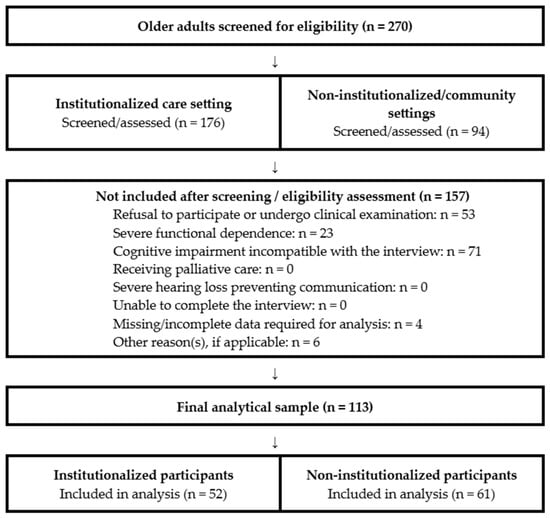
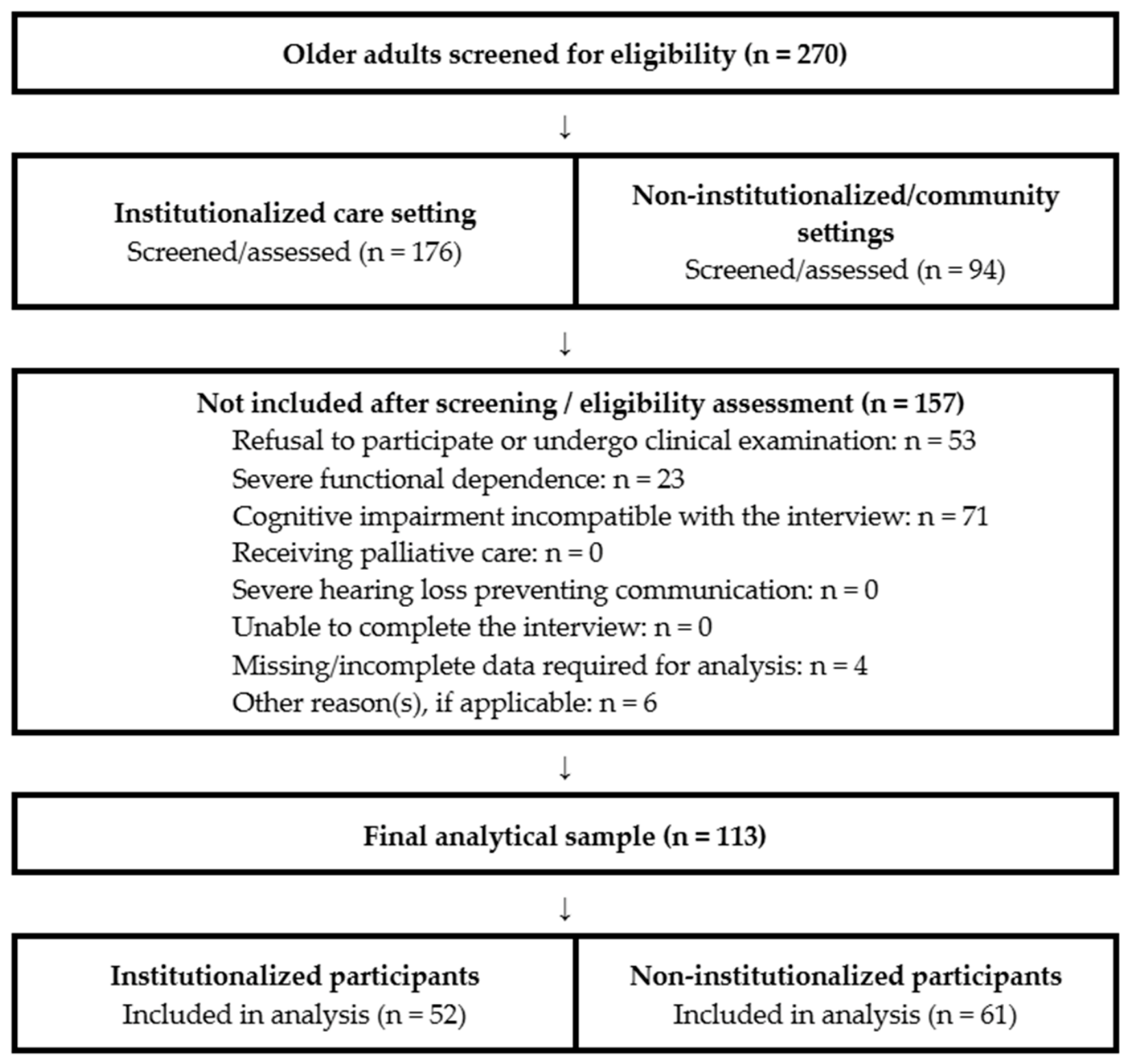
Initially, 270 older adults were screened. Information provided by institutional managers was used only for the initial identification of individuals with evident cognitive or functional limitations that could prevent participation. Final eligibility was determined according to the predefined study criteria. Individuals receiving palliative care, severe functional dependence, cognitive impairment incompatible with the interview, severe hearing loss preventing communication, refusal to undergo the clinical examination, or inability to complete the interview were excluded. The final analytical sample comprised 113 older adults, including 52 institutionalized and 61 non-institutionalized participants. Because this was a secondary analysis and complete denominators for all potentially eligible and non-participating individuals were not available in the analytical dataset, a reliable response rate could not be calculated. The participant recruitment and selection process is summarized in Figure 1.
Figure 1.
Participant flow diagram.
No a priori sample-size calculation was performed for this secondary analysis, which used data collected in a larger research project. All participants in the available dataset who met the eligibility criteria and had the variables required for the present analysis were included. The modest sample size was considered when specifying the multivariable model, which was intentionally limited to variables representing the main demographic, functional, care-setting, and oral-health domains of interest.
Two examiners were calibrated by a reference researcher before data collection. Inter-examiner and intra-examiner agreement was assessed using the Kappa coefficient, with values of 0.68 and 0.72, respectively, indicating substantial/good agreement for the recorded clinical conditions. Data was collected in face-to-face interviews and clinical examinations. The interview included sociodemographic characteristics, medical and oral-health history, functional assessment, and the Geriatric Oral Health Assessment Index (GOHAI), and its Brazilian Portuguese validated version was used [24,25]. The instrument comprises 12 items scored on a three-point scale, yielding a total score ranging from 12 to 36, with higher scores indicating better perceived OHRQoL. The same standardized data-collection forms and operational definitions were used across all participating settings.
Clinical oral-health assessment followed the World Health Organization criteria for oral-health surveys [26]. Coronal status was summarized using the Decayed, Missing, and Filled Teeth (DMFT) index. Exposed root surfaces were classified according to their clinical status, and Decayed and Filled Root Surfaces (DFS) summarized cumulative root-surface caries experience. Use and need for dental prostheses were also recorded according to WHO criteria. No radiographic examination was performed; therefore, diagnoses were based on the clinical examination only. Importantly, DFS represents cumulative decayed and restored root-surface experience and was not interpreted as a direct measure of active or symptomatic root caries.
Statistical analysis was performed in Jamovi, version 2.6 [27]. First, descriptive analyses were conducted. Categorical variables were summarized as n (%), and continuous variables were summarized as medians and interquartile ranges (IQR) because their distributions did not support parametric group comparisons. Second, bivariate comparisons between institutionalized and non-institutionalized groups used the Mann–Whitney U test for continuous variables and the chi-square test or Fisher’s exact test for categorical variables, as appropriate.
Third, an exploratory multiple linear regression model was fitted with the total GOHAI score treated as a continuous dependent variable. Predictors were specified to represent demographic (age), functional (Barthel Index), care-setting (institutionalized vs. non-institutionalized), coronal disease experience (DMFT), root-surface disease experience (DFS), and prosthetic-need domains (upper and lower prosthetic need). Variables were entered simultaneously (Enter method). Multicollinearity was assessed using the variance inflation factor (VIF). Regression coefficients (β), standard errors (SE), 95% confidence intervals (95% CI), p-values, R2, and adjusted R2 were reported. Residual diagnostics included graphical assessment of residuals and Q–Q plots. Given the sample size, cross-sectional design, and correlation expected among oral-health indicators, the multivariable analysis was interpreted as exploratory rather than confirmatory. Statistical significance was set at p < 0.05. The regression analysis used complete cases. Because the model included n = 113, corresponding to the full analytical sample, no participant was excluded from the regression due to missing data in the variables entered into the model. In addition to the VIF, model diagnostics were expanded to include inspection of residuals versus fitted values, Q–Q plots, leverage, and Cook’s distance to assess potential heteroscedasticity, non-linearity, and influential observations. Heteroscedasticity-robust standard errors were calculated using the HC1 covariance estimator. Because GOHAI is a bounded score (12–36) and scores were concentrated near the upper end of the scale, the assumptions underlying ordinary least-squares regression were interpreted cautiously. Median quantile regression was therefore used as a sensitivity analysis.
3. Results
The sociodemographic characteristics of participants are presented in Table 1. Institutionalized participants had a higher median age than non-institutionalized participants (81.0 years, IQR 74.8–85.3 vs. 76.0 years, IQR 71.0–81.0; p = 0.005). Women predominated in both groups (65.4% and 60.7%, respectively), with no statistically significant between-group difference in gender (p = 0.604).
Table 1.
Characterization of the sample of institutionalized and non-institutionalized older adults in Araraquara/SP, 2026.
3.1. Sociodemographic Evaluation
Marital status differed between groups (p = 0.048). Widowed participants were the most frequent category in both groups (52.0% institutionalized; 39.3% non-institutionalized), whereas married participants were more frequent among non-institutionalized older adults (31.1% vs. 9.6%). White participants and those with incomplete elementary education predominated in both groups, without statistically significant differences in ethnicity or education.
Functional capacity, assessed using the Barthel Index, was lower among institutionalized participants (median 95, IQR 75.0–100.0) than among non-institutionalized participants (median 100, IQR 95.0–100.0; p < 0.001). Median GOHAI scores were 33 (IQR 27.0–34.0) and 34 (IQR 29.0–34.0), respectively, with no statistically significant difference between groups (p = 0.349).
3.2. Oral Health Conditions
Table 2 summarizes oral health conditions. Institutionalized participants had fewer present teeth (p = 0.003), more missing teeth (p = 0.003), fewer filled teeth (p = 0.005), and a higher median DMFT than non-institutionalized participants (32.0, IQR 25.8–32.0 vs. 26.0, IQR 17.0–32.0; p = 0.019). No statistically significant differences were observed in healthy or decayed coronal teeth.
Table 2.
Oral conditions and use and need for dental prostheses in institutionalized and non-institutionalized older adults in Araraquara/SP, 2026.
For root surfaces, median DFS did not differ significantly between groups (0.0, IQR 0.0–1.0 vs. 0.0, IQR 0.0–2.0; p = 0.263). Filled root surfaces differed between groups (p = 0.047), whereas decayed root surfaces did not (p = 0.364). The need for an upper prosthesis was higher among institutionalized participants (34.6% vs. 14.8%; p = 0.008). The lower-prosthesis comparison yielded p = 0.050 and was not interpreted as statistically significant under the predefined p < 0.05 criterion.
3.3. Factors Associated with GOHAI
In the exploratory multiple linear regression model (Table 3), the included predictors explained 16.0% of the variance in GOHAI scores (R2 = 0.160; adjusted R2 = 0.104). After simultaneous adjustment for age, Barthel Index, care setting, DMFT, and upper and lower prosthetic needs, higher DFS was associated with lower GOHAI scores (β = −0.735; 95% CI: −1.135 to −0.335; p < 0.001). No statistically significant adjusted associations were observed for age, Barthel Index, care setting, DMFT, or prosthetic needs. Given the modest sample size, correlated clinical indicators, and the exploratory nature of the analysis, this finding should be interpreted as an adjusted association rather than as evidence of a causal relationship. No evidence of problematic multicollinearity was observed, with VIF values ranging from 1.03 to 1.41. The adjusted R2 of 0.104 indicates that, after accounting for the number of predictors, the model explained approximately 10.4% of the variability in GOHAI; therefore, most variation in the outcome remained unexplained. This limited explanatory capacity reinforces the exploratory nature of the model and the possibility of imprecision and residual confounding.
Table 3.
Exploratory multiple linear regression analysis of factors associated with GOHAI scores among institutionalized and non-institutionalized older adults. Araraquara/SP, 2026.
Sensitivity analyses using heteroscedasticity-robust standard errors and quantile (median) regression were performed given evidence of residual non-normality. The association between DFS and GOHAI remained consistent in direction and magnitude across methods (quantile regression: β = −0.674; p < 0.001), although statistical significance was attenuated when robust standard errors were applied (p = 0.063), reflecting the influence of heteroscedasticity on the classical OLS model. Residual diagnostics indicated some deviation from normality and evidence of heteroscedasticity. Accordingly, heteroscedasticity-robust standard errors were estimated using the HC1 covariance estimator. The association between DFS and GOHAI remained consistent in direction and magnitude in median quantile regression (β = −0.674; p < 0.001), whereas statistical significance was attenuated when HC1 robust standard errors were applied (p = 0.063). Leverage and Cook’s distance were additionally examined to assess influential observations.
4. Discussion
Among the eligible participants included in this study, institutionalized older adults with preserved cognition and without severe functional dependence had poorer clinical oral-health indicators and greater functional dependence than non-institutionalized participants, while GOHAI scores were similar between groups. The empirical findings therefore support a difference in objective clinical and functional status across the two groups studied, but they do not demonstrate that institutionalization itself caused these differences or altered OHRQoL. An alternative, non-mutually exclusive explanation is a ceiling effect; GOHAI scores were concentrated near the upper end of the scale in both groups (medians of 33–34 out of 36), which may have limited the instrument’s sensitivity to detect true between-group differences in OHRQoL, independent of any adaptation process.
To distinguish the levels of inference, three points should be separated. First, the present study directly observed between-group differences in age, marital status, functional capacity, tooth loss, DMFT, and upper prosthetic need. Second, previous literature has described relationships involving functional dependence, caregiver assistance, difficulties with daily oral hygiene, and access to oral-health care among institutionalized older adults [9,11,15,28]. Adaptation to tooth loss and response-shift mechanisms have also been discussed as possible explanations for discordance between clinical status and patient-reported oral-health outcomes [13,20,29,30]. Third, these mechanisms were not directly tested in the present dataset and should therefore not be interpreted as explanations for the observed differences between care settings.
The apparent discordance between poorer clinical status and similar GOHAI scores should be interpreted cautiously. OHRQoL is a patient-reported construct and may not vary in parallel with clinical indices [13,15,20]. The literature describes adaptation, recalibration of expectations, and related response-shift phenomena as possible explanations for differences between objective health status and patient-reported outcomes [29]. However, response shift requires dedicated, generally longitudinal assessment and was not measured in this cross-sectional study. Thus, adaptation and low expectations are hypotheses that may help contextualize the findings, not conclusions derived from the present data.
Institutionalized participants were older and had lower Barthel Index scores. These are direct findings of the study. Previous literature suggests that functional limitations can make daily oral hygiene and access to dental care more difficult, particularly when assistance from caregivers is required [11,20,21]. In the present adjusted model, however, the Barthel Index was not significantly associated with GOHAI, and no interaction between functional dependence and oral-health indicators was tested. Therefore, any pathway linking dependence, self-care, oral disease, and OHRQoL remains a plausible mechanism for future investigation rather than an observed mechanism in this dataset. In addition, marital status differed between groups, whereas socioeconomic conditions, lifetime access to dental care, systemic diseases, medication burden, xerostomia, and the availability or intensity of assistance with oral hygiene were not measured in sufficient detail for adjustment. Previous studies and reviews indicate that several of these factors may be relevant to oral-health conditions and care needs in older and institutionalized populations [11,18,28,31]. Therefore, the observed differences in age and functional capacity should not be interpreted as establishing a pathway from institutionalization to poorer oral health.
The institutionalized group also had fewer present teeth, more missing teeth, and higher DMFT. Because the missing component predominated, the higher DMFT mainly reflects accumulated lifetime tooth loss rather than evidence of more active coronal caries at examination. This pattern is consistent with systematic reviews reporting greater edentulism, fewer remaining teeth, and higher prosthetic needs among institutionalized older adults [26,28]. These are descriptive between-group differences. The present study cannot determine whether they reflect care setting itself, pre-existing differences before institutionalization, accumulated lifetime dental-care experiences, socioeconomic circumstances, systemic health, medication-related factors, oral-hygiene support, or other unmeasured determinants. These alternative pathways are consistent with factors discussed in prior studies of oral health among older adults and long-term care residents [11,18,28,31], but they were not directly evaluated in the present dataset.
The greater need for upper prostheses among institutionalized participants is clinically relevant because tooth loss and inadequate prosthetic rehabilitation may compromise chewing, speech, swallowing, aesthetics, and social well-being [8,28,29,30,31]. Nevertheless, prosthetic need was not significantly associated with GOHAI in the adjusted model. This again illustrates that clinical need and subjective impact are related but non-equivalent dimensions of oral health.
The DFS index requires particularly careful interpretation. DFS combines decayed and filled root surfaces and therefore reflects cumulative root-surface caries experience; it is not synonymous with active root caries, pain, or hypersensitivity [32,33,34,35]. In this sample, median DFS did not differ between care-setting groups. Nevertheless, higher DFS was associated with lower GOHAI in the adjusted linear model. Because the model is exploratory and the sample is modest, this result should be considered hypothesis-generating and should not be interpreted as proof that active root caries is the causal determinant of OHRQoL.
There are plausible clinical reasons why root-surface disease experience could relate to perceived oral health. When root lesions are active or symptomatic, they may be accompanied by pain, dentin hypersensitivity, and discomfort during mastication, with potential effects on the functional and psychosocial dimensions captured by OHRQoL measures [24,31,32,33]. These mechanisms were not measured directly here. The present result therefore supports further investigation of root-surface conditions alongside cumulative indices such as DMFT, rather than establishing DFS as a superior or causal predictor.
The absence of a statistically significant adjusted association between care setting and GOHAI also deserves emphasis. The institutionalized group differed from the non-institutionalized group in age, functional capacity, tooth loss, and prosthetic need, yet these differences were not mirrored by a significant difference in GOHAI. Possible explanations described in previous research include adaptation to tooth loss, low expectations regarding oral health, absence of current symptoms, competing general-health priorities, and normalization of edentulism [13,15,20,30]. These factors were not directly assessed and remain hypotheses. Accordingly, these literature-based explanations are presented only as contextual hypotheses and should not be used to attribute the observed clinical or patient-reported differences to institutionalization.
From a clinical perspective, the findings support comprehensive oral assessment of older adults in LTCIs, including remaining teeth, prosthetic needs, and root surfaces, without relying solely on self-perceived oral health to identify treatment needs. At the service and policy level, the poorer clinical profile observed among institutionalized participants supports attention to access to preventive, restorative, and prosthetic care in LTCIs. These are implications arising from observed unmet clinical needs, not evidence that a specific intervention will improve OHRQoL. These implications concern the oral-health needs observed in the eligible institutionalized participants and do not establish that limited access, caregiver dependence, or institutional residence caused the poorer clinical profile.
Future research should test the observed DFS–GOHAI association in larger samples and longitudinal designs, with more complete measurement of potential confounders and mediators such as pain, xerostomia, medication burden, cognitive status, oral-hygiene assistance, socioeconomic factors, and expectations regarding oral health. Longitudinal patient-reported outcome designs would also be required to evaluate response shift or adaptation directly. Although this finding was consistent across alternative modeling approaches, its statistical significance was attenuated under heteroscedasticity-robust estimation, suggesting some sensitivity to model assumptions and warranting cautious interpretation.
The multivariable findings should also be interpreted in light of the limited explanatory capacity and diagnostic constraints of the model. Seven predictors were entered simultaneously in a sample of 113 participants, and the adjusted R2 was 0.104, indicating that a substantial proportion of variation in GOHAI was not captured by the measured covariates. Thus, unmeasured determinants and residual confounding remain plausible. In addition, VIF values address multicollinearity only and do not establish homoscedasticity, linearity, normality of residuals, or absence of influential observations. The concentration of GOHAI scores near the upper boundary of the scale further challenges the approximation of a normally distributed continuous outcome. For these reasons, the OLS results are considered exploratory and are interpreted together with residual, leverage, and influence diagnostics and with the robust standard-error and quantile-regression sensitivity analyses.
The main limitations of this study include its cross-sectional design, which precludes establishing causal relationships between institutionalization, functional dependence, oral health conditions, and OHRQoL, as well as the inclusion of participants from a single municipality, which may limit the generalizability of the findings to other social and healthcare settings. In addition, participants were recruited through non-probabilistic and voluntary procedures, and some eligible older adults declined participation, which may have introduced selection bias. Furthermore, individuals with severe functional dependence or cognitive impairment were excluded, which may have led to an underrepresentation of the most clinically vulnerable long-term care residents and further limits the generalizability of the findings to the broader institutionalized population. The non-institutionalized group was also recruited from heterogeneous community settings, including day centers, a reference center, and a university program for older adults, which may differ in levels of social support and access to healthcare; this heterogeneity was not accounted for in the analysis. The present analysis was derived from a larger research project, and no a priori sample size calculation was performed specifically for this analysis. Therefore, the findings should be interpreted with caution regarding their generalizability to the broader population of institutionalized and non-institutionalized older adults. Nevertheless, the study is strengthened by the comparison of different care contexts and by the integrated assessment of clinical, functional, and subjective oral health indicators, including their association with OHRQoL.
Important potential confounders were not available or were not measured in sufficient detail, including socioeconomic conditions, lifetime access to and use of dental care, systemic diseases, medication burden, xerostomia, and the level of support received for daily oral hygiene. These factors have been identified or discussed in previous studies as relevant to oral-health conditions and care needs among older adults, including those living in long-term care settings [11,18,29,31]. Because their distribution may differ between institutionalized and non-institutionalized participants, they may have contributed to the observed differences in oral-health indicators. Consequently, residual confounding cannot be excluded, and the comparisons between care settings should be interpreted as descriptive associations rather than evidence of a causal effect of institutionalization.
This selection mechanism is particularly relevant for the institutionalized group. Because residents with severe functional dependence, cognitive impairment incompatible with the interview, palliative care needs, or major communication limitations were excluded, the institutionalized participants included in the study may represent a comparatively healthier and more functionally able subgroup of long-term care residents. Greater dependency and vulnerability are common concerns in long-term care populations, and dependence on caregivers for oral hygiene and substantial oral-health treatment needs have been described in this setting [8,11,19,29]. Accordingly, the observed clinical and OHRQoL findings may underestimate the burden experienced by more vulnerable residents, and their applicability to the broader institutionalized population should therefore be considered limited.
5. Conclusions
Eligible institutionalized older adults with preserved cognition and without severe functional dependence in this sample presented greater functional dependence, greater tooth loss, higher DMFT, and greater need for upper prosthetic rehabilitation than non-institutionalized participants. GOHAI scores did not differ significantly between groups, and care setting was not significantly associated with GOHAI in the adjusted model.
Higher DFS was associated with lower GOHAI in the exploratory adjusted linear regression model; although this association was attenuated under heteroscedasticity-robust estimation, it remained consistent in direction and magnitude across sensitivity analyses (quantile regression), supporting its interpretation as a genuine but modest signal rather than a robust, confirmed finding. However, DFS represents cumulative decayed and filled root-surface experience and should not be interpreted as a measure of active or symptomatic root caries. Clinically, the findings support comprehensive oral assessment in LTCIs, including tooth loss, prosthetic needs, and root surfaces. At the service/policy level, they identify treatment needs within the eligible population studied. These conclusions apply specifically to institutionalized older adults with preserved cognition and without severe functional dependence and should not be extrapolated to residents with severe dependence, substantial cognitive impairment, palliative care needs, or major communication limitations, who may have distinct and potentially greater oral-health care needs. For research, the DFS–OHRQoL association and hypotheses concerning adaptation or response shift require confirmation in larger longitudinal studies before causal or practice-changing conclusions are drawn.
The datasets analyzed during the current study are not publicly available because they form part of an ongoing larger research project whose analyses and publications are still in progress. In addition, ethical and privacy considerations regarding the participants preclude public data sharing at this stage.
Author Contributions
Conceptualization, I.d.M.C. and F.L.R.; methodology, I.d.M.C. and A.B.C.C.; software, I.d.M.C.; validation, L.A.P.P., S.H.d.C.S.P., A.C.d.R. and F.L.R.; formal analysis, L.E.G.; investigation, I.d.M.C. and A.B.C.C.; resources, I.d.M.C. and A.B.C.C.; data curation, I.d.M.C.; writing—original draft preparation, I.d.M.C.; writing—review and editing, L.E.G., F.L.R. and L.A.P.P.; visualization, S.H.d.C.S.P. and A.C.d.R.; supervision, F.L.R.; project administration, F.L.R. and L.A.P.P.; funding acquisition, F.L.R. All authors have read and agreed to the published version of the manuscript.
Funding
This research was funded by Pró-Reitoria de Pesquisa da UNESP (PROPe), grant number 14/2024.
Institutional Review Board Statement
The study was approved by the Ethics Committee for People of the Faculty of Dentistry of Araraquara (opinion n° 27225719.2.0000.5416). Approval Date: 27 August 2025.
Informed Consent Statement
Informed consent was obtained from all subjects involved in the study.
Data Availability Statement
Data are unavailable due to privacy restrictions.
Acknowledgments
During the preparation of this manuscript/study, the author used Elicit for literature review. The authors have reviewed and edited the output and take full responsibility for the content of this publication. All authors have read and agreed to the published version of the manuscript.
Conflicts of Interest
The authors declare no conflicts of interest.
Abbreviations
The following abbreviations are used in this manuscript:
| OHRQoL | Oral Health Related Quality of Life |
| DFS | Decayed and Filled Root Surfaces |
| GOHAI | Geriatric Oral Health Assessment Index |
| DMFT | Decayed, Missing and Filled Teeth |
| LTCI | Long-Term Care for the Elderly |
| BADL | Basic Activities of Daily Living |
| ICF | Informed Consent Form |
| MMSE | Mini-Mental State Examination |
| WHO | World Health Organization |
| IQR | Interquartile Range |
References
- Mobasseri, K.; Kousha, A.; Allahverdipour, H.; Matlabi, H. Developing a comprehensive model of home-based formal care for elderly adults in Iran: A study protocol. PLoS ONE 2023, 18, e0284462. [Google Scholar] [CrossRef] [Scilit]
- Shao, Q.; Yuan, J.; Lin, J.; Huang, W.; Ma, J.; Ding, H. A SBM-DEA-based performance evaluation and optimization for social organizations participating in community and home-based elderly care services. PLoS ONE 2021, 16, e0248474. [Google Scholar] [CrossRef] [Scilit]
- Behr, L.C.; Simm, A.; Kluttig, A.; Großkopf, A. 60 years of healthy aging: On definitions, biomarkers, scores and challenges. Ageing Res. Rev. 2023, 88, 101934. [Google Scholar] [CrossRef] [Scilit]
- Castrejón-Pérez, R.C.; Borges-Yáñez, S.A.; Irigoyen-Camacho, M.E.; Cruz-Hervert, L.P. Negative impact of oral health conditions on oral health-related quality of life of community-dwelling elders in Mexico City: A population-based study. Geriatr. Gerontol. Int. 2017, 17, 744–752. [Google Scholar] [CrossRef] [Scilit]
- Soares, L.N.D.S.; Cabral, A.E.A.; Luz, S.B.D.A.; Lourenço, M.A.G.; Pazinatto, R.B.; Santos, B.S.D.M.; Melo, L.A.D. Sociodemographic, general health and oral health factors associated with difficulty in eating among elderly people: A cross-sectional study, Brazil, 2019. Epidemiol. Serv. Saúde 2025, 34, e20240678. [Google Scholar] [CrossRef] [Scilit]
- Ministério da Saúde. Política Nacional de Saúde Da Pessoa Idosa; Ministério da Saúde: Brasília, DF, Brazil, 2006. [Google Scholar]
- Ministério Da Saúde. Estatuto Do Idoso, 3rd ed.; Ministério da Saúde: Brasília, DF, Brazil, 2003. [Google Scholar]
- Ribeiro, A.E.; Santos, G.S.; Baldani, M.H. Edentulism, need for dentures, and self-perception of oral health among institutionalized older people. Saude Debate 2023, 47, 137. [Google Scholar] [CrossRef] [Scilit]
- Lourenço, L.F.L.; Santos, S.M.A. Institutionalization of Elderly and Family Care: Perspectives of Professionals from Long-Term Facilities. Cogitare Enferm. 2021, 26, e69459. [Google Scholar] [CrossRef] [Scilit]
- Akema, S.; Mameno, T.; Nakagawa, T.; Inagaki, H.; Fukutake, M.; Hatta, K.; Murotani, Y.; Tsujioka, Y.; Hagino, H.; Higashi, K.; et al. Relationship between occlusal force and psychological frailty in Japanese community-dwelling older adults: The Septuagenarians, Octogenarians, Nonagenarians Investigation with Centenarians study. J. Am. Geriatr. Soc. 2023, 71, 1819–1828. [Google Scholar] [CrossRef] [Scilit]
- Croonquist, C.G.; Dalum, J.; Skott, P.; Sjögren, P.; Wårdh, I.; Morén, E. Effects of domiciliary professional oral care for care-dependent elderly in nursing homes: Oral hygiene, gingival bleeding, root caries and nursing staff’s oral health knowledge and attitudes. Clin. Interv. Aging 2020, 15, 1305–1315. [Google Scholar] [CrossRef] [Scilit]
- Ferreira, O.G.L.; Maciel, S.C.; Costa, S.M.G.; Silva, A.O.; Moreira, M.A.S.P. Active aging and its relationship with functional Independence. Texto Contexto Enferm. 2012, 21, 513–518. [Google Scholar] [CrossRef] [Scilit]
- Tenani, C.F.; De Checchi, M.H.R.; da Cunha, I.P.; Mendes, K.L.C.; Soares, G.H.; Michel-Crosato, E.; Jamieson, L.; Ju, X.; Mialhe, F.L. Factors associated with poor oral health-related quality of life among non-institutionalized Brazilian older adults. Spec. Care Dent. 2021, 41, 391–398. [Google Scholar] [CrossRef] [Scilit]
- MacLeod, C.A.; Bu, F.; Rutherford, A.C.; Phillips, J.; Woods, R. Cognitive impairment negatively impacts allied health service uptake: Investigating the association between health and service use. SSM Popul. Health 2021, 13, 100720. [Google Scholar] [CrossRef] [Scilit]
- Saarela, R.K.T.; Hiltunen, K.; Kautiainen, H.; Roitto, H.M.; Mäntylä, P.; Pitkälä, K.H. Oral hygiene and health-related quality of life in institutionalized older people. Eur. Geriatr. Med. 2022, 13, 213–220. [Google Scholar] [CrossRef] [Scilit]
- Ministério da Saúde. Política Nacional de Saúde Bucal; Ministério da Saúde: Brasília, DF, Brazil, 2025. [Google Scholar]
- Ministério da Saúde. Projeto SB Brasil 2010: Pesquisa Nacional de Saúde Bucal: Resultados Principais; Ministério da Saúde: Brasília, DF, Brazil, 2012. [Google Scholar]
- Su, W.S.; Chang, C.Y. Root caries in older adults: A co-citation network analysis (1980–2023). Gerodontology 2024, 41, 446–451. [Google Scholar] [CrossRef] [Scilit]
- Bakker, M.H.; de Smit, M.J.; Valentijn, A.; Visser, A. Oral health assessment in institutionalized elderly: A scoping review. BMC Oral Health 2024, 24, 272. [Google Scholar] [CrossRef] [Scilit]
- Saliba, T.A.; Ortega, M.M.; Goya, K.K.; Moimaz, S.A.S.; Garbin, C.A.S. Influence of oral health on the quality of life of institutionalized and noninstitutionalized elderly people. Dent. Res. J. 2018, 15, 256–263. [Google Scholar] [CrossRef] [Scilit]
- Vandenbroucke, J.P.; von Elm, E.; Altman, D.G.; Gøtzsche, P.C.; Mulrow, C.D.; Pocock, S.J.; Poole, C.; Schlesselman, J.J.; Egger, M. Strengthening the Reporting of Observational Studies in Epidemiology (STROBE): Explanation and elaboration. PLoS Med. 2007, 4, e297. [Google Scholar] [CrossRef] [Scilit]
- Mahoney, F.I.; Barthel, D.W. Functional evaluation: The Barthel Index. Md. State Med. J. 1965, 14, 61–65. [Google Scholar]
- Bertolucci, P.H.F.; Brucki, S.M.D.; Campacci, S.R.; Juliano, Y. O mini-exame do estado mental em uma população geral: Impacto da escolaridade. Arq. Neuropsiquiatr. 1994, 52, 1–7. [Google Scholar] [CrossRef] [Scilit]
- Atchison, K.A.; Dolan, T.A. Development of the Geriatric Oral Health Assessment Index. J. Dent. Educ. 1990, 54, 680–687. [Google Scholar] [CrossRef] [Scilit]
- Vettore, M.V.; Rebelo, M.A.B.; Rebelo Vieira, J.M.; Cardoso, E.M.; Birman, D.; Leão, A.T.T. Psychometric Properties of the Brazilian Version of GOHAI among Community-Dwelling Elderly People. Int. J. Environ. Res. Public Health 2022, 19, 14725. [Google Scholar] [CrossRef] [Scilit]
- World Health Organization. Oral Health Surveys: Basic Methods, 5th ed.; World Health Organization: Geneva, Switzerland, 2013. [Google Scholar]
- jamovi—Open Statistical Software for the Desktop and Cloud. Available online: https://www.jamovi.org/ (accessed on 23 June 2026).
- Wong, F.M.F.; Ng, Y.T.Y.; Leung, W.K. Oral health and its associated factors among older institutionalized residents: A systematic review. Int. J. Environ. Res. Public Health 2019, 16, 4132. [Google Scholar] [CrossRef] [Scilit]
- Kimura, A.; Arakawa, H.; Noda, K.; Yamazaki, S.; Hara, E.S.; Mino, T.; Matsuka, Y.; Mulligan, R.; Kuboki, T. Response shift in oral health-related quality of life measurement in patients with partial edentulism. J. Oral Rehabil. 2012, 39, 44–54. [Google Scholar] [CrossRef] [Scilit]
- Emami, E.; De Souza, R.F.; Kabawat, M.; Feine, J.S. The impact of edentulism on oral and general health. Int. J. Dent. 2013, 2013, 498305. [Google Scholar] [CrossRef] [Scilit]
- Farias, I.P.S.E.; Sousa, S.A.; Almeida, L.F.D.; Santiago, B.M.; Pereira, A.C.; Cavalcanti, Y.W. Does non-institutionalized elders have a better oral health status compared to institutionalized ones? A systematic review and meta-analysis. Cien. Saude Colet. 2020, 25, 2177–2192. [Google Scholar] [CrossRef] [Scilit]
- Berkey, D.B.; Call, R.L.; Loupe, M.J. Oral health perceptions and self-esteem in non-institutionalized older adults. Gerodontics 1985, 1, 213–216. [Google Scholar]
- Maklennan, A.; Borg-Bartolo, R.; Roccuzzo, A.; Salerno, C.; Raabe, M.K.; Monterubbianesi, R.; Wierichs, R.J.; Esteves-Oliveira, M.; Giacaman, R.A.; Campus, G. Meta-analysis of global distribution of root-caries prevalence in middle-aged and elderly. Caries Res. 2024, 59, 298–314. [Google Scholar] [CrossRef] [Scilit]
- Ritter, A.V.; Shugars, D.A.; Bader, J.D. Root caries risk indicators: A systematic review of risk models. Community Dent. Oral Epidemiol. 2010, 38, 383–397. [Google Scholar] [CrossRef] [Scilit]
- León, S.; Rivera, M.; Payero, S.; Correa-Beltrán, G.; Hugo, F.N.; Giacaman, R.A. Assessment of oral health-related quality of life as a function of non-invasive treatment with high-fluoride toothpastes for root caries lesions in community-dwelling elderly. Int. Dent. J. 2019, 69, 58–66. [Google Scholar] [CrossRef] [Scilit]

Disclaimer/Publisher’s Note: The statements, opinions and data contained in all publications are solely those of the individual author(s) and contributor(s) and not of MDPI and/or the editor(s). MDPI and/or the editor(s) disclaim responsibility for any injury to people or property resulting from any ideas, methods, instructions or products referred to in the content. |
© 2026 by the authors. Licensee MDPI, Basel, Switzerland. This article is an open access article distributed under the terms and conditions of the Creative Commons Attribution (CC BY) license.