Review

Greenspace, Inflammation, Cardiovascular Health, and Cancer: A Review and Conceptual Framework for Greenspace in Cardio-Oncology Research


by
Jean C. Bikomeye
1,2,
Andreas M. Beyer
3,*,
Jamila L. Kwarteng
1,4 and
Kirsten M. M. Beyer
1,2,4,*
1
Institute for Health and Equity, Medical College of Wisconsin, 8701 Watertown Plank Rd., Milwaukee, WI 53226, USA
2
PhD Program in Public and Community Health, Division of Epidemiology & Social Sciences, Institute for Health and Equity, Medical College of Wisconsin, 8701 Watertown Plank Rd., Milwaukee, WI 53226, USA
3
Department of Medicine, Division of Cardiology, Cardiovascular and Cancer Center, Medical College of Wisconsin, 8701 Watertown Plank Rd., Milwaukee, WI 53226, USA
4
MCW Cancer Center, Medical College of Wisconsin, 8701 Watertown Plank Rd., Milwaukee, WI 53226, USA
*
Authors to whom correspondence should be addressed.
Int. J. Environ. Res. Public Health 2022, 19(4), 2426; https://doi.org/10.3390/ijerph19042426

Submission received: 15 January 2022 / Revised: 12 February 2022 / Accepted: 17 February 2022 / Published: 19 February 2022

Abstract

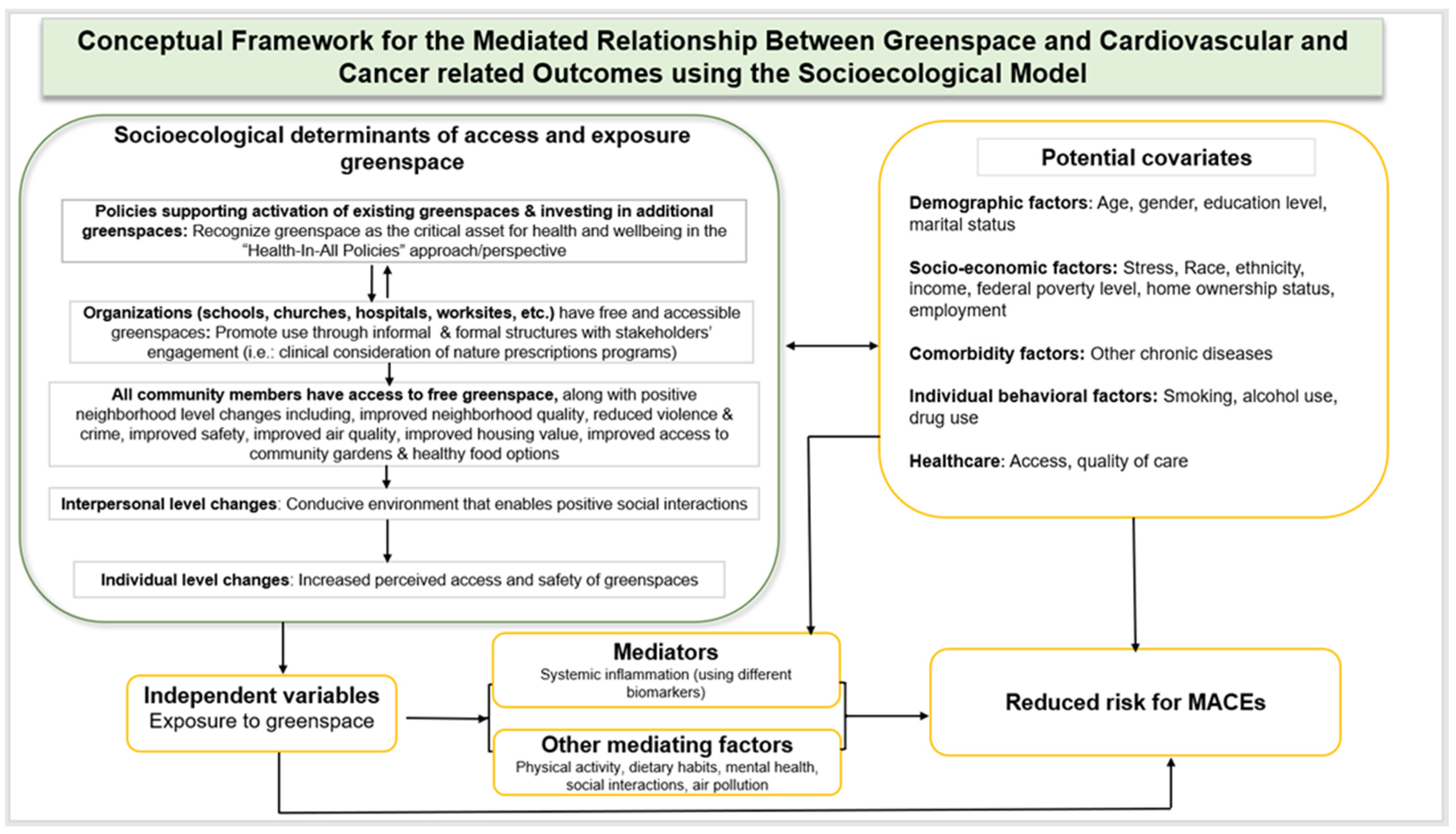
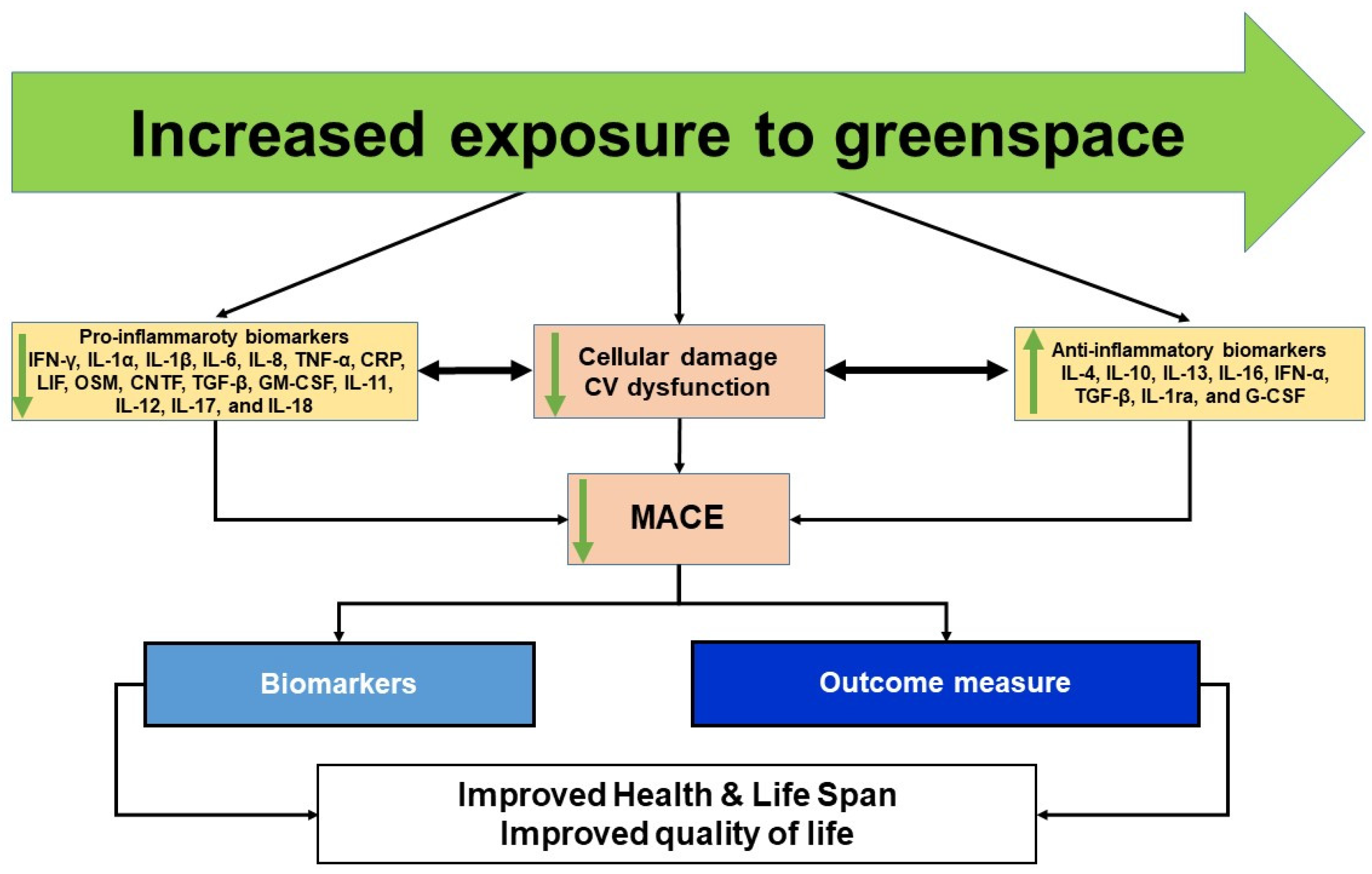
Cardiovascular disease (CVD) is a leading cause of global morbidity and mortality. Cancer survivors have significantly elevated risk of poor cardiovascular (CV) health outcomes due to close co-morbid linkages and shared risk factors between CVD and cancer, as well as adverse effects of cancer treatment-related cardiotoxicity. CVD and cancer-related outcomes are exacerbated by increased risk of inflammation. Results from different pharmacological interventions aimed at reducing inflammation and risk of major adverse cardiovascular events (MACEs) have been largely mixed to date. Greenspaces have been shown to reduce inflammation and have been associated with CV health benefits, including reduced CVD behavioral risk factors and overall improvement in CV outcomes. Greenspace may, thus, serve to alleviate the CVD burden among cancer survivors. To understand pathways through which greenspace can prevent or reduce adverse CV outcomes among cancer survivors, we review the state of knowledge on associations among inflammation, CVD, cancer, and existing pharmacological interventions. We then discuss greenspace benefits for CV health from ecological to multilevel studies and a few existing experimental studies. Furthermore, we review the relationship between greenspace and inflammation, and we highlight forest bathing in Asian-based studies while presenting existing research gaps in the US literature. Then, we use the socioecological model of health to present an expanded conceptual framework to help fill this US literature gap. Lastly, we present a way forward, including implications for translational science and a brief discussion on necessities for virtual nature and/or exposure to nature images due to the increasing human–nature disconnect; we also offer guidance for greenspace research in cardio-oncology to improve CV health outcomes among cancer survivors.
Keywords: greenspace; inflammation; cancer; cardiovascular disease (CVD); cardio-oncology; cancer treatment-related cardiotoxicity; cancer survivors; conceptual framework; socioecological model of health; major adverse cardiovascular events (MACEs) greenspace; inflammation; cancer; cardiovascular disease (CVD); cardio-oncology; cancer treatment-related cardiotoxicity; cancer survivors; conceptual framework; socioecological model of health; major adverse cardiovascular events (MACEs)