


Abstract
Background: The aim of the study was to assess the impact of having various sources of information in the field of first aid on the level of knowledge of dental and medical students, as well as to recognize if medical stereotypes exist in the domain of first aid. Methods: We tested 818 Native-(N) and English (E)—speaking students of medicine (M) and dentistry (D). The questionnaire was constructed in a way that it could detect the issues which created the biggest challenges to the students. It consisted of both theoretical and clinical questions. The intention was to find out whether there were any medical stereotypes. The students were asked to provide the sources of their knowledge to each question, and information about the presence of first aid classes at school. Results: We found medical stereotypes, but only in the questions pertaining to theory: questions concerning defibrillation, opening the airway in infants and the causes of airway obstruction of an unconscious adult. Correlations were found between the sources of knowledge with answers to the questions in each group of students and between the groups. The sources of knowledge in N students came mostly from school, or the students were not able (NA) to indicate the source of knowledge, but E groups gave out of school courses, mass media and their own knowledge (or from the others), as well as NA answers. Interestingly in ED group, among other answers, students also indicated schools as a source of their knowledge. Conclusions: We confirmed that medical stereotypes among dental and medical students exist, and they were not related to multiculturalism or the use of different sources of knowledge.
1. Background
The young people who want to study medicine come from different families and environments. They differ in appearance, character, and knowledge. Evert year at The University of Medical Sciences in Poland, Poznań, we teach about 450 Native-(N) students originally from Poland, and 200 English-(E) speaking students. Our students come from different countries from all continents except South America. They present multicultural backgrounds. For years, besides teaching, we had the opportunity to observe the students: their behavior, opportunity to solve simple medical problems and their argumentation. Occasionally we provoked the students to provide explanation concerning the causes of sudden emergency situations, in order to enable them to argue and to present the pathophysiological changes. We observed that even though they could list the problems, they were not able to explain them, they did not understand pathophysiological disorders or they possessed false information and it was not related to language problems. We suppose that the insufficient knowledge of first aid is still present among the students. In specific life-threatening situations the students present certain patterns of thinking and acting that are incorrect. These false patterns are present both in the group of Native-speaking and English-speaking students, and reflect similar problems. We can compare such patterns of inaccurate thinking to a stereotype. A stereotype, according to social psychology, is a belief about a particular category of people [1]. It can be also an expectation about every person of a particular group. A stereotype can be overgeneralized, inaccurate, and resistant to new information [2]. One must also consider the so-called implicit stereotype, which concerns the subconscious of an individual who has no control or awareness. A stereotype is also any thought which is widely adopted about specific types of individuals or certain ways of behaving [3]. What is interesting, is that these thoughts/beliefs may or may not accurately reflect reality [4]. Similarly to the stereotype, one can introduce the concept of a medical stereotype that would function similarly to psychological reductionism (i.e., on the basis of several features of phenomena or persons, a false, reduced conclusion is drawn) [5,6]. In our study we suggest using the term “medical stereotype” which is understood here as false patterns of medical thinking and acting, which do not reflect real procedures, is overgeneralized, inaccurate, and very often resistant to current knowledge. Because we often encounter stereotypes while teaching first aid, we wanted to investigate their causes and find out their sources, so we decided to explore the origin of medical stereotypes in a group of dental and medical students. There is a lack of literature about this topic, with the exception of some authors who presented the stereotypes of first aid in epilepsy and epistaxis [7,8,9]. The others assessed the stereotypes of defibrillation or AED, but they did not examine the knowledge of understanding of the mechanism of defibrillation [10,11]. Similarly, about upper airway obstruction, nobody tested the goal of a maneuver. Our attempt was to investigate in great detail the origin of this problem.
It is worth mentioning here about the main differences in theory/practice between explicit and implicit knowledge. Explicit (conscious) knowledge means that a given person has conscious access to it and can recall it. The strength of recreating this knowledge depends, among other things, on the number of repetitions and the strength of writing (the more often it is played, the better it is encoded). It depends on the neural quality (the age of the person, their condition, fatigue). This knowledge is not a threat to the human ego apparatus. Implicit (unconscious) knowledge—these are information, stimuli that are located in the unconscious sphere, they are difficult to recreate and recall because they may be poorly recorded or threatening, i.e., subject to defense mechanisms, e.g., denial. They are poorly recorded due to the lack of learning, repetition. They leaves a weak memory mark or are emotionally difficult, therefore they are repressed or denied. This knowledge may be distorted. In the aspect of first aid, explicit knowledge plays an important role. The more it is repeated, the more it is recalled. It is worth noting that organizations developing guidelines for life-threatening situations, such as the European Resuscitation Council and the American Heart Association, recommend cyclical repetition of courses, including first aid, every 2–3 years. This obligation also rests with professionals.
Our goal was to assess the impact of various sources of information on the level of knowledge in the field of first aid among dental and medical students. In particular we wanted to direct our focus on dental students and investigate the presence of medical stereotypes among them. Additionally we wanted to determine whether medical stereotypes exist in area of first aid, and if they do, to determine their sources, the influence of origin, residence and multiculturalism of the students.
2. Methods
After an approval from the Bioethical Committee (Bioethical Committee by the University of Medical Sciences, Number: 161/18) and the students’ agreement, we tested 818 respondents (NM—native medical 571, ND—native dentistry 58, EM—English medical 125, ED—English dentistry 64 students). The studies were conducted for four years, excluding online classes during the SARS-CoV-2 pandemic. We invited all first year students to participate in the study, and those who did not consent were excluded.
The N students were native Polish citizens, while E students came from 27 different countries (Europe—12 countries, North America—2 countries, West Asia—6 countries, East Asia—4 countries, Africa + Australia—4 countries) who enrolled to study dentistry and medicine here at our university. Their education, culture and environment were different from ours and that provided us with a rich source of data for our study. Based on our observations, we constructed a questionnaire in such a way that it could check mostly these issues with which in our opinion students had the greatest problems.
There were three categories of questions—demographical, theoretical and clinical. The three theoretical questions checked students’ understanding of knowledge. We asked to (1). Give a definition of defibrillation and explain how it works (2). To explain why maximal tilting of the head in infants is forbidden while opening the airway (3). Give a common cause of airway obstruction of unconscious victim lying in supine position. The three clinical questions checked their ability to perform first aid—procedures, maneuvers. We asked them to administer first aid (4). to a choking infant, (5). in seizures, (6). in epistaxis. To avoid any suggestions we used an open ended questionnaire. The answers were coded according to the earlier prepared list of categories. In the first part of the questionnaire, students were asked to name the source of their knowledge to each question, but if they were not able to do it they did not write anything (it was tantamount to the inability to identify the source of knowledge). In the second part we collected information about the existence of first aid classes in school, competency of the teacher and level of teaching as well. Both groups of students were tested at the beginning of the classes in their first year of medical studies.
The following research hypotheses were formulated:
- The medical stereotypes concerning giving first aid in the group of dental and medical students exist and differ between medical and dental students.
- The sources of stereotypes in the field of first aid are difficult to identify
- The multiculturalism of dental and medical students has influence on stereotypical answers in the domain of first aid.
For statistical analysis we relied on the program Statistica 12. The following tests were used: U Mann-Whitney, Chi^2Pearson, Fisher-Freeman-Halton, ANOVA, and Kruskal-Wallis. The statistical analysis was completed by a researcher from our university who checked the normality of the distribution and adjusted the appropriate tests. In the case of small numbers (<5), they were not taken into account.
3. Results
The demographic data are presented in Table 1. The four groups of students differ, but the most important difference was connected with the presence of first aid classes at school (NM and ND students had the classes, while less than 30% of EM and ED students declared them).
Table 1.
Demographic data and information about first aid classes at school.
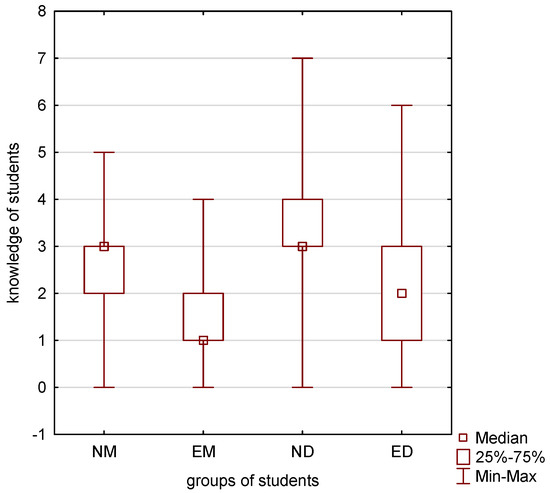
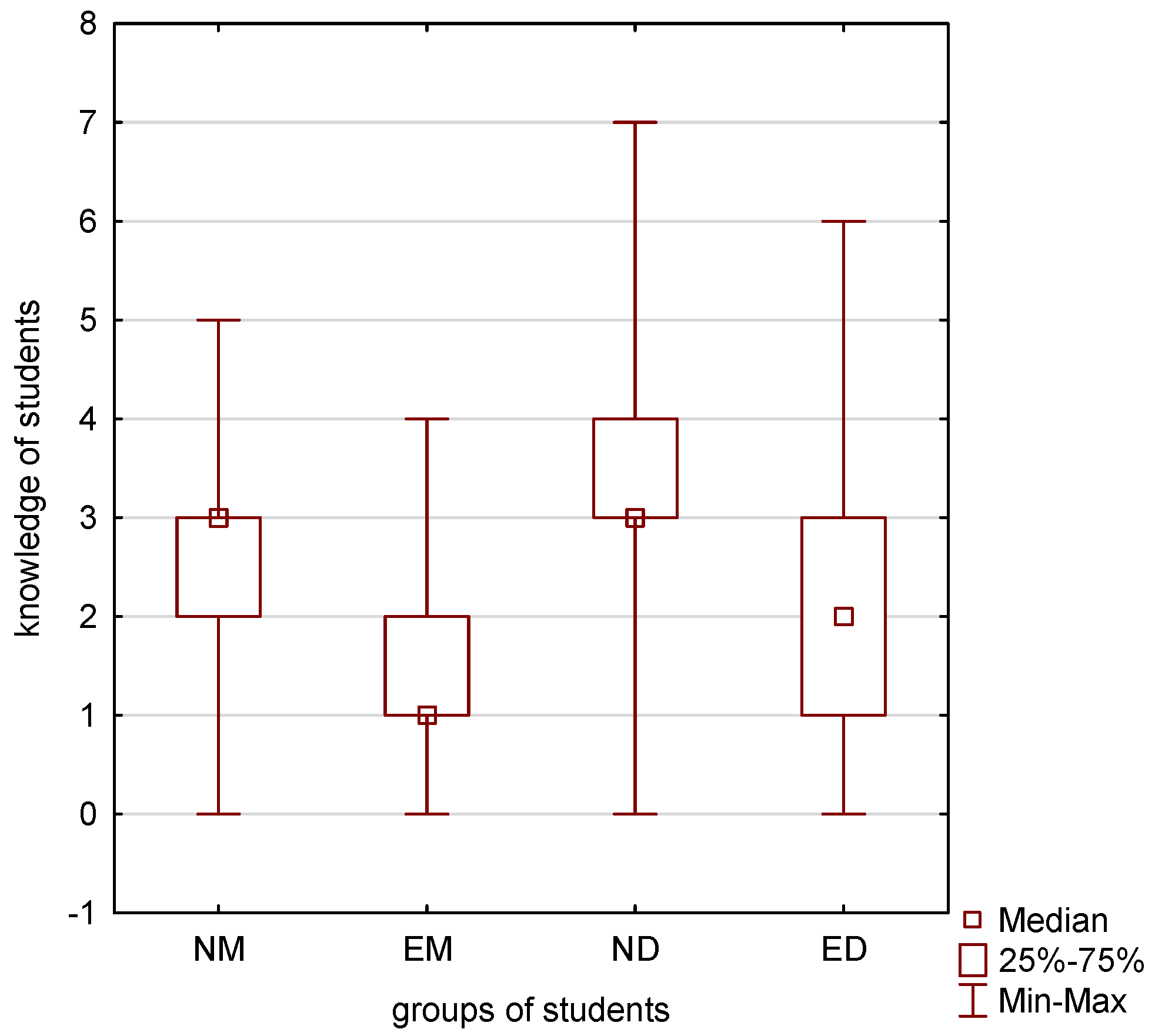
Total knowledge (checked by 6 questions) between NM, ND, EM and ED students was compared using the Kruskal-Wallis test and a correlation was found. This is presented in Figure 1.
Figure 1.
Comparison of total knowledge between NM, ND, EM and ED students (Kruskal—Wallis test, p < 0.001).
We took into consideration answers to each question and compared them among the students. The correlation was found in each question, which is presented in Table 2.
Table 2.
Answers to the questions and statistical analysis.
Tests used for statistical analysis: C (Chi^2Pearson), F (Fisher-Freeman-Halton). The statistical correlations found between the groups showed the various levels of correct answers.
We found the correlations between the sources of knowledge with answers to the questions in each group of students (N and E) and between the groups (Table 3). The most often answer in N students was school, or the students were not able (NA) to indicate the source of knowledge, but E groups gave out of school courses, mass media and their own knowledge (or from the others), as well as NA answers. Interestingly in the ED group, among other answers, students also indicated school.
Table 3.
The sources of knowledge to each question and statistical analysis.
When analyzing the answers of the students, we found medical stereotypes in 3 questions—those that dealt only with the theoretical aspects (Table 4). Interestingly, dental students did not give stereotypical answer explaining defibrillation (ND < 19%, ED < 24%) which is surprising when compared with medical students.
Table 4.
Confirmed medical stereotypes in the questions (marked by bold). There is given a number of students who answered the questions in this way.
4. Discussion
After a very detailed analysis along with of the rest of the data, we found medical stereotypes, but only in the questions testing theory: questions concerning defibrillation, opening the airway in infants and causes of airway obstruction of unconscious adults. A stereotype is a common myth; false knowledge which spreads among populations and nobody knows where the source of a problem is. No literature is available to compare with our results except the problem with defibrillation. In common thinking, myths about a mechanism of defibrillation are that it they provide stimulation to the heart, but in our study, dental students did not indicate stereotypical understanding of defibrillation. It is possible that dental students consider themselves as less resuscitation experts than medical students, and they rely more on proven sources of knowledge than on their beliefs. This false information can be found on the internet, and even on medical pages. The useful expression for the explanation of defibrillation is “restart of the heart” and it is incorrect. Restart means start again. So it can be understood that defibrillation is a stimulation of the stopped heart. Even in medical articles, this term was used [7]. In the Guidelines for CPR and Automated External Defibrillators WebMD available in internet was written that AED is a device “used to restart a heart that has stopped beating”. And even on an official website of the United States government [9] it can be read “AEDs: How These Devices in Public Places Can Restart Hearts” [9]. This is frightening because mass media plays a negative role by spreading false information. The defibrillation procedure is often shown in the movies, but the indications for its implementation are incorrect.To avoid this, in our opinion, a medical consultant should evaluate medical information.
Teachers have a similar and very important role in spreading information. We showed their role observed in native students attending the classes in secondary school. In the opinion of the majority of the students participating in first aid classes at school, the education of a teacher was probably not adequate for such classes and the standard of classes was medium and low. Similar results were presented in the article in which the authors showed that only 21.03% of the 310 high school tested teachers ever participated in life support courses; most of them did not possess adequate knowledge about adult cardiac arrest and foreign body airway obstruction. They found the relationship—as the age of the teachers’ increases the ratio of correct answers decreases. In their opinion teachers are less motivated to be kept updated [10]; the same observations came from Turkey. The majority of the 312 tested primary school teachers did not have enough knowledge about first aid. Those who had knowledge indicated driver’s license courses and printed media as the sources of that knowledge [11]. Getting used to and allowing the functioning of stereotypes leads to shortcuts, and this probably justifies teachers who do not see the need to update their knowledge.
The answers for the clinical questions (first aid in epistaxis, seizures and choking infants) were at different level in the tested groups. Native students (medical – NM and dental -ND) knew what to do in epistaxis (NM 83.54% and ND 89.66%) but E students did not possess adequate knowledge (EM 26.4% and ED 46.88%). We compared these results with a study from Saudi Arabia (SA) [12] where 39.4% of SA students recommended sitting in a position with the head forward, and these results are similar to our E students. The authors concluded that the level of knowledge of the 314 medical students between 18 and 26 years of age was good.
In an article coming from Nigeria [13], authors presented that 50.6% of students wanted to insert an object into the victim’s mouth during seizures which stands in contrast to all studied groups. Dental groups were better than medical groups (ND 0%, ED 1.56%, NM 9.64%, ED 8%). This article was published in 2013, so it may be that time played an important role in these results. The authors from the UK concluded that age of the participants was a significant factor, because in a group >65 years old, 57% thought that putting something into a victim’s mouth would be proper [14]. The older generations (elderly people) spread outdated knowledge. One of the mechanisms responsible for the transmission of stereotypes is the processes of social learning. The child can learn the stereotype directly from the parents when they express their opinions. The child learns them from adults very quickly, uncritically. This mechanism of social learning and modeling is also responsible for the transmission of stereotypical views from generation to generation. Stereotypes are also persistent because, as cognitive schemas, they are very resistant to change [15,16].
Many students participating in our study during the process of filling out the questionnaire did not indicate any source of knowledge. This means that they were not able to do it because they were not aware of where they got this information from (the impact of tacit knowledge). On the other hand, a large group of foreign students did not provide the source of their knowledge. Perhaps the school has too little influence on the transfer of medical knowledge in the field of first aid, since students did not indicate it as the main source of knowledge. From a psychological point of view it should be considered that spreading information among closely related people such as family members, relatives and friends is common without any considerations [2]. That way, old generations transmit outdated knowledge to the next generations. It can be one of the causes of persisting false information.
There are limitations of the study. First of all, tested students did not give answers to all questions, and particularly they were not able to present sources of knowledge. We did not focus on the cultural diversity as much as possible. We did not investigate personal experience, religious, beliefs etc.
5. Conclusions
We confirmed that medical stereotypes in the group of dental and medical students exist, and they were not related to multiculturalism or the use of different sources of knowledge. We did not find any obvious sources of knowledge for the medical stereotype except the role of schools, mass media and information from others. We discovered the medical stereotypes surrounding first aid in the theoretical questions concerning: the understanding of a procedure of defibrillation (except dental students), the maneuvers to open the airway in infant and a cause of airway obstruction of unconscious victim. This means that there is still lack of understanding of the pathophysiology of emergency and the mechanisms of recommended maneuvers resulting from the lack of an effective transfer of knowledge. Two things are enough to successfully fight stereotypes: reliable knowledge and critical thinking.
Still, improper phrases are present in medical literature, so based on our research we suggest to replace the term “restart of the heart” with the term “stop of the pathological heat rate”.
Stereotypes simplify the transfer of information and consequently lead to shortcuts. To exclude existing medical stereotypes, we suggest to educate teachers at schools, and to keep control over mass media when they spread medical information or increase the share of professional knowledge sources in providing up-to-date information on first aid. We advise the teachers to attend the review courses on first aid. This is necessary because every five years new guidelines are published.
Nowadays, when surfing the internet, we must proceed with caution while trying to find out medical information. We recommend only professional web sites.
After a detailed analysis of the results, we can verify the research hypotheses.
- We confirmed the medical stereotypes in the area of first aid in the theoretical questions concerning: understanding a procedure of defibrillation (except dental students), the maneuvers to open the airway in infant and a cause of airway obstruction of unconscious victim. The stereotypical answers did not differ between medical and dental students except the understanding of defibrillation, which were better in dental students.
- Our hypothesis was correct and we did not find any obvious sources of knowledge for the medical stereotypes, except the role of schools, mass media and information from the others.
- We haven’t found any influence of multiculturalism of all tested students coming from 28 countries on stereotypical answers in the domain of first aid. Despite the cultural diversity of the students, this factor did not affect the responses and medical stereotypes were similar among the students.
Author Contributions
M.G.: Substantial contributions to the conception, design of the work; the acquisition, analysis, interpretation of data for the work; and drafting the work, revising it critically for important intellectual content; and final approval of the version to be published; and agreement to be accountable for all aspects of the work in ensuring that questions related to the accuracy or integrity of any part of the work are appropriately investigated and resolved. M.I.: The acquisition, analysis, interpretation of data for the work; and drafting the work, revising it critically for important intellectual content; and final approval of the version to be published; and agreement to be accountable for all aspects of the work in ensuring that questions related to the accuracy or integrity of any part of the work are appropriately investigated and resolved. A.P.: The psychological analysis; and interpretation of data for the work; and final approval of the version to be published. A.B.-Ś.: The acquisition, analysis, interpretation of data for the work; and drafting the work for important intellectual content; and final approval of the version to be published; and agreement to be accountable for all aspects of the work in ensuring that questions related to the accuracy or integrity of any part of the work are appropriately investigated and resolved. A.D.G.: The acquisition, analysis, interpretation of data for the work; and drafting the work, revising it critically for important intellectual content; and final approval of the version to be published; and agreement to be accountable for all aspects of the work in ensuring that questions related to the accuracy or integrity of any part of the work are appropriately investigated and resolved. All authors have read and agreed to the published version of the manuscript.
Funding
This research received no external funding.
Institutional Review Board Statement
This study was approved by the Bioethical Committee by the University of Medical Sciences (Number: 161/18).
Informed Consent Statement
The consent obtained from study participants was written.
Data Availability Statement
The data sets used and/or analyzed during the current study are available from the corresponding author on reasonable request.
Conflicts of Interest
The authors report no conflict of interest. The authors are responsible for the content and writing of this article.
References
- Cardwell, M. Dictionary of Psychology; Fitzroy Dearborn: London, UK; Chicago, IL, USA, 1999. [Google Scholar]
- Myers, D.; Twenge, J. Social Psychology; McGraw-Hill: New York, NY, USA, 2013. [Google Scholar]
- McGarty, C.; Yzerbyt, V.Y.; Spears, R. Social, Cultural and Cognitive Factors in Stereotype Formation in Stereotypes as Explanations: The Formation of Meaningful Beliefs about Social Groups; Cambridge University Press: Cambridge, UK, 2002. [Google Scholar]
- Judd, C.M.; Park, B. Definition and assessment of accuracy in social stereotypes. Psychol. Rev. 1993, 100, 109–128. [Google Scholar] [CrossRef] [Scilit] [PubMed]
- André, A.; Niruj, A.; Morgan, K.D.; David, A.S. Insight in psychosis and neuropsychological function. Brit. J. Psychiatry 2006, 189, 204–212. [Google Scholar]
- Miller, L.J. Qualitative changes in hallucinations. Am. J. Psychiat. 1996, 153, 265–267. [Google Scholar] [PubMed]
- Faddy, S.C.; Jennings, P.A. Biphasic versus monophasic waveforms for transthoracic defibrillation in out-of-hospital cardiac arrest. Cochrane Database Syst. Rev. 2016, 2, CD006762. [Google Scholar] [PubMed]
- WebMD. Available online: https://www.webmd.com/search/search_results/default.aspx?query=aed (accessed on 11 June 2019).
- FDA. How AEDs in Public Places Can Restart Hearts. Available online: https://www.fda.gov/consumers/consumer-updates/aeds-how-these-devices-public-places-can-restart-hearts (accessed on 11 June 2019).
- Patsaki, A.; Pantazopoulos, I.; Dontas, I.; Passali, C.; Papadimitriou, L.; Xanthos, T. Evaluation of Greek high school teachers’ knowledge in basic life support, automated external defibrillation, and foreign body airway obstruction: Implications for nursing interventions. J. Emerg. Nurs. 2012, 38, 176–181. [Google Scholar] [CrossRef] [Scilit] [PubMed]
- Baser, M.; Coban, S.; Tasci, S.; Sungur, G.; Bayat, M. Evaluating First-aid Knowledge and Attitudes of a Sample of Turkish Primary School Teachers. J. Emerg. Nurs. 2007, 33, 428–432. [Google Scholar] [CrossRef] [Scilit] [PubMed]
- Alzaidi, A.M.; Masarit, R.M.; Bugis, B.N.; Fakeih, E.M.T. Assessment of first aid—Management of epistaxis among medical students in Saudi Arabia. Indo Am. J. Pharm. Sci. 2009, 6, 2322–2326. [Google Scholar]
- Ezeala-Adikaibe, B.A.; Achor, J.U.; Onwukwe, J.; Ekenze, O.S.; Onwuekwe, I.O.; Chukwu, O.; Onyia, H.; Ihekwaba, M.; Obu, C. Knowledge, attitude and practice towards epilepsy among secondary school students in Enugu, southeast Nigeria. Seizures 2013, 22, 299–302. [Google Scholar] [CrossRef] [Scilit] [PubMed]
- Baxendale, S.; O’Toole, A. Epilepsy myths: Alive and foaming in the 21st century. Epilepsy Behav. 2007, 11, 192–196. [Google Scholar] [CrossRef] [Scilit] [PubMed]
- Davies, P.G.; Spencer, S.J.; Steele, C.M. Clearing the air: Identity safety moderates the effects of stereotype threat on women’s leadership aspirations. J. Personal. Soc. Psychol. 2005, 88, 276–287. [Google Scholar] [CrossRef] [Scilit] [PubMed]
- Devine, P.G. Stereotypes and prejudice: Their automatic and controlled components. J. Personal. Soc. Psychol. 1989, 56, 5–18. [Google Scholar] [CrossRef]

Publisher’s Note: MDPI stays neutral with regard to jurisdictional claims in published maps and institutional affiliations. |
© 2022 by the authors. Licensee MDPI, Basel, Switzerland. This article is an open access article distributed under the terms and conditions of the Creative Commons Attribution (CC BY) license (https://creativecommons.org/licenses/by/4.0/).