


Exercise-Based Training Strategies to Reduce the Incidence or Mitigate the Risk Factors of Anterior Cruciate Ligament Injury in Adult Football (Soccer) Players: A Systematic Review

 ,
, 
 ,
,  , , and
Abstract
1. Introduction
2. Materials and Methods
2.1. Search Strategy
2.1.1. Eligibility Criteria
2.1.2. Study Selection
2.1.3. Data Extraction
2.2. Risk of Bias Assessment
3. Results
3.1. Study Selection
3.2. Characteristics of Included Articles
3.3. Risk of Bias in Individual Studies
3.4. Results of Individual Studies
4. Discussion
4.1. Effects of Exercise-Based Interventions in ACL Injury Incidence
4.1.1. Evidence from Randomised-Controlled Trials
4.1.2. Evidence from Non-Randomised Trials
4.2. Effects of Exercise-Based Intervention in Risk Factors of ACL Injury
4.2.1. Evidence from Randomized-Controlled Trials
4.2.2. Evidence from Non-Randomized Trials
4.3. Potentially Feasible Interventions from Single-Arm Studies
4.4. Do All Risk Factors Established Elsewhere in The Literature Equally Contribute to ACL Injury?
4.5. Practical Applications
4.6. Limitations
5. Conclusions
Supplementary Materials
Author Contributions
Funding
Institutional Review Board Statement
Informed Consent Statement
Data Availability Statement
Acknowledgments
Conflicts of Interest
References
- Fédération Internationale de Football Association (FIFA). FIFA Big Count 2006: 270 Million People Active in Football. FIFA Commun. Div. Inf. Serv. 2007, 31, 1–12. [Google Scholar]
- Ekstrand, J.; Spreco, A.; Bengtsson, H.; Bahr, R. Injury rates decreased in men’s professional football: An 18-year prospective cohort study of almost 12 000 injuries sustained during 1.8 million hours of play. Br. J. Sports Med. 2021, 55, 1084–1091. [Google Scholar] [CrossRef] [PubMed]
- Drew, M.K.; Raysmith, B.P.; Charlton, P.C. Injuries impair the chance of successful performance by sportspeople: A systematic review. Br. J. Sports Med. 2017, 51, 1209–1214. [Google Scholar] [CrossRef] [PubMed]
- Eirale, C.; Tol, J.L.; Farooq, A.; Smiley, F.; Chalabi, H. Low injury rate strongly correlates with team success in Qatari professional football. Br. J. Sports Med. 2013, 47, 807–808. [Google Scholar] [CrossRef]
- Hägglund, M.; Waldén, M.; Magnusson, H.; Kristenson, K.; Bengtsson, H.; Ekstrand, J. Injuries affect team performance negatively in professional football: An 11-year follow-up of the UEFA Champions League injury study. Br. J. Sports Med. 2013, 47, 738–742. [Google Scholar] [CrossRef]
- Eliakim, E.; Morgulev, E.; Lidor, R.; Meckel, Y. Estimation of injury costs: Financial damage of English Premier League teams’ underachievement due to injuries. BMJ Open Sport Exerc. Med. 2020, 6, e000675. [Google Scholar] [CrossRef]
- Øiestad, B.E.; Holm, I.; Aune, A.K.; Gunderson, R.; Myklebust, G.; Engebretsen, L.; Fosdahl, M.A.; Risberg, M.A. Knee Function and Prevalence of Knee Osteoarthritis after Anterior Cruciate Ligament Reconstruction: A Prospective Study with 10 to 15 Years of Follow-Up. Am. J. Sports Med. 2010, 38, 2201–2210. [Google Scholar] [CrossRef] [PubMed]
- Svantesson, E.; Senorski, E.H.; Webster, K.E.; Karlsson, J.; Diermeier, T.; Rothrauff, B.B.; Meredith, S.J.; Rauer, T.; Irrgang, J.J.; Spindler, K.P.; et al. Clinical Outcomes After Anterior Cruciate Ligament Injury: Panther Symposium ACL Injury Clinical Outcomes Consensus Group. Orthop. J. Sports Med. 2020, 8, 1–19. [Google Scholar] [CrossRef] [PubMed]
- Fältström, A.; Kvist, J.; Gauffin, H.; Hägglund, M. Female Soccer Players with Anterior Cruciate Ligament Reconstruction Have a Higher Risk of New Knee Injuries and Quit Soccer to a Higher Degree Than Knee-Healthy Controls. Am. J. Sports Med. 2018, 47, 31–40. [Google Scholar] [CrossRef]
- Kamath, G.V.; Murphy, T.; Creighton, R.A.; Viradia, N.; Taft, T.N.; Spang, J.T. Anterior Cruciate Ligament Injury, Return to Play, and Reinjury in the Elite Collegiate Athlete: Analysis of an NCAA Division I Cohort. Am. J. Sports Med. 2014, 42, 1638–1643. [Google Scholar] [CrossRef]
- Sandon, A.; Engström, B.; Forssblad, M. High Risk of Further Anterior Cruciate Ligament Injury in a 10-Year Follow-up Study of Anterior Cruciate Ligament-Reconstructed Soccer Players in the Swedish National Knee Ligament Registry. Arthrosc. J. Arthrosc. Relat. Surg. 2020, 36, 189–195. [Google Scholar] [CrossRef]
- Slater, L.V.; Wasserman, E.B.; Hart, J.M. Trends in Recurrent Anterior Cruciate Ligament Injuries Differ From New Anterior Cruciate Ligament Injuries in College and High School Sports: 2009-2010 through 2016–2017. Orthop. J. Sports Med. 2019, 7, 1–8. [Google Scholar] [CrossRef]
- Webster, K.E. Return to Sport and Reinjury Rates in Elite Female Athletes after Anterior Cruciate Ligament Rupture. Sports Med. 2021, 51, 653–660. [Google Scholar] [CrossRef]
- Della Villa, F.; Hägglund, M.; Della Villa, S.; Ekstrand, J.; Waldén, M. High rate of second ACL injury following ACL reconstruction in male professional footballers: An updated longitudinal analysis from 118 players in the UEFA Elite Club Injury Study. Br. J. Sports Med. 2021, 55, 1350–1356. [Google Scholar] [CrossRef] [PubMed]
- Tabben, M.; Eirale, C.; Singh, G.; Al-Kuwari, A.; Ekstrand, J.; Chalabi, H.; Bahr, R.; Chamari, K. Injury and illness epidemiology in professional Asian football: Lower general incidence and burden but higher ACL and hamstring injury burden compared with Europe. Br. J. Sports Med. 2021, 2020, 1–6. [Google Scholar] [CrossRef]
- Ekstrand, J.; Hägglund, M.; Kristenson, K.; Magnusson, H.; Waldén, M. Fewer ligament injuries but no preventive effect on muscle injuries and severe injuries: An 11-year follow-up of the UEFA Champions League injury study. Br. J. Sports Med. 2013, 47, 732–737. [Google Scholar] [CrossRef] [PubMed]
- Waldén, M.; Hägglund, M.; Magnusson, H.; Ekstrand, J. ACL injuries in men’s professional football: A 15-year prospective study on time trends and return-to-play rates reveals only 65% of players still play at the top level 3 years after ACL rupture. Br. J. Sports Med. 2016, 50, 744–750. [Google Scholar] [CrossRef]
- Della Villa, F.; Buckthorpe, M.; Grassi, A.; Nabiuzzi, A.; Tosarelli, F.; Zaffagnini, S.; Della Villa, S. Systematic video analysis of ACL injuries in professional male football (soccer): Injury mechanisms, situational patterns and biomechanics study on 134 consecutive cases. Br. J. Sports Med. 2020, 54, 1423–1432. [Google Scholar] [CrossRef]
- Bisciotti, G.N.; Chamari, K.; Cena, E.; Bisciotti, A.; Bisciotti, A.; Corsini, A.; Volpi, P. Anterior cruciate ligament injury risk factors in football. J. Sports Med. Phys. Fit. 2019, 59, 1724–1738. [Google Scholar] [CrossRef]
- Grassi, A.; MacChiarola, L.; Filippini, M.; Lucidi, G.A.; Della Villa, F.; Zaffagnini, S. Epidemiology of Anterior Cruciate Ligament Injury in Italian First Division Soccer Players. Sports Health 2019, 12, 279–288. [Google Scholar] [CrossRef] [PubMed]
- Grimm, N.L.; Jacobs, J.C.; Kim, J.; Denney, B.S.; Shea, K.G. Anterior Cruciate Ligament and Knee Injury Prevention Programs for Soccer Players: A Systematic Review and Meta-Analysis. Am. J. Sports Med. 2015, 43, 2049–2056. [Google Scholar] [CrossRef]
- Bahr, R. Why screening tests to predict injury do not work—and probably never will…: A critical review. Br. J. Sports Med. 2016, 50, 776–780. [Google Scholar] [CrossRef] [PubMed]
- Alentorn-Geli, E.; Myer, G.D.; Silvers, H.J.; Samitier, G.; Romero, D.; Lázaro-Haro, C.; Cugat, R. Prevention of non-contact anterior cruciate ligament injuries in soccer players. Part 1: Mechanisms of injury and underlying risk factors. Knee Surg. Sport Traumatol. Arthrosc. 2009, 17, 705–729. [Google Scholar] [CrossRef] [PubMed]
- International Olympic Committee Injury and Illness Epidemiology Consensus Group; Bahr, R.; Clarsen, B.; Derman, W.; Dvorak, J.; Emery, C.A.; Finch, C.F.; Hägglund, M.; Junge, A.; Kemp, S.; et al. International Olympic Committee Consensus Statement: Methods for Recording and Reporting of Epidemiological Data on Injury and Illness in Sports 2020 (Including the STROBE Extension for Sports Injury and Illness Surveillance (STROBE-SIIS)). Orthop. J. Sports Med. 2020, 8, 1–33. [Google Scholar] [CrossRef]
- Karazsia, M.B.T.; Van Dulmen, M.H.M. Assessing Injuries with Proxies: Implications for Understanding Concurrent Relations and Behavioral Antecedents of Pediatric Injuries. J. Pediatr. Psychol. 2009, 35, 51–60. [Google Scholar] [CrossRef]
- Whittaker, J.; Booysen, N.; De La Motte, S.; Dennett, L.; Lewis, C.L.; Wilson, D.; McKay, C.; Warner, M.; Padua, D.; Emery, C.A.; et al. Predicting sport and occupational lower extremity injury risk through movement quality screening: A systematic review. Br. J. Sports Med. 2017, 51, 580–585. [Google Scholar] [CrossRef] [PubMed]
- Hewett, T.E.; Myer, G.D.; Ford, K. Anterior Cruciate Ligament Injuries in Female Athletes: Part 1, Mechanisms and Risk Factors. Am. J. Sports Med. 2006, 34, 299–311. [Google Scholar] [CrossRef] [PubMed]
- Lucarno, S.; Zago, M.; Buckthorpe, M.; Grassi, A.; Tosarelli, F.; Smith, R.; Della Villa, F. Systematic Video Analysis of Anterior Cruciate Ligament Injuries in Professional Female Soccer Players. Am. J. Sports Med. 2021, 49, 1794–1802. [Google Scholar] [CrossRef]
- Waldén, M.; Krosshaug, T.; Bjørneboe, J.; Andersen, T.E.; Faul, O.; Hägglund, M. Three distinct mechanisms predominate in non-contact anterior cruciate ligament injuries in male professional football players: A systematic video analysis of 39 cases. Br. J. Sports Med. 2015, 49, 1452–1460. [Google Scholar] [CrossRef]
- Dos’Santos, T.; Thomas, C.; Comfort, P.; Jones, P.A. The Effect of Angle and Velocity on Change of Direction Biomechanics: An Angle-Velocity Trade-Off. Sports Med. 2018, 48, 2235–2253. [Google Scholar] [CrossRef]
- Fox, A.S. Change-of-Direction Biomechanics: Is What’s Best for Anterior Cruciate Ligament Injury Prevention Also Best for Performance? Sports Med. 2018, 48, 1799–1807. [Google Scholar] [CrossRef]
- Ruas, C.V.; Pinto, R.S.; Haff, G.G.; Lima, C.D.; Pinto, M.D.; Brown, L.E. Alternative Methods of Determining Hamstrings-to-Quadriceps Ratios: A Comprehensive Review. Sports Med. Open 2019, 5, 11. [Google Scholar] [CrossRef] [PubMed]
- Lloyd, D.G.; Buchanan, T. Strategies of muscular support of varus and valgus isometric loads at the human knee. J. Biomech. 2001, 34, 1257–1267. [Google Scholar] [CrossRef]
- Boutris, N.; Byrne, R.A.; Delgado, D.A.; Hewett, T.E.; McCulloch, P.C.; Lintner, D.M.; Harris, J.D. Is There an Association Between Noncontact Anterior Cruciate Ligament Injuries and Decreased Hip Internal Rotation or Radiographic Femoroacetabular Impingement? A Systematic Review. Arthrosc. J. Arthrosc. Relat. Surg. 2018, 34, 943–950. [Google Scholar] [CrossRef]
- Howe, L.P.; Bampouras, T.M.; North, J.S.; Waldron, M. Improved Ankle Mobility After a 4-Week Training Program Affects Landing Mechanics. J. Strength Cond. Res. 2020, 1–9. [Google Scholar] [CrossRef]
- Monajati, A.; Larumbe-Zabala, E.; Goss-Sampson, M.; Naclerio, F. The Effectiveness of Injury Prevention Programs to Modify Risk Factors for Non-Contact Anterior Cruciate Ligament and Hamstring Injuries in Uninjured Team Sports Athletes: A Systematic Review. PLoS ONE 2016, 11, e0155272. [Google Scholar] [CrossRef] [PubMed]
- Lopes, T.J.A.; Simic, M.; Myer, G.D.; Ford, K.; Hewett, T.E.; Pappas, E. The Effects of Injury Prevention Programs on the Biomechanics of Landing Tasks: A Systematic Review with Meta-analysis. Am. J. Sports Med. 2018, 46, 1492–1499. [Google Scholar] [CrossRef]
- Noyes, F.R.; Westin, S.D.B. Anterior Cruciate Ligament Injury Prevention Training in Female Athletes: A Systematic Review of Injury Reduction and Results of Athletic Performance Tests. Sports Health 2012, 4, 36–46. [Google Scholar] [CrossRef]
- Stevenson, J.H.; Beattie, C.S.; Schwartz, J.B.; Busconi, B.D. Assessing the Effectiveness of Neuromuscular Training Programs in Reducing the Incidence of Anterior Cruciate Ligament Injuries in Female Athletes: A Systematic Review. Am. J. Sports Med. 2014, 43, 482–490. [Google Scholar] [CrossRef]
- Stojanovic, M.D.; Ostojic, S.M. Preventing ACL Injuries in Team-Sport Athletes: A Systematic Review of Training Interventions. Res. Sports Med. 2012, 20, 223–238. [Google Scholar] [CrossRef] [PubMed]
- Taylor, J.; Waxman, J.P.; Richter, S.J.; Shultz, S.J. Evaluation of the effectiveness of anterior cruciate ligament injury prevention programme training components: A systematic review and meta-analysis. Br. J. Sports Med. 2015, 49, 79–87. [Google Scholar] [CrossRef]
- Fanchini, M.; Steendahl, I.B.; Impellizzeri, F.M.; Pruna, R.; Dupont, G.; Coutts, A.J.; Meyer, T.; McCall, A. Exercise-Based Strategies to Prevent Muscle Injury in Elite Footballers: A Systematic Review and Best Evidence Synthesis. Sports Med. 2020, 50, 1653–1666. [Google Scholar] [CrossRef]
- Nassis, G.P.; Massey, A.; Jacobsen, P.; Brito, J.; Randers, M.B.; Castagna, C.; Mohr, M.; Krustrup, P. Elite football of 2030 will not be the same as that of 2020: Preparing players, coaches, and support staff for the evolution. Scand. J. Med. Sci. Sports 2020, 30, 962–964. [Google Scholar] [CrossRef]
- Fox, A.; Bonacci, J.; McLean, S.G.; Spittle, M.; Saunders, N. A Systematic Evaluation of Field-Based Screening Methods for the Assessment of Anterior Cruciate Ligament (ACL) Injury Risk. Sports Med. 2016, 46, 715–735. [Google Scholar] [CrossRef] [PubMed]
- Moher, D.; Liberati, A.; Tetzlaff, J.; Altman, D.G.; The Prisma Group. Preferred Reporting Items for Systematic Reviews and Meta-Analyses: The PRISMA Statement. PLoS Med. 2009, 6, e100009. [Google Scholar] [CrossRef] [PubMed]
- Alentorn-Geli, E.; Mendiguchía, J.; Samuelsson, K.; Musahl, V.; Karlsson, J.; Cugat, R.; Myer, G.D. Prevention of non-contact anterior cruciate ligament injuries in sports. Part II: Systematic review of the effectiveness of prevention programmes in male athletes. Knee Surg. Sport Traumatol. Arthrosc. 2014, 22, 16–25. [Google Scholar] [CrossRef] [PubMed]
- Turner, A.N.; Parmar, N.; Jovanovski, A.; Hearne, G. Assessing Group-Based Changes in High-Performance Sport. Part 2: Effect Sizes and Embracing Uncertainty through Confidence Intervals. Strength Cond. J. 2021, 43, 68–77. [Google Scholar] [CrossRef]
- Hopkins, W.G.; Marshall, S.W.; Batterham, A.M.; Hanin, J. Progressive Statistics for Studies in Sports Medicine and Exercise Science. Med. Sci. Sports Exerc. 2009, 41, 3–13. [Google Scholar] [CrossRef]
- Sterne, J.A.C.; Savović, J.; Page, M.J.; Elbers, R.G.; Blencowe, N.S.; Boutron, I.; Cates, C.J.; Cheng, H.-Y.; Corbett, M.S.; Eldridge, S.M.; et al. RoB 2: A revised tool for assessing risk of bias in randomised trials. BMJ 2019, 366, l4898. [Google Scholar] [CrossRef]
- Sterne, J.A.C.; Hernán, M.A.; Reeves, B.C.; Savović, J.; Berkman, N.D.; Viswanathan, M.; Henry, D.; Altman, D.G.; Ansari, M.T.; Boutron, I.; et al. ROBINS-I: A tool for assessing risk of bias in non-randomised studies of interventions. BMJ Clin. Res. Ed. 2016, 355, i4919. [Google Scholar] [CrossRef]
- Higgins, J.P.T.; Altman, D.G.; Gøtzsche, P.C.; Jüni, P.; Moher, D.; Oxman, A.D.; Savović, J.; Schulz, K.F.; Weeks, L.; Sterne, J.A.C.; et al. The Cochrane Collaboration’s tool for assessing risk of bias in randomised trials. BMJ 2011, 343, d5928. [Google Scholar] [CrossRef]
- Kowalczyk, M.; Tomaszewski, P.; Bartoszek, N.; Popieluch, M. Three-Week Intensive Neuromuscular Training Improves Postural Control in Professional Male Soccer Players. Pol. J. Sport Tour. 2019, 26, 14–20. [Google Scholar] [CrossRef]
- Gilchrist, J.; Mandelbaum, B.R.; Melancon, H.; Ryan, G.W.; Silvers, H.J.; Griffin, L.Y.; Watanabe, D.S.; Dick, R.W.; Dvorak, J. A Randomized Controlled Trial to Prevent Noncontact Anterior Cruciate Ligament Injury in Female Collegiate Soccer Players. Am. J. Sports Med. 2008, 36, 1476–1483. [Google Scholar] [CrossRef] [PubMed]
- Grooms, D.R.; Palmer, T.; Onate, J.A.; Myer, G.D.; Grindstaff, T. Soccer-Specific Warm-Up and Lower Extremity Injury Rates in Collegiate Male Soccer Players. J. Athl. Train. 2013, 48, 782–789. [Google Scholar] [CrossRef] [PubMed]
- Krutsch, W.; Lehmann, J.; Jansen, P.; Angele, P.; Fellner, B.; Achenbach, L.; Krutsch, V.; Nerlich, M.; Alt, V.; Loose, O. Prevention of severe knee injuries in men’s elite football by implementing specific training modules. Knee Surg. Sports Traumatol. Arthrosc. 2019, 28, 519–527. [Google Scholar] [CrossRef]
- Silvers-Granelli, H.; Mandelbaum, B.R.; Adeniji, O.; Insler, S.; Bizzini, M.; Pohlig, R.; Junge, A.; Snyder-Mackler, L.; Dvorak, J. Efficacy of the FIFA 11+ Injury Prevention Program in the Collegiate Male Soccer Player. Am. J. Sports Med. 2015, 43, 2628–2637. [Google Scholar] [CrossRef]
- Silvers-Granelli, H.J.; Bizzini, M.; Arundale, A.; Mandelbaum, B.R.; Snyder-Mackler, L. Does the FIFA 11+ Injury Prevention Program Reduce the Incidence of ACL Injury in Male Soccer Players? Clin. Orthop. Relat. Res. 2017, 475, 2447–2455. [Google Scholar] [CrossRef]
- Whalan, M.; Lovell, R.; Steele, J.R.; Sampson, J.A. Rescheduling Part 2 of the 11+ reduces injury burden and increases compliance in semi-professional football. Scand. J. Med. Sci. Sports 2019, 29, 1941–1951. [Google Scholar] [CrossRef]
- Arundale, A.J.H.; Silvers-Granelli, H.J.; Marmon, A.; Zarzycki, R.; Dix, C.; Snyder-Mackler, L. Changes in biomechanical knee injury risk factors across two collegiate soccer seasons using the 11+ prevention program. Scand. J. Med. Sci. Sports 2018, 28, 2592–2603. [Google Scholar] [CrossRef] [PubMed]
- Ayala, F.; Pomares-Noguera, C.; Robles-Palazón, F.J.; García-Vaquero, M.D.P.; Ruiz-Pérez, I.; Hernández-Sánchez, S.; Croix, M.D.S. Training Effects of the FIFA 11+ and Harmoknee on Several Neuromuscular Parameters of Physical Performance Measures. Int. J. Sports Med. 2017, 38, 278–289. [Google Scholar] [CrossRef]
- Brito, J.; Figueiredo, P.; Fernandes, L.; Seabra, A.; Soares, J.M.; Krustrup, P.; Rebelo, A. Isokinetic strength effects of FIFA’s “The 11+” injury prevention training programme. Isokinet. Exerc. Sci. 2010, 18, 211–215. [Google Scholar] [CrossRef]
- Brughelli, M.; Mendiguchia, J.; Nosaka, K.; Idoate, F.; Arcos, A.L.; Cronin, J. Effects of eccentric exercise on optimum length of the knee flexors and extensors during the preseason in professional soccer players. Phys. Ther. Sport 2010, 11, 50–55. [Google Scholar] [CrossRef]
- Daneshjoo, A.; Mokhtar, A.H.; Rahnama, N.; Yusof, A. The Effects of Comprehensive Warm-Up Programs on Proprioception, Static and Dynamic Balance on Male Soccer Players. PLoS ONE 2012, 7, e51568. [Google Scholar] [CrossRef] [PubMed]
- Delextrat, A.; Piquet, J.; Matthews, M.J.; Cohen, D.D. Strength-Endurance Training Reduces the Hamstrings Strength Decline Following Simulated Football Competition in Female Players. Front. Physiol. 2018, 9, 1–12. [Google Scholar] [CrossRef]
- Dello Iacono, A.; Padulo, J.; Ayalon, M. Core stability training on lower limb balance strength. J. Sports Sci. 2016, 34, 671–678. [Google Scholar] [CrossRef]
- Dos’Santos, T.; McBurnie, A.; Comfort, P.; Jones, P.A. The Effects of Six-Weeks Change of Direction Speed and Technique Modification Training on Cutting Performance and Movement Quality in Male Youth Soccer Players. Sports 2019, 7, 205. [Google Scholar] [CrossRef]
- Gioftsidou, A.; Ispirlidis, I.; Pafis, G.; Malliou, P.; Bikos, C.; Godolias, G. Isokinetic strength training program for muscular imbalances in professional soccer players. Sport Sci. Health 2008, 2, 101–105. [Google Scholar] [CrossRef]
- Gioftsidou, A.F.; Malliou, P.; Pafis, G.; Beneka, A.; Tsapralis, K.; Sofokleous, P.; Kouli, O.; Rokka, S.; Godolias, G. Balance training programs for soccer injuries prevention. J. Hum. Sport Exerc. 2012, 7, 639–647. [Google Scholar] [CrossRef]
- Gonzalez-Jurado, J.A.; Boza, S.R.; Vázquez, M.C.; Bendala, F.T.; Otero-Saborido, F. Comparación de un entrenamiento propioceptivo sobre base estable y base inestable / Comparison of a Proprioceptive Training Program on Stable Base and Unstable Base. Rev. Int. Med. Cienc. Act. Física Deporte 2016, 64, 617–632. [Google Scholar] [CrossRef]
- Greska, E.K.; Cortes, N.; Van Lunen, B.L.; Oñate, J.A. A Feedback Inclusive Neuromuscular Training Program Alters Frontal Plane Kinematics. J. Strength Cond. Res. 2012, 26, 1609–1619. [Google Scholar] [CrossRef]
- Holcomb, W.R.; Rubley, M.D.; Lee, H.J.; Guadagnoli, M.A. Effect of hamstring-emphasized resistance training on hamstring. J. Strength Cond. Res. 2007, 21, 41–47. [Google Scholar] [CrossRef]
- Ibiş, S.; Aktuğ, Z.B.; Iri, R. Does individual-specific strength training have an effect upon knee muscle strength balances? Knee muscle strength balances. J. Musculoskelet. Neuronal Interact. 2016, 18, 183–190. [Google Scholar]
- Impellizzeri, F.M.; Bizzini, M.; Dvorak, J.; Pellegrini, B.; Schena, F.; Junge, A. Physiological and performance responses to the FIFA 11+ (part 2): A randomised controlled trial on the training effects. J. Sports Sci. 2013, 31, 1491–1502. [Google Scholar] [CrossRef]
- Lehnert, M.; Stastny, P.; Tufano, J.J.; Stolfa, P. Changes in Isokinetic Muscle Strength in Adolescent Soccer Players after 10 Weeks of Pre-Season Training. Open Sports Sci. J. 2017, 10, 27–36. [Google Scholar] [CrossRef]
- Malliou, P.; Gioftsidou, A.; Pafis, G.; Beneka, A.; Godolias, G. Proprioceptive training (balance exercises) reduces lower extremity injuries in young soccer players. J. Back Musculoskelet. Rehabil. 2004, 17, 101–104. [Google Scholar] [CrossRef]
- McCann, R.; Cortes, N.; Van Lunen, B.; Greska, E.; Ringleb, S.; Onate, J. Neuromuscular Changes Following an Injury Prevention Program for ACL Injuries. Int. J. Athl. Ther. Train. 2011, 16, 16–20. [Google Scholar] [CrossRef]
- Oshima, T.; Nakase, J.; Inaki, A.; Mochizuki, T.; Takata, Y.; Shimozaki, K.; Kinuya, S.; Tsuchiya, H. Comparison of muscle activity, strength, and balance, before and after a 6-month training using the FIFA11+ program (part 2). J. Orthop. Surg. 2019, 28, 1–6. [Google Scholar] [CrossRef]
- Rey, E.; Padrón-Cabo, A.; Penedo-Jamardo, E.; González-Víllora, S. Effect of the 11+ injury prevention programme on fundamental movement patterns in soccer players. Biol. Sport 2018, 35, 229–236. [Google Scholar] [CrossRef] [PubMed]
- Śliwowski, R.; Jadczak, Ł.; Hejna, R.; Wieczorek, A. The Effects of Individualized Resistance Strength Programs on Knee Muscular Imbalances in Junior Elite Soccer Players. PLoS ONE 2015, 10, e0144021. [Google Scholar] [CrossRef]
- Steffen, K.; Bakka, H.M.; Myklebust, G.; Bahr, R. Performance aspects of an injury prevention program: A ten-week intervention in adolescent female football players. Scand. J. Med. Sci. Sports 2008, 18, 596–604. [Google Scholar] [CrossRef]
- Riela, L.A.; Bertollo, M. The effectiveness of eight weeks of a movement-based program on functional movement patterns in male professional soccer players. J. Phys. Educ. Sport 2019, 19, 1976–1983. [Google Scholar] [CrossRef]
- Sugimoto, D.; Myer, G.D.; McKeon, J.M.; Hewett, T.E. Evaluation of the effectiveness of neuromuscular training to reduce anterior cruciate ligament injury in female athletes: A critical review of relative risk reduction and numbers-needed-to-treat analyses. Br. J. Sports Med. 2012, 46, 979–988. [Google Scholar] [CrossRef]
- Christensen, P.M.; Kristiansen, I.S. Number-Needed-to-Treat (NNT)—Needs Treatment with Care. Basic Clin. Pharmacol. Toxicol. 2006, 99, 12–16. [Google Scholar] [CrossRef]
- Sadigursky, D.; Braid, J.A.; De Lira, D.N.L.; Machado, B.A.B.; Carneiro, R.J.F.; Colavolpe, P.O. The FIFA 11+ injury prevention program for soccer players: A systematic review. BMC Sports Sci. Med. Rehabil. 2017, 9, 1–8. [Google Scholar] [CrossRef] [PubMed]
- O’Brien, J.; Young, W.; Finch, C.F. The use and modification of injury prevention exercises by professional youth soccer teams. Scand. J. Med. Sci. Sports 2016, 27, 1337–1346. [Google Scholar] [CrossRef] [PubMed]
- Bizzini, M.; Junge, A.; Dvorak, J. Implementation of the FIFA 11+ football warm up program: How to approach and convince the Football associations to invest in prevention. Br. J. Sports Med. 2013, 47, 803–806. [Google Scholar] [CrossRef]
- Arundale, A.J.H.; Silvers-Granelli, H.J.; Myklebust, G. ACL injury prevention: Where have we come from and where are we going? J. Orthop. Res. 2021. [Google Scholar] [CrossRef]
- Arundale, A.J.; Bizzini, M.; Giordano, A.; Hewett, T.E.; Logerstedt, D.S.; Mandelbaum, B.; Scalzitti, D.A.; Silvers-Granelli, H.; Snyder-Mackler, L. Exercise-Based Knee and Anterior Cruciate Ligament Injury Prevention. J. Orthop. Sports Phys. Ther. 2018, 48, A1–A42. [Google Scholar] [CrossRef]
- Dos’Santos, T.; Thomas, C.; Comfort, P.; Jones, P.A. The Effect of Training Interventions on Change of Direction Biomechanics Associated with Increased Anterior Cruciate Ligament Loading: A Scoping Review. Sports Med. 2019, 49, 1837–1859. [Google Scholar] [CrossRef]
- Behm, D.; Colado, J.C. The Effectiveness of Resistance Training Using Unstable Surfaces and Devices for Rehabilitation. Int. J. Sports Phys. Ther. 2012, 7, 226–241. [Google Scholar] [PubMed]
- Behm, D.G.; Muehlbauer, T.; Kibele, A.; Granacher, U. Effects of Strength Training Using Unstable Surfaces on Strength, Power and Balance Performance Across the Lifespan: A Systematic Review and Meta-analysis. Sports Med. 2015, 45, 1645–1669. [Google Scholar] [CrossRef]
- Beato, M.; Izquierdo, S.M.; Turner, A.N.; Bishop, C. Implementing strength training strategies for injury prevention in soccer: Sci-entific rationale and methodological recommendations. Int. J. Sports Physiol. Perform. 2020, 16, 1–6. [Google Scholar] [CrossRef] [PubMed]
- Lauersen, J.B.; Andersen, T.E.; Andersen, L.B. Strength training as superior, dose-dependent and safe prevention of acute and overuse sports injuries: A systematic review, qualitative analysis and meta-analysis. Br. J. Sports Med. 2018, 52, 1557–1563. [Google Scholar] [CrossRef] [PubMed]
- Benjaminse, A.; Verhagen, E. Implementing ACL Injury Prevention in Daily Sports Practice—It’s Not Just the Program: Let’s Build Together, Involve the Context, and Improve the Content. Sports Med. 2021, 1–7. [Google Scholar] [CrossRef]
- Dischiavi, S.L.; A Wright, A.; Heller, R.A.; Love, C.E.; Salzman, A.J.; Harris, C.A.; Bleakley, C.M. Do ACL Injury Risk Reduction Exercises Reflect Common Injury Mechanisms? A Scoping Review of Injury Prevention Programs. Sports Health Multidiscip. Approach 2021. [Google Scholar] [CrossRef] [PubMed]
- Alentorn-Geli, E.; Mendiguchía, J.; Samuelsson, K.; Musahl, V.; Karlsson, J.; Cugat, R.; Myer, G.D. Prevention of anterior cruciate ligament injuries in sports—Part I: Systematic review of risk factors in male athletes. Knee Surg. Sports Traumatol. Arthrosc. 2014, 22, 3–15. [Google Scholar] [CrossRef]
- Griffin, L.Y.; Albohm, M.J.; Arendt, E.A.; Bahr, R.; Beynnon, B.D.; DeMaio, M.; Dick, R.W.; Engebretsen, L.; Garrett, W.E.; Hannafin, J.A.; et al. Understanding and Preventing Noncontact Anterior Cruciate Ligament Injuries: A Review of the Hunt Valley II Meeting, January 2005. Am. J. Sports Med. 2006, 34, 1512–1532. [Google Scholar] [CrossRef]
- Hewett, T.E. Neuromuscular and Hormonal Factors Associated with Knee Injuries in Female Athletes: Strategies for Intervention. Sports Med. 2000, 29, 313–327. [Google Scholar] [CrossRef] [PubMed]
- Mehl, J.; Diermeier, T.; Herbst, E.; Imhoff, A.B.; Stoffels, T.; Zantop, T.; Petersen, W.; Achtnich, A. Evidence-based concepts for prevention of knee and ACL injuries. 2017 guidelines of the ligament committee of the German Knee Society (DKG). Arch. Orthop. Trauma Surg. 2017, 138, 51–61. [Google Scholar] [CrossRef]
- Oshima, T.; Nakase, J.; Kitaoka, K.; Shima, Y.; Numata, H.; Takata, Y.; Tsuchiya, H. Poor static balance is a risk factor for non-contact anterior cruciate ligament injury. Arch. Orthop. Trauma Surg. 2018, 138, 1713–1718. [Google Scholar] [CrossRef]
- Powers, C.M. The Influence of Abnormal Hip Mechanics on Knee Injury: A Biomechanical Perspective. J. Orthop. Sports Phys. Ther. 2010, 40, 42–51. [Google Scholar] [CrossRef] [PubMed]
- Bahr, R. Risk factors for sports injuries—A methodological approach. Br. J. Sports Med. 2003, 37, 384–392. [Google Scholar] [CrossRef]
- Hewett, T.E.; Myer, G.D.; Ford, K.R.; Heidt, R.S., Jr.; Colosimo, A.J.; McLean, S.G.; Van Den Bogert, A.J.; Paterno, M.V.; Succop, P. Biomechanical Measures of Neuromuscular Control and Valgus Loading of the Knee Predict Anterior Cruciate Ligament Injury Risk in Female Athletes: A Prospective Study. Am. J. Sports Med. 2005, 33, 492–501. [Google Scholar] [CrossRef]
- Hewett, T.E.; Torg, J.S.; Boden, B.P. Video analysis of trunk and knee motion during non-contact anterior cruciate ligament injury in female athletes: Lateral trunk and knee abduction motion are combined components of the injury mechanism. Br. J. Sports Med. 2009, 43, 417–422. [Google Scholar] [CrossRef]
- Moran, R.W.; Schneiders, A.G.; Mason, J.; Sullivan, S.J. Do Functional Movement Screen (FMS) composite scores predict subsequent injury? A systematic review with meta-analysis. Br. J. Sports Med. 2017, 51, 1661–1669. [Google Scholar] [CrossRef]
- Smith, H.C.; Vacek, P.; Johnson, R.J.; Slauterbeck, J.R.; Hashemi, J.; Shultz, S.; Beynnon, B.D. Risk Factors for Anterior Cruciate Ligament Injury. Sports Health Multidiscip. Approach 2011, 4, 69–78. [Google Scholar] [CrossRef] [PubMed]
- Johnston, J.T.; Mandelbaum, B.R.; Schub, D.; Rodeo, S.A.; Matava, M.J.; Silvers-Granelli, H.J.; Cole, B.J.; ElAttrache, N.S.; McAdams, T.R.; Brophy, R.H. Video Analysis of Anterior Cruciate Ligament Tears in Professional American Football Athletes. Am. J. Sports Med. 2018, 46, 862–868. [Google Scholar] [CrossRef]
- King, E.; Richter, C.; Daniels, K.A.; Franklyn-Miller, A.; Falvey, E.; Myer, G.D.; Jackson, M.; Moran, R.; Strike, S. Can Biomechanical Testing After Anterior Cruciate Ligament Reconstruction Identify Athletes at Risk for Subsequent ACL Injury to the Contralateral Uninjured Limb? Am. J. Sports Med. 2021, 49, 609–619. [Google Scholar] [CrossRef] [PubMed]
- Dos’Santos, T.; McBurnie, A.; Donelon, T.; Thomas, C.; Comfort, P.; Jones, P.A. A qualitative screening tool to identify athletes with ‘high-risk’ movement mechanics during cutting: The cutting movement assessment score (CMAS). Phys. Ther. Sport 2019, 38, 152–161. [Google Scholar] [CrossRef] [PubMed]
- Padua, D.A.; Marshall, S.W.; Boling, M.C.; Thigpen, C.A.; Garrett, W.E., Jr.; Beutler, A.I. The Landing Error Scoring System (LESS) Is a Valid and Reliable Clinical Assessment Tool of Jump-Landing Biomechanics: The JUMP-ACL study. Am. J. Sports Med. 2009, 37, 1996–2002. [Google Scholar] [CrossRef]
- Herrington, L.; Myer, G.D.; Munro, A. Intra and inter-tester reliability of the tuck jump assessment. Phys. Ther. Sport 2013, 14, 152–155. [Google Scholar] [CrossRef]
- Almangoush, A.; Herrington, L.; Jones, R. A preliminary reliability study of a qualitative scoring system of limb alignment during single leg squat. Phys. Ther. Rehabil. 2014, 1, 2. [Google Scholar] [CrossRef]
- Della Villa, F.; Di Paolo, S.; Santagati, D.; Della Croce, E.; Lopomo, N.F.; Grassi, A.; Zaffagnini, S. A 2D video-analysis scoring system of 90° change of direction technique identifies football players with high knee abduction moment. Knee Surg. Sports Traumatol. Arthrosc. 2021, 1–10. [Google Scholar] [CrossRef] [PubMed]
- Thompson-Kolesar, J.A.; Gatewood, C.T.; Tran, A.A.; Silder, A.; Shultz, R.; Delp, S.L.; Dragoo, J.L. Age Influences Biomechanical Changes After Participation in an Anterior Cruciate Ligament Injury Prevention Program. Am. J. Sports Med. 2018, 46, 598–606. [Google Scholar] [CrossRef]
- Thompson, J.A.; Tran, A.A.; Gatewood, C.T.; Shultz, R.; Silder, A.; Delp, S.L.; Dragoo, J.L. Biomechanical Effects of an Injury Prevention Program in Preadolescent Female Soccer Athletes. Am. J. Sports Med. 2017, 45, 294–301. [Google Scholar] [CrossRef]
- Finch, C. A new framework for research leading to sports injury prevention. J. Sci. Med. Sport 2006, 9, 3–9. [Google Scholar] [CrossRef]
- Padua, D.A.; Distefano, L.J.; Hewett, T.E.; Garrett, W.E.; Marshall, S.W.; Golden, G.M.; Shultz, S.J.; Sigward, S.M. National Athletic Trainers’ Association Position Statement: Prevention of Anterior Cruciate Ligament Injury. J. Athl. Train. 2018, 53, 5–19. [Google Scholar] [CrossRef] [PubMed]
- Sugimoto, D.; Myer, G.D.; Foss, K.D.B.; Pepin, M.J.; Micheli, L.J.; E Hewett, T. Critical components of neuromuscular training to reduce ACL injury risk in female athletes: Meta-regression analysis. Br. J. Sports Med. 2016, 50, 1259–1266. [Google Scholar] [CrossRef]
- Stølen, T.; Chamari, K.; Castagna, C.; Wisløff, U. Physiology of Soccer. Sports Med. 2005, 35, 501–536. [Google Scholar] [CrossRef]
- Donelon, T.A.; Dos’Santos, T.; Pitchers, G.; Brown, M.; Jones, P.A. Biomechanical Determinants of Knee Joint Loads Associated with Increased Anterior Cruciate Ligament Loading During Cutting: A Systematic Review and Technical Framework. Sports Med. Open 2020, 6, 1–21. [Google Scholar] [CrossRef]
- Laughlin, W.A.; Weinhandl, J.; Kernozek, T.W.; Cobb, S.C.; Keenan, K.; O’Connor, K.M. The effects of single-leg landing technique on ACL loading. J. Biomech. 2011, 44, 1845–1851. [Google Scholar] [CrossRef] [PubMed]
- Ford, K.; DiCesare, C.; Myer, G.D.; Hewett, T.E. Real-Time Biofeedback to Target Risk of Anterior Cruciate Ligament Injury: A Technical Report for Injury Prevention and Rehabilitation. J. Sport Rehabil. 2015, 24. [Google Scholar] [CrossRef] [PubMed]
- Gokeler, A.; Benjaminse, A.; Della Villa, F.; Tosarelli, F.; Verhagen, E.; Baumeister, J. Anterior cruciate ligament injury mechanisms through a neurocognition lens: Implications for injury screening. BMJ Open Sport Exerc. Med. 2021, 7, e001091. [Google Scholar] [CrossRef]
- Benjaminse, A.; Welling, W.; Otten, B.; Gokeler, A. Novel methods of instruction in ACL injury prevention programs, a systematic review. Phys. Ther. Sport 2015, 16, 176–186. [Google Scholar] [CrossRef] [PubMed]
- Harris, M.; Casey, L.B.; Meindl, J.N.; Powell, D.; Hunter, W.C.; Delgado, D. Using Behavioral Skills Training With Video Feedback to Prevent Risk of Injury in Youth Female Soccer Athletes. Behav. Anal. Pract. 2020, 13, 811–819. [Google Scholar] [CrossRef]
- De Sire, A.; Marotta, N.; Demeco, A.; Moggio, L.; Paola, P.; Marotta, M.; Iona, T.; Invernizzi, M.; Leigheb, M.; Ammendolia, A. Electromyographic Assessment of Anterior Cruciate Ligament Injury Risk in Male Tennis Players: Which Role for Visual Input? A Proof-of-Concept Study. Diagnostics 2021, 11, 997. [Google Scholar] [CrossRef]
- I Ling, D.; Boyle, C.; Janosky, J.; Chang, B.; Roselaar, N.; Kinderknecht, J.; Marx, R.G. Feedback cues improve the alignment and technique of children performing ACL injury prevention exercises. J. ISAKOS Jt. Disord. Orthop. Sports Med. 2021, 6, 3–7. [Google Scholar] [CrossRef] [PubMed]
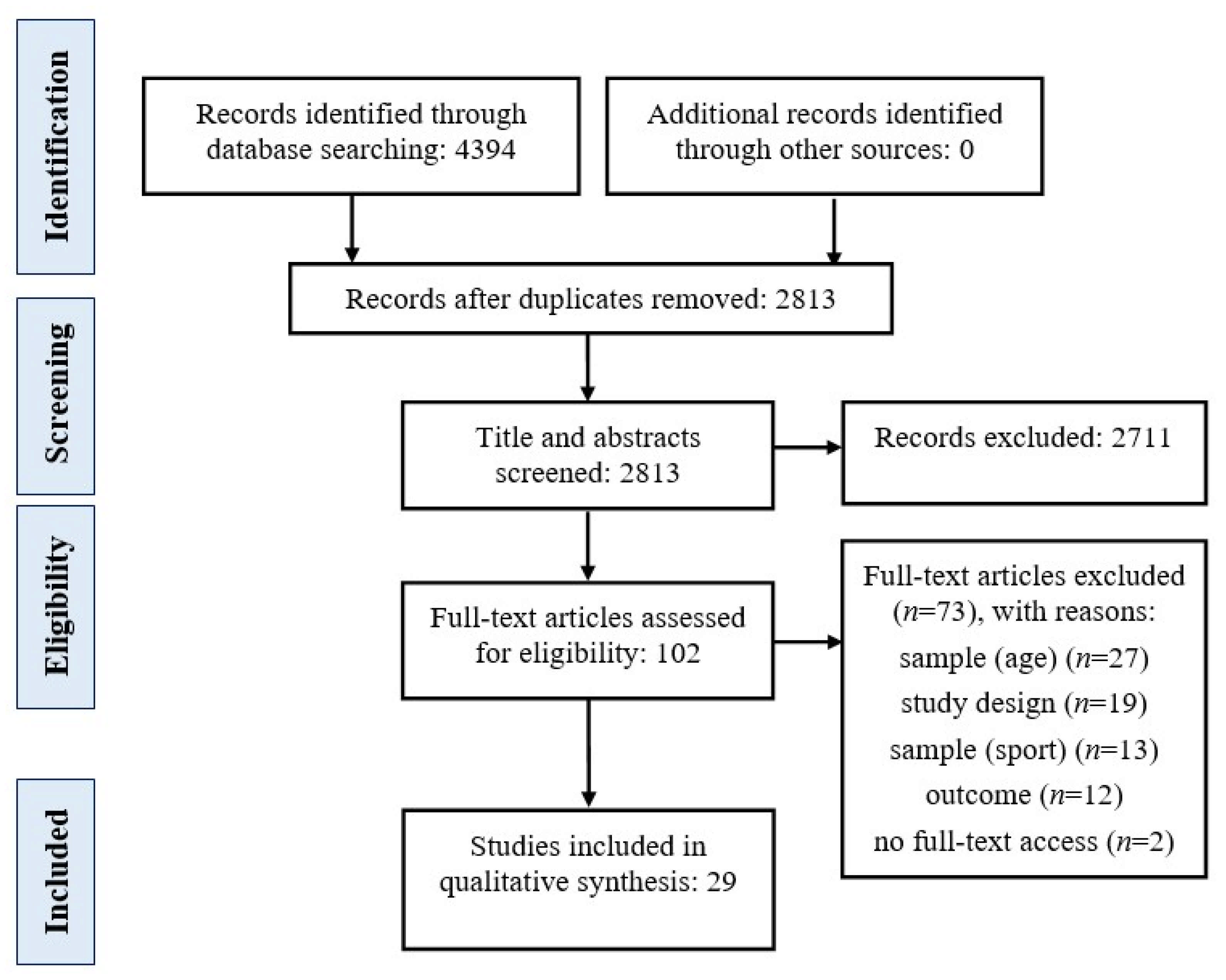
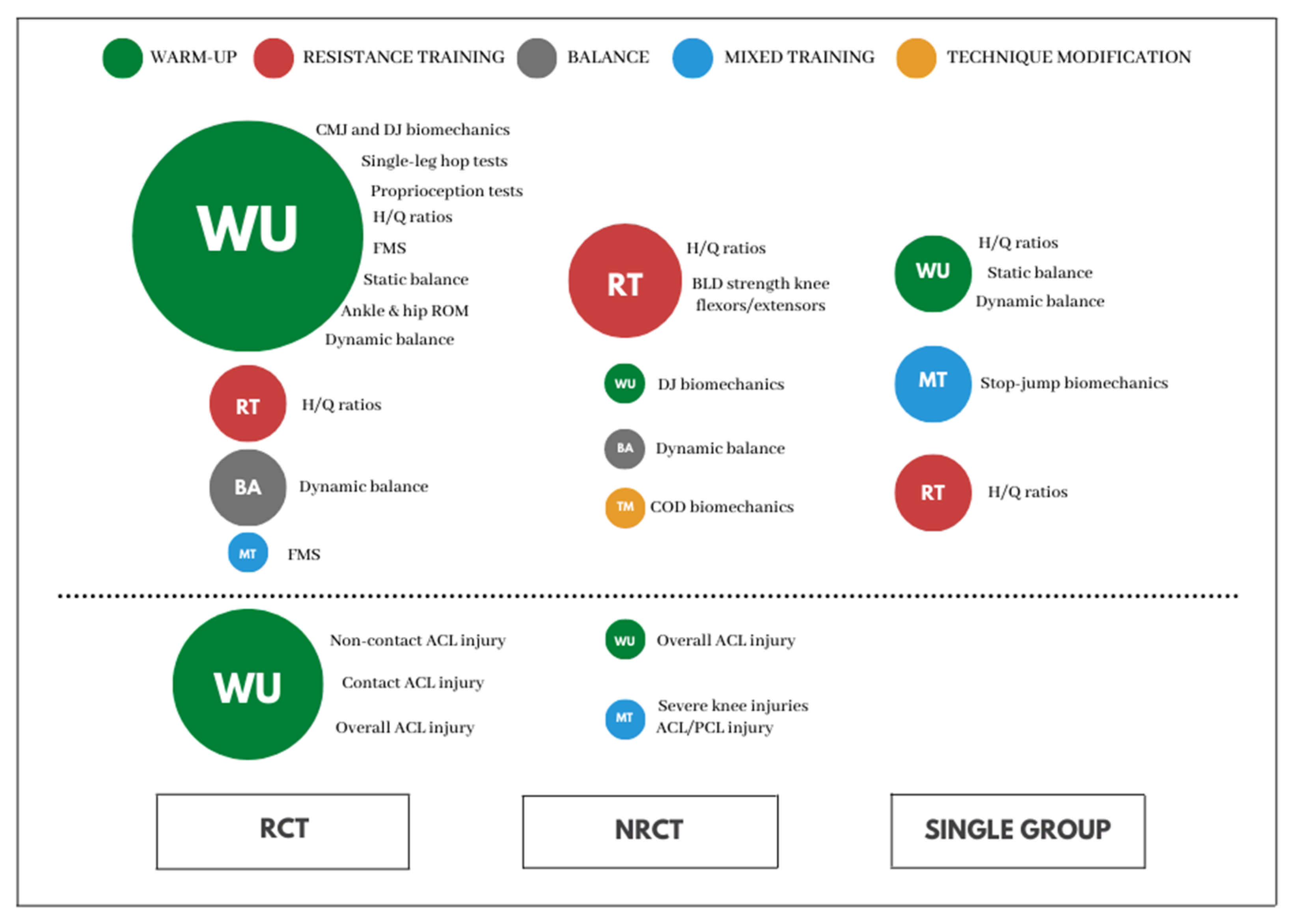

| Definition | Inclusion Criteria | Exclusion Criteria |
|---|---|---|
| Population | Adult (≥16 and ≤40 years old) football players (i.e., Association football) of any level Both male and female Not having suffered a severe injury the previous 2 years | Studies including different cohorts of athletes apart from football players (e.g., basketball, volleyball, handball) in which no sub-analysis by sport was performed |
| Intervention | Exercise or training-based interventions lasted at least 4 weeks, performed twice a week | Interventions performed with exogenous modalities (i.e., bracing, taping, etc.) or those exercise-based interventions lasting less than 4 weeks. |
| Comparator | Control group data if available (although not necessarily) | No exclusion criteria by comparator |
| Outcome | Either contact or non-contact ACL injury incidence or rate of injury Test measurements evaluating any modifiable risk factor (i.e., potentially targeted by exercise-based interventions) previously reported to have an influence in ACL injury [23,26,27,46], such as biomechanical, neuromuscular and/or physical tests (e.g., biomechanics of landing or cutting actions, H/Q ratio, balance measures, ankle or hip range of motion, etc.) | Overall injury incidence not explicitly reporting ACL type injuries Test measurements evaluating non-modifiable risk factors (e.g., anatomical) |
| Study design | Randomised-controlled trials Non-randomised studies Single-arm studies | Systematic reviews, meta-analysis, conference papers, book chapters or studies published in languages other than English. |
| Reference | Participants Level | Intervention | Comparator | Outcomes | Compliance Rate | Reliability/SWC | Results | Comments |
|---|---|---|---|---|---|---|---|---|
| Gilchrist et al. 2008 [53] | 1435 female soccer player (IG = 583, age: 19.88 years; CG = 852, age: 19.88 years) NCAA Division I | IG: PEP Program Duration: 12 weeks Frequency: 3/week Session duration: <30 min Training components: Stretching, strengthening, plyometrics, agilities, and avoidance of high-risk positions depicted on a video. Replacement exercises to alleviate boredom. | CG: Their customary warm-up. | Contact ACL injury, and non-contact ACL injury rate per 1000 AE. | 72% | NA | ↓ ACL injury rate in practice, and non-contact ACL injury rate in those with history of past ACL injury and late in season in IG. ↔ ACL injury rate and non-contact ACL injury rate in IG and CG. | Supervision: Certified athletic trainer. 8 dropouts in IG. Low compliance rate in IG. Lack of control the drills executed and of the uses of the program. |
| Steffen et al. 2008 [80] | 31 adolescent female football players (IG = 17, CG = 14; age: 17.1 ± 0.8 years) Elite sport high school | IG: FIFA 11 Duration: 10 weeks Frequency: 3/week Session duration: ≈15 min Training components: 10 exercises focusing on core stability, neuromuscular control, eccentric hamstrings strength and agility. | CG: Regular warm-up (running and ball exercises) | Conventional H/Q ratio at 60 and 240 °/s and functional H/Q at 60 °/s. Frontal plane knee angles during CMJ and DVJ. | 73% | NR/ NR | ↔ No differences between groups in either H/Q ratios or valgus angle during CMJ and DVJ (p > 0.05) | Supervision: Project coordinator. Unbalanced groups. 2 dropouts in a small sample. Low power to detect differences. |
| Brughelli et al. 2010 [62] | 28 soccer players (IG = 13, age: 20.7 ± 1.6 years; CG = 11, age: 21.5 ± 1.3 years). Professional | IG: Additional eccentric training Duration: 4 weeks Frequency: 3/week Session duration: 10–15 min Training components: 4–5 sets from 1–2 exercises, of 4 different eccentric exercises: Eccentric box drops, lunge pushes, forward deceleration steps, and reverse Nordic hamstrings. | CG: Regular field-based warm-up, but also training the Nordic hamstrings exercise (once a week, total of 2 sets of 6 reps) | H/Q ratio at 60 °/s | 100% | Acknowledges another reliability data/ NR | ↔ Q/H ratio at 60 °/s in both groups (p > 0.05) | Supervisor not specified. Drop of participants in CG (3). Low volume of additional training, and only 4 weeks. |
| Daneshjoo et al. 2010 [63] | 36 male soccer players (IG1 = 12, age: 19.2 ± 0.9; IG2 = 12, age: 17.7 ± 0.4; CG = 12, age: 19.7 ± 1.6) Professional | IG1: FIFA 11+ Duration: 8 weeks Frequency: 3/week Session duration: ≈20–25 min Training components: (1) Running exercises; (2) strength, balance, muscle control and core stability; and (3) advanced running exercises. IG2: HarmoKnee Duration: 8 weeks Frequency: 3/week Session duration: ≈20–25 min Training components: (1) Warm up; (2) muscle activation; (3) balance; (4) strength; and (5) core stability | CG: Regular field-based warm-up | Error of proprioception test at 30, 45 and 60°. Distance excursion in SEBT. Time in the stork stand balance test, with open and close eyes. | NR | NR/ NR | ↔ No significant difference between groups in either proprioception or static balance. ↑ Static balance with eyes opened in the 11+ (ESc = 2.25, p = 0.043) and HarmoKnee (ESc = 0.81, p = 0.011) and closed in the 11+ (ESc = 2.78, p = 0.027; HarmoKnee (ESc = 2.45, p = 0.022) in post- vs. pre-intervention. ↑ SEBT in the 11+ (ESc = 0.82, p = 0.004) and HarmoKnee (ESc = 0.91, p = 0.011) (time x group interaction: F = 3.767, p = 0.034). | Supervisor not specified. |
| Gioftsidou et al. 2012 [68] | 38 male soccer players (age: 22.7 ± 3.5 years) 1st Greek division | IG: Balance training program Duration: 6 weeks Frequency: 3/week Session duration: ≈20 min Training components: Four different soccer-specific (controlling, passing, heading) balance exercises performed on a hemi-cylindrical board and on an hemi-spherical board. | CG: Standard soccer training | Total (SI), anterior-posterior (API) and medial-lateral (MLI) index. Maintenance time for the anterior-posterior (APM) and medial-lateral (MLM) movements. | NR | ICC = 0.67–0.80/ NR | ↓ SI (ESc = 0.67–0.70), API (ESc = 0.65–0.74) and MLI (ESc = 1.36–1.62) in both legs in IG. ↑ APM (ESc = 1.71–3.02) and MLM (ESc = 1.49–1.53) in both legs in IG | Supervisor not specified. No p values. |
| Impellizzeri et al. 2013 [73] | 81 male soccer players (CG = 39, age: 23.3 ± 2.8; IG = 42, age: 23.7 ± 3.7 years) Amateur | IG: FIFA 11+ Duration: 9 weeks Frequency: 3/week Session duration: ≈20 min Training components: (1) Running exercises; (2) core and leg strength, balance and plyometric/agility; and (3) higher-speed running drills with cutting manoeuvres. The key element is promotion of proper technique. | CG: Traditional warm-up | SEBT. Time-to-stabilisation on a single leg during a jump-landing task. Unstable sitting posture test. | NR | SWD = 0,2*SD | ↓ Core stability (8%) in CG. ↔ Core stability (1.5%) in IG. ↔ Time-to-stabilisation (1.5%) in CG. ↓ Time-to-stabilisation (−1.8%) in IG. | Supervisor: Fitness coach. Results rounded to decimals: Problematic to detect differences. |
| Silvers-Granelli et al. 2015 [56] | 1525 male soccer players (IG = 675, age: 20.40 ± 1.66; CG = 850, age: 20.68 ± 1.46 years) NCAA Division I & II | IG: FIFA 11+ Duration: 1 competitive season Frequency: 3/week Session duration: ≈20 min Training components: (1) Running exercises that encompass cutting, COD, decelerating and proper landing techniques; (2) strength, plyometric and balance exercises that focus on core strength, eccentric control and proprioception; (3) running exercises. | CG: Typical soccer warm-up | ACL injury incidence per 1000 AE | Mean utilisation: 30.47 ± 12.16 sessions (considered moderate; total 18 games and 51/52 sessions) | NA | ↓ ACL injury incidence rate (0.362/1000AEs vs. 0.085/1000AEs) in IG vs. CG. ↓ Likelihood of incurring an ACL injury (RR = 0.236 [0.193–0.93]; NNT = 70, p < 0.001) | Supervisor: Certified athletic trainer. Weeks of training not reported. |
| Dello Iacono et al. 2016 [65] | 20 young male football players (IG = 10, age: 18.7 ± 0.67 years; CG = 10, age: 19 ± 0.063 years) Elite team national Israel league | IG: Core stability training Duration: 6 weeks Frequency: 5/week Session duration: ≈20 min Training components: The program consists of two parts: (1) improving balance and core stability, and (2) developing lower limb strength and neuromuscular control. | CG: Regular warm-up | H/Q conventional ratio at both 1.05 and 3.14 rad/s IA from GRF peak in a one-leg CMJ. | NR | 95% limits of agreement: Isokinetic tests = −1.32–1.75 Jump tests = −2.12–1.96 ICC = 0.925–0.978/ NR | ↑ H/Q ratio at 1.05 rad/s (ES = 0.61–0.75), and 3.14 rad/s (ES = 0.71–0.95) in both legs in IG. ↔ H/Q ratio at both velocities in CG. ↓ IA in IG (−71.4%, ES = 2.01). ↑ IA in CG (33.3%, ES = 1.28). | Supervisor: Researcher. Regular warm-up of the CG only consists of jogging, dynamic stretching and mobilisation. |
| Gonzalez-Jurado et al. 2016 [69] | 18 male soccer players (IG = 9, age: 25,89 ± 3.85; IG2 = 10, age: 23.33 ± 3 years) 2nd Spanish division | IG1: Proprioceptive training on stable surface Duration: 5 weeks (5 phases of one week each) Frequency: 5/week (first 4 phases) and 3/week (last phase) Session duration: ≈5 min (estimated) Training components: Monopodal proprioceptive training exercises on a stable surface, adapted to football, and executed using a 4-station circuit. | IG2: Proprioceptive training on unstable surface Duration: 5 weeks (5 phases of one week each) Frequency: 5/week (first 4 phases) and 3/week (last phase) Session duration: ≈5 min (estimated) Training components: Monopodal proprioceptive training exercises on different unstable surfaces (soft mat, Freeman Dish, Fit-sit Platform and Dyn-air), adapted to football, and executed using a 4-station circuit. | Star Excursion Balance Test (maximum distance reached in 8 directions) | NR | NR/ NR | ↑ Front left, Ant-Lat left, Lat right, Back right, and Ant-Med right (ES = 0.13–0.55) in IG1 and Front right and left, Ant-Lat left, Lat left, Post-Lat right, Post right and left, Post-Med right and left, Med right, and AntMed left (ES = 0.06–0.43) in IG2 ↑ AntMed right in IG vs. IG2 (intergroup analysis) | Supervisor not specified. Low sample size in each group. Daily training too short (5 min?). |
| Silvers-Granelli et al. 2017 [57] | 1525 male soccer players (IG = 675, age: 20.40 ± 1.66; CG = 850, age: 20.68 ± 1.46 years) NCAA Division I & II | IG: FIFA 11+ Duration: 1 competitive season Frequency: 3/week Session duration: ≈20 min Training components: (1) Running exercises that encompass cutting, COD, decelerating and proper landing techniques; (2) strength, plyometric and balance exercises that focus on core strength, eccentric control and proprioception; (3) running exercises. | CG: Typical soccer warm-up | ACL injury incidence per 1000 AE | NR | NA | ↓ ACL injury incidence rate (RR = 0.24 [0.07–0.81], p = 0.021) and non-contact ACL injury incidence rate (RR = 0.25 [0.06–1.15], p = 0.049) in IG vs. CG. ↔ Contact ACL injury incidence rate (RR = 0.21 [0.03–1.74], p = 0.148) in IG vs. CG. | Supervisor: Certified athletic trainer. Low number of ACL injuries. High amount of lost follow ups in the IG (100 players). Per protocol analysis. |
| Ayala et al. 2017 [60] | 41 male youth football players (age: 16.8 ± 0.7 years) Amateur | IG1: FIFA 11+ Duration: 4 weeks Frequency: 3/week Session duration: ≈20–25 min Training components: (1) Running exercises; (2) strength, balance, muscle control and core stability; and (3) advanced running exercises. IG2: HarmoKnee Duration: 4 weeks Frequency: 3/week Session duration: ≈20–25 min Training components: (1) Warm up; (2) muscle activation; (3) balance; (4) strength; and (5) core stability | CG: Regular field-based warm-up | Y-Balance test. Ankle and hip ROM. Single hop for distance (asymmetry). Triple hop for distance (asymmetry). | NR | Acknowledges another reliability data/ NR | ↑ Triple hop LSI score (very likely substantial difference [98%]), anterior distance (likely substantial difference [89%]), and posteriomedial distance (possibly substantial difference [60%]) in FIFA 11+ vs. CG ↔ No main effects in ankle ROM, LSI during single hop, posterolateral and composite score in FIFA 11 vs. CG and in all variables (possibly/likely trivial) in HarmoKnee vs. CG). | Supervisor: Trained rehabilitation specialist. Low sample of each group. |
| Delextrat et al. 2018 [64] | 21 female soccer players (IG1 = 10, age: 21.8 ± 4.0; IG2 = 11, age: 23.7 ± 7.2) Amateur. | IG1: Strength endurance Duration: 7 weeks Frequency: 3/week Session duration: 10–15 min Training components: 6 sets of 12–20 rep progressing by decreasing the inter-set rest period (90 to 45s) of two hamstring strength exercises: (1) seated hamstrings curl, and (2) stiff-legged deadlifts. | IG2: Strength Duration: 7 weeks Frequency: 3/week Session duration: 20–25 min Training components: 6–10 sets of 6RM progressing by increasing load (80 to 100% of 6RM), with 3-min inter-set rest, of two hamstring strength exercises: (1) seated hamstrings curl, and (2) stiff-legged deadlifts. | H/Q functional ratio before and after BEAST90 test | NR | Acknowledges another reliability data/ NR | ↔ Functional H/Q ratio before and after BEAST90 post-intervention only in IG1 in dominant leg (p = 0.045, n: 0.38) (intervention x match interaction) ↑ Functional H/Q ratio before BEAST90 post-intervention in both IG2 (+14.6%, d = 0.73, p = 0.01) and IG1 in dominant leg (+4.9%, d = 0.25, p = 0.039) | Supervisor: Experienced S&C coach. IG1 did not change the decline before/after BEAST90, but probably because the increase in the H/Q post- was higher than in IG2. |
| Rey et al. 2018 [78] | 23 male soccer players (age: 24.7 ± 3.8 years) Amateur | IG: FIFA 11+ Duration: 6 weeks Frequency: 3/week Session duration: ≈25 min Training components: Fifa 11+ consisting on 3 parts: (1) 6 running exercises at low speed; (2) 6 exercises targeting strength, balance, neuromuscular control and core stability with 3 levels of increasing difficulty; (3) running exercises at moderate/high speed. | CG: Standard warm up with jogging, ball exercises and active stretching. | FMS score, divided into FMSmove, FMSflex and FMSstab. | NR | Inter-rater: ICC = 0.899 Intra-rater: ICC = 0.991/ NR | ↔ No between groups differences. | Supervisor: Fitness trainer. No p values shown. |
| Riela et al. 2019 [81] | 30 male soccer players (IG = 15, age: 23.80 ± 4.6; CG = 15, age: 24.78 ± 2.08 years) Italian 2nd division | IG: Movement-based program Duration: 8 weeks Frequency: 3/week Session duration: ≈30 min Training components: 15 min of exercises aimed at improving mobility and flexibility and 15 min of stability and posture, and strength with the use of elastic bands, medicine balls and foam rollers. | CG: Standard technical-tactical routing of warm up. | FMS score, divided into advances movement, mobility and stability | NR | NR/ NR | ↑ Advanced movement (F(1,28) = 14.43, p = 0.03) and mobility (F(1,28) = 3.89, p = 0.50) in IG. | Supervisor: Specialised trainer. No p values. No counterbalanced the intervention with the two groups. |
| Whalan et al. 2019 [58] | 806 male soccer players (IG1 = 398, age: 24,8; IG = 408, age: 23.8 years) Sub-elite | IG1: Rescheduled FIFA 11+ Duration: 1 season (28–34 weeks) Frequency: 2/week (+ Parts 1 and 3 before matches) Session duration: ≈20–25 min Training components: 2 parts of the Fifa 11+ performed at the start of the warm-up (parts 1 and 3), and one part performed at the end of training during the cool down period (part 2). In Part 2, players remained at level 1 for a minimum of 2 weeks, and progressed to level 3 after a minimum of 6 weeks | IG2: FIFA 11+ Duration: 1 season (28–34 weeks) Frequency: 2/week (+ Parts 1 and 3 before matches) Session duration: ≈20–25 min Training components: 3 parts of the Fifa 11+ performed at the start of the warm-up. In Part 2, players remained at level 1 for a minimum of 2 weeks, and progressed to level 3 after a minimum of 6 weeks. | Non-contact ACL injury incidence per 1000 h of AE. | IG1 = 18.9 (doses), 32.7% (doses/sessions) IG2 = 29.1 (doses), 57.7% (doses/sessions) | NA | ↔ Non-contact ACL injury incidence (p = 0.238) in IG2 (IR/1000h = 0.06 [0.01–0.2]) compared to IG1 (IR/1000h = 0.15 [0.01–0.4]) | Supervisor not specified. Weeks of season not specified. |
| Reference | Participants Level | Intervention | Comparison | Outcomes | Compliance Rate | Reliability /SWC | Results | Comments |
|---|---|---|---|---|---|---|---|---|
| Malliou et al. 2004 [75] | 100 young soccer players (IG = 50, age: 16.7 ± 0.5; CG = 50, age: 16.9 ± 0.7 years) First Greek division | IG: Proprioception training program Duration: 12 weeks (competition period) Frequency: 2/week Session duration: ≈20 min Training components: Balance exercises (in order to maintain balance while they were performing soccer agilities, such as headers) performed on Biodex Stability System device, mini trampoline and balance boards. | CG: Same training than IG but without any special-extra balance training | Total stability, anterior-posterior and medial-lateral index in a balance test | NR | NR | ↓ Total index (ESc = 1.13, p < 0.001), A-P Index (ESc = 1.20, p < 0.001), and M-L Index (ESc = 0.69, p < 0.05) in IG | Supervisor not specified. |
| Gioftsidou et al. 2008 [67] | 68 male soccer players (age: 24.1 ± 5.7 years) Professional | IG: Isokinetic training program Duration: 8 weeks Frequency: 3/week Session duration: ≈60 min Training components: 10 sets in a velocity spectrum exercise (5 sets with both flexor and extensor muscle groups + 5 sets with only the weak muscle group based on the initial measurement) | CG: NR | Concentric H/Q ratio at 60 and 180 °/s. Differences between limbs in peak torque for flexors and extensors. | NR | NR NR | ↑ H/Q ratio at 60 °/s and 180 °/s at both legs (ESc = 0.51–0.87) in IG. ↓ Difference between limbs in peak torque in knee extensors and knee flexors at 60 and 180 °/s (ESc = 1.18–1.75) | Supervisor not specified. Lack of information regarding CG, and weak in the IG. Disparity between groups (IG = 41, CG = 27 players). p values and results in CG not specified. |
| Grooms et al. 2013 [54] | 41 male soccer players (CG = 30, age: 20.3 ± 1.6; IG = 34, 20.0 ± 2.4 years) NCAA Division III | IG: F-MARC 11+ Duration: ≈12 weeks Frequency: 5–6/week Session duration: ≈20 min Training components: (1) running exercises with dynamic stretching and controlled perturbations; (2) strength, balance, and jump-landing control with progression; and (3) higher-speed running drills with cutting manoeuvres. | CG: Standardised warm-up (1st season) | Relative risk (per 1000 athlete-exposures) of ACL injuries | NR | NA | ↔ No ACL injury occurred during either season. | Supervisor: Athletic trainer. Low sample to analyse risk ratio of ACL injuries. 7 dropouts in CG |
| Sliwowski et al. 2015 [79] | 24 junior male soccer players (IG = 14, age: 17.0 ± 0.78; CG = 10, age: 17.1 ± 0.71 years) Polish U17 championship | IG: RT program specific to imbalance Duration: 6 weeks Frequency: 2/week Session duration: ≈90 min Training components: Two parts: (1) a set of 5 reps at 80% of 1RM of 12 upper and lower body exercises, 3–5 min of rest between sets, and (2) 2–3 additional series of 5–7 reps at 80% of 1RM. Depending on the imbalance, the additional exercises were performed for the muscle groups of a given extremity. | CG: Only performed the first part of the RT program | Conventional H/Q ratio for D and ND (54.9% considered deficient) at 60 °/s. Bilateral ratio between knee extensors and flexors at 60 °/s. | NR | NR/ NR | ↑ H/Q ratio in D leg (Esc = 0.43, p < 0.05) in IG. ↔ No changes in the bilateral differences in any group. | Supervisor: Qualified strength training instructor. Disbalance between groups. Higher H/Q ratio in CG than in IG at baseline. |
| Ibis et al. 2018 [72] | 42 male soccer players (CG = 14, age: 22 ± 1.35; IG1 = 14, age: 23.21 ± 2.29; IG2 = 14, age: 23 ± 1.51 years) Amateur | IG1: Strength training group Duration: 8 weeks Frequency: 3/week Session duration: ≈60 min (estimated) Training components: 4 series of additional strength training at increasing load (80–95% of 1RM) of 7 lower extremity strength exercises in a pyramidal method. IG2: Individual-specific strength training group Duration: 8 weeks Frequency: 3 weeks Session duration: ≈75 min (estimated) Training components: Same training than IG1 but with 4 additional series of 2 extra exercises depending on the participant deficiencies (those with H/Q rate low or bilateral flexor deficiency performed two extra knee flexor exercises, and those with bilateral extensor deficit performed two extra knee extensor exercises). | CG: Regular training | Conventional H/Q ratio and bilateral differences (BLD) for hamstrings and quadriceps at 60, 180 and 300°/s | NR | NR/ NR | ↓ H/Q ratio at 300 °/s in ND (ESc = 0.58, p = 0.026) in CG. ↑ H/Q ratio at 60 °/s in D (ESc = 0.43) in IG1 and in D and ND, 180 °/s in D and ND, 300 °/s in D and ND (ESc = 0.58–1.68) in IG2. | Supervisor not specified. Low sample. 2 training/week CG vs. 5 training/week IG1 and IG2, and also IG2 > IG1 regarding workload. |
| Arundale et al. 2018 [59] | 68 women soccer players (IG = 48, CG = 20 in one testing point; IG = 22, CG = 15 all time points). NCAA Division I and II | IG: FIFA 11+ Duration: 1 competitive season Frequency: 3/week Session duration: ≈20 min Training components: (1) Running exercises that encompass cutting, COD, decelerating and proper landing techniques; (2) strength, plyometric and balance exercises that focus on core strength, eccentric control and proprioception; (3) running exercises. | CG: Standard warm-up | Peak hip flexion, adduction and internal rotation angles and moments, and peak knee flexion and abduction angles and moments in a DVJ from 40 cm. | NR | ICC = 0.63–0.92/ SDC and MID directly measured from the pre-season data. | 1st season: ↔ No differences between groups in postseason peak knee abduction when controlling for baseline differences. No significant time x group interactions for valgus collapse value for either limb. Both groups increased peak knee abduction angle and peak hip abduction an external rotation on the ND (IG) and on the D (CG), but no time x group interaction. ↓ Clinically meaningful decrease (>MID) in peak knee flexion angle in CG for D leg (F(1,35) = 7.64, p = 0.05, np2 = 0.18) 2nd season: ↑ ND hip abduction angle (>SDC), ND hip external rotation angle (>SDC), D knee abduction angle (>MID) in 1st season vs. 2nd season, and ND peak hip flexion angle (>SDC) in 2nd season vs. 1st season (time x season). ↓ ND hip flexion angle (>SDC) in 1st vs. 2nd season (time x season). ↔ No significant time x season interaction in valgus collapse in either leg. | Supervisor: Athletic trainer. |
| Dos’Santos et al. 2019 [66] | 26 male soccer players (IG = 13, age: 16.9 ± 0.2; CG = 13, age: 17.8 ± 0.3) Professional club (U17) | IG: COD speed and technique modification Duration: 6 weeks Frequency: 2/week Session duration: 20 min Training components: COD velocity and technique modification | CG: Regular field-based warm-up | CMAS score in a 90° COD with both limbs | IG = 88.5% CG = 90% | ICC = 0.774–0.934 SEM = 0.49–0.69 CV = 11.4–22.2/ SDD = 1.36–1.84 | ↓ CMAS in right (p = 0.025, g = −0.85, −22.5%), and left (p = 0.018, g = −1.46, −33.9%) legs in IG. ↔ No change in CG. | Supervisor: Certified S&C specialist. Some dropouts of participants in the IG (n = 5). |
| Krutsch et al. 2020 [55] | 1527 male football players (IG = 529, age: 22.7 ± 4.3, CG = 601, age: 21.9 ± 4.1 years) Elite | IG: Newly implemented football-specific training modules Duration: one season Frequency: At least 2/week Session duration: ≈12 min Training components: One main exercise and several alternative with specific variations in movements and techniques (established by the researchers; decided by the coach) of 5 modules: mobilisation, core stability, leg axis stability, jumping, and landing exercises and agility. | CG: Their usual training program | Severe knee and ACL/PCL injury incidence per 1000 AE | NR | NA | ↓ Severe knee injury incidence (0.38 vs. 0.69/1000h, p < 0.05) in IG compared to CG. ↔ ACL/PCL injury incidence (0.11 vs. 0.18/1000h, p > 0.05) in IG compared to CG | Supervisor: Coach. High number of dropouts, but do not specify how many of each group. Weeks of intervention not specified. |
| Reference | Participants Level | Intervention | Outcomes | Compliance Rate | Reliability /SWC | Results | Comments |
|---|---|---|---|---|---|---|---|
| Holcomb et al. 2007 [71] | 12 female soccer players (age: 20 ± 0.8 years) NCAA 1st division | IG: Hamstring-emphasised RT Duration: 6 weeks Frequency: 2/week Session duration: Unable to determine Training components: Two of different exercises (single leg curls, straight leg dead lifts, good morning exercises, trunk hyperextensions, resisted sled walking and exercise ball leg curls) in addition to speed, agility and endurance training. | Functional and conventional H/Q ratio at 240, 180 and 60 °/s | NR | NR NR | ↑ Functional H/Q (ESc = 1.13, p = 0.049). ↔ Conventional H/Q (ESc = 1.26, p = 0.172) | Supervisor not specified. Low sample. Results not stratified by velocities. Poor description of the intervention. |
| Brito et al. 2010 [61] | 20 male soccer players (age: 22.3 ± 4,2 years) Sub-elite | IG: FIFA 11+ Duration: 10 weeks Frequency: 3/week Session duration: 20 min Training components: (1) Running, stretching and controlled contacts; (2) strengthening, plyometrics and balance; and (3) speed running and soccer-specific movements. | H/Qcon 60° and 180°, H/Qecc30° and Hecc30 °/Qcon180°(DCR) ratios in isokinetic tests in both limbs | 73% | Acknowledges another reliability data/ NR | ↑ H/Qcon60° (ESc = 0.11) and Hecc30°/Qcon180° (ESc = 0.39) in non-dominant limb (p < 0.05). | Supervisor not specified. 2 dropouts. |
| McCann et al. 2011 [76] | 10 healthy female soccer players (age: 19.1 ± 0.9 years) | IG: Resistance and conditioning training Duration: 10 weeks (11 weeks for retention) Frequency: 4/week Session duration: ≈60 min Training components: Strength, endurance or RT twice a week (depending on the athletes’ weaknesses) and conditioning training (speed, quickness, plyometric and agility drills) twice a week. | Knee abduction and hip abduction angles, and knee flexion moment in a running stop jump. | NR | NR/ NR | ↑ Hip abduction angle and knee flexion moment from pre- to post-intervention. ↓ Knee abduction angle from pre- to post-intervention and retention (Z = −2.29), and hip abduction angle and knee flexion moment from post-intervention to retention. | Supervisor: CSCS specialist. No descriptive data. Low cohort (n = 10). No information about training during retention. |
| Greska et al. 2012 [70] | 12 female soccer players (age: 19.2 ± 0.8 years) NCAA 1st division | IG1: Strength focused RT Duration: 10 weeks Frequency: 4/week Session duration: ≈60 min Training components: 2 days of low volume of RT exercises with a self-selected rest interval and with augmented feedback (verbal and visual) in relation to the movement patterns and body positioning. 2 days of field conditioning focusing on speed, quickness, plyometric and agility drills. IG2: Endurance focused RT Duration: 10 weeks Frequency: 4/week Session duration: ≈60 min Training components: 2 days of high volume of RT exercises with a 30-s rest interval between each exercise and with augmented feedback (verbal and visual) in relation to the movement patterns and body positioning. 2 days of field conditioning focusing on speed, quickness, plyometric and agility drills. IG3: Maintenance focused RT Duration: 10 weeks Frequency: 4/week Session duration: ≈60 min Training components: 2 days of hybrid scheme between IG1 and IG2, performing strength-focused 1 day and endurance-focused the other day. 2 days of field conditioning focusing on speed, quickness, plyometric and agility drills. | Kinetic and kinematic variables during a stop-jump task | 95% | NR/ NR | ↓ Knee abduction angle at IC (d = 0.76, p = 0.007) ↑ Hip abduction angle at IC (d = 0.63, p = 0.007) and peak knee flexion (d = 0.99, p = 0.002) and maximum knee extension moment (ESc = 0.59, p = 0.022) at peak stance. | Supervisor: CSCS specialist. All participants measured together (not by group). Low sample. Inadequate and unbalanced group sizes. Differences in BW at baseline. Too much time required. |
| Lehnert et al. 2017 [74] | 18 male soccer players (age: 17.1 ± 0.4 years) Czech 1st division | IG: Pre-season training with the inclusion of progressive eccentric hamstring exercises Duration: 10 weeks Frequency: from 1/week (from 1st to 4th) to 3/week (from 5th to 10th) Session duration: ≈5–15 min Training components: Strength training with a special focus on eccentric hamstring exercises such as the Nordic curl (from 1 set of 5 reps at the beginning of the program, to 3 sets of 8–12 repetitions by the 5th week) | Conventional and functional H/Q ratio at 60 °/s. | NR | NR/ NR | ↑ Functional H/Q in ND (ESc = 0.62, p < 0.05). ↔ Conventional H/Q in D and ND (p > 0.05) | Supervisor not specified. |
| Oshima et al. 2018 [77] | 8 male soccer players (age: 20.4 ± 0.5 years) Collegiate | IG: FIFA 11+ (part 2) Duration: 24 weeks (6 months) Frequency: ≥3/week Session duration: ≈10 min Training components: Three levels of difficulty of six exercises aiming to increase muscular strength (core and lower limbs), balance, muscle control (plyometrics), and core stability. | Postural sway for 60s: Length per time (LG) and environmental area (AR) (two-leg stance with eyes opened and then with eyes closed and single leg standing with eyes opened). Star excursion balance test (SEBT - 8 directions). H/Q ratio | NR | NR/ NR | ↑ Anterior-lateral with D and medial, posterior-medial, and posterior with ND (ESc = 0.38–0.71) in SEBT. ↔ H/Q ratio in D (ESc = 0.20, p > 0.05) and ND (ESc = 0.44, p > 0.05) | Supervisor not specified. No p values reported. Low sample (n = 8) |
| Injury Incidence | Risk Factors of ACL Injury |
|---|---|
|
|
| Recommendation | Rationale |
|---|---|
| Developing preventative frameworks focusing on movement quality in risky movements | Of the 29 studies included, only four evaluated the effect of any exercise-based intervention on movement quality during potentially risky movements associated with the common ACL injury mechanism in football [59,66,70,76], while only one study has been carried out with a cost-effective tool which could be easily implemented in the football context [66]. Even though the effect of several interventions on movement quality has been performed with different team sports including football players [37], the specific nature of some exercise-based adaptations and the uniquely context in which football occur [119] could justify the need of developing more football-specific preventative programs. Furthermore, only one NRCT study incorporated TM as a strategy to mitigate risk factors of ACL injury [66] despite it is widely known the contribution of biomechanical determinants in increasing ACL loads [120], and knowing its promising results in other sports [121] and in young female players [122]. On the other hand, given the influence that neurocognition may have in ACL injuries [123], open skills tasks that evaluate athletes under football-specific neurocognitive demands (e.g., unanticipated COD) should be included in screening tests assessing effectiveness of intervention programs [123]. |
| Improving quality of the interventions | None of the included studies had pre-registered the study protocol before to its execution, by which it may be speculated that this is not common trend in Sports Sciences. Since this pre-registration would allow to compare evaluation and data analysis finally carried out with those initially intended, it would be easier to detect risk of bias, especially that related to bias in the se-lection of reported outcomes [49]. Although problems arise from the inability of blinding athletes and care providers are sometimes unavoidable in the context of interventions carried out in football teams, others such us bias due to confounding variables in NRCT or bias due to deviations from intended interventions and unequal training volumes in RCT can be prevented with appropriate analysis performed (i.e., pre-registration and overall transparency with the research process) [50]. Randomization and concealment of allocation sequence processes should be improved and explicitly reported. By doing this, the number of low risks of bias studies (only one in the present review) would be higher and, therefore, findings more reliable [49]. Additionally, by increasing samples and/or the follow-up times, greater statistical power would be reached in the associations, especially those with ACL injury incidence [21]. |
| Appropriate reporting of important features of the program: reliability of outcomes, SWC, compliance and supervisor | It is also suggested that reliability and SWC data are directly measured so that practical relevance of the results obtained because of an exercise-based intervention could be determined [90], and to ensure that training induced changes exceed the measurement error to increase the certainty improvements are “real”. This is extremely pertinent when researchers do not have the opportunity to utilize a CG and therefore adopt a single-arm design. In the present review, only 5/24 and 3/24 of the studies evaluating risk of injury variables have reported directly measured reliability and SWC data, respectively. Of note, it is suggested that supervisor of the interventions is specified, as it is known the potential positive influence of the quality of the feedback provided (i.e., through verbal, auditory and visual cues) [124,125,126] in the reinforcement of proper technique during anterior cruciate ligament injury prevention exercises [127]. 17/29 included studies reported who were the intervention supervisors. Additionally, despite the positive relationship that has been shown between compliance and effectiveness of exercise-based interventions targeting injury reduction [57,58], only 8/29 studies reported compliance rates. Indeed, compliance to the intervention has been shown to be a critical component of prevention programmes, as it highly determines its effectiveness [87]. Therefore, going forward, before concluding a training modality as potentially ineffective, it is central to consider the training compliance which, unfortunately, 72% of studies in this review failed to report. Thus, it is suggested to incorporating such data in future research to confirm the efficacy of injury mitigation training interventions. |
Publisher’s Note: MDPI stays neutral with regard to jurisdictional claims in published maps and institutional affiliations. |
© 2021 by the authors. Licensee MDPI, Basel, Switzerland. This article is an open access article distributed under the terms and conditions of the Creative Commons Attribution (CC BY) license (https://creativecommons.org/licenses/by/4.0/).
Share and Cite
Olivares-Jabalera, J.; Fílter-Ruger, A.; Dos’Santos, T.; Afonso, J.; Della Villa, F.; Morente-Sánchez, J.; Soto-Hermoso, V.M.; Requena, B. Exercise-Based Training Strategies to Reduce the Incidence or Mitigate the Risk Factors of Anterior Cruciate Ligament Injury in Adult Football (Soccer) Players: A Systematic Review. Int. J. Environ. Res. Public Health 2021, 18, 13351. https://doi.org/10.3390/ijerph182413351
Olivares-Jabalera J, Fílter-Ruger A, Dos’Santos T, Afonso J, Della Villa F, Morente-Sánchez J, Soto-Hermoso VM, Requena B. Exercise-Based Training Strategies to Reduce the Incidence or Mitigate the Risk Factors of Anterior Cruciate Ligament Injury in Adult Football (Soccer) Players: A Systematic Review. International Journal of Environmental Research and Public Health. 2021; 18(24):13351. https://doi.org/10.3390/ijerph182413351
Chicago/Turabian StyleOlivares-Jabalera, Jesús, Alberto Fílter-Ruger, Thomas Dos’Santos, Jose Afonso, Francesco Della Villa, Jaime Morente-Sánchez, Víctor Manuel Soto-Hermoso, and Bernardo Requena. 2021. "Exercise-Based Training Strategies to Reduce the Incidence or Mitigate the Risk Factors of Anterior Cruciate Ligament Injury in Adult Football (Soccer) Players: A Systematic Review" International Journal of Environmental Research and Public Health 18, no. 24: 13351. https://doi.org/10.3390/ijerph182413351
APA StyleOlivares-Jabalera, J., Fílter-Ruger, A., Dos’Santos, T., Afonso, J., Della Villa, F., Morente-Sánchez, J., Soto-Hermoso, V. M., & Requena, B. (2021). Exercise-Based Training Strategies to Reduce the Incidence or Mitigate the Risk Factors of Anterior Cruciate Ligament Injury in Adult Football (Soccer) Players: A Systematic Review. International Journal of Environmental Research and Public Health, 18(24), 13351. https://doi.org/10.3390/ijerph182413351

